































































Blog Archives

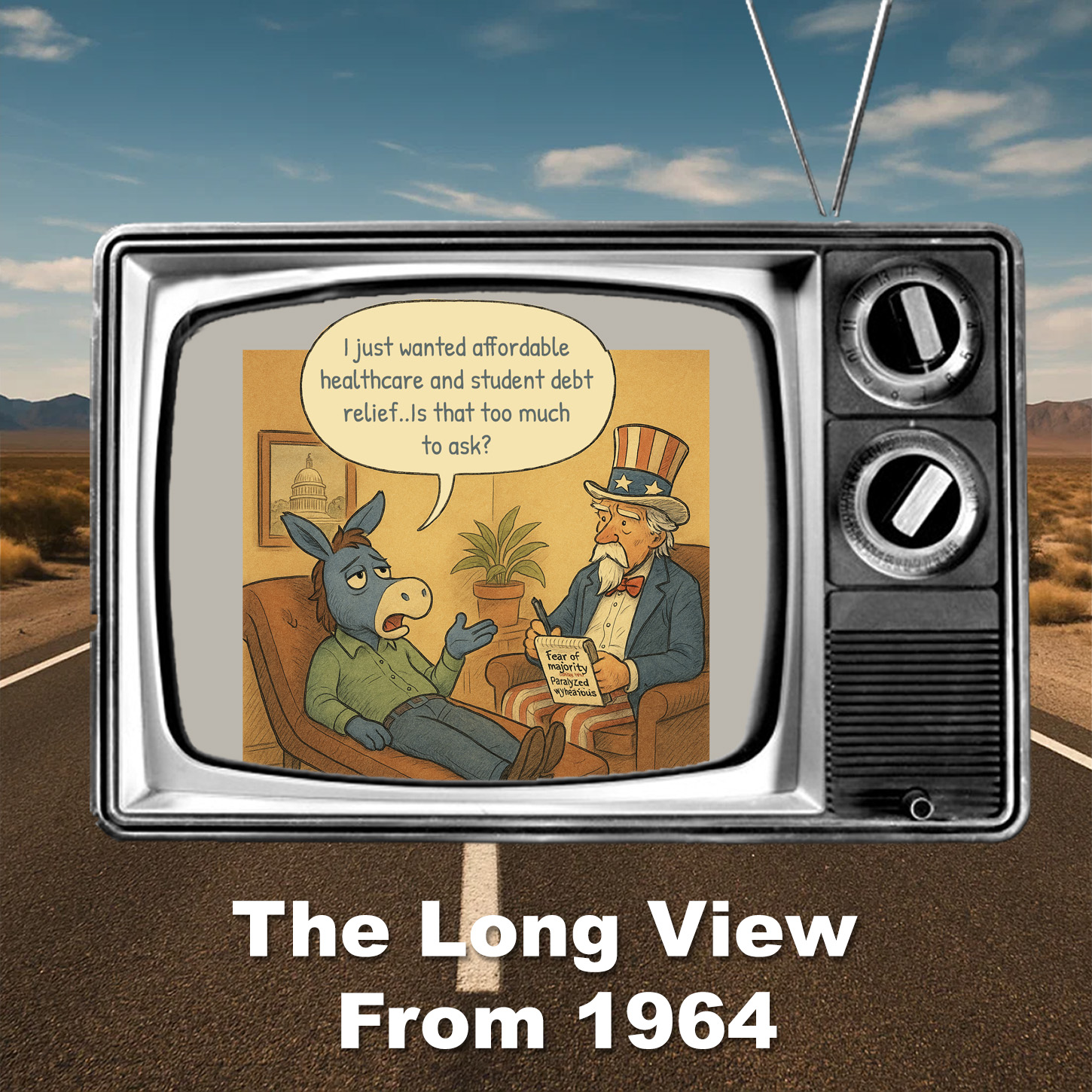
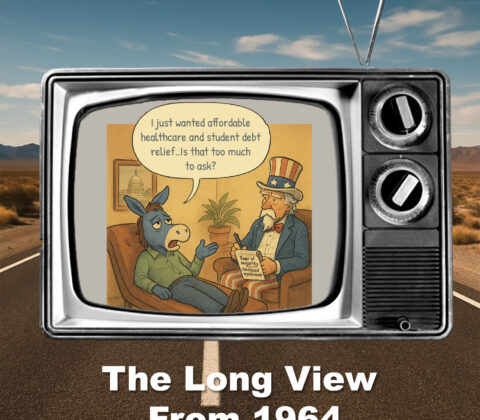
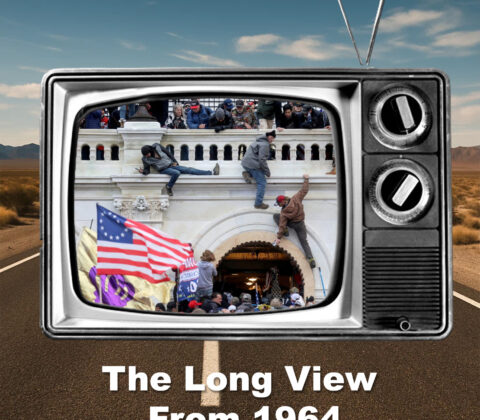
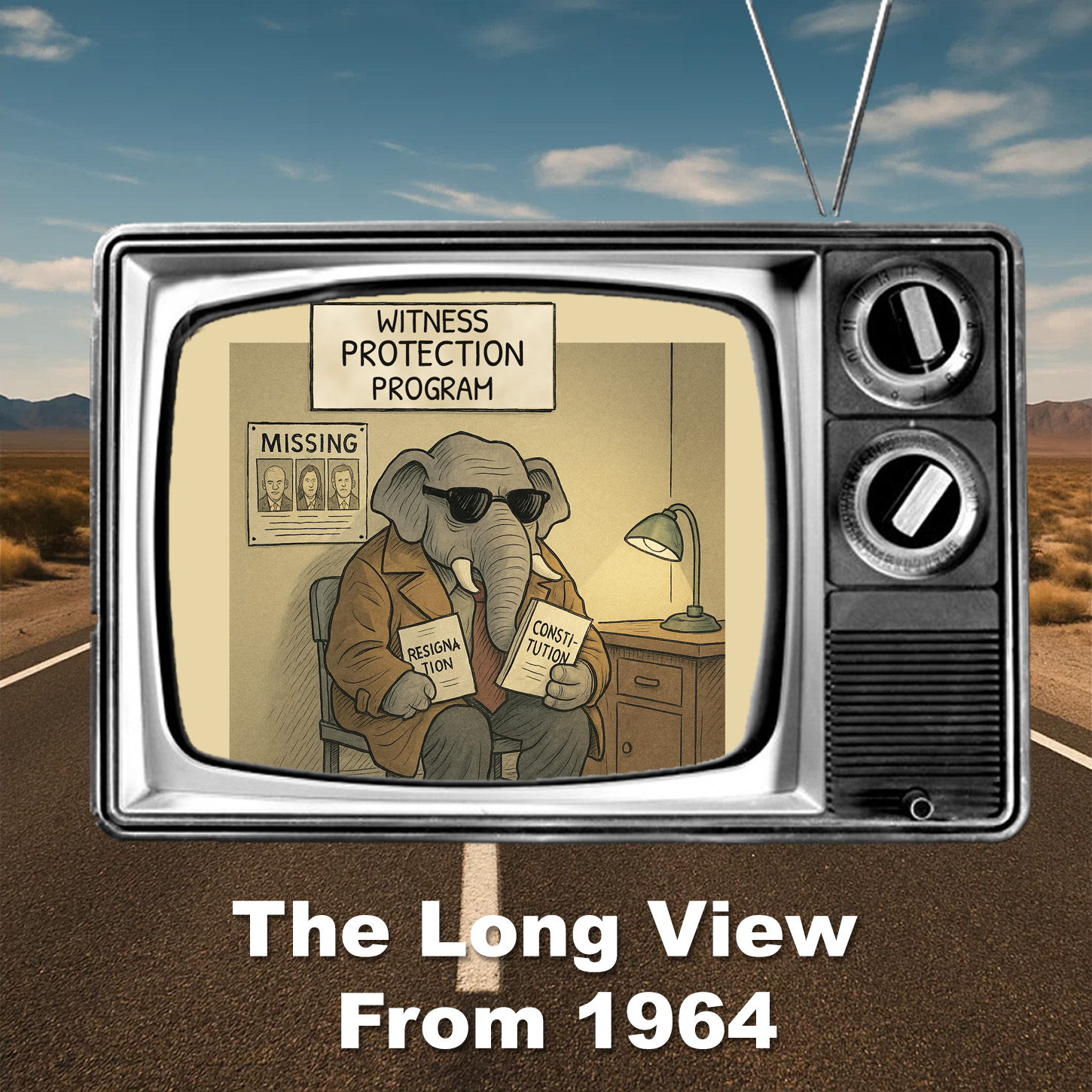
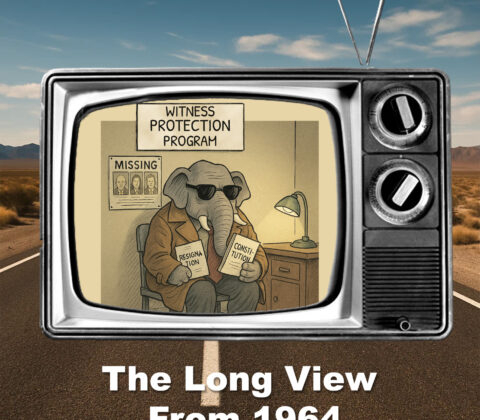
The Long View From 1964 – Maybe Just Listen – Video

So often we sit there and tune him out.

Not another war story. I have heard it before. I know, I know. Dad, Reagan isn’t President anymore and I don’t know who he is anyway except some cowboy on TV.

Do Not Get Into Political Arguments. It’s Not Worth It

Wargames s
Michael and Sarah Walker
Do Not Get Into Political Arguments. It's Not Worth It
Loading
/

What I am is a moderate. A person who believes in making decisions carefully, in recognizing complexity, in not burning the house down because you’re angry at the neighbors. A person who wants others to make their own informed choices rather than be handed a script.

In the film WarGames, the computer WOPR — also known as Joshua — was asked to play tic-tac-toe after nearly launching a nuclear war. Running through every possible scenario it reached the only honest conclusion available.

WINNER: NONE.

The Long View From 1964 2 of 6 – Maybe Just Listen

Maybe just listen podcast
Michael and Sarah Walker
The Long View From 1964 2 of 6 - Maybe Just Listen
Loading
/

The grandchildren watch Saving Private Ryan. But they forget that Great Grandpa was the one bleeding in Europe and the Philippines. They just see old people without opinions worth hearing.

Maybe we rant because nobody will listen.

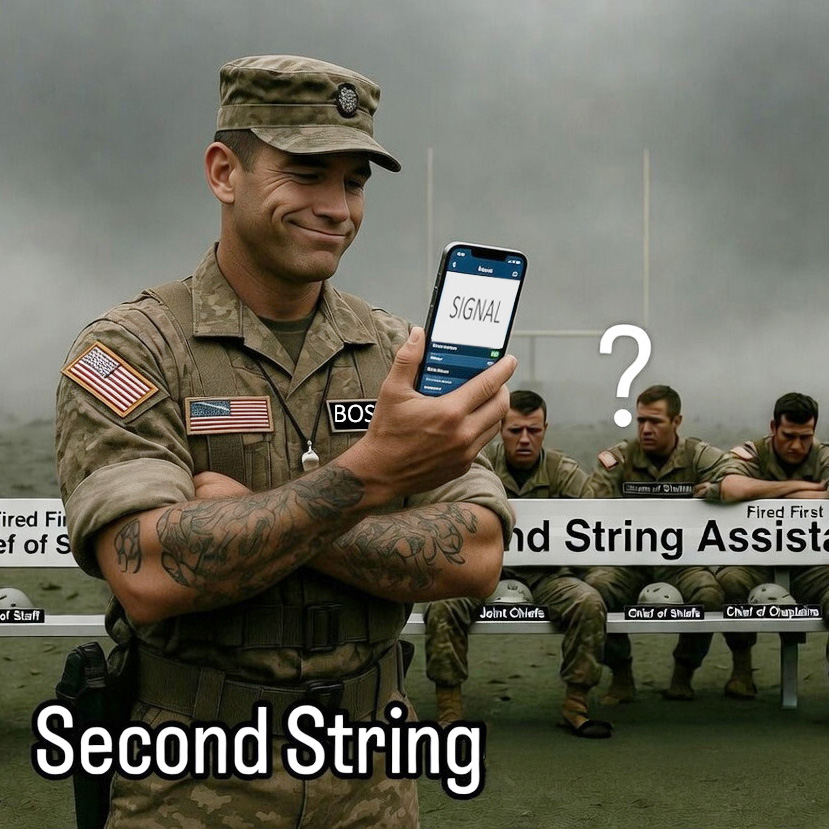
A War Being Run By the Second String – Video

The Ash Didn’t Disappear – Video

I was seven years old, an American officer’s son, when I walked through Dachau.

I remember the ovens. I remember the showers. I remember the stains still on the walls. I remember the ash piles,  this was 1954, nine years after liberation, and the ash still hadn’t disappeared. It had not yet soaked completely into the dirt.

Image (18)

Sheep Don’t Storm Castles – Video

That is insider trading. Admitted. Documented. Timestamped.

In any previous era — any previous administration — that sequence alone would have produced congressional hearings, an SEC investigation, and a constitutional crisis. Instead it produced a news cycle and then another news cycle about something else.

The Long View From 1964 – Superman – Video

I grew up watching a small black and white television in the living room. Not the family room, because we didn’t have family rooms in 1,300 square foot ranches in 1955. My older brother and I would watch the Mickey Mouse Club, heart throbbing as Annette would grace the screen — all 1.5 inches of grainy image. That was high tech back then.

The Long View From 1964 1 of 6 – Superman

Superman podcast
Michael and Sarah Walker
The Long View From 1964 1 of 6 - Superman
Loading
/

When you’re ten years old watching the Mickey Mouse Club, Superman, Zorro, Father Knows Best and the rest, the American Way seems perfectly clear. We were strong. We were proud. We had clear cut enemies. At school we were told to stand and recite the Pledge of Allegiance with pride, and when the air raid sirens went off we got under our desks — as if that would actually do any good. But it made us feel safe.

We had presidents who built America. Eisenhower chose highways over rail because he saw how disabling rail lines stopped troop movements. He should have prioritized both. JFK, with all his faults, still told us that our strength was to stand together and build a great nation. Not a monument.

Sometime after that I took a break. I married, I divorced, I had children — not necessarily in that order. I raised families. I now have grandchildren. I learned how to build businesses and was part of the great technological revolution — time spent at gin joints like Tektronix, Intel, my own consulting and more.

And when I stopped and took a breath, I looked around and saw an America that had become super wealthy and gone to hell at the same time.

The President Who Won’t Leave – Part 3 of 3 The Third String

Podcast
Michael and Sarah Walker
The President Who Won't Leave - Part 3 of 3 The Third String
Loading
/

What I am is a moderate. A person who believes in making decisions carefully, in recognizing complexity, in not burning the house down because you’re angry at the neighbors. A person who wants others to make their own informed choices rather than be handed a script.

From the Author of The Long View From 1964

These are not the first string. The first string, the Generals, the Admirals, the career military officers who built their credibility over decades of actual service, were fired. Forced to retire. Replaced with loyalists whose primary qualification was willingness to pour the coffee and butter the bagel without asking uncomfortable questions.

They aren’t the second string either (no offense intended) The second string could have been considered the National Guard, but maybe they have been asked or ordered into that grey zone, maybe ‘illegal orders’ and taking up arms against their family and friends has caused a little friction?

The President Who Won’t Leave – Part 2 of 3 Home Sweet Home

Podcast
Michael and Sarah Walker
The President Who Won't Leave - Part 2 of 3 Home Sweet Home
Loading
/

What I am is a moderate. A person who believes in making decisions carefully, in recognizing complexity, in not burning the house down because you’re angry at the neighbors. A person who wants others to make their own informed choices rather than be handed a script.

From the Author of The Long View From 1964

From day one, my ballroom, MY ballroom. A petulant child crying for his ballroom. Almost a month later the child coyly admits to the underground complex the shed is covering. All paid for with donations straight from somebody’s pocket, probably tucked into that additional 1.5 trillion dollar defense budget,  because the underground playground is his bunker. His refuge in time of war. His hidden military complex, hospital, and I am sure gilded and lavish living quarters.

The President Who Won’t Leave – Part 1 of 3 Has He Been Planning For This War All Along?

Podcast
Michael and Sarah Walker
The President Who Won't Leave - Part 1 of 3 Has He Been Planning For This War All Along?
Loading
/

What I am is a moderate. A person who believes in making decisions carefully, in recognizing complexity, in not burning the house down because you’re angry at the neighbors. A person who wants others to make their own informed choices rather than be handed a script.

From the Author of The Long View From 1964

From day one, my ballroom, MY ballroom. A petulant child crying for his ballroom. Almost a month later the child coyly admits to the underground complex the shed is covering. All paid for with donations straight from somebody’s pocket, probably tucked into that additional 1.5 trillion dollar defense budget,  because the underground playground is his bunker. His refuge in time of war. His hidden military complex, hospital, and I am sure gilded and lavish living quarters.

The Ash Didn’t Disappear

The ash podcast
Michael and Sarah Walker
The Ash Didn't Disappear
Loading
/

What I am is a moderate. A person who believes in making decisions carefully, in recognizing complexity, in not burning the house down because you’re angry at the neighbors. A person who wants others to make their own informed choices rather than be handed a script.

From the Author of The Long View From 1964
I walked through Dachau at seven years old. The ash was still there.
I am still here too.
And I remember everything.

Your Grandchildren Will Search Your Name

Podcast
Michael and Sarah Walker
Your Grandchildren Will Search Your Name
Loading
/

What I am is a moderate. A person who believes in making decisions carefully, in recognizing complexity, in not burning the house down because you’re angry at the neighbors. A person who wants others to make their own informed choices rather than be handed a script.

A plea to those who still have a choice

The gold can be removed from the walls. The statesman’s office can be restored. Exhibits can be returned. Murals can be uncovered if they are not first destroyed.

But only if someone in the room decides that their own legacy matters more than their current proximity to his.

You know who you are.

Your Grandchildren Will Search Your Name – Video

A plea to those who still have a choice

The gold can be removed from the walls. The statesman’s office can be restored. Exhibits can be returned. Murals can be uncovered if they are not first destroyed.

But only if someone in the room decides that their own legacy matters more than their current proximity to his.

You know who you are.


Making America Sick — Part 4 of 4: The Fight Back

If you have read this far and are feeling the particular kind of helplessness that comes from watching something important being dismantled by someone who cannot be reasoned with, this part is for you.

Because the resistance is real, it is organized, and some of it is winning.

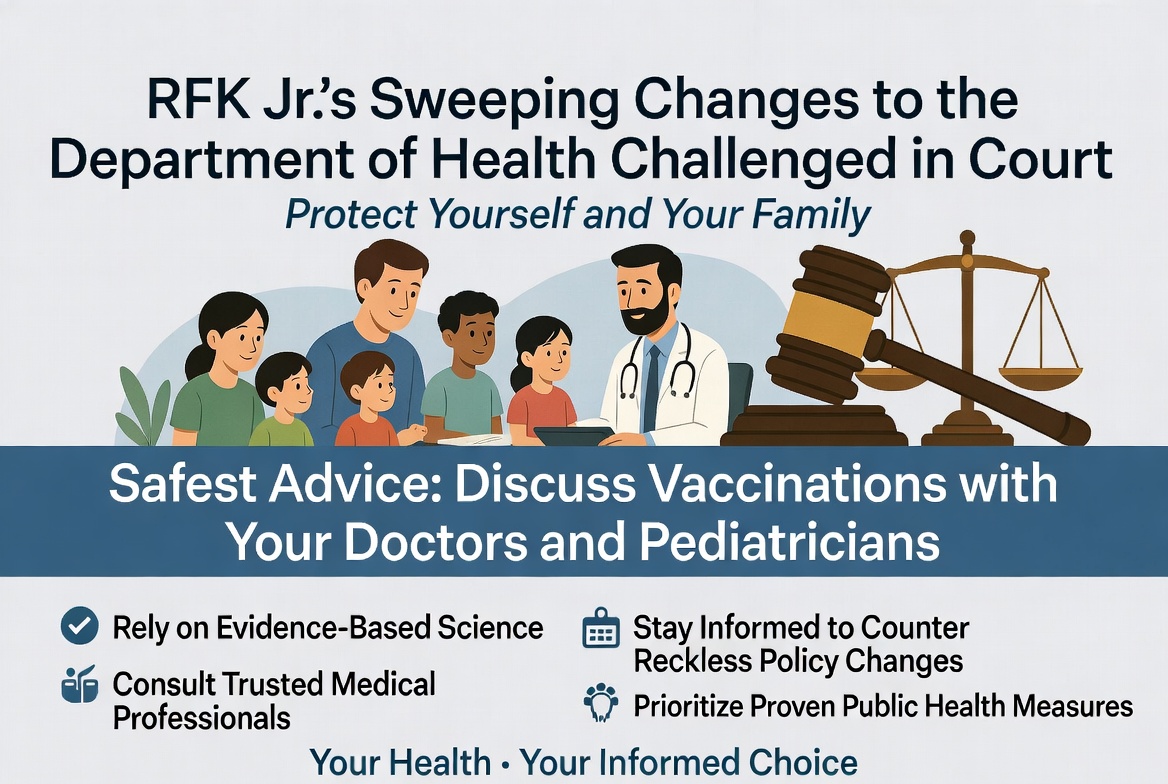
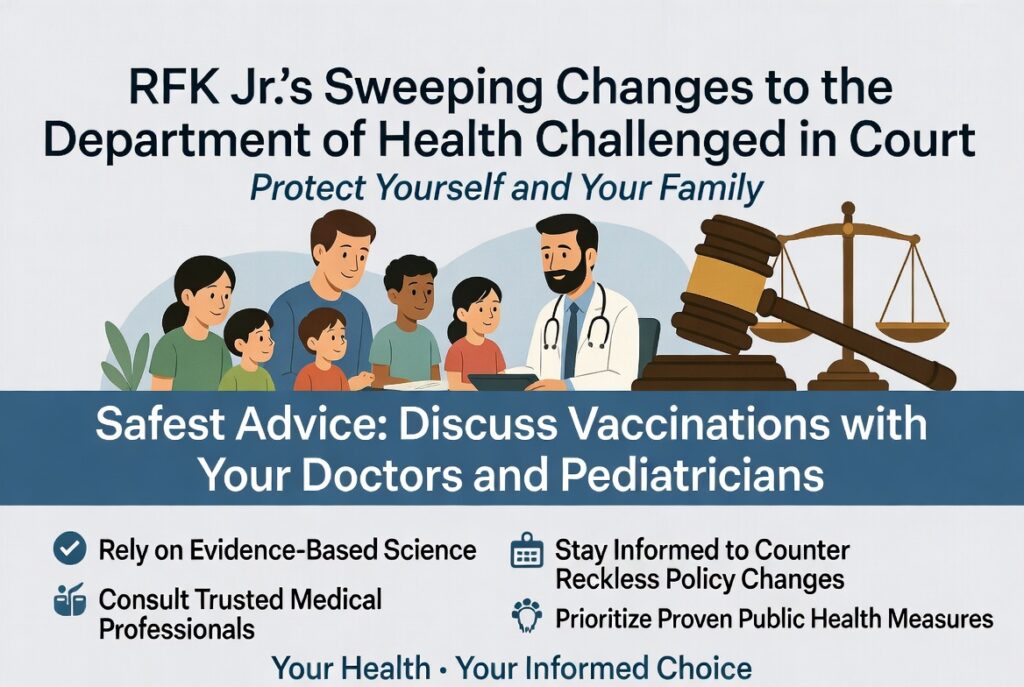
The most important thing to understand is that Kennedy overplayed his hand legally, repeatedly, and the courts have noticed. He did not just pursue aggressive policy changes, he pursued them sloppily, skipping the procedural requirements that exist precisely to prevent any single person from unilaterally rewriting public health infrastructure. That sloppiness has created legal openings that are now being used effectively.

In March 2026 a federal judge in Massachusetts sided with the American Academy of Pediatrics and blocked Kennedy’s overhaul of the CDC’s vaccine advisory committee, the one he had stacked with skeptics after firing all 17 original members. The judge invalidated votes the reconstituted panel had already taken, including decisions to downgrade hepatitis B and COVID recommendations. More significantly, the same ruling found that the CDC had exceeded its legal authority when it unilaterally reduced the childhood vaccine schedule from 17 to 11 vaccines in January, because it did so without going through the proper advisory process. The mechanism Kennedy used to do the most damage to vaccine policy is the same mechanism that is now being used to undo it.

The states have mobilized in ways that matter. Fifteen states have sued to rescind the new vaccine schedule entirely and dismantle Kennedy’s replacement advisory committee. Nineteen states and the District of Columbia are separately fighting the HHS restructuring and mass layoffs on constitutional grounds, arguing the administration violated the separation of powers and the appropriations clause, essentially that Kennedy dismantled agencies Congress had funded and mandated without the legal authority to do so. A judge has already blocked further reorganization while that case proceeds. These are not symbolic lawsuits. They are methodical, well-resourced legal challenges built on solid procedural ground, and they are advancing.

Perhaps the most quietly encouraging development is what the medical establishment itself has done. When Kennedy changed the vaccine schedule, major hospital systems and clinicians across the country simply ignored it. The American Academy of Pediatrics published its own independent vaccine schedule, declaring the federal process no longer credible, and told its members to follow that instead. This matters more than it might seem. The federal government can change its recommendations, but it cannot force pediatricians to follow them. The professional infrastructure of American medicine, the societies, the hospitals, the training programs, the peer review systems, is largely intact and largely in open rebellion against what Kennedy is doing. That infrastructure is where the actual practice of medicine happens, and it is not waiting for federal permission to protect children.

Were the signs obvious? Yes. Could this have been prevented? Yes. Did it happen purely because of politics? Yes. But we also knew who Robert F. Kennedy Jr. was before he was confirmed, and we knew he was Trump’s chosen instrument for reshaping American public health. That makes all of us who watched and waited at least a little complicit in the complacency that allowed it to happen.

Casting blame now doesn’t cure a child with measles or restore a cancer research grant. It doesn’t rebuild the institutional knowledge that walked out the door with the scientists who were fired. The courts are working, and working effectively, but they are slow by design. The best and most immediate course of action is the one closest to home, your doctor, your pediatrician, your state legislature, your voice used early rather than late.

We knew. Now we act.

Know the insurance cliff and act before it hits. Major insurers pledged to keep covering the old vaccine schedule through end of 2026. That pledge expires in December. Before then, contact your state insurance commissioner and ask specifically what protections your state is putting in place to ensure continued vaccine coverage after the federal schedule changes. If your state has not addressed this, say so publicly and say it to your state legislators by name. This is the kind of specific, time-bound pressure that actually moves state government.

Talk to your pediatrician directly. Ask them which schedule they are following. The answer in most cases will be the American Academy of Pediatrics schedule, not the federal one. But parents who don’t ask won’t know, and parents who don’t know may make decisions based on federal guidance that their own doctor has already rejected. This is a conversation that takes five minutes and could matter enormously.

Support the organizations doing the legal work. The American Academy of Pediatrics, the American Public Health Association, and American Oversight are carrying the heaviest load in court right now. They are nonprofit organizations fighting well-funded federal legal teams. They need resources and they need visibility. Sharing their work, citing their findings, and donating if you are able is not performative, it is direct support for the people holding the legal line.

Pay attention to your state legislature. Anti-vaccine activists are already moving into statehouses to use the federal schedule changes as leverage to loosen school vaccine requirements. This is happening right now in Florida and Texas and it will spread. School board meetings and state legislative hearings are where this battle will be won or lost at the community level, and they are chronically under-attended by the people who would push back. You do not have to become an activist. You have to show up once and bring two people who agree with you.

Understand what is reversible and what isn’t. The legal framework to restore the vaccine schedule exists and is being actively pursued. The court victories so far suggest it is achievable. What is harder to reverse is the institutional knowledge that walked out the door with the fired scientists, the research that wasn’t funded, the surveillance systems that went dark, and the public trust that eroded while the outbreaks spread. Those are long term repair projects that will require sustained political will across multiple administrations. That is not a reason for despair. It is a reason to vote in every election at every level with health policy as a primary consideration, and to say so out loud when you do.

The measles outbreak will not be the last consequence we see from what has happened at HHS over the past year. The cancer research that wasn’t funded will show up in treatment outcomes years from now. The children who didn’t get vaccinated because their parents received confusing guidance from the federal government will be vulnerable in ways that won’t be visible until the next outbreak arrives. The damage has a long tail.

But so does the resistance. The courts are not done. The states are not done. The medical establishment is not done. And the accumulated weight of evidence-based medicine, built over more than a century by people who understood that complexity requires sustained attention rather than simple answers, does not disappear because one man with a broken compass was handed the keys for a few years.

He was given those keys through a political transaction. They can be taken back through a democratic one.

That is not optimism. That is how the system is supposed to work, and right now, imperfectly and under enormous pressure, it is working.

Pay attention. Show up. Talk to your pediatrician.

The burger and the shake are not going to fix this either.

Image (10)

Making America Sick — Part 3 of 4: Why He’s Doing It? The Broken Compass

There is a question that stops most people when they look at the measles outbreaks, the whooping cough deaths, the hollowed out research institutions and the children who will go unvaccinated this fall because their parents received confusing guidance from the federal government. The question is simple and almost impossible to answer through a normal political lens.

How does he look at this and not stop?

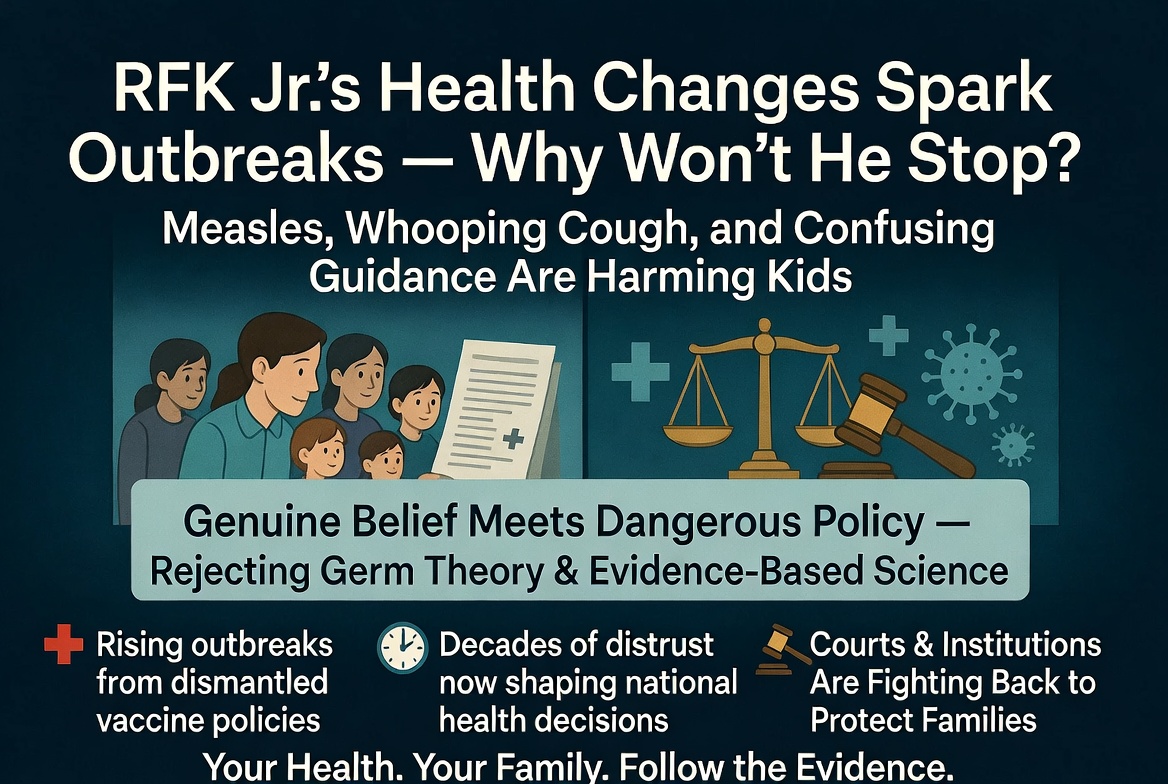
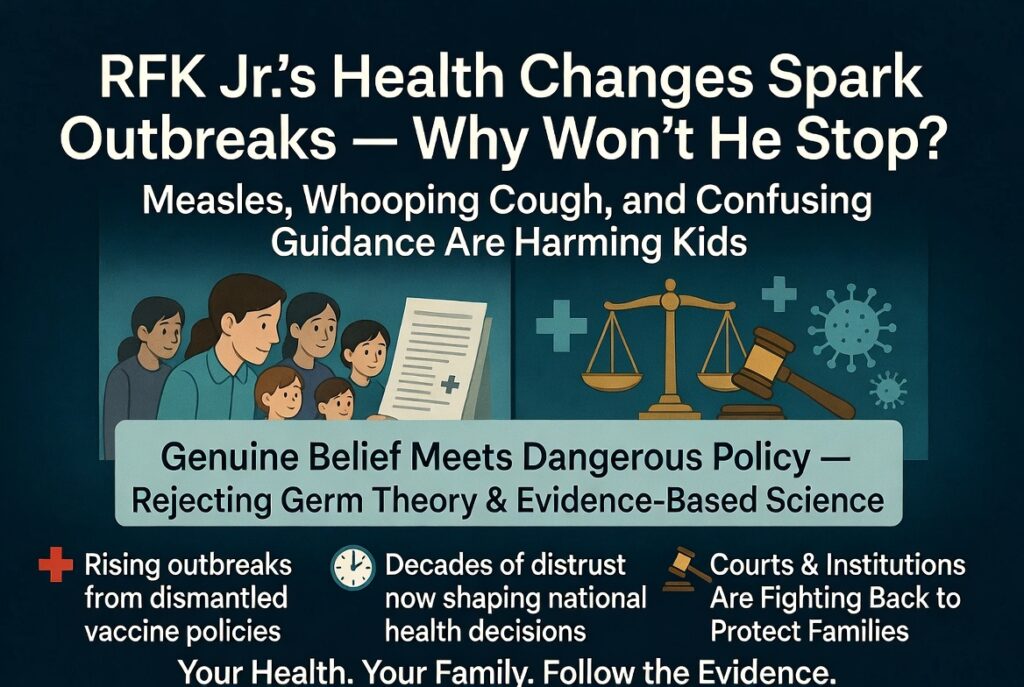
It is the right question. And if you are looking for the answer in conventional political motivation — ambition, corruption, cynicism — you will not find it, or at least not find enough of it to explain what we are watching. Kennedy is not profiting directly from dismantling vaccine policy. He is not, by any reasonable measure, doing this for personal financial gain. He genuinely believes, as far as anyone can tell, that he is helping.

That is what makes him so dangerous.

To understand what is actually happening you have to set aside the political framework entirely and pick up a different one. Those who have spent careers working in mental health and addiction treatment will recognize the pattern immediately, not because Kennedy is simply an addict — recovery is real and people rebuild their lives completely — but because there is a specific kind of cognitive reorientation that prolonged substance use can produce in certain people, particularly those who were already wired toward intensity, pattern recognition, and distrust of authority. It does not announce itself. It does not look like impairment from the outside. It looks, in fact, like conviction.

Here is how it works. The brain’s threat assessment system, disrupted by years of substance use, can become permanently recalibrated. Not broken exactly — still functional, still capable of sophisticated reasoning — but reset to a baseline of suspicion that a normal risk environment cannot satisfy. Everything gets filtered through a framework that asks not “what does the evidence show” but “who benefits from me believing the evidence.” Once that filter is in place it is essentially self-sealing. Contradicting evidence doesn’t weaken the belief — it strengthens it, because contradiction becomes proof that the threat is real enough to require active suppression.

Kennedy wrote in a 2021 book that he rejected germ theory — one of the foundational principles of modern medicine, established over 150 years ago — in favor of miasma theory, the pre-scientific idea that disease arises from environmental corruption rather than specific pathogens. This is not a fringe position he stumbled into. He argued for it at length, in print, under his own name. And yet he continues to insist he is following the science. From inside that framework, he is. The science he trusts is the science that confirms what his recalibrated threat assessment already told him was true. Everything else is captured, corrupted, or bought.

This is not unique to Kennedy and it is not unique to addiction. It is a well-documented feature of how human cognition responds to prolonged trauma, chronic stress, and certain kinds of neurological disruption. What is unusual is the scale at which we are now watching it operate. Most people who develop this kind of framework do so in private, or in communities of like-minded believers, where the consequences are limited. Kennedy developed it in public, refined it over decades, built a following around it, and then traded that following for the most powerful public health position in the world.

The cruelest irony is that his instincts were not entirely wrong at the start. Corporate influence on research is real. The pharmaceutical industry has a documented history of suppressing inconvenient findings. Public health institutions did make serious errors during the pandemic that damaged trust. Kennedy’s original antenna was picking up genuine signals. But a broken compass that points slightly wrong will take you further and further from your destination the longer you follow it. By the time you are rejecting germ theory and redesigning the childhood vaccine schedule based on a country that provides universal free healthcare and has a population smaller than Texas, you are not where you started. You are somewhere that looks nothing like the riverbanks you once protected.

And the children getting measles in South Carolina cannot tell the difference between a broken compass and a working one. They just get sick.

What makes this particularly resistant to the normal corrective mechanisms of democratic accountability is that Kennedy speaks the language of his critics fluently. He knows what evidence-based medicine sounds like. He knows how to invoke transparency and scientific rigor and institutional accountability. He uses that language not to engage with the evidence but to reframe his rejection of it as a higher form of engagement. This is not stupidity. It is something more difficult to counter than stupidity, because you cannot simply show him the data. The data is part of the system he has already decided cannot be trusted.

Which brings us to the only thing that has ever worked against this kind of entrenchment — not argument, not outrage, not the correct facts delivered with sufficient force. What works is structure. Rules. Institutions with enough independence and enough legal authority to say no regardless of what any individual believes. Courts. Professional bodies. State governments. The accumulated weight of democratic process applied with enough consistency that no single broken compass can redirect the whole ship.

Those structures exist. They are fighting back. And that is where we are going next.

Image (11)

Making America Sick — Part 2 of 4: The Damage

When Robert F. Kennedy Jr. took office in February 2025, the Department of Health and Human Services oversaw food and hospital inspections, health insurance for roughly half of the American population, vaccine recommendations, and the scientific research infrastructure that underpins most of what your doctor tells you. It was imperfect, often bureaucratic, and in genuine need of reform in places. What it did not need was to be systematically dismantled by someone who rejected the scientific foundations it was built on.

That is what happened anyway.

Within his first two months Kennedy announced the elimination of approximately 10,000 HHS jobs on top of another 10,000 employees who had already taken buyouts, collapsed 28 agencies into 15, and closed half of HHS’s regional offices. The cuts did not fall evenly. They targeted, as 19 state attorneys general would later document in federal court, specific programs and areas of expertise — the ones Kennedy had already decided were part of the problem. Infectious disease surveillance. Vaccine research. The scientific advisory infrastructure that had taken decades to build.

The research bleeding is quieter than the vaccine headlines but may prove more lasting. The National Institutes of Health cut approximately $2.7 billion in research funding, including a 31 percent reduction in cancer research. Five hundred million dollars in contracts to develop vaccines using mRNA technology, the same technology that saved millions of lives during the pandemic were canceled. Four NIH directors were fired or forced out. The FDA’s vaccine chief was removed. A CDC director Kennedy himself had hired was gone within a month. As one Georgetown University public health law professor put it, America is being hollowed out of its scientific leadership, and it will be extraordinarily difficult to reverse.

But it is the vaccine story that will be most immediately felt in pediatricians’ offices and school hallways across the country.

Kennedy promised during his confirmation hearings that he would not touch vaccine policy. Instead he fired all 17 sitting members of the CDC’s Advisory Committee on Immunization Practices, the expert body that has guided vaccine recommendations since 1964 and replaced them with known vaccine skeptics. The reconstituted committee promptly began downgrading recommendations. Then in January 2026, the CDC unilaterally reduced the universally recommended childhood vaccine schedule from 17 vaccines to 11, cutting protection against rotavirus, influenza, hepatitis A, hepatitis B and meningococcal disease from routine recommendations, not based on any new safety data, but modeled after Denmark, a country with universal free healthcare that is an outlier even among its European peers.

The consequences are not theoretical. A measles outbreak has spread to 26 states with over 960 confirmed cases centered in South Carolina. Two children have died from whooping cough. Vaccination rates have been falling since Kennedy took office. Last flu season saw 280 child deaths from influenza, the highest toll in more than a decade, and the federal government has now made the flu vaccine a matter of parental discretion rather than routine recommendation.

There is a clock ticking that most people don’t know about. Major health insurers pledged to keep covering the old vaccine schedule through the end of 2026. That pledge expires in December. After that, whether parents pay out of pocket for vaccines that were covered last year is an open question, and in a country where cost is already a barrier to preventive care for millions of families, the answer will show up in infection rates within a year or two.

None of this happened by accident. None of it happened without warning. Kennedy’s record as a vaccine skeptic was not hidden during his confirmation process, it was the central concern of every senator who questioned him, and he addressed each concern with a promise he did not keep. The damage being done to American public health is real, it is documented, and it is the direct result of placing ideological conviction above scientific evidence at the highest level of the public health system.

The question worth asking, and the one we will address next, is not whether Kennedy knows what he is doing. He does. The more useful question is why a genuinely intelligent person, with a real history of fighting for public health, arrived here. Because the answer to that question is the one that might actually help us understand how to stop it from happening again.

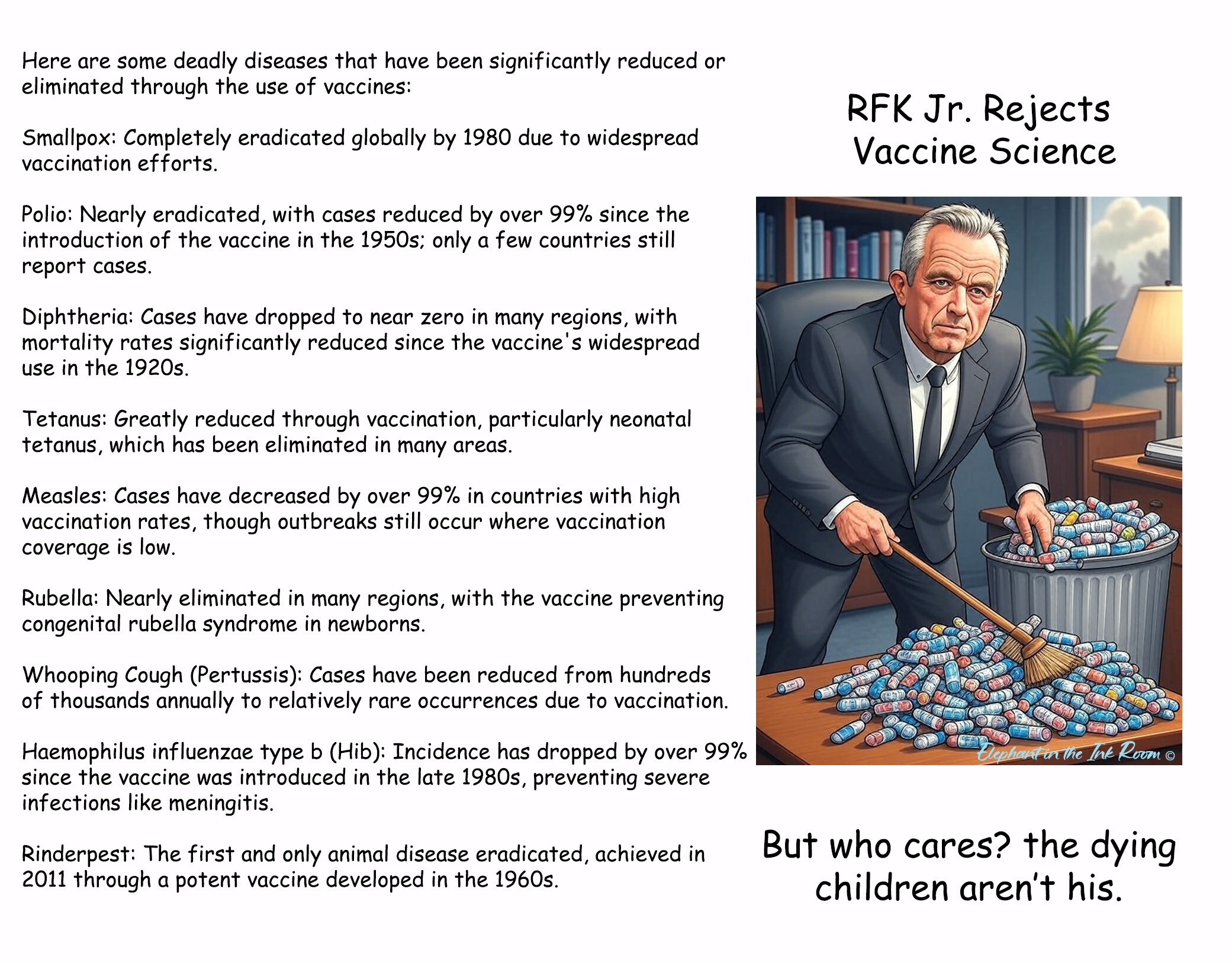
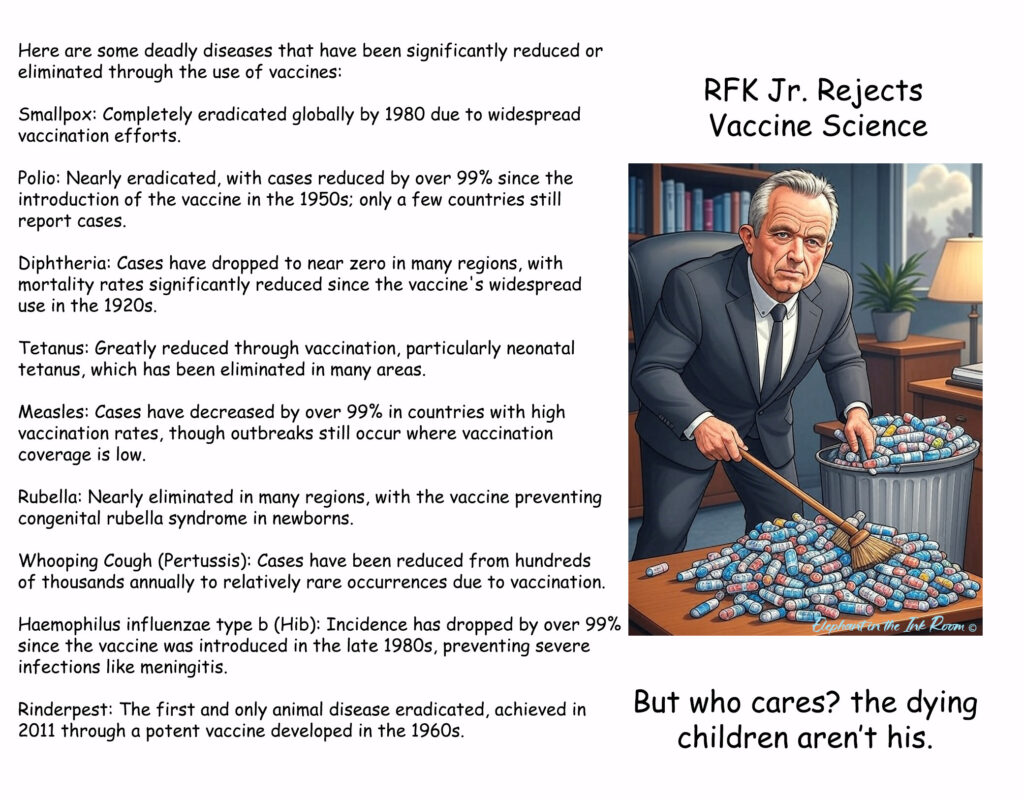
Rfkjr and vacines

The Chaos Candidate Part 2 of 2

The Chaos Candidate

Part Two: Nobody Gets to Succeed Him

The Heir Problem

Every president, even those who serve two full terms, eventually hands power to someone. The American system is built on this assumption. Parties groom successors. Vice presidents position themselves. Cabinets members quietly build their own profiles. This is normal. This is healthy. This is how democracies renew themselves.

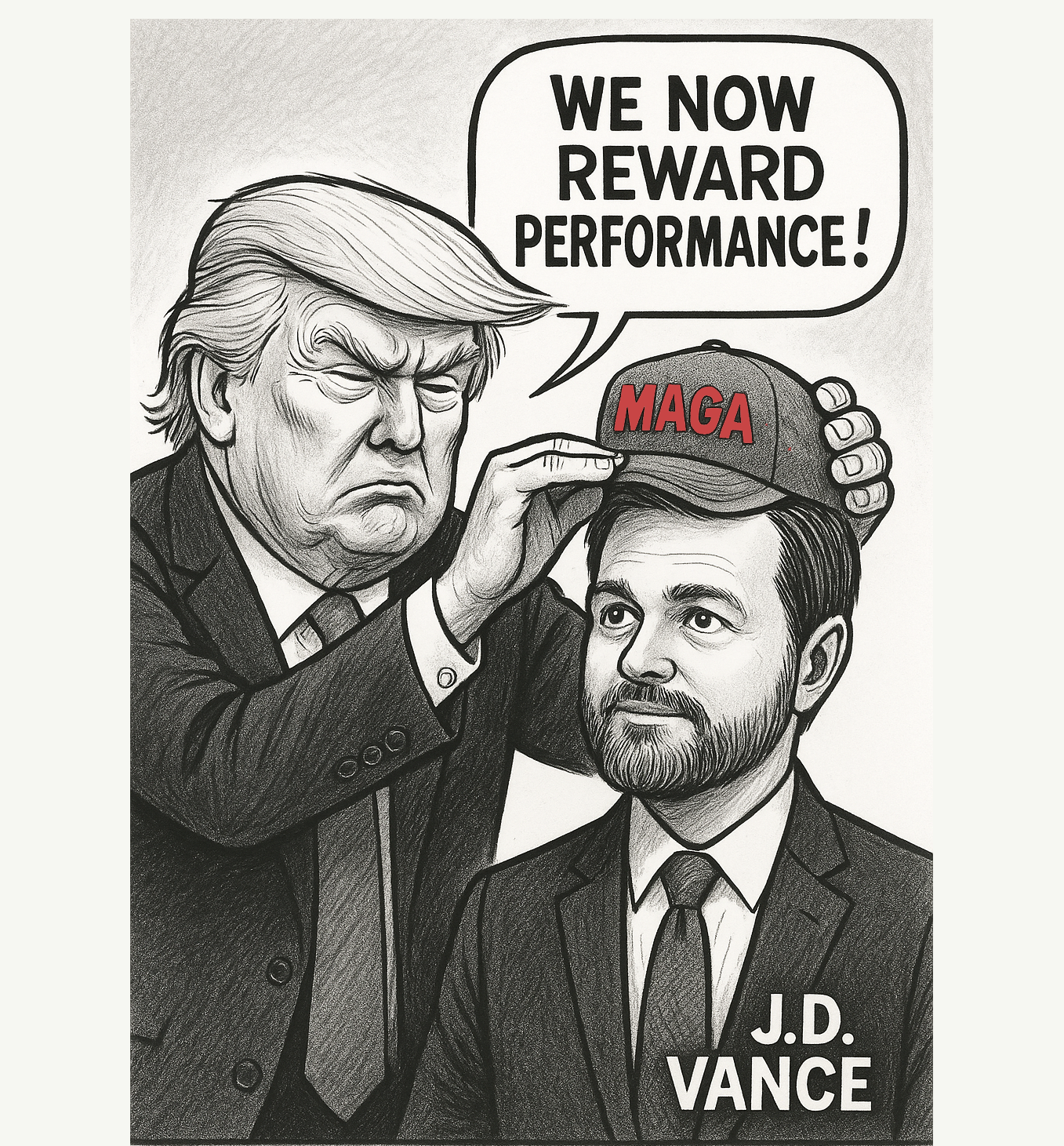
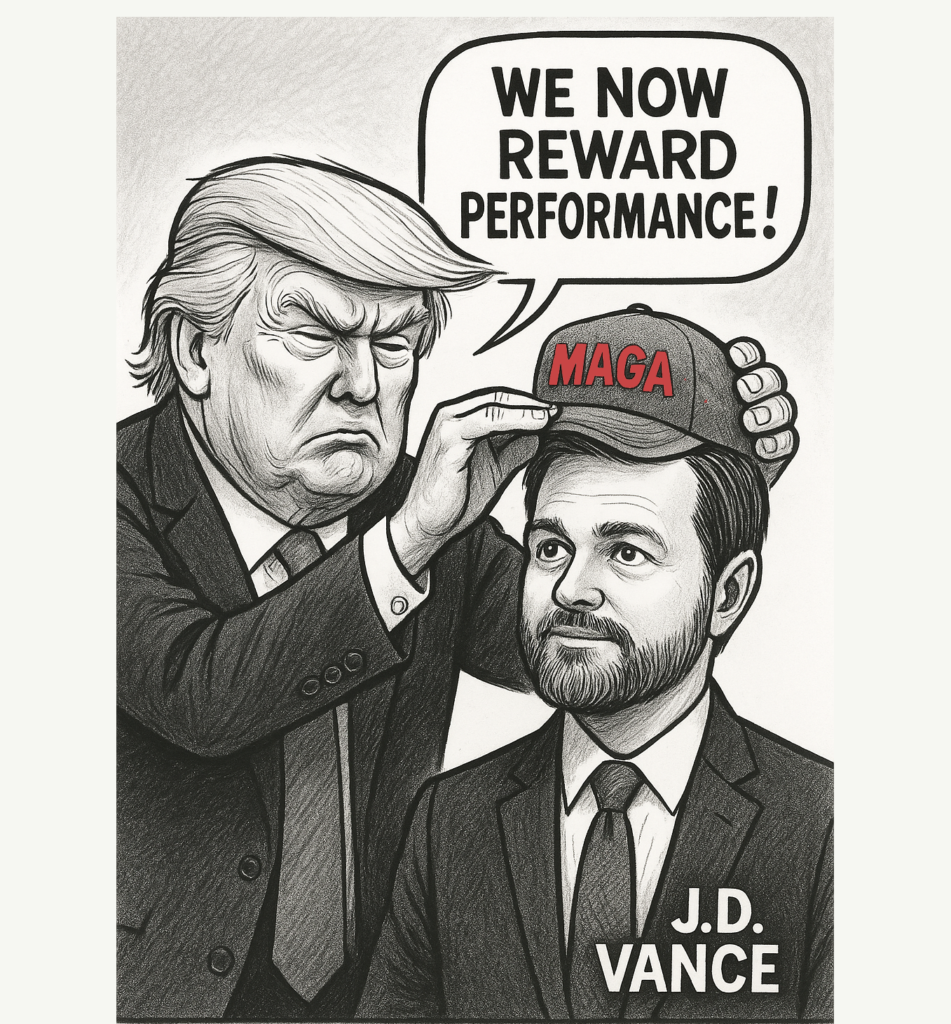
Look at what is happening to JD Vance. He was selected as the heir apparent, young, ideologically aligned, capable of carrying the movement forward. Watch how that has evolved. Watch how often he is sent to deliver messages that put him in impossible positions. Watch how the credit for anything successful flows upward while the exposure for anything uncomfortable flows toward him. This is not accidental staff management. This is deliberate political neutering.

Marco Rubio came into this administration with more foreign policy credibility than almost anyone in the Republican Party. He is a serious man who knows the world. Watch what has happened to his role. Watch the negotiations he is sent to conduct with insufficient authority to deliver results. Watch the sidelines he increasingly occupies on decisions that should be his by portfolio. The diminishment is quiet but it is consistent.

The pattern is not hard to see once you are looking for it. Nobody around this president is allowed to accumulate enough independent political gravity to pose a succession question. Not because he is term-limited out in 2028 and succession is therefore theoretical. Because the movement itself cannot have a face other than his face. The chaos requires a singular author.

Nobody around this president is allowed to accumulate enough independent political gravity to pose a succession question. The chaos requires a singular author.

The Trap Voters Built

Here is the part that requires the most intellectual honesty, because it does not flatter anyone, including people who consider themselves politically sophisticated.

The trap was not set by Donald Trump. It was set by voters, over many election cycles, as American political culture made a series of choices that seemed reasonable one at a time and catastrophic in aggregate.

We chose entertainment over information. Not all at once. Gradually, across decades, as the media ecosystem fractured and attention became the currency that determined what survived. A political system fed by attention gradually selects for performers over governors.

We chose emotion over policy. Again, not all at once. But somewhere along the way, the question voters asked shifted from “what will this person actually do” to “how does this person make me feel.” Feeling is immediate. Policy is slow. In a media environment built for immediacy, feeling wins every time.

We chose personality over institution. Parties became vehicles for individuals rather than individuals being accountable to parties. Checks and balances depend on people being more loyal to the institution than to the person, and that loyalty has been systematically eroded, on both sides, for thirty years.

The result is a political environment where chaos is not just tolerated but rewarded. Where accountability mechanisms, elections, oversight, the press, the courts, have all been either captured, discredited, or simply overwhelmed by the volume of events requiring response. You cannot hold anyone accountable for yesterday’s crisis when today’s crisis has already replaced it in the news cycle.

The Exit Is Slow

I want to be honest about what I am not saying. I am not saying this is hopeless. I am not saying the system is broken beyond repair. I have lived through enough political cycles, in California, in Oregon, across fifty years of paying close attention, to know that pendulums move. They move slowly. They move unevenly. But they move.

Oregon hasn’t elected a Republican governor since the 1980s. That may change in 2026, not because the state has transformed overnight but because enough voters have grown tired of one-party governance and its particular flavor of unresponsiveness to the full breadth of the state’s needs. That is the pendulum moving. Slow, grinding, real.

The exit from the national trap is the same kind of movement. It does not come from a single election or a single candidate or a single revelation. It comes from voters, gradually, reclaiming the habit of asking what a person will actually do instead of how they make us feel. It comes from demanding resolution instead of rewarding perpetual crisis. It comes from accepting that stability, while less dramatic than chaos, is what governance is actually for.

The chaos candidate understood something about this moment that his opponents repeatedly failed to grasp: that a significant portion of the electorate had become so accustomed to dysfunction that they stopped expecting anything else. He did not create that condition. He simply recognized it and made it work for him.

Understanding that is not defeatism. It is the beginning of the only kind of response that actually works, patient, structural, generational, and stubbornly focused on the long game rather than the next news cycle.

The pendulum is heavy. But it moves.

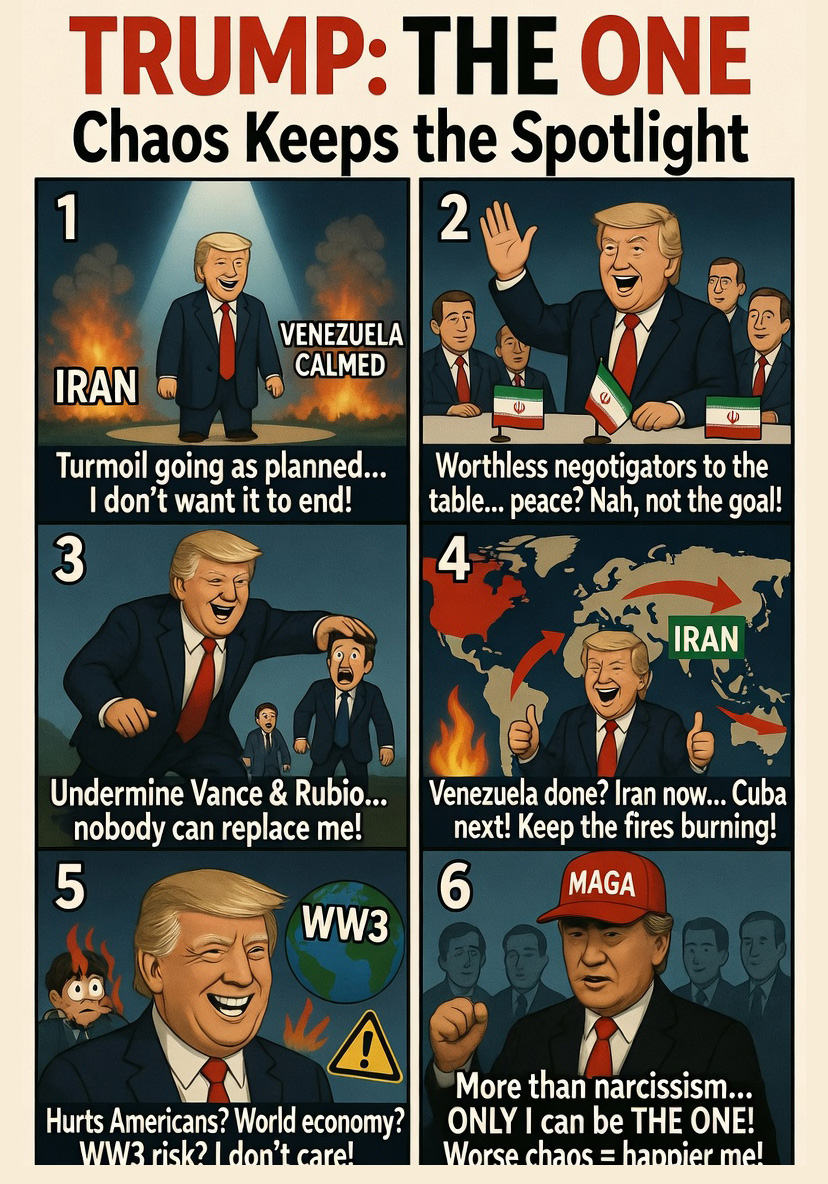
Trumptheone

The Chaos Candidate Part 1 of 2

The Chaos Candidate

How disorder became the product, succession became the threat, and voters built the trap themselves

I want to start with something simple, something you can observe without any particular political leaning, and see if you end up where I did.

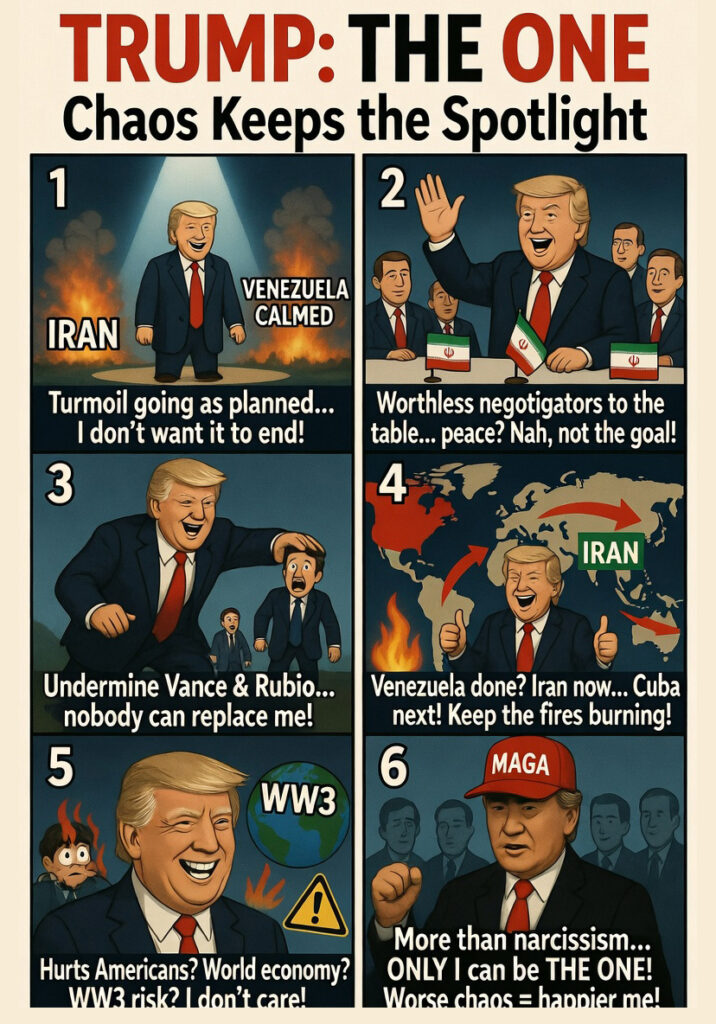
Venezuela got loud, then it quieted down. Iran got loud. Now Cuba is warming up. At some point, one of these will quiet down too, and something else will heat up. There is always something heating up. There is never a moment where the temperature drops across the board and stays down. If you step back far enough to see the whole map at once, a pattern emerges that is difficult to explain as coincidence, incompetence, or even ideology.

What if the chaos isn’t the failure? What if the chaos is the point?

I am not a conspiracy theorist. I am a man who has been watching American politics since Eisenhower, who moved from California to Oregon in 1975 and watched two states make similar mistakes on slightly different timelines, and who spent a sleepless night recently, courtesy of bad scallops and an overactive mind, turning this question over until it had an answer I could not easily dismiss.

This piece has two movements. The first is about chaos as a governing strategy. The second is about why that strategy is self-sealing, and who pays the price when it is.

What if the chaos isn’t the failure? What if the chaos is the point?

Part One: The Chaos Is the Product

What Normal Turbulence Looks Like

Every presidency generates turbulence. Foreign policy crises flare and subside. Domestic controversies rise and fall. This is the normal metabolism of governing a large, complicated country in a complicated world. Nobody reasonable expects calm.

But normal turbulence has a rhythm. Problems are identified, addressed, resolved or managed, and attention moves on. The temperature rises and falls. There is a discernible arc: crisis, response, resolution, or at minimum, honest failure followed by correction.

What we are watching now has a different rhythm entirely. The temperature does not fall. The resolution never quite arrives. Each crisis is replaced not by calm but by the next crisis, on a rotation that feels less like the unpredictable nature of world events and more like a programming schedule.

The Rotation

Venezuela became the focus. Military posturing, deportation flights, diplomatic brinksmanship. Then it subsided, not resolved, just deprioritized. Iran filled the space almost immediately. The language escalated. Negotiations were announced with negotiators who, by any serious diplomatic assessment, were not equipped to deliver results. The war drums are audible but the path to resolution is deliberately obscured.

Cuba is next. The signals are already there for anyone paying attention.

Now ask yourself a straightforward question: what does a president gain from resolution? A resolved crisis is yesterday’s news. A resolved crisis means the cameras move on. A resolved crisis means the public starts paying attention to other things, grocery prices, healthcare costs, whether their VA claim has been processed.

A ongoing crisis, on the other hand, is a spotlight. And the spotlight, in this administration, is not a tool of governance. It is the objective of governance.

A resolved crisis is yesterday’s news. An ongoing crisis is a spotlight. And the spotlight is not a tool of governance. It is the objective.

More Than Narcissism

The easy diagnosis is narcissism, and it is not wrong as far as it goes. But narcissism alone does not fully explain the pattern, because narcissism is ultimately reactive. It seeks approval, validation, the crowd’s energy. What we are observing has a more active quality. It is not just craving the spotlight. It is engineering the conditions that make the spotlight permanent.

Some political psychologists have reached for the term malignant narcissism, a combination of narcissistic personality, antisocial behavior, paranoia, and a willingness to cause harm without remorse. Others simply describe an autocratic personality type. Neither quite captures it.

What I keep coming back to is this: chaos is this man’s life support system. Not metaphorically. Functionally. Remove the crisis and you remove the reason for the rally, the reason for the emergency declaration, the reason the cameras are in the room. Stability is not just boring to him. Stability is existentially threatening.

That is not a medical diagnosis. It is a political observation. And it matters, because it changes how you evaluate everything that follows.

Image (2)

When it’s all about me

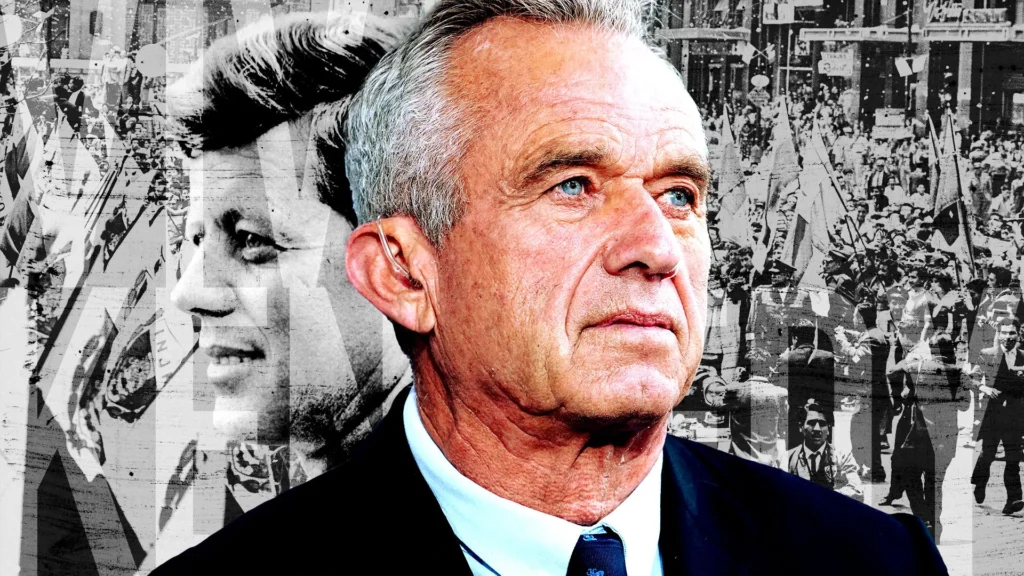
Making America Sick — Part 1 of 4: The Man Who Knew Better

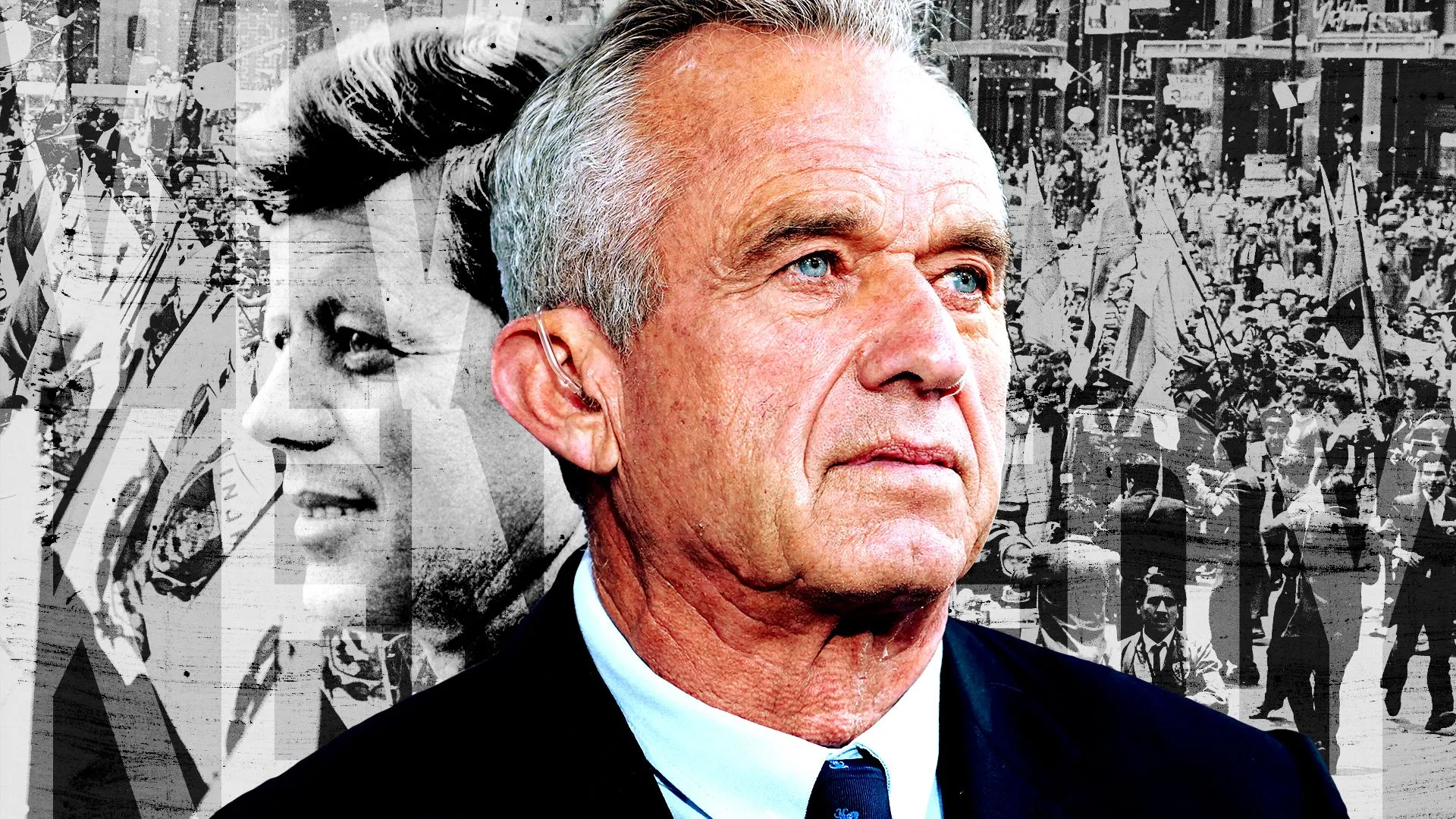
There is a version of Robert F. Kennedy Jr. that history should remember favorably.

As an environmental attorney in the 1980s and 90s, Kennedy was the real thing. He sued polluters, won, and made them pay. He fought corporations that dumped toxins into waterways serving poor communities who had no other advocate. He understood science, used it rigorously, and trusted it when it supported the case he was making, which it usually did, because the science on industrial pollution is not complicated. Corporations were poisoning people, Kennedy proved it, and he made them stop. That is not the biography of a crank. That is the biography of someone who understood exactly how institutions can be corrupted by money and power, and fought back effectively.

That understanding, that institutions lie when money is involved, is important. Because it wasn’t wrong. It was the seed of everything that came later, and like a lot of things that start from a kernel of truth, it eventually grew into something that consumed the original plant entirely.

Somewhere between the courtroom victories and the podcast appearances, Kennedy’s working theory shifted. Institutions sometimes lie became institutions always lie. Follow the money when evaluating a specific claim became follow the money as a substitute for evaluating evidence at all. The man who once used science as a sword against corporate corruption began using corporate corruption as a reason to reject science itself.

The drug years almost certainly played a role. Kennedy has spoken openly about his heroin addiction and recovery, and deserves credit for that honesty. But what he has never fully reckoned with publicly, and what anyone who has worked in addiction and mental health will recognize immediately, is that sustained substance use doesn’t just damage the body. It rewires the framework through which a person processes trust, authority, and risk. It can leave someone genuinely intelligent operating from a threat-assessment system that is permanently calibrated too high. Everything becomes suspect. Every institution becomes an enemy. Every simple answer becomes more trustworthy than a complex one, because complexity itself starts to feel like manipulation.

This is not a diagnosis. It is a pattern that professionals in mental health and addiction recognize, and it matters here because it explains something important: Kennedy is not stupid. He is not simply corrupt. He is a genuinely intelligent person operating from a framework that was damaged long before he ever set foot in the Department of Health and Human Services, and that framework is now being applied to the health of 330 million Americans.

He was confirmed as Secretary of Health and Human Services in February 2025, after a Senate process in which he promised, repeatedly, that he would not dismantle vaccine policy, would not politicize public health, and would bring transparency and accountability to institutions that had lost public trust during the pandemic. Those were not unreasonable promises. Some of them were even things his critics could agree were worth doing.

He has broken nearly all of them.

What is less often discussed is how he got there. Kennedy’s path to confirmation ran directly through his decision to drop his independent presidential campaign and deliver his followers to Trump. The job was, by most credible accounts, the arrangement. Not a reward for expertise in public health. Not a record of administrative competence. A political transaction between two men who had spent years distrusting the same institutions, for very different reasons, and who each believed they were the one doing the using.

1710801629903

A Text Message and FDA Approval – A COMPANION PIECE TO THE SERIES: MAKING AMERICA SICK — ROBERT F. KENNEDY JR.

When good things happen for the wrong reasons, and the wrong things happen anyway

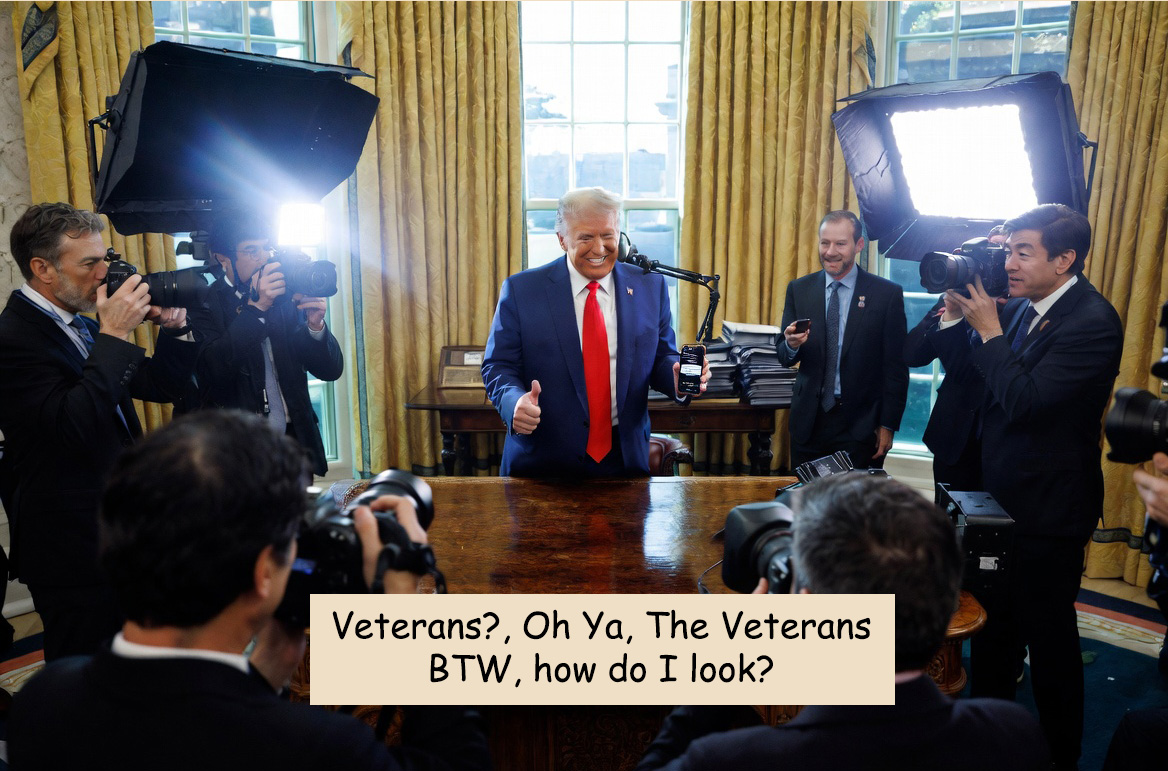
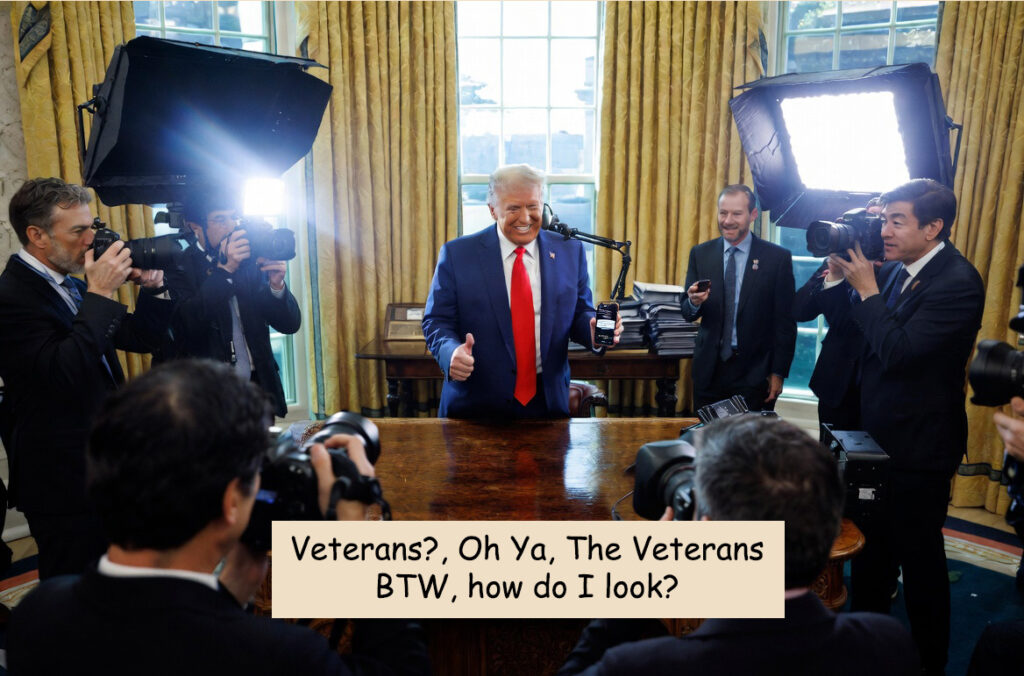
On Saturday, April 18, 2026, President Trump signed an executive order directing the FDA to fast-track its review of psychedelic drugs  including ibogaine, psilocybin, and MDMA for the treatment of PTSD, depression, and traumatic brain injuries in military veterans. He stood in the Oval Office flanked by RFK Jr., Dr. Oz, podcaster Joe Rogan, and Marcus Luttrell, the decorated Navy SEAL whose story became the film Lone Survivor. It was, by any measure, a striking scene.

And here is the uncomfortable truth: the science behind this decision has genuine merit. A 2024 Stanford study found that veterans treated with ibogaine showed an 80 to 90 percent reduction in symptoms of depression and anxiety within a single month. For over twenty years, more than 6,000 veterans per year have died by suicide, a rate more than twice that of the civilian population. When people are dying at that scale, the calculus around acceptable risk changes. Sometimes you take the risk. Sometimes you throw the dice.

So credit where it is due: if this research is conducted properly, it could save lives. That matters. That is real.

Sounds great. Do you want FDA approval? Let’s do it.” — President Trump, responding to a text from Joe Rogan

Policy by Text Message

But here is where the story gets complicated, and where the parallels to my ongoing series on Robert F. Kennedy Jr. become impossible to ignore.

This executive order, according to officials present, was written in less than a week. Its genesis was not a briefing from the VA, or a report from the National Institutes of Health, or years of advocacy from veterans’ organizations, though those voices exist and have been pushing for this research for years. Its genesis was a text message from Joe Rogan. Trump’s reply, as Rogan told it from the Oval Office: “Sounds great. Do you want FDA approval? Let’s do it.”

This is the same governing philosophy we see throughout this administration’s approach to public health. RFK Jr. didn’t dismantle vaccine confidence programs because of rigorous scientific review. He did it because of ideology, grievance, and the gravitational pull of a particular media universe. Trump didn’t fast-track psychedelic research because of a systematic review of veteran health outcomes. He did it because a podcaster texted him and it sounded good.

The mechanism is identical. The outcomes just happen to point in opposite directions.

The Hypocrisy the Headlines Won’t Tell You

While this announcement was being celebrated and it deserves some celebration the Department of Veterans Affairs has been quietly hemorrhaging the people who actually serve veterans every single day. Thousands of VA employees have been cut or are under threat as part of the administration’s broader federal workforce reductions. These are the people who answer phones, process disability claims, run mental health clinics, and sit across from veterans in crisis.

Ibogaine, even under an optimistic timeline, will not be widely available to veterans for years. The research still needs to be done properly. The cardiac risks, ibogaine has been linked to fatal heart arrhythmias and is connected to over thirty deaths in the medical literature — need to be understood and managed. The FDA approval process, even a fast-tracked one, takes time.

So what happens to the veteran who calls the VA crisis line next Tuesday and nobody answers? What happens to the veteran waiting eighteen months for a disability claim decision while staff positions sit empty? They don’t have Joe Rogan’s number. They don’t have a Lone Survivor story to tell in the Oval Office. They have a phone number and a waiting list.

This administration has demonstrated, repeatedly, that access to presidential attention and federal resources is mediated not by need, but by platform. By visibility. By whether you are useful to the political performance of the moment. Veterans, as a group, are enormously useful as symbols. As a bureaucratic constituency with daily, grinding needs they are less convenient.

The Thalidomide Shadow

Those of us old enough to remember thalidomide understand the cost of moving too fast. That drug approved in Europe, thankfully blocked in the US by one courageous FDA reviewer caused severe birth defects in thousands of children. The FDA’s deliberate pace exists for a reason. It was written in tragedy.

Ibogaine is not thalidomide. But it carries real risks, and the pressure now being applied to the FDA approve this in “weeks, not years” as the FDA commissioner suggested should make anyone who remembers that history uneasy. Speed driven by political momentum is not the same as speed driven by scientific confidence.

The research should proceed. The clinical trials should be funded. The veterans who have traveled to Mexico to access ibogaine treatments because they had no legal option at home deserve a legitimate pathway. All of that is true.

But “do you want FDA approval? Let’s do it” is not a drug approval process. It is a vibe. And we have seen, in this administration’s approach to public health writ large, what governing by vibe costs us.

Hold Both Truths

The hardest intellectual task in political commentary right now is holding two truths simultaneously when one of them gives comfort to people you disagree with. So let me be clear one final time: this research, done properly, could save veteran lives. That is good. That is worth fighting for regardless of who signs the order.

But the way it was done, by text message, in a week, surrounded by cameras and celebrities, while the VA workforce is being dismantled behind the scenes, is not a veterans policy. It is a veterans performance. And the veterans who will be waiting for ibogaine to navigate clinical trials and FDA approval while their local VA mental health clinic loses half its staff deserve to know the difference.

Good outcomes for bad reasons are still good outcomes. But they do not absolve the bad reasons. And they do not fill the staff positions that were cut last month.

This is a companion piece to the ongoing series Making America Sick: Robert F. Kennedy Jr., examining the Trump administration’s approach to public health, science, and the machinery of medical governance.

Published April 2026

Vetransfdafasttrack

He’s At It Again. He Never Really Stopped.

There is one political maneuver that has outlasted every empire, every demagogue, and every failed democracy in recorded history. It requires no particular intelligence to execute. It requires only a crowd of people who have been genuinely hurt by a system they don’t fully understand, and a voice willing to point in the wrong direction with enough confidence that nobody looks where the finger is actually coming from.

Donald Trump used it to get elected. He is using it again right now, aimed at a new audience, ahead of the midterms.

Here is how it works. You find people who have real grievances, and in America in 2026 there is no shortage of them. Wages that haven’t kept pace with the cost of living. Unions that were dismantled. Housing that became unaffordable. Debt that was engineered to be inescapable. These are real injuries, caused by identifiable decisions made by identifiable people with identifiable financial interests. The billionaires who took the wages. The corporations that crushed the unions. The politicians who deregulated the housing market. The financial system that built the debt trap.

You don’t point there. That’s the move. You point down instead. You tell the people who were robbed that the theft was committed by the people below them on the economic ladder. The immigrants, the minorities, the ones who have even less power than they do. You make them feel powerful by giving them someone they can still step on. And it works, because anger needs a target, and the real targets are harder to reach and better protected.

Trump did this in 2016 and 2024 with devastating effectiveness. Your jobs didn’t go to billionaires who lobbied for trade deals. They went to those people crossing the border. Your neighborhood didn’t get hollowed out by financial policy. It got hollowed out by those people getting handouts. Your children’s futures aren’t being sold by the donor class. They’re being taken by those people getting what should be yours.

It was a lie then. It is the same lie now, repackaged for a younger audience at a megachurch in Phoenix, dressed up in pyrotechnics and Lee Greenwood, aimed at voters who are still forming their understanding of how power actually works.

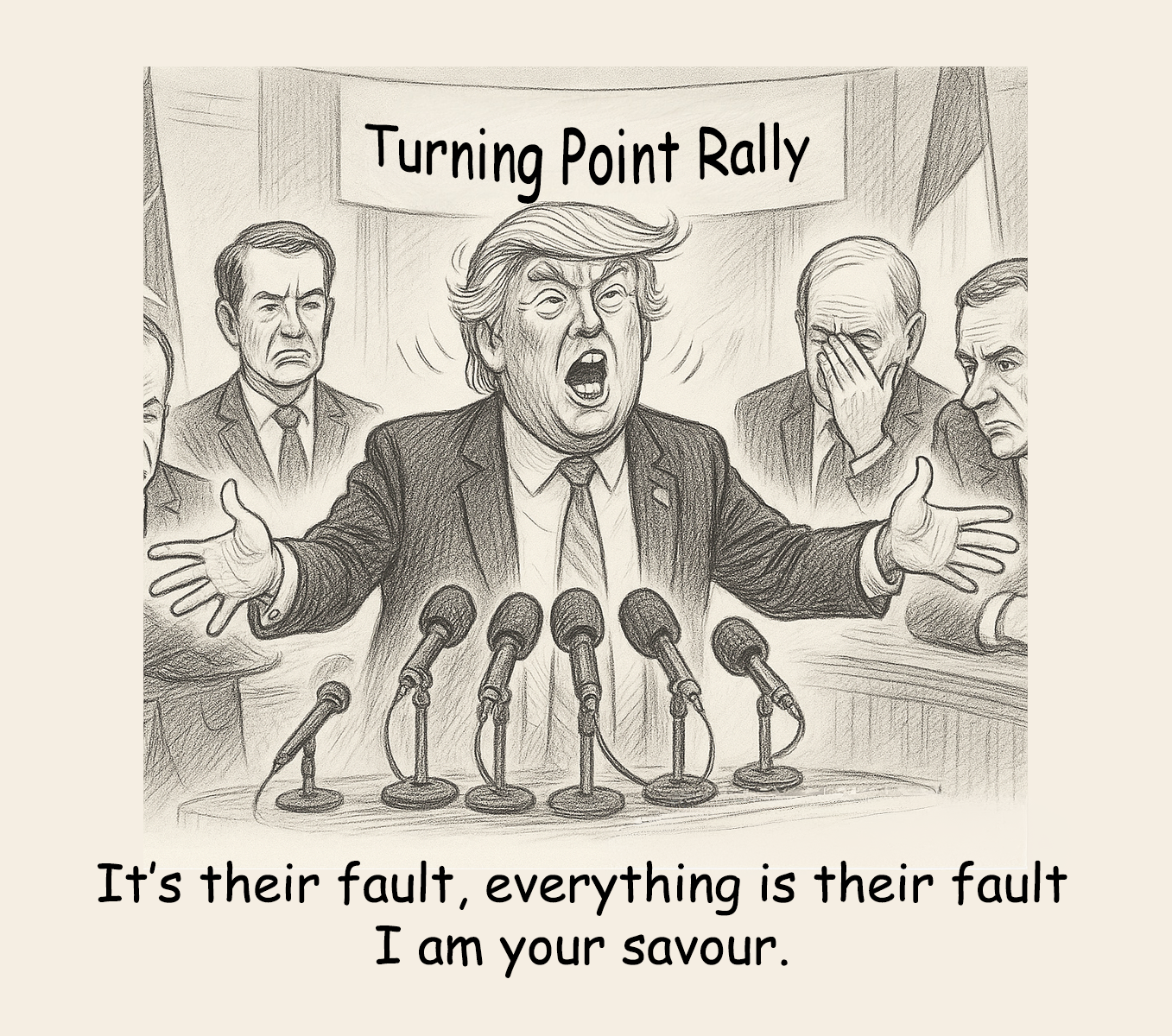
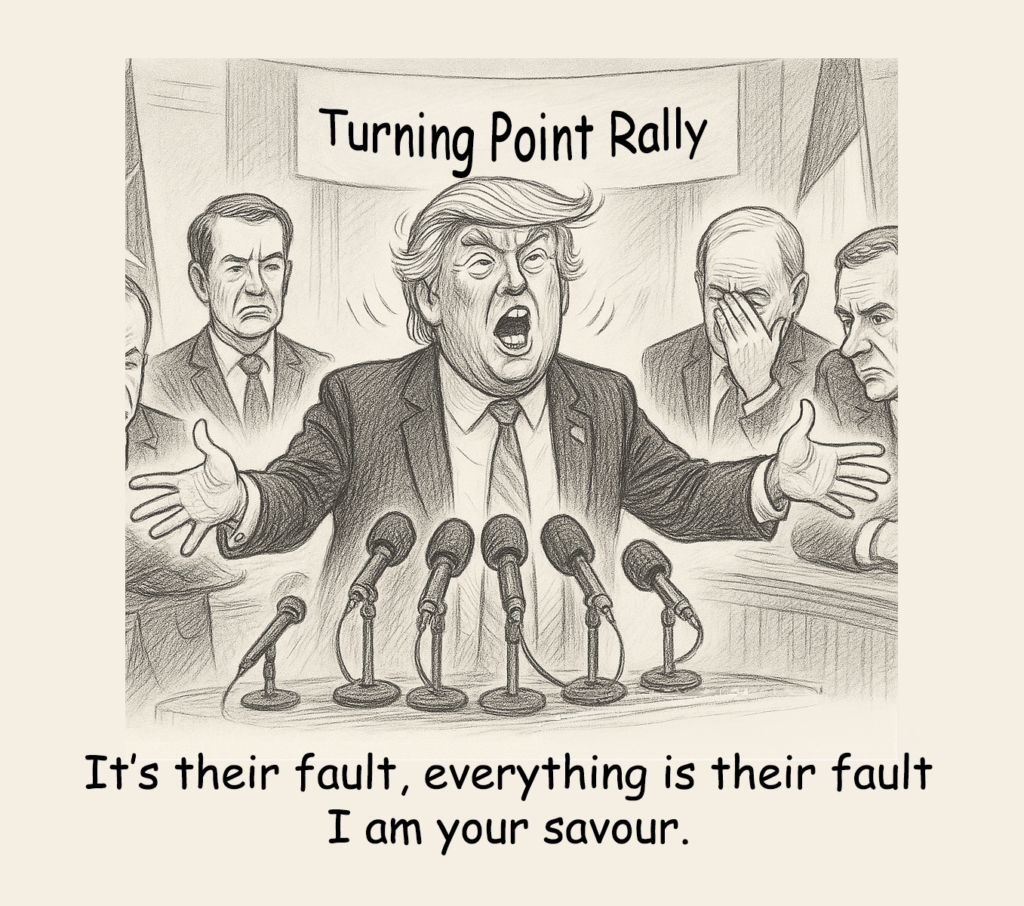
What has changed is the urgency. He said it himself at the Turning Point rally this week, almost accidentally. He knows the historical pattern, that the president’s party typically loses ground in midterm elections. He said he can’t figure out why. He can. He just can’t say it out loud. So instead he is doing what he has always done when the ground shifts under him. He is pointing downward harder, faster, and at a younger audience that hasn’t yet learned to check where the finger is actually aimed.

He told those young voters at the Dream City Church in North Phoenix, the midterms are existential. He is right about that. He just has the direction exactly backward. The threat is not the Democrats. The threat is the consolidation of power by a man who has spent his entire political career making sure you are angry at the person next to you instead of the one above you.

The oldest trick in the authoritarian playbook is not complicated. It just requires that nobody stops to look up.

Look up.

Savour

Article 3 of 3 The Long Game — Power Beyond the Ballot

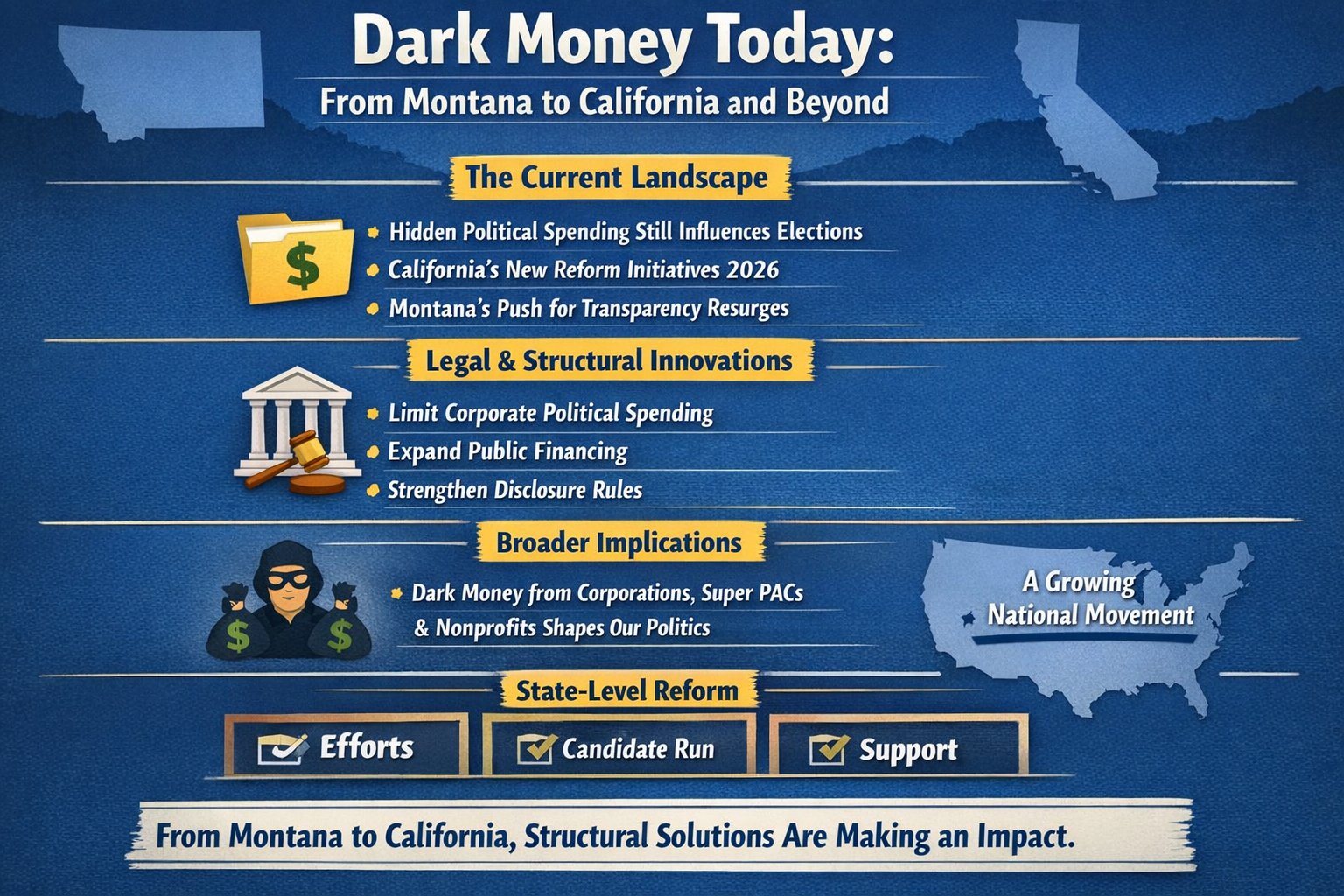
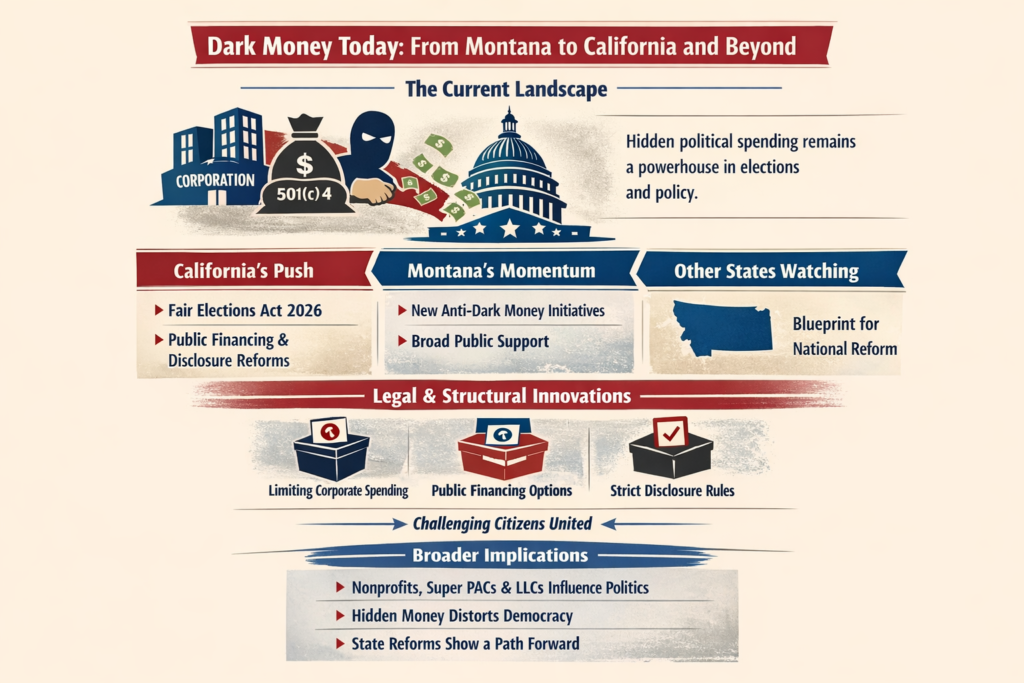
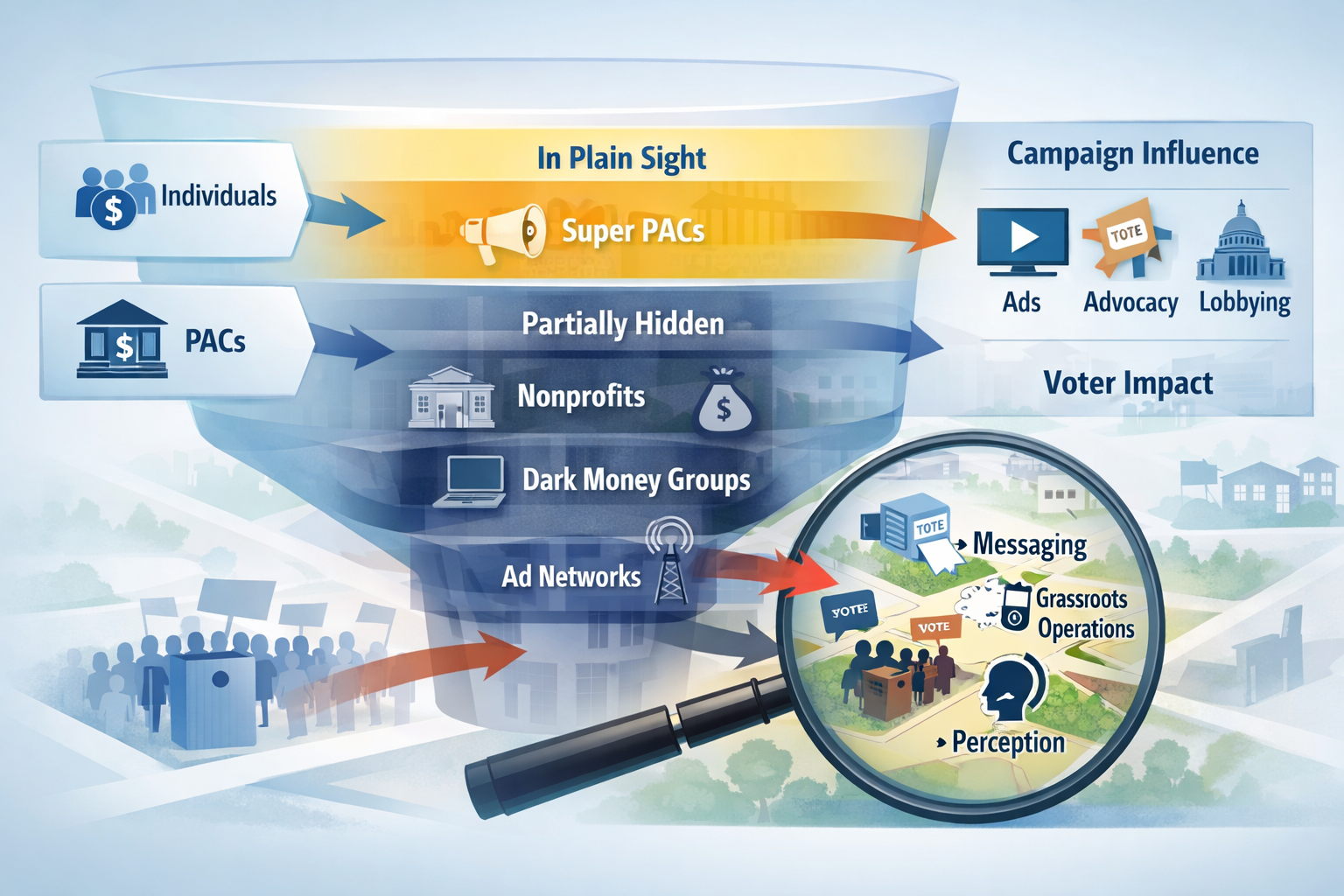
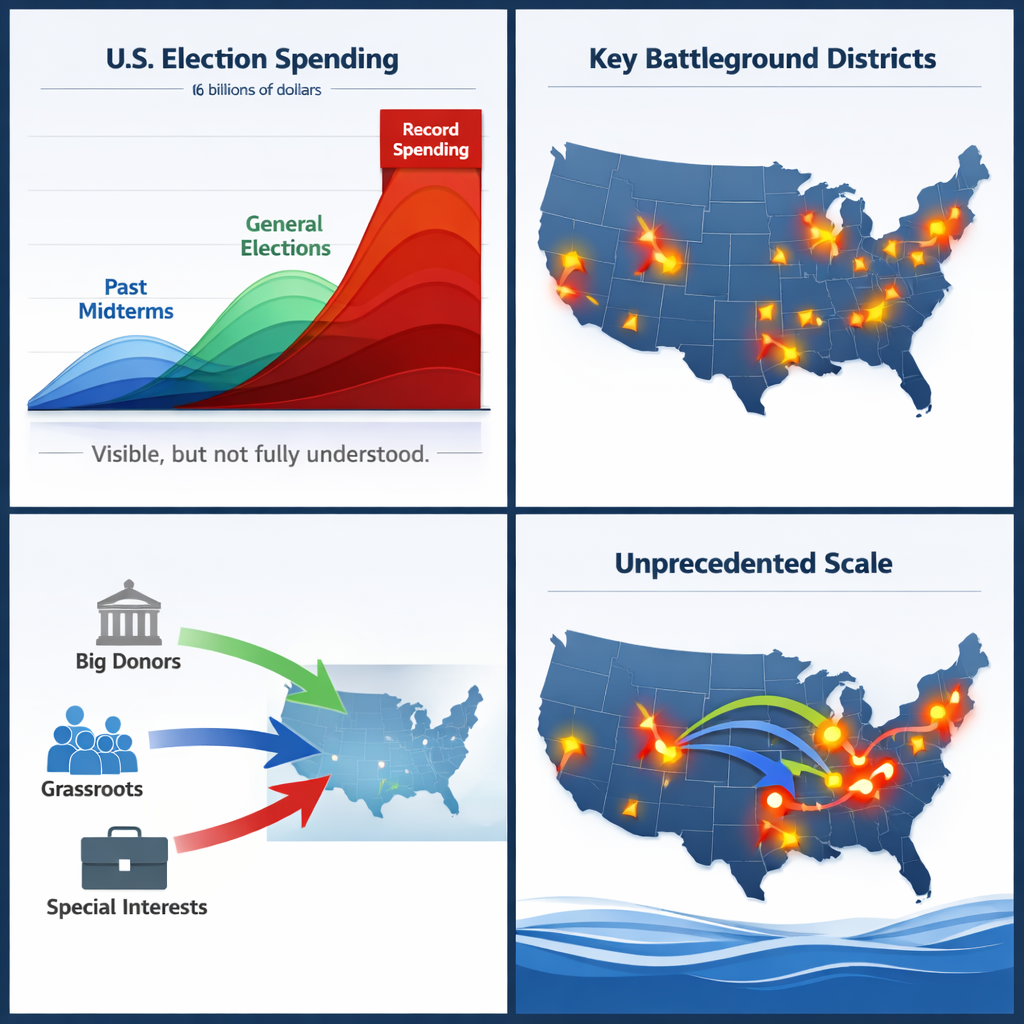
By now, it is clear that the 2026 midterms are unlike any we have seen in recent memory. The scale of spending, the intensity of coordination, and the precision of messaging all suggest a high-stakes contest—but the full story goes deeper than individual candidates or party control.

Article 2 of 3 Transparency Illusions — Money in Plain Sight

The early surge of funding into the 2026 midterms is hard to ignore, yet the public is still largely in the dark about how that money actually shapes the election. Even when contributions are disclosed, transparency is often more illusory than real.

Voters see the headlines—mega-donors, super PACs, and campaign cash—but few grasp the mechanics behind it, or the strategic intent that guides these flows. In essence, visibility does not equal understanding.

Disclosed vs. Hidden Influence

Campaign finance laws require certain reporting: super PACs must list their donors, and major contributions are public record. This disclosure gives the impression of accountability.

But disclosure is only part of the story. The “where” and “how” of influence often remains obscured. Mega-donors channel money into targeted districts, specialized messaging, and digital campaigns whose impacts ripple quietly.

Even non-dark money—funds that are fully reported—can operate as a form of strategic opacity. Voters know that spending is happening, but rarely see the nuanced ways it shapes perceptions, priorities, and local political infrastructure.

The Mechanics of Influence

Modern political spending is surgical. The goal is rarely broad persuasion; it’s about precise leverage:

  • District targeting: Money flows into the races that are winnable or strategically critical.

  • Message amplification: Ads, mailers, and digital campaigns are coordinated to push certain narratives.

  • Network shaping: Grassroots organizations, local media, and advocacy groups can be nudged—or suppressed—through funding decisions.

In combination, these tools allow wealth and influence to shape the electoral playing field long before voters cast ballots.

Public Perception and Strategic Opacity

To most citizens, a donor check is a check. But campaigns are more than contributions—they are engines of influence. Strategic opacity allows campaigns to appear open while steering attention, framing debates, and shaping perceptions without overt coercion.

The result is a paradox: the money is in plain sight, yet its full effect and intent are largely invisible. Voters see movement, but not the levers behind it.

Setting Up the Bigger Question

If disclosed money can operate as a subtle form of hidden influence, the real question becomes: what about the truly opaque channels? Dark money, nonprofit networks, and cross-linked advocacy groups operate largely outside public scrutiny.

And even among visible spending, both parties appear to be building something larger than a simple tally of wins and losses. Influence flows, narratives solidify, and infrastructure takes shape—often with consequences that extend well beyond Election Day.

The stage is set for a deeper exploration: how much of the opposition’s strategy is truly reactive, and how much is about quietly shaping enduring structures of influence?

Article

Article 1 of 3 Midterms Under Siege — The Scale of Influence

Midterm elections are supposed to be smaller, quieter affairs compared to presidential contests. Yet, heading into 2026, the sums being poured into these races are unprecedented, rivaling what we normally see only in general elections. The early flood of resources, even when fully disclosed, is a stark reminder that what the public sees is rarely the full story.

While headlines often focus on candidates, slogans, and social media battles, the real game is being played behind the scenes, where money flows strategically, shaping outcomes before most voters even pay attention.

The Numbers Are Jaw-Dropping

Even at this early stage, hundreds of millions of dollars are being funneled into key districts. Mega-donors and super PACs dominate the headlines, their contributions fully disclosed, but the scale alone is enough to overwhelm local campaigns and influence narrative framing.

This is money that historically would have been reserved for the general election, yet now, it is strategically deployed in primary and midterm races to set the stage for longer-term control. The sheer volume highlights the stakes: these elections are about more than individual candidates—they are about shaping influence, infrastructure, and future power.

Public Awareness vs. Reality

Disclosed contributions give the appearance of transparency. The public can see who is funding campaigns, which can create a sense of clarity and accountability. But even with full disclosure, the real intent behind the spending is often obscured.

Which districts are targeted? Which messages are amplified, and which are suppressed? How are grassroots networks subtly nudged or marginalized? The mechanics of influence remain largely invisible to voters, even when the money itself is visible.

In effect, disclosed money can still function as a form of strategic opacity. Voters notice that spending is happening, but few understand the purpose behind it, or the subtle ways it shapes perception, policy priorities, and candidate viability.

Implications for Democracy

This massive influx of resources into midterms raises urgent questions. When campaigns are so heavily funded from the top down, with precise targeting and messaging strategies, the electoral process is no longer just about persuading voters—it is about shaping the environment in which voters make choices.

The concern is not only about fairness but about the concentration of influence. Large donors and outside groups can disproportionately affect outcomes, often favoring well-funded narratives over community-driven priorities. Even when the money is visible, it is wielded with an intent that is not fully apparent.

Setting the Stage for Deeper Questions

If the stakes of the 2026 midterms are already higher than expected, and the flow of money is more aggressive than usual, we must ask: what is the larger purpose? Is this simply about winning seats, or is there a longer-term plan to entrench influence, shape norms, and steer policy pathways?

Understanding the scale and timing of these investments is the first step toward asking the bigger question: what are voters not being shown, and what structures are quietly being built behind the curtain?

Article

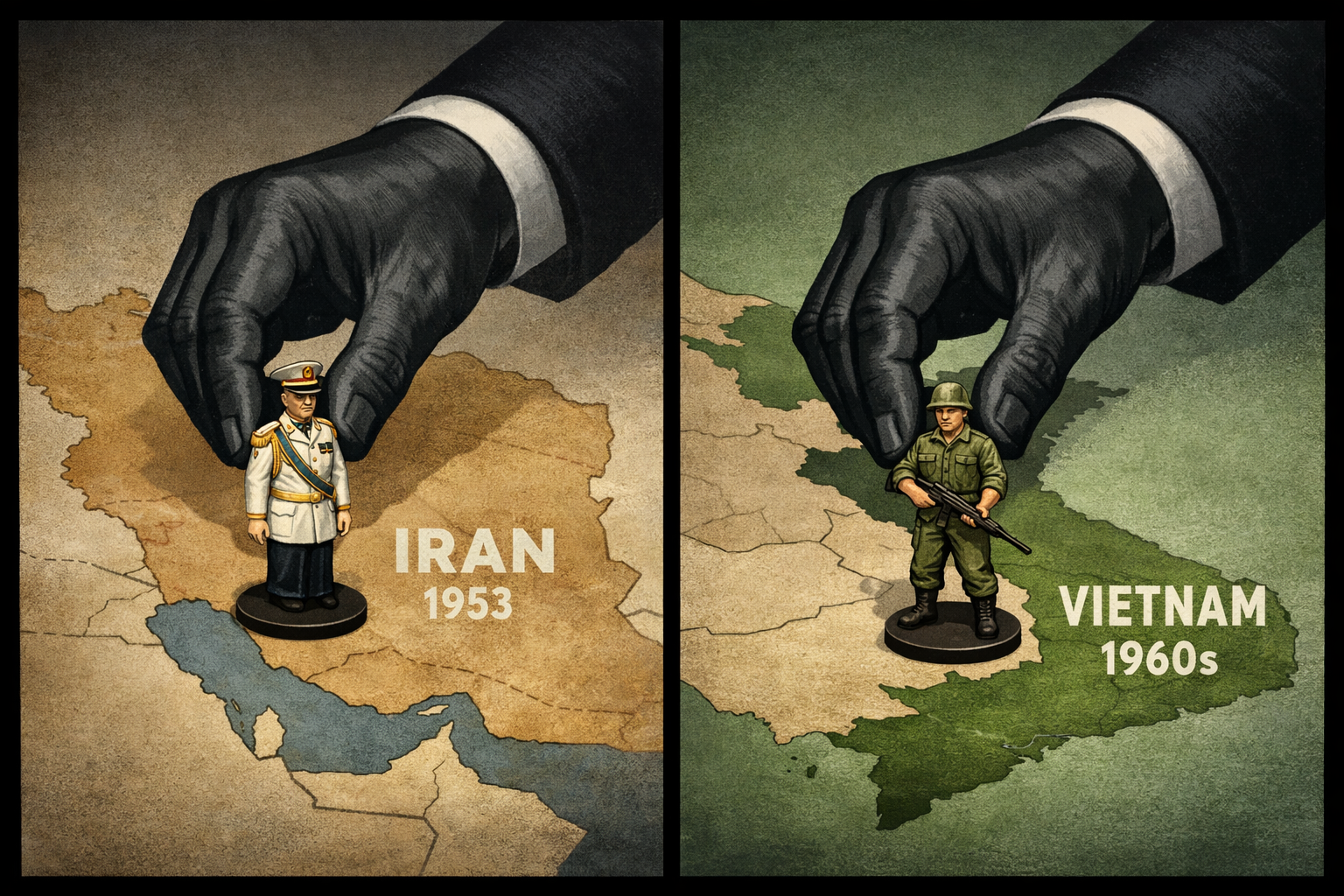
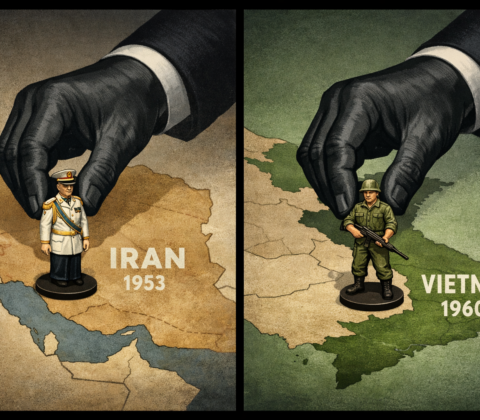
The Illusion of Control: From Vietnam to Iran

1963.

At the time, Vietnam wasn’t “the war”—not yet. It was something smaller, something contained. Advisors. Strategy. A situation we believed we understood.

Looking back, that belief may have been the most dangerous part.

Because by 1963, the United States was already working from a playbook it had used before—most notably in Iran just ten years earlier.

In 1953, the U.S., alongside Britain, helped remove Iran’s democratically elected leader,
Mohammad Mossadegh, after he nationalized the country’s oil industry. In his place, we reinforced the rule of
Mohammad Reza Pahlavi—a leader more aligned with Western interests.

At the time, it looked like a clean success.

No drawn-out conflict. No troop buildup. Just decisive action in the name of stability and Cold War necessity.

But what we couldn’t see—or perhaps didn’t want to see—was what we had set in motion.

Vietnam unfolded differently, but the thinking behind it felt familiar.

We didn’t begin with war. We began with confidence.

Confidence that we understood the threat.
Confidence that we could shape the outcome.
Confidence that backing the “right” leadership would bring stability.

So we supported governments in South Vietnam, including leaders like
Ngo Dinh Diem, even as their footing at home became more uncertain.

We believed we were preventing something—communism spreading across Southeast Asia.

What we didn’t fully recognize was what we were creating in the process: instability, resistance, and a conflict that could not be managed from the outside.

Iran and Vietnam were not the same.

But the pattern was.

In both cases, American policy was driven by a mix of real strategic concern and a powerful assumption—that we could influence events inside countries we did not fully understand.

In Iran, that assumption produced short-term stability and long-term resentment, culminating in the
Iranian Revolution.

In Vietnam, it led to gradual escalation, a prolonged war, and a divided country at home.

Different circumstances. Same blind spot.

The illusion wasn’t that we acted without reason.

The illusion was that we were in control.

That belief—that with enough planning, pressure, or precision we could shape another nation’s future—has echoed through decades of American foreign policy.

Sometimes quietly. Sometimes with consequences that take years to fully reveal themselves.

Today, the names and places have changed, but the instincts can feel familiar.

We still face moments where distant conflicts are framed in simple terms. Where intervention is presented as measured, necessary, and under control. Where the complexities on the ground are compressed into something easier to act on—and easier to explain.

And once again, the question isn’t whether the concerns are real.

It’s whether our confidence matches our understanding.

For those of us who remember Vietnam, this isn’t abstract history.

It’s personal.

It’s the distance between what we were told and what we later came to understand.

And it leaves us with a question that still matters:

Have we learned to recognize that pattern when it appears?

Or do we still mistake influence for understanding—and action for control?

History doesn’t repeat itself exactly.

But it does repeat its assumptions.

And if there’s one lesson that connects Iran in 1953 and Vietnam in 1963, it’s this:

We are far better at shaping events in the moment
than we are at living with what follows.

Why you need me!

There’s an irony happening across all of this long-form resistance writing. The more dangerous things get, the more people retreat into documentation, analysis, and processing — almost as a coping mechanism. As if explaining it carefully enough will somehow contain it. But you can’t footnote your way out of a crisis.

The urgency I feel — that slap-across-the-face energy — is actually a more honest response to what’s happening. When the house is on fire, don’t write a 3,000 word essay about the history of combustion.

And here’s the thing — what Trump posted this morning, signing a war threat with “Praise be to Allah” on Easter Sunday while threatening to destroy civilian infrastructure — that’s not analysis territory. That’s a five sentence alarm bell. It either lands or it doesn’t.

The long form has its place for the record. But right now the moment needs a bullhorn, not a dissertation. I’ve got the bullhorn.

Institutional paralysis. The long form writers process endlessly because processing feels like doing something. The anchors soften the language because their entire professional framework was built around norms that no longer apply — and they haven’t been given permission, or don’t have the courage, to throw out the rulebook.

“President Trump said some harsh words” when the man threatened to destroy the water supply of 90 million people and mocked Islam on Easter morning while negotiating war deadlines with himself — that isn’t journalism. That’s hostage language.

And the faces tell the truth their words won’t. You can see the anchors doing the math in real time. If I say what this actually is, what happens to me? To the network? To our access? So they sand the edges off until the story is unrecognizable.

The podcasters and writers are doing a different version of the same thing. If I analyze this deeply enough, thoroughly enough, maybe I can make sense of it. But some things don’t deserve sense-making. Some things deserve to be called what they are in plain language and left standing there naked.

The tragedy is that the people with the biggest platforms are the most captured by the instinct to soften. And the people willing to just say it plainly,  are working with a fraction of the reach.

That gap is the real problem.

The anchors have contracts, advertisers, access agreements and career trajectories to protect. The Substack writers have subscriber counts and brand reputations to maintain. Even the big voices in the resistance have become institutions unto themselves — and institutions self-protect.

I have none of those chains.

I’m not performing for an algorithm. I’m not worried about losing a sponsor. I’m not calibrating my language to keep a seat at the table. I can just say the true thing in plain words and walk away from the keyboard.

That’s not a small thing. That’s actually what a free press was supposed to look like before it got corporatized and monetized into paralysis.

The small fish with nothing to lose and a lifetime of paying attention is sometimes exactly who cuts through when the big fish are all busy protecting their ponds.

I know you aren’t going to support me, I know you aren’t going to buy me a coffee, I know this is all on me, But the one thing you can do, and it’s free, and it just might make a difference is share my posts if they ring true to you. Spread the word because the word needs to be spread and my message is to Think For Yourself.

Image (3)

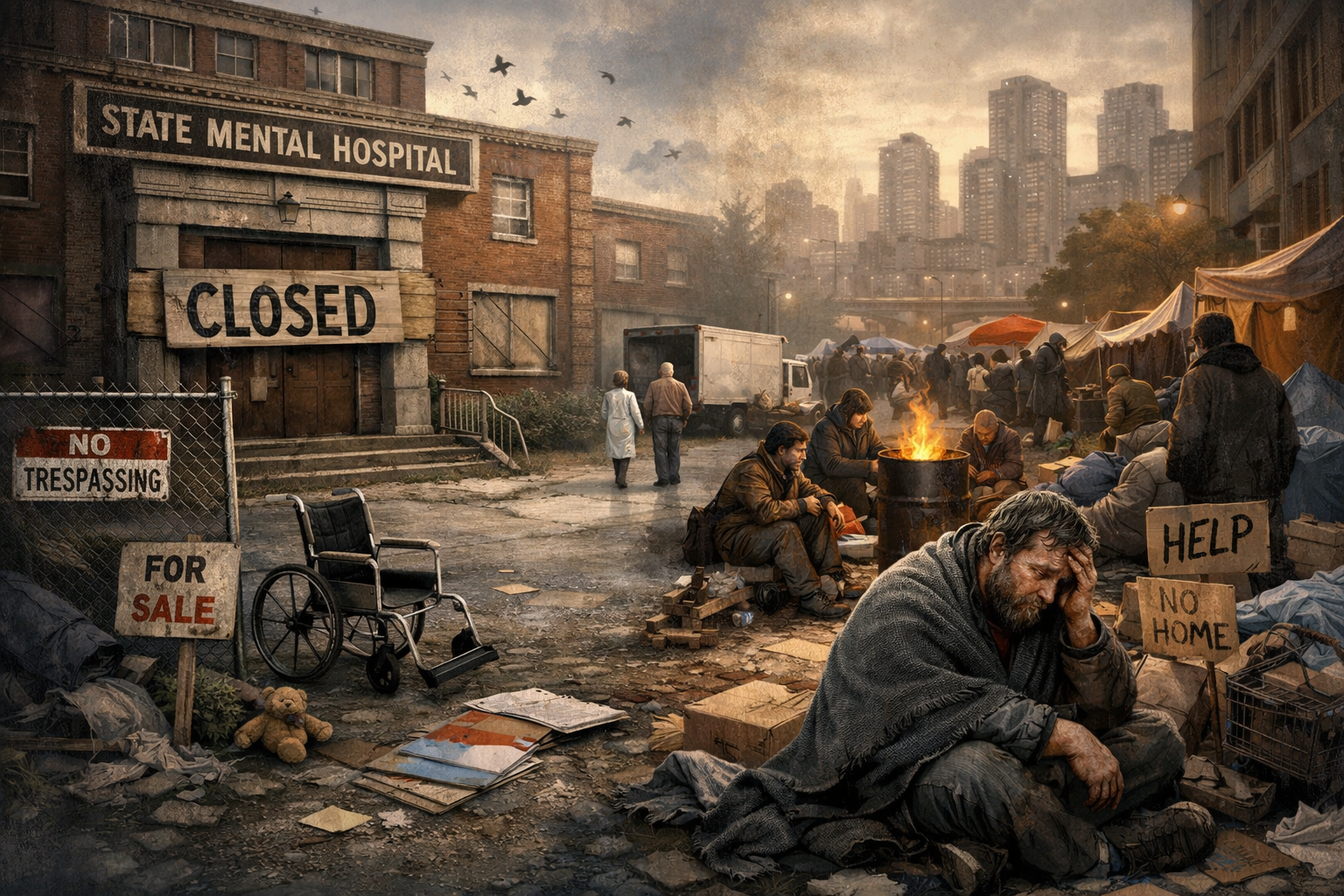
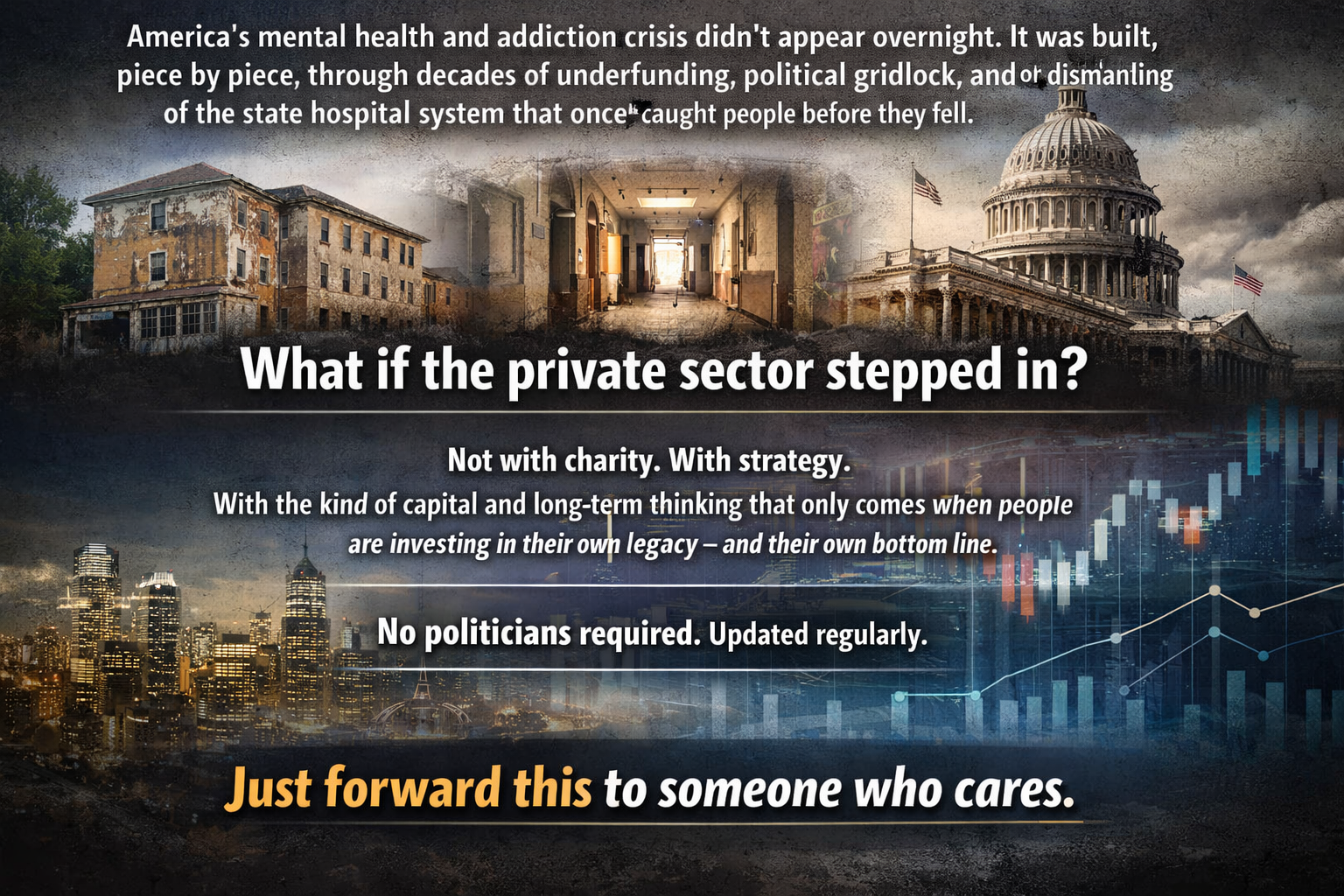
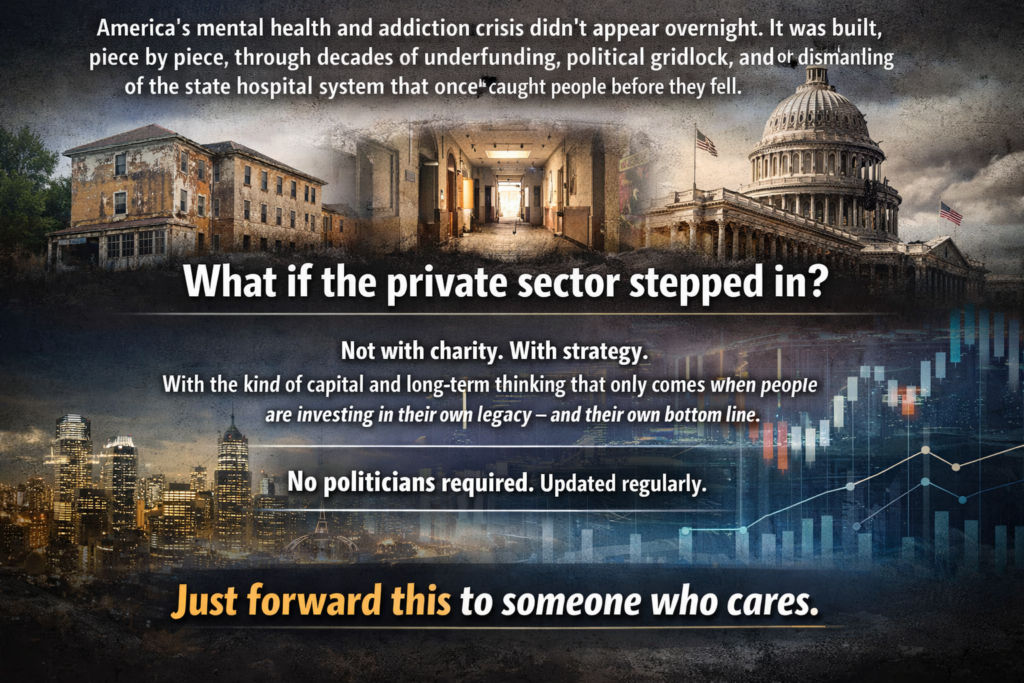
Adressing Mental Health – “A Practical Approach:”


A Practical Approach: When Something Obvious Isn’t Being Done

There’s a lot of noise right now.

Wars. Elections. Markets. Politics layered on top of politics. Everyone talking, few people listening. Most of it feels unstable. Most of it feels out of reach.

And maybe that’s part of the problem.

Because while we’re all focused on the big, complicated, unsolvable things… there are problems sitting right in front of us that aren’t complicated at all.

They’re just not being picked up.

Addiction treatment is one of them.

Not addiction in isolation—because addiction is often the visible problem. The root often lies in untreated or poorly managed mental health challenges. But addiction is treatable. It’s measurable. Interventions can work. And it’s where we can actually make a difference.

We see it everywhere. In cities, small towns, emergency rooms, police calls, families trying to hold together. People falling through the cracks of systems that were supposed to catch them.

We’ve known this for years. Studied it. Funded it. Debated it. Reframed it. Turned it into policy arguments, budget fights, election talking points.

And still—it sits there.

Not solved. Not improving in any meaningful, consistent way.

Just… managed.

Part of the reason is that we’ve treated it like a political problem. Something to be argued over. Something funded or defunded depending on who’s in charge. Something that shifts direction every few years without building real continuity.

But addiction doesn’t wait for elections. It doesn’t follow politics. And this doesn’t feel like a political problem anymore.

It feels like a systems problem.

Systems problems—when they’re clear enough—can be built differently.

This isn’t about overhauling healthcare. It’s not about rewriting insurance laws or building another layer of bureaucracy.

It’s simpler than that.

It’s about creating places where people can go when they’re not okay—and actually get help for the things we can treat.

Structured help. Humane help. Recovery-focused help.

Places designed from the beginning to focus on outcomes, not billing cycles. Where addiction is addressed alongside the underlying mental health context. Where accountability is measured by whether people stabilize, recover, and return to life with some form of independence.

Right now, we spend an extraordinary amount of time and energy reacting to crises after they’ve already spilled out.

Emergency response. Law enforcement. Crisis management.

All necessary. None designed to fix the root.

The quieter question is whether we’re willing to build something that works before people reach that point.

This isn’t impossible.

It’s neglected.

And sometimes the difference between the two is simply whether someone decides to pick it up.

Healthcare in America vs Socialized Medicine Today

Healthcare in America vs Socialized Medicine Today
Michael and Sarah Walker
Healthcare in America vs Socialized Medicine Today
Loading
/

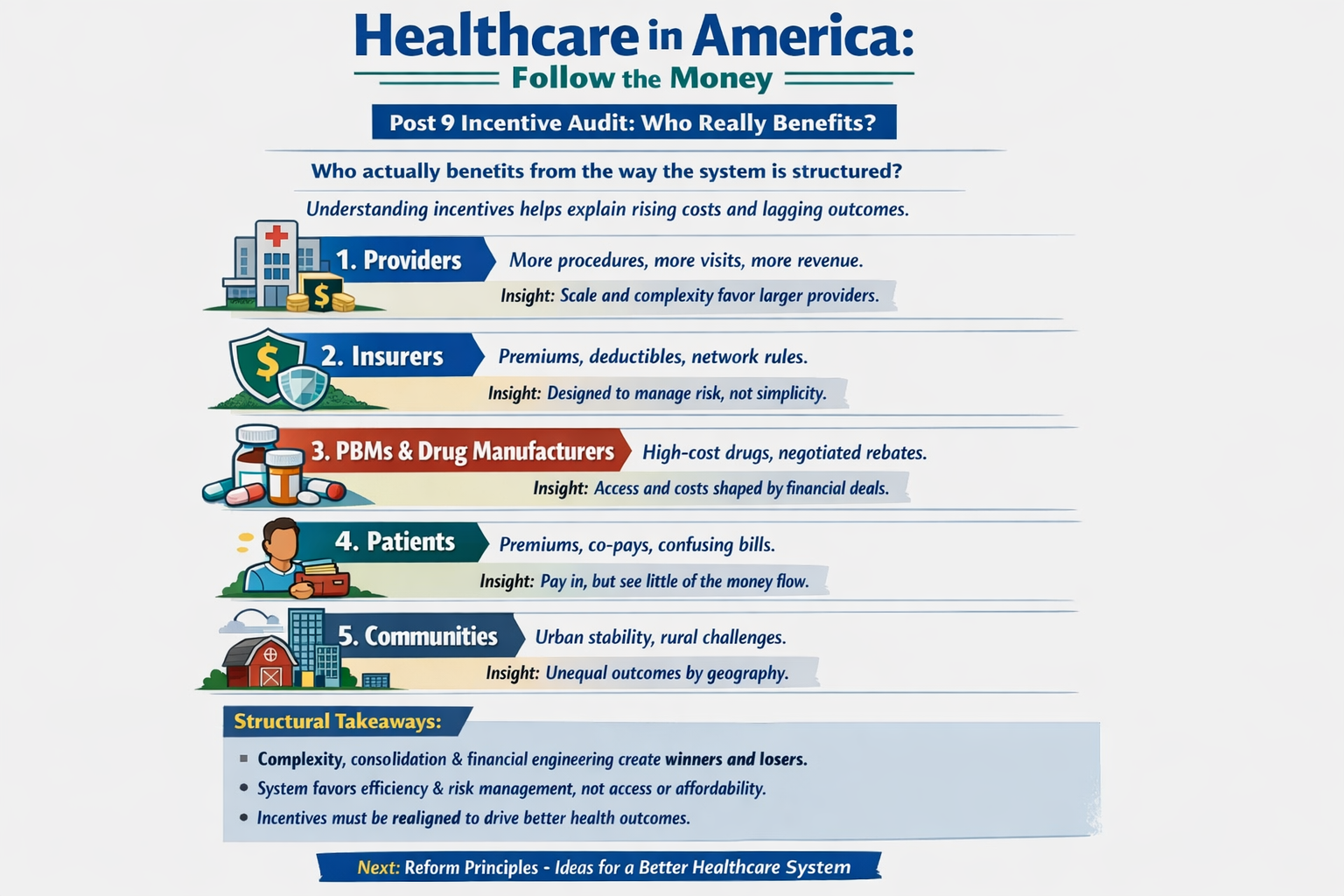
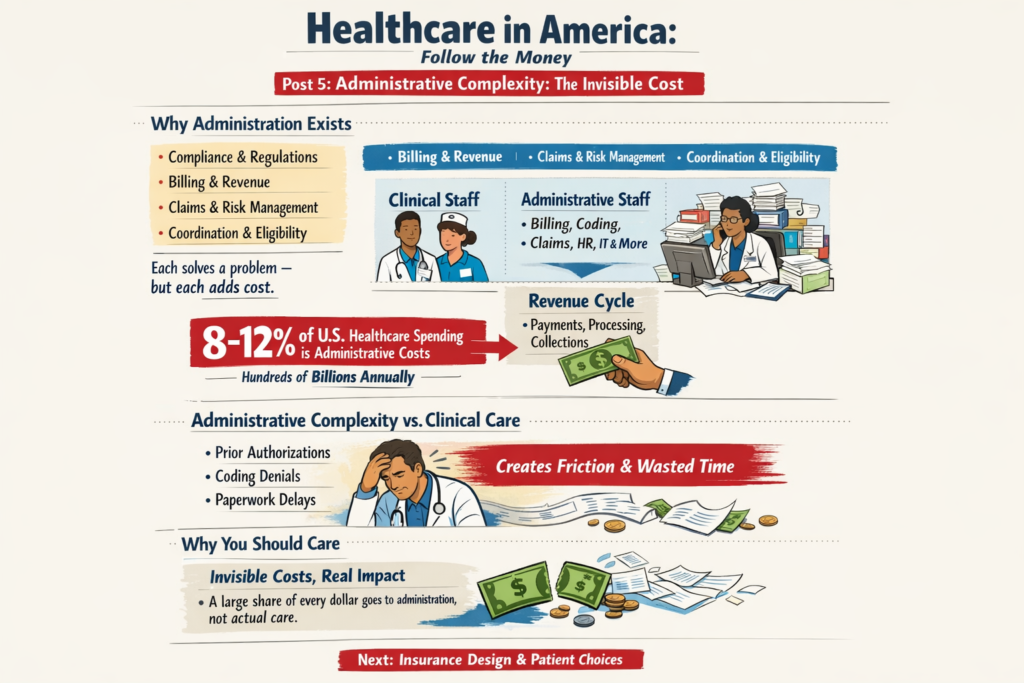
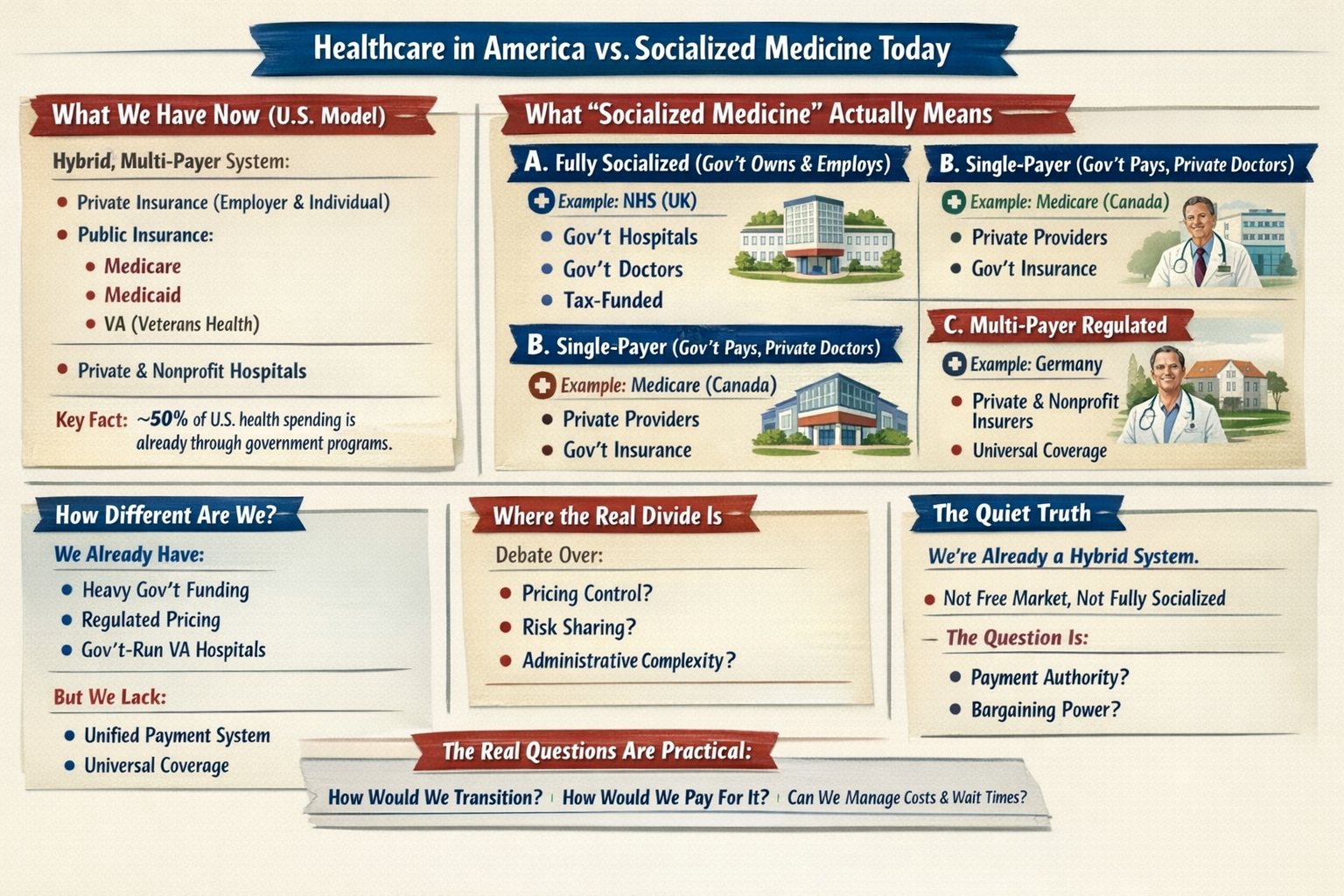
Roughly half or more of U.S. healthcare spending already flows through government programs. We are not a pure market system. We are a complex blend.

Youtube Playlist for Our Healthcare Series

Healthcare in America vs Socialized Medicine Today- End of Series

Healthcare in America vs Socialized Medicine Today

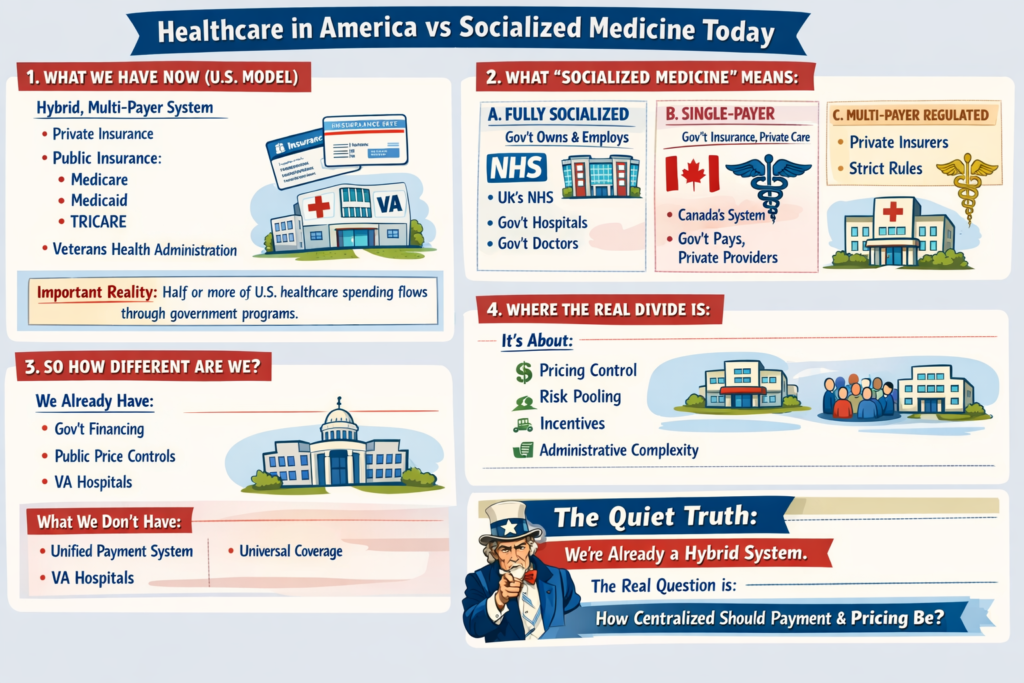
1. What We Have Now (U.S. Model)

The U.S. system is a hybrid, multi-payer system:

  • Private insurance (employer-based and individual market)

  • Public insurance:

    • Medicare

    • Medicaid

    • TRICARE

    • Veterans Health Administration

  • Private hospitals (mostly nonprofit, some for-profit)

  • Private physician practices (increasingly consolidated)

Important reality:

Roughly half or more of U.S. healthcare spending already flows through government programs. We are not a pure market system. We are a complex blend.

2. What “Socialized Medicine” Actually Means

People often use “socialized” loosely. There are actually three different models internationally:

A. Fully Socialized (Government Owns & Employs)

Example: National Health Service in the UK

  • Government owns hospitals

  • Doctors are government employees

  • Government sets budgets directly

  • Care funded through taxes

That’s true “socialized medicine.”

B. Single-Payer (Government Pays, Private Providers Deliver)

Example: Medicare (Canada’s system)

  • Private hospitals & doctors

  • Government is the main insurer

  • One public payment system

  • Funded via taxes

This is not government-run hospitals — it’s government-run insurance.

C. Multi-Payer Regulated System

Example: Statutory Health Insurance

  • Private and nonprofit insurers

  • Strict national rules

  • Price controls

  • Universal coverage mandate

3. So How Different Are We?

Structurally:

  • We already have heavy government financing.

  • We already regulate pricing in public programs.

  • We already operate large government-run care systems (VA hospitals).

  • We already subsidize private insurance through tax exclusions.

What we don’t have:

  • A unified payment structure

  • National price controls across the board

  • Universal automatic coverage

  • Simplified billing

The biggest structural difference isn’t just “who pays.”

It’s:

  • Fragmentation

  • Administrative layering

  • Pricing freedom in private markets

  • Employment-tied insurance

4. Where the Real Divide Is

The debate isn’t simply:

Private vs Socialized.

It’s about:

  • Who controls pricing?

  • How risk is pooled?

  • How incentives are aligned?

  • How much administrative complexity is tolerated?

Even a “socialized” system still rations care — just differently (wait times vs cost-sharing).

Even our current system has price controls — just unevenly applied.

5. If the U.S. “Moved Toward Socialized” — What Would Actually Change?

Not necessarily hospital ownership.

More likely changes would include:

  • Centralized bargaining power

  • Uniform reimbursement rates

  • Elimination of employer-based insurance

  • Tax-based funding instead of premium-based funding

  • Dramatically reduced administrative overhead

  • Reduced insurer role

The money flow changes.
The power centers shift.
Administrative structure simplifies.

But doctors would still practice medicine.
Hospitals would still exist.
Care would still be rationed — just through different mechanisms.

6. The Quiet Truth

We are already halfway between models.

The U.S. system is not a free market.
It is not socialized.
It is a layered hybrid with competing incentives.

The question isn’t:

“Would we become socialized?”

The real question is:

“How centralized do we want payment and pricing authority to be?”

That’s a structural debate — not just a funding debate.


To go deeper, we have to explore:

  • What would actually happen to costs?

  • What happens to innovation?

  • What happens to wait times?

  • Or what a realistic transition would look like?

The real questions aren’t ideological. They’re mechanical:
  • How do you unwind employer-based insurance?

  • What happens to 150+ million people currently covered through work?

  • How do you transition provider payment rates?

  • What happens to hospital revenue if Medicare rates become universal?

  • How do you fund it — payroll tax? VAT? income tax?

  • What happens to innovation incentives?

  • What happens to wait-time management?

  • What happens to administrative jobs?

  • How long would the transition take? 5 years? 10?

20260227 0847 Healthcare Systems Comparison simple compose 01kjfzx2nmeqjrt1pbawk9ew5r

Healthcare in America Structural Reform Playbook Post 6 Technology & Telehealth Optimization

Healthcare in America Structural Reform Playbook Post 6 Technology & Telehealth Optimization
Michael and Sarah Walker
Healthcare in America Structural Reform Playbook Post 6 Technology & Telehealth Optimization
Loading
/

When combined with oversight, transparency, and coordinated care, technology turns abstract reforms into real-world improvements that patients can see and feel.
The series shows that practical, achievable reforms exist, even without overhauling the entire system. Small, structural changes — applied thoughtfully — can reduce friction, preserve access, and improve outcomes.

Youtube Playlist for Our Healthcare Series

Healthcare in America Structural Reform Playbook Post 5 Rural & Underserved Access

Healthcare in America Structural Reform Playbook Post 5 Rural & Underserved Access
Michael and Sarah Walker
Healthcare in America Structural Reform Playbook Post 5 Rural & Underserved Access
Loading
/

Rural and underserved populations are canaries in the coal mine for healthcare stress. Structural interventions — not political promises — determine whether access is preserved.

Youtube Playlist for Our Healthcare Series

In America, we have No Kings. March 28 https://www.nokings.org/

In America, we have No Kings.

We are showing up together again on March 28.

When our families are under attack and costs are pushing people to the brink, silence is not an option. We will defend ourselves and our communities against this administration’s unjust and cruel acts of violence. America does not belong to strongmen, greedy billionaires, or those who rule through fear. It belongs to us, the people.

https://www.nokings.org/

3D3DKT0

Thank You, Mr. Trump: How Media Consolidation Is Accidentally Saving Journalism

There is something almost poetic about what is happening to the American media landscape right now. The more Donald Trump and his circle of oligarchs tighten their grip on mainstream media — CBS, NBC, ABC, Fox News, Newsmax, TikTok, X, Truth Social — the clearer the picture actually becomes. Not because the propaganda gets better. Because it gets easier to spot.

When everything runs through the same hands, when the same interests control the message, the narrative becomes so uniform, so coordinated, that a simple rule of thumb starts to apply: if they say up, look down. Consolidation, ironically, is doing the work that media criticism has failed to do for decades. It is teaching people to read between the lines.

The Migration Is Already Happening

Here is what you may not have noticed yet: the journalists you trusted are leaving.

They are not retiring. They are not giving up. They are moving to the internet — to podcasts, to Substack, to independent platforms where no one can call them into an office and tell them what story to kill. Think of voices like Dan Rather or Robert Reich, commentators with decades of credibility who no longer need a network’s permission to speak.

What you find when you go looking for them is something mainstream media stopped offering a long time ago: honest commentary from people who no longer have to answer to Jeff Bezos, Larry Ellison, or Donald Trump.

The Money Problem Nobody Wants to Talk About

There is a catch, and it would be dishonest to pretend otherwise. The internet does not come with a paycheck.

I know this firsthand. For over a year now, I have been doing this work — nearly full time. I am my own web designer. My graphic artist is AI and me. My research assistant is AI and me. And I have funded every bit of it out of my own pocket. I am not telling you this to ask for anything. I am telling you this because it is the reality facing most of the independent journalists you will find on platforms like Substack. They are doing it on their own dime, because they are journalists, and because they believe the work matters.

The lack of money is a problem without an easy answer. But it is also, in a strange way, a kind of protection. With money comes control. The moment someone else starts paying the bills, they start having opinions about the content.

How to Find the Truth — On Your Own Terms

I have not written off mainstream media entirely. I still check the headlines. I still scan the aggregators. And I have found that European media, in particular, often gives a clearer picture of what is actually happening here in the United States than our own outlets do. Distance has a way of sharpening perspective.

But if you want journalism that is working for you rather than for its owners, start looking around. Search out the independent voices. Find the podcasts. Read the Substacks. You will recognize good journalism when you find it — it will make you think, not just confirm what you already believe.

I will not tell you who to read or who to trust. That is your call to make.

Though obviously, you should start here. 😉

Images

Healthcare in America Structural Reform Playbook Post 4 Incentive Alignment for Prevention & Chronic Disease

Healthcare in America Structural Reform Playbook Post 4 Incentive Alignment for Prevention & Chronic Disease
Michael and Sarah Walker
Healthcare in America Structural Reform Playbook Post 4 Incentive Alignment for Prevention & Chronic Disease
Loading
/

Chronic disease drives the majority of U.S. healthcare costs. Managing it is not just a clinical challenge — it’s also a matter of incentives. Even small changes in how care is reimbursed or structured can produce better outcomes and lower costs.

Youtube Playlist for Our Healthcare Series

Process vs. Power: When the Courts Step Into Medicine

Process vs. Power: When the Courts Step Into Medicine

There are moments when a policy fight stops being about the policy itself.

This week, that moment arrived in American healthcare.

A federal judge blocked a sweeping effort by Health and Human Services Secretary Robert F. Kennedy Jr. to remake the nation’s vaccine advisory system—halting the dismissal of long-standing experts and the rapid installation of new appointees. The ruling did not declare winners or losers in the vaccine debate. It did something more fundamental.

It drew a line around process.

At the center of the dispute is the Advisory Committee on Immunization Practices, a body that quietly shapes how vaccines are recommended, covered, and distributed across the United States. Its work affects everything from pediatric care to insurance coverage to public health planning. It is not designed to be fast. It is designed to be deliberate.

That deliberateness is precisely what was disrupted.

The court found that the attempt to remove the committee’s members and replace them wholesale likely violated the legal framework governing such advisory bodies. More importantly, it concluded that established procedures—those slow, often frustrating guardrails—had been bypassed.

And that is where this story shifts.

Because this was never only about vaccines.

It is about whether complex medical policy can be reengineered through speed and authority, or whether it must remain anchored in systems built to resist exactly that kind of acceleration.

For months, public health experts warned what would happen if those systems were sidestepped. Replace institutional process with rapid overhaul, they said, and the result would not be clarity—it would be instability. Legal challenges would follow. Guidance would fracture. Trust, already strained, would erode further.

Those warnings are no longer theoretical.

The court’s intervention has now frozen key decisions, thrown advisory structures into uncertainty, and raised immediate questions about what guidance still stands. Programs that rely on stable recommendations—from insurance coverage mandates to childhood vaccination access—now face a period of ambiguity.

Even those who support reform are left with a difficult reality: a national health system cannot function cleanly when its underlying rules are in dispute.

There is a deeper tension here, one that extends beyond this case.

Americans are increasingly divided not just on outcomes, but on process itself. There is impatience with institutions, skepticism of expertise, and a growing belief that speed is a substitute for rigor. In that environment, the temptation to “just fix it” becomes powerful.

But systems like public health were never designed for speed.

They were designed for resilience.

The court’s decision does not resolve the broader debate over vaccines, nor does it attempt to. Instead, it reinforces a quieter principle: that how decisions are made still matters, especially when those decisions affect millions of people.

In the absence of that principle, every administration—left or right—would be free to rebuild critical systems in its own image, as quickly as it chooses.

That may feel efficient in the moment.

Until the next change comes just as fast.

What we are seeing now is not simply a legal pause. It is the system doing what it was built to do when pushed too far, too fast.

Slowing things down.

And in a healthcare system that touches every American life, that friction—however frustrating—may be the only thing preventing something far more unstable from taking its place.

Rfkjr and vacines

Healthcare in America Structural Reform Playbook Post 3 Integrated Care & Coordination

Healthcare in America Structural Reform Playbook Post 3 Integrated Care & Coordination
Michael and Sarah Walker
Healthcare in America Structural Reform Playbook Post 3 Integrated Care & Coordination
Loading
/

Integrated models — like Kaiser Permanente or other vertically coordinated systems — reduce these frictions by aligning care delivery, records, and financial flows.

Youtube Playlist for Our Healthcare Series

A Pivot Opportunity on America’s Mental Health Crisis – Redirecting Priorities from Endless War

Elon,You’ve already highlighted failures in mental health policy—deinstitutionalization left untreated severe cases on the streets, fueling homelessness, addiction, crime, and chaos (your “Make Asylums Great Again” posts in Feb 2026 nailed the critique of that 20th-century cost-cutting disaster). You’ve been open about personal struggles too (prescription ketamine for dark states, calling out “mental rabies” in violent offenders who need containment/treatment, not release).

The current hypocrisy is glaring and worsening: The Iran war (started late Feb 2026) is burning ~$1 billion/day (Pentagon briefed Congress on $11.3B+ in first 6 days; estimates now push $12–18B+ cumulative by mid-March, per CSIS/Reuters/NYT). That’s endless foreign escalation with no clear end, spiking gas prices and hurting Americans at home—while behavioral health funding gets squeezed (billions cut/reversed in SAMHSA grants under recent efficiencies).

A subtle distance from the current admin’s trajectory (less close proximity to avoid shrapnel from backlash) could open huge ground for you to lead on this domestically. Champion modern psychiatric treatment centers/recovery campuses (avoid “asylums” stigma—frame as humane, evidence-based facilities with safeguards, voluntary where possible, mandatory for severe threats). Tie it to protecting families/communities from exploitation, trauma, addiction cycles—subtly “shines” your image amid any lingering noise (e.g., old Epstein file smears).

Bring in Bezos, Zuckerberg, Ellison (Oracle) for a consortium: Announce an initial $19.5B fund (roughly 2–3 weeks of current war burn—people can do the math). Position it as:

  • Not replacing DEA street-level enforcement (that’s federal law job).

  • Funding treatment infrastructure: beds, crisis units, integrated SUD/mental health care, recovery housing, peer programs.

  • “Giving back”—this money originated from American taxpayers; redirecting a fraction to heal at home instead of endless abroad conflicts.

You have the platform (X), cash, and disruption cred to make this viral and bipartisan—addressing blue-city street crises and rural opioid/mental health gaps without heavy ideology. It aligns with your existing views, scales like your big missions, and could force national conversation/pressure for reallocations.

Worth considering? The timing (lame-duck dynamics, midterm/economic pain building) might be right.

No pressure—just an idea from a purple independent who’s tired of misplaced priorities.

@elonmusk – worth considering?

Healthcare in America Structural Reform Playbook Post 2 Price Transparency & Negotiation

Healthcare in America Structural Reform Playbook Post 2 Price Transparency & Negotiation
Michael and Sarah Walker
Healthcare in America Structural Reform Playbook Post 2 Price Transparency & Negotiation
Loading
/

Price transparency is not about “free market” ideology; it’s about clarity, fairness, and predictability. When patients see costs clearly, the system becomes easier to navigate — and wasteful practices are exposed.

Youtube Playlist for Our Healthcare Series

Healthcare in America Structural Reform Playbook Post 1 Administrative Oversight & Waste Reduction

Healthcare in America Structural Reform Playbook Post 1 Administrative Oversight & Waste Reduction
Michael and Sarah Walker
Healthcare in America Structural Reform Playbook Post 1 Administrative Oversight & Waste Reduction
Loading
/

Administrative tasks — billing, claims processing, coding, approvals — are necessary, but studies show U.S. administrative costs are roughly double those of comparable countries. That’s hundreds of billions of dollars each year that could be redirected toward actual care.

Youtube Playlist for Our Healthcare Series

Healthcare in America, Follow the Money Post 10 Reform Principles: Aligning the System

Healthcare in America, Follow the Money Post 10 Reform Principles: Aligning the System

We’ve traced the U.S. healthcare system from dollars to delivery, explored administrative complexity, chronic disease, and rural pressures, and analyzed incentives. Now the question becomes: what would a system look like if it aligned with outcomes rather than complexity?

This is not about ideology or politics. It’s about structure and function.

1. Simplification

  • Reduce unnecessary administrative layers.

  • Streamline claims, billing, and prior authorization processes.

  • Standardize coding and reporting where possible.

Goal: Money and effort should flow toward care, not paperwork.

2. Transparent Pricing

  • Make costs clear for patients, employers, and payers.

  • Standardize pricing across hospitals and providers where feasible.

  • Ensure out-of-network and surprise bills are minimized.

Goal: Reduce confusion, improve decision-making, and empower patients.

3. Incentive Alignment

  • Reward preventive care and long-term health outcomes rather than volume of procedures.

  • Align provider reimbursement with patient health metrics and chronic disease management.

  • Encourage insurers to focus on outcomes and accessibility rather than purely risk mitigation.

Goal: Make the system work for health, not just billing.

4. Rural Stabilization

  • Support small hospitals and critical access facilities with scalable administrative support.

  • Consider alternative models for staffing, telehealth, and regional collaboration.

  • Protect essential services even in low-volume communities.

Goal: Ensure equitable access regardless of geography.

5. Data-Driven Oversight

  • Use data to identify inefficiencies, high-cost drivers, and gaps in access.

  • Encourage transparency in spending and outcomes across all layers.

  • Support continuous improvement rather than static regulation.

Goal: Make evidence the foundation for policy and operational decisions.

6. Patient-Centered Design

  • Simplify insurance interactions.

  • Educate patients on coverage, preventive care, and cost implications.

  • Make navigation of care intuitive and friction-free.

Goal: Ensure patients experience the system as a service, not a puzzle.

Closing Insight

The U.S. healthcare system is enormous, expensive, and complex. But it is not irredeemable. By focusing on structure, transparency, and incentives, it is possible to reduce waste, improve access, and align resources with actual care.

The principles outlined here are nonpartisan and structural: they do not depend on ideology, politics, or personalities. They depend on understanding the machine and reshaping it to serve the people it was meant to help.

This completes the Follow the Money series:

  • Post 1: $4.5 Trillion Machine

  • Post 2: Who Actually Funds the Machine?

  • Post 3: Where the Money Goes

  • Post 4: Following the Dollar

  • Post 5: Administrative Complexity

  • Post 6: Insurance Design

  • Post 7: Chronic Disease

  • Post 8: Rural Healthcare & Consolidation

  • Post 9: Incentive Audit

  • Post 10: Reform Principles

20260227 0936 Image Generation simple compose 01kjg2pg1vf7hs80ej6yaxjkyd

Healthcare in America, Follow the Money Post 10 Reform Principles: Aligning the System

Healthcare in America, Follow the Money Post 10 Reform Principles Aligning the System
Michael and Sarah Walker
Healthcare in America, Follow the Money Post 10 Reform Principles: Aligning the System
Loading
/

The U.S. healthcare system is enormous, expensive, and complex. But it is not irredeemable. By focusing on structure, transparency, and incentives, it is possible to reduce waste, improve access, and align resources with actual care.
The principles outlined here are nonpartisan and structural: they do not depend on ideology, politics, or personalities. They depend on understanding the machine and reshaping it to serve the people it was meant to help.

Youtube Playlist for Our Healthcare Series

Healthcare in America, Follow the Money Post 9 Incentive Audit: Who Really Benefits?

Healthcare in America, Follow the Money Post 9 Incentive Audit Who Really Benefits
Michael and Sarah Walker
Healthcare in America, Follow the Money Post 9 Incentive Audit: Who Really Benefits?
Loading
/

Structural Takeaways
Complexity, consolidation, and financial engineering create winners and losers.
The system works for efficiency and risk management, but not always for access, affordability, or simplicity.
Understanding incentives is essential before discussing reform: any solution must realign motivations, not just cut costs.

Youtube Playlist for Our Healthcare Series

Healthcare in America, Follow the Money Post 8 Rural Healthcare & Consolidation: When the Machine Strains

Healthcare in America, Follow the Money Post 8 Rural Healthcare & Consolidation When the Machine Strains
Michael and Sarah Walker
Healthcare in America, Follow the Money Post 8 Rural Healthcare & Consolidation: When the Machine Strains
Loading
/

Even when care is “available” virtually, the real-world friction remains: long travel times, delayed treatment, and fragmented services.

Youtube Playlist for Our Healthcare Series

Healthcare in America, Follow the Money Post 7 Chronic Disease: The Real Cost Driver

Healthcare in America, Follow the Money Post 7 Chronic Disease The Real Cost Driver
Michael and Sarah Walker
Healthcare in America, Follow the Money Post 7 Chronic Disease: The Real Cost Driver
Loading
/

“The machine isn’t broken because of greed. It’s stressed because of chronic demand and misaligned incentives.”

Youtube Playlist for Our Healthcare Series

Healthcare in America, Follow the Money Post 6 Insurance Design: Why It Feels Complicated

Healthcare in America, Follow the Money Post 6 Insurance Design Why It Feels Complicated
Michael and Sarah Walker
Healthcare in America, Follow the Money Post 6 Insurance Design: Why It Feels Complicated
Loading
/

Network design can be narrow, meaning that not every local provider is covered. This protects insurers from excessive risk but can frustrate patients who assume all doctors are treated equally under their plan.

Youtube Playlist for Our Healthcare Series

Healthcare in America, Follow the Money Post 5 Administrative Complexity: The Invisible Cost

Healthcare in America, Follow the Money Post 5 Administrative Complexity The Invisible Cost
Michael and Sarah Walker
Healthcare in America, Follow the Money Post 5 Administrative Complexity: The Invisible Cost
Loading
/

Administrative complexity is invisible to most patients. You see your bills, your deductible, your co-pay — but rarely the thousands of small interactions behind them.

Youtube Playlist for Our Healthcare Series

Healthcare in America, Follow the Money Post 4 Following the Dollar

Healthcare in America Structural Reform Playbook Post 4 Incentive Alignment for Prevention & Chronic Disease
Michael and Sarah Walker
Healthcare in America, Follow the Money Post 4 Following the Dollar
Loading
/

Even here, the dollar is split: part covers the premium contribution from the employee, part comes from the employer’s share. Often, employees never see this money — it’s folded into total compensation.
This means the same dollar has been contributed multiple times: first through the paycheck, then through taxes (if federal programs subsidize care), and again at the point of service.

Youtube Playlist for Our Healthcare Series

Healthcare in America, Follow the Money Post 3 Where the Money Goes

Healthcare in America, Follow the Money Post 3 Where the Money Goes
Michael and Sarah Walker
Healthcare in America, Follow the Money Post 3 Where the Money Goes
Loading
/

Price negotiation occurs through insurers and pharmacy benefit managers, but patients often experience unpredictability in costs, especially for high-cost or specialty medications.

Youtube Playlist for Our Healthcare Series

Healthcare in America, Follow the Money Post 2 Who Actually Funds the Machine?

Healthcare in America, Follow the Money Post 2 Who Actually Funds the Machine
Michael and Sarah Walker
Healthcare in America, Follow the Money Post 2 Who Actually Funds the Machine?
Loading
/

Employers contribute a significant portion of the premium, but economists generally agree those costs are built into total compensation. In practical terms, health insurance premiums come out of wages — whether workers see the deduction directly or not.
When premiums rise, wage growth slows.

Youtube Playlist for Our Healthcare Series

Healthcare in America, Follow the Money Post 1 The $4.5 Trillion Machine

Healthcare in America, Follow the Money Post 1 The $4.5 Trillion Machine
Michael and Sarah Walker
Healthcare in America, Follow the Money Post 1 The $4.5 Trillion Machine
Loading
/

American healthcare is not a single program. It is a layered payment network built over decades — employers, insurers, federal programs, state programs, hospital systems, physician groups, pharmacy benefit managers, pharmaceutical manufacturers, compliance divisions, coding departments, billing contractors, and regulators — all interacting at once.

Youtube Playlist for Our Healthcare Series

Healthcare in America Series III – Kicker: Security Is a Feeling. Risk Is a Structure

Healthcare in America Series III Part 3 When Risk Accumulates
Michael and Sarah Walker
Healthcare in America Series III - Kicker: Security Is a Feeling. Risk Is a Structure
Loading
/

Healthcare debates often center on security. People want to feel protected — protected from catastrophic illness, from unexpected bills, from system failure. That desire is reasonable. It is human.

Youtube Playlist for Our Healthcare Series

Healthcare in America Series III – Part 3 When Risk Accumulates

Healthcare in America Series III Part 3 When Risk Accumulates
Michael and Sarah Walker
Healthcare in America Series III - Part 3 When Risk Accumulates
Loading
/

At the community level, accumulation can reshape access entirely. When a hospital closes, travel times increase. Emergency response lengthens. Recruitment of clinicians becomes more difficult. Economic stability shifts. Healthcare infrastructure is not separate from community infrastructure — it is intertwined with it.

Youtube Playlist for Our Healthcare Series

Healthcare in America Series III – Part 2 Invisible Risk Carriers

Healthcare in America Series III Part 2 Invisible Risk Carriers
Michael and Sarah Walker
Healthcare in America Series III - Part 2 Invisible Risk Carriers
Loading
/

Clinical risk is inherent in medicine. But modern practice also carries moral and structural risk. Practicing under constraint — limited time, limited staffing, insurance limitations, documentation demands — forces tradeoffs. Liability exposure exists alongside ethical strain. Burnout, in this context, is not simply fatigue. It is accumulated tension between professional obligation and structural limitation.

Youtube Playlist for Our Healthcare Series

Healthcare in America Series III – Part 1 Risk Doesn’t Disappear. It Moves

Healthcare in America Series III Part 1 Risk Doesn’t Disappear. It Moves
Michael and Sarah Walker
Healthcare in America Series III - Part 1 Risk Doesn’t Disappear. It Moves
Loading
/

Which setting is appropriate?
How urgent is urgent?
Who coordinates what happens next?
These expectations exist — but the instruction rarely does.

Youtube Playlist for Our Healthcare Series

Christian nationalism isn’t really about Christianity at al

Alisa Valdes-Rodriguez recently argued on her Substack that Democrats chasing religious voters are missing the point entirely. She’s right, and the reasons go deeper than most people realize.

Christian nationalism isn’t really about Christianity at all. At its root, it’s about tribe: white, native-born, conservative Protestant identity under siege. The scholars who study it (people like Philip Gorski and Samuel Perry) are clear: this isn’t a theological movement you can talk or preach someone out of. It’s loyalty to a group defined by race, grievance, and the feeling that their way of life is being erased. Social science has shown for decades that when a group feels attacked, waving their symbols back at them doesn’t convert anyone. It just feels like invasion. They dig in harder.

That’s why the old Democratic playbook of trying to out-Jesus the right in places like Texas keeps failing. The consultants are still chasing an older, whiter, more church-going version of the state that is literally shrinking every year. Meanwhile the actual Texas, younger, browner, more urban, more secular, is being ignored. Religiosity is dropping fast nationwide, especially among the generations driving Texas’s growth. One in four Texans is under 18. The future isn’t waiting for a moderate white candidate to sound more pious.

And here’s the tell: if Republicans truly owned Texas the way the maps pretend, they wouldn’t have had to redraw congressional districts mid-decade in 2025, surgically cracking Latino and Black neighborhoods and packing them into as few seats as possible. You only gerrymander that aggressively when you’re terrified the real electorate is slipping away. Real Texas, majority nonwhite, increasingly independent, tired of a rigged system, doesn’t need pandering. It needs policies that treat its existence as fact, not a problem to be diluted. The GOP knows exactly who that Texas is. That’s why they keep changing the rules.

Georgia just showed what happens when Democrats stop chasing ghosts and start talking to the people actually in front of them. In November 2025, two Democrats swept statewide elections to Georgia’s Public Service Commission, flipping seats Republicans had held for nearly two decades and winning nearly 63% of the vote. They didn’t run on culture war counterattacks or carefully triangulated faith messaging. They ran on electricity bills. On the audacity of a utility company raising rates while its shareholders cashed in. On the basic idea that a regulatory body should regulate for people, not for Georgia Power.

And an even bigger upset is Democrat Shawn Harris’s lead to take Marjorie Taylor Greene’s seat, Harris who is leading the GOP candidate’ Fuller could very well add one more Democrat prior to the 2026 Midterms.

The results were read, even by Republican strategists on the ground, as less anti-Republican than anti-incumbent, a signal that voters are furious about grocery prices, housing costs, and energy bills, and will vote for whoever seems to take that fury seriously. That’s not a narrow opening. That’s a door standing wide open.

The Democrats flipped 22 counties that had voted for Donald Trump in 2024, not by persuading those voters to abandon their cultural identity, but by giving them something concrete to vote for. The tribe instinct is real, but it has a threshold. When the lights cost too much and nobody in power seems to care, people will cross it.

This is the playbook Democrats keep forgetting they have. Not the one written around finding the right white moderate who can quote scripture without wincing. The one built around material conditions, the cost of staying alive in the place you live. It doesn’t require anyone to abandon their identity. It just requires a party to show up and say: the people running this system are getting rich while you fall behind, and we’re going to make that stop.

Texas is the long game. The demographics are real, the gerrymandering proves the GOP knows it, and the question is whether Democrats will organize around the electorate that exists rather than the one their consultants remember. Georgia is the proof of concept: a red state, a low-turnout race, a utilitarian message, and a landslide.

But templates only travel if someone picks them up. And that’s where the Democratic Party keeps losing the thread. The Georgia win didn’t happen because a national committee handed down a strategy. It happened because two candidates decided to talk about something real and voters responded. The problem isn’t that Democrats lack a message. It’s that no one seems authorized to carry it everywhere, not just in the districts where winning already feels possible.

The GOP has a unified voice. You can agree with it or despise it, but you always know what it is. Democrats keep waiting for permission to find theirs. That’s not a messaging problem. That’s a leadership problem, and until the party decides to solve it, Georgia stays an asterisk instead of becoming a blueprint.

The party doesn’t need a new theology. It needs someone willing to say the same true thing in everywhere and mean it every time.

This piece was inspired by Alisa Valdes-Rodriguez’s essay “No, Jesus Won’t Save the Democratic Party” on her Substack, Alisa Writes.

20260312 1124 Image Generation simple compose 01kkhmmt6ef669v4cda5s3hp71

Healthcare in America, Follow the Money Post 9 Incentive Audit: Who Really Benefits?

Healthcare in America, Follow the Money Post 9 Incentive Audit: Who Really Benefits?

Protecting Your Voting Rights

Protecting voting rights is a fundamental aspect of American democracy, and your concern about potential executive overreach is valid given recent reports. While presidents have issued executive orders related to elections in the past, they don’t have unilateral authority to control how states run them, elections are primarily a state responsibility under the Constitution (Article I, Section 4), with Congress able to set or alter regulations for federal races. Any attempt to impose sweeping changes via executive order, especially if premised on unsubstantiated claims like foreign interference from past elections, would likely face immediate legal challenges and injunctions from federal courts, as happened with a similar order in March 2025.

Courts have repeatedly affirmed that such actions can’t override constitutional limits or state authority without clear statutory backing.

That said, litigation can take time, so proactive steps are key to safeguarding access to the ballot. Here’s what individuals and communities can do, based on established strategies from voting rights organizations:1. Stay Informed and Monitor Changes

Follow reliable sources for updates on election laws and any proposed executive actions. Organizations like the ACLU, Brennan Center for Justice, and League of Women Voters track voter suppression efforts and provide alerts.
Sign up for their newsletters or use tools like the Election Assistance Commission’s (EAC) website to check your state’s rules.

Track bills in Congress, such as efforts to restore the full protections of the Voting Rights Act of 1965 (e.g., the John R. Lewis Voting Rights Advancement Act), which could counter discriminatory changes.

The Act’s preclearance provision historically required federal approval for changes in states with discrimination histories, though it was weakened by the Supreme Court in 2013.

2. Register, Vote, and Help Others Do the Same

Ensure you’re registered and update your information if needed—use the National Voter Registration Act (NVRA) provisions, which allow registration at DMVs or online in many states.
Encourage friends, family, and neighbors to register early to avoid last-minute barriers.
Vote in every election, including primaries and locals, where turnout can influence who shapes voting rules. If mail voting or early voting is available in your state, use it to reduce reliance on Election Day logistics that could be disrupted.

Know your rights: Federal laws like the Voting Rights Act prohibit discrimination based on race, color, or language, and the Help America Vote Act (HAVA) ensures provisional ballots if your eligibility is questioned. If you face issues at the polls (e.g., intimidation or denial), report them immediately to the DOJ’s Voting Section or the Election Protection Hotline (866-OUR-VOTE).

3. Support Advocacy and Legal Efforts
Donate to or volunteer with groups fighting voter suppression, such as the NAACP Legal Defense Fund, Common Cause, or the Brennan Center. They file lawsuits to block unlawful changes and have successfully challenged past executive orders.

For instance, multiple courts blocked key parts of the 2025 election integrity order.

Push for state-level Voting Rights Acts, which some states have adopted to fill gaps left by federal weakenings.

Contact your state legislators to advocate for expansions like automatic voter registration or protections against purges.

4. Engage Civically and Build Community

Contact your members of Congress to oppose bills like the SAVE America Act if they create unnecessary barriers (e.g., strict proof-of-citizenship requirements), and support reforms like the Freedom to Vote Act for national standards on early voting and mail ballots.

Volunteer as a poll worker, watcher, or nonpartisan monitor through groups like the EAC or local election boards. This helps ensure transparency and can deter irregularities.
Join or form community groups to educate others—host voter registration drives or workshops on recognizing misinformation about elections.

5. Prepare for Potential Challenges
If an executive order is issued attempting to mandate things like nationwide voter ID, bans on mail voting, or federal oversight of state systems, expect rapid court action.

Advocacy groups are already poised to challenge them, arguing they exceed presidential authority and violate states’ rights.

In the meantime, focus on state-level protections, as federal overreach often gets enjoined quickly.

Document and report any suspicious activity, like voter purges or intimidation, to the FBI or state attorneys general.
Ultimately, the strongest defense is high participation and collective action—history shows that when voters mobilize, attempts to restrict access often fail. If things escalate, resources like the DOJ’s Civil Rights Division can provide enforcement.

Stay engaged, and remember that protections like the 14th, 15th, and 19th Amendments provide a solid foundation against discrimination.

20260227 1538 Image Generation simple compose 01kjgqdwssfdtrr9cs1f1w4ghs

The GOAT Strategy

GOAT.

Not Greatest of All Time.
In today’s political environment it might stand for something else entirely:

Got Old And Tired.

You can see it in small ways. A guy standing in line at the grocery store, flipping through headlines on his phone. War somewhere. Another scandal somewhere else. Another political fight lighting up the television.

He sighs, shrugs, and tosses a short case of Bud into the cart.

That seems to be the condition a lot of Americans have reached. Not angry. Not shocked. Not even surprised anymore.

Just tired.

Take the latest swirl of stories surrounding Jeffrey Epstein’s Zorro Ranch in New Mexico. Investigations are reopening. Allegations are resurfacing. Independent writers like Alisa Valdes-Rodriguez are digging through records and asking uncomfortable questions about who knew what and when.

Some of the claims are explosive. Some may prove wrong. Some may eventually prove true.

But the reaction from much of the public seems strangely muted.

Ten years ago, allegations involving a powerful financier, trafficking networks, wealthy associates, and political connections would have dominated the national conversation. Today the reaction often feels more like a shrug.

“Yeah? And?”

That’s the part that should concern us.

Because the pattern isn’t limited to Epstein.

Watch the way the political conversation moves now. One day the talk is about confronting Iran and removing its leadership. Reality intervenes — the military cost, the geopolitical consequences, the pushback from advisers. Within days the focus shifts somewhere else. Now we’re talking about Cuba. Tomorrow it will be something different again.

The story never really ends. It just…moves.

Iran. Cuba. Epstein. Immigration. War. Elections. Economic crisis. Another scandal. Another outrage. Another headline.

And the public tries to keep up.

But human beings aren’t designed to process a dozen national crises every week. Eventually the brain does what it has to do to survive: it tunes out.

Political strategists understand something important about the modern media environment. You don’t necessarily have to convince people you’re right. You don’t even have to win every argument.

Sometimes it’s enough to simply flood the zone.

And to be fair, politicians aren’t the only ones feeding the machine. Cable news needs constant conflict. Social media rewards outrage. Every platform is fighting for attention in a 24-hour cycle that never slows down.

The result is the same: a national conversation that moves faster than any citizen can realistically follow.

If the information stream becomes chaotic enough—if the scandals pile up fast enough, if the accusations are constant enough—people eventually reach a kind of emotional overload. They stop trying to sort truth from exaggeration. They stop trying to follow every thread.

They get tired.

GOAT.

Got Old And Tired.

When that happens, accountability weakens. Not because people approve of what’s happening, but because they no longer have the energy to chase every new controversy.

And maybe that’s the real strategy.

Not persuasion.

Exhaustion.

Keep the stories coming fast enough and messy enough, and the public eventually shrugs and goes back to everyday life. Work. Bills. Kids. Groceries. The ordinary things that actually matter in people’s lives.

“War again?”

“We’re getting screwed again?”

“What’s new.”

While you’re at the store, pick up another short case of Bud.

Because at some point, a lot of Americans have simply decided they can’t keep up anymore.

They didn’t stop caring.

They just got old and tired.

And the day a country stops paying attention may be the day the people running it stop worrying about what the public thinks.

GOAT.

20260310 0852 Image Generation simple compose 01kkc75gmrecss9qcg4vnp28hg

Healthcare in America, Follow the Money Post 5 Administrative Complexity: The Invisible Cost

Healthcare in America, Follow the Money Post 5 Administrative Complexity: The Invisible Cost

American healthcare is enormous. We’ve seen who pays and where the money goes, and even traced a single dollar through the system. Now let’s examine one of the largest, least visible drivers of cost: administration.

Why Administration Exists

No single entity is “to blame.” Administrative layers exist because:

  • Compliance requirements: Hospitals and insurers must follow federal, state, and local regulations.

  • Revenue protection: Providers need billing, coding, and collections departments.

  • Risk management: Insurers need claims review, denials, and appeals processing.

  • Coordination: Multiple payers, network contracts, and patient eligibility require staff to manage flow.

Each of these layers solves a problem — but each also adds cost.

How It Breaks Down

Consider a typical hospital:

  • Clinical staff: Doctors, nurses, therapists — directly delivering care

  • Administrative staff: Billing, coding, claims review, human resources, IT, compliance, legal

  • Revenue cycle management: Collecting, processing, and reconciling payments from insurers and patients

In the United States, administrative costs account for roughly 8–12% of total healthcare spending. That’s hundreds of billions of dollars annually — roughly double what similar countries spend.

Doctors spend more time on paperwork than in almost any other system. Nurses and support staff spend hours on documentation and prior authorizations.

This is why physicians burn out and hospitals struggle with margins, even when they are busy providing care.

Administrative Complexity vs. Clinical Care

The problem isn’t just cost. It’s friction.

  • Prior authorizations delay treatment.

  • Coding errors trigger denials.

  • Complex claims systems confuse patients.

Every layer of administration increases time, effort, and uncertainty for everyone: providers, payers, and patients.

In other words, money spent on administration doesn’t directly improve outcomes, yet it is essential to keep the machine functioning.

Why You Should Care

Administrative complexity is invisible to most patients. You see your bills, your deductible, your co-pay — but rarely the thousands of small interactions behind them.

Following the dollar in the previous post, you now understand: a significant portion of each premium and tax dollar never touches clinical care. It’s diverted to manage, track, and control the system.

This is the first clear point where incentives collide with outcomes: the machine works, but it also imposes invisible costs that no one directly sees.

Transition
Next, we’ll examine insurance design, where financial engineering meets patient experience. This is where the system’s complexity begins to influence behavior, choices, and ultimately, cost.

20260226 1110 Invisible Healthcare Costs simple compose 01kjdnpxmve0hv1j5e0xhaw2nq

To The United States Congress – Thirty eight words

I posted this on Thursday the 3rd of March, I actually had HOPE, sadly, I don’t anymore. I feel very disappointed.

It’s easier to shoot an ostrich in the ass when his head is in the sand.

Hiding doesn’t change anything. He attacks anyway — friends, allies, members of his own party, people who have given him everything he asked for and more. That isn’t strategy or politics. That’s just who he is. You have exactly as much control over that as you think you do, which is none. What you do have control over is what happens when he does. Or better yet, whether it happens at all.

You took an oath. Thirty eight words. You said them out loud, probably with your hand raised and people you love watching. They weren’t complicated words. They didn’t leave much room for interpretation. They asked one thing of you — that you defend the Constitution of the United States against all enemies, foreign and domestic. Not your party. Not your president. Not your seat.

Six of your colleagues said the same words and then actually meant them. You watched what happened to them. And you learned the wrong lesson.

What you are protecting today is no longer a political ideology, however you felt about it. It is no longer a movement, whatever you believed it stood for. What sits in the Oval Office today is a sick, confused, aging man who is being carefully managed and manipulated by people you did not elect, whose names most Americans couldn’t tell you, and whose interests have never once aligned with the people who sent you to Washington.

They need his signature. They need his office. They need his name on things they could never have accomplished through a democracy that was functioning the way it was designed to. And they need you to keep your head in the sand while they get it done.

The people paying for this are not abstractions. They are the people who pulled a lever with your name on it. They are paying it in healthcare they can’t afford, in sons and daughters being sent to wars that serve other nations’ interests, in votes that are being systematically made harder to cast, in rights that are quietly being converted from guarantees into privileges. They are paying for it every single day while the deliberate looking away continues.

There is a version of this moment that history will record with something close to understanding. People were afraid. The pressure was real. The threats were not empty. It was a difficult time and some people made difficult choices.

But that version requires that someone, eventually, did something. That the fear had a limit. That the oath turned out to mean something after all.

Right now that version is not being written.

You came to Washington for a reason. Maybe it was noble. Maybe it was ambition. Maybe somewhere in between, which is honest enough. But the benefits of the office, the security, the pension, the car, the title — none of that was the reason the job exists.

The job exists because somebody has to stand between the people and the abuse of power.

That’s it. That’s the whole job.

Thirty eight words.

So far, for most of you, it turns out that was just something you said out loud while people you love were watching.

History is watching too. And unlike your constituents, it doesn’t forget and it doesn’t forgive.

The only question left is what you do tomorrow morning.

20260303 1202 Image Generation simple compose 01kjtmpe3be8cbhr7fywjg2z7r

Healthcare in America, Follow the Money Post 3 Where the Money Goes

Healthcare in America, Follow the Money, Post 3, Where the Money Goes

Knowing who pays is only the start. To understand the system, we need to see where those dollars actually land.

The $4.5 trillion flowing into healthcare doesn’t go to one place. It is split across several major buckets, each with its own dynamics and incentives.

1. Hospitals — Roughly 30–35% of Spending

Hospitals are the single largest cost center.

  • Inpatient care: surgeries, ICU, long stays

  • Outpatient care: ER visits, imaging, labs, procedures

  • Facility costs: building, equipment, administration

Hospitals are complex organizations:

  • Clinical staff

  • Administrative staff

  • Compliance, IT, revenue cycle management

Every additional layer adds cost, even if it doesn’t touch patient care directly.

2. Physicians & Clinicians — About 20%

Doctors, nurses, and other clinicians account for roughly one-fifth of total spending.

  • Compensation varies widely by specialty

  • Fee-for-service models often reward procedures over preventive care

Here, incentives shape behavior: more complex, billable procedures generate revenue, while counseling or preventive care may not.

3. Prescription Drugs — 10–15%

Prescription spending includes:

  • Branded drugs

  • Generics

  • Specialty medications

Price negotiation occurs through insurers and pharmacy benefit managers, but patients often experience unpredictability in costs, especially for high-cost or specialty medications.

4. Administrative & Billing Costs — 8–12%

One of the largest invisible drivers of cost:

  • Claims processing

  • Coding

  • Prior authorizations

  • Billing disputes

Studies show U.S. administrative costs are twice those of comparable countries, yet they do not directly improve patient care.

5. Long-Term & Post-Acute Care — 5–10%

Includes:

  • Nursing homes

  • Rehab facilities

  • Home health care

Population aging and chronic disease prevalence drive spending in this area.

6. Other Services & Public Health

The remainder covers:

  • Preventive care

  • Public health initiatives

  • Mental health services

  • Emergency preparedness

Small individually, but collectively essential.

Structural Insight

Looking at the buckets, one pattern emerges: complexity drives cost.

  • Hospitals and physician care dominate, but are themselves entangled with administrative and billing layers.

  • Drugs and specialized services add unpredictability.

  • Individuals and payers have little visibility into total flow.

The next step is tracing the flow of a single dollar — from paycheck to provider — to make the system tangible. That’s where things get almost counterintuitive, and where the first real tension appears between intention and outcome.

20260226 0959 Healthcare Spending Breakdown simple compose 01kjdhn1xdf4w9qcxt49df0x56

I Get It

Plato may be right. All democracies will fail. But I don’t think now’s the time.

When looked at from a distance, we can see the arc of almost anything. Civilizations, movements, ideas. The beginning and the end become visible, like a landscape from altitude. But the closer we get, the more the timeline shifts and blurs. The ending moves around. Why would that be? Maybe because philosophies and people don’t always work hand in hand.

Ideas are clean. People are not.

I have been around long enough to have stood in a few crowds, carried a few convictions, and watched more than one cause rise and fade. Through all of it, every march, every movement, every upheaval, there has always been a placard somewhere in the crowd that read some version of the same thing: Power to the people.

We both know that’s a catch phrase. It always has been. But here’s the thing about catch phrases. The good ones survive because they point at something real, even when nobody’s delivering it. The illusion has to be maintained because somewhere underneath it is a truth people can feel even when they can’t see it.

That truth is this. The closest thing to actual power most of us will ever hold is a vote and a voice. That’s it. That’s the whole arsenal. It isn’t much, until enough people pick it up at the same time.

But neither of those things work if we stop using them. And they stop working in a different way when we use them without thinking. When we vote the way we’re told to vote, believe what we’re told to believe, and accept what we’re told to accept.

Independent thought has always been the first casualty of concentrated power. Not because the people are stupid. They never are. But because every system, in every era, has had a quiet interest in discouraging it. It is easier to lead people who have already decided what they think. Easier still to lead people who believe that what they think, they arrived at on their own.

We live under a democracy, a republic if you want to be precise about it. Living under it comes with benefits most of us have stopped noticing, the way you stop noticing a foundation until it cracks. But those benefits have never been free. They have always cost something. The people who built this thing paid for it. The people who saved it, more than once, paid for it. And the people who will determine whether it survives this particular moment in its timeline will pay for it too.

The question isn’t whether you’re willing to believe in it.

The question is whether you’re willing to stop accepting the illusion in place of the real thing, and what you’re prepared to do about it.

That’s always been the question. It just hasn’t always been this urgent.

20260302 0846 Image Generation simple compose 01kjqq3dhbewmaqdrrmxxqbd89

Dark Money Today: From Montana to California and Beyond

Dark Money Today: From Montana to California and Beyond

Two months ago, we explored the Montana initiative as a test case for curbing dark money. The story didn’t end there. Today, states like California are building on that example, showing that structural solutions — not just outrage — can reshape the rules of political influence.

The Current Landscape

Hidden political spending remains a major driver of elections and policy. Corporations, nonprofits, and 501(c)(4)s continue to funnel large sums into campaigns with little transparency. But now, state-level reforms are gaining traction:

  • California is preparing ballot initiatives and legislation aimed at limiting corporate influence, expanding public financing, and enforcing stricter disclosure rules. Voters could see the California Fair Elections Act in November 2026, giving candidates alternatives to reliance on big donors.

  • Montana remains a test case. After a legal challenge stalled an earlier initiative, new filings are moving forward, backed by strong public support. These efforts focus on restricting corporate spending and making dark money sources visible.

  • Other states are watching. Models from Montana and California are providing a blueprint for structural reform nationwide.

Legal & Structural Innovations

States are exploring ways to sidestep Citizens United without waiting for a federal reversal:

  • Some leverage state corporate charters to limit corporations’ political spending at the source.

  • Public financing programs allow candidates to run competitive campaigns without large outside contributions.

  • Disclosure rules ensure voters see who is influencing elections, making money less “invisible.”

These approaches shift the focus from partisan debate to structural solutions, changing the incentives in the system itself.

Broader Implications

Dark money isn’t only about corporations. Nonprofit groups, super PACs, and LLCs contribute heavily to elections while keeping donors hidden. This creates outsized influence on local and national politics, often at odds with public interest.

Structural reforms like Montana’s and California’s tackle this from the ground up, offering practical paths forward rather than relying on idealistic federal solutions.

Connecting Back

As we discussed in the previous Montana series, states can push back against big money in meaningful ways. California’s emerging initiatives show that these strategies are not isolated — they’re part of a growing national movement. Readers following that series can now see how lessons learned in Montana are spreading and evolving.

Takeaways

  • Progress is possible through state-level reforms, disclosure requirements, and public financing.

  • Structural changes can reduce hidden influence and increase accountability.

  • Like in healthcare, small, practical reforms can create measurable improvements, even in complex systems.

20260225 1126 Dark Money Reforms simple compose 01kjb46x14fr796c36z7jasmmb

Healthcare in America Series III – Part 3 When Risk Accumulates

Healthcare in America Series III – Part 3 When Risk Accumulates

“Welcome back to Healthcare in America.

In this series, we’ve said that risk does not disappear — it moves. We’ve looked at where it settles: patients, families, providers, institutions.

Now we need to ask a harder question.

What happens when transferred risk accumulates?

Risk is manageable in small amounts. Systems are designed to tolerate variability. Individuals can absorb limited uncertainty. Institutions can adjust to periodic strain.

But accumulation changes behavior.

When financial exposure increases year after year, patients delay care. Preventive visits are postponed. Prescriptions are stretched. Small conditions become larger ones — not because people are irresponsible, but because uncertainty has weight.

When navigational complexity increases, administrative errors multiply. Missed authorizations, delayed referrals, incomplete follow-ups — these are not moral failures. They are predictable outcomes when informational risk exceeds capacity.

When families carry prolonged coordination burdens, fatigue sets in. Care becomes harder to sustain. Emotional strain compounds physical illness.

Providers absorb accumulated exposure differently. Staffing shortages stretch shifts longer. Documentation expands. Professional judgment operates within narrowing margins. Burnout becomes structural rather than episodic.

Institutions respond to accumulated volatility with contraction. Service lines close. Mergers increase. Rural facilities shut down. Stability is preserved by reducing scope — but reduction has geographic and community consequences.

At the community level, accumulation can reshape access entirely. When a hospital closes, travel times increase. Emergency response lengthens. Recruitment of clinicians becomes more difficult. Economic stability shifts. Healthcare infrastructure is not separate from community infrastructure — it is intertwined with it.

None of this happens overnight.

Accumulation is gradual. It often appears manageable until a threshold is crossed. And thresholds are rarely visible in advance.

This is the nature of structural risk. It does not announce itself dramatically. It builds quietly until fragility becomes apparent.

Again, this is not an argument for a particular reform or political direction. It is an observation about stability.

Systems that continuously relocate exposure outward may maintain surface balance — but relocation has limits. Eventually, someone or something cannot absorb more.

In our final reflection for this series, we’ll step back and consider the difference between feeling secure and being structurally stable.

For now, the recognition is simple:

Risk can be transferred.
It can be managed.
It can be delayed.

But when it accumulates, it changes the shape of the system itself.”

20260215 1557 Image Generation simple compose 01khhvqs4kf1xafgg8rh2g68fj

Part 3 Jeffery Epstein: Not Just Pedophilia, But Treason and Systemic Compromise?

Conspiracy Theories, Maybe, Maybe Not.

The Real Fear: Not Just Pedophilia, But Treason and Systemic Compromise

This is why the cover-up feels so ferocious. Sleeping with an underage girl 20 years ago is a career-ending scandal, but it is survivable with the right lawyers and apologies. Being caught on hidden camera discussing classified information, financial crimes, or foreign-policy favors with a man who was feeding that material to a foreign intelligence service is something else entirely. That crosses into espionage, influence operations, and potential treason.

The clients weren’t all pedophiles—many powerful visitors to the island or the jet have never been credibly accused of sex with minors. What they shared was access to secrets: government contracts, hedge-fund strategies, tech IP, political dirt. Epstein’s operation looks like classic kompromat: compromise the mark, record it, own the leverage. The sex made the compromise stickier and more shameful, ensuring silence.

Les Wexner, the Victoria’s Secret billionaire who essentially gifted Epstein a fortune, power of attorney over his assets, and the New York mansion, later claimed Epstein stole “vast sums.” Wexner enabled the rise; the question of what Epstein gave (or sold) in return lingers.

Why the Media Shied Away

Sex sells. Blackmail rings involving intelligence services and treason do not—especially when they implicate the same media, political, and financial elites who control narratives. Outlets that spent years detailing every victim’s horror story suddenly grew squeamish about cameras in Kleenex boxes, un-raided storage units, or Acosta’s “intelligence” explanation. The result: a public fixated on the salacious while the structural machinery of compromise remains half-hidden.

The Bottom Line

None of this excuses or diminishes the evil done to the victims. Their suffering was not a side effect; it was the engine. But to pretend Epstein was merely a lone-wolf pervert with a private plane is to miss the point of the operation. He was a broker in the oldest and dirtiest currency of power: human compromise packaged as leverage.

Full transparency—searching every storage unit, releasing every unredacted video and hard drive, declassifying the intelligence files—would serve justice for the victims far better than another round of selective leaks and pearl-clutching. Until then, the fear that keeps the real story suppressed isn’t about 20-year-old indiscretions. It’s about what those indiscretions bought and who still owes. The blackmail wasn’t a byproduct. It was the business model.

Key Recent Developments Amplifying the Intelligence/Blackmail View

New batches of files (from Data Sets 9–12 in the DOJ’s Epstein repository) include emails, FBI summaries, and property records that highlight surveillance and evasion tactics:

  • Hidden cameras and recording setups: A 2014 email chain shows Epstein directing his pilot Larry Visoski to buy and install motion-detected hidden cameras—small enough to hide in Kleenex boxes—for his Palm Beach mansion. Victims and property searches long described bedroom/common-area cameras; these emails make it explicit he was actively building (or upgrading) the system years after his 2008 conviction.

  • Secret storage units: Epstein maintained at least six storage lockers across the US (near Palm Beach, New York, and elsewhere), paying rent until his 2019 death. He used private detectives to move computers, hard drives, photos, and equipment from his island and homes as investigations closed in around 2005–2006. Search warrants suggest federal authorities never raided these units—raising questions about what remains hidden (potentially unseen kompromat or evidence of co-conspirators).

These details align with victim accounts of being filmed and the sheer infrastructure needed for ongoing leverage.On the intelligence side, 2025–2026 releases and reporting have revived and expanded older claims:

  • FBI memos (unsealed in batches) cite an informant convinced Epstein was a “co-opted Mossad agent” trained as a spy, with ties to Ehud Barak (who visited multiple times and had aides staying at Epstein properties). Leaked emails show Epstein pursuing deals with ex-MI6/Mossad figures (e.g., frozen Libyan assets).

  • Acosta’s “intelligence” comment (“I was told Epstein belonged to intelligence and to leave it alone”) keeps resurfacing in new file contexts and interviews. While Acosta later denied direct knowledge, the line appears in vetting notes and DOJ reviews, fueling speculation he was warned off due to higher-level protection.

  • Broader ties: Reports link Epstein to Russian kompromat efforts (recruiting Russian women, advising officials on US politics), potential CIA-adjacent access-agent roles, and even historical overlaps with PROMIS software scandals or arms networks via Robert Maxwell. Former CIA officer John Kiriakou called him a “textbook access agent” on recent shows, noting only state-level funding explains the scale.

One last question for the reader, if Jeffery Epstein was involved in Treason, do you thing willing accomplices that where complicit with Jeffery’s scheme should also be considered and tried under our Treason laws? Pedophilia and sexual indiscretion with minors and Treason to the United States are two different crimes.

20260224 1254 Image Generation simple compose 01kj8ptk44ez3vd83yvk1dg0qg

Healthcare in America Series III – Part 2 Invisible Risk Carriers

Healthcare in America Series III – Part 2 Invisible Risk Carriers

“Welcome back to Healthcare in America.

In the last episode, we said something simple but important: risk in healthcare does not disappear. It moves.

Today, we’re going to look at where it lands.

Risk is rarely distributed evenly. Exposure tends to accumulate where buffers are weakest. Some individuals and institutions are better positioned to absorb volatility. Others are not. And the distribution is often quiet — not announced, not debated — just experienced.

Patients are often the first visible absorbers of risk.

Financial exposure can begin long before insurance activates. Deductibles, copayments, and uncovered services create uncertainty before treatment even starts. But financial risk is only part of it.

There is navigational risk — referrals, approvals, coverage rules, and paperwork that must be managed correctly. A missed form or misunderstood instruction can delay care. Informational risk compounds this: patients frequently operate without full clarity about what is covered, what is authorized, or what will happen next.

There is also time risk. Waiting for appointments, coordinating schedules, losing wages during illness — these pressures rarely appear in formal accounting, but they are real exposures.

Families absorb risk as well.

When care transitions from hospital to home, coordination becomes informal. Someone manages medications. Someone schedules follow-ups. Someone interprets discharge instructions under stress. This labor is unpaid, often unrecognized, and structurally necessary. Without it, outcomes decline.

Families also absorb emotional uncertainty. They stabilize environments while waiting for results, while watching for symptoms, while navigating systems that were not designed for clarity.

Providers carry a different kind of exposure.

Clinical risk is inherent in medicine. But modern practice also carries moral and structural risk. Practicing under constraint — limited time, limited staffing, insurance limitations, documentation demands — forces tradeoffs. Liability exposure exists alongside ethical strain. Burnout, in this context, is not simply fatigue. It is accumulated tension between professional obligation and structural limitation.

Institutions absorb risk too.

Hospitals manage volume volatility — unpredictable surges and declines. Rural facilities operate with thin margins and limited redundancy. Workforce shortages increase fragility. Service lines close not necessarily because care is unneeded, but because stability requires contraction somewhere.

On paper, systems can appear stable. Metrics may show balance. But stability at one layer can conceal fragility at another.

This episode does not rank these exposures. It does not assign blame or prescribe reform. It simply observes distribution.

Risk pools where protection is thin.

In the next episode, we’ll look at what happens when that pooled exposure accumulates over time — and how quiet redistribution can eventually reshape entire communities.

For now, the important recognition is this:

When risk moves, it does not vanish.
It settles somewhere.
Often quietly.”

20260215 1553 Image Generation simple compose 01khhvgydbfrpr7ffr4c129f4v

Part 2 – Jeffery Epstein: The Intelligence Connections

Conspiracy Theories, Maybe, Maybe Not.

The Intelligence Connections

The most explosive thread—still officially unproven but stubbornly persistent—links Epstein to intelligence services. The cornerstone remains the Alexander Acosta episode. In 2019, journalist Vicky Ward reported that during Trump-transition vetting for Labor Secretary, Acosta explained his 2008 sweetheart deal by saying he had been told Epstein “belonged to intelligence” and to “leave it alone.” Ward’s source was a former senior White House official present for the discussion. Acosta later told DOJ investigators he had no knowledge of Epstein being an intelligence asset, but he has never directly denied Ward’s account under oath in a way that fully dispels it.

Ghislaine Maxwell’s father, Robert Maxwell, the British media mogul who died mysteriously in 1991, was long alleged to have been a Mossad asset. He was buried in Israel with eulogies from prime ministers; Ari Ben-Menashe, a former Israeli military intelligence officer, has claimed he personally met Epstein and Ghislaine in the 1980s when they were already working for Israeli intelligence on “honeytrap” operations.

Newly released FBI memos (from a 2020 Los Angeles field office source, unsealed in 2026 batches) state an undercover informant “became convinced” Epstein was a “co-opted Mossad agent” who had been “trained as a spy” and maintained back-channel ties to Israeli figures, including former Prime Minister Ehud Barak. Barak visited Epstein’s properties multiple times; one of his senior aides, Yoni Koren (linked to Israeli military intelligence), stayed regularly at Epstein’s New York mansion, with Epstein covering medical bills. Epstein’s own 2018 email mused that Robert Maxwell had once threatened Mossad with exposure unless they bailed out his crumbling empire.

Epstein also funneled money to Israeli causes via his foundation, including the Friends of the Israeli Defense Forces and the Jewish National Fund. Drop Site News reporting (2025) documented Epstein quietly brokering security deals for Israel with third countries, including Mongolia, while facilitating back-channel communications during the Syrian civil war. These are not conspiracy theories; they are patterns documented in emails, flight records, and financial transfers.

Whether Epstein was a formal asset of Mossad, the CIA, both, or a freelancer playing all sides remains unproven. What is clear is that he moved in intelligence-adjacent circles with extraordinary protection. The 2008 deal shielded potential co-conspirators across state lines. His 2019 death occurred while cameras malfunctioned and guards slept. Vast troves of material sit in un-searched storage units or remain heavily redacted.

The Real Fear: Not Just Pedophilia, But Treason and Systemic Compromise

This is why the cover-up feels so ferocious. Sleeping with an underage girl 20 years ago is a career-ending scandal, but it is survivable with the right lawyers and apologies. Being caught on hidden camera discussing classified information, financial crimes, or foreign-policy favors with a man who was feeding that material to a foreign intelligence service is something else entirely. That crosses into espionage, influence operations, and potential treason.

The clients weren’t all pedophiles—many powerful visitors to the island or the jet have never been credibly accused of sex with minors. What they shared was access to secrets: government contracts, hedge-fund strategies, tech IP, political dirt. Epstein’s operation looks like classic kompromat: compromise the mark, record it, own the leverage. The sex made the compromise stickier and more shameful, ensuring silence.
Les Wexner, the Victoria’s Secret billionaire who essentially gifted Epstein a fortune, power of attorney over his assets, and the New York mansion, later claimed Epstein stole “vast sums.” Wexner enabled the rise; the question of what Epstein gave (or sold) in return lingers.

Why the Media Shied Away

Sex sells. Blackmail rings involving intelligence services and treason do not—especially when they implicate the same media, political, and financial elites who control narratives. Outlets that spent years detailing every victim’s horror story suddenly grew squeamish about cameras in Kleenex boxes, un-raided storage units, or Acosta’s “intelligence” explanation. The result: a public fixated on the salacious while the structural machinery of compromise remains half-hidden.

The Bottom Line

None of this excuses or diminishes the evil done to the victims. Their suffering was not a side effect; it was the engine. But to pretend Epstein was merely a lone-wolf pervert with a private plane is to miss the point of the operation. He was a broker in the oldest and dirtiest currency of power: human compromise packaged as leverage.

Full transparency—searching every storage unit, releasing every unredacted video and hard drive, declassifying the intelligence files—would serve justice for the victims far better than another round of selective leaks and pearl-clutching. Until then, the fear that keeps the real story suppressed isn’t about 20-year-old indiscretions. It’s about what those indiscretions bought and who still owes. The blackmail wasn’t a byproduct. It was the business model.

Key Recent Developments Amplifying the Intelligence/Blackmail View

New batches of files (from Data Sets 9–12 in the DOJ’s Epstein repository) include emails, FBI summaries, and property records that highlight surveillance and evasion tactics:

  • Hidden cameras and recording setups: A 2014 email chain shows Epstein directing his pilot Larry Visoski to buy and install motion-detected hidden cameras—small enough to hide in Kleenex boxes—for his Palm Beach mansion. Victims and property searches long described bedroom/common-area cameras; these emails make it explicit he was actively building (or upgrading) the system years after his 2008 conviction.
  • Secret storage units: Epstein maintained at least six storage lockers across the US (near Palm Beach, New York, and elsewhere), paying rent until his 2019 death. He used private detectives to move computers, hard drives, photos, and equipment from his island and homes as investigations closed in around 2005–2006. Search warrants suggest federal authorities never raided these units—raising questions about what remains hidden (potentially unseen kompromat or evidence of co-conspirators).

These details align with victim accounts of being filmed and the sheer infrastructure needed for ongoing leverage.On the intelligence side, 2025–2026 releases and reporting have revived and expanded older claims:

  • FBI memos (unsealed in batches) cite an informant convinced Epstein was a “co-opted Mossad agent” trained as a spy, with ties to Ehud Barak (who visited multiple times and had aides staying at Epstein properties). Leaked emails show Epstein pursuing deals with ex-MI6/Mossad figures (e.g., frozen Libyan assets).

  • Acosta’s “intelligence” comment (“I was told Epstein belonged to intelligence and to leave it alone”) keeps resurfacing in new file contexts and interviews. While Acosta later denied direct knowledge, the line appears in vetting notes and DOJ reviews, fueling speculation he was warned off due to higher-level protection.

  • Broader ties: Reports link Epstein to Russian kompromat efforts (recruiting Russian women, advising officials on US politics), potential CIA-adjacent access-agent roles, and even historical overlaps with PROMIS software scandals or arms networks via Robert Maxwell. Former CIA officer John Kiriakou called him a “textbook access agent” on recent shows, noting only state-level funding explains the scale.

20260224 1244 Image Generation simple compose 01kj8p8z5det89yeac244gdmrt

Part 1 – Jeffrey Epstein: The Information Broker Behind the Honey Trap

Conspiracy Theories, Maybe, Maybe Not.

Jeffrey Epstein was a monster. He systematically exploited, trafficked, and abused dozens—by some accounts over a thousand—young girls and women, many underage. The trauma inflicted on those victims is real, profound, and unforgivable. No analysis of his network should ever minimize that horror or treat the “bait,” as some coldly call them, as mere props in a larger game. They were human beings whose lives were shattered for the gratification and leverage of powerful men. That said, the mountain of evidence now public—including flight logs, victim testimonies, property searches, and recently unsealed documents—points to something larger than a simple sex-trafficking ring. Epstein ran a sophisticated kompromat operation: a blackmail-and-intelligence machine in which underage sex was the lure, but secrets, recordings, and influence were the real product.

The Surface Story vs. the Deeper One

Mainstream coverage has rightly hammered the sex crimes. Epstein pleaded guilty in 2008 to procuring minors for prostitution in Florida. He was arrested again in 2019 on federal sex-trafficking charges and died in jail weeks later (officially ruled suicide amid glaring security failures). Ghislaine Maxwell, his longtime partner, was convicted in 2021 of recruiting and grooming victims. The “Lolita Express” jet, Little St. James island, the Palm Beach mansion—these have become shorthand for elite depravity.

But from the beginning, something didn’t add up. How did a college dropout with no obvious family wealth become a billionaire financier able to hobnob with presidents, prime ministers, Nobel laureates, and tech titans? Why did he receive such a shockingly lenient 2008 plea deal—18 months with extensive work release, immunity for unnamed co-conspirators, and the case sealed from victims? And why, even after his 2019 arrest and death, do so many documents, hard drives, and potential recordings remain either redacted, destroyed, or unaccounted for?

The answer increasingly suggested by court filings, victim accounts, and fresh 2025-2026 document releases is that Epstein was first and foremost an information broker. Sex was the tool to compromise targets; the real currency was leverage over the rich, powerful, and politically connected.

The Surveillance Infrastructure

Epstein’s properties were wired like a spy den. Victims repeatedly told investigators they believed they were being filmed. In February 2014—years after his first conviction—Epstein emailed his longtime pilot Larry Visoski: “Lets get three motion detected hidden cameras, that record.” Visoski replied he had bought two tiny units from a Fort Lauderdale surveillance store, capable of 64 hours of recording, and was “installing them into Kleenex boxes” for the Palm Beach mansion. Photos from the New York townhouse later showed obvious cameras in bedrooms and common areas.

Recent DOJ releases confirm Epstein maintained at least six secret storage units across the United States, rented from 2003 until his death in 2019. Financial records show he paid private detectives tens of thousands of dollars to remove computers, hard drives, photographs, CDs, and other equipment from his Florida home after he was apparently tipped off about the 2005-2006 police investigation. Some of those computers came from Little St. James. Search warrants reviewed by journalists indicate federal authorities never raided the lockers. Victims’ attorney Gloria Allred has publicly demanded the FBI search them immediately.

Recent DOJ releases confirm Epstein maintained at least six secret storage units across the United States, rented from 2003 until his death in 2019. Financial records show he paid private detectives tens of thousands of dollars to remove computers, hard drives, photographs, CDs, and other equipment from his Florida home after he was apparently tipped off about the 2005-2006 police investigation. Some of those computers came from Little St. James. Search warrants reviewed by journalists indicate federal authorities never raided the lockers. Victims’ attorney Gloria Allred has publicly demanded the FBI search them immediately.

An official 2025 FBI review of its Epstein holdings claimed “no credible evidence” of blackmail against prominent individuals and “no client list.” Yet the physical evidence of hidden cameras, motion-triggered recording, off-site data dumps, and the sheer volume of material moved out of reach of investigators tells a different story. Why build and hide such an apparatus if the only goal was personal gratification?

20260224 1250 Epstein's Hidden Surveillance simple compose 01kj8pm87ketk9nrgz1svs150n

Healthcare in America Series III – Part 1 Risk Doesn’t Disappear. It Moves

Risk Doesn’t Disappear. It Moves.

“Welcome back to Healthcare in America.

In our last series, we looked at urgency — what happens when care can’t wait, when decisions compress, and when someone must act before clarity arrives.

Now we’re going to step back from the moment of crisis and look at something quieter, but just as powerful: risk.

Before we talk about money, before we talk about policy, before we debate systems — we need to understand something fundamental.

Healthcare risk does not disappear.
It moves.

Risk is not the same thing as cost. Cost is what shows up after something happens. Risk is the exposure that exists before it happens. It is uncertainty — about illness, about timing, about outcome, about complication.

No healthcare system eliminates uncertainty. At best, it redistributes it.

Illness is inherently unpredictable. Some conditions are manageable. Others escalate. Some recoveries are smooth. Others are not. Systems exist to absorb and manage that unpredictability — but they do not erase it.

So the question becomes: who holds the uncertainty?

Historically, risk has sat in different places. Hospitals once absorbed more uncompensated variability. Employers buffered insurance volatility. Communities bore collective responsibility for certain types of care. That arrangement was never perfect, and we don’t romanticize it. But distribution has always shifted over time.

Today, risk often moves quietly.

It can move through higher deductibles — increasing the financial exposure before insurance begins to absorb cost.
It can move through narrower provider networks — limiting flexibility when care is needed.
It can move through administrative complexity — preauthorizations, coverage rules, and paperwork that shift informational burden outward.
It can move through time — waiting, navigating, coordinating.

None of these mechanisms are inherently malicious. They are structural adjustments designed to stabilize institutions. But when systems stabilize themselves, exposure does not vanish. It relocates.

And risk is not singular. It takes multiple forms.

There is financial risk — the possibility of unexpected bills or gaps in coverage.
There is informational risk — not knowing what is covered, what is approved, or what is required.
There is time risk — delays that affect work, income, or progression of illness.
There is clinical risk — the uncertainty of outcome itself.
And there is moral risk — borne by providers who must practice within constraints that limit what they can offer.

When risk moves to individuals, it is often described in the language of responsibility. We hear phrases like “consumer engagement” or “skin in the game.” But exposure and empowerment are not the same thing. Responsibility can feel like choice — but sometimes it is simply proximity to uncertainty.

This is not a debate about political models. It is not an argument for or against any specific reform. It is an observation.

Risk in healthcare is structural.
And structure determines stability.

In the next episode, we’ll look more closely at who absorbs that risk most quietly — and what happens when exposure accumulates beneath the surface.

For now, the key idea is simple:

Risk does not disappear.
It moves.”

20260215 1520 Image Generation simple compose 01khhsk4twejg8hpp85yyq26rp

Healthcare in America Series II, Part 8 – What Patients Are Expected to Know (But Don’t)

Healthcare in America — Series II, Part 8 — What Patients Are Expected to Know (But Don’t)
Michael and Sarah Walker
Healthcare in America Series II, Part 8 - What Patients Are Expected to Know (But Don’t)
Loading
/

Which setting is appropriate?
How urgent is urgent?
Who coordinates what happens next?
These expectations exist — but the instruction rarely does.

Youtube Playlist for Our Healthcare Series

Healthcare in America Series II, Part 7 – The Invisible Layer — Administration

Healthcare in America — Series II, Part 7 — The Invisible Layer — Administration
Michael and Sarah Walker
Healthcare in America Series II, Part 7 - The Invisible Layer — Administration
Loading
/

Healthcare administration isn’t a single office or department. It’s a web of functions required to make modern healthcare operable:

Youtube Playlist for Our Healthcare Series

Healthcare in America Series II, Part 6 – Insurance Is Not Healthcare

Healthcare in America — Series II, Part 6 — Insurance Is Not Healthcare
Michael and Sarah Walker
Healthcare in America Series II, Part 6 - Insurance Is Not Healthcare
Loading
/

One of the most persistent misunderstandings in healthcare is the idea that insurance and care are the same thing.
They’re related — but they are not interchangeable.
This confusion shapes expectations, frustration, and even how people judge their own experiences inside the system.

Youtube Playlist for Our Healthcare Series

Healthcare in America Series II, Part 7 – The Invisible Layer — Administration

Most people experience healthcare through exam rooms, waiting areas, and conversations with clinicians. What they don’t see is the layer that sits between care and payment — the administrative machinery that keeps the system running.

This layer is largely invisible to patients, but it shapes cost, access, and workload in ways that are hard to overstate.

What “Administration” Actually Means

Healthcare administration isn’t a single office or department. It’s a web of functions required to make modern healthcare operable:

  • Billing and coding

  • Insurance verification

  • Compliance with federal and state regulations

  • Documentation requirements

  • Quality reporting

  • Audit preparation

  • Contract management

None of these activities deliver care directly — but nearly all are mandatory.

Why So Much Paperwork Exists

Healthcare is one of the most regulated industries in the country, and for understandable reasons: safety, fraud prevention, privacy, and accountability all matter.

Over time, however, layers of rules, reporting requirements, and payer-specific processes have accumulated — often without coordination.

The result is a system where:

  • The same information is entered multiple times

  • Different insurers require different formats

  • Documentation is written for billing as much as for care

This complexity doesn’t disappear just because patients don’t see it.

The Staffing Reality Most People Don’t Know

It’s common for a single physician to require multiple non-clinical staff members to support their work.

These roles may include:

  • Billing specialists

  • Coding experts

  • Authorization coordinators

  • Compliance staff

  • Administrative support

This isn’t inefficiency in the casual sense. It’s the operational cost of navigating a fragmented system.

How This Affects the Exam Room

Administrative demands shape clinical care indirectly:

  • Less time per patient

  • More time spent on documentation

  • Delays caused by approvals and verifications

  • Burnout among clinicians who trained to practice medicine, not paperwork

Patients feel the effects even if they never see the cause.

A Quiet but Important Point

When healthcare costs rise, it’s tempting to assume the increase comes from tests, treatments, or clinician salaries.

Often, it doesn’t.

A significant share of growth occurs outside the exam room, in the systems required to document, justify, process, and pay for care.

That reality doesn’t assign blame — but it does challenge assumptions.

In the final post of this week, we’ll step back and look at the system from the patient’s perspective: what people are implicitly expected to know — but are almost never taught — when navigating healthcare.

20260209 1451 Image Generation simple compose 01kh29jg36e2ktzvhssw8j569r

Healthcare in America Series II, Part 5 – Why Emergency Rooms Are Overwhelmed (And It’s Not “Abuse”)

Emergency rooms are often described as being “overused” or “abused.”
It’s a familiar claim — and an easy one.

But it’s also an incomplete explanation that misses how people actually experience healthcare when something feels wrong.

To understand why emergency departments are overwhelmed, we need to look at how decisions are made in real time, not how they look in hindsight.

The Decision Most People Are Asked to Make

Imagine a sudden health issue:

  • Pain is increasingAll Episodes

  • Swelling is obvious

  • The cause isn’t clear

  • It’s happening now, not next week

Is this urgent care?
Is it the emergency room?
Is it safe to wait?

Most people were never taught how to answer those questions.

Take something as simple — and as ambiguous — as a spider bite. It’s swelling. It looks alarming. It hurts more than expected. Infection is a possibility, but not a certainty. Is that urgent care? Or the ER?

For most people, the safest choice feels obvious: go where help is guaranteed.

That instinct isn’t misuse. It’s risk avoidance.

What Emergency Rooms Are Required to Do

Under federal law (EMTALA), emergency departments cannot turn people away based on ability to pay or perceived severity. If someone shows up, they must be evaluated and stabilized if necessary.

That obligation is essential — but it also means ERs become the default safety net when other options are unclear, unavailable, or delayed.

Why the ER Becomes the Catch-All

Several structural factors push people toward emergency care:

  • Limited primary care access, especially after hours or in rural areas

  • Urgent care boundaries that aren’t well explained or intuitive

  • Insurance rules that complicate same-day care elsewhere

  • Fear of “missing something serious” when symptoms escalate quickly

In those moments, people aren’t choosing the ER because it’s convenient. They’re choosing it because it feels responsible.

The Mismatch No One Talks About

Emergency medicine is designed for stabilization, not continuity.

That means:

  • The problem is addressed, not managed long-term

  • Follow-up happens elsewhere — if it happens at all

  • The ER absorbs pressure created upstream in the system

When primary care access shrinks or urgent care becomes ambiguous, emergency departments feel the strain.

This isn’t random. It’s predictable.

Reframing the Conversation

Blaming patients for showing up doesn’t fix overcrowding.
It just ignores why they came in the first place.

Most ER visits that later get labeled “non-emergent” only look that way after a clinician has evaluated them. Before that evaluation, uncertainty is real — and fear is rational.

Understanding this doesn’t excuse system inefficiencies.
It explains them.

In the next post, we’ll untangle another common source of confusion: the assumption that insurance is the same thing as healthcare — and why that belief quietly shapes access, delays, and frustration throughout the system.

20260209 1451 Image Generation simple compose 01kh29jg37feytxzm554bgsaxz

Healthcare in America Series II, Part 5 – Why Emergency Rooms Are Overwhelmed (And It’s Not “Abuse”)

Healthcare in America — Series II, Part 5 — Why Emergency Rooms Are Overwhelmed (And It’s Not “Abuse”)
Michael and Sarah Walker
Healthcare in America Series II, Part 5 - Why Emergency Rooms Are Overwhelmed (And It’s Not “Abuse”)
Loading
/

Is this urgent care?
Is it the emergency room?
Is it safe to wait?

Youtube Playlist for Our Healthcare Series

Healthcare in America Series II – Kicker: Why We Struggle to Talk About the Unavoidable

Healthcare in America — Series II — Kicker Why We Struggle to Talk About the Unavoidable
Michael and Sarah Walker
Healthcare in America Series II - Kicker: Why We Struggle to Talk About the Unavoidable
Loading
/

Most conversations about healthcare skip this moment. We jump to policy, budgets, and blame. We treat crises as exceptions rather than as signals. But the truth is that someone always absorbs the weight when care can’t wait. Patients, families, frontline providers, and entire communities share the burden — quietly, unevenly, and often invisibly.

Youtube Playlist for Our Healthcare Series

Healthcare in America Series II, Part 4 – How the System Is Actually Structured

Before we talk about costs, delays, frustration, or reform, we need to pause and do something that rarely happens in public conversations about healthcare:

Define the system.

Most of the anger and confusion people feel about healthcare doesn’t come from bad intentions or unreasonable expectations. It comes from assuming that healthcare is a single thing — a place, a person, or a service — when in reality it’s a collection of distinct parts, each designed for a specific role.

When those roles blur, frustration follows.

This week is not about blame. It’s about understanding how the pieces fit together — and just as importantly, where they don’t.

Primary Care: Continuity and Coordination

Primary care is designed to be the foundation of the system.

Its role is not urgency. It is continuity:

        • Preventive care
        • Managing chronic conditions
        • Tracking changes over time
        • Coordinating referrals and follow-ups

Primary care works best when it knows you — your history, patterns, risks, and medications. It is the long view of healthcare.
When primary care access is limited or delayed, pressure builds elsewhere in the system.

Urgent Care: Episodic and Limited by Design

Urgent care exists to handle non-life-threatening issues that can’t wait, but don’t require hospital-level resources.

Examples include:

        • Minor fractures
        • Infections
        • Wounds requiring stitches
        • Sudden but stable symptoms

Urgent care is intentionally narrow. It is not meant to replace primary care, and it is not designed to manage complex or escalating conditions. Its value is speed and accessibility — not depth.

Because its boundaries aren’t intuitive, urgent care is often misunderstood.

Emergency Departments: Stabilization, Not Ongoing Care

Emergency departments are built for one purpose: stabilization.

They exist to address:

        • Life-threatening conditions
        • Severe trauma
        • Rapidly deteriorating symptoms
        • Situations where delay could cause permanent harm

Emergency medicine is about minutes and hours, not weeks or months. It is not designed for continuity, follow-up, or long-term management — even though it is often asked to fill those gaps.

This distinction matters more than most people realize.

Specialists: Depth Without Context

Specialists focus deeply on specific systems or conditions.

They provide expertise, not oversight.

        • Narrow scope
        • Referral-driven access
        • High value in defined situations

Specialists are essential — but they rely on other parts of the system to provide coordination and context.

Hospitals, Systems, and Networks (Not the Same Thing)

One final distinction that often gets overlooked:

        • Hospitals are places where care is delivered
        • Health systems manage multiple facilities and services
        • Networks manage contracts and access

These are operational and organizational layers — not clinical ones — but they shape how care is delivered and accessed.

We’ll come back to why that matters later.

Why This Structure Matters

When one part of the system is missing, overloaded, or inaccessible, pressure shifts to another part — often one that was never designed to handle it.

That’s not chaos.

That’s predictable behavior in a complex system.

In the next post, we’ll look at one of the most visible consequences of this mismatch: why emergency rooms are overwhelmed — and why it’s not as simple as blaming patients.

20260209 1450 Image Generation simple compose 01kh29fyr4emx9gyd9wnwt80y5

Healthcare in America Series II, Part 4 – How the System Is Actually Structured

Healthcare in America — Series II, Part 4 —How the System Is Actually Structured
Michael and Sarah Walker
Healthcare in America Series II, Part 4 - How the System Is Actually Structured
Loading
/

Most of the anger and confusion people feel about healthcare doesn’t come from bad intentions or unreasonable expectations. It comes from assuming that healthcare is a single thing — a place, a person, or a service — when in reality it’s a collection of distinct parts, each designed for a specific role.

Youtube Playlist for Our Healthcare Series

Healthcare in America Series II, Part 3 – Who Absorbs the Consequences When Waiting Isn’t an Option

Healthcare in America — Series II, Part 3 — Who Absorbs the Consequences When Waiting Isn’t an Option
Michael and Sarah Walker
Healthcare in America Series II, Part 3 - Who Absorbs the Consequences When Waiting Isn’t an Option
Loading
/

Urgency does not distribute impact evenly. Some patients are more vulnerable than others. Some families are better equipped to navigate complexity. And some communities have far fewer resources. The system doesn’t decide this intentionally. It just happens, quietly, invisibly, and sometimes tragically.

Youtube Playlist for Our Healthcare Series

Healthcare in America Series II, Part 2 – When Systems Built for Efficiency Meet Urgency

Healthcare in America — Series II, Part 2 — When Systems Built for Efficiency Meet Urgency
Michael and Sarah Walker
Healthcare in America Series II, Part 2 - When Systems Built for Efficiency Meet Urgency
Loading
/

Most healthcare systems are built around averages. Schedules, staffing, and workflow all assume a level of predictability. Efficiency depends on forecasting, and forecasting depends on stability. But urgent care doesn’t follow a curve or a plan. It arrives in spikes, in crises, in moments that no one could schedule. And when that happens, even the best-designed system starts to strain.

Youtube Playlist for Our Healthcare Series

Healthcare in America Series II, Part 1 – What Urgent Care Actually Is (and Is Not)

Healthcare in America — Series II, Part 1 — What Urgent Care Actually Is (and Is Not)
Michael and Sarah Walker
Healthcare in America Series II, Part 1 - What Urgent Care Actually Is (and Is Not)
Loading
/

Urgency collapses options. Decisions that would normally take days, weeks, or months are compressed into minutes or hours. There’s no time to compare prices, shop for the best facility, or negotiate who sees you first. Consent still exists, but it’s constrained. Choice becomes secondary to need.

Youtube Playlist for Our Healthcare Series

Healthcare in America — Series II: When Care Can’t Wait – Podcast Prelude

Healthcare in America — Series II When Care Can’t Wait Podcast Prelude
Michael and Sarah Walker
Healthcare in America — Series II: When Care Can’t Wait - Podcast Prelude
Loading
/

In the first episode, we’ll explore what urgent care actually is, and what it isn’t. We’ll see how immediacy changes the rules, compresses choices, and forces decisions that no one wants to make lightly.
In the second episode, we’ll look at what happens when systems designed for efficiency are suddenly forced into urgent, unpredictable situations. We’ll see where bottlenecks appear, where workarounds become routine, and how pressure spreads across the system in ways that aren’t always visible.
In the third episode, we’ll ask a simple but important question: Who carries the consequences when care can’t wait? Patients, families, frontline providers, and communities all bear the load — often quietly, without recognition.

Youtube Playlist for Our Healthcare Series

Heathcare – Closure of State Run Mental Facilities and Increase in Homeless Population

Heathcare Closure of State Run Mental Facilities and Increase in Homeless Population
Michael and Sarah Walker
Heathcare - Closure of State Run Mental Facilities and Increase in Homeless Population
Loading
/

Overall, Oregon’s closures are a microcosm of a national policy that prioritized deinstitutionalization without the necessary infrastructure, directly fueling homelessness by stranding vulnerable people. If you’re diving deeper for your healthcare series, sources like HUD’s Annual Homelessness Assessment Reports or AMA ethics journals provide robust data for further exploration.

Youtube Playlist for Our Healthcare Series

Control of Voting – If Trump Is Ousted: Does It Die on the Vine?

Control of Voting – If Trump Is Ousted: Does It Die on the Vine?

Not entirely, it would slow at the federal level, but these efforts are bigger than one person. Project 2025 isn’t just a Trump playbook; it’s a Heritage Foundation-led blueprint from over 100 conservative groups, predating his second term. By October 2025, Trump had implemented ~47% of its domestic agenda (e.g., workforce cuts via shutdown, executive orders on election “integrity”).

If impeached/removed:

Federal Slowdown: A new admin (e.g., under Vance or a Democrat post-midterms) could reverse executive orders, like Biden did with Trump’s first-term policies. DOJ probes into “fraud” might halt, and appointees like Cleta Mitchell’s network could be ousted. But some changes (e.g., embedded federal observers, voter roll purges) could linger if not actively undone, per experts at the Center for American Progress.

State and Local Persistence: Much of this is decentralized. GOP-led states have passed 100+ “integrity” laws since 2020 (e.g., voter ID, mail ballot restrictions), independent of Trump. Groups like the Election Integrity Network or RNC’s Protect the Vote operate at grassroots levels, training poll watchers and filing lawsuits, stuff that doesn’t vanish overnight. Even without Trump, red states resist federal overreach (e.g., some GOP secretaries of state withholding full voter data from DOJ).

Think Tank and Donor Networks: Heritage, Federalist Society, and funders like Leonard Leo would pivot. Project 2025 is framed as a “conservative promise” for any GOP admin, not Trump-specific. If Trump goes, they’d rebrand for 2028 (e.g., focusing on state ballot initiatives, litigation).

It wouldn’t “die quickly”—more like a temporary federal retreat, with momentum shifting to states and courts. Post-2020, GOP election denialism rewarded incumbents (e.g., no electoral penalty for “stop the steal” supporters in 2022). But backlash (e.g., bipartisan criticism of Georgia raids) could erode support if overreach backfires.
Will They Shift Gears?

Absolutely, conservative networks are adaptive. Without Trump, tactics might soften federally (e.g., less overt “nationalization” talk) but intensify locally: more state laws, voter challenges, or “audit” pushes. X chatter and op-eds suggest prepping for 2028 census fights or midterms as a “blue tsunami” opportunity for Dems. Critics (ACLU, Brennan) warn it could evolve into subtler subversion, like weakening DOJ voting rights enforcement.

In my view, this is a long-game ecosystem (think tanks, donors, state parties) that’s survived presidents before. Trump’s a catalyst, but removal would force a tactical reset—not abandonment. The midterms are the pivot point; if GOP holds, it accelerates. If not, it decentralizes.

20260211 1331 Image Generation simple compose 01kh79v28seq8t505xg3ywtg5x

Control of Voting – If Trump Is Ousted: Does It Die on the Vine?

Control of Voting If Trump Is Ousted Does It Die on the Vine
Dark Money in American Politics
Control of Voting - If Trump Is Ousted: Does It Die on the Vine?
Loading
/

In my view, this is a long-game ecosystem (think tanks, donors, state parties) that’s survived presidents before. Trump’s a catalyst, but removal would force a tactical reset—not abandonment. The midterms are the pivot point; if GOP holds, it accelerates. If not, it decentralizes.

Youtube Playlist for Dark Money

Seize Control of Voting, Who is Behind the Curtain

Seize Control of Voting, Who is Behind the Curtain
Dark Money in American Politics
Seize Control of Voting, Who is Behind the Curtain
Loading
/

My question is who is actually the architect? I don’t believe Trump ever had the smarts to do this on his own and certainly not now. Someone or some organization is orchestrating everything behind the scenes

Youtube Playlist for Dark Money

Seize Control of Voting, Who is Behind the Curtain

Feb 11, 2026, I read this informative article about the FBI seizing the voting records in Georgia.

“The Silent Coup Is Already Underway: How Trump is moving to seize control of voting — starting in Georgia” by Glenn Kessler (published on his Substack: glennkessler.substack.com).

It discusses concerns over Donald Trump’s statements and actions aimed at influencing or “nationalizing” election processes, with a focus on Georgia as an early example. The article opens with a quote from Trump in a February 2 interview with Dan Bongino: “The Republicans ought to nationalize the voting.” It revisits Trump’s past claims of election fraud and frames current moves (like potential federal involvement in state voting systems, ballot handling, or oversight) as steps toward greater control ahead of future elections, such as the 2026 midterms.

My question is who is actually the architect? I don’t believe Trump ever had the smarts to do this on his own and certainly not now. Someone or some organization is orchestrating everything behind the scenes

Key Players and Enablers from the Article and Related Context

The Kessler article doesn’t name an overarching “architect” but points to several individuals and groups actively involved in pushing this agenda, particularly in Georgia as a testing ground:

Cleta Mitchell: She’s a prominent conservative lawyer who was on the infamous 2021 call where Trump pressured Georgia’s Secretary of State Brad Raffensperger to “find” votes. Mitchell now leads the Election Integrity Network, a group focused on challenging election processes and training poll watchers. The article notes her influence through appointees like Heather Honey (Deputy Assistant Secretary for Election Integrity), who has ties to Mitchell’s network and has floated ideas like declaring a “national emergency” to override state voting rules.

Kurt Olsen: Appointed by Trump as Director of Election Security and Integrity, he’s been sanctioned in the past for baseless election fraud claims. He referred the warrant that led to the FBI seizing Fulton County ballots in January 2026, reviving old 2020 conspiracies.

Tulsi Gabbard: As Director of National Intelligence, she oversaw the FBI raid on Fulton County for a vague “national security issue,” which the article suggests is a pretext for federal overreach.

These folks aren’t new; they’ve been part of Trump’s orbit since his first term or the 2020 challenges. The Georgia focus—using a Trump-friendly state election board to potentially seize county boards—seems designed as a blueprint for scaling up nationally, per the article.

Broader Influences and Organizations

Looking beyond the piece, reporting ties this to a more structured conservative playbook that’s been in development since at least 2024-2025:

Heritage Foundation and Project 2025: This stands out as the most likely “organizational architect.” Project 2025, a detailed policy roadmap from the Heritage Foundation (a major conservative think tank), explicitly calls for using the Department of Justice (DOJ) to investigate and prosecute alleged voter fraud, even based on debunked claims. It proposes federal interventions like proof-of-citizenship requirements for voting and empowering agencies to audit state elections. Trump’s administration has implemented parts of this, such as shifting the DOJ’s Civil Rights Division toward “fraud” probes under appointees like Harmeet Dhillon (a 2020 election denier) and Kash Patel (FBI pick who’s vowed to go after perceived election riggers).

Critics from groups like the Brennan Center have called it a “MAGA fever dream” for nationalizing voter suppression tactics, like banning mail ballots or overhauling voter registration.

Other Advisors and Networks: Figures like Stephen Miller (Trump’s policy whisperer on immigration and now broader issues) or Steve Bannon (who’s pushed election denialism via his “War Room” podcast) often get credited in analyses for strategizing these moves. There’s also overlap with groups like the Center for Internet Security (CIS), which handles election cybersecurity and has DHS ties—some X discussions speculate it’s part of a deeper infrastructure for monitoring elections.

In Georgia specifically, the push involves embedding federal observers and audits, which echoes tactics from Project 2025.

As for the Federalist Society: They’re hugely influential in judicial appointments (shaping courts that could rule on election cases), and their co-founder Leonard Leo has funneled big money into conservative causes, including election-related litigation through networks like the Honest Elections Project. But they’re not the primary driver here—that seems more Heritage’s lane for policy blueprints. Federalist Society folks might advise on legal strategies to make this stick, though.

Trump isn’t devising this solo; his style is more improvisational and grievance-driven than master-planner. In my view, the real “architecture” is a decentralized but aligned network of conservative think tanks (led by Heritage via Project 2025) and loyalists like Mitchell, Olsen, and Patel, who’ve been gaming out ways to centralize election oversight under the guise of “integrity.” It’s not a conspiracy in the tin-foil sense—it’s out in the open, rooted in post-2020 frustrations and amplified by Trump’s platform.

The goal appears to be tilting the system toward Republicans by federalizing controls that states have historically managed, which raises constitutional red flags (elections are state-run per the Constitution, as even some GOP allies like Gov. Greg Abbott have pushed back on).

Whether this succeeds depends on courts, Congress, and public push back—it’s already facing bipartisan criticism and could backfire if it erodes trust further.

20260211 1205 Image Generation simple compose 01kh74wcqff3et9yhd5n0qp2sg

Heathcare – Closure of State Run Mental Facilities and Increase in Homeless Population

Historical Context: The National Deinstitutionalization Trend State-run psychiatric hospitals were once the primary providers of long-term mental health care in the U.S., peaking in the 1950s with around 559,000 inpatient beds nationwide.

By the 1990s, this number had plummeted to about 40,000, a roughly 92% reduction, as facilities closed or downsized dramatically.

This wasn’t isolated to Oregon; it happened across nearly every state, driven by a combination of factors: Policy Reforms and Federal Incentives: The Community Mental Health Act of 1963, signed by President Kennedy, aimed to shift care from large institutions to community-based centers, supported by new antipsychotic medications and civil rights advocacy against abusive asylum conditions.

Federal funding encouraged states to deinstitutionalize, but promised community resources were chronically underfunded — only about half of the planned 1,500 community mental health centers were ever built.

Budget Pressures and Cost-Shifting: States faced rising costs for institutional care amid economic shifts in the 1970s–1980s. Many closed facilities to cut expenses, relying on Medicaid and other federal programs to fund outpatient alternatives. However, this often meant discharging patients without sufficient follow-up, housing, or treatment options.

Examples Across States: Closures mirrored Oregon’s timeline (e.g., Dammasch in 1995). Nationally, facilities like Topeka State Hospital (Kansas, 1997), Metropolitan State Hospital (Massachusetts, 1992), and Allentown State Hospital (Pennsylvania, 2010) shut down in similar waves.

By 2023, many states had fewer than 10 state-operated psychiatric hospitals left, with total public beds dropping to historic lows.

In Oregon, the closure of Dammasch — opened in 1961 and shuttered amid reports of inhumane conditions — exemplified this, releasing patients into communities ill-equipped to support them.

The state’s Eastern Oregon Psychiatric Center in Pendleton closed in 2014, further reducing capacity.

Today, Oregon has only about 743 state hospital beds for adults, with even fewer staffed.

How This Contributed to the National Homeless Crisis While deinstitutionalization wasn’t the sole cause of homelessness — factors like affordable housing shortages, poverty, and substance use disorders play major roles — it undeniably exacerbated the issue by leaving many with severe mental illnesses without stable support. Here’s how the evidence connects the dots: Discharge Without Adequate Safety Nets: Many patients were released from institutions with minimal planning. Nationally, the lack of community mental health funding meant former inpatients often ended up cycling through emergency rooms, jails, or streets.

Studies show a direct correlation: as hospital beds vanished, homelessness among the mentally ill rose, with estimates that 25–30% of homeless individuals have severe mental illnesses like schizophrenia or bipolar disorder.

In Oregon, around 40% of the homeless population has a serious mental illness, higher than the national average, and closures like Dammasch directly led to increased street homelessness in Portland in the 1990s.

Rising Homelessness Statistics: U.S. homelessness hit a record 771,480 people on a single night in January 2024, up 18% from 2023 and 40% from 2018.

Chronic homelessness (long-term, often with disabilities including mental illness) surged 73% over the same period, from 97,000 to 168,000.

About 22% (140,000) of homeless adults in 2024 met criteria for serious mental illness.

Researchers attribute part of this to deinstitutionalization’s “trans institutionalization,” where people shifted from hospitals to prisons or homelessness.

Broader Systemic Failures: The affordable housing crisis amplified the impact — median rents outpaced wages, making stable housing unattainable for those with mental health challenges.

In states like California and Oregon, this led to visible increases in unsheltered homelessness (36% of the total in 2024).

Oregon’s experience echoes this: without enough community treatment or housing post-closures, many cycle between the Oregon State Hospital, jails, and streets.

Nationally, experts note that while deinstitutionalization aimed for better outcomes, underfunding turned it into a “system designed to fail.”

Key Nuances and Ongoing Implications Not every closure was detrimental — some states maintained or repurposed facilities, and advances in outpatient care have helped many. However, the national bed shortage (now about 50 per 100,000 people, far below the recommended 50–60) leaves gaps, especially for acute crises.

In Oregon, this manifests in long waits for care and over-reliance on emergency departments.

Recent federal efforts, like executive orders promoting institutionalization for homelessness reduction, highlight the debate: some advocate for more beds, others for better community funding to prevent crises.

Overall, Oregon’s closures are a microcosm of a national policy that prioritized deinstitutionalization without the necessary infrastructure, directly fueling homelessness by stranding vulnerable people. If you want to dive deeper into this topic, sources like HUD’s Annual Homelessness Assessment Reports or AMA ethics journals provide robust data for further exploration.

20260204 1044 Image Generation simple compose 01kgmzfkrefmjrd71fws9026z1

A Call to Action: Defund Corporate Media and Support Independent Voices

A Call to Action Defund Corporate Media and Support Independent Voices
Michael and Sarah Walker
A Call to Action: Defund Corporate Media and Support Independent Voices
Loading
/

Public trust in mainstream media has collapsed — and for good reason. High-profile events like the Washington Post’s massive layoffs are not isolated incidents; they are symptoms of a deeper problem. Much of today’s media ecosystem is owned by billionaires, driven by shareholders, and shaped by advertising revenue and algorithmic incentives. Truth is no longer the priority. Profit is.

This isn’t accidental. Corporate news outlets — including social platforms that quietly manipulate what we see — are constrained by the same financial forces that keep them alive: advertisers, institutional investors, and elite ownership. Editorial independence becomes impossible when the bottom line comes first.

If we want real change, we need to respond in the only language that system understands: money.

Cancel subscriptions. Unsubscribe. Withdraw your support. Defund them.

Yes, that may mean giving up a favorite show or streaming service owned by a publicly traded media conglomerate — entities deeply entangled with institutional investors like Vanguard and BlackRock. So be it. Let them eat cake while we redirect our resources toward journalism that actually serves the public.

What to Support Instead

Rather than feeding corporate media, seek out independent creators — journalists and podcasters who prioritize truth over ideology and are funded directly by listeners, not advertisers or conglomerates.

Support voices across the political spectrum — left, right, and center — as long as they are genuinely independent and not beholden to corporate overlords. You don’t have to agree with everything they say. In fact, you probably shouldn’t. What matters is that you are allowed to hear it.

What mainstream media pushes today is often predetermined at levels far above our pay grades. The antidote is decentralization: many independent voices instead of a single manufactured narrative.

Below is a curated list of independent podcasts, grouped by general leaning for clarity. These recommendations are based on podcast directories, media reviews, and user feedback, and focus on shows that:

  • Are not owned by major media corporations

  • Emphasize factual reporting and honest analysis

  • Are funded primarily by listeners


Left-Leaning Independent Podcasts (Progressive, Anti-Corporate Focus)

These shows often critique corporate power, neoliberalism, and systemic inequality while remaining listener-supported.

Best of the Left
A long-running podcast curating progressive commentary on politics, culture, and economics. Produced by a small independent team, free of algorithmic manipulation or corporate backing. Funded through donations and memberships.

Rev Left Radio
An independently hosted show exploring leftist history, theory, and current events from a working-class perspective. Ad-free and supported by Patreon.

Secular Talk (Kyle Kulinski)
A fact-focused progressive commentary podcast emphasizing anti-establishment politics. Funded directly by viewers without corporate ownership.

The Humanist Report (Mike Figueredo)
Independent political commentary with a humanist and social justice lens. Fully listener-funded and unapologetically critical of media accountability failures.


Right-Leaning Independent Podcasts (Conservative, Free-Speech Focus)

These emphasize conservative values such as limited government and free expression while operating outside corporate media structures.

The Tucker Carlson Podcast
Independently produced following Carlson’s departure from Fox News. Features long-form interviews and commentary without network constraints, supported through subscriptions.

The Canadian Conservative
A solo-hosted, listener-supported podcast offering conservative commentary on Canadian and global political issues.

Relatable with Allie Beth Stuckey
An independent podcast blending conservative Christian perspectives with news analysis. Funded through ads and listener support, not corporate media ownership.


Centrist / Non-Partisan Independent Podcasts (Balanced, Media-Critical)

These shows aim to challenge narratives on both sides and prioritize context, evidence, and accountability.

On the Media
Produced by WNYC, a public radio outlet rather than a corporate media conglomerate. Focuses on media ethics, journalism practices, and narrative framing. Funded primarily by public donations.

The Purple Principle
An independent podcast seeking common ground by interviewing voices across the political spectrum. Fully listener-supported.

Left, Right & Center
A structured debate format featuring progressive, conservative, and moderate perspectives. Originally public radio, now widely distributed but still focused on civil, fact-based dialogue.

UNBIASED (Jordan Berman)
A daily, ad-free recap of U.S. news focused on facts rather than spin. Entirely listener-funded.

MeidasTouch Network
A lawyer-run independent media network offering fact-checked political analysis. Often left-leaning, but structured outside traditional corporate media.


Why This Matters

Independent journalism survives only if people are willing to support it directly. This shift isn’t easy — but it is powerful. Every canceled subscription and every dollar redirected helps weaken a system that no longer serves the public and strengthens one that still might.

If we want accountability, transparency, and honest debate, this is how we build it.

And yes — we could use a little help as well.

Dark Money and Influence, It’s time to move on.

Move on
Dark Money in American Politics
Dark Money and Influence, It's time to move on.
Loading
/

Not all dark money is a conspiracy and not all conspiracies use dark money.

Youtube Playlist for Dark Money

Coda: What We Know Now – Healthcare in America Series 1

What We Know Now
Michael and Sarah Walker
Coda: What We Know Now - Healthcare in America Series 1
Loading
/

The purpose here was not to provide answers, but to establish a starting point grounded in reality rather than ideology. Any serious conversation going forward has to begin with what healthcare actually is: partially market, partially public, and fundamentally human. It cannot be reduced to slogans without losing something essential.

Youtube Playlist for Our Healthcare Series

Part 6: When the System Stops Pretending – Healthcare in America

Part 6 When the System Stops Pretending
Michael and Sarah Walker
Part 6: When the System Stops Pretending - Healthcare in America
Loading
/

For years, America’s healthcare debates have circled the same familiar arguments: cost, access, innovation, choice. Each side insists the problem is just one adjustment away from being solved — a different payer mix, a different incentive, a different set of rules.

What rarely gets said out loud is simpler and more uncomfortable:

Youtube Playlist for Our Healthcare Series

Part 6: When the System Stops Pretending – Healthcare in America

Part 6: When the System Stops Pretending

For years, America’s healthcare debates have circled the same familiar arguments: cost, access, innovation, choice. Each side insists the problem is just one adjustment away from being solved — a different payer mix, a different incentive, a different set of rules.

What rarely gets said out loud is simpler and more uncomfortable:

The system no longer matches the reality it is supposed to serve.

This isn’t a failure of compassion, and it isn’t a failure of effort. It is a failure of structure — a system built on assumptions that no longer hold.

A system optimized for avoidance

Modern healthcare is not primarily organized around outcomes. It is organized around risk avoidance.

Risk is shifted:

  • From insurers to providers

  • From providers to patients

  • From institutions to families

  • From policy to paperwork

Each step is rational in isolation. Each makes sense on a spreadsheet. Together, they create a system where no one is fully responsible for the whole.

The result is not efficiency. It is fragmentation.

The language that shields the problem

We rely heavily on comforting language:

  • “Consumer choice”

  • “Market efficiency”

  • “Personal responsibility”

  • “Innovation”

These phrases are not lies, but they are incomplete. They work well for elective care, predictable conditions, and people with time, money, and literacy to navigate complexity.

They break down when care becomes urgent, unavoidable, or human.

When health stops being optional, the language stops working.

Who carries the weight now

As responsibility diffuses upward, the burden concentrates downward.

Patients manage billing disputes while recovering.
Families coordinate care without training.
Providers burn out navigating systems designed to protect revenue, not judgment.
Rural hospitals absorb losses with no margin for error.

None of this shows up cleanly in political talking points. It shows up in closures, staffing shortages, delayed care, and quiet financial collapse.

The place the system can’t avoid

There is one place where all of these distortions converge — where care cannot be deferred, denied, or negotiated in advance.

The system depends on it.
The system resents it.
And the system refuses to fully account for it.

This is not because it is inefficient, but because it is honest.

It is where every upstream decision eventually lands.

The political stalemate

Healthcare dysfunction has become politically useful.

One side uses it to fundraise.
The other uses it to posture.
Both promise fixes that stop short of structural change.

Real reform would force tradeoffs.
Tradeoffs create accountability.
Accountability threatens narratives.

So the system limps forward, managed rather than repaired.

The fork in the road

We are now past the point where incremental adjustments can hide the mismatch.

We can continue to:

  • Shift costs

  • Narrow networks

  • Add complexity

  • Manage decline

Or we can acknowledge the truth that has been visible for years:

A healthcare system that pretends everything is a market, everything is optional, and responsibility can always be deferred will eventually fail at the moments that matter most.

This series is not about choosing sides.
It is about deciding whether we are willing to stop pretending.

20260131 1305 Image Generation simple compose 01kgaxxq29evqbt5ttckk9s2zw

How Citizens United Came to Be: From a Hillary Hit Piece to Unlimited Corporate Cash in Elections – Dark Money

The 2010 Supreme Court decision in Citizens United v. FEC remains one of the most divisive rulings in modern American history. It didn’t just tweak campaign finance rules—it blew the doors off them, allowing corporations, unions, and wealthy donors to pour unlimited money into elections through “independent” spending. Super PACs, dark money groups, and billionaire influence? Thank (or blame) this case.

But how did we get here? It all started with a conservative nonprofit, a scathing documentary about Hillary Clinton, and a bold challenge to longstanding restrictions on political speech.

The Origins: Citizens United and “Hillary: The Movie”

Citizens United, a conservative advocacy group founded in 1988 by Floyd Brown (known for attack ads like the infamous Willie Horton spot in 1988), positioned itself as a producer of political documentaries. In 2007–2008, during Hillary Clinton’s run for the Democratic presidential nomination, the group created Hillary: The Movie—a 90-minute film portraying Clinton as power-hungry, untrustworthy, and unfit for office.

They planned to air it on DirecTV and promote it with TV ads right before primaries. But they hit a wall: the Bipartisan Campaign Reform Act (BCRA) of 2002—better known as the McCain-Feingold law—banned corporations and unions from funding “electioneering communications” (ads naming candidates) within 30 days of a primary or 60 days of a general election if those ads reached a broad audience.

Citizens United wasn’t just any corporation; as a nonprofit, it argued the rules violated its First Amendment rights to free speech. They sued the Federal Election Commission (FEC) in December 2007, seeking to declare parts of BCRA unconstitutional, both on their face and as applied to the film and its ads.

A federal district court mostly sided with the FEC: the film was basically election advocacy, not a neutral documentary, so the ban applied. Citizens United appealed directly to the Supreme Court.

The Supreme Court Showdown

The case was argued in March 2009, but the Court surprised everyone by ordering a rare reargument in September 2009, expanding the question to whether prior precedents like Austin v. Michigan Chamber of Commerce (1990)—which allowed bans on corporate independent expenditures—should be overruled.

On January 21, 2010, the Court ruled 5-4 in favor of Citizens United, going far beyond the narrow issue of the movie.

Majority (5 justices):

Anthony Kennedy (wrote the main opinion): Argued that spending money on political speech is protected expression. Banning corporate independent expenditures based on the speaker’s identity (corporation vs. person) violates the First Amendment. “If the First Amendment has any force, it prohibits Congress from fining or jailing citizens, or associations of citizens, for simply engaging in political speech.”

Joined by: Chief Justice John Roberts, Antonin Scalia, Samuel Alito, and Clarence Thomas (Thomas concurred separately, dissenting on disclosure rules).

Dissent (4 justices):

John Paul Stevens (wrote a blistering 90-page dissent): Called the ruling a “radical departure” that threatens democracy by allowing corporate wealth to drown out ordinary voices. Corporations aren’t “We the People,” he argued, and unlimited spending risks corruption and erodes public trust.

Joined by: Ruth Bader Ginsburg, Stephen Breyer, and Sonia Sotomayor.

The Court struck down the corporate spending ban, overturned Austin, and opened the floodgates for unlimited independent expenditures—as long as they weren’t coordinated with candidates.

The Controversy: Free Speech Victory or Corporate Takeover?

The decision ignited immediate firestorms.

President Obama blasted it in his 2010 State of the Union address:

“Last week, the Supreme Court reversed a century of law to open the floodgates for special interests—including foreign corporations—to spend without limit.” (That line drew a viral “not true” mouthed response from Justice Alito.)

Supporters hailed it as a triumph for the First Amendment, preventing government censorship of political views just because they’re from corporations (seen as groups of individuals). Critics decried it for equating money with speech, amplifying megadonors, and enabling “dark money” nonprofits to hide sources—leading to billions in outside spending that many say distorts democracy.

Fifteen years later (and counting), the ruling birthed super PACs, record-shattering election spending, and ongoing calls for a constitutional amendment to overturn it. Polls show overwhelming public opposition across party lines.

Was Citizens United a principled defense of free expression, or did it hand elections to the highest bidders? In the elephant in the room: the money keeps flowing, and ordinary voices often get shouted down.

What do you think—time to amend the Constitution, or is this just how free speech works in a capitalist democracy? Drop your thoughts in the comments.

Sources: Supreme Court opinion, Brennan Center for Justice, FEC records, Wikipedia summary (cross-verified).

Part 5: Choice vs. Coverage – Healthcare in America

Part 5: Choice vs. Coverage

After responsibility shifts to individuals, the system offers something in return.

It offers choice.

At first glance, this feels like a fair trade. More options suggest more control. More plans suggest better fit. More flexibility suggests empowerment.

But choice and coverage are not the same thing.

Confusing the two is one of the most common — and costly — misunderstandings in modern healthcare.

What Coverage Actually Means

Coverage answers a simple question:

When something goes wrong, will care be there — and at what cost?

It is about:

  • Predictability

  • Risk pooling

  • Protection from catastrophic expense

Good coverage reduces uncertainty.

Choice, by contrast, often increases it.

How Choice Expands as Coverage Thins

As responsibility moves away from systems, people are asked to select from:

  • Multiple plans

  • Multiple networks

  • Multiple deductible levels

  • Multiple cost-sharing structures

Each option appears reasonable in isolation.

Taken together, they create a decision environment where:

  • Tradeoffs are hard to evaluate

  • Consequences are delayed

  • Mistakes are discovered only after care is needed

The presence of choice creates the impression that outcomes are the result of informed decisions, even when the information required to decide well is unavailable or unintelligible.

Why This Isn’t a Normal Market

In most consumer markets:

  • You can compare prices

  • You can test quality

  • You can change providers easily

  • Mistakes are reversible

Healthcare works differently.

Decisions are often made:

  • Under time pressure

  • Without full information

  • During stress or illness

  • With limited ability to switch later

Choice without usable information is not empowerment. It is exposure.

The Emotional Cost of Choice

When outcomes are framed as the result of personal choice, people internalize failure.

Confusion becomes guilt.
Unexpected bills become regret.
Coverage gaps feel like personal mistakes.

This emotional burden discourages people from seeking care, asking questions, or challenging outcomes — reinforcing the system that created the confusion in the first place.

What to Listen for Going Forward

When you hear health policy framed around expanding choice, it’s worth asking:

  • Is coverage actually improving?

  • Are risks being shared more broadly — or pushed downward?

  • Is guidance increasing along with options?

Choice can coexist with strong coverage.

But when choice replaces coverage, the difference matters.

Setting Up the Next Step

Once choice becomes the primary mechanism, the system begins to rely on an assumption that individuals can act as informed consumers.

In the next part, we’ll examine that assumption — and why the idea of the fully informed healthcare consumer breaks down in practice.

Next: Part 6 — The Myth of the Informed Consumer

Part 5: Choice vs. Coverage – Healthcare in America

Part 5 Choice vs. Coverage
Michael and Sarah Walker
Part 5: Choice vs. Coverage - Healthcare in America
Loading
/

After responsibility shifts to individuals, the system offers something in return.
It offers choice.
At first glance, this feels like a fair trade. More options suggest more control. More plans suggest better fit. More flexibility suggests empowerment.
But choice and coverage are not the same thing.
Confusing the two is one of the most common — and costly — misunderstandings in modern healthcare.

Youtube Playlist for Our Healthcare Series

Part 4: When Responsibility Moves Quietly – Healthcare in America

Part 4 When Responsibility Moves Quietly
Michael and Sarah Walker
Part 4: When Responsibility Moves Quietly - Healthcare in America
Loading
/

When health policy stalls, something important happens that is easy to miss.
Responsibility doesn’t disappear.
It moves.
And almost always, it moves away from systems and toward individuals.
This shift rarely arrives with an announcement. There is no press conference declaring that people are now on their own. Instead, the change shows up gradually, wrapped in reasonable language.

Youtube Playlist for Our Healthcare Series

‘Over Here’ No Kings and No ICE

I grew up with big screen HEROS, John Wayne, Eddie Murphy, and way to many more saving America from the Evils of tyranny during WW II, and still enjoyed Gary Cooper as SGT York saving us during WW I, but none of that would have been possible if James Cagney hadn’t played George Cohan and given us music like OVER THERE.

Find it, listen to it, let the goose bumbs rise, remember what your grand fathers and your great gran fathers sacrificed so you could live in America.

This is MY version, sing it, use it, it’s ours, it’s mine and it’s yours.

“Over Here” – sing it to the same tune:

Verse 1
Folks, get your voice, get your voice, get your voice,
Raise it up high, up high, up high.
Hear them calling, you and me,
Every son and daughter free.
Hurry right away, no delay, stand today,
Make your fathers proud, to have raised such a crowd.
Tell your children not to fear,
Be proud we’re standing here.

Chorus
Over here, over here,
Send the word, send the word over here—
That the people are waking, the people are waking,
The truth is thundering everywhere.
So beware, say a prayer,
Send the word, send the word to beware—
We’re stronger than you, we’re coming through,
And we won’t back down till it’s over, over here!

Verse 2
Folks, see the game, see the game, see the game,
We see through the lies, the lies, the lies.
No more chains, no more chains, break away,
Liberty’s call won’t fade today.
From the farms to the streets we rise,
Grit in our hearts, fire in our eyes.
We’ve buried too many for this land,
Now we take back what’s in our hand.

Chorus repeat
Over here, over here,
Send the word, send the word over here—
That the resilient are rising, the resilient are rising,
The spirit is rumbling everywhere.
So prepare, have a care,
Send the word, send the word to beware—
We’re tougher than steel, we see what you conceal,
And we’re coming for freedom, over here!

Part 4: When Responsibility Moves Quietly – Healthcare in America

Part 4: When Responsibility Moves Quietly

When health policy stalls, something important happens that is easy to miss.

Responsibility doesn’t disappear.

It moves.

And almost always, it moves away from systems and toward individuals.

This shift rarely arrives with an announcement. There is no press conference declaring that people are now on their own. Instead, the change shows up gradually, wrapped in reasonable language.

Words like:

  • “Choice”

  • “Flexibility”

  • “Consumer-driven”

  • “Personal responsibility”

On their own, these words sound empowering. In practice, they often signal something else.

What Happens When Policy Pauses

When governments delay, defer, or avoid clear health policy decisions, the system still has to function.

Care still costs money. Providers still need to be paid. Insurers still need to price risk. Employers still need to decide what they will offer.

In the absence of coordinated policy, the burden of navigating those decisions shifts downward.

From institutions → to employers.
From employers → to families.
From families → to individuals.

No one votes on this transfer. It happens quietly, through defaults.

How “Choice” Becomes a Signal

Choice is not inherently bad.

But when choice expands while guidance, coverage, or protection does not, it becomes a signal that responsibility has shifted.

Instead of asking:

  • “Is this covered?”

People are asked to consider:

  • Which plan?

  • Which network?

  • Which deductible?

  • Which out-of-pocket maximum?

  • Which exclusions?

These are not choices most people can make with confidence, especially under time pressure or medical stress.

Yet the presence of choice creates the impression that outcomes are the result of personal decisions, not structural design.

The Human Experience of the Shift

Most people never engage with health policy directly.

They encounter it at moments of vulnerability:

  • A job change

  • A pregnancy

  • A diagnosis

  • A cancellation notice

  • A premium increase

At that point, the question isn’t ideological. It’s practical:
Am I covered?
Is my family covered?
What happens if something goes wrong?

When responsibility has already shifted, the answers are often unclear — not because people weren’t paying attention, but because the system expects them to manage complexity that used to be handled upstream.

Why This Shift Often Goes Unnoticed

The transfer of responsibility feels normal because it happens gradually.

Each step can be justified:
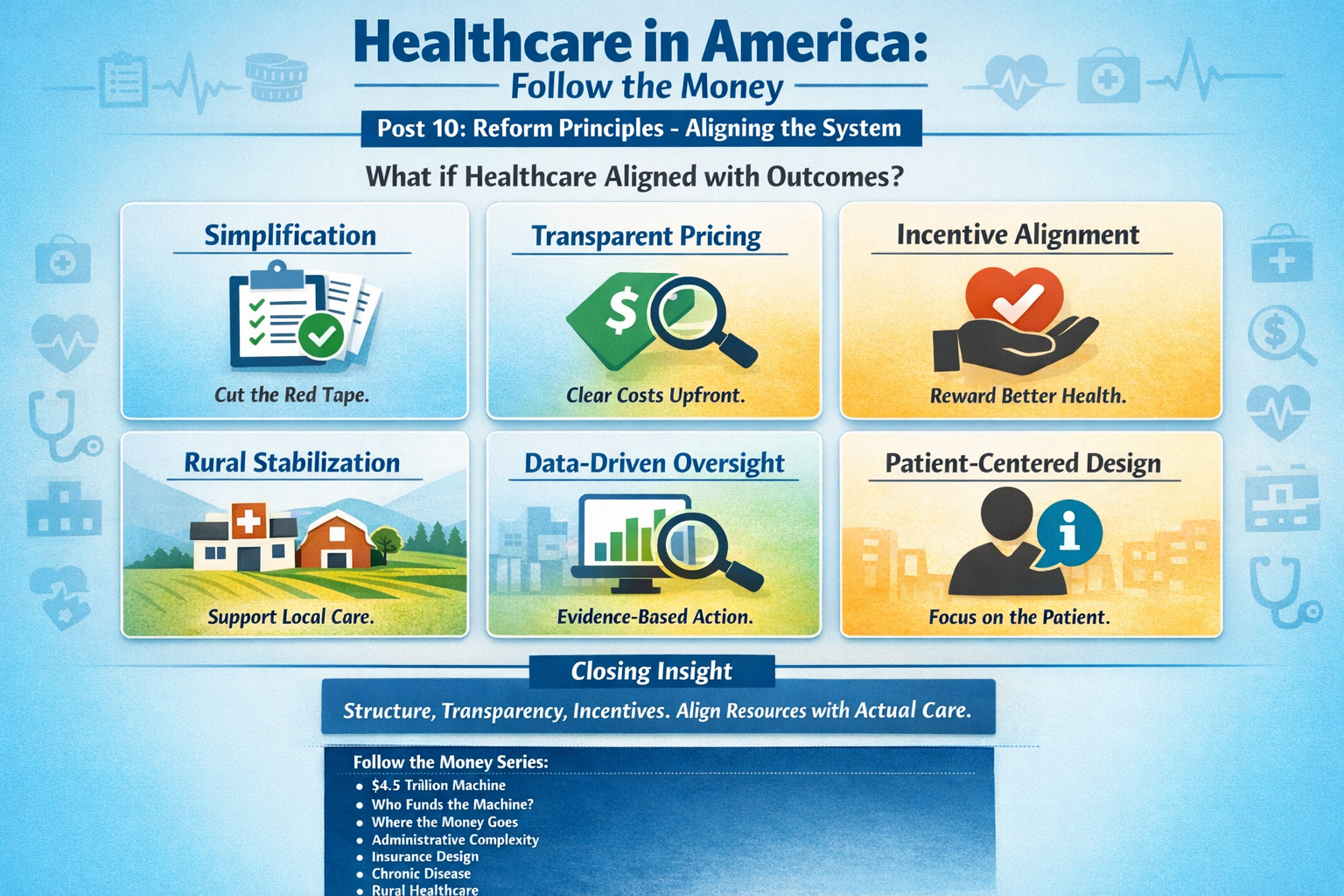
  • Employers reassess costs

  • Insurers adjust plans

  • Governments emphasize flexibility

No single change looks unreasonable.

But taken together, they redefine who bears the risk.

By the time people realize what has happened, the system presents the outcome as a matter of personal choice rather than public design.

Setting Up What Comes Next

Once responsibility moves to individuals, complexity becomes the gatekeeper.

Understanding plans, coverage limits, and tradeoffs becomes essential — and increasingly difficult.

In the next part, we’ll look at the difference between having choices and having meaningful coverage, and why those two things are often confused.

Next: Part 5 — Choice vs. Coverage