Before we talk about costs, delays, frustration, or reform, we need to pause and do something that rarely happens in public conversations about healthcare:
Define the system.
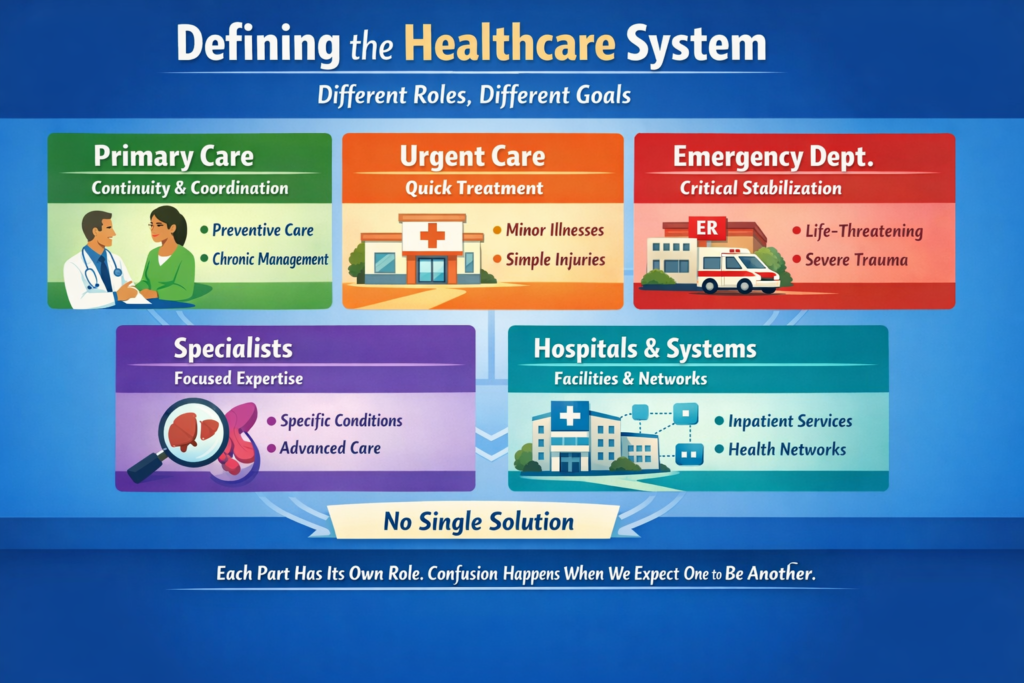
Most of the anger and confusion people feel about healthcare doesn’t come from bad intentions or unreasonable expectations. It comes from assuming that healthcare is a single thing — a place, a person, or a service — when in reality it’s a collection of distinct parts, each designed for a specific role.
When those roles blur, frustration follows.
This week is not about blame. It’s about understanding how the pieces fit together — and just as importantly, where they don’t.
Primary Care: Continuity and Coordination
Primary care is designed to be the foundation of the system.
Its role is not urgency. It is continuity:
Preventive care
Managing chronic conditions
Tracking changes over time
Coordinating referrals and follow-ups
Primary care works best when it knows you — your history, patterns, risks, and medications. It is the long view of healthcare.
When primary care access is limited or delayed, pressure builds elsewhere in the system.
Urgent Care: Episodic and Limited by Design
Urgent care exists to handle non-life-threatening issues that can’t wait, but don’t require hospital-level resources.
Examples include:
Minor fractures
Infections
Wounds requiring stitches
Sudden but stable symptoms
Urgent care is intentionally narrow. It is not meant to replace primary care, and it is not designed to manage complex or escalating conditions. Its value is speed and accessibility — not depth.
Because its boundaries aren’t intuitive, urgent care is often misunderstood.
Emergency Departments: Stabilization, Not Ongoing Care
Emergency departments are built for one purpose: stabilization.
They exist to address:
Life-threatening conditions
Severe trauma
Rapidly deteriorating symptoms
Situations where delay could cause permanent harm
Emergency medicine is about minutes and hours, not weeks or months. It is not designed for continuity, follow-up, or long-term management — even though it is often asked to fill those gaps.
This distinction matters more than most people realize.
Specialists: Depth Without Context
Specialists focus deeply on specific systems or conditions.
They provide expertise, not oversight.
Narrow scope
Referral-driven access
High value in defined situations
Specialists are essential — but they rely on other parts of the system to provide coordination and context.
Hospitals, Systems, and Networks (Not the Same Thing)
One final distinction that often gets overlooked:
Hospitals are places where care is delivered
Health systems manage multiple facilities and services
Networks manage contracts and access
These are operational and organizational layers — not clinical ones — but they shape how care is delivered and accessed.
We’ll come back to why that matters later.
Why This Structure Matters
When one part of the system is missing, overloaded, or inaccessible, pressure shifts to another part — often one that was never designed to handle it.
That’s not chaos.
That’s predictable behavior in a complex system.
In the next post, we’ll look at one of the most visible consequences of this mismatch: why emergency rooms are overwhelmed — and why it’s not as simple as blaming patients.



Comments are Disabled