If you have read this far and are feeling the particular kind of helplessness that comes from watching something important being dismantled by someone who cannot be reasoned with, this part is for you.
Because the resistance is real, it is organized, and some of it is winning.
The most important thing to understand is that Kennedy overplayed his hand legally, repeatedly, and the courts have noticed. He did not just pursue aggressive policy changes, he pursued them sloppily, skipping the procedural requirements that exist precisely to prevent any single person from unilaterally rewriting public health infrastructure. That sloppiness has created legal openings that are now being used effectively.
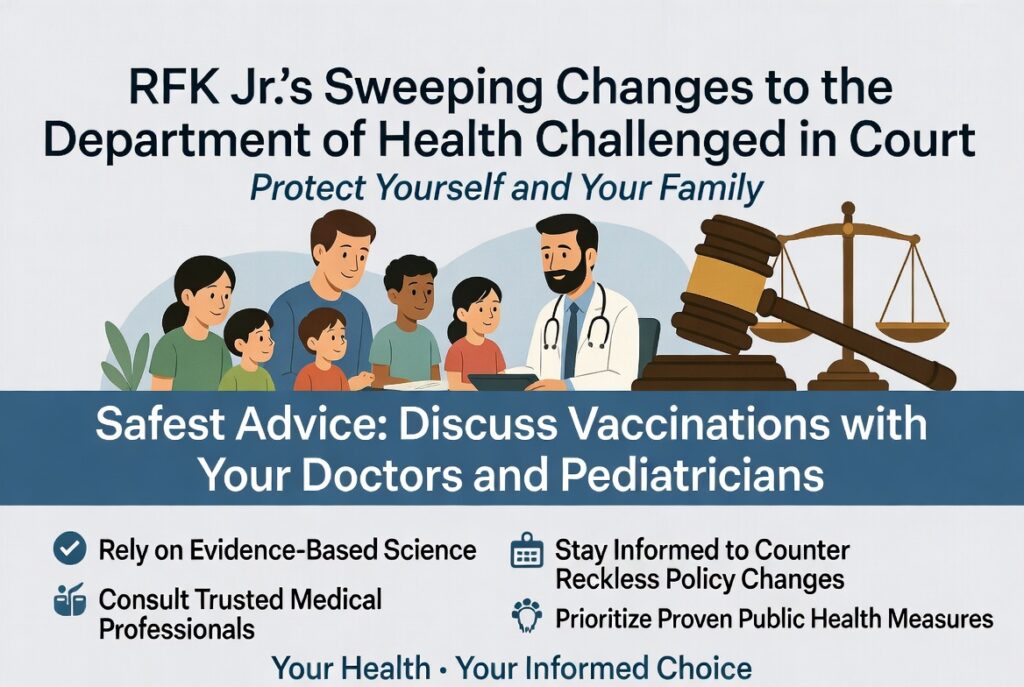
In March 2026 a federal judge in Massachusetts sided with the American Academy of Pediatrics and blocked Kennedy’s overhaul of the CDC’s vaccine advisory committee, the one he had stacked with skeptics after firing all 17 original members. The judge invalidated votes the reconstituted panel had already taken, including decisions to downgrade hepatitis B and COVID recommendations. More significantly, the same ruling found that the CDC had exceeded its legal authority when it unilaterally reduced the childhood vaccine schedule from 17 to 11 vaccines in January, because it did so without going through the proper advisory process. The mechanism Kennedy used to do the most damage to vaccine policy is the same mechanism that is now being used to undo it.
The states have mobilized in ways that matter. Fifteen states have sued to rescind the new vaccine schedule entirely and dismantle Kennedy’s replacement advisory committee. Nineteen states and the District of Columbia are separately fighting the HHS restructuring and mass layoffs on constitutional grounds, arguing the administration violated the separation of powers and the appropriations clause, essentially that Kennedy dismantled agencies Congress had funded and mandated without the legal authority to do so. A judge has already blocked further reorganization while that case proceeds. These are not symbolic lawsuits. They are methodical, well-resourced legal challenges built on solid procedural ground, and they are advancing.
Perhaps the most quietly encouraging development is what the medical establishment itself has done. When Kennedy changed the vaccine schedule, major hospital systems and clinicians across the country simply ignored it. The American Academy of Pediatrics published its own independent vaccine schedule, declaring the federal process no longer credible, and told its members to follow that instead. This matters more than it might seem. The federal government can change its recommendations, but it cannot force pediatricians to follow them. The professional infrastructure of American medicine, the societies, the hospitals, the training programs, the peer review systems, is largely intact and largely in open rebellion against what Kennedy is doing. That infrastructure is where the actual practice of medicine happens, and it is not waiting for federal permission to protect children.
Were the signs obvious? Yes. Could this have been prevented? Yes. Did it happen purely because of politics? Yes. But we also knew who Robert F. Kennedy Jr. was before he was confirmed, and we knew he was Trump’s chosen instrument for reshaping American public health. That makes all of us who watched and waited at least a little complicit in the complacency that allowed it to happen.
Casting blame now doesn’t cure a child with measles or restore a cancer research grant. It doesn’t rebuild the institutional knowledge that walked out the door with the scientists who were fired. The courts are working, and working effectively, but they are slow by design. The best and most immediate course of action is the one closest to home, your doctor, your pediatrician, your state legislature, your voice used early rather than late.
We knew. Now we act.
Know the insurance cliff and act before it hits. Major insurers pledged to keep covering the old vaccine schedule through end of 2026. That pledge expires in December. Before then, contact your state insurance commissioner and ask specifically what protections your state is putting in place to ensure continued vaccine coverage after the federal schedule changes. If your state has not addressed this, say so publicly and say it to your state legislators by name. This is the kind of specific, time-bound pressure that actually moves state government.
Talk to your pediatrician directly. Ask them which schedule they are following. The answer in most cases will be the American Academy of Pediatrics schedule, not the federal one. But parents who don’t ask won’t know, and parents who don’t know may make decisions based on federal guidance that their own doctor has already rejected. This is a conversation that takes five minutes and could matter enormously.
Support the organizations doing the legal work. The American Academy of Pediatrics, the American Public Health Association, and American Oversight are carrying the heaviest load in court right now. They are nonprofit organizations fighting well-funded federal legal teams. They need resources and they need visibility. Sharing their work, citing their findings, and donating if you are able is not performative, it is direct support for the people holding the legal line.
Pay attention to your state legislature. Anti-vaccine activists are already moving into statehouses to use the federal schedule changes as leverage to loosen school vaccine requirements. This is happening right now in Florida and Texas and it will spread. School board meetings and state legislative hearings are where this battle will be won or lost at the community level, and they are chronically under-attended by the people who would push back. You do not have to become an activist. You have to show up once and bring two people who agree with you.
Understand what is reversible and what isn’t. The legal framework to restore the vaccine schedule exists and is being actively pursued. The court victories so far suggest it is achievable. What is harder to reverse is the institutional knowledge that walked out the door with the fired scientists, the research that wasn’t funded, the surveillance systems that went dark, and the public trust that eroded while the outbreaks spread. Those are long term repair projects that will require sustained political will across multiple administrations. That is not a reason for despair. It is a reason to vote in every election at every level with health policy as a primary consideration, and to say so out loud when you do.
The measles outbreak will not be the last consequence we see from what has happened at HHS over the past year. The cancer research that wasn’t funded will show up in treatment outcomes years from now. The children who didn’t get vaccinated because their parents received confusing guidance from the federal government will be vulnerable in ways that won’t be visible until the next outbreak arrives. The damage has a long tail.
But so does the resistance. The courts are not done. The states are not done. The medical establishment is not done. And the accumulated weight of evidence-based medicine, built over more than a century by people who understood that complexity requires sustained attention rather than simple answers, does not disappear because one man with a broken compass was handed the keys for a few years.
He was given those keys through a political transaction. They can be taken back through a democratic one.
That is not optimism. That is how the system is supposed to work, and right now, imperfectly and under enormous pressure, it is working.
Pay attention. Show up. Talk to your pediatrician.
The burger and the shake are not going to fix this either.

Making America Sick — Part 4 of 4: The Fight Back
If you have read this far and are feeling the particular kind of helplessness that comes from watching something important being dismantled by someone who cannot be reasoned with, this part is for you.
Because the resistance is real, it is organized, and some of it is winning.
The most important thing to understand is that Kennedy overplayed his hand legally, repeatedly, and the courts have noticed. He did not just pursue aggressive policy changes, he pursued them sloppily, skipping the procedural requirements that exist precisely to prevent any single person from unilaterally rewriting public health infrastructure. That sloppiness has created legal openings that are now being used effectively.
In March 2026 a federal judge in Massachusetts sided with the American Academy of Pediatrics and blocked Kennedy’s overhaul of the CDC’s vaccine advisory committee, the one he had stacked with skeptics after firing all 17 original members. The judge invalidated votes the reconstituted panel had already taken, including decisions to downgrade hepatitis B and COVID recommendations. More significantly, the same ruling found that the CDC had exceeded its legal authority when it unilaterally reduced the childhood vaccine schedule from 17 to 11 vaccines in January, because it did so without going through the proper advisory process. The mechanism Kennedy used to do the most damage to vaccine policy is the same mechanism that is now being used to undo it.
The states have mobilized in ways that matter. Fifteen states have sued to rescind the new vaccine schedule entirely and dismantle Kennedy’s replacement advisory committee. Nineteen states and the District of Columbia are separately fighting the HHS restructuring and mass layoffs on constitutional grounds, arguing the administration violated the separation of powers and the appropriations clause, essentially that Kennedy dismantled agencies Congress had funded and mandated without the legal authority to do so. A judge has already blocked further reorganization while that case proceeds. These are not symbolic lawsuits. They are methodical, well-resourced legal challenges built on solid procedural ground, and they are advancing.
Perhaps the most quietly encouraging development is what the medical establishment itself has done. When Kennedy changed the vaccine schedule, major hospital systems and clinicians across the country simply ignored it. The American Academy of Pediatrics published its own independent vaccine schedule, declaring the federal process no longer credible, and told its members to follow that instead. This matters more than it might seem. The federal government can change its recommendations, but it cannot force pediatricians to follow them. The professional infrastructure of American medicine, the societies, the hospitals, the training programs, the peer review systems, is largely intact and largely in open rebellion against what Kennedy is doing. That infrastructure is where the actual practice of medicine happens, and it is not waiting for federal permission to protect children.
Were the signs obvious? Yes. Could this have been prevented? Yes. Did it happen purely because of politics? Yes. But we also knew who Robert F. Kennedy Jr. was before he was confirmed, and we knew he was Trump’s chosen instrument for reshaping American public health. That makes all of us who watched and waited at least a little complicit in the complacency that allowed it to happen.
Casting blame now doesn’t cure a child with measles or restore a cancer research grant. It doesn’t rebuild the institutional knowledge that walked out the door with the scientists who were fired. The courts are working, and working effectively, but they are slow by design. The best and most immediate course of action is the one closest to home, your doctor, your pediatrician, your state legislature, your voice used early rather than late.
We knew. Now we act.
Know the insurance cliff and act before it hits. Major insurers pledged to keep covering the old vaccine schedule through end of 2026. That pledge expires in December. Before then, contact your state insurance commissioner and ask specifically what protections your state is putting in place to ensure continued vaccine coverage after the federal schedule changes. If your state has not addressed this, say so publicly and say it to your state legislators by name. This is the kind of specific, time-bound pressure that actually moves state government.
Talk to your pediatrician directly. Ask them which schedule they are following. The answer in most cases will be the American Academy of Pediatrics schedule, not the federal one. But parents who don’t ask won’t know, and parents who don’t know may make decisions based on federal guidance that their own doctor has already rejected. This is a conversation that takes five minutes and could matter enormously.
Support the organizations doing the legal work. The American Academy of Pediatrics, the American Public Health Association, and American Oversight are carrying the heaviest load in court right now. They are nonprofit organizations fighting well-funded federal legal teams. They need resources and they need visibility. Sharing their work, citing their findings, and donating if you are able is not performative, it is direct support for the people holding the legal line.
Pay attention to your state legislature. Anti-vaccine activists are already moving into statehouses to use the federal schedule changes as leverage to loosen school vaccine requirements. This is happening right now in Florida and Texas and it will spread. School board meetings and state legislative hearings are where this battle will be won or lost at the community level, and they are chronically under-attended by the people who would push back. You do not have to become an activist. You have to show up once and bring two people who agree with you.
Understand what is reversible and what isn’t. The legal framework to restore the vaccine schedule exists and is being actively pursued. The court victories so far suggest it is achievable. What is harder to reverse is the institutional knowledge that walked out the door with the fired scientists, the research that wasn’t funded, the surveillance systems that went dark, and the public trust that eroded while the outbreaks spread. Those are long term repair projects that will require sustained political will across multiple administrations. That is not a reason for despair. It is a reason to vote in every election at every level with health policy as a primary consideration, and to say so out loud when you do.
The measles outbreak will not be the last consequence we see from what has happened at HHS over the past year. The cancer research that wasn’t funded will show up in treatment outcomes years from now. The children who didn’t get vaccinated because their parents received confusing guidance from the federal government will be vulnerable in ways that won’t be visible until the next outbreak arrives. The damage has a long tail.
But so does the resistance. The courts are not done. The states are not done. The medical establishment is not done. And the accumulated weight of evidence-based medicine, built over more than a century by people who understood that complexity requires sustained attention rather than simple answers, does not disappear because one man with a broken compass was handed the keys for a few years.
He was given those keys through a political transaction. They can be taken back through a democratic one.
That is not optimism. That is how the system is supposed to work, and right now, imperfectly and under enormous pressure, it is working.
Pay attention. Show up. Talk to your pediatrician.
The burger and the shake are not going to fix this either.
Share this:
Like this: