By now, it is clear that the 2026 midterms are unlike any we have seen in recent memory. The scale of spending, the intensity of coordination, and the precision of messaging all suggest a high-stakes contest—but the full story goes deeper than individual candidates or party control.
The real question is not just who wins, but how power is being built and exercised beyond what voters can easily see.
The Right’s Strategy: Retain Power, Overtly
For the Republican-aligned forces, the goals are largely apparent: retain control, reinforce policy agendas, and consolidate influence over both formal institutions and public discourse.
Fear, cultural anxiety, and economic issues are the levers most often used.
Messaging and media campaigns are coordinated to reinforce narratives favorable to retention of power.
Infrastructure investments, such as digital platforms and PAC networks, aim to create lasting influence in key regions.
The strategy is clear—even if the tactics involve distortion or exaggeration, the intention is explicit: maintain control.
The Opposition: More Than a Reaction?
On the surface, the Democratic-aligned spending appears reactive: flip seats, gain committee control, and counter the right’s narrative. But the scale and coordination of resources suggest a more systemic effort.
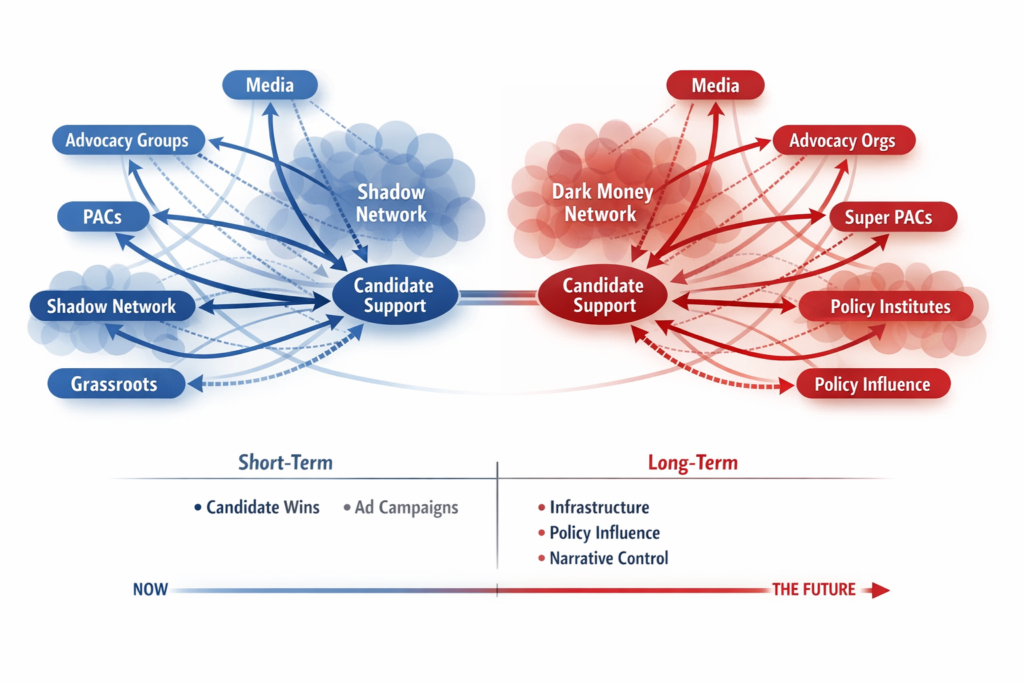
Large sums are flowing into issue networks, nonprofit advocacy, and media pipelines.
These efforts don’t just support candidates—they shape long-term messaging, policy priorities, and the broader political infrastructure.
The question arises: is the opposition simply seeking to transfer power, or is it quietly constructing a parallel system of influence that endures regardless of the next election?
Invisible Structures and Enduring Influence
Both sides are engaging in a subtle, long-term game:
Media pipelines that shape public perception.
Policy advocacy that primes future legislation.
Networks of nonprofits, PACs, and think tanks that maintain continuity of influence.
Even visible money can serve as a tool for structural shaping, while truly opaque spending adds another layer of strategic depth.
What Voters Don’t See
Most citizens focus on candidates, slogans, and immediate outcomes. Yet the forces of influence operate largely in shadows: guiding narratives, building infrastructure, and securing leverage points that persist beyond Election Day.
This is the essence of modern political power: it is not solely about winning elections; it is about embedding influence into the very fabric of governance, media, and public perception.
The Critical Question
As the 2026 midterms approach, voters must ask themselves: are we witnessing a straightforward contest over seats, or is there a larger game being played—one where both sides seek enduring structural influence, often invisible to the public eye?
Understanding this hidden layer is essential for anyone seeking to grasp the stakes of modern American politics. The long game is underway, and the rules are not fully visible.

Comments are Disabled