Article 2 of 3 Transparency Illusions — Money in Plain Sight
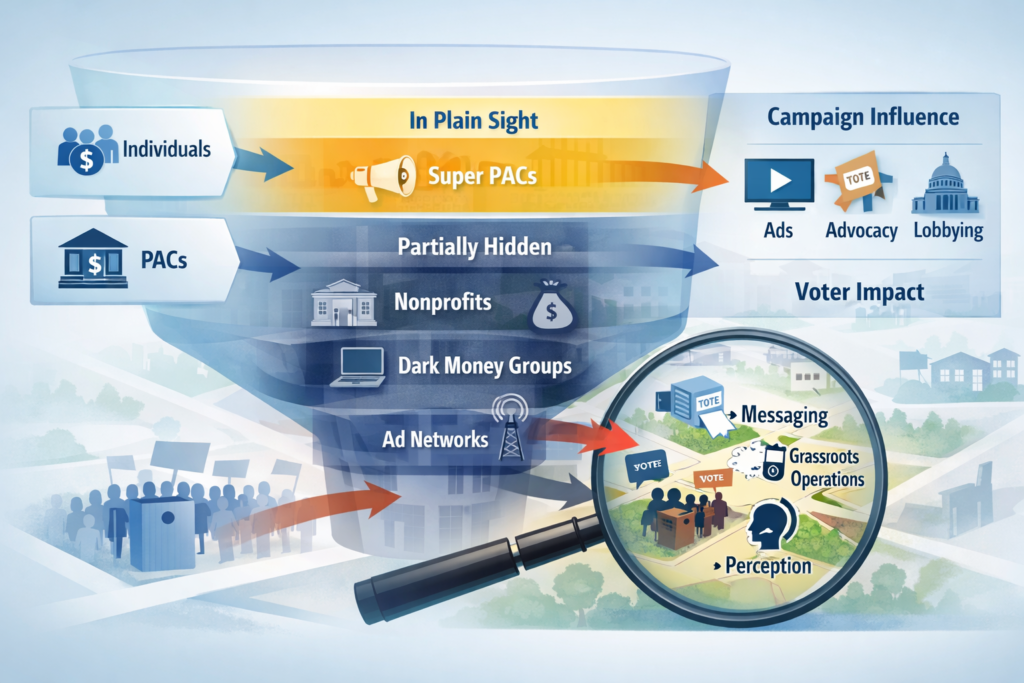
The early surge of funding into the 2026 midterms is hard to ignore, yet the public is still largely in the dark about how that money actually shapes the election. Even when contributions are disclosed, transparency is often more illusory than real.
Voters see the headlines—mega-donors, super PACs, and campaign cash—but few grasp the mechanics behind it, or the strategic intent that guides these flows. In essence, visibility does not equal understanding.
Disclosed vs. Hidden Influence
Campaign finance laws require certain reporting: super PACs must list their donors, and major contributions are public record. This disclosure gives the impression of accountability.
But disclosure is only part of the story. The “where” and “how” of influence often remains obscured. Mega-donors channel money into targeted districts, specialized messaging, and digital campaigns whose impacts ripple quietly.
Even non-dark money—funds that are fully reported—can operate as a form of strategic opacity. Voters know that spending is happening, but rarely see the nuanced ways it shapes perceptions, priorities, and local political infrastructure.
The Mechanics of Influence
Modern political spending is surgical. The goal is rarely broad persuasion; it’s about precise leverage:
-
District targeting: Money flows into the races that are winnable or strategically critical.
-
Message amplification: Ads, mailers, and digital campaigns are coordinated to push certain narratives.
-
Network shaping: Grassroots organizations, local media, and advocacy groups can be nudged—or suppressed—through funding decisions.
In combination, these tools allow wealth and influence to shape the electoral playing field long before voters cast ballots.
Public Perception and Strategic Opacity
To most citizens, a donor check is a check. But campaigns are more than contributions—they are engines of influence. Strategic opacity allows campaigns to appear open while steering attention, framing debates, and shaping perceptions without overt coercion.
The result is a paradox: the money is in plain sight, yet its full effect and intent are largely invisible. Voters see movement, but not the levers behind it.
Setting Up the Bigger Question
If disclosed money can operate as a subtle form of hidden influence, the real question becomes: what about the truly opaque channels? Dark money, nonprofit networks, and cross-linked advocacy groups operate largely outside public scrutiny.
And even among visible spending, both parties appear to be building something larger than a simple tally of wins and losses. Influence flows, narratives solidify, and infrastructure takes shape—often with consequences that extend well beyond Election Day.
The stage is set for a deeper exploration: how much of the opposition’s strategy is truly reactive, and how much is about quietly shaping enduring structures of influence?
Please Visit The Elephants BBQ on Substack
The Elephants BBQ
Help Support Our Efforts
AI Disclaimer
"Let's slow down and think this through."
161

Comments are Disabled