Posts in Category: Dark Money
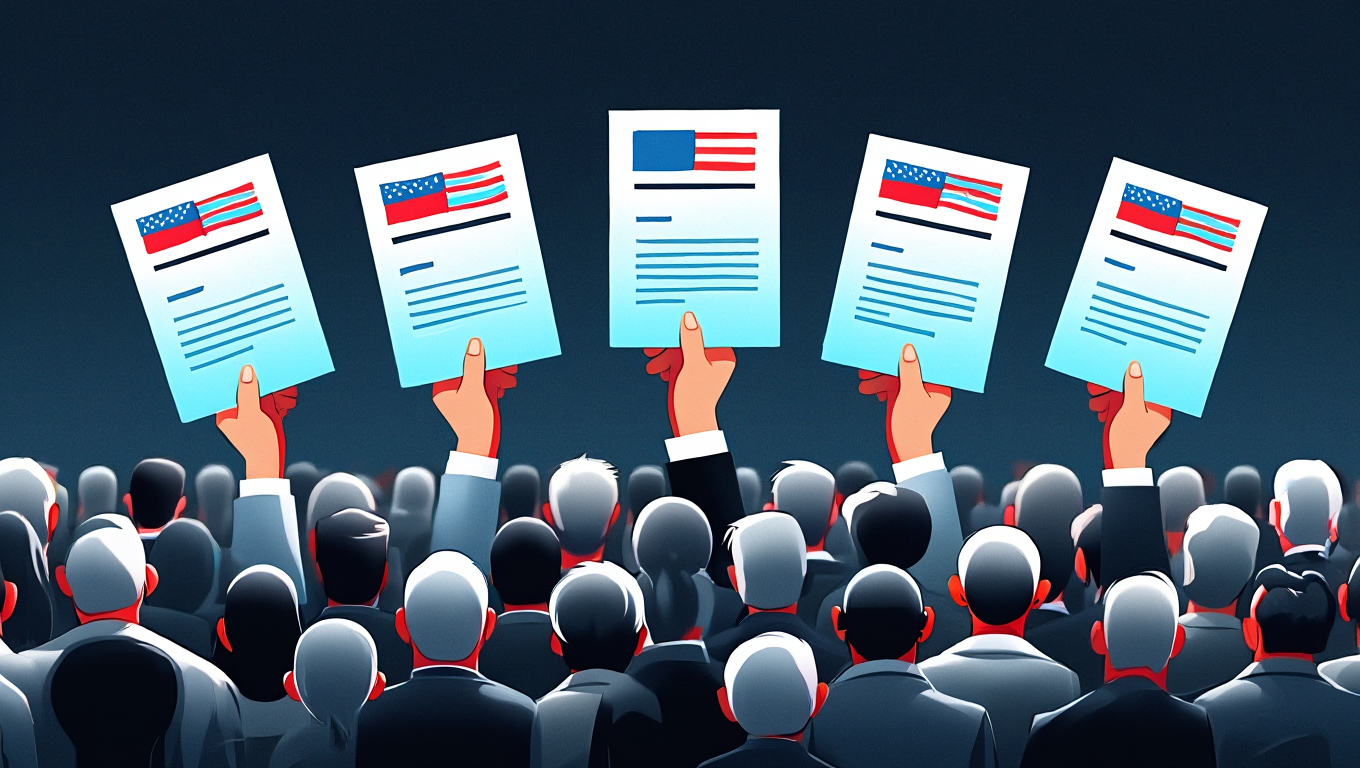
Elections and Media in the Modern Era – Part 1 of 3: Elections – Behind the Ballot Box – Video
Let me ask you one question: just how many votes does it take to win an election? 1,000? 100? 10? Or maybe… just 1?
Early reports from the 2026 Boca Raton mayoral race suggested it could have been a single vote. One person deciding to mail their ballot—or to skip it—could have changed the outcome entirely. In the end, it turned out the margin was five votes. Still, in a city election, that’s barely a handful—and it perfectly illustrates why every vote truly matters.

Share this:


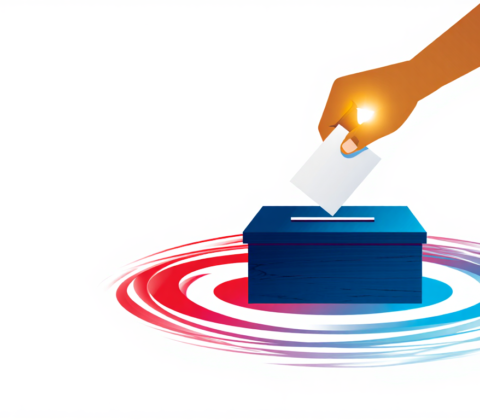
Elections and Media in the Modern Era – Part 1 of 3: Elections – Behind the Ballot Box
Does Your Vote Count?
Let me ask you one question: just how many votes does it take to win an election? 1,000? 100? 10? Or maybe… just 1?
Early reports from the 2026 Boca Raton mayoral race suggested it could have been a single vote. One person deciding to mail their ballot—or to skip it—could have changed the outcome entirely. In the end, it turned out the margin was five votes. Still, in a city election, that’s barely a handful—and it perfectly illustrates why every vote truly matters.
More Than Just a Ballot: How Votes Are Shaped Before They’re Cast
Even in small towns, elections don’t work the way most of us think. There was a time when Americans largely got the same story from the evening news—ABC, NBC, CBS. Today, a voter in rural Montana might watch a cable town hall on CNN, scroll X for candidate updates, and see a TikTok ad funded by a local political action committee. By the time they step into the booth, the story they’ve absorbed is a patchwork of channels, platforms, and messages—and each piece is shaped by someone trying to influence their choice.
Concrete Example — Boca Raton Mayor
Andy Thomson won the 2026 Boca Raton mayoral race by just five votes, after machine counts and multiple manual recounts. Early reports suggested the margin could have been a single vote. In other words, a handful—or even one—ballot could have changed the result.
In Boca Raton, like everywhere else, candidates weren’t just counting ballots—they were trying to reach voters with the right information at the right time. Even small shifts in turnout or perception could tip the scales. And that’s where the system behind elections—the information channels, messaging, and media—starts to matter.
Your vote can change outcomes, even if it feels invisible. And the information you receive before you vote—the stories, ads, news, and commentary—plays a role in shaping that choice. Understanding the system is the first step in making your vote count.
Core Explanation: Elections Are No Longer Simple
Voting today is no longer a straight line from candidate to voter. It’s a complex web of influence:
-
Traditional layers remain: parties, candidates, ballots, volunteers.
-
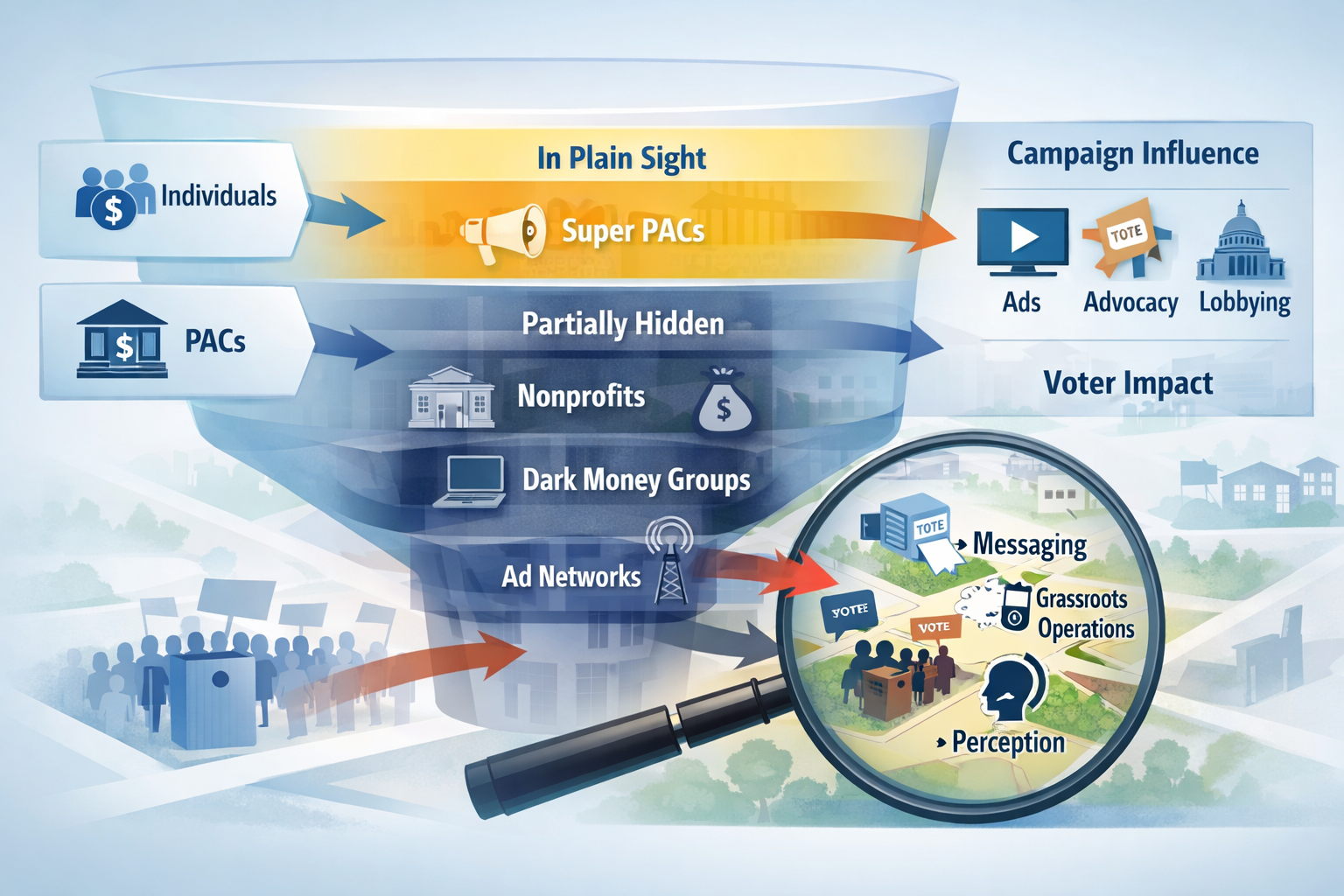
Outside spending shapes messaging: PACs, nonprofits, advocacy groups push targeted campaigns.
-
Digital platforms amplify influence: social media and apps deliver precise messages to specific audiences.
-
Fragmented media environment: cable, social media, and online outlets deliver very different stories, so voters rarely encounter the same information.
The end result is clear: votes aren’t just cast—they’re shaped long before they reach the ballot box.
Relatable Example Continued
Imagine Mary, a voter navigating today’s environment. She sees:
-
A Facebook post from a candidate’s page highlighting local infrastructure promises
-
A TikTok ad from a PAC showing a dramatic clip about healthcare
-
A cable news segment analyzing the same election in a different context
Each source presents a slightly different narrative. Mary has to make sense of it all—but the truth behind who funded each message is mostly invisible. And yet, in places like Boca Raton, a handful of votes—or even one—can decide who governs the city. That’s the tangible power of participation.
Pattern / Insight
This isn’t about ideology. It’s about mechanics. The flow of information—shaped by parties, outside money, and digital platforms—affects every voter. Understanding that flow gives people the clarity to see why elections look the way they do today, beyond the surface headlines.
Understanding why every vote matters is only the first part of the story. Equally important is how the information voters receive before Election Day is shaped and delivered. From traditional network broadcasts to social media, cable news, and independent commentary, the channels through which voters learn about candidates and issues have multiplied—and fragmented. To see why elections look the way they do today, we need to look closely at the modern media landscape.
Share this:

Don’t Check Just the Box
I just read an article by Alisa Valdes-Rodriguez that said something I think deserves to be repeated.
We have gotten so used to thinking politics means choosing a team that we sometimes forget what voting is actually supposed to be about.
A party label can tell you what someone calls themselves. It doesn’t tell you what they believe, what they have done, or what they will actually do once they are in office.
That’s why I keep coming back to the middle.
I don’t completely trust either political party — and I don’t think you should simply hand either one your vote.
Research the candidate. Look at their record. Look at what they actually say, not just the slogans, ads and talking points coming from their party. Then make your own decision.
Sometimes that may mean voting for a Republican. Sometimes a Democrat. Sometimes someone outside the two major parties. And sometimes it may mean leaving a box unchecked.
The point is simple: don’t vote for the party. Vote for the person.
And credit where it belongs — the idea that prompted this post came from Alisa Valdes-Rodriguez and her article. I’m not trying to rewrite her work. I’m saying her point is worth passing along.
Share this:


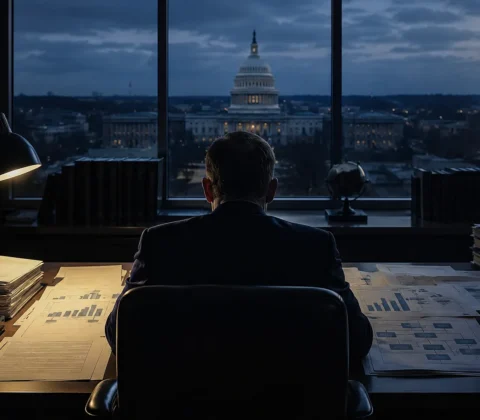
Is Russell Vought the Most Destructive Person in the Trump Administration? by John Turley MD
Share this:





The Purple Rose of Texas – Video
Thank God I’m not from Texas, because being a Purple Rose is being a screwed Rose in Texas not much better than being a Yellow Rose.
Only Red roses and Blue Rose have a chance there.I’m just flabergasted Vance and Rubio haven’t article 25ve
A rose by any other color is just fertilized out of luck.
Try being an independent in Texas, Oh your allowed , maybe have to sit inn the back of the bus, if they can find a seat. And that’s a big maybe. But then again, the Fight at Alamo was as much about retaining slavery as gaining independence, don’t believe me, go read your history books.
The two party system has a choke hold on us, it has to change, we have to stop and it won’t be easy. The battle will look like we are fighting the Democrats and the Republicans but in reality, we will be fighting dark money.
The fight will be against Citizens United, the Federalist Society, the Superpacs, Acs American Constitution Society, Leonard Leo, Arabella Advisors and the list goes on. It’s the dark money, they want to control and control is easier when there are fewer choices.
Open the field and the Superpacs become less effective. Then we have can have a Congress that become MORE effective.
The choices are yours.

Share this:



MAGA 2.0 — A Rose By Any Other Name Still Stinks – Video
Marjorie Taylor Greene, Tucker Carlson, MAGA 2.0 why those sneaky little so and so’s. That didn’t take long, here I have been writing my little fingers to nubs and those two have been sneaking behind The barn for a little pow wow. Makes sense though.
Both of them have been saying it. Marjorie has come out and said Trump appears to be working more for Israel than for us — so if he’s going to call her a traitor, she can call him one right back. Tucker said he won’t vote for a party working for a foreign government, won’t vote for MAGA, won’t vote for a Democrat, won’t vote for a Republican.
Golly. Just whom will Tucker vote for?
Little remarks. From both of them. Am I just imagining this?
No. I am not.
Marjorie even insinuated that Tucker might run himself, which would neatly solve the problem of who he’d vote for. A podcaster. Running for president. Well, why not, we already proved that particular bar doesn’t exist anymore. And maybe Marjorie could become Secretary of Something if she plays her cards right. Party favors.
So MAGA is done for. The Republicans are done for. Reboot time. MAGA 2.0.
Which, surprisingly, sounds exactly like MAGA 1.0. And isn’t it interesting that MAGA 1.0 and the Republicans are now one and the same, no longer MAGA versus the RINOs, just MAGA, wall to wall, corner to corner.
==========================================================
And what ticket was The Vance planning on running on exactly? Or was he perhaps hoping to find himself as the incumbent after a convenient Article 25?
Twilight Zone music plays softly in the background.
========================================================
It was so much easier when it was just the evil left against the evil right. Now it’s the evil left against the evil right against the other evil right against the original evil right.
After the dust settles, will we ever know which one is right?
Share this:

The Purple Rose of Texas
Thank God I’m not from Texas.
Because being a Purple Rose in Texas is being a screwed rose. Only Red roses and Blue roses have a chance there. A rose by any other color is just fertilized out of luck.
Try being an independent in Texas. You’re allowed — technically. Maybe you get to sit in the back of the bus, if they can find you a seat. And that’s a big maybe.
But then again, the fight at the Alamo was as much about retaining slavery as gaining independence. Don’t believe me — go read your history books.
Here’s what Texas law actually requires of an independent candidate running for statewide office.
First — collect more than 81,000 valid voter signatures just to get on the ballot. That’s a steep hill by itself. But Texas doesn’t stop there.
Independent candidates aren’t allowed to start collecting signatures until after the party primary runoff elections are finished. This year that meant waiting until May 26th.
Read that again because it matters.
Independent candidates aren’t allowed to start collecting signatures until after the party primary runoff elections are finished.
The petitions were due June 25th.
Do the math.
Thirty days to collect over 81,000 signatures statewide — a task that would challenge even a well-funded campaign with an established organization behind it.
Then it gets more interesting.
Anyone who voted in either a party primary or runoff election is prohibited from signing an independent candidate’s petition. Texas shrinks the pool of eligible signers before the process even begins.
Thirty day deadline. Reduced pool of eligible voters. Statewide signature requirement that would be difficult under the best of circumstances.
You can decide for yourself whether that’s about election integrity or ballot access.
Texas didn’t write these laws in a vacuum. The machinery that benefits from limited choices operates at a national level even when the laws are written state by state. Similar barriers — different deadlines, different thresholds, different methods — exist across the country. The details change. The effect is the same. Fewer choices. Less competition. A political system that protects the existing parties from having to compete with anyone who doesn’t carry their label.
Whether it’s gerrymandered districts reducing competition or ballot access laws making it nearly impossible for independent candidates to qualify — the result is consistent. A chokehold.
And the hands on that chokehold aren’t just Republican or Democrat.
They’re darker than that.
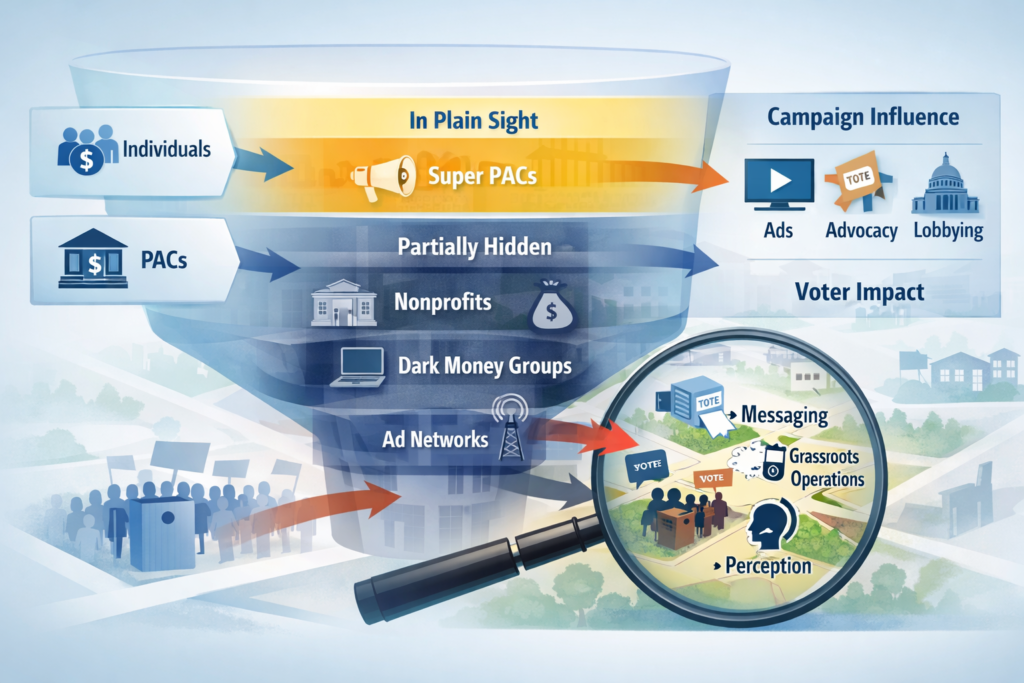
Citizens United opened the floodgates. Leonard Leo built the judicial architecture. Arabella Advisors operates the left side of the same coin. Federalist Society. SuperPACs. Dark money flowing through nonprofits that don’t have to disclose their donors to anyone.
The two party system isn’t just a political habit. It’s a business model. And it’s extraordinarily well funded by people who understand that fewer choices means more control and more control means more return on their investment.
Open the field and the SuperPACs become less effective. More candidates means more variables means less predictable outcomes means less return on the dark money investment.
That’s why the field stays closed.
The Purple Rose doesn’t get fertilized by accident.
It just gets shit on.
The choices are yours.
But first you have to fight for the right to make them.
Share this:

MAGA 2.0 — A Rose By Any Other Name Still Stinks
Better Than FOX, I am, I am.
Marjorie Taylor Greene, Tucker Carlson, MAGA 2.0 why those sneaky little so and so’s. That didn’t take long, here I have been writing my little fingers to nubs and those two have been sneaking behind The barn for a little pow wow. Makes sense though.
Both of them have been saying it. Marjorie has come out and said Trump appears to be working more for Israel than for us — so if he’s going to call her a traitor, she can call him one right back. Tucker said he won’t vote for a party working for a foreign government, won’t vote for MAGA, won’t vote for a Democrat, won’t vote for a Republican.
Golly. Just whom will Tucker vote for?
Little remarks. From both of them. Am I just imagining this?
No. I am not.
Marjorie even insinuated that Tucker might run himself, which would neatly solve the problem of who he’d vote for. A podcaster. Running for president. Well, why not, we already proved that particular bar doesn’t exist anymore. And maybe Marjorie could become Secretary of Something if she plays her cards right. Party favors.
So MAGA is done for. The Republicans are done for. Reboot time. MAGA 2.0.
Which, surprisingly, sounds exactly like MAGA 1.0. And isn’t it interesting that MAGA 1.0 and the Republicans are now one and the same, no longer MAGA versus the RINOs, just MAGA, wall to wall, corner to corner.
Oh my brain hurts. How do you tell the difference between the Far Right and the Far Right? The new Far Right is 2.0 — or is it really just 1.5? And where exactly is the money going to come from to finance it? The Federalist Society 2.0? Citizens United 2.0?
Which brings us to today. June 30th, 2026. The day The Vance won his Supreme Court case.
Let’s be precise about what just happened, because it matters enormously and it happened quietly while everyone was watching the circus. The Supreme Court, 6-3 along purely partisan lines, axed longstanding limits on how much money party committees can spend in direct coordination with candidates. The challenge was brought in 2022 by JD Vance, then a Senate candidate from Ohio. It was decided today in his favor.
Here’s the part worth reading twice: just days after Vance suggested that if Watergate happened today it would barely make the news, let alone end a presidency, the Supreme Court embraced his argument against a 1974 campaign finance rule that Congress passed specifically in response to Watergate. The rule designed to prevent exactly this kind of corruption, gone. Because of him. Today.
The Republican National Committee entered June with more than $125 million in available cash and no unpaid bills — ready to unleash coordinated spending on their favored candidates with no limits whatsoever.
And what ticket was The Vance planning on running on exactly? Or was he perhaps hoping to find himself as the incumbent after a convenient Article 25?
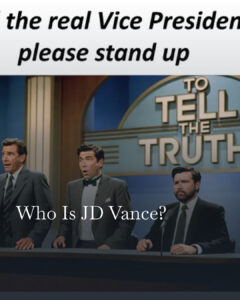
Twilight Zone music plays softly in the background.
Business as usual. Put on your wading boots — the manure just got considerably deeper and considerably smellier.
After the fertilizer settles though, remember this: a MAGA by any other MAGA name is still a MAGA. And MAGA 2.0 is not to be confused with MAGA 1.0, because the Toll-House cookies made by MAGA 1.0 used Nestlé morsels, while MAGA 2.0 is using Ghirardelli. Different aprons. Same kitchen. Same players. Same aroma drifting down the hallway.
It was so much easier when it was just the evil left against the evil right. Now it’s the evil left against the evil right against the other evil right against the original evil right.
After the dust settles, will we ever know which one is right?
Share this:

The Elephant In The Room Nobody Is Looking At – Video
Trump is out. The clown is getting the hook. You’d have to be blind not to see it — and he’s too busy with his burgers to notice it himself. I have recently written about how the two party system has failed us and how dark money has made it nearly impossible for an independent candidate to even get on the ballot. The Republicans and the Democrats are not running the show. The SuperPACs are.
So when Musk threatened to start his own party during the DOGE wars all he was really doing was threatening Trump. Because Musk’s party couldn’t have gotten on 90 percent of American ballots. But it would have weakened the MAGA base — which was exactly the point.
Then Tucker Carlson said this:
“I would not support the Republican Party, there’s no chance. Not gonna support the Democratic Party. I don’t know what I’m going to do. How could I or any American voter support a political party that’s not loyal to the United States — that puts the interests of a foreign country above those of its own citizens. It’s not possible to vote for people like that and I’m not going to. I voted Republican my entire life. I worked at Fox News. I’ve been a consistent defender for 35 years of the Republican Party, but there’s no defending this because it’s immoral. I’m out. And if I’m out, then I think a lot of other people are out.”
Different name. Same chokehold. Same dark money. Same result for the Purple Rose.
I don’t think I need to put the pipe down to ask that question.
I think it’s the only question worth asking right now.
And I’m genuinely puzzled why so few people are asking it.
Share this:

The Elephant In The Room Nobody Is Looking At
Ever feel like you’re on the verge of a nervous breakdown from all the noise? The he said she said, on and on, round and round. Just noise.
But is it just noise?
Sometimes the most important thing happening isn’t the loudest thing happening. Sometimes the real story is in the room nobody is looking at.
Trump is out. The clown is getting the hook. You’d have to be blind not to see it — and he’s too busy with his burgers to notice it himself. I have recently written about how the two party system has failed us and how dark money has made it nearly impossible for an independent candidate to even get on the ballot. The Republicans and the Democrats are not running the show. The SuperPACs are.
So when Musk threatened to start his own party during the DOGE wars all he was really doing was threatening Trump. Because Musk’s party couldn’t have gotten on 90 percent of American ballots. But it would have weakened the MAGA base — which was exactly the point.
Then Tucker Carlson said this:
“I would not support the Republican Party, there’s no chance. Not gonna support the Democratic Party. I don’t know what I’m going to do. How could I or any American voter support a political party that’s not loyal to the United States — that puts the interests of a foreign country above those of its own citizens. It’s not possible to vote for people like that and I’m not going to. I voted Republican my entire life. I worked at Fox News. I’ve been a consistent defender for 35 years of the Republican Party, but there’s no defending this because it’s immoral. I’m out. And if I’m out, then I think a lot of other people are out.”
Thank you Heather Delaney Reese for Trump loyalists are jumping off the sinking ship
Tucker Carlson. Thirty five years. Out.
Now ask the question nobody seems to want to ask out loud.
Where are they going?
Tucker isn’t going long term. A third party takes decades to build and he doesn’t have that kind of patience or that kind of money. But somebody does.
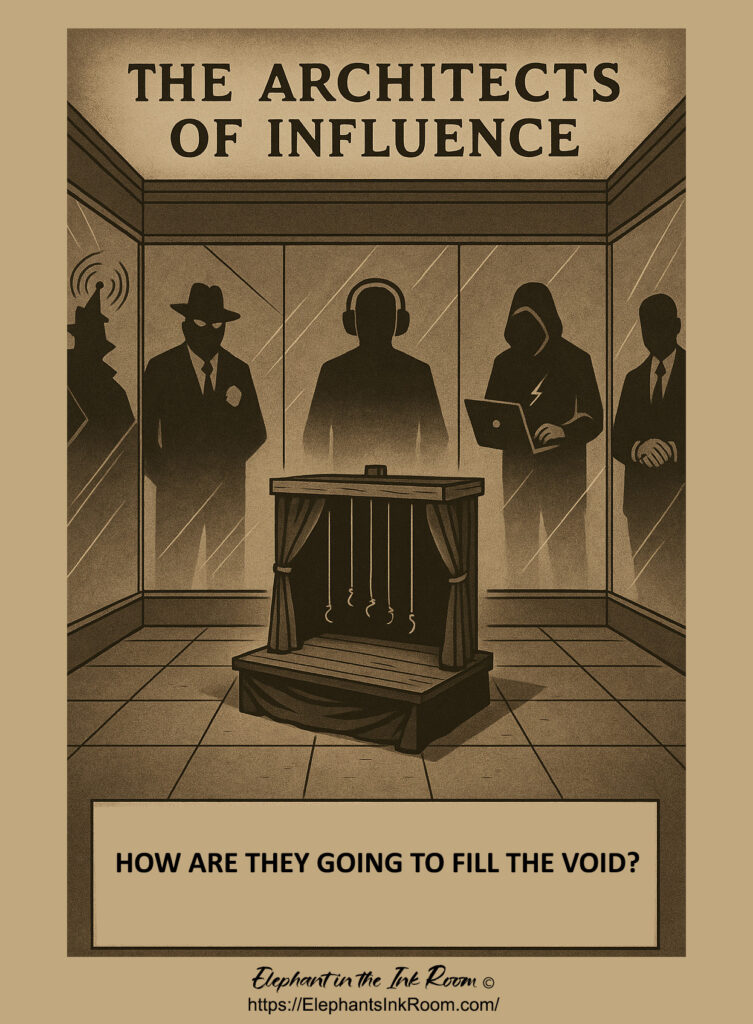
Here is where we need to look. Here is the room nobody is looking at.
The SuperPACs. The dark money. The Federalist Society. Leonard Leo. Arabella Advisors. The entire infrastructure that has been quietly and methodically building the conservative legal and political architecture for thirty years.
They didn’t back Trump because they loved him. They backed him because he was a useful vehicle. Three Supreme Court justices. Hundreds of federal judges. Regulatory rollback. Tax structure. The return on their investment has been substantial.
But now the vehicle is embarrassing them. The stall is covered in dung. The clown is jeopardizing thirty years of careful infrastructure with daily chaos and a cognitive decline visible to anyone paying attention.
MAGA is dead. Trying to save it is a fool’s errand.
So what are the options?
Save the Republican Party — purge the MAGA element, restore something resembling functional conservatism, hope Vance or Rubio or someone with a law degree and a functioning prefrontal cortex can carry the banner forward. Vance and Rubio haven’t invoked the 25th Amendment yet because they’re still afraid of the MAGA base. But here’s the thing — if they did it the Republican establishment would put them on their shoulders. The dark money would fund the parade.
Or start over — a new right of center party, properly funded, built from the existing infrastructure that Leonard Leo and the Federalist Society have already constructed. It would have money. It would have judicial connections. It would have the organizational architecture that third parties normally spend decades trying to build.
Which brings us to the question that should keep everyone awake.
Is that a good thing?
Are we watching the dark money apparatus recognize that their vehicle has failed and quietly preparing to deploy a new one? A cleaner one. A more electable one. A saving angel that turns out to serve the same architecture in a better suit?
Or to put it another way — would a new right wing party actually break the two party system open for independents and moderates?
Or would it just be a Texas sidestep?
Different name. Same chokehold. Same dark money. Same result for the Purple Rose.
I don’t think I need to put the pipe down to ask that question.
I think it’s the only question worth asking right now.
And I’m genuinely puzzled why so few people are asking it.
Share this:



It Takes Two to Tango, But The More The Merrier
Did you ever play a game of snooker against yourself? Put up the other side of a ping pong table to practice? It didn’t take long until video game creators realized they made more money in a bar with a PacMan with opposing controllers. Let’s face it, playing by yourself isn’t as much fun or as satisfying. That’s why we had the post-war population explosion.
We are wired for opposition, for partnership, for the push and pull of another person across the table. It’s more rewarding together than alone, after all, taking a shower together was always nicer than showering alone.
But enough of beer bars and bedrooms. Off to where the real back-stabbing and dirty stuff happens, politics and government.
In my opinion, the evil creating the havoc we live with today can be traced directly to what we call the two-party system. Anyone who wants a career in politics has to align themselves with a party. They have to declare that they are eitherLiberal – Blue, or Conservative – Red. They can’t walk in and say, hey, look at me. This is what I can do for you. And the reason is twofold: money and the checkbox.
Campaigns cost money, and an independent candidate has to compete against the Superpacs. This isn’t a small thing. Since I am registered Republican, this is the only example I can give honestly, but I am positive it is equally true for Blue. I receive at least fifty give-me-money emails a day from Trump, Vance, Trump’s kids, and would probably get them from Trump’s dog if he had one. Those contributions flow into what we call a Superpac. So when a party endorses your opponent, your opponent suddenly has a war chest you can’t match, financed by people who have never heard your name and wouldn’t care if they had. If you run independent, you finance from your own pocket or whatever limited funds you can scratch together from limited supporters. A very uneven battlefield.
The second problem is who they serve once elected. They no longer can support the people who voted for them, they must support the people who paid for their election. They must vote along party lines. We see that now, every day. It has a name: partisan. Which is a polite word for captured.
Let me ask you a few questions. If we didn’t have the two-party system, would Donald Trump have been elected? If he had been elected, would those — sorry, you didn’t see the three-minute pause while I searched for words other than idiots, thieves, and suckups — cabinet secretaries ever have been confirmed? Would we be in Trump’s war of choice? Would Trump have been Article 25’d by now?
I’ll let you answer those yourself.
The two-party system isn’t in the Constitution. It isn’t carved in stone or handed down from the founders. It’s a habit. An expensive, entrenched, self-serving habit that benefits exactly two groups of people, the two parties, and leaves the rest of us standing outside the dance hall listening to music we didn’t choose and paying the cover charge anyway. Habits can be broken. Systems can be redesigned. The question isn’t whether we can do better. The question is whether enough of us get angry enough, soon enough, to demand it.
The Entire Foundation Series
The series as a downloadable PDF

Share this:

On May 14, 2026, Josh Green signed Senate Bill 2471 into law, now known as Act 011
On May 14, 2026, Josh Green signed Senate Bill 2471 into law, now known as Act 011 — a move that may become one of the most significant state-level challenges to “dark money” and corporate political influence since the Supreme Court’s 2010 Citizens United decision.
At its core, Act 011 is not just another campaign finance reform bill. It is something far more aggressive and structurally important. Instead of trying to regulate political spending directly — a path repeatedly blocked by courts after Citizens United — Hawaii chose a different route entirely: redefining the powers granted to corporations by the state itself.
The legal theory behind the law is deceptively simple:
Corporations are creations of the state. If the state creates them, the state can define what powers they do and do not possess.
Under Act 011, Hawaii essentially states that corporations and other “artificial persons” were never intended to possess the power to spend money influencing elections or ballot initiatives. The law removes that authority from entities organized under Hawaii law.
Supporters view the measure as a direct response to the explosion of outside political spending unleashed after Citizens United v. Federal Election Commission. Since that ruling, corporate spending and opaque “dark money” networks have flooded American politics with billions of dollars, much of it impossible for ordinary voters to trace. OpenSecrets estimated more than $4 billion in outside spending during the 2024 federal election cycle alone, including nearly $2 billion in undisclosed “dark money” activity.
That is where this story ties directly into any broader dark money series.
Act 011 represents a growing realization among both conservatives and liberals that modern elections are increasingly shaped not by citizens, but by large financial networks operating above public visibility. The issue is no longer simply campaign donations. It is systemic influence — influence routed through nonprofits, shell organizations, Super PACs, and corporate structures that often obscure who is actually funding political narratives. Hawaii’s law attempts to strike at the foundation itself rather than merely treating the symptoms.
Critics, including Hawaii’s own Attorney General, argue the law is likely unconstitutional and destined for immediate court challenges. Opponents say the law is essentially an indirect attempt to overturn Citizens United by denying corporations rights the Supreme Court has already recognized. Legal analysts expect First Amendment lawsuits almost immediately once the law takes effect on July 1, 2027.
But whether the law survives may be only part of the story.
The larger significance is symbolic and political.
For the first time in years, a state government openly challenged the assumption that unlimited corporate political spending is untouchable. Hawaii’s action signals that frustration with dark money is no longer confined to activist circles or campaign reform organizations. It is beginning to evolve into institutional resistance.
What makes this especially important for a dark money series is that Act 011 exposes a deeper question many Americans across the political spectrum are beginning to ask:
Who actually governs modern America — voters, or the financial systems surrounding them?
Because dark money is rarely ideological at its core. It moves fluidly through both parties, funds competing narratives simultaneously, and often benefits from division itself. The more polarized the public becomes, the easier it is for massive financial interests to operate behind the curtain while citizens fight one another in front of it.
Hawaii’s law may ultimately fail in court. It may be narrowed, delayed, or overturned entirely. But its existence alone marks an escalation in the national conversation. It suggests that some states are no longer satisfied with merely complaining about dark money — they are beginning to experiment with ways to structurally confront it.
And that may be the real story.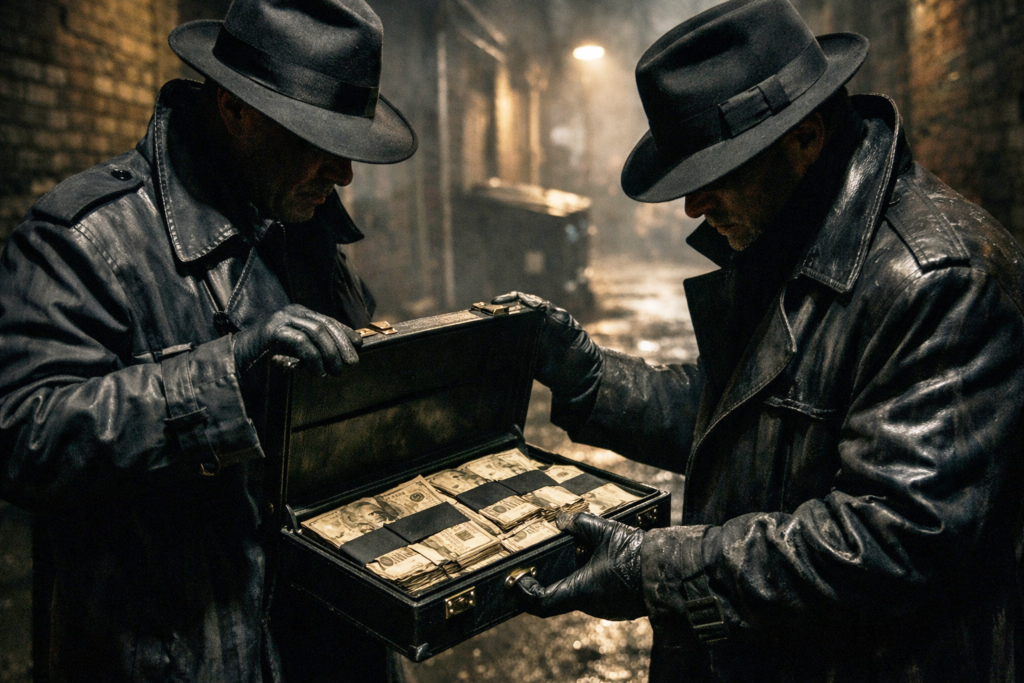
Share this:


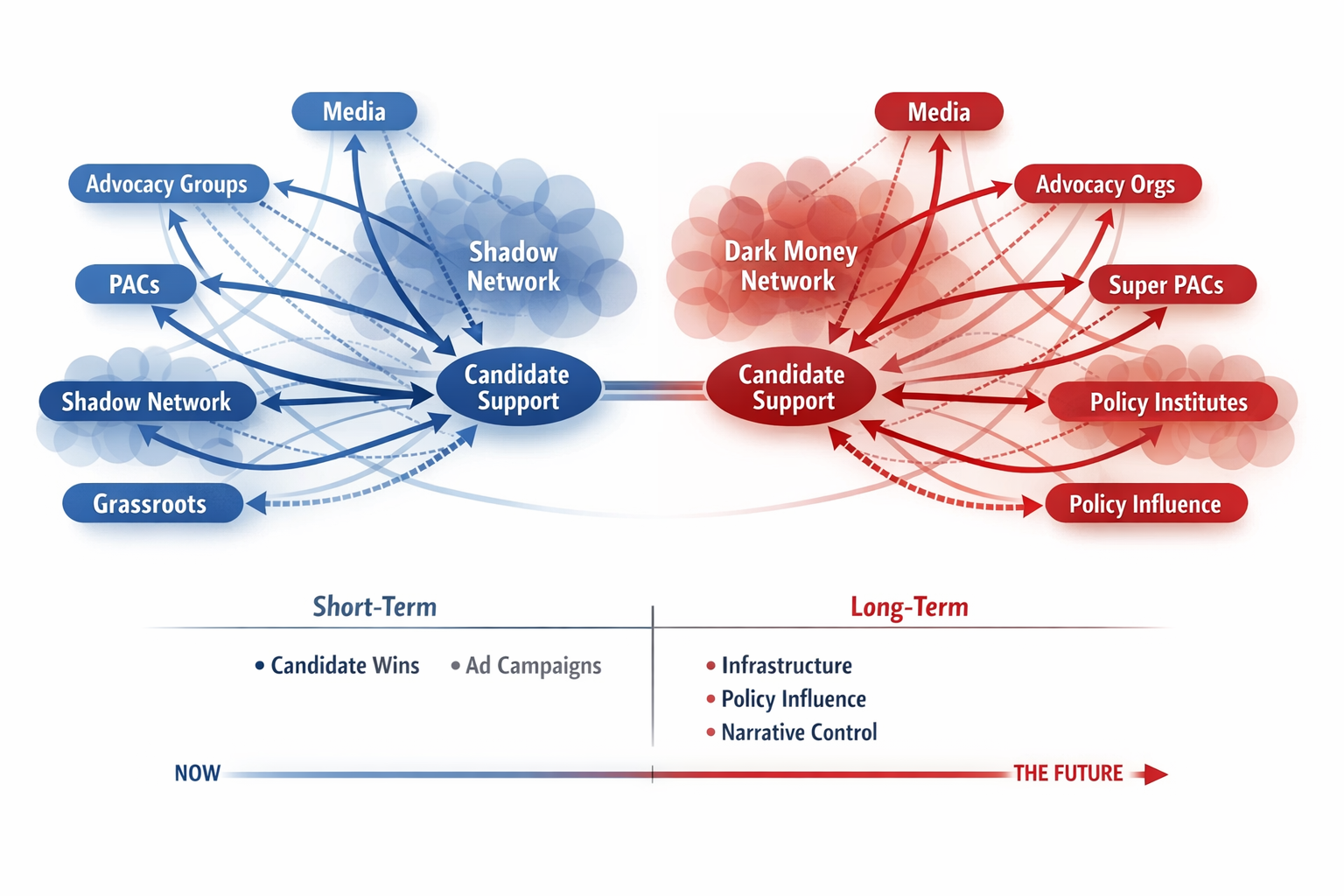
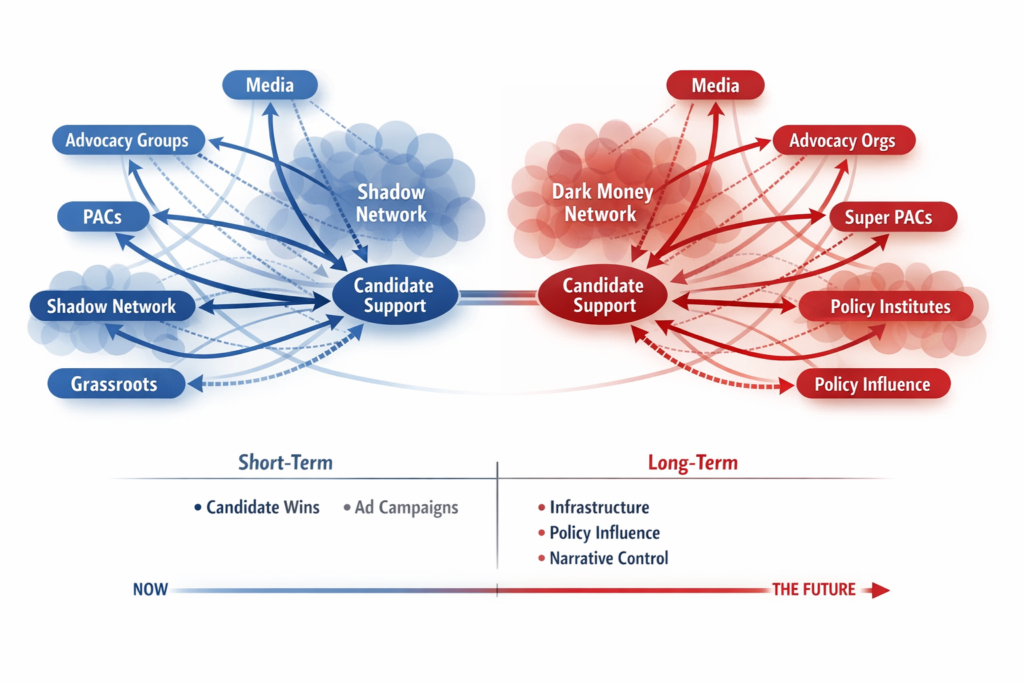
Article 3 of 3 The Long Game — Power Beyond the Ballot
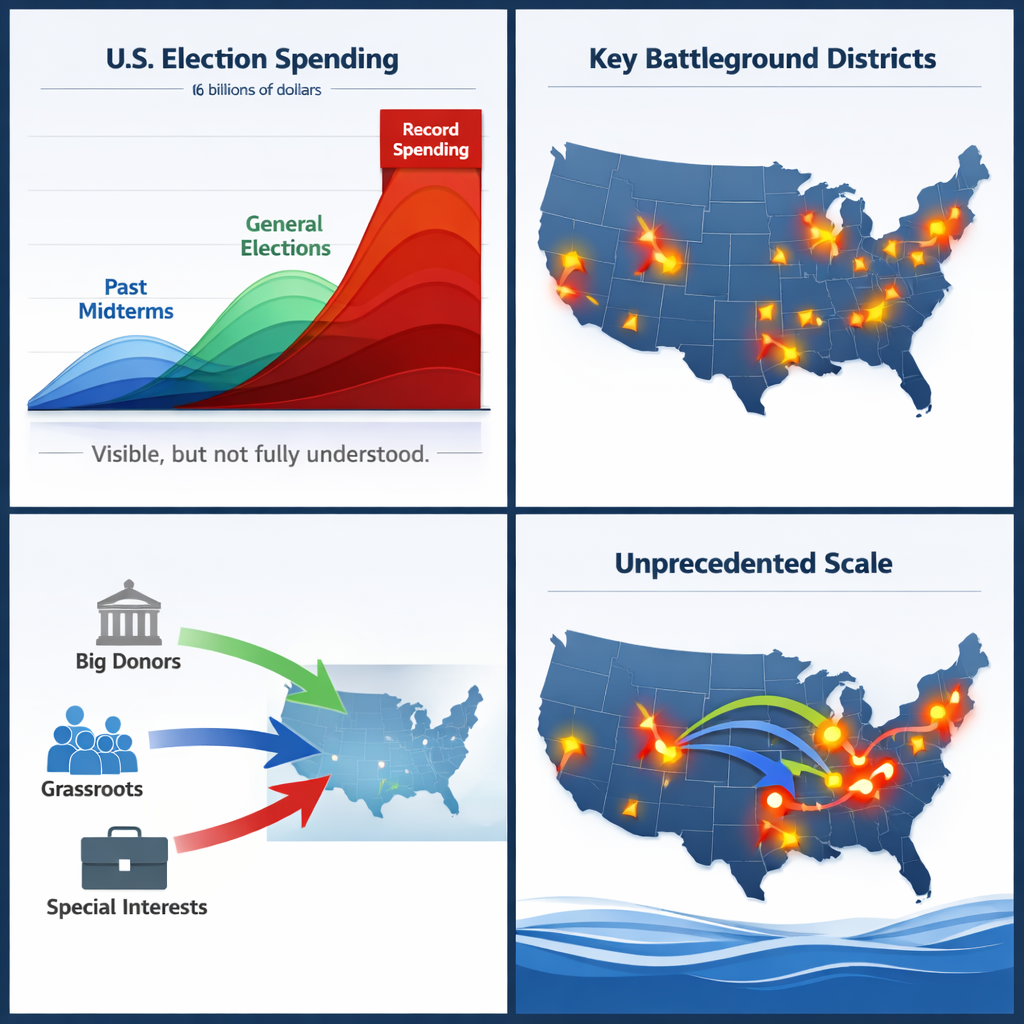
By now, it is clear that the 2026 midterms are unlike any we have seen in recent memory. The scale of spending, the intensity of coordination, and the precision of messaging all suggest a high-stakes contest—but the full story goes deeper than individual candidates or party control.
Share this:


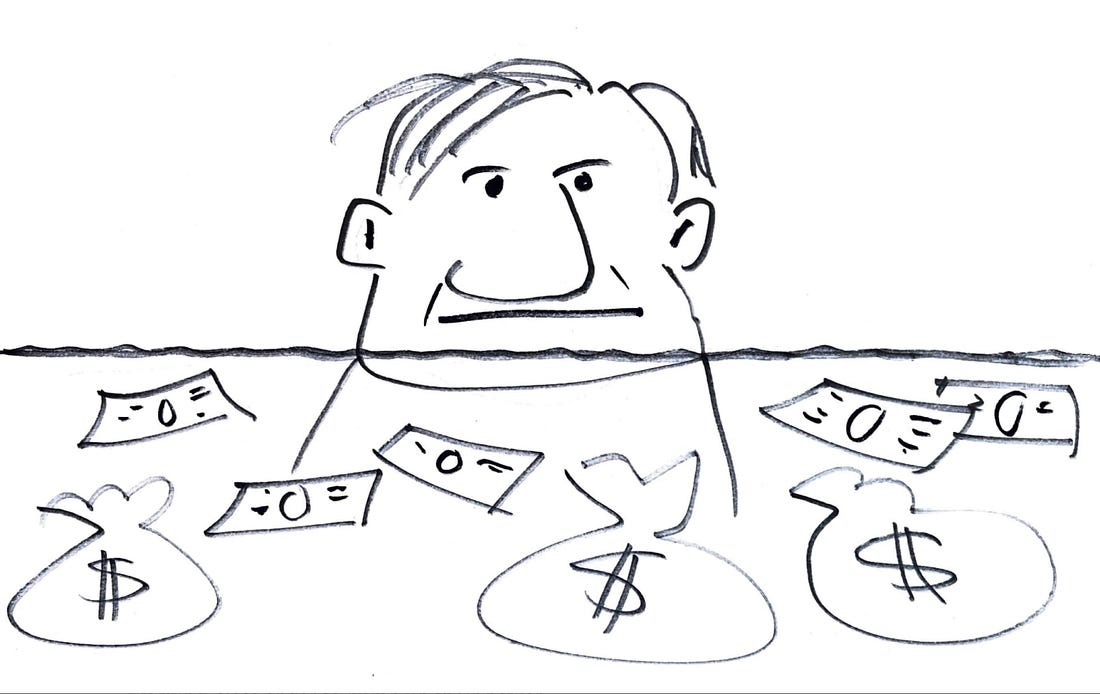
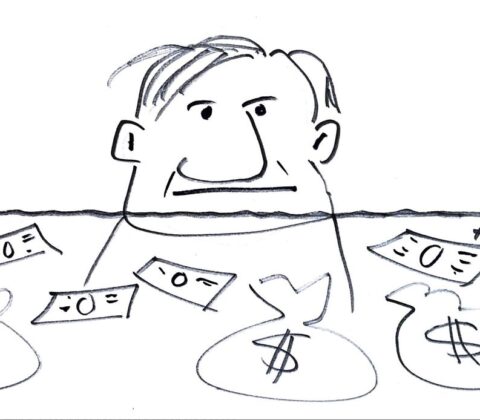
How We Get Rid of “Citizens United” And get back our democracy Robert Reich
Share this:

And the Beat Goes On
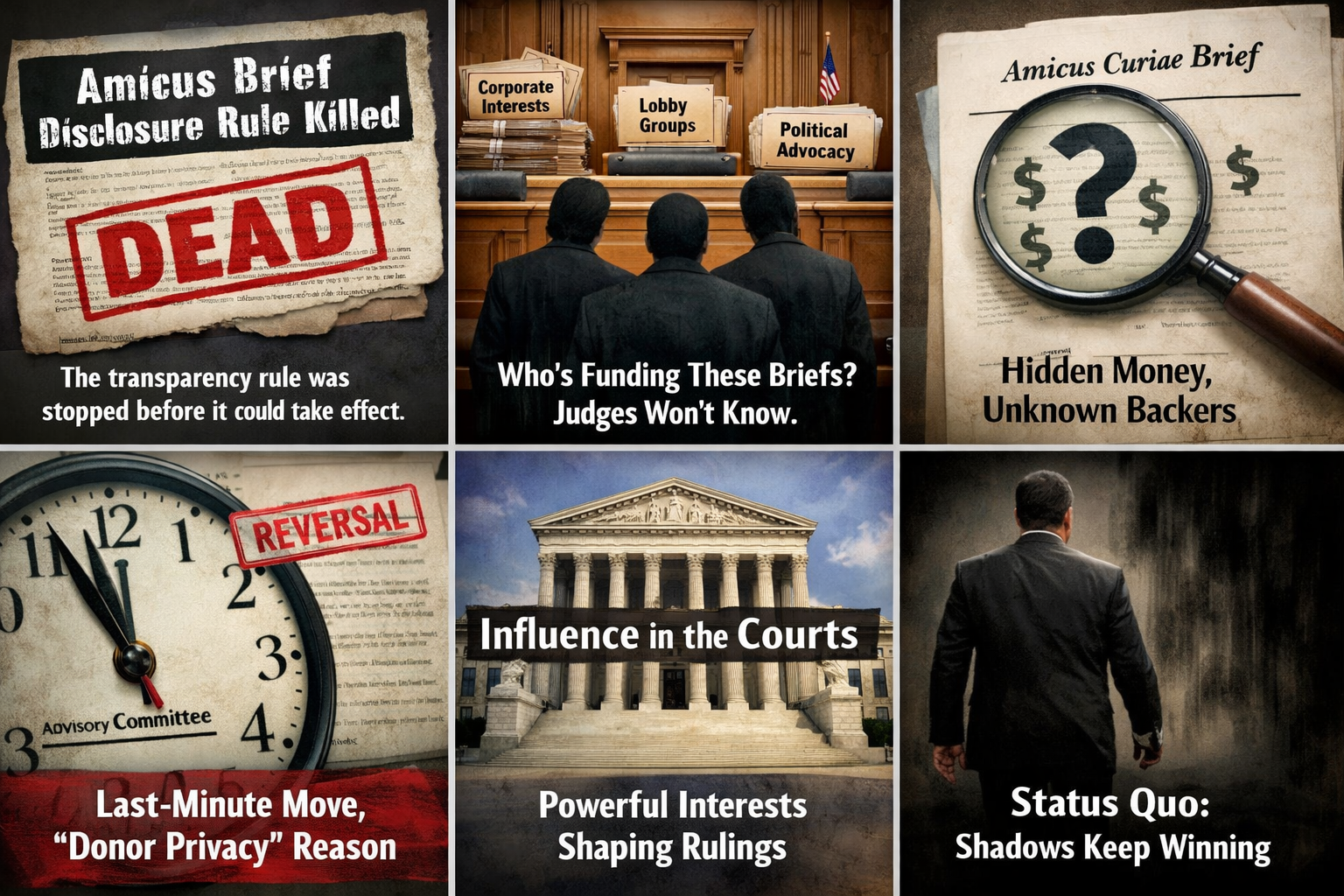
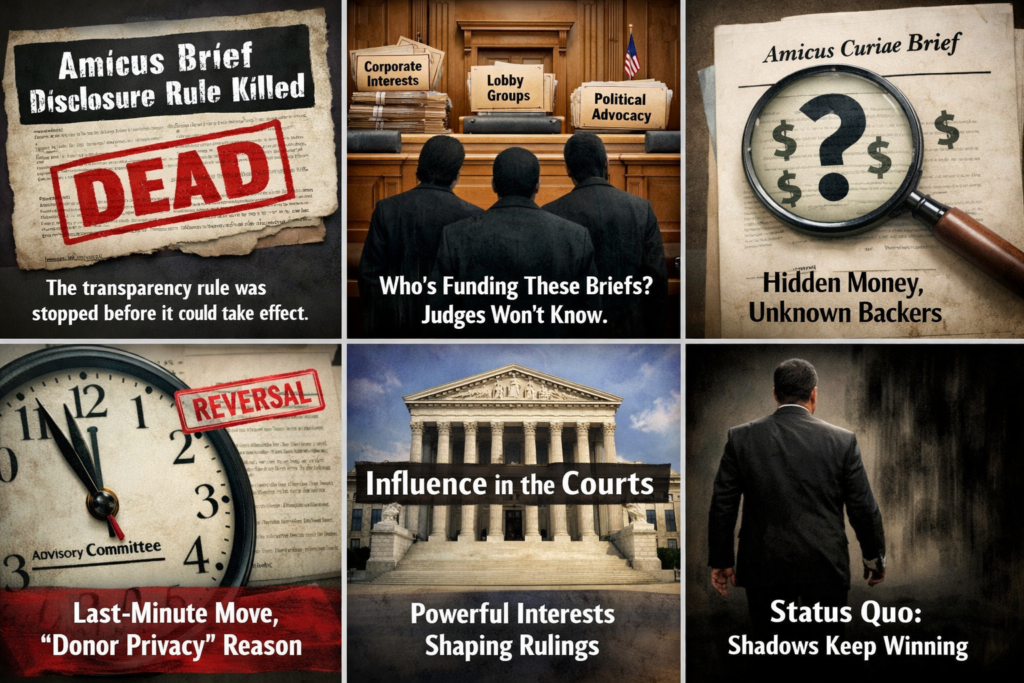
A rule change that would have required disclosure of who funds amicus curiae (“friend of the court”) briefs was killed before it ever went anywhere. Things go back to exactly the way they were.
In practical terms that means well-funded interest groups — corporations, political advocacy organizations, ideological networks — can continue to file coordinated briefs influencing federal court decisions while the judges hearing those cases have no reliable way of knowing who is actually behind them. A brief that appears to represent independent expert opinion may in fact be funded by a direct party interest in the outcome, and nobody is required to say so.
The significance of the timing is probably the real story. The advisory body had already done the legal work, found disclosure constitutional, and moved the process forward. The reversal came late, quietly, and the stated reason — donor privacy — is the same argument the groups lobbying against it would make. Whether that’s coincidence is a judgment call, but the sequence is notable.
The broader context is that amicus briefs have grown into a significant influence tool at the federal level, particularly at the Supreme Court, and the funding networks behind them are largely the same ones that have been involved in judicial selection and court-related advocacy for years.
So the short answer: transparency lost, the status quo held, and the people who preferred the shadows got to keep them.
Share this:

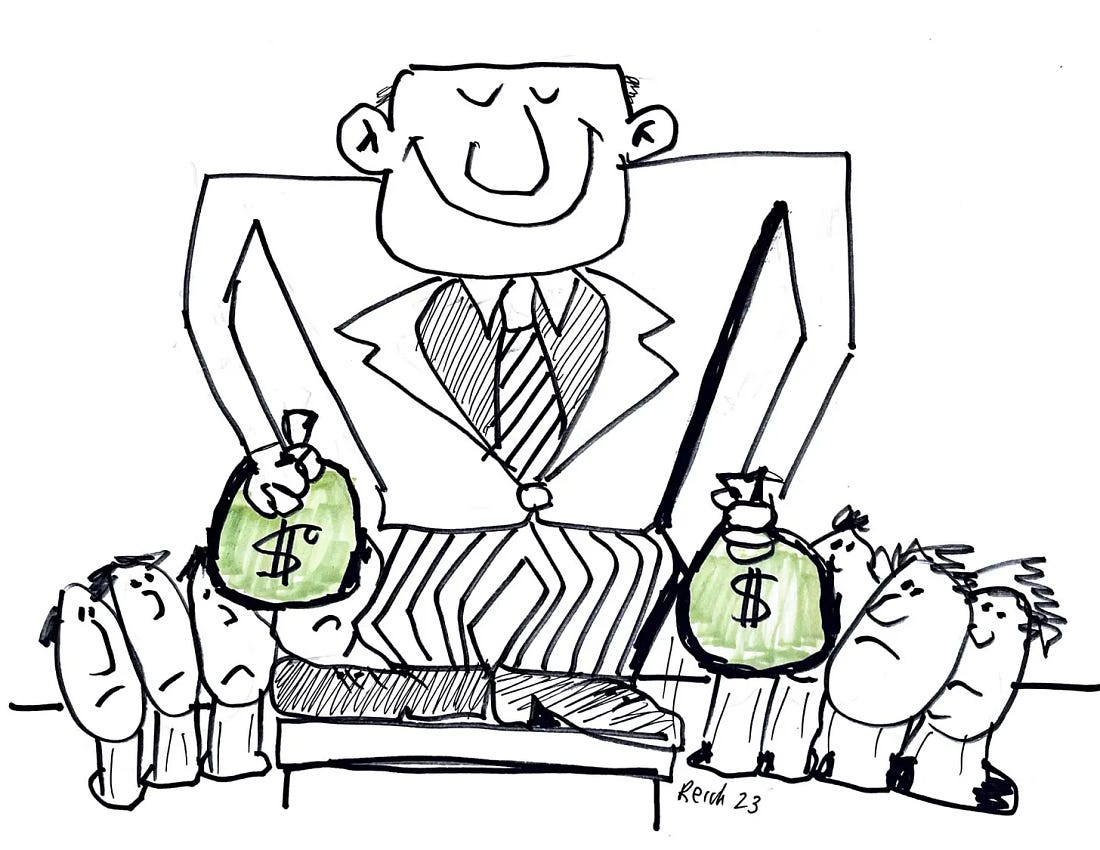
“America has a choice. We can have great wealth in the hands of a few, or we can have a democracy. But we cannot have both.” Robert Reich
Share this:



Thank You, Mr. Trump: How Media Consolidation Is Accidentally Saving Journalism
There is something almost poetic about what is happening to the American media landscape right now. The more Donald Trump and his circle of oligarchs tighten their grip on mainstream media — CBS, NBC, ABC, Fox News, Newsmax, TikTok, X, Truth Social — the clearer the picture actually becomes. Not because the propaganda gets better. Because it gets easier to spot.
When everything runs through the same hands, when the same interests control the message, the narrative becomes so uniform, so coordinated, that a simple rule of thumb starts to apply: if they say up, look down. Consolidation, ironically, is doing the work that media criticism has failed to do for decades. It is teaching people to read between the lines.
The Migration Is Already Happening
Here is what you may not have noticed yet: the journalists you trusted are leaving.
They are not retiring. They are not giving up. They are moving to the internet — to podcasts, to Substack, to independent platforms where no one can call them into an office and tell them what story to kill. Think of voices like Dan Rather or Robert Reich, commentators with decades of credibility who no longer need a network’s permission to speak.
What you find when you go looking for them is something mainstream media stopped offering a long time ago: honest commentary from people who no longer have to answer to Jeff Bezos, Larry Ellison, or Donald Trump.
The Money Problem Nobody Wants to Talk About
There is a catch, and it would be dishonest to pretend otherwise. The internet does not come with a paycheck.
I know this firsthand. For over a year now, I have been doing this work — nearly full time. I am my own web designer. My graphic artist is AI and me. My research assistant is AI and me. And I have funded every bit of it out of my own pocket. I am not telling you this to ask for anything. I am telling you this because it is the reality facing most of the independent journalists you will find on platforms like Substack. They are doing it on their own dime, because they are journalists, and because they believe the work matters.
The lack of money is a problem without an easy answer. But it is also, in a strange way, a kind of protection. With money comes control. The moment someone else starts paying the bills, they start having opinions about the content.
How to Find the Truth — On Your Own Terms
I have not written off mainstream media entirely. I still check the headlines. I still scan the aggregators. And I have found that European media, in particular, often gives a clearer picture of what is actually happening here in the United States than our own outlets do. Distance has a way of sharpening perspective.
But if you want journalism that is working for you rather than for its owners, start looking around. Search out the independent voices. Find the podcasts. Read the Substacks. You will recognize good journalism when you find it — it will make you think, not just confirm what you already believe.
I will not tell you who to read or who to trust. That is your call to make.
Though obviously, you should start here. 😉
Share this:

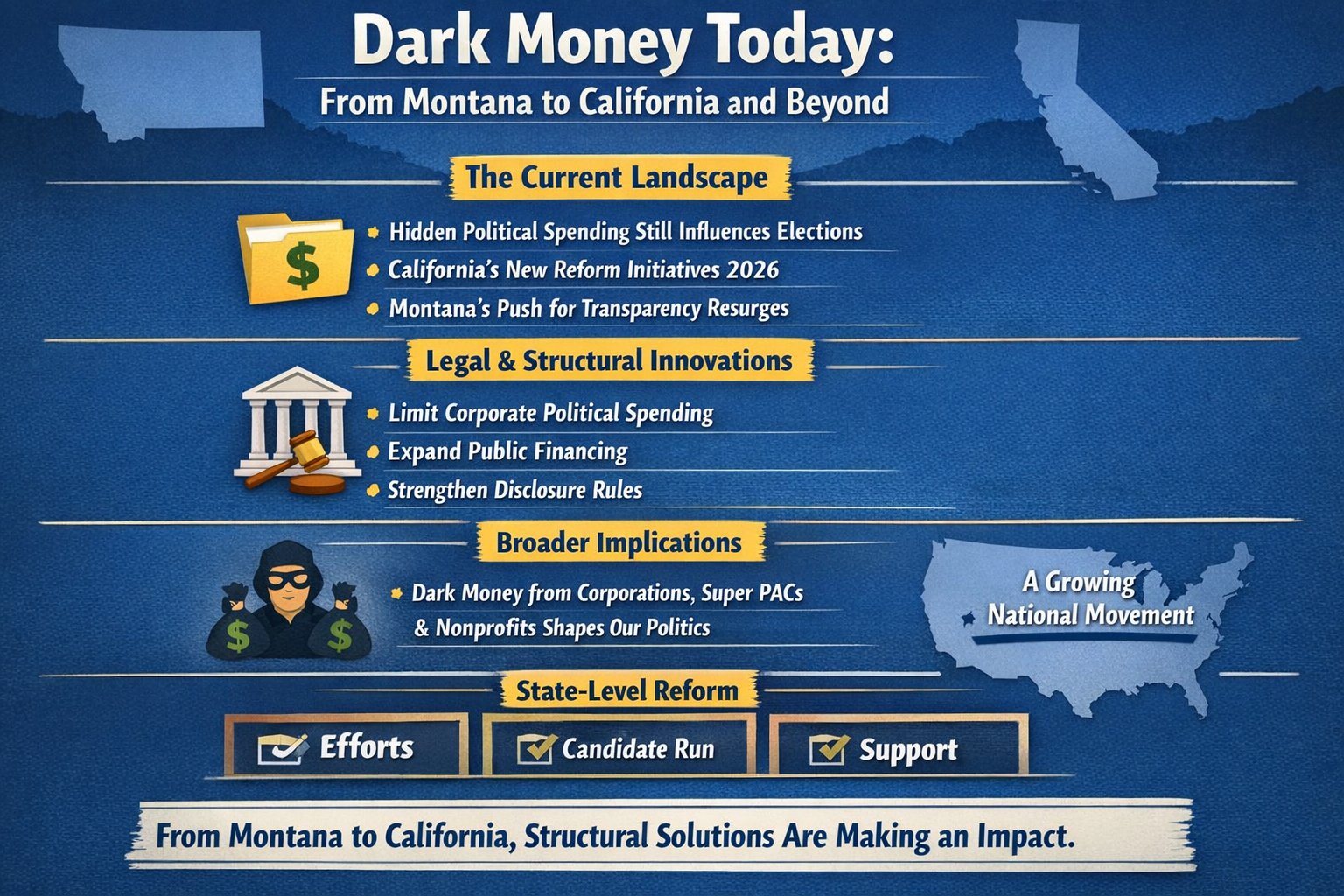
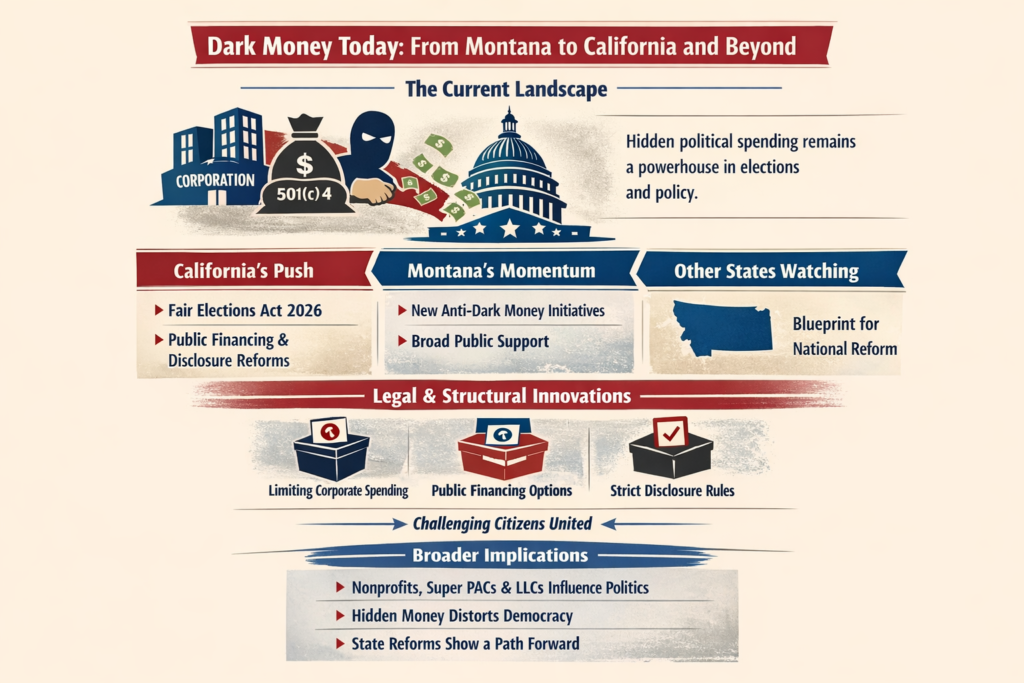
Dark Money Today: From Montana to California and Beyond
Dark Money Today: From Montana to California and Beyond
Two months ago, we explored the Montana initiative as a test case for curbing dark money. The story didn’t end there. Today, states like California are building on that example, showing that structural solutions — not just outrage — can reshape the rules of political influence.
The Current Landscape
Hidden political spending remains a major driver of elections and policy. Corporations, nonprofits, and 501(c)(4)s continue to funnel large sums into campaigns with little transparency. But now, state-level reforms are gaining traction:
-
California is preparing ballot initiatives and legislation aimed at limiting corporate influence, expanding public financing, and enforcing stricter disclosure rules. Voters could see the California Fair Elections Act in November 2026, giving candidates alternatives to reliance on big donors.
-
Montana remains a test case. After a legal challenge stalled an earlier initiative, new filings are moving forward, backed by strong public support. These efforts focus on restricting corporate spending and making dark money sources visible.
-
Other states are watching. Models from Montana and California are providing a blueprint for structural reform nationwide.
Legal & Structural Innovations
States are exploring ways to sidestep Citizens United without waiting for a federal reversal:
-
Some leverage state corporate charters to limit corporations’ political spending at the source.
-
Public financing programs allow candidates to run competitive campaigns without large outside contributions.
-
Disclosure rules ensure voters see who is influencing elections, making money less “invisible.”
These approaches shift the focus from partisan debate to structural solutions, changing the incentives in the system itself.
Broader Implications
Dark money isn’t only about corporations. Nonprofit groups, super PACs, and LLCs contribute heavily to elections while keeping donors hidden. This creates outsized influence on local and national politics, often at odds with public interest.
Structural reforms like Montana’s and California’s tackle this from the ground up, offering practical paths forward rather than relying on idealistic federal solutions.
Connecting Back
As we discussed in the previous Montana series, states can push back against big money in meaningful ways. California’s emerging initiatives show that these strategies are not isolated — they’re part of a growing national movement. Readers following that series can now see how lessons learned in Montana are spreading and evolving.
Takeaways
-
Progress is possible through state-level reforms, disclosure requirements, and public financing.
-
Structural changes can reduce hidden influence and increase accountability.
-
Like in healthcare, small, practical reforms can create measurable improvements, even in complex systems.
Share this:

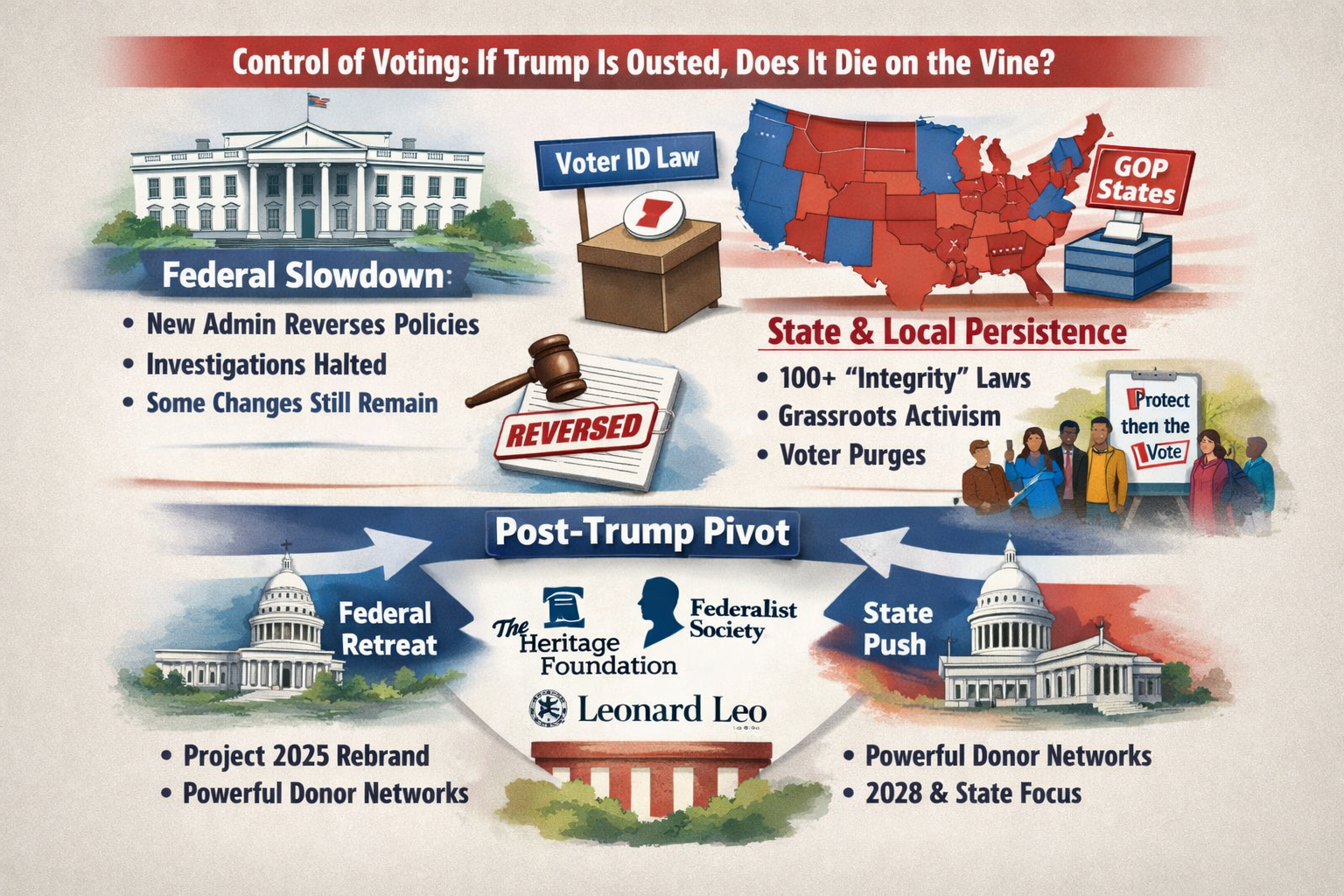
Control of Voting – If Trump Is Ousted: Does It Die on the Vine?
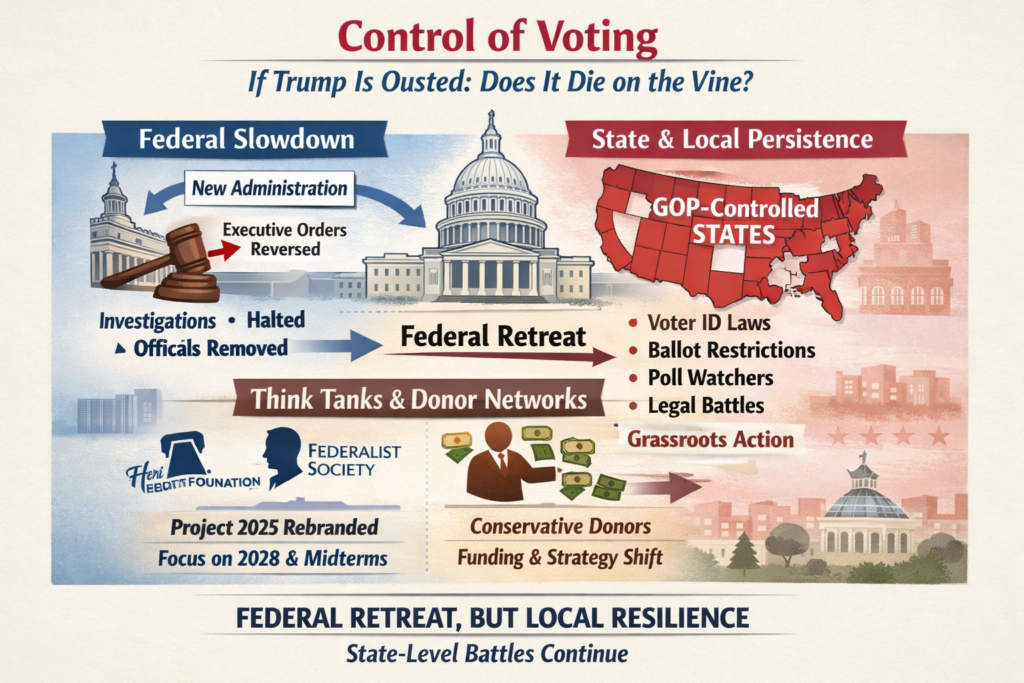
Control of Voting – If Trump Is Ousted: Does It Die on the Vine?
Not entirely, it would slow at the federal level, but these efforts are bigger than one person. Project 2025 isn’t just a Trump playbook; it’s a Heritage Foundation-led blueprint from over 100 conservative groups, predating his second term. By October 2025, Trump had implemented ~47% of its domestic agenda (e.g., workforce cuts via shutdown, executive orders on election “integrity”).
If impeached/removed:
Federal Slowdown: A new admin (e.g., under Vance or a Democrat post-midterms) could reverse executive orders, like Biden did with Trump’s first-term policies. DOJ probes into “fraud” might halt, and appointees like Cleta Mitchell’s network could be ousted. But some changes (e.g., embedded federal observers, voter roll purges) could linger if not actively undone, per experts at the Center for American Progress.
State and Local Persistence: Much of this is decentralized. GOP-led states have passed 100+ “integrity” laws since 2020 (e.g., voter ID, mail ballot restrictions), independent of Trump. Groups like the Election Integrity Network or RNC’s Protect the Vote operate at grassroots levels, training poll watchers and filing lawsuits, stuff that doesn’t vanish overnight. Even without Trump, red states resist federal overreach (e.g., some GOP secretaries of state withholding full voter data from DOJ).
Think Tank and Donor Networks: Heritage, Federalist Society, and funders like Leonard Leo would pivot. Project 2025 is framed as a “conservative promise” for any GOP admin, not Trump-specific. If Trump goes, they’d rebrand for 2028 (e.g., focusing on state ballot initiatives, litigation).
It wouldn’t “die quickly”—more like a temporary federal retreat, with momentum shifting to states and courts. Post-2020, GOP election denialism rewarded incumbents (e.g., no electoral penalty for “stop the steal” supporters in 2022). But backlash (e.g., bipartisan criticism of Georgia raids) could erode support if overreach backfires.
Will They Shift Gears?
Absolutely, conservative networks are adaptive. Without Trump, tactics might soften federally (e.g., less overt “nationalization” talk) but intensify locally: more state laws, voter challenges, or “audit” pushes. X chatter and op-eds suggest prepping for 2028 census fights or midterms as a “blue tsunami” opportunity for Dems. Critics (ACLU, Brennan) warn it could evolve into subtler subversion, like weakening DOJ voting rights enforcement.
In my view, this is a long-game ecosystem (think tanks, donors, state parties) that’s survived presidents before. Trump’s a catalyst, but removal would force a tactical reset—not abandonment. The midterms are the pivot point; if GOP holds, it accelerates. If not, it decentralizes.
Share this:

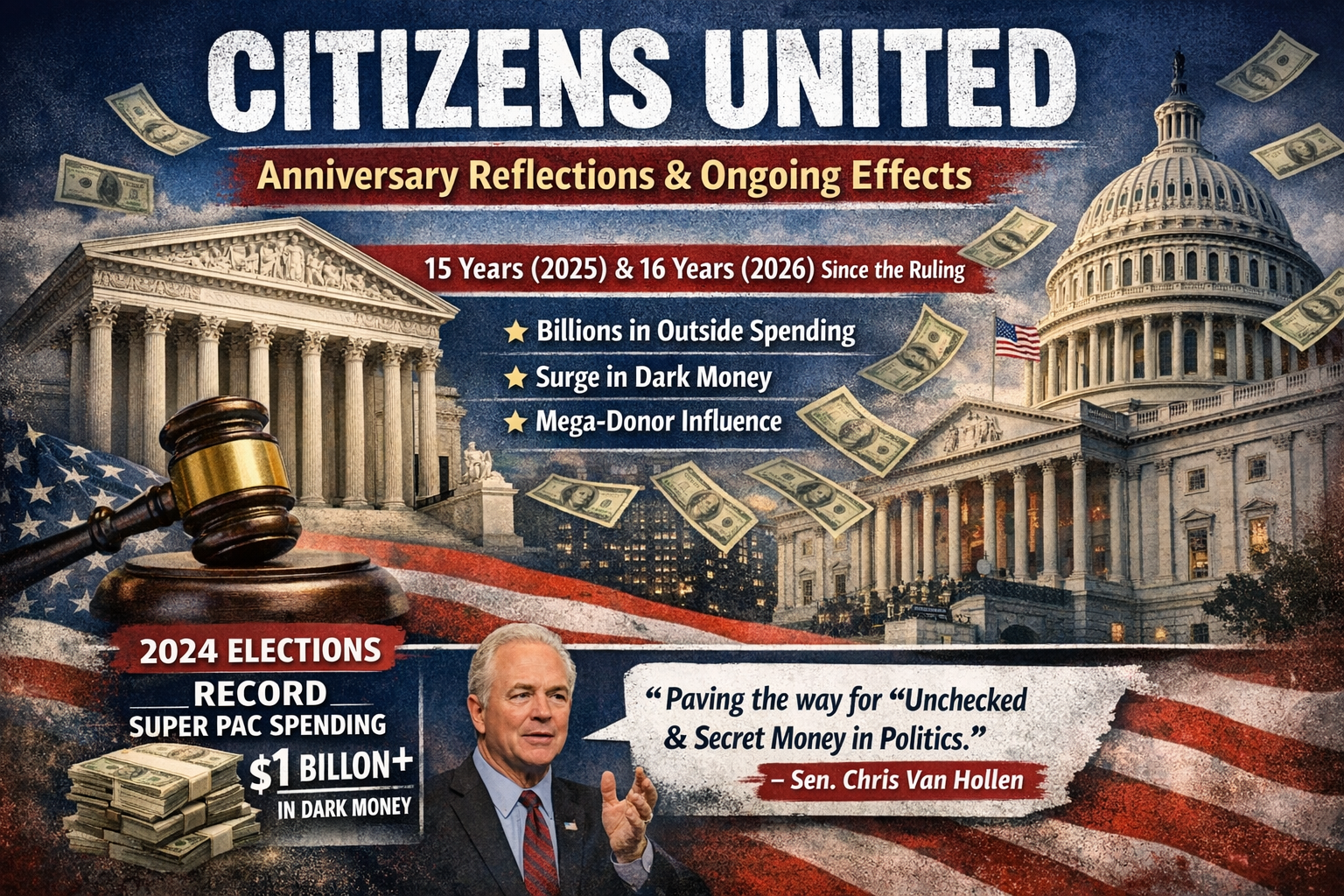
Fifteen Years later, Citizen United still is in the news and still the center of controversy
 Key recent highlights (from late 2025 into early 2026):
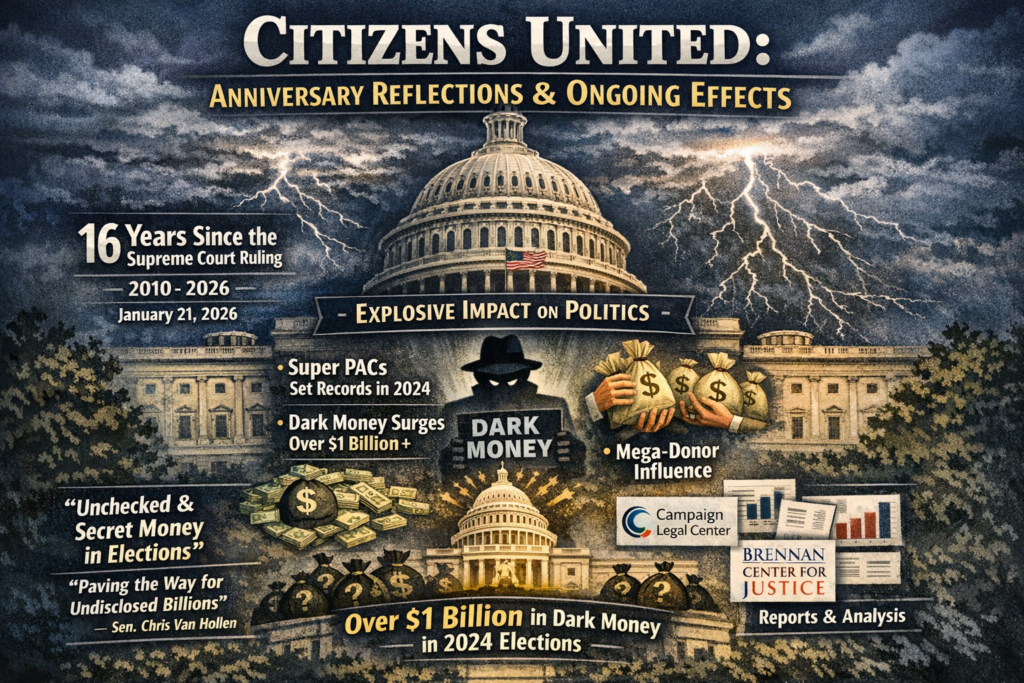
Anniversary reflections and ongoing effects: On the 15-year (2025) and now 16-year (January 21, 2026) anniversaries of the ruling, groups like the Campaign Legal Center, Brennan Center for Justice, and others published analyses showing how Citizens United has enabled billions in outside spending, dark money surges, and megadonor influence. For example, super PACs set records in 2024 elections, with dark money topping $1 billion in some cycles. Posts from figures like Senator Chris Van Hollen criticized it for paving the way for “unchecked & secret money” in politics.
Calls for reform and constitutional amendments: In September 2025, Democratic lawmakers (including Reps. Summer Lee, Joe Neguse, Jim McGovern, and Sen. Adam Schiff) introduced the “Citizens Over Corporations Amendment” to overturn Citizens United, restore limits on corporate spending, and distinguish between people and corporations in campaign finance. This builds on long-standing efforts, with endorsements from groups like CREW (Citizens for Responsibility and Ethics in Washington).
State-level and alternative strategies: Discussions continue on state actions to push back, such as “trigger laws” (laws that activate if the ruling is overturned) or rethinking corporate powers via state incorporation laws to make Citizens United “irrelevant.” A Montana initiative and reports from groups like the Center for American Progress highlighted these in 2025. Polls (e.g., from American Promise in early 2026) show broad public rejection of “money = speech,” with support for reforms across party lines.
Broader commentary: Advocacy organizations (e.g., Brennan Center, End Citizens United) and critics frequently tie current political dynamics—like billionaire influence in transitions or elections—to the decision’s legacy. On X (formerly Twitter), users continue debating it in contexts like big donors, election integrity, and specific politicians.
How does this affect you, in my opinion, it reduced our voice. It is no longer one person, one voice.
What can we do about it? As with anything thing in politics, the louder the voice, the more often it will be heard. You know where your phone is, you know where your email is, use them.
Share this:

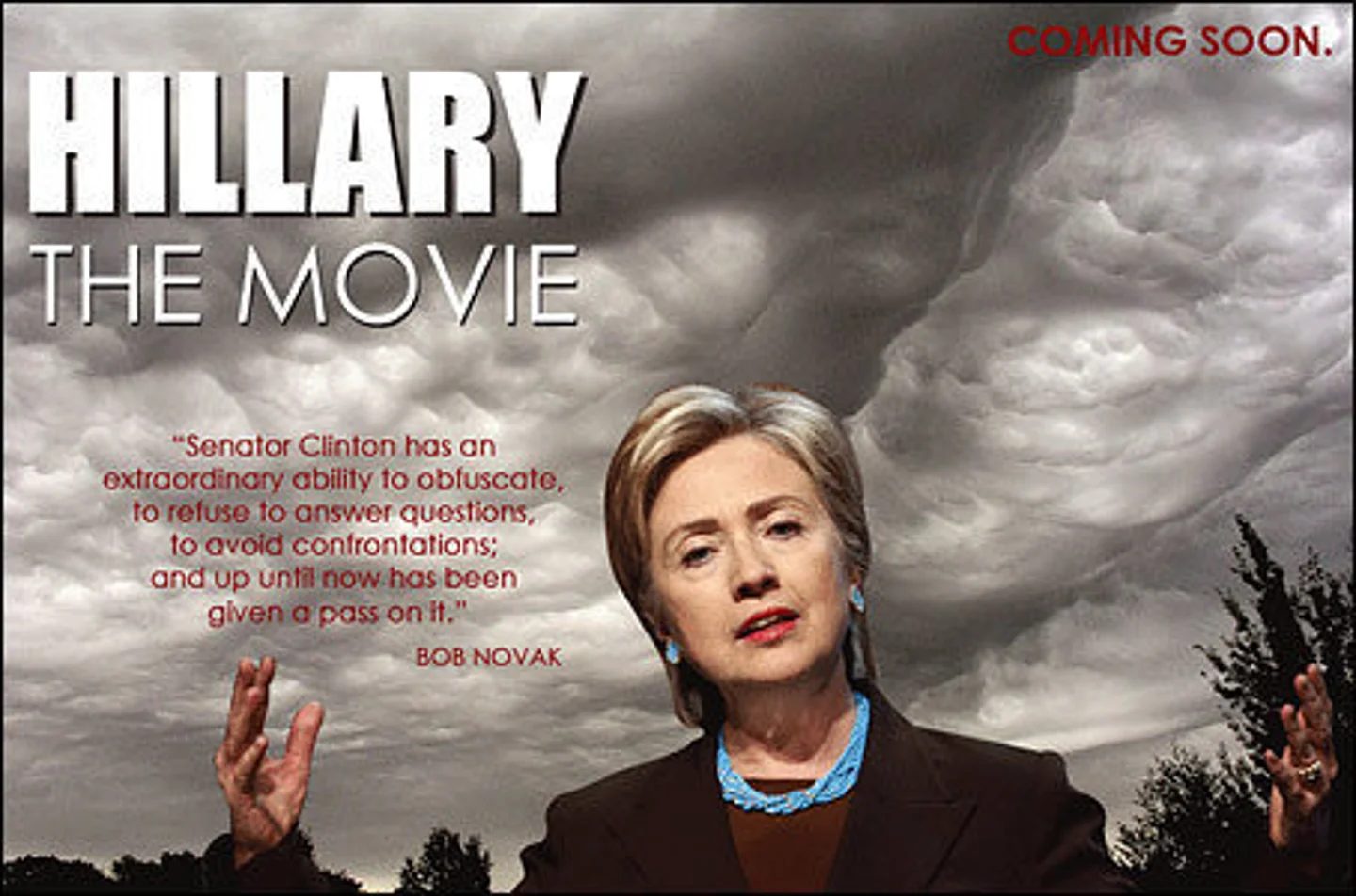
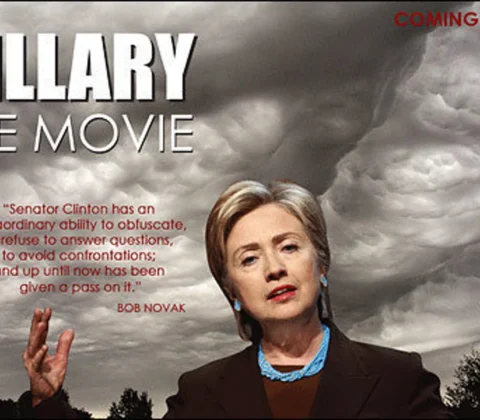
How Citizens United Came to Be: From a Hillary Hit Piece to Unlimited Corporate Cash in Elections – Dark Money
The 2010 Supreme Court decision in Citizens United v. FEC remains one of the most divisive rulings in modern American history. It didn’t just tweak campaign finance rules—it blew the doors off them, allowing corporations, unions, and wealthy donors to pour unlimited money into elections through “independent” spending. Super PACs, dark money groups, and billionaire influence? Thank (or blame) this case.
But how did we get here? It all started with a conservative nonprofit, a scathing documentary about Hillary Clinton, and a bold challenge to longstanding restrictions on political speech.
The Origins: Citizens United and “Hillary: The Movie”
Citizens United, a conservative advocacy group founded in 1988 by Floyd Brown (known for attack ads like the infamous Willie Horton spot in 1988), positioned itself as a producer of political documentaries. In 2007–2008, during Hillary Clinton’s run for the Democratic presidential nomination, the group created Hillary: The Movie—a 90-minute film portraying Clinton as power-hungry, untrustworthy, and unfit for office.
They planned to air it on DirecTV and promote it with TV ads right before primaries. But they hit a wall: the Bipartisan Campaign Reform Act (BCRA) of 2002—better known as the McCain-Feingold law—banned corporations and unions from funding “electioneering communications” (ads naming candidates) within 30 days of a primary or 60 days of a general election if those ads reached a broad audience.
Citizens United wasn’t just any corporation; as a nonprofit, it argued the rules violated its First Amendment rights to free speech. They sued the Federal Election Commission (FEC) in December 2007, seeking to declare parts of BCRA unconstitutional, both on their face and as applied to the film and its ads.
A federal district court mostly sided with the FEC: the film was basically election advocacy, not a neutral documentary, so the ban applied. Citizens United appealed directly to the Supreme Court.
The Supreme Court Showdown
The case was argued in March 2009, but the Court surprised everyone by ordering a rare reargument in September 2009, expanding the question to whether prior precedents like Austin v. Michigan Chamber of Commerce (1990)—which allowed bans on corporate independent expenditures—should be overruled.
On January 21, 2010, the Court ruled 5-4 in favor of Citizens United, going far beyond the narrow issue of the movie.
Majority (5 justices):
Anthony Kennedy (wrote the main opinion): Argued that spending money on political speech is protected expression. Banning corporate independent expenditures based on the speaker’s identity (corporation vs. person) violates the First Amendment. “If the First Amendment has any force, it prohibits Congress from fining or jailing citizens, or associations of citizens, for simply engaging in political speech.”
Joined by: Chief Justice John Roberts, Antonin Scalia, Samuel Alito, and Clarence Thomas (Thomas concurred separately, dissenting on disclosure rules).
Dissent (4 justices):
John Paul Stevens (wrote a blistering 90-page dissent): Called the ruling a “radical departure” that threatens democracy by allowing corporate wealth to drown out ordinary voices. Corporations aren’t “We the People,” he argued, and unlimited spending risks corruption and erodes public trust.
Joined by: Ruth Bader Ginsburg, Stephen Breyer, and Sonia Sotomayor.
The Court struck down the corporate spending ban, overturned Austin, and opened the floodgates for unlimited independent expenditures—as long as they weren’t coordinated with candidates.
The Controversy: Free Speech Victory or Corporate Takeover?
The decision ignited immediate firestorms.
President Obama blasted it in his 2010 State of the Union address:
“Last week, the Supreme Court reversed a century of law to open the floodgates for special interests—including foreign corporations—to spend without limit.” (That line drew a viral “not true” mouthed response from Justice Alito.)
Supporters hailed it as a triumph for the First Amendment, preventing government censorship of political views just because they’re from corporations (seen as groups of individuals). Critics decried it for equating money with speech, amplifying megadonors, and enabling “dark money” nonprofits to hide sources—leading to billions in outside spending that many say distorts democracy.
Fifteen years later (and counting), the ruling birthed super PACs, record-shattering election spending, and ongoing calls for a constitutional amendment to overturn it. Polls show overwhelming public opposition across party lines.
Was Citizens United a principled defense of free expression, or did it hand elections to the highest bidders? In the elephant in the room: the money keeps flowing, and ordinary voices often get shouted down.
What do you think—time to amend the Constitution, or is this just how free speech works in a capitalist democracy? Drop your thoughts in the comments.
Sources: Supreme Court opinion, Brennan Center for Justice, FEC records, Wikipedia summary (cross-verified).
Share this:



Dark Money and Influence, It’s time to move on.

At that point, the choice is yours.
You can go to the bar and complain.
You can leave angry comments online.
You can declare the right evil, the left evil, or both — and feel briefly satisfied.
Or you can do something about it.
To close out this section on dark money, We’ve pointed to the largest national players we know on each side of the ideological divide. On the right, the Federalist Society and Leonard Leo. On the left, the American Constitution Society and Arabella Advisors.
This wasn’t done to assign blame or score points.
It was done to show that influence networks exist on both sides, operate differently, and are rarely as simple as the slogans used to describe them. We’ve tried to approach this non-partisanly — not because “both sides are the same,” but because understanding requires honesty, not loyalty.
Our goal isn’t outrage.
It’s perspective.
If we want to slow the pendulum, regain some sanity in the process, and move forward in a way that doesn’t leave communities feeling manipulated or powerless, it starts here — with awareness, restraint, and local engagement.
What happens next is up to you.
Share this:

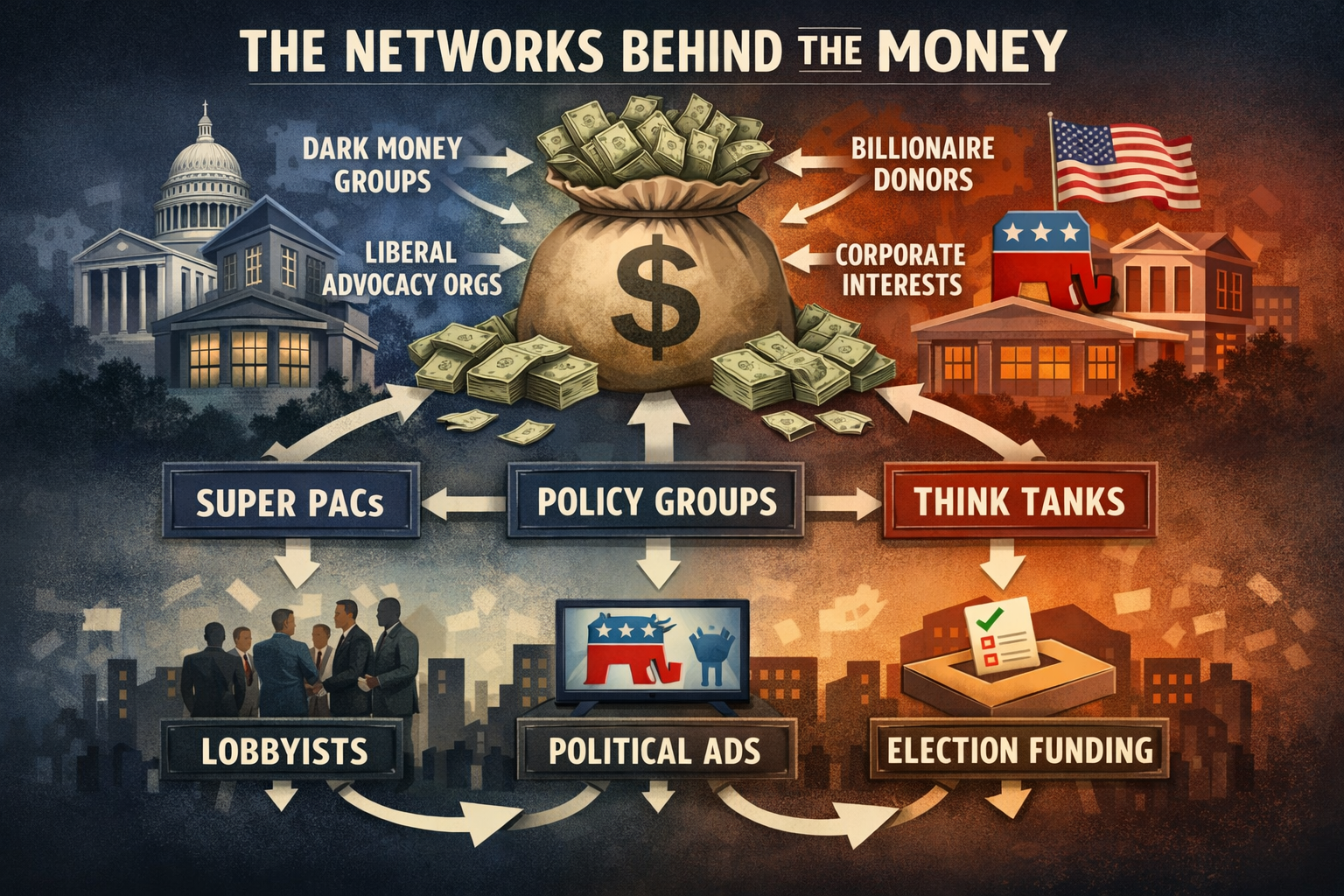
What we could expect with Major reform in campaign finance / donation transparency
What we could expect with Major reform in campaign finance / donation transparency
Most of this was included in the Pendulum Swing, assuming a right to left shift, but the organizations need to be brought to light and understood.
On the surface, what we might see would be more honest campaign promises as the backroom financing would become more transparent. This would be more obvious on the local level but would migrate up the National Ladder.
Major reform in campaign finance / donation transparency — if laws tighten, anonymity and dark-money flows shrink.
-
- Economic collapse or disruption to corporate profits — institutional money depends on capital; if the economy sours, so does financial influence.
- Mass public backlash / grassroots insurgency — if voters demand structural change, elite influence may become a liability rather than an asset.
- Global shifts (trade, climate, geopolitics) that outgrow traditional domestic lobbying and require new alignments — making old networks obsolete or forced to transform drastically.
Major Networks & Institutions Likely to Persist Through a Shift
|
Name / Network |
Why They Endure /What Makes Them Resilient |
|---|---|
|
Sixteen Thirty Fund (and affiliated Arabella Advisors funds) |
Long-standing “dark money” powerhouse for the left. Provides fiscal-sponsorship and funding to many progressive causes and campaigns. As a 501(c)(4) nonprofit, it can channel money — often anonymously — into activism, ballot initiatives, and elections. Wikipedia+1 |
|
Berger Action Fund (network tied to Swiss billionaire support of progressive causes) |
Serves as a major donor funnel for progressive policy agendas. Its role shows how international money and large-scale philanthropy can influence U.S. politics regardless of which party is in charge. Wikipedia+1 |
|
Priorities USA Action |
One of the largest Democratic-leaning super PACs. Has shown flexibility in shifting strategy (e.g. moving toward digital campaigning rather than just TV ads), which suggests institutional agility in changing political climates. Wikipedia |
|
American Bridge 21st Century |
A major liberal opposition-research and election campaign group—effective at media and messaging work. Such infrastructures are portable: no matter who’s in power, they can redirect resources toward oversight, opposition, or new causes. Wikipedia |
|
Tides Foundation / Tides Network |
A long-standing donor-advised fund and fiscal-sponsorship network. Its versatile structure lets wealthy donors fund causes under the radar — meaning it can remain influential regardless of which party holds power. Wikipedia+1 |
|
Major Conservative Mega-Donors (e.g. Richard Uihlein & family, Scaife-linked foundations, etc.) |
These “big-money backers” have deep pockets and substantial influence on think tanks, policy-planning networks, and regulatory lobbying. Their funds tend to follow structural interests (tax law, business regulation, corporate incentives) — which can often survive major party shifts. DeSmog+2The Good Men Project+2 |
|
Embedded Think Tanks and Policy Networks (e.g. Heritage Foundation, Intercollegiate Studies Institute (ISI), and other longtime policy infrastructure) |
These institutions provide long-term ideological frameworks, produce research, influence judiciary nominations, shape legislation drafts — and have memberships, staffs, and networks that outlast electoral cycles. DeSmog+1 |
|
Financial-industry donors and Super-PAC backers (e.g. Kenneth C. Griffin, other hedge-fund and Wall Street funders) |
Money from big finance often plays both ends: campaign donations, policy lobbying, influence over regulation. Because their interest is often stability, deregulation, and favorable economic policy — not always party ideology — they can pivot if a left administration offers similar benefits. Fiscal Report+1 |
Why These Actors Are So Durable
- Legal and structural opacity: Many are nonprofits or 501(c)(4) / donor-advised funds that are not required to publicly disclose all donors or spending. That secrecy makes them hard to trace — and easy to reorient quietly.
- Networks over individuals: Their power rests in institutions, infrastructure, think tanks, PACs, and donor webs — not individuals whose fortunes rise or fall with elections.
- Financial interests over pure ideology: Many of these players (especially donors, think-tanks, financial backers) prioritize economic, regulatory, and institutional stability — interests that survive either party being in power.
- Adaptability: Super-PACs and nonprofit umbrellas can shift focus quickly: from supporting one party to supporting causes, ballot initiatives, or policy campaigns under any administration.
- Trans-partisan appeal: Particularly for business interests and big donors — maintaining influence requires access from whichever side controls power. So pivoting becomes strategy, not betrayal.
Share this:



Arabella Advisors (via the Sixteen Thirty Fund)
| Leonard Leo | Arabella Advisors |
|---|---|
| Builds and steers a network | Builds and steers a network |
| Operates mostly out of public view | Operates mostly out of public view |
| Uses nonprofits and fiscal vehicles | Uses nonprofits and fiscal vehicles |
| Focuses on long-term institutional outcomes | Focuses on long-term institutional outcomes |
| Rarely the public face of campaigns | Rarely the public face of campaigns |
The Other Side of the Leonards Coin: Arabella Advisors and the Progressive Influence Network
Arabella Advisors dissolved in late 2025 and transferred its services to Sunflower Services. That organizational change does not alter the relevance of what follows. This discussion focuses on the methods, structures, and influence models that operated under Arabella’s umbrella—models that continue to exist across the political spectrum regardless of name or branding.
If you’ve read about Leonard Leo and wondered whether there’s an equivalent force operating on the other side of the political spectrum, the short answer is: yes — but it looks different.
If you are unfamiliar with Leonard Leo then I suggest you read our brief on him, it will make my cross references here clearer.
Rather than centering on one highly visible figure, progressive influence has tended to operate through organizational networks. One of the most significant of those is Arabella Advisors.
This is not a critique or an endorsement. It’s an attempt to understand how modern political influence actually works.
What Is Arabella Advisors?
Arabella Advisors is a for-profit consulting firm that specializes in managing and supporting nonprofit organizations and advocacy efforts. Its influence comes less from public messaging and more from infrastructure.
Arabella administers several large nonprofit funds, including:
-
The Sixteen Thirty Fund
-
The New Venture Fund
-
The Hopewell Fund
-
The Windward Fund
These funds act as fiscal sponsors, meaning they legally host and manage hundreds of projects that may not have their own independent nonprofit status.
In practical terms, this allows advocacy campaigns to:
-
Launch quickly
-
Share administrative resources
-
Receive funding efficiently
-
Operate under existing legal umbrellas
This structure is entirely legal and widely used across the nonprofit world.
How the Network Operates
Unlike traditional nonprofits with a single mission and brand, Arabella’s model supports many separate initiatives at once, often focused on:
-
Voting and election policy
-
Climate and environmental advocacy
-
Healthcare access
-
Judicial and legal reform
-
Democracy and governance issues
Most people encountering these efforts don’t see “Arabella” at all. They see:
-
A campaign name
-
A policy group
-
A ballot-issue committee
-
An issue-specific advocacy organization
That’s not secrecy — it’s organizational design.
Why Some Critics Raise Concerns
Criticism of Arabella’s network usually centers on three issues:
1. Donor opacity
Some of the funds administered through the network do not publicly disclose individual donors, which raises concerns similar to those voiced about conservative dark-money groups.
2. Scale and coordination
Because many projects are housed under a small number of fiscal sponsors, critics argue this can concentrate influence in ways that are hard for the public to track.
3. Distance from local impact
National funding routed through professionalized networks can shape outcomes in local or state-level debates without local communities fully understanding where the support originated.
These concerns mirror critiques made of conservative influence networks — which is precisely why Arabella is worth understanding.
Why Others Defend the Model
Supporters argue that Arabella’s structure:
-
Improves efficiency
-
Reduces administrative duplication
-
Allows rapid response to emerging issues
-
Helps smaller or newer causes compete in an expensive political environment
They also point out that conservative networks have used similar structures for decades — often more visibly and more successfully — and that progressive donors were slow to build comparable infrastructure.
Why This Matters
Arabella Advisors isn’t the progressive version of a political party, a campaign, or a single leader.
It’s something subtler:
An influence platform — not for persuasion, but for coordination.
That makes it powerful, and it also makes it easy to misunderstand.
Just as Leonard Leo represents how conservative legal influence became institutionalized, Arabella represents how progressive advocacy adapted to a landscape where money, law, and organization matter as much as ideas.
The Larger Point
Seeing Arabella Advisors clearly helps avoid two common mistakes:
-
Believing influence only flows from one side
-
Confusing infrastructure with ideology
Modern politics is less about speeches and more about systems — systems that decide which ideas get sustained, funded, and repeated over time.
Understanding those systems doesn’t require agreement.
It requires attention.
Share this:



Leonard Leo has done more to reshape the American legal landscape than many senators, presidents, or judges.
Most Americans can name Donald Trump. Many can name Joe Biden.
Fewer can name Brett Kavanaugh or Amy Coney Barrett.
But almost no one knows the name Leonard Leo, and that’s exactly how he prefers it. While the country fights over policies, Leo quietly builds the structures that decide them. He’s not an elected official. He doesn’t run for office. But over the past two decades, Leonard Leo has done more to reshape the American legal landscape than many senators, presidents, or judges. And he’s done it behind the curtain. As co-chairman and former executive vice president of the Federalist Society, Leo advised on the selection of Supreme Court justices who overturned Roe v. Wade, narrowed voting rights, and limited environmental protections.
But he didn’t stop at the high court, he built a pipeline. From district courts to appeals courts, Leo’s influence extends like a legal shadow network, placing originalist judges where precedent used to live.
And now he has the money to go even further. In 2021, Leo’s Marble Freedom Trust received a staggering $1.6 billion donation from Chicago businessman Barre Seid, the largest known political gift in American history.
Not to fund a campaign, but to advance conservative activism in his vision. That means supporting legal challenges against government regulation, climate policy, abortion access, and even election processes. The playbook? It aligns with efforts like Project 2025, a Heritage Foundation-led initiative to overhaul the federal government, and Leo’s networks have funded groups preparing for similar conservative policy shifts.
He’s also facilitated lavish, undisclosed trips for Supreme Court justices like Samuel Alito and Clarence Thomas, the kind of perks organized through his donor networks that would get a public servant fired, but which have evaded strict ethics enforcement in a judiciary with limited oversight.
And yet, the headlines rarely mention his name. That’s the danger. While we’re busy arguing on social media about candidates and slogans, Leonard Leo is writing the footnotes of history, in fine print most of us never see. This isn’t conspiracy. It’s coordination. And it’s working. So the next time you wonder how a fringe legal theory became binding law, or why public trust in the courts has cratered, remember this name. Not because he shouts it, but because he doesn’t have to. Leonard Leo. The most powerful unelected man in America. And we’re letting him do it in silence.
1.He’s almost completely invisible to the public
Most Americans couldn’t pick him out of a lineup, and yet he has arguably reshaped more of the American political landscape than any living figure, without ever running for office.
2.He operates through permanence, not popularity
While presidents come and go, Leo’s real power comes from engineering a judicial supermajority and embedding his ideology into the law for decades, particularly through lifetime federal judges.
3. He has billion-dollar influence with zero accountability
Through his networks (like the Marble Freedom Trust), he’s moved $1.6 billion from donors into judicial activism, legal campaigns, and media shaping, with almost no oversight or press scrutiny.
4. His agenda is deeply ideological, and strategic
This isn’t just about being “conservative.” It’s about remaking the constitutional framework:
-
Weakening federal oversight
-
Empowering state-level authority
-
Rolling back decades of precedent on voting rights, reproductive rights, regulatory power, and civil protections
He’s the force behind decisions like Dobbs, Shelby County, and the Chevron deference rollback, each systematically shifting power away from elected government and toward courts, corporations, and conservative legal theory.
So, a quick recap:
-
Co-chairman and former executive vice president of the Federalist Society
-
Longtime judicial kingmaker on the American right
-
Key advisor in the conservative legal revolution, including stacking the Supreme Court
-
Aligned with networks supporting Project 2025, the policy playbook for a conservative overhaul of government
Why He’s Dangerous
He doesn’t run for office. He runs people who do.
He’s behind the curtain shaping judicial, legal, and policy infrastructure that outlasts any election.
His fingerprints are on decisions gutting voting rights, abortion access, campaign finance law, and federal agency power.
He builds systems, not headlines.
While Trump tweets and shouts, Leo advises on the manual, places the judges, and engineers the undoing of the administrative state.
Bureaucratic reprogramming disguised as “liberty.”
He understands how to leverage chaos.
The louder the MAGA noise, the more quietly Leo’s network rewires the levers of power: Supreme Court, state AGs, education boards, religious coalitions, media outlets.
He has billions at his disposal now.
In 2021, he received $1.6 billion from Barre Seid, the largest known political donation in U.S. history, and he’s using it not to run ads, but to reshape the legal battlefield.
Why People Overlook Him
No bombastic rallies, no orange spray tan, no obvious cult of personality.
The media mostly sees him as “that judicial guy from the Federalist Society.”
But under the radar, he’s weaponizing legal legitimacy, which is far more enduring than any single politician’s charisma.
If Trump is the actor, Leonard Leo is the playwright, and the stage manager, and the guy who installed the trapdoor under the audience.
Share this:

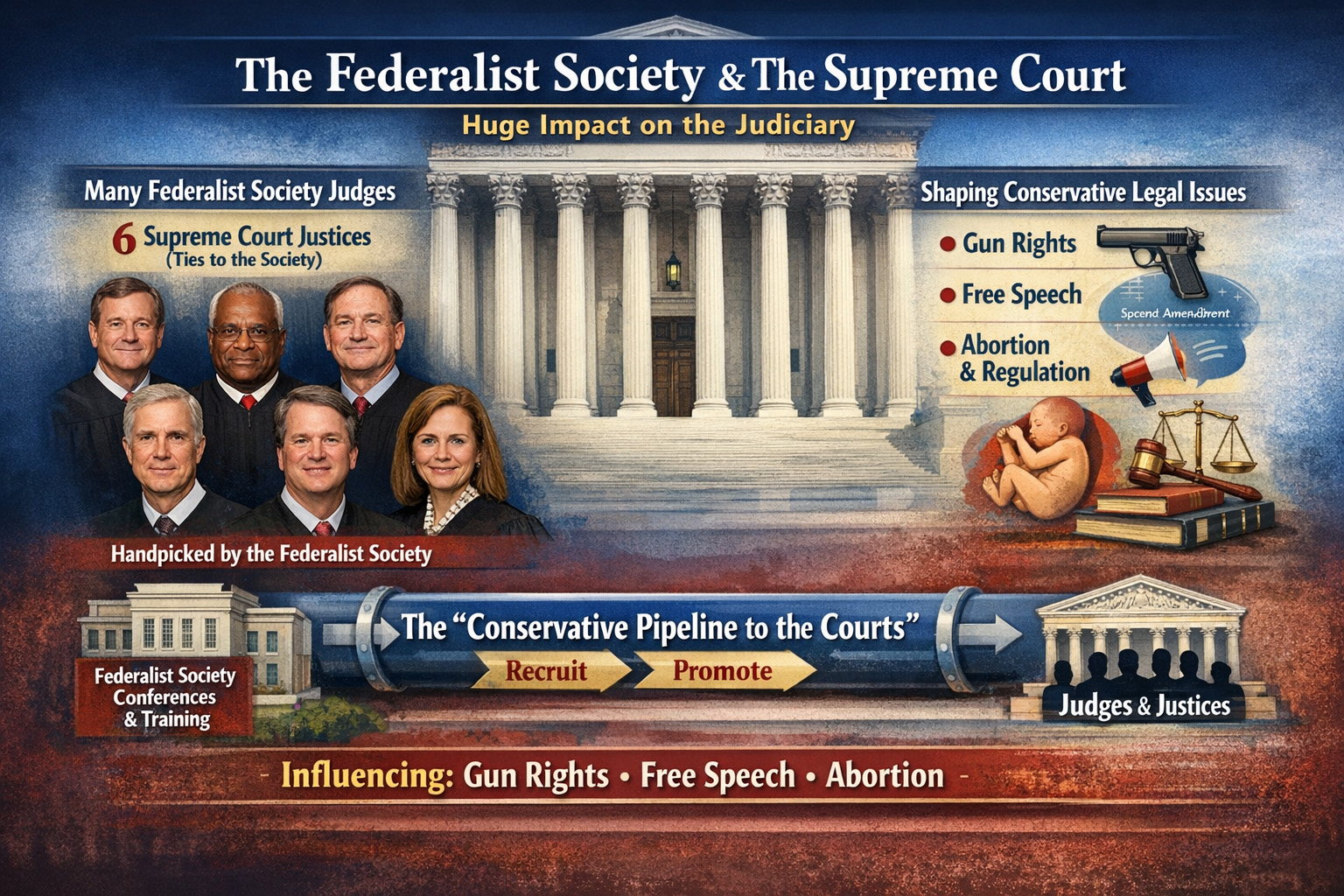
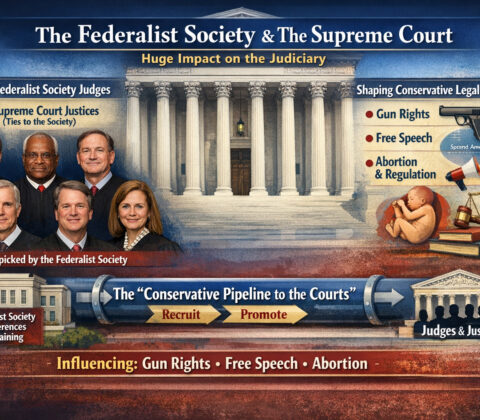
A Beginner’s Guide to the Federalist Society
The Federalist Society for Law and Public Policy Studies (often called “FedSoc”) is a major American organization of conservative and libertarian lawyers, judges, law students, and scholars. Founded in 1982 by law students at Yale, Harvard, and the University of Chicago, it started as a way to challenge what its founders saw as dominant liberal ideas in law schools.Key Principles (straight from their mission):
- The government exists to preserve individual freedom.
- Separation of powers is central to the U.S. Constitution.
- Judges should interpret the law as written (textualism and originalism), not make new policy (“say what the law is, not what it should be”).
It’s not a lobbying group or political party — it claims to be non-partisan and focuses on open debate. They host events, panels, and speeches with speakers from all sides (though most align conservative/libertarian).Structure:
- Student chapters: Over 200 at law schools across the U.S.
- Lawyers chapters: In major cities.
- Faculty division and national events.
Influence:
- Huge impact on the judiciary. Many federal judges (including 6 current Supreme Court Justices with ties) are members or recommended by the group.
- Helped shape conservative legal thinking on issues like gun rights, free speech, abortion, and regulation.
- Often called the “conservative pipeline” to the courts.
Critics say it’s too partisan and has shifted the courts rightward. Supporters say it promotes intellectual diversity and constitutional fidelity.The James Madison ConnectionThe society’s logo is a silhouette of James Madison (4th U.S. President, “Father of the Constitution,” co-author of The Federalist Papers). They see themselves as heirs to Madison’s ideas on limited government and checks and balances.
- They have a James Madison Club — a donor group for major supporters.
- Some student chapters win the “James Madison Chapter of the Year” award.
There is no separate major organization called the “Madison Society” directly paired with the Federalist Society. “Madison Society” refers to various unrelated groups (e.g., Second Amendment advocacy, university alumni clubs, or progressive counterparts like the American Constitution Society). The “Federalist and Madison Societies” likely refers to the Federalist Society’s strong ties to James Madison’s legacy.In short: The Federalist Society is the big player in conservative legal circles, proudly Madison-inspired. It’s all about debating ideas to keep government limited and judges neutral.For more: Visit fedsoc.org or read The Federalist Papers for the original inspiration!
Share this:

A few Dark Money Examples, Oh Yeah’s to sleep well with.
You don’t have to take my word for it. Most of us have already seen this — we just didn’t always know what we were looking at.
A Few “Oh Yeah” Examples of Dark Money at Work
You don’t need to follow these closely to get the point. Most of you already recognize the pattern.
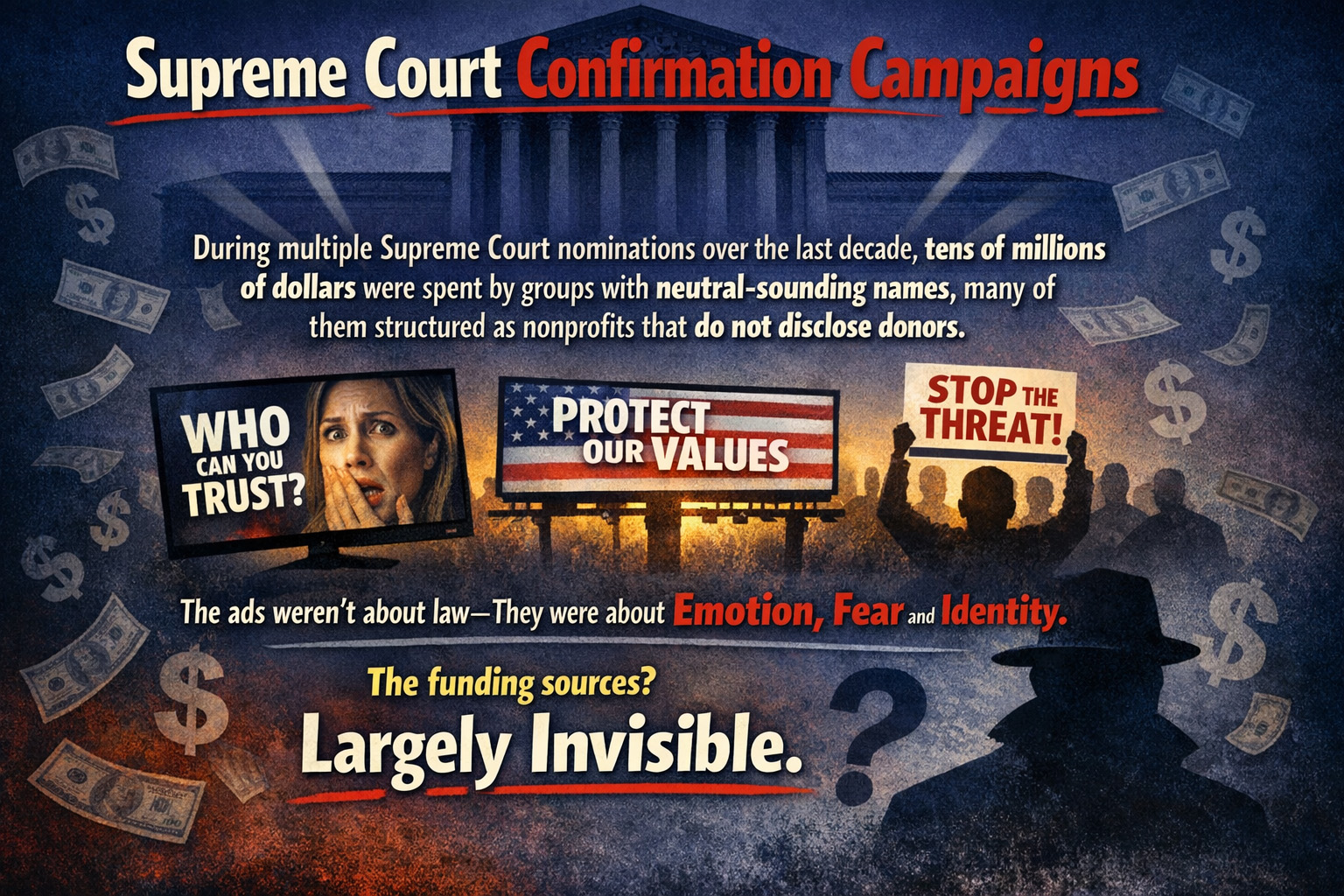
1. Supreme Court Confirmation Campaigns
During multiple Supreme Court nominations over the last decade, tens of millions of dollars were spent by groups with neutral-sounding names, many of them structured as nonprofits that do not disclose donors.
The ads weren’t about law — they were about emotion, fear, and identity.
The funding sources? Largely invisible.
Oh yeah.
2. State Judicial Races
In several states, outside money has flooded judicial elections — races most voters barely notice — because judges decide issues like tort law, environmental regulation, and labor disputes.
Small states. Big money. Quiet races.
Oh yeah.
3. Local Ballot Initiatives with National Backers
Energy, mining, and real estate interests have repeatedly funded campaigns against local ballot initiatives — zoning rules, environmental protections, or tax measures — using PACs that make them look like grassroots efforts.
The campaign feels local.
The money often isn’t.
Oh yeah.
4. Education “Reform” Groups
School board races and education policy fights increasingly attract outside funding from ideological organizations on both the right and the left — often routed through nonprofits that don’t disclose donors.
Parents think it’s a local debate.
The funding strategy was written elsewhere.
Oh yeah.
5. Issue Ads That Aren’t Campaign Ads
Ever see ads that say things like:
-
“Tell Senator X to protect freedom”
-
“Call Representative Y and demand action”
These often come from groups legally classified as issue advocacy, not campaigns — which allows them to spend heavily without revealing who’s paying.
Same effect. Different label.
Oh yeah.
6. Small-State Disproportionate Spending
In lower-population states, a few million dollars can completely reshape a political conversation — making them attractive targets for national organizations seeking influence at a bargain price.
Montana, Wyoming, the Dakotas, West Virginia — none of them are accidental.
Oh yeah.
Share this:

No One Best Fix, Part 3 Dark Money Continued – Montana as a Test Case, Not a Template
No One Best Fix — 3
Montana as a Test Case, Not a Template
Most people outside of Montana don’t think about Montana much — and that’s exactly the point.
Montana matters here not because it has all the answers, but because it raises a question many places are quietly facing:
What happens when a community tries to limit outside influence structurally instead of just complaining about it?

To ground that question in reality, here are two useful references:
-
Official proposed ballot text and description (Montana Secretary of State) — this is the government’s own page listing what the initiative says it would do. Montana Proposed 2026 Ballot Issues Page (Official Text & Summary)
-
Plain-language summary of the initiative statement — a concise version of what the amendment would change. Group Releases Text of Proposed Montana Constitutional Amendment to Curb Dark Money (Summary)
With those in hand, you can always look at the source language while reading this section.
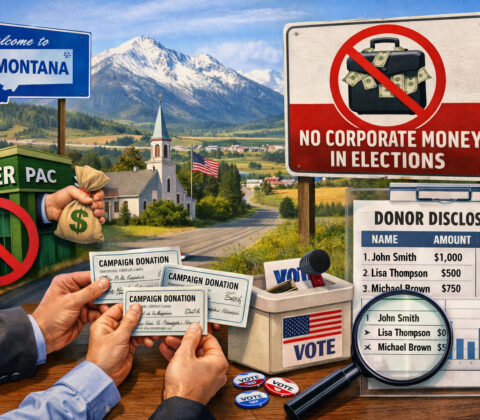
What the initiative would do
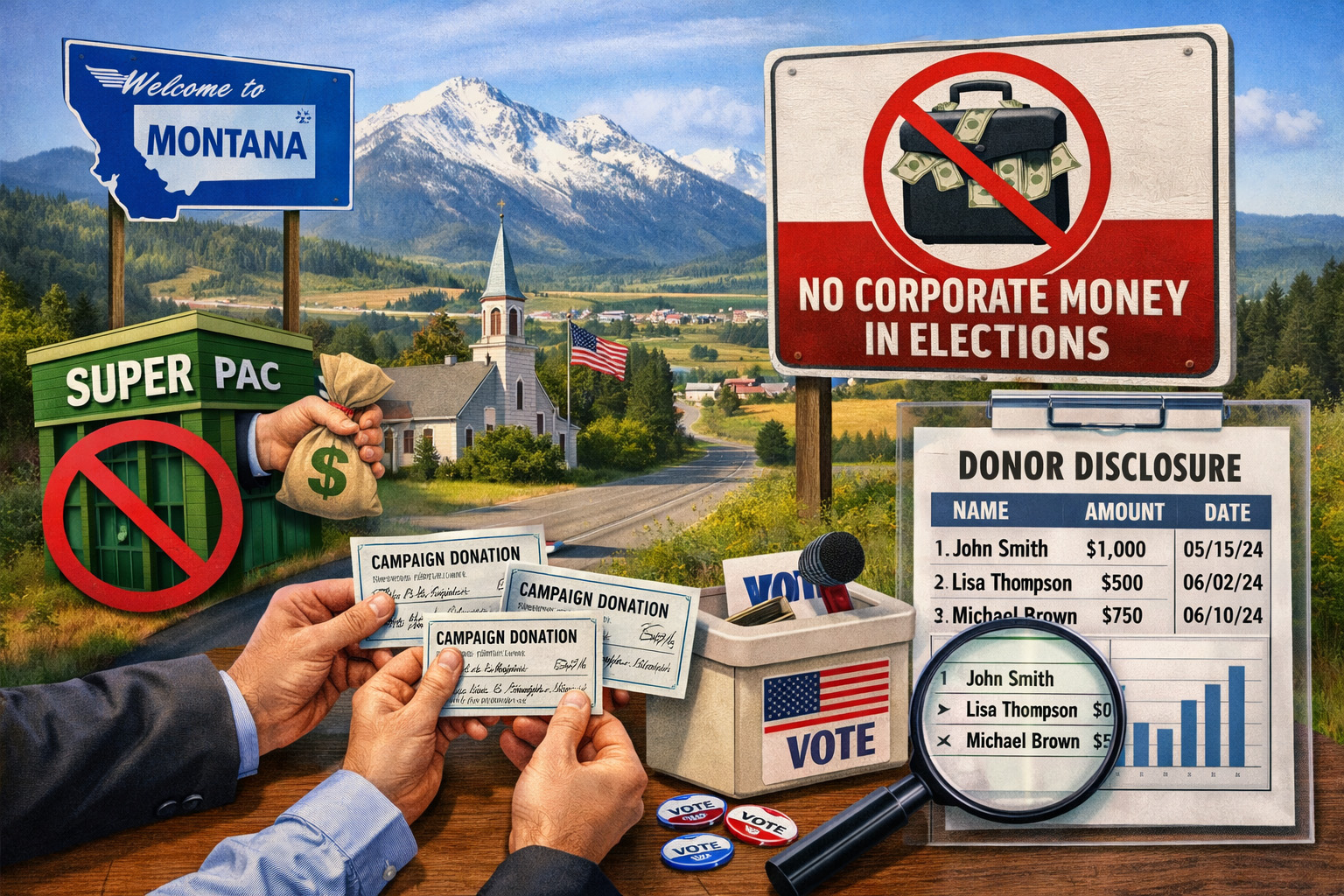
The change in Montana law would simply not grant the corporations the power to give to candidates or causes, but would allow individuals to give, but those donations would be tracked.
The proposed legislation is the first-of-its-kind and takes a different approach to the problem of campaign finance in spending. For example, last year’s U.S. Senate race in Montana, which saw Republican Tim Sheehy beat incumbent Democrat Jon Tester, had more than $275 million spent in a state of roughly 1.2 million people.
“Basically, the only difference is that corporations won’t be able to spend in our elections,” Mangan said.
The specifics of the proposed constitutional amendment would carve out exceptions for organizations like political parties and even media organizations whose coverage could possibly run afoul of the amendment’s language.
“If a person wants to spend money, then they have to put their name on it. It’s full disclosure. That’s what this is all about,” Mangan said.
The Montana proposal — often referred to as the Montana Plan or the Transparent Election Initiative — is fundamentally different from traditional campaign finance reforms.
Instead of regulating spending directly, it would change the basic definition of what corporations and similar entities (“artificial persons”) are allowed to do in elections. In effect, it would:
-
Amend the state constitution to say corporations and other artificial entities have only the powers the constitution explicitly grants them.
-
Specifically ensure that corporations have no authority to spend money or anything of value on elections or ballot issues.
-
Leave open the possibility for political committees (not corporations) to spend money on elections.
-
Include enforcement provisions and severability clauses to protect parts of the law if others are ruled invalid. Montana Secretary of State+1
This isn’t the typical approach of saying “limit X amount” or “disclose Y.” It says, in essence:
If the state never gave a corporate entity the power to spend in politics in the first place, then it can’t do so now. Harvard Law Corporate Governance Forum
That’s why proponents describe it as a doctrine-based challenge to the framework established by Citizens United — not a straightforward campaign finance rule. Harvard Law Corporate Governance Forum
Why this matters structurally
There are four big implications worth noting:
1. It reframes power, not just spending.
Instead of capping or reporting spending, it redefines who gets that power at all. That’s a deeper structural shift in how the political system treats corporations. Harvard Law Corporate Governance Forum
2. It acts at the level where consequences are visible.
When outside groups spend in small races or ballot campaigns, local voters often never see the circuit of influence. This initiative aims to shorten that circuit — even if imperfectly. Truthout
3. It shows how local contexts shape responses to national problems.
Dark money isn’t a national phenomenon only — it’s a distributed one, especially in low-attention environments like state and local elections. Montana’s approach reflects that reality. NonStop Local Montana
4. It illustrates why there’s “no one best fix.”
You’ll notice this proposal doesn’t:
-
Ban all political spending by wealthy individuals
-
Eliminate all influence from outside actors
-
End lobbying
-
And, according to some critics, may raise free speech or legal concerns if adopted wholesale Montana Free Press
What it does is test a structural lever that hasn’t been widely tried before: the state’s sovereign authority to grant or withhold corporate powers.
What’s happening with the initiative now
As of late 2025:
-
The Montana Attorney General has ruled the proposed initiative legally insufficient, arguing it combines multiple constitutional changes into one item and may affect more than a single subject. Montana Free Press
-
The organizers are planning to challenge that ruling and pursue placement on the 2026 ballot. Montana Free Press
This process — review, challenge, signature gathering — is itself part of what makes Montana a useful test case. It isn’t a finished story yet.
How to think about this
When you look at the initiative text and the summary together with your understanding of dark money and influence, here’s the clean takeaway:
-
Montana isn’t offering a pre-packaged solution.
-
It’s testing whether changing who can spend at all alters the dynamics of influence.
-
The state’s unique legal authority provides a laboratory for ideas that might be adapted elsewhere in different forms.
In other words:
Montana’s initiative isn’t the answer — it’s an experiment. Good data from experimentation — success or failure — gives other states something concrete to think with.
Share this:

No One Best Fix, Part 1 Dark Money Continued – Why Simple Solutions Fail
Parts One and Two are being kept deliberately short. Not because the issues are simple — but because my attention span is being throttled back.

I’ve found that even when something seems straightforward, actually understanding it requires letting it sit for a moment before moving on. Digest first. Then build.
By the time we reach Part Three, we’ll introduce an initiative from one state that attempts to address these issues as they affect them. The better we understand the basic principle, the better we’ll understand how — or whether — it could apply to our own states and circumstances.
And it’s worth repeating:
One size does not fit all.
No One Best Fix — 1
Why Simple Solutions Fail
Once people understand how dark money works, the next instinct is to ask:
“Why don’t we just ban it?”
That reaction is understandable — and it’s also where most discussions fall apart.
The free speech problem
Political speech is protected broadly in the United States, not because it’s always noble, but because limiting it is dangerous. Any rule strong enough to silence bad actors is also strong enough to silence legitimate dissent.
That creates a hard tradeoff:
-
Regulate too lightly, and influence hides
-
Regulate too aggressively, and speech is chilled
There is no clean line that separates “acceptable” influence from “unacceptable” influence without collateral damage.
The money problem
Money itself isn’t illegal. People are allowed to spend their own money advocating for causes they believe in.
The difficulty arises when:
-
Money becomes scalable
-
Influence becomes detached from consequences
-
The people paying don’t live with the outcomes
Banning money outright isn’t realistic. Limiting it too tightly just pushes it into new, often less visible channels.
The enforcement problem
Even well-written laws struggle in practice:
-
Agencies are underfunded
-
Rules are complex
-
Violations are hard to prove
-
Punishments arrive long after elections are over
By the time enforcement catches up, the decision has already been made.
Why this matters
The reason dark money persists isn’t because no one has tried to fix it. It’s because every fix runs into real-world constraints.
Understanding those constraints doesn’t mean giving up.
It means being honest about what’s possible.
That honesty is the starting point for any solution that has a chance of lasting.

Share this:



Dark Money for Dummies — Part 3
Why It Shows Up in Small and Local Places
If you want to understand dark money’s real power, don’t look first at presidential elections. Look at small states, local races, and low-visibility decisions.

That’s where the leverage is highest.
Small places are efficient
Influencing a national election is expensive and unpredictable.
Influencing a state legislature, regulatory board, court election, or ballot initiative is often:
Far cheaper
Less crowded with competing messages
Less scrutinized by media
More consequential per dollar spent
In smaller political ecosystems, a relatively modest amount of money can:
Shape the debate
Deter opposition
Make outcomes feel pre-decided
This isn’t because voters are uninformed. It’s because the volume of influence overwhelms the scale of the system.
Local decisions can unlock national value
Many of the most important decisions affecting national industries are made locally:
Resource extraction permits
Environmental standards
Tax structures
Judicial interpretations
Regulatory enforcement
Winning a single state-level fight can:
Set precedent
Reduce compliance costs elsewhere
Protect billions in downstream revenue
From that perspective, local politics isn’t small at all. It’s strategic.
Why motives stay unadvertised
If an organization openly said:
“We’re here to protect a distant financial interest that won’t bear the local costs”
…it would fail immediately.
So messaging focuses on:
Jobs
Growth
Stability
Freedom
Tradition
Safety
These themes are not fake. They resonate because they matter to people’s lives. The issue isn’t that they’re false — it’s that they’re partial.
What’s usually missing is:
Who benefits most
Who absorbs long-term costs
Who leaves when the damage is done
That information gap isn’t accidental. It’s essential to the strategy.
The quiet effect on local communities
Over time, this kind of influence can:
Narrow the range of acceptable debate
Make opposition feel futile or extreme
Shift policy without visible public consent
The most important outcome often isn’t a single law or election result. It’s the normalization of decisions made with local consequences but remote beneficiaries.
That’s the point where influence becomes detached from accountability.
Where this leaves us
By now, three things should be clear:
Dark money is usually legal
It works best where attention is lowest
Its power comes from distance — not secrecy
The remaining question isn’t whether this system exists.
It’s whether communities should have the ability to limit how much invisible, outside influence their political systems can absorb.
That’s where ideas like the Montana initiative enter the picture — not as a cure-all, but as a structural experiment.
Share this:

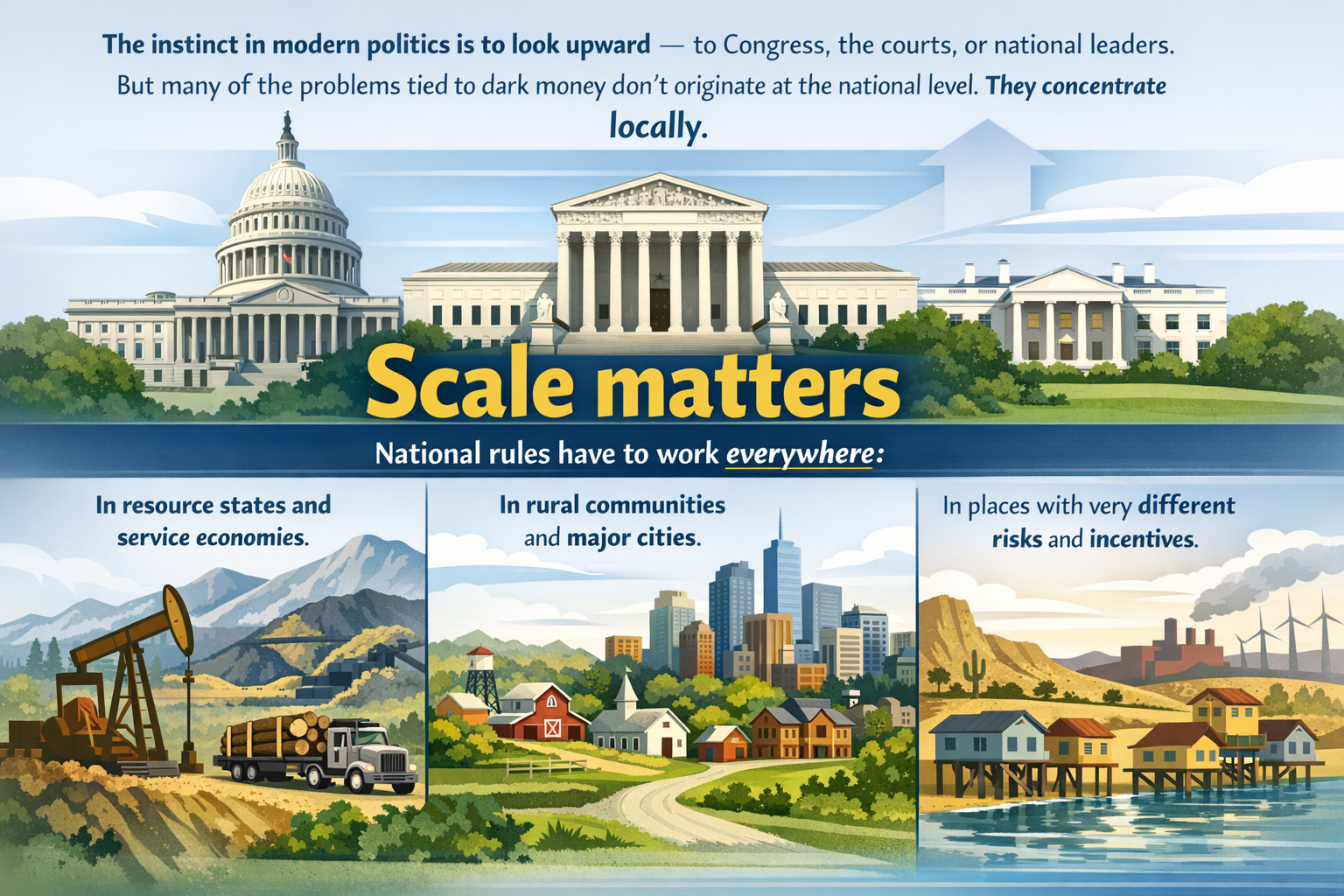
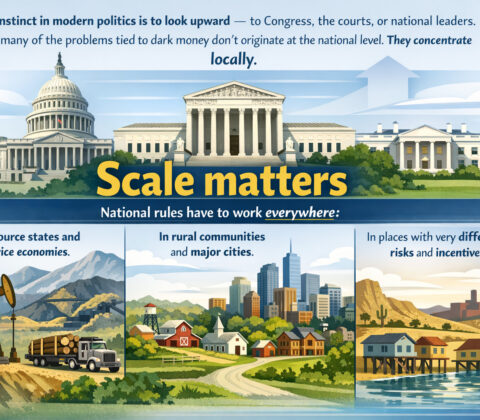
No One Best Fix, Part 2 Dark Money Continued – Why Local Answers Matter More Than National Ones
No One Best Fix — 2
Why Local Answers Matter More Than National Ones

If there is no single best fix, the next question becomes:
“At what level should we even try?”
The instinct in modern politics is to look upward — to Congress, the courts, or national leaders. But many of the problems tied to dark money don’t originate at the national level. They concentrate locally.
In reality, many of the National Initiatives actually originated at the local level, they are designed, implemented and evaluated locally before they are introduced on a National Level. Although what works here doesn’t work there is true. Money is spent wisely and pilot plans or test runs are judged in different environments.
One of the most outwardly confusing observations is why actions or interference will be implemented in one locality or region and not another. When this happens you must step back and follow either the money or the vote. We may be led to believe the new infrastructure is for the communities health, but will it still be supported when the oil fracking or coal mining, or.. or.. is no longer profitable to the corporation located many states away without any other financial ties to the local population.
Scale matters
National rules have to work everywhere:
-
In resource states and service economies
-
In rural communities and major cities
-
In places with very different risks and incentives
That forces compromise — and compromise often produces rules that are too blunt to be effective and too rigid to adapt.
Local and state systems, by contrast:
-
Have clearer lines of cause and effect
-
Face specific pressures rather than abstract ones
-
Can tailor responses to their own vulnerabilities
What works in one state may fail in another — and that’s not a flaw. It’s reality.
Accountability is stronger closer to home
When decisions are made locally:
-
The people affected are easier to identify
-
The consequences are harder to ignore
-
The distance between influence and impact is shorter
That doesn’t eliminate outside pressure, but it makes it harder to hide.
This isn’t about isolation
Focusing on local solutions isn’t about shutting out the world or pretending states exist in a vacuum.
It’s about restoring balance:
-
National rules set guardrails
-
Local systems decide how much influence they can absorb
That balance is what federalism was designed to provide.
Share this:



Dark Money for Dummies — Part 2
Why It Exists (and Why It’s Legal)
Once people understand what dark money is, the next question is obvious:
If this creates so many problems, why does it exist at all?
The short answer is not corruption or conspiracy.
The longer answer is classification.
The difference between campaigns and “issues”
U.S. election law draws a sharp line between:
Campaign activity (which is regulated and disclosed)
Issue advocacy (which is far less regulated)
If an organization explicitly tells you to:
“Vote for” or “Vote against” a candidate
…it is treated as a campaign and must disclose donors.
If it instead says:
“Support energy independence”
“Protect public safety”
“Stand up for local jobs”
“Defend parental rights”
…it may be classified as issue advocacy, even if the timing, targeting, and messaging clearly benefit one candidate or policy outcome.
That distinction is the foundation dark money is built on.
Why nonprofits are central to this system
Many dark money organizations are nonprofits because nonprofits were never designed to function like political campaigns. They were meant to:
Promote causes
Educate the public
Advocate broadly for values
Over time, those purposes expanded — legally — to include political messaging that stops just short of explicit campaigning.
Once that door opened, the incentives became obvious:
Donors could influence politics without public scrutiny
Organizations could spend heavily without disclosure
Voters would see the message, but not the full context
Nothing about this requires bad actors. It works even when everyone is technically following the rules.
Why “just disclose it” hasn’t fixed the problem
It’s tempting to think the solution is simple: require more disclosure.
The problem is that disclosure alone often fails in practice because:
Information is scattered across filings few people read
Money moves through multiple layers of organizations
The source may be technically disclosed but practically untraceable
Voters encounter the message long before they encounter the data
By the time transparency arrives, the influence has already done its work.
Dark money doesn’t rely on secrecy so much as opacity through complexity.
Why the law tolerates this
Courts have consistently protected issue advocacy because:
Political speech is broadly protected
The line between ideas and elections is hard to police
Over-regulation risks suppressing legitimate civic activity
In other words, the system tolerates dark money not because it’s admired, but because the alternative risks collateral damage to free expression.
This creates a tradeoff:
Protect speech broadly
Accept influence that is difficult to see
That tradeoff becomes more consequential the smaller and quieter the political arena is.
Which brings us to the next question.
If dark money is everywhere, why does it seem to concentrate so heavily in state and local politics?
Share this:



Article 3 of 3 The Long Game — Power Beyond the Ballot – Video
By now, it is clear that the 2026 midterms are unlike any we have seen in recent memory. The scale of spending, the intensity of coordination, and the precision of messaging all suggest a high-stakes contest—but the full story goes deeper than individual candidates or party control.
Share this:
Like this: