


















































































































































































































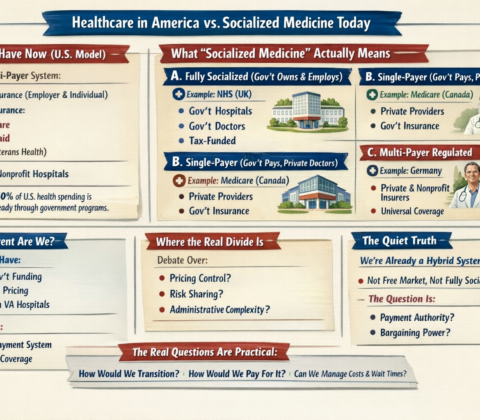
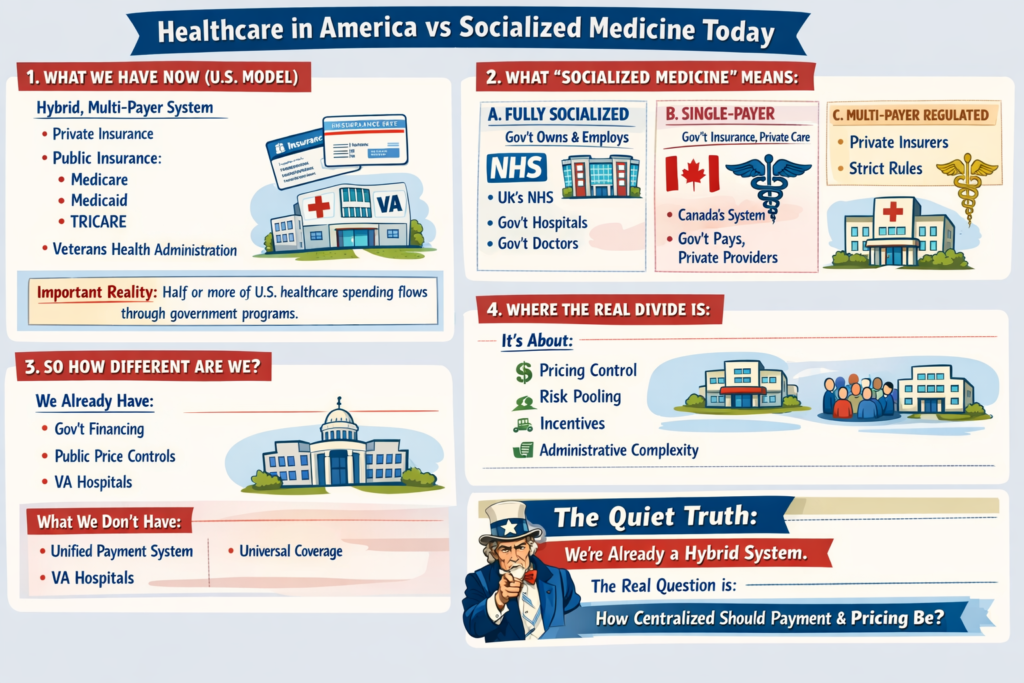
Healthcare in America vs Socialized Medicine Today
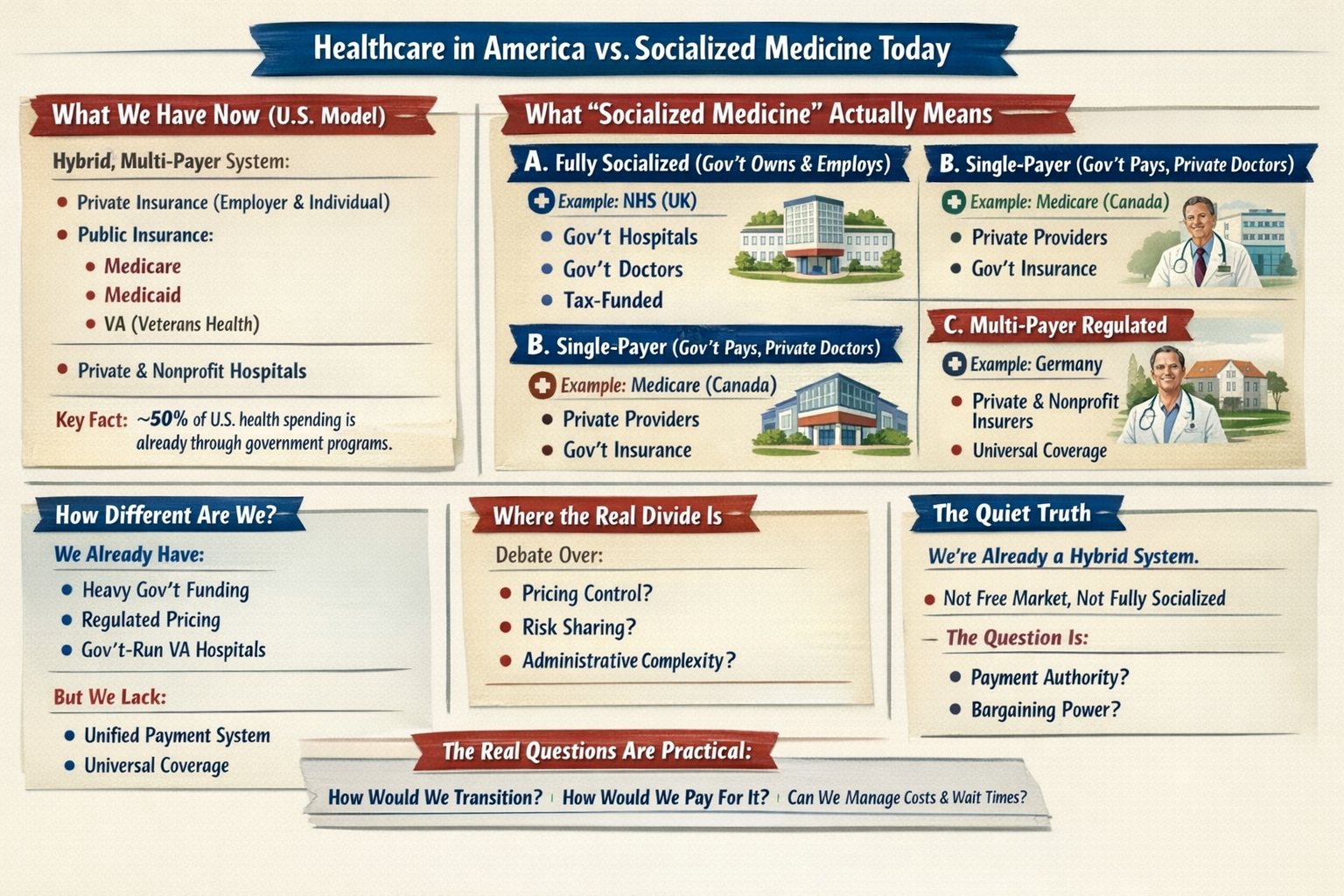
1. What We Have Now (U.S. Model)
The U.S. system is a hybrid, multi-payer system:
-
Private insurance (employer-based and individual market)
-
Public insurance:
-
Medicare
-
Medicaid
-
TRICARE
-
Veterans Health Administration
-
-
Private hospitals (mostly nonprofit, some for-profit)
-
Private physician practices (increasingly consolidated)
Important reality:
Roughly half or more of U.S. healthcare spending already flows through government programs. We are not a pure market system. We are a complex blend.
2. What “Socialized Medicine” Actually Means
People often use “socialized” loosely. There are actually three different models internationally:
A. Fully Socialized (Government Owns & Employs)
Example: National Health Service in the UK
-
Government owns hospitals
-
Doctors are government employees
-
Government sets budgets directly
-
Care funded through taxes
That’s true “socialized medicine.”
B. Single-Payer (Government Pays, Private Providers Deliver)
Example: Medicare (Canada’s system)
-
Private hospitals & doctors
-
Government is the main insurer
-
One public payment system
-
Funded via taxes
This is not government-run hospitals — it’s government-run insurance.
C. Multi-Payer Regulated System
Example: Statutory Health Insurance
-
Private and nonprofit insurers
-
Strict national rules
-
Price controls
-
Universal coverage mandate
3. So How Different Are We?
Structurally:
-
We already have heavy government financing.
-
We already regulate pricing in public programs.
-
We already operate large government-run care systems (VA hospitals).
-
We already subsidize private insurance through tax exclusions.
What we don’t have:
-
A unified payment structure
-
National price controls across the board
-
Universal automatic coverage
-
Simplified billing
The biggest structural difference isn’t just “who pays.”
It’s:
-
Fragmentation
-
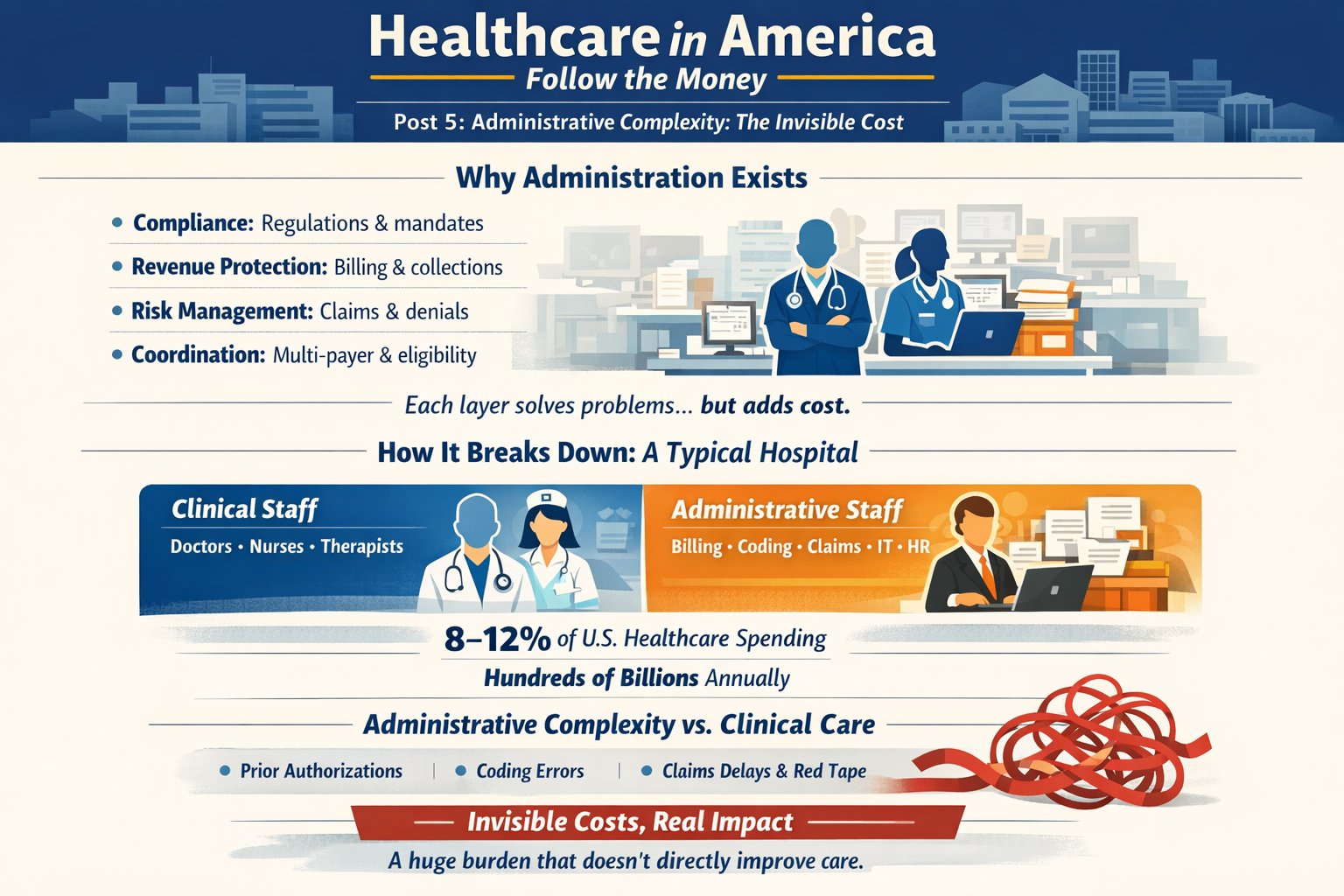
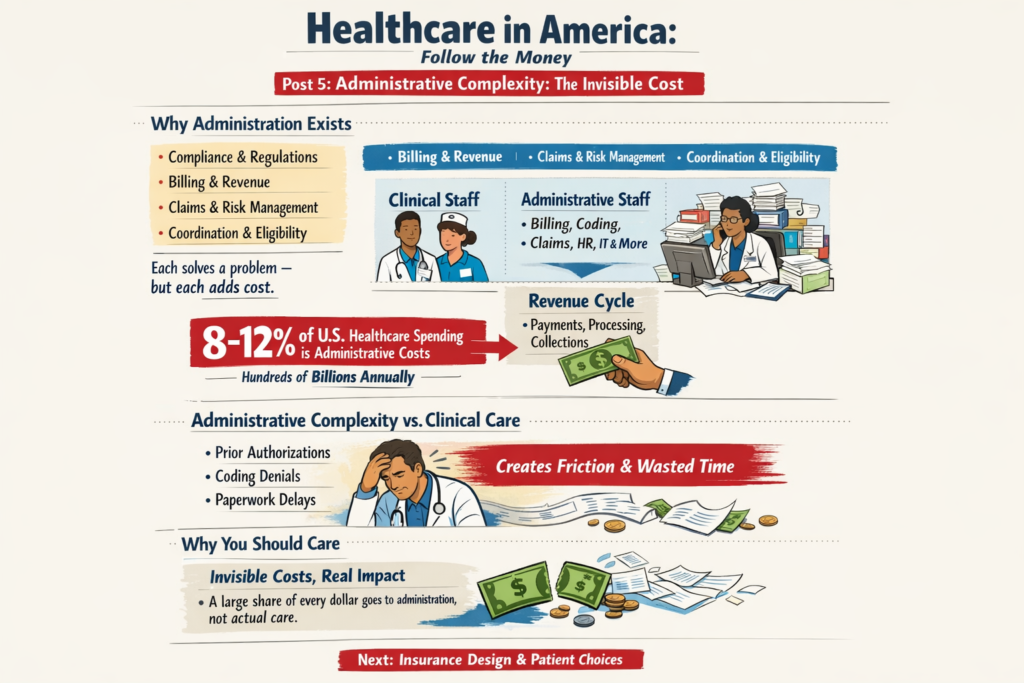
Administrative layering
-
Pricing freedom in private markets
-
Employment-tied insurance
4. Where the Real Divide Is
The debate isn’t simply:
Private vs Socialized.
It’s about:
-
Who controls pricing?
-
How risk is pooled?
-
How incentives are aligned?
-
How much administrative complexity is tolerated?
Even a “socialized” system still rations care — just differently (wait times vs cost-sharing).
Even our current system has price controls — just unevenly applied.
5. If the U.S. “Moved Toward Socialized” — What Would Actually Change?
Not necessarily hospital ownership.
More likely changes would include:
-
Centralized bargaining power
-
Uniform reimbursement rates
-
Elimination of employer-based insurance
-
Tax-based funding instead of premium-based funding
-
Dramatically reduced administrative overhead
-
Reduced insurer role
The money flow changes.
The power centers shift.
Administrative structure simplifies.
But doctors would still practice medicine.
Hospitals would still exist.
Care would still be rationed — just through different mechanisms.
6. The Quiet Truth
We are already halfway between models.
The U.S. system is not a free market.
It is not socialized.
It is a layered hybrid with competing incentives.
The question isn’t:
“Would we become socialized?”
The real question is:
“How centralized do we want payment and pricing authority to be?”
That’s a structural debate — not just a funding debate.
To go deeper, we have to explore:
-
What would actually happen to costs?
-
What happens to innovation?
-
What happens to wait times?
-
Or what a realistic transition would look like?
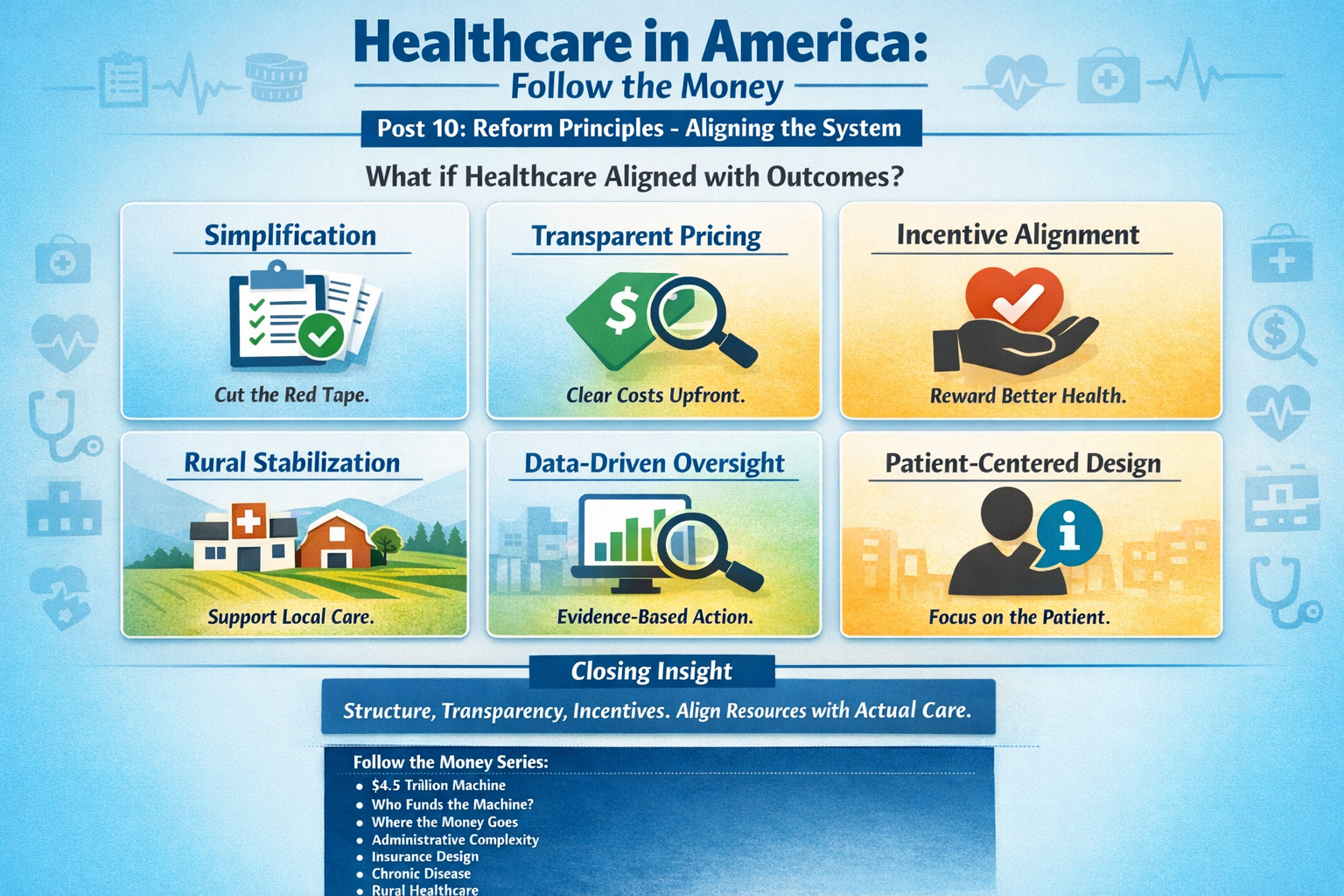
The real questions aren’t ideological. They’re mechanical:





































































































MAGA 2.0 — A Rose By Any Other Name Still Stinks – Video
Marjorie Taylor Greene, Tucker Carlson, MAGA 2.0 why those sneaky little so and so’s. That didn’t take long, here I have been writing my little fingers to nubs and those two have been sneaking behind The barn for a little pow wow. Makes sense though.
Both of them have been saying it. Marjorie has come out and said Trump appears to be working more for Israel than for us — so if he’s going to call her a traitor, she can call him one right back. Tucker said he won’t vote for a party working for a foreign government, won’t vote for MAGA, won’t vote for a Democrat, won’t vote for a Republican.
Golly. Just whom will Tucker vote for?
Little remarks. From both of them. Am I just imagining this?
No. I am not.
Marjorie even insinuated that Tucker might run himself, which would neatly solve the problem of who he’d vote for. A podcaster. Running for president. Well, why not, we already proved that particular bar doesn’t exist anymore. And maybe Marjorie could become Secretary of Something if she plays her cards right. Party favors.
So MAGA is done for. The Republicans are done for. Reboot time. MAGA 2.0.
Which, surprisingly, sounds exactly like MAGA 1.0. And isn’t it interesting that MAGA 1.0 and the Republicans are now one and the same, no longer MAGA versus the RINOs, just MAGA, wall to wall, corner to corner.
==========================================================
And what ticket was The Vance planning on running on exactly? Or was he perhaps hoping to find himself as the incumbent after a convenient Article 25?
Twilight Zone music plays softly in the background.
========================================================
It was so much easier when it was just the evil left against the evil right. Now it’s the evil left against the evil right against the other evil right against the original evil right.
After the dust settles, will we ever know which one is right?
Share this:
Like this: