Skip to content







Posts in Category: Foundation
The Moment We’ve Been Building Toward
|






Share this:

Rebuilding How We Choose Leaders – Video
I’ve always been a conservative. I’ve always registered Republican.
Today I find myself asking a different question. Looking toward 2028, who actually makes sense? Who can represent the broad range of Americans who don’t fit neatly into one political box?
My answer is simple:
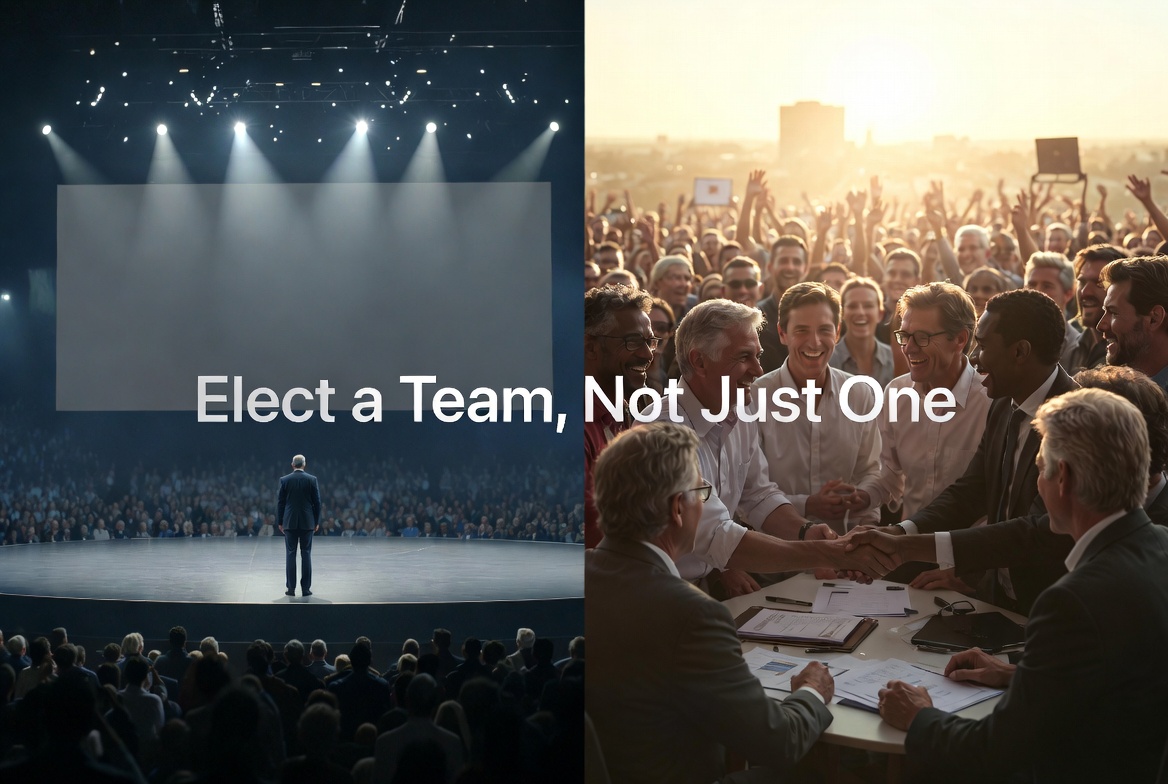
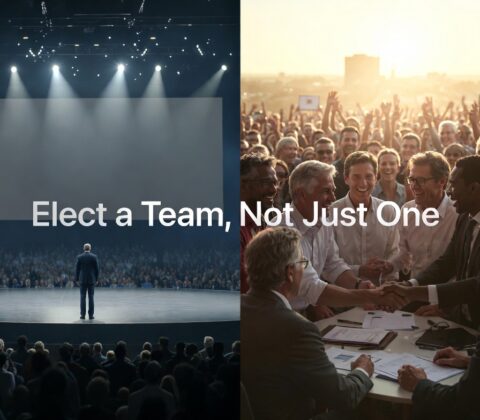
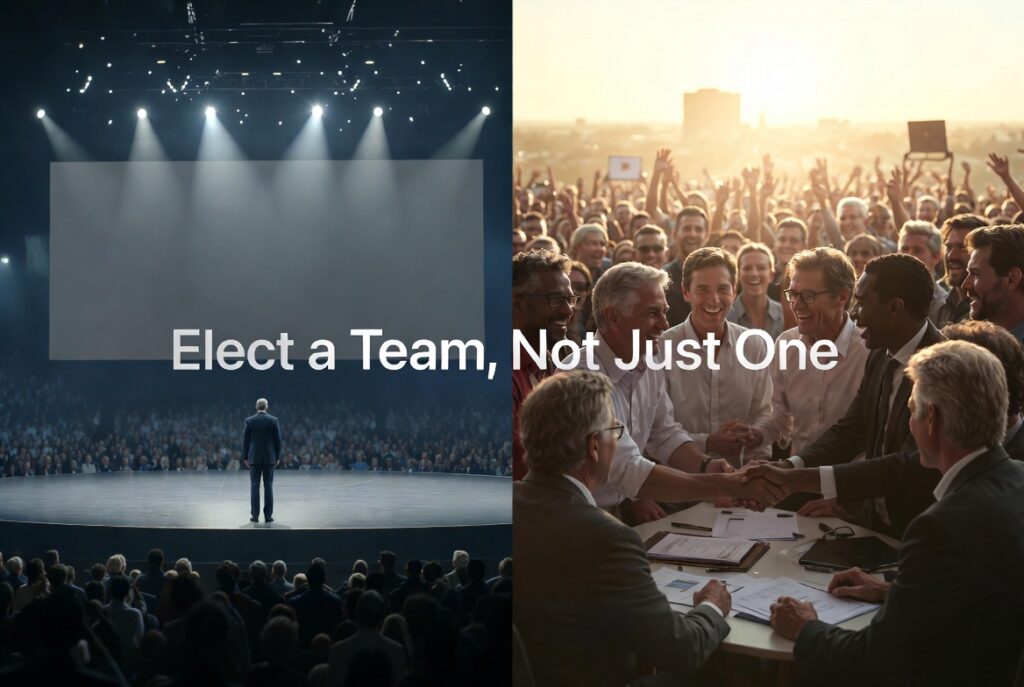
I like a team.
I think putting a team together from day one is the smart move.
Not just a candidate. A governing team.
Two people who complement each other, who can genuinely work together, and who both understand the responsibility of the presidency. Two people where, if one had to step into the Oval Office, Americans would feel confident that the direction of the country would continue.
The old way — selecting one popular candidate and then scrambling to find a vice president who might help win a certain state or demographic — is outdated. It does a disservice to the office and to the voters.
Why not build the team first?
=========================================
A governing team.
A team with a realistic agenda, not promises made from a stage two weeks before Election Day.
A team ready to govern on day one.
The series as a downloadable PDF
Share this:

Rebuilding How We Choose Leaders
I’ve always been a conservative. I’ve always registered Republican.
Today I find myself asking a different question. Looking toward 2028, who actually makes sense? Who can represent the broad range of Americans who don’t fit neatly into one political box?
My answer is simple:
I like a team.
I think putting a team together from day one is the smart move.
Not just a candidate. A governing team.
Two people who complement each other, who can genuinely work together, and who both understand the responsibility of the presidency. Two people where, if one had to step into the Oval Office, Americans would feel confident that the direction of the country would continue.
The old way — selecting one popular candidate and then scrambling to find a vice president who might help win a certain state or demographic — is outdated. It does a disservice to the office and to the voters.
Why not build the team first?
Presidential candidates spend years traveling the country trying to understand the needs of people with different economies, different histories, and different challenges.
The farmer in rural America, the technology worker in the city, the small business owner, the factory worker, the healthcare worker — they do not all have the same problems.
The president cannot personally solve every problem.
Nor should they.
What I want to hear from a candidate is:
“I am here to help you solve your own problems. When you need help, the federal government will be there. But government should empower people, not replace them.”
That does not mean everything belongs at the local level. Some things belong to all Americans equally: basic education standards, protection of constitutional rights, healthcare standards, and guarantees of religious freedom.
Some responsibilities are shared.
But the idea that one person can personally make every decision, solve every problem, and direct every aspect of government is unrealistic.
Recent years have reminded us of the risks of placing too much responsibility in the hands of one individual.
This is why I believe in a team.
And not just a President and Vice President selected for political convenience.
A real governing partnership.
The Vice President should not be an afterthought. The Vice President should be someone Americans would trust to become President if circumstances required it. The agenda should not change because one person leaves office.
The team should already be working together before Election Day.
We live in an era of artificial intelligence, robotics, space exploration, and challenges we have never faced before.
Why are we still choosing executive leadership the same way we did generations ago?
Imagine a different approach.
After the primaries, instead of waiting for a winner to choose a cabinet after the election, a presidential team could begin assembling the administration before voters make their final decision.
The voters would know what they are voting for.
The country would not lose months while Congress fights over political appointments.
The vetting, planning, and preparation would already be underway.
Government is the largest project any of us will ever undertake.
I spent much of my career in engineering, and one lesson applies to any complex project:
You do not hire one person and tell them, “Make it work.”
You assemble the right team.
You identify the lead programmer, the project manager, and the people with the skills needed to complete the job. You define the goals, the scope, and the expected results before the work begins.
Then you maintain oversight to keep the project on track.
Government should be no different.
We still need accountability. The buck still has to stop somewhere.
But the idea that one person can successfully manage the entire operation alone is outdated.
A strong team is not a weakness. It is how complex organizations succeed.
And perhaps the greatest benefit is that it moves us beyond the idea that only one party has all the answers.
Yes, we have a two-party system today. Hopefully, someday we have more choices.
But a governing team built around competence should be able to draw from the best people available, regardless of party label.
The question should not always be:
“Who has the right letter after their name?”
The question should be:
“Who can do the job?”
Today’s challenges are simply too great for one person, one party, or one ideology to solve alone.
It is time to stop playing politics and start playing government.
While we still have one.
Maybe that is the lesson America should take from the Trump years.
Not simply who won or who lost.
But that our system needs to adapt.
Let’s build a team.
Not just a campaign team.
A governing team.
A team with a realistic agenda, not promises made from a stage two weeks before Election Day.
A team ready to govern on day one.
The series as a downloadable PDF
Share this:

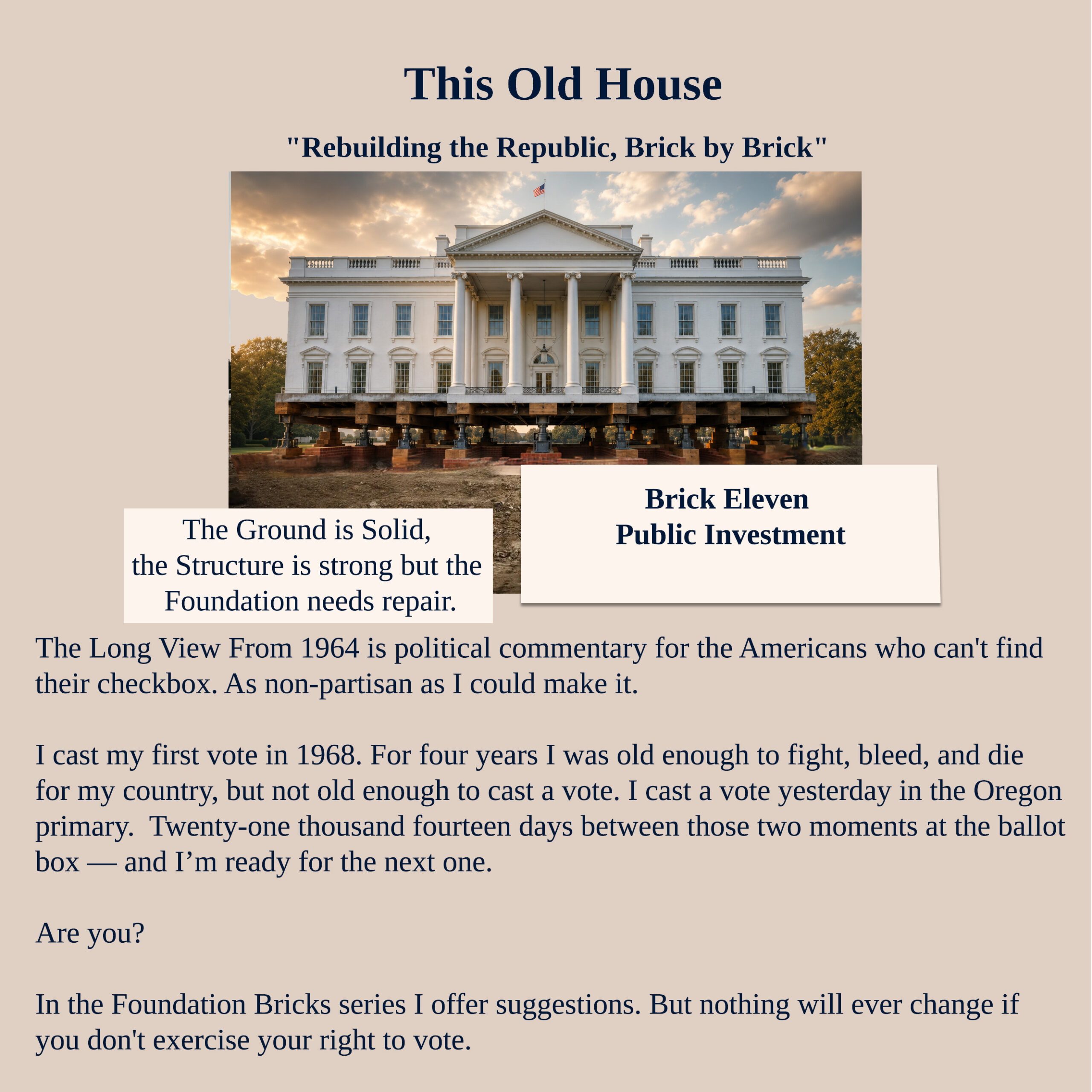
The Public Investment Brick What Good Government Requires – Brick Eleven – Public Investment
Public Investment, Who Owns The Future?
Something has been happening quietly that deserves more attention than it’s getting.
The United States government now holds roughly a 10% equity stake in Intel. It has secured equity positions in rare earth mining and U.S. Steel. Bernie Sanders has proposed the government acquiring a 50% equity share of AI technology companies through a tax structure.
The era of public investment in private industry is not coming. It is already here.

The question nobody is asking clearly enough is, who controls those stakes? Who manages the money? What voting rights does the government hold? And most importantly, who benefits?
Because right now the answer to that last question is not the American people.
The Alaska Model
The Alaska Permanent Fund is the most successful example of public benefit investment in American history. When Alaska’s oil was extracted the state recognized a simple principle, this is a public resource being monetized by private companies and citizens should receive a direct share of the value generated.
Alaskans receive annual dividends. Not promises. Not infrastructure projects named after politicians. Actual checks.
One reason the model has survived decades of political change is exactly that tangibility. Citizens see the benefit directly. Politicians find it very difficult to raid a fund that sends checks to voters.
AI Is A Natural Resource
Here is the argument that reframes everything.
Artificial intelligence is built on the collective knowledge of humanity. Every book ever written. Every scientific paper ever published. Every conversation, creative work, and piece of human expression ever digitized. Living and dead, we all contributed to the foundation these systems are built on.
That makes AI a public resource being monetized by private companies.
Sound familiar?
If Alaska’s oil wealth belongs partly to Alaskans, if the value extracted from a public resource should benefit the public, then the wealth generated by AI belongs partly to all of us. Not to the handful of people who happened to own the compute infrastructure when the moment arrived.
Think of public pension funds. Teachers’ retirement funds own enormous amounts of stock in American companies. But teachers don’t decide what products those companies build. Ownership and control are not the same thing.
That distinction is everything.
The Public Investment Authority
What is needed is not government control of AI companies. It is a structured, independent, constitutional firewall between public ownership and political manipulation.
Call it the Public Investment Authority.
Independent management. Multi-year board terms that survive changes in administration. Strict conflict of interest rules. No elected officials serving on the board. No lobbying employment afterward. Annual public audits. Full transparency.
We must be honest about what we are building against.
Politicians will try to abuse it. Corporations will try to capture it. Lobbyists will try to influence it. Insiders will try to profit from it.
The time to build the safeguards is at the beginning, not after the insider trading scandals arrive. And they will arrive if the structure isn’t right from the start.
No insider trading. No elected officials. Fixed terms. Independent audits. Public transparency.
A fund that politicians cannot raid. A fund that sends tangible benefits to citizens rather than promises to constituents. A fund that owns shares without controlling companies, the same way Alaska owns a share of oil revenue without telling Exxon how to drill.
The Precedent Already Exists
The government taking equity stakes in strategic industries is no longer a radical proposal. It happened with Intel. It happened with rare earth mining. It happened with U.S. Steel.
The only question is whether those stakes benefit the American people or simply give politicians another lever to pull.
The Public Investment Authority answers that question before it becomes another scandal.
Build the firewall first.
The investment is already happening whether we build it or not.
The Complete Foundation Sieries
The series as a downloadable PDF
Share this:

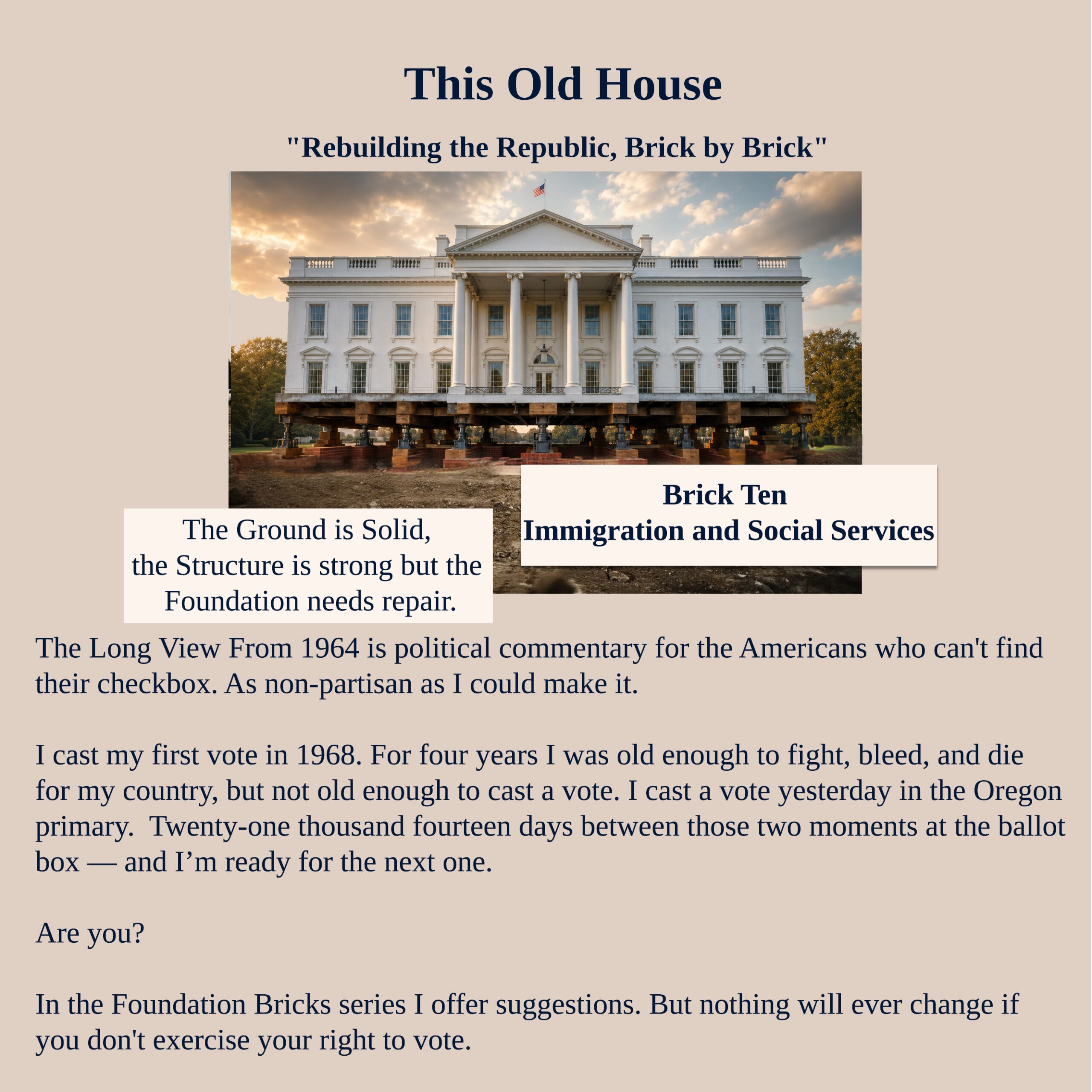
The Immigration and Social Services Brick What Good Government Actually Requires – Brick Ten – Immigration and Social Services
The Immigration and Social Services Brick What Good Government Actually Requires
In the beginning, and in many ways it was before there was light, this nation needed to be built. And to build it, it needed people.
Johnny Appleseed planted apple seeds. They sprouted apple trees. Lots of apple trees produce lots and lots of apples.

This brings us to two intertwined topics that get separated in political debate but belong together in honest conversation. People. And the services that allow people to contribute.
I don’t have an easy answer. Nobody does. But before we can assign an answer we have to accept both the reality of the problem and the reality of the blessing.
The Statue of Liberty holds aloft a torch of welcome. She is not extending her middle finger and charging an entrance fee.
France gifted us that great work of art in 1885. Our need for immigrants was different then. But our need hasn’t disappeared, it has changed. The requirement for screening and regulation cannot be overstated. But remember those apples.
Those apples rotting on the ground because you are too good to go harvest them.
Yes. You.
The media shows us undocumented farm workers as if this is a new and alarming development. In 1885 we welcomed farm workers and cobblers, not apple pie bakers but shoemakers. Today we still need farm workers. We also need talented engineers, skilled tradespeople, and everything in between. And if you believe you have a bad job because of an immigrant you are genuinely unable to look in the mirror.
Our needs haven’t really changed. Our honesty about them has.
Any clear eyed person can see the need for immigrants. They can also see why people aren’t flooding our shores with pockets full of cash. They come with what they have and they work with what they find. We need to help them get established. That means social services. Not as charity. As investment in the people who are going to harvest the apples and build the houses and pay into the system.
This is not about rapists, grifters, or predators. We don’t have to look at immigrants to find those.
Now the social services argument, and here is where the two threads become one.
What about your neighbor? The kids next door who look hungry. The single mother. The children who need vaccinations or fell and broke an arm. The family whose father was just laid off. The farmer who lost his crops because someone in power decided to take away his fertilizer subsidy to settle a political score.
We need social services. They are generally provided by the states and generally backed by the federal government. There was a reason for this. A good one.
Social service programs and their funding must be protected from the whims of any politician regardless of who holds the office. Threatening to cut funding because a district voted against you should be an impeachable offense. Full stop. No exceptions. No party exemptions.
We are a wealthy country. We are, when we choose to be, a compassionate one. We should never fail to provide basic services to the people who need them. Not because it is politically convenient. Because it is who we said we were when we put that torch in Lady Liberty’s hand.
And here is the cold hard fact that nobody wants to say out loud.
An undocumented but employed immigrant pays into Social Security and Medicare every paycheck. They will never be able to collect retirement benefits from either program.
We are accusing them of draining a system they are subsidizing.
That is not an immigration problem.
That is a mirror problem.
Look down if you want. Or look in.
The Complete Foundation Sieries
The series as a downloadable PDF
Share this:

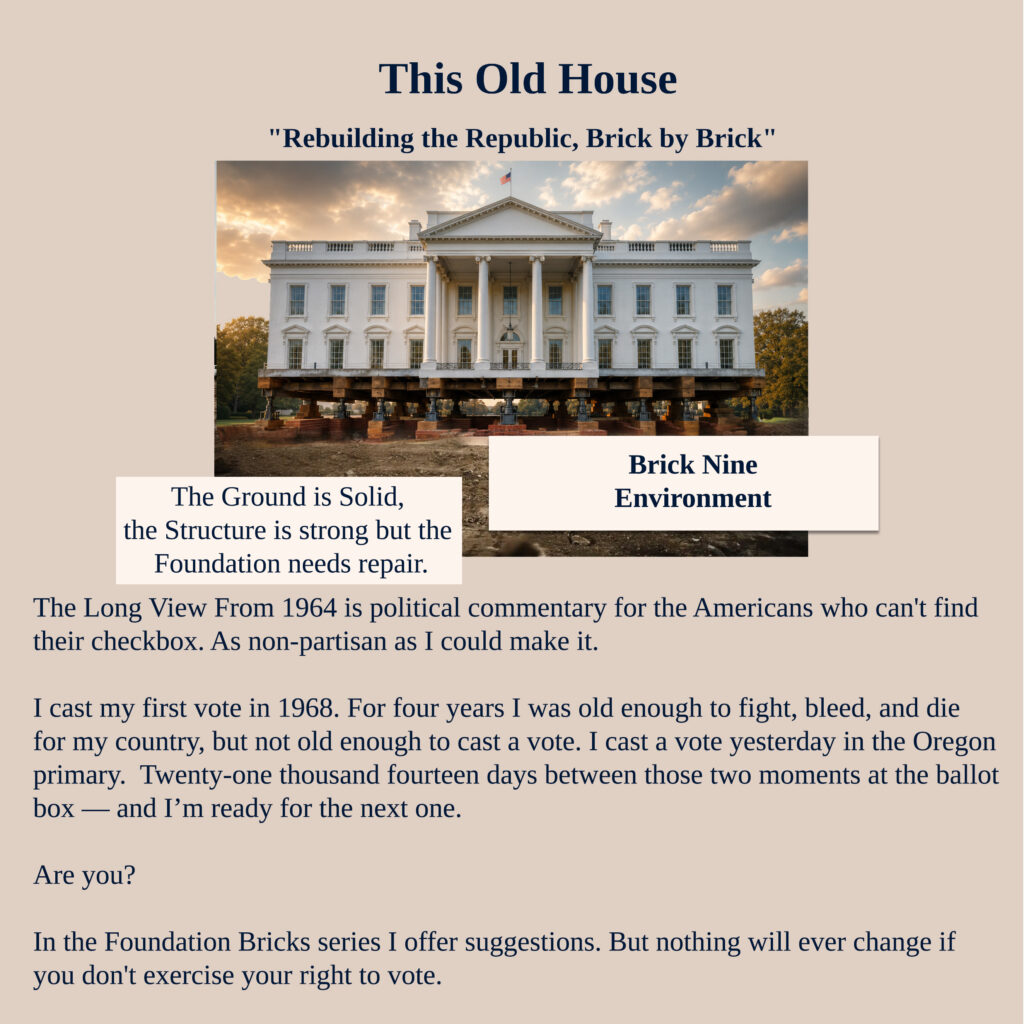
The Environment Brick What Good Government Actually Requires — Brick Nine – Environment
The Environment Brick What Good Government Actually Requires
This is a balanced world.
Or it was. Ecologically, the planet developed over billions of years into a self-correcting system. Not perfect. Not static. But capable of absorbing disruption and finding equilibrium, when left with enough margin to do so.
We have been removing the margin.
There is no ideological argument required here. No party position needed. Just the observation that we are spending principal and calling it income. Extracting what took millennia to accumulate and booking it as this quarter’s profit.
That is not economics. That is the oldest con in the book.
We are not against using resources. That is not the argument. Every civilization in human history has used the resources available to it. The argument is against exploiting them foolishly when other clear options exist. And the options exist.
Wind farms. Solar farms. Solar on homes and buildings that sit in the sun regardless of whether anyone harvests it. Mini nuclear plants currently in development that can be transported on flatbeds and deployed where the grid is weakest. The technology is not theoretical. It is here or nearly here and arriving faster than the political conversation has managed to acknowledge.
We know that harnessing ocean water for industrial cooling and dumping the heat back into the sea does damage that compounds quietly until it isn’t quiet anymore. Eighteen whale deaths in Washington state in a single year. The ocean does not issue press releases. It just changes. And when it changes enough the change is no longer reversible on any timeline that matters to anyone alive.
The alternatives are not perfect. Batteries require metals. Mining those metals creates its own environmental cost. Recycling infrastructure has not kept pace with the technology it needs to process. These are real problems.
But here is what history actually shows when we choose to look honestly at it.
Human beings have solved most of their self-created environmental problems when they chose to.
The ozone layer was healing after we chose to address it. Rivers that caught fire stopped catching fire after we chose to address it. Species pulled back from the edge of extinction when we chose to address them.
The technology exists. The alternatives exist. The knowledge of what we are doing and what it costs exists.
The only variable is the last one.
When he chooses to.
That choice, made collectively, structurally, with the kind of policy teeth that don’t disappear when the next administration arrives, is the brick.
Not a perfect environmental policy. Not a zero extraction economy. Just the honest acknowledgment that exploitation without limit is not capitalism. It is not freedom. It is not progress.
It is greed. And more greed.
Every Trump golf course should be turned into a wind farm.
He does supply enough hot air.
The Complete Foundation Sieries
The series as a downloadable PDF
Share this:

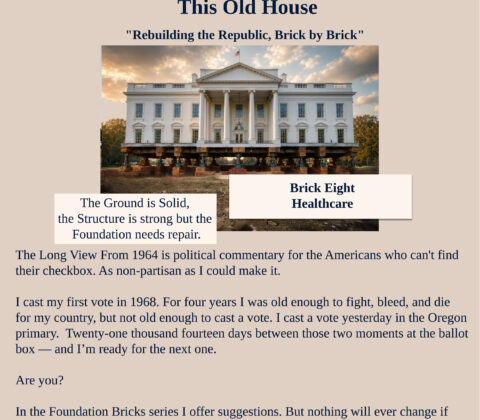
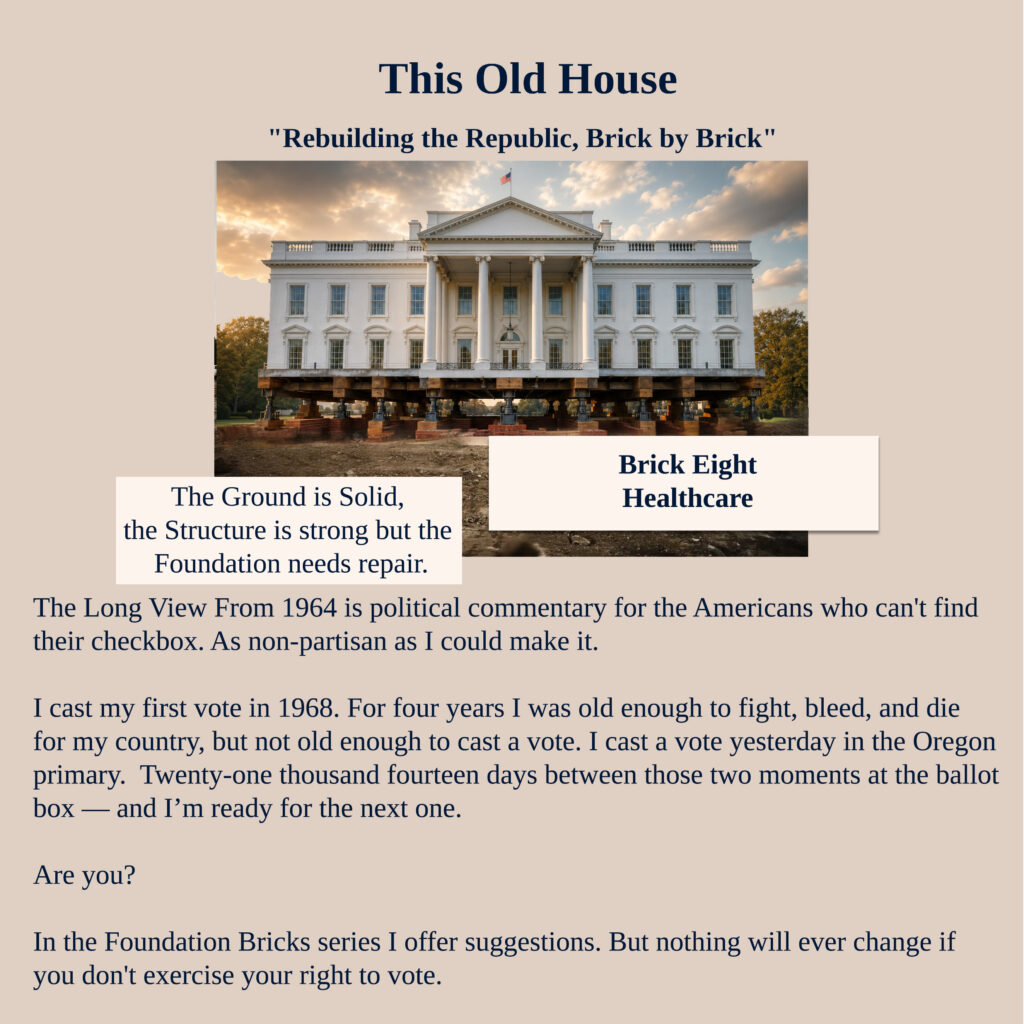
The Healthcare Brick What Good Government Actually Requires — Brick Eight – Healthcare
The Healthcare Brick What Good Government Actually Requires
Healthcare in America is not broken.
That is not a comfortable statement. But it is an accurate one.
It is strained. It is expensive. It is fragmented, administratively bloated, and structurally misaligned in ways that cost lives and savings simultaneously. But it functions imperfectly, unevenly, and at enormous cost for most of the people it serves most of the time.
Understanding the difference between broken and strained matters before we talk about fixing anything.
Over the past year this platform has published an extensive series examining exactly what the American healthcare system isnot what politicians say it is, not what we wish it were, but what it actually is. How the money moves. Where the risk lands. Who absorbs the consequences when care can’t wait. Why insurance and healthcare are not the same thing even though we treat them as if they are.
That work is here if you want it. It will not tell you who to vote for. It will not tell you that one system is superior to another. It will tell you how the machine works which is the only honest starting point for any conversation about changing it.
If interested please use our menu selection HEALTHCARE, articles are offered in two index orders, last related published at the top, and on the right side column, in original published order.
If you prefer, a combined presentation is available here. HEALTHCARE COMBINED.
So here is the healthcare brick. Not a policy prescription. Not a wish list. Just three honest observations.
First – this is what we have.
A layered hybrid system. Part market. Part public. Part employer obligation. Part individual burden. Already half funded by government programs. Already heavily regulated in some places and completely unregulated in others. Not socialized medicine. Not free market. Something messier and more complicated than either label suggests.
Are we okay with it?
Not as a political question. As a personal one. The system described in this series is not a conspiracy or a failure of compassion. It is a structure built over decades by people solving real problems with the tools available at the time. Layers were added for reasons. Each layer solved something and created something else.
The honest question is whether the accumulated result still serves the people it was built for.
Second – want is not a policy.
Saying I want free healthcare changes nothing. Neither does I want to keep what I have. Want is not a funding mechanism. Want is not a transition plan for 150 million people currently covered through employers. Want is not an answer to what happens to hospital revenue when payment rates change overnight.
The people who benefit most from the want debate are the people who need you distracted from the structural debate. As long as the conversation stays at the level of what we want we never get to the harder and more useful question of what is actually achievable and how.
Third – the realistic lever is insurance structure.
Not who builds the hospitals. Not whether your doctor works for the government. Not a binary choice between the system we have and a system that exists nowhere in the form being promised.
The realistic lever is how risk is pooled. How pricing is negotiated. How the administrative layers between you and your care get simplified. How the 8 to 12 cents of every dollar currently absorbed by billing, coding, prior authorization and claims processing gets redirected toward the care it was supposed to fund.
That’s where the flow can be diverted.
The Complete Foundation Sieries
The series as a downloadable PDF
Share this:

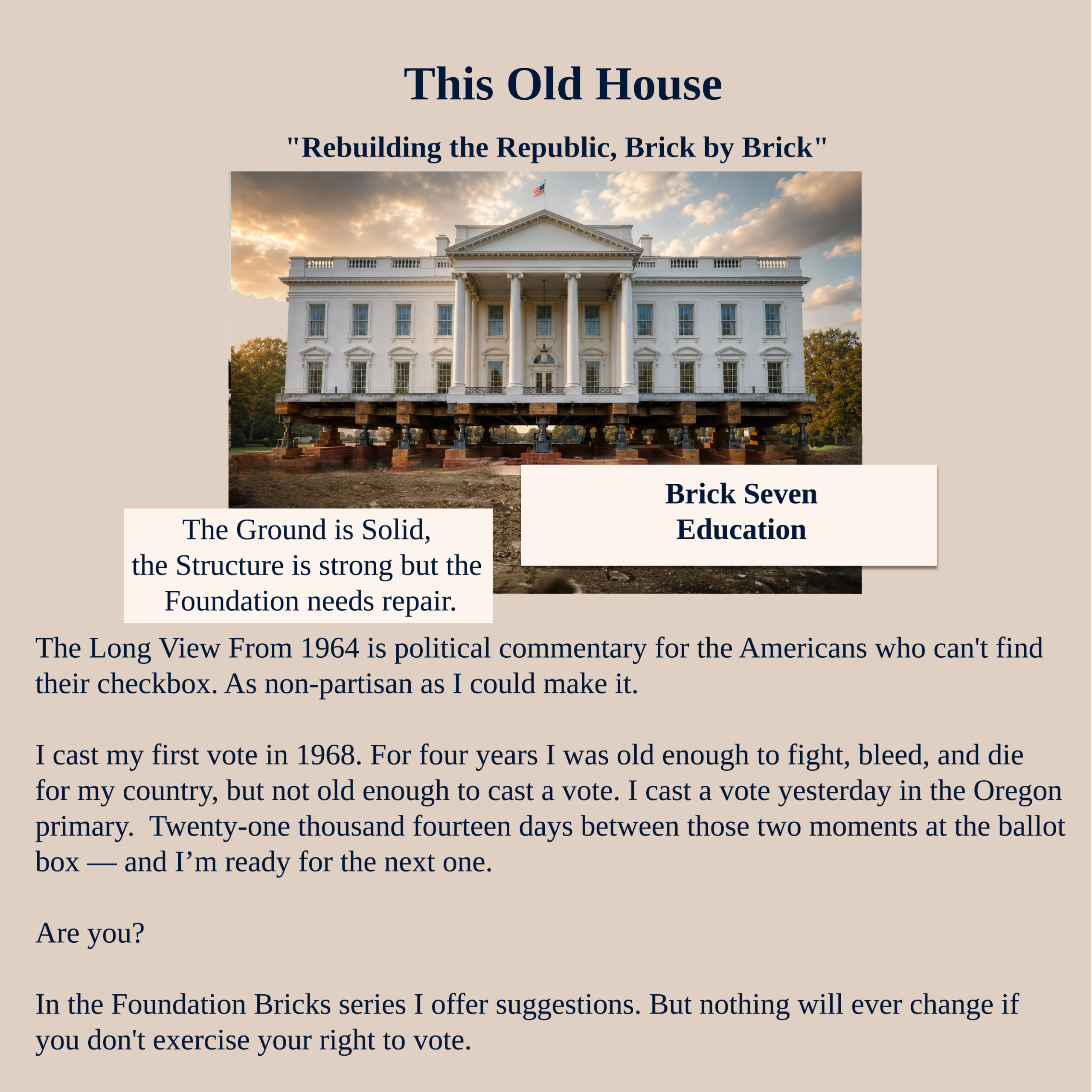
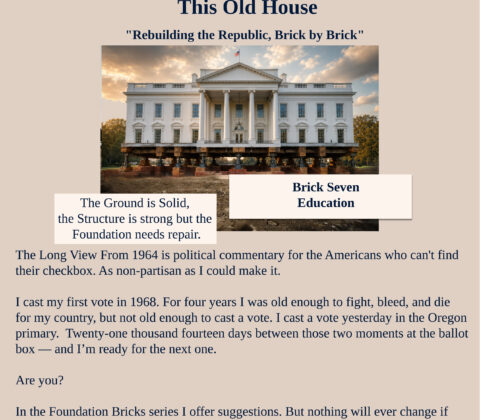
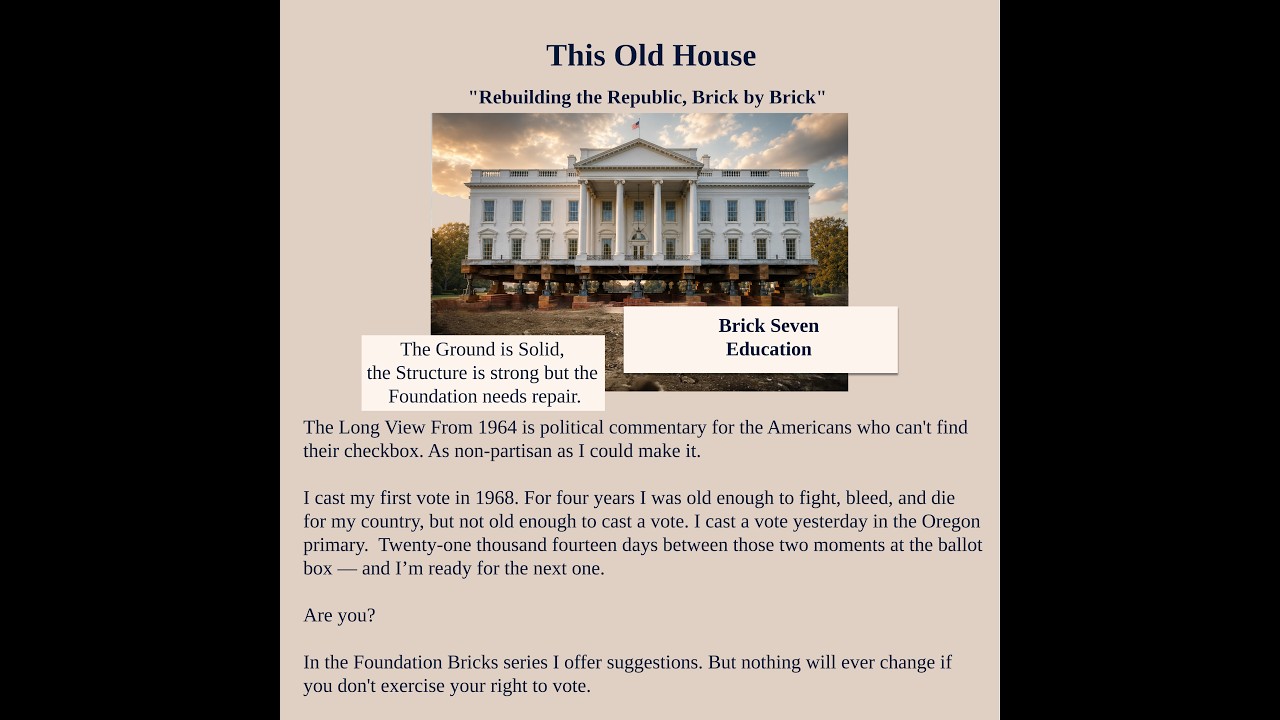
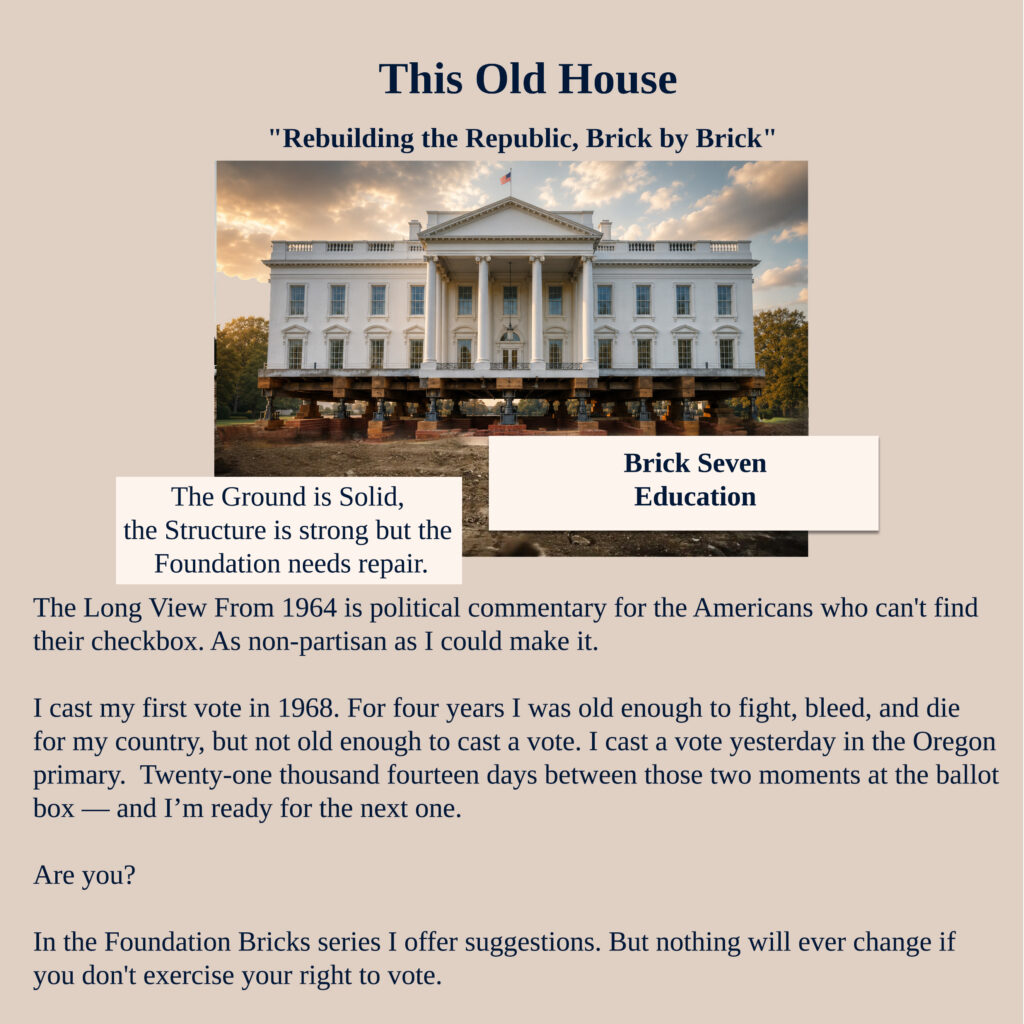
The Education Brick What Good Government Actually Requires — Brick Seven – Education
The Education Brick What Good Government Actually Requires
Education in America has a marketing problem.
For decades the message was simple get a degree and get a job. The degree became the credential and the credential became the promise. Nobody mentioned that the promise had an expiration date or that the debt was forever.
We need a more honest conversation.
The Social Contract Model
If the public invests in your education the public has a right to expect something back. Not repayment with interest service. A known, transparent agreement made before the first dollar is spent.
We fund your medical degree. You spend three years at a VA hospital or an under served rural clinic. We fund your nursing degree. You serve in a community that needs you. We fund your accounting degree. You spend two years at the IRS or the GSA.
This is not radical. It is the oldest social contract in the book. The military has operated this way for generations we train you, you serve, you earn the benefit. The difference is we need that model applied beyond the military and into the civilian professions the country actually needs more of.
The deal is simple. The terms are known upfront. And the payback is productive rather than just financial the country gets doctors in the places doctors don’t go, nurses in the communities that can’t afford to recruit them, and accountants who actually understand the systems they’re auditing.
The Credential Is Not The Job
A white collar education does not promise a white collar job. It never honestly did but the myth persisted long enough to saddle a generation with debt for degrees that prepared them for a world that was already changing while they were still in class.
Artificial intelligence is reshaping entry level positions. That is real and it is accelerating. But it does not change the fundamental human requirement at the core of most work. Claude is not walking in the door, shaking a hand, and drinking a cup of coffee. That is still on the human.
What it does change is what preparation for that work actually needs to look like. Knowing how to effectively use the tools that exist is now as important as the credential that gets you in the door. The education system has not caught up to that reality. It needs to.
The Trade School Gap
Here is the most important and most under addressed part of this brick.
The federal government currently has one primary pipeline into trade education the military. That is not enough and it was never designed for this purpose.
Look up the pay scales for licensed electricians. Price a plumber. Find out what a licensed HVAC technician charges per hour. The market has already answered the question of whether these skills are valuable. The answer is yes emphatically and increasingly.
What is missing is a federal civilian pathway to trade certification that carries the same social contract as the degree programs. We fund your training as an electrician, a welder, a medical technician, a licensed trades person of any kind. You serve your community with that skill for a defined period at a wage that reflects the investment.
The private sector cannot fill this gap alone. It was never designed to. This is exactly the kind of investment in people, in capability, in the infrastructure of daily life that government exists to make.
The person who keeps the lights on and the water running and the roads safe is not less valuable than the person with the credential and the debt.
It is time the education system said so clearly.
And it is time the federal government built a path that reflects it.
The Complete Foundation Sieries
The series as a downloadable PDF
Share this:

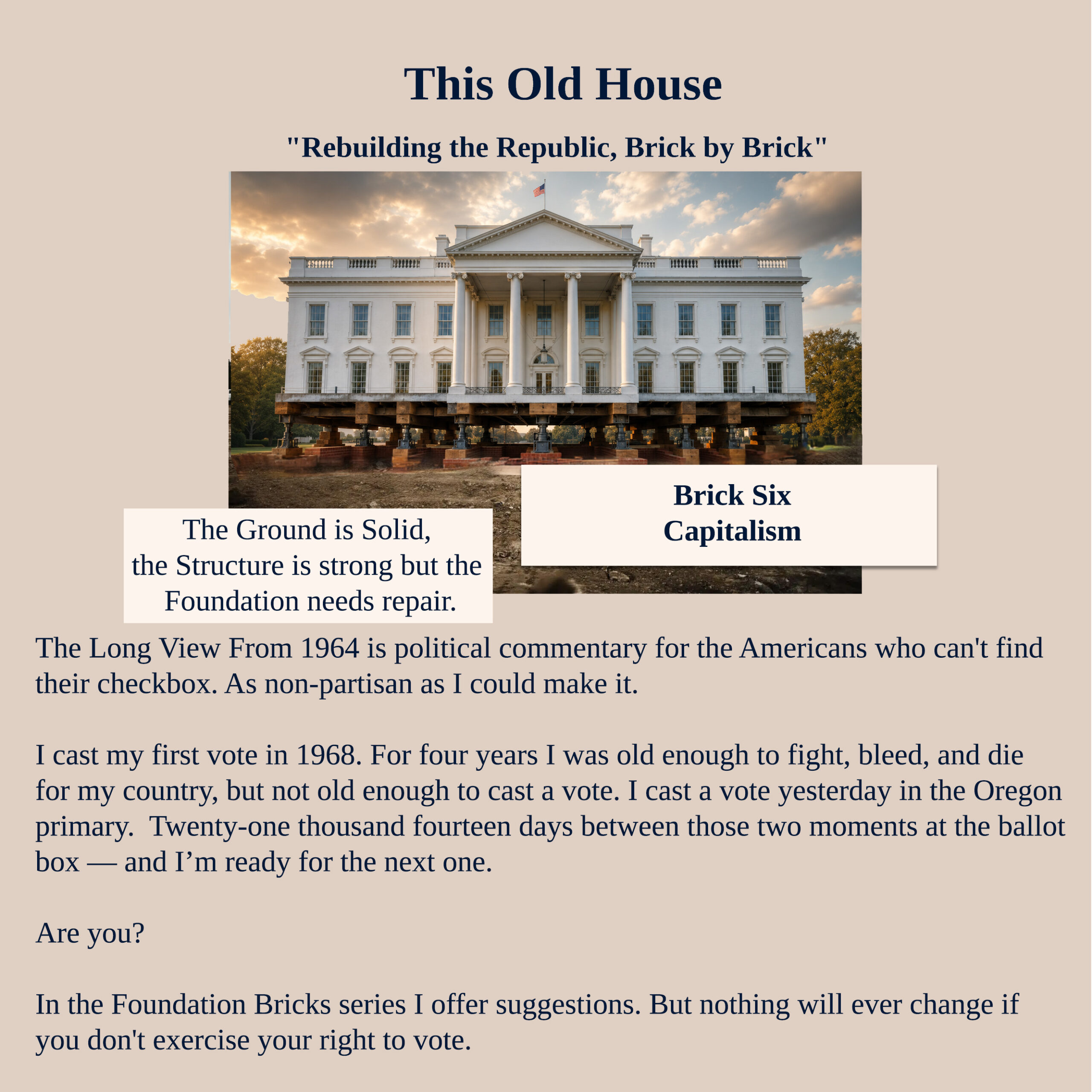
The Capitalism Brick What Good Government Actually Requires — Brick Six – Capitalism
Brick Six – Capitalism
The Sixth Brick What Good Government Actually RequiresPart Six
CapitalismHow Much Is Enough?
I am not an economist. I have trouble balancing my own checkbookto the point that I haven’t written a check in years. I live by the debit card and rely on the bank to keep score. They make fewer mistakes than I do.
So take what follows for what it is. Not economic theory. Just observation from someone who has been inside the system long enough to see where the seams are coming apart.
I believe in capitalism. I believe in free enterprise. I believe we should be innovative and be rewarded for that innovation. I was part of the technological revolutionthe gin joints of Tektronix and Intel and my own consulting workand I watched what genuine innovation looks like when it builds something real.
That’s the capitalism I believe in.
Where I get lost is somewhere between that and here.
We once built enterprises that built a nation. Railroads. Steel. Highways. Infrastructure that everyone eventually lived inside regardless of whether they owned a share of it. The Carnegies and Vanderbilts exploited laborthat’s documented and truebut the byproduct was a physical country that generations inherited.
What does the new generation of concentrated wealth build?
Delivery systems. Platforms. Apps that monetize your attention and sell it back to you as connection. The byproduct this time isn’t a nation. It’s a customer base and a stock price.
I don’t have a clean answer to when enough is enough. I haven’t reached that threshold myself so I’m not casting stones. And I’m aware that most obscene wealth exists on paperinvestment portfolios, unrealized gains, numbers on screens rather than cash in hand.
But somewhere on the path to obscene riches somebody has been cheating the system. The system the rest of us have to play by. The loopholes didn’t appear by accidentthey were written in by people who benefited from them being there and protected by people who were paid to keep them open.
Plug the loopholes. Levy fair taxes against the structure. Not punitive. Not confiscatory. Fair. And if the structure can’t survive fair taxation here then perhaps the wealth shouldn’t be made here.
Simple idea. Complicated execution. Which is why you hire people smart enough to figure out the nuts and boltswhich is itself the argument for competent government rather than a government of loyalists and donors.
If Coca Cola owned Pepsi and Dr Pepper there would be no competitive pricing. There would be one pricewhatever they decided to charge. We have agencies designed specifically to prevent that concentration. Anti-monopoly regulation exists because we learned the hard way what happens without it.
We are currently in a period of deliberate deregulation. Sold as freedom for business to grow. What it actually produceswhen the major players are left to their own devicesis consolidation until competition disappears and the consumer pays whatever the monopoly decides they pay.
Deregulation without oversight isn’t freedom. It’s the slow removal of the rules that kept the game fair for everyone playing it.
One more thing worth noting before we move on.
The most overlooked corner of capitalism is the small business. The licensed electrician. The plumber. The person who showed up at my house with a high pressure rooter and a camera and charged me six hundred dollars for an hour of work.
Good for them. Seriously. That’s skilled labor commanding fair market value and I begrudge them nothing.
We’ll talk more about trade schools and education in the next brick. But the point worth making here is that capitalism works best when it works at every levelnot just at the top where the delivery systems and platforms live but at the street level where someone with a license and a truck and a set of skills can build a life without a college degree and a venture capital round.
That’s the capitalism worth preserving.
The other kind needs some work.
The Complete Foundation Sieries
The series as a downloadable PDF

Share this:

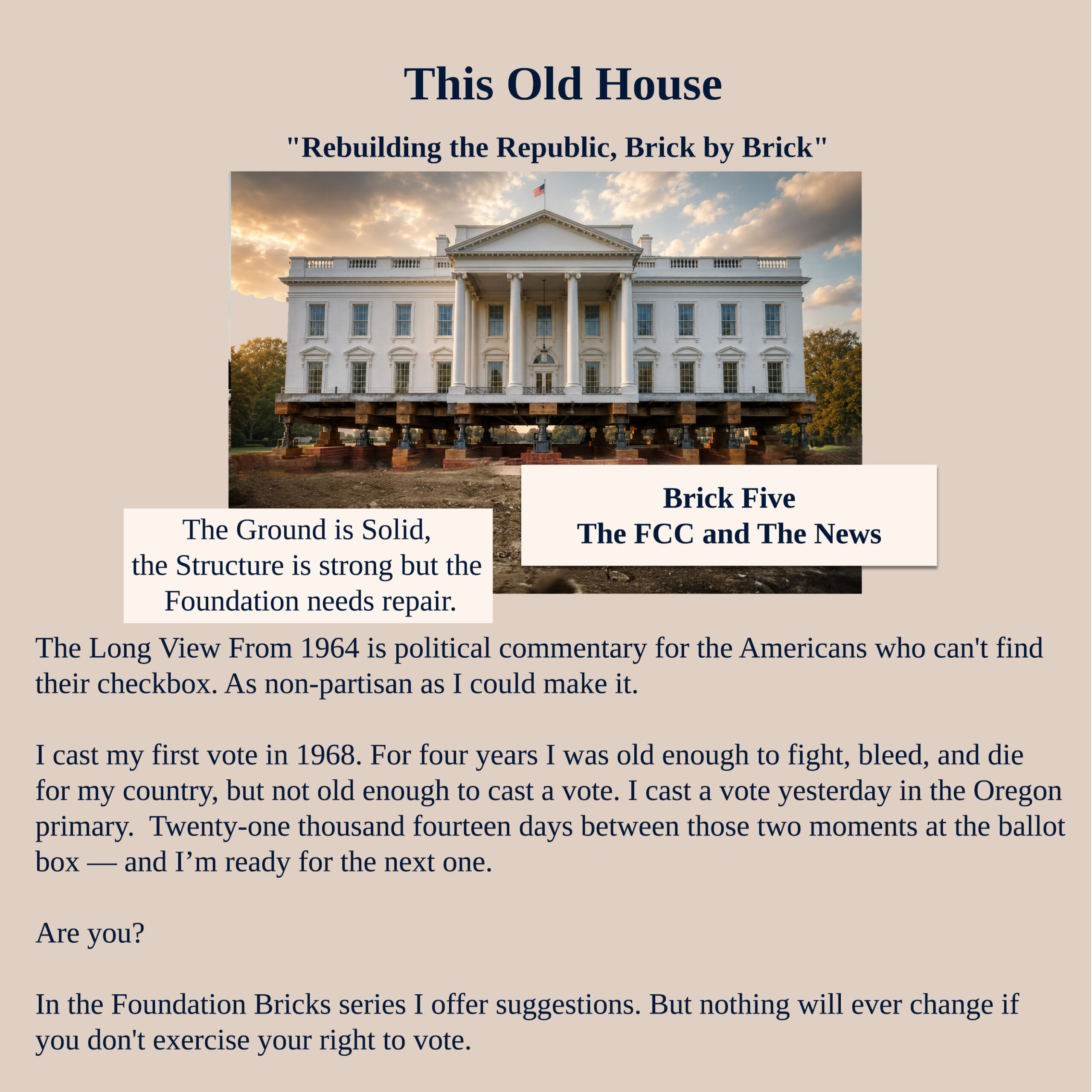
The FCC and The News Brick What Good Government Actually Requires — Brick Five – The FCC and The News
The Fifth Brick What Good Government Actually Requires — Part Five
The FCC, The First Amendment, and The News That Used to Be News
The founding charter of the Federal Communications Commission is the Communications Act of 1934, an independent federal mandate enacted by Congress to regulate the airwaves in the public interest.
I encourage everyone to look it up. Read what it was designed to do. Then compare that to what it is currently doing.
The gap is the story.
The airwaves are public property. Broadcast licenses are issued in the public trust, not as private rights but as public obligations. The entity that receives a license to use the public airwaves accepts a responsibility to serve the public interest. That was the founding principle. That was the deal.
Somewhere along the way the deal changed.
Today a handful of corporations own most of what Americans see and hear. When that many outlets are controlled by that few owners the news stops being news and becomes something else. Call it perspective. Call it editorial direction. Call it what it actually is, propaganda with a news desk and a theme song.
This will be worth repeating in future segments because it touches everything. An informed citizenry is the foundation under the foundation. You cannot have accountability without information. You cannot have meaningful elections without accurate news. You cannot have a functioning democracy when the information ecosystem is owned by people with specific financial and political interests in what you believe.
Now add the Inspector Generals.
We have them. Or we had them. Their purpose is straightforward, independent oversight of the agencies they monitor, specifically designed to catch corruption and prevent regulatory capture. A check on the checkers. An independent eye on the people making the rules.
The current administration fired most of them.
The same oversight that would have monitored what the administration itself was doing, gone. Not restructured. Not replaced. Removed. Because independent oversight of your own behavior is inconvenient when your behavior requires oversight.
This is not a political attack. It is an illustration of exactly why the executive branch needs hard limits on what it can and cannot touch. There need to be areas of the civil service where executive orders have little to no effect. Where the order arrives and the response is not a court challenge but a rubbish bin. Some things should simply be beyond the reach of any single administration regardless of who won the last election.
The FCC is one of those things.
Its job is regulation. Monitor acquisitions. Prevent monopolies. Protect the public interest in the airwaves it licenses. What is not, what should not be, in its charter is any role in determining what speech is acceptable to the current occupant of the White House.
And yet.
For anyone paying attention, look up the details of what happened with Jimmy Kimmel, Stephen Colbert, and the Daily Show. The FCC was used as a direct instrument of executive pressure to coerce networks into dropping programming the president found unfavorable. Not illegal content. Not obscenity. Programming he didn’t like.
That is not regulation. That is a threat wearing a regulatory costume.
In our new foundation the safeguards have to be structural not assumed. No presidential pressure moves the needle because the president cannot fire the people holding the needle. Independence is not a courtesy, it is an architecture. Built in. Locked. Not dependent on the good faith of whoever currently holds power.
I can remember when the news was presented as news. Facts. This is what is happening. If an outlet wanted to offer opinion it was called an editorial and labeled as such. The separation was clear and it was honored because the public expected it and the license required it.
That line has been erased. Rebuilding it requires more than nostalgia. It requires structural protection with enforceable consequences.
You cannot have the First Amendment and suppress it simultaneously. That is not how the system was designed to work.
And here is the danger that goes beyond any single administration or any single network or any single late night host who said something unflattering.
When you find a way to circumvent one rule, even a small one, even quietly, even with a plausible justification, the next rule becomes easier. And the one after that. The erosion is always gradual until suddenly it isn’t gradual at all.
There need to be consequences.
Fast ones. Enforceable ones.
The First Amendment is not a suggestion. It is the first brick for a reason.
The Complete Foundation Sieries
The series as a downloadable PDF
Share this:

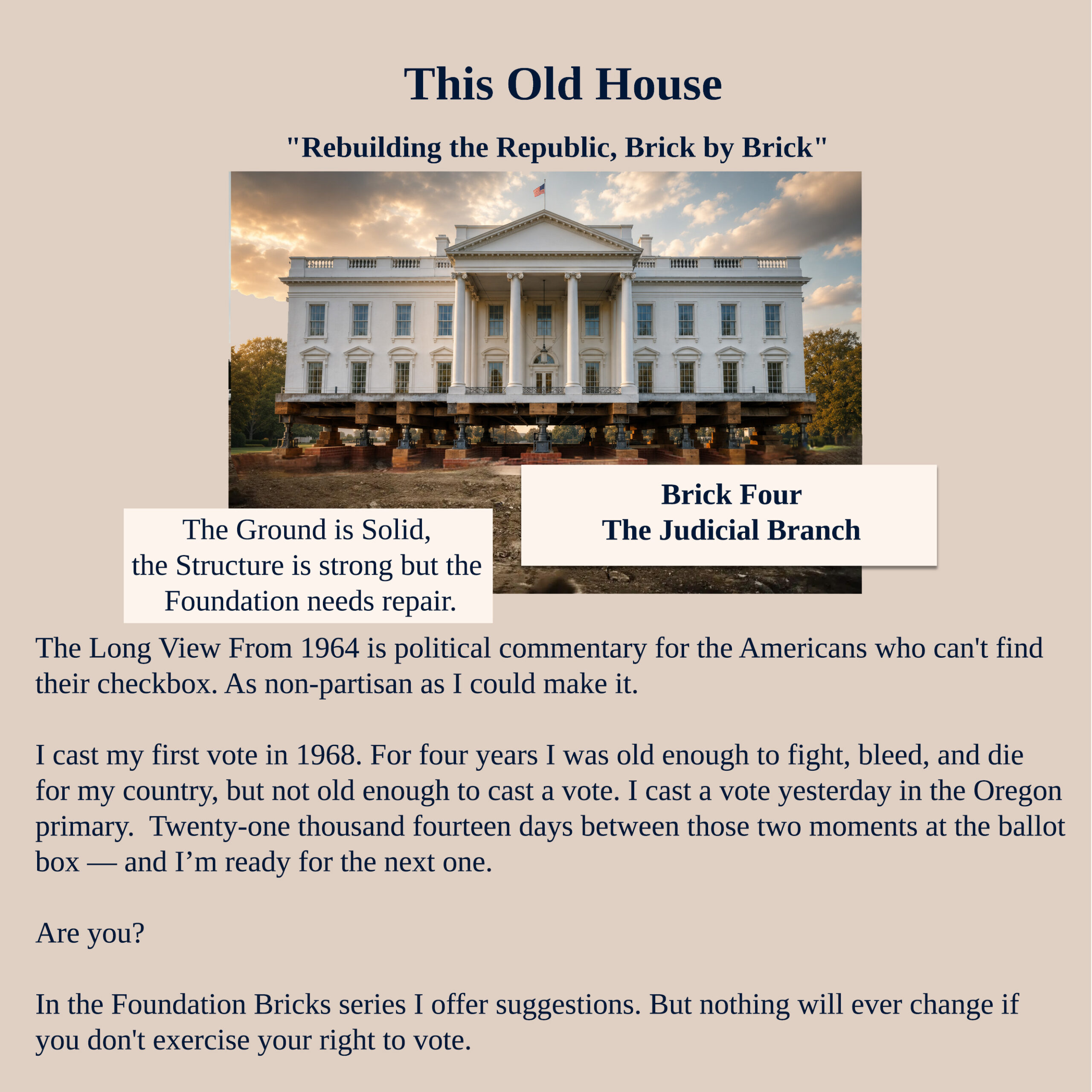
The Judicial Branch Brick What Good Government Actually Requires — Brick Four – The Judicial Branch
Brick Four – The Judicial Branch
The Fourth Brick What Good Government Actually Requires — Part Four
The Judicial Branch
The Supreme Court was never designed to be a political prize.
It has become one anyway.

Every president now treats Supreme Court appointments as the most important legacy decision of their term, not because they care deeply about judicial philosophy but because they are buying future outcomes. The pocket justice. The reliable vote. The insurance policy wearing a robe.
The result is a court whose decisions are predictable before the arguments are heard. Everyone knows which way each justice will rule on any politically charged question because everyone knows who appointed them and what was expected in return. That is not justice. That is scorekeeping in robes.
The fix is not complicated. It is just threatening to the people who benefit from the current arrangement.
More justices. Randomly assigned. Term limited. Appointed by peers not presidents.
Not a specific number, the number is less important than the principle. Enough justices that no single president can stack the composition. Assigned to rotating panels by lottery so nobody can predict which justices will hear which case. Appointed by their fellow jurists rather than by the politician who wants to own their vote. Term limited to twelve or eighteen years, long enough to develop genuine expertise, short enough to prevent the court from calcifying around a single political moment.
The lottery is the key. You cannot game a random draw. You cannot have a justice in your pocket if you don’t know which pocket they’ll be sitting in when your case arrives. The pipeline between political appointment and predetermined outcome gets broken not by ideology but by randomness.
But the most important brick in the judicial wall has nothing to do with composition.
It has to do with enforcement.
Right now the Supreme Court can rule and the executive branch can say no. And nothing happens. The court has no army. The court has no marshals with actual authority. The court has strongly worded opinions and the assumption that the executive branch will comply because it always has before.
That assumption has been tested and found wanting.
Here is a question worth sitting with.
Every lower court in America has enforcement authority. A district judge can hold anyone in contempt and have them detained. Federal marshals exist specifically to enforce court orders at every level of the federal judiciary.
Except the highest one.
The Supreme Court, the final word on constitutional law, the last institutional check on executive power, operates on the honor system.
What good is the honor system if no one honors it?
We have now seen what happens when that hope runs out.
At what point do we acknowledge that the highest court in the land deserves at least the enforcement authority we grant to every court below it?
The Supreme Court needs its own enforcement mechanism. A Marshal’s service with the specific authority to detain anyone, anyone, that the court by majority vote determines is willfully operating outside their constitutional limits and has become a national threat.
No exceptions. No immunity. No rank that places a person beyond the reach of a court order.
The moment a president, or anyone else, can look at a Supreme Court ruling and respond with effective impunity the entire architecture of the republic becomes decorative. Pretty columns on a building with no foundation.
The court says no and the no has to mean something.
That is the fourth brick.
Not a perfect court. Not an infallible court. Just one that cannot be owned before the case is filed and cannot be ignored after the ruling is issued.
Justice without enforcement is just a word.
The Complete Foundation Sieries
The series as a downloadable PDF
Share this:

It Takes Two to Tango, But The More The Merrier
Did you ever play a game of snooker against yourself? Put up the other side of a ping pong table to practice? It didn’t take long until video game creators realized they made more money in a bar with a PacMan with opposing controllers. Let’s face it, playing by yourself isn’t as much fun or as satisfying. That’s why we had the post-war population explosion.
We are wired for opposition, for partnership, for the push and pull of another person across the table. It’s more rewarding together than alone, after all, taking a shower together was always nicer than showering alone.
But enough of beer bars and bedrooms. Off to where the real back-stabbing and dirty stuff happens, politics and government.
In my opinion, the evil creating the havoc we live with today can be traced directly to what we call the two-party system. Anyone who wants a career in politics has to align themselves with a party. They have to declare that they are eitherLiberal – Blue, or Conservative – Red. They can’t walk in and say, hey, look at me. This is what I can do for you. And the reason is twofold: money and the checkbox.
Campaigns cost money, and an independent candidate has to compete against the Superpacs. This isn’t a small thing. Since I am registered Republican, this is the only example I can give honestly, but I am positive it is equally true for Blue. I receive at least fifty give-me-money emails a day from Trump, Vance, Trump’s kids, and would probably get them from Trump’s dog if he had one. Those contributions flow into what we call a Superpac. So when a party endorses your opponent, your opponent suddenly has a war chest you can’t match, financed by people who have never heard your name and wouldn’t care if they had. If you run independent, you finance from your own pocket or whatever limited funds you can scratch together from limited supporters. A very uneven battlefield.
The second problem is who they serve once elected. They no longer can support the people who voted for them, they must support the people who paid for their election. They must vote along party lines. We see that now, every day. It has a name: partisan. Which is a polite word for captured.
Let me ask you a few questions. If we didn’t have the two-party system, would Donald Trump have been elected? If he had been elected, would those — sorry, you didn’t see the three-minute pause while I searched for words other than idiots, thieves, and suckups — cabinet secretaries ever have been confirmed? Would we be in Trump’s war of choice? Would Trump have been Article 25’d by now?
I’ll let you answer those yourself.
The two-party system isn’t in the Constitution. It isn’t carved in stone or handed down from the founders. It’s a habit. An expensive, entrenched, self-serving habit that benefits exactly two groups of people, the two parties, and leaves the rest of us standing outside the dance hall listening to music we didn’t choose and paying the cover charge anyway. Habits can be broken. Systems can be redesigned. The question isn’t whether we can do better. The question is whether enough of us get angry enough, soon enough, to demand it.
The Entire Foundation Series
The series as a downloadable PDF

Share this:

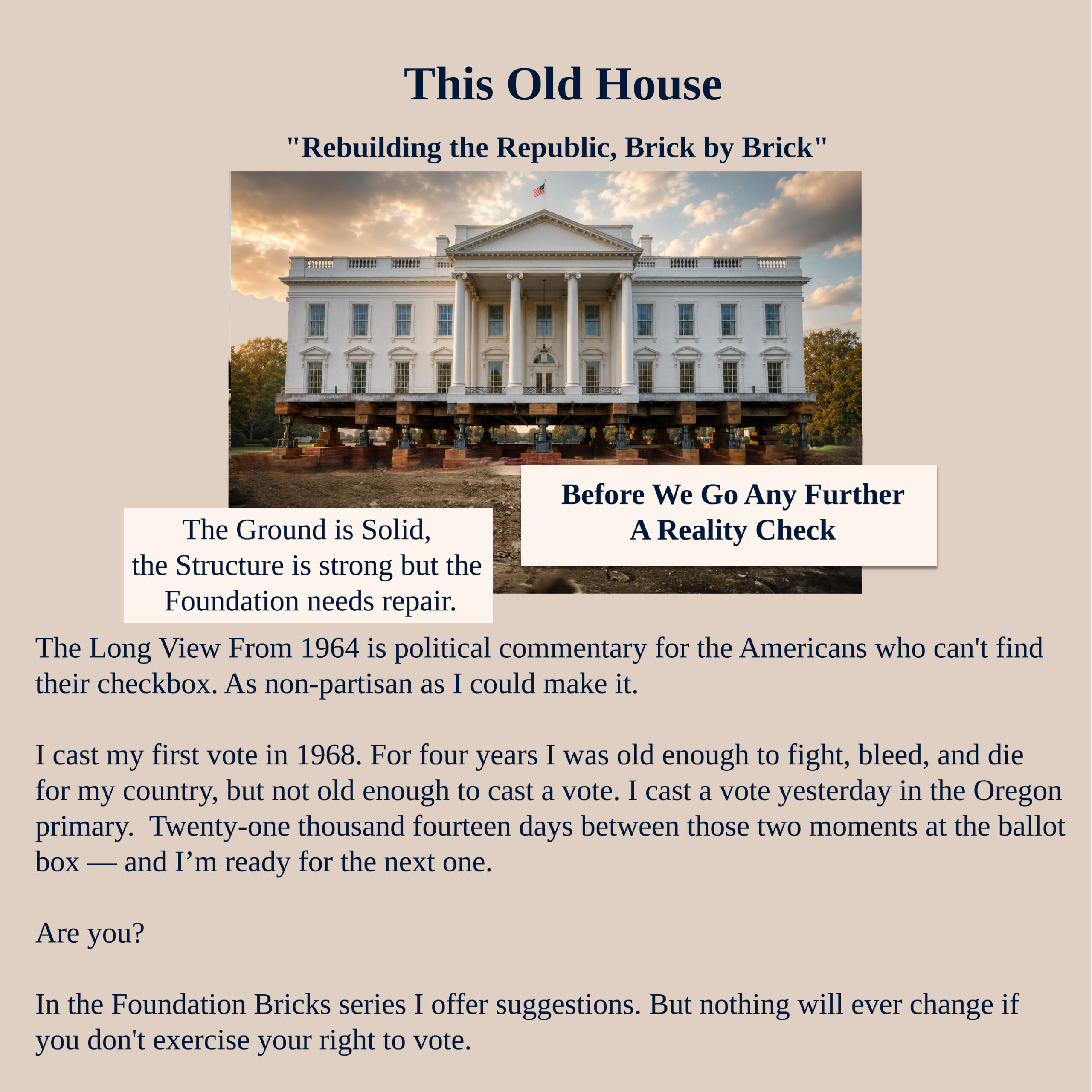
Before We Go Any Further A Reality Check
Before we go any further building a foundation for the future we have to stop and look at reality.
What we have is a mess. A partisan battlefield where ninety percent of the effort and legislation is directed toward power, who is in charge and who is making the rules. And the needs of the people are in reality not taken into consideration. Oh, lip service is given on every stump any good politician can find to state their cause. And their cause is to get themselves reelected.
So in all honesty, is this a pipe dream? Are we just sitting here grooving to Grace Slick singing White Rabbit?
Or is this doable.
I believe it is. Can it be done overnight? No. But it can be done.
Honesty point number two. Who will be the strongest opponents to effective change? The entrenched politicians themselves. They voted for their own terms, their own pay, their own retirement, their own power. They don’t want to give it up.
Well. F them.
What it will take is us. But not just us in numbers, an educated us. An involved us. It is like wanting to look like Arnold Schwarzenegger or Cheryl Ladd while eating another pint of Häagen-Dazs. It isn’t going to happen without the exercise. You need muscles before you can flex them.
Think of what I am proposing as a blueprint in its early stages. Something to be thrown around, talked about, redrawn, picked apart and rewritten. And when you’re done, go back and compare it to the original and start building. That is, if you truly want something better.
It isn’t going to magically appear on its own.
We will talk about many things. Healthcare, what should we expect, what do we want, and what is actually reasonable? It’s easy to say free healthcare but someone still has to pay for it. Education, what good is a PhD if you can’t get a job? Maybe trade schools are a good thing. Should the Washington reflecting pool reflect something worth reflecting or just be a pretty shade of blue? The list could go on forever. But I’m old, so I promise you it will be a reasonable list.
And we will address capitalism. After all it is what got us here. I am all for it. But let’s put it in perspective. Who gets what and how much is enough?
It’s all about the seeds. You need to supply the earth, the water and the fertilizer, if any can be found under the current regime.
We also need a label. We all like labels. We need labels. It’s the American Way. This is supposed to be a Democratic Republic we live in.
I’m not so sure that label fits very well anymore.
What do you think?
The obvious goal with this set of foundation blocks isn’t to fix the broken system. It’s to provide a structure with enough strength that it cannot be so easily broken and manipulated again.
The strength comes from simplicity.
Not complexity.
The Entire Foundation Series
The series as a downloadable PDF
Share this:

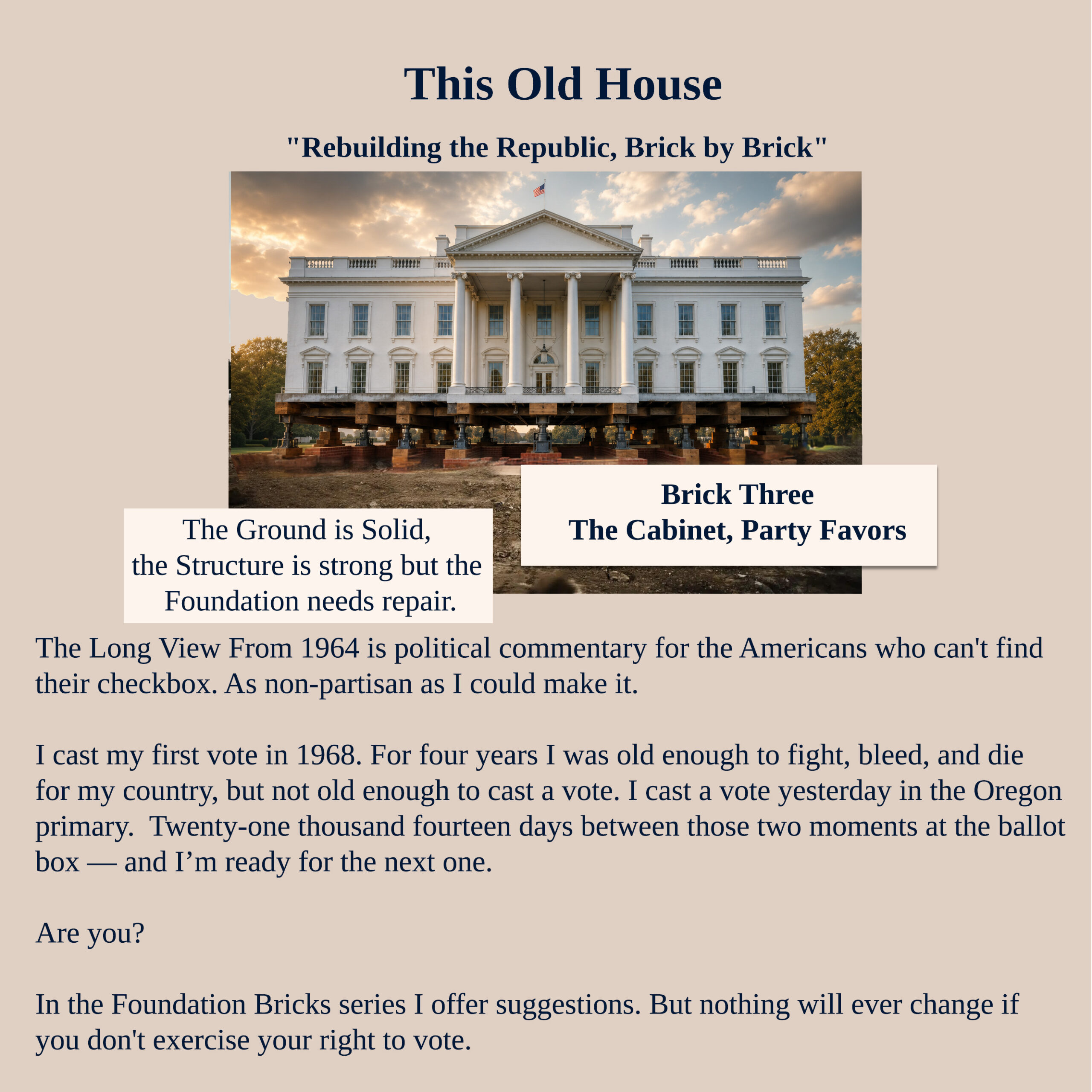
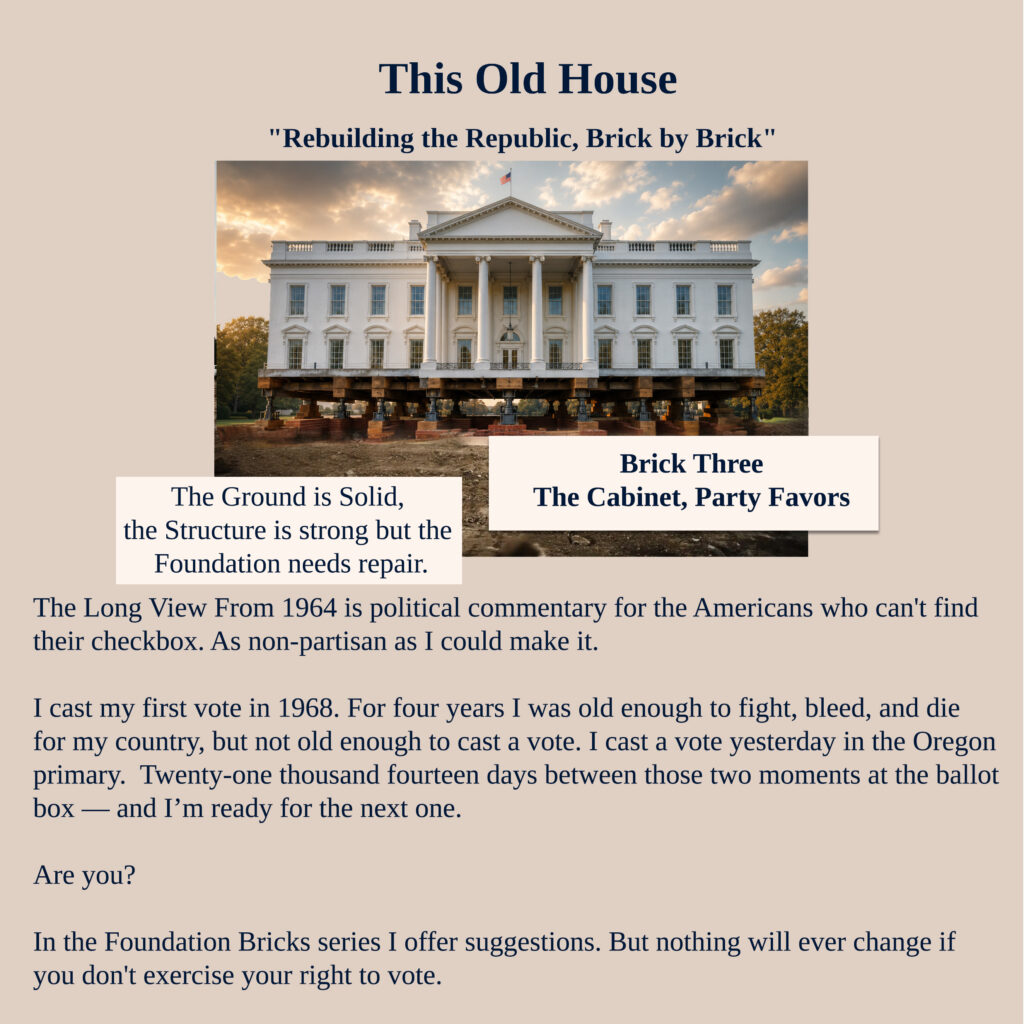
The Cabinet, Party Favors Brick What Good Government Actually Requires — Brick Three – The Cabinet, Party Favors
The Third Brick What Good Government Actually Requires — Part Three
There is a tradition in American politics so embedded that most people never question it.
The president wins. The president hands out cabinet positions. The cabinet positions go to the people who helped the president win — donors, allies, loyalists, true believers, and occasionally someone who spent the entire campaign calling for the department they now run to be abolished.
We call this governing.
It isn’t.

It is the thank you gift system dressed up as executive leadership. Party favors with confirmation hearings. And while career civil servants generally do the actual work underneath the political appointees, the damage happens when the unqualified person at the top starts making policy. Policy driven not by expertise or national interest but by the ideology, ego, or donor relationships of someone who got the job because they made the right phone calls at the right time.
The confirmation process was supposed to prevent the worst of this. In theory Congress evaluates the nominee and decides whether they are qualified to lead a critical department. In practice — as we have watched in painful real time — partisan confirmation is theater. When the system is controlled by one party the hearings become a formality and the outcome is predetermined regardless of qualification.
So here is the question the third brick asks.
What if the president didn’t pick the cabinet?
Not entirely. Not unilaterally. What if the senior positions in critical departments — Defense, State, Justice, Intelligence, the Federal Reserve — were filled by professionals who advanced through their own institutional ranks on merit, competence, and demonstrated performance? The way military officers advance. The way career diplomats advance. The way the civil service was designed to work before political appointees started parachuting in over the people who actually know the job.
The president would then work within that professional framework to accomplish the agenda the voters elected them to execute.
Which brings us to the vice president.
Right now the vice president is chosen to win a state, appeal to a demographic, or balance a ticket geographically. They are an electoral calculation wearing the costume of a governing partner. Your running mate is whoever helps you win. What happens after winning is a separate conversation.
What if it wasn’t?
What if the vice president was required to be a genuine working partner — someone who shared the governing agenda, complemented the president’s specific weaknesses, and was capable of actually running the country if called upon? Not a campaign asset. A co-architect.
That changes everything downstream.
A president who has to pick a genuine partner picks differently than a president assembling an electoral coalition. A ticket built around a shared agenda attracts a cabinet built around executing that agenda. If the country faces a climate crisis the executive team running on clean energy solutions has the expertise and the congressional backing to address it. If national security is the crisis the team built around genuine military and diplomatic competence has the credibility to lead.
There would still be infighting. There will always be infighting. Human nature doesn’t get reformed by better institutional design.
But more handshakes and less backstabbing is not a naive hope. It is what happens when you change the incentive structure. Right now the incentive is loyalty to one person. Change the incentive to competence in service of a shared agenda and the culture follows the incentive.
The military figured this out. You do not hand the Joint Chiefs to someone’s campaign donor. You advance through the ranks, demonstrate competence at every level, and earn the position. The fact that this system was recently dismantled in favor of loyalty appointments is not an argument against the system. It is the strongest possible argument for protecting it with something more durable than institutional habit and assumed good faith.
Professional advancement. Merit confirmation. A vice president who is a partner not a prop. A cabinet built to execute an agenda rather than reward the people who funded it.
The Entire Foundation Series
The series as a downloadable PDF
Share this:

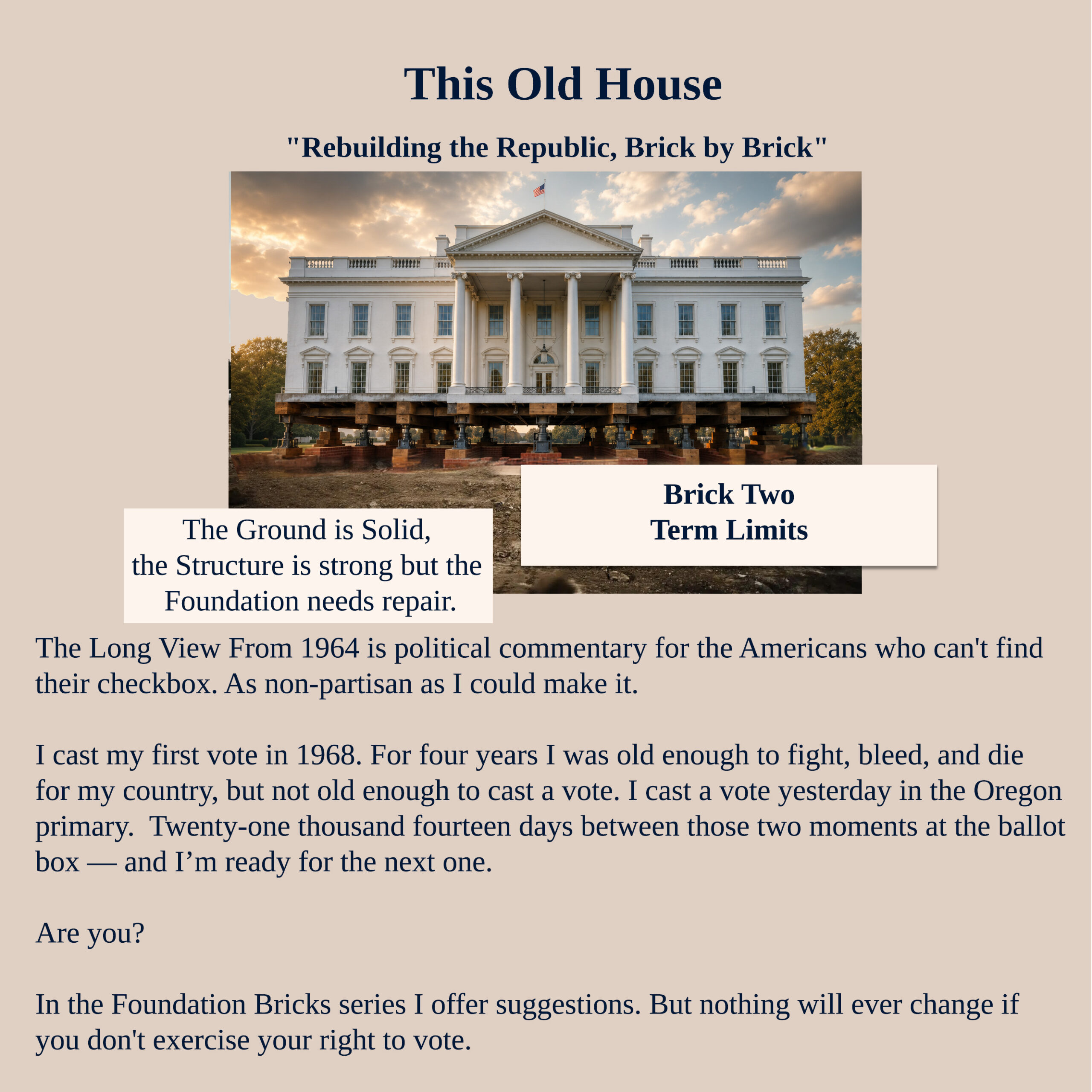
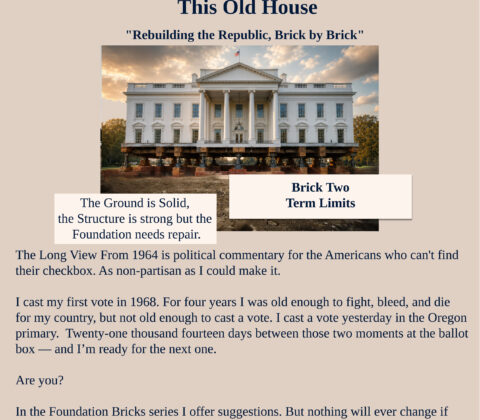
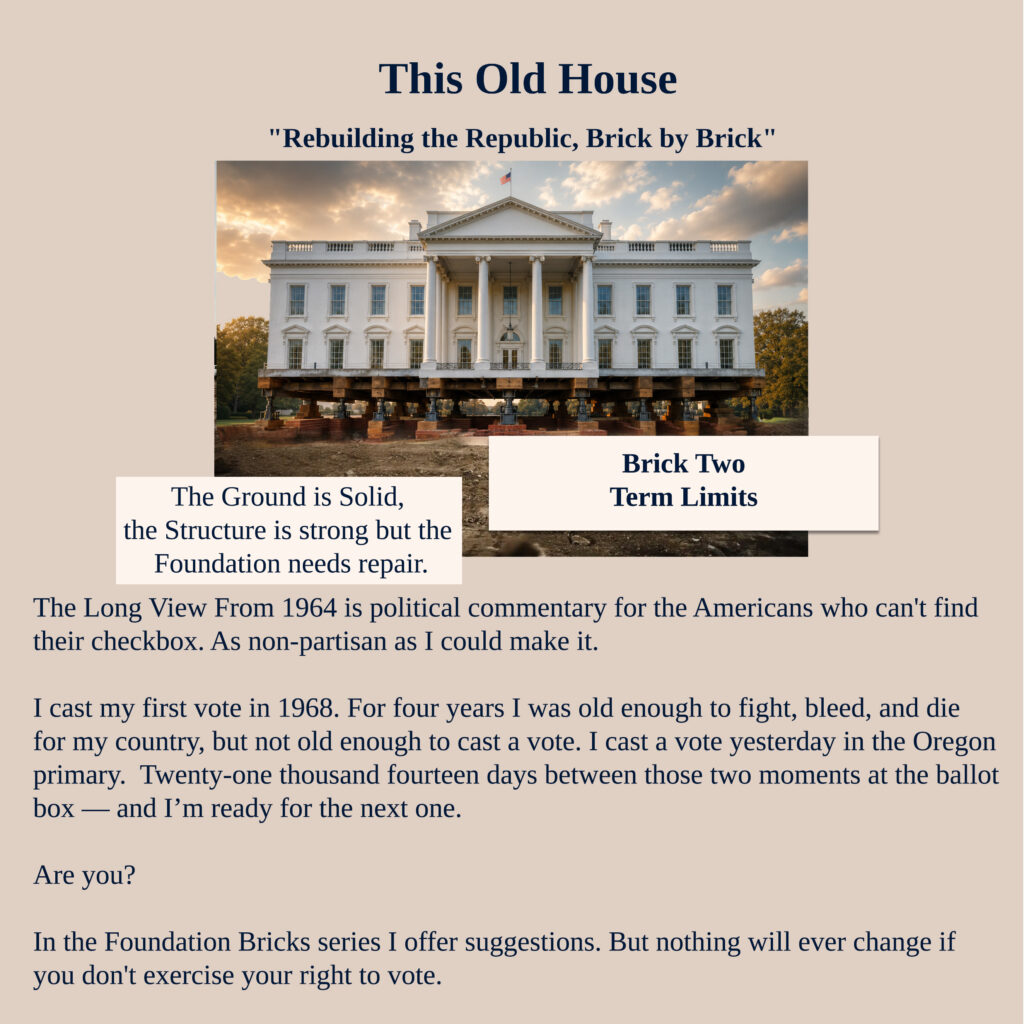
The Term Limits Brick What Good Government Actually Requires — Brick Two – Term Limits
The Second Brick What Good Government Actually Requires — Part Two
If accountability is the foundation then the second brick is simple.
Nobody stays forever.

Term limits. Age accountability. The systematic removal of dead wood before it becomes the structure itself. The recognition that in any healthy organization — a business, a military unit, a family — the inability to remove someone who has outlived their effectiveness isn’t loyalty. It’s institutional rot.
We have watched what happens when people stay too long. The institution bends around them rather than them serving the institution. J. Edgar Hoover ran the FBI for 48 years. Nobody could remove him because nobody could afford the cost of trying. That is not a feature of good government. That is a cautionary tale that we apparently need to be told more than once.
On Age
A hard cutoff number is both cruel and imprecise. Minds age differently. A 79 year old with a video tape memory and fifty years of accumulated pattern recognition may serve better than a 55 year old running on talking points and donor calls. A number on a birth certificate tells you nothing useful.
What tells you something useful is behavior.
A committee empowered to evaluate and recommend further medical and mental evaluation when behavior becomes noticeable. Not partisan. Not elected. Drawn from retired judges, physicians, and civic leaders with staggered appointments designed to insulate from political pressure. The process itself is the deterrent — most people approaching genuine cognitive decline would rather resign than submit to public evaluation.
The goal isn’t to humiliate. It’s to create a dignified off ramp before the institution suffers.
On Term Limits
The structure matters as much as the limit.
A president at two four year terms has enough time to govern without enough time to become permanent. A senator at two six year terms — twelve years — learns the job properly and builds something durable without becoming a resident. A representative on perpetual two year cycles is always campaigning and never governing. Move them to four year terms. Give them enough runway to actually do the work.
The goal is sufficient time to be effective without sufficient time to become immovable.
On the Two Party System
Here is the brick that will make everyone uncomfortable.
Eliminate it.
Not reform it. Not balance it. Remove the institutional infrastructure that makes it the only viable option. No party designations on ballots. No party primaries with public funding. No party based committee assignments in Congress.
Watch what happens to the PACs when there are no teams to back. Watch what happens to the dark money when the jersey colors disappear. Citizens United becomes considerably less useful when there is no party machinery to funnel the money into.
This isn’t naive. It’s the recognition that the two party system has become the primary mechanism for preventing exactly the accountability the foundation requires.
On Compensation
If we require fidelity we require fidelity.
Public servants receive public servant compensation. A PERS program like other government employees. Healthcare through the same options available to federal workers. A pathway into continued government service for those who want to contribute after their term ends.
No golden umbrellas. No lifetime pensions after a single term. No healthcare for life unavailable to the constituents who funded it.
The same standard applied to the person making the rules as the person living under them.
That is the second brick.
Nobody stays forever. Nobody lives above the system they were elected to serve.
Build on that and the walls start to mean something.
The Entire Foundation Series
The series as a downloadable PDF
Share this:

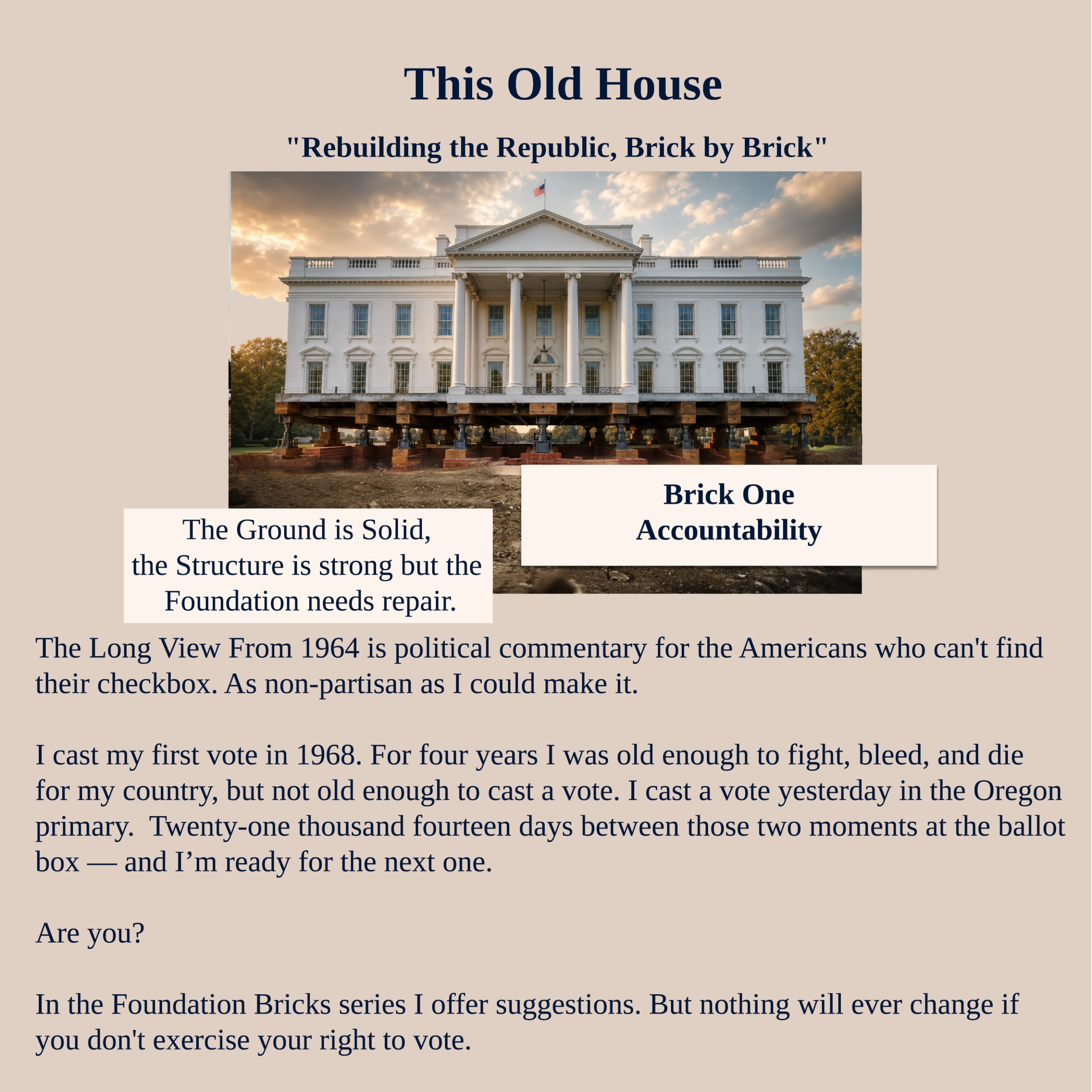
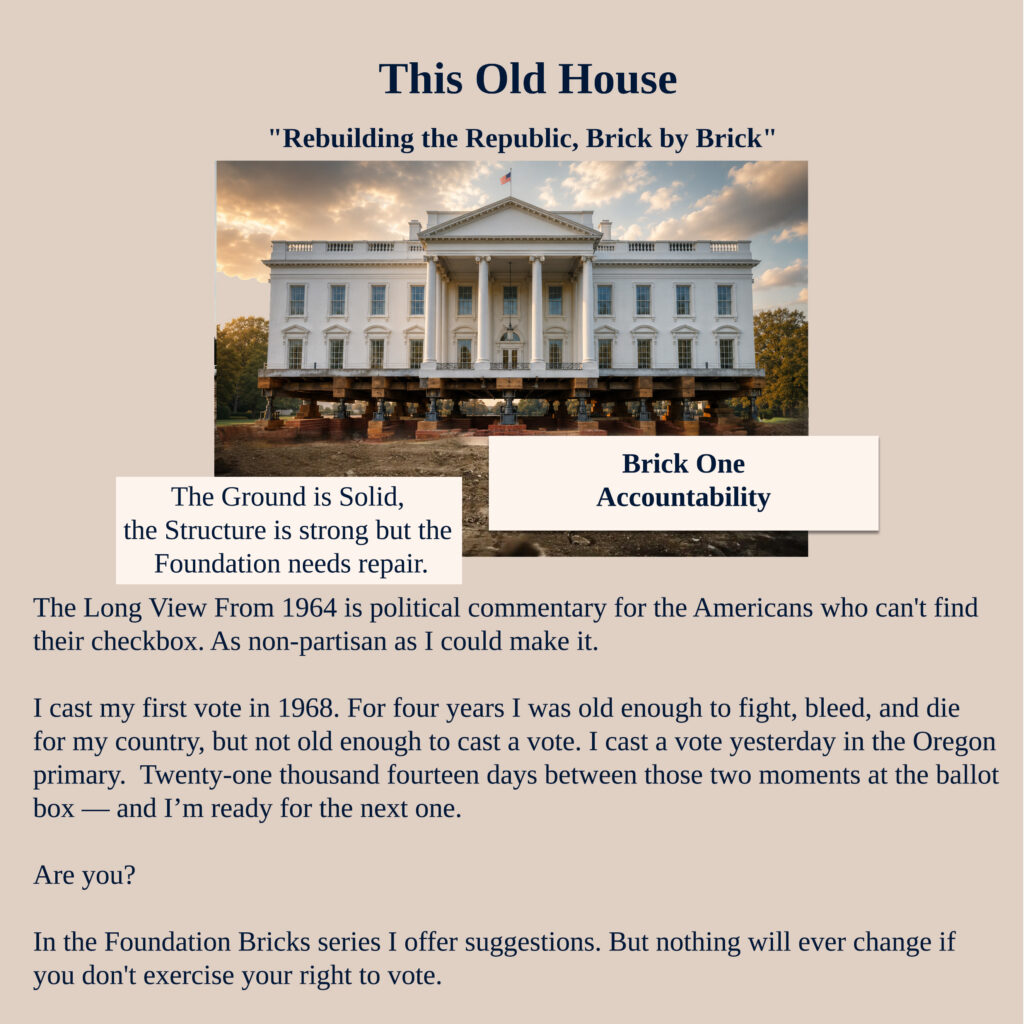
The Accountability Brick What Good Government Actually Requires — Brick One – Accountability
The Foundation What Good Government Actually Requires — Part One
Accountability.
Not the political science version. Not the talking point. The real thing. The kind you learn before you’re old enough to vote.

When you break something you admit it. There is no rug. There is no sweeping. You live with what you have and if you don’t have it you earn it. If you make a promise you keep it — or you have a legitimate reason for not doing so that you share with the people you made it to.
That’s it. That’s the foundation.
Everything else — healthcare, infrastructure, justice, national security, the institutions we depend on daily without noticing — sits on top of that one simple principle. Remove it and nothing else holds. The walls crack. The roof comes down. The building that took two hundred and fifty years to construct becomes a very expensive pile of rubble with gold curtains.
We have watched what happens when accountability disappears from the top.
I will lower your taxes. What goes unspoken is that someone’s benefits will pay for it. I will protect your benefits. What goes unspoken is where the money comes from. The empty promise isn’t always an outright lie. Sometimes it’s just half the truth delivered with enough confidence that nobody does the math until the bill arrives.
The bill always arrives.
Presidential immunity is the legal formalization of unaccountability. The Supreme Court’s 2024 decision didn’t create the problem — it just removed the last pretense that the problem didn’t exist. When the president does it it isn’t illegal. Nixon said that too. It didn’t work then because the institution held.
The institution didn’t hold this time.
Which means the foundation has to be rebuilt with something stronger than institutional habit and assumed good faith. The founders were obsessed with this question. They had just lived under a king. Every check, every balance, every separation of power was the answer to one central anxiety — what happens when the wrong person gets the power?
They built a back door. A way to stop something. Checks and balances as the architectural response to the certainty that power will eventually be held by someone who shouldn’t have it.
That back door has to be properly locked from both sides. No presidential immunity. Full stop. The same standard applied to the person signing the orders as to the person receiving them.
To require fidelity requires fidelity.
That covers governance and marriage and institutional trust and the social contract simultaneously. You cannot demand loyalty from a country you are actively betraying. You cannot require honesty from institutions you are actively corrupting. You cannot ask the American people to follow rules you have granted yourself immunity from.
One standard. No exceptions. No immunity.
That is the foundation.
Without it nothing else we build will stand.
The Entire Foundation Series
The series as a downloadable PDF
Share this:

Guest Post – Outrage Turned Us vs. Them Into Us vs. Us
The political class does not need every citizen to agree with its agenda. It only needs citizens to remain divided enough that they never organize around the things they already agree upon. The cost of living, safe communities, transparent government, affordable healthcare, accountable leadership, fair wages, reliable infrastructure, and reduced corruption are not fringe concerns. They are the ordinary expectations of people who still believe a modern nation should function reasonably well.
Yet functioning government is terrible entertainment. Competent administration does not generate ratings. A successful infrastructure project is not nearly as exciting as a culture war. A balanced budget lacks the emotional punch of outrage. Solving problems rarely creates the same level of engagement as arguing about them indefinitely.
As a result, the public often finds itself trapped in a cycle where the issues that divide Americans become permanent campaign material, while the issues that unite Americans become optional. The disagreements remain unresolved because unresolved conflicts are politically valuable. They provide fundraising opportunities, campaign slogans, media appearances, and endless reasons to return voters to the polls convinced that disaster is one election away.
Meanwhile, many of the structures that citizens regularly complain about remain largely untouched. Bureaucracies continue to grow and evolve. Lobbying networks remain deeply embedded. Regulatory systems become increasingly complex. Major donors continue to enjoy access that ordinary citizens can only imagine. Regardless of which party wins a given election, the machinery itself often proves remarkably durable.
This is not to suggest that elections do not matter. They do. Policies matter. Laws matter. Judicial appointments matter. The outcomes of elections can and do have significant consequences for millions of people.
The problem is that Americans are increasingly encouraged to view politics as a never-ending battle between ordinary citizens rather than as a mechanism for governing a country. Political disagreement is natural and healthy in a free society. It is impossible to have liberty without disagreement because free people inevitably reach different conclusions about how society should be organized.
The trouble begins when disagreement ceases to be a challenge that politics attempts to manage and instead becomes the product being sold.
In that environment, conflict acquires value of its own. Outrage becomes a commodity. Fear becomes a fundraising strategy. Anger becomes a marketing tool. Citizens become consumers of political entertainment rather than participants in self-government.
The result is a nation in which people spend extraordinary amounts of time debating one another while exercising surprisingly little influence over the institutions that affect their daily lives. Americans can instantly identify the latest cultural controversy, yet many struggle to explain how legislation is written, how regulatory agencies operate, or how lobbying organizations influence policy. They know the arguments they are expected to have because those arguments are constantly placed in front of them. They are far less likely to know where the money flows, who benefits from specific decisions, or why certain reforms never seem to advance beyond campaign promises.
None of this requires a grand conspiracy. Human nature is sufficient. Politicians respond to incentives. Media organizations respond to incentives. Activist groups respond to incentives. Consultants, donors, corporations, and advocacy organizations all respond to incentives. If outrage generates attention, and attention generates money, influence, or power, then outrage will be produced in abundance.
That reality should concern citizens regardless of ideology.
A conservative who believes government has become unaccountable should be concerned. A progressive who believes corporations wield excessive influence should be concerned. An independent who simply wants competent leadership should be concerned. The specific diagnosis may vary, but the underlying problem remains remarkably similar: institutions often benefit from public division in ways that ordinary citizens do not.
The challenge, therefore, is not to eliminate disagreement. That would be impossible and undesirable. A healthy society needs vigorous debate. It needs competing ideas. It needs people who are willing to challenge one another’s assumptions and defend their beliefs.
What it does not need is a political culture that treats every disagreement as evidence that fellow citizens are enemies.
Americans can disagree about gun policy while still demanding affordable housing. They can disagree about abortion while still insisting upon accessible healthcare. They can debate immigration policy while expecting government agencies to function efficiently. They can argue about climate policy while wanting clean water, reliable infrastructure, and accountable public officials.
In fact, the ability to maintain those distinctions may be one of the most important civic skills a democracy can possess.
The danger is not disagreement itself. The danger is allowing disagreement to become a leash that can be pulled whenever those in power need citizens looking somewhere else.
When people are exhausted, angry, and constantly reacting, they become easier to manage. They spend their energy fighting one another instead of examining systems. They become focused on symptoms instead of incentives. They become consumers of outrage rather than organizers of solutions.
Outrage can be useful. It can draw attention to genuine injustice. It can motivate action. It can expose corruption and force accountability.
But outrage alone is not power.
Power comes from organization. It comes from persistence. It comes from understanding how institutions work and demanding that they serve the public interest. It comes from citizens who are willing to track promises, follow legislation, monitor spending, attend meetings, vote consistently, and remain engaged long after the cameras have moved on to the next controversy.
Most importantly, power comes from recognizing that fellow citizens are not automatically enemies simply because they disagree.
The country does not need another lecture about unity from politicians who profit from division. It does not need another campaign built entirely around fear of the other side. It does not need another election cycle in which Americans are told that their greatest threat is the person living across the street.
What it needs are citizens willing to notice the trick.
The divide in America is real. Some disagreements are profound and unlikely to disappear anytime soon. But division is also useful to those who benefit from keeping the public fragmented and distracted.
That reality does not erase legitimate differences between left and right. It simply raises a different question: who benefits when citizens become so consumed by fighting one another that they stop paying attention to the people holding the matches?
The sign still insists everything is under control.
Perhaps it is finally time to stop arguing long enough to ask who keeps fueling the fire.