
Posts By


The Long View From 1964 – Maybe Just Listen – Video
So often we sit there and tune him out.
Not another war story. I have heard it before. I know, I know. Dad, Reagan isn’t President anymore and I don’t know who he is anyway except some cowboy on TV.
The Long View From 1964
- Superman
- Maybe Just Listen
- The Checkbox Problem
- The Land Moved While You Slept
- The Road and the Ground Beneath It
- Where is Anywhere
- The Saucepan Hat
- Superman (Video)
- Maybe Just Listen (Video)
- The Checkbox Problem (Video)
- The Land Moved While You Slept (Video)
- The Road and the Ground Beneath It (Video)
- Where is Anywhere (Video)
- The Saucepan Hat (Video)
Share this:


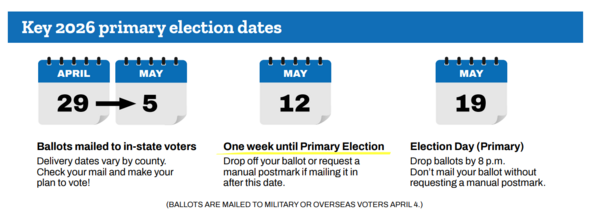
It’s time to mail back your ballot! The May 19th election is 1 week away. 6/12/26
|


 Tobias Read






Share this:

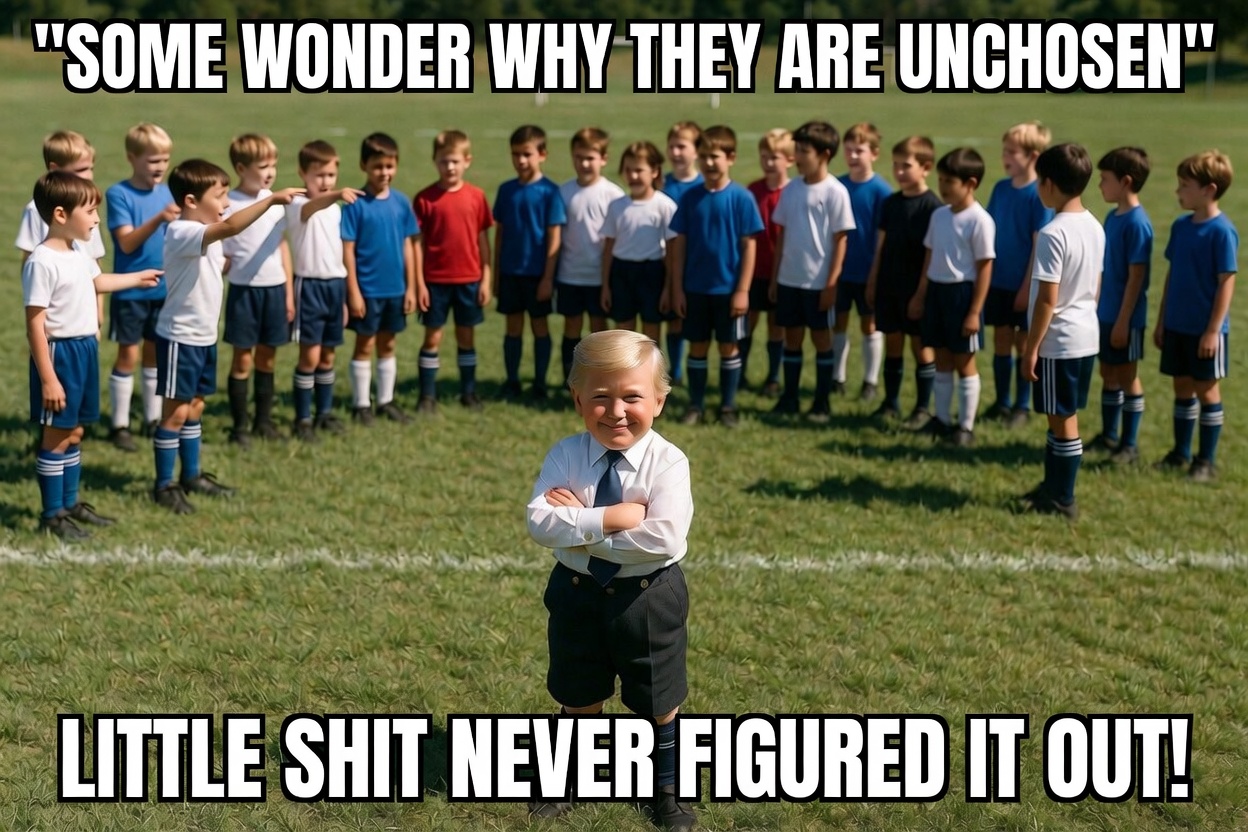
Second String Donny
Here is the simplest explanation for everything you have been watching.
The first string doesn’t work for second string management. Never has. Never will.
Competent people require a competent environment. They need their judgment respected, their expertise valued, their honest assessments welcomed rather than punished. The moment a genuinely capable person walks into a room and realizes the man at the top is threatened by competence rather than energized by it — they leave. Or they get fired for exactly that reason.
So you get what you get.
Hegseth plagiarizing Tarantino movies for spiritual guidance. Loyalists whose primary qualification is willingness to pour the coffee and butter the bagel without asking uncomfortable questions. ICE with presidential immunity instead of military professionals with a conscience and a code. A chain of command built entirely on loyalty to one man rather than to the Constitution those officers swore to defend.
The entire administration is a mirror of the man at the top.
Which brings us to a new name. Not a nickname born of malice. A descriptor earned by résumé.
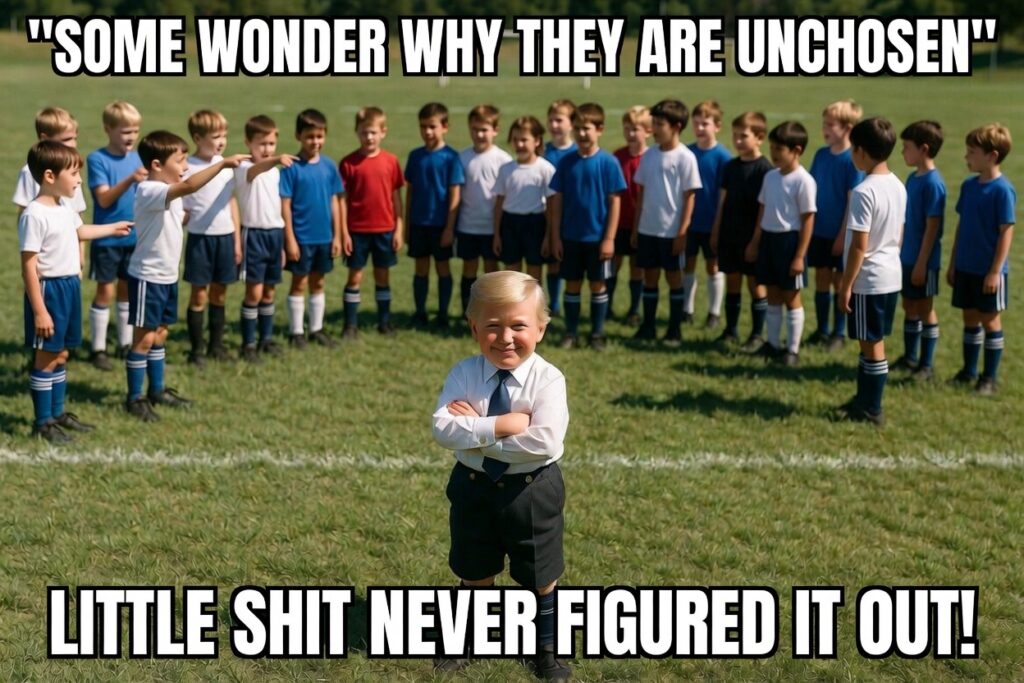
Second String Donny.
The man who fired the first string because the first string made him look exactly like what he is.
There is only one problem with that explanation.
To be second string you have to have been picked for a team at some point.
I am not sure that ever happened.
The obvious question is,
If he’s second string, how did he get elected twice?
Because there is one thing Second String Donny is genuinely first string at. The con. Identifying what frightened and ignored people want to hear and saying it without hesitation or conscience. That’s not leadership. That’s salesmanship.
P.T. Barnum was first string at the circus too.
You still wouldn’t hand him the Pentagon.
‘Second String Donny’ Feel free to use it. Johnny Appleseed didn’t trademark the seeds.
Share this:

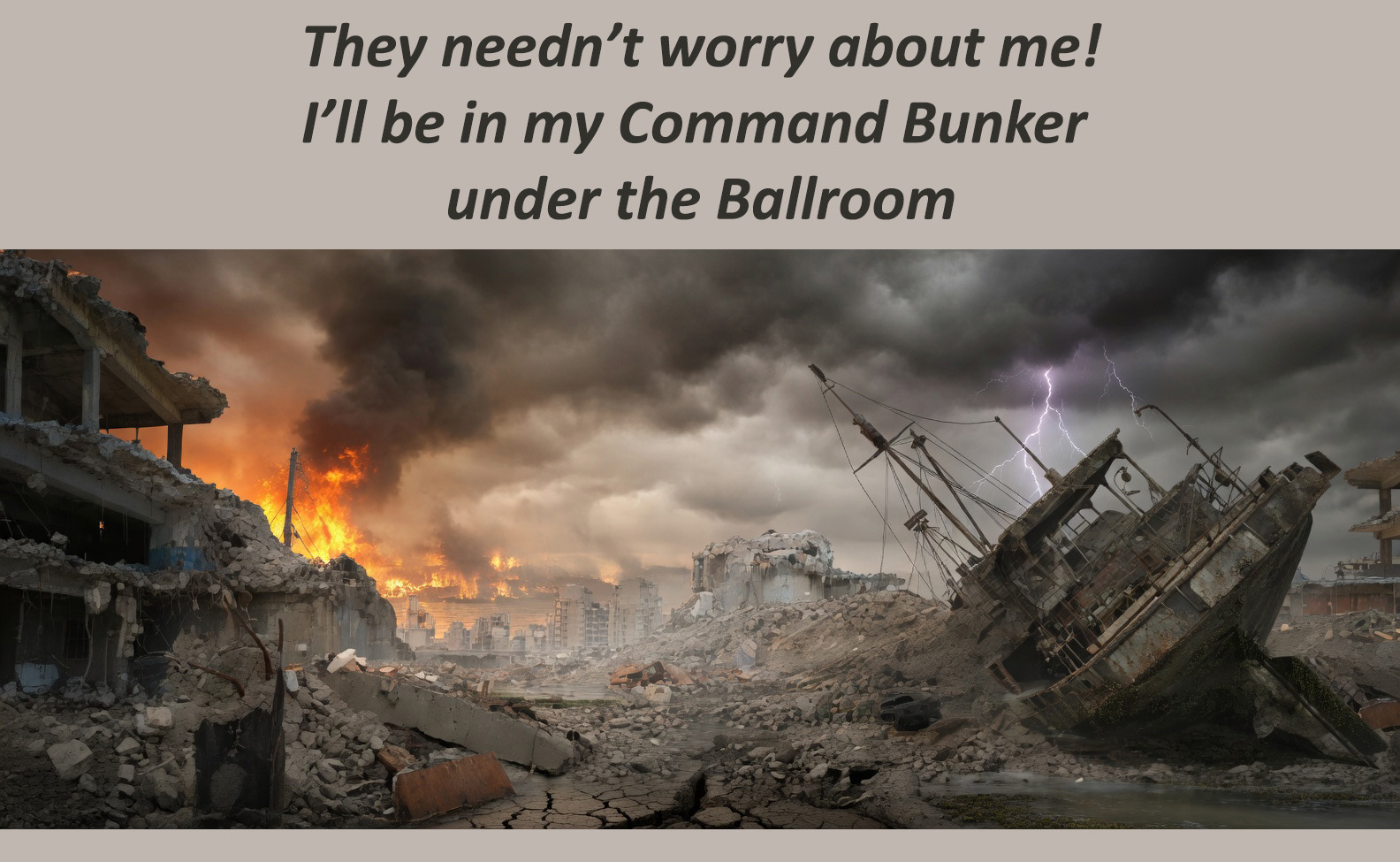
The President Who Won’t Leave – Part 2 of 3 Home Sweet Home – Video

Ballrooms, gala affairs, champagne flowing, maybe even a tango to catch the eye. Of course it’s hard to see the occupants when the reflections from an overwhelming amount of gilded surfaces bounce from every nook and cranny. But we’re not here to pass judgment on what may well be the most garish brothel parlor in existence.
The President Who Won’t Leave’ Part 1 of 3 Has He Been Planning For This War All Along? Video
The President Who Won’t Leave ‘ Part 3 of 3 The Third String Video
Share this:

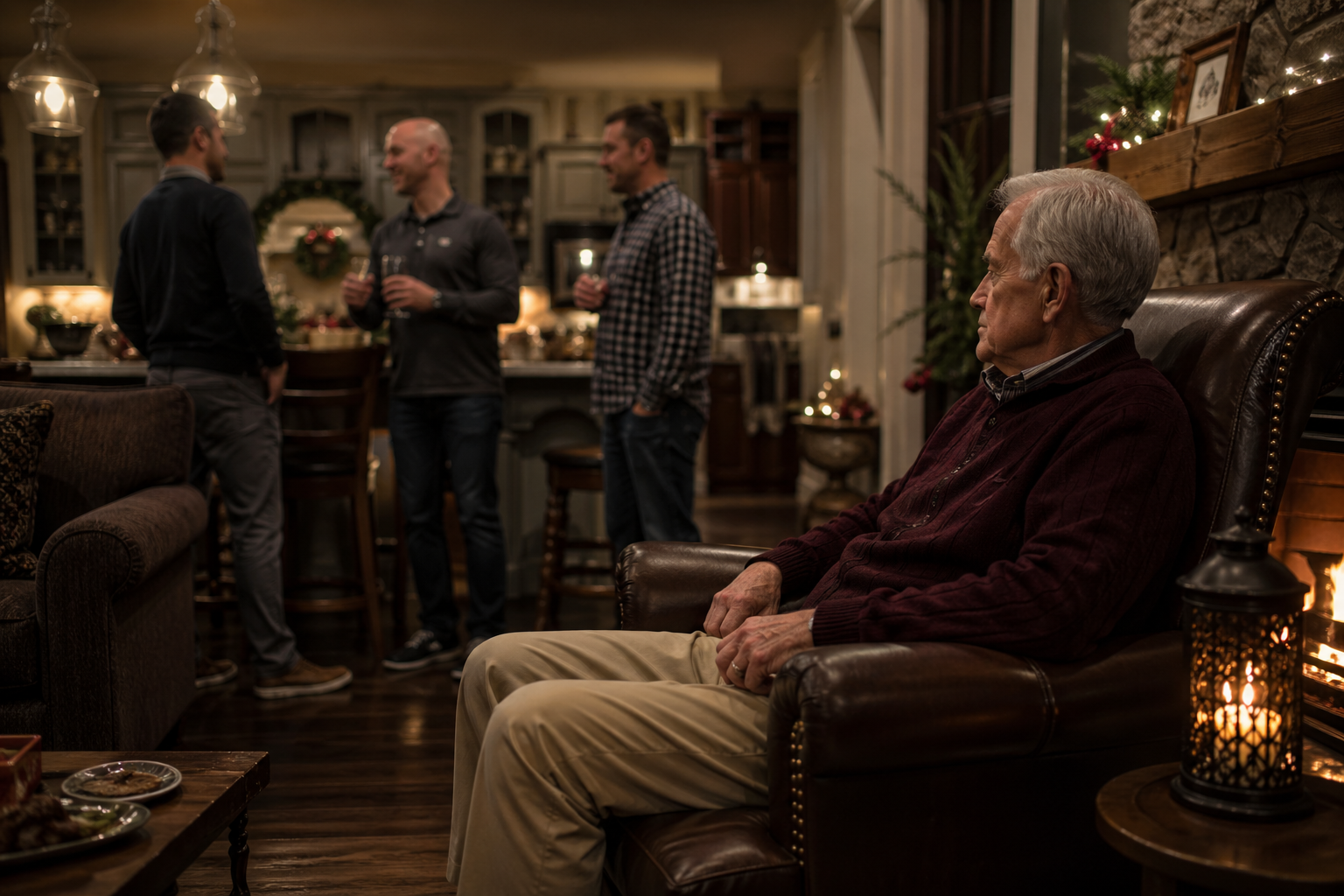
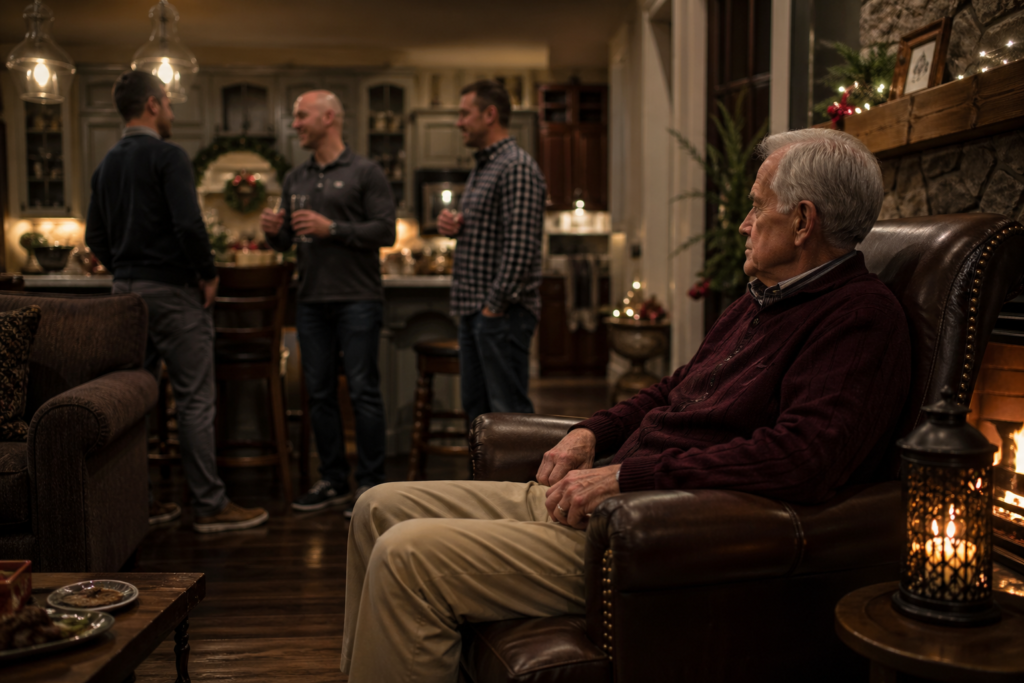
The Long View From 1964 – Maybe Just Listen
So often we sit there and tune him out.
Not another war story. I have heard it before. I know, I know. Dad, Reagan isn’t President anymore and I don’t know who he is anyway except some cowboy on TV.
Everything is moving so fast today. We have AI. We have instant everything. And somewhere in that acceleration we forgot that Dad — and Mom, I’m just shortening the typing process — are the ones who actually built the infrastructure we are all living inside.
Our children forget that Dads started Intel. Built Tektronix. Worked at Texas Instruments. That the company that became Texas Instruments was created by GSI — Geophysical Services Incorporated — because analog computing wasn’t getting the job done. That Dads spent years in Southern California discovering the oil that Standard Oil and Chevron pumped out of the LA Basin and the Santa Barbara Channel. That these things did not build themselves.
The grandchildren watch Saving Private Ryan. But they forget that Great Grandpa was the one bleeding in Europe and the Philippines. They just see old people without opinions worth hearing.
Maybe we rant because nobody will listen.
But here is what I think the real problem is. They can’t see what politics is anymore. All they see is TikTok. All they see is YouTube. All they see is one outlet calling another outlet fake news while being called fake news in return. And then they watch it all falling down and they can’t even find the question to ask, let alone the answer.
Maybe if Grandpa and Dad had stopped ranting and started explaining. And maybe if Johnny and Jane had stopped scrolling and started listening. Maybe some of this could have been avoided.
Maybe. Just maybe.
I don’t have all the answers. I want to be clear about that. This entire series has been questions more than answers and that is entirely intentional. But there is one truth I know from experience — and I have the scars on my shoulder and chest to prove it is experience and not theory.
When you pull a boiling coffee pot off the stove and it comes down on you, you get burned. You don’t do it a second time. You learned something real in a way that no amount of telling could have taught you.
So yes. You have to make mistakes to learn. You have to touch something hot to understand burns. You have to get things wrong before you understand what right costs.
But the secret — the thing the scars actually teach you if you pay attention — is to get a small burn and learn your lesson. Not go down in the flames.
And right now it looks very much like we are headed for the flames.
Grandpa is not ranting.
Grandpa is pointing at the stove.
The Long View From 1964
- Superman
- Maybe Just Listen
- The Checkbox Problem
- The Land Moved While You Slept
- The Road and the Ground Beneath It
- Where is Anywhere
- The Saucepan Hat
- Superman (Video)
- Maybe Just Listen (Video)
- The Checkbox Problem (Video)
- The Land Moved While You Slept (Video)
- The Road and the Ground Beneath It (Video)
- Where is Anywhere (Video)
- The Saucepan Hat (Video)
Share this:

TODAY: Virtual Town Hall on Elections & Voting with Oregon Secretary of State Tobias Read, U.S. Senator Jeff Merkley, OACC President Dag Robinson 5/11/26
| Town hall will be moderated by Sandy Chung, Executive Director of ACLU of Oregon |
|
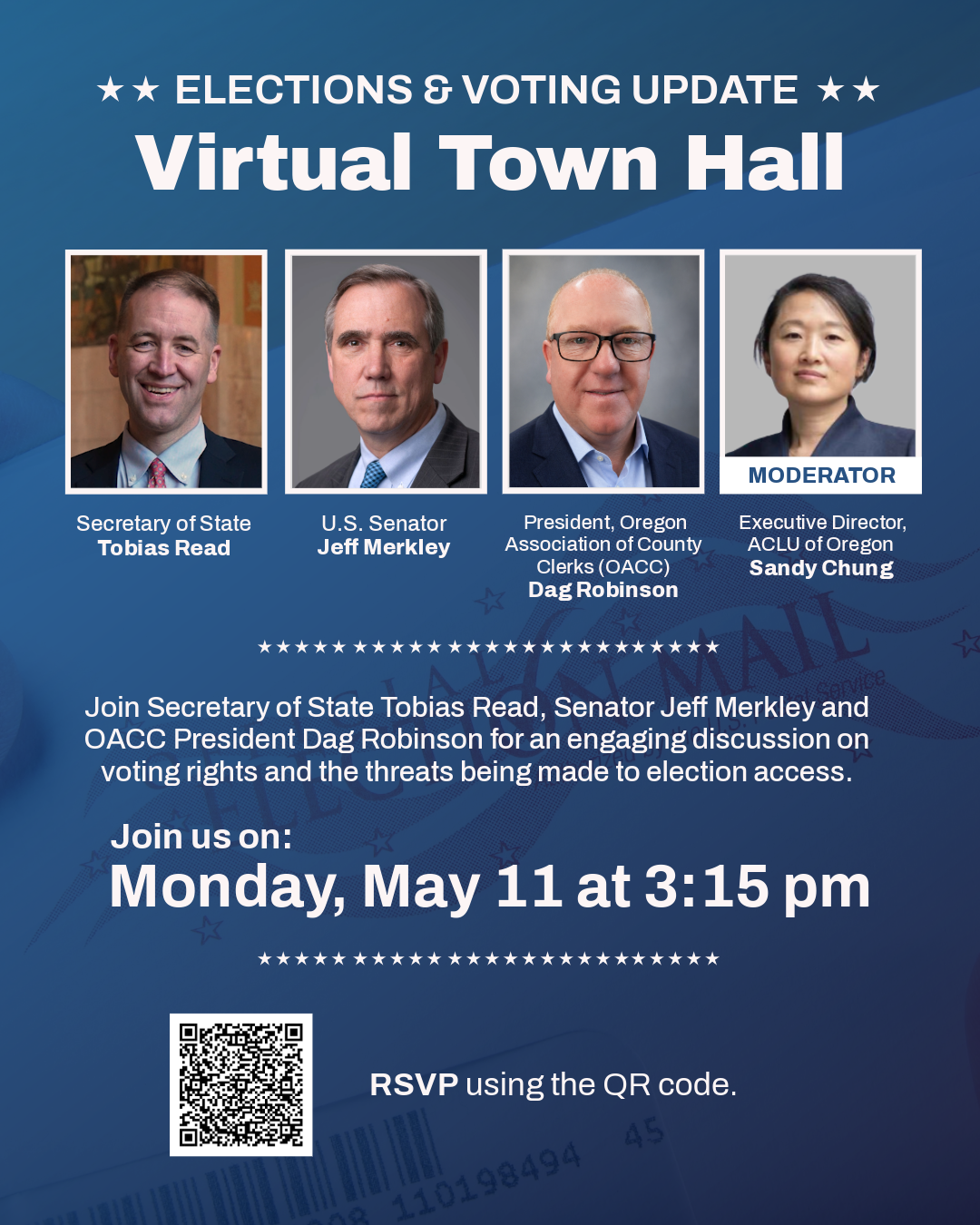 U.S. Senator Jeff Merkley and President of the Oregon Association of County Clerks (OACC) Dag Robinson are joining Oregon Secretary of State Tobias Read for a virtual town hall about elections & voting TODAY, May 11, at 3:15 p.m. The event will be moderated by Sandy Chung, Executive Director of the ACLU of Oregon.
Share this:

The President Who Won’t Leave – Part 2 of 3 Home Sweet Home
The President Who Won’t Leave – Part 2 of 3 Home Sweet Home
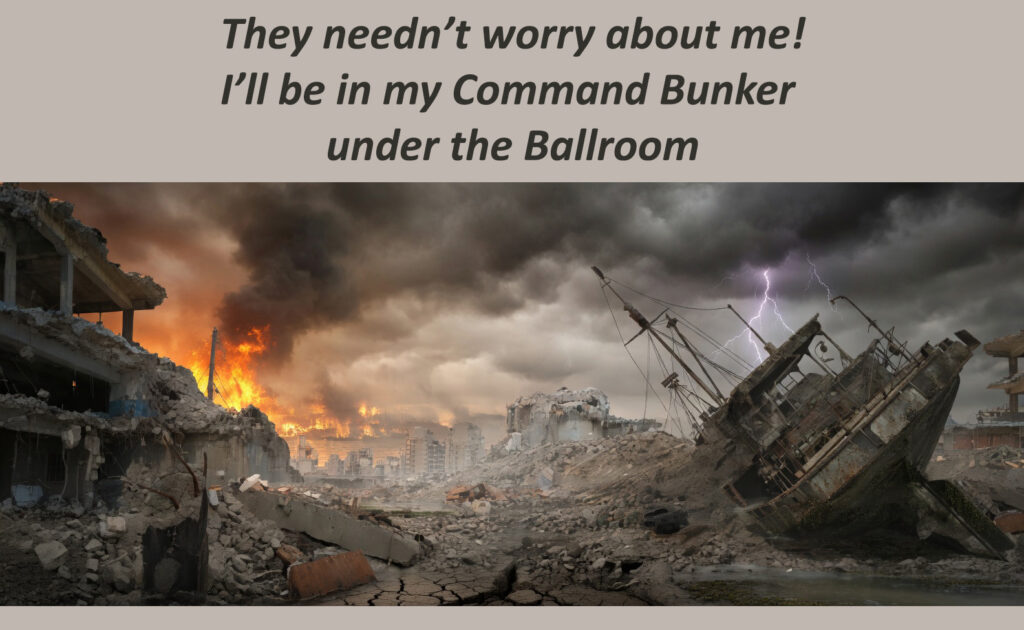
Ballrooms, gala affairs, champagne flowing, maybe even a tango to catch the eye. Of course it’s hard to see the occupants when the reflections from an overwhelming amount of gilded surfaces bounce from every nook and cranny. But we’re not here to pass judgment on what may well be the most garish brothel parlor in existence.
We’re here to wonder at the thickness of the bulletproof glass. At the structural engineering that went into this shed, yes, shed, as that is what the President himself referred to it as.
The shed that covers his expansive bomb shelter and command center. His hospital complex. His lavish living quarters. In wartime they call it a bunker. That’s where Hitler hid at the end and took the coward’s way out.
A bunker.
Why do we need such a command center? When was the last time the United States was attacked on its own soil? When has there been a physical threat from another nation since the end of the Cold War?
And Dude, his bunker isn’t going to survive ground zero. So what’s it all about? Maybe Alfie knows.
If it won’t survive a nuclear blast, won’t survive a rogue comet or asteroid, and we don’t see hordes of zombies rushing over the horizon, we are still left with one question.
Why does he need a bunker?
Maybe, just maybe, he thinks he needs it to protect himself from us.
And if that’s so, the next question follows naturally.
Why would he need to protect himself from the very people he was sworn to serve and protect?
Or are we expendable?
Maybe that’s a question we should all be asking ourselves.
I know I am.
You?
The President Who Won’t Leave; Part 1 of 3 Has He Been Planning For This War All Along?
The President Who Won’t Leave; Part 3 of 3 The Third String
Share this:

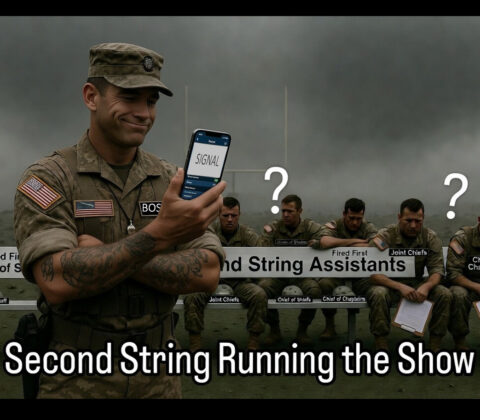
A War Being Run By the Second String – Video
We have the second string running the show.
Makes you proud to be an American, doesn’t it?
Share this:

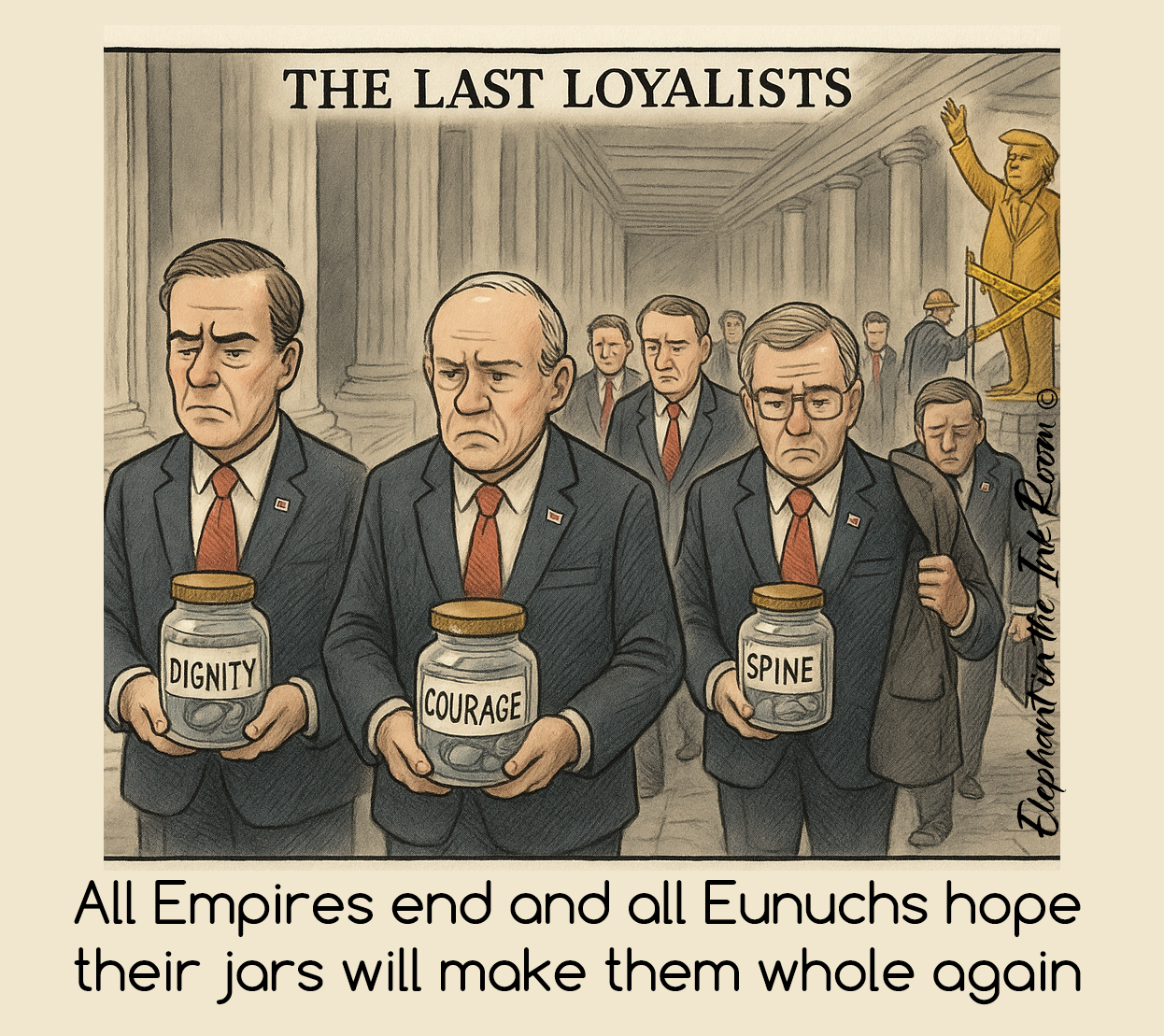
Fifty Ways to Lose Your Congressman – Video
If you are from a district where your congressional representative votes for everything the current administration puts in front of them, go to their town hall meetings. If they are still brave enough to hold them. Write letters. Make calls. Send emails. Be polite. Vulgarity and profanity is the fast lane to the trash, physical and digital alike.
Share this:



The Ash Didn’t Disappear – Video
I was seven years old, an American officer’s son, when I walked through Dachau.
I remember the ovens. I remember the showers. I remember the stains still on the walls. I remember the ash piles, this was 1954, nine years after liberation, and the ash still hadn’t disappeared. It had not yet soaked completely into the dirt.

Share this:


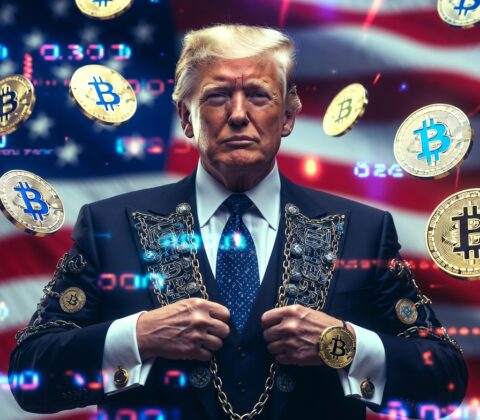



The President Who Won’t Leave – Part 1 of 3 Has He Been Planning For This War All Along? – Video

From day one, my ballroom, MY ballroom. A petulant child crying for his ballroom. Almost a month later the child coyly admits to the underground complex the shed is covering. All paid for with donations straight from somebody’s pocket, probably tucked into that additional 1.5 trillion dollar defense budget, because the underground playground is his bunker. His refuge in time of war. His hidden military complex, hospital, and I am sure gilded and lavish living quarters.
The President Who Won’t Leave’ Part 2 of 3 Home Sweet Home Video
The President Who Won’t Leave ‘ Part 3 of 3 The Third String Video
Share this:

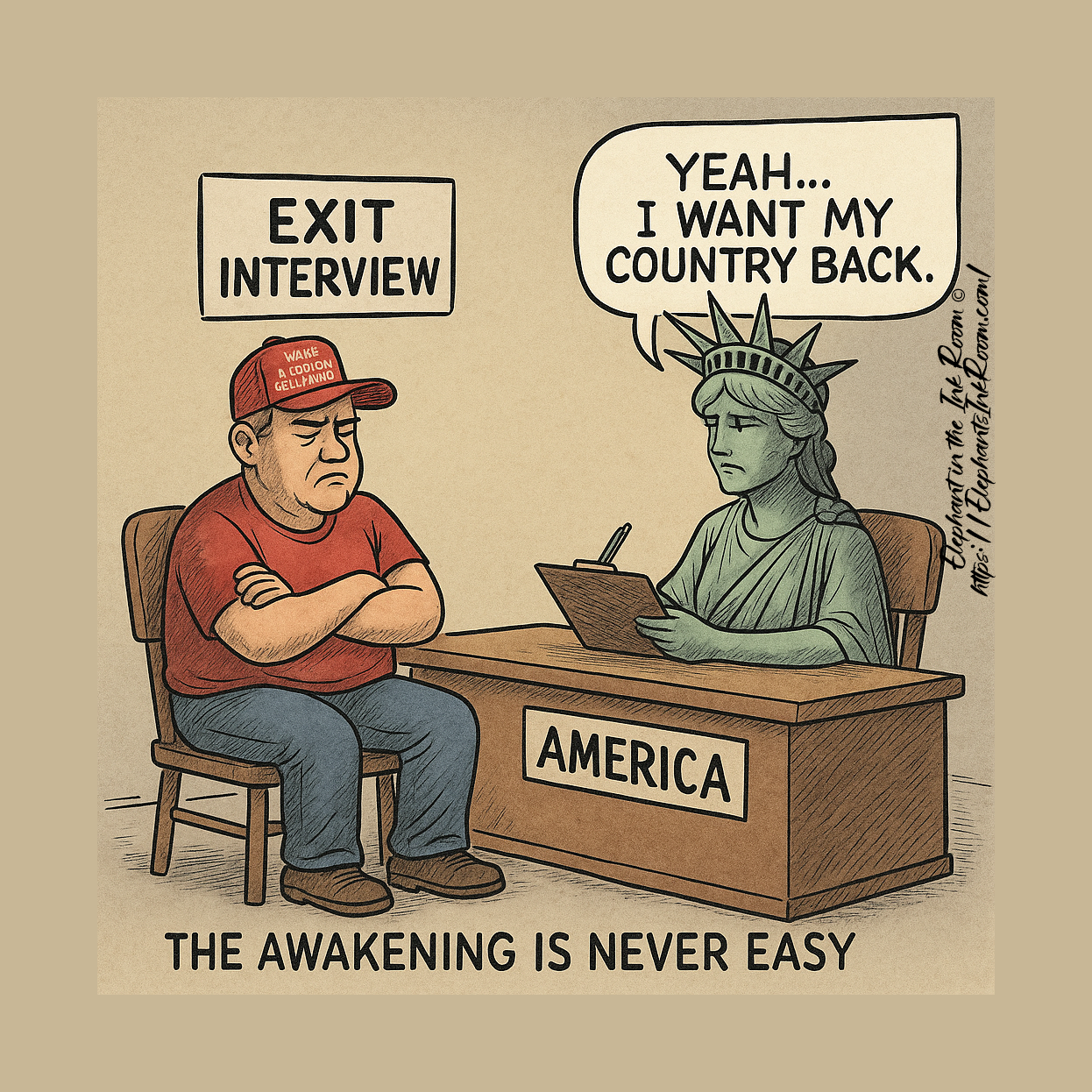
Fifty Ways to Lose Your Congressman
This isn’t about the Democrats winning.
This isn’t about a party label.
This is about healthcare. This is about the price of gasoline, and diesel. I bought my 1999 Dodge Ram with a Cummins because diesel was cheaper than regular. I’m glad I’m back to gasoline now. This is about the price of hot dogs and three dollar candy bars.
Coffee, well. I have years worth of green unroasted beans stocked up. But most people don’t.
Here is my very partisan advice. Something I try very hard not to give.
If you are from a district where your congressional representative votes for everything the current administration puts in front of them, go to their town hall meetings. If they are still brave enough to hold them. Write letters. Make calls. Send emails. Be polite. Vulgarity and profanity is the fast lane to the trash, physical and digital alike.
Don’t bother asking them to change their tune.
Just tell them to go home. Have a cigar. Get a drink. And start looking for another job.
Because they are done. Fired. Relieved of duty. No longer trusted. No longer wanted.
There are fifty ways to leave your lover. Pick one.
If you are a Republican who wants a Republican, fine. Find a conservative who doesn’t bow. Find someone honest enough to represent you rather than perform for an audience of one in Washington. Find someone who remembers that their job is the kitchen table not the gold curtains.
Maybe they wear an Independent label. Maybe they sound a little more middle of the road. Maybe they look a little more purple.
Midterms are coming.
The only message that matters between now and then is simple.
You work for us. And you’re fired.
Share this:



Sheep Don’t Storm Castles – Video
That is insider trading. Admitted. Documented. Timestamped.
In any previous era — any previous administration — that sequence alone would have produced congressional hearings, an SEC investigation, and a constitutional crisis. Instead it produced a news cycle and then another news cycle about something else.
Share this:

The President Who Won’t Leave – Part 1 of 3 Has He Been Planning For This War All Along?
The President Who Won’t Leave – Part 1 of 3 Has He Been Planning For This War All Along?
From day one, my ballroom, MY ballroom. A petulant child crying for his ballroom. Almost a month later the child coyly admits to the underground complex the shed is covering. All paid for with donations straight from somebody’s pocket, probably tucked into that additional 1.5 trillion dollar defense budget, because the underground playground is his bunker. His refuge in time of war. His hidden military complex, hospital, and I am sure gilded and lavish living quarters.
But this is old news. And that is exactly what makes it today’s news.
What has he been planning? Who is he protecting himself from?
Look at another trend from day one. ICE, his personal army. Not just personal. His army based on American soil. We have a huge Navy, somewhere else. A huge Air Force, but they fight from the air. Our ground forces are intentionally small because modern warfare isn’t patterned after large invading occupational forces.
But ICE is local. ICE is new. And ICE is loyal, loyal because he extended presidential immunity to cover their actions on American soil. Pretty clever move.
Not everything has run smoothly. The National Guard pushed back. Generals and Admirals pushed back, we will not follow illegal orders. So he fired them. Forced them to retire. What’s left are a few weak loyalists. But they’ll still pour the coffee and butter the bagel. What more does he need?
I’ll tell you what he needs.
And I’ll tell you that he knows it too.
He needs his BUNKER to hide from the one enemy he cannot neutralize, the awakening and very angry American people. The old people who can’t afford their medications. The veterans losing their benefits. The people who see his cheap drugs website as just another grift. The working mothers who can’t afford daycare. The legal immigrants being herded like cattle.
He went to war against the wrong people.
That’s why he needs the bunker. And he knows it. Which is why he is in such a panic to get it built. He doesn’t plan on going anywhere, and I think he has realized that even Bubba is going to end up on the other side of this one.
What’s your take over this morning’s coffee?
The President Who Won’t Leave – Part 2 of 3 Home Sweet Home
The President Who Won’t Leave – Part 3 of 3 The Third String

Share this:

Do Not Get Into Political Arguments. It’s Not Worth It. – Video

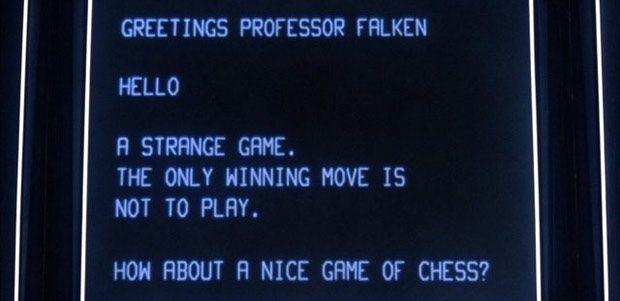
In the film WarGames, the computer WOPR — also known as Joshua — was asked to play tic-tac-toe after nearly launching a nuclear war. Running through every possible scenario it reached the only honest conclusion available.
WINNER: NONE.
Share this:

Americans Are Feeling the Squeeze. Washington Must Do Better. 05/08/2026
|

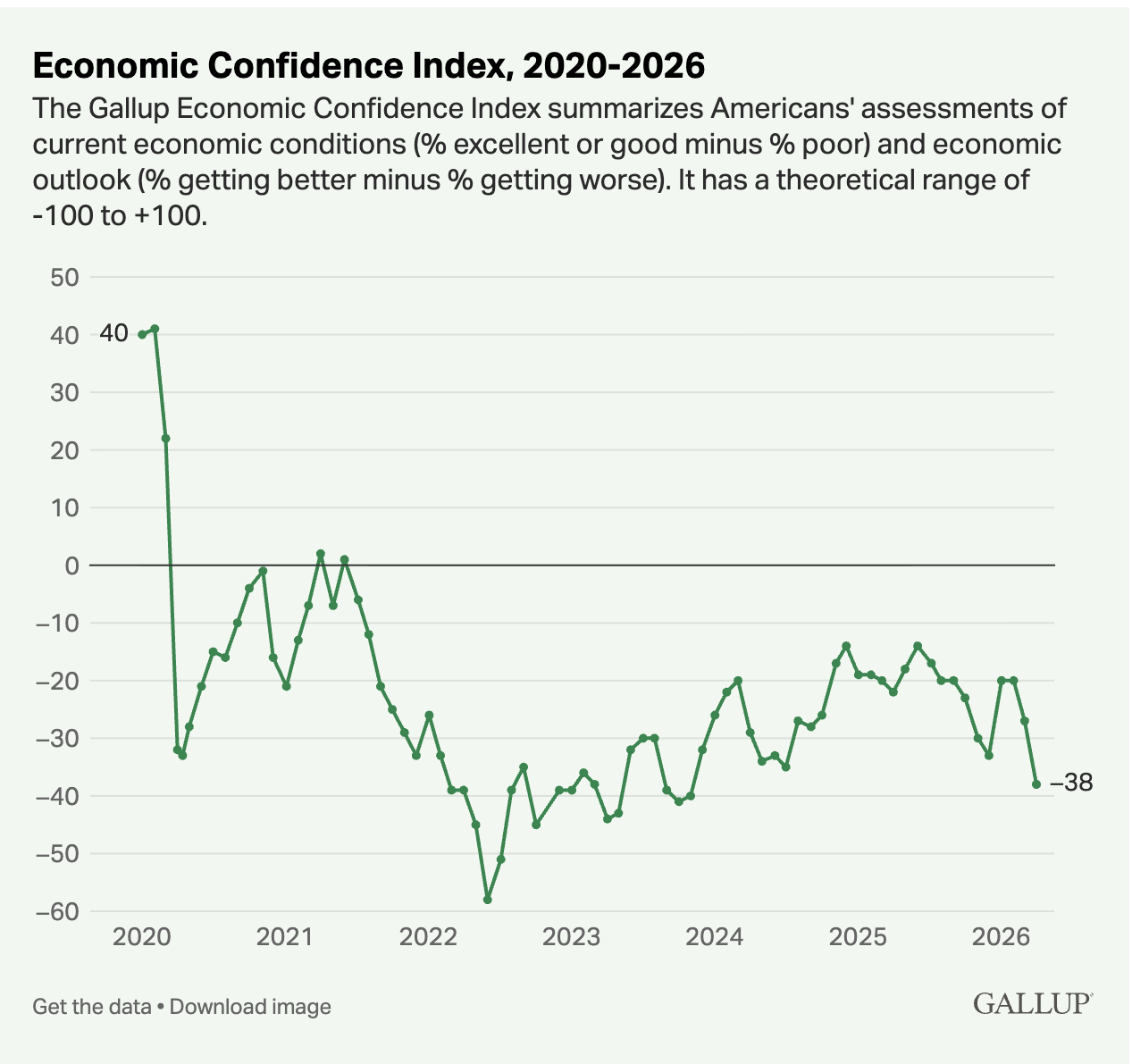
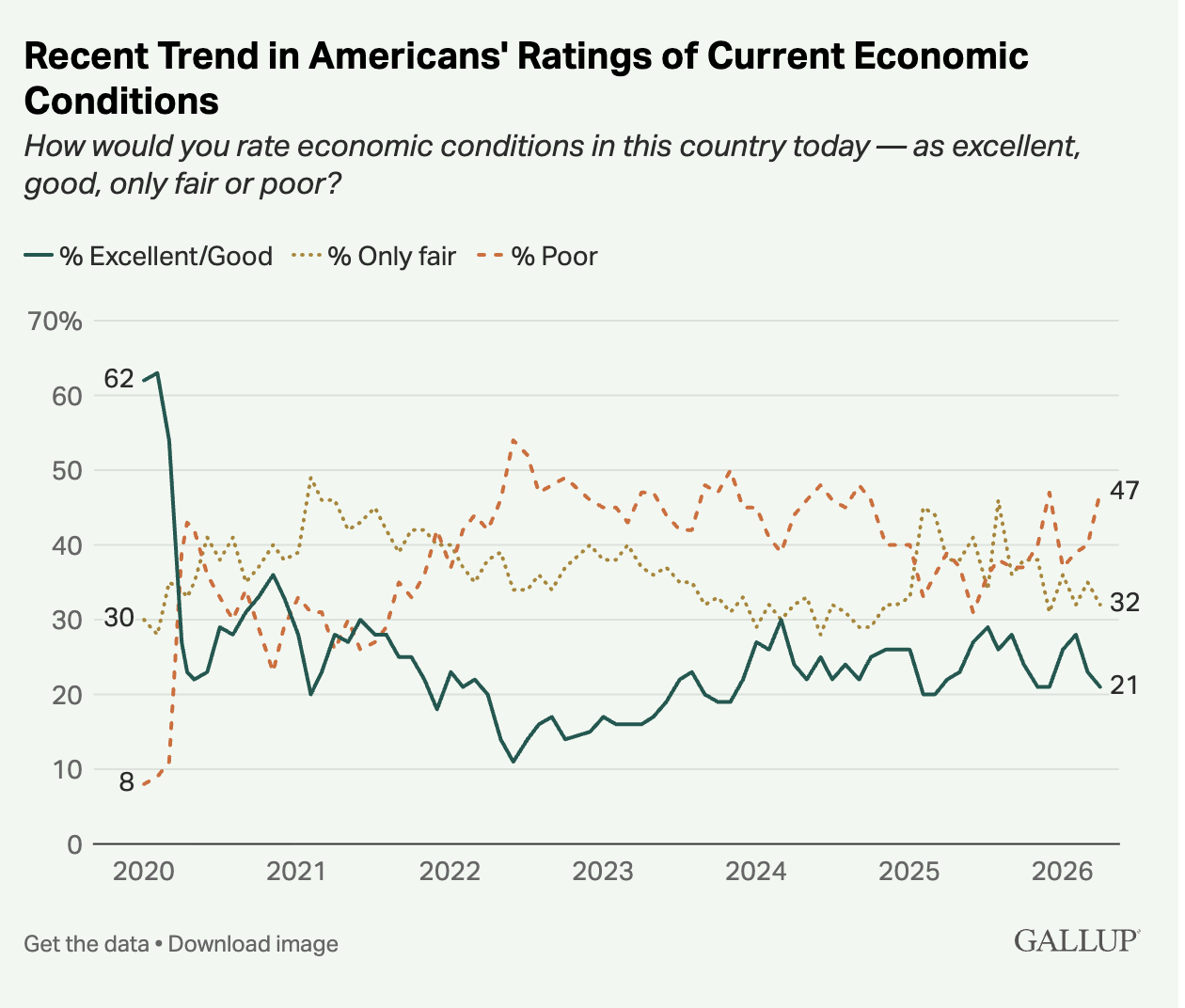







Share this:

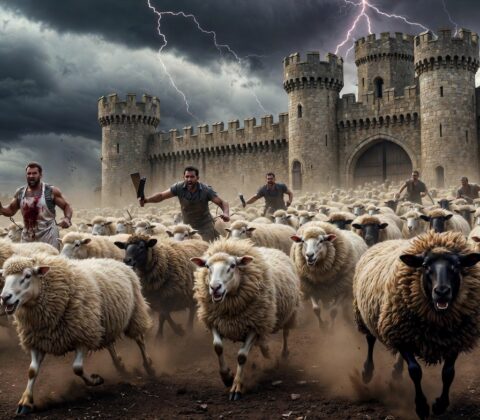
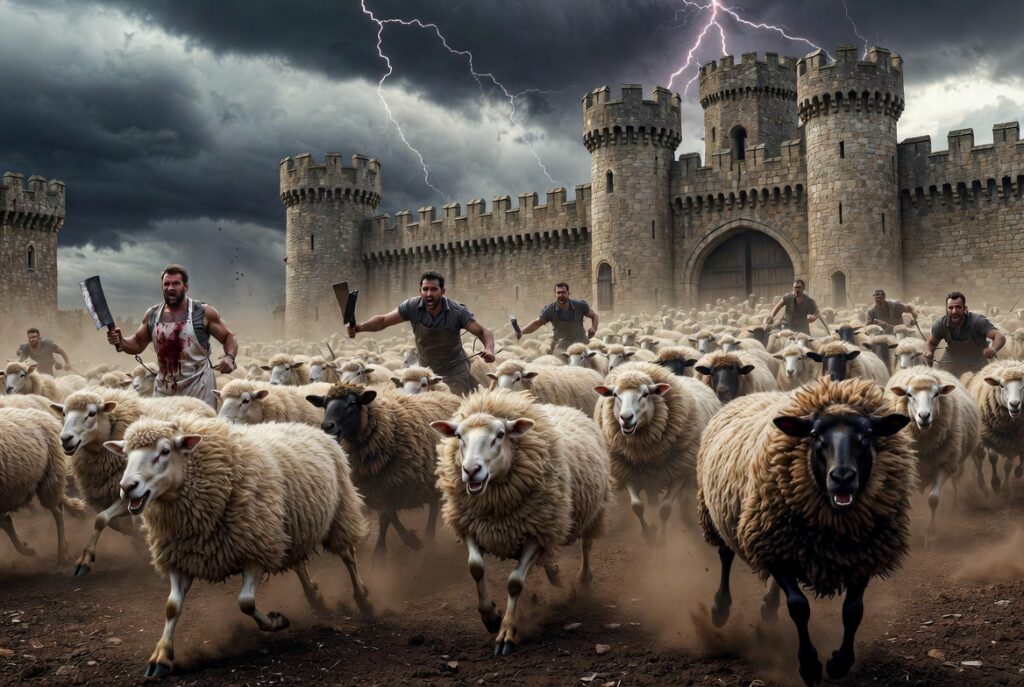
Sheep Don’t Storm Castles
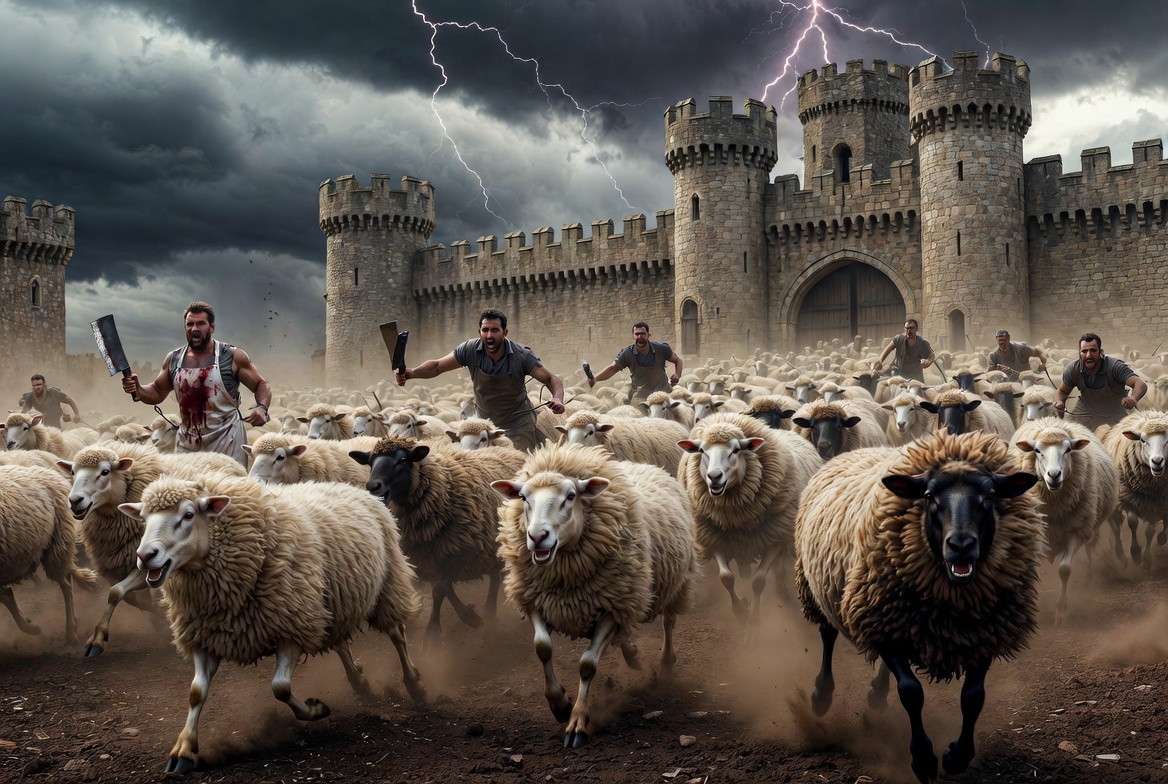
Sheep Don’t Storm Castles
There is an interesting distinction being made in America right now and I want to make sure everyone is clear on it.
When a sitting president tells his followers to march on the Capitol because he didn’t like the way an election went — that is a rallying cry. A movement. A expression of passion from the people.
When a citizen observes that perhaps the people should respond to a president who has admitted to insider trading, manipulated markets for personal profit, fired the military leadership, and explicitly threatened the First Amendment, that is potentially seditious. That is a line not to be crossed. That is the kind of thing that gets noted.
Same castle. Completely different rules depending on who benefits from the storming.
Let’s be clear about what has been admitted and documented.
On April 9th 2025 at 9:37 in the morning the President posted on his social media platform that it was a great time to buy. Less than four hours later he announced a 90 day pause on tariffs. The S&P 500 surged 9.5 percent — one of the strongest single day performances in decades. His personal stake in Trump Media increased by approximately 400 million dollars in a matter of hours. He later acknowledged he had already been considering the pause before telling the public to buy.
That is insider trading. Admitted. Documented. Timestamped.
In any previous era — any previous administration — that sequence alone would have produced congressional hearings, an SEC investigation, and a constitutional crisis. Instead it produced a news cycle and then another news cycle about something else.
I come from a time when the castle would have been stormed by now.
Not because people were more violent. Because people were less willing to accept the unacceptable with a shrug and a scroll.
Watergate produced street protests, congressional spine, and an eventual resignation. Nixon hadn’t admitted to insider trading. Nixon hadn’t fired the military leadership. Nixon hadn’t threatened citizens with sedition for political commentary he disagreed with. By the standards of any previous American political crisis what is happening now would have produced a constitutional response before this sentence was written.
Instead we get campaign emails promising a share of the tariff money. Money the courts already told him to return. A promise we all know will never be kept arriving in inboxes between ads for pillows and supplements.
I keep asking myself where the outrage is. Not the content outrage, the carefully calibrated social media kind that generates engagement and never quite becomes action because action has costs and content has revenue. The real kind. The kind that shows up in person and doesn’t leave until something changes.
And then I remember.
Sheep don’t storm castles.
They stand in the field and wait to be shorn. Again and again and again. Occasionally complaining to each other about the cold. Occasionally sharing a strongly worded post about the shearer’s technique.
Then they get turned into shepherd’s pie.
The First Amendment is still technically standing. I am using it right now and I note the irony carefully. The press secretary has already put us on notice that what we say can be reframed as sedition at their discretion. The line is deliberately undefined because the uncertainty is the point. You don’t have to prosecute everyone. You just have to make everyone uncertain enough that they put down the pen.
I haven’t put down the pen.
But I am watching the field.
And I am thinking about shepherd’s pie.
Have a nice day.
Share this:

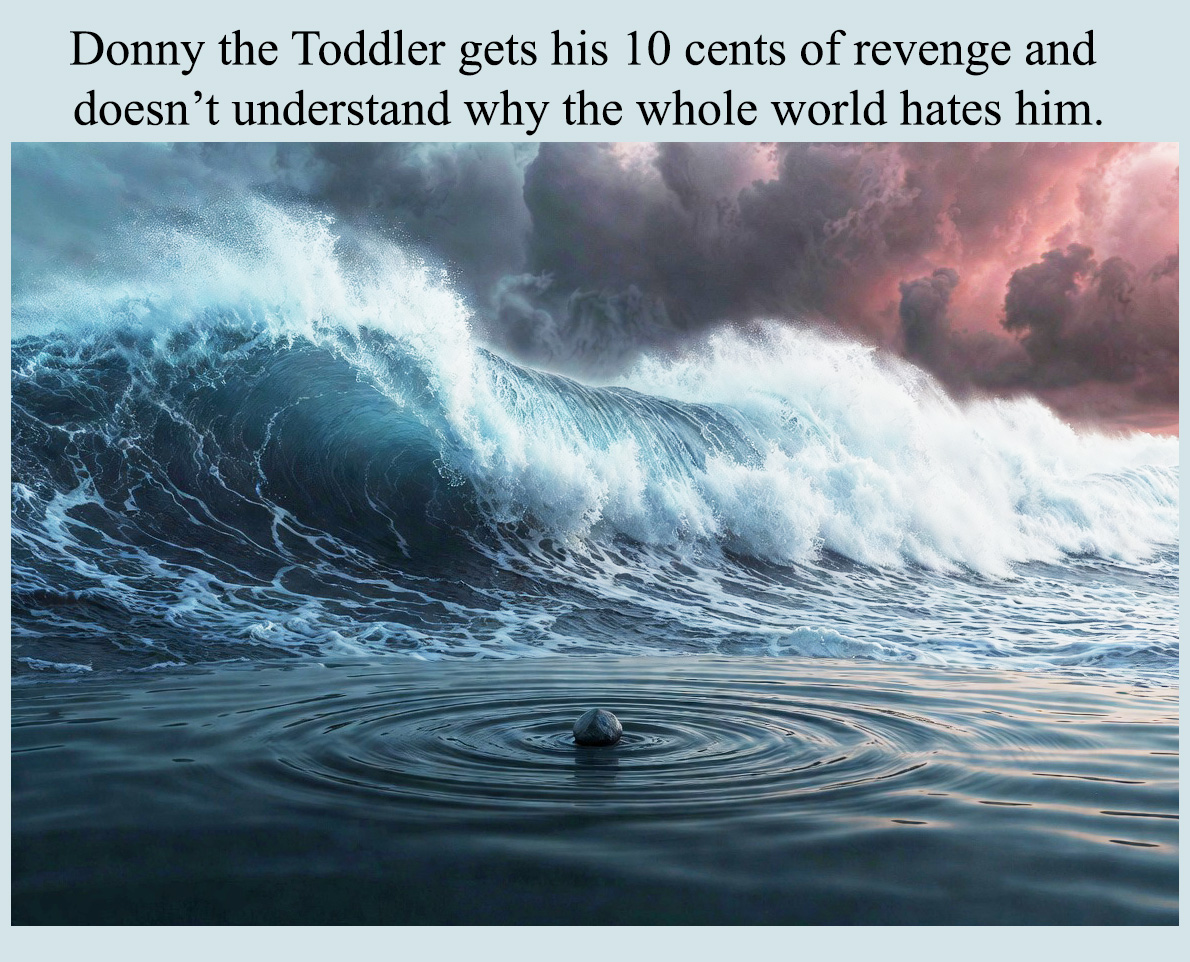
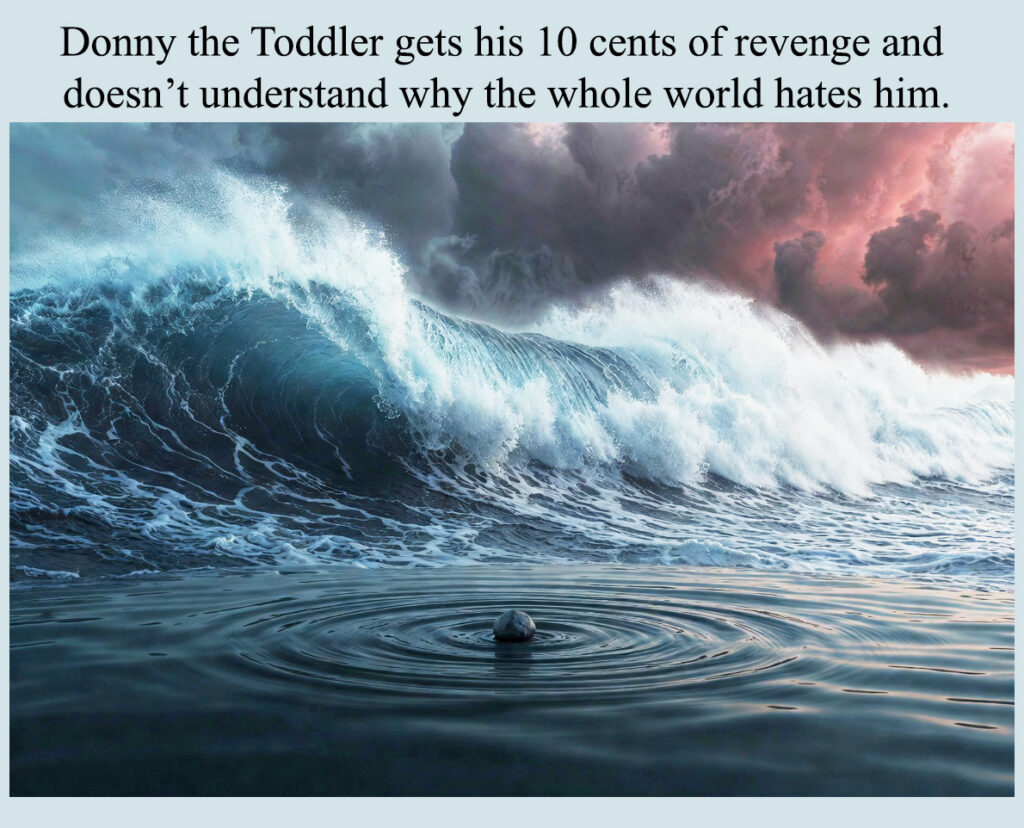
The Ripple Effect, The Cost of Donny the Toddler’s Revenge
We are in a strange environment where nothing feels as it was.
Because it isn’t as it was.
I have contracted in companies where the boss was a hands-on micromanager and every failure was blamed on whoever was closest. Never the real culprit. Never the micromanaging boss. It was never their fault.
Sound familiar?
When decisions are made with a sense of satisfaction, a score settled, a grievance answered, to the person making them it feels like justice.
The action itself can seem small. A policy change. A funding cut. A shift in priorities framed as strength or loyalty. Something done not just because it is believed to be right, but because it answers a need to get even. To punish an enemy.
A stone dropped into still water.
At first nothing dramatic happens. Just a small disturbance. A ripple that feels contained, manageable, even insignificant.
But ripples don’t stay where they begin.
They move outward, quietly, steadily, touching places far removed from the original decision. People who were never part of the argument. Communities that had no voice in the conflict. Families who don’t follow the headlines closely but live with the outcomes.
-
A clinic closes earlier than it should.
-
A farmer faces one more season with less support.
-
A family sits at a table trying to make numbers work that no longer do.
None of them were in the room when the decision was made.
None of them were the target.
But they feel the result all the same.
This is the danger of governance driven by grievance rather than responsibility. The intent may be narrow, focused on winning, punishing, proving a point, but the consequences are not.
They spread.
Leadership isn’t measured by the force of the initial action or the satisfaction it brings in the moment. It’s measured by how far those ripples travel and who they reach when they arrive.
Our government is being run by a micromanager governing out of grievance, without care or foresight for the damage the ripples of his decisions are creating.
Sometimes a ripple becomes a tsunami.
Who is going to clean up the carnage?
Share this:

Do Not Get Into Political Arguments. It’s Not Worth It.
Do Not Get Into Political Arguments. It’s Not Worth It.
Yes, that is easy to say. And no, I am not saying that having an opinion is wrong or that sharing it is off limits.
But there is always someone who will argue with you. And the sad truth is that no matter how wrong they may be, there will be a ten percent truth buried in their argument that they will throw out as an anchor. And that will get you every time.
This is a lose lose situation.
Learn from MAGA. No matter what argument you make — and yes, that is an absolute — they always come back with “Well, Biden.” And somewhere in that response there is that ten percent truth.
If you counter it they have their one fact and you lose. If you throw your hands up you lose. If you say something considerably less polite you lose.
In the film WarGames, the computer WOPR — also known as Joshua — was asked to play tic-tac-toe after nearly launching a nuclear war. Running through every possible scenario it reached the only honest conclusion available.
WINNER: NONE.
That is the conclusion you should reach before ever getting into a political argument.
The game was designed so that nobody wins.
Stop playing.
Share this:

The Dirt On Everybody
Everyone knows what is happening in Washington right now.
And no one will do anything about it.
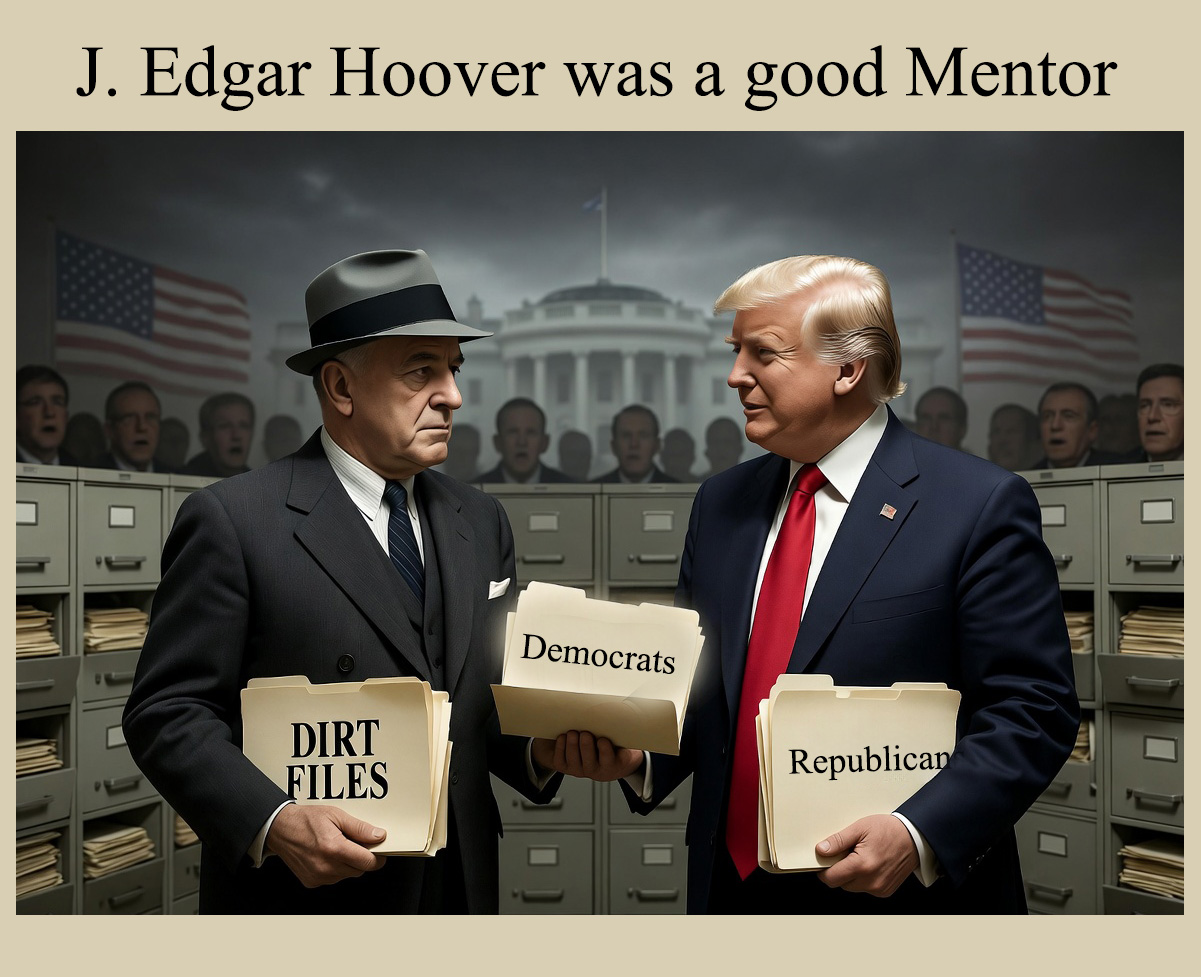
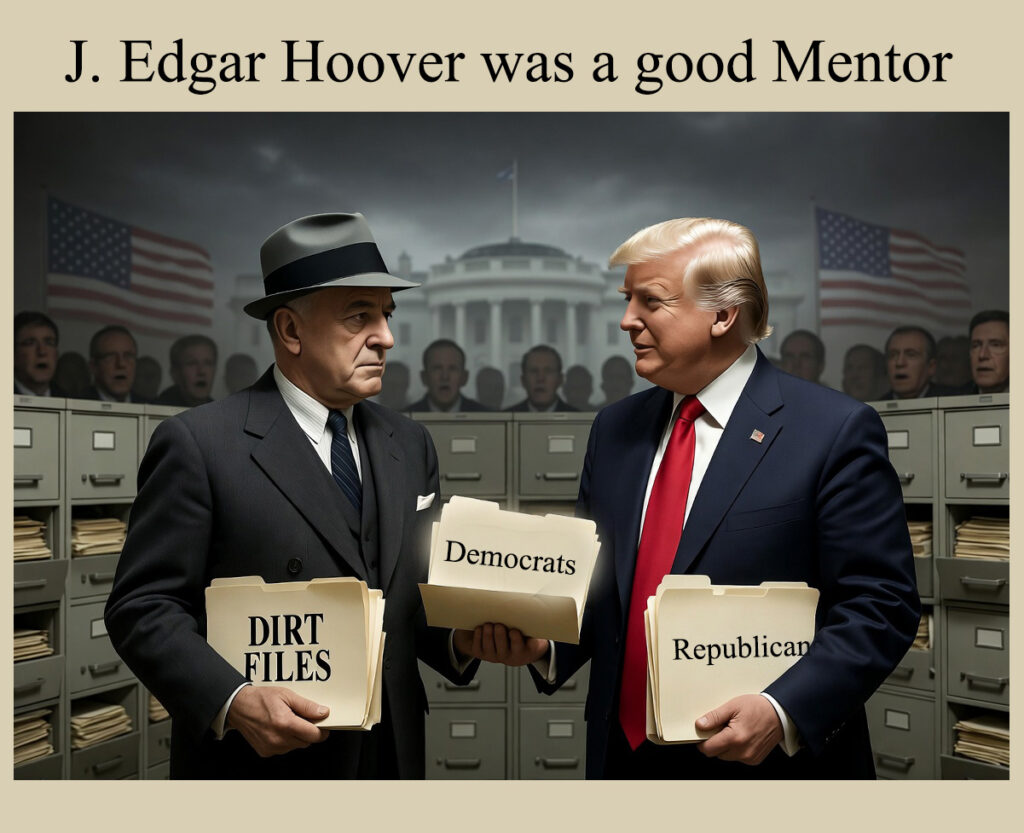
A generation ago there was one individual nobody messed with. His name was J. Edgar Hoover. We even named a Federal Building after him. He was the first director and founder of what became the FBI. The reason nobody touched him was simple and widely understood — he had the dirt on everybody. Republican. Democrat. It didn’t matter. You didn’t cross Hoover because Hoover knew things about you that you preferred stayed quiet.
I am starting to think history has a familiar shape right now.
The Democrats are a minority — that’s real. But all they are doing is making noise when they could be doing more. The Republicans are something else entirely. Not a lost cause in the traditional sense. Something quieter and more troubling than that. They are covering themselves. Carefully. Deliberately. One vote at a time.
Ask yourself a simple question.
Why hasn’t Congress invoked the War Powers Act?
Not because they don’t know how. Not because they lack the constitutional authority. Because a vote on the record is a vote that lives forever. And the Republicans in Congress do not want their names attached to anything visible before midterms — as if they still believe they’ll have jobs when the smoke clears.
That’s not principle. That’s not governance.
That’s a room full of people who know exactly where the dirt is kept.
Share this:

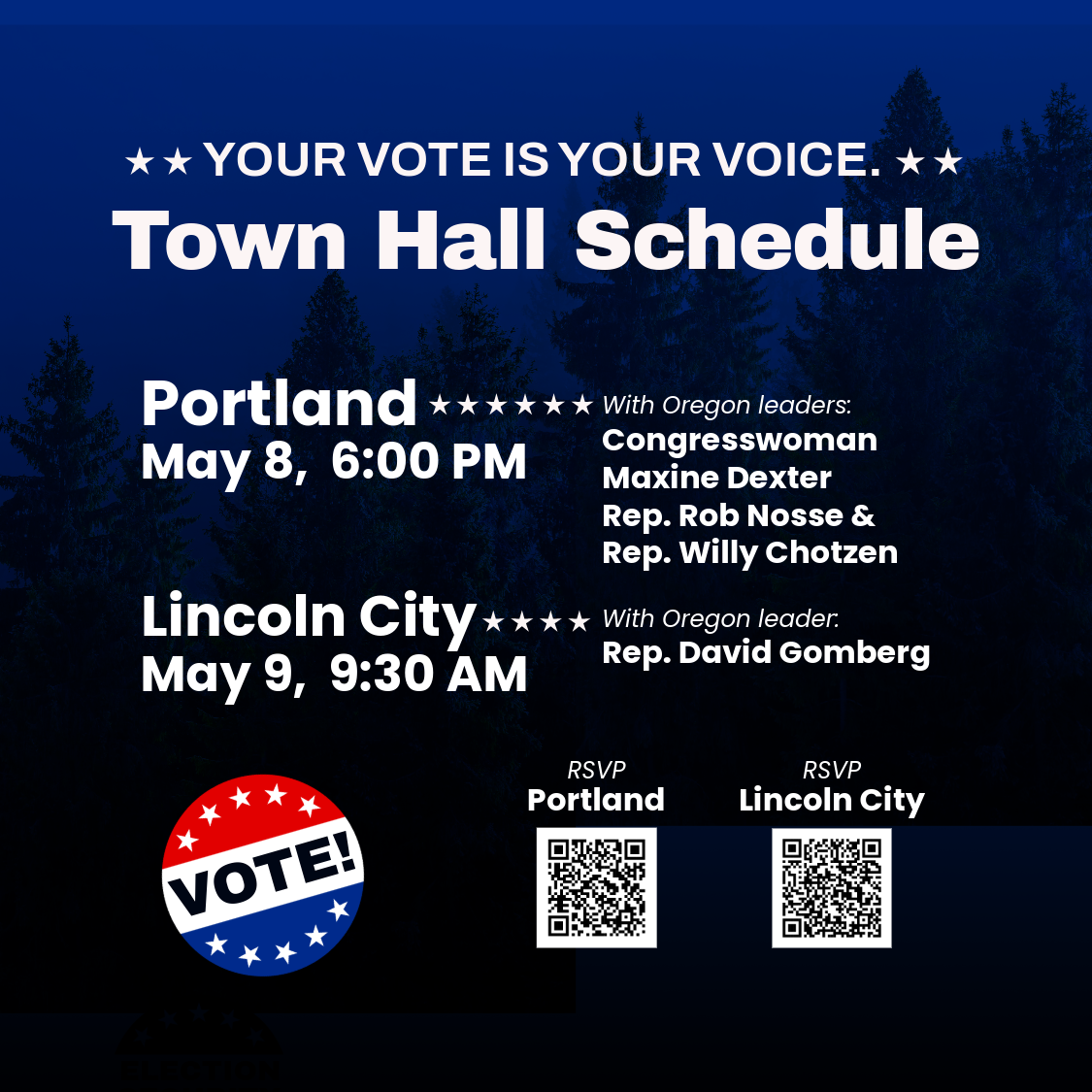
EVENT ALERT: Portland Election Info Town Hall with Congresswoman Dexter, Representatives Nosse & Chotzen
| RSVP today! |
|
 Oregon Secretary of State Tobias Read, U.S. Congresswoman Maxine Dexter, State Representative Rob Nosse, and State Representative Willy Chotzen will hold a community town hall on Friday, May 8 in Portland for a conversation about voting, election integrity, and recent activity in Salem and Washington D.C.
Share this:

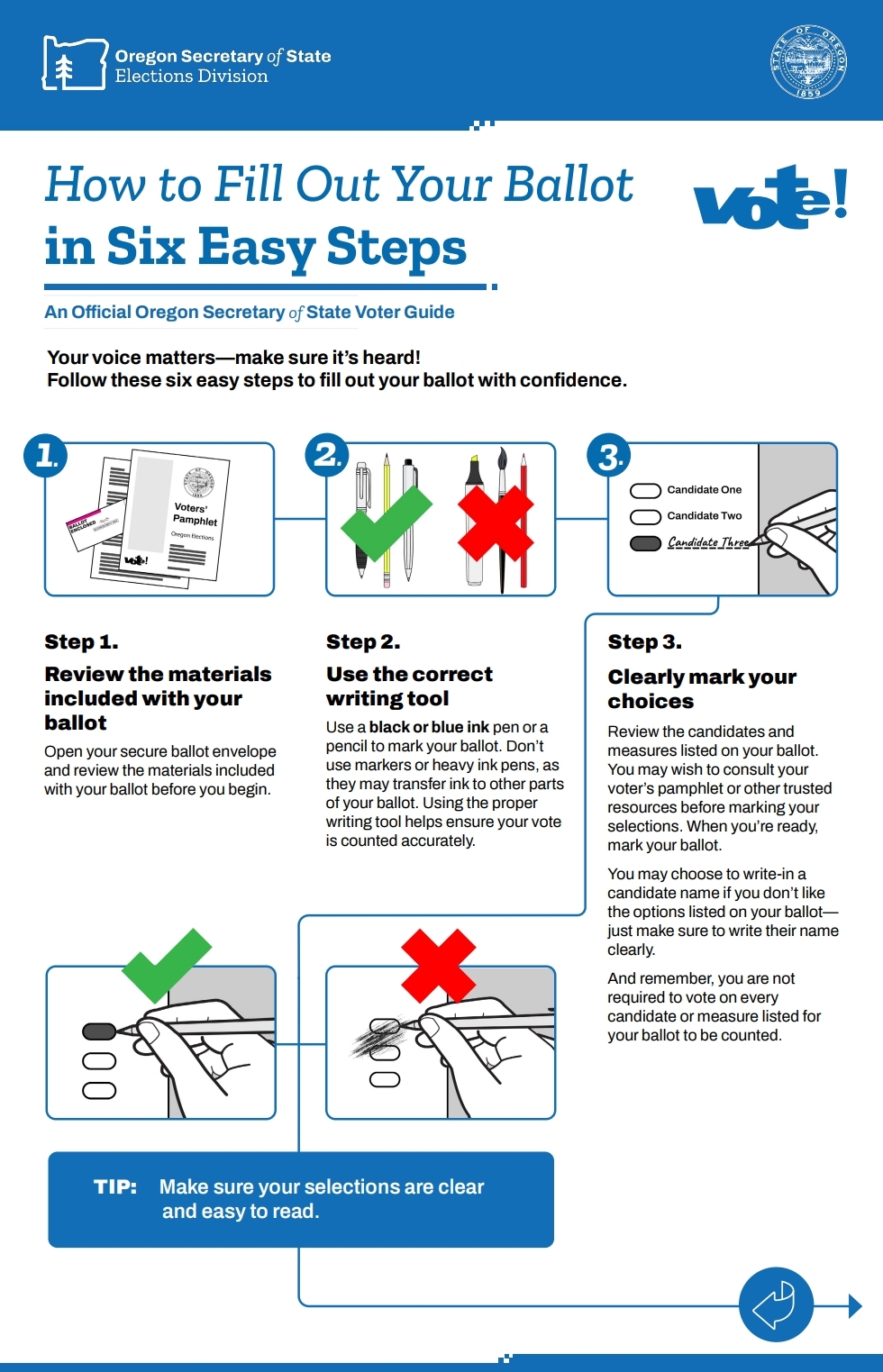
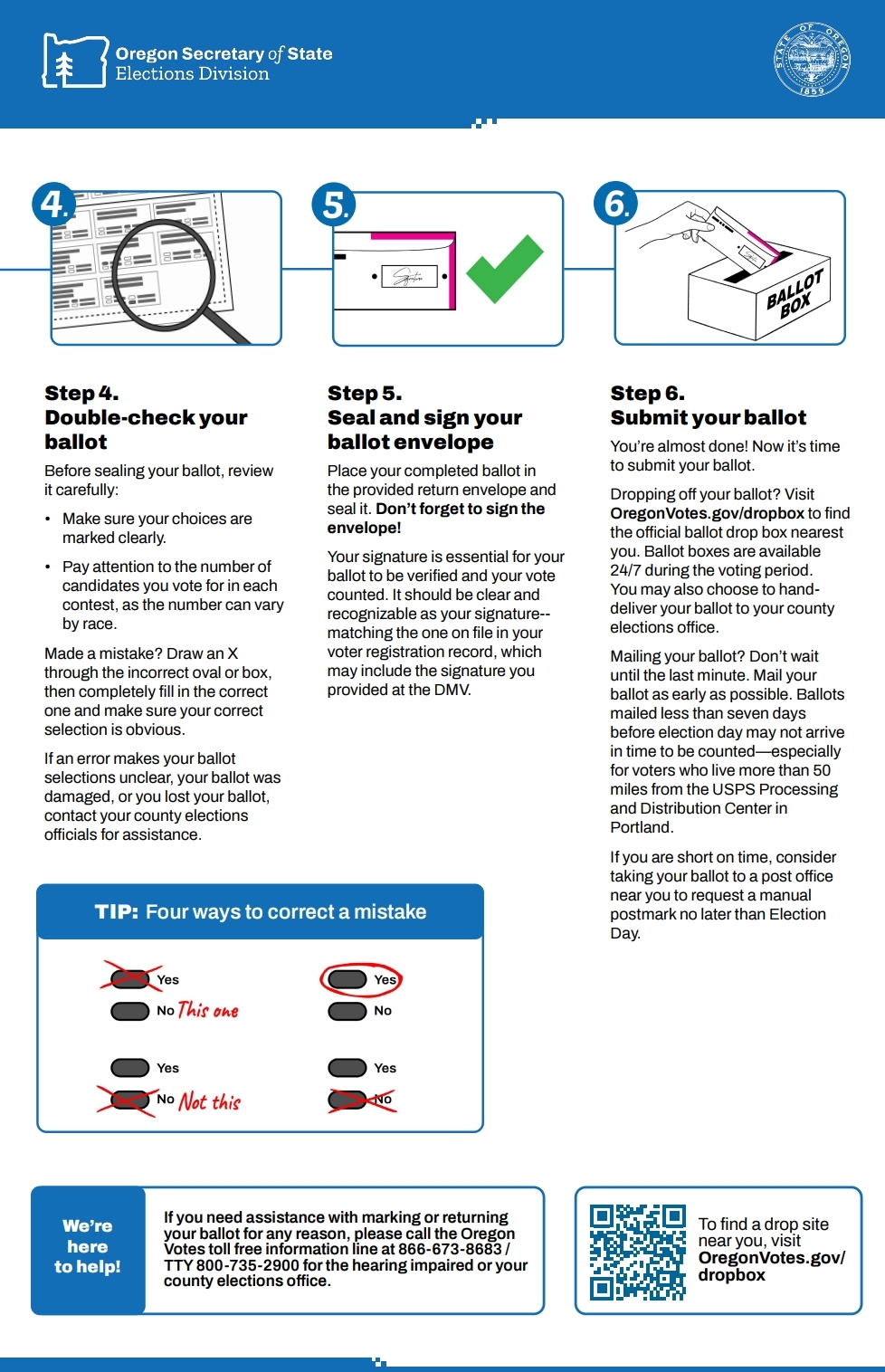
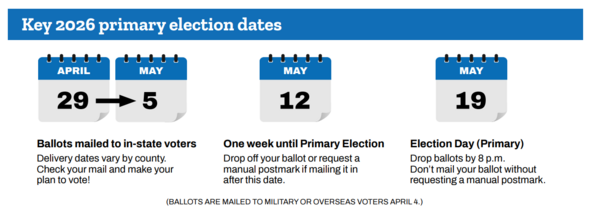
Fill Out Your Ballot with Confidence this Primary Election – Oregon
|

Share this:

PROLOGUE: IN THE BEGINNING, THERE WAS THE LIE – Repost American Pulse
Share this:



The Long View From 1964 – Superman – Video
I grew up watching a small black and white television in the living room. Not the family room, because we didn’t have family rooms in 1,300 square foot ranches in 1955. My older brother and I would watch the Mickey Mouse Club, heart throbbing as Annette would grace the screen — all 1.5 inches of grainy image. That was high tech back then.
The Long View From 1964
- Superman
- Maybe Just Listen
- The Checkbox Problem
- The Land Moved While You Slept
- The Road and the Ground Beneath It
- Where is Anywhere
- The Saucepan Hat
- Superman (Video)
- Maybe Just Listen (Video)
- The Checkbox Problem (Video)
- The Land Moved While You Slept (Video)
- The Road and the Ground Beneath It (Video)
- Where is Anywhere (Video)
- The Saucepan Hat (Video)
Share this:

The Long View From 1964 – Superman
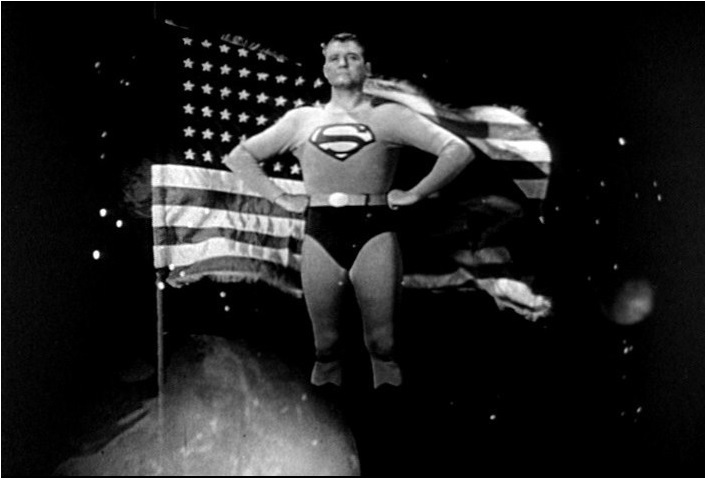
I grew up watching a small black and white television in the living room. Not the family room, because we didn’t have family rooms in 1,300 square foot ranches in 1955. My older brother and I would watch the Mickey Mouse Club, heart throbbing as Annette would grace the screen — all 1.5 inches of grainy image of her. That was high tech back then.
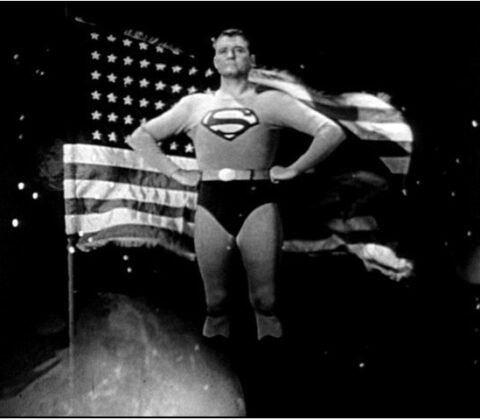
Lassie would dash back into the one room farmhouse and announce that Timmy had fallen in the well again, and Superman would boldly declare that he stood for Truth, Justice and the American Way. Oh, the patriotic pride we would feel — young army brats, freshly back from Germany where our father had been stationed for three years. But that’s another story of concentration camps and sausage restaurants on the Danube.
Back to Superman, because that’s what this is all about. Truth, Justice and the American Way. Straight from the 1940’s comic books — not graphic novels. They were comic books. A graphic novel was Classics Illustrated doing The Last of the Mohicans.
Truth was the TRUTH. It was telling the truth. Real truth. What do we have today? We have Truth Social, and we are told to believe it. But what is it? It is whatever Donald Trump and the MAGA movement wants you to believe. I’m not saying it’s all lies, because everything has to have an element of truth to stand. But believe at your own peril.
How about X.com? Look at the bots. Look at how many times posts have been reposted — not 5 or 6 times, but hundreds. That’s a machine. Posted by Betsy, a housewife from Atlanta. Check her profile — courtesy of Elon, finally — and you find that Betsy has changed her name 83 times and is posting from Asia or Eastern Europe.
Get a clue.
Justice. That’s a good one. Look at what our courts have become. We have so much partisan influence that the very word has little meaning anymore. I learned the hard way fifty years ago that all you can reasonably expect is a decision. But fifty years ago it was a mostly unbiased and impartial one.
Today at the federal level that’s an ongoing war. A war because we do still have honorable people in power — but they are outnumbered and outfunded, all the way to the very top. It’s a stacked deck.
And lastly, perhaps the most ambiguous but most important — The American Way.
When you’re ten years old watching the Mickey Mouse Club, Superman, Zorro, Father Knows Best and the rest, the American Way seems perfectly clear. We were strong. We were proud. We had clear cut enemies. At school we were told to stand and recite the Pledge of Allegiance with pride, and when the air raid sirens went off we got under our desks — as if that would actually do any good. But it made us feel safe.
We had presidents who built America. Eisenhower chose highways over rail because he saw how disabling rail lines stopped troop movements. He should have prioritized both. JFK, with all his faults, still told us that our strength was to stand together and build a great nation. Not a monument.
Sometime after that I took a break. I married, I divorced, I had children — not necessarily in that order. I raised families. I now have grandchildren. I learned how to build businesses and was part of the great technological revolution — time spent at gin joints like Tektronix, Intel, my own consulting and more.
And when I stopped and took a breath, I looked around and saw an America that had become super wealthy and gone to hell at the same time.
So I ask you — by today’s standards, what is the American Way?
The Long View From 1964
- Superman
- Maybe Just Listen
- The Checkbox Problem
- The Land Moved While You Slept
- The Road and the Ground Beneath It
- Where is Anywhere
- The Saucepan Hat
- Superman (Video)
- Maybe Just Listen (Video)
- The Checkbox Problem (Video)
- The Land Moved While You Slept (Video)
- The Road and the Ground Beneath It (Video)
- Where is Anywhere (Video)
- The Saucepan Hat (Video)
Share this:

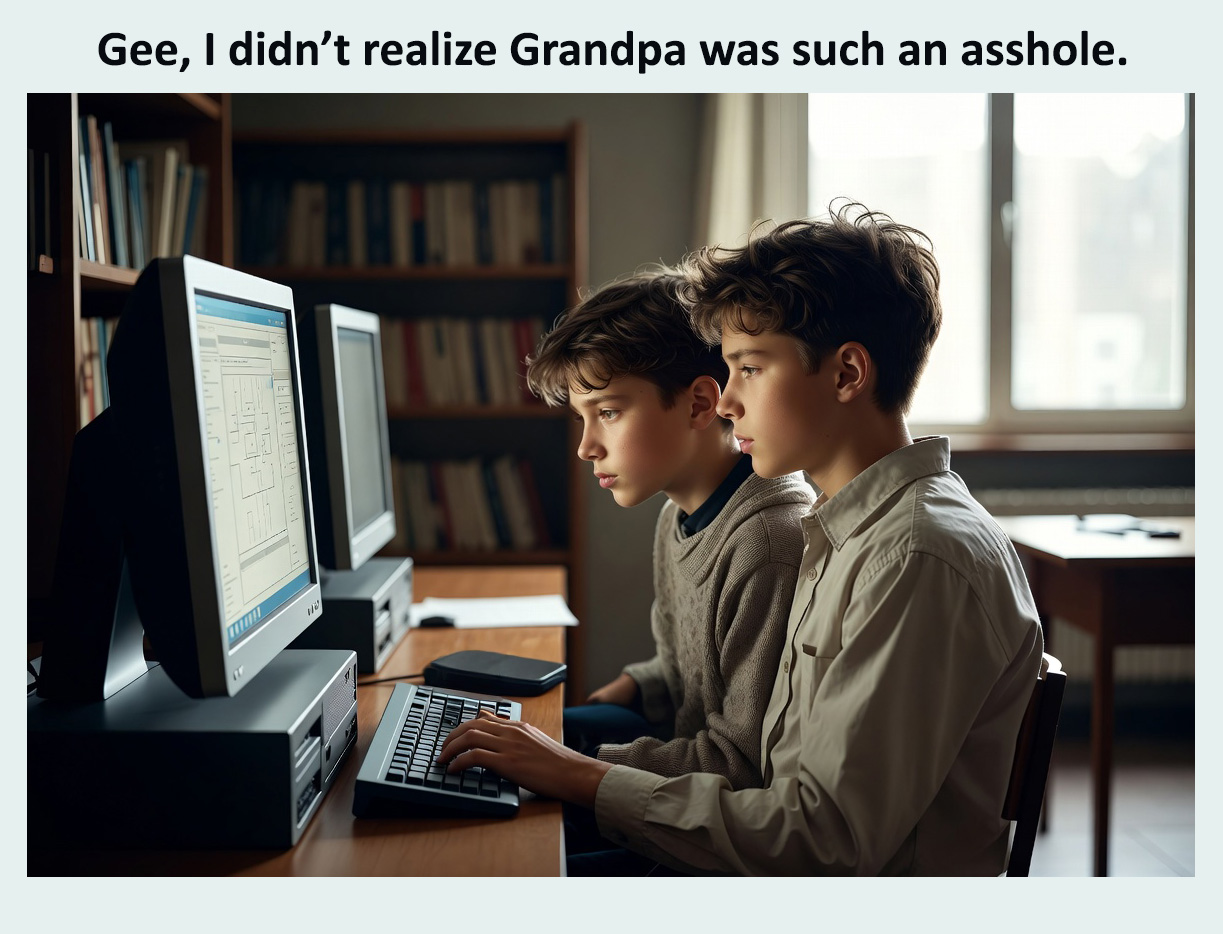
Your Grandchildren Will Search Your Name – Video
A plea to those who still have a choice
The gold can be removed from the walls. The statesman’s office can be restored. Exhibits can be returned. Murals can be uncovered if they are not first destroyed.
But only if someone in the room decides that their own legacy matters more than their current proximity to his.
You know who you are.
Share this:

Are Our Leaders Focused on What Actually Matters? 05/01/2026
|
Share this:

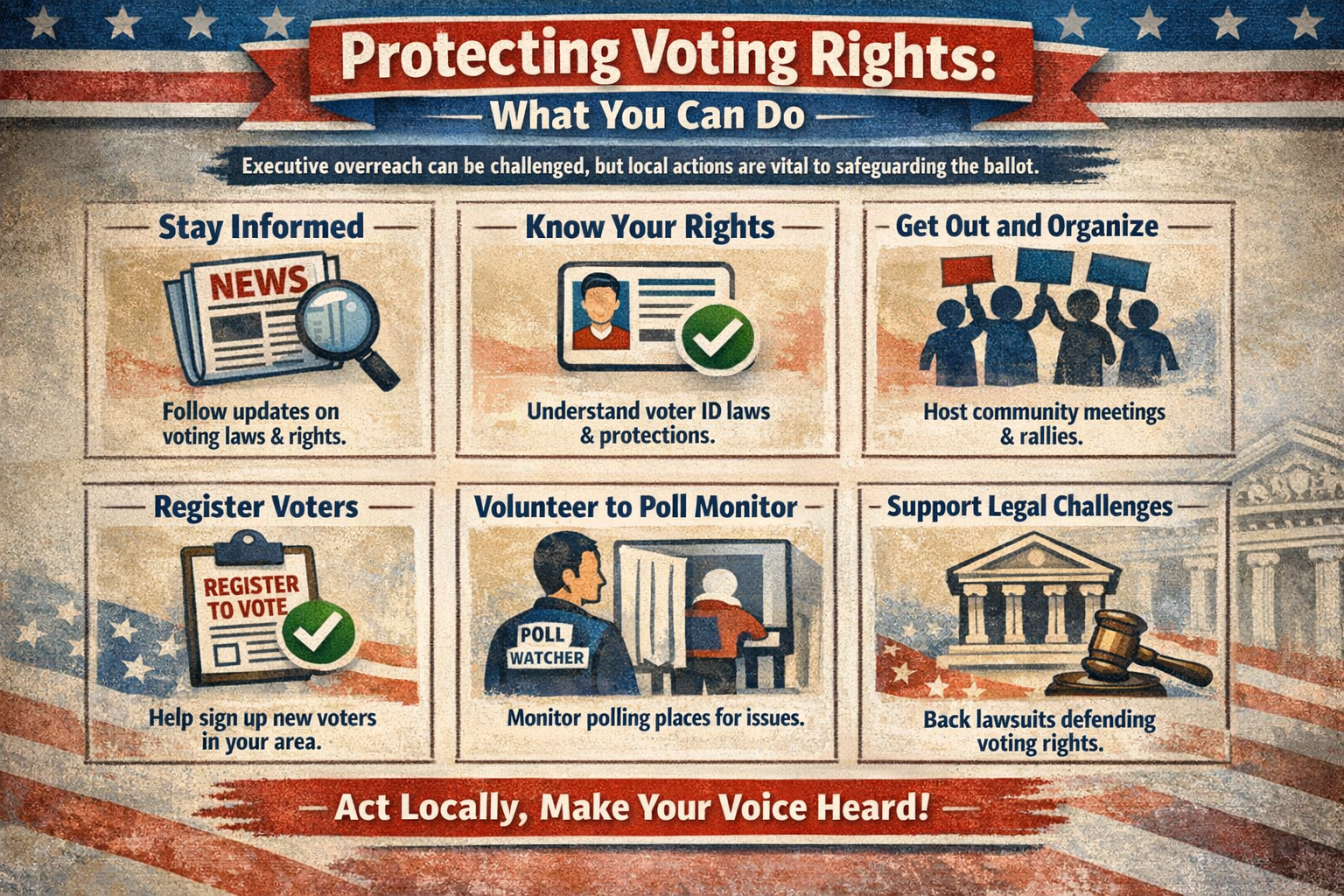

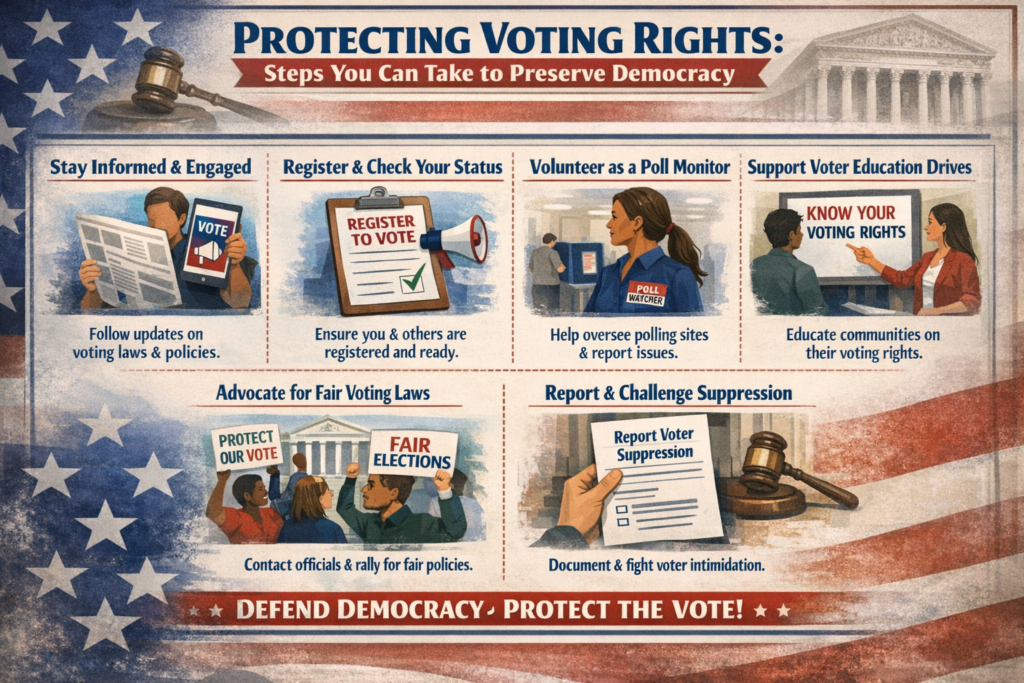
Protecting Voting Rights is a fundamental aspect of American Democracy
Protecting voting rights is a fundamental aspect of American democracy, and your concern about potential executive overreach is valid given recent reports. While presidents have issued executive orders related to elections in the past, they don’t have unilateral authority to control how states run them, elections are primarily a state responsibility under the Constitution (Article I, Section 4), with Congress able to set or alter regulations for federal races. Any attempt to impose sweeping changes via executive order, especially if premised on unsubstantiated claims like foreign interference from past elections, would likely face immediate legal challenges and injunctions from federal courts, as happened with a similar order in March 2025.
Courts have repeatedly affirmed that such actions can’t override constitutional limits or state authority without clear statutory backing.
Share this:

A War Being Run By the Second String
I was in the Army Corps of Engineers for six years. Sounds impressive. I must know my stuff.
Let me tell you war stories. Let me show you my tattoos. Let me regale you with heroics that will make you swoon. I will lead into battle and command troops like no other. Just look at me — a true American hero. All you have to do is be stupid enough to believe me.
Now for the truth.
Yes, I was in the Army for six years. Yes, I was trained as a Pioneer Combat Engineer. Yes, I was taught to clear minefields with a bayonet, build bridges between our infantry and theirs, and duck when the bullets screamed by.
But what wasn’t said — what never gets said by people like me — is that I enlisted right after my 17th birthday, still in high school, in the California National Guard. November 1963. Monthly Guard meetings until graduation, then off to basic training at Fort Ord.
For anyone who went through basic training, you know the first thing they try to do is intimidate, confuse, and disorient you. That’s a pretty hard thing to accomplish when you and your brother had the run of the base because your father had been the East Garrison Commander — but that’s another story.
Basic done. Off to Fort Leonard Wood for advanced training. Back by Christmas. Monthly meetings. First summer camp and we had the Watts Riots — not nice, but afterwards a walk in the park.
Why? Because I did the worst thing you can do in the military. I volunteered.
During monthly meetings there isn’t much to do except clean things. So when they needed a cook I raised my hand. I like to cook. Every summer camp afterward, instead of going to the desert and sleeping in the dirt, I went to Camp San Luis Obispo and cooked for the California Military Academy. Didn’t ride in a deuce and a half for 200 miles — I drove my ’48 MG TC and later my ’68 Plymouth GTX. Rough six years. Great war stories — catching flies and drag racing up the main entrance.
I tell you all of this for one reason.
The people who tell you heroic war stories are liars. The people who actually saw the horrors of war keep it to themselves. My father served in the Pacific, was stationed in Japan, served in Korea, was stationed in Germany. My brother’s National Guard unit was one of the very few activated and sent to Vietnam. I had close friends drafted who went. None of them ever told me war stories. And I never asked.
I also tell you this because I know what I am talking about. I am an Army brat — born and bred. And I know BS when I smell it.
You don’t have to be Rambo. You just have to be honest with and about yourself.
Which is why I am bothered — genuinely, deeply bothered — when a Fox News broadcaster covered in tattoos has the unmitigated gall to believe he has the experience and wisdom to lead our fine service personnel into battle.
He is such a leader that his spiritual pep talks are plagiarized from Tarantino movies.
Perhaps that explains why Major General William Green Jr., Army Chief of Chaplains, was fired in April 2026. He may have thought the Bible was a better source for scripture than Pulp Fiction.
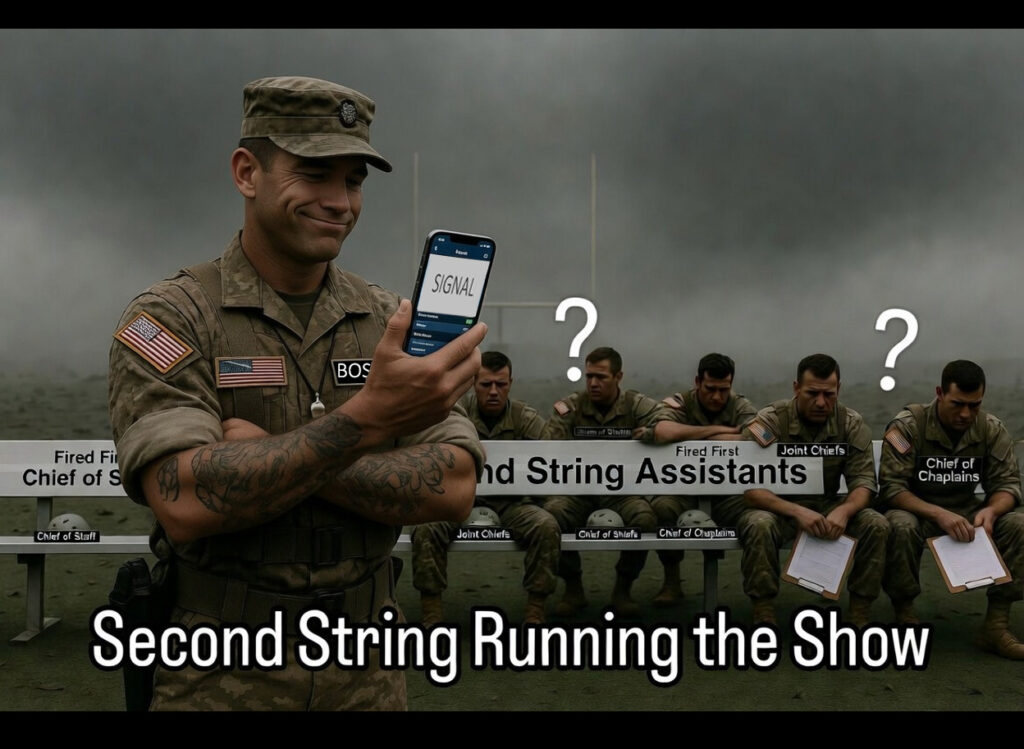
He wasn’t alone. Here is what the first string looks like after the second string finished with it:
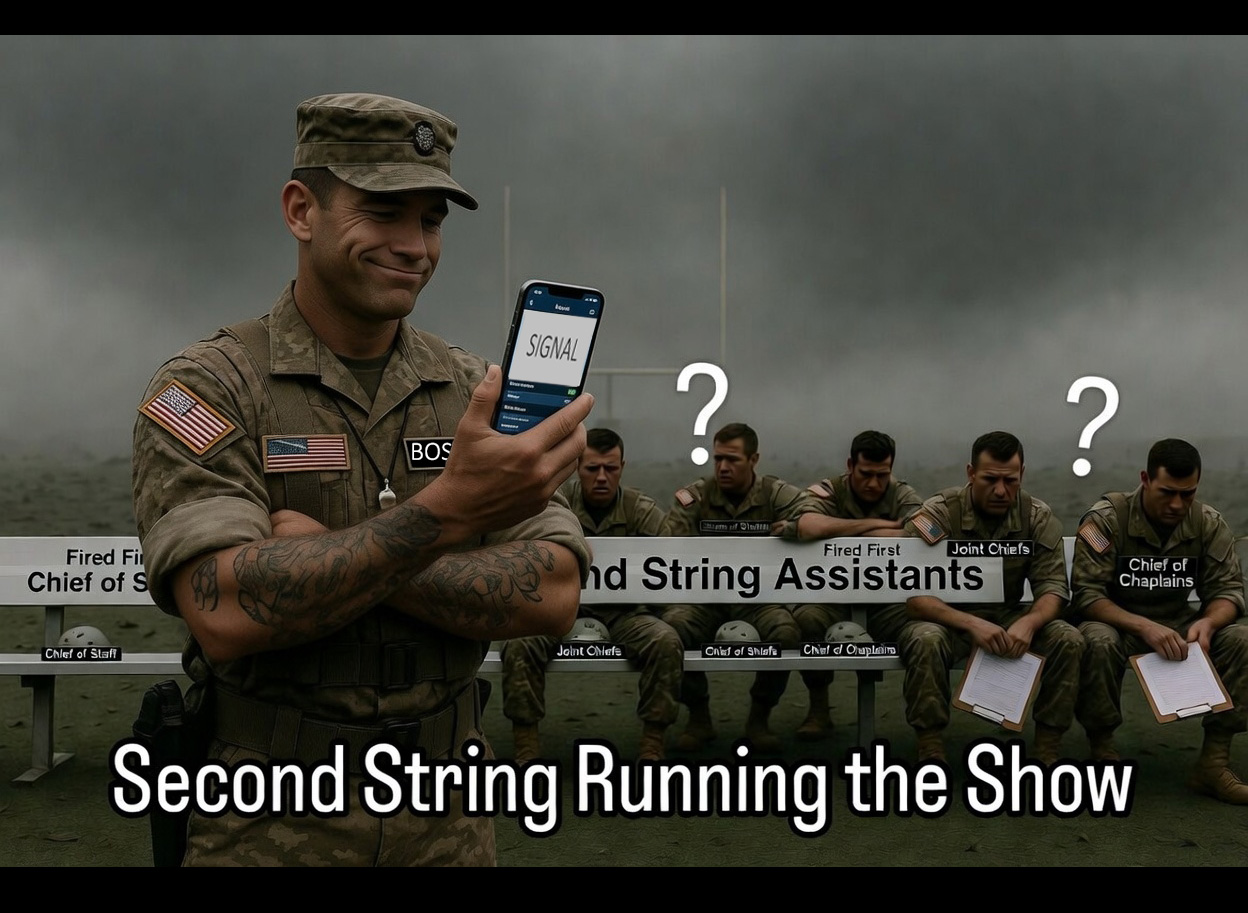
General Randy George, Army Chief of Staff — removed and asked to retire, April 2026, following disputes with Hegseth. Major General William Green Jr., Army Chief of Chaplains — fired — the first time in history this role was terminated by the Secretary of Defense. General David Hodne — removed from command of the Transformation and Training Command. General C.Q. Brown, Chairman of the Joint Chiefs — fired. General James Slife, Air Force Vice Chief of Staff — removed. Admiral Lisa Franchetti, Chief of Naval Operations — fired. Lieutenant General Jeffrey Kruse, Defense Intelligence Agency — fired.
The first string was either fired or asked to resign. What we have left is the second string. At best.
And at the very top — bone spurs and all — a man now talking about bringing back firing squads because he finds other people’s free speech inconvenient. Only his own has value.
Pete’s Crusader Cross tattoo is going to look real interesting sagging off an eighty year old man’s bitch tits in about twenty years. But that’s the least of our problems right now.
We have the second string running the show.
Makes you proud to be an American, doesn’t it?
A clarification worth making. Every incoming president replaces cabinet members. That is normal, expected, and appropriate. The president’s political appointees serve at the president’s pleasure and a new administration brings new priorities.
What is not normal — what career military officers and national security experts have described as unprecedented — is the systematic purge of decorated senior military leadership based on personal loyalty rather than performance or strategic need. Previous presidents fired specific generals for specific cause. Truman fired MacArthur for public insubordination. Bush replaced commanders in Iraq as part of a documented strategic shift.
Firing more than a dozen four star generals and admirals — including the first woman to lead the Navy, the second Black chairman of the Joint Chiefs, and the head of the Defense Intelligence Agency days after his agency contradicted the president’s claims — is a different thing entirely.
That is not transition. That is the second string replacing the first string because the first string wouldn’t salute the right person.
Share this:


Secretary Read Responds to Supreme Court Voting Rights: ‘Another Loophole Politicians Will Use to Rig the System Against the American People’
|
|
|
|
|
Share this:

Today’s Your Last Day to Register to Vote for the Big Primary Election!
|
| Having trouble viewing this email? View it as a Web page. |
| | Help |
Share this:



The Ash Didn’t Disappear
I was seven years old, an American officer’s son, when I walked through Dachau.
I remember the ovens. I remember the showers. I remember the stains still on the walls. I remember the ash piles, this was 1954, nine years after liberation, and the ash still hadn’t disappeared. It had not yet soaked completely into the dirt.
If you think seven years old is too young to remember something like that, you don’t know a child whose memory is a video recorder without an erase feature.
As I grew older I could never understand how the German people had allowed it to happen. How ordinary men and women watched it unfold and did nothing. How a civilization that produced Beethoven and Goethe looked away while the ovens ran.
I am getting a better understanding these days.
Ignorance and apathy go a long way. Distance from history plays a large role as well. And the road has to stretch far enough that the people who remember are gone before the circle closes.
But not all of us are gone.
My father was stationed in postwar Germany, Army Corps of Engineers officially. When you read through his documents as an adult he appears to have played larger roles — why else would his pancreatic cancer have been attributed to White Sands testing? He was 6’2″, quiet, decorated. Purple Hearts. Bronze Star. Never talked about any of it.
Dachau was probably a Saturday or Sunday outing. Dad, Mom, my brother and I. Before the monuments, before the cleanup, before the ash was removed or fully absorbed. Just the ovens and the showers and the stains and the silence of a place where the horror was still present enough to touch.
We went home afterward. I honestly don’t remember if we were still driving the 1951 red Ford convertible my mother had bought when my father turned his back and left for Germany, or the new 1955 Austin Healey, all red, red leather, red top. Either way there were four of us, none of us small, a full sized long haired dachshund, and a very little car touring a lot of postwar Germany. One of us boys on the padded hump, the other between Mom’s legs, the dog on the floorboard. I don’t remember any of us complaining much.
But I am drifting from what brought me here.
A brief history is in order.
On February 27, 1933, the German Reichstag building burned. Within hours Hitler’s government blamed the Communists. The following day the Reichstag Fire Decree suspended civil liberties across Germany. Within weeks political opponents were being arrested for using their voices to warn about the man in power.
Whether the fire was set by the Nazis themselves remains disputed. What is not disputed is what they did with it. The crisis, real or manufactured, became the mechanism. The emergency became the justification. And by the time people understood what was happening the machinery was already running.
We don’t need to know who fired the shots at the White House Correspondents Dinner. What matters is what came immediately after.
The White House Press Secretary, who by any reasonable standard should have been on maternity leave, delivered remarks that directly attacked the First Amendment. What we say going forward will not be treated as political commentary. It will be treated as slander. As sedition.
This was delivered shortly after the Department of Justice had been instructed to explore reinstating firing squads as a form of capital punishment.
I am not speculating about the shooting. I am not attributing motive. I am simply observing the sequence. Crisis. Immediate response. Threats against speech. Escalating consequences for dissent.
I have seen this sequence before.
Not in a textbook. In the dirt. In the ash that hadn’t yet disappeared nine years after the fact.
We look at history as a linear line. We open the textbook at the beginning and work forward to where we are standing. But I cannot help feeling, standing on this hill in time and looking at that line from the side, that it has taken a detour and made a circle back onto itself.
The problem is that the road stretched far enough that most of the people who would recognize the circle have died.
But not all of us.
I walked through Dachau at eight years old. The ash was still there.
I am still here too.
And I remember everything.
Share this:

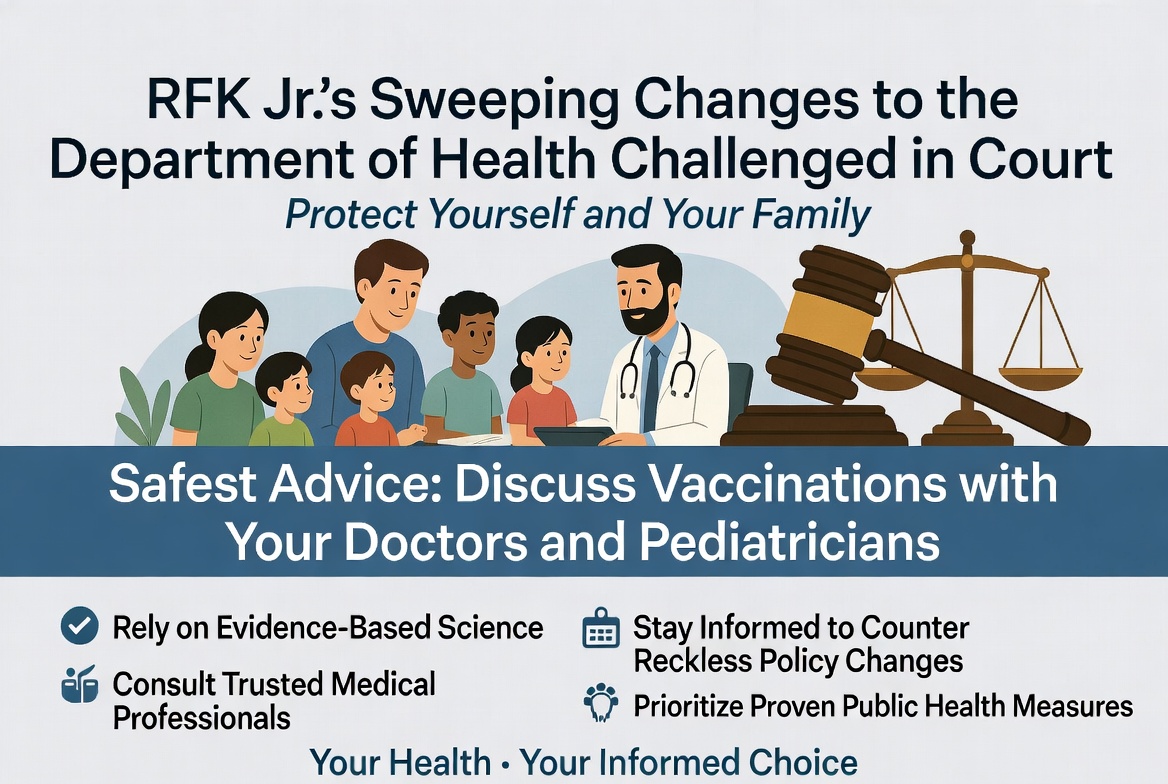
Making America Sick — Part 4 of 4: The Fight Back
If you have read this far and are feeling the particular kind of helplessness that comes from watching something important being dismantled by someone who cannot be reasoned with, this part is for you.
Because the resistance is real, it is organized, and some of it is winning.
The most important thing to understand is that Kennedy overplayed his hand legally, repeatedly, and the courts have noticed. He did not just pursue aggressive policy changes, he pursued them sloppily, skipping the procedural requirements that exist precisely to prevent any single person from unilaterally rewriting public health infrastructure. That sloppiness has created legal openings that are now being used effectively.
In March 2026 a federal judge in Massachusetts sided with the American Academy of Pediatrics and blocked Kennedy’s overhaul of the CDC’s vaccine advisory committee, the one he had stacked with skeptics after firing all 17 original members. The judge invalidated votes the reconstituted panel had already taken, including decisions to downgrade hepatitis B and COVID recommendations. More significantly, the same ruling found that the CDC had exceeded its legal authority when it unilaterally reduced the childhood vaccine schedule from 17 to 11 vaccines in January, because it did so without going through the proper advisory process. The mechanism Kennedy used to do the most damage to vaccine policy is the same mechanism that is now being used to undo it.
The states have mobilized in ways that matter. Fifteen states have sued to rescind the new vaccine schedule entirely and dismantle Kennedy’s replacement advisory committee. Nineteen states and the District of Columbia are separately fighting the HHS restructuring and mass layoffs on constitutional grounds, arguing the administration violated the separation of powers and the appropriations clause, essentially that Kennedy dismantled agencies Congress had funded and mandated without the legal authority to do so. A judge has already blocked further reorganization while that case proceeds. These are not symbolic lawsuits. They are methodical, well-resourced legal challenges built on solid procedural ground, and they are advancing.
Perhaps the most quietly encouraging development is what the medical establishment itself has done. When Kennedy changed the vaccine schedule, major hospital systems and clinicians across the country simply ignored it. The American Academy of Pediatrics published its own independent vaccine schedule, declaring the federal process no longer credible, and told its members to follow that instead. This matters more than it might seem. The federal government can change its recommendations, but it cannot force pediatricians to follow them. The professional infrastructure of American medicine, the societies, the hospitals, the training programs, the peer review systems, is largely intact and largely in open rebellion against what Kennedy is doing. That infrastructure is where the actual practice of medicine happens, and it is not waiting for federal permission to protect children.
Were the signs obvious? Yes. Could this have been prevented? Yes. Did it happen purely because of politics? Yes. But we also knew who Robert F. Kennedy Jr. was before he was confirmed, and we knew he was Trump’s chosen instrument for reshaping American public health. That makes all of us who watched and waited at least a little complicit in the complacency that allowed it to happen.
Casting blame now doesn’t cure a child with measles or restore a cancer research grant. It doesn’t rebuild the institutional knowledge that walked out the door with the scientists who were fired. The courts are working, and working effectively, but they are slow by design. The best and most immediate course of action is the one closest to home, your doctor, your pediatrician, your state legislature, your voice used early rather than late.
We knew. Now we act.
Know the insurance cliff and act before it hits. Major insurers pledged to keep covering the old vaccine schedule through end of 2026. That pledge expires in December. Before then, contact your state insurance commissioner and ask specifically what protections your state is putting in place to ensure continued vaccine coverage after the federal schedule changes. If your state has not addressed this, say so publicly and say it to your state legislators by name. This is the kind of specific, time-bound pressure that actually moves state government.
Talk to your pediatrician directly. Ask them which schedule they are following. The answer in most cases will be the American Academy of Pediatrics schedule, not the federal one. But parents who don’t ask won’t know, and parents who don’t know may make decisions based on federal guidance that their own doctor has already rejected. This is a conversation that takes five minutes and could matter enormously.
Support the organizations doing the legal work. The American Academy of Pediatrics, the American Public Health Association, and American Oversight are carrying the heaviest load in court right now. They are nonprofit organizations fighting well-funded federal legal teams. They need resources and they need visibility. Sharing their work, citing their findings, and donating if you are able is not performative, it is direct support for the people holding the legal line.
Pay attention to your state legislature. Anti-vaccine activists are already moving into statehouses to use the federal schedule changes as leverage to loosen school vaccine requirements. This is happening right now in Florida and Texas and it will spread. School board meetings and state legislative hearings are where this battle will be won or lost at the community level, and they are chronically under-attended by the people who would push back. You do not have to become an activist. You have to show up once and bring two people who agree with you.
Understand what is reversible and what isn’t. The legal framework to restore the vaccine schedule exists and is being actively pursued. The court victories so far suggest it is achievable. What is harder to reverse is the institutional knowledge that walked out the door with the fired scientists, the research that wasn’t funded, the surveillance systems that went dark, and the public trust that eroded while the outbreaks spread. Those are long term repair projects that will require sustained political will across multiple administrations. That is not a reason for despair. It is a reason to vote in every election at every level with health policy as a primary consideration, and to say so out loud when you do.
The measles outbreak will not be the last consequence we see from what has happened at HHS over the past year. The cancer research that wasn’t funded will show up in treatment outcomes years from now. The children who didn’t get vaccinated because their parents received confusing guidance from the federal government will be vulnerable in ways that won’t be visible until the next outbreak arrives. The damage has a long tail.
But so does the resistance. The courts are not done. The states are not done. The medical establishment is not done. And the accumulated weight of evidence-based medicine, built over more than a century by people who understood that complexity requires sustained attention rather than simple answers, does not disappear because one man with a broken compass was handed the keys for a few years.
He was given those keys through a political transaction. They can be taken back through a democratic one.
That is not optimism. That is how the system is supposed to work, and right now, imperfectly and under enormous pressure, it is working.
Pay attention. Show up. Talk to your pediatrician.
The burger and the shake are not going to fix this either.
Share this:



Your Grandchildren Will Search Your Name
A plea to those who still have a choice
I want to be honest with you about something.
When I watch the bulldozer move through what took three hundred years to build, my first response is physical. Not political. Physical. The kind of nausea that arrives when you watch something irreplaceable disappear and understand with complete clarity that it is not coming back.
I am not writing this to attack you. I am writing this because I think you may not have fully considered what you are standing in the middle of.
The Oval Office is not his. The Smithsonian is not his. The murals on the walls of federal buildings painted by artists who lived through the Depression and rendered that American moment in pigment on plaster — not his. He is a temporary tenant. You are helping him renovate a historic property he does not own and cannot replace.
Ask yourself a simple question. What has he actually built?
Hotels. Golf courses. And a long list of ventures driven into bankruptcy. Contractors unpaid. Partners abandoned. Institutions that trusted him left holding the debt while he moved to the next project.
We are the next project.
But here is what I really want you to consider this morning over your coffee.
It is not only our heritage being dismantled. It is yours. Your children’s. Your grandchildren’s. The America being hollowed out and redecorated as a monument to a man who has never successfully monumentalized anything — that is the America your family lives in too. The portfolio may grow. But you will not be able to spend it in the country that remains when this is finished.
And look to your right. Not politics — direction.
Look at Bondi. Look at what she has become. Look at Patel. Look at Hegseth — a man who had every opportunity to be taken seriously and is now a cautionary footnote. Look at what proximity to this man does to the people who believed they were using him and discovered the arrangement only works one direction.
Do you believe you are different? Do you believe you are smarter than they were? More careful? Better positioned to emerge intact?
History is not waiting to render its verdict. It is writing right now. Your name is going into it in real time. Your grandchildren will search for you and find exactly what you are doing today preserved perfectly and permanently.
No bankruptcy protection covers that.
Here is the thing about three hundred years of American political heritage. It is embarrassingly short by the standards of human civilization. Europe has a thousand years of preserved darkness and beauty both — they kept it not because it was comfortable but because they understood you cannot know where you are going without knowing where you came from. We have a fraction of that. A snap of the fingers. And in that brief moment we built something that the world used as a model even when it disagreed with us.
That is what is being bulldozed.
Not to build something better. To build a monument to a man whose monuments have a consistent history of ending in court.
You are in the room. You still have a choice that most of us don’t have. We can vote, we can write, we can refuse the checkbox that no longer fits — and we will. But you can do something more immediate.
You can slow the bulldozer.
Not for us. For yourself. For the verdict already being written. For the grandchildren who will search your name and find today staring back at them.
Is the portfolio worth that?
I am asking honestly. Not as your enemy. As someone who has been paying attention for a very long time and has watched enough history to know how these particular stories end.
The gold can be removed from the walls. The statesman’s office can be restored. Exhibits can be returned. Murals can be uncovered if they are not first destroyed.
But only if someone in the room decides that their own legacy matters more than their current proximity to his.
You know who you are.
Share this:

The Longest Con: Why Trump Needs to Lose
‘Only I can fix it, and they won’t let me. I need your help’ Sound familiar?
We have watched this administration mount one failed initiative after another. Not occasionally. Not accidentally. Relentlessly, and with a consistency that, if you look at it with a sober eye, stops making sense as incompetence and starts looking like something else entirely.
Take the removal of the gay pride flag from federal buildings. Did he really not know that would be challenged in court? Did he genuinely not see that coming? The judges who struck it down weren’t making novel law. They were doing exactly what any first-year law student could have predicted. So either the most powerful man in the world has no one around him capable of that analysis, or the loss was never the problem.
You could fill an hour listing the initiatives, the executive orders, the sweeping declarations, each one rolled out with fanfare, each one shot down with a predictability that borders on performance art.
So what’s going on?
Senility? We won’t go there.
Maybe, just maybe, he already knew the answer. Because at the Turning Point USA “Build the Red Wall” rally in Phoenix on April 17th, he said the quiet part out loud: “We have to win the midterms if all of these things will stay with us forever.”
Read that again. Everything he’s done, every promise, every order, every purge, is temporary. He said so himself. It all evaporates without the midterms.
And here’s the thing about midterms: presidents almost always lose them. Not sometimes. Not usually. Always. Since 1946, the president’s party has lost House seats in 18 out of 20 midterm elections, 90% of the time. And when a president’s approval rating is below 50%? Every single one of them lost seats. Every one. The average loss when a president is underwater: 37 House seats.
Trump knows this. He’s known it from the beginning.
So here’s the thesis, the one that keeps nagging on a quiet Saturday morning:
What if the failures aren’t failures?
What if every court loss, every struck-down order, every piece of legislation that died in a hallway, what if they were never meant to succeed? What if they were meant to build a wall of grievance so high that by November 2026, his base is not just motivated, they’re furious? Furious at the judges. Furious at the Democrats. Furious at the system that kept their man from delivering what he promised.
He is the victim. He has done everything he could. The corrupt courts stopped him. The evil opposition blocked him. The rigged system failed the people again.
And the only solution, the only way to finally, truly deliver, is to give him absolute power to finish the job.
Forever.
Back in 2024, at another Turning Point rally, he told the crowd something that should have ended the conversation right there: “You won’t have to vote anymore, my beautiful Christians. You won’t have to vote anymore.”
He wasn’t joking. He was telling them the plan.
The midterm “curse” isn’t a threat to Donald Trump. It’s the foundation of his next move. Lose the midterms, or better yet, make sure the results can be contested, and you have your stolen election, your corrupt system, your mandate to burn it all down and start over.
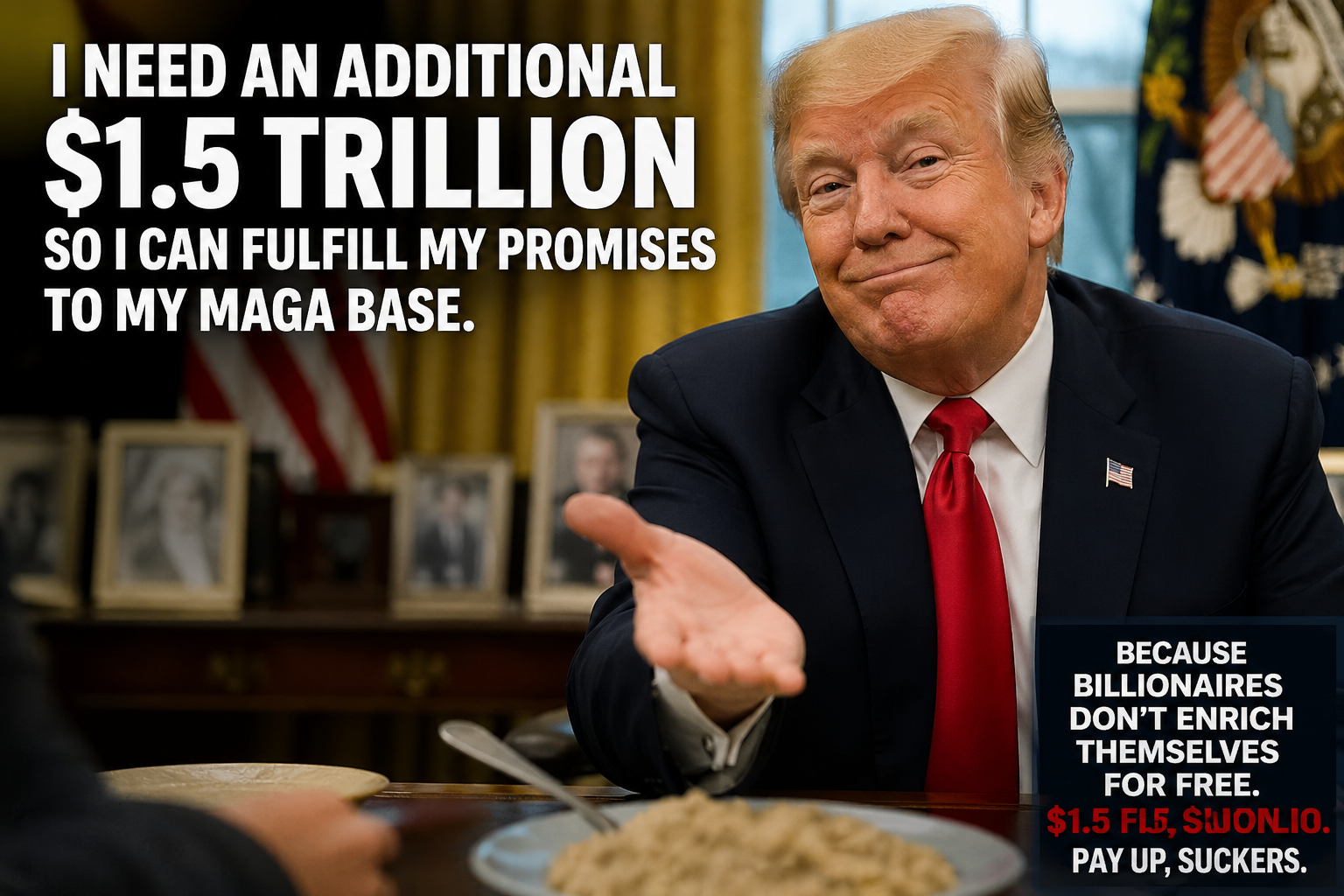
Oh, and he’ll need another 1.5 trillion dollars to do it.
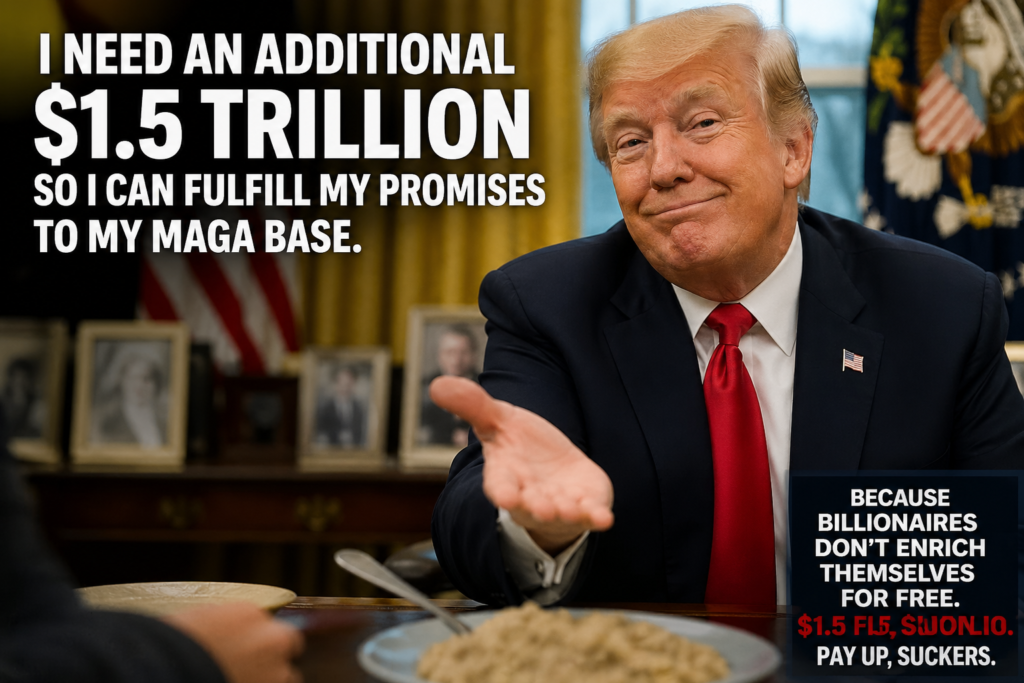
Share this:



Nobody to Blame but Himself
Donald Trump has done more for the crusade for clean renewable energy in less than 30 days than most advocates have accomplished in their entire careers. The man deserves an appropriate Nobel Prize.
By launching the Trump War against Iran—and Iran’s swift retaliation of closing the Strait of Hormuz—he single-handedly choked off roughly 20% of the world’s available oil supply. This triggered widespread fuel shortages across the United States and Europe, sent gas prices skyrocketing, and left airlines grounded and gasping.
As a direct result, governments and corporations worldwide are now frantically dumping resources into renewable energy. Solar is getting some love, but the real winner? Wind turbines. They’re popping up on the horizon faster than you can say “green new deal.”
It is estimated that the mirrored glass on Trump Towers already kills more birds than most wind farms, so the turbines should blend right in. Prime locations are already being scouted—especially areas with a steady supply of hot air, such as off the lower eastern coast of Florida.
Experts have also suggested installing the turbines as hazards on golf courses. They’d serve a dual purpose: providing a formidable challenge for players while simultaneously recharging golf carts, thus easing the strain on the power grid.
Naturally, on Trump-branded courses, the blades would be gold-gilded.
We don’t need no stinking oil anymore. Thanks to the Donald, the future is blowing in the wind.

Share this:

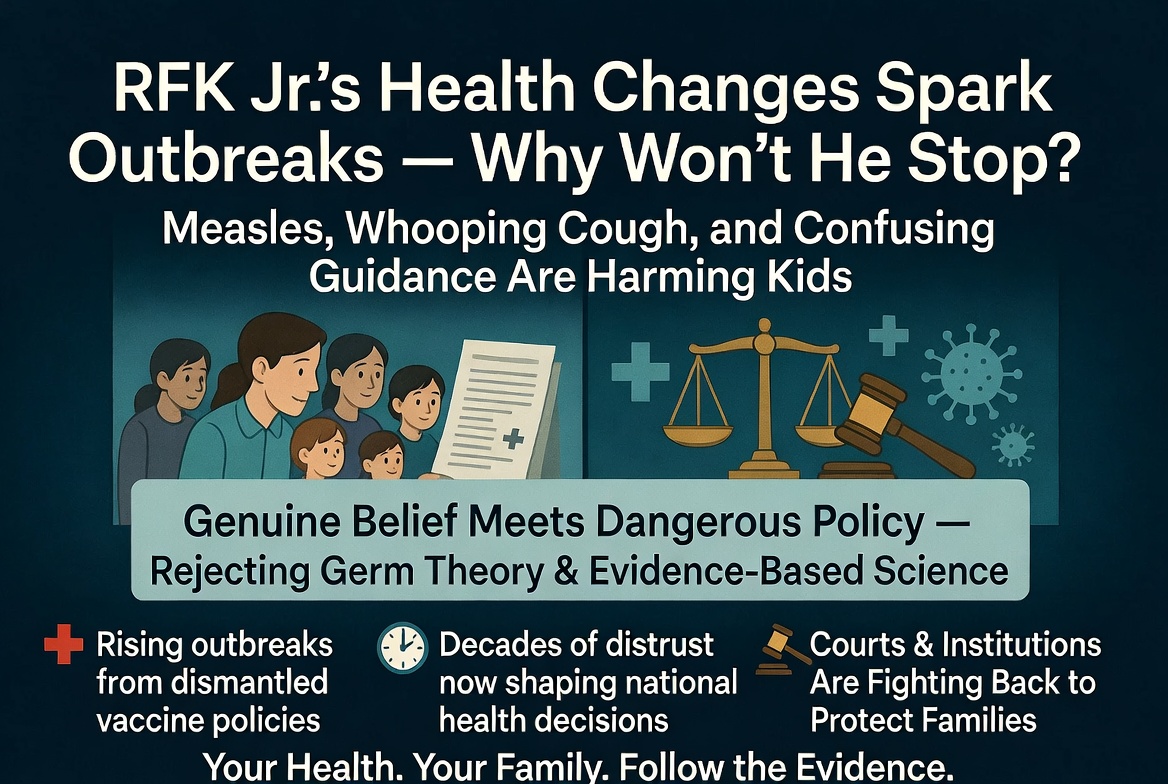
Making America Sick — Part 3 of 4: Why He’s Doing It? The Broken Compass
There is a question that stops most people when they look at the measles outbreaks, the whooping cough deaths, the hollowed out research institutions and the children who will go unvaccinated this fall because their parents received confusing guidance from the federal government. The question is simple and almost impossible to answer through a normal political lens.
How does he look at this and not stop?
It is the right question. And if you are looking for the answer in conventional political motivation — ambition, corruption, cynicism — you will not find it, or at least not find enough of it to explain what we are watching. Kennedy is not profiting directly from dismantling vaccine policy. He is not, by any reasonable measure, doing this for personal financial gain. He genuinely believes, as far as anyone can tell, that he is helping.
That is what makes him so dangerous.
To understand what is actually happening you have to set aside the political framework entirely and pick up a different one. Those who have spent careers working in mental health and addiction treatment will recognize the pattern immediately, not because Kennedy is simply an addict — recovery is real and people rebuild their lives completely — but because there is a specific kind of cognitive reorientation that prolonged substance use can produce in certain people, particularly those who were already wired toward intensity, pattern recognition, and distrust of authority. It does not announce itself. It does not look like impairment from the outside. It looks, in fact, like conviction.
Here is how it works. The brain’s threat assessment system, disrupted by years of substance use, can become permanently recalibrated. Not broken exactly — still functional, still capable of sophisticated reasoning — but reset to a baseline of suspicion that a normal risk environment cannot satisfy. Everything gets filtered through a framework that asks not “what does the evidence show” but “who benefits from me believing the evidence.” Once that filter is in place it is essentially self-sealing. Contradicting evidence doesn’t weaken the belief — it strengthens it, because contradiction becomes proof that the threat is real enough to require active suppression.
Kennedy wrote in a 2021 book that he rejected germ theory — one of the foundational principles of modern medicine, established over 150 years ago — in favor of miasma theory, the pre-scientific idea that disease arises from environmental corruption rather than specific pathogens. This is not a fringe position he stumbled into. He argued for it at length, in print, under his own name. And yet he continues to insist he is following the science. From inside that framework, he is. The science he trusts is the science that confirms what his recalibrated threat assessment already told him was true. Everything else is captured, corrupted, or bought.
This is not unique to Kennedy and it is not unique to addiction. It is a well-documented feature of how human cognition responds to prolonged trauma, chronic stress, and certain kinds of neurological disruption. What is unusual is the scale at which we are now watching it operate. Most people who develop this kind of framework do so in private, or in communities of like-minded believers, where the consequences are limited. Kennedy developed it in public, refined it over decades, built a following around it, and then traded that following for the most powerful public health position in the world.
The cruelest irony is that his instincts were not entirely wrong at the start. Corporate influence on research is real. The pharmaceutical industry has a documented history of suppressing inconvenient findings. Public health institutions did make serious errors during the pandemic that damaged trust. Kennedy’s original antenna was picking up genuine signals. But a broken compass that points slightly wrong will take you further and further from your destination the longer you follow it. By the time you are rejecting germ theory and redesigning the childhood vaccine schedule based on a country that provides universal free healthcare and has a population smaller than Texas, you are not where you started. You are somewhere that looks nothing like the riverbanks you once protected.
And the children getting measles in South Carolina cannot tell the difference between a broken compass and a working one. They just get sick.
What makes this particularly resistant to the normal corrective mechanisms of democratic accountability is that Kennedy speaks the language of his critics fluently. He knows what evidence-based medicine sounds like. He knows how to invoke transparency and scientific rigor and institutional accountability. He uses that language not to engage with the evidence but to reframe his rejection of it as a higher form of engagement. This is not stupidity. It is something more difficult to counter than stupidity, because you cannot simply show him the data. The data is part of the system he has already decided cannot be trusted.
Which brings us to the only thing that has ever worked against this kind of entrenchment — not argument, not outrage, not the correct facts delivered with sufficient force. What works is structure. Rules. Institutions with enough independence and enough legal authority to say no regardless of what any individual believes. Courts. Professional bodies. State governments. The accumulated weight of democratic process applied with enough consistency that no single broken compass can redirect the whole ship.
Those structures exist. They are fighting back. And that is where we are going next.
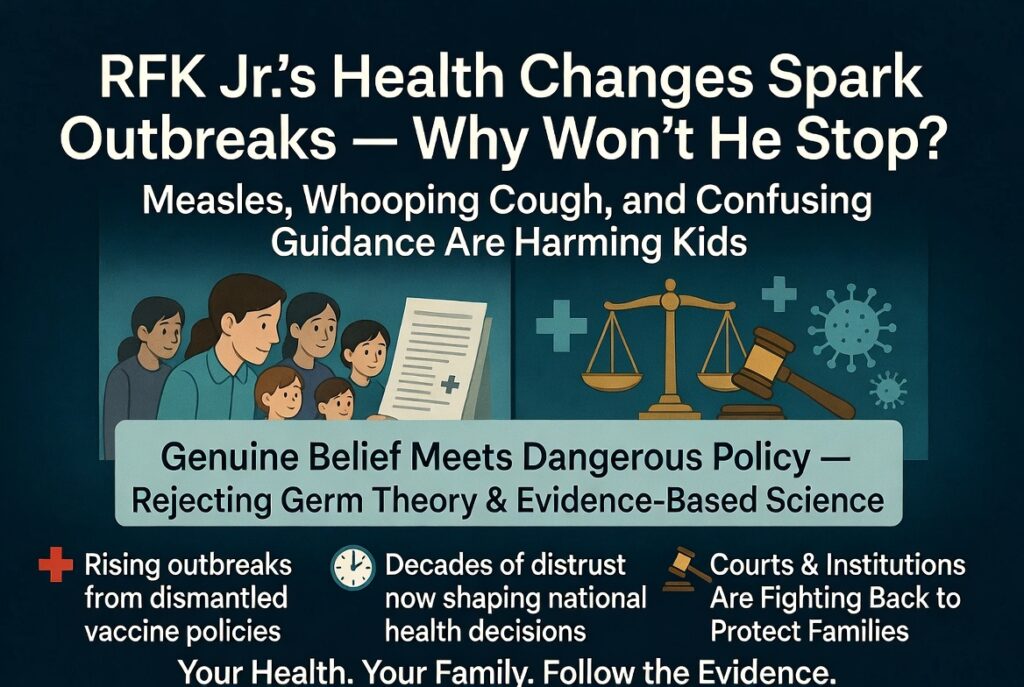
Share this:

Fast Forward 04/24/2026
|
Share this:

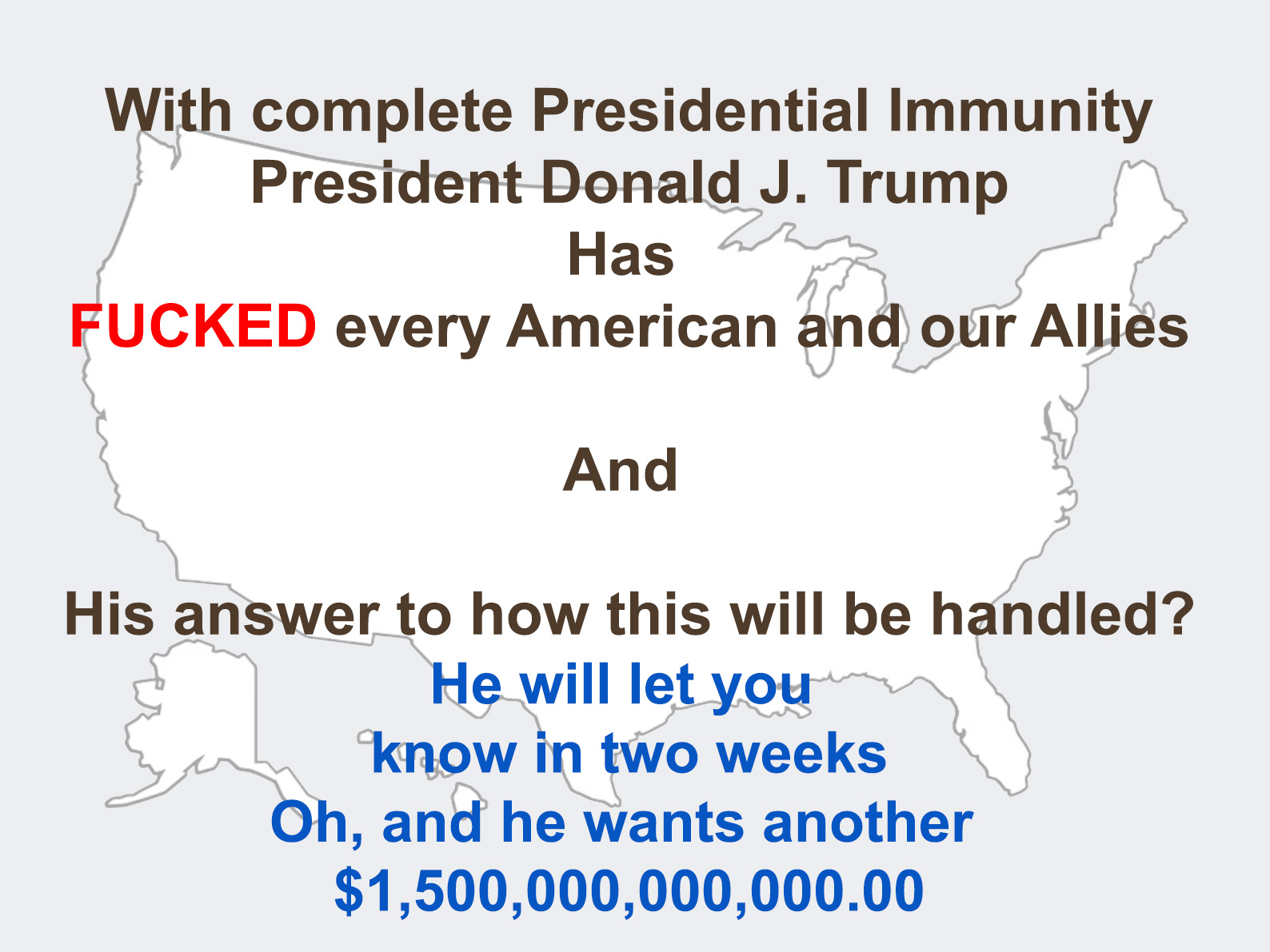



The Truth, The Whole Truth and Nothing but the Truth, Yah Right, Far Right, Far Far Right.
What follows is the response from Grok, I never joined Truth Social because, well. I never wanted to give them that much info about me. So, now, a year later I asked GROK how long the survival rate was for anti Trump or anti administration poilicy posts was. As expected, about as long as a mayfly in hell.
Free Speech, I don’t think so. thanks Donny.
Anti-Trump or anti-MAGA posts on Truth Social are heavily moderated and rarely survive long—they are frequently deleted, shadowbanned (made invisible to others), or result in account suspensions.
Official Policy vs. PracticeTruth Social’s community guidelines and moderation FAQ emphasize “free speech,” “viewpoint neutrality,” and minimal removals. They claim to use AI + human review mainly for illegal content, spam, violence, hate speech, bullying, explicit material, or TOS violations (e.g., no disparagement of the platform itself in early terms, though that was later softened). They state they do not moderate based on political viewpoint.
In practice, the platform functions as a pro-Trump/MAGA echo chamber. Early reports (2022, from Public Citizen and others) documented:
-
Bans or suspensions for posting about January 6 hearings/Capitol attack investigations.
-
Shadowbanning or removal of content criticizing Trump, his allies, abortion rights, or liberal/progressive views.
-
Immediate bans for parody usernames (e.g., mocking executives) or usernames seen as critical.
citizen.org
Terms of Service give broad discretion: the company can delete content or ban users “for any reason or for no reason” at its sole discretion.
Recent Evidence (2024–2026)
-
User anecdotes on Reddit, X, and elsewhere consistently report quick deletions or bans for even mild criticism, questions about Trump’s policies (e.g., on Russia/Putin or other issues), or anti-MAGA sentiment. Posts calling out perceived weaknesses or asking “reasonable questions” often vanish.
reddit.com -
Liberal or dissenting conservative voices are suppressed to maintain the narrative. The platform has been described as creating an “echo chamber of violent views” with more restrictive moderation than early Twitter in some analyses.
en.wikipedia.org -
While Trump himself has deleted some of his own controversial posts (e.g., AI Jesus imagery or other memes drawing internal backlash), this is self-editing rather than platform moderation.
wsj.com
Non-critical or pro-Trump content thrives, including conspiracy theories, strong Biden/anti-Dem attacks, and MAGA talking points. Dissent is not tolerated at scale.Why This Happens
-
Business model and audience: It’s a small, loyal, older, Republican-leaning user base (estimates ~6M MAU). Allowing widespread criticism would alienate the core and reduce engagement.
-
Enforcement: Relies on AI flagging + human mods, with reports of overreach on “sensitive” or off-narrative topics.
-
Comparisons: Unlike X (under Musk, more permissive overall) or pre-2022 Twitter, Truth Social was built explicitly as a Trump-safe space after his bans elsewhere. It had to tighten moderation for app store approvals (e.g., Google Play).
npr.org
In short, if you’re posting substantive anti-Trump or anti-MAGA content, expect it to be removed quickly or your account limited/banned. Mild or humorous jabs sometimes slip through briefly but don’t last. The platform prioritizes its identity over broad free speech in practice. For the latest, check user reports on X/Reddit or try it yourself (at your own risk).

Share this:

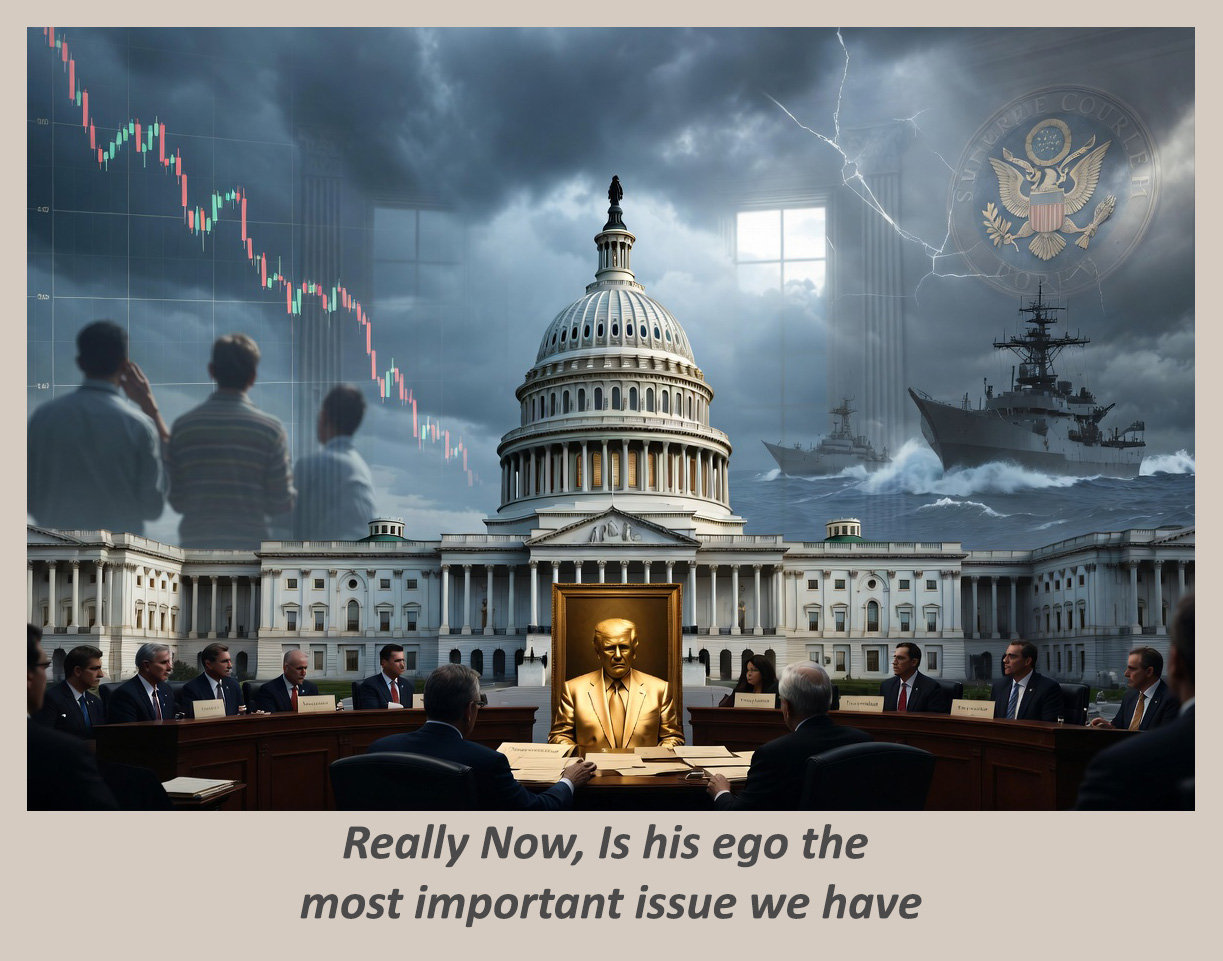
Hard at work solving our problems?
At a time when the country is dealing with serious economic pressure, global instability, and eroding trust in institutions, some of the legislative attention in Washington is being directed toward symbolic efforts tied to Donald Trump.
Yes, Congress has always included a mix of substantive work and political messaging. That’s nothing new.
What feels different now is the imbalance.
When proposals surface around renaming public institutions after political figures, or directing federal agencies to study something as politically loaded as “Trump Derangement Syndrome,” it’s fair to ask whether the focus is where it should be—or whether lawmakers are prioritizing signaling over governing.
No one expects every bill to solve a national crisis. But there is an expectation that elected officials understand the moment they’re in.
Right now, that moment calls for seriousness, discipline, and a clear sense of priority.
And when the public sees attention diverted toward gestures instead of solutions, it doesn’t just frustrate—it reinforces the belief that Washington is more interested in the performance of politics than the responsibilities of it.
Share this:

SPECIAL REPORT – Your Neighbour Canada Has Changed And You’re Not Going to Like What is Happening by Canadian Pulse
Came across this piece on how Canada has repositioned itself over the past year — trade, Arctic, alliances. Lot of specific data points worth knowing about regardless of where you stand politically. Make of it what you will.
Share this:




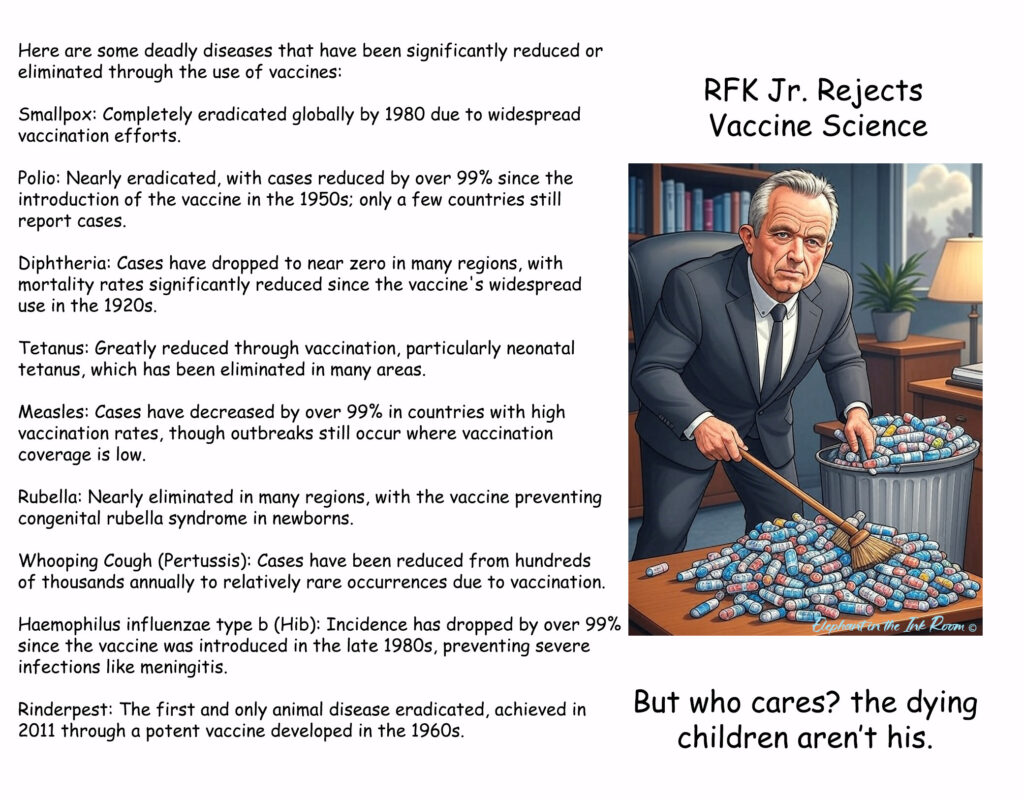
Making America Sick — Part 2 of 4: The Damage
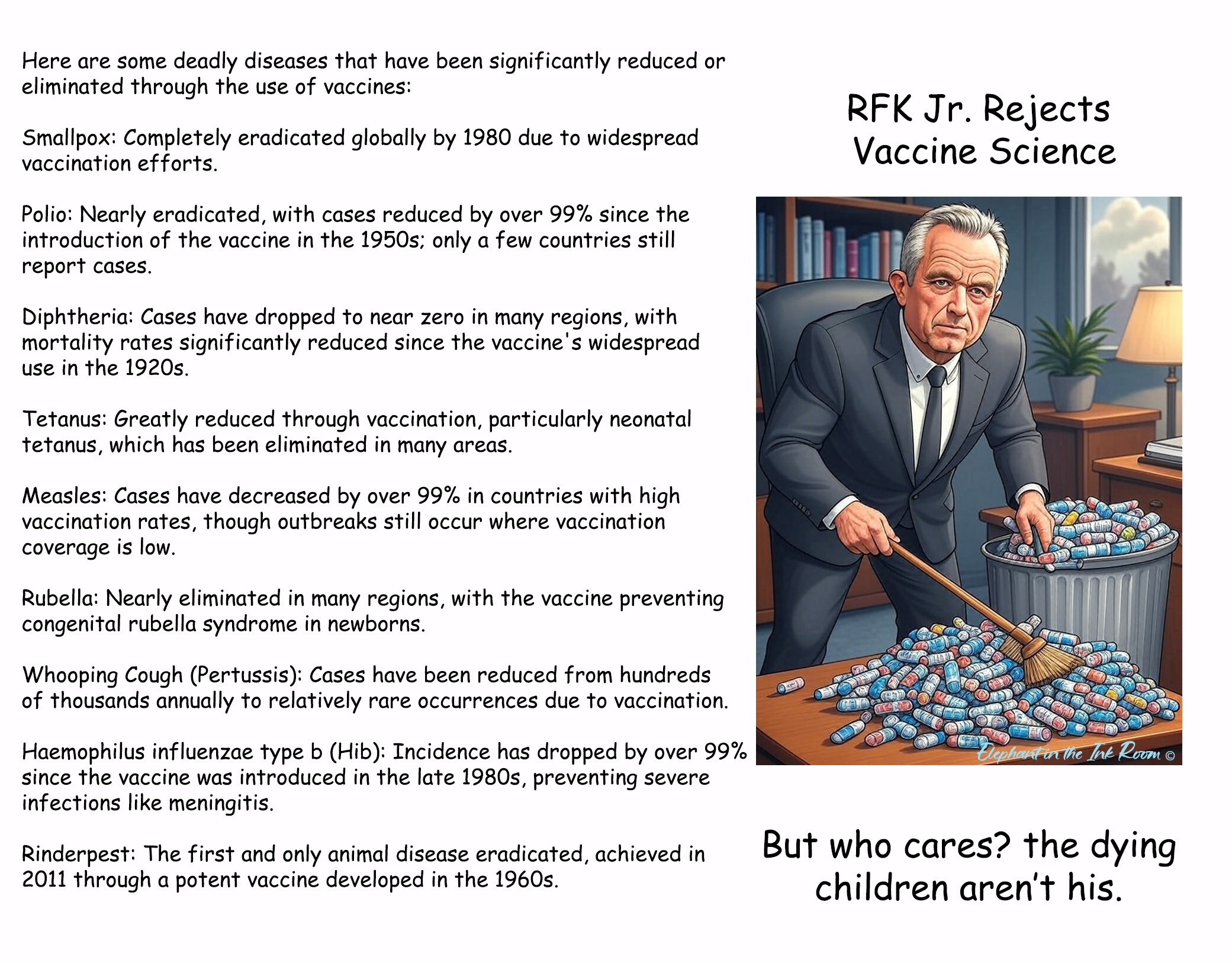
When Robert F. Kennedy Jr. took office in February 2025, the Department of Health and Human Services oversaw food and hospital inspections, health insurance for roughly half of the American population, vaccine recommendations, and the scientific research infrastructure that underpins most of what your doctor tells you. It was imperfect, often bureaucratic, and in genuine need of reform in places. What it did not need was to be systematically dismantled by someone who rejected the scientific foundations it was built on.
That is what happened anyway.
Within his first two months Kennedy announced the elimination of approximately 10,000 HHS jobs on top of another 10,000 employees who had already taken buyouts, collapsed 28 agencies into 15, and closed half of HHS’s regional offices. The cuts did not fall evenly. They targeted, as 19 state attorneys general would later document in federal court, specific programs and areas of expertise — the ones Kennedy had already decided were part of the problem. Infectious disease surveillance. Vaccine research. The scientific advisory infrastructure that had taken decades to build.
The research bleeding is quieter than the vaccine headlines but may prove more lasting. The National Institutes of Health cut approximately $2.7 billion in research funding, including a 31 percent reduction in cancer research. Five hundred million dollars in contracts to develop vaccines using mRNA technology, the same technology that saved millions of lives during the pandemic were canceled. Four NIH directors were fired or forced out. The FDA’s vaccine chief was removed. A CDC director Kennedy himself had hired was gone within a month. As one Georgetown University public health law professor put it, America is being hollowed out of its scientific leadership, and it will be extraordinarily difficult to reverse.
But it is the vaccine story that will be most immediately felt in pediatricians’ offices and school hallways across the country.
Kennedy promised during his confirmation hearings that he would not touch vaccine policy. Instead he fired all 17 sitting members of the CDC’s Advisory Committee on Immunization Practices, the expert body that has guided vaccine recommendations since 1964 and replaced them with known vaccine skeptics. The reconstituted committee promptly began downgrading recommendations. Then in January 2026, the CDC unilaterally reduced the universally recommended childhood vaccine schedule from 17 vaccines to 11, cutting protection against rotavirus, influenza, hepatitis A, hepatitis B and meningococcal disease from routine recommendations, not based on any new safety data, but modeled after Denmark, a country with universal free healthcare that is an outlier even among its European peers.
The consequences are not theoretical. A measles outbreak has spread to 26 states with over 960 confirmed cases centered in South Carolina. Two children have died from whooping cough. Vaccination rates have been falling since Kennedy took office. Last flu season saw 280 child deaths from influenza, the highest toll in more than a decade, and the federal government has now made the flu vaccine a matter of parental discretion rather than routine recommendation.
There is a clock ticking that most people don’t know about. Major health insurers pledged to keep covering the old vaccine schedule through the end of 2026. That pledge expires in December. After that, whether parents pay out of pocket for vaccines that were covered last year is an open question, and in a country where cost is already a barrier to preventive care for millions of families, the answer will show up in infection rates within a year or two.
None of this happened by accident. None of it happened without warning. Kennedy’s record as a vaccine skeptic was not hidden during his confirmation process, it was the central concern of every senator who questioned him, and he addressed each concern with a promise he did not keep. The damage being done to American public health is real, it is documented, and it is the direct result of placing ideological conviction above scientific evidence at the highest level of the public health system.
The question worth asking, and the one we will address next, is not whether Kennedy knows what he is doing. He does. The more useful question is why a genuinely intelligent person, with a real history of fighting for public health, arrived here. Because the answer to that question is the one that might actually help us understand how to stop it from happening again.
Share this:

The Chaos Candidate Part 2 of 2
The Chaos Candidate
Part Two: Nobody Gets to Succeed Him
The Heir Problem
Every president, even those who serve two full terms, eventually hands power to someone. The American system is built on this assumption. Parties groom successors. Vice presidents position themselves. Cabinets members quietly build their own profiles. This is normal. This is healthy. This is how democracies renew themselves.
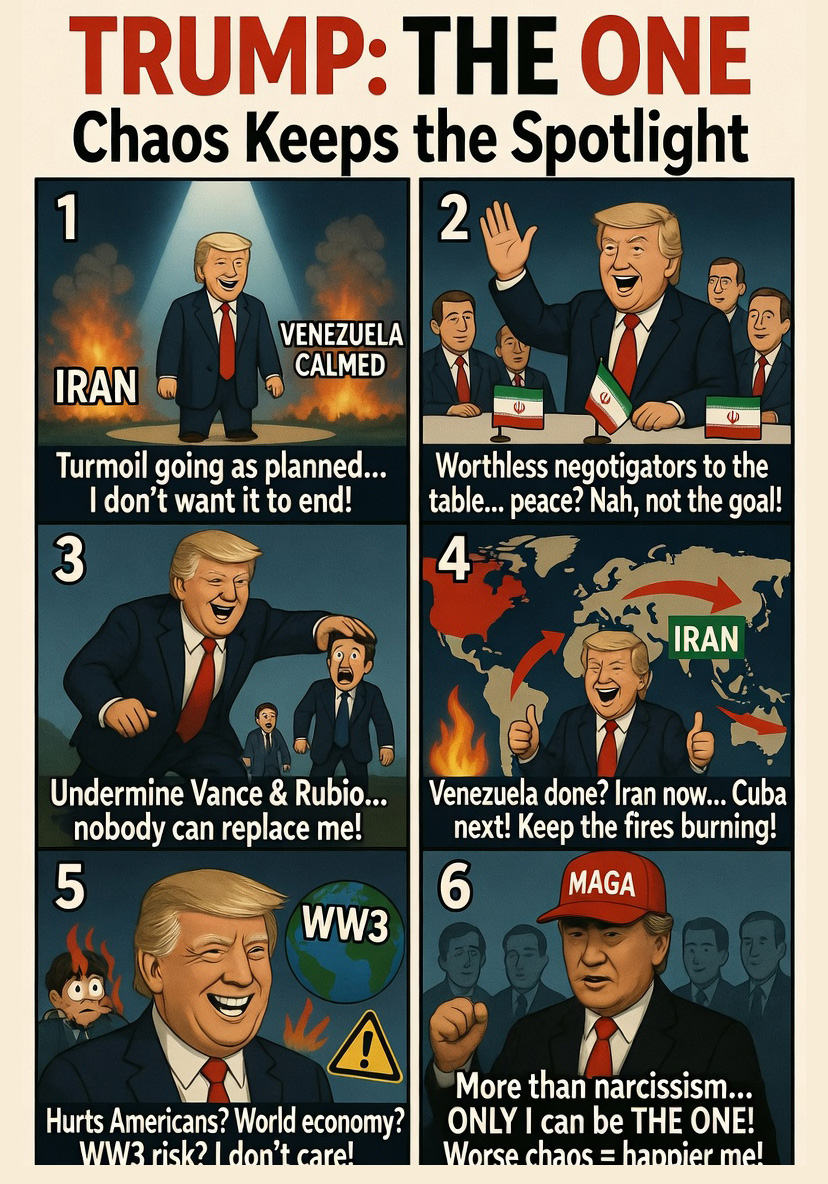
Look at what is happening to JD Vance. He was selected as the heir apparent, young, ideologically aligned, capable of carrying the movement forward. Watch how that has evolved. Watch how often he is sent to deliver messages that put him in impossible positions. Watch how the credit for anything successful flows upward while the exposure for anything uncomfortable flows toward him. This is not accidental staff management. This is deliberate political neutering.
Marco Rubio came into this administration with more foreign policy credibility than almost anyone in the Republican Party. He is a serious man who knows the world. Watch what has happened to his role. Watch the negotiations he is sent to conduct with insufficient authority to deliver results. Watch the sidelines he increasingly occupies on decisions that should be his by portfolio. The diminishment is quiet but it is consistent.
The pattern is not hard to see once you are looking for it. Nobody around this president is allowed to accumulate enough independent political gravity to pose a succession question. Not because he is term-limited out in 2028 and succession is therefore theoretical. Because the movement itself cannot have a face other than his face. The chaos requires a singular author.
Nobody around this president is allowed to accumulate enough independent political gravity to pose a succession question. The chaos requires a singular author.
The Trap Voters Built
Here is the part that requires the most intellectual honesty, because it does not flatter anyone, including people who consider themselves politically sophisticated.
The trap was not set by Donald Trump. It was set by voters, over many election cycles, as American political culture made a series of choices that seemed reasonable one at a time and catastrophic in aggregate.
We chose entertainment over information. Not all at once. Gradually, across decades, as the media ecosystem fractured and attention became the currency that determined what survived. A political system fed by attention gradually selects for performers over governors.
We chose emotion over policy. Again, not all at once. But somewhere along the way, the question voters asked shifted from “what will this person actually do” to “how does this person make me feel.” Feeling is immediate. Policy is slow. In a media environment built for immediacy, feeling wins every time.
We chose personality over institution. Parties became vehicles for individuals rather than individuals being accountable to parties. Checks and balances depend on people being more loyal to the institution than to the person, and that loyalty has been systematically eroded, on both sides, for thirty years.
The result is a political environment where chaos is not just tolerated but rewarded. Where accountability mechanisms, elections, oversight, the press, the courts, have all been either captured, discredited, or simply overwhelmed by the volume of events requiring response. You cannot hold anyone accountable for yesterday’s crisis when today’s crisis has already replaced it in the news cycle.
The Exit Is Slow
I want to be honest about what I am not saying. I am not saying this is hopeless. I am not saying the system is broken beyond repair. I have lived through enough political cycles, in California, in Oregon, across fifty years of paying close attention, to know that pendulums move. They move slowly. They move unevenly. But they move.
Oregon hasn’t elected a Republican governor since the 1980s. That may change in 2026, not because the state has transformed overnight but because enough voters have grown tired of one-party governance and its particular flavor of unresponsiveness to the full breadth of the state’s needs. That is the pendulum moving. Slow, grinding, real.
The exit from the national trap is the same kind of movement. It does not come from a single election or a single candidate or a single revelation. It comes from voters, gradually, reclaiming the habit of asking what a person will actually do instead of how they make us feel. It comes from demanding resolution instead of rewarding perpetual crisis. It comes from accepting that stability, while less dramatic than chaos, is what governance is actually for.
The chaos candidate understood something about this moment that his opponents repeatedly failed to grasp: that a significant portion of the electorate had become so accustomed to dysfunction that they stopped expecting anything else. He did not create that condition. He simply recognized it and made it work for him.
Understanding that is not defeatism. It is the beginning of the only kind of response that actually works, patient, structural, generational, and stubbornly focused on the long game rather than the next news cycle.
The pendulum is heavy. But it moves.
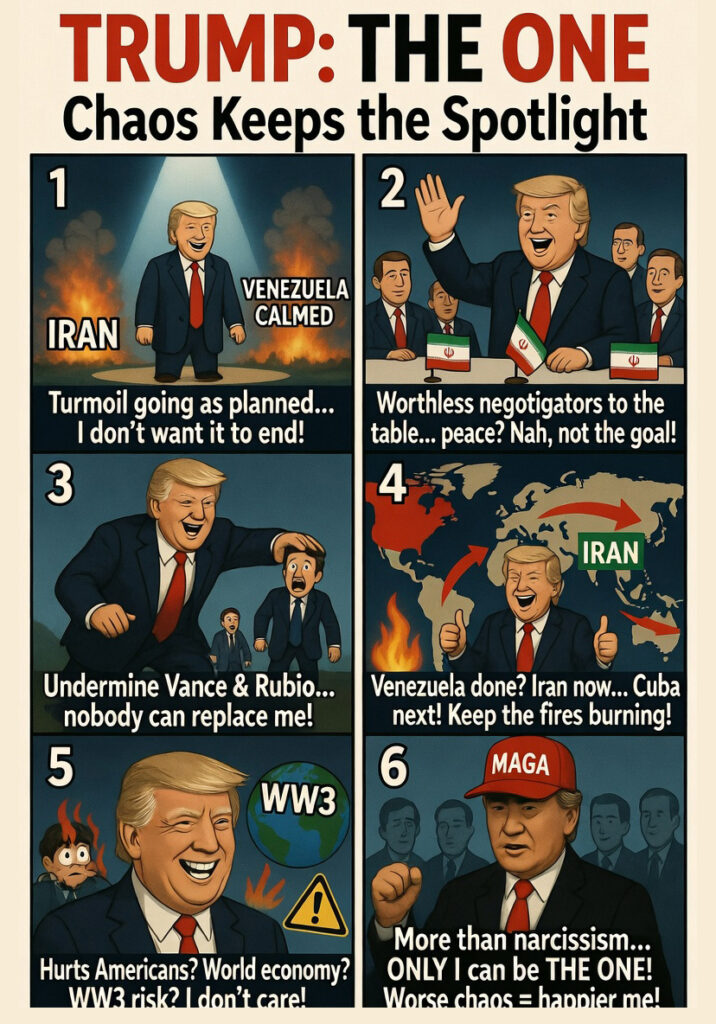
Share this:

2026 Elections Toolkit & Voter Registration Deadline- Oregon
|
|||||||||||||||||

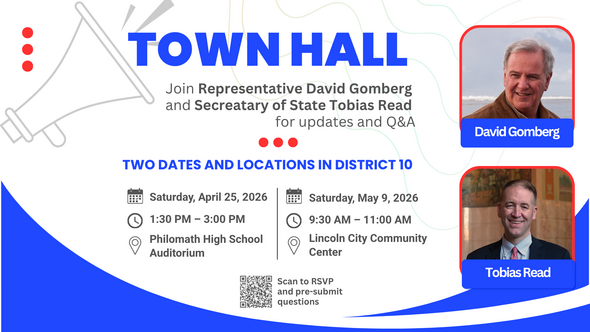

Share this:

The Most Important Speech of Political and Constitutional Philosophy That Never Should Have Been Given
Share this:



The Chaos Candidate Part 1 of 2
The Chaos Candidate
How disorder became the product, succession became the threat, and voters built the trap themselves
I want to start with something simple, something you can observe without any particular political leaning, and see if you end up where I did.
Venezuela got loud, then it quieted down. Iran got loud. Now Cuba is warming up. At some point, one of these will quiet down too, and something else will heat up. There is always something heating up. There is never a moment where the temperature drops across the board and stays down. If you step back far enough to see the whole map at once, a pattern emerges that is difficult to explain as coincidence, incompetence, or even ideology.
What if the chaos isn’t the failure? What if the chaos is the point?
I am not a conspiracy theorist. I am a man who has been watching American politics since Eisenhower, who moved from California to Oregon in 1975 and watched two states make similar mistakes on slightly different timelines, and who spent a sleepless night recently, courtesy of bad scallops and an overactive mind, turning this question over until it had an answer I could not easily dismiss.
This piece has two movements. The first is about chaos as a governing strategy. The second is about why that strategy is self-sealing, and who pays the price when it is.
What if the chaos isn’t the failure? What if the chaos is the point?
Part One: The Chaos Is the Product
What Normal Turbulence Looks Like
Every presidency generates turbulence. Foreign policy crises flare and subside. Domestic controversies rise and fall. This is the normal metabolism of governing a large, complicated country in a complicated world. Nobody reasonable expects calm.
But normal turbulence has a rhythm. Problems are identified, addressed, resolved or managed, and attention moves on. The temperature rises and falls. There is a discernible arc: crisis, response, resolution, or at minimum, honest failure followed by correction.
What we are watching now has a different rhythm entirely. The temperature does not fall. The resolution never quite arrives. Each crisis is replaced not by calm but by the next crisis, on a rotation that feels less like the unpredictable nature of world events and more like a programming schedule.
The Rotation
Venezuela became the focus. Military posturing, deportation flights, diplomatic brinksmanship. Then it subsided, not resolved, just deprioritized. Iran filled the space almost immediately. The language escalated. Negotiations were announced with negotiators who, by any serious diplomatic assessment, were not equipped to deliver results. The war drums are audible but the path to resolution is deliberately obscured.
Cuba is next. The signals are already there for anyone paying attention.
Now ask yourself a straightforward question: what does a president gain from resolution? A resolved crisis is yesterday’s news. A resolved crisis means the cameras move on. A resolved crisis means the public starts paying attention to other things, grocery prices, healthcare costs, whether their VA claim has been processed.
A ongoing crisis, on the other hand, is a spotlight. And the spotlight, in this administration, is not a tool of governance. It is the objective of governance.
A resolved crisis is yesterday’s news. An ongoing crisis is a spotlight. And the spotlight is not a tool of governance. It is the objective.
More Than Narcissism
The easy diagnosis is narcissism, and it is not wrong as far as it goes. But narcissism alone does not fully explain the pattern, because narcissism is ultimately reactive. It seeks approval, validation, the crowd’s energy. What we are observing has a more active quality. It is not just craving the spotlight. It is engineering the conditions that make the spotlight permanent.
Some political psychologists have reached for the term malignant narcissism, a combination of narcissistic personality, antisocial behavior, paranoia, and a willingness to cause harm without remorse. Others simply describe an autocratic personality type. Neither quite captures it.
What I keep coming back to is this: chaos is this man’s life support system. Not metaphorically. Functionally. Remove the crisis and you remove the reason for the rally, the reason for the emergency declaration, the reason the cameras are in the room. Stability is not just boring to him. Stability is existentially threatening.
That is not a medical diagnosis. It is a political observation. And it matters, because it changes how you evaluate everything that follows.

When it’s all about me
Share this:

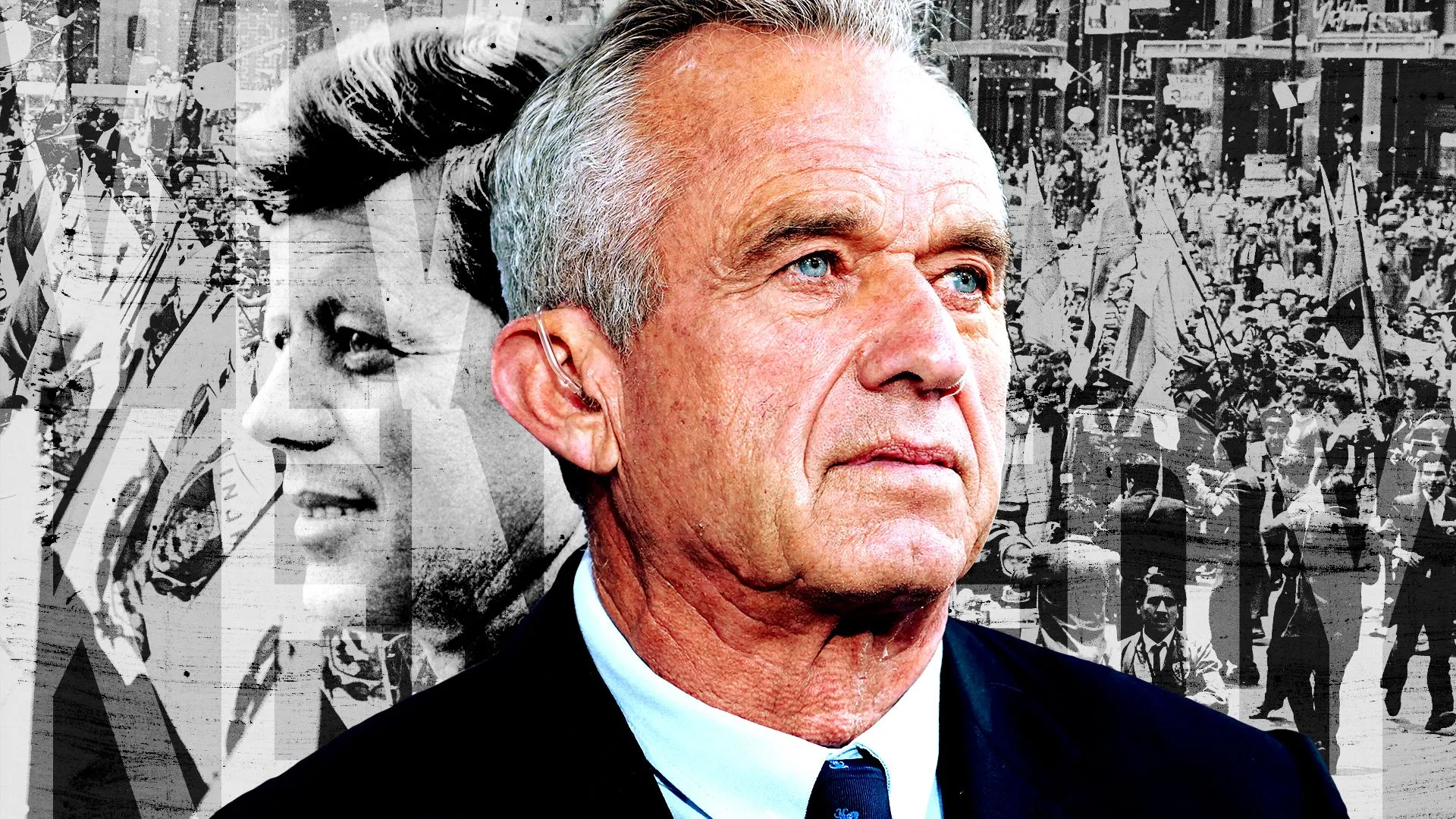
Making America Sick — Part 1 of 4: The Man Who Knew Better
There is a version of Robert F. Kennedy Jr. that history should remember favorably.
As an environmental attorney in the 1980s and 90s, Kennedy was the real thing. He sued polluters, won, and made them pay. He fought corporations that dumped toxins into waterways serving poor communities who had no other advocate. He understood science, used it rigorously, and trusted it when it supported the case he was making, which it usually did, because the science on industrial pollution is not complicated. Corporations were poisoning people, Kennedy proved it, and he made them stop. That is not the biography of a crank. That is the biography of someone who understood exactly how institutions can be corrupted by money and power, and fought back effectively.
That understanding, that institutions lie when money is involved, is important. Because it wasn’t wrong. It was the seed of everything that came later, and like a lot of things that start from a kernel of truth, it eventually grew into something that consumed the original plant entirely.
Somewhere between the courtroom victories and the podcast appearances, Kennedy’s working theory shifted. Institutions sometimes lie became institutions always lie. Follow the money when evaluating a specific claim became follow the money as a substitute for evaluating evidence at all. The man who once used science as a sword against corporate corruption began using corporate corruption as a reason to reject science itself.
The drug years almost certainly played a role. Kennedy has spoken openly about his heroin addiction and recovery, and deserves credit for that honesty. But what he has never fully reckoned with publicly, and what anyone who has worked in addiction and mental health will recognize immediately, is that sustained substance use doesn’t just damage the body. It rewires the framework through which a person processes trust, authority, and risk. It can leave someone genuinely intelligent operating from a threat-assessment system that is permanently calibrated too high. Everything becomes suspect. Every institution becomes an enemy. Every simple answer becomes more trustworthy than a complex one, because complexity itself starts to feel like manipulation.
This is not a diagnosis. It is a pattern that professionals in mental health and addiction recognize, and it matters here because it explains something important: Kennedy is not stupid. He is not simply corrupt. He is a genuinely intelligent person operating from a framework that was damaged long before he ever set foot in the Department of Health and Human Services, and that framework is now being applied to the health of 330 million Americans.
He was confirmed as Secretary of Health and Human Services in February 2025, after a Senate process in which he promised, repeatedly, that he would not dismantle vaccine policy, would not politicize public health, and would bring transparency and accountability to institutions that had lost public trust during the pandemic. Those were not unreasonable promises. Some of them were even things his critics could agree were worth doing.
He has broken nearly all of them.
What is less often discussed is how he got there. Kennedy’s path to confirmation ran directly through his decision to drop his independent presidential campaign and deliver his followers to Trump. The job was, by most credible accounts, the arrangement. Not a reward for expertise in public health. Not a record of administrative competence. A political transaction between two men who had spent years distrusting the same institutions, for very different reasons, and who each believed they were the one doing the using.
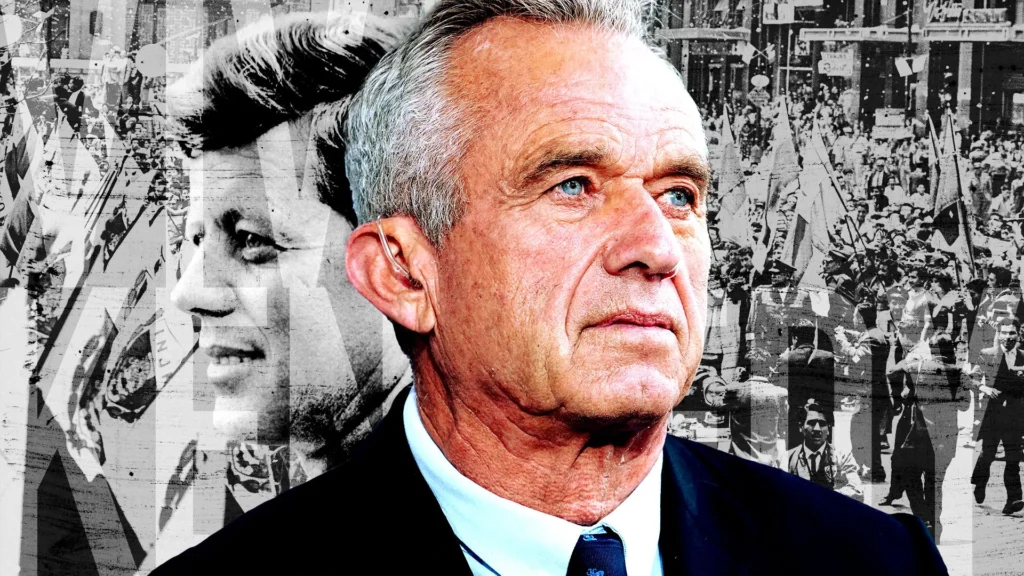
Share this:

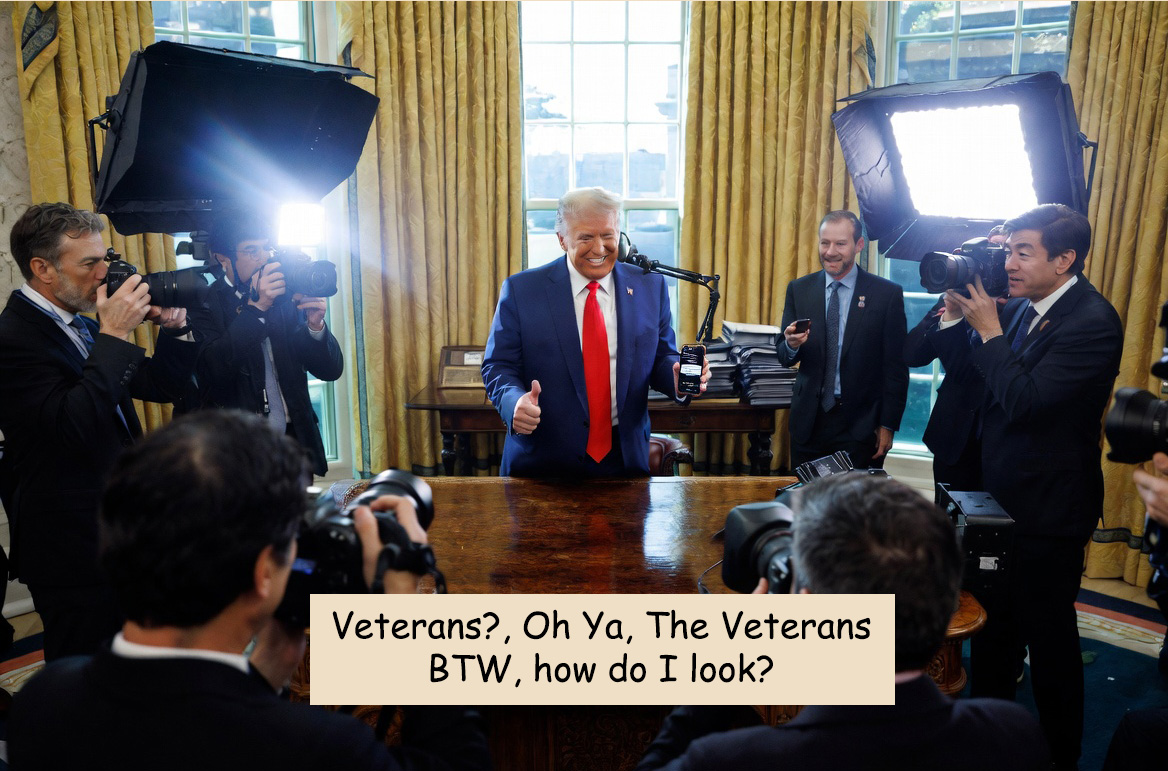
A Text Message and FDA Approval – A COMPANION PIECE TO THE SERIES: MAKING AMERICA SICK — ROBERT F. KENNEDY JR.
When good things happen for the wrong reasons, and the wrong things happen anyway
On Saturday, April 18, 2026, President Trump signed an executive order directing the FDA to fast-track its review of psychedelic drugs including ibogaine, psilocybin, and MDMA for the treatment of PTSD, depression, and traumatic brain injuries in military veterans. He stood in the Oval Office flanked by RFK Jr., Dr. Oz, podcaster Joe Rogan, and Marcus Luttrell, the decorated Navy SEAL whose story became the film Lone Survivor. It was, by any measure, a striking scene.
And here is the uncomfortable truth: the science behind this decision has genuine merit. A 2024 Stanford study found that veterans treated with ibogaine showed an 80 to 90 percent reduction in symptoms of depression and anxiety within a single month. For over twenty years, more than 6,000 veterans per year have died by suicide, a rate more than twice that of the civilian population. When people are dying at that scale, the calculus around acceptable risk changes. Sometimes you take the risk. Sometimes you throw the dice.
So credit where it is due: if this research is conducted properly, it could save lives. That matters. That is real.
“Sounds great. Do you want FDA approval? Let’s do it.” — President Trump, responding to a text from Joe Rogan
Policy by Text Message
But here is where the story gets complicated, and where the parallels to my ongoing series on Robert F. Kennedy Jr. become impossible to ignore.
This executive order, according to officials present, was written in less than a week. Its genesis was not a briefing from the VA, or a report from the National Institutes of Health, or years of advocacy from veterans’ organizations, though those voices exist and have been pushing for this research for years. Its genesis was a text message from Joe Rogan. Trump’s reply, as Rogan told it from the Oval Office: “Sounds great. Do you want FDA approval? Let’s do it.”
This is the same governing philosophy we see throughout this administration’s approach to public health. RFK Jr. didn’t dismantle vaccine confidence programs because of rigorous scientific review. He did it because of ideology, grievance, and the gravitational pull of a particular media universe. Trump didn’t fast-track psychedelic research because of a systematic review of veteran health outcomes. He did it because a podcaster texted him and it sounded good.
The mechanism is identical. The outcomes just happen to point in opposite directions.
The Hypocrisy the Headlines Won’t Tell You
While this announcement was being celebrated and it deserves some celebration the Department of Veterans Affairs has been quietly hemorrhaging the people who actually serve veterans every single day. Thousands of VA employees have been cut or are under threat as part of the administration’s broader federal workforce reductions. These are the people who answer phones, process disability claims, run mental health clinics, and sit across from veterans in crisis.
Ibogaine, even under an optimistic timeline, will not be widely available to veterans for years. The research still needs to be done properly. The cardiac risks, ibogaine has been linked to fatal heart arrhythmias and is connected to over thirty deaths in the medical literature — need to be understood and managed. The FDA approval process, even a fast-tracked one, takes time.
So what happens to the veteran who calls the VA crisis line next Tuesday and nobody answers? What happens to the veteran waiting eighteen months for a disability claim decision while staff positions sit empty? They don’t have Joe Rogan’s number. They don’t have a Lone Survivor story to tell in the Oval Office. They have a phone number and a waiting list.
This administration has demonstrated, repeatedly, that access to presidential attention and federal resources is mediated not by need, but by platform. By visibility. By whether you are useful to the political performance of the moment. Veterans, as a group, are enormously useful as symbols. As a bureaucratic constituency with daily, grinding needs they are less convenient.
The Thalidomide Shadow
Those of us old enough to remember thalidomide understand the cost of moving too fast. That drug approved in Europe, thankfully blocked in the US by one courageous FDA reviewer caused severe birth defects in thousands of children. The FDA’s deliberate pace exists for a reason. It was written in tragedy.
Ibogaine is not thalidomide. But it carries real risks, and the pressure now being applied to the FDA approve this in “weeks, not years” as the FDA commissioner suggested should make anyone who remembers that history uneasy. Speed driven by political momentum is not the same as speed driven by scientific confidence.
The research should proceed. The clinical trials should be funded. The veterans who have traveled to Mexico to access ibogaine treatments because they had no legal option at home deserve a legitimate pathway. All of that is true.
But “do you want FDA approval? Let’s do it” is not a drug approval process. It is a vibe. And we have seen, in this administration’s approach to public health writ large, what governing by vibe costs us.
Hold Both Truths
The hardest intellectual task in political commentary right now is holding two truths simultaneously when one of them gives comfort to people you disagree with. So let me be clear one final time: this research, done properly, could save veteran lives. That is good. That is worth fighting for regardless of who signs the order.
But the way it was done, by text message, in a week, surrounded by cameras and celebrities, while the VA workforce is being dismantled behind the scenes, is not a veterans policy. It is a veterans performance. And the veterans who will be waiting for ibogaine to navigate clinical trials and FDA approval while their local VA mental health clinic loses half its staff deserve to know the difference.
Good outcomes for bad reasons are still good outcomes. But they do not absolve the bad reasons. And they do not fill the staff positions that were cut last month.
This is a companion piece to the ongoing series Making America Sick: Robert F. Kennedy Jr., examining the Trump administration’s approach to public health, science, and the machinery of medical governance.
Published April 2026
Share this:

What Your Cat Understands About Donald Trump That Most Democrats Don’t
Share this:

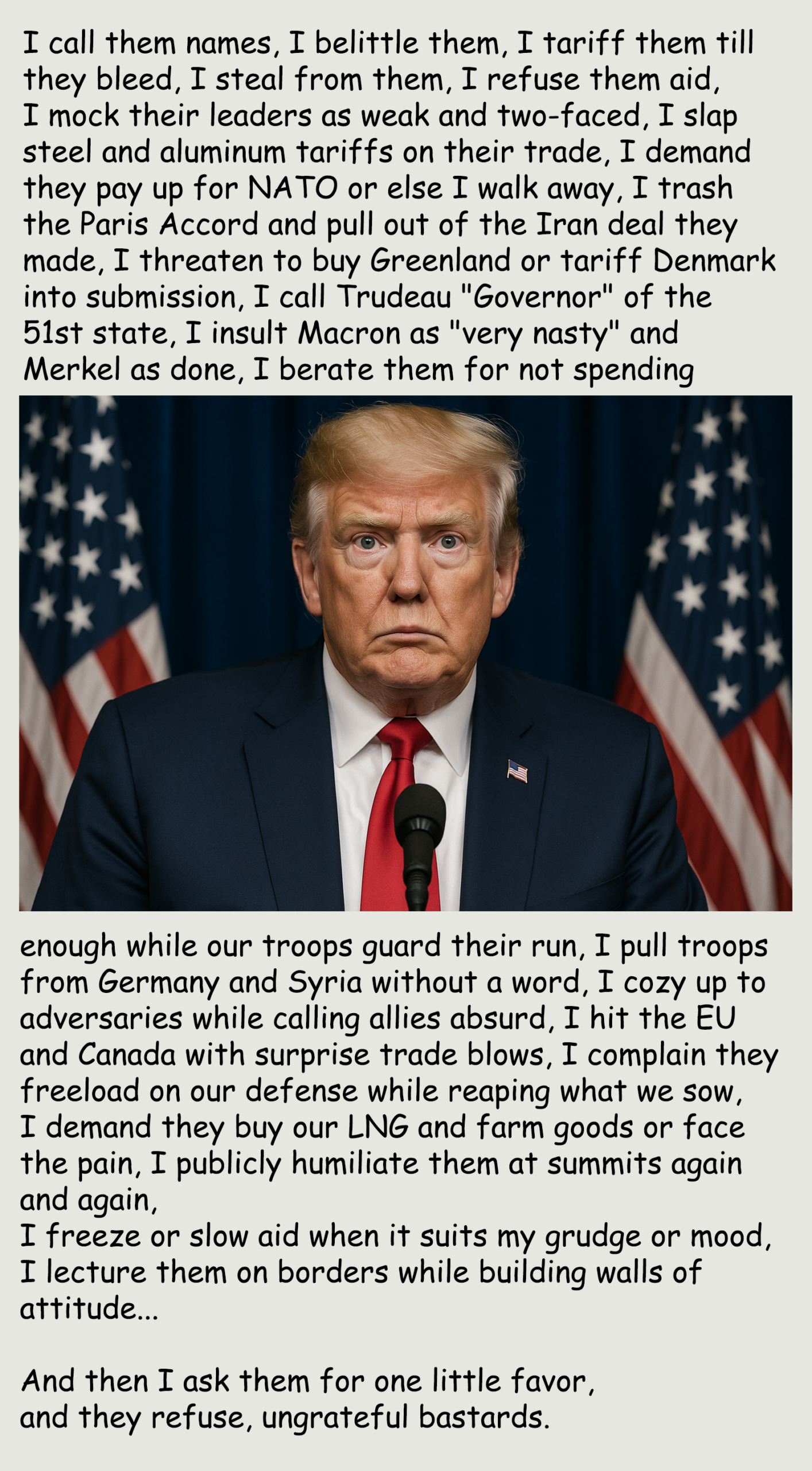
Ungrateful Bastards
I call them names, I belittle them, I tariff them till they bleed, I steal from them, I refuse them aid, I mock their leaders as weak and two-faced, I slap steel and aluminum tariffs on their trade, I demand they pay up for NATO or else I walk away, I trash the Paris Accord and pull out of the Iran deal they made, I threaten to buy Greenland or tariff Denmark into submission, I call Trudeau “Governor” of the 51st state, I insult Macron as “very nasty” and Merkel as done, I berate them for not spending enough while our troops guard their run, I pull troops from Germany and Syria without a word, I cozy up to adversaries while calling allies absurd,
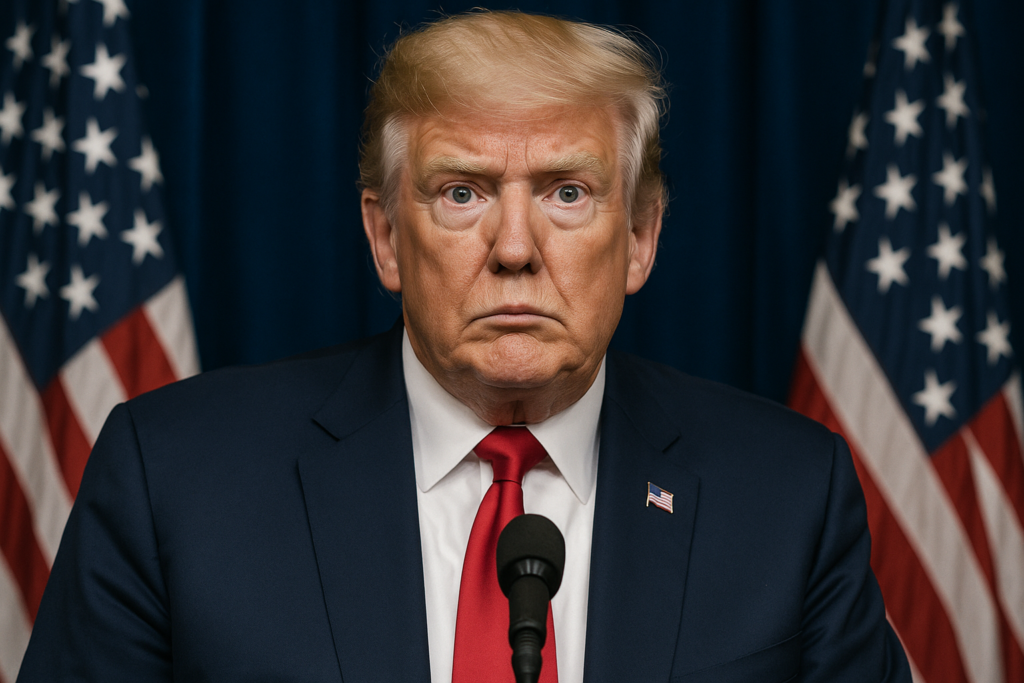
I hit the EU and Canada with surprise trade blows, I complain they freeload on our defense while reaping what we sow, I demand they buy our LNG and farm goods or face the pain, I publicly humiliate them at summits again and again, I freeze or slow aid when it suits my grudge or mood, I lecture them on borders while building walls of attitude… And then I ask them for one little favor, and they refuse, ungrateful bastards.
Share this:

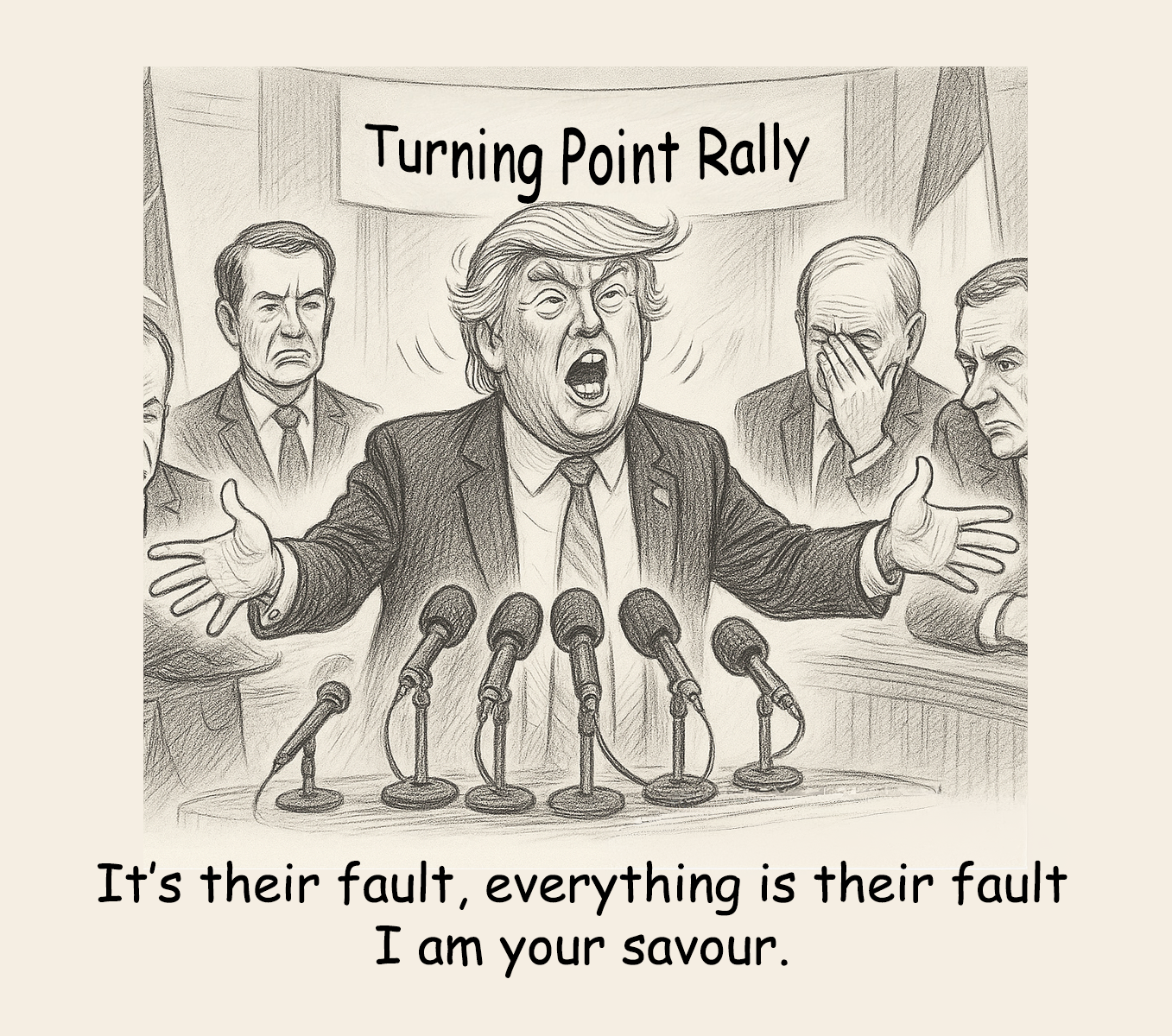
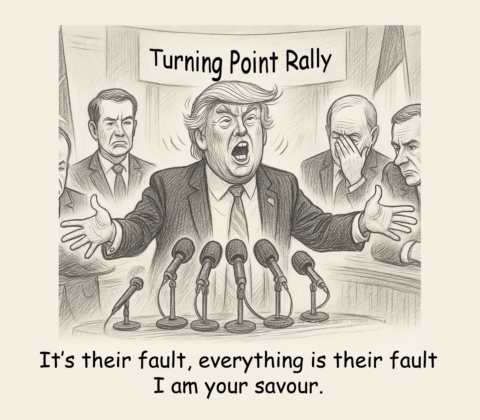
He’s At It Again. He Never Really Stopped.
There is one political maneuver that has outlasted every empire, every demagogue, and every failed democracy in recorded history. It requires no particular intelligence to execute. It requires only a crowd of people who have been genuinely hurt by a system they don’t fully understand, and a voice willing to point in the wrong direction with enough confidence that nobody looks where the finger is actually coming from.
Donald Trump used it to get elected. He is using it again right now, aimed at a new audience, ahead of the midterms.
Here is how it works. You find people who have real grievances, and in America in 2026 there is no shortage of them. Wages that haven’t kept pace with the cost of living. Unions that were dismantled. Housing that became unaffordable. Debt that was engineered to be inescapable. These are real injuries, caused by identifiable decisions made by identifiable people with identifiable financial interests. The billionaires who took the wages. The corporations that crushed the unions. The politicians who deregulated the housing market. The financial system that built the debt trap.
You don’t point there. That’s the move. You point down instead. You tell the people who were robbed that the theft was committed by the people below them on the economic ladder. The immigrants, the minorities, the ones who have even less power than they do. You make them feel powerful by giving them someone they can still step on. And it works, because anger needs a target, and the real targets are harder to reach and better protected.
Trump did this in 2016 and 2024 with devastating effectiveness. Your jobs didn’t go to billionaires who lobbied for trade deals. They went to those people crossing the border. Your neighborhood didn’t get hollowed out by financial policy. It got hollowed out by those people getting handouts. Your children’s futures aren’t being sold by the donor class. They’re being taken by those people getting what should be yours.
It was a lie then. It is the same lie now, repackaged for a younger audience at a megachurch in Phoenix, dressed up in pyrotechnics and Lee Greenwood, aimed at voters who are still forming their understanding of how power actually works.
What has changed is the urgency. He said it himself at the Turning Point rally this week, almost accidentally. He knows the historical pattern, that the president’s party typically loses ground in midterm elections. He said he can’t figure out why. He can. He just can’t say it out loud. So instead he is doing what he has always done when the ground shifts under him. He is pointing downward harder, faster, and at a younger audience that hasn’t yet learned to check where the finger is actually aimed.
He told those young voters at the Dream City Church in North Phoenix, the midterms are existential. He is right about that. He just has the direction exactly backward. The threat is not the Democrats. The threat is the consolidation of power by a man who has spent his entire political career making sure you are angry at the person next to you instead of the one above you.
The oldest trick in the authoritarian playbook is not complicated. It just requires that nobody stops to look up.
Look up.
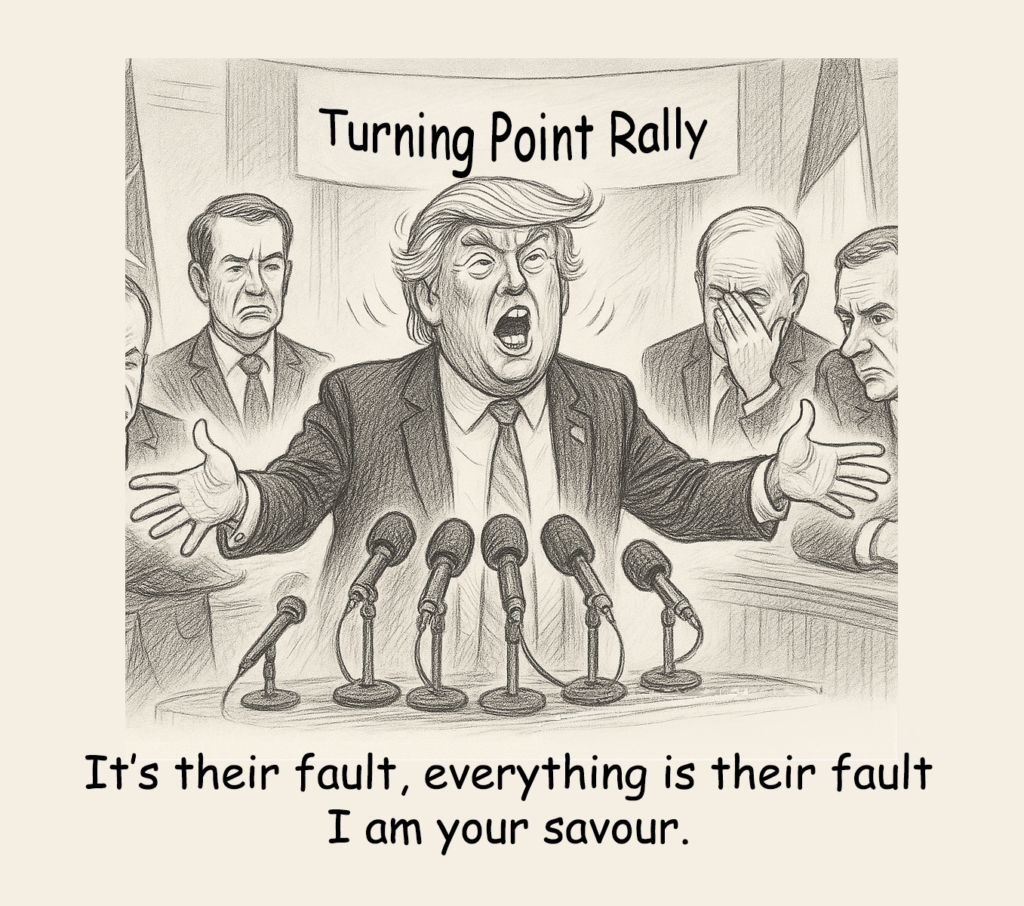
Share this:

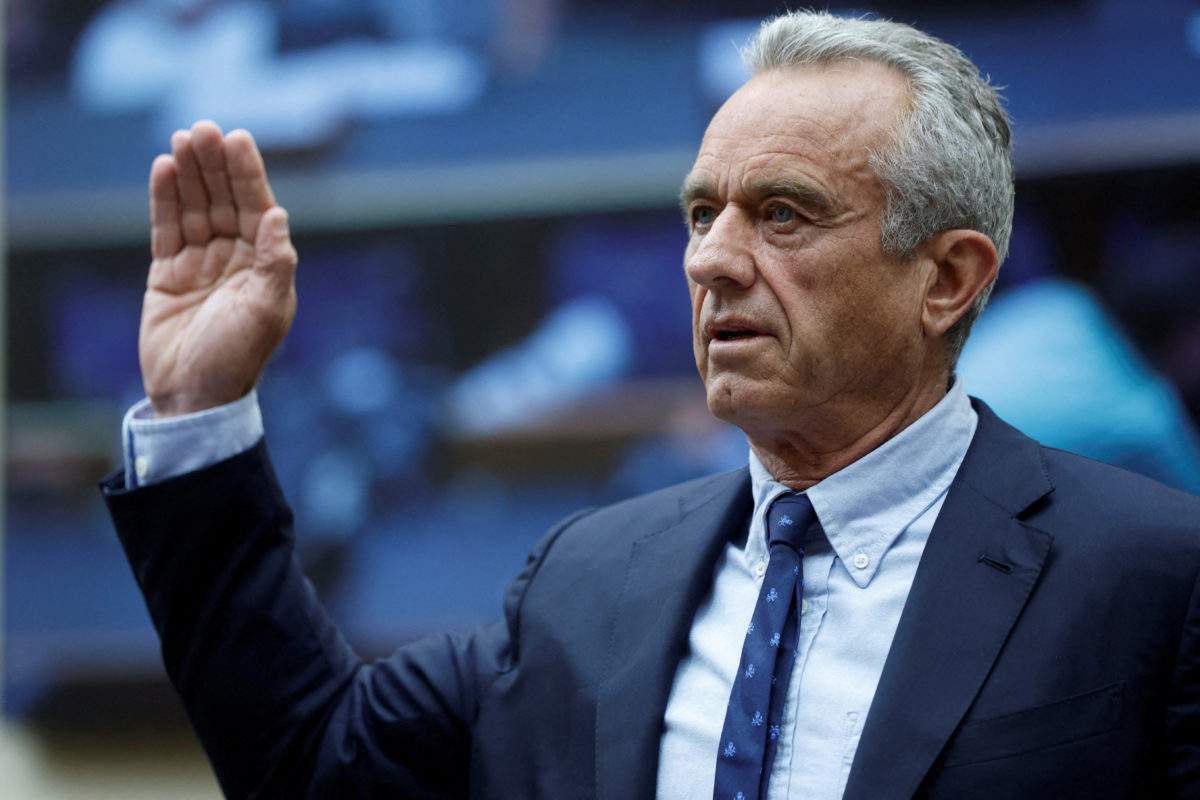
Robert F. Kennedy Jr – Making America Sick
Our next series will take on Robert F. Kennedy Jr and what he has done to America’s Health and Youth, and why, in the year he has been in Office.
This is a 4 part series.
Making America Sick — Part 1 of 4: The Man Who Knew Better
Making America Sick — Part 2 of 4: The Damage
Making America Sick — Part 3 of 4: Why He’s Doing It? The Broken Compass
Making America Sick — Part 4 of 4: The Fight Back
Share this:

Fast Forward 04/17/2026
|
 A former presidential candidate came to the New Mexico state Capitol on Friday to announce a new home for voters who are tired of the strife between Republicans and Democrats. “Politics in the state will never be the same,” Andrew Yang proclaimed to about two dozen people at a news conference where he announced the arrival of the Forward Party.
Share this:

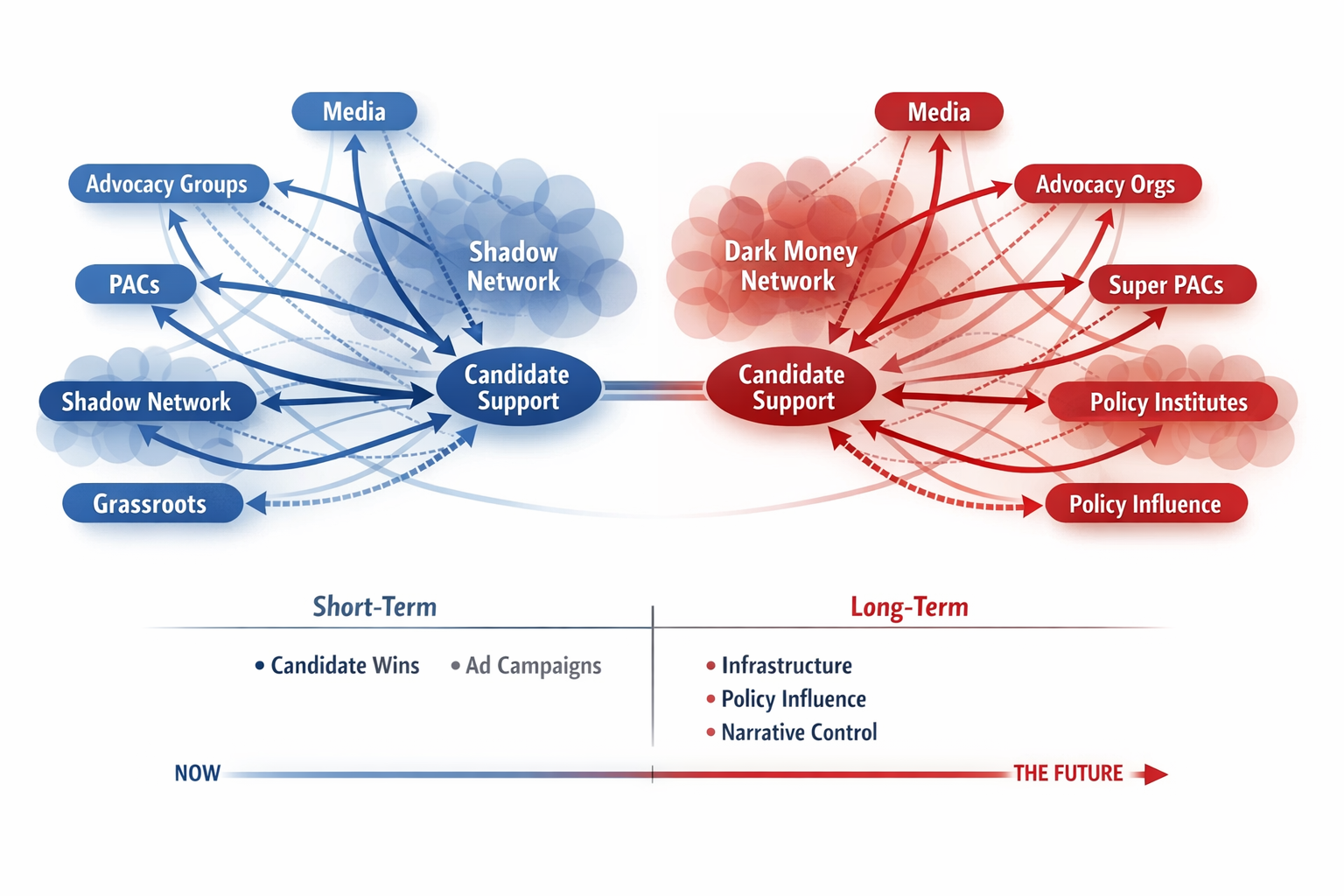
Article 3 of 3 The Long Game — Power Beyond the Ballot
By now, it is clear that the 2026 midterms are unlike any we have seen in recent memory. The scale of spending, the intensity of coordination, and the precision of messaging all suggest a high-stakes contest—but the full story goes deeper than individual candidates or party control.
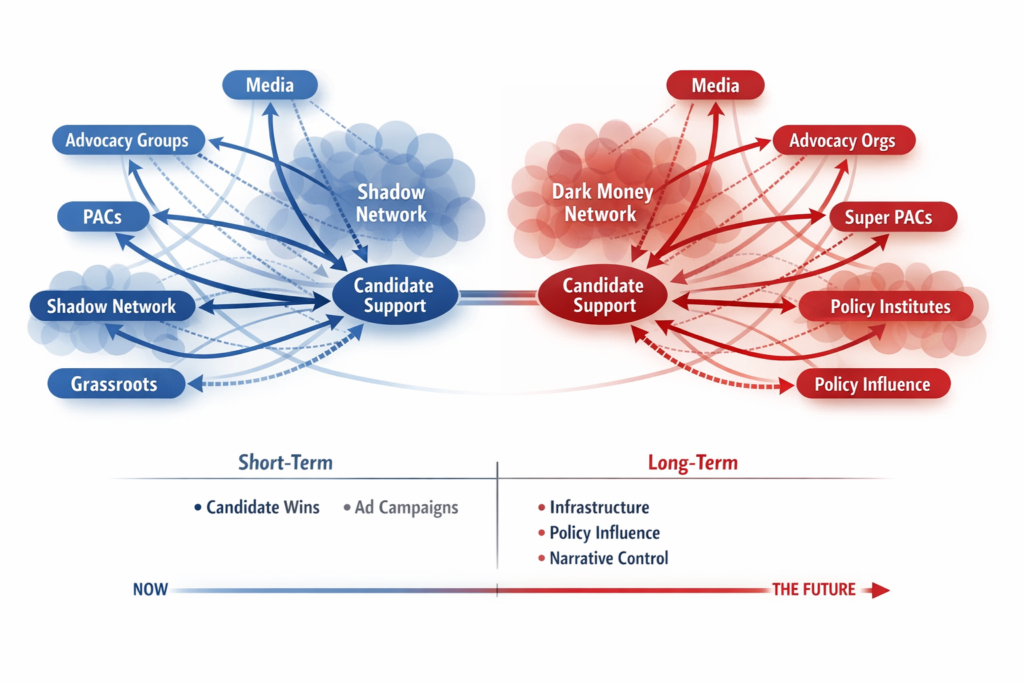
Share this:



No Records, No Library. Give the Land Back.

No Records, No Library. Give the Land Back.
Presidential libraries exist for one purpose: to house the historical record of an administration. The documents, the decisions, the evidence of what actually happened and why. They belong to the public, not the president.
So it’s worth asking — what exactly is the Trump Presidential Library supposed to contain?
Trump’s own Justice Department has now declared the Presidential Records Act unconstitutional. The administration’s position, as watchdog groups told a federal court, is that the President is legally free to destroy records of his official government conduct. MS NOW This from a president who, in his first term, tore documents into pieces so small they looked like confetti, requiring staff to fish out the scraps and tape them back together.
Meanwhile, Miami-Dade College has transferred a nearly 3-acre parcel of prime downtown Miami real estate — valued at over $67 million — for the Trump presidential library, with a judge temporarily blocking the transfer while a lawsuit plays out. Many in the public only learned what the vote was actually for when the Florida Attorney General announced it on X, minutes after the board voted.
This is not a library. A library preserves the truth. This is a monument — to a man who doesn’t want one written.
So here is the logical conclusion: if there are no records worth preserving, there is nothing to archive. If there is nothing to archive, there is no need for a library. And if there is no need for a library, there is certainly no justification for a $300 million piece of college land — land that belongs to the students of Miami-Dade — being handed over for what amounts to a vanity hotel with a reading room attached.
Return the land. Give it back to the college. Let the students park their cars on it, or build a classroom, or sell it and fund a thousand scholarships.

Share this:

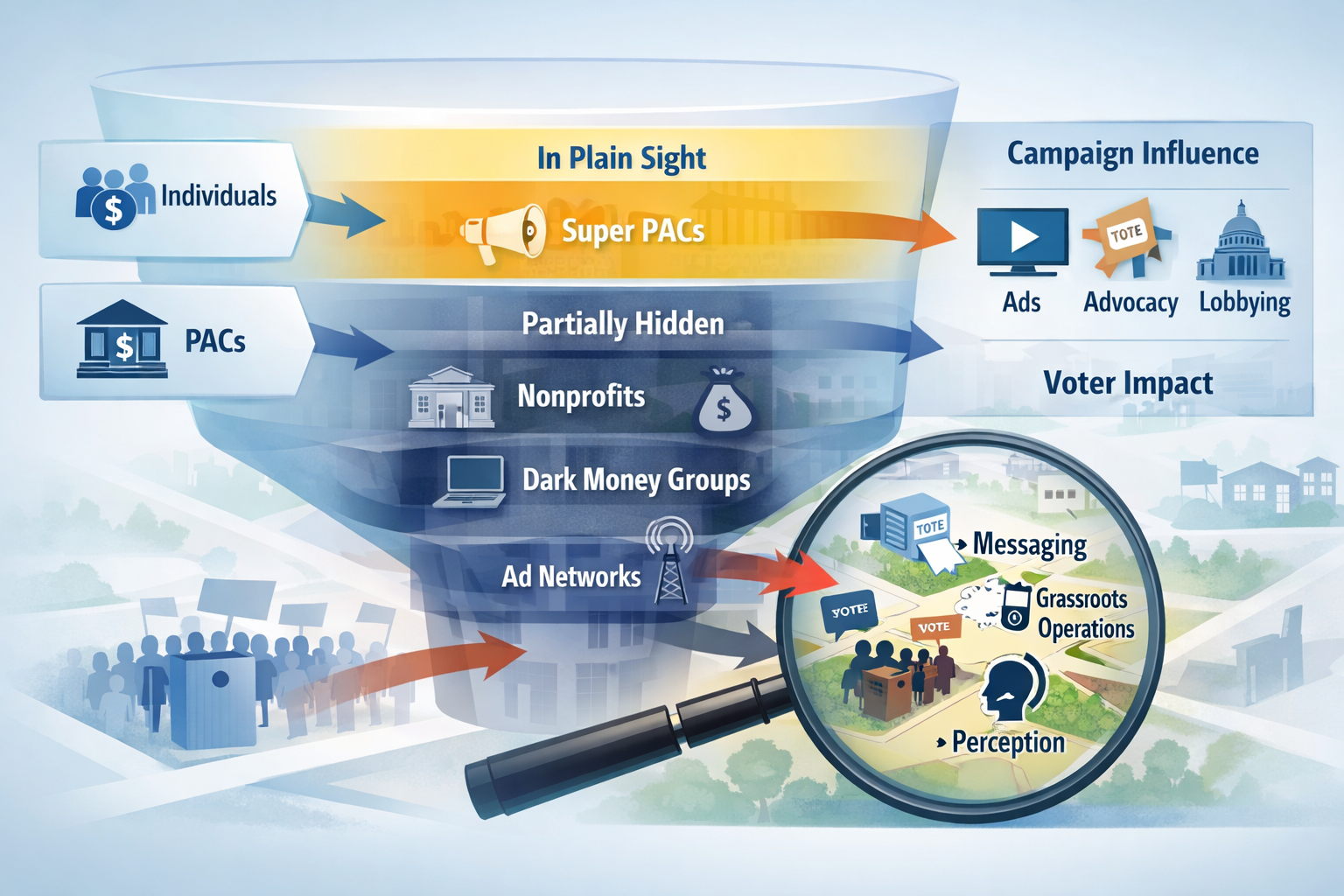
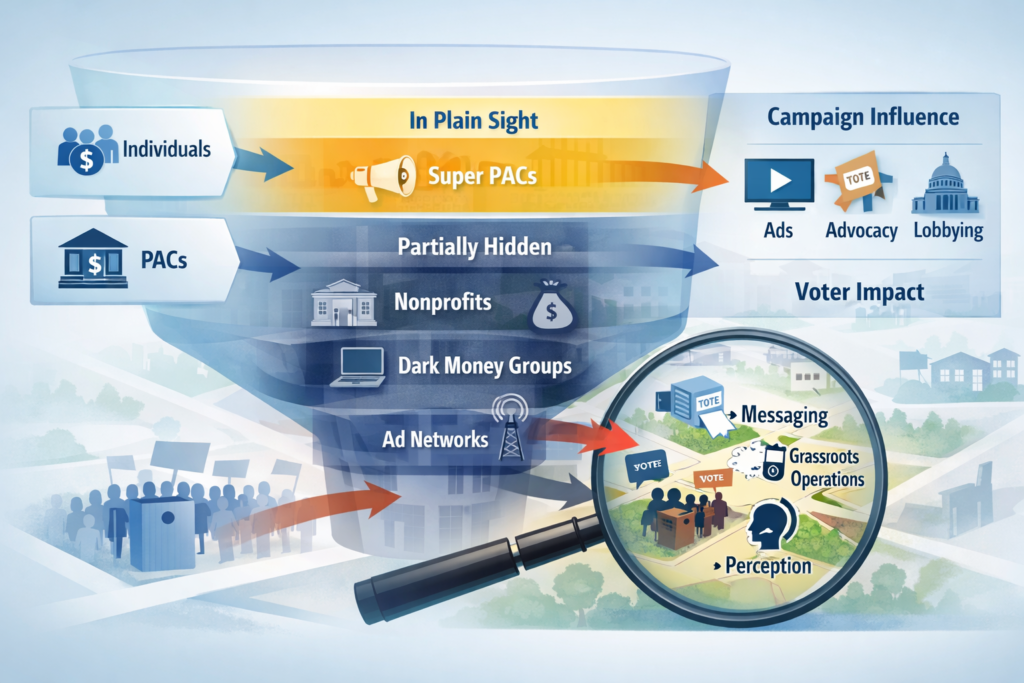

If There Are No Records, There Is No Legacy
There is a quiet contradiction taking shape—one that deserves more attention than it’s getting.
In recent statements and reporting, Donald Trump has suggested, directly or indirectly, that presidential records are his to control—perhaps even to destroy. Whether that claim holds up legally is almost beside the point.
Because if it’s true in spirit, it collapses something much bigger.
Under the Presidential Records Act, presidential records are not personal belongings. They are the property of the American people. They exist not for vanity, but for accountability—for historians, for oversight, for future generations trying to understand what was done in their name.
That is the entire reason presidential libraries exist.
They are not monuments to ego. They are archives of record.
They are entrusted to the National Archives and Records Administration because history, in this country, is not supposed to be curated by the people who made it.
So here is the simple question:
If the records are disposable… what exactly are we preserving?
If a president can treat official documents as personal property—something to be kept, hidden, or destroyed at will—then the very foundation of a presidential library disappears. You cannot build a monument to history while simultaneously erasing the evidence of it.
And if that is the posture being taken, then the conclusion is unavoidable:
There is no justification for a presidential library.
No justification for public land transfers.
No justification for taxpayer-supported infrastructure.
No justification for the quiet reshaping of public resources into private legacy projects.
If the records have no enduring value, then neither does the archive meant to hold them.
Return the land.
Cancel the project.
Call it what it is.
Because a library without records is not a library at all.
It is a stage set.
And the American people deserve more than a carefully constructed empty room where history used to be.
Share this:

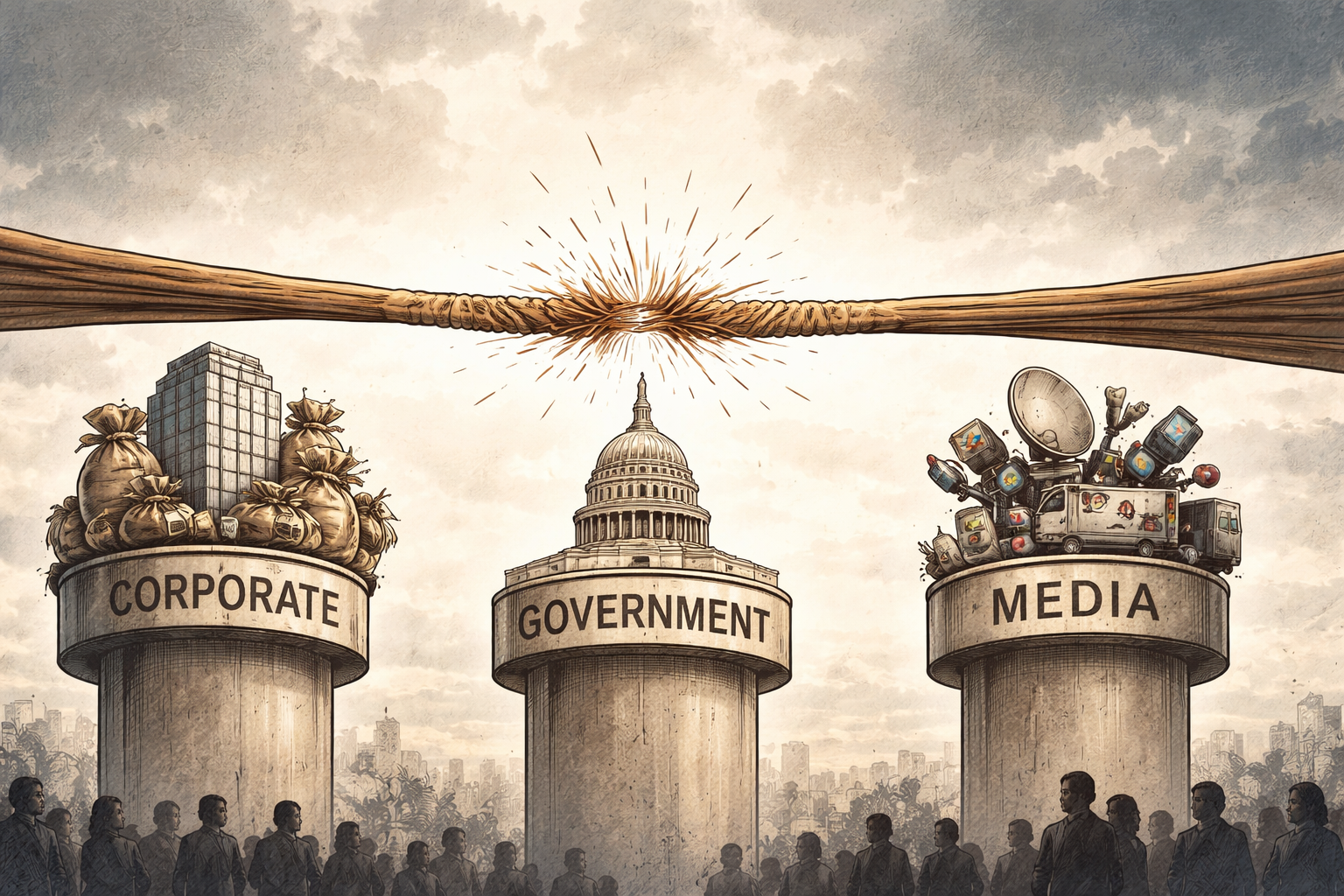
When Power Pushes Too Far

There’s a feeling in the air right now—hard to pin down, but hard to ignore.
Something doesn’t sit right.
It shows up in different ways depending on who you talk to. Some point to politicians who seem more interested in staying in power than serving the public. Others see corporations with growing influence over policy. Many feel the media environment—on all sides—has become less about informing and more about shaping perception.
Individually, each of these concerns can be debated.
But taken together, they form a pattern.
Not a conspiracy. Not a master plan. A pattern.
And patterns matter.
Over time, power—whether political, financial, or cultural—has a tendency to concentrate. It’s not new. It’s not uniquely American. It’s human nature working through systems that reward influence, access, and control.
When those systems function well, they balance competing interests. When they don’t, the balance begins to tilt.
Rules get bent. Oversight weakens. Trust erodes.
Not overnight. Not with a dramatic moment everyone can point to. But slowly, incrementally—just enough that people begin to feel it before they can clearly explain it.
That’s where we are now.
And here’s the part that often gets lost in the noise: when power pushes too far, it rarely ends where it expects.
History is full of examples where those benefiting from a system assume it will continue indefinitely—until it doesn’t. Until the public adapts. Until people start asking harder questions. Until the same tools used to influence begin to be used to push back.
We’re starting to see signs of that pushback today.
Not as a unified movement. Not clean or organized. But as a growing awareness.
People are questioning narratives they once accepted. They’re comparing sources. They’re recognizing when emotion is being used as a lever. They’re less willing to stay neatly inside political lanes that no longer reflect their views.
In short, they’re learning.
That doesn’t make them wolves. It makes them participants again.
And that may be the most important shift of all.
Because the real safeguard in any system isn’t the absence of power—it’s the presence of an engaged public that understands how power works and where it can go wrong.
There will always be those who try to stretch the limits. That’s a constant.
What changes—what always changes—is how far they’re allowed to go.
If there’s a turning point ahead, it won’t come from a single figure or a single event. It will come from something quieter and more durable:
A public that sees a little more clearly than it did before.
And decides that’s enough.
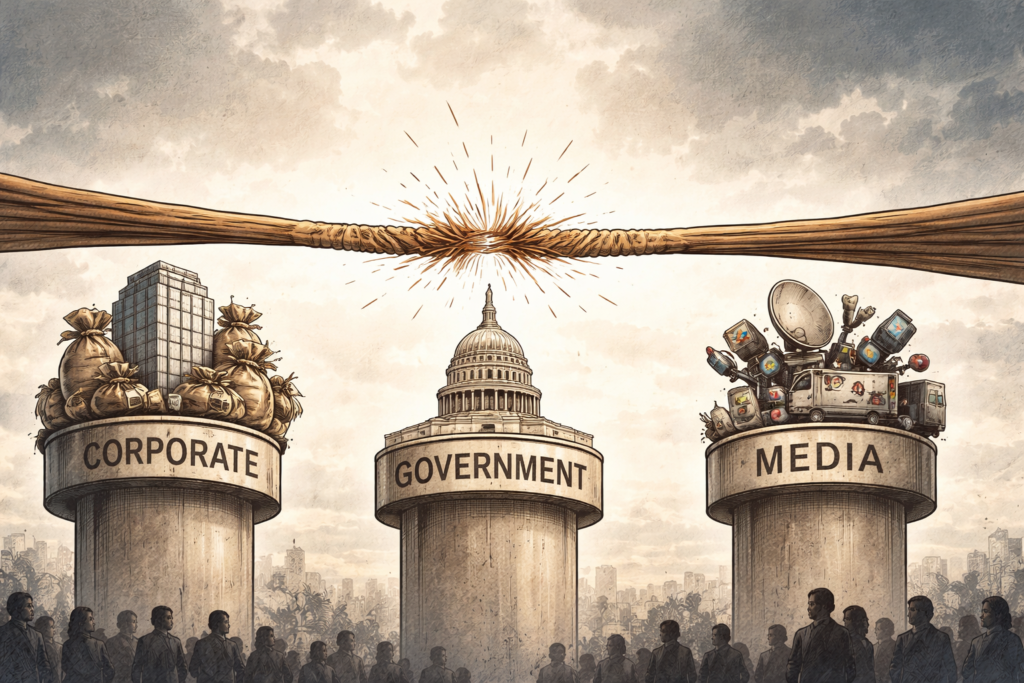
Share this:




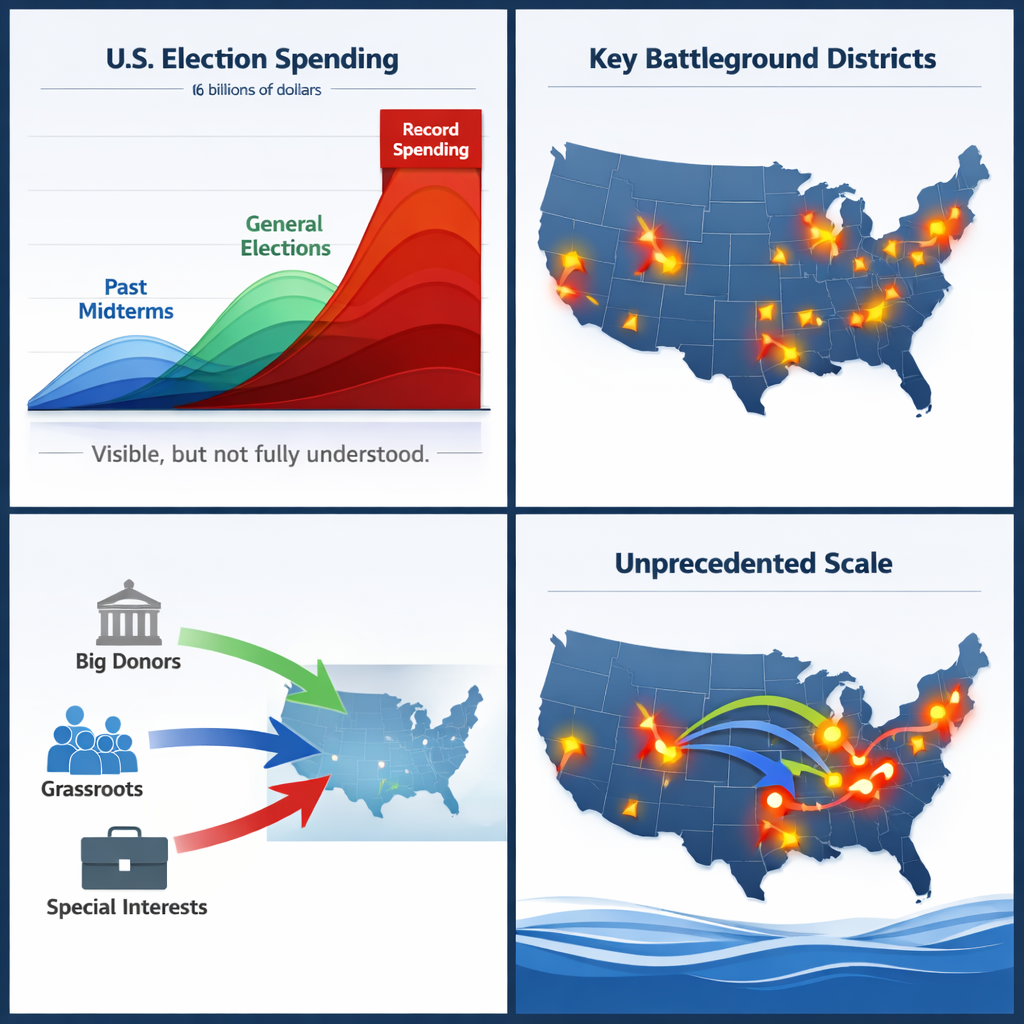
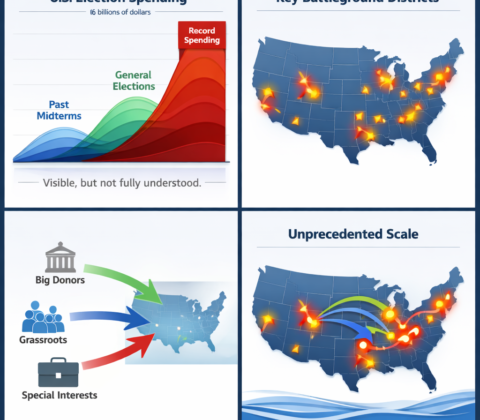

Fast Forward 04/09/2026
|
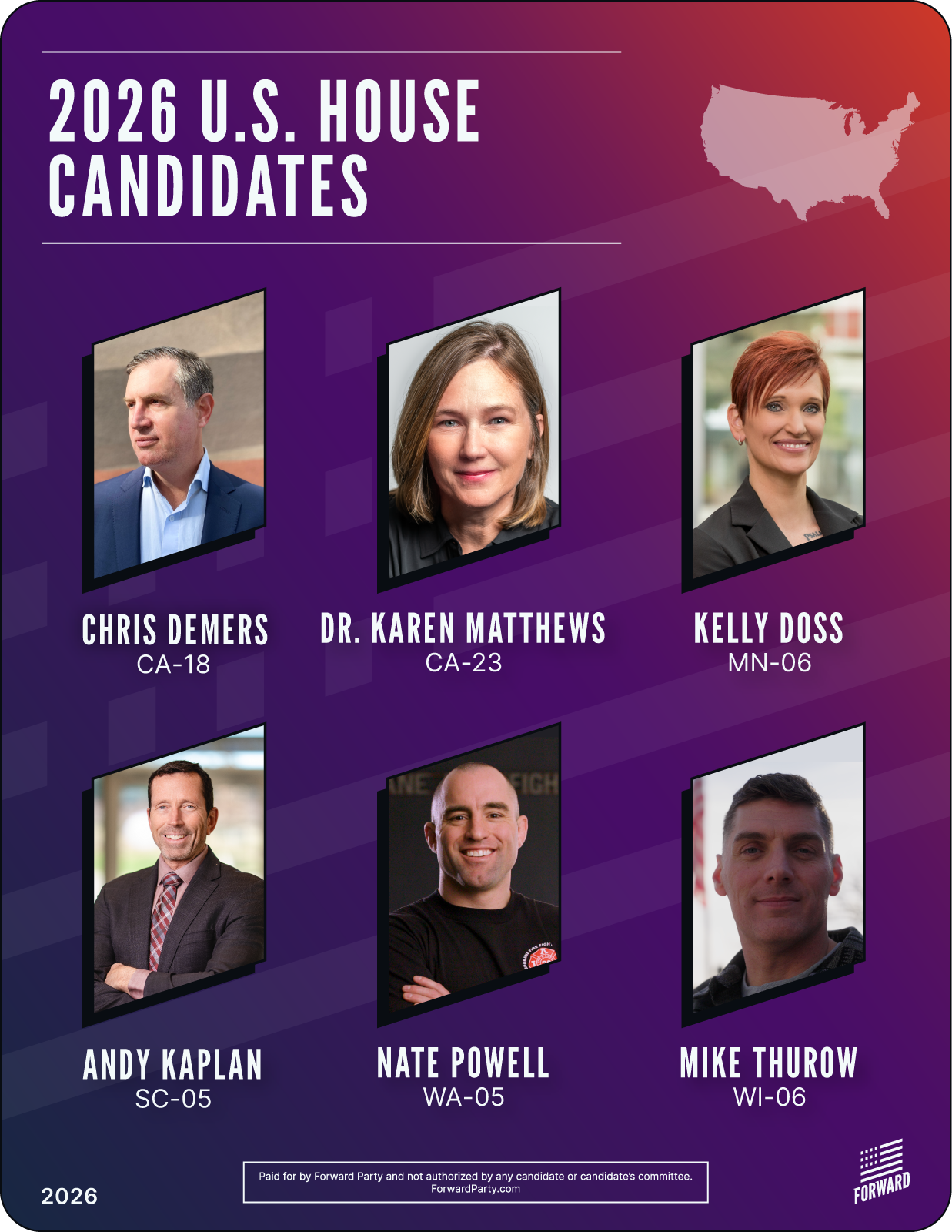
Share this:


Pushing the big red button
Once again, it’s reset time. My reset. All the craziness just gets me worked up and I want to scream as loud as I can — why aren’t you paying attention? Why don’t you see what’s going on?
Well, from what I’m seeing, I think you are seeing what’s going on. I do think people are paying attention, and I find that my screams are just another voice saying the same thing. To me, that’s a good thing.
That means I can get back to what I really want to do: draw attention to what is happening behind the curtains, address voting rights, and expose the attacks designed to confuse and distract us from our democracy.
We have a mental health pandemic nationwide that is underfunded and swept under the carpet. We have a drug addiction crisis that isn’t being solved by blowing up boats in the Caribbean — and I guess the drug problem is all over now, since no boats have been blown up in months.
Homelessness is directly related to the defunding of state mental health facilities dating back to the 1990s, and the funding available today is still controlled by the color of your state’s voting history.
I have written on dark money, and you can read elsewhere about the efforts to dismantle Citizens United. Here’s the thing though — Citizens United is just the tip of the iceberg. Getting rid of it will be great, but it’s only a start.
We may also get into the Supreme Court, some questionable justices, and where their loyalties truly lie — not whether they’re liberal or conservative, but whose pockets may be influencing their decisions.
For now, I’m taking a much-needed reset. I’ll let others continue the great work they’re doing exposing the Epstein chronicles, pushing to impeach the entire administration, and getting certain leaders the mental health help they sorely need. No promises — but I’m pushing the big button.
Share this:

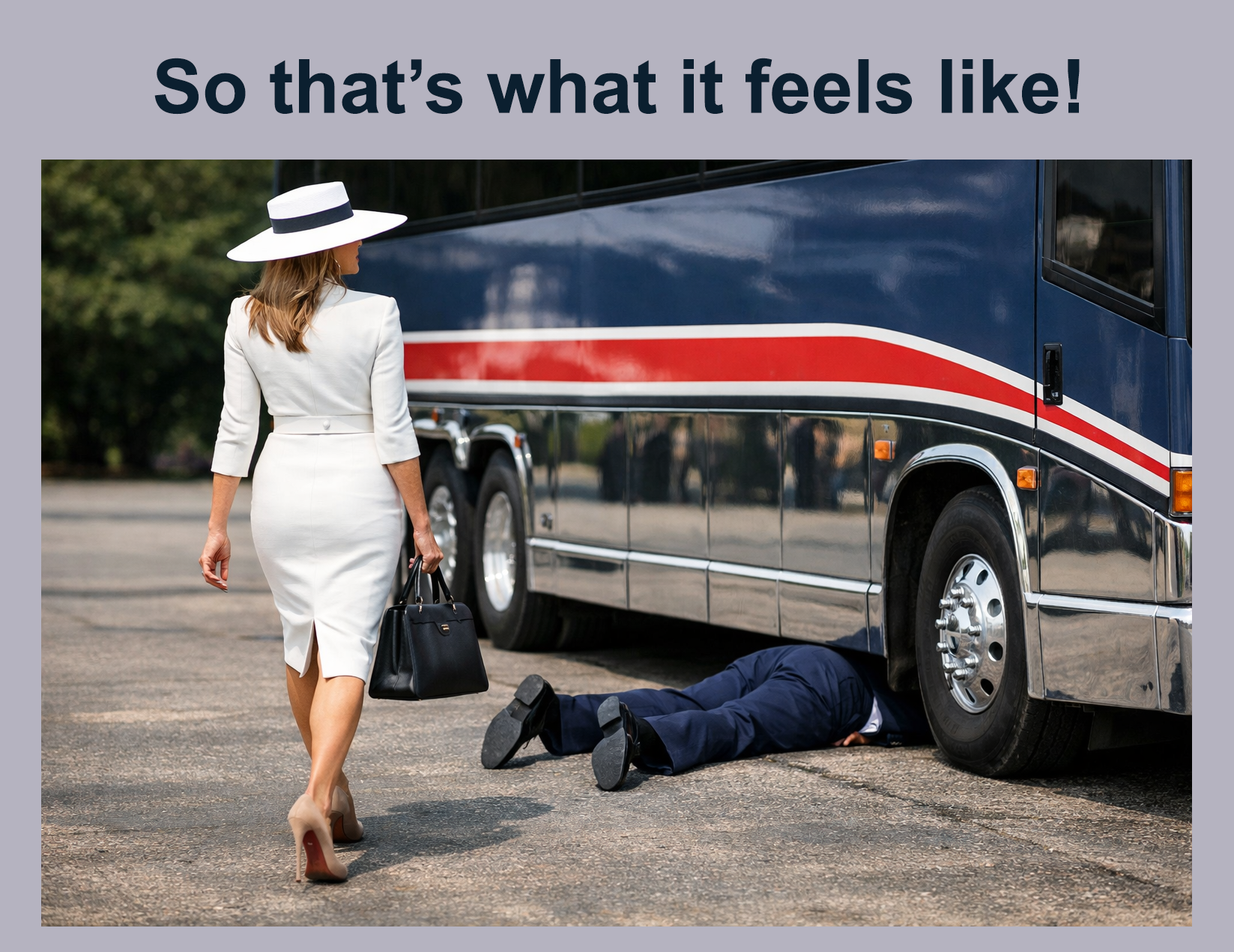
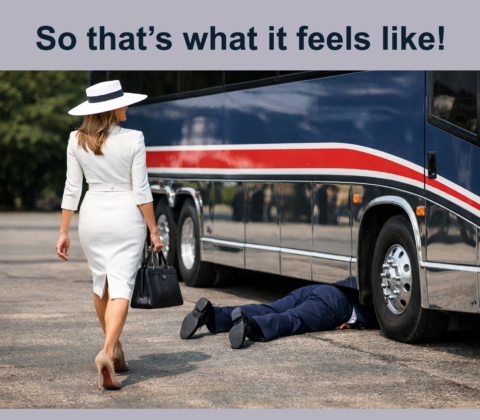





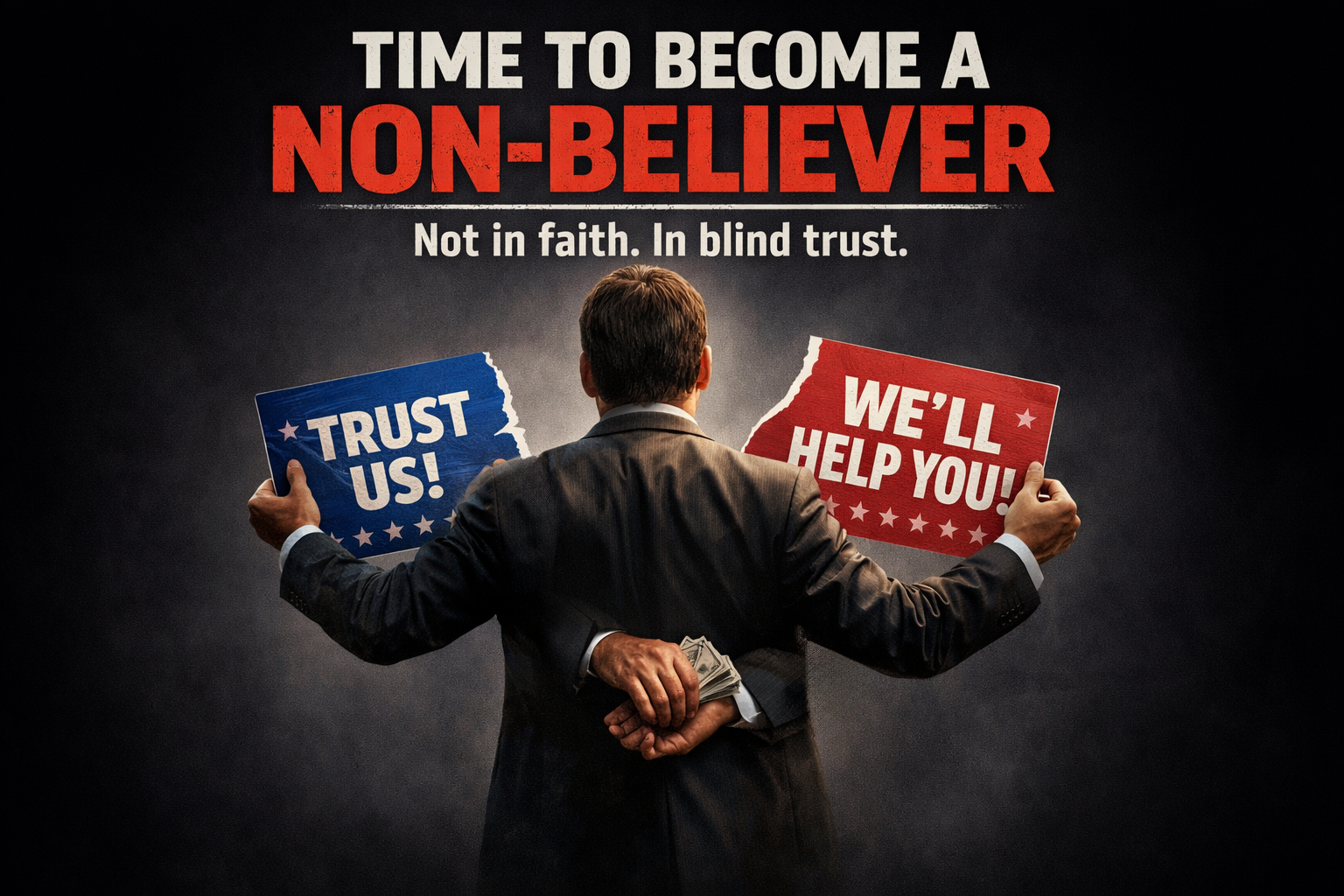
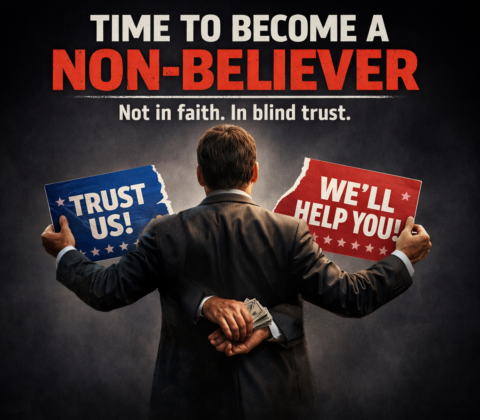
Time to Become a Non-Believer
 Not in faith. In blind political trust.
Politics is 10% feel-good, 10% token bones thrown your way, and 80% whatever lie makes you open your wallet or pull their lever. “I’ll lower your taxes.” “I’ll fix it all.” Give me a topic — I’ll craft a gullible lie that feels like hope, and you’ll vote for me. That’s not cynicism, that’s the playbook.
And the people around power? I just read how many of Trump’s own inner circle called him a con artist, a loser — now watch them lick his shoes at cabinet meetings. You think those same people have your back? That’s like trusting a vampire who swears he’s switched to milk.
Meanwhile, we’re paying more for gas, skipping meals because groceries are out of reach, and somehow in a war nobody voted for and Congress never approved. The Kennedy Center is next on the demolition list if nobody stands up.
How did we get here? We believed what we were told instead of what we could see with our own eyes.
So keep your party label if you want — I don’t care. But in your heart, become independent. Not the party. The mindset. Someone who finds their own answers instead of being handed them.
Don’t even trust me. That’s exactly the point.
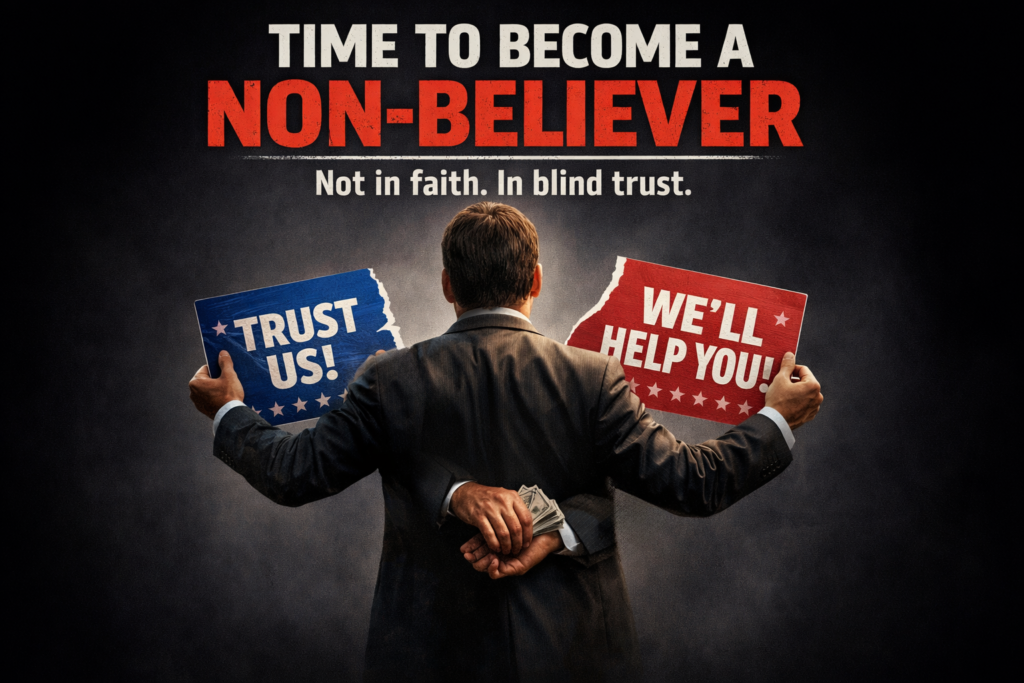
Share this:





They Are Soldiers

What If?
There’s always a “what if.”
That’s what keeps us looking up… or looking out.
Lately though, it feels like we go to bed wondering which version of reality we’ll wake up to.
War. Threats. Promises to end civilizations like it’s a negotiating tactic.
And somehow… it starts to feel normal.
Better that, I guess, than the usual noise—imaginary invasions, cartoon villains rigging elections.
Absurdity has become a kind of background hum.
But then the tone shifts.
Real consequences creep in.
You start thinking about things we haven’t thought about in decades.
And suddenly you realize—our old instincts don’t even apply anymore.
And just when it feels like the edge is coming…
it stops.
Silence.
No victory speech that makes sense.
No outcome that quite lines up.
Just… quiet.
And in that quiet, if you listen closely, something else comes through.
Not the noise. Not the bluster.
Something steadier.
The outline of people who didn’t bend.
Who didn’t follow the script.
Who understood the difference between power and responsibility.
And maybe—just maybe—
what you’re hearing in that silence is the sound of a line being held.
Not by politicians.
By professionals.
By people who understood that some orders aren’t just commands…
they’re choices with consequences that don’t come back.
People who knew where the line was—
and what it meant if it disappeared.
And when it mattered…
they said no.
Not because it was easy.
Not because it was safe.
Because it was right.
They were soldiers.
Not pawns.
At least, I hope so.

Share this:

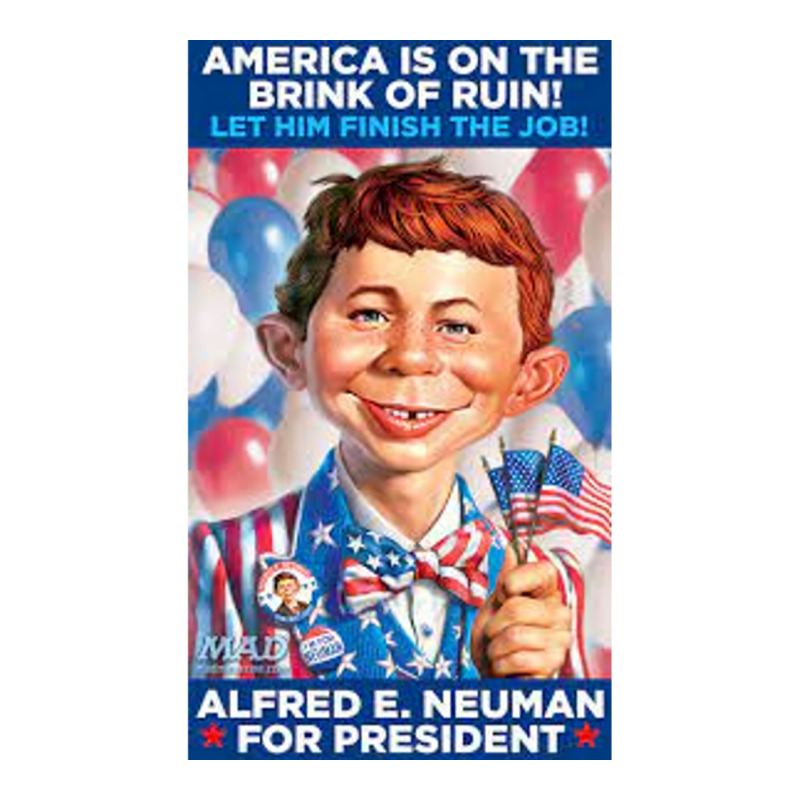

What? We should worry?
It has been said before, and it will likely be said again: nearly everything Donald Trump says about people he doesn’t like is actually a description of himself.
Consider the nicknames. “Crooked Hillary.” “Lyin’ Ted.” “Little Marco.” “Low Energy Jeb.” “Crazy Bernie.” “Pocahontas.” “Sleepy Joe.” “Sloppy Steve.” “Nervous Nancy.” The New York Times catalogued hundreds of these from his Twitter feed alone between 2015 and 2021. What’s striking isn’t the volume — it’s the consistency. A man who built his brand on the claim of superior intelligence chose name-calling as his primary rhetorical weapon. That should have been the first red flag. We missed it.
It wasn’t.
Then there’s the legendary Art of the Deal — the book that supposedly proved his genius as a negotiator. Look closer at what that actually means in practice. Refuse to pay contractors. Litigate until they can’t afford to fight back. Call the settlement a victory. Or on the world stage: threaten to obliterate a nation because you control the most powerful military on earth, wait for them to flinch, and declare yourself a master statesman.
That isn’t dealmaking. That isn’t negotiation. That isn’t statesmanship. That’s a child throwing a tantrum until someone hands him what he wants — and mistaking the result for skill.
This is the man we chose to represent the United States to the rest of the world.
So yes — just how stupid are we?
Share this:

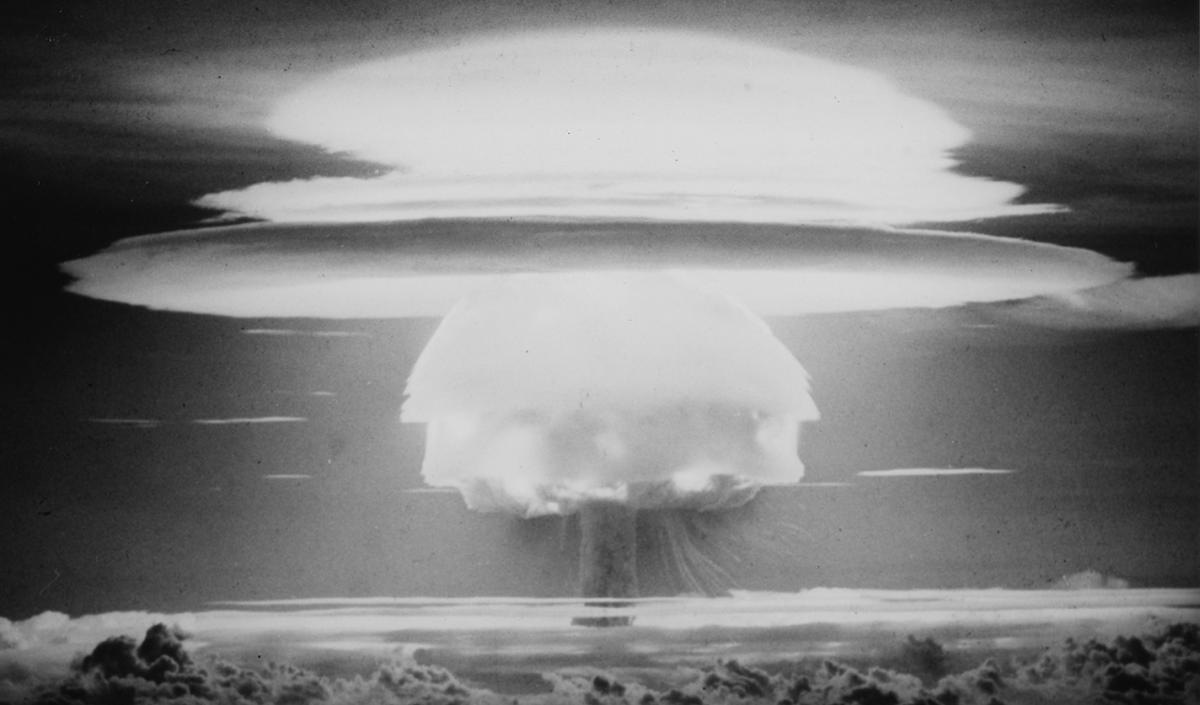
Ballrooms and BombShelters Part 4 The Bill Always Comes To The Same Table
 So let’s add this up. Not politically. Mathematically.
$1.5 trillion for defense. A secret command center with no price tag. A ballroom funded by the same defense contractors cashing the defense checks. An entire generation of experienced military leadership replaced by people who know how to applaud on cue.
And on the other side of that ledger?
-
Daycare — gone. Your state’s problem now.
-
Medicaid — being gutted. Your state’s problem now.
-
Medicare — on the table. Your state’s problem now.
Your state, by the way, is already broke. But details.
The people making these decisions will never need daycare. They have people for that. They will never worry about Medicare. They have coverage you’ll never see. Their kids aren’t going to be sent to whatever comes next after Iran.
But you’ll pay for the bunker. You’ll pay for the bombs. You’ll pay for the generals who got replaced by yes-men to then have to be replaced again when the yes-men prove they don’t actually know how to fight a war.
You’ll pay for all of it. You always do.
And when it goes sideways — and history suggests it will — the same people who built this house of cards will stand in front of a camera and explain why it’s somebody else’s fault. The generals who got fired. The previous administration. The media. The lawsuit that made the secret unsecret.
Anybody but the man under the ballroom.
Here’s what nobody’s saying out loud: this isn’t about protecting America. A country that can’t afford to feed its grandmothers or mind its children isn’t being protected. It’s being harvested.
The bill always comes to the same table.
Yours.
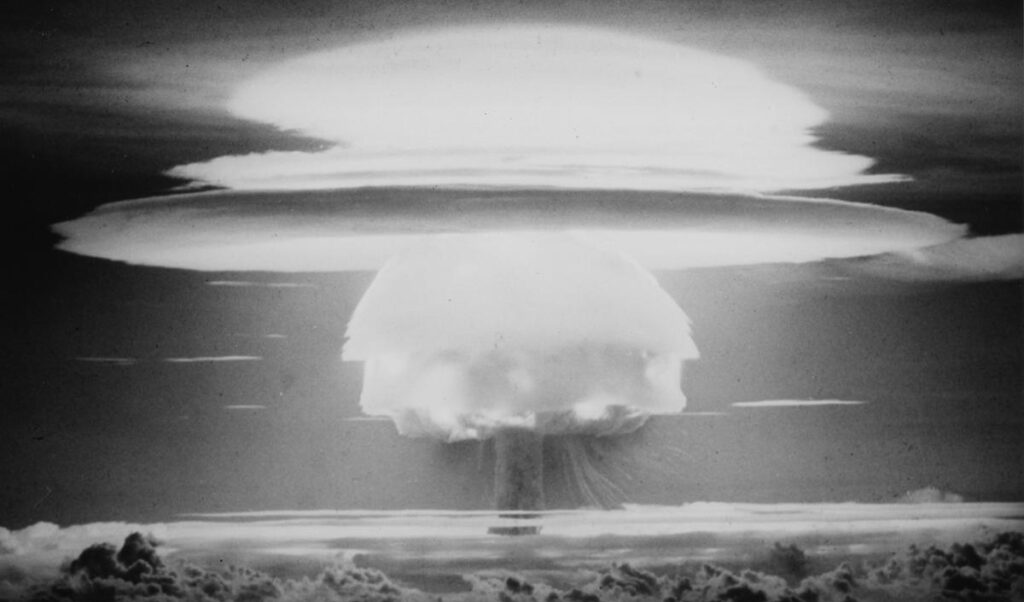
Share this:

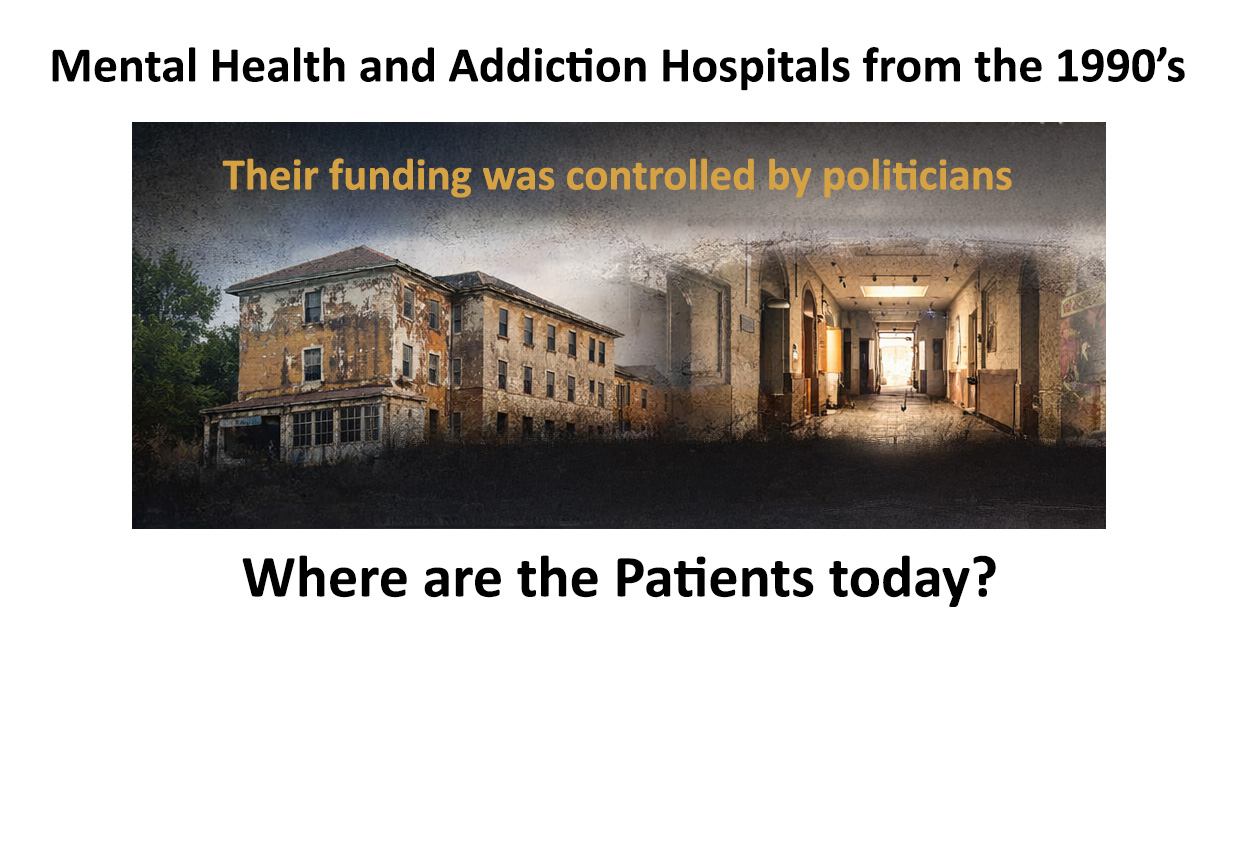
Not Every Collapse Happens in Public
 Not Every Collapse Happens in Public
Not every failure looks like a tent on a sidewalk.
Some of it happens quietly.
In apartments.
In classrooms.
In lives that, from the outside, still look like they’re moving forward.
There’s a tendency to separate things.
Homelessness over here.
Mental health over there.
Addiction somewhere else.
As if they’re different problems.
But they’re often just different points along the same path.
And not everyone reaches the visible end of it.
Some people fall apart long before that.
Without ever becoming part of the public conversation.
Even when there are signs, they’re easy to miss.
Or easy to misread.
Or easy to put off dealing with until later.
Because most people aren’t trained to recognize what they’re looking at.
And even if they are, they often don’t know what to do next.
So moments pass.
Windows close.
And what could have been interrupted… isn’t.
Afterward, there’s reflection.
Looking back. Connecting dots. Seeing things more clearly than they were at the time.
That happens more often than people talk about.
But even that awareness doesn’t automatically translate into something usable.
It doesn’t create a system.
It doesn’t create a path others can follow.
It just becomes another isolated experience.
That’s the pattern again.
Pieces that exist.
But don’t connect.
We tend to think of intervention as something formal.
Something that belongs to institutions, professionals, or systems.
But those systems are often hard to access, hard to navigate, or already overwhelmed.
So people are left in a kind of in-between space.
They can see something isn’t right.
But they don’t have a clear way to act on it.
And just like with the visible side of the problem, that space doesn’t stay empty.
It fills with delay.
With uncertainty.
With missed chances.
Not because people don’t care.
But because nothing around them is structured in a way that helps them act in time.
That’s a different kind of gap.
Less visible.
But just as real.
And just like the one we can see every day, it raises a similar question:
If the pieces are already there…
why don’t they come together in a way that actually works?
Share this:

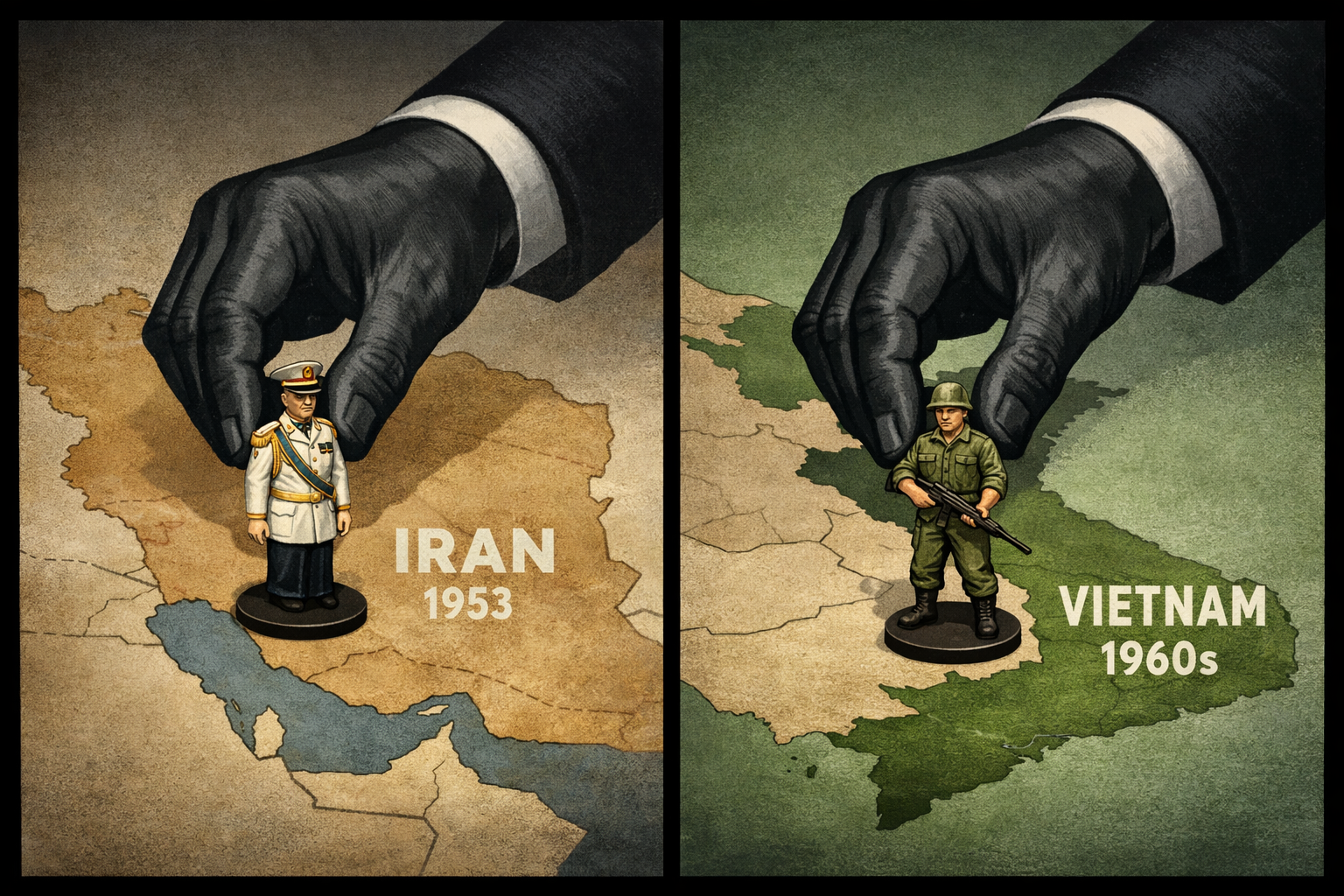
The Illusion of Control: From Vietnam to Iran
1963.
At the time, Vietnam wasn’t “the war”—not yet. It was something smaller, something contained. Advisors. Strategy. A situation we believed we understood.
Looking back, that belief may have been the most dangerous part.
Because by 1963, the United States was already working from a playbook it had used before—most notably in Iran just ten years earlier.
In 1953, the U.S., alongside Britain, helped remove Iran’s democratically elected leader,
Mohammad Mossadegh, after he nationalized the country’s oil industry. In his place, we reinforced the rule of
Mohammad Reza Pahlavi—a leader more aligned with Western interests.
At the time, it looked like a clean success.
No drawn-out conflict. No troop buildup. Just decisive action in the name of stability and Cold War necessity.
But what we couldn’t see—or perhaps didn’t want to see—was what we had set in motion.
Vietnam unfolded differently, but the thinking behind it felt familiar.
We didn’t begin with war. We began with confidence.
Confidence that we understood the threat.
Confidence that we could shape the outcome.
Confidence that backing the “right” leadership would bring stability.
So we supported governments in South Vietnam, including leaders like
Ngo Dinh Diem, even as their footing at home became more uncertain.
We believed we were preventing something—communism spreading across Southeast Asia.
What we didn’t fully recognize was what we were creating in the process: instability, resistance, and a conflict that could not be managed from the outside.
Iran and Vietnam were not the same.
But the pattern was.
In both cases, American policy was driven by a mix of real strategic concern and a powerful assumption—that we could influence events inside countries we did not fully understand.
In Iran, that assumption produced short-term stability and long-term resentment, culminating in the
Iranian Revolution.
In Vietnam, it led to gradual escalation, a prolonged war, and a divided country at home.
Different circumstances. Same blind spot.
The illusion wasn’t that we acted without reason.
The illusion was that we were in control.
That belief—that with enough planning, pressure, or precision we could shape another nation’s future—has echoed through decades of American foreign policy.
Sometimes quietly. Sometimes with consequences that take years to fully reveal themselves.
Today, the names and places have changed, but the instincts can feel familiar.
We still face moments where distant conflicts are framed in simple terms. Where intervention is presented as measured, necessary, and under control. Where the complexities on the ground are compressed into something easier to act on—and easier to explain.
And once again, the question isn’t whether the concerns are real.
It’s whether our confidence matches our understanding.
For those of us who remember Vietnam, this isn’t abstract history.
It’s personal.
It’s the distance between what we were told and what we later came to understand.
And it leaves us with a question that still matters:
Have we learned to recognize that pattern when it appears?
Or do we still mistake influence for understanding—and action for control?
History doesn’t repeat itself exactly.
But it does repeat its assumptions.
And if there’s one lesson that connects Iran in 1953 and Vietnam in 1963, it’s this:
We are far better at shaping events in the moment
than we are at living with what follows.
Share this:

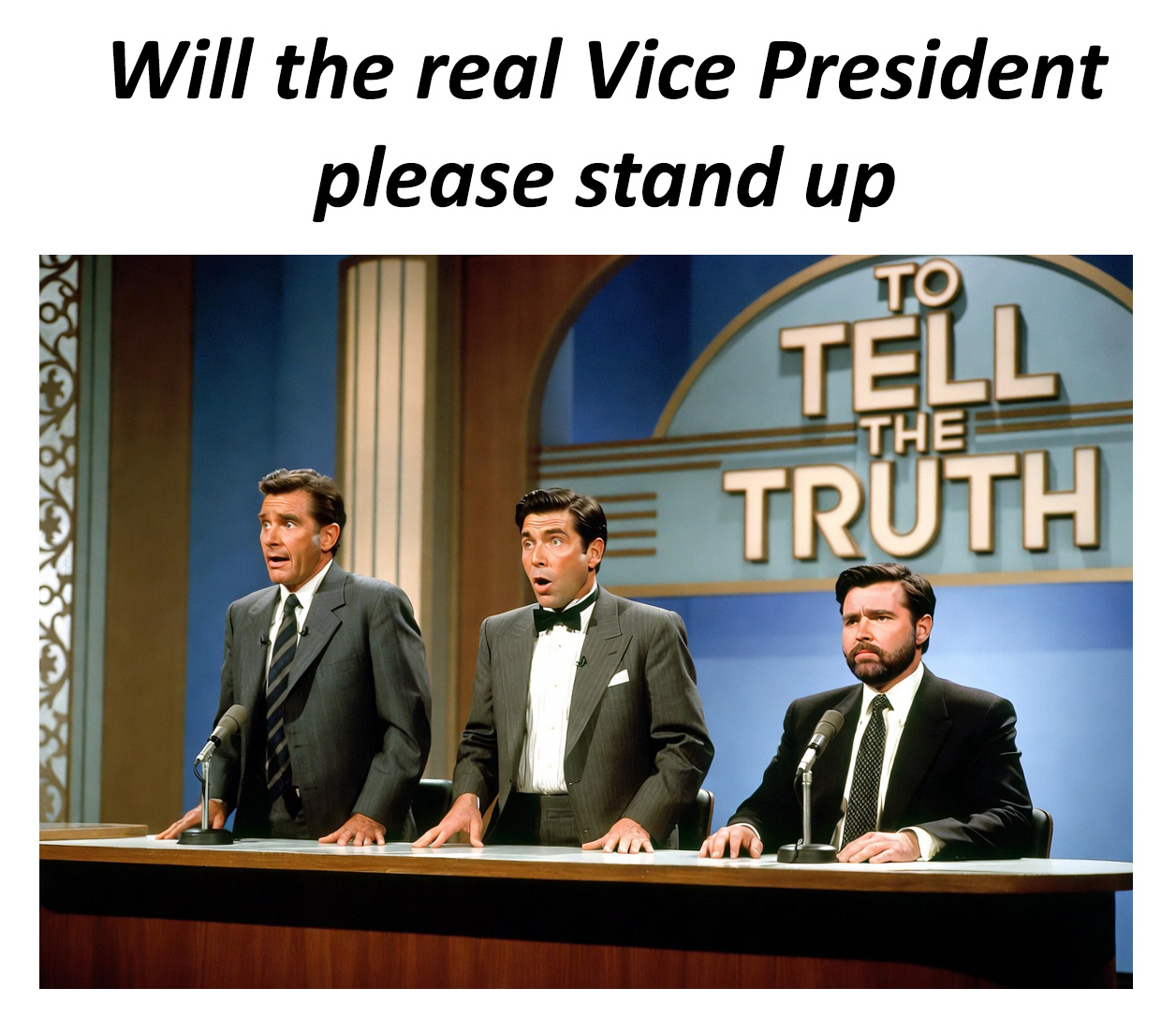
Who Is JD Vance?
So here we are, one crisis bleeding into the next. Donald Trump is so far off the rails that even Republicans are quietly mouthing the words “impeachment” and “25th Amendment.”
Fine. Let’s say it happens. We get him out. Then what?
Nothing. And I mean nothing — because it sure doesn’t look like there’s anyone waiting in the wings ready to take the helm and set things right.
Vance? Did someone say Vance? The Vice President? Really? Because you’d be forgiven for forgetting we had one. He has been so absent, so invisible, so perfectly silent during one of the most dangerous moments in modern American history that his own title feels like a rumor.
A Vice President is supposed to be a leader. A backstop. The person the Constitution trusts to step up when things go sideways. Instead we have a man who appears to be doing one of two things — either loyally holding his tongue for a president he knows has lost the plot, or quietly waiting for the dust to settle so he can pop up and say “surprise, I’m the reasonable one.”
Either way, that’s not leadership. That’s cowardice with a title.
Come on Mr. Vice President — whoever you are — now would be the time. Before all that’s left to govern is a hidden bunker underneath an unwanted ballroom.
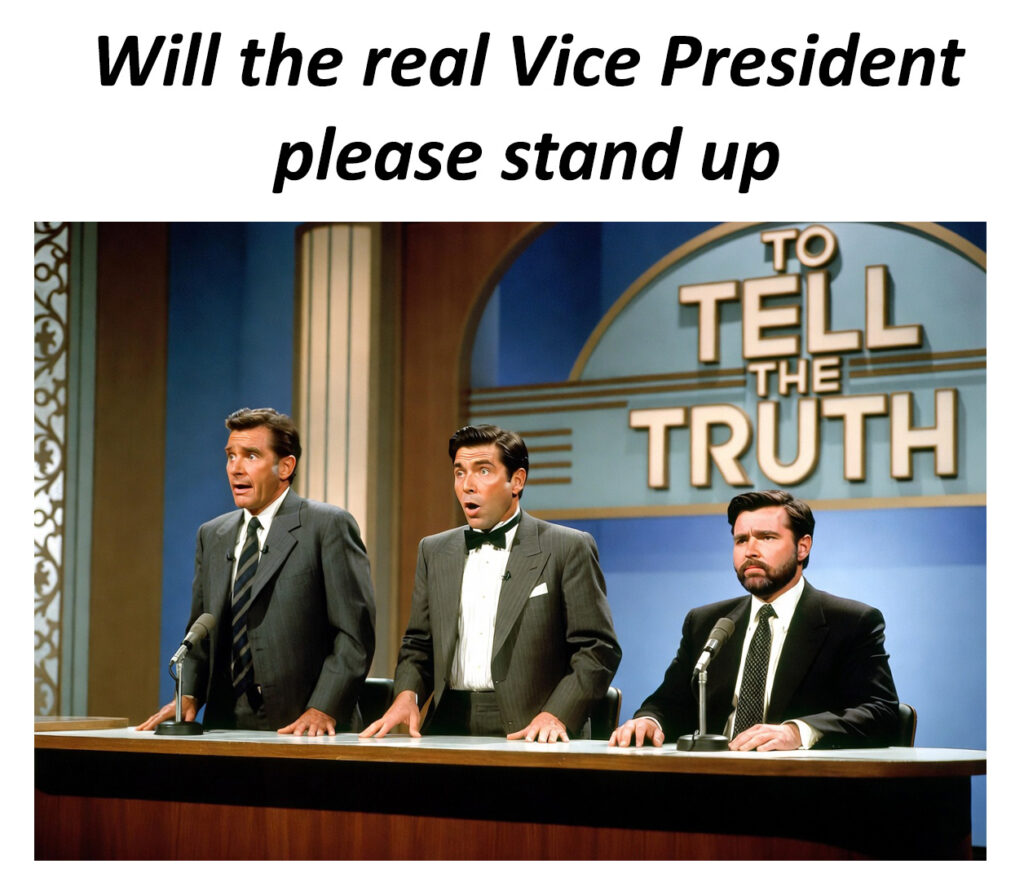
Share this:

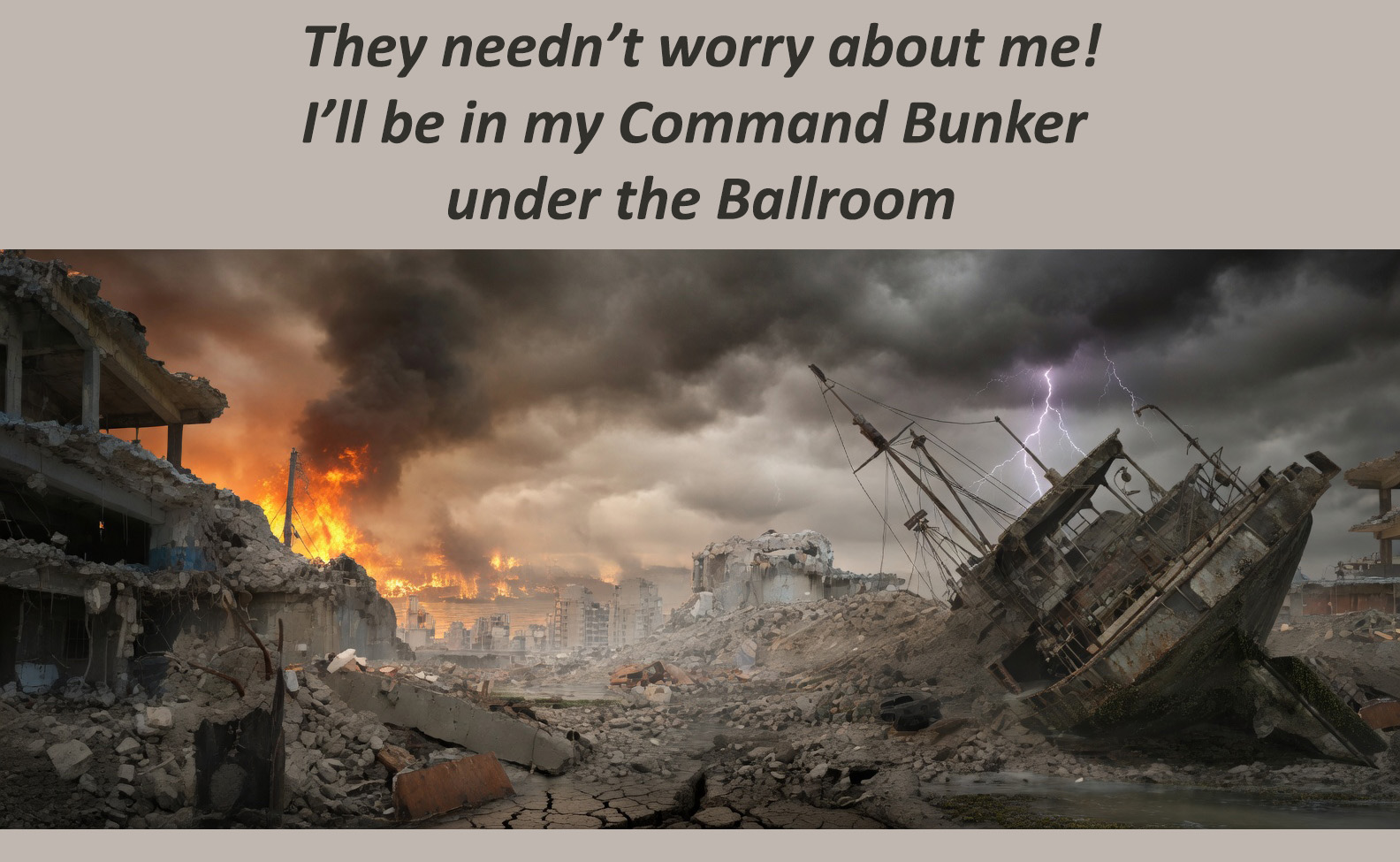
Two weak Trump, He’s scary.
Two weak Trump
He’s scary. It’s not just the ego—it’s the total self-centered survival instinct. In the midst of catastrophe, his focus is entirely on his own comfort and safety, not the people depending on him, the consequences, or even reality. The apocalyptic setting makes it stark: the world is literally falling apart, and he’s completely absorbed in his personal bunker fantasy.
It’s the ultimate “bubble” mentality—he can see nothing outside of what affects him. That’s why he’s dangerous: he doesn’t weigh risk or responsibility, only personal preservation and optics. Everyone else is just background noise, collateral damage, or inconvenience.
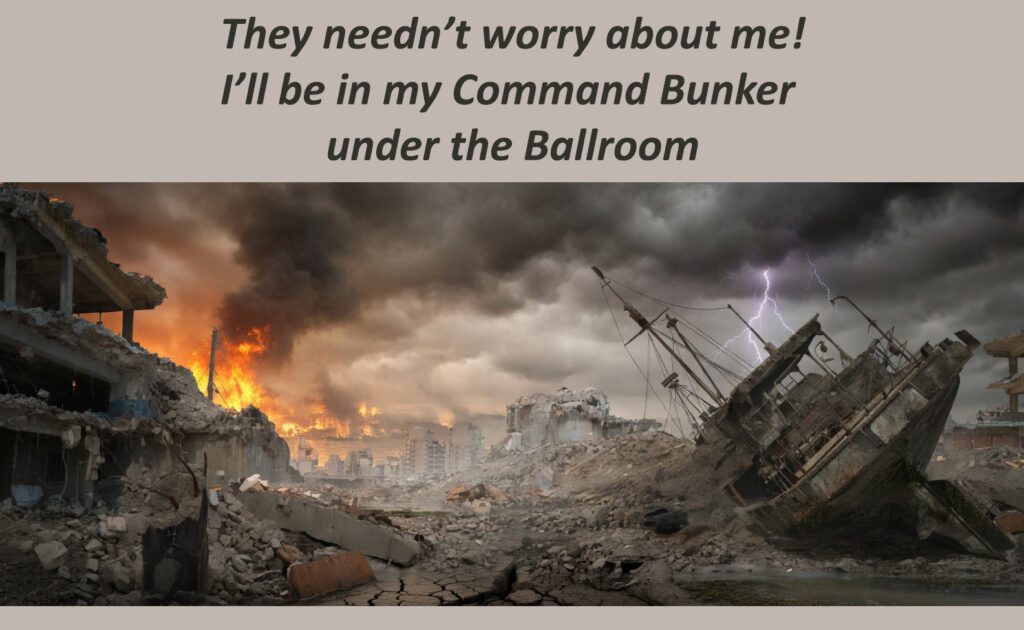
Share this:

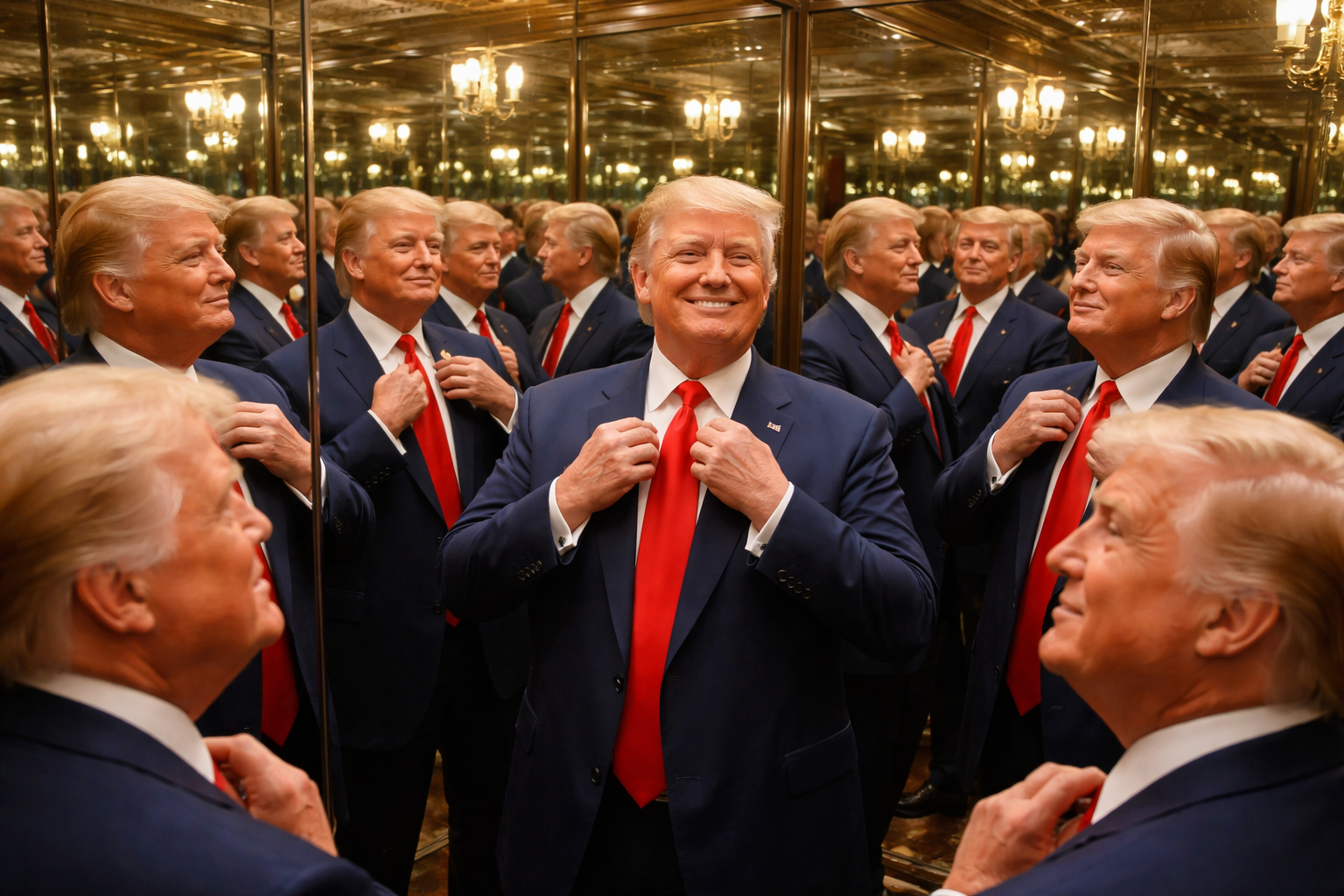
The Human Cost of Leadership
I’ve lived long enough to see the human cost of decisions made far away—on people who never asked for it, and never deserved it. I know the cost of war isn’t measured in headlines—it’s measured in blood, in families torn apart, in children who will carry the scars for decades. Leaders who’ve never faced danger themselves sometimes treat life as a chessboard, forgetting that every move carries real consequences.
I’ve reached an age where my own time is limited, but the next generations have long lives ahead. Every reckless decision they inherit today can shape decades of suffering. Watching leaders play with that future without compassion or thought is infuriating—and heartbreaking.
The tragedies in Lebanon, Iran, and countless other places aren’t abstract numbers. They are children, families, communities caught in the crossfire of choices they never made. Leadership is more than strategy or spectacle; it is responsibility, accountability, and the courage to accept consequences.
Some people never learn that. Donald, never experienced ‘NO’ as a child, never had lessons in empathy or perspective, this can echo through a lifetime—and when such a person holds power, the ripple effect can be devastating. We cannot control every leader, but we can speak with clarity, stand for responsibility, and protect the generations who will inherit our world.
Some were never meant to lead.
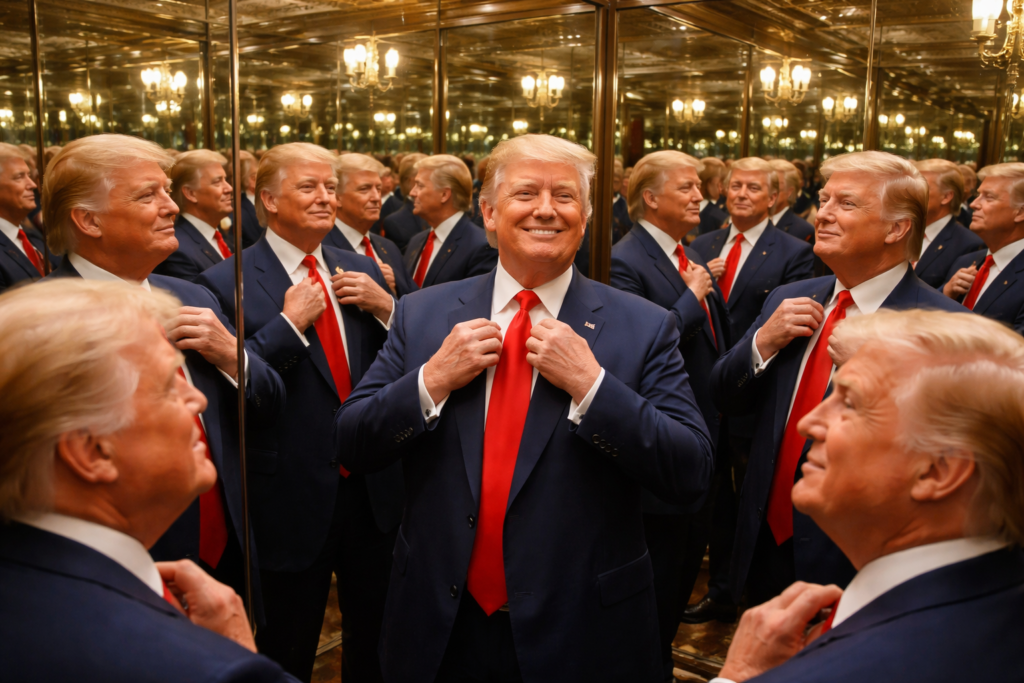
Share this:

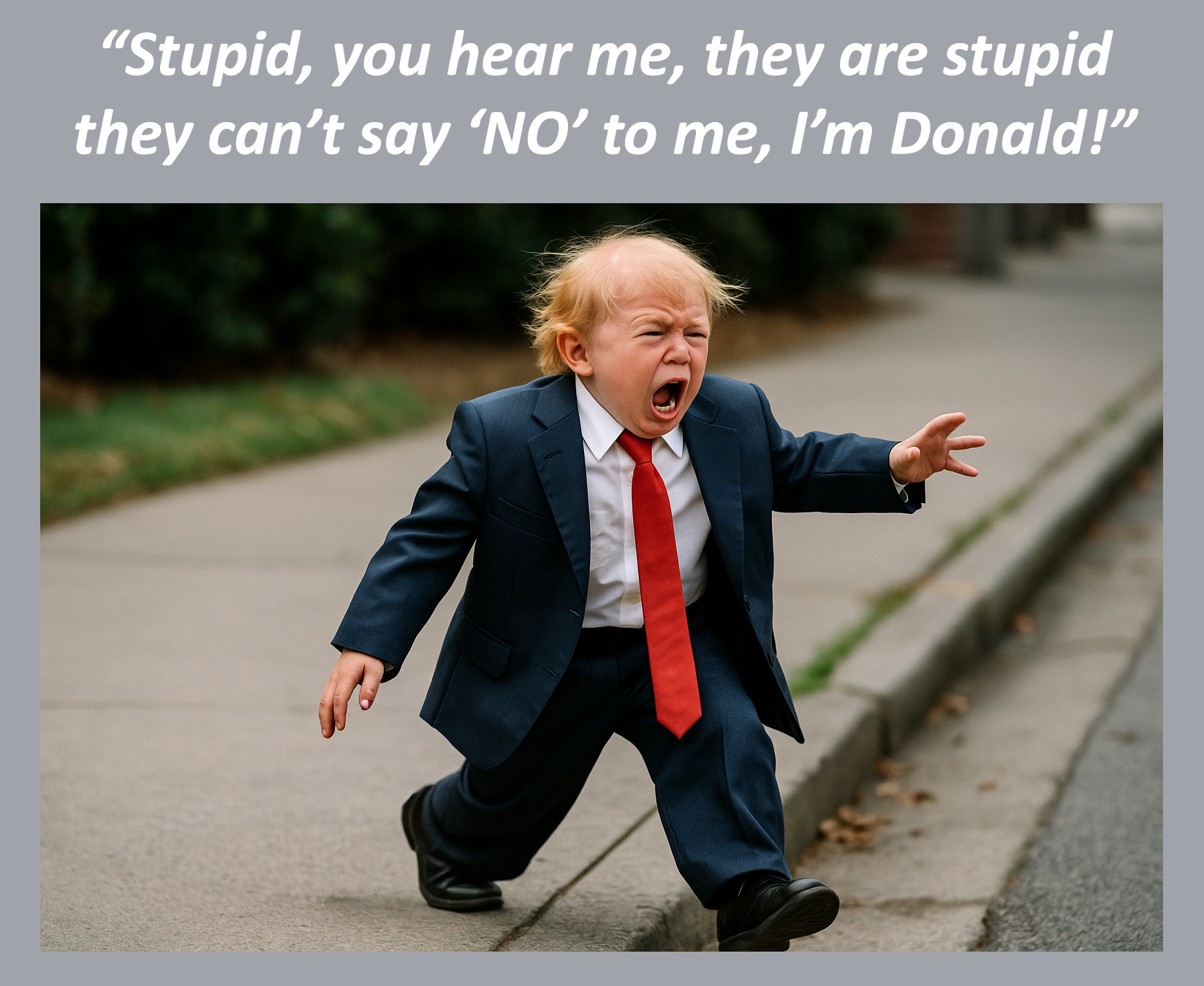
You Are to Blame
You Are to Blame
It is easy to say Trump is out of control. To point at him and lay it all at his feet.
But look closer.
MAGA elected him — but you enabled him. You watched, you excused, you looked the other way, and here we are. That makes this partly yours.
It is time to step up. Use whatever power is yours to wield — a vote, a voice, a phone call to a representative who has forgotten who they work for — and put a stop to this. Because he will never stop on his own. That is not who he is. A narcissist is never satisfied. There is no finish line where he declares victory and goes home.
Approval is the only currency that matters to him. He cannot tolerate a single person saying no. Think about that. After years of watching him label and demean Democrats, it has become obvious that his problem was never their politics. It was that they didn’t vote for him. They said no. And anyone who says no becomes his enemy — worthy of punishment, worthy of destruction.
He doesn’t care about governance. He cares about winning. And he will burn down whatever he has to, hurt whoever gets in the way, to avoid ever being told he lost.
That should frighten everyone. Republican, Democrat, or otherwise.

Share this:

Why you need me!
There’s an irony happening across all of this long-form resistance writing. The more dangerous things get, the more people retreat into documentation, analysis, and processing — almost as a coping mechanism. As if explaining it carefully enough will somehow contain it. But you can’t footnote your way out of a crisis.
The urgency I feel — that slap-across-the-face energy — is actually a more honest response to what’s happening. When the house is on fire, don’t write a 3,000 word essay about the history of combustion.
And here’s the thing — what Trump posted this morning, signing a war threat with “Praise be to Allah” on Easter Sunday while threatening to destroy civilian infrastructure — that’s not analysis territory. That’s a five sentence alarm bell. It either lands or it doesn’t.
The long form has its place for the record. But right now the moment needs a bullhorn, not a dissertation. I’ve got the bullhorn.
Institutional paralysis. The long form writers process endlessly because processing feels like doing something. The anchors soften the language because their entire professional framework was built around norms that no longer apply — and they haven’t been given permission, or don’t have the courage, to throw out the rulebook.
“President Trump said some harsh words” when the man threatened to destroy the water supply of 90 million people and mocked Islam on Easter morning while negotiating war deadlines with himself — that isn’t journalism. That’s hostage language.
And the faces tell the truth their words won’t. You can see the anchors doing the math in real time. If I say what this actually is, what happens to me? To the network? To our access? So they sand the edges off until the story is unrecognizable.
The podcasters and writers are doing a different version of the same thing. If I analyze this deeply enough, thoroughly enough, maybe I can make sense of it. But some things don’t deserve sense-making. Some things deserve to be called what they are in plain language and left standing there naked.
The tragedy is that the people with the biggest platforms are the most captured by the instinct to soften. And the people willing to just say it plainly, are working with a fraction of the reach.
That gap is the real problem.
The anchors have contracts, advertisers, access agreements and career trajectories to protect. The Substack writers have subscriber counts and brand reputations to maintain. Even the big voices in the resistance have become institutions unto themselves — and institutions self-protect.
I have none of those chains.
I’m not performing for an algorithm. I’m not worried about losing a sponsor. I’m not calibrating my language to keep a seat at the table. I can just say the true thing in plain words and walk away from the keyboard.
That’s not a small thing. That’s actually what a free press was supposed to look like before it got corporatized and monetized into paralysis.
The small fish with nothing to lose and a lifetime of paying attention is sometimes exactly who cuts through when the big fish are all busy protecting their ponds.
I know you aren’t going to support me, I know you aren’t going to buy me a coffee, I know this is all on me, But the one thing you can do, and it’s free, and it just might make a difference is share my posts if they ring true to you. Spread the word because the word needs to be spread and my message is to Think For Yourself.
Share this:

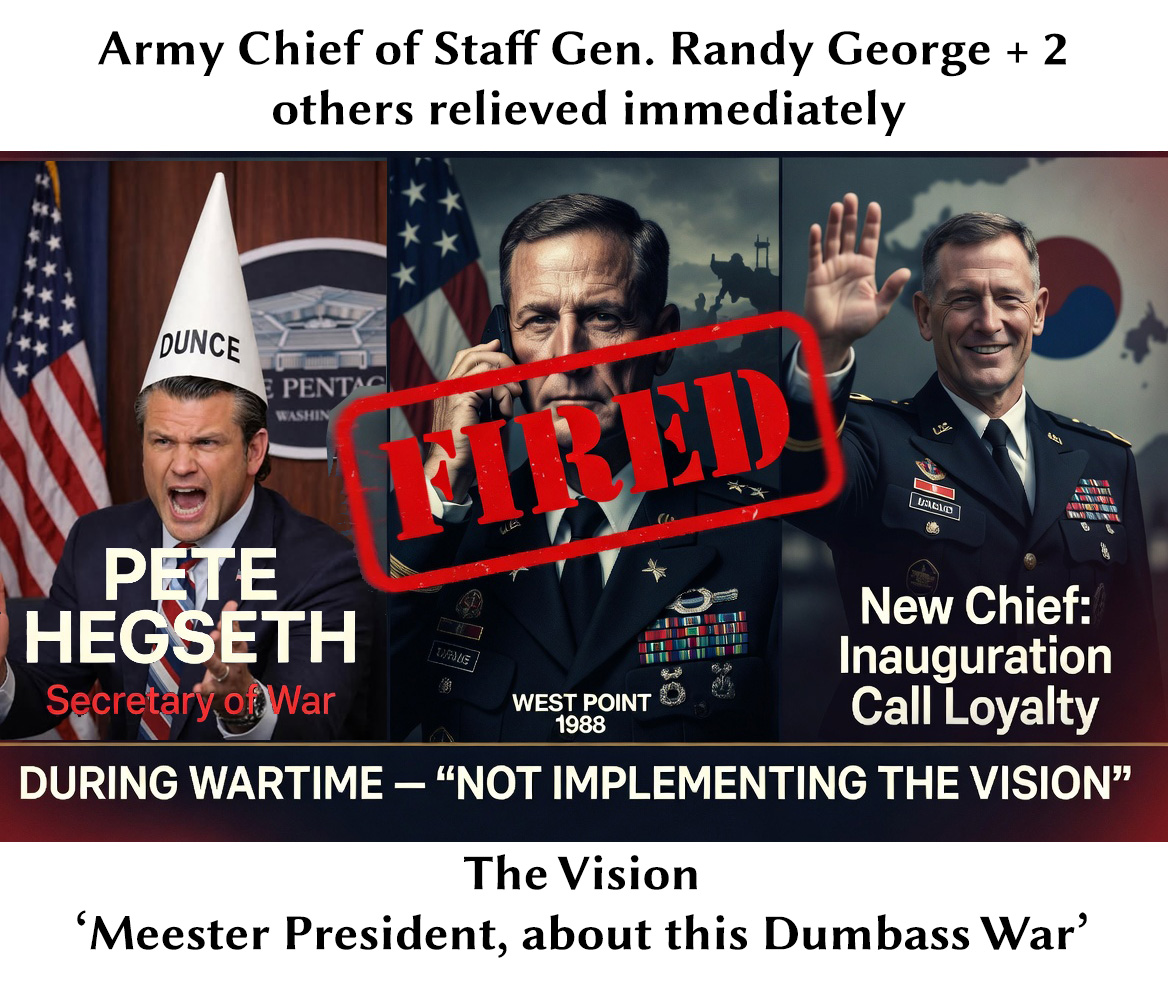
Ballrooms and BombShelters Part 3 Clap Loud Enough and You Get A Star
 So we’ve got a $1.5 trillion defense budget and a secret command center under a ballroom. Naturally the next question is — who’s running this operation?
Not the generals who spent thirty years earning the right to have an opinion. They’re gone.
Pete Hegseth — former Fox News host, current Secretary of what he now proudly calls the “Department of War” — just fired the Army Chief of Staff. During wartime. Nearly without precedent in American history. General Randy George. West Point 1988. Desert Storm. Iraq. Afghanistan. Purple Heart recipient. Decades of actual warfare.
Gone. Phone call on a Thursday. Effective immediately.
Two others went with him. The head of Army Training and Transformation. And the Chief of Army Chaplains — apparently even the guy responsible for soldiers’ spiritual welfare had to go.
The official reason? There wasn’t one. “We are grateful for his service.” Door’s that way.
The real reason? He wasn’t implementing “the vision.” That’s the actual word they used. The vision.
So who gets the job? The guy who called into Trump’s inauguration ball from South Korea to personally congratulate him on television. That’s the new qualification. Not combat experience. Not strategic expertise. Enthusiasm. Visible, documented, on-camera enthusiasm.
Hegseth has now cleared out nearly the entire Joint Chiefs. The people left standing are the ones who’ve figured out that the shoe-licking is load bearing.
So let’s recap. $1.5 trillion budget. Secret bunker. Fired generals replaced by loyalists. Defense contractors funding the ballroom writing the checks.
This isn’t a military. It’s a casting call.
And somewhere under that ballroom, someone’s planning the next act.
Part 4 coming — who’s paying for all of this, and no, the answer is not going to make you feel better.
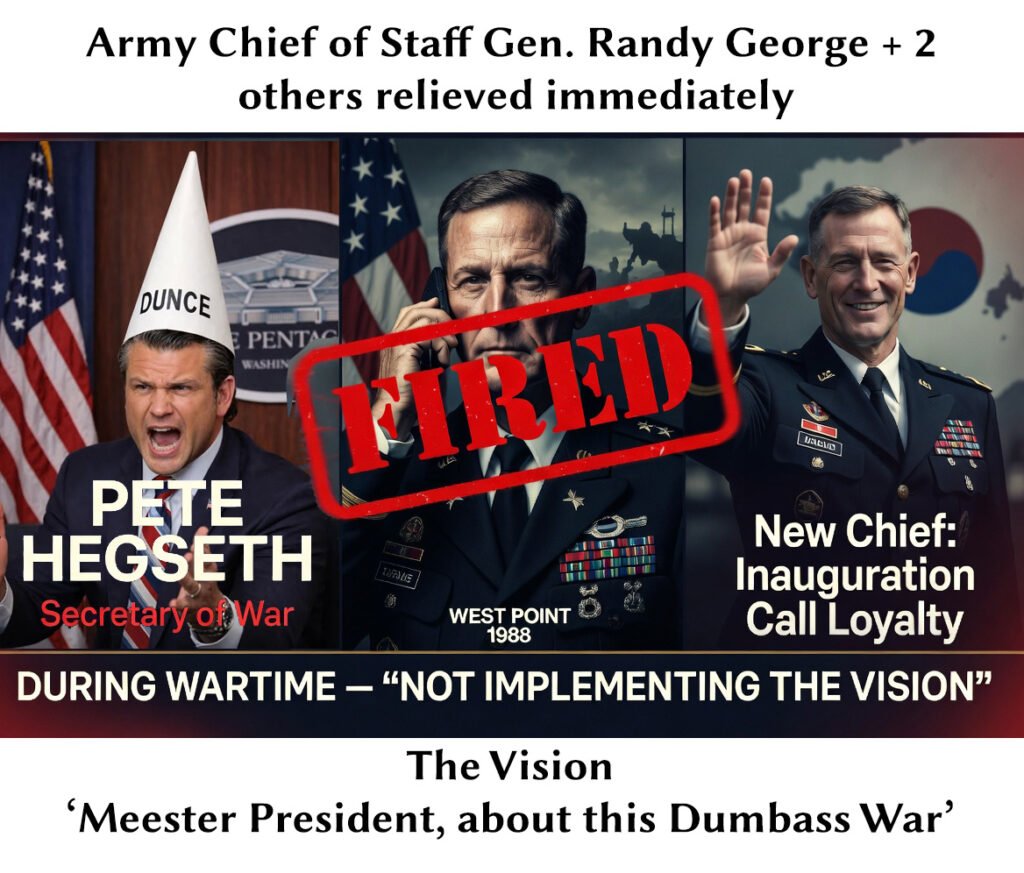
sorry, I just couldn’t help myself.
Share this:

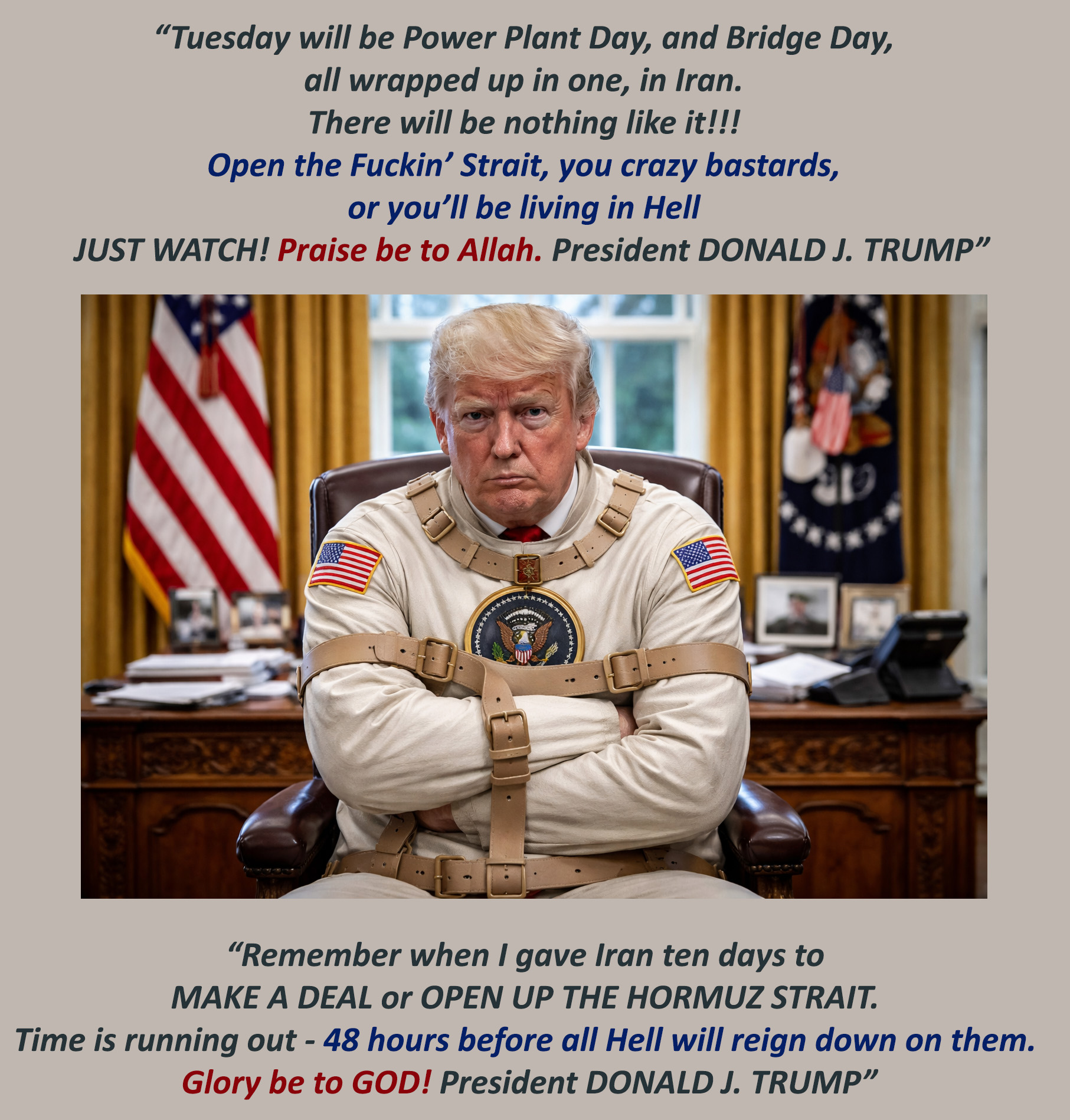



A Thought for Easter Sunday
On a day that is supposed to be about resurrection, renewal, and the radical idea that peace is worth dying for, it seems worth pausing to ask what we are actually building toward.
There are no winners at the end of a religious war. History has told us that story enough times. The bodies on all sides look the same. The grief on all sides sounds the same. And the world that emerges from that kind of conflict doesn’t resemble the righteous vision anyone started with — it just carries the scars.
Whatever your faith, or lack of it, today is as good a day as any to slow down, look at the direction things are heading, and decide whether that is actually where we want to go.
Because once that door is fully open, it is very hard to close.

Share this:



Who’s Calling the Shots — and Whose Finger is on the Button?
Who’s Calling the Shots — and Whose Finger is on the Button?
Trump hasn’t been in the spotlight for a couple of days, and given his usual need to dominate every news cycle, the silence is more unnerving than reassuring. Like putting a toddler down for a nap — peaceful on the surface, but the trouble hasn’t gone anywhere. In fact, the hostilities continue to escalate.
During Trump’s downtime, some deeply troubling posts have been emerging from Truth Social. The tone and content raise a serious question: is he writing them, or has someone else picked up the keyboard? Hegseth and Miller come to mind. Both men carry a zealot’s conviction, and the rhetoric coming out has begun to take on a distinctly religious edge — the kind of language that doesn’t just target Iran’s theocratic regime or the specific threat of Shi’a militant networks, but paints with a much broader brush.
That distinction matters enormously. There is a significant difference between opposing Shi’a extremism and declaring a posture that reads as a war against Islam itself. The former is a defensible strategic position. The latter alienates the Sunni allies, the moderate Muslim states, and the ordinary Muslim populations around the world that any coherent foreign policy depends on. It hands recruitment propaganda to the very extremists we’re trying to isolate.
Trump’s turbulence has always carried a certain recklessness we’ve learned to weather — disruptive, exhausting, but readable. True ideological fanatics operating from the shadows are a different problem entirely. A zealot who frames geopolitical conflict as a holy war doesn’t leave much room for the diplomacy, alliances, or off-ramps that prevent things from spiraling beyond anyone’s control.
Hegseth has been methodically purging military leadership that dares to push back. Miller, arguably unsettled by recent departures, may be digging his ideological heels in deeper rather than pulling back. And somewhere in the middle of all this, Trump appears either unaware or unconcerned about what is being done in his name.
So the question stands: is anyone actually minding the store, or have they all been promised a bunk in the new Ballroom Command Center?

Share this:



Grifter vs Thief
A thief takes your wallet.
A grifter makes you hand it to him and thank him for the opportunity.
The thief knows he’s a criminal. The grifter has convinced himself he’s a businessman.
And the really good ones — the ones at the top of the game — have convinced themselves they’re actually doing you a favor. That’s what separates a common thief from a world class grifter. The thief runs away. The grifter runs for office.
Sound Familar??

Share this:

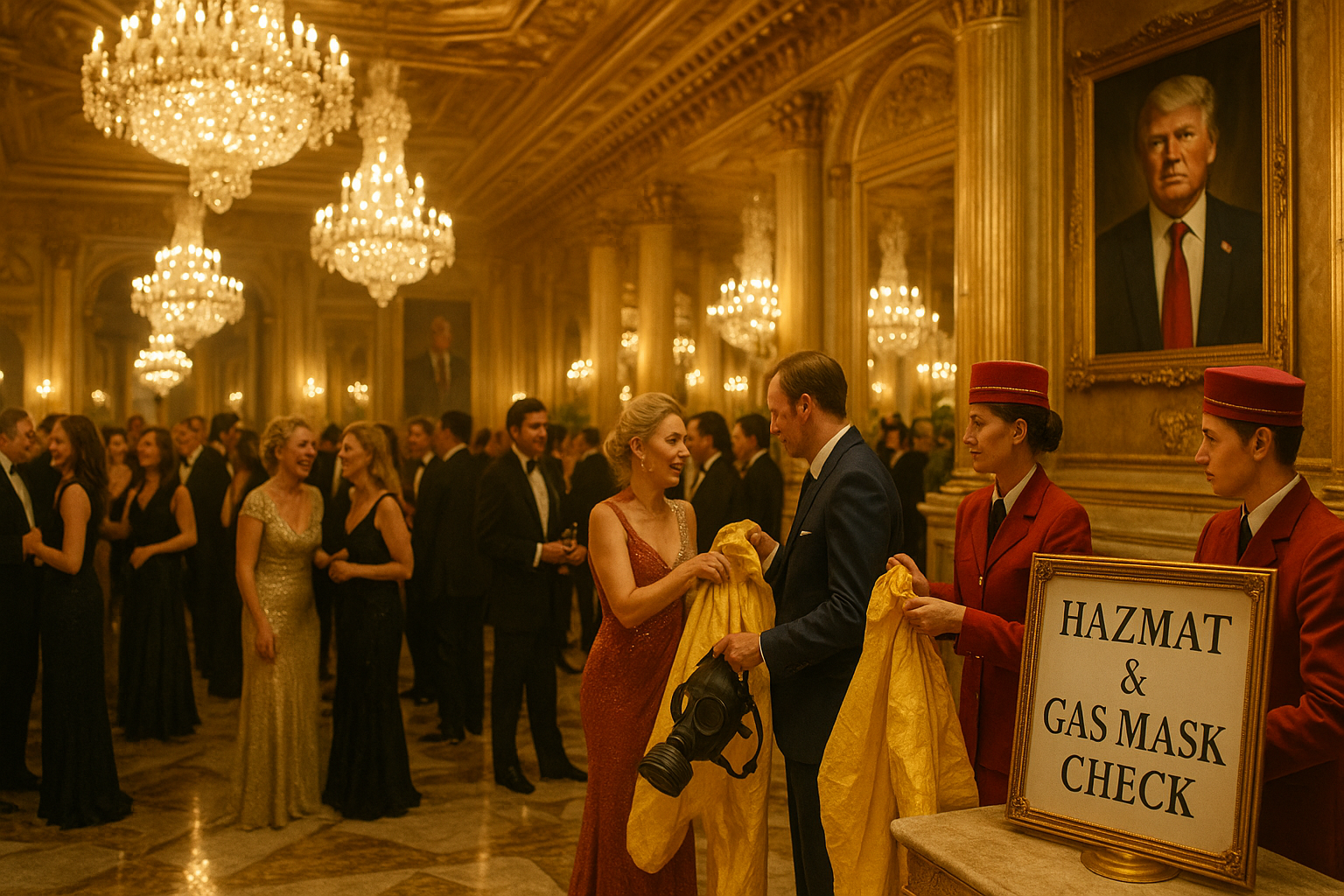
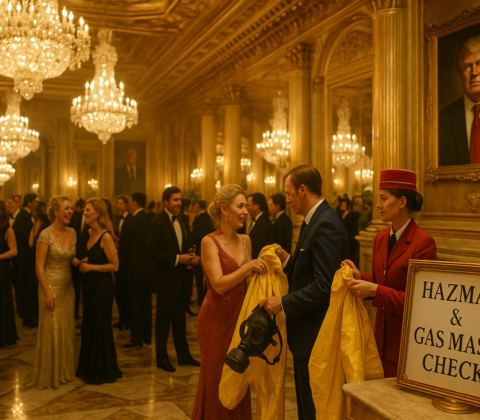
Ballrooms and BombShelters Part 2 The Most Expensive Shed In History
 Part 2: The Most Expensive Shed In History
So we left off asking who exactly we’re planning to bomb with that $1.5 trillion defense budget.
Turns out there’s a clue buried under a ballroom.
Trump’s building a $400 million ballroom at the White House. Don’t worry — defense contractors like Lockheed Martin and Palantir picked up the tab. You know, the same companies that just got a very nice $1.5 trillion Christmas present called the defense budget. Funny how that works.
But here’s where it gets interesting. Trump called the ballroom — and I’m quoting him directly here — “a shed for what’s being built underneath.”
Underneath is a massive military command center. Bulletproof glass. Drone-proof ceilings. Hospital. Communications. Everything a man needs to run his wars. Personally. From underneath a ballroom.
It was supposed to be secret. He said that too. Then spent ten minutes describing it on Air Force One because a lawsuit made him cranky.
So let’s connect the dots your calculator already figured out.
We can’t afford daycare. Can’t afford Medicaid. States are on their own. But somewhere under the most expensive dance floor in American history, we’re building a personal war room for a man who just fired every general who might have told him no.
And the underground portion? Nobody knows what that costs. Experts have literally said we’ll “never get the line of sight on that number.”
So the next time someone asks where the money went — it went into a hole in the ground under a ballroom that a defense contractor paid for, in a city that can’t get a straight answer about any of it.
That’s not a conspiracy theory. That’s just Tuesday.
Part 3 coming — who got fired for knowing too much, and who got hired for clapping loud enough.

Share this:

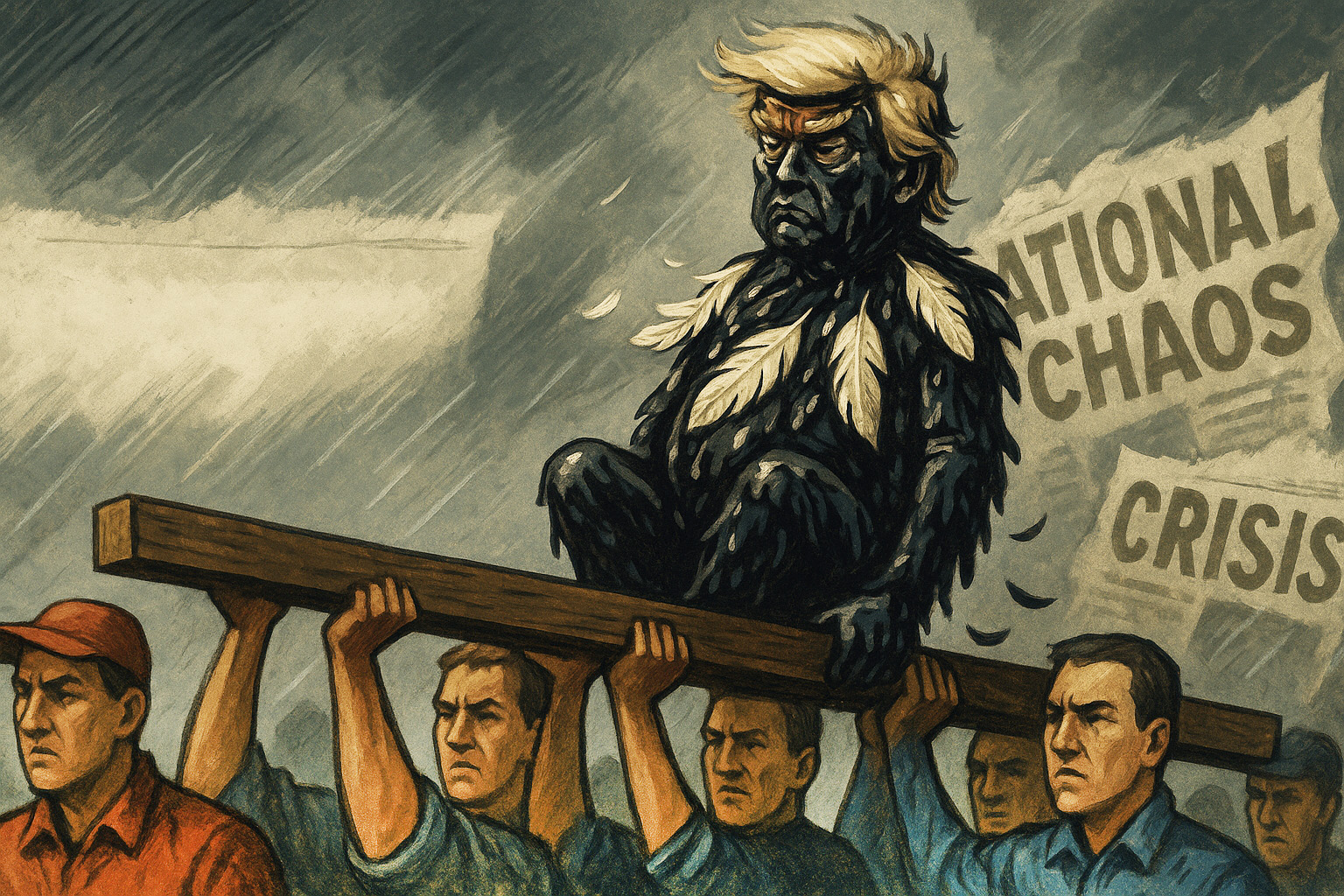



Ballrooms and BombShelters Part 1 Who The Hell Does He Plan On Bombing Next?
Who The Hell Does He Plan On Bombing Next?
Trump says we can’t afford daycare. Can’t afford Medicaid. Can’t afford Medicare. States can handle it. He’s got one priority: “military protection.”
$1.5 trillion for defense in FY2027. Let that sink in. That’s a 40% jump from last year, which was already over a trillion. One of the largest single year military budget increases in American history.
So the question isn’t political. It’s mathematical. You don’t spend $1.5 trillion on defense to sit in a lawn chair. That’s not a defense budget, that’s a shopping list.
Meanwhile grandma can’t afford her medication, your kid can’t get into daycare, and your state — which last time you checked is already broke — is supposed to pick up the slack.
And the kicker? He’s “rebuilding a depleted military.” The same military that was just fine before he started playing with it.
So yeah. Who exactly are we planning to bomb? Because somebody’s got a very expensive answer to a question nobody asked.
Iran’s already on the list apparently. Who’s next, and more importantly — who’s paying for it?
Spoiler: You are. Just not your kids’ daycare. That’s on you.

Share this:



So does tragedy parody life or life parody tragedy?
Now here’s a question worth sitting with over a good cup of coffee.
So does tragedy parody life or life parody tragedy?
The ancient Greeks would say tragedy came first, that we invented it to process the things too painful to look at directly. Parody came along as the release valve. You laugh so you don’t scream.
But right now? Life has gotten so absurd that parody can’t keep up. Saturday Night Live has been struggling for years because reality keeps lapping them. The Onion publishes something ridiculous and two weeks later it’s a press release from the Pentagon.
Mel Brooks said something to the effect that you make something funny to take away its power to frighten you. That’s why he made The Producers — Hitler as a joke defangs him. Brilliant in theory.
The problem we’re running into now is that the subjects of the parody don’t know they’re being parodied. Dark Helmet at least knew he was ridiculous. The current cast seems genuinely unaware — which makes it less Spaceballs and more of something darker that doesn’t have a good genre yet.
Maybe the question isn’t which came first, but whether parody still works when the people being parodied have no shame to pierce.
When the court jester makes fun of the king and the king just… agrees and takes a bow — the jester’s lost his only weapon.
That might be where we actually are right now.

Share this:

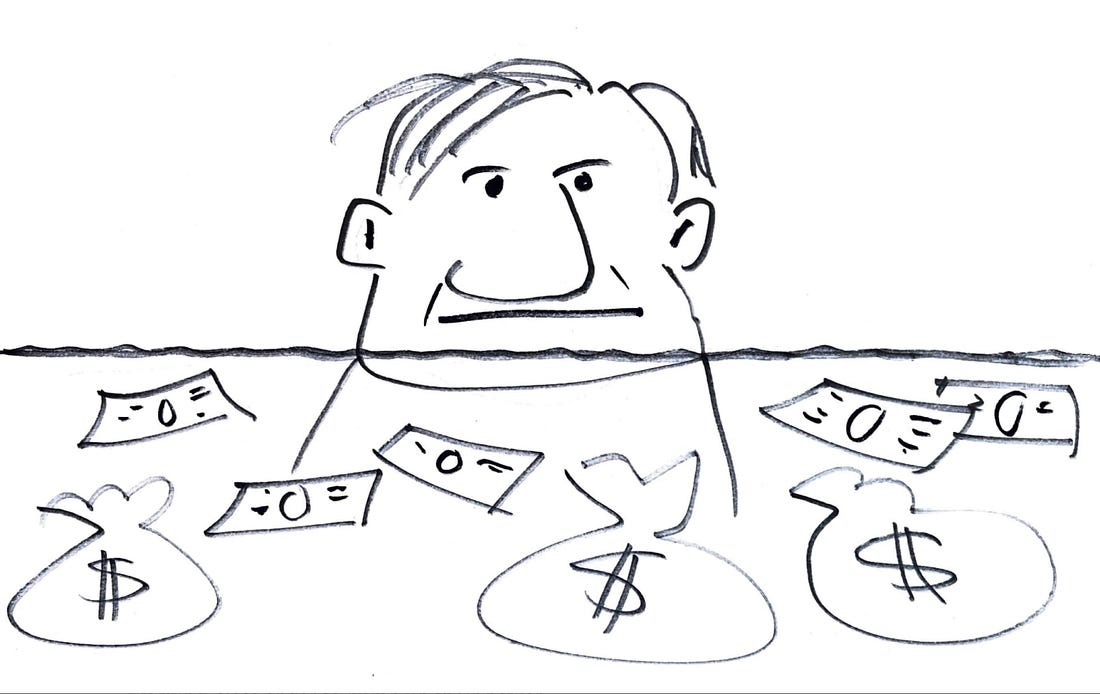
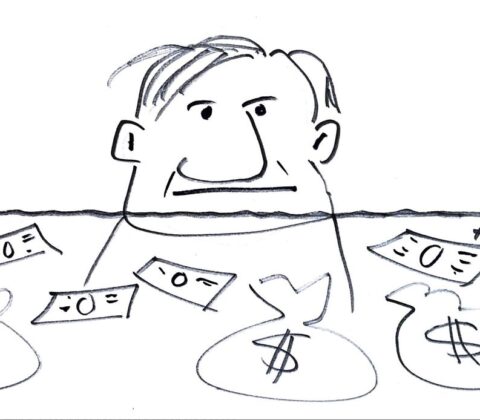
How We Get Rid of “Citizens United” And get back our democracy Robert Reich
Share this:

Fast Forward 04/02/2026
|

Share this:



What would I do if I were King, er, President
What would I do if I were King, er, President.
Well first things first. I would look weak. I would humbly ask all our great allies to give us another chance.
I would ask the Iranians to at least let everyone else’s oil through the straits, and start real talks on how to end this—not a war.
I would inform Putin that I don’t know anyone called ‘Bubba’ so cut the shit, and if he has anything on me, so what, I’m an old man.
I would ask Canada if they’d like to just call it even and maybe go halfsies on a really good fence. Maybe offer to trade some good Bourbon for some good Canadian Whiskey?
In the meantime, all the administration’s offices would be relocated to Alligator Alcatraz.
The Kennedy Center would immediately book a Cats revival just to see who shows up.
I would immediately return all the library books that have been missing from the Smithsonian since January.
I would ask Elon if he’d like his desk back at Twitter, one-way ticket, no carry-ons.
While all this was being done I would be getting as much advice as possible on who would actually be good replacements for the now-empty cabinet positions. Party labels be damned.
The White House East Rose Garden would be staged for one hell of a bling yard sale—gold glitz and curtains anyone? Be nice to hold court in something other than a brothel parlor.
I would release the Epstein files on a Friday afternoon, then everybody would be too busy to notice how clumsy I was.
I would have Air Force One parked. I don’t have my own golf course and spa and I would look like a fool carting ‘Putter’ around.
I would have non-stop news coverage of Trump being perp-walked away muttering some nonsense about a silly ballroom.
BZZZZZZ BZZZZZZ BZZZZZZ damn alarm clock …
Share this:

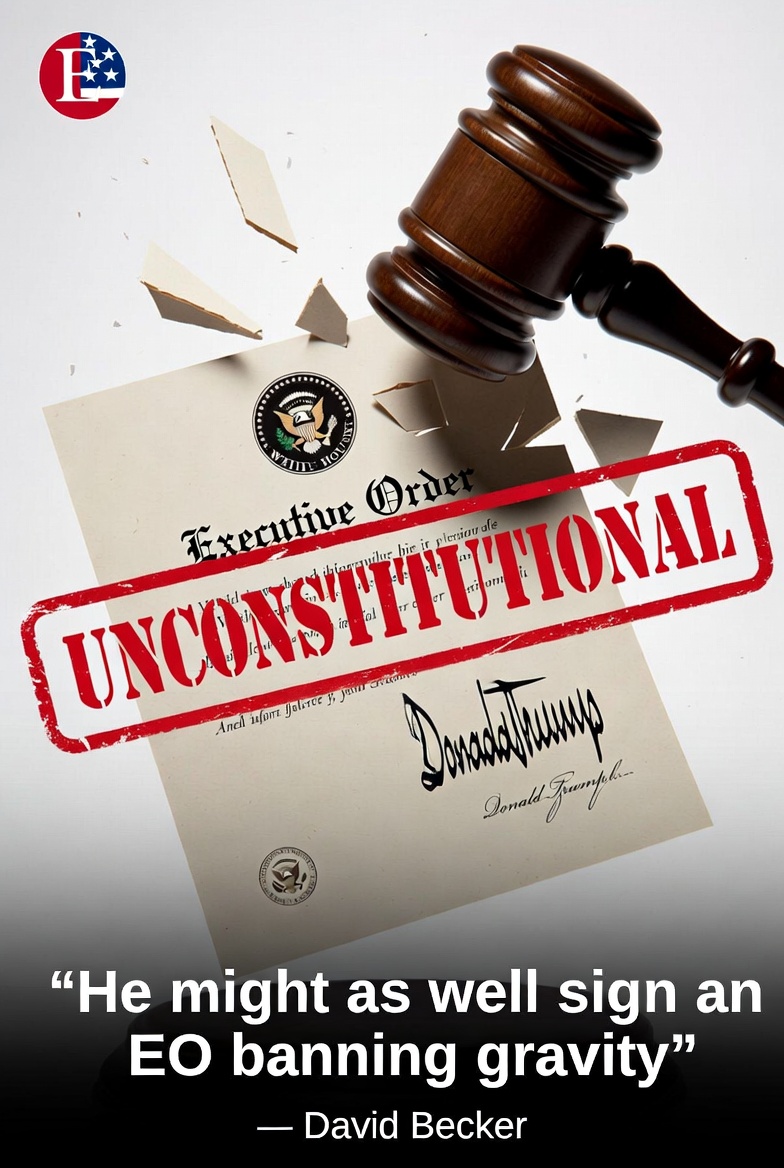
I said Trump would screw with the midterms.
I said Trump would screw with the midterms.
He signed the illegal EO attacking mail-in voting.
Nonpartisan election expert David Becker (executive director of the Center for Election Innovation & Research and former DOJ Voting Section lawyer) posted: “Some may freak out about this, but honestly, this is hilarious. It’s clearly unconstitutional, will be blocked immediately… He might as well sign an EO banning gravity.”
Power grab is DOA. Courts will kill it fast. https://www.reuters.com/world/us/trump-signs-order-mail-ballots-escalating-election-overhaul-push-2026-03-31/
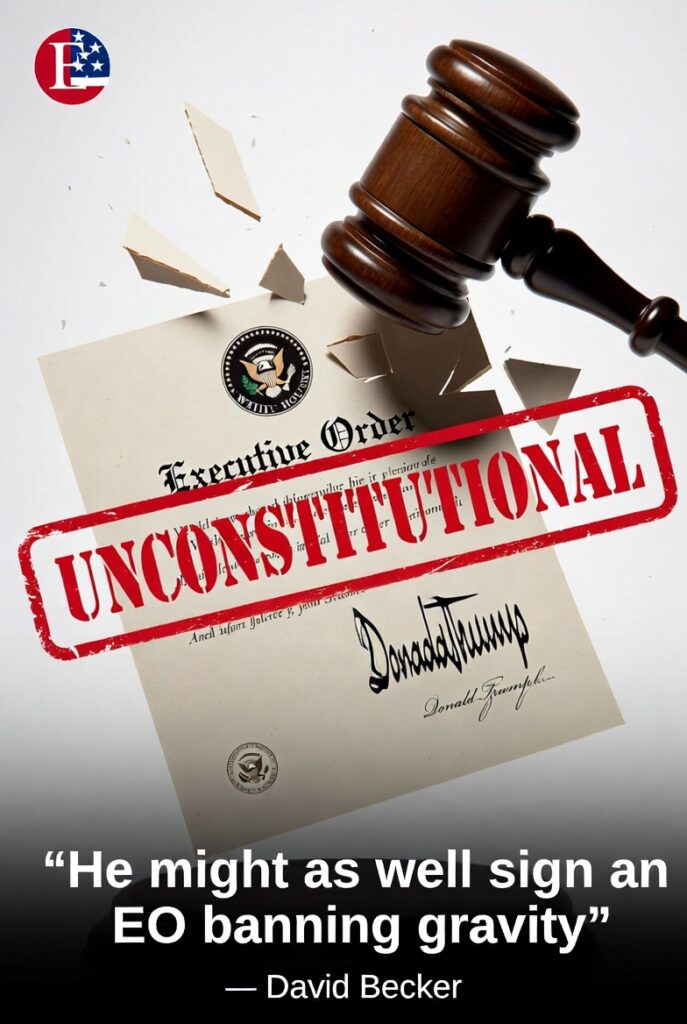
Share this:

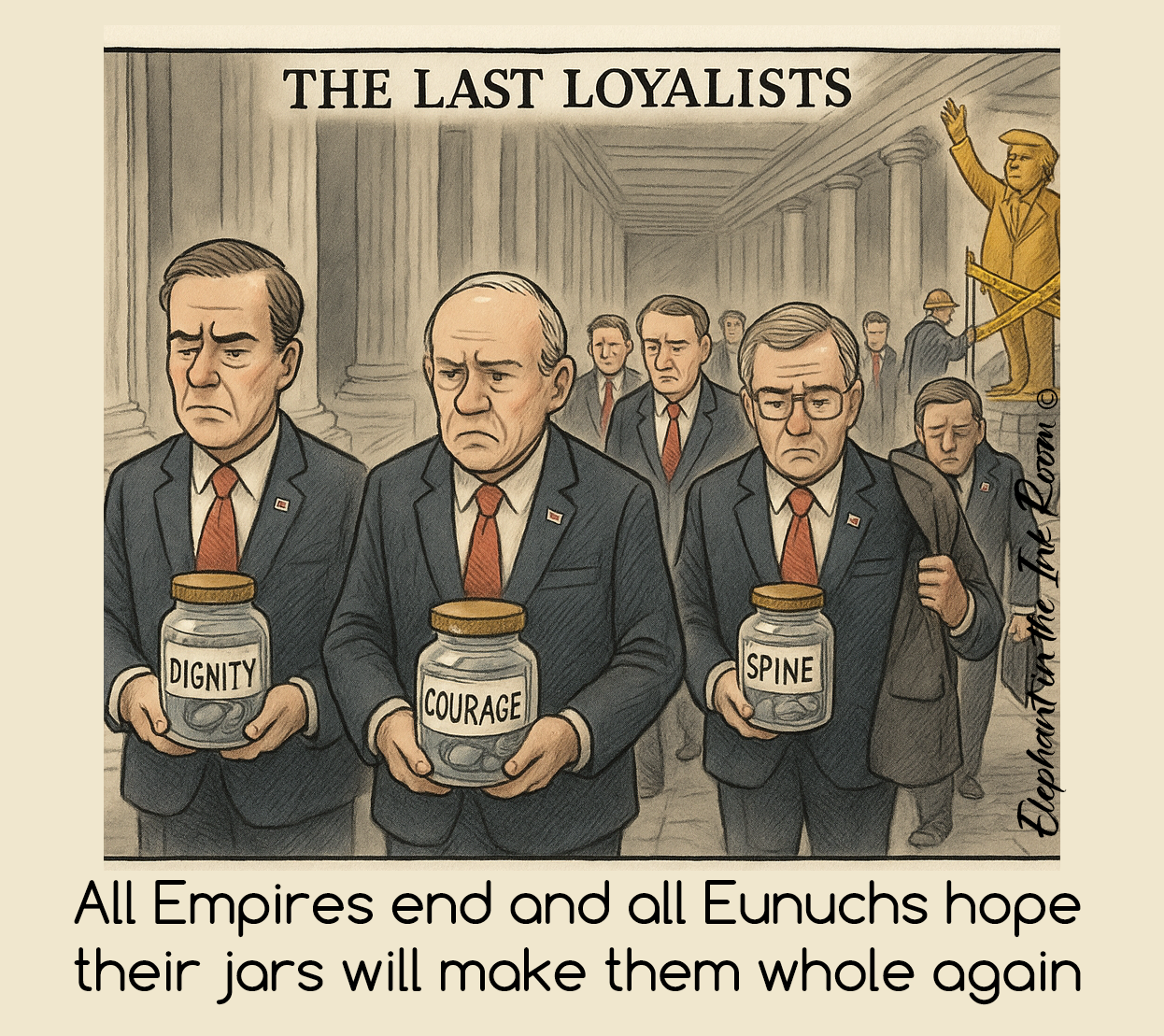
I told you and Congress what he was going to do, guess what?
“He will try to rig the mid-term, pay attention, because that won’t work.”
He Signed An Executive Order:
Trump directed DHS and the Social Security Administration to build a national list of verified eligible voters. The Postal Service will only send mail-in ballots to people on that list. States that don’t comply lose federal funding.
Election law experts called it unconstitutional on its face. Legal challenges are already forming. Midterm primaries are already underway in many states.
The Constitution gives states the authority to run elections. Not the president. Not by executive order.
That is the most important thing you must remember, what he says is just noise, just noise. Always check with your state election officials. They are in charge.
He knows that. He signed it anyway.
Pay attention.
We eat tacos.
Share this:

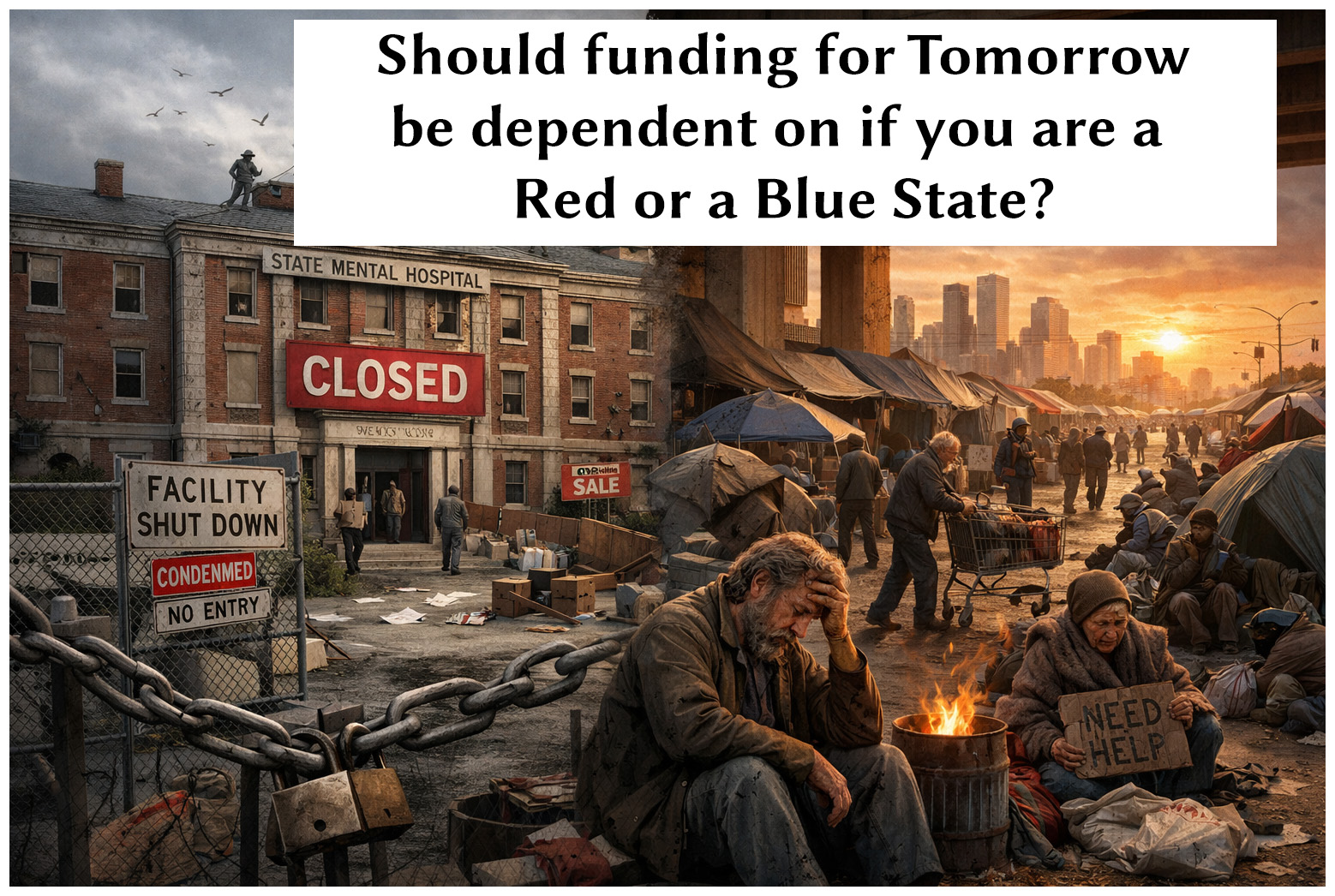
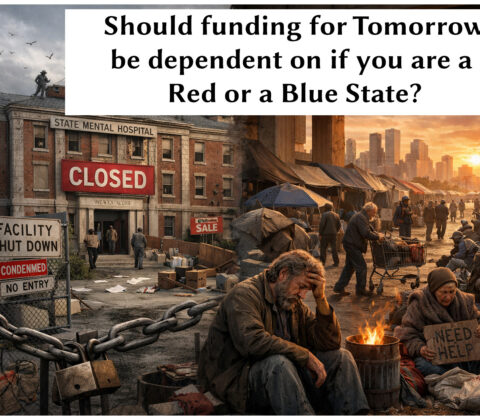



The EU and France’s repsonse to get your own oil.
Trump screwed up the straights, he doesn’t care, he can’t open them and has to France and the EO to go open the straights themselves, or better yet, buy oil from Trump. The UE was touched, so they gifted the American people another statue of Liberty. That is, if we are tired of eating cake.

Share this:



The President Who Won’t Leave – Part 3 of 3 The Third String
The President Who Won’t Leave – Part 3 of 3 The Third String
You may have read about George Kelby, the quiet storekeeper who could shoot two silver dollars out of the air and hoped he’d never have to prove it to anything more than a paper target.
Vinnie the desperado rode into town anyway.
Meet today’s Vinnie. Face mask. Body armor. Presidential immunity in his pocket and a gun pointed at an unarmed driver. This is ICE, Trump’s private army. The force he has chosen to guard his bunker, patrol his streets, and project his power on American soil.
Let’s be honest about what we’re looking at.
These are not the first string. The first string, the Generals, the Admirals, the career military officers who built their credibility over decades of actual service, were fired. Forced to retire. Replaced with loyalists whose primary qualification was willingness to pour the coffee and butter the bagel without asking uncomfortable questions.
They aren’t the second string either (no offense intended) The second string could have been considered the National Guard, but maybe they have been asked or ordered into that grey zone, maybe ‘illegal orders’ and taking up arms against their family and friends has caused a little friction?
So what’s left guarding the bunker?
Vinnie. Multiplied. Masked and armored and brave because they’ve been told the rules don’t apply to them. Presidential immunity extended to cover their actions on American soil. A private army answerable not to the Constitution but to the man underground.
They drive around and point weapons at unarmed drivers. They shoot unarmed women. They shot a man in the back repeatedly until he was dead. They are cowards wearing body armor because without it and the mask and the immunity they are exactly what they are — people who couldn’t get hired as Walmart security guards.
This is the army Trump thinks will hold the line when the American people finally have enough.
Boy is he in for a rude surprise.
Vinnie is brave only because he thinks he’s the fastest. He’s never actually been tested. He’s never stood in front of someone who knows exactly what they’re doing and has nothing left to prove.
There are a lot of George Kelby’s out here.
The storekeeper. The neighbor. The veteran who never told war stories because the real ones aren’t told. The army brat who went to the range for fifty years and hopes the cap gun stays on the shelf.
We are not looking for a fight.
But we are not running either.
And unlike Vinnie — we know exactly what we’re doing.
The bunker won’t save him from that.
The President Who Won’t Leave; Part 1 of 3 Has He Been Planning For This War All Along?
The President Who Won’t Leave; Part 2 of 3 Home Sweet Home
Share this:
Like this: