Healthcare in America Structural Reform Playbook Part 3 Integrated Care & Coordination
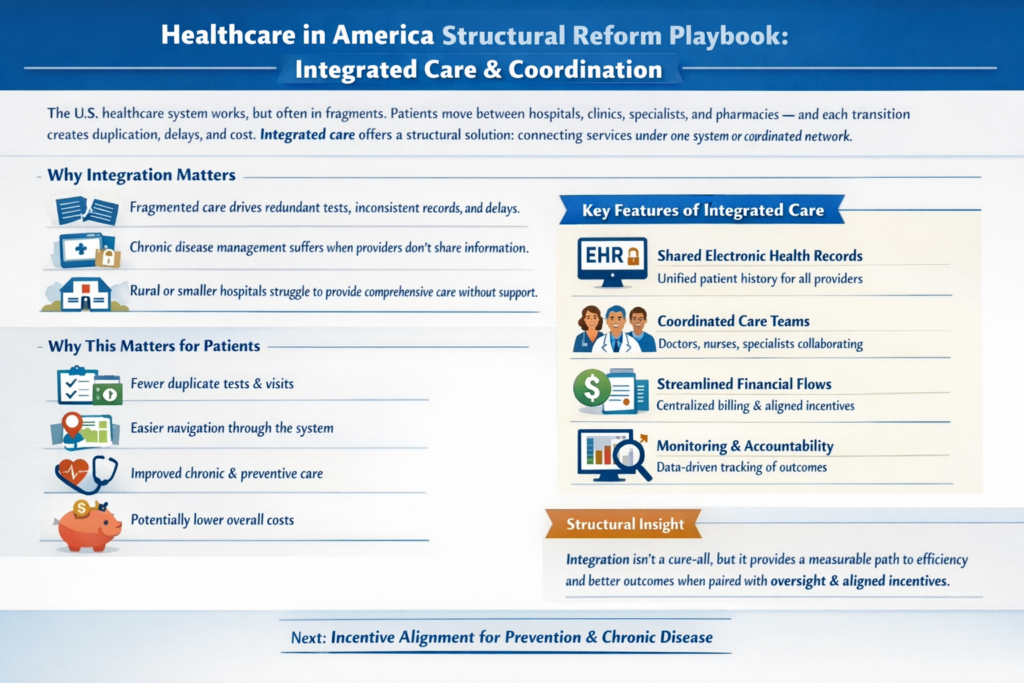
The U.S. healthcare system works, but often in fragments. Patients move between hospitals, clinics, specialists, and pharmacies — and each transition creates duplication, delays, and cost. Integrated care offers a structural solution: connecting services under one system or coordinated network.
Why Integration Matters
Fragmented care drives redundant tests, inconsistent records, and delays.
Chronic disease management suffers when providers don’t share information.
Rural or smaller hospitals struggle to provide comprehensive care without support.
Integrated models — like Kaiser Permanente or other vertically coordinated systems — reduce these frictions by aligning care delivery, records, and financial flows.
Key Features of Integrated Care
Shared Electronic Health Records (EHRs)
All providers within the network can access patient history
Reduces repeated tests and improves treatment consistency
Coordinated Care Teams
Physicians, nurses, pharmacists, and specialists collaborate
Focus on patient outcomes rather than billable procedures
Streamlined Financial Flows
Centralized billing and contracting reduces administrative burden
Clearer incentives for prevention and long-term management
Monitoring & Accountability
Data-driven tracking of outcomes and efficiency
Encourages continuous improvement without adding complexity
Why This Matters for Patients
Fewer redundant tests and appointments
Smoother navigation through the system
Better management of chronic conditions and preventive care
Potentially lower overall costs, even within existing insurance structures
Structural Insight
Integration is not a cure-all, and scale can create new challenges (like monopolistic pricing). But when paired with oversight, transparency, and incentive alignment, integrated care provides a measurable path to efficiency and better outcomes.
Transition
Next, we’ll examine Incentive Alignment for Prevention & Chronic Disease, a tight post showing how small shifts in payment models can improve health outcomes while controlling costs.



Comments are Disabled