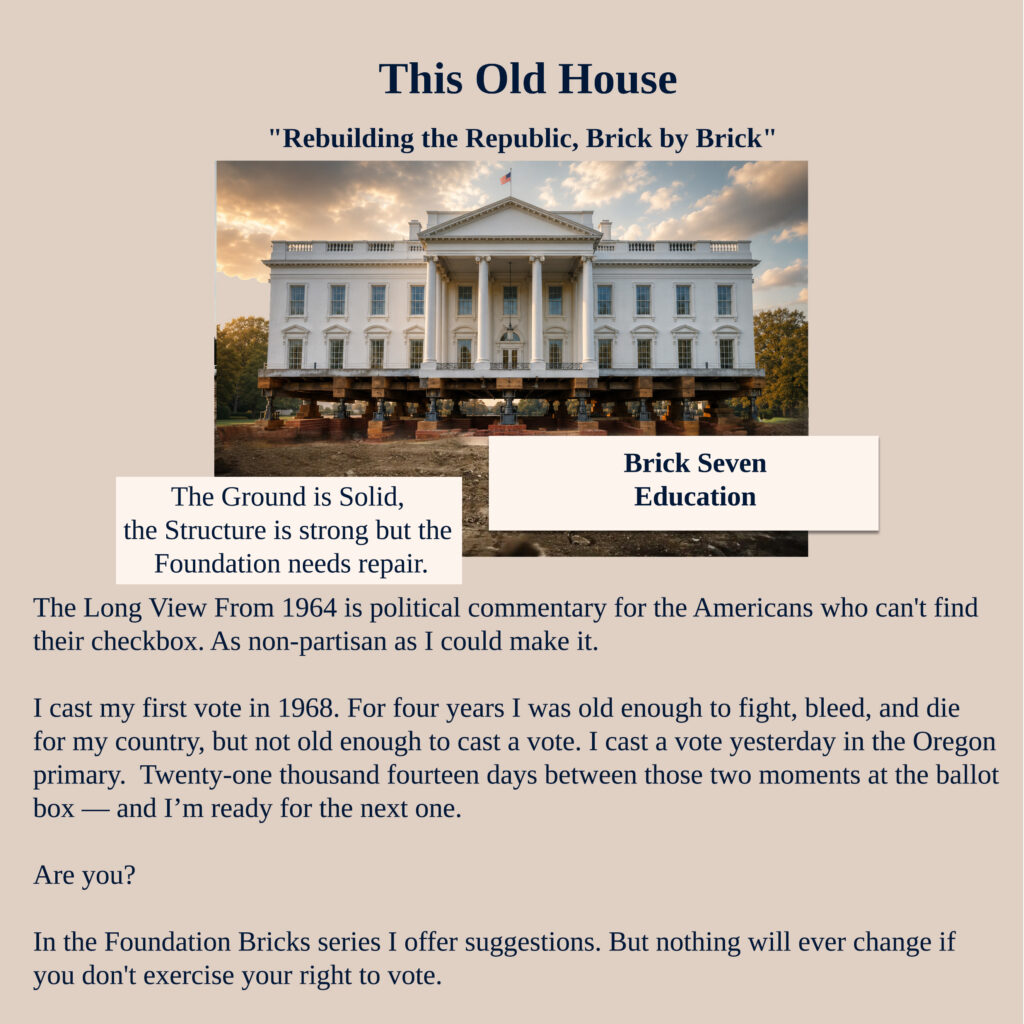
The Education Brick What Good Government Actually Requires
Education in America has a marketing problem.
For decades the message was simple get a degree and get a job. The degree became the credential and the credential became the promise. Nobody mentioned that the promise had an expiration date or that the debt was forever.
We need a more honest conversation.
The Social Contract Model
If the public invests in your education the public has a right to expect something back. Not repayment with interest service. A known, transparent agreement made before the first dollar is spent.
We fund your medical degree. You spend three years at a VA hospital or an under served rural clinic. We fund your nursing degree. You serve in a community that needs you. We fund your accounting degree. You spend two years at the IRS or the GSA.
This is not radical. It is the oldest social contract in the book. The military has operated this way for generations we train you, you serve, you earn the benefit. The difference is we need that model applied beyond the military and into the civilian professions the country actually needs more of.
The deal is simple. The terms are known upfront. And the payback is productive rather than just financial the country gets doctors in the places doctors don’t go, nurses in the communities that can’t afford to recruit them, and accountants who actually understand the systems they’re auditing.
The Credential Is Not The Job
A white collar education does not promise a white collar job. It never honestly did but the myth persisted long enough to saddle a generation with debt for degrees that prepared them for a world that was already changing while they were still in class.
Artificial intelligence is reshaping entry level positions. That is real and it is accelerating. But it does not change the fundamental human requirement at the core of most work. Claude is not walking in the door, shaking a hand, and drinking a cup of coffee. That is still on the human.
What it does change is what preparation for that work actually needs to look like. Knowing how to effectively use the tools that exist is now as important as the credential that gets you in the door. The education system has not caught up to that reality. It needs to.
The Trade School Gap
Here is the most important and most under addressed part of this brick.
The federal government currently has one primary pipeline into trade education the military. That is not enough and it was never designed for this purpose.
Look up the pay scales for licensed electricians. Price a plumber. Find out what a licensed HVAC technician charges per hour. The market has already answered the question of whether these skills are valuable. The answer is yes emphatically and increasingly.
What is missing is a federal civilian pathway to trade certification that carries the same social contract as the degree programs. We fund your training as an electrician, a welder, a medical technician, a licensed trades person of any kind. You serve your community with that skill for a defined period at a wage that reflects the investment.
The private sector cannot fill this gap alone. It was never designed to. This is exactly the kind of investment in people, in capability, in the infrastructure of daily life that government exists to make.
The person who keeps the lights on and the water running and the roads safe is not less valuable than the person with the credential and the debt.
It is time the education system said so clearly.
And it is time the federal government built a path that reflects it.



Comments are Disabled