
The Capitalism Brick What Good Government Actually Requires — Brick Six – Capitalism
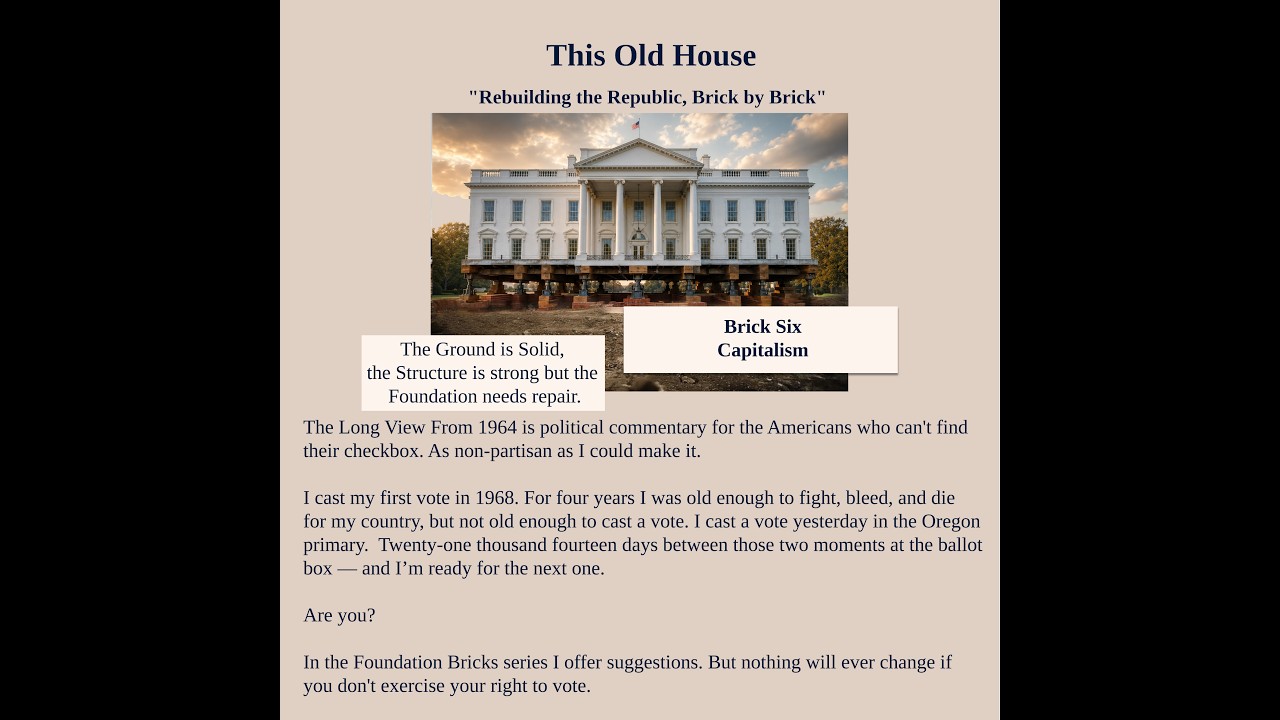
Brick Six – Capitalism
The Sixth Brick What Good Government Actually RequiresPart Six
CapitalismHow Much Is Enough?
I am not an economist. I have trouble balancing my own checkbookto the point that I haven’t written a check in years. I live by the debit card and rely on the bank to keep score. They make fewer mistakes than I do.
So take what follows for what it is. Not economic theory. Just observation from someone who has been inside the system long enough to see where the seams are coming apart.
I believe in capitalism. I believe in free enterprise. I believe we should be innovative and be rewarded for that innovation. I was part of the technological revolutionthe gin joints of Tektronix and Intel and my own consulting workand I watched what genuine innovation looks like when it builds something real.
That’s the capitalism I believe in.
Where I get lost is somewhere between that and here.
We once built enterprises that built a nation. Railroads. Steel. Highways. Infrastructure that everyone eventually lived inside regardless of whether they owned a share of it. The Carnegies and Vanderbilts exploited laborthat’s documented and truebut the byproduct was a physical country that generations inherited.
What does the new generation of concentrated wealth build?
Delivery systems. Platforms. Apps that monetize your attention and sell it back to you as connection. The byproduct this time isn’t a nation. It’s a customer base and a stock price.
I don’t have a clean answer to when enough is enough. I haven’t reached that threshold myself so I’m not casting stones. And I’m aware that most obscene wealth exists on paperinvestment portfolios, unrealized gains, numbers on screens rather than cash in hand.
But somewhere on the path to obscene riches somebody has been cheating the system. The system the rest of us have to play by. The loopholes didn’t appear by accidentthey were written in by people who benefited from them being there and protected by people who were paid to keep them open.
Plug the loopholes. Levy fair taxes against the structure. Not punitive. Not confiscatory. Fair. And if the structure can’t survive fair taxation here then perhaps the wealth shouldn’t be made here.
Simple idea. Complicated execution. Which is why you hire people smart enough to figure out the nuts and boltswhich is itself the argument for competent government rather than a government of loyalists and donors.
If Coca Cola owned Pepsi and Dr Pepper there would be no competitive pricing. There would be one pricewhatever they decided to charge. We have agencies designed specifically to prevent that concentration. Anti-monopoly regulation exists because we learned the hard way what happens without it.
We are currently in a period of deliberate deregulation. Sold as freedom for business to grow. What it actually produceswhen the major players are left to their own devicesis consolidation until competition disappears and the consumer pays whatever the monopoly decides they pay.
Deregulation without oversight isn’t freedom. It’s the slow removal of the rules that kept the game fair for everyone playing it.
One more thing worth noting before we move on.
The most overlooked corner of capitalism is the small business. The licensed electrician. The plumber. The person who showed up at my house with a high pressure rooter and a camera and charged me six hundred dollars for an hour of work.
Good for them. Seriously. That’s skilled labor commanding fair market value and I begrudge them nothing.
We’ll talk more about trade schools and education in the next brick. But the point worth making here is that capitalism works best when it works at every levelnot just at the top where the delivery systems and platforms live but at the street level where someone with a license and a truck and a set of skills can build a life without a college degree and a venture capital round.
That’s the capitalism worth preserving.
The other kind needs some work.
The Complete Foundation Sieries
The series as a downloadable PDF


Comments are Disabled