The Second BrickWhat Good Government Actually Requires — Part Two
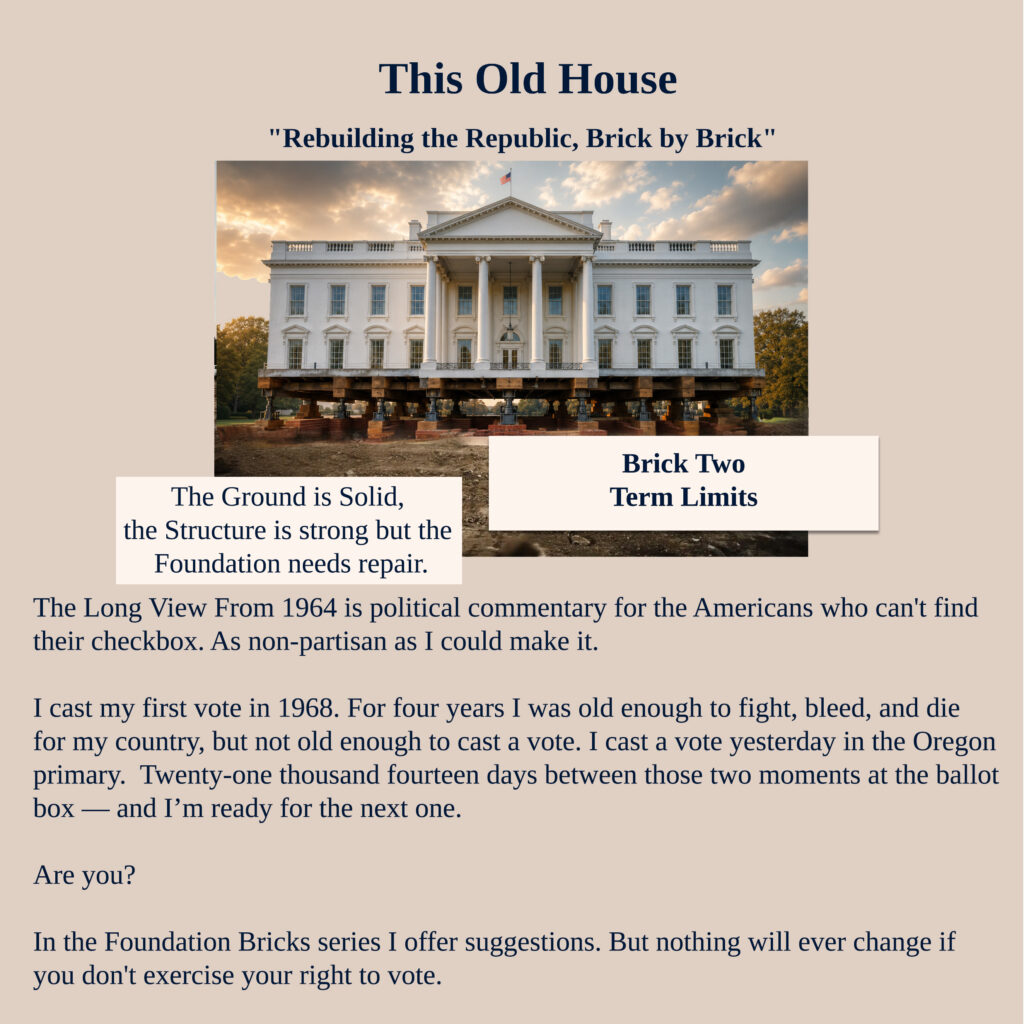
If accountability is the foundation then the second brick is simple.
Nobody stays forever.
Term limits. Age accountability. The systematic removal of dead wood before it becomes the structure itself. The recognition that in any healthy organization — a business, a military unit, a family — the inability to remove someone who has outlived their effectiveness isn’t loyalty. It’s institutional rot.
We have watched what happens when people stay too long. The institution bends around them rather than them serving the institution. J. Edgar Hoover ran the FBI for 48 years. Nobody could remove him because nobody could afford the cost of trying. That is not a feature of good government. That is a cautionary tale that we apparently need to be told more than once.
On Age
A hard cutoff number is both cruel and imprecise. Minds age differently. A 79 year old with a video tape memory and fifty years of accumulated pattern recognition may serve better than a 55 year old running on talking points and donor calls. A number on a birth certificate tells you nothing useful.
What tells you something useful is behavior.
A committee empowered to evaluate and recommend further medical and mental evaluation when behavior becomes noticeable. Not partisan. Not elected. Drawn from retired judges, physicians, and civic leaders with staggered appointments designed to insulate from political pressure. The process itself is the deterrent — most people approaching genuine cognitive decline would rather resign than submit to public evaluation.
The goal isn’t to humiliate. It’s to create a dignified off ramp before the institution suffers.
On Term Limits
The structure matters as much as the limit.
A president at two four year terms has enough time to govern without enough time to become permanent. A senator at two six year terms — twelve years — learns the job properly and builds something durable without becoming a resident. A representative on perpetual two year cycles is always campaigning and never governing. Move them to four year terms. Give them enough runway to actually do the work.
The goal is sufficient time to be effective without sufficient time to become immovable.
On the Two Party System
Here is the brick that will make everyone uncomfortable.
Eliminate it.
Not reform it. Not balance it. Remove the institutional infrastructure that makes it the only viable option. No party designations on ballots. No party primaries with public funding. No party based committee assignments in Congress.
Watch what happens to the PACs when there are no teams to back. Watch what happens to the dark money when the jersey colors disappear. Citizens United becomes considerably less useful when there is no party machinery to funnel the money into.
This isn’t naive. It’s the recognition that the two party system has become the primary mechanism for preventing exactly the accountability the foundation requires.
On Compensation
If we require fidelity we require fidelity.
Public servants receive public servant compensation. A PERS program like other government employees. Healthcare through the same options available to federal workers. A pathway into continued government service for those who want to contribute after their term ends.
No golden umbrellas. No lifetime pensions after a single term. No healthcare for life unavailable to the constituents who funded it.
The same standard applied to the person making the rules as the person living under them.
That is the second brick.
Nobody stays forever. Nobody lives above the system they were elected to serve.
Build on that and the walls start to mean something.



Comments are Disabled