The Fourth BrickWhat Good Government Actually Requires — Part Four
The Judicial Branch
The Supreme Court was never designed to be a political prize.
It has become one anyway.
Every president now treats Supreme Court appointments as the most important legacy decision of their term, not because they care deeply about judicial philosophy but because they are buying future outcomes. The pocket justice. The reliable vote. The insurance policy wearing a robe.
The result is a court whose decisions are predictable before the arguments are heard. Everyone knows which way each justice will rule on any politically charged question because everyone knows who appointed them and what was expected in return. That is not justice. That is scorekeeping in robes.
The fix is not complicated. It is just threatening to the people who benefit from the current arrangement.
More justices. Randomly assigned. Term limited. Appointed by peers not presidents.
Not a specific number, the number is less important than the principle. Enough justices that no single president can stack the composition. Assigned to rotating panels by lottery so nobody can predict which justices will hear which case. Appointed by their fellow jurists rather than by the politician who wants to own their vote. Term limited to twelve or eighteen years, long enough to develop genuine expertise, short enough to prevent the court from calcifying around a single political moment.
The lottery is the key. You cannot game a random draw. You cannot have a justice in your pocket if you don’t know which pocket they’ll be sitting in when your case arrives. The pipeline between political appointment and predetermined outcome gets broken not by ideology but by randomness.
But the most important brick in the judicial wall has nothing to do with composition.
It has to do with enforcement.
Right now the Supreme Court can rule and the executive branch can say no. And nothing happens. The court has no army. The court has no marshals with actual authority. The court has strongly worded opinions and the assumption that the executive branch will comply because it always has before.
That assumption has been tested and found wanting.
Here is a question worth sitting with.
Every lower court in America has enforcement authority. A district judge can hold anyone in contempt and have them detained. Federal marshals exist specifically to enforce court orders at every level of the federal judiciary.
Except the highest one.
The Supreme Court, the final word on constitutional law, the last institutional check on executive power, operates on the honor system.
What good is the honor system if no one honors it?
We have now seen what happens when that hope runs out.
At what point do we acknowledge that the highest court in the land deserves at least the enforcement authority we grant to every court below it?
The Supreme Court needs its own enforcement mechanism. A Marshal’s service with the specific authority to detain anyone, anyone, that the court by majority vote determines is willfully operating outside their constitutional limits and has become a national threat.
No exceptions. No immunity. No rank that places a person beyond the reach of a court order.
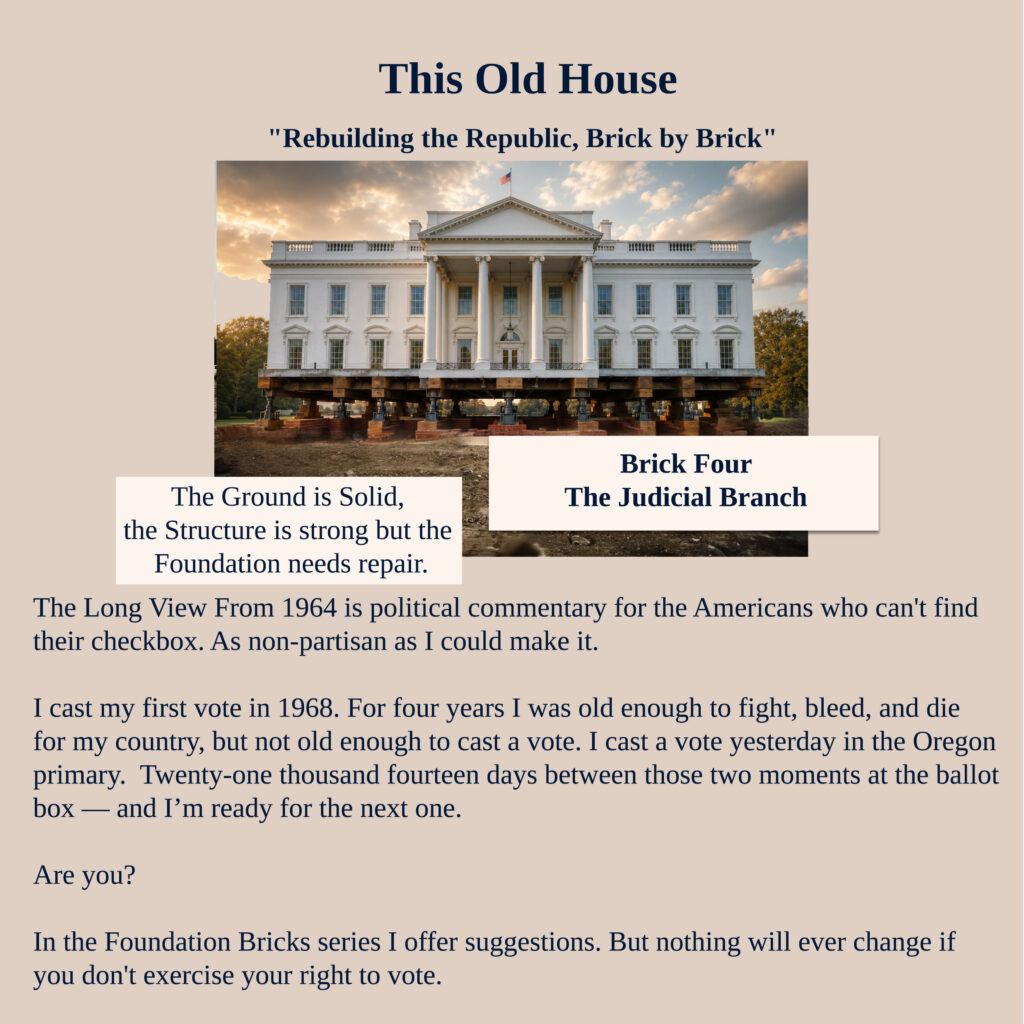
The moment a president, or anyone else, can look at a Supreme Court ruling and respond with effective impunity the entire architecture of the republic becomes decorative. Pretty columns on a building with no foundation.
The court says no and the no has to mean something.
That is the fourth brick.
Not a perfect court. Not an infallible court. Just one that cannot be owned before the case is filed and cannot be ignored after the ruling is issued.



Comments are Disabled