
Blog Archives
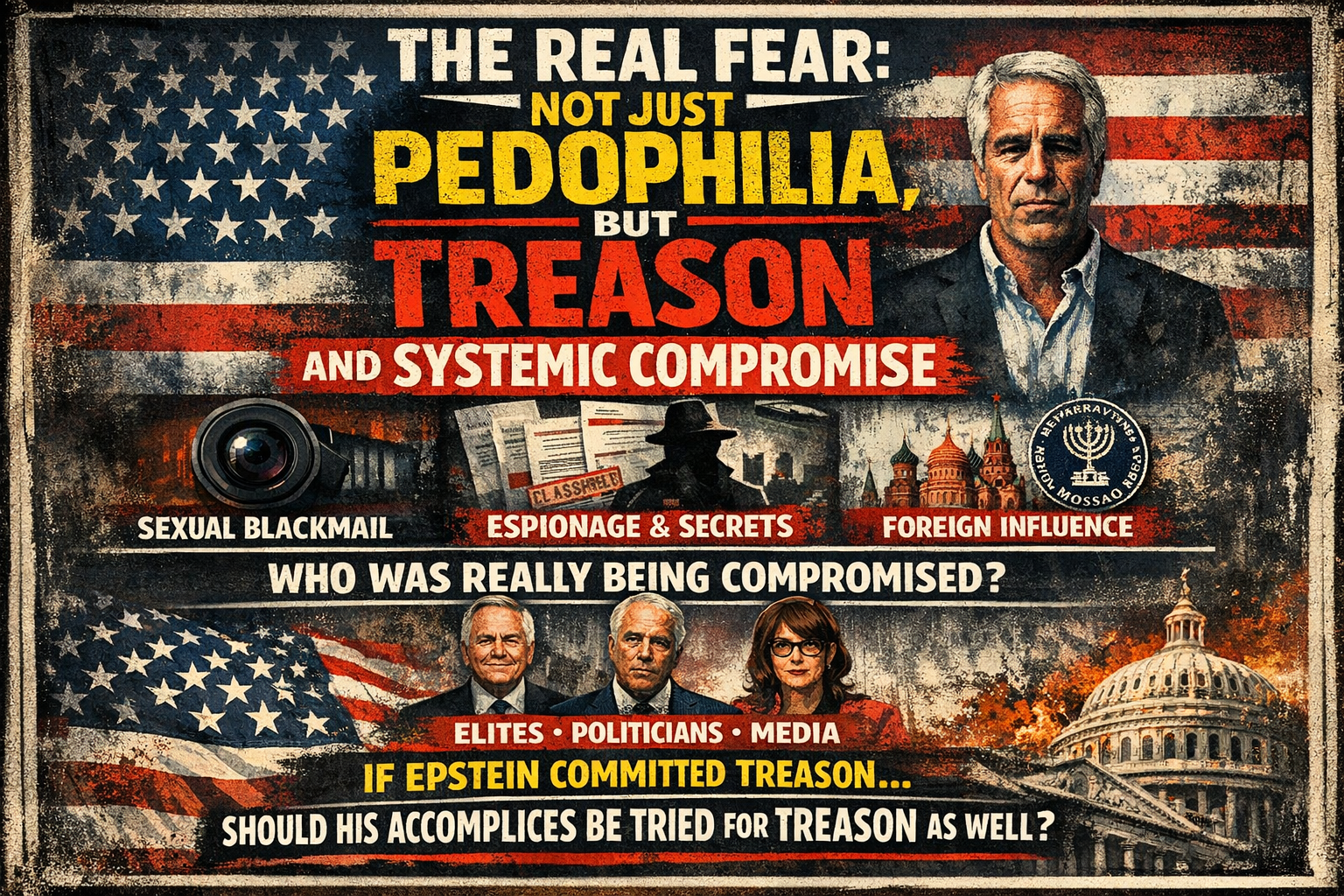
Part 3 Jeffery Epstein: Not Just Pedophilia, But Treason and Systemic Compromise?
Conspiracy Theories, Maybe, Maybe Not.
The Real Fear: Not Just Pedophilia, But Treason and Systemic Compromise
This is why the cover-up feels so ferocious. Sleeping with an underage girl 20 years ago is a career-ending scandal, but it is survivable with the right lawyers and apologies. Being caught on hidden camera discussing classified information, financial crimes, or foreign-policy favors with a man who was feeding that material to a foreign intelligence service is something else entirely. That crosses into espionage, influence operations, and potential treason.
The clients weren’t all pedophiles—many powerful visitors to the island or the jet have never been credibly accused of sex with minors. What they shared was access to secrets: government contracts, hedge-fund strategies, tech IP, political dirt. Epstein’s operation looks like classic kompromat: compromise the mark, record it, own the leverage. The sex made the compromise stickier and more shameful, ensuring silence.
Les Wexner, the Victoria’s Secret billionaire who essentially gifted Epstein a fortune, power of attorney over his assets, and the New York mansion, later claimed Epstein stole “vast sums.” Wexner enabled the rise; the question of what Epstein gave (or sold) in return lingers.
Why the Media Shied Away
Sex sells. Blackmail rings involving intelligence services and treason do not—especially when they implicate the same media, political, and financial elites who control narratives. Outlets that spent years detailing every victim’s horror story suddenly grew squeamish about cameras in Kleenex boxes, un-raided storage units, or Acosta’s “intelligence” explanation. The result: a public fixated on the salacious while the structural machinery of compromise remains half-hidden.
The Bottom Line
None of this excuses or diminishes the evil done to the victims. Their suffering was not a side effect; it was the engine. But to pretend Epstein was merely a lone-wolf pervert with a private plane is to miss the point of the operation. He was a broker in the oldest and dirtiest currency of power: human compromise packaged as leverage.
Full transparency—searching every storage unit, releasing every unredacted video and hard drive, declassifying the intelligence files—would serve justice for the victims far better than another round of selective leaks and pearl-clutching. Until then, the fear that keeps the real story suppressed isn’t about 20-year-old indiscretions. It’s about what those indiscretions bought and who still owes. The blackmail wasn’t a byproduct. It was the business model.
Key Recent Developments Amplifying the Intelligence/Blackmail View
New batches of files (from Data Sets 9–12 in the DOJ’s Epstein repository) include emails, FBI summaries, and property records that highlight surveillance and evasion tactics:
-
Hidden cameras and recording setups: A 2014 email chain shows Epstein directing his pilot Larry Visoski to buy and install motion-detected hidden cameras—small enough to hide in Kleenex boxes—for his Palm Beach mansion. Victims and property searches long described bedroom/common-area cameras; these emails make it explicit he was actively building (or upgrading) the system years after his 2008 conviction.
-
Secret storage units: Epstein maintained at least six storage lockers across the US (near Palm Beach, New York, and elsewhere), paying rent until his 2019 death. He used private detectives to move computers, hard drives, photos, and equipment from his island and homes as investigations closed in around 2005–2006. Search warrants suggest federal authorities never raided these units—raising questions about what remains hidden (potentially unseen kompromat or evidence of co-conspirators).
These details align with victim accounts of being filmed and the sheer infrastructure needed for ongoing leverage.On the intelligence side, 2025–2026 releases and reporting have revived and expanded older claims:
-
FBI memos (unsealed in batches) cite an informant convinced Epstein was a “co-opted Mossad agent” trained as a spy, with ties to Ehud Barak (who visited multiple times and had aides staying at Epstein properties). Leaked emails show Epstein pursuing deals with ex-MI6/Mossad figures (e.g., frozen Libyan assets).
-
Acosta’s “intelligence” comment (“I was told Epstein belonged to intelligence and to leave it alone”) keeps resurfacing in new file contexts and interviews. While Acosta later denied direct knowledge, the line appears in vetting notes and DOJ reviews, fueling speculation he was warned off due to higher-level protection.
-
Broader ties: Reports link Epstein to Russian kompromat efforts (recruiting Russian women, advising officials on US politics), potential CIA-adjacent access-agent roles, and even historical overlaps with PROMIS software scandals or arms networks via Robert Maxwell. Former CIA officer John Kiriakou called him a “textbook access agent” on recent shows, noting only state-level funding explains the scale.
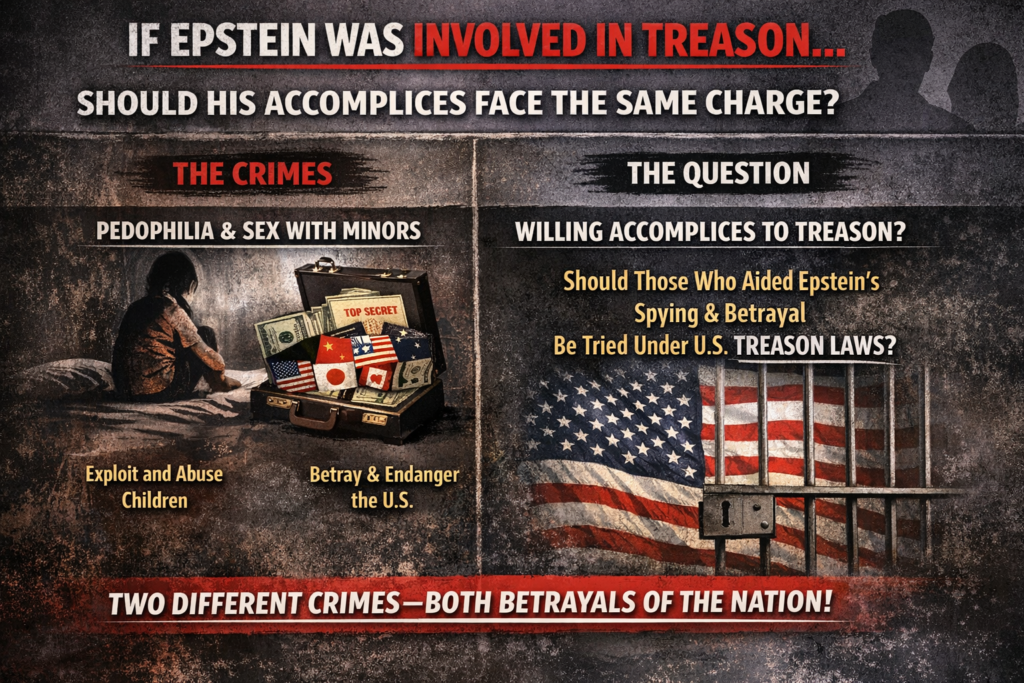
One last question for the reader, if Jeffery Epstein was involved in Treason, do you thing willing accomplices that where complicit with Jeffery’s scheme should also be considered and tried under our Treason laws? Pedophilia and sexual indiscretion with minors and Treason to the United States are two different crimes.
Share this:

Healthcare in America Series III – Part 2 Invisible Risk Carriers
Healthcare in America Series III – Part 2 Invisible Risk Carriers
“Welcome back to Healthcare in America.
In the last episode, we said something simple but important: risk in healthcare does not disappear. It moves.
Today, we’re going to look at where it lands.
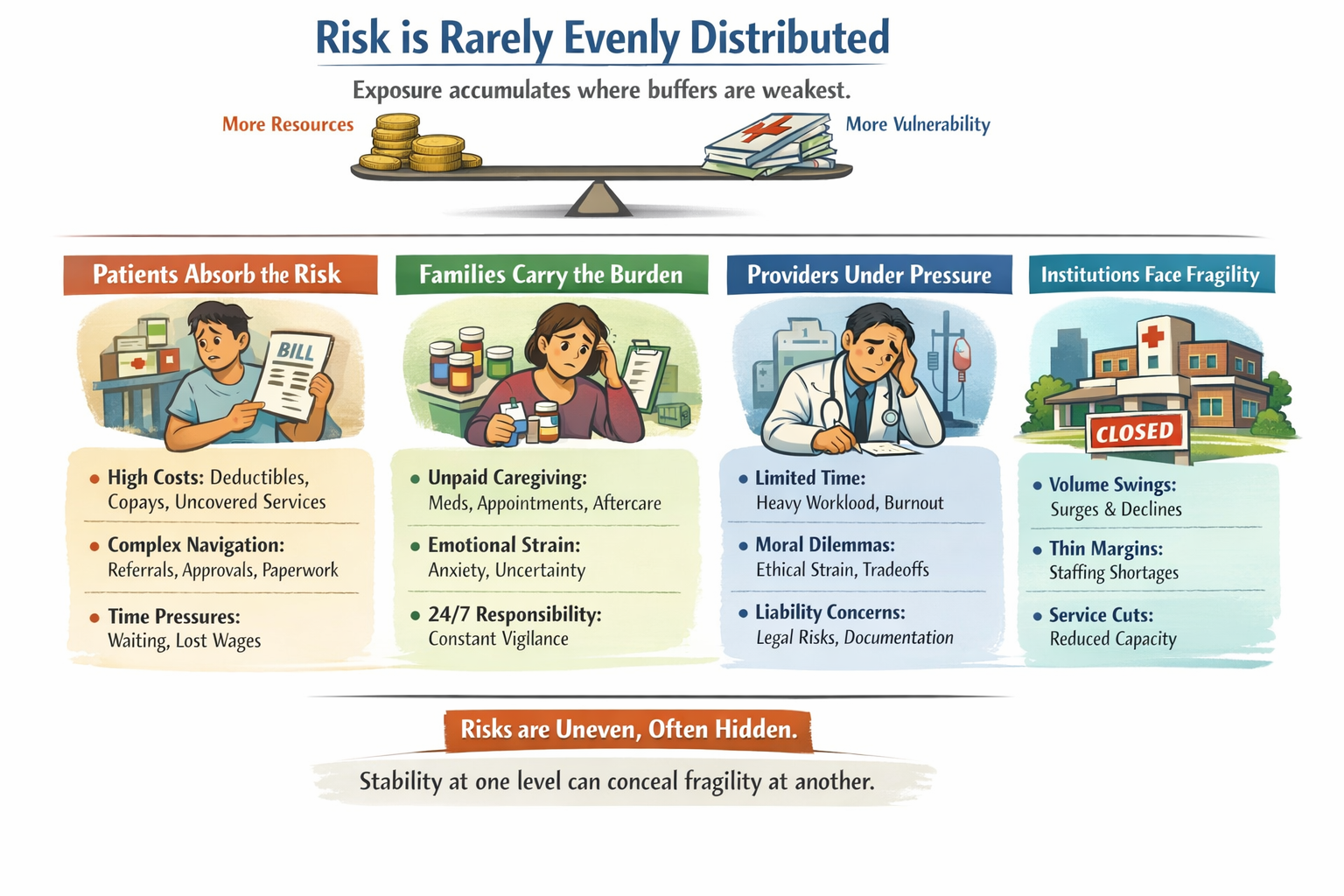
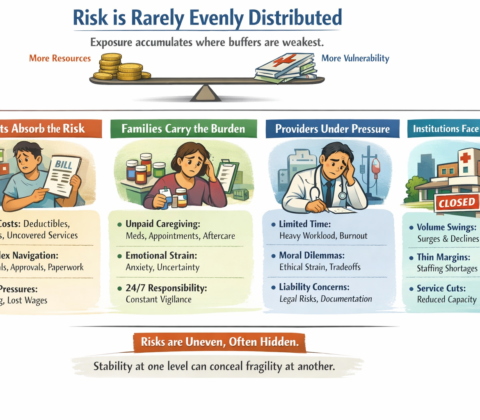
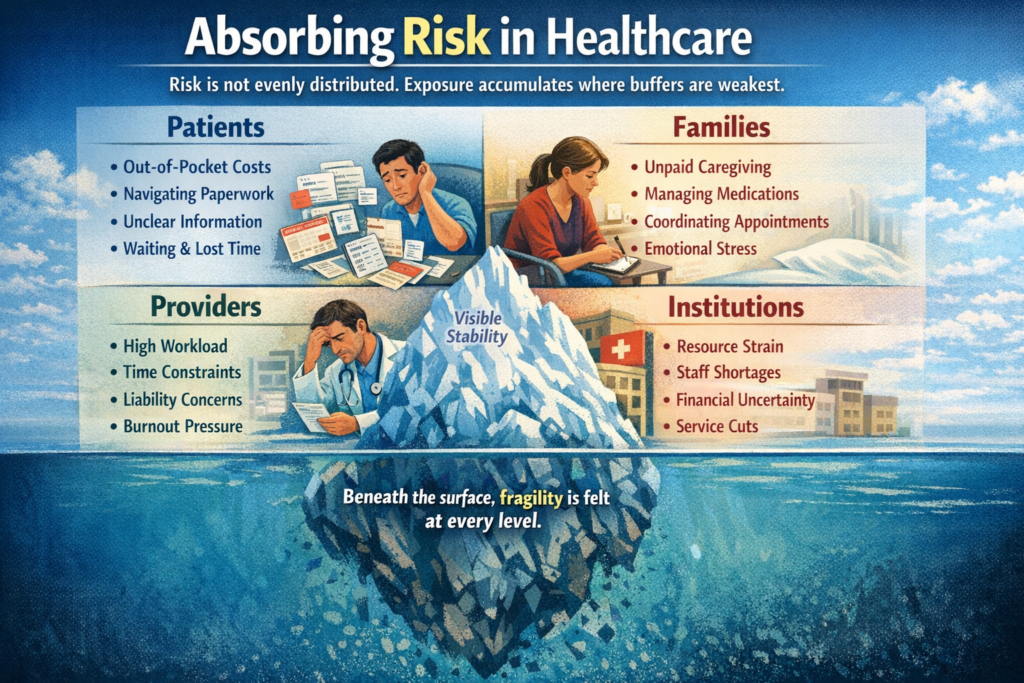
Risk is rarely distributed evenly. Exposure tends to accumulate where buffers are weakest. Some individuals and institutions are better positioned to absorb volatility. Others are not. And the distribution is often quiet — not announced, not debated — just experienced.
Patients are often the first visible absorbers of risk.
Financial exposure can begin long before insurance activates. Deductibles, copayments, and uncovered services create uncertainty before treatment even starts. But financial risk is only part of it.
There is navigational risk — referrals, approvals, coverage rules, and paperwork that must be managed correctly. A missed form or misunderstood instruction can delay care. Informational risk compounds this: patients frequently operate without full clarity about what is covered, what is authorized, or what will happen next.
There is also time risk. Waiting for appointments, coordinating schedules, losing wages during illness — these pressures rarely appear in formal accounting, but they are real exposures.
Families absorb risk as well.
When care transitions from hospital to home, coordination becomes informal. Someone manages medications. Someone schedules follow-ups. Someone interprets discharge instructions under stress. This labor is unpaid, often unrecognized, and structurally necessary. Without it, outcomes decline.
Families also absorb emotional uncertainty. They stabilize environments while waiting for results, while watching for symptoms, while navigating systems that were not designed for clarity.
Providers carry a different kind of exposure.
Clinical risk is inherent in medicine. But modern practice also carries moral and structural risk. Practicing under constraint — limited time, limited staffing, insurance limitations, documentation demands — forces tradeoffs. Liability exposure exists alongside ethical strain. Burnout, in this context, is not simply fatigue. It is accumulated tension between professional obligation and structural limitation.
Institutions absorb risk too.
Hospitals manage volume volatility — unpredictable surges and declines. Rural facilities operate with thin margins and limited redundancy. Workforce shortages increase fragility. Service lines close not necessarily because care is unneeded, but because stability requires contraction somewhere.
On paper, systems can appear stable. Metrics may show balance. But stability at one layer can conceal fragility at another.
This episode does not rank these exposures. It does not assign blame or prescribe reform. It simply observes distribution.
Risk pools where protection is thin.
In the next episode, we’ll look at what happens when that pooled exposure accumulates over time — and how quiet redistribution can eventually reshape entire communities.
For now, the important recognition is this:
When risk moves, it does not vanish.
It settles somewhere.
Often quietly.”
Share this:

Part 2 – Jeffery Epstein: The Intelligence Connections
Conspiracy Theories, Maybe, Maybe Not.
The Intelligence Connections
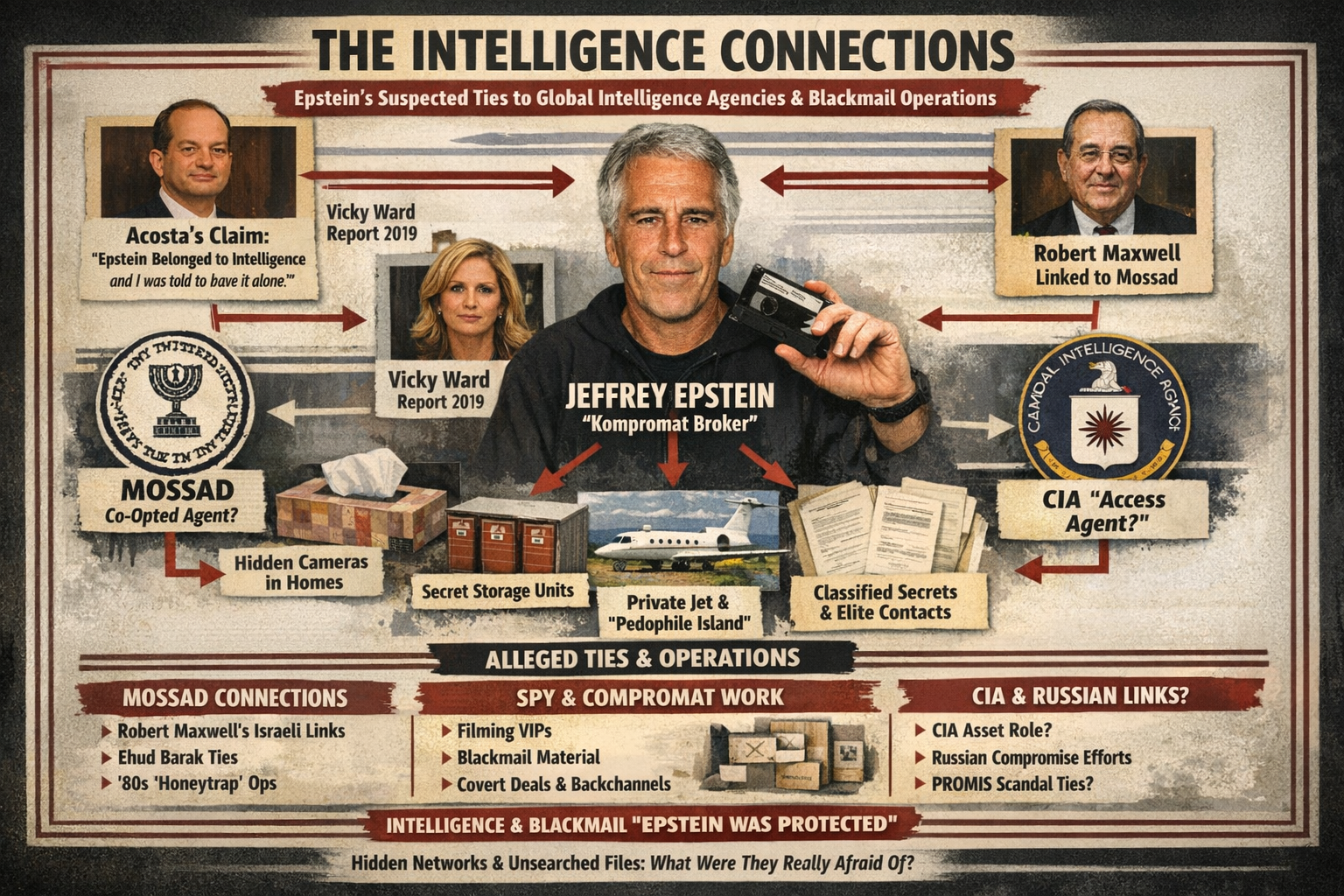
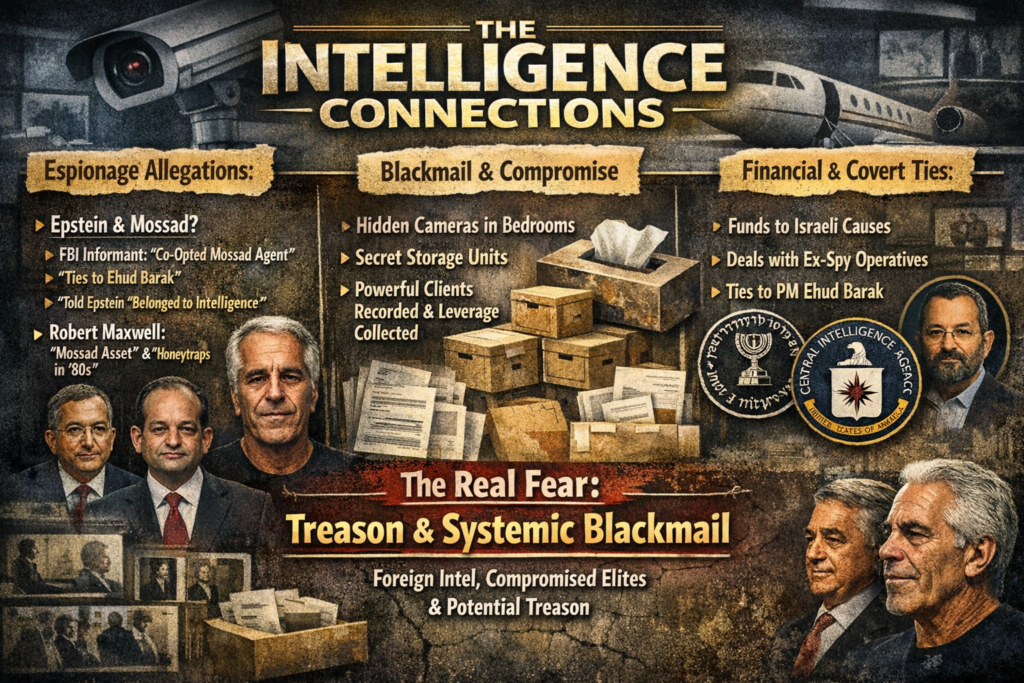
The most explosive thread—still officially unproven but stubbornly persistent—links Epstein to intelligence services. The cornerstone remains the Alexander Acosta episode. In 2019, journalist Vicky Ward reported that during Trump-transition vetting for Labor Secretary, Acosta explained his 2008 sweetheart deal by saying he had been told Epstein “belonged to intelligence” and to “leave it alone.” Ward’s source was a former senior White House official present for the discussion. Acosta later told DOJ investigators he had no knowledge of Epstein being an intelligence asset, but he has never directly denied Ward’s account under oath in a way that fully dispels it.
Ghislaine Maxwell’s father, Robert Maxwell, the British media mogul who died mysteriously in 1991, was long alleged to have been a Mossad asset. He was buried in Israel with eulogies from prime ministers; Ari Ben-Menashe, a former Israeli military intelligence officer, has claimed he personally met Epstein and Ghislaine in the 1980s when they were already working for Israeli intelligence on “honeytrap” operations.
Newly released FBI memos (from a 2020 Los Angeles field office source, unsealed in 2026 batches) state an undercover informant “became convinced” Epstein was a “co-opted Mossad agent” who had been “trained as a spy” and maintained back-channel ties to Israeli figures, including former Prime Minister Ehud Barak. Barak visited Epstein’s properties multiple times; one of his senior aides, Yoni Koren (linked to Israeli military intelligence), stayed regularly at Epstein’s New York mansion, with Epstein covering medical bills. Epstein’s own 2018 email mused that Robert Maxwell had once threatened Mossad with exposure unless they bailed out his crumbling empire.
Epstein also funneled money to Israeli causes via his foundation, including the Friends of the Israeli Defense Forces and the Jewish National Fund. Drop Site News reporting (2025) documented Epstein quietly brokering security deals for Israel with third countries, including Mongolia, while facilitating back-channel communications during the Syrian civil war. These are not conspiracy theories; they are patterns documented in emails, flight records, and financial transfers.
Whether Epstein was a formal asset of Mossad, the CIA, both, or a freelancer playing all sides remains unproven. What is clear is that he moved in intelligence-adjacent circles with extraordinary protection. The 2008 deal shielded potential co-conspirators across state lines. His 2019 death occurred while cameras malfunctioned and guards slept. Vast troves of material sit in un-searched storage units or remain heavily redacted.
The Real Fear: Not Just Pedophilia, But Treason and Systemic Compromise
This is why the cover-up feels so ferocious. Sleeping with an underage girl 20 years ago is a career-ending scandal, but it is survivable with the right lawyers and apologies. Being caught on hidden camera discussing classified information, financial crimes, or foreign-policy favors with a man who was feeding that material to a foreign intelligence service is something else entirely. That crosses into espionage, influence operations, and potential treason.
Why the Media Shied Away
Sex sells. Blackmail rings involving intelligence services and treason do not—especially when they implicate the same media, political, and financial elites who control narratives. Outlets that spent years detailing every victim’s horror story suddenly grew squeamish about cameras in Kleenex boxes, un-raided storage units, or Acosta’s “intelligence” explanation. The result: a public fixated on the salacious while the structural machinery of compromise remains half-hidden.
The Bottom Line
None of this excuses or diminishes the evil done to the victims. Their suffering was not a side effect; it was the engine. But to pretend Epstein was merely a lone-wolf pervert with a private plane is to miss the point of the operation. He was a broker in the oldest and dirtiest currency of power: human compromise packaged as leverage.
Key Recent Developments Amplifying the Intelligence/Blackmail View
New batches of files (from Data Sets 9–12 in the DOJ’s Epstein repository) include emails, FBI summaries, and property records that highlight surveillance and evasion tactics:
- Hidden cameras and recording setups: A 2014 email chain shows Epstein directing his pilot Larry Visoski to buy and install motion-detected hidden cameras—small enough to hide in Kleenex boxes—for his Palm Beach mansion. Victims and property searches long described bedroom/common-area cameras; these emails make it explicit he was actively building (or upgrading) the system years after his 2008 conviction.
- Secret storage units: Epstein maintained at least six storage lockers across the US (near Palm Beach, New York, and elsewhere), paying rent until his 2019 death. He used private detectives to move computers, hard drives, photos, and equipment from his island and homes as investigations closed in around 2005–2006. Search warrants suggest federal authorities never raided these units—raising questions about what remains hidden (potentially unseen kompromat or evidence of co-conspirators).
These details align with victim accounts of being filmed and the sheer infrastructure needed for ongoing leverage.On the intelligence side, 2025–2026 releases and reporting have revived and expanded older claims:
-
FBI memos (unsealed in batches) cite an informant convinced Epstein was a “co-opted Mossad agent” trained as a spy, with ties to Ehud Barak (who visited multiple times and had aides staying at Epstein properties). Leaked emails show Epstein pursuing deals with ex-MI6/Mossad figures (e.g., frozen Libyan assets).
-
Acosta’s “intelligence” comment (“I was told Epstein belonged to intelligence and to leave it alone”) keeps resurfacing in new file contexts and interviews. While Acosta later denied direct knowledge, the line appears in vetting notes and DOJ reviews, fueling speculation he was warned off due to higher-level protection.
-
Broader ties: Reports link Epstein to Russian kompromat efforts (recruiting Russian women, advising officials on US politics), potential CIA-adjacent access-agent roles, and even historical overlaps with PROMIS software scandals or arms networks via Robert Maxwell. Former CIA officer John Kiriakou called him a “textbook access agent” on recent shows, noting only state-level funding explains the scale.
Share this:

Part 1 – Jeffrey Epstein: The Information Broker Behind the Honey Trap
Conspiracy Theories, Maybe, Maybe Not.
Jeffrey Epstein was a monster. He systematically exploited, trafficked, and abused dozens—by some accounts over a thousand—young girls and women, many underage. The trauma inflicted on those victims is real, profound, and unforgivable. No analysis of his network should ever minimize that horror or treat the “bait,” as some coldly call them, as mere props in a larger game. They were human beings whose lives were shattered for the gratification and leverage of powerful men. That said, the mountain of evidence now public—including flight logs, victim testimonies, property searches, and recently unsealed documents—points to something larger than a simple sex-trafficking ring. Epstein ran a sophisticated kompromat operation: a blackmail-and-intelligence machine in which underage sex was the lure, but secrets, recordings, and influence were the real product.
The Surface Story vs. the Deeper One
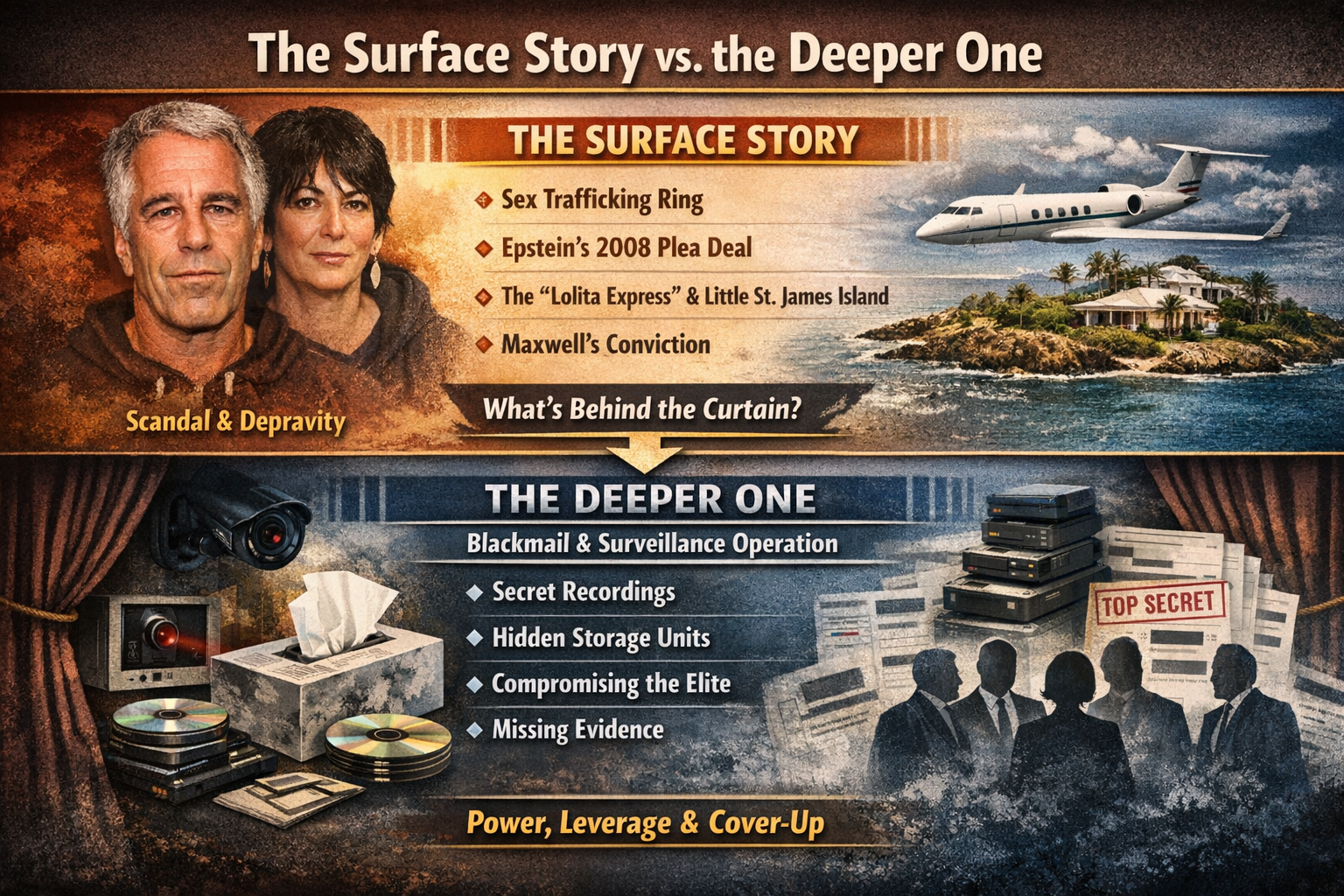
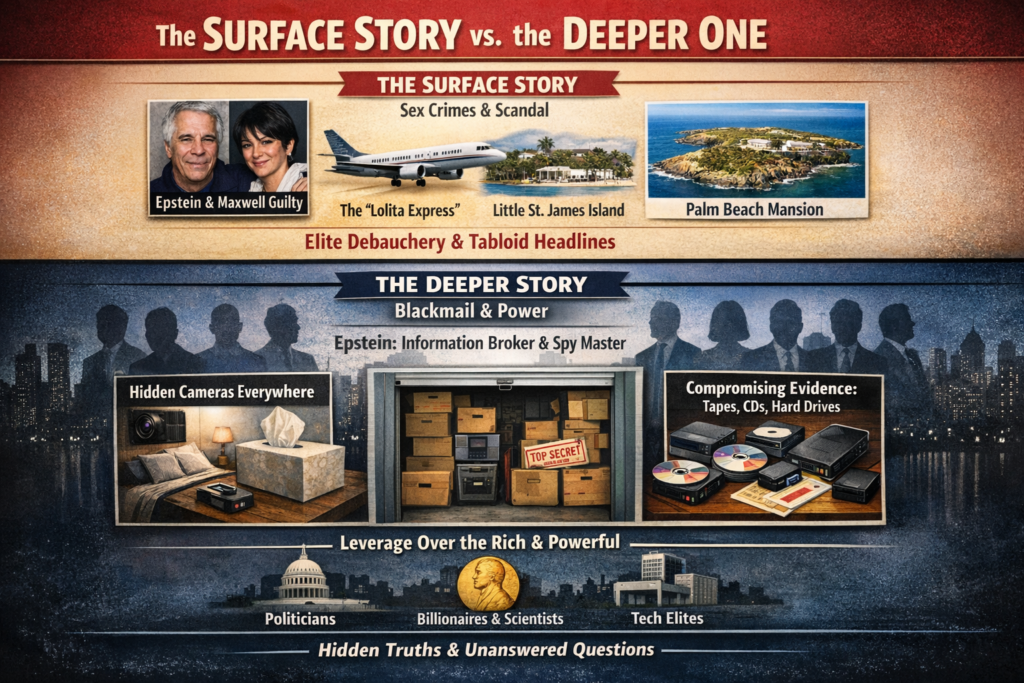
Mainstream coverage has rightly hammered the sex crimes. Epstein pleaded guilty in 2008 to procuring minors for prostitution in Florida. He was arrested again in 2019 on federal sex-trafficking charges and died in jail weeks later (officially ruled suicide amid glaring security failures). Ghislaine Maxwell, his longtime partner, was convicted in 2021 of recruiting and grooming victims. The “Lolita Express” jet, Little St. James island, the Palm Beach mansion—these have become shorthand for elite depravity.
But from the beginning, something didn’t add up. How did a college dropout with no obvious family wealth become a billionaire financier able to hobnob with presidents, prime ministers, Nobel laureates, and tech titans? Why did he receive such a shockingly lenient 2008 plea deal—18 months with extensive work release, immunity for unnamed co-conspirators, and the case sealed from victims? And why, even after his 2019 arrest and death, do so many documents, hard drives, and potential recordings remain either redacted, destroyed, or unaccounted for?
The answer increasingly suggested by court filings, victim accounts, and fresh 2025-2026 document releases is that Epstein was first and foremost an information broker. Sex was the tool to compromise targets; the real currency was leverage over the rich, powerful, and politically connected.
The Surveillance Infrastructure
Epstein’s properties were wired like a spy den. Victims repeatedly told investigators they believed they were being filmed. In February 2014—years after his first conviction—Epstein emailed his longtime pilot Larry Visoski: “Lets get three motion detected hidden cameras, that record.” Visoski replied he had bought two tiny units from a Fort Lauderdale surveillance store, capable of 64 hours of recording, and was “installing them into Kleenex boxes” for the Palm Beach mansion. Photos from the New York townhouse later showed obvious cameras in bedrooms and common areas.
Recent DOJ releases confirm Epstein maintained at least six secret storage units across the United States, rented from 2003 until his death in 2019. Financial records show he paid private detectives tens of thousands of dollars to remove computers, hard drives, photographs, CDs, and other equipment from his Florida home after he was apparently tipped off about the 2005-2006 police investigation. Some of those computers came from Little St. James. Search warrants reviewed by journalists indicate federal authorities never raided the lockers. Victims’ attorney Gloria Allred has publicly demanded the FBI search them immediately.
Recent DOJ releases confirm Epstein maintained at least six secret storage units across the United States, rented from 2003 until his death in 2019. Financial records show he paid private detectives tens of thousands of dollars to remove computers, hard drives, photographs, CDs, and other equipment from his Florida home after he was apparently tipped off about the 2005-2006 police investigation. Some of those computers came from Little St. James. Search warrants reviewed by journalists indicate federal authorities never raided the lockers. Victims’ attorney Gloria Allred has publicly demanded the FBI search them immediately.
An official 2025 FBI review of its Epstein holdings claimed “no credible evidence” of blackmail against prominent individuals and “no client list.” Yet the physical evidence of hidden cameras, motion-triggered recording, off-site data dumps, and the sheer volume of material moved out of reach of investigators tells a different story. Why build and hide such an apparatus if the only goal was personal gratification?
Share this:

Healthcare in America Series III – Part 1 Risk Doesn’t Disappear. It Moves
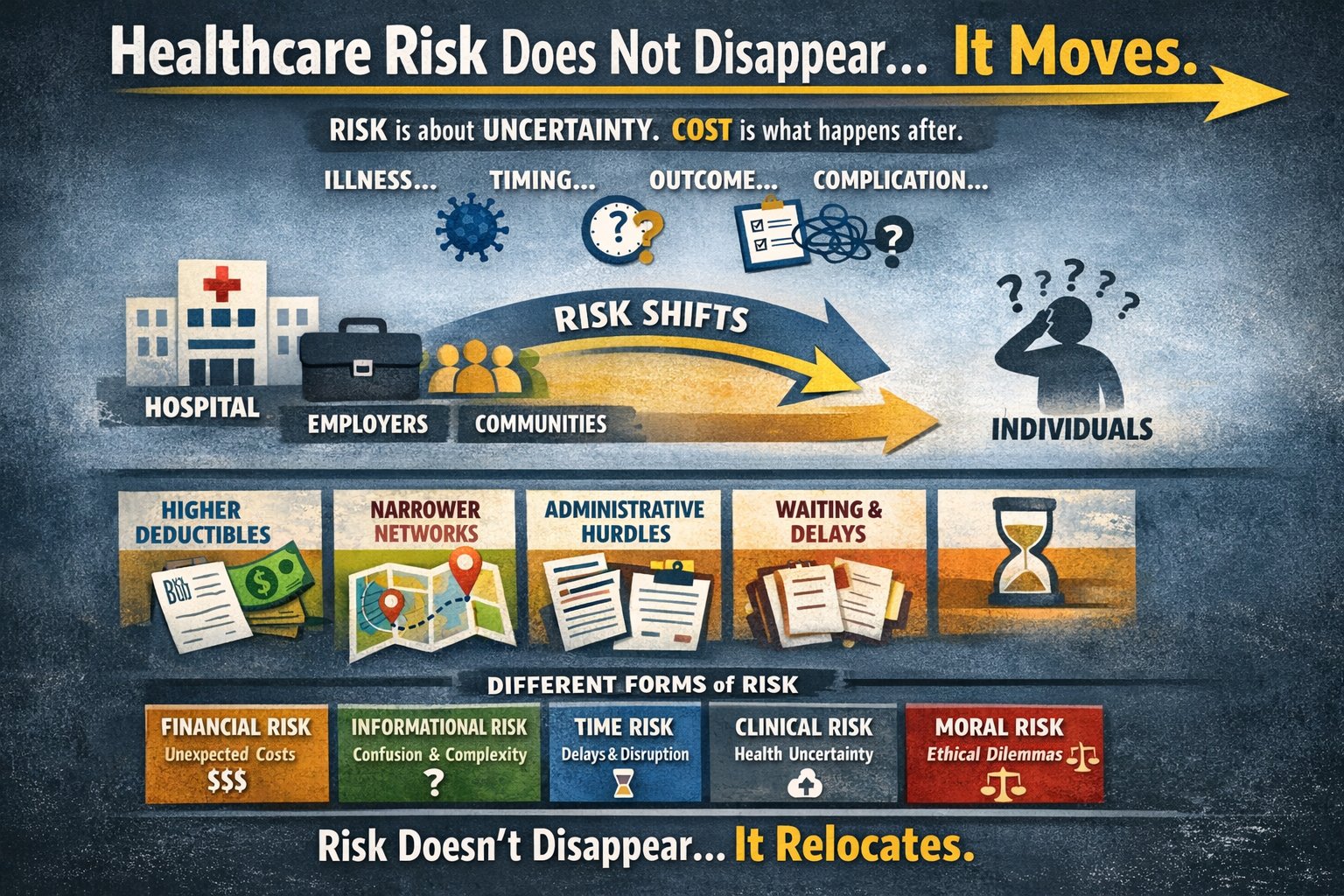
Risk Doesn’t Disappear. It Moves.
“Welcome back to Healthcare in America.
In our last series, we looked at urgency — what happens when care can’t wait, when decisions compress, and when someone must act before clarity arrives.
Now we’re going to step back from the moment of crisis and look at something quieter, but just as powerful: risk.
Before we talk about money, before we talk about policy, before we debate systems — we need to understand something fundamental.
Healthcare risk does not disappear.
It moves.
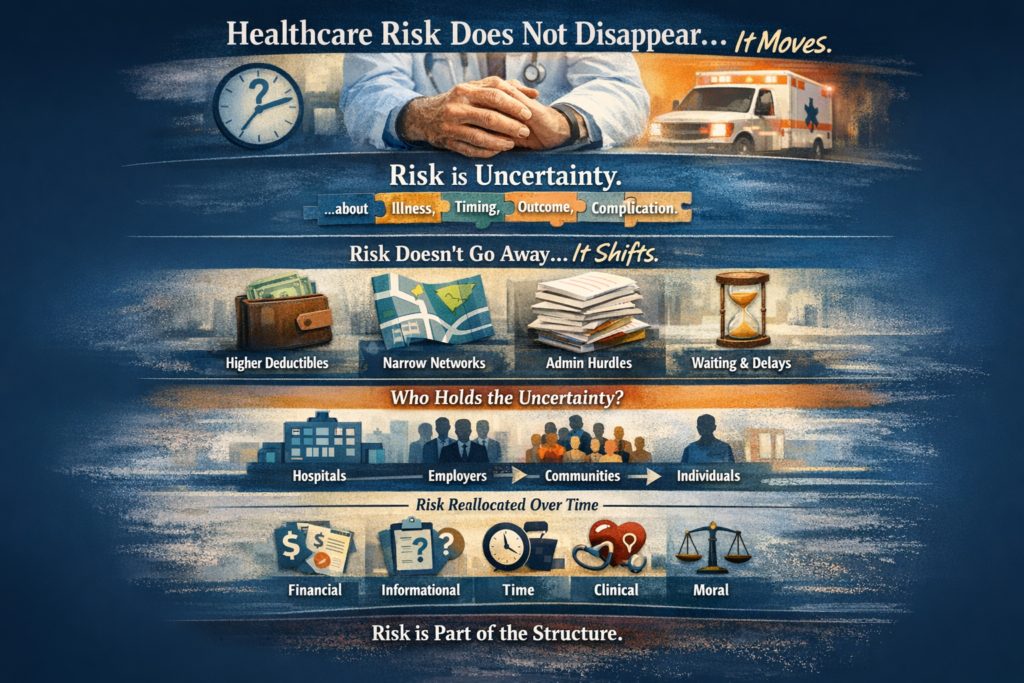
Risk is not the same thing as cost. Cost is what shows up after something happens. Risk is the exposure that exists before it happens. It is uncertainty — about illness, about timing, about outcome, about complication.
No healthcare system eliminates uncertainty. At best, it redistributes it.
Illness is inherently unpredictable. Some conditions are manageable. Others escalate. Some recoveries are smooth. Others are not. Systems exist to absorb and manage that unpredictability — but they do not erase it.
So the question becomes: who holds the uncertainty?
Historically, risk has sat in different places. Hospitals once absorbed more uncompensated variability. Employers buffered insurance volatility. Communities bore collective responsibility for certain types of care. That arrangement was never perfect, and we don’t romanticize it. But distribution has always shifted over time.
Today, risk often moves quietly.
It can move through higher deductibles — increasing the financial exposure before insurance begins to absorb cost.
It can move through narrower provider networks — limiting flexibility when care is needed.
It can move through administrative complexity — preauthorizations, coverage rules, and paperwork that shift informational burden outward.
It can move through time — waiting, navigating, coordinating.
None of these mechanisms are inherently malicious. They are structural adjustments designed to stabilize institutions. But when systems stabilize themselves, exposure does not vanish. It relocates.
And risk is not singular. It takes multiple forms.
There is financial risk — the possibility of unexpected bills or gaps in coverage.
There is informational risk — not knowing what is covered, what is approved, or what is required.
There is time risk — delays that affect work, income, or progression of illness.
There is clinical risk — the uncertainty of outcome itself.
And there is moral risk — borne by providers who must practice within constraints that limit what they can offer.
When risk moves to individuals, it is often described in the language of responsibility. We hear phrases like “consumer engagement” or “skin in the game.” But exposure and empowerment are not the same thing. Responsibility can feel like choice — but sometimes it is simply proximity to uncertainty.
This is not a debate about political models. It is not an argument for or against any specific reform. It is an observation.
Risk in healthcare is structural.
And structure determines stability.
In the next episode, we’ll look more closely at who absorbs that risk most quietly — and what happens when exposure accumulates beneath the surface.
For now, the key idea is simple:
Risk does not disappear.
It moves.”
Share this:



Healthcare in America Series II, Part 8 – What Patients Are Expected to Know (But Don’t)


Which setting is appropriate?
How urgent is urgent?
Who coordinates what happens next?
These expectations exist — but the instruction rarely does.
Youtube Playlist for Our Healthcare Series
Share this:


Healthcare in America Series II, Part 7 – The Invisible Layer — Administration

Healthcare administration isn’t a single office or department. It’s a web of functions required to make modern healthcare operable:
Youtube Playlist for Our Healthcare Series
Share this:



Healthcare in America Series II, Part 6 – Insurance Is Not Healthcare

One of the most persistent misunderstandings in healthcare is the idea that insurance and care are the same thing.
They’re related — but they are not interchangeable.
This confusion shapes expectations, frustration, and even how people judge their own experiences inside the system.
Youtube Playlist for Our Healthcare Series
Share this:


Healthcare in America Series II, Part 7 – The Invisible Layer — Administration
Most people experience healthcare through exam rooms, waiting areas, and conversations with clinicians. What they don’t see is the layer that sits between care and payment — the administrative machinery that keeps the system running.
This layer is largely invisible to patients, but it shapes cost, access, and workload in ways that are hard to overstate.
What “Administration” Actually Means
Healthcare administration isn’t a single office or department. It’s a web of functions required to make modern healthcare operable:
-
Billing and coding
-
Insurance verification
-
Compliance with federal and state regulations
-
Documentation requirements
-
Quality reporting
-
Audit preparation
-
Contract management
None of these activities deliver care directly — but nearly all are mandatory.
Why So Much Paperwork Exists
Healthcare is one of the most regulated industries in the country, and for understandable reasons: safety, fraud prevention, privacy, and accountability all matter.
Over time, however, layers of rules, reporting requirements, and payer-specific processes have accumulated — often without coordination.
The result is a system where:
-
The same information is entered multiple times
-
Different insurers require different formats
-
Documentation is written for billing as much as for care
This complexity doesn’t disappear just because patients don’t see it.
The Staffing Reality Most People Don’t Know
It’s common for a single physician to require multiple non-clinical staff members to support their work.
These roles may include:
-
Billing specialists
-
Coding experts
-
Authorization coordinators
-
Compliance staff
-
Administrative support
This isn’t inefficiency in the casual sense. It’s the operational cost of navigating a fragmented system.
How This Affects the Exam Room
Administrative demands shape clinical care indirectly:
-
Less time per patient
-
More time spent on documentation
-
Delays caused by approvals and verifications
-
Burnout among clinicians who trained to practice medicine, not paperwork
Patients feel the effects even if they never see the cause.
A Quiet but Important Point
When healthcare costs rise, it’s tempting to assume the increase comes from tests, treatments, or clinician salaries.
Often, it doesn’t.
A significant share of growth occurs outside the exam room, in the systems required to document, justify, process, and pay for care.
That reality doesn’t assign blame — but it does challenge assumptions.
In the final post of this week, we’ll step back and look at the system from the patient’s perspective: what people are implicitly expected to know — but are almost never taught — when navigating healthcare.

Share this:


Healthcare in America Series II, Part 5 – Why Emergency Rooms Are Overwhelmed (And It’s Not “Abuse”)
Emergency rooms are often described as being “overused” or “abused.”
It’s a familiar claim — and an easy one.
But it’s also an incomplete explanation that misses how people actually experience healthcare when something feels wrong.
To understand why emergency departments are overwhelmed, we need to look at how decisions are made in real time, not how they look in hindsight.
The Decision Most People Are Asked to Make
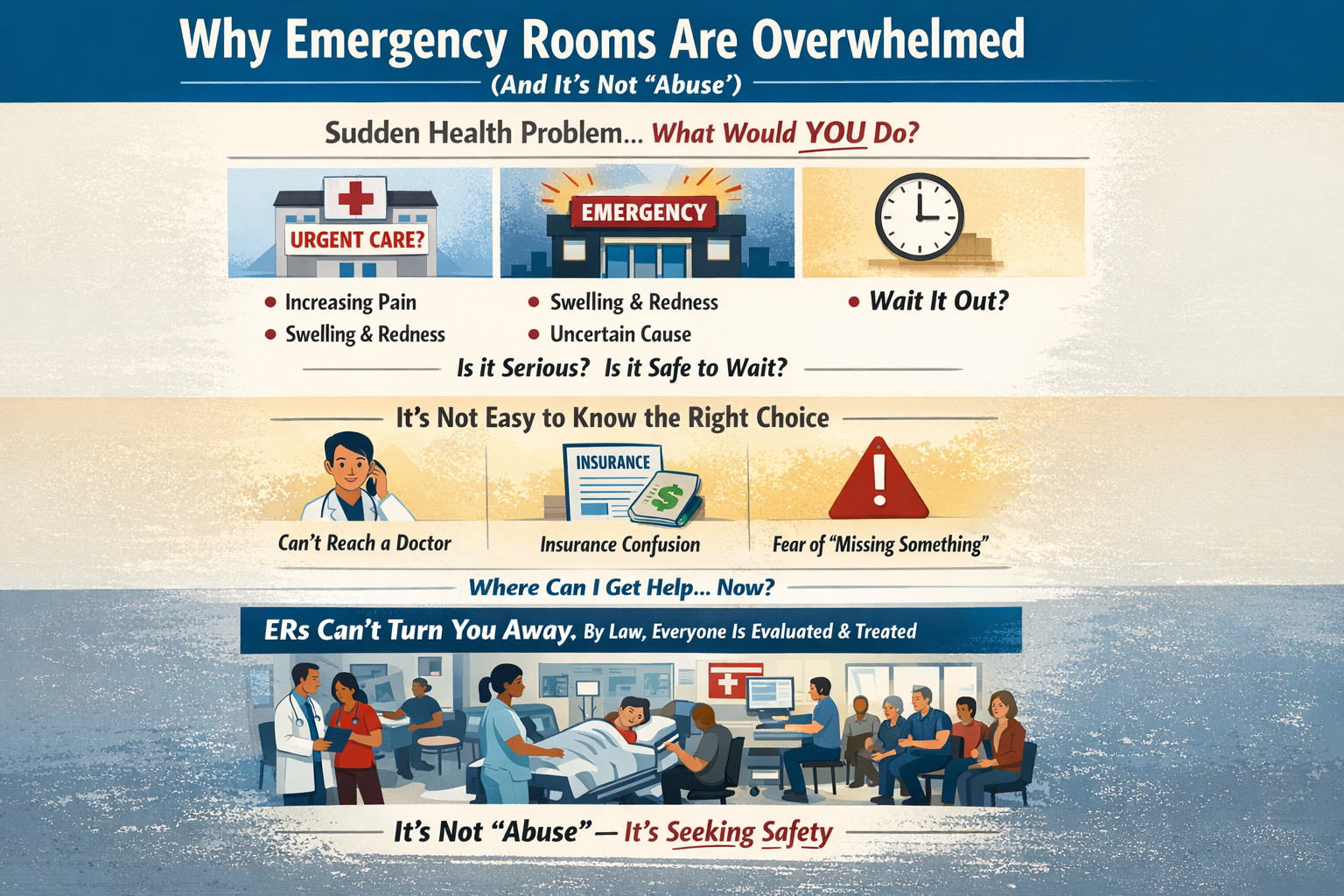
Imagine a sudden health issue:
-
Pain is increasingAll Episodes
-
Swelling is obvious
-
The cause isn’t clear
-
It’s happening now, not next week
Is this urgent care?
Is it the emergency room?
Is it safe to wait?
Most people were never taught how to answer those questions.
Take something as simple — and as ambiguous — as a spider bite. It’s swelling. It looks alarming. It hurts more than expected. Infection is a possibility, but not a certainty. Is that urgent care? Or the ER?
For most people, the safest choice feels obvious: go where help is guaranteed.
That instinct isn’t misuse. It’s risk avoidance.
What Emergency Rooms Are Required to Do
Under federal law (EMTALA), emergency departments cannot turn people away based on ability to pay or perceived severity. If someone shows up, they must be evaluated and stabilized if necessary.
That obligation is essential — but it also means ERs become the default safety net when other options are unclear, unavailable, or delayed.
Why the ER Becomes the Catch-All
Several structural factors push people toward emergency care:
-
Limited primary care access, especially after hours or in rural areas
-
Urgent care boundaries that aren’t well explained or intuitive
-
Insurance rules that complicate same-day care elsewhere
-
Fear of “missing something serious” when symptoms escalate quickly
In those moments, people aren’t choosing the ER because it’s convenient. They’re choosing it because it feels responsible.
The Mismatch No One Talks About
Emergency medicine is designed for stabilization, not continuity.
That means:
-
The problem is addressed, not managed long-term
-
Follow-up happens elsewhere — if it happens at all
-
The ER absorbs pressure created upstream in the system
When primary care access shrinks or urgent care becomes ambiguous, emergency departments feel the strain.
This isn’t random. It’s predictable.
Reframing the Conversation
Blaming patients for showing up doesn’t fix overcrowding.
It just ignores why they came in the first place.
Most ER visits that later get labeled “non-emergent” only look that way after a clinician has evaluated them. Before that evaluation, uncertainty is real — and fear is rational.
Understanding this doesn’t excuse system inefficiencies.
It explains them.
In the next post, we’ll untangle another common source of confusion: the assumption that insurance is the same thing as healthcare — and why that belief quietly shapes access, delays, and frustration throughout the system.

Share this:



Healthcare in America Series II, Part 5 – Why Emergency Rooms Are Overwhelmed (And It’s Not “Abuse”)

Is this urgent care?
Is it the emergency room?
Is it safe to wait?
Youtube Playlist for Our Healthcare Series
Share this:



Healthcare in America Series II – Kicker: Why We Struggle to Talk About the Unavoidable

Most conversations about healthcare skip this moment. We jump to policy, budgets, and blame. We treat crises as exceptions rather than as signals. But the truth is that someone always absorbs the weight when care can’t wait. Patients, families, frontline providers, and entire communities share the burden — quietly, unevenly, and often invisibly.
Youtube Playlist for Our Healthcare Series
Share this:


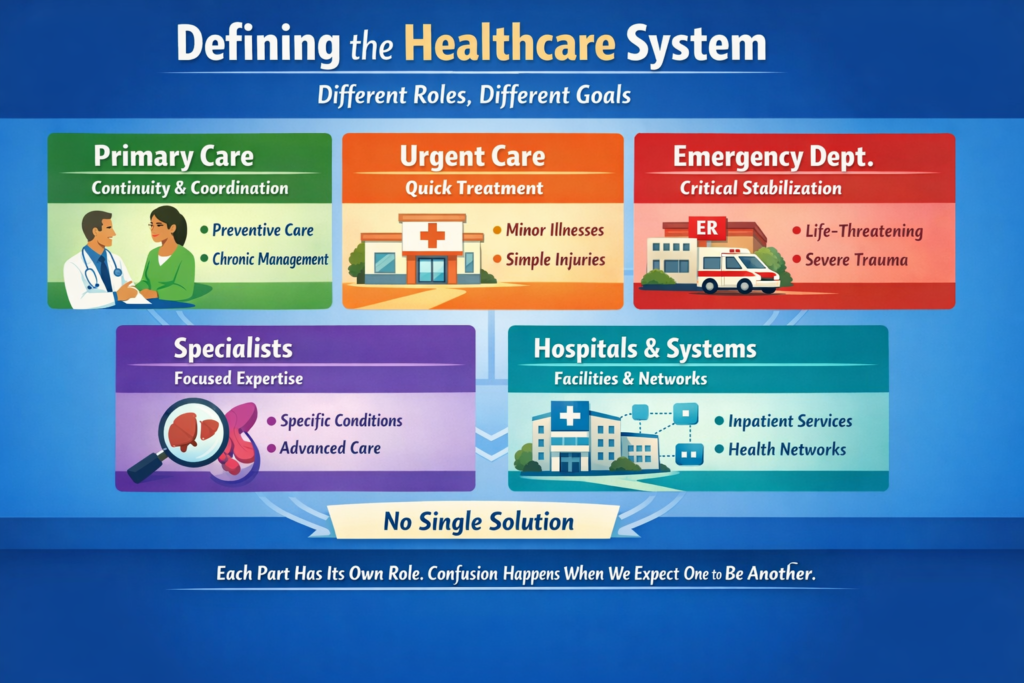
Healthcare in America Series II, Part 4 – How the System Is Actually Structured
Before we talk about costs, delays, frustration, or reform, we need to pause and do something that rarely happens in public conversations about healthcare:
Define the system.
Most of the anger and confusion people feel about healthcare doesn’t come from bad intentions or unreasonable expectations. It comes from assuming that healthcare is a single thing — a place, a person, or a service — when in reality it’s a collection of distinct parts, each designed for a specific role.
When those roles blur, frustration follows.
This week is not about blame. It’s about understanding how the pieces fit together — and just as importantly, where they don’t.
Primary Care: Continuity and Coordination
Primary care is designed to be the foundation of the system.
Its role is not urgency. It is continuity:
-
-
-
-
Preventive care
-
Managing chronic conditions
-
Tracking changes over time
-
Coordinating referrals and follow-ups
-
-
-
Primary care works best when it knows you — your history, patterns, risks, and medications. It is the long view of healthcare.
When primary care access is limited or delayed, pressure builds elsewhere in the system.
Urgent Care: Episodic and Limited by Design
Urgent care exists to handle non-life-threatening issues that can’t wait, but don’t require hospital-level resources.
Examples include:
-
-
-
-
Minor fractures
-
Infections
-
Wounds requiring stitches
-
Sudden but stable symptoms
-
-
-
Urgent care is intentionally narrow. It is not meant to replace primary care, and it is not designed to manage complex or escalating conditions. Its value is speed and accessibility — not depth.
Because its boundaries aren’t intuitive, urgent care is often misunderstood.
Emergency Departments: Stabilization, Not Ongoing Care
Emergency departments are built for one purpose: stabilization.
They exist to address:
-
-
-
-
Life-threatening conditions
-
Severe trauma
-
Rapidly deteriorating symptoms
-
Situations where delay could cause permanent harm
-
-
-
Emergency medicine is about minutes and hours, not weeks or months. It is not designed for continuity, follow-up, or long-term management — even though it is often asked to fill those gaps.
This distinction matters more than most people realize.
Specialists: Depth Without Context
Specialists focus deeply on specific systems or conditions.
They provide expertise, not oversight.
-
-
-
-
Narrow scope
-
Referral-driven access
-
High value in defined situations
-
-
-
Specialists are essential — but they rely on other parts of the system to provide coordination and context.
Hospitals, Systems, and Networks (Not the Same Thing)
One final distinction that often gets overlooked:
-
-
-
-
Hospitals are places where care is delivered
-
Health systems manage multiple facilities and services
-
Networks manage contracts and access
-
-
-
These are operational and organizational layers — not clinical ones — but they shape how care is delivered and accessed.
We’ll come back to why that matters later.
Why This Structure Matters
When one part of the system is missing, overloaded, or inaccessible, pressure shifts to another part — often one that was never designed to handle it.
That’s not chaos.
That’s predictable behavior in a complex system.
In the next post, we’ll look at one of the most visible consequences of this mismatch: why emergency rooms are overwhelmed — and why it’s not as simple as blaming patients.
Share this:


Healthcare in America Series II, Part 4 – How the System Is Actually Structured

Most of the anger and confusion people feel about healthcare doesn’t come from bad intentions or unreasonable expectations. It comes from assuming that healthcare is a single thing — a place, a person, or a service — when in reality it’s a collection of distinct parts, each designed for a specific role.
Youtube Playlist for Our Healthcare Series
Share this:



Healthcare in America Series II, Part 3 – Who Absorbs the Consequences When Waiting Isn’t an Option

Urgency does not distribute impact evenly. Some patients are more vulnerable than others. Some families are better equipped to navigate complexity. And some communities have far fewer resources. The system doesn’t decide this intentionally. It just happens, quietly, invisibly, and sometimes tragically.
Youtube Playlist for Our Healthcare Series
Share this:



Healthcare in America Series II, Part 2 – When Systems Built for Efficiency Meet Urgency

Most healthcare systems are built around averages. Schedules, staffing, and workflow all assume a level of predictability. Efficiency depends on forecasting, and forecasting depends on stability. But urgent care doesn’t follow a curve or a plan. It arrives in spikes, in crises, in moments that no one could schedule. And when that happens, even the best-designed system starts to strain.
Youtube Playlist for Our Healthcare Series
Share this:


Healthcare in America Series II, Part 1 – What Urgent Care Actually Is (and Is Not)

Urgency collapses options. Decisions that would normally take days, weeks, or months are compressed into minutes or hours. There’s no time to compare prices, shop for the best facility, or negotiate who sees you first. Consent still exists, but it’s constrained. Choice becomes secondary to need.
Youtube Playlist for Our Healthcare Series
Share this:


Healthcare in America — Series II: When Care Can’t Wait – Podcast Prelude

In the first episode, we’ll explore what urgent care actually is, and what it isn’t. We’ll see how immediacy changes the rules, compresses choices, and forces decisions that no one wants to make lightly.
In the second episode, we’ll look at what happens when systems designed for efficiency are suddenly forced into urgent, unpredictable situations. We’ll see where bottlenecks appear, where workarounds become routine, and how pressure spreads across the system in ways that aren’t always visible.
In the third episode, we’ll ask a simple but important question: Who carries the consequences when care can’t wait? Patients, families, frontline providers, and communities all bear the load — often quietly, without recognition.
Youtube Playlist for Our Healthcare Series
Share this:


Heathcare – Closure of State Run Mental Facilities and Increase in Homeless Population

Overall, Oregon’s closures are a microcosm of a national policy that prioritized deinstitutionalization without the necessary infrastructure, directly fueling homelessness by stranding vulnerable people. If you’re diving deeper for your healthcare series, sources like HUD’s Annual Homelessness Assessment Reports or AMA ethics journals provide robust data for further exploration.
Youtube Playlist for Our Healthcare Series
Share this:

Control of Voting – If Trump Is Ousted: Does It Die on the Vine?
In my view, this is a long-game ecosystem (think tanks, donors, state parties) that’s survived presidents before. Trump’s a catalyst, but removal would force a tactical reset—not abandonment. The midterms are the pivot point; if GOP holds, it accelerates. If not, it decentralizes.
Youtube Playlist for Dark Money
Share this:


Seize Control of Voting, Who is Behind the Curtain
My question is who is actually the architect? I don’t believe Trump ever had the smarts to do this on his own and certainly not now. Someone or some organization is orchestrating everything behind the scenes
Youtube Playlist for Dark Money
Share this:

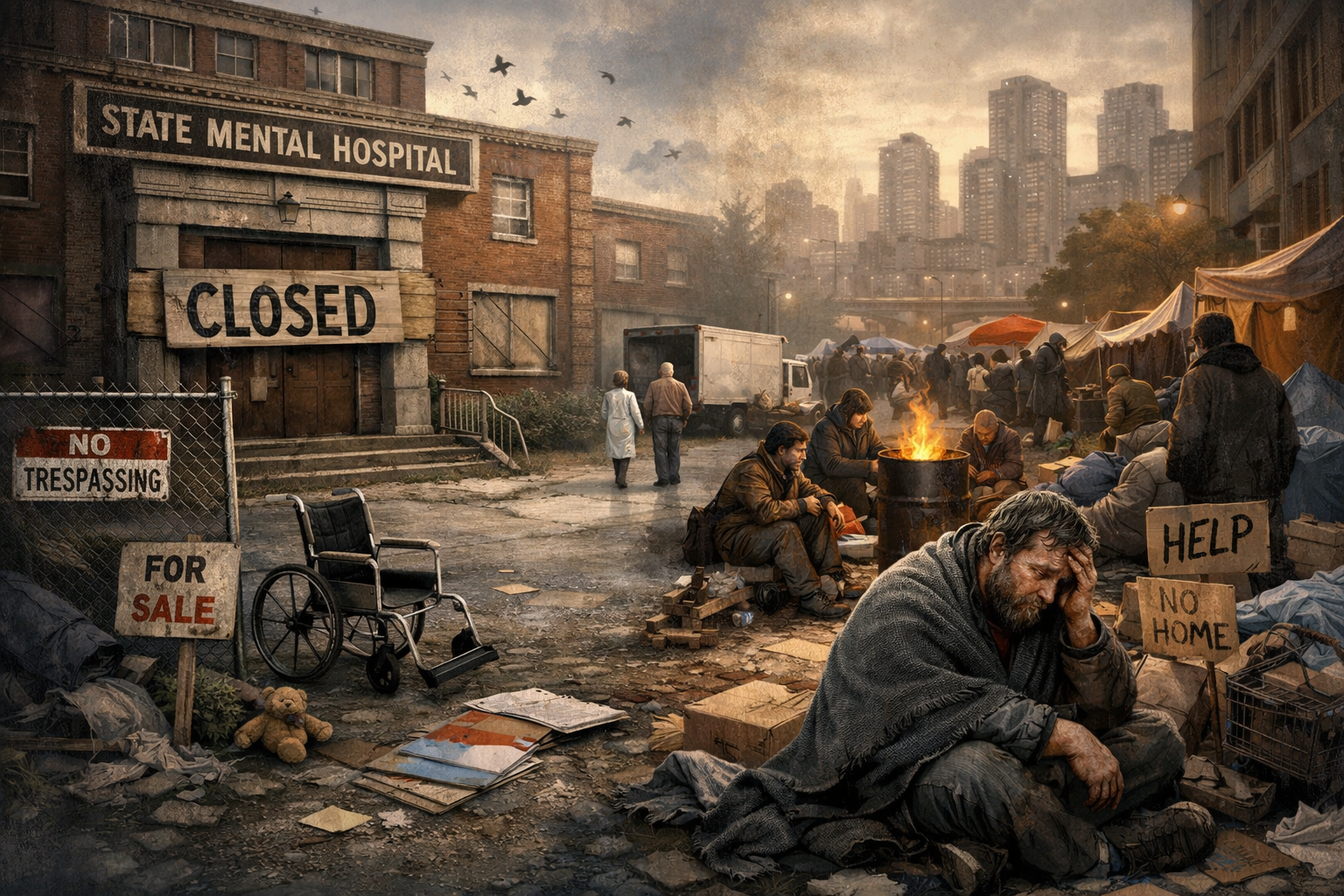
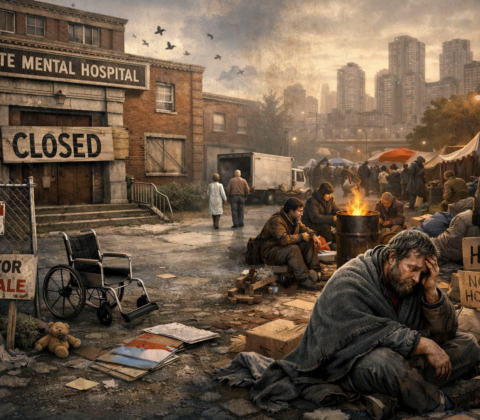
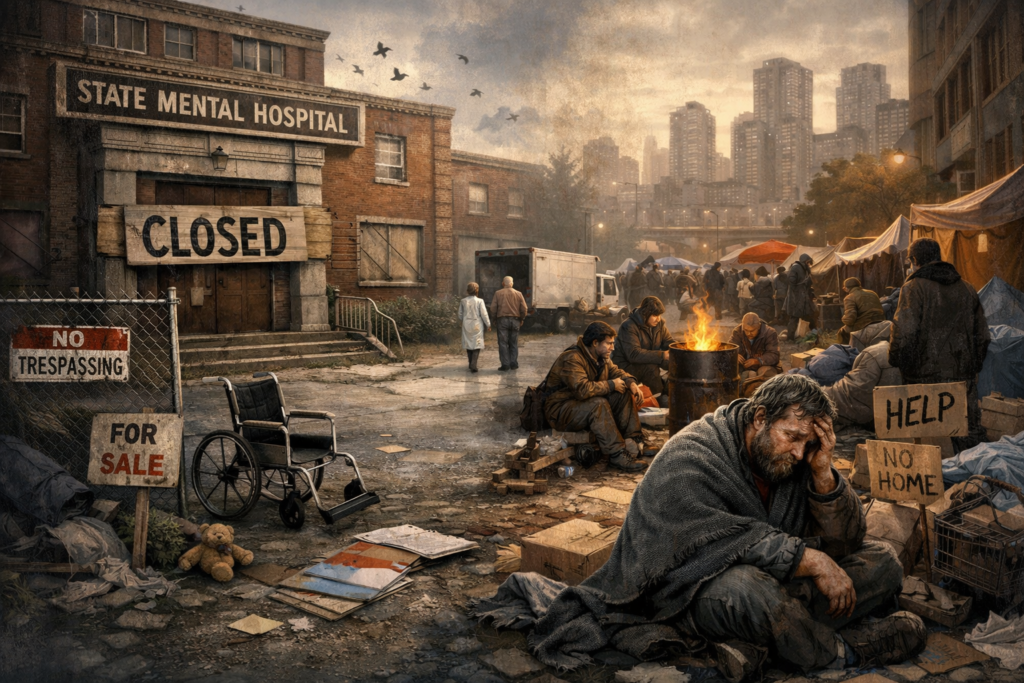
Healthcare – Closure of State Run Mental Facilities and Increase in Homeless Population
Historical Context: The National Deinstitutionalization Trend State-run psychiatric hospitals were once the primary providers of long-term mental health care in the U.S., peaking in the 1950s with around 559,000 inpatient beds nationwide.
By the 1990s, this number had plummeted to about 40,000, a roughly 92% reduction, as facilities closed or downsized dramatically.
This wasn’t isolated to Oregon; it happened across nearly every state, driven by a combination of factors: Policy Reforms and Federal Incentives: The Community Mental Health Act of 1963, signed by President Kennedy, aimed to shift care from large institutions to community-based centers, supported by new antipsychotic medications and civil rights advocacy against abusive asylum conditions.
Federal funding encouraged states to deinstitutionalize, but promised community resources were chronically underfunded — only about half of the planned 1,500 community mental health centers were ever built.
Budget Pressures and Cost-Shifting: States faced rising costs for institutional care amid economic shifts in the 1970s–1980s. Many closed facilities to cut expenses, relying on Medicaid and other federal programs to fund outpatient alternatives. However, this often meant discharging patients without sufficient follow-up, housing, or treatment options.
Examples Across States: Closures mirrored Oregon’s timeline (e.g., Dammasch in 1995). Nationally, facilities like Topeka State Hospital (Kansas, 1997), Metropolitan State Hospital (Massachusetts, 1992), and Allentown State Hospital (Pennsylvania, 2010) shut down in similar waves.
By 2023, many states had fewer than 10 state-operated psychiatric hospitals left, with total public beds dropping to historic lows.
In Oregon, the closure of Dammasch — opened in 1961 and shuttered amid reports of inhumane conditions — exemplified this, releasing patients into communities ill-equipped to support them.
The state’s Eastern Oregon Psychiatric Center in Pendleton closed in 2014, further reducing capacity.
Today, Oregon has only about 743 state hospital beds for adults, with even fewer staffed.
How This Contributed to the National Homeless Crisis While deinstitutionalization wasn’t the sole cause of homelessness — factors like affordable housing shortages, poverty, and substance use disorders play major roles — it undeniably exacerbated the issue by leaving many with severe mental illnesses without stable support. Here’s how the evidence connects the dots: Discharge Without Adequate Safety Nets: Many patients were released from institutions with minimal planning. Nationally, the lack of community mental health funding meant former inpatients often ended up cycling through emergency rooms, jails, or streets.
Studies show a direct correlation: as hospital beds vanished, homelessness among the mentally ill rose, with estimates that 25–30% of homeless individuals have severe mental illnesses like schizophrenia or bipolar disorder.
In Oregon, around 40% of the homeless population has a serious mental illness, higher than the national average, and closures like Dammasch directly led to increased street homelessness in Portland in the 1990s.
Rising Homelessness Statistics: U.S. homelessness hit a record 771,480 people on a single night in January 2024, up 18% from 2023 and 40% from 2018.
Chronic homelessness (long-term, often with disabilities including mental illness) surged 73% over the same period, from 97,000 to 168,000.
About 22% (140,000) of homeless adults in 2024 met criteria for serious mental illness.
Researchers attribute part of this to deinstitutionalization’s “trans institutionalization,” where people shifted from hospitals to prisons or homelessness.
Broader Systemic Failures: The affordable housing crisis amplified the impact — median rents outpaced wages, making stable housing unattainable for those with mental health challenges.
In states like California and Oregon, this led to visible increases in unsheltered homelessness (36% of the total in 2024).
Oregon’s experience echoes this: without enough community treatment or housing post-closures, many cycle between the Oregon State Hospital, jails, and streets.
Nationally, experts note that while deinstitutionalization aimed for better outcomes, underfunding turned it into a “system designed to fail.”
Key Nuances and Ongoing Implications Not every closure was detrimental — some states maintained or repurposed facilities, and advances in outpatient care have helped many. However, the national bed shortage (now about 50 per 100,000 people, far below the recommended 50–60) leaves gaps, especially for acute crises.
In Oregon, this manifests in long waits for care and over-reliance on emergency departments.
Recent federal efforts, like executive orders promoting institutionalization for homelessness reduction, highlight the debate: some advocate for more beds, others for better community funding to prevent crises.
Overall, Oregon’s closures are a microcosm of a national policy that prioritized deinstitutionalization without the necessary infrastructure, directly fueling homelessness by stranding vulnerable people. If you want to dive deeper into this topic, sources like HUD’s Annual Homelessness Assessment Reports or AMA ethics journals provide robust data for further exploration.
Share this:

Dark Money and Influence, It’s time to move on.

Not all dark money is a conspiracy and not all conspiracies use dark money.
Youtube Playlist for Dark Money
Share this:



Coda: What We Know Now – Healthcare in America Series 1

The purpose here was not to provide answers, but to establish a starting point grounded in reality rather than ideology. Any serious conversation going forward has to begin with what healthcare actually is: partially market, partially public, and fundamentally human. It cannot be reduced to slogans without losing something essential.
Youtube Playlist for Our Healthcare Series
Share this:


Part 6: When the System Stops Pretending – Healthcare in America

For years, America’s healthcare debates have circled the same familiar arguments: cost, access, innovation, choice. Each side insists the problem is just one adjustment away from being solved — a different payer mix, a different incentive, a different set of rules.
What rarely gets said out loud is simpler and more uncomfortable:
Youtube Playlist for Our Healthcare Series
Share this:

Part 6: When the System Stops Pretending – Healthcare in America
Part 6: When the System Stops Pretending
For years, America’s healthcare debates have circled the same familiar arguments: cost, access, innovation, choice. Each side insists the problem is just one adjustment away from being solved — a different payer mix, a different incentive, a different set of rules.
What rarely gets said out loud is simpler and more uncomfortable:
The system no longer matches the reality it is supposed to serve.
This isn’t a failure of compassion, and it isn’t a failure of effort. It is a failure of structure — a system built on assumptions that no longer hold.
A system optimized for avoidance
Modern healthcare is not primarily organized around outcomes. It is organized around risk avoidance.
Risk is shifted:
-
From insurers to providers
-
From providers to patients
-
From institutions to families
-
From policy to paperwork
Each step is rational in isolation. Each makes sense on a spreadsheet. Together, they create a system where no one is fully responsible for the whole.
The result is not efficiency. It is fragmentation.
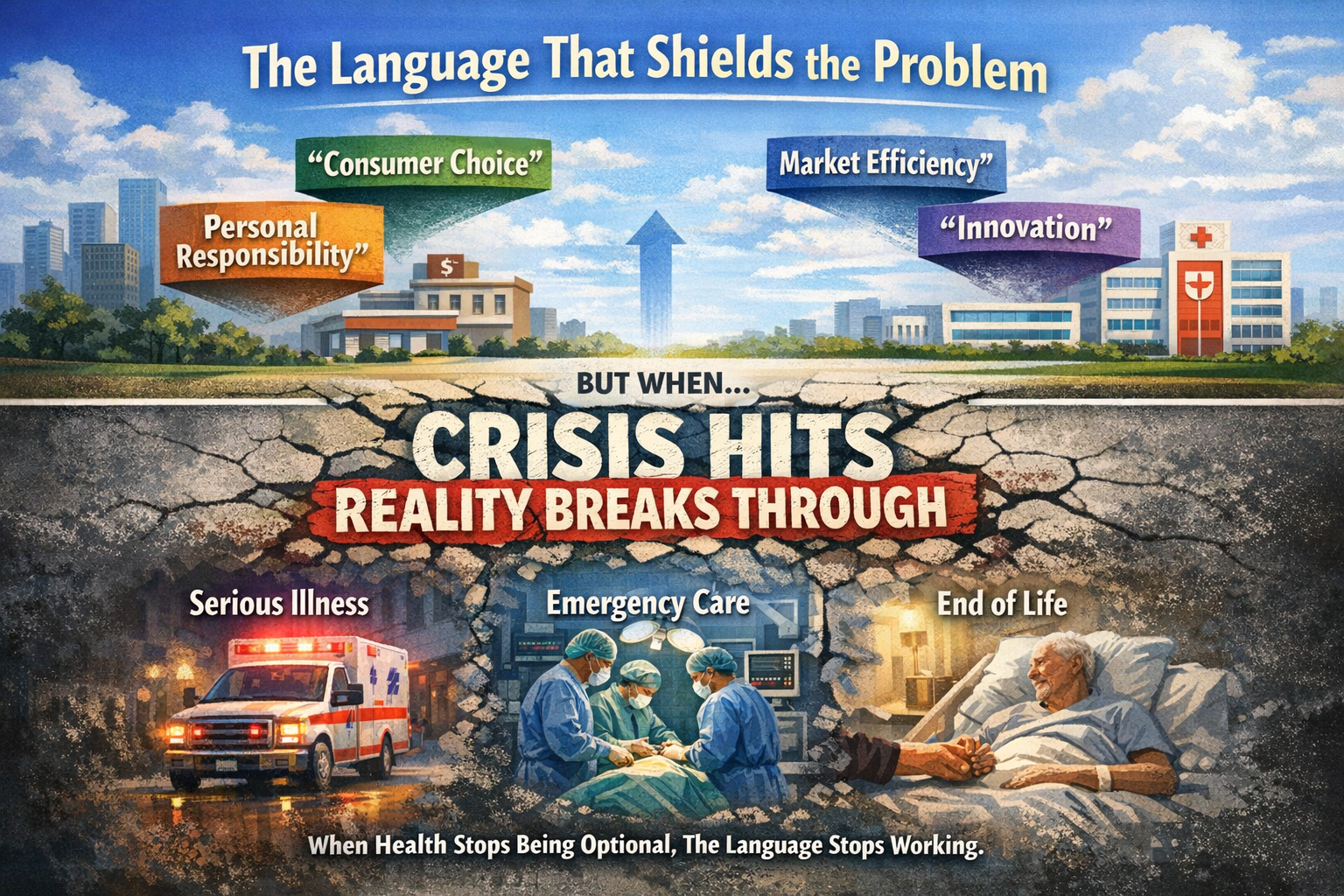
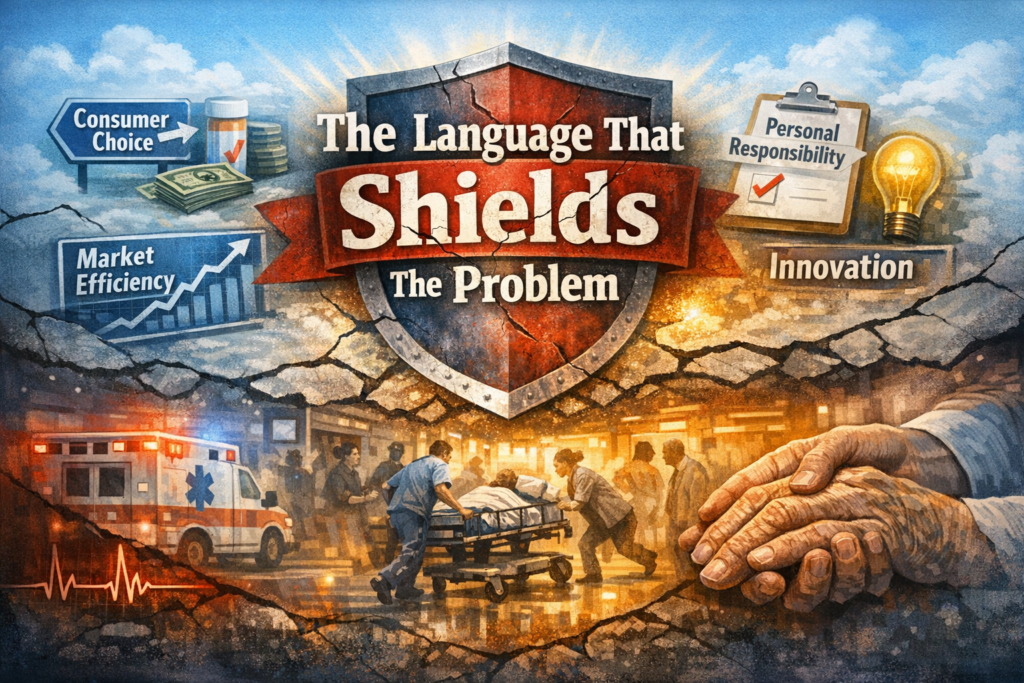
The language that shields the problem
We rely heavily on comforting language:
-
“Consumer choice”
-
“Market efficiency”
-
“Personal responsibility”
-
“Innovation”
These phrases are not lies, but they are incomplete. They work well for elective care, predictable conditions, and people with time, money, and literacy to navigate complexity.
They break down when care becomes urgent, unavoidable, or human.
When health stops being optional, the language stops working.
Who carries the weight now
As responsibility diffuses upward, the burden concentrates downward.
Patients manage billing disputes while recovering.
Families coordinate care without training.
Providers burn out navigating systems designed to protect revenue, not judgment.
Rural hospitals absorb losses with no margin for error.
None of this shows up cleanly in political talking points. It shows up in closures, staffing shortages, delayed care, and quiet financial collapse.
The place the system can’t avoid
There is one place where all of these distortions converge — where care cannot be deferred, denied, or negotiated in advance.
The system depends on it.
The system resents it.
And the system refuses to fully account for it.
This is not because it is inefficient, but because it is honest.
It is where every upstream decision eventually lands.
The political stalemate
Healthcare dysfunction has become politically useful.
One side uses it to fundraise.
The other uses it to posture.
Both promise fixes that stop short of structural change.
Real reform would force tradeoffs.
Tradeoffs create accountability.
Accountability threatens narratives.
So the system limps forward, managed rather than repaired.
The fork in the road
We are now past the point where incremental adjustments can hide the mismatch.
We can continue to:
-
Shift costs
-
Narrow networks
-
Add complexity
-
Manage decline
Or we can acknowledge the truth that has been visible for years:
A healthcare system that pretends everything is a market, everything is optional, and responsibility can always be deferred will eventually fail at the moments that matter most.
This series is not about choosing sides.
It is about deciding whether we are willing to stop pretending.
Share this:

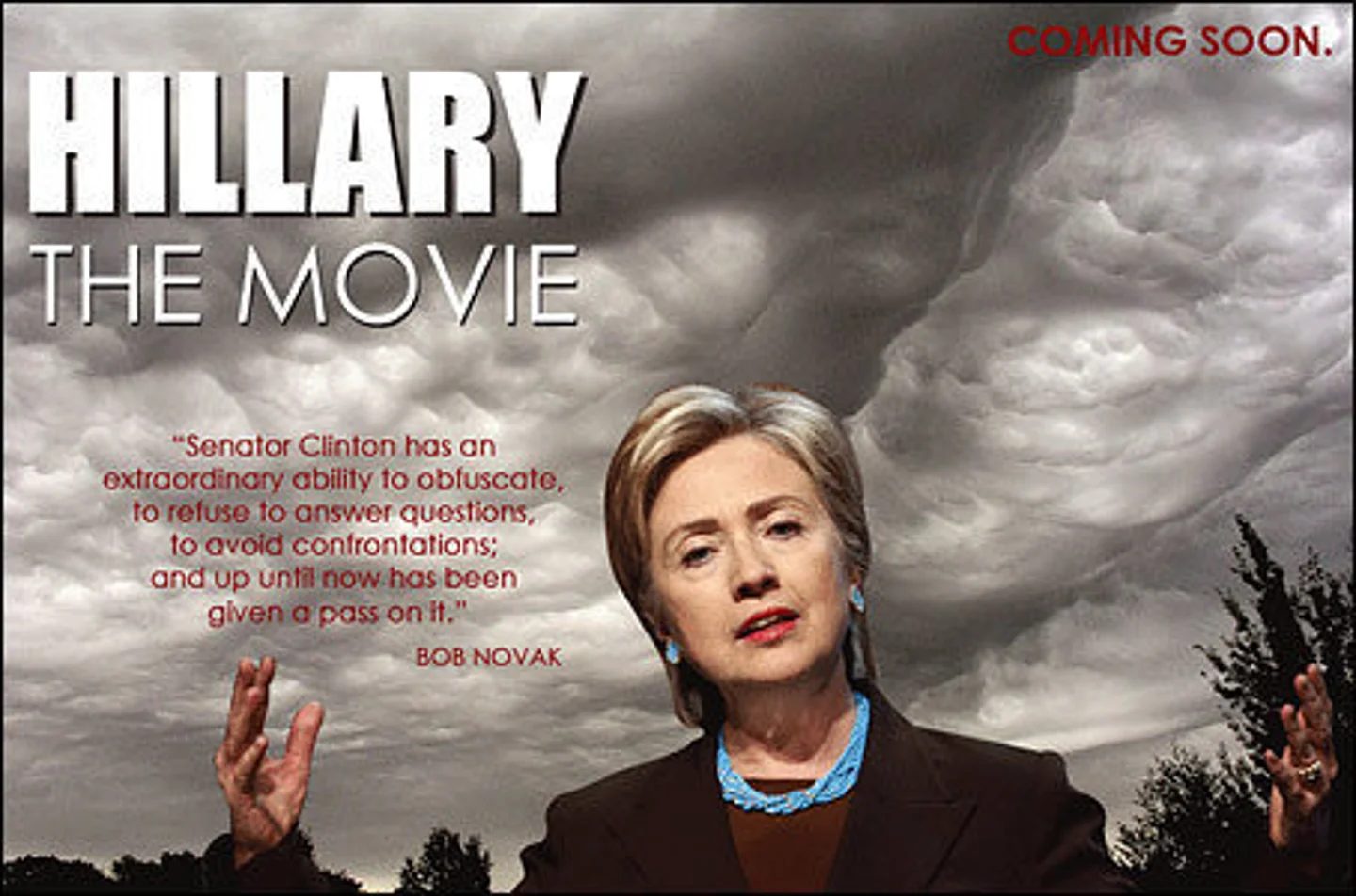
How Citizens United Came to Be: From a Hillary Hit Piece to Unlimited Corporate Cash in Elections – Dark Money
The 2010 Supreme Court decision in Citizens United v. FEC remains one of the most divisive rulings in modern American history. It didn’t just tweak campaign finance rules—it blew the doors off them, allowing corporations, unions, and wealthy donors to pour unlimited money into elections through “independent” spending. Super PACs, dark money groups, and billionaire influence? Thank (or blame) this case.
But how did we get here? It all started with a conservative nonprofit, a scathing documentary about Hillary Clinton, and a bold challenge to longstanding restrictions on political speech.
The Origins: Citizens United and “Hillary: The Movie”
Citizens United, a conservative advocacy group founded in 1988 by Floyd Brown (known for attack ads like the infamous Willie Horton spot in 1988), positioned itself as a producer of political documentaries. In 2007–2008, during Hillary Clinton’s run for the Democratic presidential nomination, the group created Hillary: The Movie—a 90-minute film portraying Clinton as power-hungry, untrustworthy, and unfit for office.
They planned to air it on DirecTV and promote it with TV ads right before primaries. But they hit a wall: the Bipartisan Campaign Reform Act (BCRA) of 2002—better known as the McCain-Feingold law—banned corporations and unions from funding “electioneering communications” (ads naming candidates) within 30 days of a primary or 60 days of a general election if those ads reached a broad audience.
Citizens United wasn’t just any corporation; as a nonprofit, it argued the rules violated its First Amendment rights to free speech. They sued the Federal Election Commission (FEC) in December 2007, seeking to declare parts of BCRA unconstitutional, both on their face and as applied to the film and its ads.
A federal district court mostly sided with the FEC: the film was basically election advocacy, not a neutral documentary, so the ban applied. Citizens United appealed directly to the Supreme Court.
The Supreme Court Showdown
The case was argued in March 2009, but the Court surprised everyone by ordering a rare reargument in September 2009, expanding the question to whether prior precedents like Austin v. Michigan Chamber of Commerce (1990)—which allowed bans on corporate independent expenditures—should be overruled.
On January 21, 2010, the Court ruled 5-4 in favor of Citizens United, going far beyond the narrow issue of the movie.
Majority (5 justices):
Anthony Kennedy (wrote the main opinion): Argued that spending money on political speech is protected expression. Banning corporate independent expenditures based on the speaker’s identity (corporation vs. person) violates the First Amendment. “If the First Amendment has any force, it prohibits Congress from fining or jailing citizens, or associations of citizens, for simply engaging in political speech.”
Joined by: Chief Justice John Roberts, Antonin Scalia, Samuel Alito, and Clarence Thomas (Thomas concurred separately, dissenting on disclosure rules).
Dissent (4 justices):
John Paul Stevens (wrote a blistering 90-page dissent): Called the ruling a “radical departure” that threatens democracy by allowing corporate wealth to drown out ordinary voices. Corporations aren’t “We the People,” he argued, and unlimited spending risks corruption and erodes public trust.
Joined by: Ruth Bader Ginsburg, Stephen Breyer, and Sonia Sotomayor.
The Court struck down the corporate spending ban, overturned Austin, and opened the floodgates for unlimited independent expenditures—as long as they weren’t coordinated with candidates.
The Controversy: Free Speech Victory or Corporate Takeover?
The decision ignited immediate firestorms.
President Obama blasted it in his 2010 State of the Union address:
“Last week, the Supreme Court reversed a century of law to open the floodgates for special interests—including foreign corporations—to spend without limit.” (That line drew a viral “not true” mouthed response from Justice Alito.)
Supporters hailed it as a triumph for the First Amendment, preventing government censorship of political views just because they’re from corporations (seen as groups of individuals). Critics decried it for equating money with speech, amplifying megadonors, and enabling “dark money” nonprofits to hide sources—leading to billions in outside spending that many say distorts democracy.
Fifteen years later (and counting), the ruling birthed super PACs, record-shattering election spending, and ongoing calls for a constitutional amendment to overturn it. Polls show overwhelming public opposition across party lines.
Was Citizens United a principled defense of free expression, or did it hand elections to the highest bidders? In the elephant in the room: the money keeps flowing, and ordinary voices often get shouted down.
What do you think—time to amend the Constitution, or is this just how free speech works in a capitalist democracy? Drop your thoughts in the comments.
Sources: Supreme Court opinion, Brennan Center for Justice, FEC records, Wikipedia summary (cross-verified).
Share this:



Part 5: Choice vs. Coverage – Healthcare in America
Part 5: Choice vs. Coverage
After responsibility shifts to individuals, the system offers something in return.
It offers choice.
At first glance, this feels like a fair trade. More options suggest more control. More plans suggest better fit. More flexibility suggests empowerment.
But choice and coverage are not the same thing.
Confusing the two is one of the most common — and costly — misunderstandings in modern healthcare.
What Coverage Actually Means
Coverage answers a simple question:
When something goes wrong, will care be there — and at what cost?
It is about:
-
Predictability
-
Risk pooling
-
Protection from catastrophic expense
Good coverage reduces uncertainty.
Choice, by contrast, often increases it.
How Choice Expands as Coverage Thins
As responsibility moves away from systems, people are asked to select from:
-
Multiple plans
-
Multiple networks
-
Multiple deductible levels
-
Multiple cost-sharing structures
Each option appears reasonable in isolation.
Taken together, they create a decision environment where:
-
Tradeoffs are hard to evaluate
-
Consequences are delayed
-
Mistakes are discovered only after care is needed
The presence of choice creates the impression that outcomes are the result of informed decisions, even when the information required to decide well is unavailable or unintelligible.
Why This Isn’t a Normal Market
In most consumer markets:
-
You can compare prices
-
You can test quality
-
You can change providers easily
-
Mistakes are reversible
Healthcare works differently.
Decisions are often made:
-
Under time pressure
-
Without full information
-
During stress or illness
-
With limited ability to switch later
Choice without usable information is not empowerment. It is exposure.
The Emotional Cost of Choice
When outcomes are framed as the result of personal choice, people internalize failure.
Confusion becomes guilt.
Unexpected bills become regret.
Coverage gaps feel like personal mistakes.
This emotional burden discourages people from seeking care, asking questions, or challenging outcomes — reinforcing the system that created the confusion in the first place.
What to Listen for Going Forward
When you hear health policy framed around expanding choice, it’s worth asking:
-
Is coverage actually improving?
-
Are risks being shared more broadly — or pushed downward?
-
Is guidance increasing along with options?
Choice can coexist with strong coverage.
But when choice replaces coverage, the difference matters.
Setting Up the Next Step
Once choice becomes the primary mechanism, the system begins to rely on an assumption that individuals can act as informed consumers.
In the next part, we’ll examine that assumption — and why the idea of the fully informed healthcare consumer breaks down in practice.
Next: Part 6 — The Myth of the Informed Consumer
Share this:


Part 5: Choice vs. Coverage – Healthcare in America

After responsibility shifts to individuals, the system offers something in return.
It offers choice.
At first glance, this feels like a fair trade. More options suggest more control. More plans suggest better fit. More flexibility suggests empowerment.
But choice and coverage are not the same thing.
Confusing the two is one of the most common — and costly — misunderstandings in modern healthcare.
Youtube Playlist for Our Healthcare Series
Share this:


Part 4: When Responsibility Moves Quietly – Healthcare in America

When health policy stalls, something important happens that is easy to miss.
Responsibility doesn’t disappear.
It moves.
And almost always, it moves away from systems and toward individuals.
This shift rarely arrives with an announcement. There is no press conference declaring that people are now on their own. Instead, the change shows up gradually, wrapped in reasonable language.
Youtube Playlist for Our Healthcare Series
Share this:

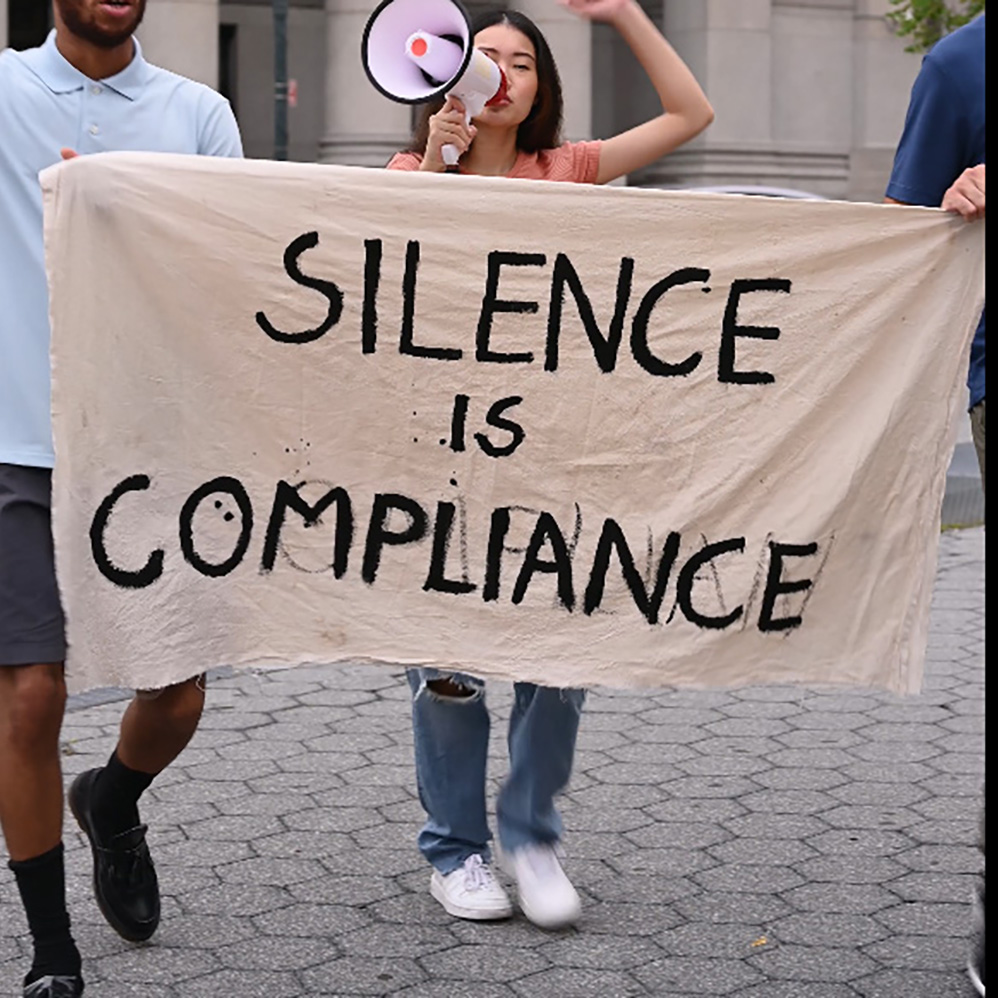
‘Over Here’ No Kings and No ICE
I grew up with big screen HEROS, John Wayne, Eddie Murphy, and way to many more saving America from the Evils of tyranny during WW II, and still enjoyed Gary Cooper as SGT York saving us during WW I, but none of that would have been possible if James Cagney hadn’t played George Cohan and given us music like OVER THERE.
Find it, listen to it, let the goose bumbs rise, remember what your grand fathers and your great gran fathers sacrificed so you could live in America.
This is MY version, sing it, use it, it’s ours, it’s mine and it’s yours.
“Over Here” – sing it to the same tune:
Verse 1
Folks, get your voice, get your voice, get your voice,
Raise it up high, up high, up high.
Hear them calling, you and me,
Every son and daughter free.
Hurry right away, no delay, stand today,
Make your fathers proud, to have raised such a crowd.
Tell your children not to fear,
Be proud we’re standing here.
Chorus
Over here, over here,
Send the word, send the word over here—
That the people are waking, the people are waking,
The truth is thundering everywhere.
So beware, say a prayer,
Send the word, send the word to beware—
We’re stronger than you, we’re coming through,
And we won’t back down till it’s over, over here!
Verse 2
Folks, see the game, see the game, see the game,
We see through the lies, the lies, the lies.
No more chains, no more chains, break away,
Liberty’s call won’t fade today.
From the farms to the streets we rise,
Grit in our hearts, fire in our eyes.
We’ve buried too many for this land,
Now we take back what’s in our hand.
Chorus repeat
Over here, over here,
Send the word, send the word over here—
That the resilient are rising, the resilient are rising,
The spirit is rumbling everywhere.
So prepare, have a care,
Send the word, send the word to beware—
We’re tougher than steel, we see what you conceal,
And we’re coming for freedom, over here!
Share this:

Part 4: When Responsibility Moves Quietly – Healthcare in America
Part 4: When Responsibility Moves Quietly
When health policy stalls, something important happens that is easy to miss.
Responsibility doesn’t disappear.
It moves.
And almost always, it moves away from systems and toward individuals.
This shift rarely arrives with an announcement. There is no press conference declaring that people are now on their own. Instead, the change shows up gradually, wrapped in reasonable language.
Words like:
-
“Choice”
-
“Flexibility”
-
“Consumer-driven”
-
“Personal responsibility”
On their own, these words sound empowering. In practice, they often signal something else.
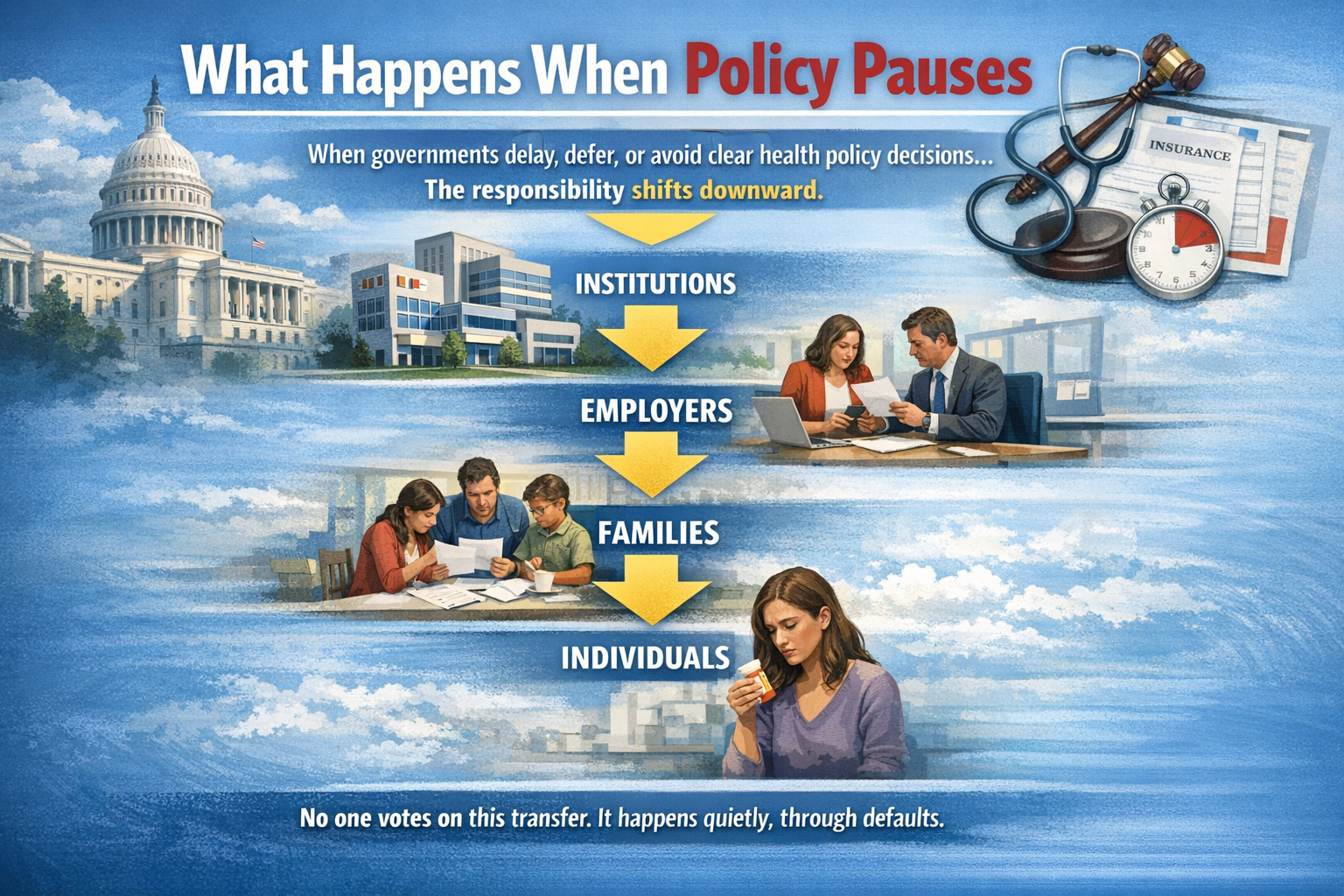
What Happens When Policy Pauses
When governments delay, defer, or avoid clear health policy decisions, the system still has to function.
Care still costs money. Providers still need to be paid. Insurers still need to price risk. Employers still need to decide what they will offer.
In the absence of coordinated policy, the burden of navigating those decisions shifts downward.
From institutions → to employers.
From employers → to families.
From families → to individuals.
No one votes on this transfer. It happens quietly, through defaults.
How “Choice” Becomes a Signal
Choice is not inherently bad.
But when choice expands while guidance, coverage, or protection does not, it becomes a signal that responsibility has shifted.
Instead of asking:
-
“Is this covered?”
People are asked to consider:
-
Which plan?
-
Which network?
-
Which deductible?
-
Which out-of-pocket maximum?
-
Which exclusions?
These are not choices most people can make with confidence, especially under time pressure or medical stress.
Yet the presence of choice creates the impression that outcomes are the result of personal decisions, not structural design.
The Human Experience of the Shift
Most people never engage with health policy directly.
They encounter it at moments of vulnerability:
-
A job change
-
A pregnancy
-
A diagnosis
-
A cancellation notice
-
A premium increase
At that point, the question isn’t ideological. It’s practical:
Am I covered?
Is my family covered?
What happens if something goes wrong?
When responsibility has already shifted, the answers are often unclear — not because people weren’t paying attention, but because the system expects them to manage complexity that used to be handled upstream.
Why This Shift Often Goes Unnoticed
The transfer of responsibility feels normal because it happens gradually.
Each step can be justified:
-
Employers reassess costs
-
Insurers adjust plans
-
Governments emphasize flexibility
No single change looks unreasonable.
But taken together, they redefine who bears the risk.
By the time people realize what has happened, the system presents the outcome as a matter of personal choice rather than public design.
Setting Up What Comes Next
Once responsibility moves to individuals, complexity becomes the gatekeeper.
Understanding plans, coverage limits, and tradeoffs becomes essential — and increasingly difficult.
In the next part, we’ll look at the difference between having choices and having meaningful coverage, and why those two things are often confused.
Next: Part 5 — Choice vs. Coverage
Share this:

A Real-Time Example (Why Markets React Faster Than Voters) – Healthcare in America
Industry groups warn of potential disruptions when 2027 coverage renews in late 2026, though final rates will not be set until April. This adds pressure to an already challenging Medicare Advantage landscape, where many plans have recently faced premium increases, benefit adjustments, or network changes.
Youtube Playlist for Our Healthcare Series
Share this:

What we could expect with Major reform in campaign finance / donation transparency

On the surface, what we might see would be more honest campaign promises as the backroom financing would become more transparent. This would be more obvious on the local level but would migrate up the National Ladder.
Youtube Playlist for Dark Money
Share this:

Leonard Leo has done more to reshape the American legal landscape than many senators, presidents, or judges.

No bombastic rallies, no orange spray tan, no obvious cult of personality.
The media mostly sees him as “that judicial guy from the Federalist Society.”
But under the radar, he’s weaponizing legal legitimacy, which is far more enduring than any single politician’s charisma.
If Trump is the actor, Leonard Leo is the playwright, and the stage manager, and the guy who installed the trapdoor under the audience.
Youtube Playlist for Dark Money
Share this:


Arabella Advisors (via the Sixteen Thirty Fund)

Distance from local impact
National funding routed through professionalized networks can shape outcomes in local or state-level debates without local communities fully understanding where the support originated.
Youtube Playlist for Dark Money
Share this:



A Beginner’s Guide to the Federalist Society

Influence:
Huge impact on the judiciary. Many federal judges (including 6 current Supreme Court Justices with ties) are members or recommended by the group.
Helped shape conservative legal thinking on issues like gun rights, free speech, abortion, and regulation.
Often called the “conservative pipeline” to the courts.
Youtube Playlist for Dark Money
Share this:

Part 3a – When This Happened Before – Healthcare in America
Part 3A: When This Happened Before
Before this series goes any further, it’s worth pausing to show that what we are describing is not new — and not partisan.
Long before COVID, long before Trump, and long before modern media ecosystems, the same policy pattern played out around tobacco.
This matters because it reveals how policy can be shaped without ever being formally decided.
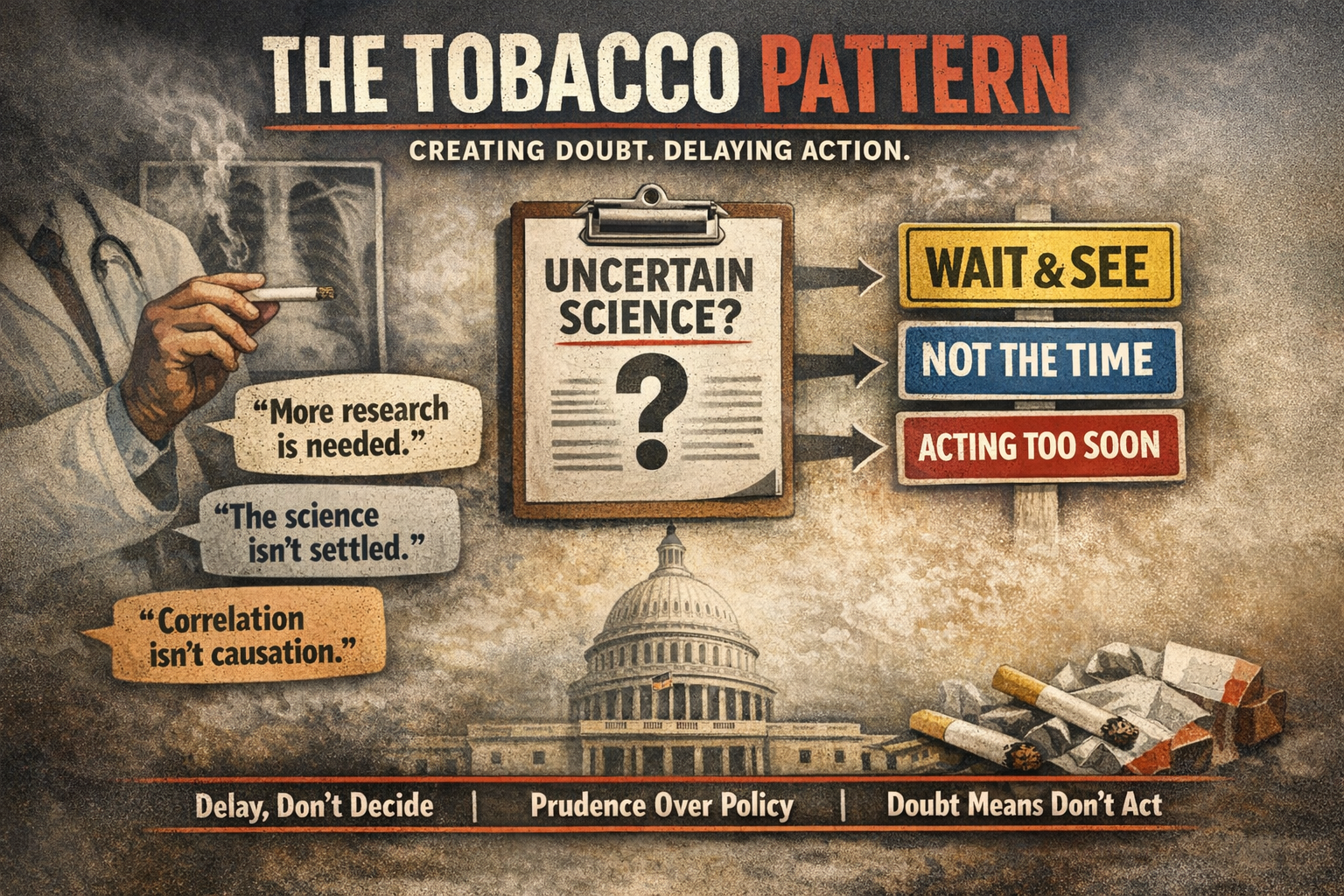
The Tobacco Pattern
For decades, the health risks of smoking were not unknown. Doctors observed higher rates of lung disease. Epidemiologists saw correlations strengthen year after year. Internal industry research — later revealed — often confirmed the danger.
Yet public policy stalled.
Why?
Because the dominant message repeated to the public was not that smoking was safe, but that it was uncertain.
“More research is needed.”
“The science isn’t settled.”
“Correlation isn’t causation.”
None of those statements were outright lies. That’s what made them effective.
They created just enough doubt to justify inaction.
Repetition as Delay
This is the critical mechanism.
The message didn’t need to persuade people that cigarettes were healthy. It only needed to persuade policymakers and the public that acting now would be premature.
Each repetition reinforced a sense of responsible restraint:
-
Waiting was framed as prudence
-
Delay was framed as neutrality
-
Action was framed as overreaction
Over time, delay itself became the policy.
No single announcement said, “We choose not to regulate.” But the repeated framing ensured regulation would always be postponed.
The Cost of Waiting
The human cost accumulated quietly.
Smoking-related illnesses rose predictably. Generations adopted a habit already known to be dangerous. The burden fell disproportionately on working-class families, veterans, and rural communities — long before those terms became political shorthand.
By the time policy finally caught up, millions of lives had already been affected.
No one could point to a single decision that caused the harm. That, too, was part of the design.
Why This Example Matters Now
Tobacco shows how repetition substitutes for policy.
When uncertainty is repeated often enough, it becomes permission. When delay is normalized, it feels responsible. When action is framed as reckless, inaction feels safe.
This is not about cigarettes.
It is about a pattern.
Setting Up the Next Step
Once you recognize this structure, you start to see it elsewhere — especially in health policy.
Not through detailed plans. Not through legislation. But through repeated language that signals what will not happen.
In the next section, we’ll examine how repetition itself functions as a policy signal — and why hearing the same claim again and again is rarely accidental.
Next: Part 3B — Repetition as Policy Signal
Share this:

Part 3b – Repetition As Policy Signal – Healthcare in America

When these phrases appear once, they may reflect genuine uncertainty. When they appear repeatedly, over weeks or months, they become signals.
The tobacco era showed this clearly. For years, the same reassurances were offered while evidence mounted. No new information was added—only the same language, restated. The repetition was not meant to inform; it was meant to delay.
Youtube Playlist for Our Healthcare Series
Share this:


Part 3a – When This Happened Before – Healthcare in America

Smoking-related illnesses rose predictably. Generations adopted a habit already known to be dangerous. The burden fell disproportionately on working-class families, veterans, and rural communities — long before those terms became political shorthand.
By the time policy finally caught up, millions of lives had already been affected.
No one could point to a single decision that caused the harm. That, too, was part of the design.
Youtube Playlist for Our Healthcare Series
Share this:


Part 2: When Expertise Became Personal – HealthCare in America

Public health expertise was not always controversial. For decades, it functioned largely in the background—technical, imperfect, and mostly invisible. When it worked, few noticed. When it failed, corrections were usually quiet and procedural.
That changed when expertise became personal.
As trust in institutions weakened, authority began to migrate away from systems and toward individuals. Complex guidance was no longer evaluated primarily on evidence or process, but on who was delivering it—and how consistently.
This shift did not require a coordinated effort. It was a natural response to confusion. When institutions struggle to communicate clearly, people look for human proxies they can assess intuitively.
Youtube Playlist for Our Healthcare Series
Share this:

Part 1: Trust Became the Weak Point – HealthCare in America

As systems grew more complex, institutional communication often became more defensive. Language shifted toward legal precision and risk avoidance, rather than clarity.
Explanations became longer but less informative. Mistakes were corrected quietly, if at all. Accountability was diffused across agencies, insurers, providers, and administrators—each technically accurate, but collectively unhelpful.
Over time, this creates a vacuum.
When institutions struggle to explain themselves, others step in to explain for them.
Youtube Playlist for Our Healthcare Series
Share this:


It isn’t funny anymore, so let’s get ready for tomorrow – Healthcare in America

. Not conspiracy theories, just a better understanding of the how and why. My goal wasn’t to be partisan — it was to help readers better grasp the mechanics behind the curtain and make better, self-informed decisions.Next up: a ~15-part series on institutional healthcare. Not the latest premium hikes, Trump tweets, or partisan talking points. Instead:
Youtube Playlist for Our Healthcare Series
Share this:



America’s Health Policy, Why This Series Exists – Healthcare in America

Examine policy outcomes without assigning personal motive
Use real examples to illustrate structural dynamics
Move deliberately, one concept at a time
Include guidance on what signals matter and where influence exists
Youtube Playlist for Our Healthcare Series
Share this:

This series is about health policy, not ideology – Healthcare in America

Decisions about healthcare in the United States are often discussed as political abstractions—talking points, slogans, and personalities. But their consequences are not abstract. They show up in emergency rooms, schools, workplaces, and kitchens. They show up in who gets care, when they get it, and at what cost.
Youtube Playlist for Our Healthcare Series
Share this:

No One Best Fix, Part 3 Dark Money Continued – Montana as a Test Case, Not a Template

It tests something narrower:
Whether a state can limit certain forms of outside influence
Whether local accountability can be strengthened structurally
Whether reducing scale changes behavior
Youtube Playlist for Dark Money
Share this:

No One Best Fix, Part 2 Dark Money Continued – Why Local Answers Matter More Than National Ones

Accountability is stronger closer to home
When decisions are made locally:
The people affected are easier to identify
The consequences are harder to ignore
The distance between influence and impact is shorter
Youtube Playlist for Dark Money
Share this:


No One Best Fix, Part 1 Dark Money Continued – Why Simple Solutions Fail

The difficulty arises when:
Money becomes scalable
Influence becomes detached from consequences
The people paying don’t live with the outcomes
Banning money outright isn’t realistic. Limiting it too tightly just pushes it into new, often less visible channels.
Youtube Playlist for Dark Money
Share this:

Part 2: When Expertise Became Personal – Healthcare in America
Part 2: When Expertise Became Personal
Public health expertise was not always controversial. For decades, it functioned largely in the background—technical, imperfect, and mostly invisible. When it worked, few noticed. When it failed, corrections were usually quiet and procedural.
That changed when expertise became personal.
As trust in institutions weakened, authority began to migrate away from systems and toward individuals. Complex guidance was no longer evaluated primarily on evidence or process, but on who was delivering it—and how consistently.
This shift did not require a coordinated effort. It was a natural response to confusion. When institutions struggle to communicate clearly, people look for human proxies they can assess intuitively.
From Institutions to Individuals
Institutions speak in committees, caveats, and revisions. Individuals speak in faces, voices, and confidence. In an environment already strained by complexity, the latter often feels more accessible—even when the underlying information is less complete.
As a result, public health authority increasingly became embodied in specific figures. Scientific disagreement, which is normal and necessary, was reframed as personal inconsistency. Updated guidance, which reflects learning, was recast as unreliability.
This personalization made expertise easier to attack, defend, or dismiss. A system can absorb critique; a person cannot without becoming the story.
Why Personalization Works
Personalization simplifies judgment. Instead of evaluating methods, data, and uncertainty, people are encouraged—often unintentionally—to evaluate tone, confidence, and perceived alignment.
Once expertise is tied to individuals:
-
Disagreement feels like betrayal
-
Revision feels like deception
-
Nuance feels like weakness
This dynamic is especially potent in public health, where uncertainty is unavoidable and recommendations evolve as evidence accumulates.
The Cost of Making Experts the Message
When individuals become symbols for entire systems, consequences follow.
Debate shifts away from institutional capacity, funding, and preparedness, and toward loyalty or opposition to particular figures. Questions about infrastructure and decision-making are replaced by arguments over credibility and character.
This does not improve understanding. It narrows it.
Over time, public health guidance becomes harder to evaluate on its merits because it is no longer received as guidance—it is received as advocacy.
What to Watch For
As this series continues, notice when:
-
Policy disagreements are framed around personalities rather than processes
-
Critiques focus on tone or consistency rather than outcomes
-
Individuals are treated as proxies for complex systems
-
Institutional failures are personalized instead of examined structurally
These are signs that expertise has been detached from the institutions that support—or undermine—it.
Why This Matters Going Forward
Once expertise becomes personal, it becomes fragile. Removing or discrediting an individual can feel like resolving a systemic problem, even when the underlying structures remain unchanged.
This creates an opening for rhetoric to replace capacity, and confidence to replace preparation.
Understanding this shift helps explain why later public health debates become less about evidence and more about allegiance—and why restoring trust is far more difficult than losing it.
That dynamic becomes clearer in the next phase of the series.
Next: Repetition as Policy Signal
Share this:

Part 1: Trust Became the Weak Point – Healthcare in America
Part 1: Trust Became the Weak Point
Public health systems depend on trust in ways that are easy to underestimate. Not blind trust, and not perfect trust—but enough confidence that people believe guidance is given in good faith, decisions are explainable, and errors are acknowledged rather than obscured.
In the United States, that foundation weakened long before any recent crisis or political figure. It weakened quietly, through everyday interactions that felt small at the time but cumulative in effect.
Most people did not stop trusting healthcare because they rejected science. They stopped trusting it because the system became harder to understand, harder to navigate, and harder to believe was working in their interest.
Complexity Without Clarity
Healthcare in the U.S. is genuinely complex. That complexity is not itself the problem. The problem is that complexity is often presented without translation.
Insurance documents describe coverage in terms of tiers, codes, networks, and contingencies that are difficult for even attentive readers to interpret. Changes are communicated through dense notices that explain what is happening without clearly explaining why or what it means in practice.
When plans are canceled and replaced with alternatives that appear nearly identical—except for higher premiums or different cost-sharing—people are left with terminology rather than understanding. Over time, repeated experiences like this create a sense that explanations are designed to satisfy requirements, not to inform.
That gap matters.
Cost as a Trust Erosion Mechanism
Trust is also shaped by predictability. Few things undermine confidence faster than discovering the true cost of care only after it has been received.
Surprise billing, opaque pricing, and inconsistent coverage rules train people to expect uncertainty. Even when care is technically available, the fear of unknown cost changes behavior—delaying treatment, avoiding follow-ups, or disengaging entirely.
This is not an ideological response. It is a rational one.
When people cannot anticipate consequences, they stop believing assurances.
Institutions That Speak Poorly Under Pressure
As systems grew more complex, institutional communication often became more defensive. Language shifted toward legal precision and risk avoidance, rather than clarity.
Explanations became longer but less informative. Mistakes were corrected quietly, if at all. Accountability was diffused across agencies, insurers, providers, and administrators—each technically accurate, but collectively unhelpful.
Over time, this creates a vacuum.
When institutions struggle to explain themselves, others step in to explain for them.
What Happens When Trust Weakens
When trust erodes, several predictable shifts occur:
-
Expertise must compete with confidence
-
Repetition begins to substitute for evidence
-
Personal narratives feel more credible than institutional ones
-
Individuals become symbols for entire systems
None of this requires malice or conspiracy. It is how people adapt when clarity is missing and stakes are high.
By the time a crisis arrives, the groundwork has already been laid. The public is primed not to evaluate guidance on its merits, but on whether it feels consistent, confident, and aligned with prior experience.
Signals to Watch
As this series continues, it helps to notice a few early indicators of trust strain:
-
Explanations that grow longer but clearer on none of the practical details
-
Language that emphasizes compliance without understanding
-
Corrections that appear quietly, without acknowledgment
-
Complexity that increases without improving outcomes
These signals often appear well before policy consequences become visible.
Why This Matters Going Forward
Health policy does not fail all at once. It frays.
Trust is usually the first strand to weaken, not the last. Once it does, every subsequent decision—no matter how well-intentioned—faces skepticism, resistance, or distortion.
Understanding how that erosion occurs is essential, because it explains why later debates become less about evidence and more about narrative.
That is where the series goes next.
Next: When Expertise Became Personal
Share this:

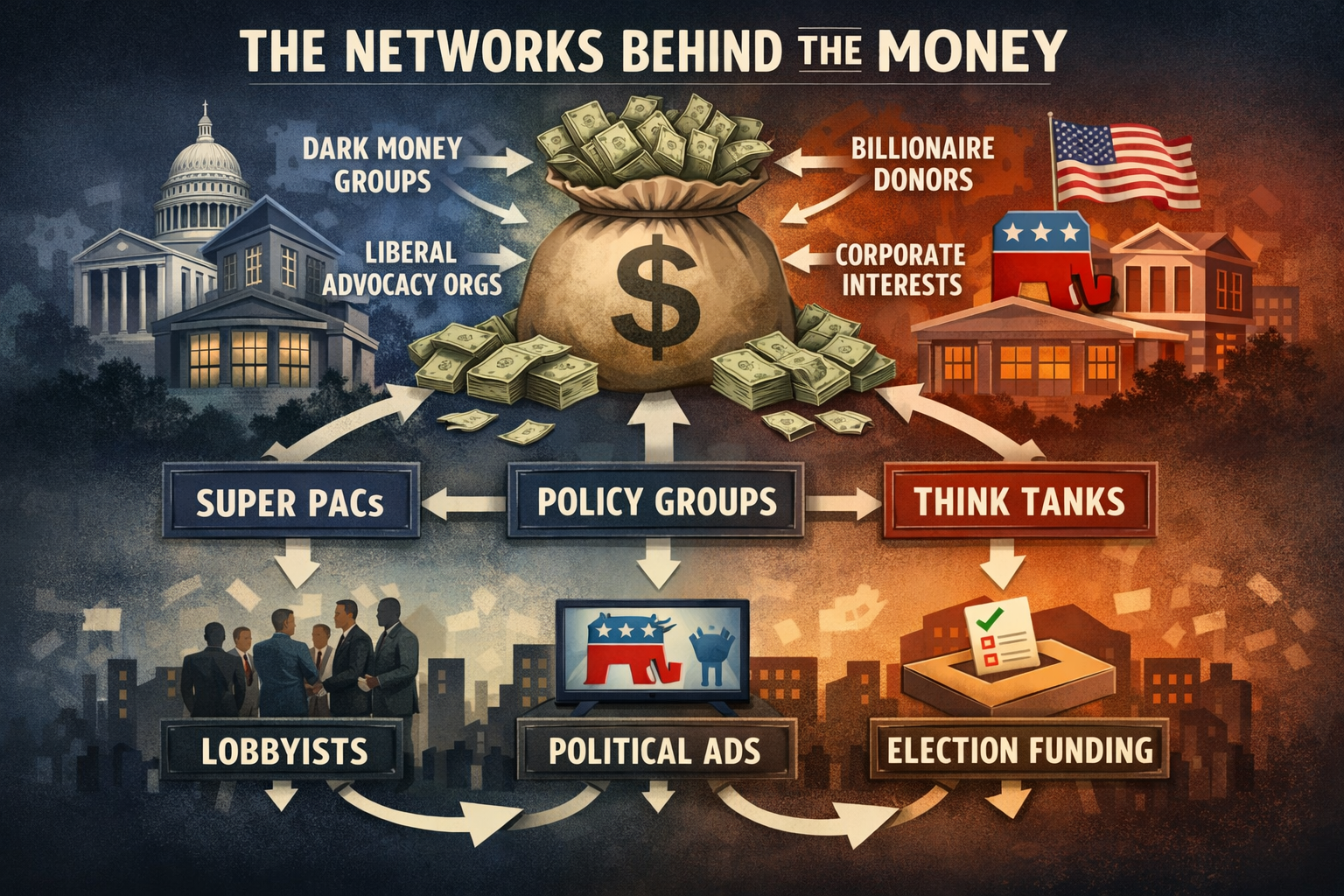
What we could expect with Major reform in campaign finance / donation transparency
What we could expect with Major reform in campaign finance / donation transparency
Most of this was included in the Pendulum Swing, assuming a right to left shift, but the organizations need to be brought to light and understood.
On the surface, what we might see would be more honest campaign promises as the backroom financing would become more transparent. This would be more obvious on the local level but would migrate up the National Ladder.
Major reform in campaign finance / donation transparency — if laws tighten, anonymity and dark-money flows shrink.
-
- Economic collapse or disruption to corporate profits — institutional money depends on capital; if the economy sours, so does financial influence.
- Mass public backlash / grassroots insurgency — if voters demand structural change, elite influence may become a liability rather than an asset.
- Global shifts (trade, climate, geopolitics) that outgrow traditional domestic lobbying and require new alignments — making old networks obsolete or forced to transform drastically.
Major Networks & Institutions Likely to Persist Through a Shift
|
Name / Network |
Why They Endure /What Makes Them Resilient |
|---|---|
|
Sixteen Thirty Fund (and affiliated Arabella Advisors funds) |
Long-standing “dark money” powerhouse for the left. Provides fiscal-sponsorship and funding to many progressive causes and campaigns. As a 501(c)(4) nonprofit, it can channel money — often anonymously — into activism, ballot initiatives, and elections. Wikipedia+1 |
|
Berger Action Fund (network tied to Swiss billionaire support of progressive causes) |
Serves as a major donor funnel for progressive policy agendas. Its role shows how international money and large-scale philanthropy can influence U.S. politics regardless of which party is in charge. Wikipedia+1 |
|
Priorities USA Action |
One of the largest Democratic-leaning super PACs. Has shown flexibility in shifting strategy (e.g. moving toward digital campaigning rather than just TV ads), which suggests institutional agility in changing political climates. Wikipedia |
|
American Bridge 21st Century |
A major liberal opposition-research and election campaign group—effective at media and messaging work. Such infrastructures are portable: no matter who’s in power, they can redirect resources toward oversight, opposition, or new causes. Wikipedia |
|
Tides Foundation / Tides Network |
A long-standing donor-advised fund and fiscal-sponsorship network. Its versatile structure lets wealthy donors fund causes under the radar — meaning it can remain influential regardless of which party holds power. Wikipedia+1 |
|
Major Conservative Mega-Donors (e.g. Richard Uihlein & family, Scaife-linked foundations, etc.) |
These “big-money backers” have deep pockets and substantial influence on think tanks, policy-planning networks, and regulatory lobbying. Their funds tend to follow structural interests (tax law, business regulation, corporate incentives) — which can often survive major party shifts. DeSmog+2The Good Men Project+2 |
|
Embedded Think Tanks and Policy Networks (e.g. Heritage Foundation, Intercollegiate Studies Institute (ISI), and other longtime policy infrastructure) |
These institutions provide long-term ideological frameworks, produce research, influence judiciary nominations, shape legislation drafts — and have memberships, staffs, and networks that outlast electoral cycles. DeSmog+1 |
|
Financial-industry donors and Super-PAC backers (e.g. Kenneth C. Griffin, other hedge-fund and Wall Street funders) |
Money from big finance often plays both ends: campaign donations, policy lobbying, influence over regulation. Because their interest is often stability, deregulation, and favorable economic policy — not always party ideology — they can pivot if a left administration offers similar benefits. Fiscal Report+1 |
Why These Actors Are So Durable
- Legal and structural opacity: Many are nonprofits or 501(c)(4) / donor-advised funds that are not required to publicly disclose all donors or spending. That secrecy makes them hard to trace — and easy to reorient quietly.
- Networks over individuals: Their power rests in institutions, infrastructure, think tanks, PACs, and donor webs — not individuals whose fortunes rise or fall with elections.
- Financial interests over pure ideology: Many of these players (especially donors, think-tanks, financial backers) prioritize economic, regulatory, and institutional stability — interests that survive either party being in power.
- Adaptability: Super-PACs and nonprofit umbrellas can shift focus quickly: from supporting one party to supporting causes, ballot initiatives, or policy campaigns under any administration.
- Trans-partisan appeal: Particularly for business interests and big donors — maintaining influence requires access from whichever side controls power. So pivoting becomes strategy, not betrayal.
Share this:



Arabella Advisors (via the Sixteen Thirty Fund)
| Leonard Leo | Arabella Advisors |
|---|---|
| Builds and steers a network | Builds and steers a network |
| Operates mostly out of public view | Operates mostly out of public view |
| Uses nonprofits and fiscal vehicles | Uses nonprofits and fiscal vehicles |
| Focuses on long-term institutional outcomes | Focuses on long-term institutional outcomes |
| Rarely the public face of campaigns | Rarely the public face of campaigns |
The Other Side of the Leonards Coin: Arabella Advisors and the Progressive Influence Network
Arabella Advisors dissolved in late 2025 and transferred its services to Sunflower Services. That organizational change does not alter the relevance of what follows. This discussion focuses on the methods, structures, and influence models that operated under Arabella’s umbrella—models that continue to exist across the political spectrum regardless of name or branding.
If you’ve read about Leonard Leo and wondered whether there’s an equivalent force operating on the other side of the political spectrum, the short answer is: yes — but it looks different.
If you are unfamiliar with Leonard Leo then I suggest you read our brief on him, it will make my cross references here clearer.
Rather than centering on one highly visible figure, progressive influence has tended to operate through organizational networks. One of the most significant of those is Arabella Advisors.
This is not a critique or an endorsement. It’s an attempt to understand how modern political influence actually works.
What Is Arabella Advisors?
Arabella Advisors is a for-profit consulting firm that specializes in managing and supporting nonprofit organizations and advocacy efforts. Its influence comes less from public messaging and more from infrastructure.
Arabella administers several large nonprofit funds, including:
-
The Sixteen Thirty Fund
-
The New Venture Fund
-
The Hopewell Fund
-
The Windward Fund
These funds act as fiscal sponsors, meaning they legally host and manage hundreds of projects that may not have their own independent nonprofit status.
In practical terms, this allows advocacy campaigns to:
-
Launch quickly
-
Share administrative resources
-
Receive funding efficiently
-
Operate under existing legal umbrellas
This structure is entirely legal and widely used across the nonprofit world.
How the Network Operates
Unlike traditional nonprofits with a single mission and brand, Arabella’s model supports many separate initiatives at once, often focused on:
-
Voting and election policy
-
Climate and environmental advocacy
-
Healthcare access
-
Judicial and legal reform
-
Democracy and governance issues
Most people encountering these efforts don’t see “Arabella” at all. They see:
-
A campaign name
-
A policy group
-
A ballot-issue committee
-
An issue-specific advocacy organization
That’s not secrecy — it’s organizational design.
Why Some Critics Raise Concerns
Criticism of Arabella’s network usually centers on three issues:
1. Donor opacity
Some of the funds administered through the network do not publicly disclose individual donors, which raises concerns similar to those voiced about conservative dark-money groups.
2. Scale and coordination
Because many projects are housed under a small number of fiscal sponsors, critics argue this can concentrate influence in ways that are hard for the public to track.
3. Distance from local impact
National funding routed through professionalized networks can shape outcomes in local or state-level debates without local communities fully understanding where the support originated.
These concerns mirror critiques made of conservative influence networks — which is precisely why Arabella is worth understanding.
Why Others Defend the Model
Supporters argue that Arabella’s structure:
-
Improves efficiency
-
Reduces administrative duplication
-
Allows rapid response to emerging issues
-
Helps smaller or newer causes compete in an expensive political environment
They also point out that conservative networks have used similar structures for decades — often more visibly and more successfully — and that progressive donors were slow to build comparable infrastructure.
Why This Matters
Arabella Advisors isn’t the progressive version of a political party, a campaign, or a single leader.
It’s something subtler:
An influence platform — not for persuasion, but for coordination.
That makes it powerful, and it also makes it easy to misunderstand.
Just as Leonard Leo represents how conservative legal influence became institutionalized, Arabella represents how progressive advocacy adapted to a landscape where money, law, and organization matter as much as ideas.
The Larger Point
Seeing Arabella Advisors clearly helps avoid two common mistakes:
-
Believing influence only flows from one side
-
Confusing infrastructure with ideology
Modern politics is less about speeches and more about systems — systems that decide which ideas get sustained, funded, and repeated over time.
Understanding those systems doesn’t require agreement.
It requires attention.
Share this:



Leonard Leo has done more to reshape the American legal landscape than many senators, presidents, or judges.
Most Americans can name Donald Trump. Many can name Joe Biden.
Fewer can name Brett Kavanaugh or Amy Coney Barrett.
But almost no one knows the name Leonard Leo, and that’s exactly how he prefers it. While the country fights over policies, Leo quietly builds the structures that decide them. He’s not an elected official. He doesn’t run for office. But over the past two decades, Leonard Leo has done more to reshape the American legal landscape than many senators, presidents, or judges. And he’s done it behind the curtain. As co-chairman and former executive vice president of the Federalist Society, Leo advised on the selection of Supreme Court justices who overturned Roe v. Wade, narrowed voting rights, and limited environmental protections.
But he didn’t stop at the high court, he built a pipeline. From district courts to appeals courts, Leo’s influence extends like a legal shadow network, placing originalist judges where precedent used to live.
And now he has the money to go even further. In 2021, Leo’s Marble Freedom Trust received a staggering $1.6 billion donation from Chicago businessman Barre Seid, the largest known political gift in American history.
Not to fund a campaign, but to advance conservative activism in his vision. That means supporting legal challenges against government regulation, climate policy, abortion access, and even election processes. The playbook? It aligns with efforts like Project 2025, a Heritage Foundation-led initiative to overhaul the federal government, and Leo’s networks have funded groups preparing for similar conservative policy shifts.
He’s also facilitated lavish, undisclosed trips for Supreme Court justices like Samuel Alito and Clarence Thomas, the kind of perks organized through his donor networks that would get a public servant fired, but which have evaded strict ethics enforcement in a judiciary with limited oversight.
And yet, the headlines rarely mention his name. That’s the danger. While we’re busy arguing on social media about candidates and slogans, Leonard Leo is writing the footnotes of history, in fine print most of us never see. This isn’t conspiracy. It’s coordination. And it’s working. So the next time you wonder how a fringe legal theory became binding law, or why public trust in the courts has cratered, remember this name. Not because he shouts it, but because he doesn’t have to. Leonard Leo. The most powerful unelected man in America. And we’re letting him do it in silence.
1.He’s almost completely invisible to the public
Most Americans couldn’t pick him out of a lineup, and yet he has arguably reshaped more of the American political landscape than any living figure, without ever running for office.
2.He operates through permanence, not popularity
While presidents come and go, Leo’s real power comes from engineering a judicial supermajority and embedding his ideology into the law for decades, particularly through lifetime federal judges.
3. He has billion-dollar influence with zero accountability
Through his networks (like the Marble Freedom Trust), he’s moved $1.6 billion from donors into judicial activism, legal campaigns, and media shaping, with almost no oversight or press scrutiny.
4. His agenda is deeply ideological, and strategic
This isn’t just about being “conservative.” It’s about remaking the constitutional framework:
-
Weakening federal oversight
-
Empowering state-level authority
-
Rolling back decades of precedent on voting rights, reproductive rights, regulatory power, and civil protections
He’s the force behind decisions like Dobbs, Shelby County, and the Chevron deference rollback, each systematically shifting power away from elected government and toward courts, corporations, and conservative legal theory.
So, a quick recap:
-
Co-chairman and former executive vice president of the Federalist Society
-
Longtime judicial kingmaker on the American right
-
Key advisor in the conservative legal revolution, including stacking the Supreme Court
-
Aligned with networks supporting Project 2025, the policy playbook for a conservative overhaul of government
Why He’s Dangerous
He doesn’t run for office. He runs people who do.
He’s behind the curtain shaping judicial, legal, and policy infrastructure that outlasts any election.
His fingerprints are on decisions gutting voting rights, abortion access, campaign finance law, and federal agency power.
He builds systems, not headlines.
While Trump tweets and shouts, Leo advises on the manual, places the judges, and engineers the undoing of the administrative state.
Bureaucratic reprogramming disguised as “liberty.”
He understands how to leverage chaos.
The louder the MAGA noise, the more quietly Leo’s network rewires the levers of power: Supreme Court, state AGs, education boards, religious coalitions, media outlets.
He has billions at his disposal now.
In 2021, he received $1.6 billion from Barre Seid, the largest known political donation in U.S. history, and he’s using it not to run ads, but to reshape the legal battlefield.
Why People Overlook Him
No bombastic rallies, no orange spray tan, no obvious cult of personality.
The media mostly sees him as “that judicial guy from the Federalist Society.”
But under the radar, he’s weaponizing legal legitimacy, which is far more enduring than any single politician’s charisma.
If Trump is the actor, Leonard Leo is the playwright, and the stage manager, and the guy who installed the trapdoor under the audience.
Share this:

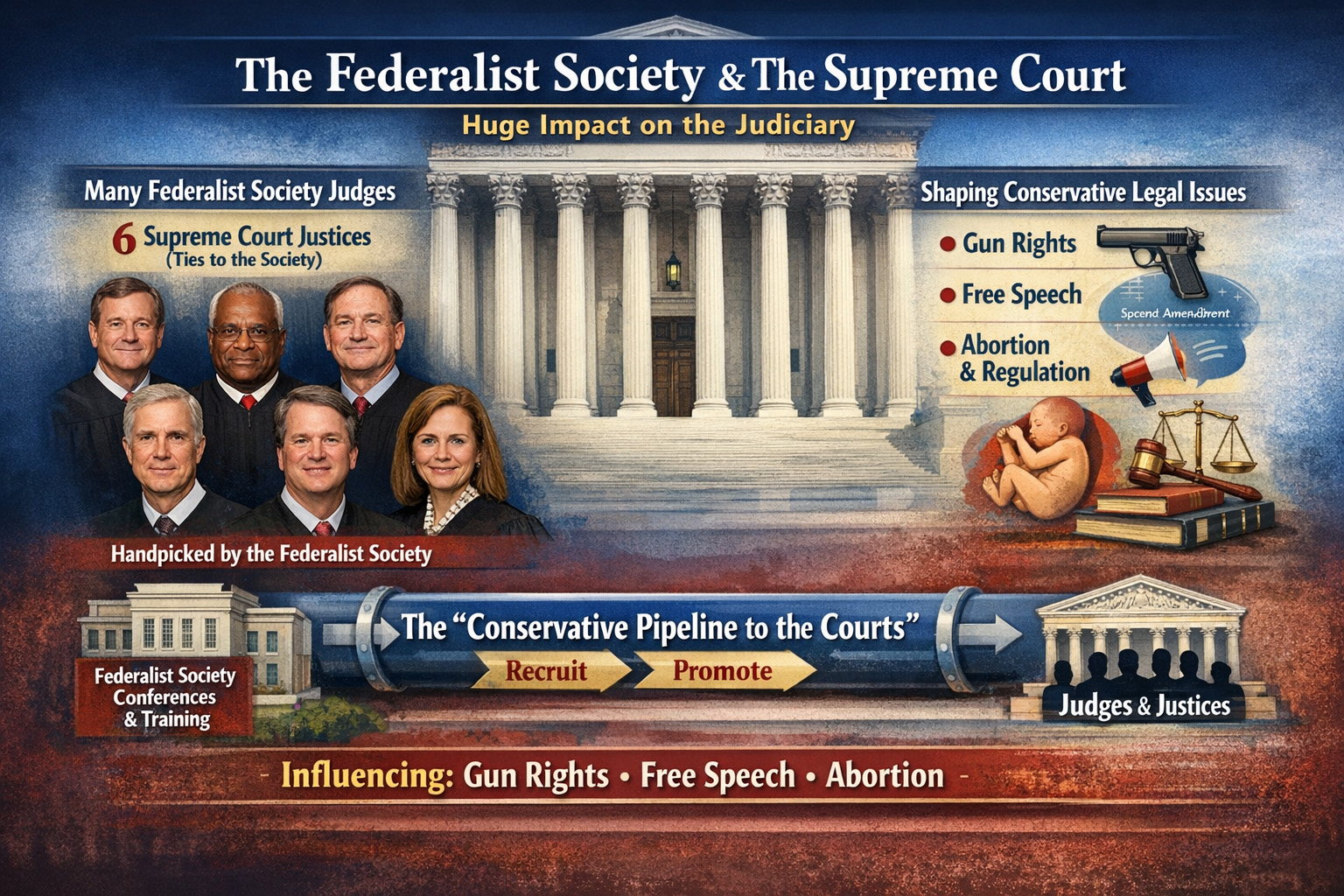
A Beginner’s Guide to the Federalist Society
The Federalist Society for Law and Public Policy Studies (often called “FedSoc”) is a major American organization of conservative and libertarian lawyers, judges, law students, and scholars. Founded in 1982 by law students at Yale, Harvard, and the University of Chicago, it started as a way to challenge what its founders saw as dominant liberal ideas in law schools.Key Principles (straight from their mission):
- The government exists to preserve individual freedom.
- Separation of powers is central to the U.S. Constitution.
- Judges should interpret the law as written (textualism and originalism), not make new policy (“say what the law is, not what it should be”).
It’s not a lobbying group or political party — it claims to be non-partisan and focuses on open debate. They host events, panels, and speeches with speakers from all sides (though most align conservative/libertarian).Structure:
- Student chapters: Over 200 at law schools across the U.S.
- Lawyers chapters: In major cities.
- Faculty division and national events.
Influence:
- Huge impact on the judiciary. Many federal judges (including 6 current Supreme Court Justices with ties) are members or recommended by the group.
- Helped shape conservative legal thinking on issues like gun rights, free speech, abortion, and regulation.
- Often called the “conservative pipeline” to the courts.
Critics say it’s too partisan and has shifted the courts rightward. Supporters say it promotes intellectual diversity and constitutional fidelity.The James Madison ConnectionThe society’s logo is a silhouette of James Madison (4th U.S. President, “Father of the Constitution,” co-author of The Federalist Papers). They see themselves as heirs to Madison’s ideas on limited government and checks and balances.
- They have a James Madison Club — a donor group for major supporters.
- Some student chapters win the “James Madison Chapter of the Year” award.
There is no separate major organization called the “Madison Society” directly paired with the Federalist Society. “Madison Society” refers to various unrelated groups (e.g., Second Amendment advocacy, university alumni clubs, or progressive counterparts like the American Constitution Society). The “Federalist and Madison Societies” likely refers to the Federalist Society’s strong ties to James Madison’s legacy.In short: The Federalist Society is the big player in conservative legal circles, proudly Madison-inspired. It’s all about debating ideas to keep government limited and judges neutral.For more: Visit fedsoc.org or read The Federalist Papers for the original inspiration!
Share this:

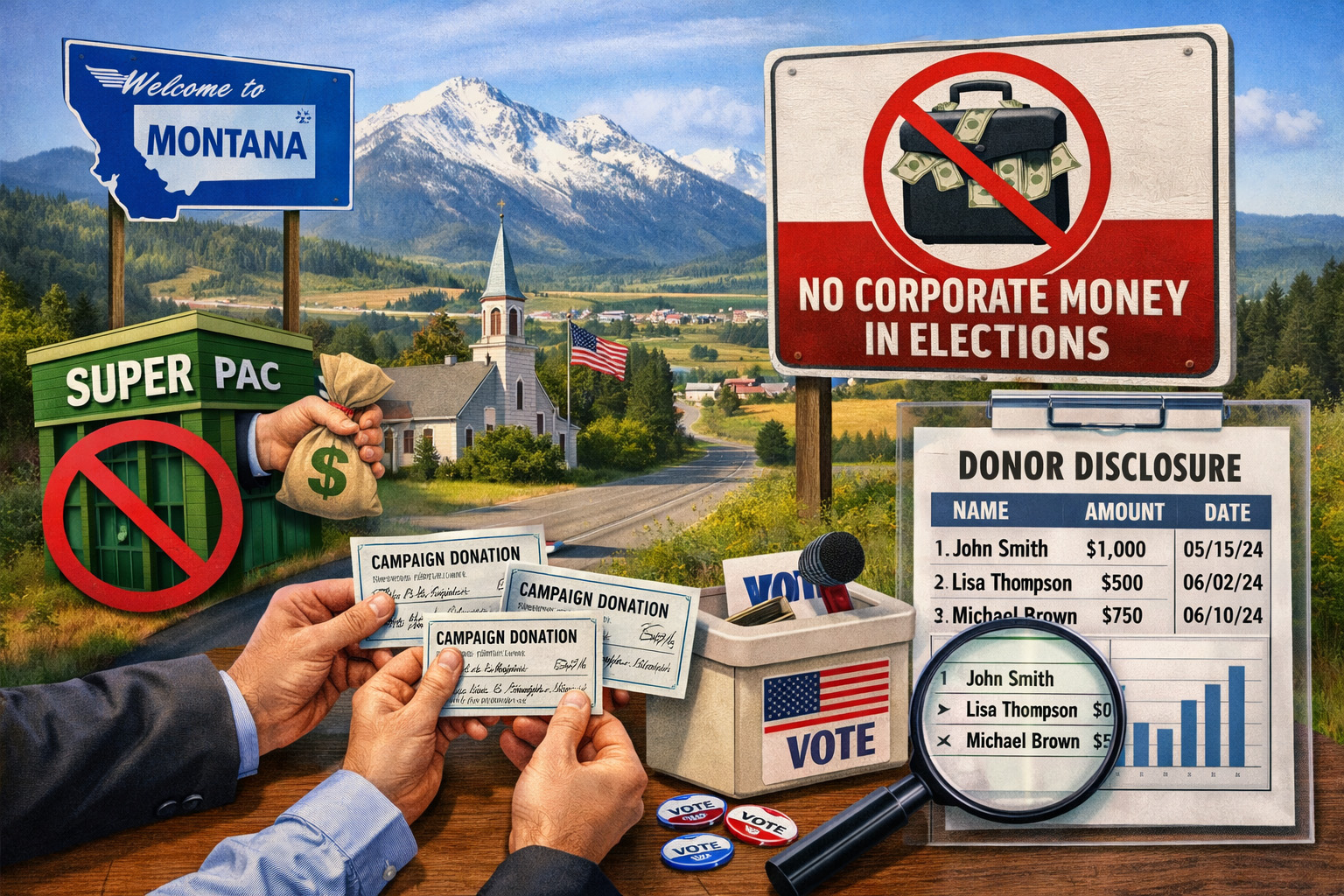
No One Best Fix, Part 3 Dark Money Continued – Montana as a Test Case, Not a Template
No One Best Fix — 3
Montana as a Test Case, Not a Template
Most people outside of Montana don’t think about Montana much — and that’s exactly the point.
Montana matters here not because it has all the answers, but because it raises a question many places are quietly facing:
What happens when a community tries to limit outside influence structurally instead of just complaining about it?

To ground that question in reality, here are two useful references:
-
Official proposed ballot text and description (Montana Secretary of State) — this is the government’s own page listing what the initiative says it would do. Montana Proposed 2026 Ballot Issues Page (Official Text & Summary)
-
Plain-language summary of the initiative statement — a concise version of what the amendment would change. Group Releases Text of Proposed Montana Constitutional Amendment to Curb Dark Money (Summary)
With those in hand, you can always look at the source language while reading this section.
What the initiative would do
The change in Montana law would simply not grant the corporations the power to give to candidates or causes, but would allow individuals to give, but those donations would be tracked.
The proposed legislation is the first-of-its-kind and takes a different approach to the problem of campaign finance in spending. For example, last year’s U.S. Senate race in Montana, which saw Republican Tim Sheehy beat incumbent Democrat Jon Tester, had more than $275 million spent in a state of roughly 1.2 million people.
“Basically, the only difference is that corporations won’t be able to spend in our elections,” Mangan said.
The specifics of the proposed constitutional amendment would carve out exceptions for organizations like political parties and even media organizations whose coverage could possibly run afoul of the amendment’s language.
“If a person wants to spend money, then they have to put their name on it. It’s full disclosure. That’s what this is all about,” Mangan said.
The Montana proposal — often referred to as the Montana Plan or the Transparent Election Initiative — is fundamentally different from traditional campaign finance reforms.
Instead of regulating spending directly, it would change the basic definition of what corporations and similar entities (“artificial persons”) are allowed to do in elections. In effect, it would:
-
Amend the state constitution to say corporations and other artificial entities have only the powers the constitution explicitly grants them.
-
Specifically ensure that corporations have no authority to spend money or anything of value on elections or ballot issues.
-
Leave open the possibility for political committees (not corporations) to spend money on elections.
-
Include enforcement provisions and severability clauses to protect parts of the law if others are ruled invalid. Montana Secretary of State+1
This isn’t the typical approach of saying “limit X amount” or “disclose Y.” It says, in essence:
If the state never gave a corporate entity the power to spend in politics in the first place, then it can’t do so now. Harvard Law Corporate Governance Forum
That’s why proponents describe it as a doctrine-based challenge to the framework established by Citizens United — not a straightforward campaign finance rule. Harvard Law Corporate Governance Forum
Why this matters structurally
There are four big implications worth noting:
1. It reframes power, not just spending.
Instead of capping or reporting spending, it redefines who gets that power at all. That’s a deeper structural shift in how the political system treats corporations. Harvard Law Corporate Governance Forum
2. It acts at the level where consequences are visible.
When outside groups spend in small races or ballot campaigns, local voters often never see the circuit of influence. This initiative aims to shorten that circuit — even if imperfectly. Truthout
3. It shows how local contexts shape responses to national problems.
Dark money isn’t a national phenomenon only — it’s a distributed one, especially in low-attention environments like state and local elections. Montana’s approach reflects that reality. NonStop Local Montana
4. It illustrates why there’s “no one best fix.”
You’ll notice this proposal doesn’t:
-
Ban all political spending by wealthy individuals
-
Eliminate all influence from outside actors
-
End lobbying
-
And, according to some critics, may raise free speech or legal concerns if adopted wholesale Montana Free Press
What it does is test a structural lever that hasn’t been widely tried before: the state’s sovereign authority to grant or withhold corporate powers.
What’s happening with the initiative now
As of late 2025:
-
The Montana Attorney General has ruled the proposed initiative legally insufficient, arguing it combines multiple constitutional changes into one item and may affect more than a single subject. Montana Free Press
-
The organizers are planning to challenge that ruling and pursue placement on the 2026 ballot. Montana Free Press
This process — review, challenge, signature gathering — is itself part of what makes Montana a useful test case. It isn’t a finished story yet.
How to think about this
When you look at the initiative text and the summary together with your understanding of dark money and influence, here’s the clean takeaway:
-
Montana isn’t offering a pre-packaged solution.
-
It’s testing whether changing who can spend at all alters the dynamics of influence.
-
The state’s unique legal authority provides a laboratory for ideas that might be adapted elsewhere in different forms.
In other words:
Montana’s initiative isn’t the answer — it’s an experiment. Good data from experimentation — success or failure — gives other states something concrete to think with.
Share this:



Dark Money for Dummies — Part 3
Why It Shows Up in Small and Local Places
If you want to understand dark money’s real power, don’t look first at presidential elections. Look at small states, local races, and low-visibility decisions.

That’s where the leverage is highest.
Small places are efficient
Influencing a national election is expensive and unpredictable.
Influencing a state legislature, regulatory board, court election, or ballot initiative is often:
Far cheaper
Less crowded with competing messages
Less scrutinized by media
More consequential per dollar spent
In smaller political ecosystems, a relatively modest amount of money can:
Shape the debate
Deter opposition
Make outcomes feel pre-decided
This isn’t because voters are uninformed. It’s because the volume of influence overwhelms the scale of the system.
Local decisions can unlock national value
Many of the most important decisions affecting national industries are made locally:
Resource extraction permits
Environmental standards
Tax structures
Judicial interpretations
Regulatory enforcement
Winning a single state-level fight can:
Set precedent
Reduce compliance costs elsewhere
Protect billions in downstream revenue
From that perspective, local politics isn’t small at all. It’s strategic.
Why motives stay unadvertised
If an organization openly said:
“We’re here to protect a distant financial interest that won’t bear the local costs”
…it would fail immediately.
So messaging focuses on:
Jobs
Growth
Stability
Freedom
Tradition
Safety
These themes are not fake. They resonate because they matter to people’s lives. The issue isn’t that they’re false — it’s that they’re partial.
What’s usually missing is:
Who benefits most
Who absorbs long-term costs
Who leaves when the damage is done
That information gap isn’t accidental. It’s essential to the strategy.
The quiet effect on local communities
Over time, this kind of influence can:
Narrow the range of acceptable debate
Make opposition feel futile or extreme
Shift policy without visible public consent
The most important outcome often isn’t a single law or election result. It’s the normalization of decisions made with local consequences but remote beneficiaries.
That’s the point where influence becomes detached from accountability.
Where this leaves us
By now, three things should be clear:
Dark money is usually legal
It works best where attention is lowest
Its power comes from distance — not secrecy
The remaining question isn’t whether this system exists.
It’s whether communities should have the ability to limit how much invisible, outside influence their political systems can absorb.
That’s where ideas like the Montana initiative enter the picture — not as a cure-all, but as a structural experiment.
Share this:



Dark Money for Dummies — Part 2
Why It Exists (and Why It’s Legal)
Once people understand what dark money is, the next question is obvious:
If this creates so many problems, why does it exist at all?
The short answer is not corruption or conspiracy.
The longer answer is classification.
The difference between campaigns and “issues”
U.S. election law draws a sharp line between:
Campaign activity (which is regulated and disclosed)
Issue advocacy (which is far less regulated)
If an organization explicitly tells you to:
“Vote for” or “Vote against” a candidate
…it is treated as a campaign and must disclose donors.
If it instead says:
“Support energy independence”
“Protect public safety”
“Stand up for local jobs”
“Defend parental rights”
…it may be classified as issue advocacy, even if the timing, targeting, and messaging clearly benefit one candidate or policy outcome.
That distinction is the foundation dark money is built on.
Why nonprofits are central to this system
Many dark money organizations are nonprofits because nonprofits were never designed to function like political campaigns. They were meant to:
Promote causes
Educate the public
Advocate broadly for values
Over time, those purposes expanded — legally — to include political messaging that stops just short of explicit campaigning.
Once that door opened, the incentives became obvious:
Donors could influence politics without public scrutiny
Organizations could spend heavily without disclosure
Voters would see the message, but not the full context
Nothing about this requires bad actors. It works even when everyone is technically following the rules.
Why “just disclose it” hasn’t fixed the problem
It’s tempting to think the solution is simple: require more disclosure.
The problem is that disclosure alone often fails in practice because:
Information is scattered across filings few people read
Money moves through multiple layers of organizations
The source may be technically disclosed but practically untraceable
Voters encounter the message long before they encounter the data
By the time transparency arrives, the influence has already done its work.
Dark money doesn’t rely on secrecy so much as opacity through complexity.
Why the law tolerates this
Courts have consistently protected issue advocacy because:
Political speech is broadly protected
The line between ideas and elections is hard to police
Over-regulation risks suppressing legitimate civic activity
In other words, the system tolerates dark money not because it’s admired, but because the alternative risks collateral damage to free expression.
This creates a tradeoff:
Protect speech broadly
Accept influence that is difficult to see
That tradeoff becomes more consequential the smaller and quieter the political arena is.
Which brings us to the next question.
If dark money is everywhere, why does it seem to concentrate so heavily in state and local politics?

Share this:



Dark Money for Dummies — Part 1
What It Is (and What It Isn’t)
“Dark money” sounds dramatic, like something illegal or conspiratorial.
Most of the time, it’s neither.
At its simplest, dark money is political spending where the true source of the money is hidden from the public. The spending itself is usually legal. What’s obscured is who is really behind it.
That distinction matters.
What dark money is
Dark money typically flows through organizations that are allowed to spend money on political causes without publicly disclosing their donors. These are often nonprofits or issue-advocacy groups rather than campaigns themselves.
The money can be used for:
Ads supporting or opposing candidates
Messaging around ballot initiatives
“Issue advocacy” that clearly benefits one side without explicitly saying “vote for” or “vote against”
By the time a voter sees the message, they often have no practical way of knowing:
Who paid for it
What larger interests might be involved
Whether the message is local, national, or purely financial in motivation
The money is “dark” not because it’s criminal, but because the light stops short of the original source.
What dark money is not
Dark money is not:
A suitcase of cash changing hands in a back room
A single billionaire pulling puppet strings in secret
Always tied to one political party or ideology
It’s also not limited to federal elections. In fact, it often shows up more clearly in state and local politics, where disclosure rules are looser and attention is lower.
Importantly, dark money does not usually persuade people by lying outright. It persuades by selecting which truths get amplified and which questions never get asked.
Why the term exists at all
Political campaigns have long been required to disclose donors. The idea is simple: if voters know who is funding a campaign, they can better judge motives and credibility.
Dark money exists because not all political spending is classified as campaign spending.
If an organization says it is:
Educating the public
Advocating on issues
Promoting values rather than candidates
…it may not be required to disclose its donors, even if the practical effect is the same as campaigning.
That gap — between influence and disclosure — is where dark money lives.
A simple example
Imagine seeing an ad that says:
“Protect local jobs. Support responsible energy development.”
The ad doesn’t tell you:
Who funded it
Whether the group is local or national
Whether the real goal is jobs, regulatory relief, tax advantages, or something else
The message might be true in part. It might even be well intentioned. But without knowing who paid for it, you can’t fully evaluate why you’re seeing it, or why now.
That’s the core issue.
Why this matters (without getting dramatic)
Dark money doesn’t usually change minds overnight. Its real power is quieter.
It can:
Shape which issues feel “normal” to discuss
Make certain outcomes feel inevitable
Discourage opposition by signaling overwhelming backing
Most importantly, it allows people who won’t live with the consequences of a decision to influence that decision anyway.
This isn’t about corruption in the movie sense. It’s about detachment — influence without accountability.
One thing to keep in mind going forward
If this already feels a little murky, that’s not because you’re missing something. Complexity is not an accident here; it’s part of the design.
In the next part, we’ll look at why dark money exists at all, why it’s legal, and why simply “disclosing more” hasn’t solved the problem.
For now, the takeaway is just this:
Dark money isn’t hidden because it’s illegal.
It’s hidden because hiding works.
Share this:


Dark Money for Dummies — Part 3

The conspiracy’s that aren’t.
Far cheaper
Less crowded with competing messages
Less scrutinized by media
More consequential per dollar spent
Youtube Playlist for Dark Money
Share this:


Dark Money for Dummies — Part 2

Once people understand what dark money is, the next question is obvious:
If this creates so many problems, why does it exist at all?
The short answer is not corruption or conspiracy.
Youtube Playlist for Dark Money
Share this:


Dark Money for Dummies — Part 1

“Dark money” sounds dramatic, like something illegal or conspiratorial.
Most of the time, it’s neither.
At its simplest, dark money is political spending where the true source of the money is hidden from the public. The spending itself is usually legal. What’s obscured is who is really behind it.
That distinction matters.
Youtube Playlist for Dark Money
Share this:



Ghosts of Tomorrow – Infinite Palace

In the time of AI we look to our futures and promises.
Quoted from @elonmusk 11/19/2025 “The most likely outcome is that AI and robots make everyone wealthy. In fact, far wealthier than the richest person on Earth 👀 By this, I mean that people will have access to everything from medical care that is superhuman to games that are far more fun that what exists today. We do need to make sure that AI cares deeply about truth and beauty for this to be the probable future. ”
But what waits for us, Heaven or Hell?
Youtube Playlist for Ghosts of Tomorrow
Share this:


Ghosts of Tomorrow – The Smiling Prison

In the time of AI we look to our futures and promises.
Quoted from @elonmusk 11/19/2025 “The most likely outcome is that AI and robots make everyone wealthy. In fact, far wealthier than the richest person on Earth 👀 By this, I mean that people will have access to everything from medical care that is superhuman to games that are far more fun that what exists today. We do need to make sure that AI cares deeply about truth and beauty for this to be the probable future. ”
But what waits for us, Heaven or Hell?
Youtube Playlist for Ghosts of Tomorrow
Share this:



Ghosts of Tomorrow – Eternal

In the time of AI we look to our futures and promises.
Quoted from @elonmusk 11/19/2025 “The most likely outcome is that AI and robots make everyone wealthy. In fact, far wealthier than the richest person on Earth 👀 By this, I mean that people will have access to everything from medical care that is superhuman to games that are far more fun that what exists today. We do need to make sure that AI cares deeply about truth and beauty for this to be the probable future. ”
But what waits for us, Heaven or Hell?
Youtube Playlist for Ghosts of Tomorrow
Share this:



Elon’s Future
quoted from @elonmusk 11/19/2025 “The most likely outcome is that AI and robots make everyone wealthy. In fact, far wealthier than the richest person on Earth 👀 By this, I mean that people will have access to everything from medical care that is superhuman to games that are far more fun that what exists today. We do need to make sure that AI cares deeply about truth and beauty for this to be the probable future. “
https://x.com/elonmusk/status/1991238829198713072
Share this:



Ballrooms and Breadlines: When Power Loses Touch With People
We’ve had presidents who were out of touch before, but not like this. Ours today doesn’t just miss the mood of the country, he seems to have lost his grip on reality altogether. When families are counting dollars at the grocery store, this administration is counting chandeliers. When food assistance is being cut, it’s planning parties.
It isn’t just bad optics. It’s a moral failure. The presidency isn’t about appearances; it’s about empathy. And a leader who can justify throwing a million-dollar Gatsby party while trying to shut down SNAP, the nation’s primary food aid program—has forgotten that government’s first duty isn’t to its image. It’s to its people.
I can understand the conservative point of view here. I’m conservative by heart and by history. I believe in responsibility, not dependency. I’ve seen the waste, the abuse, the fraud that creeps into welfare systems. My first wife was a social worker for Los Angeles County back in the 1970s. She came home with stories that would make any taxpayer’s blood boil. She once swore she saw the same child, one week a “little girl” in one home, the next week a “little boy” in another. There was real manipulation in that system, and real frustration for those who tried to do honest work within it.
So yes, I understand the anger. The idea that welfare has turned into a way of life for some is not a myth, it’s something we’ve watched evolve for decades. But that anger can’t become an excuse for cruelty, or for abandoning common sense. You don’t fix fraud by destroying the safety net. You fix fraud by fixing the system.
We’ve lost sight of that. The administration talks about “tough choices,” but there’s nothing tough about punishing the powerless. There’s nothing brave about ignoring the courts when they order full funding for food assistance. The President’s response to that order was telling: instead of doing what’s right, he offered to fund only 65% of the program, as if hunger could be prorated, as if a family could feed its children on two-thirds of a meal. When the federal courts pushed back “Do it, and do it now” he waffled again.
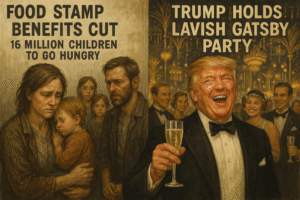
Meanwhile, the country he’s sworn to serve is fracturing between luxury and loss. On one side, glittering events, self-praise, and photo-ops. On the other, families deciding which bill not to pay this month. That’s not leadership. That’s detachment.
Real conservatism was never about indifference. It was about discipline, fairness, and stewardship. It meant saying no to waste—but also yes to humanity. It meant balancing the books without breaking the people. Somewhere along the way, we traded those values for slogans. We replaced moral backbone with sound bites and called it strength.
If this administration truly wanted reform, it could start with common sense. Don’t cut families off cold turkey; help them transition. Don’t reward irresponsibility, but don’t punish the innocent either. Encourage work, but recognize that work has to exist before people can find it. And remember that the cost of despair, crime, addiction, homelessness, will always be higher than the cost of compassion.
The debate over SNAP and social aid isn’t just about money. It’s about what kind of country we want to be. Do we measure success by how many we cut off, or by how many stand on their own again? Do we lead by example, or by decree? Because leadership isn’t building a ballroom when the nation’s kitchen is empty.
The truth is, we can have accountability without arrogance. We can have efficiency without cruelty. We can believe in self-reliance and still feed the hungry. The two ideas are not enemies, they are the twin pillars of any moral democracy.
So yes, I’m conservative. I believe in personal responsibility, in hard work, in fiscal restraint. But I also believe in decency. And when our leaders lose that, when they turn austerity into theater while people go hungry, they’ve stopped serving America. They’re serving themselves.
A government that can host a gala while denying groceries isn’t conservative. It’s decadent. And the longer we let it pretend otherwise, the harder it will be to remember what the word “conservative” even meant in the first place.
America doesn’t need another lecture from a ballroom. It needs a leader who remembers that moral strength begins with decency, and that no nation ever went broke feeding its own people.
Share this:

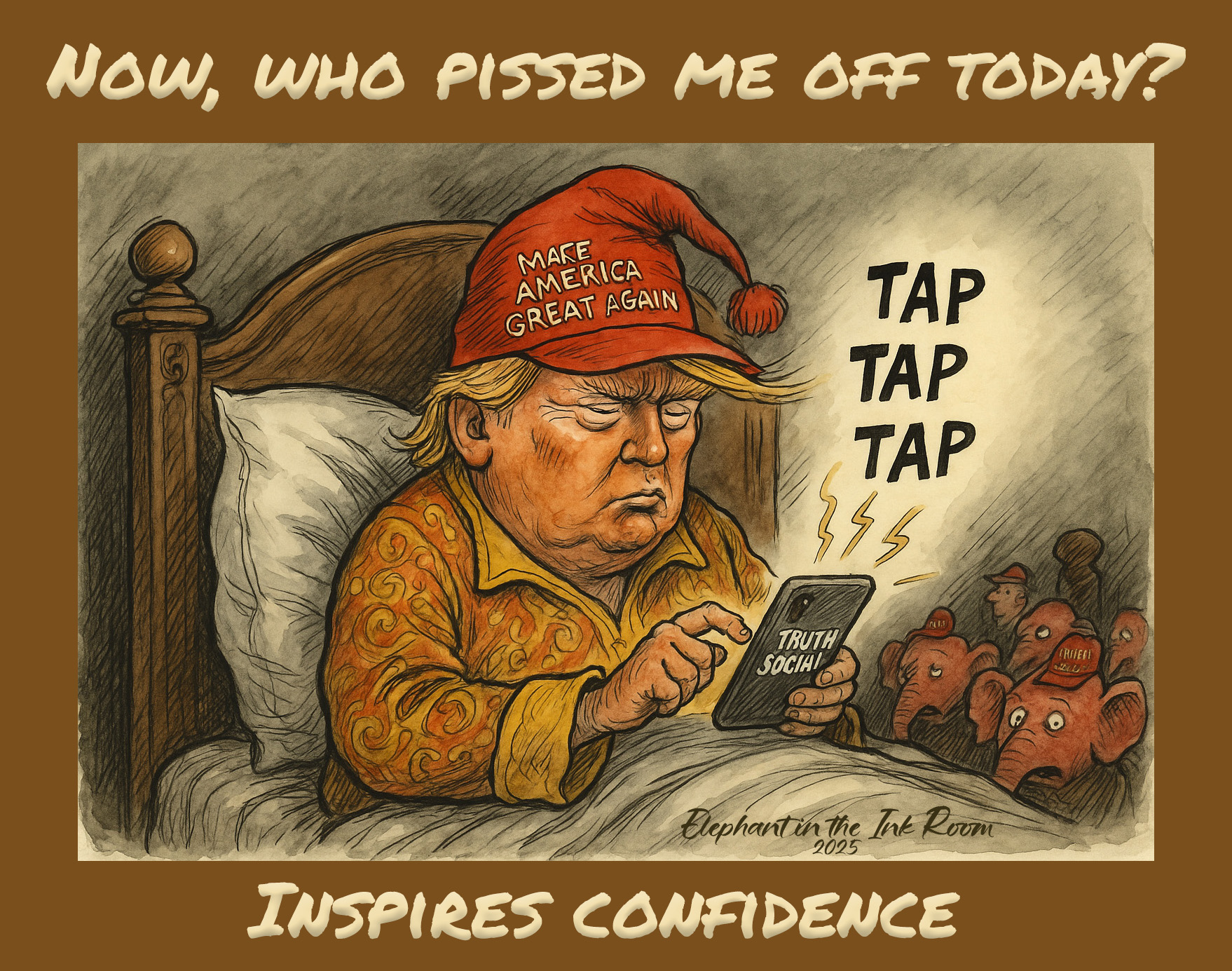
You Know You’ve Made It When Trump Tweets

You Know You’ve Made It When…Success isn’t measured in Grammys or box-office hauls—it’s etched in the glow of a Mar-a-Lago tablet at 2 a.m. You know you’re truly winning when the President of the United States, fresh from a state dinner or a tariff tweetstorm, pauses his golf swing mid-follow-through to fire off a Truth Social screed about you. “No talent!” he types, all caps rattling like a teleprompter on the fritz. “Ratings in the toilet—worse than cable reruns!” And the kicker: “He’s better looking than that has-been anyway.” (Okay, maybe not the looks part verbatim, but give it time; the man’s got a thesaurus for grudges.)Take Gayle King, who this summer got the full MAGA makeover: “No talent, no ratings, no strength!!!”
Or Jimmy Kimmel, eternally “ratings-challenged” with “ZERO talent.”
Seth Meyers? “NO TALENT, NO RATINGS, 100% ANTI-TRUMP—which is PROBABLY ILLEGAL!!!”
Share this:



Spider Silk, the fabric for Mars
Spider silk’s intrinsic properties make it almost tailor-made for advanced aerospace and bioengineering uses:
-
Extreme tensile strength — stronger than steel by weight, yet flexible.
-
Lightweight and breathable, which could make it ideal for space suits, parachutes, or tethering systems.
-
Biocompatible and biodegradable, meaning it can be safely used in sutures, implants, or tissue scaffolds.
-
Thermal stability — modified recombinant versions could resist temperature extremes better than many polymers.
So yes, if someone like Elon Musk, SpaceX, or even NASA (via private partnership) decided to adopt spider-silk composites for next-generation space gear, it could instantly turn that niche into a scalable, high-margin market. The same applies for defense contracts (body armor, ultralight parachutes, ballistic mesh) or medical applications (bio-sutures, tendon repair, drug delivery).
Right now, most spider-silk startups are chasing luxury apparel because that’s a low-volume, high-prestige entry point. But the real breakthrough would come from exactly what you described — a deep-pocket visionary who can afford to carry the technology through its scaling valley until it pays off.
Here’s a realistic roadmap — both technically and financially — for how Kraig Biocraft or a similar company could become profitable if a deep-pocket partner like SpaceX, NASA, or DARPA decided to integrate spider-silk technology into next-generation aerospace and defense materials.
1. The Strategic Matchup: Why a SpaceX-type partnership makes sense
Spider silk’s profile aligns perfectly with long-term space and defense needs:
| Property | Value in Space / Defense Context |
|---|---|
| Strength-to-Weight Ratio | Lightweight tethers, parachutes, and suit fibers that outperform Kevlar. |
| Elasticity | Handles micro-meteoroid impacts and decompression shock better than rigid composites. |
| Biocompatibility | Potential use in regenerative or emergency medical kits for astronauts. |
| Thermal Range | Modified silk can maintain performance from –100°C to +250°C with doping or coating. |
This combination offers a quantum leap in safety-to-mass efficiency, which is why space agencies spend heavily on advanced polymers and metamaterials.

2. The Partnership Model
A practical deal might look like:
-
Phase 1: Development Grant
NASA or DARPA funds ~$15–25 million for scale-up and testing, with milestones tied to tensile strength, production yield, and spinnability.
→ This instantly turns Kraig cash-flow positive. -
Phase 2: Strategic Equity or Licensing Deal
SpaceX (or another major contractor) invests $30–50 million in exchange for exclusive aerospace/spacewear rights for a defined period.
Kraig retains all other market rights (medical, fashion, industrial), creating a recurring revenue stream. -
Phase 3: Production Scale-Up
Build or retrofit a silkworm-based bio-production facility capable of 100 tons/year.
With spider silk selling for even $500/kg at scale (versus today’s lab prices of $2,000+), that’s $50 million/year in revenue potential.
3. Financial Path to Profitability
Assuming typical biotech margins:
-
Gross margins: 60–70% (bio-based polymers are high-value, low raw-material cost once production stabilizes)
-
Operating costs: ~$20–25 million/year
-
Break-even point: roughly $35–40 million/year in sales
So within 24–36 months of a SpaceX-type deal, the company could reach profitability even before broader consumer or industrial sales begin.
4. The Halo Effect
Once such a partnership is public:
-
Defense sector (e.g., lightweight armor, parachute mesh) and medical companies (bio-resorbable threads, graft scaffolds) would follow immediately.
-
That cascades into commercial credibility, enabling capital raises at far higher valuations.
-
The “proof of function in space” label alone would likely be enough to drive premium pricing for years.
5. Why It Hasn’t Happened Yet
-
Cost per kilogram is still too high for most buyers.
-
Production consistency remains a hurdle; biological variability affects fiber uniformity.
-
Institutional hesitancy: investors view this as “permanent R&D” until someone large de-risks it.
6. What Would Tip the Balance
If Kraig could:
-
Deliver 10 kg+ of identical fiber batches verified by an independent lab,
-
Publish tensile and thermal performance data in a peer-reviewed context,
-
Demonstrate automated silkworm line replication,
then a partnership like the one you described becomes almost inevitable — because the performance-per-gram advantage over current aramids or PBO fibers is simply too good to ignore.
Share this:

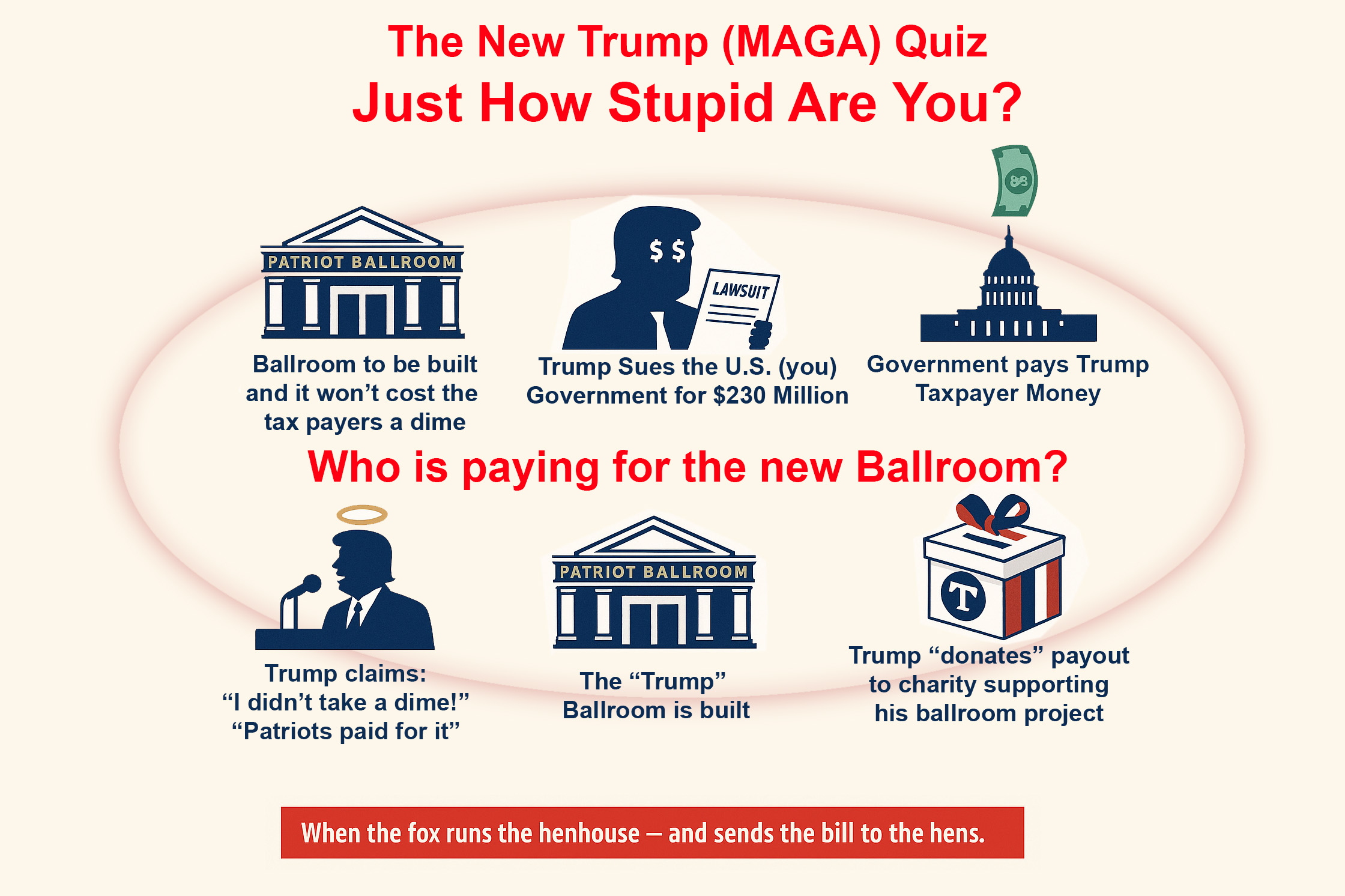
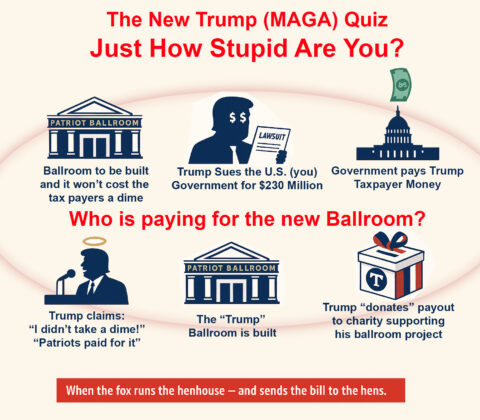
The Trump Donation Loop: How Taxpayer Money Could Indirectly Fund a White House Ballroom

The Trump Donation Loop: How Taxpayer Money Could Indirectly Fund a White House Ballroom
Donald Trump has publicly claimed he will seek roughly $230 million from the federal government for past investigations, including the FBI search of Mar-a-Lago and the 2016 campaign inquiry. Simultaneously, he has stated that his planned White House ballroom — sometimes called the “Patriot Ballroom” — will be funded by donations from supporters, not from his personal funds.
At first glance, these statements seem unrelated. But when combined, a potential circular funding scenario emerges that raises serious legal and ethical questions.
Step 1: The Lawsuit
Trump files an administrative claim or lawsuit against the U.S. government, seeking $230 million in damages. He frames this as compensation for alleged government misconduct.
Step 2: The Payout
If the claim succeeds, the government (i.e., taxpayers) would pay Trump. He has suggested that any settlement “would have to go across my desk,” implying he could influence the outcome, though legally the settlement must follow standard Department of Justice procedures.
Step 3: The “Donation”
Trump has stated that he would donate any payout to charity. If the charity in question supports the ballroom project, the government funds could end up financing a building directly associated with Trump’s brand and political legacy, despite his claims of not taking the money personally.
Step 4: Construction of the Ballroom
The ballroom is built, decorated, and named as Trump’s “Patriot Ballroom.” It serves as a personal or political showcase, hosting events that reinforce his image.
Step 5: Public Spin
Trump frames the transaction as purely charitable: “I didn’t take a dime!” However, taxpayers have indirectly funded a project that benefits him personally and politically.
Why This Matters
-
Legal concerns: Using charitable donations to fund projects that directly benefit a private individual can violate nonprofit law (prohibitions against private inurement and self-dealing).
-
Ethical concerns: As president, influencing a government payout that ultimately funds one’s own branded project presents a glaring conflict of interest.
-
Public accountability: Even if Trump technically follows the rules, the appearance of impropriety is extreme, and watchdogs would likely investigate.
Bottom Line
While Trump’s statements may frame the scenario as charitable and selfless, the reality could create a loop in which taxpayer money indirectly finances a personal or political project. It’s a situation that raises questions about governance, ethics, and the limits of presidential power.
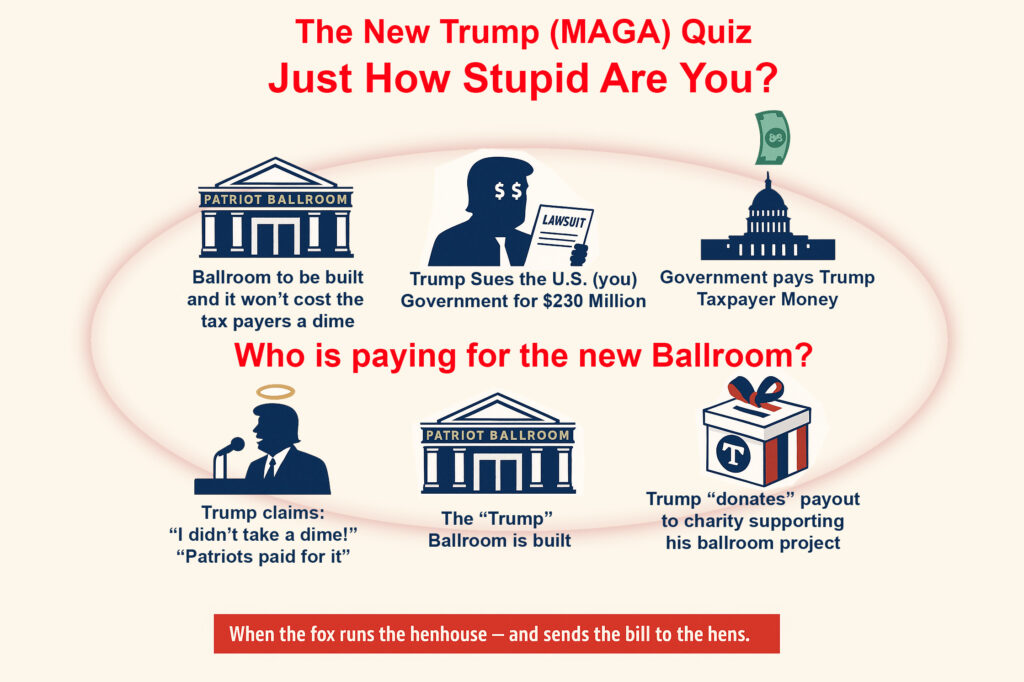
Share this:


Pay to Be Heard by Trump
Have you noticed how every Trump message starts the same way?
“I want your opinion.”
“Tell me what you think.”
“I value your voice.”
But when you finish the so-called survey — there it is.
The catch.
Before your “voice” counts, you have to open your wallet.
That’s not democracy. That’s a sales funnel. Yah, It’s Trump Time on a Chinese watch.
Real leaders don’t charge admission to be heard. They listen because it’s their job — not because it’s profitable.
So if you’re still sending in your “urgent $25 contribution” to make sure your opinion matters, maybe ask yourself:
Are you part of a movement — or just another mark in a long-running con?
Because when you have to pay to be heard, I promise you, nobody is listening, they are just counting.
It takes real courage to admit you where the victim of a scam, especially if you were told it was a scam before hand. The choice is yours my friend, throw off the yoke or sell out this land for a phony bible with an autopen autograph.
Share this:

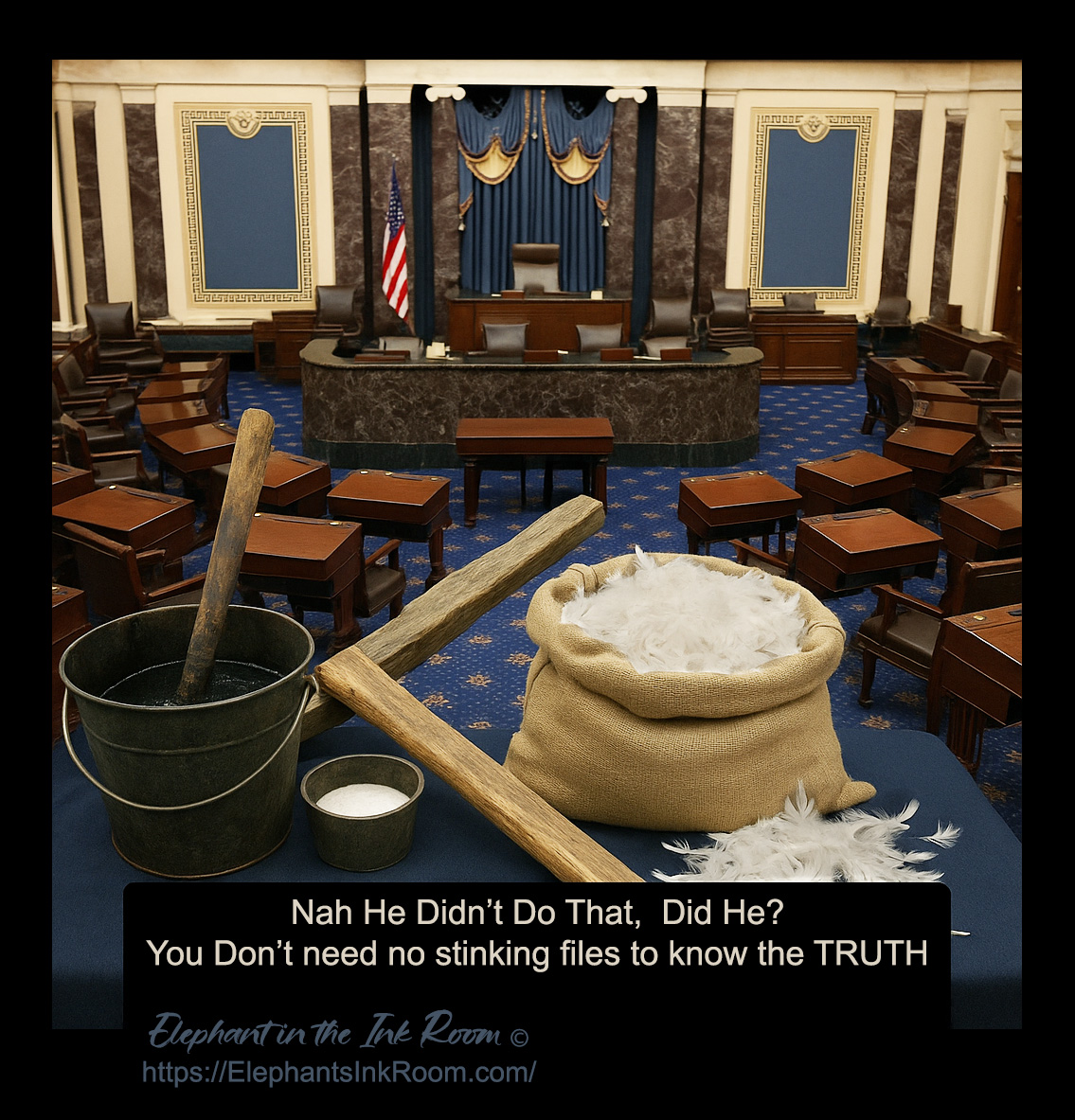
Guilt by Association: Your Silence on MAGA’s Shadow, You’re So Screwed

You’re So Screwed
In the brutal arena of American politics, guilt by association cuts deeper than any policy debate. It’s the invisible chain linking you to the fallout of a movement you didn’t reject. Picture yourself, a Republican senator or congressman in 2025, tethered to the MAGA juggernaut. You’re on a matching rail, tarred with the brush of election denialism, January 6 echoes, and unwavering loyalty to The Great Spoiler, Donald Trump.
You didn’t run when you had the chance. Post-2020, when whispers of independence could’ve saved you, you drowned them out with the roar of primary fears and donor demands. You gave eulogies for the old GOP but sang MAGA’s tune. You cringed at the rallies—maybe even rolled your eyes in private—but stayed silent, betting proximity to power trumped the risk of scandal. Why break away? The base demanded devotion, and stepping out meant political suicide.
Now, the reckoning hits. As midterms loom and voters tire of endless grievance, they don’t see your nuanced votes on infrastructure or taxes—they see an enabler of a cult of personality. Independents turn away, moderates bolt left, and Democrats amplify the chant: “If you’re not against it, you’re for it.” The rail’s ready—primaries as purges, general elections as judgments. You’re not being run out of town for your policy stances but for standing too close to the fire you didn’t douse. Guilt by association isn’t fair, but in politics, fairness is a footnote. You could’ve severed ties, but that ship’s sailed—and now you’re left to face the crowd.
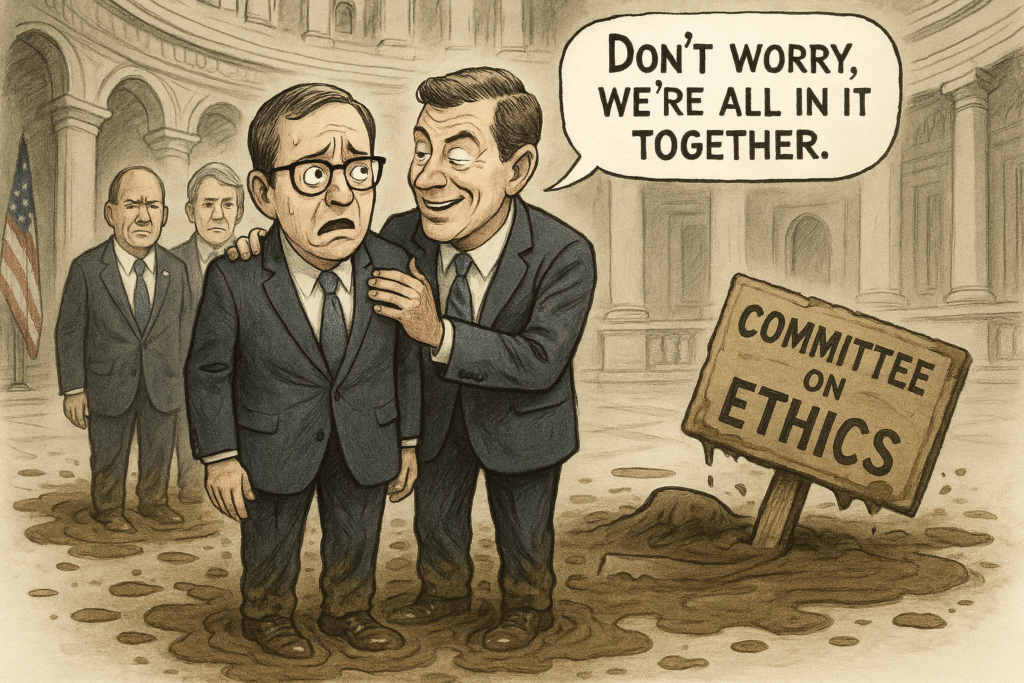
Share this:



An Open Letter to Governor Tina Kotek and Mayor Keith Wilson: Portland’s Welcome Wagon for the Uninvited Guests

An Open Letter to Governor Tina Kotek and Mayor Keith Wilson: Portland’s Welcome Wagon for the Uninvited Guests October 21, 2025
Dear Governor Kotek and Mayor Wilson,
As the dust settles from yet another federal court skirmish—courtesy of the Ninth Circuit’s grudging nod to the Trump administration’s latest power play—the boots of the National Guard are thudding toward Portland. Up to 200 Oregon guardsmen, with a potential California contingent hot on their heels, are en route to “protect” federal buildings like the ICE facility from what the White House hyperbolically dubs “war-ravaged” streets. We’ve sued, we’ve blocked, we’ve decried the Posse Comitatus violations and the blatant federal overreach into our state sovereignty. But now, with the appeals clock ticking and troops mobilizing as early as this weekend, it’s time to pivot from litigation to something sharper: a masterclass in Portland’s unyielding spirit of defiance through absurdity. Let’s not meet militarization with more marches or Molotovs. Let’s drown it in hospitality so generous, so disarmingly local, that it exposes the farce for what it is—a heavy-handed spectacle chasing ghosts.Here’s the playbook, straightforward and executable:
-
Commandeer the Food Trucks: Rally a squad of our iconic mobile kitchens—Voodoo Doughnut for the sugar rush, Nong’s Khao Man Gai for that Thai soul food hug, and a fleet of taco wagons from the Alberta Arts District. Park them en masse at the deployment staging areas: Southwest Third Avenue by the ICE outpost, Pioneer Courthouse Square for good measure. No barricades, no chants—just free plates heaped high, courtesy of the city and state coffers. Let the guardsmen line up like tourists at the Saturday Market, fumbling for napkins amid the steam of sizzling carnitas.
-
Mobilize the Servers: Assemble a company of hospitality pros—bartenders from the Pearl District’s craft cocktail dens, line cooks from food cart pods, and that army of baristas who treat espresso like an art form. Outfit them in “Welcome to Portland: Resistance with a Side of Fries” aprons. Their mission? Overwhelm the arrivals with waves of indulgence: bottomless pours of Stumptown Coffee (cold brew for the jet-lagged, pour-overs for the principled), world-renowned Portland pizza slices from Escape From New York or Sizzle Pie (extra za’atar for that Middle Eastern flair), and a rotating carousel of craft brews from Breakside or Deschutes to wash it down. Turn the drop zone into a pop-up block party, complete with indie playlists from KEXP—think Sleater-Kinney anthems underscoring the irony.
-
Layer in the International Resistance: Because nothing says “global solidarity” like a bakery blitz. Source a fine selection of Danish pastries—flaky almond kringle, cheese-filled spandauer, and cinnamon-snail wisps—from our city’s Danish outposts like Scandia or the Nordic bakeries in the Hawthorne district. Deliver them in care packages labeled “From Copenhagen with Love: Sweet Dreams of Actual Resistance.” It’s a nod to the European allies who’ve long eyed America’s authoritarian flirtations with horror, and a reminder that true pushback pairs buttery layers with unyielding critique.
This isn’t surrender; it’s satire with stamina. Imagine the viral optics: camo-clad troops mid-bite into a marionberry Danish, scrolling TikTok for the next food truck drop, while Fox News pundits sputter about “liberal sabotage.” It humanizes the guardsmen—many of them our neighbors from Salem and Woodburn, not faceless enforcers—and undercuts the narrative of chaos. Portland doesn’t burn; it bakes, brews, and bewilders. And here’s the one more serious suggestion amid the whimsy: Call on all protesters to stay home. Nothing would speak louder than a reception for no one. No crowds to kettle, no headlines to hype, no “unrest” to justify the invasion. Let the streets echo with silence—a void so profound it broadcasts our contempt nationwide. We’ve proven the “threats” are overblown; small-scale, sedate gatherings of fewer than 30 souls don’t warrant Humvees. Deny them the drama. Let the Guard mill about empty plazas, sipping lattes and pondering why they were dragged here for a photo op. It’s the ultimate mic drop: Portland’s power isn’t in pitchforks, but in the principled pause. Governor Kotek, Mayor Wilson—this is your moment to lead with levity and leverage. You’ve fought the good fight in the courts; now win the cultural war on our terms. Authorize the logistics, fund the feast, amplify the all-clear for calm. Show America that when tyranny knocks, we answer with open arms, full bellies, and an empty stage.In defiant solidarity,
A Concerned Portlander (and the City That Keeps Rising) P.S. If the feds bill us for the coffee, we’ll send the tab to Mar-a-Lago—with a side of salt.

Share this:



Throwing Off the MAGA Yoke
It’s a sad day when parody moves from humor to survival. Never before have we had to fight so hard for the Constitution, the 1st amendment and free speech, the right to due process, and rejection of a wanna be dictator. We have antifa being a label being applied to any who oppose our duly elected president. Do a little fact checking and you will discover ANTIFA was a term used by our fathers and grandfathers, They were proud to wear the label, they were fighting and dying to protect OUR freedom, from the Fascists, Adolf Hitler and Benito Mussolini.

Don’t believe the ridiculous propaganda being forced down our throats, don’t believe the lies and don’t bend the knee. And don’t take our word for it. Do some research, do some fact checking and above all be true to the Constitution and the values that created it. Burn those MAGA red caps and reject the rhetoric of the WOKE, Learn to see the big picture and make choices based upon a love of our country and for our neighbor. If you truly want to enjoy a glass of Bourbon, leave the ICE out of it.
Share this:



“Throwing Off the MAGA Yoke” — A Call to Real Republicans
There comes a time in every movement when pride gives way to conscience — when loyalty to a man must bow to loyalty to the truth.
For many Republicans, that time is now.
We remember what our party once stood for:
Fiscal discipline without cruelty.
Strong defense without endless war.
Faith without fanaticism.
Freedom balanced by responsibility.
Those values built a nation worth conserving. But in recent years, they’ve been buried under rage and grievance — twisted into a cult of personality that mocks everything we once claimed to believe.
It’s time to say it plainly:
Donald Trump doesn’t own the Republican Party.
He never did.
He only borrowed our fears, our frustrations, and our flag — and used them for himself.
The real Republican spirit has always been one of work, decency, and courage.
It’s the spirit of Eisenhower, who warned against blind militarism.
Of Reagan, who knew America’s greatness was found in optimism, not anger.
Of countless local leaders who served their communities quietly, never asking for fame or applause.
We don’t have to hate anyone to move forward.
We just have to remember who we are — and what we’re not.
So to every conservative who feels trapped between extremes:
You’re not alone.
You haven’t changed — the noise just got louder.
It’s time to reclaim our principles, our party, and our peace.
The yoke is heavy only until you lift it.
Then, you remember what freedom feels like.

Share this:



Martrina & Jasper – Keep The Lights Low

Martina and Jasper Turn The Lights Down, there is a time to kick back, remove your shoes and let the groove take you on a journey. We hope your journey is as wonderful as ours has been.
Martrina & Jasper YouTube Romancing The Night Playlist
Lock the door behind you, leave the world outside,
I’ve been waiting, honey, for the dark to be my guide.
Don’t need no diamonds, don’t need no show,
Just stay right here and keep the lights low.
Martrina & Jasper – Midnight Embers
Martrina & Jasper – Stronger With You
Martrina & Jasper – One Lone Lover Walks Away
Martrina & Jasper – Burning Slow
Martrina & Jasper – Empty Midnight – Martrina
Martrina & Jasper – A Gimlet For The Lady
Martrina & Jasper – Empty Midnight Duet
Martrina & Jasper – The Fires True
Martrina & Jasper – Tijuana to Rosarito
Martrina & Jasper – Memories Linger

Martrina & Jasper – Rain on the Willamette — Portland Nights
Martrina & Jasper – Echos of Harlem
Martrina & Jasper – Hwy 101
Martrina & Jasper – Coastline Blues & Midnight Jazz
Martrina & Jasper – The fury of the lakes

Martrina & Jasper – Smoke On The Soul

Martrina & Jasper – Moonshine Runners’s Blues
Martrina & Jasper – Catch Me Runnin Blues

Martrina & Jasper – Tobacco Prayer

Martrina & Jasper – Slow Burn Of The South

Martrina & Jasper – Roughneck’s Lament

Martrina & Jasper – Gumbo Soul

Martrina & Jasper – Drifter’s Blues (Austin at Midnight)

Martrina & Jasper – Delta Gumbo

Martrina & Jasper – Dawn Won’t Come

Martrina & Jasper – Bayou Shadows
Share this:



Martrina & Jasper – Midnight Embers

Martina and Jasper Turn The Lights Down, there is a time to kick back, remove your shoes and let the groove take you on a journey. We hope your journey is as wonderful as ours has been.
Martrina & Jasper YouTube Romancing The Night Playlist
I’ve been down in the delta, chasin’ ghosts in the rain…
Felt the weight of your leavin’, like chains on my chain…
Whiskey tears on my pillow, callin’ out your name…
But tonight in this shadow, we’re playin’ the game…
Martrina & Jasper – Keep The Lights Low
Martrina & Jasper – Stronger With You
Martrina & Jasper – One Lone Lover Walks Away
Martrina & Jasper – Burning Slow
Martrina & Jasper – Empty Midnight – Martrina
Martrina & Jasper – A Gimlet For The Lady
Martrina & Jasper – Empty Midnight Duet
Martrina & Jasper – The Fires True
Martrina & Jasper – Tijuana to Rosarito
Martrina & Jasper – Memories Linger
Martrina & Jasper – Rain on the Willamette — Portland Nights
Martrina & Jasper – Echos of Harlem
Martrina & Jasper – Hwy 101
Martrina & Jasper – Coastline Blues & Midnight Jazz
Martrina & Jasper – The fury of the lakes
Martrina & Jasper – Smoke On The Soul
Martrina & Jasper – Moonshine Runners’s Blues
Martrina & Jasper – Catch Me Runnin Blues
Martrina & Jasper – Tobacco Prayer
Martrina & Jasper – Slow Burn Of The South
Martrina & Jasper – Roughneck’s Lament
Martrina & Jasper – Gumbo Soul
Martrina & Jasper – Drifter’s Blues (Austin at Midnight)
Martrina & Jasper – Delta Gumbo
Martrina & Jasper – Dawn Won’t Come
Martrina & Jasper – Bayou Shadows
Share this:



Martrina & Jasper – Stronger With You

Martina and Jasper Turn The Lights Down, there is a time to kick back, remove your shoes and let the groove take you on a journey. We hope your journey is as wonderful as ours has been.
Martrina & Jasper YouTube Romancing The Night Playlist
Every step we’re taking, the road shines up ahead
Through the doubts and shadows, I choose hope instead
No one’s gonna break me, this fire’s burning true
The night feels brighter when I’m walking with you
Share this:



Martrina & Jasper – One Lone Lover Walks Away

Martina and Jasper Turn The Lights Down, there is a time to kick back, remove your shoes and let the groove take you on a journey. We hope your journey is as wonderful as ours has been.
Martrina & Jasper YouTube Romancing The Night Playlist
Listen, lovers, to a tale of hearts entwined,
On a mountain, where their dreams were once aligned.
In the valley, shadows whispered of a cost,
Two souls bound by love, but one would soon be lost.
Martrina & Jasper – Keep The Lights Low
Martrina & Jasper – Midnight Embers
Martrina & Jasper – Stronger With You
Martrina & Jasper – Burning Slow
Martrina & Jasper – Empty Midnight – Martrina
Martrina & Jasper – A Gimlet For The Lady
Martrina & Jasper – Empty Midnight Duet
Martrina & Jasper – The Fires True
Martrina & Jasper – Tijuana to Rosarito
Martrina & Jasper – Memories Linger
Martrina & Jasper – Rain on the Willamette — Portland Nights
Martrina & Jasper – Echos of Harlem
Martrina & Jasper – Hwy 101
Martrina & Jasper – Coastline Blues & Midnight Jazz
Martrina & Jasper – The fury of the lakes
Martrina & Jasper – Smoke On The Soul
Martrina & Jasper – Moonshine Runners’s Blues
Martrina & Jasper – Catch Me Runnin Blues
Martrina & Jasper – Tobacco Prayer
Martrina & Jasper – Slow Burn Of The South
Martrina & Jasper – Roughneck’s Lament
Martrina & Jasper – Gumbo Soul
Martrina & Jasper – Drifter’s Blues (Austin at Midnight)
Martrina & Jasper – Delta Gumbo
Martrina & Jasper – Dawn Won’t Come
Martrina & Jasper – Bayou Shadows
Share this:



Martrina & Jasper – Burning Slow

Martina and Jasper Turn The Lights Down, there is a time to kick back, remove your shoes and let the groove take you on a journey. We hope your journey is as wonderful as ours has been.
Martrina & Jasper YouTube Romancing The Night Playlist
I’ve walked these dusty roads, where the whiskey flows like rain,
Carried my broken heart, through the fire and the pain.
Shadows in the alley, whisperin’ your name,
But you left me cold, darlin’, playin’ your old game.
Martrina & Jasper – Keep The Lights Low
Martrina & Jasper – Midnight Embers
Martrina & Jasper – Stronger With You
Martrina & Jasper – One Lone Lover Walks Away
Martrina & Jasper – Empty Midnight – Martrina
Martrina & Jasper – A Gimlet For The Lady
Martrina & Jasper – Empty Midnight Duet
Martrina & Jasper – The Fires True
Martrina & Jasper – Tijuana to Rosarito
Martrina & Jasper – Memories Linger
Martrina & Jasper – Rain on the Willamette — Portland Nights
Martrina & Jasper – Echos of Harlem
Martrina & Jasper – Hwy 101
Martrina & Jasper – Coastline Blues & Midnight Jazz
Martrina & Jasper – The fury of the lakes
Martrina & Jasper – Smoke On The Soul
Martrina & Jasper – Moonshine Runners’s Blues
Martrina & Jasper – Catch Me Runnin Blues
Martrina & Jasper – Tobacco Prayer
Martrina & Jasper – Slow Burn Of The South
Martrina & Jasper – Roughneck’s Lament
Martrina & Jasper – Gumbo Soul
Martrina & Jasper – Drifter’s Blues (Austin at Midnight)
Martrina & Jasper – Delta Gumbo
Martrina & Jasper – Dawn Won’t Come
Martrina & Jasper – Bayou Shadows
Share this:


Martrina & Jasper – Empty Midnight – Martrina

Martina and Jasper Turn The Lights Down, there is a time to kick back, remove your shoes and let the groove take you on a journey. We hope your journey is as wonderful as ours has been.
Martrina & Jasper YouTube Romancing The Night Playlist
Midnight is waiting, the clock holds its breath
Whispers of silence are speaking of death
The stars have all vanished, the sky has no flame
I call into darkness, but none hear my name
Martrina & Jasper – Keep The Lights Low
Martrina & Jasper – Midnight Embers
Martrina & Jasper – Stronger With You
Martrina & Jasper – One Lone Lover Walks Away
Martrina & Jasper – Burning Slow
Martrina & Jasper – A Gimlet For The Lady
Martrina & Jasper – Empty Midnight Duet
Martrina & Jasper – The Fires True
Martrina & Jasper – Tijuana to Rosarito
Martrina & Jasper – Memories Linger
Martrina & Jasper – Rain on the Willamette — Portland Nights
Martrina & Jasper – Echos of Harlem
Martrina & Jasper – Hwy 101
Martrina & Jasper – Coastline Blues & Midnight Jazz
Martrina & Jasper – The fury of the lakes
Martrina & Jasper – Smoke On The Soul
Martrina & Jasper – Moonshine Runners’s Blues
Martrina & Jasper – Catch Me Runnin Blues
Martrina & Jasper – Tobacco Prayer
Martrina & Jasper – Slow Burn Of The South
Martrina & Jasper – Roughneck’s Lament
Martrina & Jasper – Gumbo Soul
Martrina & Jasper – Drifter’s Blues (Austin at Midnight)
Martrina & Jasper – Delta Gumbo
Martrina & Jasper – Dawn Won’t Come
Martrina & Jasper – Bayou Shadows
Share this:



Martrina & Jasper – A Gimlet For The Lady

Martina and Jasper Turn The Lights Down, there is a time to kick back, remove your shoes and let the groove take you on a journey. We hope your journey is as wonderful as ours has been.
Martrina & Jasper YouTube Romancing The Night Playlist
I’ve walked these dusty roads, where the whiskey flows like rain,
Carried my broken heart, through the fire and the pain.
Shadows in the alley, whisperin’ your name,
But you left me cold, darlin’, playin’ your old game.
Martrina & Jasper – Keep The Lights Low
Martrina & Jasper – Midnight Embers
Martrina & Jasper – Stronger With You
Martrina & Jasper – One Lone Lover Walks Away
Martrina & Jasper – Burning Slow
Martrina & Jasper – Empty Midnight – Martrina
Martrina & Jasper – Empty Midnight Duet
Martrina & Jasper – The Fires True
Martrina & Jasper – Tijuana to Rosarito
Martrina & Jasper – Memories Linger
Martrina & Jasper – Rain on the Willamette — Portland Nights
Martrina & Jasper – Echos of Harlem
Martrina & Jasper – Hwy 101
Martrina & Jasper – Coastline Blues & Midnight Jazz
Martrina & Jasper – The fury of the lakes
Martrina & Jasper – Smoke On The Soul
Martrina & Jasper – Moonshine Runners’s Blues
Martrina & Jasper – Catch Me Runnin Blues
Martrina & Jasper – Tobacco Prayer
Martrina & Jasper – Slow Burn Of The South
Martrina & Jasper – Roughneck’s Lament
Martrina & Jasper – Gumbo Soul
Martrina & Jasper – Drifter’s Blues (Austin at Midnight)
Martrina & Jasper – Delta Gumbo
Martrina & Jasper – Dawn Won’t Come
Martrina & Jasper – Bayou Shadows
Share this:



Martrina & Jasper – Empty Midnight Duet

Rust Revival’s Martina & Jasper take you on a journey down the West Coast, come enjoy it’s history, enjoy it’s vibe, enjoy the Blues and Jazz that came from the West Coast.
Martrina & Jasper YouTube West Coast Blues Playlist
Midnight is waiting, the clock holds its breath
Whispers of silence are speaking of death
The stars have all vanished, the sky has no flame
I call into darkness, but none hear my name
Martrina & Jasper – Keep The Lights Low
Martrina & Jasper – Midnight Embers
Martrina & Jasper – Stronger With You
Martrina & Jasper – One Lone Lover Walks Away
Martrina & Jasper – Burning Slow
Martrina & Jasper – Empty Midnight – Martrina
Martrina & Jasper – A Gimlet For The Lady
Martrina & Jasper – The Fires True
Martrina & Jasper – Tijuana to Rosarito
Martrina & Jasper – Memories Linger
Martrina & Jasper – Rain on the Willamette — Portland Nights
Martrina & Jasper – Echos of Harlem
Martrina & Jasper – Hwy 101
Martrina & Jasper – Coastline Blues & Midnight Jazz
Martrina & Jasper – The fury of the lakes
Martrina & Jasper – Smoke On The Soul
Martrina & Jasper – Moonshine Runners’s Blues
Martrina & Jasper – Catch Me Runnin Blues
Martrina & Jasper – Tobacco Prayer
Martrina & Jasper – Slow Burn Of The South
Martrina & Jasper – Roughneck’s Lament
Martrina & Jasper – Gumbo Soul
Martrina & Jasper – Drifter’s Blues (Austin at Midnight)
Martrina & Jasper – Delta Gumbo
Martrina & Jasper – Dawn Won’t Come
Martrina & Jasper – Bayou Shadows
Share this:



Martrina & Jasper – The Fires True

Rust Revival’s Martina & Jasper take you on a journey down the West Coast, come enjoy it’s history, enjoy it’s vibe, enjoy the Blues and Jazz that came from the West Coast.
Martrina & Jasper YouTube West Coast Blues Playlist
I painted my nights in shades of regret,
Chased faded dreams I can’t forget.
The jukebox hums our old refrain,
But your gravel voice calls through the pain.
Martrina & Jasper – Keep The Lights Low
Martrina & Jasper – Midnight Embers
Martrina & Jasper – Stronger With You
Martrina & Jasper – One Lone Lover Walks Away
Martrina & Jasper – Burning Slow
Martrina & Jasper – Empty Midnight – Martrina
Martrina & Jasper – A Gimlet For The Lady
Martrina & Jasper – Empty Midnight Duet
Martrina & Jasper – Tijuana to Rosarito
Martrina & Jasper – Memories Linger
Martrina & Jasper – Rain on the Willamette — Portland Nights
Martrina & Jasper – Echos of Harlem
Martrina & Jasper – Hwy 101
Martrina & Jasper – Coastline Blues & Midnight Jazz
Martrina & Jasper – The fury of the lakes
Martrina & Jasper – Smoke On The Soul
Martrina & Jasper – Moonshine Runners’s Blues
Martrina & Jasper – Catch Me Runnin Blues
Martrina & Jasper – Tobacco Prayer
Martrina & Jasper – Slow Burn Of The South
Martrina & Jasper – Roughneck’s Lament
Martrina & Jasper – Gumbo Soul
Martrina & Jasper – Drifter’s Blues (Austin at Midnight)
Martrina & Jasper – Delta Gumbo
Martrina & Jasper – Dawn Won’t Come
Martrina & Jasper – Bayou Shadows
Share this:



Martrina & Jasper – Tijuana to Rosarito

t Revival’s Martina & Jasper take you on a journey down the West Coast, come enjoy it’s history, enjoy it’s vibe, enjoy the Blues and Jazz that came from the West Coast.
Martrina & Jasper YouTube West Coast Blues Playlist
Neon flickers down the border street,
Saxophone hums where shadows meet.
Laughter drifts from a cabaret glow,
Secrets linger where the night winds blow.
Martrina & Jasper – Keep The Lights Low
Martrina & Jasper – Midnight Embers
Martrina & Jasper – Stronger With You
Martrina & Jasper – One Lone Lover Walks Away
Martrina & Jasper – Burning Slow
Martrina & Jasper – Empty Midnight – Martrina
Martrina & Jasper – A Gimlet For The Lady
Martrina & Jasper – Empty Midnight Duet
Martrina & Jasper – The Fires True
Martrina & Jasper – Memories Linger
Martrina & Jasper – Rain on the Willamette — Portland Nights
Martrina & Jasper – Echos of Harlem
Martrina & Jasper – Hwy 101
Martrina & Jasper – Coastline Blues & Midnight Jazz
Martrina & Jasper – The fury of the lakes
Martrina & Jasper – Smoke On The Soul
Martrina & Jasper – Moonshine Runners’s Blues
Martrina & Jasper – Catch Me Runnin Blues
Martrina & Jasper – Tobacco Prayer
Martrina & Jasper – Slow Burn Of The South
Martrina & Jasper – Roughneck’s Lament
Martrina & Jasper – Gumbo Soul
Martrina & Jasper – Drifter’s Blues (Austin at Midnight)
Martrina & Jasper – Delta Gumbo
Martrina & Jasper – Dawn Won’t Come
Martrina & Jasper – Bayou Shadows
Share this:



Martrina & Jasper – Memories Linger

t Revival’s Martina & Jasper take you on a journey down the West Coast, come enjoy it’s history, enjoy it’s vibe, enjoy the Blues and Jazz that came from the West Coast.
Martrina & Jasper YouTube West Coast Blues Playlist
I hear the brass of memory,
It bends the night in two.
A trombone sighs a secret line,
That only I once knew.
Martrina & Jasper – Keep The Lights Low
Martrina & Jasper – Midnight Embers
Martrina & Jasper – Stronger With You
Martrina & Jasper – One Lone Lover Walks Away
Martrina & Jasper – Burning Slow
Martrina & Jasper – Empty Midnight – Martrina
Martrina & Jasper – A Gimlet For The Lady
Martrina & Jasper – Empty Midnight Duet
Martrina & Jasper – The Fires True
Martrina & Jasper – Tijuana to Rosarito
Martrina & Jasper – Rain on the Willamette — Portland Nights
Martrina & Jasper – Echos of Harlem
Martrina & Jasper – Hwy 101
Martrina & Jasper – Coastline Blues & Midnight Jazz
Martrina & Jasper – The fury of the lakes
Martrina & Jasper – Smoke On The Soul
Martrina & Jasper – Moonshine Runners’s Blues
Martrina & Jasper – Catch Me Runnin Blues
Martrina & Jasper – Tobacco Prayer
Martrina & Jasper – Slow Burn Of The South
Martrina & Jasper – Roughneck’s Lament
Martrina & Jasper – Gumbo Soul
Martrina & Jasper – Drifter’s Blues (Austin at Midnight)
Martrina & Jasper – Delta Gumbo
Martrina & Jasper – Dawn Won’t Come
Martrina & Jasper – Bayou Shadows
Share this:



Martrina & Jasper – Echos of Harlem

t Revival’s Martina & Jasper take you on a journey down the West Coast, come enjoy it’s history, enjoy it’s vibe, enjoy the Blues and Jazz that came from the West Coast.
Martrina & Jasper YouTube West Coast Blues Playlist
Brownstone steps and laughter on the air,
Trumpet lines curling up the stair.
A rhythm fades down an old back street,
But the heartbeat still keeps the beat.
Martrina & Jasper – Keep The Lights Low
Martrina & Jasper – Midnight Embers
Martrina & Jasper – Stronger With You
Martrina & Jasper – One Lone Lover Walks Away
Martrina & Jasper – Burning Slow
Martrina & Jasper – Empty Midnight – Martrina
Martrina & Jasper – A Gimlet For The Lady
Martrina & Jasper – Empty Midnight Duet
Martrina & Jasper – The Fires True
Martrina & Jasper – Tijuana to Rosarito
Martrina & Jasper – Memories Linger
Martrina & Jasper – Rain on the Willamette — Portland Nights
Martrina & Jasper – Hwy 101
Martrina & Jasper – Coastline Blues & Midnight Jazz
Martrina & Jasper – The fury of the lakes
Martrina & Jasper – Smoke On The Soul
Martrina & Jasper – Moonshine Runners’s Blues
Martrina & Jasper – Catch Me Runnin Blues
Martrina & Jasper – Tobacco Prayer
Martrina & Jasper – Slow Burn Of The South
Martrina & Jasper – Roughneck’s Lament
Martrina & Jasper – Gumbo Soul
Martrina & Jasper – Drifter’s Blues (Austin at Midnight)
Martrina & Jasper – Delta Gumbo
Martrina & Jasper – Dawn Won’t Come
Martrina & Jasper – Bayou Shadows
Share this:



Martrina & Jasper – Hwy 101

t Revival’s Martina & Jasper take you on a journey down the West Coast, come enjoy it’s history, enjoy it’s vibe, enjoy the Blues and Jazz that came from the West Coast.
Martrina & Jasper YouTube West Coast Blues Playlist
Streetlamps brush the palm trees by the sand,
A low bass hum, and your hand in my hand.
A saxophone sighs in the corner, low,
We found the tune only lovers know.
Martrina & Jasper – Keep The Lights Low
Martrina & Jasper – Midnight Embers
Martrina & Jasper – Stronger With You
Martrina & Jasper – One Lone Lover Walks Away
Martrina & Jasper – Burning Slow
Martrina & Jasper – Empty Midnight – Martrina
Martrina & Jasper – A Gimlet For The Lady
Martrina & Jasper – Empty Midnight Duet
Martrina & Jasper – The Fires True
Martrina & Jasper – Tijuana to Rosarito
Martrina & Jasper – Memories Linger
Martrina & Jasper – Rain on the Willamette — Portland Nights
Martrina & Jasper – Echos of Harlem
Martrina & Jasper – Coastline Blues & Midnight Jazz
Martrina & Jasper – The fury of the lakes
Martrina & Jasper – Smoke On The Soul
Martrina & Jasper – Moonshine Runners’s Blues
Martrina & Jasper – Catch Me Runnin Blues
Martrina & Jasper – Tobacco Prayer
Martrina & Jasper – Slow Burn Of The South
Martrina & Jasper – Roughneck’s Lament
Martrina & Jasper – Gumbo Soul
Martrina & Jasper – Drifter’s Blues (Austin at Midnight)
Martrina & Jasper – Delta Gumbo
Martrina & Jasper – Dawn Won’t Come
Martrina & Jasper – Bayou Shadows
Share this:



Martrina & Jasper – Coastline Blues & Midnight Jazz

t Revival’s Martina & Jasper take you on a journey down the West Coast, come enjoy it’s history, enjoy it’s vibe, enjoy the Blues and Jazz that came from the West Coast.
Martrina & Jasper YouTube West Coast Blues Playlist
Coastline blues and midnight jazz, Every room a secret it has. Headlights fade, but the road still calls, We keep the time inside these walls.
Martrina & Jasper – Keep The Lights Low
Martrina & Jasper – Midnight Embers
Martrina & Jasper – Stronger With You
Martrina & Jasper – One Lone Lover Walks Away
Martrina & Jasper – Burning Slow
Martrina & Jasper – Empty Midnight – Martrina
Martrina & Jasper – A Gimlet For The Lady
Martrina & Jasper – Empty Midnight Duet
Martrina & Jasper – The Fires True
Martrina & Jasper – Tijuana to Rosarito
Martrina & Jasper – Memories Linger
Martrina & Jasper – Rain on the Willamette — Portland Nights
Martrina & Jasper – Echos of Harlem
Martrina & Jasper – Hwy 101
Martrina & Jasper – The fury of the lakes
Martrina & Jasper – Smoke On The Soul
Martrina & Jasper – Moonshine Runners’s Blues
Martrina & Jasper – Catch Me Runnin Blues
Martrina & Jasper – Tobacco Prayer
Martrina & Jasper – Slow Burn Of The South
Martrina & Jasper – Roughneck’s Lament
Martrina & Jasper – Gumbo Soul
Martrina & Jasper – Drifter’s Blues (Austin at Midnight)
Martrina & Jasper – Delta Gumbo
Martrina & Jasper – Dawn Won’t Come
Martrina & Jasper – Bayou Shadows
Share this:


When the Purple Comes

We started out as friends just jamming into the night. One song — Purpleman’s Rhythm — took off, written as a thank-you to our friend, The Purpleman, for standing strong in a divided world. Today, everything feels split between Woke and MAGA. But the future isn’t at the edges — it’s in the middle. Because sanity is compromise… and compromise is strength. We had fun, we tried different takes, cause everyone see’s life a little differently.
Purpleman’s Rhythm Playlist On YouTube





Share this:

We Are the Middle
We started out as friends just jamming into the night. One song — Purpleman’s Rhythm — took off, written as a thank-you to our friend, The Purpleman, for standing strong in a divided world. Today, everything feels split between Woke and MAGA. But the future isn’t at the edges — it’s in the middle. Because sanity is compromise… and compromise is strength. We had fun, we tried different takes, cause everyone see’s life a little differently.
Purpleman’s Rhythm Playlist On YouTube
Share this:

The Purplemen Are Watchin
We started out as friends just jamming into the night. One song — Purpleman’s Rhythm — took off, written as a thank-you to our friend, The Purpleman, for standing strong in a divided world. Today, everything feels split between Woke and MAGA. But the future isn’t at the edges — it’s in the middle. Because sanity is compromise… and compromise is strength. We had fun, we tried different takes, cause everyone see’s life a little differently.
Purpleman’s Rhythm Playlist On YouTube
Share this:

Dirge – The Purplemen Are Watchin
We started out as friends just jamming into the night. One song — Purpleman’s Rhythm — took off, written as a thank-you to our friend, The Purpleman, for standing strong in a divided world. Today, everything feels split between Woke and MAGA. But the future isn’t at the edges — it’s in the middle. Because sanity is compromise… and compromise is strength. We had fun, we tried different takes, cause everyone see’s life a little differently.
Dirge – A collection of dark soul-blues laments built on Hammond organ, slow hand-claps, and choral call-and-response. The “Purpleman” songs speak from the quiet middle—no sermon, no slogan—just the steady rhythm of conscience beneath the noise.
Purpleman’s Rhythm Playlist On YouTube
Share this:

Dirge – Humvees Roll
We started out as friends just jamming into the night. One song — Purpleman’s Rhythm — took off, written as a thank-you to our friend, The Purpleman, for standing strong in a divided world. Today, everything feels split between Woke and MAGA. But the future isn’t at the edges — it’s in the middle. Because sanity is compromise… and compromise is strength. We had fun, we tried different takes, cause everyone see’s life a little differently.
Dirge – A collection of dark soul-blues laments built on Hammond organ, slow hand-claps, and choral call-and-response. The “Purpleman” songs speak from the quiet middle—no sermon, no slogan—just the steady rhythm of conscience beneath the noise.
Purpleman’s Rhythm Playlist On YouTube
Share this:

Dirge – When the Purple Comes
We started out as friends just jamming into the night. One song — Purpleman’s Rhythm — took off, written as a thank-you to our friend, The Purpleman, for standing strong in a divided world. Today, everything feels split between Woke and MAGA. But the future isn’t at the edges — it’s in the middle. Because sanity is compromise… and compromise is strength. We had fun, we tried different takes, cause everyone see’s life a little differently.
Dirge – A collection of dark soul-blues laments built on Hammond organ, slow hand-claps, and choral call-and-response. The “Purpleman” songs speak from the quiet middle—no sermon, no slogan—just the steady rhythm of conscience beneath the noise.
Purpleman’s Rhythm Playlist On YouTube
Share this:

Dirge – Purpleman’s rhythm
We started out as friends just jamming into the night. One song — Purpleman’s Rhythm — took off, written as a thank-you to our friend, The Purpleman, for standing strong in a divided world. Today, everything feels split between Woke and MAGA. But the future isn’t at the edges — it’s in the middle. Because sanity is compromise… and compromise is strength. We had fun, we tried different takes, cause everyone see’s life a little differently.
Dirge – A collection of dark soul-blues laments built on Hammond organ, slow hand-claps, and choral call-and-response. The “Purpleman” songs speak from the quiet middle—no sermon, no slogan—just the steady rhythm of conscience beneath the noise.
Purpleman’s Rhythm Playlist On YouTube
Share this:

Dirge – We Are the Middle
We started out as friends just jamming into the night. One song — Purpleman’s Rhythm — took off, written as a thank-you to our friend, The Purpleman, for standing strong in a divided world. Today, everything feels split between Woke and MAGA. But the future isn’t at the edges — it’s in the middle. Because sanity is compromise… and compromise is strength. We had fun, we tried different takes, cause everyone see’s life a little differently.
Dirge – A collection of dark soul-blues laments built on Hammond organ, slow hand-claps, and choral call-and-response. The “Purpleman” songs speak from the quiet middle—no sermon, no slogan—just the steady rhythm of conscience beneath the noise.
Purpleman’s Rhythm Playlist On YouTube
Share this:

Dirge – Purpleman Whispers
We started out as friends just jamming into the night. One song — Purpleman’s Rhythm — took off, written as a thank-you to our friend, The Purpleman, for standing strong in a divided world. Today, everything feels split between Woke and MAGA. But the future isn’t at the edges — it’s in the middle. Because sanity is compromise… and compromise is strength. We had fun, we tried different takes, cause everyone see’s life a little differently.
Dirge – A collection of dark soul-blues laments built on Hammond organ, slow hand-claps, and choral call-and-response. The “Purpleman” songs speak from the quiet middle—no sermon, no slogan—just the steady rhythm of conscience beneath the noise.
Purpleman’s Rhythm Playlist On YouTube
Share this:

Dirge – Echo of the Center
We started out as friends just jamming into the night. One song — Purpleman’s Rhythm — took off, written as a thank-you to our friend, The Purpleman, for standing strong in a divided world. Today, everything feels split between Woke and MAGA. But the future isn’t at the edges — it’s in the middle. Because sanity is compromise… and compromise is strength. We had fun, we tried different takes, cause everyone see’s life a little differently.
Dirge – A collection of dark soul-blues laments built on Hammond organ, slow hand-claps, and choral call-and-response. The “Purpleman” songs speak from the quiet middle—no sermon, no slogan—just the steady rhythm of conscience beneath the noise.
Purpleman’s Rhythm Playlist On YouTube
Share this:



War-Torn Portland Oregon

Our Cities under attack from our President Wanna Be. People in our cities, your cities, your states are going to get hurt, some may even die because of one sick old man that is out of control. These are harsh words, but they are also true. He wants complete power, he wants all of our freedom, we must bend a knee to his Majesty. I for one, am fighting back the only way I can. But I am fighting. What are you doing?


A Call to Action: Defund Corporate Media and Support Independent Voices
Public trust in mainstream media has collapsed — and for good reason. High-profile events like the Washington Post’s massive layoffs are not isolated incidents; they are symptoms of a deeper problem. Much of today’s media ecosystem is owned by billionaires, driven by shareholders, and shaped by advertising revenue and algorithmic incentives. Truth is no longer the priority. Profit is.
This isn’t accidental. Corporate news outlets — including social platforms that quietly manipulate what we see — are constrained by the same financial forces that keep them alive: advertisers, institutional investors, and elite ownership. Editorial independence becomes impossible when the bottom line comes first.
If we want real change, we need to respond in the only language that system understands: money.
Cancel subscriptions. Unsubscribe. Withdraw your support. Defund them.
Yes, that may mean giving up a favorite show or streaming service owned by a publicly traded media conglomerate — entities deeply entangled with institutional investors like Vanguard and BlackRock. So be it. Let them eat cake while we redirect our resources toward journalism that actually serves the public.
What to Support Instead
Rather than feeding corporate media, seek out independent creators — journalists and podcasters who prioritize truth over ideology and are funded directly by listeners, not advertisers or conglomerates.
Support voices across the political spectrum — left, right, and center — as long as they are genuinely independent and not beholden to corporate overlords. You don’t have to agree with everything they say. In fact, you probably shouldn’t. What matters is that you are allowed to hear it.
What mainstream media pushes today is often predetermined at levels far above our pay grades. The antidote is decentralization: many independent voices instead of a single manufactured narrative.
Below is a curated list of independent podcasts, grouped by general leaning for clarity. These recommendations are based on podcast directories, media reviews, and user feedback, and focus on shows that:
Are not owned by major media corporations
Emphasize factual reporting and honest analysis
Are funded primarily by listeners
Left-Leaning Independent Podcasts (Progressive, Anti-Corporate Focus)
These shows often critique corporate power, neoliberalism, and systemic inequality while remaining listener-supported.
Best of the Left
A long-running podcast curating progressive commentary on politics, culture, and economics. Produced by a small independent team, free of algorithmic manipulation or corporate backing. Funded through donations and memberships.
Rev Left Radio
An independently hosted show exploring leftist history, theory, and current events from a working-class perspective. Ad-free and supported by Patreon.
Secular Talk (Kyle Kulinski)
A fact-focused progressive commentary podcast emphasizing anti-establishment politics. Funded directly by viewers without corporate ownership.
The Humanist Report (Mike Figueredo)
Independent political commentary with a humanist and social justice lens. Fully listener-funded and unapologetically critical of media accountability failures.
Right-Leaning Independent Podcasts (Conservative, Free-Speech Focus)
These emphasize conservative values such as limited government and free expression while operating outside corporate media structures.
The Tucker Carlson Podcast
Independently produced following Carlson’s departure from Fox News. Features long-form interviews and commentary without network constraints, supported through subscriptions.
The Canadian Conservative
A solo-hosted, listener-supported podcast offering conservative commentary on Canadian and global political issues.
Relatable with Allie Beth Stuckey
An independent podcast blending conservative Christian perspectives with news analysis. Funded through ads and listener support, not corporate media ownership.
Centrist / Non-Partisan Independent Podcasts (Balanced, Media-Critical)
These shows aim to challenge narratives on both sides and prioritize context, evidence, and accountability.
On the Media
Produced by WNYC, a public radio outlet rather than a corporate media conglomerate. Focuses on media ethics, journalism practices, and narrative framing. Funded primarily by public donations.
The Purple Principle
An independent podcast seeking common ground by interviewing voices across the political spectrum. Fully listener-supported.
Left, Right & Center
A structured debate format featuring progressive, conservative, and moderate perspectives. Originally public radio, now widely distributed but still focused on civil, fact-based dialogue.
UNBIASED (Jordan Berman)
A daily, ad-free recap of U.S. news focused on facts rather than spin. Entirely listener-funded.
MeidasTouch Network
A lawyer-run independent media network offering fact-checked political analysis. Often left-leaning, but structured outside traditional corporate media.
Why This Matters
Independent journalism survives only if people are willing to support it directly. This shift isn’t easy — but it is powerful. Every canceled subscription and every dollar redirected helps weaken a system that no longer serves the public and strengthens one that still might.
If we want accountability, transparency, and honest debate, this is how we build it.
And yes — we could use a little help as well.
Share this:
Like this: