Skip to content

**Two and a Half Years to Go: We Look at Impeachment, and the Consequences**
**Two and a Half Years to Go: We Look at Impeachment, and the Consequences**
Two and a Half Years to Go: We Look at Impeachment, and the Consequences
**Two and a Half Years to Go: We Look at Impeachment, and the Consequences**


Posts in Category: Impeachment trap
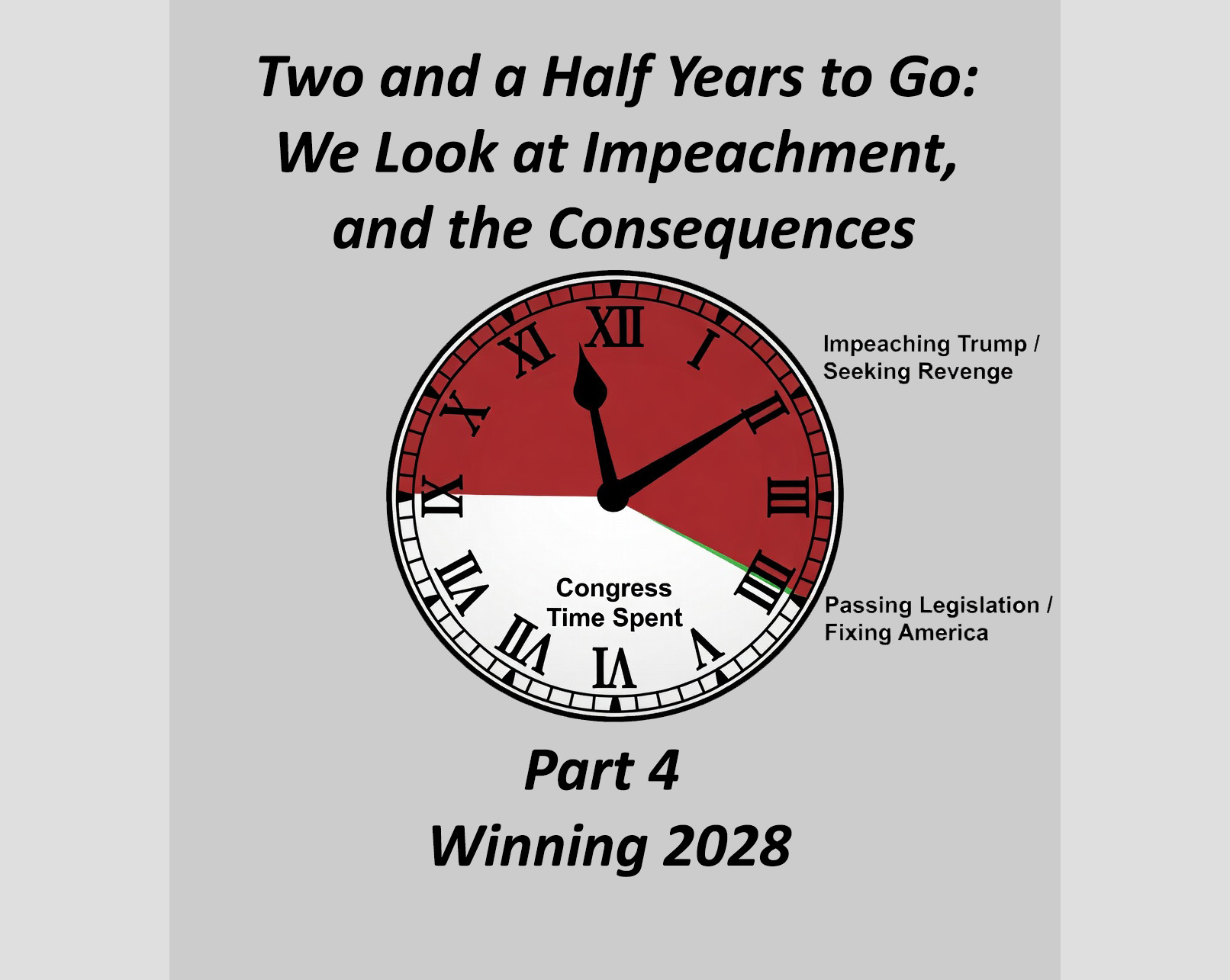
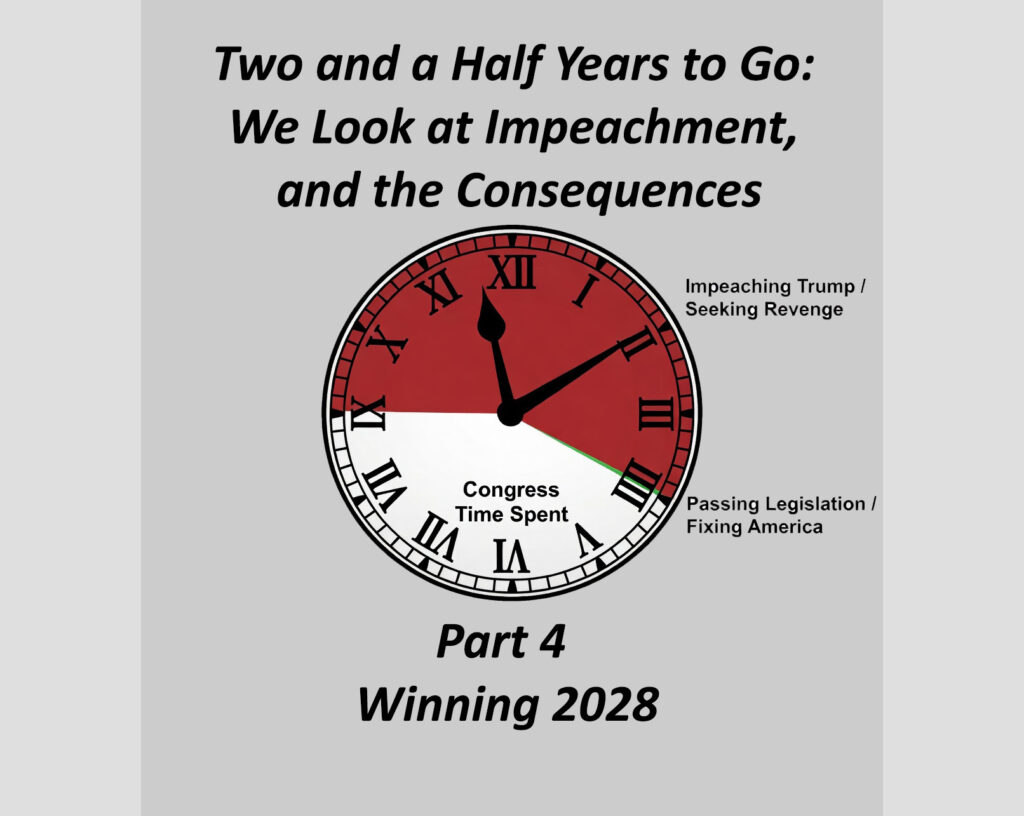
Two and a Half Years to Go: We Look at Impeachment, and the Consequences, Part 4 — Winning 2028
I’ve always been a conservative. I’ve always registered Republican. Today, I consider myself an independent with a lowercase “i.” No party. No checkbox.
For a moment, I’m going to step off my usual neutral track. My biggest disagreement has always been my distrust of Donald Trump and the hard-right MAGA movement, not the conservative Republican base generally. It seems to me that the political pendulum is going to swing left. I just don’t want it to swing wildly left. I distrust the hard left as much as I distrust the hard right.

Moderate. Remember.
So, looking toward 2028, the question becomes: who makes sense? Who can represent a country that is not neatly divided into two simple groups? Who can represent both the liberal and conservative values that exist across America?
The answer I keep coming back to is simple.
I like a team.
I think putting a team together on day one is the smart move. Not just a presidential candidate, but a governing team. Two people who complement each other, who genuinely work together, and either of whom could step into the presidency if necessary without the American people feeling anxious or uncertain about the future.
The old way, selecting one popular candidate and then having the party scramble to find a vice president who might help win a particular state or appeal to a particular voting group. is outdated. It does a disservice to the office and to the voters.
Why not build the team first?
Presidential candidates have one of the hardest jobs in America. They have to travel across a country where people have completely different needs, different economies, and different histories. What matters to a farmer in rural America may be very different from what matters to someone working in a technology center or a manufacturing community.
The president cannot personally solve every problem.
Nor should they.
What I want to hear from a candidate is something like this:
“I am here to help you solve your own problems. When you need help, the federal government will be there. But government should support people, not replace them.”
That does not mean everything belongs at the local level. Some things belong to all Americans equally. Basic education standards, protection of constitutional rights, healthcare standards, and guarantees of religious freedom are examples of responsibilities that require a national commitment.
The challenge is finding the proper balance.
That is a pretty big order. We want someone who can make every decision, solve every problem, and manage every crisis. Wait a minute, don’t we have that right now? At least the current President seems to believe that is possible.
I’m not going to spend this article discussing Trump. I only mention him to reinforce the reason I believe a team is needed. The presidency was never designed to be a one-person operation. It was designed around a system of checks, balances, advisors, and institutions.
The team should not begin after the election.
It should already exist before the election.
I started with the idea of a President and Vice President. Yes, a President and Vice President, but a Vice President that the American people would genuinely trust if they had to step into those much larger shoes. If that happened, the country should know that the same governing philosophy and agenda would continue.
We are entering an era of artificial intelligence, robotics, space exploration, and challenges that previous generations could not have imagined. Why are we still choosing executive leadership the same way we did generations ago?
Why not modernize how America chooses its executive branch?
Imagine a system where the presidential team is not simply a candidate and a running mate, but the beginning of a governing organization. After the primaries, there is still time before the general election to assemble a proposed administration. The voters would know what they were actually voting for.
The country would not lose months after an election while Congress debates and fights over cabinet selections. The vetting process would already have been underway. The American people would have a clearer understanding of who would actually be responsible for running the government.
And here is another benefit.
Yes, today we are stuck with a two-party system. Hopefully, someday that changes. But a governing team could begin moving us beyond the idea that the only qualification that matters is the letter after someone’s name.
The team leader should have the ability to select the best people for the job. Republican, Democrat, Independent, Libertarian, the question should be whether they are qualified and capable.
Today’s challenges are simply too great for one person, one party, or one ideology to solve alone.
I spent much of my career in engineering, and one lesson applies to every complex project: you do not hire one person and tell them, “Make it work.”
You assemble a team.
You identify the lead programmer, the project manager, and the people who can work together to accomplish the goal. You define the scope, the expected results, and the responsibilities before anyone starts writing code. Then you have oversight to make sure the project stays on track.
Government is the largest project any of us could ever undertake.
Yet we continue to pretend that one person can manage it all.
The president is still responsible. The buck still has to stop somewhere. But a strong team does not weaken leadership. It strengthens it.
It is time to stop playing politics and start playing government.
While we still have one.
Maybe that is the lesson America should take from the Trump years. Not simply who won or who lost, but that our system needs to adapt.
Let’s respond by building a team.
Not just a campaign team.
A governing team.
A team with a realistic agenda that can actually be accomplished, not campaign promises made from a stage two weeks before Election Day.
A team ready to govern on day one.
Share this:

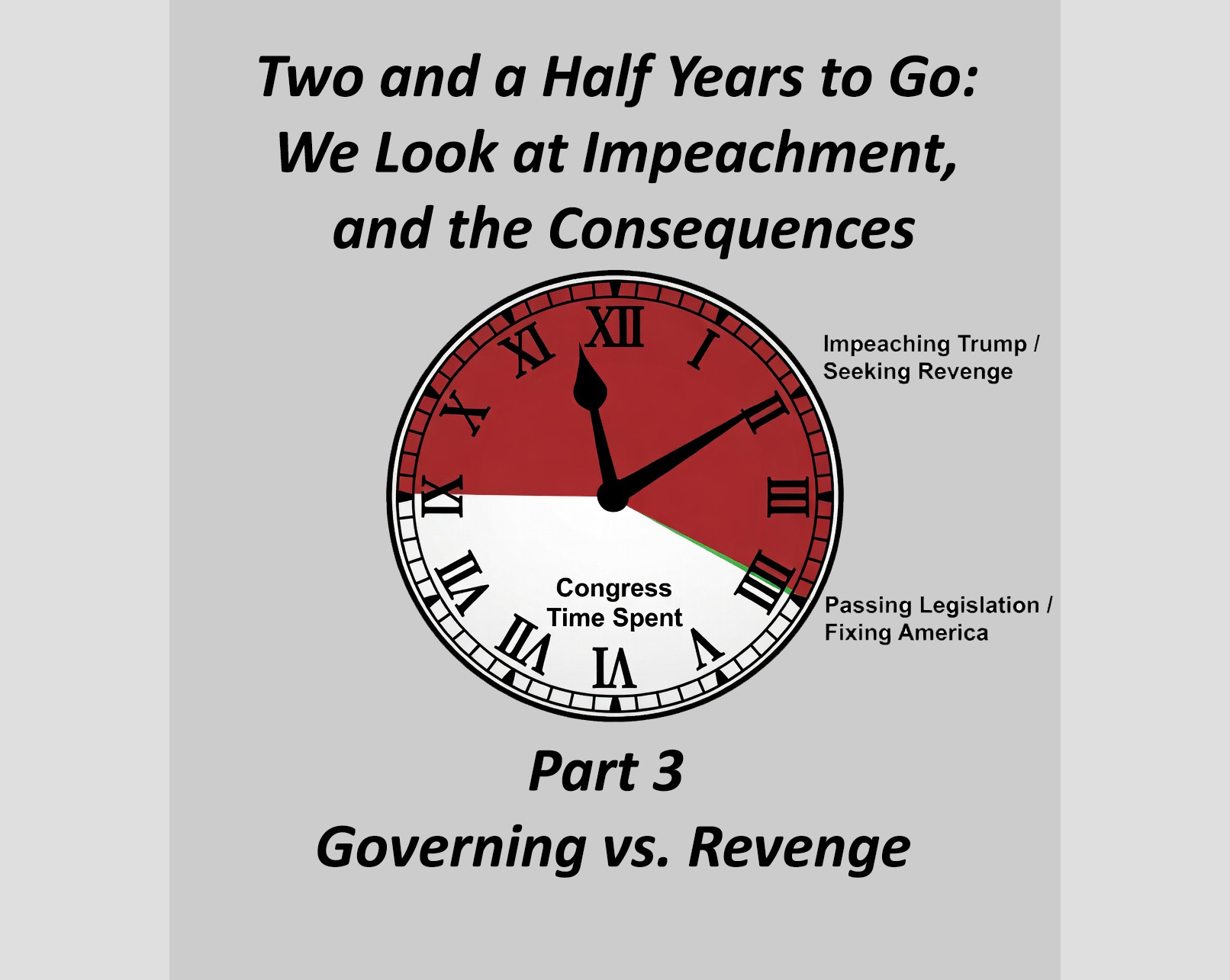
Two and a Half Years to Go: We Look at Impeachment, and the Consequences, Part 3 — Governing vs. Revenge
Two and a Half Years to Go: We Look at Impeachment, and the Consequences
Part 3 — Governing vs. Revenge
A quick caveat before we get into it. I’ll be referring to Democrats throughout, since they’re the opposing side in our two-party system and the ones midterm math points to. But I want to stress that what I actually want is moderation, a meeting of minds and policies considerate of the needs of the citizens of the United States, not the desires of individual politicians. I know that’s asking a lot. But miracles have been known to happen. Right, Santa?

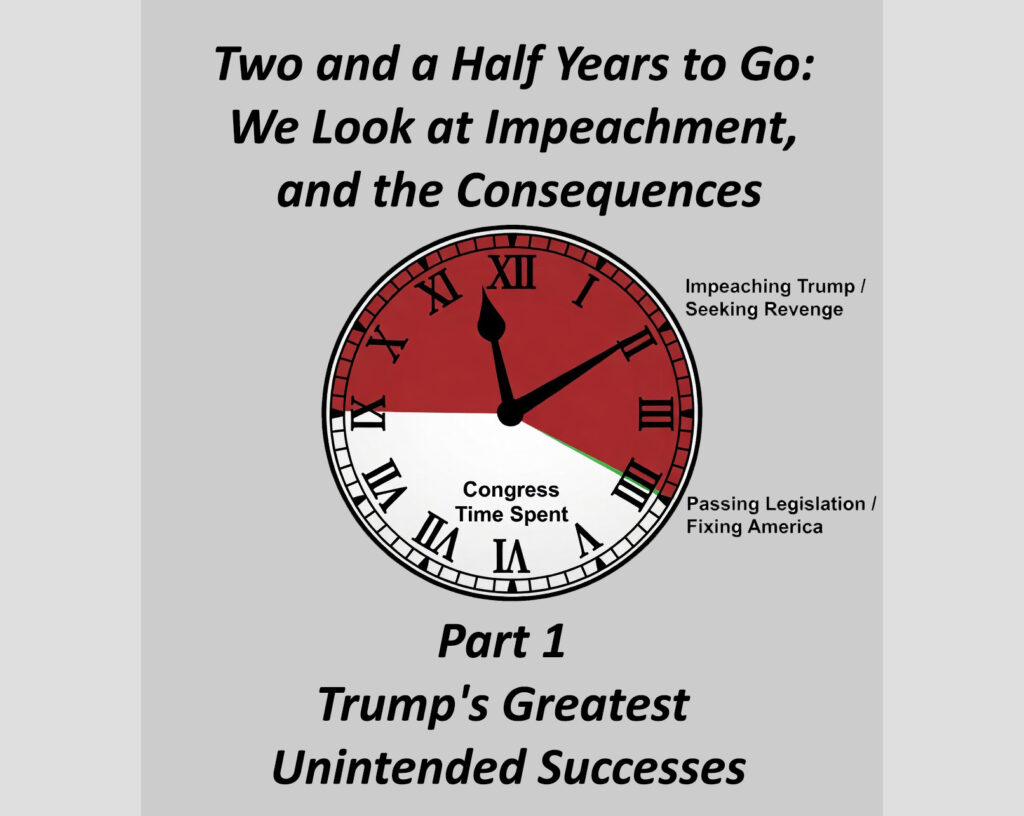
Assuming Democrats take control of Congress come the midterms, and all signs point to it, here’s the real question: do we spend two years re-litigating the last four, or do we spend it fixing what’s broken?
I don’t believe we can do both well.
It doesn’t take much to understand why. First, we’ll have a wave of new senators and representatives who need to come up to speed on how Congress actually functions, which, given the last few years, may be a skill some incumbents could stand to relearn too. Second, we need Congress to actually show up and do the job we pay them for. For an average salary of $175,000 a year, I think it’s fair to expect something in return. I don’t get paid a dime for writing this.
Once they’re back, the first order of business shouldn’t be revenge, it should be reinstating the services that were stripped away, especially the ones targeted by political demographics. Government is supposed to be for the people, by the people. Not for settling scores.
Instead of revenge, they need to re-establish responsible government. That means securing elections the way they’re supposed to be secured, by the states, not by an authoritarian federal hand. And speaking of authoritarian government, Congress has until 2028 to start rebuilding real limitations on the executive branch. Because we don’t want a Democrat dictator any more than we want a MAGA or Republican one. And yes, I consider MAGA a separate party that hijacked the Republican one, you’re welcome to your own interpretation.
Congress will have to actually work, maybe for the first time in decades. There’s plenty to fix. Healthcare reform can’t wait another ten years. Veterans are waiting on help that “eventually” doesn’t solve. Immigration isn’t a padlock and a skin-tone test. And then there’s the budget, where do you even start. My foundation series touched on AI taxation as a possible short-term bridge, not a full answer, but a bridge is more than we have now, and we need actual answers.
What we don’t need is a Congress that spends its time impeaching a lame-duck president. He can be sued and held accountable after he’s out in 2028. In the meantime, he’s already been mostly neutered, we’ll still have to endure the tweets and the executive orders, but we could always install a shredder to make government a little more efficient.
That doesn’t mean no accountability. There should still be real oversight, reinstate the Inspectors General, put them back under Congress’s control, and let them do their jobs. Oversight isn’t revenge. Revenge is spending two years trying to erase a president instead of one day trying to fix what he broke.
So: what do you want? Revenge, or results?
And if Democrats actually want to win in 2028 — what story do they want to be able to tell?
Part 3 — Governing vs. Revenge
—
**Two and a Half Years to Go: We Look at Impeachment, and the Consequences**
Part 1 — Trump’s Greatest Unintended Successes
Part 2 — The Impeachment Trap
Part 3 — Governing vs. Revenge
Part 4 — Winning 2028

Share this:

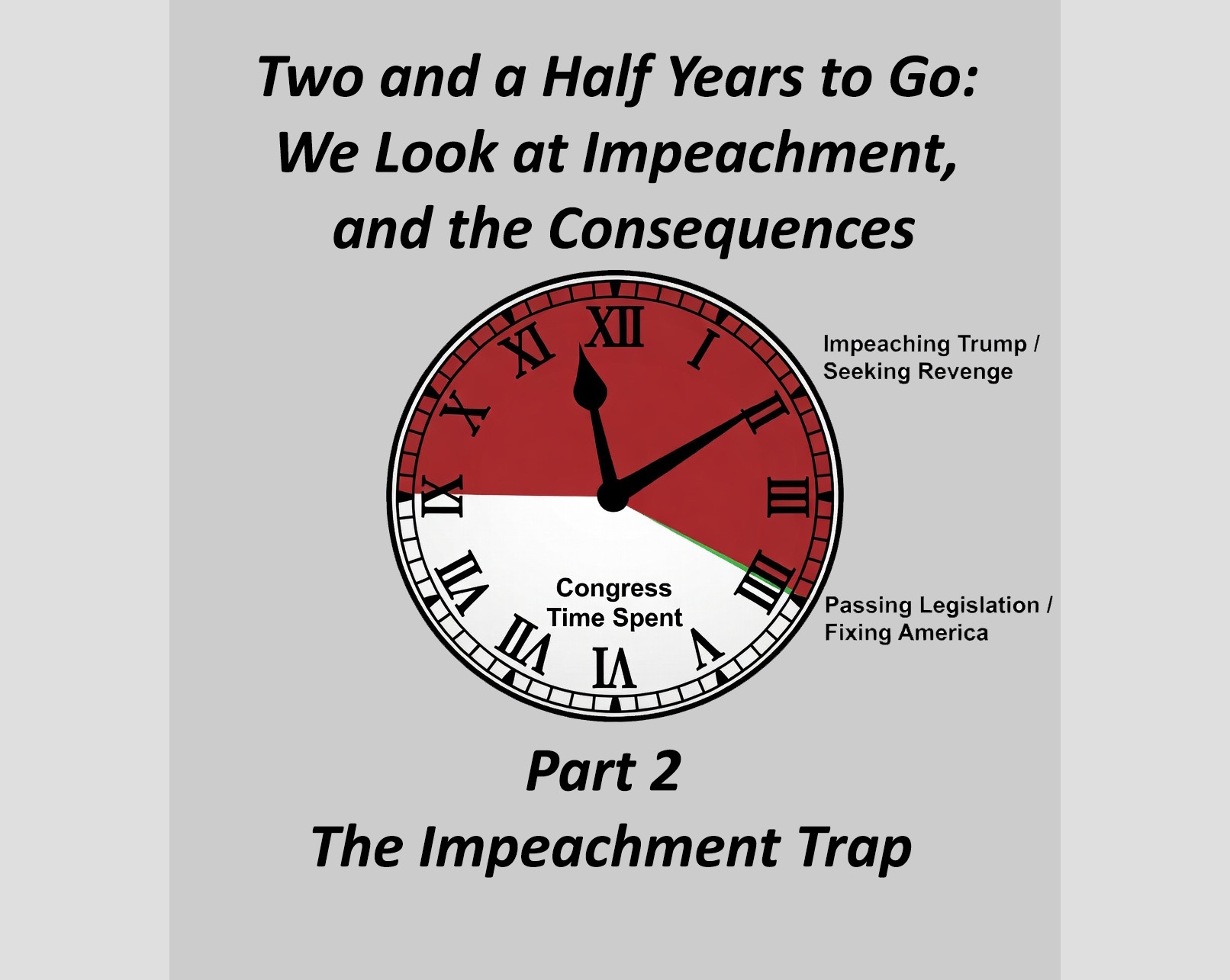
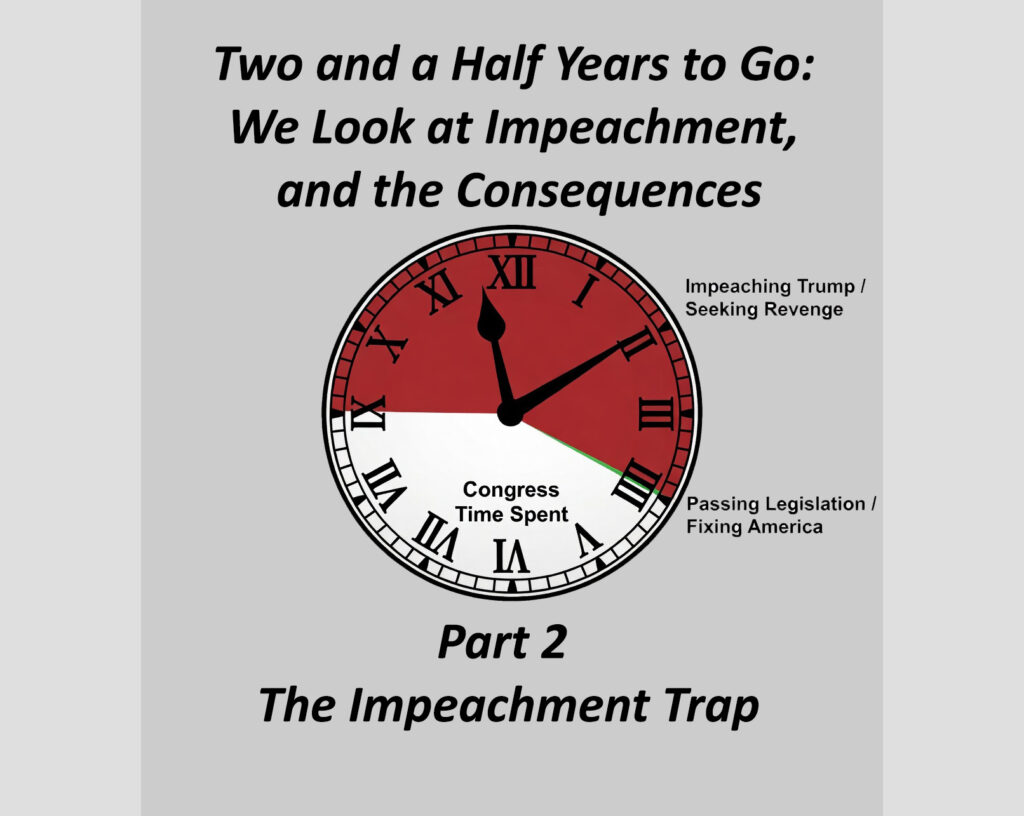
Two and a Half Years to Go: We Look at Impeachment, and the Consequences, Part 2 — The Impeachment Trap
What if impeachment hands the presidency to someone even more effective?
If Donald Trump were impeached and removed from office, there would be no special election and no national debate over his replacement. Under the Constitution, Vice President JD Vance would become President.

For many Trump critics, that may sound like a victory. But before celebrating, it’s worth asking a simple question:
Would that actually improve the political landscape, or make it more difficult?
My personal opinion is no secret. I don’t trust JD Vance, and I wouldn’t vote for him. But this article isn’t about whether I like him or dislike him. It’s about the political consequences of making him President.
History shows that incumbency is a significant advantage in American politics. A sitting president has the visibility of the office, the ability to shape the national conversation, and the support that comes from leading a major political party. Any discussion of impeachment has to include that reality.
That advantage may be even greater today.
On June 30, 2026, the U.S. Supreme Court ruled in National Republican Senatorial Committee v. Federal Election Commission, striking down long-standing limits on coordinated campaign spending between political parties and candidates. Supporters hailed the decision as a victory for political speech under the First Amendment. Critics argued that it further increased the influence of large donors and wealthy interests in federal elections.
Whatever one’s opinion of the ruling, its practical effect is clear: political parties now have greater freedom to coordinate and spend money on behalf of their candidates.
If JD Vance became President through impeachment, he would enter the 2028 campaign not only as the incumbent but also with the full advantages of that office and a Republican Party operating under a more permissive campaign finance system.
That doesn’t guarantee victory. Elections are never guaranteed. But it would give him advantages he otherwise would not have enjoyed.
This is why I question whether impeachment is the best strategy.
If the objective is simply to remove Donald Trump from office, impeachment succeeds. But if the objective is to change the direction of the country, the answer is less obvious. Replacing Trump with a younger, quieter, and potentially more disciplined Republican president may ultimately strengthen the very political movement opponents hope to defeat.
Congress has another option.
If voters change control of the House or Senate in the midterm elections, Congress can investigate, provide oversight, control spending, and act as the constitutional check the Framers intended, without creating a new incumbent for the next presidential election.
The strategic question, then, is not whether Donald Trump deserves impeachment. Others will debate that.
The question is whether impeachment today makes winning in 2028 easier—or harder.
Part 2 — The Impeachment Trap
—
**Two and a Half Years to Go: We Look at Impeachment, and the Consequences**
Part 1 — Trump’s Greatest Unintended Successes
Part 2 — The Impeachment Trap
Part 3 — Governing vs. Revenge
Part 4 — Winning 2028
Share this:

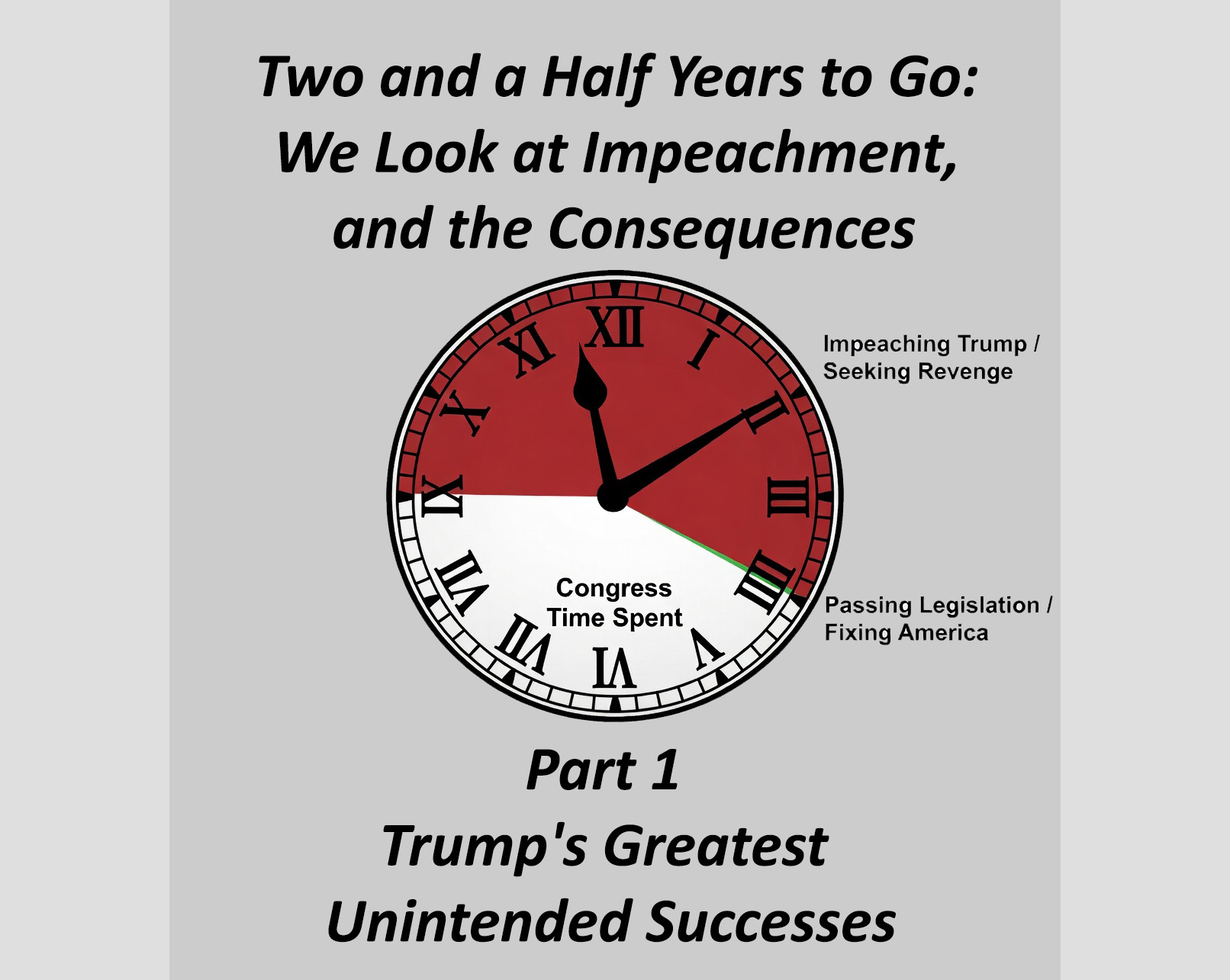
Two and a Half Years to Go: We Look at Impeachment, and the Consequences, Part 1 — Trump’s Greatest Unintended Successes
Two and a Half Years to Go: We Look at Impeachment, and the Consequences
Part 1 — Trump’s Greatest Unintended Successes
Believe it or not, some of Donald Trump’s biggest successes haven’t benefited America at all. They’ve benefited America’s allies.

Not because he wanted to — because he tried to bend them to his will, and it backfired. Exhibit A is our closest friend and neighbor, Canada. Canada and the U.S. always had a trade relationship that tilted toward America, but Canada got its share too, like a little brother getting big brother’s leftovers, but also big brother’s protection.
That ended with two things: Donald Trump’s poorly thought out, and illegal, tariff policy, and the rise of a Canadian banker named Mark Carney. Suddenly both countries had a non-politician in charge, one a con man, the other a banker. The banker saw through the con, and the north and south settled into a whiskey war. Funny thing is, you can still buy Canadian whiskey down here, they’re the ones who pulled the Kentucky and Tennessee stuff off their shelves. And where did all the good maple syrup go? My pancakes just aren’t the same with Aunt Jemima.
Long story short, Canadians stopped coming south as tourists, there went the tourist trade in Seattle and up the Eastern Seaboard. But hold on, you say, Americans are still going to Canada. Sure. And while we’re up there, Trump, ever wonder where the electricity keeping Melania’s Penthouse warm actually comes from? The Northeast leans hard on Quebec and Ontario for hydro and nuclear power.
But that’s just window dressing. Here’s what Canada has actually done because of Trump’s policies: they’re building pipelines east to west instead of south, so they can sell oil to other nations instead of us. They’ve brokered better deals to sell steel and aluminum overseas, so they’re no longer dependent on U.S. buyers. Beer lovers take note, bottles only now. Their national security alliances are shifting too: submarines from Germany, outfitted with electronics and systems no longer tied into U.S. military networks. Fighter jets from Sweden’s Saab instead of Boeing and Lockheed.
And Trump is countering the Boeing losses by making deals with China. China? That’s our supreme deal-maker, working with a deck of 47 cards.
So here’s the point: when the United States became an unreliable partner, other democracies adapted. Canada diversified its trade. Canada built out east-west energy. Canada started buying from Europe. Canada strengthened its own manufacturing.
How’s that tariff thing going, by the way? I keep getting Super PAC emails from Trump asking if I want my “cut” of the tariffs he’s collected, the same funds he’s been ordered to return. All it’ll cost me is another fifty-dollar contribution and a thank-you-sucker.
But back to the good things Trump has accomplished.
**China.** Trump’s big trade war tariffs on China were meant to punish, punish and get revenge, because apparently “negotiate” wasn’t in the playbook. He wanted to win the war, bring jobs back to the U.S., and massively redirect global supply chains. Problem is, when you don’t have the infrastructure to back that up, you lose and someone else wins. Vietnam was the big winner. We were the big weiner.
Companies didn’t fully reshore to the U.S. they moved to lower-tariff countries, and Vietnam’s exports to us boomed in electronics, apparel, furniture, and more. Vietnam overtook China outright in categories like laptops and game consoles, and Chinese firms started assembling there themselves just to dodge the tariffs. That accelerated Vietnam’s industrialization, its foreign investment, its whole economy. Malaysia, Thailand, India, and Mexico picked up similar gains. And don’t forget, Trump still has to pay back all those illegal tariffs he collected. From us. Not them. Us.
Trump’s bullying of China created a “China+1” strategy that supercharged the competition. Vietnam and the rest became more attractive manufacturing hubs, less dependent on any single partner, while we got higher consumer prices and disrupted supply chains instead of a manufacturing renaissance.
**NATO and the allies.** When America weaponized trade, everybody else built new networks. Trump spent years calling NATO allies freeloaders, threatening to withhold protection, demanding they pay up. So they did, Poland, the Baltics, and the rest of Europe ramped up defense budgets, bought new equipment, built up their own capability.
The backfire: less dependence on U.S. security guarantees, and a boost for European defense industries as countries looked to intra-European or non-U.S. suppliers. Trump accelerated Europe’s push toward “strategic autonomy”, joint European fighter and missile-defense programs that don’t have a single American bolt in them. The allies did exactly what he demanded, spent more on their own defense, and in doing so became less beholden to us long-term. Same story as Canada: squeeze an ally hard enough, and it doesn’t collapse, it just stops needing you.
**Climate.** Trump’s exit from the Paris Agreement and his general disdain for multilateral deals left a leadership vacuum. The EU stepped into it, advancing its own Green Deal and slapping carbon tariffs on imports from countries that won’t clean up their act, a tax that hits American exporters right along with everyone else. China, ever the self-interested opportunist, positioned itself as the champion of global climate cooperation, and now sells the world the solar panels and batteries America decided it didn’t need to build. Same pattern, third time: we walked away from the table, and somebody else picked up the check and the leverage that came with it.
So where does that leave us? Still a powerful country, but no longer the feared superpower we once were. Little Iran even took a title away from us at the Strait of Hormuz.
So what has Trump actually accomplished in his second term, grand old 47? He’s out to dominate the world, not king, but world emperor, and what he’s getting back is a redesigned world that feels increasingly comfortable telling him to bugger off. From a global point of view, good going, Donald. Maybe we should keep you in office a bit longer.
Canada didn’t fall apart when the ground shifted under it. It adapted. Neither did NATO. Neither did the EU. Worth remembering that, we’ll come back to it before this series is done.
—
**Two and a Half Years to Go: We Look at Impeachment, and the Consequences**
Part 1 — Trump’s Greatest Unintended Successes
Part 2 — The Impeachment Trap
Part 3 — Governing vs. Revenge
Part 4 — Winning 2028
Share this:

Impeach Him, Impeach Him, Well Maybe we Hold Off On That – Piece 2: Why Not Impeaching Might Be the Smarter Move
Come the midterms, I’m pretty sure the Democrats gain control, good chance both houses, and then it’s impeachment time, right? Right? Right?
Well, here’s the thing. Yes, it could be impeachment time. But should it be? Big question. Very big question.
Until the midterms, unless Trump really alienates his own MAGA Congress, all the Democrats can do is make a bunch of noise. And, well, make a bunch of noise. I subscribe to a lot of Substack writers, left-leaning and right-leaning both, and every single one is “look what he did today, that’s an impeachable offense”, and then nothing happens the next day. Day after day. For the past year. It’ll make you crazy.
Worse are the attorneys, spouting law, and still, day after day, nothing happens. Trump himself said his power is absolute until proven otherwise. Well. Will somebody actually prove it?
So let’s say the Democrats get both houses. What do you actually want them doing with the two years left in Trump’s term? Because here’s the thing, they can effectively neuter him without impeachment. Block what needs blocking. Take back the power of Congress that’s been ceded to him. Maybe even set things up to take the whole Trump organization and family to court once he’s out of office, seize the stolen assets, put the stolen loot back in the Treasury. Maybe that’s just a daydream, and he really is a benevolent old grandfather. But the point stands: they might accomplish more against Trump’s financial dealings by not impeaching him on day one than by spending two years trying to.
And here’s the most important part, though some might argue it should’ve come first. There will be two years in which Congress actually has to work at setting things right, instead of mimicking King Trump and his revenge tour. They can focus on budgets, oversight, healthcare, immigration, veterans, election reform, all while conducting investigations. That gives them a real record to run on in 2028. Maybe even something they can say at a town hall that earns them a basket of tomatoes still in the basket, instead of one thrown at them.
Congress can keep Trump off balance for two years and, in the process, show the country what a functioning government actually looks like. Limit future presidential power while they’re at it.
You wouldn’t be running a candidate against the sitting president in 2028, you’d be running against a legacy. Vance may be on the ticket, but he won’t be the incumbent, and he’ll face real opposition from inside his own party, whatever that party even is by then. MAGA, MAGA 2.0, or Vance quietly rebranding himself as someone who was a Republican all along, working from the inside, Benedict Vance, unless Rubio beats him to it.
So: to impeach, or not to impeach. Maybe that’s the question we put to Congress before they decide it on their own. After all, they work for us.
This is just a prelude to an upcoming 4 part series on what’s to gain by impeachment and what’s to gain by NOT impeaching Trump. It’s not an easy decision, especially if we want actual Government, Not REVENGE tactics.
Share this:

Impeach Him, Impeach Him, Well Maybe we Hold Off On That – Piece 1: The Vance Problem – Video
Since Trump took office as the 47th, whoopee, all I keep hearing is impeach him, he did this, impeach him, he did that, impeach him. And if I’d been critical while looking through that looking glass into the past, who knows, I might have been one of those saying it too.
So let me start with my confession. I don’t like the man. I didn’t vote for him. Although, in all honesty, I didn’t vote for Harris either. Do I want to see Trump gone? Darn tootin’. So badly that sometimes I gaze with adoring eyes at the liquor store.
Now why tell you that? Because this piece isn’t the one you’re expecting. This one’s about why maybe not impeaching Trump is the smarter chess move. Yes, you heard that right.
=======================================================
And here’s the part that should worry you most if you’re thinking ahead to 2028. Impeach Trump now, and Vance spends two years as the sitting president. incumbent, name recognition, the power of the office behind him going into that election. That’s a much harder man to beat than a former vice president running as a candidate, still needing to win his own party’s nomination, still facing real opposition from inside a party that isn’t even sure what it is by then. MAGA, MAGA 2.0, or Vance quietly rebranding himself as someone who was a Republican all along, working from the inside. Benedict Vance, unless Rubio beats him to it.
You don’t hand him the incumbency for free. You make him earn it.

Share this:

Impeach Him, Impeach Him, Well Maybe we Hold Off On That – Piece 1: The Vance Problem
Since Trump took office as the 47th, whoopee, all I keep hearing is impeach him, he did this, impeach him, he did that, impeach him. And if I’d been critical while looking through that looking glass into the past, who knows, I might have been one of those saying it too.
So let me start with my confession. I don’t like the man. I didn’t vote for him. Although, in all honesty, I didn’t vote for Harris either. Do I want to see Trump gone? Darn tootin’. So badly that sometimes I gaze with adoring eyes at the liquor store.
Now why tell you that? Because this piece isn’t the one you’re expecting. This one’s about why maybe not impeaching Trump is the smarter chess move. Yes, you heard that right.
There are actually a few things he’s done that have worked out for the best. Take Canada. Hey, I didn’t say worked out best for us. Canada’s been forced to grow up, no longer dependent on the good old USA, they had to go find new trade partners, and from what I’ve read, they’ve done a bang-up job of it. Fighter jet contracts with Saab instead of Boeing. Submarine contracts with Germany. New alliances. An oil pipeline running east to west instead of south to us. By the time this is over, Trump will have inadvertently become their best friend, while hurting the hell out of us financially and damaging our national security. But heck, who’s paying attention to the little stuff.
I just wanted to say one nice thing about the Very, Very Old Boy before I get to the part that keeps me up at night.
Here’s the elephant in the room. Yes, the MAGA elephant. Impeach Trump, and who becomes president? Mini Trump. Not just mini Trump, an educated mini Trump. Which, if you’re a middle-of-the-road type like me, might be far more dangerous. I’ll skip the couch humor. Here’s why: he won’t be up all night tweeting his grievances. He won’t be broadcasting every plan before he’s made it. And he’ll have inherited Trump’s superpowers, courtesy of the idiots on the Supreme Court. And he knows it.
If you’re MAGA, rejoice. If you’re a Republican, well, you’re a RINO again. If you’re an Independent, the majority, the 45% plus of us, a moderate Democrat or a not-so-moderate one, in my opinion, you can kiss democracy goodbye. Because it won’t go quietly with gilded monuments to his own greatness. It’ll go quietly with the blessings and financial backing of the Super PACs, the Federalist Society, the super-rich, the oligarchs. They don’t want a democracy. It limits their power. And they will not be loud about taking it.
That’s the Vance problem. Not that he’s Trump’s successor. That he’s Trump with the volume turned down and have the power already installed.
And here’s the part that should worry you most if you’re thinking ahead to 2028. Impeach Trump now, and Vance spends two years as the sitting president. incumbent, name recognition, the power of the office behind him going into that election. That’s a much harder man to beat than a former vice president running as a candidate, still needing to win his own party’s nomination, still facing real opposition from inside a party that isn’t even sure what it is by then. MAGA, MAGA 2.0, or Vance quietly rebranding himself as someone who was a Republican all along, working from the inside. Benedict Vance, unless Rubio beats him to it.
You don’t hand him the incumbency for free. You make him earn it.

Impeach Him, Impeach Him, Well Maybe we Hold Off On That – Piece 2: Why Not Impeaching Might Be the Smarter Move – Video
Come the midterms, I’m pretty sure the Democrats gain control, good chance both houses, and then it’s impeachment time, right? Right? Right?
Well, here’s the thing. Yes, it could be impeachment time. But should it be? Big question. Very big question.
Until the midterms, unless Trump really alienates his own MAGA Congress, all the Democrats can do is make a bunch of noise. And, well, make a bunch of noise. I subscribe to a lot of Substack writers, left-leaning and right-leaning both, and every single one is “look what he did today, that’s an impeachable offense”, and then nothing happens the next day. Day after day. For the past year. It’ll make you crazy.
Worse are the attorneys, spouting law, and still, day after day, nothing happens. Trump himself said his power is absolute until proven otherwise. Well. Will somebody actually prove it?
======================================
You wouldn’t be running a candidate against the sitting president in 2028, you’d be running against a legacy. Vance may be on the ticket, but he won’t be the incumbent, and he’ll face real opposition from inside his own party, whatever that party even is by then. MAGA, MAGA 2.0, or Vance quietly rebranding himself as someone who was a Republican all along, working from the inside, Benedict Vance, unless Rubio beats him to it.
So: to impeach, or not to impeach. Maybe that’s the question we put to Congress before they decide it on their own. After all, they work for us.
This is just a prelude to an upcoming 4 part series on what’s to gain by impeachment and what’s to gain by NOT impeaching Trump. It’s not an easy decision, especially if we want actual Government, Not REVENGE tactics.
Share this:
Like this: