What if impeachment hands the presidency to someone even more effective?
If Donald Trump were impeached and removed from office, there would be no special election and no national debate over his replacement. Under the Constitution, Vice President JD Vance would become President.
For many Trump critics, that may sound like a victory. But before celebrating, it’s worth asking a simple question:
Would that actually improve the political landscape, or make it more difficult?
My personal opinion is no secret. I don’t trust JD Vance, and I wouldn’t vote for him. But this article isn’t about whether I like him or dislike him. It’s about the political consequences of making him President.
History shows that incumbency is a significant advantage in American politics. A sitting president has the visibility of the office, the ability to shape the national conversation, and the support that comes from leading a major political party. Any discussion of impeachment has to include that reality.
That advantage may be even greater today.
On June 30, 2026, the U.S. Supreme Court ruled in National Republican Senatorial Committee v. Federal Election Commission, striking down long-standing limits on coordinated campaign spending between political parties and candidates. Supporters hailed the decision as a victory for political speech under the First Amendment. Critics argued that it further increased the influence of large donors and wealthy interests in federal elections.
Whatever one’s opinion of the ruling, its practical effect is clear: political parties now have greater freedom to coordinate and spend money on behalf of their candidates.
If JD Vance became President through impeachment, he would enter the 2028 campaign not only as the incumbent but also with the full advantages of that office and a Republican Party operating under a more permissive campaign finance system.
That doesn’t guarantee victory. Elections are never guaranteed. But it would give him advantages he otherwise would not have enjoyed.
This is why I question whether impeachment is the best strategy.
If the objective is simply to remove Donald Trump from office, impeachment succeeds. But if the objective is to change the direction of the country, the answer is less obvious. Replacing Trump with a younger, quieter, and potentially more disciplined Republican president may ultimately strengthen the very political movement opponents hope to defeat.
Congress has another option.
If voters change control of the House or Senate in the midterm elections, Congress can investigate, provide oversight, control spending, and act as the constitutional check the Framers intended, without creating a new incumbent for the next presidential election.
The strategic question, then, is not whether Donald Trump deserves impeachment. Others will debate that.
The question is whether impeachment today makes winning in 2028 easier—or harder.
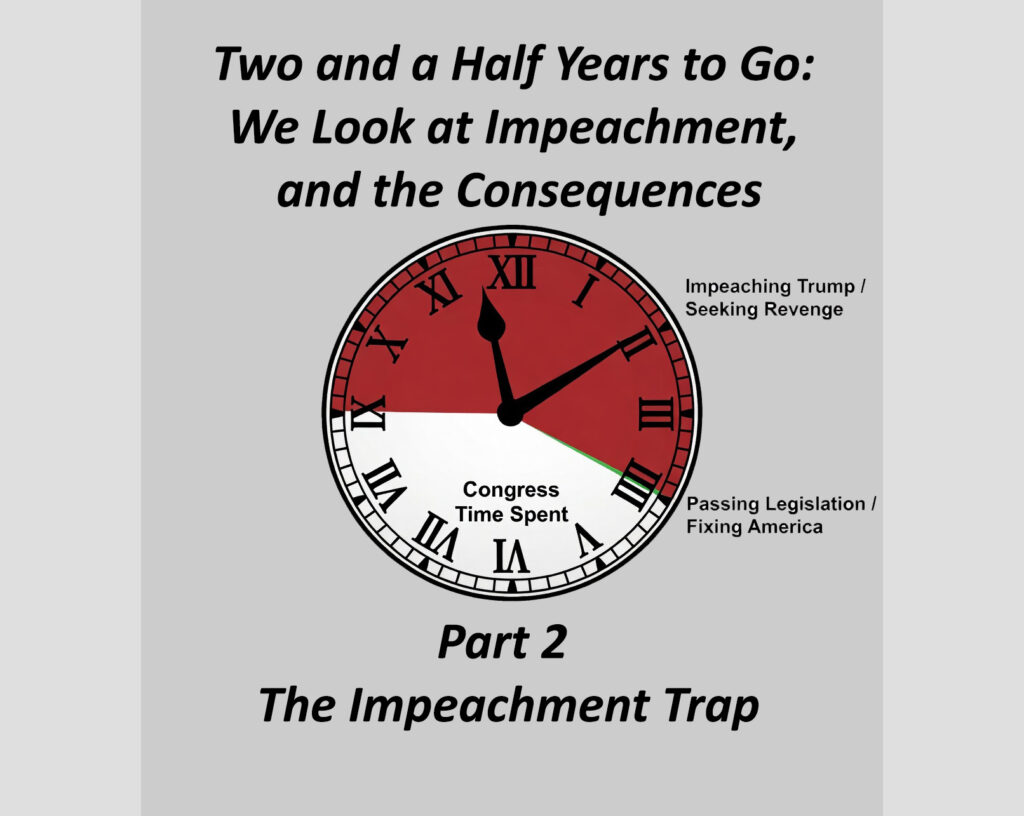
Part 2 — The Impeachment Trap
—
**Two and a Half Years to Go: We Look at Impeachment, and the Consequences**
Part 1 — Trump’s Greatest Unintended Successes
Part 2 — The Impeachment Trap
Part 3 — Governing vs. Revenge
Part 4 — Winning 2028


Comments are Disabled