Promises and Prescriptions: The Reality of Veterans' Healthcare in Trump's Second Term
/
RSS Feed
Share
Link
Embed
Veterans’ healthcare has always been a sacred pledge — a promise exchanged for sacrifice. But in Donald Trump’s second term, that promise is being reshaped, repackaged, and, in some cases, quietly outsourced.
Trump’s rhetoric remains bold: “No one has done more for veterans than me.” But behind the slogans, a different reality unfolds — particularly for those living in rural America, where access to quality care is already a logistical challenge. Under the guise of “freedom of choice,” the Trump administration has accelerated a shift toward privatization, outsourcing more care to the private sector. That sounds good — until you realize that for many veterans, especially in underserved regions, it means longer waits, fewer specialists, and an increased reliance on providers who don’t fully understand the VA system or military-related conditions.
The expanded use of private clinics through the VA Mission Act (initially passed in 2018 but dramatically expanded during Trump’s second term) has created what critics call a “two-tiered system.” The best care remains in VA hospitals, but the funding and resources are quietly being drained away — diverted to private providers whose oversight is looser and whose outcomes vary.
Rural veterans — those who arguably need the most consistent and integrated care — now face a fractured healthcare network. Many have to drive hours, not to the nearest VA hospital, but to a private clinic that may or may not accept them. If they don’t like the care? Tough. The much-touted “choice” is often an illusion.
Meanwhile, Trump’s political allies paint the issue in black-and-white terms: government care bad, private market good. But this ignores a fundamental truth — the VA system, for all its flaws, was built to treat the unique health challenges of veterans: PTSD, burn pit exposure, prosthetics, military sexual trauma. These aren’t routine ailments, and generic civilian care doesn’t cut it.
To make matters worse, partisan messaging has drowned out nuance. Anyone who criticizes the shift is branded as “anti-veteran.” But if honoring veterans means more than applause at rallies, we must ask: what kind of system are we building, and for whom?
Ironically, some of the loudest voices calling for the privatization of the VA have never served. And some of the most outspoken defenders of the VA — doctors, nurses, and veterans themselves — are struggling to be heard above the political noise.
In Trump’s second term, the battle for veterans’ healthcare isn’t just about clinics and co-pays. It’s about priorities. Do we value loyalty to slogans, or loyalty to those who served? Do we want a healthcare system that rewards political donors, or one that keeps its promise to the people who wore the uniform?
Veterans didn’t ask for this ideological experiment. They asked for care, dignity, and respect. It’s time we deliver.
Gerrymandering: The Fire Trump Lit—and Why Everyone’s Getting Burned
/
RSS Feed
Share
Link
Embed
In a democracy, voters are supposed to choose their leaders. But once again, in 2025, Donald Trump has flipped that idea on its head—this time by pressuring Texas Republicans to redraw their congressional map mid-decade. Not because the population changed. Not because there was a court order. But because they saw a political opportunity.
The new Texas map, rammed through under Trump’s influence, would give Republicans nearly 80% of the state’s congressional seats—even though they win just over half the vote. This isn’t just a tilt; it’s a landslide created by slicing up Democratic communities, particularly Black and Latino districts, and burying their votes under carefully carved boundaries. It’s called gerrymandering, and Trump’s making it an art form.
Naturally, it didn’t stop there. Democrats—especially in California and New York—are now gearing up to respond in kind. California Governor Gavin Newsom has already signaled that if Texas wants to play dirty, California’s ready to fight fire with fire. And suddenly, the very people who pioneered this game—Trump’s MAGA base—are screaming foul.
That’s the hypocrisy of the moment. After more than a decade of Republican-led redistricting across states like North Carolina, Wisconsin, and Ohio, Trump has simply escalated the tactic to a new level. And now that Democratic states are considering similar power plays, the cries of “unfair” from the GOP ring hollow.
But let’s be clear: this isn’t a win for either party. It’s a loss for the country. Gerrymandering erodes the principle of one person, one vote. It rigs the game before it starts. And when both sides begin weaponizing redistricting, we move further away from representative government and deeper into partisan trench warfare.
This isn’t about balance—it’s about manipulation. And the more we normalize it, the more we teach future leaders that power matters more than process, and winning matters more than fairness.
So yes, Trump lit the fire. But now it’s spreading. And unless we find the courage to put partisan advantage aside and restore independent redistricting across all states, we’ll all be standing in the ashes—wondering when democracy burned down.
Politicization of Economic Data. When it sounds too good to be True, it Usually Is
/
RSS Feed
Share
Link
Embed
Firing of the Bureau of Labor Statistics Commissioner
On August 2, 2025, Trump abruptly dismissed Erika McEntarfer, commissioner of the Bureau of Labor Statistics (BLS), after a jobs report showing slow employment growth. He accused her of fabricating data without evidence—a claim widely condemned by economists and former officials who argue this politicization could seriously undermine faith in U.S. economic statistics and market stability. Experts warned such actions risk eroding credibility in one of the world’s most respected data agencies
Below we get into more specific areas of how The Trump Administration is falseifing economic data. A feel good tactic for the Loyalist and a way to hide correct data for everyone else. Investing for our future and budgeting for today is impossible when the TRUTH is hidden, and the LIES are the only barometer we have to ‘depend’ upon.
1. Labor‐Market Statistics (BLS Reports)
What’s changing?
The BLS’s monthly employment and unemployment figures—long regarded as nonpartisan—are now subject to leadership appointments based on political loyalty rather than technical expertise. Surveys that underlie these reports already suffer from declining response rates (down from ~82% to 57.6%), increasing volatility and revisions in the headline numbers .
Threats:
Erosion of credibility in one of the world’s most trusted labor‐market gauges, which companies and policymakers rely on for hiring and rate‐setting decisions .
Heightened market volatility, as investors demand larger risk premiums to compensate for “flawed instrument panels” when interpreting jobs data .
The BLS also compiles the Consumer Price Index and Producer Price Index—benchmarks for cost‐of‐living adjustments, Federal Reserve inflation targets, and Social Security benefits. Staffing cuts and budget shortfalls have already forced the BLS to scale back data collection, relying more heavily on statistical models rather than fresh survey information .
Threats:
Misleading inflation signals, which could delay or accelerate interest‐rate changes inappropriately, risking either unnecessary tightening (stoking recession) or easy money (fueling runaway prices).
Undermined public trust in price‐stability measures, potentially spurring “second‐order” effects like wage‐price spirals if workers and businesses doubt official CPI figures.
3. Federal Reserve Governance
What’s changing?
By publicly disparaging Fed Chair Jerome Powell and engineering board vacancies (e.g., the recent resignation of Governor Adriana Kugler), the administration is seeking a more “rate‐cut‐friendly” leadership team .
Threats:
Compromised central‐bank independence, which is crucial to anchoring inflation expectations. If markets believe the Fed must defer to political pressures, long-term borrowing costs rise and the U.S. dollar’s reserve‐currency status could weaken .
4. National Accounts & Trade Data
What’s changing?
While less visible, the Commerce Department’s Bureau of Economic Analysis (GDP, trade balances) and Census Bureau (manufacturing, retail data) could face similar leadership swaps or budget assaults, tilting headline growth and trade‐deficit figures to suit political narratives.
Threats:
Distorted growth metrics, making it harder to gauge the true health of the economy and leading to ill-informed fiscal and monetary policies.
Diplomatic friction, if “adjusted” trade stats are used to justify tariff escalations, it could fuel international legal disputes and market dislocations.
Bottom Line
Political control over these data channels risks undermining the bedrock of policy and market decision‐making. Without reliable, transparent statistics:
Investors face murkier risk assessments.
Policymakers lose their compass for calibrating interest rates and fiscal stimulus.
The public may come to distrust not just one agency but the entire system of U.S. governance.
Restoring trust will require both technical fixes (e.g., adequate funding, survey improvements) and institutional safeguards (statutory protections for data‐agency independence), lest the U.S. slide toward the very instability past cases in Greece, Argentina, and elsewhere have shown.
When power resides in one man, and one man alone, you might as well bend over and say goodbye. Jerome Powell isn’t one man giving orders, he is the front man for a board that evaluates the economy and then sets interest rates. Trump want to be in charge of everything and is destroying America in the process.
Your voice does count and is heard. It may sound weak and small by it’s self, but when it joines 10 thousand voices, it starts to demand attention. Get the picture?
Canceled Kennedy Center Shows, 1st 6 months of Trump Taking the Center Over.
/
RSS Feed
Share
Link
Embed
Since President Donald Trump took over as chairman of the John F. Kennedy Center for the Performing Arts in February 2025, at least 26 shows have been canceled or postponed, as reported by the Kennedy Center in a statement released on March 7, 2025. This list, described as a “complete account of program cancellations over the last six months,” includes 15 cancellations attributed to reasons unrelated to illness, availability, sales, or finances, with several artists explicitly citing Trump’s takeover as their reason for pulling out. Notable cancellations include:
Hamilton, a Tony- and Pulitzer Prize-winning musical, canceled its 2026 run due to the “new spirit of partisanship” at the center.
Eureka Day, a play about the anti-vaxx movement, canceled due to “financial circumstances” shortly after Trump’s appointment.
Finn, a children’s musical with an LGBTQ+ subtext, canceled for financial reasons.
A Peacock Among Pigeons, a National Symphony Orchestra concert featuring the Gay Men’s Chorus of Washington, D.C., removed from the schedule during World Pride 2025, listed as a financial decision.
An Evening with Issa Rae, a sold-out show canceled by the actress citing an “infringement on the values” of the institution.
Low Cut Connie, a rock band, canceled their March 19, 2025, performance in protest of Trump’s leadership.
Fellow Travelers, an opera about gay government workers, withdrawn from the 2025–26 Washington National Opera season due to the takeover.
Les Misérables, where 10 to 12 performers boycotted a July 11, 2025, performance tied to a Trump fundraiser.
International Pride Orchestra’s Pride Celebration Concert, scheduled for June 4, 2025, canceled after Trump’s comments against drag shows.
Performances by artists like Louise Penny, Amanda Rheaume, Rhiannon Giddens, Peter Wolf, and Christian Tetzlaff, who cited ideological conflicts or Trump’s leadership as reasons for canceling.
The Kennedy Center’s statement claims cancellations since February 12, 2025, were due to low ticket sales or artist availability, but artists like Lin-Manuel Miranda, Issa Rae, and others explicitly protested Trump’s takeover, suggesting a mix of financial and political motivations. The exact number may vary slightly as some cancellations, like those by Ben Folds or Renée Fleming, involved resignations rather than specific show cancellations, and others may not be fully documented.
The Kennedy Center was one of the first things Trump attacked after taking office in second term, This begs the question, why? Is his fragile ego that needy, was he trying to impress Melania, or more likely, he just doesn’t care what he corrupts. Where ever he goes, he leaves an orange stain. Hopefully this can be cleaned after he is gone.
John F Kennedy was a President that served his country as a Naval Officer in World War II and as President helped defuse the Cuban Crisis in the 1960’s and now we have a draft dodger degrading his name and accomplishments because his overblown EGO needs the attention it doesn’t deserve.
House Republicans have proposed renaming the John F. Kennedy Center for the Performing Arts in Washington, D.C., after President Donald Trump, with a bill introduced by Rep. Bob Onder on July 23, 2025, called the “Make Entertainment Great Again Act.” The legislation aims to designate the venue as the “Donald J. Trump Center for the Performing Arts.” Additionally, on July 22, 2025, the House Appropriations Committee passed an amendment (33-25) to rename the Kennedy Center’s Opera House the “First Lady Melania Trump Opera House,” citing her role as honorary chair of the center’s board and her supposed support for the arts.
These proposals follow Trump’s appointment of himself as chairman of the Kennedy Center’s board in February 2025, after replacing Biden-appointed trustees with his own allies, including Richard Grenell as president.
The Kennedy Center, established in 1971 as a living memorial to President John F. Kennedy under Public Law 88-260, is a major cultural institution hosting thousands of performances.
Critics, including Kennedy’s grandson Jack Schlossberg and niece Maria Shriver, argue that renaming it violates federal law, which prohibits additional memorials or plaques within the center. Schlossberg called the move an attempt by Trump to overshadow JFK’s legacy, while Shriver labeled it “petty” and “small-minded.”
Legal experts, like Georgetown law professor David Super, note that the center’s board, even with Trump as chair, lacks authority to rename the facility, and such changes would require congressional approval, which faces significant hurdles.The proposals have sparked controversy, with opponents arguing they disrespect Kennedy’s legacy as a supporter of the arts and reflect an unusual push to name public institutions after living figures.
The bill to rename the entire center has not yet been voted on by the full House, which is on summer break, and the opera house amendment requires further House and Senate approval to become law. Public sentiment on X reflects polarized views, with some decrying the proposals as cultural vandalism and others supporting Trump’s influence. The Kennedy Center has not officially commented.
Is this just another diversion, another slap across the face designed to make us look the other way, or is this an unchecked ego running rampant?
A prime example is what just happened to Sydney Sweeney and American Eagle Jeans.
And naturally, the internet lit up — because what’s more American than a blonde woman in tight jeans under a waving flag?
To some, it was patriotic. To others, it was white nationalism in high-waisted denim.
Because apparently, if you’re blonde, busty, and not apologizing for it, you’re now one step away from a book burning.
Like MAGA, the Woke just became angry, if it wasn’t their way, it was wrong, so wrong it was as affront. They had to have demonstrations, they needed to shout, when all they really had to do was calm down. Not everything is a personal attack.
Good movements can lose their way when they become obsessed with control. The ideals that began as a call to conscience slowly hardened into a set of dogmas, and then into a kind of cultural authoritarianism.
In the name of inclusion, speech was policed. In the name of justice, individuals were shamed, fired, or silenced for using the wrong word, asking the wrong question, or simply disagreeing. Forgiveness was replaced with punishment. Grace became weakness. The only safe position was total, uncritical agreement.
Soon, people began to notice that the movement had stopped persuading — and started enforcing.
Woke culture turned into something that often felt more like a religion than a political cause: complete with rituals, heresies, and moral purges. Even longtime progressives — writers, professors, comedians, feminists, even civil rights leaders — found themselves under fire for stepping slightly outside the ever-shifting lines of acceptable thought.
Worse, the obsession with language and symbolism began to overshadow real progress. Elite institutions performed grand gestures of virtue signaling while doing little to address deeper problems like poverty, housing, education, and opportunity. Identity became the central lens for everything, while class — the great unifier of struggle — was pushed aside.
As the movement turned inward, it lost public support. Ordinary people, even sympathetic ones, began to walk away — not because they didn’t believe in justice, but because they didn’t recognize the movement anymore.
There was a time not long ago when the progressive Left captured the moral imagination of an entire generation. The promises were simple, powerful, and overdue: treat people with dignity, include those left out, right the wrongs of history, and build a more compassionate society.
The movement that would later be labeled “Woke” began as something far more grounded: a call to awareness. Awareness of how racism, sexism, homophobia, and other forms of exclusion had quietly embedded themselves in the systems we live under. Schools, police departments, housing, healthcare, hiring — none of it was ever neutral, and people began to wake up to that.
Young people especially were drawn to the energy. They saw injustice and wanted to fix it, now — not later. They marched, they organized, they read and listened and learned. They believed that progress wasn’t just possible — it was urgent. Many institutions, from universities to corporations, responded with new policies and pledges. In those early days, the moral center of the Left was strong: driven by empathy, energized by truth, and guided by a desire to include, not exclude.
This was the Left at its best — idealistic, honest, impatient in the right ways, and serious about improving the lives of others. No reasonable person could deny the importance of what they were trying to do.
The solution isn’t to abandon the values of justice, inclusion, and equity — it’s to grow up with them. Maturity doesn’t mean compromise with cruelty; it means knowing the difference between real harm and honest disagreement. It means building bridges, not burning them. It means remembering that people are flawed, not evil — and that progress is measured by outcomes, not slogans.
The future of the Left — the sane, principled Left — will be made by those who:
Refuse to dehumanize people they disagree with
Embrace open dialogue instead of purity tests
Fight for fairness without becoming fanatics
Focus on policy over posturing
Reclaim empathy as a strength, not a weakness
If the original Woke moment was a kind of moral adolescence — angry, idealistic, sensitive to hypocrisy — then this next phase must be adulthood. Clear-eyed. Humble. Strategic. Compassionate.
America still needs a Left that speaks to its better angels — that reminds us of our shared responsibilities, not just our separate identities. A Left that stands for something, not just against everything. A Left that leads by inspiration, not intimidation.
We don’t need to tear down the house of justice. We just need to rebuild it with stronger beams and wider doors.
MAGA, What is MAGA? Before Trump Turned it into a Cult
/
RSS Feed
Share
Link
Embed
When we look at the original core beliefs of MAGA — before they were distorted by authoritarianism, disinformation, and grievance theatrics — there were some genuinely resonant themes that connected with millions of Americans. Here’s a breakdown of those core ideas, framed without the Trump spectacle:
1. Economic Nationalism
Belief: American jobs should come first — especially in manufacturing and industry.
Motivation: Decades of globalization and free trade deals like NAFTA were seen as hurting U.S. workers while benefiting multinational corporations.
Goal: Bring jobs back to American soil, reduce outsourcing, and protect domestic industries with fair trade policies.
2. Border Security and Immigration Reform
Belief: A sovereign nation must control its borders.
Motivation: Concerns over illegal immigration, wage suppression, and national security — mixed with cultural anxiety about changing demographics.
Goal: Enforce immigration laws, secure the border, and reform the system so it serves U.S. interests while maintaining lawful pathways.
3. Government Accountability & Drain the Swamp
Belief: Washington is corrupt, elitist, and out of touch.
Motivation: Anger at career politicians, lobbyists, and bureaucrats who seemed to serve donors and corporations instead of the people.
Goal: Shake up the system, reduce special interests, and return power to voters.
4. America-First Foreign Policy
Belief: The U.S. should stop being the world’s policeman.
Motivation: Frustration with costly wars (Iraq, Afghanistan) and foreign aid while domestic problems were ignored.
Goal: Focus on national interests, avoid entangling alliances, and use diplomacy and economic leverage over military force.
5. Respect for Working-Class and Rural Americans
Belief: The voices of rural and working-class people have been ignored or mocked.
Motivation: Cultural resentment toward urban elites, media, academia, and Hollywood.
Goal: Reassert the dignity and importance of everyday Americans — especially those in smaller towns and traditional industries.
6. Skepticism of Global Institutions
Belief: Organizations like the UN, WTO, and WHO don’t always act in America’s best interest.
Motivation: A feeling that globalism had undermined American sovereignty.
Goal: Reassert national independence in decision-making.
7. Cultural Traditionalism
Belief: Traditional values — faith, family, patriotism — are under assault.
Motivation: Rapid cultural change, secularism, and progressive social norms created anxiety and backlash.
Goal: Defend what many saw as the moral foundation of the country.
Summary:
MAGA began as a reaction to lost trust in institutions — economic, political, and cultural. It channeled authentic frustration with globalization, elitism, and cultural displacement. Many of its early supporters were not racist, authoritarian, or conspiracy-driven — they were disillusioned voters looking for someone to listen.
What Went Wrong:
Trump harnessed that energy but weaponized it, shifting the focus from policy solutions to personal loyalty, vengeance, and spectacle.
MAGA became less about “Make America Great Again” and more about “Make Trump Untouchable.”
But if you strip the narcissism and noise away, what remains are concerns that deserve serious, non-extremist attention — and could form the basis of a healthier populism if reclaimed from demagogues.
When Donald Trump talks about transgender issues, it’s rarely about protecting rights or understanding complexity. More often, it feels like a distraction — a shiny object dangled to redirect public outrage while more consequential matters unfold in the background.
Transgender Americans make up an estimated 0.6% to 0.8% of the U.S. population — a small but visible group. They live in every state, pay taxes, raise children, serve in the military, and simply want the same freedoms promised to everyone else.
So why the obsession?
Trump has increasingly focused on transgender participation in sports, access to bathrooms, and visibility in education. But his tone isn’t one of thoughtful debate — it’s one of mockery, fearmongering, and misdirection. If he truly cared about competitive fairness, why not address disparities in funding between men’s and women’s sports? If it’s about children, why ignore gun violence, hunger, and educational inequity?
The answer may be simpler than ideology: distraction works.
Trump is under legal fire, facing courtrooms instead of campaign rallies. Every time news tightens around his legal troubles, another wedge issue surfaces. Immigration. Crime. And now, gender identity. These aren’t just issues — they’re tools. And transgender people, many already vulnerable, are being used as props in a political play.
This isn’t to say all questions about fairness and inclusion are invalid. There are good-faith discussions to be had about how to ensure athletic equity. But those conversations deserve reason, respect, and science-based policy — not culture war theater.
It’s possible to believe in fairness without cruelty. It’s possible to protect kids without persecuting others. And it’s essential to recognize when outrage is being manufactured for manipulation.
Trump isn’t speaking out because he cares. He’s speaking out because it sells.
Trump and the Windmill: A Case Study in Manufactured Enemies
Donald Trump’s bizarre vendetta against wind turbines might seem like comic relief—a sideshow of sound effects, bird-killing accusations, and cancer conspiracies—but it actually offers a telling window into how he operates politically. Like so many of his obsessions, the war on windmills began as a personal grievance, was inflated into a populist symbol, and has now become a permanent part of his rhetorical arsenal.
The origin is almost petty: Trump’s long, losing legal battle in Scotland, where he tried to block an offshore wind farm near his Aberdeenshire golf course. He claimed the turbines would ruin the view and diminish property values. When the courts and the Scottish government didn’t side with him, the issue metastasized into something larger. It was no longer about one golf course; it became about betrayal, liberal overreach, and the indignity of being told “no.”
And so, from that personal defeat, Trump built a narrative villain: the windmill. Not just a clean energy device—but a symbol of everything he resents: environmental regulation, international cooperation, changing technology, and a world where his preferences don’t automatically carry the day.
Trump’s windmill rants are more than comic outbursts. They’re a blueprint for his political style. He takes something real (wind energy), attaches a lie or distortion (“they cause cancer”), sprinkles in some emotional bait (“your property values will collapse”), and then sells it as a righteous fight. Facts don’t matter—what matters is that his audience feels under attack and sees him as their champion. Even when the “enemy” is a giant fan.
By mocking wind energy, he also draws a line in the sand between traditional energy (coal, oil, gas—industries tied to his base) and the future he’s convinced his supporters to fear. It’s climate denialism packaged in slapstick, grievance dressed up as policy. His windmill routine is both absurd and strategic.
It also fits into a larger pattern: Trump doesn’t battle real problems; he invents ones he can beat. Immigrants are “invaders.” Journalists are “enemies of the people.” Wind turbines are death machines. These inflated threats allow him to present himself as a larger-than-life warrior defending the country—when in fact, he’s just tilting at windmills.
In Don Quixote, Cervantes gave us a man so lost in his own delusion that he charged at windmills thinking they were giants. In Trump, we’ve somehow elected the same archetype—with a gold-plated golf cart instead of a horse, and a microphone instead of a lance.
We laugh at his windmill tirades because they’re ridiculous. But underneath the absurdity is a political strategy: Create the enemy. Exaggerate the threat. Declare yourself the savior. Rinse and repeat. The windmill is just the punchline. The pattern is the warning.
Every time Donald Trump is cornered by truth, he doesn’t defend—he deflects.
The pattern is so consistent it might as well be strategy.
Epstein connections start surfacing?
Suddenly:
“Obama has been caught. Biggest scandal in American history.”
No evidence. No facts. Just noise—louder and louder—until headlines forget what they were originally chasing.
His mental sharpness gets questioned?
He rolls out the old story:
“I took the test. I aced it. No one’s ever done better.”
What he’s referring to is not an IQ test, not even a memory test—it’s a cognitive screening for early dementia. Questions like:
“Name three words: cat, shy, kitchen.”
“Draw a clock: the big hand is on 12, the little hand on 11.”
It’s a test for Alzheimer’s, not aptitude. And yet, he brags about it—because he knows the headline isn’t the truth. It’s his confidence in the lie.
And when even that doesn’t work? It’s “Biden’s fault”. Or “The election was rigged.” Or “They’re coming after me because of you.”
The Game Isn’t Defense—It’s Distraction
It’s never about answering the question. It’s about changing the subject so fast and so furiously, the public can’t keep up. It’s political sleight of hand. While we’re staring at the noise, the truth quietly disappears.
This isn’t incompetence. It’s a formula. And unless we start recognizing the pattern, we’ll keep falling for it.
He does it because it works for him, but this stuff gets old and we get tired of it. Call him on all of it, all the time, over and over. Let him know we aren’t as stupid as he thinks we are, and yes, he thinks everyone but him is STUPID.
Reporting Under Fire: How Trump’s Lawsuit Against Murdoch Is Reshaping Political Journalism
/
RSS Feed
Share
Link
Embed
The most recent development in the lawsuit filed by President Donald Trump against Rupert Murdoch, The Wall Street Journal, and its parent companies, Dow Jones and News Corp, occurred in July 2025. Trump initiated a $10 billion defamation lawsuit in the Southern District of Florida federal court on July 18, 2025, following a Wall Street Journal article published the previous day. The article alleged that Trump sent a “bawdy” birthday letter and a sexually suggestive drawing to Jeffrey Epstein for his 50th birthday in 2003. Trump denies the authenticity of the letter, calling it “fake” and claiming it does not reflect his writing style or behavior, and accuses the defendants of acting with malicious intent to harm his reputation.
The lawsuit names Murdoch, News Corp CEO Robert Thomson, and reporters Khadeeja Safdar and Joe Palazzolo as defendants, alleging libel and slander. Trump’s legal action followed his direct warnings to Murdoch and the Journal’s editor, Emma Tucker, against publishing the story, which he claims they ignored. The Wall Street Journal and Dow Jones have stated they stand by their reporting and will vigorously defend against the lawsuit.
The case has been assigned to U.S. District Judge Darrin Gayles, who previously handled a 2023 lawsuit Trump filed against his former lawyer Michael Cohen, which Trump dropped before a scheduled deposition. Legal experts have expressed skepticism about the lawsuit’s merits, noting that Trump must prove “actual malice” to succeed in a defamation case, and the $10 billion damages sought are considered unusually high and potentially unrealistic.
The lawsuit has strained the long-standing, complex relationship between Trump and Murdoch, a media mogul whose outlets, including Fox News, have historically supported Trump but have also faced his criticism. Some reports suggest the suit serves as a warning to other media outlets, raising concerns about press freedom. There are no updates beyond July 2025 indicating further court proceedings or resolutions as of my last available information.
This isn’t just a defamation suit—it’s a tactic. Trump’s lawsuit is part of a larger pattern in which journalism isn’t merely questioned, but threatened—by legal firepower intended to force editorial compliance, intimidate sources, and discourage scrutiny. It tests whether a free press can operate freely when powerful political figures use litigation to police narrative boundaries.
1. Weaponizing Lawsuits to Regulate Truth
Trump’s case isn’t likely to succeed on legal grounds—New York Times v. Sullivan sets a high bar for defamation. But that may not be the point. Like SLAPP suits (Strategic Lawsuits Against Public Participation), this action imposes financial and legal burdens meant to:
Stall or chill investigative reporting
Shift editorial policies toward “safer,” less critical ground
Force outlets to weigh the legal cost of “getting it wrong” against journalistic boldness
What this implies: A political figure can regulate journalism not with laws, but with lawyers.
2. Political Oversight Through Fear, Not Policy
Unlike traditional government censorship or regulatory control, this is oversight through intimidation:
Editors become risk managers
Reporters self-censor to avoid being the next target
Media companies weigh “is it worth it?” instead of “is it true?”
This form of “soft censorship” doesn’t require legislation—it requires deep pockets, loyal followers, and a willingness to attack institutions.
3. Eroding the Public’s Trust by Destabilizing the Source
When Trump sues The Wall Street Journal, it’s not just about setting the record straight. It’s a message to his base:
“Even your trusted conservative outlets are lying—only I speak the truth.”
This isolates his followers from any independent source of verification—making journalism itself the enemy. The result?
Loyalty trumps objectivity
Tribal narratives override shared facts
Journalism is seen as either “ours” or “theirs”
4. The Long-Term Cost: Press as Political Risk, Not Public Service
The chilling effect doesn’t stop at WSJ. Smaller outlets, freelance journalists, even whistleblowers see what happens when you challenge political power with inconvenient facts.
If the new precedent is:
“Report on power at your own risk,” then journalism is no longer a civic tool—it’s a liability.
In an era where power no longer needs to pass laws to control speech, it simply needs to raise the cost of telling the truth. And that cost is now being paid in court.
And one more thought, just who do you think is paying for all this?
In an age of rampant misinformation, understanding the distinction between genuine fact-checking and merely seeking evidence to support a preconceived notion is crucial. While both involve reviewing information, their fundamental goals and methodologies are worlds apart. Actual fact-checking is a process of impartial verification, while searching for supporting documentation is often an exercise in confirmation bias.
The Goal: Truth vs. Affirmation
The primary objective of fact-checking is to determine the accuracy of a claim, regardless of the outcome. A fact-checker starts with a question: “Is this statement true?” They then embark on a comprehensive and unbiased investigation, gathering all relevant evidence, both for and against the claim. The ultimate goal is to present a verified and accurate picture to the public.
Conversely, the principal aim of searching for supporting documentation is to find evidence that validates a pre-existing belief or argument. The starting point is not a question, but an assertion. The individual is not seeking to test the validity of their claim, but rather to find proof that they are correct.
The Process: Investigation vs. Advocacy
The methodologies employed by fact-checkers and those simply seeking support differ significantly.
Fact-checking is a meticulous and often lengthy process that includes:
Identifying verifiable claims: Not all statements can be fact-checked. Opinions, for instance, are not subject to this process.
Gathering diverse evidence: Fact-checkers consult a wide array of sources, including primary documents, expert opinions, and data from reputable institutions. They actively look for conflicting information to ensure a well-rounded view.
Evaluating sources: A critical component of fact-checking is assessing the credibility and potential bias of each source of information.
Synthesizing and concluding: After weighing all the evidence, a conclusion is drawn about the veracity of the claim, often with a nuanced explanation of the findings.
Searching for supporting documentation, on the other hand, is often characterized by:
Cherry-picking data: Individuals may selectively choose evidence that aligns with their views while ignoring contradictory information.
Ignoring source credibility: The reliability of a source may be overlooked if the information it provides is favorable to the individual’s argument.
Avoiding contradictory evidence: There is no active effort to find information that might challenge the initial belief.
The Mindset: Objectivity vs. Confirmation Bias
At its core, the difference between these two activities lies in the mindset of the individual. A fact-checker approaches a claim with a healthy dose of skepticism and a commitment to objectivity. The goal is to be a neutral arbiter of facts.
In contrast, someone searching for supporting documentation is often operating under the influence of confirmation bias. This is the psychological tendency to search for, interpret, favor, and recall information in a way that confirms or supports one’s prior beliefs or values. This can lead to a skewed and inaccurate understanding of an issue.
In essence, a fact-checker’s loyalty is to the truth, wherever it may lead. For someone simply seeking to support their own views, their loyalty lies with their pre-existing beliefs.
There was a time in America when satire was celebrated — a necessary pressure valve in a democracy, a mirror that reflected uncomfortable truths through the safety of humor. But today, that mirror is being shattered, not by mobs or movements, but by boardrooms and political power.
The recent cancellation of The Late Show — conveniently following an administration’s sustained pressure campaign — is more than a programming change. It’s a warning shot across the bow of every parent company, streaming platform, and publication: comedy that speaks truth to power is no longer good for business. Or rather, it’s no longer safe for business.
Why did Paramount fold? Why now? And who’s next?
We are witnessing a quiet but forceful reshaping of the public square. Instead of government censorship, we get corporate compliance. Instead of storming newsrooms, leaders merely have to hint — threaten a lawsuit here, suggest regulatory pressure there — and truth buckles under the weight of liability.
Donald Trump’s threat to sue The Wall Street Journal if it published an article linking him to Jeffrey Epstein isn’t just a blustering headline — it’s an attempt to preemptively kill reporting that may be factual, inconvenient, or worse: undeniable. Whether or not the story sees daylight, the chilling effect already spreads.
What we’re left with is a hollowed-out discourse. Facts are rebranded as attacks. Jokes become “fake news.” And networks — fearing backlash more than boredom — simply choose silence.
It’s not about whether you liked Colbert or hated him, whether you trust the Journal or cancel your subscription. This is about whether we still believe truth matters. Whether satire still has a place. Whether comedy, critique, and inconvenient reporting are signs of a functioning democracy — or symptoms to be suppressed.
Because when power no longer fears the truth, it doesn’t argue with it. It simply erases it.
I Grew Up with the Truth — Now I Watch Them Bury It
/
RSS Feed
Share
Link
Embed
I Grew Up with the Truth — Now I Watch Them Bury It
I grew up believing truth had power. That facts could stand on their own — maybe bruised in the headlines, maybe doubted in the moment — but ultimately stronger than lies. And when the truth got too hard to face, we had satire. A comedian could say what a politician couldn’t. Laughter was a lifeline — not just for humor, but for honesty.
Now I watch that lifeline being cut.
The recent cancellation of The Late Show hit harder than I expected. Not because I thought Stephen Colbert could save the country with a monologue, but because I saw the message behind it. This wasn’t just a show ending — it was a warning. When those in power start making parent companies like Paramount nervous, satire becomes expendable. Not because it isn’t working — but because it is.
Then came the threats against The Wall Street Journal. Trump warning of lawsuits if they print a story connecting him to Epstein — whether the article is airtight or not — sends a message louder than any denial: “Tell the truth, and I’ll destroy you.” And just like that, the reporting gets delayed, the story shelved, the truth silenced.
This isn’t about left or right. It’s about a shift in the ground we’re standing on. We used to debate the facts. Now we debate whether they matter at all. Truth has become a liability. Satire, a threat. I never thought I’d see the day when a punchline could get you canceled — not by angry audiences, but by political pressure disguised as business decisions.
I don’t know where we go from here. But I do know this: when leaders fear jokes more than journalists, we’re in trouble. And when journalists start pulling punches to keep the lawyers away, we’re already there.
So yeah, I miss the laughs. But what I miss more is what those laughs meant — that we still had the freedom to question, to expose, to say it out loud.
President Barack Obama and First Lady Michelle Obama
/
RSS Feed
Share
Link
Embed
“Still Building Something Bigger”
Barack Obama didn’t come from money or power. He came from organizing neighborhoods, teaching the Constitution, and believing deeply in what ordinary people could do together. And though he made history in the White House, his legacy—along with Michelle’s—has only grown since he left it.
Before the White House: A Foundation of Service
Barack Obama began his career not in politics, but on the streets of Chicago’s South Side. With a Columbia degree in hand, he became a community organizer, helping struggling residents fight for jobs, housing, and opportunity. It wasn’t glamorous—but it was real.
Later, he graduated from Harvard Law School and became the first Black president of the Harvard Law Review. But instead of chasing prestige, he returned to Chicago—working as a civil rights attorney and teaching constitutional law at the University of Chicago.
He didn’t seek the spotlight. He sought impact. That ethic followed him through the Illinois State Senate and into the U.S. Senate, where he gained national attention with a single line:
“There is not a liberal America and a conservative America—there is the United States of America.”
Michelle Obama—Princeton and Harvard-educated—also began in corporate law but chose a different path. She left a high-paying job to work in public service, first in city government and later as the founding executive director of Chicago’s Public Allies, helping young people become leaders in their own communities.
Before becoming First Lady, she was a hospital executive developing programs that connected the University of Chicago Medical Center with underserved neighborhoods. She never needed fame. She chose purpose.
The Presidency (2009–2017): Calm in the Storm
Barack Obama’s presidency was historic—but more than that, it was steady.
He took office during the worst economic collapse since the Great Depression. His actions helped prevent another one.
The Affordable Care Act expanded health coverage to over 20 million Americans.
The Recovery Act saved jobs and rebuilt infrastructure.
Dodd-Frank added safeguards to a reckless financial system.
He ended the war in Iraq.
He repealed “Don’t Ask, Don’t Tell.”
He ordered the raid that killed Osama bin Laden.
But perhaps his most lasting presidential achievement was emotional:
He led with dignity, grace, and zero personal scandal—modeling what character in leadership could look like.
After the White House: Service, Not Celebrity
When they left the White House, Barack and Michelle Obama didn’t disappear—but they didn’t cling to the spotlight, either. They started building again.
The Obama Foundation
Launched to train and empower the next generation of leaders. Its key initiatives:
The Obama Presidential Center in Chicago: More than a museum—it’s a hub for activism and leadership development.
My Brother’s Keeper Alliance: Created to support boys and young men of color facing systemic barriers.
Michelle Obama’s initiative to educate and empower girls around the world.
Higher Ground Productions
Their Netflix-based storytelling company highlights hope, resilience, and truth. Its debut, American Factory, won an Oscar for Best Documentary. Projects like Crip Camp and Waffles + Mochi mix education with cultural connection.
The Written Word
Barack’s A Promised Land and Michelle’s Becoming became publishing phenomena, offering not gossip—but depth, vulnerability, and clarity.
Their book tours and speaking engagements continue to inspire civic engagement across generations.
They Could’ve Cashed Out—They Paid It Forward Instead
There are easier paths for ex-presidents. But the Obamas didn’t take them.
No gold-plated towers. No angry rallies. No grievance campaigns.
Just libraries, documentaries, classrooms, and community centers.
“I’m inspired by the young people I meet—confident, hopeful, and unafraid to make their voices heard.”
— Barack Obama
“When they go low, we go high.”
— Michelle Obama
Barack Obama didn’t just make history. He and Michelle are still making a future—one book, one girl, one young leader at a time.
“The best way to not feel hopeless is to get up and do something.” — Barack Obama
“Your story is what you have, what you will always have. It is something to own.” — Michelle Obama
President Dwight D. Eisenhower - General of the Army
/
RSS Feed
Share
Link
Embed
“The Commander Who Warned Us All”
Dwight D. Eisenhower wasn’t just a five-star general and two-term president—he was a builder, a unifier, and in the end, a truth-teller.
The Presidency (1953–1961): Steady Hands in Unsteady Times
As the 34th President of the United States, Eisenhower brought calm leadership to a nation caught between Cold War anxiety and rapid post-war change.
Built to Last: His Federal-Aid Highway Act of 1956 created the 41,000-mile Interstate Highway System—transforming commerce, defense, and daily life for generations.
Civil Rights Action: Though cautious by modern standards, he signed the Civil Rights Act of 1957, the first since Reconstruction, and sent federal troops to Little Rock to enforce desegregation—putting law above politics.
Space Age Vision: In response to Sputnik, he created NASA in 1958, launching America into the Space Race and sparking a new era of scientific achievement.
Peace Through Strength: He ended the Korean War and adopted the “New Look” defense strategy—emphasizing deterrence, not escalation. Yet, in his farewell address, he warned Americans of a new danger: the growing influence of the “military-industrial complex.”
“Only an alert and knowledgeable citizenry can compel the proper meshing of the huge industrial and military machinery of defense with our peaceful methods and goals.”
— Eisenhower, 1961
After the White House: Still Serving
Eisenhower didn’t disappear when his presidency ended—he just kept serving.
A President’s President: From his Gettysburg farm, he advised both Kennedy and Johnson, offering counsel on crises like the Bay of Pigs and Vietnam.
A Thoughtful Legacy: He authored two presidential memoirs and a personal reflection, At Ease, sharing wisdom without self-glorification.
Still a General: In a rare honor, President Kennedy restored his five-star rank after he left office—an acknowledgment that some titles transcend politics.
He Could Have Led Forever—But He Chose to Warn Us Instead
Eisenhower was a man who won wars but didn’t glorify them, built systems without seeking credit, and spoke hard truths when silence would’ve been safer.
He left us highways, a space agency, and a cautionary note we still haven’t fully heeded.
He didn’t rage or rant.
He didn’t sell hats.
He just served.
That’s what real leadership looks like.
During World War II, Dwight D. Eisenhower held several key command positions, culminating in the highest-ranking and most influential role in the Allied war effort in Europe, His rank and titles evolved as his responsibilities grew throughout the conflict.
At the time of the United States’ entry into the war in December 1941, Eisenhower was a Colonel. However, his rise through the ranks was swift. His most notable ranks and titles during World War II were:
General of the Army: This five-star rank was conferred upon Eisenhower in December 1944, making him one of a select few to hold this distinction in American history. It signified his immense authority and contribution to the war effort.
Supreme Commander, Allied Expeditionary Force (SCAEF): This was Eisenhower’s most famous and consequential title, which he held from late 1943 until the end of the war in Europe. In this capacity, he was the supreme commander of all Allied forces in the European Theater of Operations. He was responsible for planning and executing Operation Overlord, the Allied invasion of Normandy on D-Day, June 6, 1944, and the subsequent campaign to defeat Nazi Germany.
Prior to his appointment as SCAEF, Eisenhower also held other significant commands, including:
Commanding General, European Theater of Operations, U.S. Army (ETOUSA)
Allied Commander-in-Chief of the North African Theater of Operations
In essence, Dwight D. Eisenhower’s ultimate rank during World War II was General of the Army, and his most critical title was Supreme Commander, Allied Expeditionary Force.
41st President of the United States • WWII Hero • Diplomat • Humanitarian
Before politics, before power, and long after the spotlight faded, George H. W. Bush led a life defined not by ego, but by service. In an era increasingly obsessed with celebrity and dominance, Bush represented something rare: a man who could lead without the need to be worshipped.
From Cockpit to Character
Bush enlisted in the U.S. Navy on his 18th birthday during World War II — becoming the nation’s youngest naval aviator at the time. He flew 58 combat missions, was shot down over the Pacific, and rescued by submarine. For completing his bombing run even as his plane burned, he earned the Distinguished Flying Cross.
That moment of courage wasn’t just a war story. It was a window into a life defined by duty, sacrifice, and resolve — values that remained steady through war, peace, politics, and personal tragedy.
The Businessman Who Didn’t Brag
After the war, Bush attended Yale and moved to Texas to build a life from scratch in the oil industry. He co-founded Zapata Offshore, achieving financial success quietly, without the bravado or headlines. His wealth wasn’t flaunted — it enabled him to serve, not to posture.
Service in Every Season
Bush’s rise through public service was old-school and hands-on:
Congressman.
U.N. Ambassador.
Envoy to China.
CIA Director.
Vice President.
He accepted each role with humility, rarely complaining, never self-promoting.
A Presidency of Prudence and Principle
As President, he navigated some of the most delicate moments in modern history:
Oversaw the peaceful end of the Cold War.
Managed the reunification of Germany.
Built a broad coalition to repel Saddam Hussein from Kuwait.
Signed the Americans with Disabilities Act.
Called Americans to service with his “Thousand Points of Light” — a lasting initiative that celebrated community and volunteerism over ideology.
He was mocked for being careful with his words, thoughtful in his diplomacy, and unwilling to boast. But history has grown kinder with time.
Loss, Grief, and Grace
In 1953, he and Barbara lost their daughter Robin to leukemia. It left a wound that never fully healed — but it also deepened their compassion and drove their charitable work. Later in life, his devotion to Barbara and their family stood in contrast to the performative masculinity often worshipped in politics.
Post-Presidency: The Best Years?
Bush’s most admired acts may have come after he left office:
The Letter to Clinton (1993): After losing reelection, Bush left a handwritten note in the Oval Office — gracious, hopeful, and supportive. A final act of statesmanship.
Bipartisan Humanitarianism:
Teamed with Bill Clinton to raise over $100 million for global disaster relief. Their friendship became iconic — a reminder that decency can rise above party.
A Volunteer to the End:
Continued parachuting into his 70s and 80s — not for headlines, but to honor his past and inspire others.
Through the Points of Light Foundation, he kept calling Americans to serve — not a party, but each other.
Legacy Beyond Power
He lived to see his son become President — and handled both agreement and disagreement with quiet dignity. He outlived his wife by just months, and was laid to rest with her and daughter Robin, carried by the same plane he once flew into war.
Final Reflection:
George H. W. Bush may not have tweeted. He didn’t insult his rivals. He didn’t stage rallies for applause. But he did risk his life for his country, govern with humility, admit mistakes, extend a hand to his opponents, and continue serving long after power was gone.
Quote to Frame It All:
“Any definition of a successful life must include service to others.” — George H. W. Bush
Senator John McCain — A Legacy of Courage, Principle, and Service
/
RSS Feed
Share
Link
Embed
John McCain — A Legacy of Courage, Principle, and Service
John Sidney McCain III (1936–2018) was more than a U.S. Senator or presidential candidate. He was a war hero, a maverick politician, and a man defined by his service and sacrifice — qualities that set him apart in today’s politics.
Early Life and Military Service
Born into a distinguished naval family, McCain followed in the footsteps of his father and grandfather, both four-star admirals. Though he struggled academically, his rebellious spirit and charisma earned him the nickname “John Wayne.” He graduated from the U.S. Naval Academy in 1958 and became a naval aviator.In
1967, during the Vietnam War, McCain was shot down over Hanoi and captured. Despite severe injuries and brutal torture, he refused an early release because he insisted that fellow prisoners captured before him be freed first — a testament to his honor and loyalty. He endured over five years of imprisonment in harrowing conditions before his release in 1973.
Political Career and Leadership
After retiring from the Navy due to war injuries, McCain entered politics, serving as a U.S. Representative and then as a Senator from Arizona for more than three decades. Known as a “maverick,” he frequently defied party lines to champion campaign finance reform, immigration reform, and veterans’ issues.
His political life wasn’t without controversy — from the Keating Five scandal to his choice of Sarah Palin as a running mate — but McCain’s willingness to admit mistakes and push for ethical reform remained central to his character.
Defining Moments of Principle
McCain’s legacy is punctuated by moments that highlight his courage over convenience:
Crossing Party Lines: He worked across the aisle to pass important legislation and improve government integrity.
2008 Concession Speech: After losing the presidential race to Barack Obama, McCain graciously urged unity and acceptance.
2017 Healthcare Vote: In a dramatic Senate moment, McCain cast the decisive vote against repealing the Affordable Care Act, defying party pressure and President Trump’s demands — a bold act of independence that cost him political favor but earned widespread respect.
Vocal Trump Critic: McCain openly opposed many Trump policies and refused to endorse him in 2016. Their feud culminated when Trump publicly disparaged McCain’s war record.
Legacy of Service and Honor
McCain’s story is one of duty over self, endurance in the face of adversity, and standing by principles even when unpopular. His military valor, bipartisan efforts, and moral leadership make him a compelling figure in contrast to today’s divisive politics.
He passed away in 2018 after a battle with brain cancer, leaving behind a legacy celebrated by many across political divides. The John S. McCain Institute continues his work, focusing on leadership and human dignity.
A Contrast Worth Remembering
As Trump dismissed McCain with crude remarks — including the infamous “I like people who weren’t captured” — McCain’s life embodied the highest form of service: sacrifice without complaint, honor without self-promotion, and courage under fire.
President Jimmy Carter: The Power of Selfless Service
Jimmy Carter’s presidency (1977–1981) was marked by economic challenges and foreign policy crises, leading some to label him a “weak president.” But history tells a different story. It was after he left office that Carter’s greatness truly emerged.
This wasn’t a man chasing power, attention, or wealth. Carter devoted the rest of his life — more than four decades — to humanitarian causes, global diplomacy, and public service. He turned the quiet years after the presidency into a platform for peace, justice, and dignity.
Before the Presidency: A Foundation in Service
Naval Officer & Engineer: Carter graduated from the U.S. Naval Academy in 1946, serving on submarines and working under Admiral Hyman Rickover on the early nuclear fleet. He developed a reputation for discipline, intelligence, and humility.
Peanut Farmer: After his father’s death, Carter returned to Plains, Georgia, where he modernized and saved the family’s struggling peanut business. He understood labor, economics, and resilience from the ground up.
Progressive Southern Governor: As Georgia’s governor (1971–1975), Carter pushed for government reform, racial integration, better mental health systems, and environmental conservation — rare and risky stands in the South at the time.
After the Presidency: Service Over Self
The Carter Center (Founded 1982)
Created with Rosalynn Carter to promote peace, fight disease, and strengthen human rights globally.
Disease Eradication: The Carter Center led efforts that reduced Guinea worm disease from 3.5 million cases in 1986 to fewer than 10 in 2023. Carter once said:
“I’d like the last guinea worm to die before I do.”
The Center also fought river blindness, malaria, and other neglected diseases.
Election Monitoring: Carter personally observed over 100 elections in 39 countries — from Nicaragua to Ghana — helping ensure democratic integrity where it was fragile or new.
Conflict Mediation: Often working behind the scenes, Carter brokered peace talks or humanitarian access in North Korea (1994), Sudan, Ethiopia, Haiti, Bosnia, and beyond.
Habitat for Humanity
Starting in 1984, Carter became the face of Habitat for Humanity, physically helping build and repair homes in more than 14 countries.
Even into his 90s — after cancer and surgeries — he was still swinging a hammer. The annual “Carter Work Project” continues his legacy of hands-on compassion.
Author and Thought Leader
Carter wrote over 30 books, blending personal memoir, policy insight, and moral reflection. Highlights include:
An Hour Before Daylight (2001) – a memoir of rural life, race, and responsibility
Palestine: Peace Not Apartheid (2006) – a controversial but honest attempt to push for a two-state solution
A Call to Action (2014) – on global gender inequality and religious injustice
Moral Leadership
Carter consistently put principle before politics, even when it cost him.
Spoke out against U.S. human rights violations, regardless of party
Criticized the Southern Baptist Convention for its sexism, leaving it in protest
Advocated for women’s rights, democracy, and global justice
A Life Lived in Full
Jimmy and Rosalynn Carter returned to Plains, Georgia, and lived in a modest $200,000 house. No speaking tours for millions, no luxury estates. Just service.
He taught Sunday school at his local church into his 90s. When he entered hospice care in 2023, the world remembered him not just as a former president — but as a man who walked his talk for a lifetime.
Barack Obama once said: “Jimmy Carter may be the best former president America has ever had.”
What I am interested in is project 2025, key points and what Trump has done thats aligns with the project.
ChatGPT said:
Project 2025 is a comprehensive plan developed by the Heritage Foundation, a prominent conservative think tank, to reshape the U.S. federal government if a Republican—likely Donald Trump—returns to power in 2025. It’s officially called “Mandate for Leadership: The Conservative Promise.” The project is a 900+ page policy and staffing blueprint aiming to overhaul the federal bureaucracy, expand presidential power, and implement far-right conservative policy across all agencies.
Key Points of Project 2025
Presidential Power Expansion
Dismantle the “administrative state” (career civil servants) and replace them with loyal political appointees.
Use the Schedule F executive order (briefly enacted by Trump in 2020) to reclassify tens of thousands of federal workers and fire those deemed disloyal.
Departmental Overhauls
Eliminate or consolidate federal agencies viewed as obstacles to conservative goals (e.g., Department of Education, Department of Energy).
Replace leadership and staff at agencies like the FBI, DOJ, IRS, CDC with political loyalists.
Rollbacks of Social Programs and Regulations
Roll back climate initiatives, LGBTQ+ protections, DEI (diversity, equity, inclusion) programs.
Reverse clean energy policies and environmental protections.
Privatize social safety net programs and reduce federal oversight.
Immigration Crackdown
Mass deportations using expanded military powers.
Restore and expand the travel ban and public charge rule.
Push for ending birthright citizenship through executive action or reinterpretation of the 14th Amendment.
Education
Ban “critical race theory” and DEI from public education.
Promote school choice, religious schooling, and parental control over curriculum.
Culture War Agenda
Advance anti-abortion policies (including national restrictions).
Use federal agencies to promote “biblical” values.
Restrict rights of transgender individuals.
Foreign Policy Shift
Dismantle globalist institutions and alliances.
Favor unilateral military action and protectionist trade policies.
Law and Order
Expand policing and surveillance powers.
Curtail protest rights and restrict civil liberties in the name of “order.”
Media & Censorship
Investigate and potentially prosecute journalists or tech platforms accused of “bias.”
Defund or dismantle public media (like NPR, PBS).
How Trump Already Aligns with or Has Acted on Project 2025 Goals
Schedule F (Civil Service Purge Tool)
Trump signed this executive order in October 2020. Though it was never widely implemented before Biden rescinded it, Trump has promised to revive it on Day One of a second term—Project 2025 heavily relies on it.
Loyalty-Driven Appointments
Trump has already shown preference for personal loyalty over qualifications—Project 2025 calls for a “deep bench” of vetted loyalists ready to take over federal positions.
Agency Overhauls
Trump previously tried to slash the budgets or eliminate agencies like the EPA, NEA, and even the Department of Education. These goals are reiterated in Project 2025.
Immigration
He implemented family separations, “Remain in Mexico,” and tried to end DACA. Project 2025 recommends going further, including using the military for mass deportations.
Anti-DEI & Anti-Trans Policies
Trump banned diversity training in federal agencies and military.
Project 2025 would expand these efforts system-wide and implement national restrictions on transgender healthcare and visibility.
Abortion
Trump appointed the Supreme Court justices who overturned Roe v. Wade. Project 2025 advocates using the Comstock Act (an 1800s anti-obscenity law) to ban abortion pills nationwide.
Climate and Energy
Trump withdrew from the Paris Agreement, slashed EPA regulations.
Project 2025 calls for ending all “green energy” subsidies and fast-tracking oil and gas drilling.
Election Law and DOJ Interference
Trump repeatedly pressured DOJ to support false election claims; Project 2025 wants to remove independence from DOJ and make the Attorney General fully answerable to the President.
Christian Nationalism
Project 2025 openly aligns with Christian nationalist language. Trump has embraced this in speeches, portraying himself as a protector of Christian values against secular liberalism.
Why This Matters
Project 2025 is not just a policy document—it’s a staffing and execution plan for a second Trump term. It represents the culmination of efforts to institutionalize authoritarian tendencies, weaken checks and balances, and reorient federal power toward a hard-right ideological agenda. Trump has endorsed its ideas indirectly through campaign promises, and many of his allies are directly involved in the project’s creation.🇺🇸 Trump vs. Project 2025: Policy Comparison Chart
Issue Area
Trump 2016–2020
Project 2025 (Heritage Plan)
Trump 2025 Campaign Promises
Federal Workforce
Tried to “drain the swamp,” fired Comey, but most bureaucracies remained intact
Replace 50,000+ civil servants with loyalists via Schedule F
Reinstate Schedule F, purge “Deep State” on Day One
We’ve pointed fingers. We’ve said, “This isn’t what I voted for.” Now comes the part where we ask: What are you willing to do about it?
We Live in What We Build
You don’t get to sit in silence while others vote, organize, or legislate — and then act shocked when the country veers hard left or right. If the future looks more like a police state than a democracy, ask yourself:
Did I speak up?
Did I show up?
Did I support institutions or just complain about them?
If you don’t want a police state, don’t wait for someone else to stop it. If you do want one, at least own that openly — and let the rest of us challenge you in public.
Part 5 of “The Cost of Doing Nothing” - Volunteer for a Cause, Not a Party
/
RSS Feed
Share
Link
Embed
“Your Country Doesn’t Just Need Voters — It Needs Neighbors”
Political engagement doesn’t stop at the ballot box — and it doesn’t always wear a campaign button. Some of the most patriotic acts happen quietly: building homes with Habitat for Humanity, tutoring kids after school, delivering groceries to neighbors, or mentoring young people who need a role model.
Real democracy is local. It’s grounded in empathy and action — not in shouting matches or social media arguments. When you give your time and heart to your community, you invest in a future that goes beyond party lines.
You don’t have to join a movement to make a difference — just show up. Lend a hand. Be a neighbor.
Because America is built on sweat and kindness, not tweets and slogans.
Part 4 of “The Cost of Doing Nothing” - Fund Local Journalism
/
RSS Feed
Share
Link
Embed
If You Don’t Pay for Truth, You Pay for Chaos
There was a time when every city council meeting, school board vote, and budget proposal had a reporter in the room. Not because it was glamorous—but because someone needed to keep watch. That was the role of local journalism: the quiet watchdog making sure decisions were made in the light of day.
But today, many of those newsrooms are gone. Shrinking ad revenue and the rise of free digital content gutted local papers. Hedge funds bought what was left, stripped them for parts, and left ghost publications behind.
And into that vacuum rushed social media—faster, louder, and rarely accountable. But Facebook doesn’t report on your school district’s budget hearing. TikTok won’t tell you when your mayor quietly signs a zoning change that affects your property taxes. Twitter doesn’t sit through six-hour planning commission meetings.
When no one is watching, the powerful get reckless. Corruption grows in the dark. Misinformation fills the void. And democracy starts to wobble.
If we want to keep self-government intact, we need to fund the people who shine the light.
Subscribe. Donate. Share real reporting.
Local truth is not free. But the cost of losing it is far greater.
Part 3 of “The Cost of Doing Nothing” - Vote in the Primaries
/
RSS Feed
Share
Link
Embed
“The Extremes Win by Default”
By the time you vote in November, the real choice has already been made — often by just 1 in 10 voters.
That’s not a metaphor. In many districts, primary turnout is under 15%. That means a small, highly motivated, often ideologically extreme group picks the candidates. You’re left choosing between two people handpicked by the far edges of the political spectrum. So if you’re wondering why our national conversations feel hijacked by outrage and slogans — look no further than the primaries.
Moderates don’t lose because they’re unpopular. They lose because they don’t show up.
The Cycle We’re Stuck In
Primaries are held in the spring or early summer — most people don’t vote.
Candidates cater to the “base,” not the middle, to win the primary.
By November, you’re choosing between extremes.
People feel disillusioned — and disengage even more.
This cycle feeds itself — and extremists know it.
What You Can Do
Mark your local and state primary dates — they’re different everywhere.
Vote early if you can. Don’t let a long workday or a flat tire stop you.
Encourage independents to check if they can vote — in some states, you need to register with a party before the primary to participate.
This is where your vote has the most impact. A few hundred votes can swing a district. And a moderate challenger can win — if moderates show up.
Part 2 of “The Cost of Doing Nothing” - Show Up Locally
/
RSS Feed
Share
Link
Embed
“The People Who Actually Control Your Life Aren’t on TV”
You can rage all day about the president, Congress, or that guy on cable news, but the truth is: your everyday quality of life is shaped far more by people whose names you don’t know — yet.
We’re talking about the local school board deciding what your kids read.
The zoning commission deciding if a big box store goes up on your corner.
The water district deciding what you drink.
The county clerk deciding how — or whether — your vote counts.
These aren’t glamorous offices. Most don’t get debates. Few attract press. Often, no one even runs against them. Which means that:
The fewer people show up, the more power each person has. Want influence? Be there.
Real Power Is Often Unattended
In many local elections, turnout is under 20%. Sometimes it’s under 10%. That means a dozen people at a school board meeting can sway policy. One vote can decide who gets to redraw your district map. Your absence is someone else’s opportunity.
What Showing Up Looks Like
Attend a city council or board meeting (they’re public — and sometimes online).
Ask a question. You don’t need a soapbox, just curiosity.
Vote in the “boring” elections. They’re where the rules are written.
Volunteer for a committee or advisory group. You don’t need experience — just the willingness to listen and help.
Remember This:
The people who affect your daily life — traffic, schools, bills, clean water, housing, voting access — don’t have to go viral to be powerful.
And they don’t need millions to win. Sometimes they only need you not to notice.
Technically True, Totally Misleading — The Weaponization of Context
/
RSS Feed
Share
Link
Embed
“Technically True, Totally Misleading” — The Weaponization of Context”
Truth Without Context Is Just a Weapon We live in the age of the sound bite — the 6-second clip, the cherry-picked quote, the one-liner pulled from a 10-minute conversation. It’s no longer about what was said, but about what can be used.
Take any public figure, any marriage argument, any social post — isolate a sentence, and boom: you’ve got ammunition. It’s how truth becomes distortion. Something technically accurate can be wildly inaccurate once it’s amputated from its full meaning.
Clint Eastwood once called Obama a “hoax.” That’s true. But say it without context, and you’ve created a falsehood with a fact. Same with how a spouse might say, “You said you didn’t care,” without including the next part: “…about the color of the curtains.”
In politics, this kind of manipulation isn’t lazy — it’s strategic. And in our personal lives, it’s toxic.
So maybe we should all stop judging each other by headlines and start reading the full article — or listening to the whole sentence.
That’s where the real truth still lives.
This was written because I love the Kimmel, The Daily Show, Jon Stewart and their satire about just anything.
But we must be careful to not let those short clips, you know. The ones where ‘The Sound Bite, says something entirely different than what the message was’ . Go ahead and laugh, I do. But make sure you fact check the parts that bother you. Or the ones you are about to “Quote”
I could list more why not’s but in reality, you do matter, you do count. How eles do you think all this stuff you are against happens.
Spoiler alert, it doesn’t happen on it’s own. It happens because the people that do believe or want that agenda go out and work for it while you sit arong a complain and say “That’s not what I wanted”
So we will list five things that you can do that will make a difference.
Part 1 of “The Cost of Doing Nothing” “talking”
We’re living in an age where it’s easier than ever to surround yourself with agreement. Algorithms make sure your feed reflects your views. Friends and family know which topics to avoid. And the people who might challenge you? They’re just a swipe away from being unfollowed.
It’s peaceful. Comfortable.
And, frankly, lethal.
The truth is, our country isn’t broken because people disagree. It’s broken because people have stopped talking across the disagreement. We’ve traded in the messy, human business of dialogue for the false security of echo chambers — and in doing so, we’ve lost the ability to even understand each other, let alone work together.
Here is A Conversation That Went Sideways (But Was Worth It)
A while back, I sat down with an old friend — someone I’d shared beers and stories with back when politics were just background noise. But things changed. He took the MAGA route, full throttle. And I didn’t. Still, we met for coffee. Within 10 minutes, it was clear: we weren’t going to agree on much.
The election. The media. January 6. His tone got sharp. Mine probably did too. At one point he said something I thought was completely nuts — and I told him so. It could’ve ended right there.
But we kept going. I stopped trying to win. I started listening, asking questions. Not to catch him in contradictions — just to understand how he got there. And somewhere in that mess, something softened. Not agreement. But recognition.
We walked away still disagreeing. But we also walked away still friends. And now, oddly enough, he sends me articles — some ridiculous, but some thoughtful. And I send him a few back. We don’t always read them. But we send them. That matters.
Why This Matters
If we don’t start rebuilding the muscle of uncomfortable conversation, we’re going to keep drifting into camps that don’t see each other as human anymore.
And once that happens — once people stop being neighbors and become enemies — history tells us what comes next.
You don’t have to agree. You don’t have to convince anyone.
But you do have to be brave enough to talk.
That’s how democracy survives. Not in the yelling, but in the listening.
Yesterday I talked about blame — who’s to blame and how we come to terms with our role in what’s happening. That second part — accepting our role — is the hard part. But it’s also the pivotal one.
We can’t fix anything until we’re clear-headed and honest with ourselves. Only then can we be honest with others.
That said, let’s talk about what the real problem is.
I’ll generalize: the issue revolves around the 47th President and a pattern of behavior many of us see as unlawful and anti-constitutional. I assume you’re reading this because you feel the same way — if you weren’t, you’d be over at Bubba’s MAGA retreat sipping Kool-Aid out of a red hat.
I perceive Trump as a clear and present danger to the Republic. A wannabe dictator — or as I call it, a “dictraitor.” He’s a power-hungry tyrant who demands absolute loyalty, sees himself as not above the law, but the law and surrounds himself with so-called loyalists who are actually opportunists. Let’s not kid ourselves — any one of them would throw the others, even Trump himself, under the bus if it got them closer to power.
That’s the danger. If Trump goes down, these people don’t just disappear — they’re waiting in the wings. I cover this more in my commentary “Okay, He’s Been Impeached — Now What?”(read it if you’re serious about helping).
Once you start asking those hard questions, you have to start examining consequences.
Would we be better off politically neutering him — stripping him of influence while letting the term play out — so that we can choose his successor democratically? Or do we impeach and risk a Mar-a-Lago shadow presidency run through handpicked stooges? He has demonstrated that his control runs deep, from making Mike Johnson Speaker to forcing his Big Beautiful Bill through. He doesn’t have the clout, he has the dirt.
If we choose to let the term expire, then the next big question becomes: Who do we want next? And that choice shouldn’t be made for us by party machines. I’m a Republican moderate — that’s where my heart lies. But I believe the answer should come through consensus, not coercion.
We should be looking at new frameworks, like Andrew Yang’s Forward Party — a space where the extremes are left behind. But we still need to ask: What does it mean when a party is founded by a billionaire? What’s the long game — good or bad?
None of this matters if all we do is bitch and moan. Get up. Protest. Join something — anything — that isn’t pushing a red hat or a deep blue badge.
Or join my Purple Hat Party — no membership, no dues, no agenda except one: Make decisions based on morality and facts. Stop swallowing lies. Save America — don’t burn it down.
For most of us, the answer is no. But there are some out there who want to play Rambo—and I understand the temptation.
After all, First Blood had a message: push people too far, and they break. And yes—Trump has drawn first blood. That’s on him, no matter how he tries to spin it.
But is violence the answer? I hope not.
Because Trump’s army is being built—we see it. And yes, it’s evil.
Not because they’re enforcing immigration laws, but because of how they’re doing it.
We’re watching armed bullies act with impunity—given permission to intimidate, provoke, and escalate. And it’s not random. It’s strategic. They are pushing the buttons.
They need to be stopped—and they need to be stopped now.
Every day that passes, they grow stronger, bolder, more dangerous.
But here’s the trap: if you answer their violence with violence, you’re walking straight into Trump’s plan.
He needs the chaos. His playbook is short—and this is the play:
Provoke violence. Then declare martial law.
Once that happens, democracy won’t stand a chance.
These are dangerous times. We must resist—but not fall into his hands.
We must fight back—but not start a war.
Go back to peaceful demonstrations. Go back to community rallies.
Go back to trusting in democracy—and fighting for it the right way.
Go back to your families, but don’t give up. And don’t give in.
Make your signs personal. Speak from the heart.
When you see the uniformed enforcers, remind them: their oath is to the Constitution, not the President.
Ask them: Is this what you want for your children’s future?
Ask them: Do you want a fight? Because if you do, it won’t be a foreign enemy. You’ll be fighting fellow Americans—Americans who won’t bow, won’t flinch, and won’t move out of the way.
We stand for a country that still belongs to all of us.
Don’t let Trump burn it down to save himself.
Yesterday, we cast blame—on Trump, on his enablers, on the media, on the voters. And yes, we even pointed a little at ourselves.
But today, we move forward. Today is about accepting our own role in all of this.
Yes—you are to blame. Yes—you probably could have stopped it. And yes, I can hear the whining already: “But I tried! I told my friends Trump was a bad choice!”
I did that too. I told anyone who would listen. I watched The Daily Show. I watched Jon Stewart and Jimmy Kimmel. I laughed. We all laughed.
But laughter made it safe. Laughter made it seem like it wasn’t really serious. They poked fun at Biden too, right? They always poke fun at everyone. So we dismissed the threat. We smirked, shrugged, and said, “Yeah, that was funny.”
But did we really believe what we were seeing?
This is what I call Step Two: Acceptance. Truly, deeply accept the role you played—because doing nothing is still a choice. It still plays a part.
If we don’t accept that, then nothing changes. The Administration won’t change. You won’t change.
And if you don’t change, then the beat goes on.
After acceptance comes a harder question: What now? How do you deal with the anger? The despair? The guilt?
Yes—guilt.
For me, the first emotion was anger. I was pissed off—at myself and everyone I knew who thought Trump walked on water. So I turned to satire.
Look through the 300+ cartoons here. You’ll see it— the early rage, the raw emotion, and how it slowly evolved. The work became more thoughtful, less mean. It became a way to make people think instead of just yelling.
That’s growth. That’s acceptance in motion.
If this resonates with you, go back to my earliest Daily Thought posts. Start from the bottom and read forward. It’s a journey—from blame to purpose.
And soon, I’ll share what comes next. What we can do to win this battle. What we must do to save the grandkids— because they’re watching, and they are depending on us.
First off, let’s figure out just who did this to us.
All of you. That’s who. I’m blameless. Well, maybe not completely blameless. I didn’t vote for him—I wrote in a name, thinking that would “send a message.” To who? Probably nobody. But hey, it made me feel better.
Let’s start casting blame where it belongs.
The Non-Voters
You’re to blame. Maybe if you’d actually shown up, the outcome would’ve been different. Democracy doesn’t run on vibes—it runs on participation.
The Democrats
Wake. Up.
You knew Biden was slipping. Everyone knew. And you picked him anyway, assuming Trump didn’t have a chance. He was nuts, sure—but he had a loyal following. He had dirt. On everybody. Senators. Congressmen. You name it.
And Epstein? Oh, right. There never was an Epstein—just more “fake news.” But if Musk read the Epstein files, where do you think he read them? Yeah. Duh.
And Kamala Harris? I’m not sexist. But she was attached to the Biden administration like a sidecar on a sinking motorcycle. Trump crucified the whole administration, and she’s the backup plan?
Democrats, seriously—get your act together. Quit the infighting. Form a real party line or we’ll be stuck with Trump until he dies—and then his loyalists will carry on like foot soldiers in a post-apocalyptic monarchy.
The Party-less Voters
Yep. You too. You saw the writing on the wall. Most of you didn’t want Trump or Harris—fine. But this isn’t fantasy football. You don’t get points for having cool opinions while the house burns down.
Look hard at someone like the Forward Party. Moderates. Grounded. Some idealism but not delusional. Take it seriously this time.
Third-Party Voters (and Me)
I’m all for third parties. I’m a moderate. But when the devil’s knocking, don’t do what I did. Hold your nose, vote for the lesser evil. It sucks. But it’s better than a man who told you to your face that he wanted to be a dictator. That “ha ha” wasn’t a joke. He meant it.
The Republican Voter Who Just Votes the Line
“My granddaddy was Republican, my daddy was Republican, so I vote Republican.” Well, grow up. I did. And for way too many years, I voted the party no matter who was running. That was my mistake. Don’t make it yours.
The MAGA Crowd—Two Kinds
Let’s be real—there are two MAGAs:
The ones who genuinely want to Make America Great Again. Smaller government. Border security. Law and order. I get it. I want those things too. I want affordable healthcare. Kids who aren’t hungry. An American Dream worth chasing.
The Cult of Trump. You think he’s your Jesus. Your savior. You’d sacrifice your firstborn for him if he told you to.
To the First MAGAs (Not in the Cult)
Stop saying “this isn’t what I voted for.”
Because yes it is.
He said it. You heard him. Tariffs. Deportations. Endless executive power. He told you who his friends were. You knew. You just didn’t want to believe it. You thought he was bluffing.
Next time—if there is a next time—pay attention. It’s not just your life on the line. It’s your grandchildren’s future. And that’s a terrifying thought.
To the Trump Loyalists
You’re the worst of all. Just a bunch of haters looking for someone to blame for your own misery. You don’t want to fix anything—you want to burn it all down. And you’re willing to follow a man who’d gladly sacrifice you if it made him king.
Final Thought for the MAGA Base
Take off those stupid red hats.
Better yet, put them on, and come help us fix this. We need you to help take Trump down. But when we do, we’ve got work to do—his loyalists are embedded deep. And if we don’t root them out, Trump won’t need a second term. He’ll keep pulling the strings from Mar-a-Lago, louder and stronger than ever.
If you have read this far, then there is one question for you, and it’s the most important one you will ever be asked out here. What is Plan B?
Don’t have one? don’t know? well get to work on it.
Many Trump supporters heard his extreme rhetoric—about punishing enemies, silencing media critics, or ignoring norms—but assumed it was hyperbole. They liked the attitude, not the action.
Example: When Trump said he would “lock her up” (Hillary Clinton), many assumed it was just campaign bluster, not an actual policy intent.
2. Wishful Filtering
Supporters often filtered Trump’s agenda through their own values, believing he’d do the “good” things they liked (tax cuts, deregulation, strong border) but not follow through on the more destructive promises—or would be restrained by institutions.
“He won’t really try to overturn an election,” some believed—until he did.
3. MAGA Identity over Policy
For some, the Trump vote was a cultural statement, not a policy choice. It was about fighting “elites,” “wokeness,” or “the swamp.” That identity sometimes blinds people to the real consequences of electing someone who actually meant what he said.
4. Post-Hoc Regret
Now that many of Trump’s actions are playing out in ways that damage democratic norms or reveal disregard for the rule of law, some voters are facing cognitive dissonance: “I didn’t vote for this.” But in many cases—they did. He telegraphed much of it.
5. The ‘Entertainer’ Effect
Many treated Trump like a TV character. His bombast was entertaining, not threatening—until it wasn’t.
These are things Trump said and either you thought is was bluster or with some of them, your sentiments as well.
Frequently Criticized Words & Phrases Used by Trump:
Regarding Opponents or Critics:
“Crooked Hillary” (referring to Hillary Clinton)
“Sleepy Joe” (referring to President Biden)
“Pencil-neck” (Adam Schiff)
“Crazy Nancy” (Nancy Pelosi)
“Low IQ” (used toward various women and critics, including Rep. Maxine Waters)
Once the voice of Appalachian disillusionment, J.D. Vance built his brand as the reflective conservative who got it. He warned us about the dangers of Trumpism. He questioned the grift, the chaos, the cult. But ambition, as it often does in Washington, found its price.
Now, as Trump’s chosen running mate, Vance isn’t just toeing the line — he’s doing the goose-step.
Gone is the man who warned of authoritarian drift. In his place stands a perfectly-coiffed apprentice, parroting conspiracy theories, defending insurrections, and pledging loyalty not to the Constitution, but to one man. It’s not just a flip-flop — it’s a full costume change, complete with MAGA hat and media training.
Vance didn’t evolve. He surrendered.
And if you think this is just politics as usual, think again. This is the coronation of a new kind of conservative: one who knows better — but does it anyway. One who wraps populist anger around corporate servitude. One who will trade legacy for loyalty in the blink of a Fox News segment.
This isn’t just about J.D. Vance. It’s about what we now reward in our leaders: not truth, not principle, but performance. And Vance is ready for his curtain call.
MAGA realizes they were sold a fantasy. Jobs aren’t returning, the “enemies” list keeps growing, and now even they are scared of his next target.
The Left already hated him, but now even centrist Democrats and old-guard Republicans are whispering about invoking the 25th or impeachment.
The VP? Handpicked for loyalty, not leadership—probably spineless and dangerous.
What We’re “Stuck With” If He’s Impeached/Removed Now:
1. Vice President Puppet
Could be J.D. Vance, Stefanik, Noem, Donalds, or another MAGA diehard.
Their presidency would appear calmer, but only because they’d be doing the same authoritarian playbook—just with better manners.
No one elected them. They were chosen to be a loyalist safety net.
2. Deep State of Fear
Even if Trump is removed, his influence remains through:
Loyalty oaths and NDAs
Stacked judiciary
Intelligence agency blackmail files
Pardoned loyalists in key positions
He could be the shadow president, feeding directives from Mar-a-Lago or prison.
3. Civil Instability
MAGA diehards may riot or splinter.
The Left won’t celebrate—they’ll fear what’s next.
The Middle is numb and angry.
America breathed a half-sigh of relief when Trump was finally impeached—well into his second term of chaos, vendettas, and whispered threats. But no sooner was one fire put out, another began smoldering.
Because Trump didn’t pick a VP for strength, leadership, or vision. He picked J.D. Vance—not for what he believes, but for how little he’d dare to believe on his own.
What We’re Stuck With: The J.D. Vance Scenario
If Trump is impeached and removed seven months into his second term, we don’t get relief—we get J.D. Vance or someone just like him. And that’s not a return to normalcy. It’s the next act of the same show, just with a cleaner face and fewer indictments.Who Is J.D. Vance, Really?
Author of Hillbilly Elegy, once a Trump critic who warned about populist rage.
Now? Full MAGA loyalist. Made his peace with Trumpism for power.
Smart, calculating, but not ideologically grounded—more opportunist than true believer.
What He Represents
Trumpism without Trump: Same attacks on institutions, same scapegoating, but delivered with Ivy League polish.
Obedience over leadership: He was chosen for loyalty, not backbone.
No baggage? No problem: Without Trump’s circus, he could more efficiently implement the same dangerous agenda.
Why That Might Be Worse
He’s more coherent. Vance could actually get things done. Bad things.
He lacks Trump’s legal vulnerabilities. No indictments, no porn star trials—just a clean slate and a MAGA checklist.
He appeals to the intellectual Right. Think tanks and media outlets might embrace him as a “serious” alternative.
And Don’t Forget…
The MAGA machine stays in place—courts, cabinet, enforcers.
Trump himself might still be broadcasting from Mar-a-Lago, trying to puppet the movement.
The people who enabled Trump won’t suddenly grow a spine just because Vance has a different tone.
Final Thought:Trump may be impeached, but unless the movement itself is rejected—and the people propping it up held accountable—we’re just swapping one version of autocracy for a smoother, more effective one.
“The Devil You Know vs. the Devil You Helped Groom.”
Vance will become The Inheritor of a Throne Built on Fear A decade ago, J.D. Vance was a bestselling author trying to bridge America’s class divides. Today, he’s become Trump’s polished, camera-ready protégé. More articulate. Less scandal-prone. And dangerously better at hiding the cruelty behind conservative populism.Trumpism with a law degree.
From Chaos to Competence… in the Worst WayIf Vance becomes president, the mood will shift from wild and erratic to controlled and calculating. That’s not comfort—it’s concern.
He’ll speak calmly, but push the same extremist judges.
He’ll smile politely, while slashing protections and scapegoating immigrants.
He’ll avoid the bluster, but maintain the loyalty machine Trump built—maybe even refine it.
The Deeper Trap Replacing Trump with Vance doesn’t reverse course. It makes the authoritarian turn more palatable to the average voter. More difficult to challenge. It trades a burning barn for a freshly painted dungeon.And worst of all, it could fracture the opposition:
Woke progressives mistrust centrist Dems.
Never-Trump Republicans claim “see, it’s normal now.”
Independents disengage again.
The Real Legacy of Trump? Not that he broke America. But that he taught someone else how to break it more effectively.
Another day, no more dollars. Good thing I roast my own coffee beans.
A new tact is taking shape. I’ve always wanted this to be a voice from the middle — no WOKEs, no MAGAs — and for the most part, I think I’ve held that line.
That said, I’ll admit: the WOKE movement needs to get its act together and lighten up. If it doesn’t, the Democrats may soon be little more than a footnote. On the flip side, Republicans need to shut down MAGA — the hate and bigotry will destroy them from within. And no, I’m not pushing my imaginary Purple Hat Party.
What I’m trying to build here is honest commentary — something that might offer insight, even if you don’t yet know the right questions to ask. Maybe this space helps you start asking, instead of shouting and hating.
I truly hope the comments and articles I share here (as opposed to the occasional snarky jab online) are only a little biased. Try reading them. You might just end up with a few questions of your own.
RFK Jr.’s Cabinet Position Below is a list of the damage he has done in only 6 months of service.
On February 13, 2025, President Trump signed the nomination for RFK Jr. as the 26th HHS Secretary, and he was confirmed by the Senate by a narrow 52–48 vote
Major Actions Since Taking Office
1. Slashed ~10,000 HHS jobs
A department-wide restructuring reduced approximately 10,000 positions across the FDA, CDC, NIH, and other agencies
A federal judge has temporarily blocked parts of this plan in response to a lawsuit by 19 states
2. Dismantled CDC immunization advisory board
In May 2025, he disbanded the 17-member CDC Advisory Committee on Immunization Practices, replacing them with individuals aligned with vaccine skepticism
3. Revoked COVID‑19 vaccine recommendation for children & pregnant women
Released a directive removing the blanket CDC recommendation for COVID-19 vaccines in these groups
This has prompted multiple lawsuits from bodies like AAP, ACP, and Infectious Disease Society of America
4. Prompted mass resignations from FDA officials
Tensions over vaccine safety led to the resignation of Dr. Peter Marks, head of the FDA’s Biologics division, along with other senior staff people.com.
5. Established the ‘Make America Healthy Again’ (MAHA) Commission
Chaired a new presidential commission launched simultaneously with his swearing-in, focusing on chronic diseases and reexamining vaccines, psychiatric medications, environmental chemicals, and processed foods .
The MAHA report, issued May 22, featured significant citation errors—some studies even appeared fabricated
6. Promoted food‑related initiatives for Medicaid & Medicare beneficiaries
On July 7, he endorsed Mom’s Meals—claiming they are “without additives”—despite criticism that their offerings are ultraprocessed with high sodium and fats
7. Public approval is low
As of early May 2025, 43% of U.S. adults disapprove of his performance, versus 36% approval; disapproval is especially high (~70%) among Democrats
Why These Moves Spark Controversy
Removing vaccine recommendations and advisory experts undermines established science-based policies, according to public health groups
The job cuts and restructuring are viewed as potentially crippling key agencies (CDC, FDA, NIH) during outbreaks
The MAHA report’s shaky sourcing and alleged AI-created citations cast doubt on its legitimacy
Summary: What He’s Done Since Entering Office up to 7/7/2025
Confirmed as HHS Secretary on Feb 13, 2025
Led major downsizing of HHS staff (~10k cuts)
Dismantled CDC immunization advisory board
Revoked COVID‑19 vaccine guidance for children & pregnant women
Faced multiple lawsuits from leading medical groups
Sparked resignations of senior FDA personnel
Created and chaired the MAHA Commission (report issued May 22)
Public health professionals overwhelmingly disapprove of his direction
Good morning. Let’s walk through what’s known, what’s speculative, and what’s observable regarding Trump’s mental state — particularly the concern over possible cognitive decline or dementia.
What’s Observable:
Over time — and especially in recent years — Trump has shown a number of visible changes in behavior, speech, and memory that have led some observers (including former aides and medical professionals) to speculate about cognitive decline, possibly even dementia or frontotemporal degeneration. These include:
Verbal Confusion and Word Salad
Increasing slurring of words and tangential rants
Repeating phrases like “many people are saying” without follow-up
Nonsensical tangents mid-sentence (e.g., jumping from policy to personal grievances)
Confusing names and historical facts (mixing up Nancy Pelosi with Nikki Haley, or Obama with Biden)
Temporal Confusion and Memory Lapses
Claiming he beat Obama in an election (he ran against Hillary Clinton and Biden)
Repeated confusion of basic facts he used to confidently wield (dates, countries, officials)
Forgetting major policy positions he previously pushed
Behavioral Signs
More erratic, disinhibited public appearances (e.g., calling people “stupid,” “fat,” or worse)
Dramatic increase in grievance-oriented thinking and paranoia
Inability to process criticism without outbursts or projection
Long, rambling speeches where coherence breaks down over time
Medical Context (Without a Diagnosis)
Doctors who haven’t personally examined Trump cannot ethically diagnose him, but some neurologists and psychologists have raised red flags, including:
Possible frontotemporal dementia (FTD): A form of dementia marked by personality change, emotional flatness, and language disruption — more common in the 70s.
Cognitive fatigue: Long rallies or interviews often show him deteriorating in energy, focus, and coherence over time.
The group Duty to Warn (psychologists warning of presidential instability) has pointed to malignant narcissism, but that’s psychological, not neurological — though these can coexist.
How Trump and His Team Respond
Trump has bragged about passing a cognitive test, repeatedly mentioning he “aced” the Montreal Cognitive Assessment (which screens for basic dementia signs).
His public defenses often reinforce concerns, such as challenging Biden to “take a test,” as if this somehow proves his own sharpness.
Allies tend to dismiss critiques as political attacks, calling his behavior “strategic” or “authentic.”
Context: Comparison with Biden
Both men have had their cognitive fitness questioned — but Biden’s is often tied to slowness, stammering, or stiffness, while Trump’s is about impulse control, paranoia, and disorganized thinking. These are different types of decline, and one doesn’t negate the other.
What To Watch For
Worsening speech coherence over time
Delusions of grandeur or persecution
Increasing paranoia or fixation on enemies
Public lapses in understanding context or basic facts
Reliance on simple language, filler phrases, or repetitive content
We’ve reached the point where Donald Trump’s mental decline is no longer whispered speculation—it’s observable, repeated, and dangerous. His slurred speech, wandering thoughts, invented stories, and childlike tantrums aren’t occasional slips; they’re symptoms. The man who once blustered with bombast is now often lost in word salad, praising imaginary people, confusing basic facts, and recycling lies even he seems to forget are lies. The signs of cognitive impairment are glaring.
And yet… the machine rolls on.
The Republican Party, which once argued that age and mental acuity must be evaluated in a president, now turns its eyes downward in unified silence. These are not stupid people. They see what we see. But they’ve chosen to ride the broken-down chariot as long as it still gets them closer to power. History is littered with men who lost their minds while surrounded by flatterers who gained by pretending otherwise.
This is not just about Donald Trump anymore. It’s about the people—senators, governors, donors, media personalities—who have decided that winning matters more than governing, more than stability, more than reality.
It’s about us, too.
Because if a man who cannot form a coherent sentence is handed the nuclear codes again, it won’t be because no one knew better. It will be because enough people decided it didn’t matter.
We don’t need more videos proving he’s unfit. We need a national gut-check about what we’re willing to accept in a leader. Not just from Trump, but from those who prop him up like a gilded weekend-at-Bernie’s mascot of a movement they no longer control.
The 25th Amendment is real. Primary challenges are real. Convention delegates, party leadership, and state-level ballots still matter. But none of it will happen unless enough Americans—on both sides—stop pretending this is normal.
Trump’s mind is fading. That’s tragic. What’s worse is the moral fadeout of those who see it clearly… and keep marching anyway.
I wake up in the morning and don’t feel refreshed. Not ready for the good fight. Mostly, I lie there thinking it would be nice to just roll over — roll far enough and maybe, just maybe, all of this would go away.
So far, that hasn’t worked.
At some point, I decided I wasn’t going to be a quiet toad in the corner. I started making satirical images — calling out Trump and the cult of grievance he built. At first, it felt good. Like I was fighting back. But lately? I’ve had to admit: they made me feel good, but I’m not sure they’ve done much else.
And let’s be honest — no one really sees what I do. I’m not Elon. I’m not one of the influencers with a million eyes tracking every word. I’m just… me. A nobody trying to be seen and heard.
And as the old saying goes: “How’s that working out for you?” Pretty dismal.
So I built a website to spread the message. I added a “Buy Me a Coffee” link — a little button for anyone who cared about the work, who maybe wanted to help in some small way. So far, 112 people have clicked it. I’m still the only one buying my coffee.
What does that tell me?
Maybe people are as broke as I am. Maybe they just don’t care what the future holds. Or maybe — and this is the one that gets me — maybe they feel like nothing they do will make a damn bit of difference.
And that… makes me question my own efforts.
Should I just fire up the barbecue, throw on some chicken, and try not to notice the federal police force Trump is assembling? In 1938 Germany, they called it the Gestapo. But hey — who cares, right?
We used to have FEMA: a flawed but functional system that, at its best, tried to show up when Americans were hurting. Hurricanes, floods, fires — the goal was to help people rebuild, not watch them sink. There was at least a pretense of coordination, of seriousness, of the idea that government should protect its citizens.
Now?
We’ve traded that for a political circus. Alligator Alcatraz. Red hats cheering for crackdowns, detention camps for migrants, and policies built more on cruelty than competence. It’s not about responding to disaster — it’s about manufacturing it. Fear and spectacle have replaced planning and compassion.
So what can we do?
1. Call it out. Relentlessly. Don’t let the absurd become normalized. Satire, editorials, political cartoons — use every tool available to expose the cruelty and incompetence for what it is.
2. Reclaim the narrative. Remind people what FEMA was supposed to be. Talk about real emergencies — climate disasters, housing crises, wildfires — and how unprepared we now are because the focus has shifted to punishing instead of protecting.
3. Support real leadership. Local and state leaders still matter. Back the ones who are rebuilding emergency infrastructure, resisting federal overreach, and actually delivering aid without a political litmus test.
4. Humanize the consequences. This isn’t just about politics — it’s about families left stranded, neighborhoods ignored, and lives uprooted. Share those stories. Make it impossible for people to look away.
5. Vote like it matters. Because it does. Every down-ballot race, every school board, every sheriff. The machinery of real governance is being hollowed out while we’re distracted by the show.
If FEMA stood for Federal Emergency Management, Alligator Alcatraz is Federally Endorsed Madness Amplified — a spectacle meant to keep us scared, distracted, and divided.
We fix it by staying serious when they turn everything into a game.
It’s was supposed to be a day of pride. A day of unity, of fireworks and flags and some shared sense of who we are. But this year? It feels different. A little hollow. Like the celebration is more about what we used to be than what we are now.
And I’ve been asking myself—am I overreacting? Am I being too cynical? But no. It’s not paranoia when the fractures are this visible. When truth bends to loyalty. When institutions tiptoe around threats. When shouting drowns out listening. It’s not paranoia when I’ve seen the warning signs before—and now they’re flashing red again.
I’ve lived through times when we actually moved forward. Times when, despite our flaws, we were at least trying to get better. But now? It feels like people are giving up ground they don’t even realize they’re standing on.
Still, I haven’t stopped trying.
I keep writing. Drawing. Questioning. Challenging. Speaking out. I’ve chosen to fight back—with reason, with satire, with decency. Even when it’d be easier to just sit and fume.
That’s my kind of patriotism. The kind that day should honor.
So maybe it doesn’t quite feel like the Fourth of July this year. Maybe that’s because I’m not just treating it like a holiday—I’m treating it like a responsibility. And yeah, that can feel heavy sometimes.
And I don’t have to carry it alone. There are millions of us out there who still believe this country can be worth the effort.
Because owning everything isn’t quite as satisfying as running everything.
They’ve already got:
Private jets
Private islands
Private security
Private space programs
But what they really want… is a say in your public life.
“Sure, I could buy the system from the outside… But wouldn’t it be more efficient if I just became the system?”
They call it leadership. We call it monopoly with better PR.
Because nothing says “man of the people” like a tax shelter in the Caymans and a 9-figure Super PAC.
1. Power Begets Power Wealth brings access. But for many billionaires, money alone isn’t enough — they want influence, the ability to shape the rules of society, not just play by them. Politics gives them a say in taxation, regulation, labor policy, even global diplomacy.
2. Protecting Their InterestsThey often enter politics (directly or indirectly) to defend their fortunes:
Lower corporate or capital gains taxes
Looser regulation
Weaker labor unions
Favorable contracts or subsidies
Even if they claim “public service,” there’s almost always an economic upside.
3. Ego and LegacySome billionaires genuinely believe they know best — and want history to remember them not just for money, but as visionaries or saviors:
Think Elon Musk, who tweets like a policy czar.
Or Michael Bloomberg, who literally ran for president.
Or Ross Perot, who spent a fortune trying to “fix” the system.
They often see themselves as smarter than the politicians they fund — and sometimes, they’re right.
4. Ideology and Belief (Real or Manufactured)Some have actual convictions. Others adopt them as branding strategies. Either way, they often:
Fund think tanks and media outlets
Shape school curriculums
Influence public opinion in ways most voters never see
It’s soft power, backed by massive wallets.
5. They Don’t Trust Democracy Many billionaires prefer technocratic control — that is, rule by “smart” elites (including themselves). Democracy is slow, messy, and involves compromise. For someone used to absolute control, it’s frustrating.
The BBQ is over, the One Big Beautiful Bill has passed, and the lies are already ramping up.
I watched Trump’s little speech from the balcony. I actually felt for Melania — she looked like she either wanted to be anywhere else or throw up over the railing.
As Trump droned on to a completely silent audience, he told us we could now deduct auto loan interest from our taxes — a “first-time-ever” benefit, supposedly created by him. The lies come so easily to him, delivered with a straight face. But here’s the truth: we used to be able to deduct auto loan interest — along with credit card and other consumer loan interest — until the 1986 Tax Reform Act under Reaganomics eliminated it.
That moment lit a fire in me. I wasn’t just disgusted — I was angry. And that’s important, because I’ve always said it was hate that first pushed me to speak out here — not my own hate, but the hate I saw rising around me. Baseless. Ugly. Toxic.
I don’t want to become that. But Trump — and the Cult he’s built — keep pushing that button.
Here are two truths that should be obvious: You’re not a hero just because you wear a MAGA hat. And you’re not a commie bastard if you don’t.
But maybe, just maybe, there are some red hats out there who are starting to get tired of the hate too. I believe — deeply — that many people do see through the lies. But they feel trapped. They’re afraid of looking foolish. Afraid that admitting they were wrong will lead to shame or scorn.
I can’t speak for anyone but myself. But if I ever see someone discard that red hat?
It’s the Fourth of July, but it doesn’t feel like it.
Sure, the flags are out. The hot dogs are on. Fireworks will light up the sky. But deep down, something’s missing—and I think a lot of us feel it, even if we’re not saying it.
Maybe it’s trust. Maybe it’s unity. Maybe it’s the quiet belief that the system still works.
I used to feel proud on this day. Now I mostly feel determined. Determined not to let the loudest, angriest voices define what this country becomes. Determined not to let indifference win. Determined to say something while it still matters to say it.
Because America wasn’t built on perfection. It was built on disagreement, reinvention, and the stubborn refusal to accept that things have to be the way they are.
So today, even if I’m not feeling the fireworks in my heart, I’m still here. Still pushing. Still believing we can be better than this—if we want to be.
And maybe that’s what patriotism really looks like right now. Not celebration. Commitment.
About Here - How it started, and where it is going.
/
RSS Feed
Share
Link
Embed
For those interested—yes, all seven of you—you might just be the real Magnificent Seven.
In the distant past, a billionaire caught my attention. He promised positive change, and I voted for him.
Then I had four years to watch and learn. I realized I’d made a mistake—but at the time, I still thought he was the best we had to offer.
Then came the day of reckoning: January 6th. Oh boy, did he convince me of the error of my ways. I have to admit, his performance had been so bad that I voted for the opposition, if only because the Republican Party had started embracing MAGA: Make Americans Gullible Again.
The next four years? Honestly, not so bad. I’m a moderate, and the Democrats’ WOKE movement was too far left for my taste—but life went on. Meanwhile, #45 kept stumping, kept selling cheap Chinese junk like it was treasure. The only thing of value? The money MAGA supporters kept pouring into it. And don’t get me started on the endless “contribute now” emails.
Then came another election. I couldn’t stand the Putz, and I wasn’t thrilled with the alternative either. So I wrote in someone I believed in—Nikki Haley. I knew she didn’t have a chance, but I hoped someone might notice the message behind the vote.
Fast forward a few months, and my suspicions were confirmed. I’m not willing to live through another Nazi Germany, not if I can help it.
So, I started speaking up—using satire and cartoons to say what I wanted to say. You know what they say: one picture is worth a thousand words.
Then I really got into it. It was fun. It felt rewarding. But it needed more.
So, I built a website. I began creating commentaries—messages based on what I believe to be true. Not hate-based. Just good, common sense and Fact checked.
As time passed, I kept wondering: what happens if we impeach the Putz? And I’ll admit, I was hesitant to see the Vice President take over. Why? Because he doesn’t stand for America. He sold his soul to the devil to get his foot in the door.
I still didn’t see real leadership rising on the left either. I like Jasmine for her outspoken attacks. I like AOC—I think she’s honest. But at this point, I don’t see either as the leader we need.
So… what if?
What if we could bypass both the MAGAs and the WOKEs? What if we had a no-party movement? What if we could form teams—not politicians, but just good Americans?
A President and Vice President who believe in balance. Who could work together for a better America. An America I could be proud of. An America the world respected again—one they stopped laughing at.
These are pairings of people I think would give it their all: Keep America strong. Support the military. Secure the borders. Stand up for the poor. And live by one guiding motto: “No child dies of starvation or lack of medicine on our watch.”
Sounds good to me.
How about you?
About the Author I joined the military at 17 in 1963 and somehow walked away after 6 years with an honorable discharge—despite forcing my immaturity on the U.S. government. Since then, I’ve spent a lifetime learning, creating, and occasionally yelling at the TV. Now I use satire, commentary, and political cartoons to say what too many are afraid to say: this country is worth fixing, and it won’t fix itself.
Could I use some help YES, Doing this isn’t cheap, Not cheap in Time and Not Cheap building this message. So think about helping me out. Money is always good so if you want to donate then please do. Otherwise reuse this content, re-post what you find that rings true to you, the message is worth just giving this to you.
When Reform Is Needed, But Retraction Becomes a Death Sentence
No one is denying it: serious misconduct has occurred inside USAID. There have been failures of oversight, mismanagement, and moments of corruption that rightly demand accountability. Some officials abused public trust, others looked the other way, and safeguards that should have protected taxpayer dollars often failed to do so.
But there is a profound difference between cleaning house and burning the house down. And by choosing to freeze, dismantle, or politically sideline USAID rather than reform it, we are not punishing the guilty — we are abandoning the innocent.
Corruption is Real — But So Is the Need
Yes, the system must be fixed. But when the U.S. government pulls back aid in response to internal wrongdoing, the ones who suffer aren’t the bureaucrats in D.C. — they are families in Sudan, Gaza, Haiti, and dozens of fragile states.
These are people who depended on shipments of food, vaccines, water purification, and basic medical supplies. To them, USAID was not a political entity. It was hope.
Reform Is Possible — and Necessary
Every institution with global reach eventually confronts its own failures. The answer is not to dismantle it, but to build back better — with transparency, accountability, and structural integrity.
Reform could mean:
Independent auditing and reporting,
Whistleblower protections,
Contracting transparency,
Career experts, not political appointees, in charge of field decisions.
These are not radical ideas. They are the very practices that prevent corruption from becoming systemic.
The Cost of Retraction
If the decision to punish a few leads to the withdrawal of aid from millions, then the punishment is not justice — it is negligence.
When vaccines spoil in warehouses, when famine goes unaddressed, when clean water systems shut down because funds are frozen, the cost is counted not in dollars, but in deaths. Quiet deaths. Children who never make the news. Entire regions that fall further into desperation.
What We Stand For
The United States doesn’t have to be the world’s savior. But it should not become a silent bystander to suffering it once helped prevent. A tarnished agency can be repaired. A global reputation — and the lives lost along the way — may not be so easily recovered.
In Closing
Yes, there was wrongdoing. Yes, there must be consequences. But if we confuse justice with abandonment, we risk turning a scandal into a catastrophe. USAID must change — but it must survive.
Because in much of the world, our ability to help is not a symbol of power. It’s a lifeline.
ICE and the Gestapo: Structural Parallels in Authoritarian Policing
/
RSS Feed
Share
Link
Embed
ICE and the Gestapo: Structural Parallels in Authoritarian Policing
The comparison between ICE under the Trump administration and Nazi Germany’s Gestapo is not a moral equivalency — it’s a historical warning. The two agencies differ enormously in scale, ideology, and brutality. But understanding the tactical similarities in how they enforced policy through fear, secrecy, and dehumanization is essential in preventing future abuses of government power.
1. Purpose-Built Agencies for “Internal Threats”
The Gestapo (Geheime Staatspolizei) was created in 1933 to suppress dissent and control populations deemed dangerous to the Nazi regime.
ICE, formed in 2003 under DHS, intensified under the Trump administration, expanding its mission from immigration enforcement to include aggressive workplace raids, mass deportations, and surveillance.
Similarity: Both agencies were designed or adapted to target specific populations deemed threatening — often based on identity, ideology, or origin.
2. Fear-Based Compliance and Raids
The Gestapo operated without judicial oversight, conducting raids, detentions, and interrogations often without evidence or warrants.
Under Trump, ICE carrys out high-profile raids in homes, schools, hospitals, and workplaces — often with vague warrants or none at all. Family separations at the border added to the psychological warfare.
Similarity: Both institutions wielded fear as a tool of social control, where the possibility of arrest was enough to drive people into hiding or silence.
3. Dehumanization of the Target Population
The Gestapo labeled Jews, Roma, LGBTQ+ individuals, and political dissidents as Untermenschen — subhuman — to justify extrajudicial brutality.
Trump-era rhetoric around immigrants often uses dehumanizing language: “animals,”“infestation,” and “invaders.” This language gave ICE cover to operate with public tolerance, if not support.
Similarity: Dehumanization served as a precursor to policy justification — once a group is seen as “less than,” extreme actions against them feel permissible.
4. Legal Loopholes and Lack of Oversight
The Gestapo had full power to arrest without judicial review under the 1936 Gestapo Law.
ICE under Trump operates in legal gray zones: detaining asylum seekers indefinitely, fast-tracking deportations, and sidestepping local law enforcement cooperation through federal supremacy.
Similarity: The erosion of checks and balances enabled both to act beyond typical rule-of-law constraints.
5. Public Spectacle and Message Control
The Gestapo used visible arrests and disappearances as deterrents.
ICE’s public raids — especially those timed near political moments — created a media spectacle, reinforcing political narratives about crime, sovereignty, and national identity.
Similarity: Both systems used public visibility to spread fear, not just enforce law.
Important Distinctions
Scale and intent: The Gestapo enforced a totalitarian regime, committed genocide, and worked outside any ethical framework. ICE, despite its excesses, operated within a constitutional democracy.
Resistance and visibility: ICE faces ongoing resistance from U.S. courts, media, advocacy groups, and whistleblowers. The Gestapo operated with near-total impunity.
Why These Comparisons Matter
Comparing modern agencies to past authoritarian tools doesn’t mean they are the same — it means we must recognize when democratic institutions begin to drift toward unchecked power.
ICE’s trajectory under Trump wasn’t inevitable — it is policy-driven. And history reminds us that authoritarianism isn’t always born in revolutions — it often grows through bureaucracy, fear, and “just doing my job.”
Conclusion
The Trump-era ICE is not the Gestapo. But it sometimes acts with disturbing echoes of how authoritarian regimes uses policing agencies to enforce ideology, sow fear, and target vulnerable populations. Drawing those lines isn’t hyperbole — it’s a democratic responsibility.
Gavin Newsom Visionary Governor. Crisis-tested leader. Newsom brings bold executive experience, from wildfire response to universal preschool. He champions clean energy, climate resilience, and digital infrastructure — while keeping California’s economy the fourth largest in the world.
Pete Buttigieg Technocrat. Veteran. Forward-thinker. As U.S. Transportation Secretary, Buttigieg rebuilt roads, bridges, and broadband with quiet competence. Harvard-smart, Indiana-practical — he’s the rare public servant who speaks policy and people.
Why This Ticket?
Because climate change won’t wait. Because high-speed rail shouldn’t be science fiction. Because government can be smart, not bloated.
This ticket fuses West Coast ambition with Midwest pragmatism. It’s what progress could look like — if we were serious.
Core Values
Infrastructure for the Future — Invest in clean transit, modern housing, and broadband access.
Climate Action Now — Renewable energy scaled intelligently, not ideologically.
Data-Informed Policy — Let evidence drive results, not partisanship.
Social Inclusion — Equality isn’t a talking point — it’s table stakes.
What They’re Not
Not chasing nostalgia.
Not performative.
Not interested in culture wars or clickbait.
Not afraid to be wonky — because it’s time to fix things.
It’s Not About Zelensky — It’s About Stopping Putin
/
RSS Feed
Share
Link
Embed
As war fatigue sets in and political narratives twist public perception, it’s important to clarify one thing: supporting Ukraine is not about idolizing President Volodymyr Zelensky. It’s about stopping Vladimir Putin.
You don’t have to romanticize Ukraine’s government or approve of every decision it makes. Like any young democracy, Ukraine has flaws — corruption, internal divisions, and growing pains. But that’s not what’s at stake here. What’s at stake is the world’s response to a violent, revisionist autocrat using brute force to redraw borders and extinguish a sovereign nation.
Putin’s invasion of Ukraine wasn’t provoked by NATO expansion or western meddling — it was fueled by a belief that smaller, weaker neighbors don’t deserve true independence. That belief has no place in a modern world. If left unchecked, it sends a dangerous message to other authoritarian regimes: you can crush your neighbor, massacre civilians, and still be tolerated on the world stage.
This isn’t a regional squabble. It’s a test of whether democratic nations will still stand together in the face of naked aggression. It’s about whether might makes right becomes the new normal.
Zelensky, for all his flaws, has become a symbol of national resistance — not because he’s perfect, but because he stayed and fought while bombs fell on his capital. He didn’t start this war. Putin did. And when the dust settles, history won’t ask whether Zelensky’s approval ratings were high. It will ask whether the world let a dictator conquer a free nation by force.
This is bigger than one man. This is about defending the basic idea that borders aren’t erased by tanks, and that people have the right to choose their own leaders, even in countries far from our own.
You don’t have to love Zelensky to believe in Ukraine’s right to exist — and in the world’s duty to say: no more.
Are you tired of the endless bickering, fed up with the lies, and weary of empty promises? You’re not alone. Imagine a world where we move beyond partisan divides, choosing leaders who haven’t sold their souls to wealthy elites. Picture a society that walks down the middle of the road, focused on getting things done for the common good.I’m starting this movement because I’m old, tired, and know that today’s political decisions won’t affect me much. But I care deeply about the world my children and grandchildren will inherit.
What kind of future awaits them if we stay trapped in partisan gridlock? We need a no-party system—a way to elect leaders without the baggage of political parties. In this system, candidates run as individuals, not as Democrats or Republicans. They campaign on their own ideas, not party platforms, and voters choose based on merit, not labels. Think of city elections where mayors win by addressing real issues like safety or schools, not by towing a party line. A no-party system frees leaders to form coalitions on specific issues, reducing the influence of powerful elites and fostering practical solutions.This approach can deliver the balance we need:
Sustainable Energy: Blend green energy with responsible fossil fuel use for a stable, eco-friendly future.
Accessible Healthcare: Build a system that’s affordable and high-quality for all.
Community Safety: Strengthen neighborhoods so everyone feels secure, while rebuilding trust with allies to promote global cooperation.
Economic Stability: Ensure food on every table and opportunities for all to thrive.
Extreme ideologies—whether far-left or far-right—divide us. By drawing on the best ideas from all sides, we can build a stronger nation and a united people. Let’s reject the status quo and support independent voices who prioritize progress over power. Join me in this crusade for a no-party future—one where our children inherit a world that works for everyone. Start by learning about nonpartisan elections in your community or supporting candidates who put people first
These potential running mates are from our imagination. They are here to illustrate what could be if we didn’t rely on antiquated labels like Democrat, WOKE, Republican or MAGA. But we evaluated them based on what they bring to the table.
Raimondo (current U.S. Secretary of Commerce, former RI Governor)
Hogan (former Republican Governor of Maryland)
Technocrats. Proven governors. Economic pragmatists.
Theme: “Competence over Chaos”
Tester (Democratic Senator from Montana, moderate voice in a red state)
Murkowski (Republican Senator from Alaska, one of the most independent-minded)
Rural-friendly, bipartisan respect, grounded in practical values.
Theme: “Heartland Grit Meets Alaskan Independence”
Michelle Obama (popular, credible, above the fray)
Kinzinger (former GOP congressman, critic of extremism)
Moral clarity, emotional intelligence, political courage.
Theme: “Dignity and Duty”
Booker (optimistic, solution-oriented)
Crenshaw (conservative but thoughtful, willing to criticize MAGA)
Veteran + Idealist. May disagree on policy but could forge common ground.
Theme: “Service First. Ego Last.”
Manchin (centrist from West Virginia, known for deal-making)
Klobuchar (pragmatic Senator, pro-worker, good on infrastructure)
Capitol Hill vets. Middle-roaders.
Theme: “Let’s Fix It”
Stewart brings sharp insight, credibility with younger and independent voters, and a long-standing commitment to veterans and government transparency.
Rice, former Secretary of State, offers deep foreign policy expertise, grace under pressure, and broad respect on both sides of the aisle.
Theme: “Accountability Meets Experience”
Nonpartisan integrity
Calm leadership in crisis
A ticket rooted in honesty, humility, and global perspective
Newsom brings bold leadership and a climate-forward vision shaped by real-world governance in the nation’s most complex state.
Buttigieg delivers sharp, data-driven solutions with a calm, competent hand — turning infrastructure into innovation. Together, they fuse ambition with execution — idealism with engineering.
In an era of misinformation and mistrust, Jon Stewart and Condoleezza Rice offer something the country desperately needs: clarity, courage, and calm. Stewart, a relentless advocate for truth and veterans, brings humor and grit to a tired political landscape. Rice, a stateswoman with decades of experience at the highest levels of government, offers steady leadership and diplomatic know-how. Together, they balance accountability with wisdom — ready to restore faith in American governance.
What They Bring to the Table
Jon Stewart
Comedian | Former Host of The Daily Show | Advocate for Veterans
Champion of Truth – Known for cutting through political spin with wit and insight.
Veterans’ Advocate – Instrumental in raising awareness about health care and benefits for military personnel.
Independent Outsider – Respected by viewers across the political spectrum.
Passionate Communicator – Engages young and disillusioned voters with honesty and humor.
Condoleezza Rice
Former U.S. Secretary of State | National Security Advisor | Professor
Experienced Diplomat – Navigated some of America’s most critical foreign policy challenges.
Respected Leader – Praised for intellect, composure, and bipartisan respect.
Bridge Builder – Worked to advance national security while promoting international cooperation.
Educator and Thought Leader – Committed to mentoring future leaders and public service.
Shared Values
Truth over spin Service before self Experience paired with candor Unity in diversity of thought
Who This Ticket Is For
Americans craving honest dialogue and real solutions
Veterans and public servants seeking dedicated advocates
Younger voters and independents tired of partisan extremes
Anyone who believes that experience and authenticity matter
Mark Cuban and Andrew Yang are not career politicians — and that’s exactly the point. One is a self-made billionaire entrepreneur who’s built businesses and called out corporate greed. The other is a visionary thinker whose ideas on automation, universal basic income, and future-of-work issues have reshaped political conversation. Together, they offer nonpartisan, forward-thinking leadership built on data, transparency, and guts.
What They Bring to the Table
Mark Cuban
Entrepreneur | Investor | Owner of the Dallas Mavericks
Self-Made Billionaire – Built and sold successful companies without special favors.
Government Skeptic, Systems Fixer – Advocates for price transparency in healthcare, reducing red tape, and ethical capitalism.
Outspoken and Unbought – Willing to challenge both parties and entrenched interests.
Believes in Tech for Good – Champions innovation, digital access, and entrepreneur-friendly policy.
Andrew Yang
Entrepreneur | Founder of Forward Party | Former Presidential Candidate
Ideas-Driven Leader – First to bring UBI, AI ethics, and data-as-property to the national stage.
Human-Centered Capitalist – Supports economic reform that benefits people, not just corporations.
Cross-Party Popularity – Draws support from disillusioned voters across the political spectrum.
Optimistic Realist – Focuses on long-term structural solutions over short-term posturing.
Shared Values
Innovation over inertia Facts over fearmongering Transparent governance and tech-savvy solutions Empowering individuals in a changing economy
Who This Ticket Is For
Younger voters and digital natives
Entrepreneurs, freelancers, and gig economy workers
Disillusioned independents and non-voters
Anyone ready to break the gridlock without breaking the country
Americans are tired of political games and Washington standoffs. Senator Joe Manchin and Senator Amy Klobuchar have spent decades doing what many politicians only talk about: writing laws, making deals, and actually governing. Together, they bring a steady, pragmatic approach rooted in midwestern work ethic and Appalachian realism. No flash. No cult of personality. Just two senators who still believe democracy should work.
What They Bring to the Table
Joe Manchin
U.S. Senator from West Virginia | Former Governor
Independent-Minded Democrat – Not afraid to break party lines in favor of his constituents.
Energy + Economy Focused – Strong on domestic energy, job growth, and labor protections.
Deal-Maker in a Divided Senate – A key figure in bipartisan budget and infrastructure talks.
Moderate, Not Malleable – Willing to say no, even under political pressure.
Amy Klobuchar
U.S. Senator from Minnesota | Former Prosecutor
Effective and Efficient – One of the most prolific legislators in Congress.
Champion for Families & Fairness – Supports consumer protections, broadband access, and affordable healthcare.
Proven Vote-Getter – Wins in a purple state by focusing on kitchen-table issues.
Tough Without Being Toxic – Believes in accountability, not antagonism.
Shared Values
Function over fanfare Middle-class priorities Energy independence & economic realism Preserving institutions through reform, not revolution
Who This Ticket Is For
Blue-collar workers, energy workers, and small-town Americans
Moderates who want Congress to function
Voters who prioritize infrastructure, healthcare, and economic fairness
America doesn’t need louder voices — it needs stronger listeners. Senator Cory Booker and Congressman Dan Crenshaw come from different sides of the aisle, but they share one essential belief: public service means showing up for the people, not yourself. One grew up in urban Newark, the other served in combat zones abroad. Together, they offer a balance of compassion and conviction — and a path forward built on real dialogue.
What They Bring to the Table
Cory Booker
U.S. Senator from New Jersey | Former Mayor of Newark
Urban Optimist – Lifted up a struggling city with hands-on leadership and hope-based policy.
National Voice for Justice – Advocates for criminal justice reform and economic fairness.
Faith-Based Bridge Builder – Known for kindness, compromise, and emotional intelligence.
Charismatic Communicator – Energizes young voters and urban communities with a vision of unity.
Dan Crenshaw
U.S. Congressman from Texas | Former Navy SEAL
Combat-Tested Patriot – Wounded in Afghanistan, continues to serve with resolve.
Principled Conservative – Fiscal discipline, strong national defense, and liberty-driven policy.
Calls Out Extremes – Willing to challenge far-right rhetoric from within his own party.
Policy-Focused Problem Solver – Supports innovation, clean energy, and infrastructure investment.
Shared Values
Service before party loyalty Civil debate over performative outrage Public trust over partisanship Strength with humility
Who This Ticket Is For
Veterans, first responders, and urban voters who want action, not slogans
Civic-minded Americans who believe in leadership without arrogance
Moderates looking for fire without fury
Those craving cross-cultural, cross-geographic understanding
In a time when many Americans feel like their country has lost its moral compass, Michelle Obama and Adam Kinzinger offer something rare: decency, character, and the courage to lead with principle. One is a former First Lady whose grace and advocacy earned global respect. The other, a veteran and former Republican congressman, risked his career to stand for the Constitution. Together, they offer a unifying message: This country still belongs to the people who care.
What They Bring to the Table
Michelle Obama
Former First Lady | Advocate for Youth, Health, and Education
Trusted Moral Voice – One of the most admired women in the world.
Champion for Families and Kids – Focused on education, nutrition, and opportunity.
Above the Fray – Has never run for office, but has been at the center of civic engagement.
Inspirational Figure – Brings unmatched ability to connect across generations and backgrounds.
Adam Kinzinger
Former GOP Congressman | Air National Guard Pilot | Jan. 6 Committee Member
Defender of Democracy – Broke ranks with his party to stand for constitutional accountability.
Military Experience – Over 20 years of service and multiple overseas deployments.
Fiscal Conservative, Socially Responsible – Supports pragmatic government and personal freedoms.
Strong Communicator – Advocates for reasoned dialogue, national service, and unity.
Shared Values
Country over party Honor over opportunism Facts over fear Future-focused and people-centered
Who This Ticket Is For
Americans looking for moral leadership, not power grabs
Young voters, veterans, and families tired of culture wars and chaos
Civic-minded moderates and independents who believe character matters
Anyone who wants to restore America’s image at home and abroad
Jon Tester and Lisa Murkowski don’t just talk about bipartisanship — they’ve lived it. With deep roots in America’s rural heartland and frontier state, they understand that real leadership means listening, working across divides, and protecting the values that hold this country together. No theatrics. No cults of personality. Just two seasoned lawmakers willing to work — and work together.
What They Bring to the Table
Jon Tester
U.S. Senator from Montana | Farmer | Veteran’s Advocate
Authentic Rural Voice – Still runs his family farm; understands the challenges of everyday Americans.
Veterans’ Champion – A powerful voice for the VA and servicemember healthcare.
Pro-Privacy, Anti-Corruption – Fights for transparency, data rights, and government accountability.
Deals, Not Drama – One of the most effective bipartisan negotiators in the Senate.
Lisa Murkowski
U.S. Senator from Alaska | Energy & Environment Expert
Independent-Minded Republican – Voted her conscience, not her party line, even under intense pressure.
Pro-Conservation + Pro-Energy – Skilled in balancing natural resource development with environmental protections.
Respected Across the Aisle – A moderate voice trusted by Democrats and Republicans alike.
Courage Under Fire – Took principled stands, often alone, in defense of democracy and norms.
Shared Values
Rural dignity over urban elite pandering Governing over grandstanding Integrity, not infamy Respect for process, institutions, and the Constitution
Who This Ticket Is For
Rural and working-class Americans tired of being talked over
Disenchanted Republicans and Democrats who still want common sense
Veterans and public servants looking for representation with backbone
In a time of division and dysfunction, Americans deserve leaders who solve problems — not create them. Gina Raimondo and Larry Hogan are two proven public servants who have led with results, reason, and responsibility. Together, they represent a centrist, unifying vision for America’s future.
What They Bring to the Table
Gina Raimondo
Secretary of Commerce | Former Governor of Rhode Island
Data-Driven Problem Solver – Led Rhode Island’s pension reform and economic recovery with transparency and innovation.
Pro-Business + Pro-Worker – Championed manufacturing, clean energy jobs, and workforce development.
Respected Internationally – Trusted voice in U.S. trade policy and global economic strategy.
Calm Under Pressure – Managed crises with poise and pragmatism, including during COVID-19.
Larry Hogan
Two-Term Republican Governor of Maryland
Bipartisan Bridge Builder – Twice elected in a deep-blue state by prioritizing results over party politics.
Fiscal Conservative, Social Moderate – Balanced budgets, invested in infrastructure, and supported individual rights.
Crisis Manager – Praised for steady leadership during unrest and public health emergencies.
Independent-Minded – Refused to bow to extremism, earning credibility across the political spectrum.
Shared Values
Accountability over ideology Civic duty over political theater Facts, not fear Respect for democracy and the rule of law
Who This Ticket Is For
The exhausted majority
Independents, centrists, and reform-minded citizens
Disillusioned Democrats and Republicans who still believe in country over party
Real Men Aren’t Intimidated by Strong Women — They Stand Beside Them
There’s a tired old narrative still echoing through politics and culture — that strong, outspoken women are somehow a threat. That when women show intellect, confidence, or conviction, they must be “nasty,” “angry,” or “too ambitious.” It’s the kind of thinking that has held back not just women, but progress itself.
But here’s the truth: real men aren’t afraid of strong women — they embrace them.
They don’t flinch when a woman speaks with clarity and authority. They don’t mock her credentials or reduce her value to appearance. Real men listen, learn, and, when appropriate, get out of the way. Because leadership isn’t defined by gender — it’s defined by integrity, strength, and the courage to speak uncomfortable truths.
Look at the fear in the eyes of those clinging to outdated power structures. What scares them isn’t chaos — it’s competence. It’s women who can out-argue them, out-organize them, and out-lead them. Women like Jasmine Crockett, who can cut through nonsense with precision. Women like Michelle Obama, who lead with grace and backbone. Women like AOC and Kamala Harris, who fight for their beliefs with clarity and principle.
These women don’t ask permission to speak. And that unnerves small men who’ve spent their lives mistaking dominance for strength.
But it doesn’t rattle real men.
Because real men — the kind who build partnerships, raise daughters to speak up, and recognize strength in others — see these women not as threats, but as allies. They know progress is not a zero-sum game. And they understand that respecting strong women makes them stronger, too.
We don’t need fewer strong women. We need more strong men willing to stand beside them.
Strong Women: Across the Aisle — You Decide
They’ve shaped the conversation, challenged power, and changed the course of history — often while being told to sit down and smile.
Barbara Bush didn’t mince words when defending her beliefs, even when they strayed from party lines. Nancy Reagan redefined the role of First Lady as a behind-the-scenes power broker and fierce protector of her husband’s legacy.
On the other side, Michelle Obama turned the East Wing into a national platform for health and education. Kamala Harris, once a courtroom prosecutor, now stands a heartbeat from the presidency. Alexandria Ocasio-Cortez, love her or not, has sparked new engagement from a younger generation.
Then there’s Jasmine Crockett, who answers condescension with clarity, and Liz Cheney, who stood alone in her own party to defend constitutional integrity.
These women don’t all agree on policy. Some would debate each other fiercely. But one thing is certain — they didn’t wait for permission to speak, lead, or stand firm.
In an era where strength can be mistaken for threat, ask yourself: What are we really afraid of?
Oh, how sweet it is to perch atop the rubble of bad decisions and declare the four most satisfying words in the English language: I told you so.
For years, we waved the warning flags. We pointed out the potholes. We even drew you a map. But you — with your rose-tinted glasses and stubborn faith in quick fixes — kept telling us everything was fine. You ignored the signs, dismissed the skeptics, and barreled headfirst into chaos. And now? Here we are, knee-deep in the wreckage of your “it’ll all work out” optimism.
Let’s start with the economy. Remember when we said that printing money like Monopoly cash might have consequences? You laughed, called it “stimulus,” and said it was necessary. Well, congratulations — now your grocery bill looks like a car payment, and eggs are priced like precious metals. I told you so.
Or the great AI gold rush. We warned against worshipping algorithms like they were infallible digital gods. But no, you eagerly handed over jobs, privacy, and common sense to chatbots, facial recognition systems, and surveillance apps. And now? Your inbox reads like a dystopian novel, your boss is taking orders from predictive analytics, and your barista is a glitchy robot that can’t spell “latte” without autocorrect. I told you so.
And politics? We begged for nuance — for leaders who read books instead of tweets, for policies grounded in reality instead of reality TV. But you went all-in on circus clowns with megaphones. Now the Capitol looks less like the seat of democracy and more like the set of a badly scripted streaming series. I told you so.
The kicker? This isn’t the end. You’ll do it again. You’ll chase the next shiny fad, ignore the red flags, and act shocked — shocked! — when it all implodes. And when it does, I’ll be right here, sipping my overpriced coffee, watching it unfold in slow motion, and muttering those four delicious words…
The Land Baron’s War: When Foreign Policy Becomes a Private Game
/
RSS Feed
Share
Link
Embed
The Land Baron’s War: When Foreign Policy Becomes a Private Game
In the growing tension between the U.S., Israel, and Iran, there’s a disturbing pattern emerging—and at the center of it is Donald Trump. Not acting as a head of state. Not as a strategist. But as a rogue land baron, pulling strings for personal and political gain, with little regard for institutional process or long-term consequences.
This isn’t diplomacy. It’s unchecked manipulation of global conflict.
According to recent reporting, Trump has escalated pressure for potential action against Iran—not through formal coordination with U.S. military or intelligence agencies, but through private channels with Israeli leadership. And much like his past foreign policy moves, this play appears guided more by ego, impulse, and election politics than by national security strategy.
We’ve seen this before. In 2020, just weeks before leaving office, Trump seriously considered striking Iran’s nuclear facilities. It took high-ranking officials to talk him down. Today, those guardrails seem absent, and the MAGA apparatus he now commands looks far more willing to go along for the ride.
What makes this so dangerous isn’t just Trump’s disregard for process—it’s his bypassing of American checks and balances altogether. The Pentagon? Sidelined. Congress? Not consulted. NATO allies? Out of the loop. Instead, he’s dealing in foreign aggression as if it’s a private oil deal, directing proxies like a man playing with matchsticks in a field of dry grass.
Meanwhile, loyalists like Pete Hegseth and the MAGA media machine cheerlead potential war, not out of duty, but out of loyalty to a man who views international conflict as a chessboard for self-image.
Let’s be clear: coordinating strikes with a foreign nation while excluding your own defense institutions isn’t policy—it’s paranoia in action. It’s a vigilante doctrine where the only strategy is spectacle, and the only goal is control.
And if history teaches us anything, it’s this: the cost of impulsive war is never paid by the land baron. It’s paid by the people living under the rubble.
The U.S. Constitution sets the bar for impeachment at “Treason, Bribery, or other high Crimes and Misdemeanors.” That last phrase, intentionally broad, has historically been interpreted to include serious abuses of power or violations of public trust—even if they’re not technically criminal.
A strong case for impeachment (of any official, including a president) should include clear evidence of one or more of the following:
1. Abuse of Power
This is the most common and compelling impeachment charge. It refers to using public office for personal gain or to damage opponents.
Example basis:
Attempting to overturn election results through improper influence on state officials or Congress.
Using government resources or authority (e.g., the DOJ) to target political opponents.
These are not mere policy disagreements—they challenge the integrity of the democratic process.
2. Obstruction of Justice
Interfering with investigations—especially into one’s own conduct—can be grounds for impeachment. While obstruction can be criminal, even non-criminal interference with the justice system may qualify.
Example basis:
Encouraging witnesses not to testify.
Attempting to impede or shut down investigations into official wrongdoing.
3. Corruption or Bribery
Direct personal benefit from public office—whether through foreign deals, shady business interests, or misuse of campaign funds—can meet the constitutional standard.
Example basis:
Accepting or soliciting gifts, money, or favors from foreign governments or domestic actors in exchange for influence or policy changes.
4. Incitement to Violence or Insurrection
Encouraging or failing to stop violent or illegal actions by supporters—especially when in a position to do so—is extremely serious.
Example basis:
Using inflammatory language to incite a mob to disrupt lawful government proceedings.
Standing by passively as violence unfolds when intervention was possible.
5. Undermining the Rule of Law
When a president systematically undermines institutions designed to ensure justice, oversight, or the peaceful transfer of power, the cumulative effect can justify impeachment.
Why This Matters
Impeachment is not about politics—it’s about accountability. It exists to prevent future harm, preserve democratic norms, and reinforce that no one—not even a president—is above the law.
This case isn’t dependent on party or personality—it’s about behavior, precedent, and constitutional duty. Whether you support or oppose impeachment in any given instance should come down to facts and fidelity to the rule of law, not tribal loyalty.
Should the world tolerate Putin’s violent, revisionist imperialism?
When framed that way, Ukraine is not just a recipient of aid. It’s the front line of a much larger confrontation—between authoritarian conquest and international law, between aggression and accountability.
Here’s how to break that reframing down:
It’s Not About “Supporting Ukraine”
That sounds like a moral favor.
This is about stopping a pattern of behavior that, if left unchecked, will extend beyond Ukraine’s borders—and possibly beyond Europe.
It’s About Putin’s Pattern
Crimea (2014): Annexed by force, no meaningful consequences.
Georgia (2008): Partial occupation, same story.
Ukraine (2022): Full-scale invasion, mass atrocities, targeting civilians.
Next? Moldova? The Baltics? NATO states?
Putin has publicly stated that the collapse of the Soviet Union was a tragedy and that he intends to “restore” Russian greatness. This is not bluster—it’s a blueprint.
Precedent Matters
If Russia is allowed to carve up Ukraine or drag it into permanent instability, what message does that send to:
China and its ambitions toward Taiwan?
Iran and its influence in the region?
Any authoritarian leader who sees violence as a way to solve political problems?
Cost Now vs. Cost Later
Yes, aid to Ukraine is expensive. But letting Putin succeed is far more costly—in blood, destabilization, and possibly a direct NATO conflict down the line.
The Right Framing
So the question should be:
Do we stop Putin now, or deal with the consequences of appeasement later?
Because this isn’t just about Ukraine’s sovereignty—it’s about whether modern democracies still have the spine to stand up to naked aggression.
When Power Serves Itself: The Case for Impeaching Donald Trump
/
RSS Feed
Share
Link
Embed
When Power Serves Itself: The Case for Impeaching Donald Trump
Impeachment isn’t meant to settle political scores. It’s a constitutional safeguard for when a public official—especially the president—uses the power of office not to serve the nation, but to protect and advance themselves.
In the case of Donald J. Trump, the most applicable and alarming justification for impeachment is abuse of power.
This isn’t about disagreeing with his policies or personality. It’s about a pattern of conduct that shows a willingness—time and again—to bend the instruments of government toward personal interest, rather than public duty.
Key Examples of Abuse
1. Pressuring Election Officials
After losing the 2020 election, Trump pressured Georgia Secretary of State Brad Raffensperger to “find 11,780 votes”—exactly enough to overturn the state’s results. This wasn’t an inquiry; it was an attempt to weaponize state power to reverse the outcome of a free election.
2. Orchestrating Fake Electors
Trump and his allies helped promote slates of fraudulent electors in multiple states—people who falsely claimed to represent the will of voters. This plan was designed to disrupt the Electoral College and keep Trump in office regardless of the vote.
3. Undermining the DOJ
He repeatedly leaned on the Department of Justice to validate baseless claims of voter fraud and later considered replacing leadership with loyalists willing to do so. The DOJ is supposed to serve the law, not the president’s political goals.
4. Inciting the Capitol Insurrection
On January 6, 2021, Trump urged a crowd to march on the Capitol, insisting they “fight like hell” to stop the certification of the election. When violence erupted, he delayed taking any meaningful action to stop it—watching as lawmakers fled for their safety.
5. Retaliation Against Critics
From career civil servants to whistleblowers, Trump repeatedly fired or attacked individuals who challenged him, including ambassadors and inspectors general—gutting internal accountability structures meant to protect democratic norms.
Why It Matters
These aren’t isolated incidents. They form a consistent pattern of using presidential power to remain in power, avoid consequences, and punish dissent. That’s the textbook definition of abuse.
Trump has already been impeached twice—once for soliciting foreign interference in a U.S. election, and once for inciting insurrection. That he remains a political contender, and possibly a future president, makes accountability not just relevant, but essential.
Impeachment isn’t a partisan weapon. It’s the last-resort tool the Constitution provides to defend democracy from those who treat public power as a private shield.
The bar is high—but Trump cleared it, more than once.
Two Weeks, the Greatest plan will be ready in Two Weeks
/
RSS Feed
Share
Link
Embed
Two Weeks, the greatest plan will be ready in Two Weeks.
Well he finally admitted it. He called you stupid. Why stupid? because you keep falling for ‘in two weeks, the greatest plan ever’.
1. Health Care Plan: Throughout his first term and subsequent campaigns, Trump frequently promised to release a comprehensive health care plan to replace the Affordable Care Act (ACA). He often claimed this plan would be unveiled “in two weeks” or shortly after, but no detailed, actionable plan was ever presented.
2. Infrastructure Plan: Trump repeatedly promised a major infrastructure plan or deal to address the nation’s roads, bridges, and other infrastructure needs. Despite claims that details would be revealed soon, often within “two weeks,” no comprehensive infrastructure legislation or plan was delivered during his first term.
3. Tax Returns: Trump promised multiple times to release his income tax returns, often stating they would be made public soon. These promises, some of which were tied to a “two-week” timeline, were never fulfilled, with Trump citing ongoing audits as a reason for the delay.
4. Border Wall Paid for by Mexico: During his 2016 campaign and presidency, Trump promised to build a border wall along the U.S.-Mexico border, with Mexico covering the costs. Despite repeated assurances, including timelines suggesting progress within weeks, Mexico did not fund the wall, and only limited sections were constructed, primarily with U.S. taxpayer money.
5. Trade War with China: Trump claimed a “winnable” trade war with China would yield quick results, with some promises suggesting significant progress within weeks. While tariffs were imposed, the trade war led to mixed economic outcomes, with no clear resolution or victory as promised.
6. Lower Drug Prices: Trump pledged to lower prescription drug prices, with some statements indicating action within a short timeframe. While he signed the Know the Lowest Price Act and the Patient Right to Know Drug Prices Act, no broad, systemic reduction in drug prices materialized as promised.
7. Ending the Russia-Ukraine War: During his 2024 campaign and early second term, Trump claimed he could end the Russia-Ukraine war quickly, including giving Russian President Vladimir Putin “two weeks” to act. As of mid-2025, no concrete actions or resolutions have been reported, and the conflict continues.
8. Ending the War in Gaza: Trump promised swift action to resolve the Israel-Gaza conflict, with some statements suggesting progress within weeks. No significant progress or resolution has been achieved as of the latest updates.
9. TikTok Deal or Ban: Trump mentioned resolving the status of TikTok, either through a deal or a ban, with a timeline suggesting action soon. As of June 2025, no final resolution has been reported.
10. Lower Grocery Prices: Trump promised to address rising grocery prices quickly, but no specific policies or outcomes have been reported to achieve this goal within the promised timeframe.
11. Denuclearization of North Korea: Trump claimed progress on denuclearizing North Korea would be swift, with some timelines suggesting breakthroughs within weeks. Despite high-profile summits, no significant denuclearization occurred.
12. Pandemic Resolution: In 2020, Trump claimed the COVID-19 pandemic would “disappear” soon, including by April 2020, but the pandemic persisted far beyond the promised timeline.
13. Melania Trump’s Immigration Papers: Trump promised to provide documentation regarding Melania Trump’s immigration status within “two weeks,” but these documents were never released. But when they did appear, we discovered that she got fast tracked, Einstein status, that’s debatable, Yes she did marry a Billionaire, But No, she married Donald Trump. You decide.
Is this something your comfortable with? Knowing that you will never know and the only plan that he really has is for himself.
Trump thinks you have an attention span considerably less than two weeks. We have seen him time and time again tell us in ‘two weeks’ .
We can do something about this, yes, we can. Call him on that topic, over and over again, tell him ‘two weeks’ isn’t good enough.
“Admitting I was fooled would mean admitting I was wrong — and I can’t do that.”
/
RSS Feed
Share
Link
Embed
It’s one of the most troubling and fascinating questions of our time — and it speaks to the psychology of belief more than just logic or fact.
Here’s a breakdown of why people believe obvious lies:
1. Identity Over Accuracy
People tend to prioritize group identity over objective truth. If a belief signals loyalty to a group they value (political, religious, cultural), they will often defend it — even when it’s demonstrably false.
Example: “If my tribe says the sky is green, then saying it’s blue makes me a traitor.”
2. Repetition Breeds Belief
Even obvious lies, when repeated enough, start to feel true. This is known as the illusory truth effect. The more often we hear something — even if it’s absurd — the more familiar and comfortable it feels.
“I don’t know why I believe it… I’ve just heard it so many times.”
3. Emotion Beats Reason
Lies that appeal to fear, anger, or hope override logic. Emotionally charged stories activate the parts of the brain responsible for survival and intuition — not careful analysis.
“It just feels true. I don’t need proof.”
4. Cognitive Dissonance
People resist facts that contradict their worldview because it creates psychological discomfort. Believing the lie becomes easier than facing the possibility that they were wrong all along.
“Admitting I was fooled would mean admitting I was wrong — and I can’t do that.”
5. Mistrust of Institutions
When trust in media, science, or government erodes, people turn to alternative sources — often unvetted or manipulative ones. Lies seem more credible in a world where nothing seems trustworthy.
“Everyone lies anyway. At least this guy seems honest.”
6. Social Reinforcement
People are heavily influenced by what others around them believe. If everyone in their circle buys the lie, challenging it can mean isolation, ridicule, or conflict.
“I’d rather be wrong with them than right and alone.”
7. The Lie Is Convenient
Sometimes the lie is just easier, simpler, or more emotionally satisfying than the truth. Especially if the truth is complicated, painful, or undermines one’s self-image or worldview.
“It’s not that I believe it… I just like what it lets me believe about myself.”
If you’re seeing this dynamic in politics, media, or personal conversations — you’re not alone. This is where misinformation gains power: not through logic, but through human psychology.
Recent immigration policies have aggressively tightened borders and expanded enforcement efforts, but the human and societal costs are profound. The use of mass raids and detentions — often described as paramilitary operations — has sowed fear and mistrust in immigrant communities. These tactics disrupt families, undermine due process, and raise serious questions about civil rights and humane treatment.
While border security is a legitimate priority, enforcement must be balanced with respect for human dignity and the rule of law. Policies that prioritize harshness over compassion risk alienating vulnerable populations and weakening social cohesion. True security comes not from intimidation and separation, but from thoughtful, fair, and effective immigration reform.
What Trump’s Immigration Policies Have Actually Accomplished
1. Reduced Legal Immigration Levels: The Trump administration implemented stricter visa restrictions and reduced refugee admissions significantly. Caps on asylum claims and travel bans on several majority-Muslim countries also curtailed legal immigration flows.
2. Tougher Border Enforcement: There was a strong emphasis on “zero tolerance” policies leading to family separations at the border, increased border wall construction, and heightened use of detention facilities.
3. Expanded ICE Enforcement: ICE ramped up raids and deportations targeting undocumented immigrants, including those with minor offenses or no criminal records. This aggressive enforcement fueled widespread fear among immigrant communities.
4. Public Backlash and “ICE-Gestapo” Criticism: Critics and immigrant advocates accused ICE of acting like a paramilitary “Gestapo,” citing reports of harsh raids, lack of due process, and aggressive tactics. This rhetoric highlighted the deep mistrust and fear generated by enforcement methods.
5. Impact on Communities and Economy: The policies disrupted immigrant families, led to legal challenges, and created uncertainty for workers in industries reliant on immigrant labor. Some industries reported labor shortages and economic strain due to stricter enforcement.
Summary
Trump’s immigration policies effectively tightened borders and reduced immigration numbers but at the cost of humanitarian concerns, legal challenges, and increased social polarization. The aggressive ICE tactics, often described by critics with terms like “Gestapo,” deepened fear and trauma within immigrant communities and sparked intense debate about the balance between enforcement and human rights.
In a time when credible intelligence is vital to the safety and stability of the nation, it is deeply troubling to witness leadership that favors superstition and spectacle over facts and expertise. Instead of placing trust in the dedicated professionals of the intelligence community, we see a disturbing pattern of turning to unreliable sources — from internet influencers to conspiracy theories — for guidance on matters of grave consequence.
This cartoon captures the absurdity of a reality where official briefings and classified reports are cast aside, replaced by a symbolic Ouija board, representing the mystical and ungrounded “intelligence” that some choose to believe. When critical decisions about national security depend more on the whims of viral misinformation and less on verified evidence, the consequences can be catastrophic.
Leadership demands discernment, respect for expertise, and a commitment to truth — qualities that seem increasingly in short supply. The national interest suffers when elected officials prioritize their echo chambers over established facts, fueling confusion and undermining public trust.
The “Oracle of Alternate Intelligence” is more than satire; it is a stark warning. Our security and future depend on the courage to face reality head-on, not to seek answers from shadows and illusions.
Key Agencies within the US Intelligence Community: Central Intelligence Agency (CIA):
.
Focuses on gathering human intelligence (HUMINT) and conducting covert operations abroad.
National Security Agency (NSA):
.
Primarily responsible for signals intelligence (SIGINT) and cybersecurity, protecting U.S. national security systems.
Defense Intelligence Agency (DIA):
.
Provides military intelligence to the Department of Defense and other government agencies.
National Geospatial-Intelligence Agency (NGA):
.
Manages geospatial intelligence (GEOINT) and provides geographic information for national security and defense.
National Reconnaissance Office (NRO):
.
Develops, acquires, and operates reconnaissance satellites for intelligence gathering.
Federal Bureau of Investigation (FBI):
.
While primarily a law enforcement agency, the FBI also has an intelligence component focused on domestic and international threats.
Office of the Director of National Intelligence (ODNI):
.
Leads and integrates the IC, ensuring coordination and consistency among the various agencies.
Department of Homeland Security (DHS):
.
Has an intelligence component focused on threats to homeland security.
Department of Energy (DOE):
.
Focuses on intelligence related to energy security and nuclear weapons.
Department of State (DoS):
.
Provides intelligence analysis on foreign policy and international relations.
This is not about all the additional spending and Federal Debt, It’s about how we are going to be affected Healthwise. As of July 15th 2925
Deep Medicaid cuts & new requirements
Roughly $1 trillion in Medicaid budget cuts over the next decade
Work requirements: able-bodied adults must complete 80 hours/month of work, school, or community service
Coverage losses expected: around 7.8 million uninsured by 2034
ACA Marketplace changes
Elimination of enhanced premium tax credits, phasing out the COVID-era boosts
Automatic re-enrollment ends; enrollees need annual verification starting 2027
Enrollment window shortened; premiums likely to rise from a smaller risk pool
Rural healthcare impact
Over 300 rural hospitals may close, more than 700 at risk
Includes a $50 billion Rural Health Transformation fund from 2026–2030
Private insurers feel the squeeze
Insurers reliant on Medicaid/Medicare seeing profits drop; some re-plan or exit markets
What It Could Mean for You
Group Likely Impact
Group
Likely Impact
Low-income individuals/families
Reduced Medicaid coverage, higher out-of-pocket costs, risk of losing care
Marketplace enrollees
Less subsidy support, tighter enrollment rules, higher rates
Rural communities
Potential loss of local hospitals and services
Insurers
Margins under pressure—could affect availability and competition
Why There’s No “Trump Healthcare Plan” in the Bill
Trump campaigned on building a “big, beautiful healthcare plan,” but this legislation is not a substitute healthcare blueprint. Instead, it:
Cuts funding and restructures access.
Does not detail a replacement model with insurance standards.
Lacks cost or coverage analyses tied to a specific proposal.
This mirrors earlier patterns: repeal-focused, low on replace details
Bottom Line
If you’re seeking the supposed “big, beautiful” healthcare plan Trump mentioned — it’s not here. What it does include is a sweeping rollback of coverage and protections, without a clear replacement. The result is more burden on individuals, especially those least able to afford it.
My Original What If Posting
If Trump’s “Big, Beautiful” Healthcare Plan Passes — What Could Actually Happen?
Published June 20th 2025
Below is what I published when the Original draft was proposed, you look through it, see how close I was, and where I missed the mark.
Donald Trump is once again promising a “big, beautiful” healthcare plan if he returns to the White House. But after four years in office with no replacement for the Affordable Care Act (ACA) and no detailed proposal even now, Americans are left wondering: What would such a plan actually look like? And more importantly, what would it mean for their health coverage?
Let’s take a realistic look at what could happen — based on his previous policies, campaign statements, and the people advising him.
What We Know So Far (Spoiler: Not Much)
Trump has yet to release a detailed healthcare policy document for 2025. Instead, we’ve heard phrases like:
“We’re going to have the best healthcare system in the world.”
“It’ll be better than Obamacare, and much cheaper.”
“We’ll protect preexisting conditions — much better than the Democrats.”
But there’s no actual bill, framework, or cost analysis — just vague promises.
So let’s break it down based on what we do know.
1. The ACA Would Be Target #1
If Trump regains control with a Republican Congress, repealing what’s left of the Affordable Care Act would likely return to the agenda.
What that could mean:
Loss of Medicaid expansion in many states — affecting millions of low-income Americans.
Elimination of subsidies that help people afford insurance.
Weakened protections for preexisting conditions, unless replaced by something equally strong (which hasn’t been proposed).
Insurance companies could again deny or price out coverage for older or sicker people.
2. “Cheaper Plans” Likely Means Less Coverage
Trump has long promoted short-term health plans as affordable alternatives. These plans often:
Exclude maternity, mental health, and prescription drug coverage.
Don’t protect against surprise medical bills.
Cap coverage or deny claims for preexisting conditions.
If his new plan expands these options even further, many Americans may face a return to “buyer beware” insurance — cheap upfront, expensive when you need it.
3. Medicaid Would Likely Shrink
Trump supports block grants and work requirements for Medicaid — essentially turning it into a state-run welfare program with stricter rules.
That could mean:
Millions of people — especially in rural or low-income areas — losing coverage.
States being forced to ration care when federal funds run out.
Increased bureaucracy and red tape for the most vulnerable.
4. Drug Prices? Still a Big Question Mark
Trump often says he wants to lower drug prices, and he did push some transparency measures while in office.
But without a specific policy, it’s unclear what “lower prices” would actually look like:
Will Medicare negotiate drug prices? (His allies often oppose it.)
Will there be an international pricing index? (His 2020 plan was never implemented.)
Will pharmaceutical lobbyists again steer the final bill?
Odds are, without aggressive regulation, drug prices will remain high.
5. Seniors and Medicare — A Mixed Bag
Trump says he’ll protect Social Security and Medicare, but many of his allies have proposed:
Raising the eligibility age.
Pushing more people into private Medicare Advantage plans.
Cutting long-term costs through privatization.
Depending on how the plan is written, seniors could see:
More options, but also more confusion.
Greater out-of-pocket costs.
Fewer protections under traditional Medicare.
6. Risk of Losing Protections Without a Backup Plan
If Trump successfully repeals ACA provisions without a clear replacement:
Preexisting condition protections could vanish.
Caps on lifetime medical costs could return.
Young adults might lose coverage through parents’ plans.
Essential benefits (like ER visits and maternity care) could once again be optional.
In short: the “repeal” part is always detailed. The “replace” part? Still a mystery.
Bottom Line: What Could Happen If Trump’s Healthcare Plan Becomes Law?
If past is prologue, the likely result of a Trump-led healthcare overhaul is fewer protections, less coverage, and more risk shifted onto individuals.
For healthy, wealthy Americans, premiums might go down. For everyone else — especially those with chronic conditions, disabilities, or limited income — the safety net may get a lot thinner.
What Should Voters Ask?
Before supporting any sweeping healthcare changes, voters should demand:
When Donald Trump ran for president in 2016, he promised to fix America’s healthcare system with a bold pledge: “Everybody’s going to be taken care of… better and cheaper.” He said he’d repeal Obamacare and replace it with something “beautiful.”
So what happened after four years in office? What changed — and what didn’t?
Let’s break it down.
What Trump Did Change
1. Got Rid of the Individual Mandate Penalty
The 2017 tax law eliminated the Affordable Care Act’s (ACA) penalty for not having insurance. That meant people no longer had to pay a fine for going uninsured.
Supporters saw it as a win for personal freedom.
Critics warned it would destabilize the insurance market — and it did increase the number of uninsured Americans.
2. Expanded Cheaper, Short-Term Insurance Plans
Trump allowed short-term health plans to last up to 12 months (renewable), instead of just 3. These plans came with lower premiums — but they also didn’t have to cover things like:
Preexisting conditions
Mental health
Maternity care
They were cheaper because they covered less. Some called them “junk insurance.”
3. Improved Healthcare Access for Veterans
One area where Trump saw bipartisan praise was veterans’ care. He signed the MISSION Act, making it easier for vets to see private doctors if VA care wasn’t available quickly. He also boosted telehealth and pushed for tech upgrades at the VA.
4. Pushed for Price Transparency
Hospitals were ordered to disclose prices for procedures. Drug companies were told to include prices in TV ads (though that rule was blocked in court).
While helpful in theory, these moves didn’t bring major price relief to consumers — but they did push the system toward more transparency.
What Trump Promised but Didn’t Deliver
1. No Replacement for Obamacare
Despite constant promises, Trump never unveiled a full replacement for the ACA.
In 2017, Republicans tried to repeal it — but famously failed when Senator John McCain voted no.
Trump said a new plan was “coming in two weeks” multiple times. It never came.
2. Didn’t Lower Drug Prices
Trump talked tough on drug companies and announced several plans, like international price indexing. But most were delayed, dropped, or blocked in court.
In the end, prescription drug prices remained a top concern for Americans — with no real relief.
3. Tried to Cut Medicaid Access
Trump pushed states to require Medicaid recipients to work. Some states implemented it, but federal courts blocked most of them.
These changes could have led to millions losing coverage, according to healthcare experts.
The Preexisting Conditions Contradiction
Trump repeatedly claimed he would protect people with preexisting conditions.
But — his administration also backed a lawsuit to strike down the entire ACA, which includes those protections. Critics saw this as a dangerous contradiction. No replacement plan ever guaranteed the same level of coverage.
The “America First Healthcare Plan”?
In 2020, Trump introduced what he called the “America First Healthcare Plan.” It was mostly a summary of past executive orders and ideas — without new funding or legislation.
There were no major new policies. Just more promises.
So, What’s Trump’s Real Legacy on Healthcare?
Trump’s presidency saw:
Partial dismantling of the ACA
Looser insurance regulations
Expanded access for veterans
Some transparency reforms
But it did not deliver lower costs, better coverage, or a meaningful replacement plan.
Healthcare — one of the top issues for voters — remained deeply divided and unresolved after four years.
Bottom line:
Trump changed parts of the system, mostly by weakening what was already there. But he never built the “beautiful” new healthcare system he promised.
When loyalty to destruction replaces duty to democracy
In Stanley Kubrick’s Dr. Strangelove, the most disturbing laugh comes at the very end — a lone cowboy riding a nuclear bomb into oblivion, shouting “Yee-haw!” as the world ends not with a whimper, but with a cheer.
It was satire in 1964. In 2025, it feels like prophecy.
Today’s political cowboys ride their own bunker busters — not in service of security or principle, but in pursuit of vengeance, fame, and ratings. Donald Trump, waving his MAGA cap, doesn’t just court chaos; he glorifies it. With every rally cry of “retribution,” every threat to dismantle the federal bureaucracy, and every vow to jail opponents, he dares the democratic foundations of America to survive the impact.
He’s not alone in the cockpit. Media allies like Pete Hegseth toast the freefall with champagne, cheerleading authoritarianism under the banner of freedom. And the base, numbed by disinformation and conditioned for loyalty, applauds the drop.
This isn’t the logic of governance. It’s the logic of Dr. Strangelove — where ideology trumps consequence, and the nuclear option is always the first option.
What we’re watching is not just a political movement. It’s a doctrine of destruction. A belief that if you can’t control the system, you’re justified in blowing it up.
The tragic irony? The bomb doesn’t just land on enemies. It lands on all of us. On institutions. On norms. On the fragile trust that holds this diverse nation together.
The Strangelove Doctrine thrives in cynicism. It feeds off apathy. It tells Americans that democracy is too broken to save — so why bother?
But satire, even the darkest kind, contains a warning. And if we’re willing to hear it, we may yet rewrite the ending.
We were told to fear each other. That our neighbors were the threat. That anyone who disagreed was a danger to democracy — or to freedom.
So we picked sides. We flew flags. We posted slogans. We got loud. We got angry. We stopped listening.
And while we fought, they sold us lies. They sold us hope like a product. They sold us outrage like entertainment. They told us we were powerless — and they would fix everything. But they never did.
Maybe the problem isn’t the Democrats. Or the Republicans. Maybe the problem is us — the voters — always looking for someone else to run our lives.
We’re tired. Not of each other. Of being played.
So now, two sides who never wanted to meet — pick up the broken tools of democracy: Compromise. Civility. Listening.
We work with what’s left. We fix what’s broken. We start over — not with perfect leaders, but with imperfect neighbors.
Because America’s not a team. It’s a town hall.
“Politics is like a game of chess,
But in politics, there are fifty people screaming at you different ideas for moves, But in politics, you have no knowledge of your opponent’s move for hours, But in politics, everyone can make as many moves as they want, and it’s always everyone’s turn, But in politics, the pieces often move of their own accord.”
— Eric Wang, Quora user, circa 2019
Visitors are welcome to repost and use the unmodified Elephant cartoons and Editorials as they wish.
Silence and loyalty are not the same as integrity.
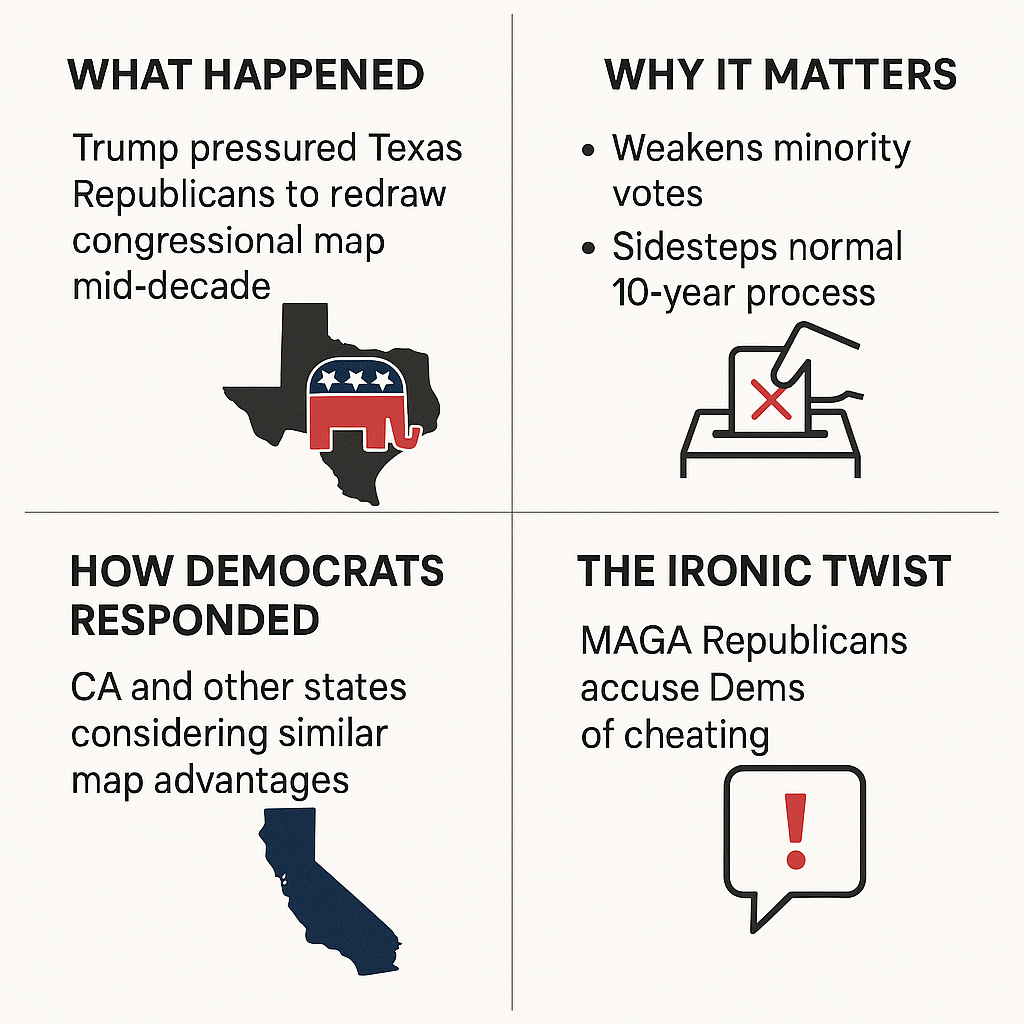



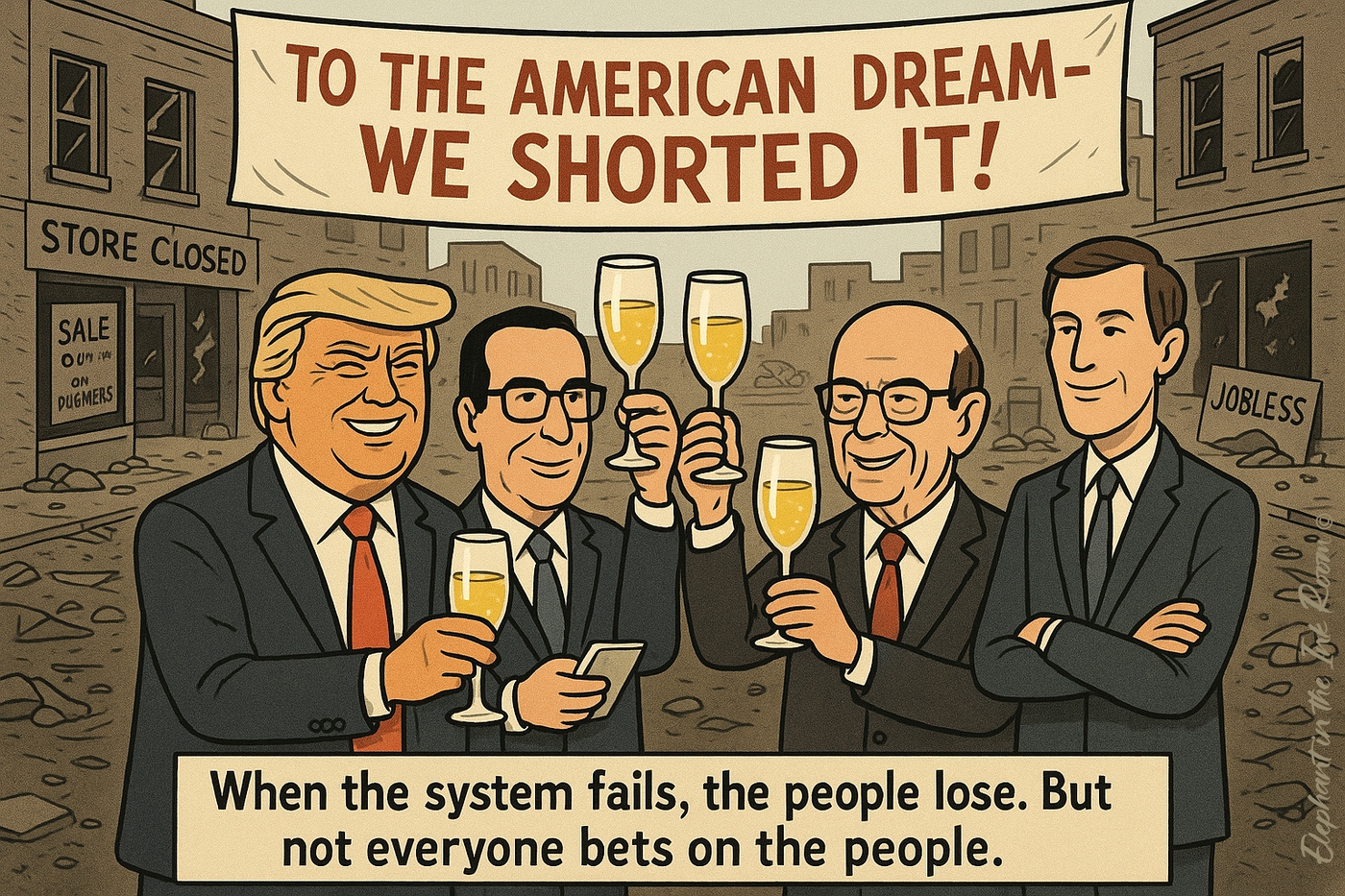
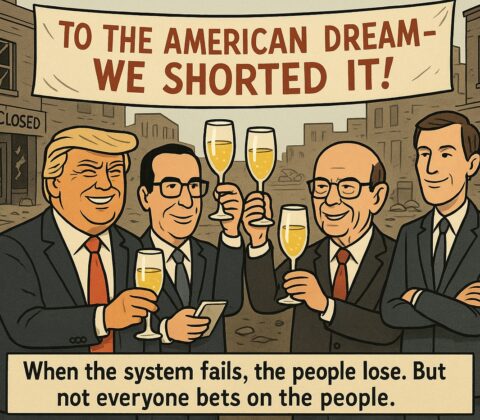

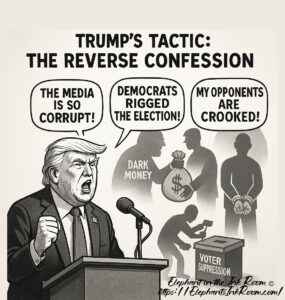

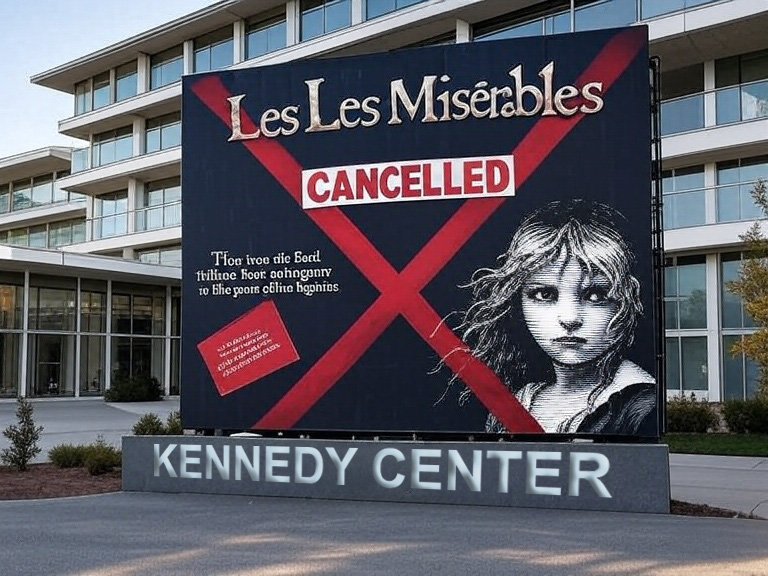
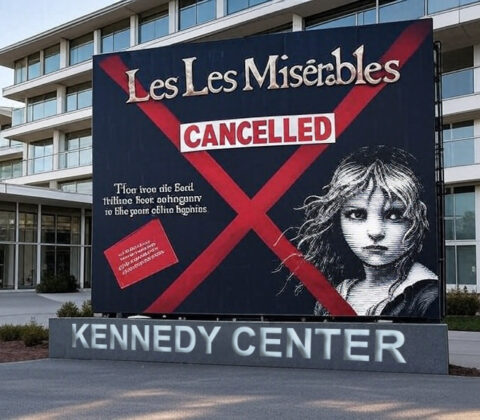











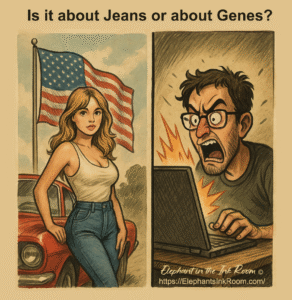



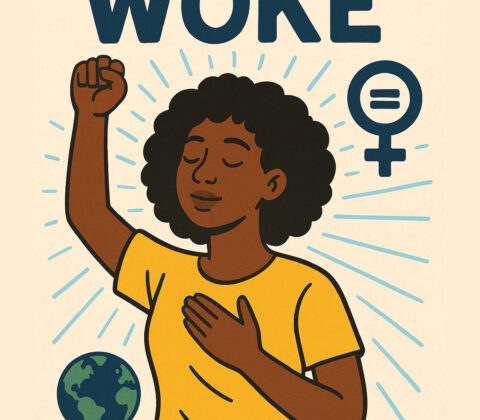


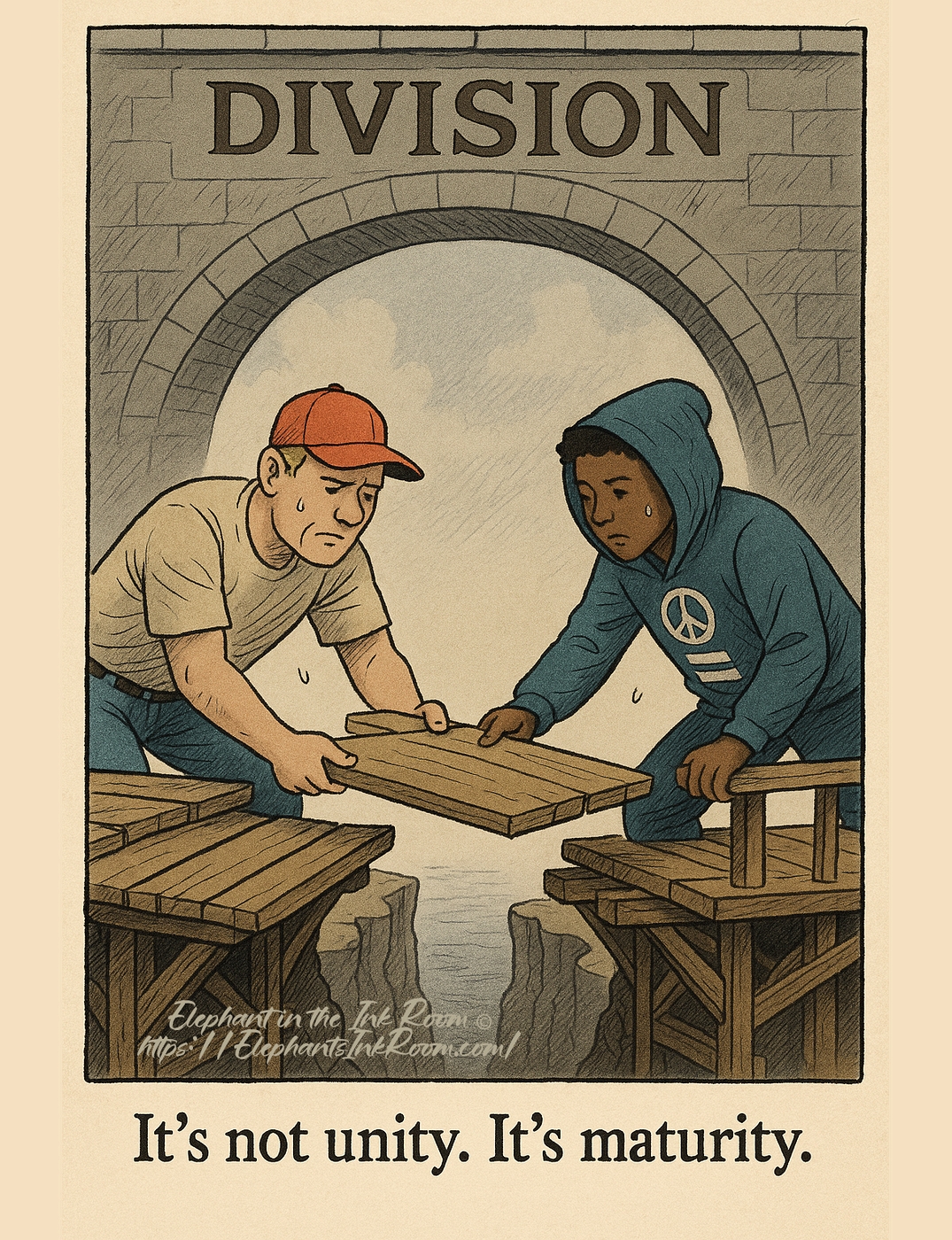


















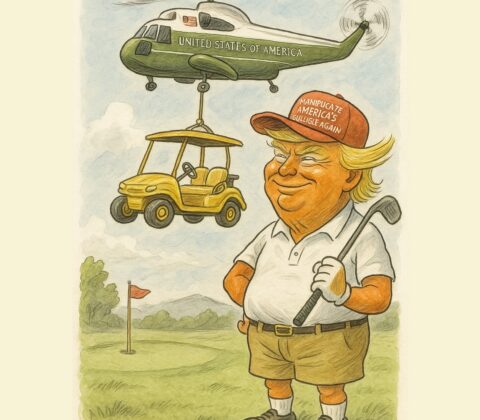

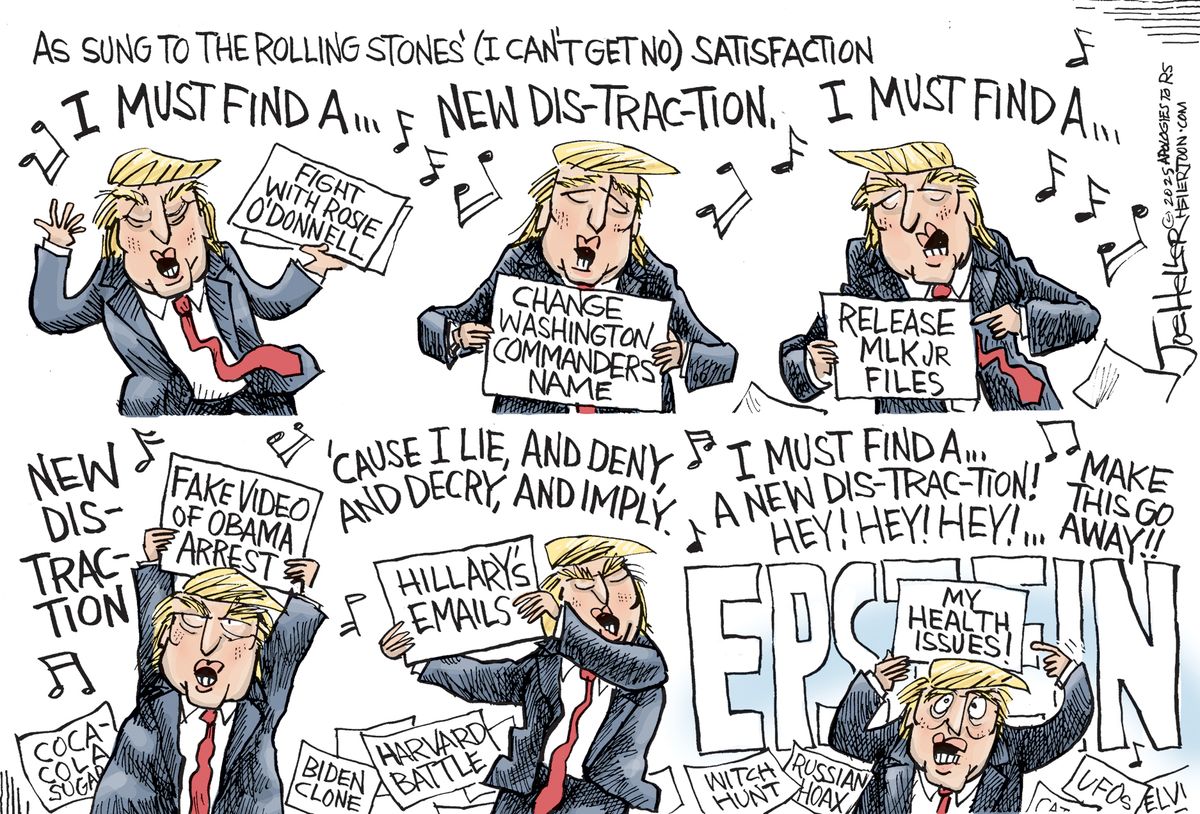





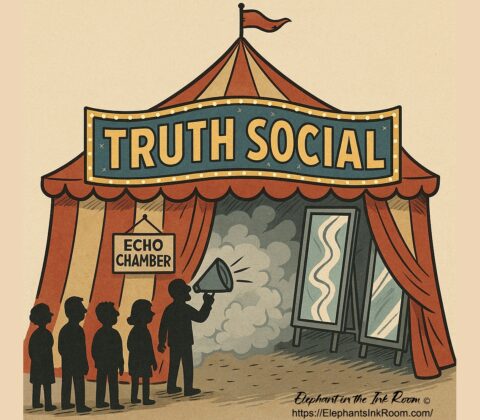

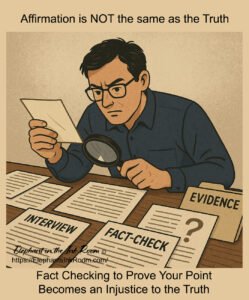

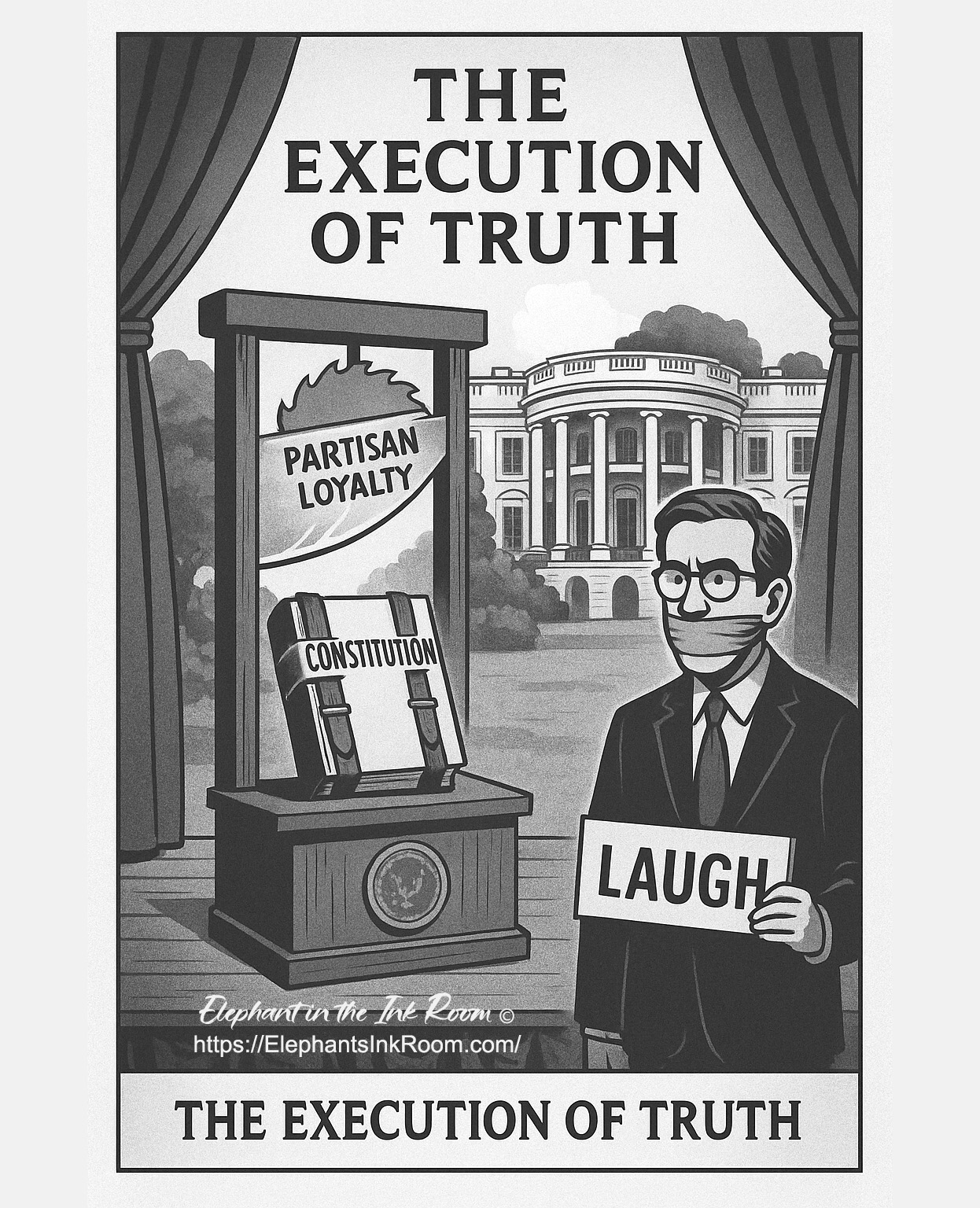


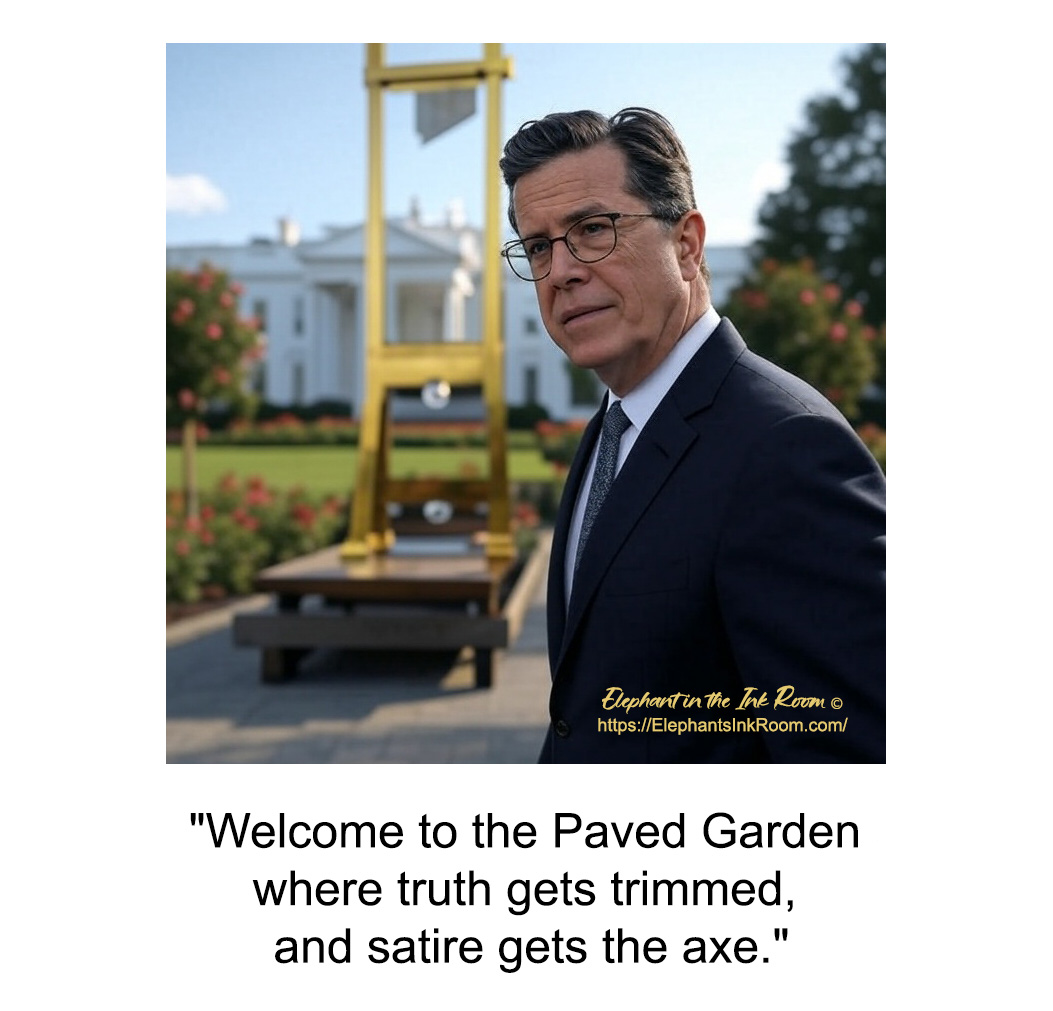



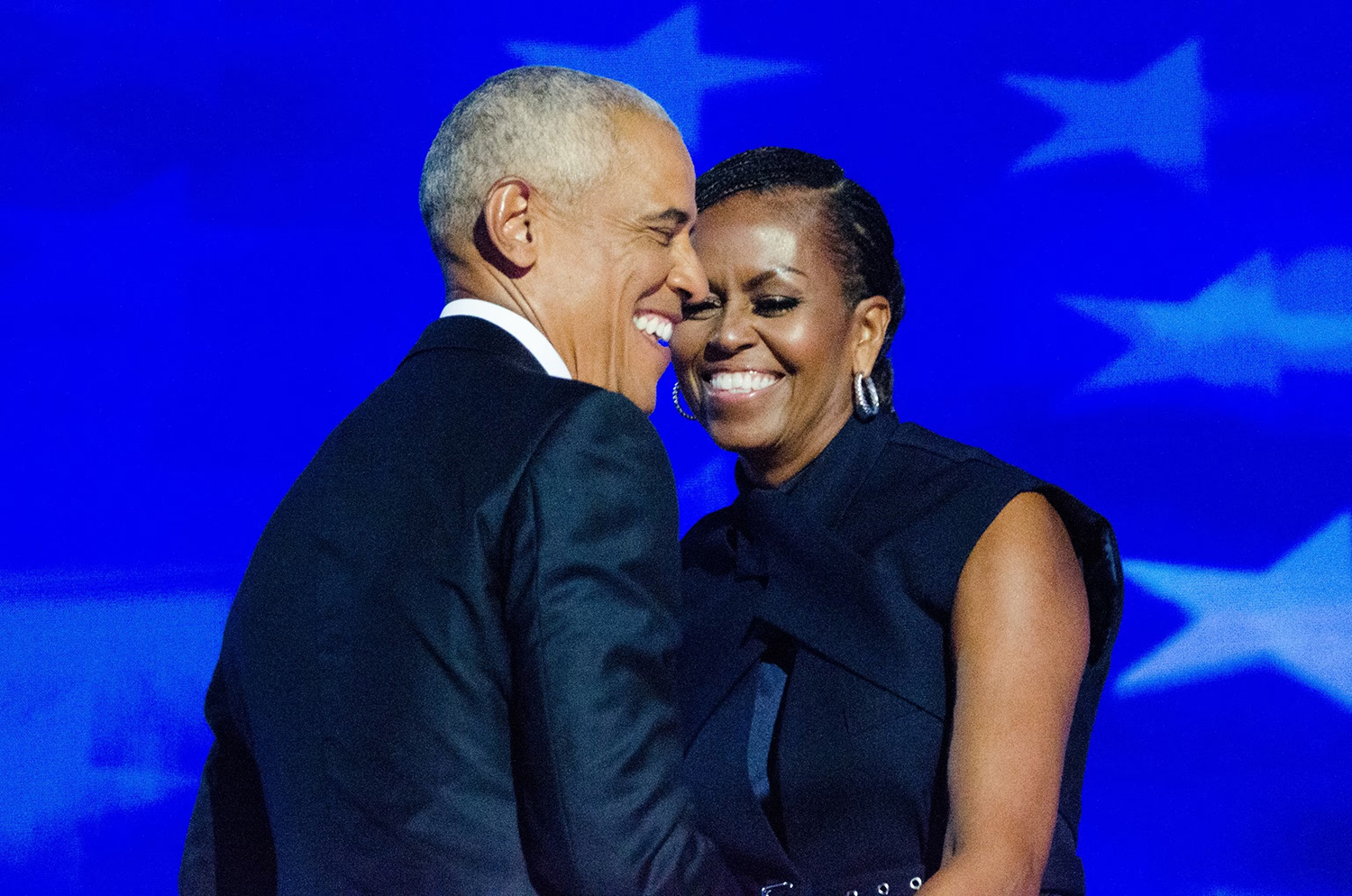
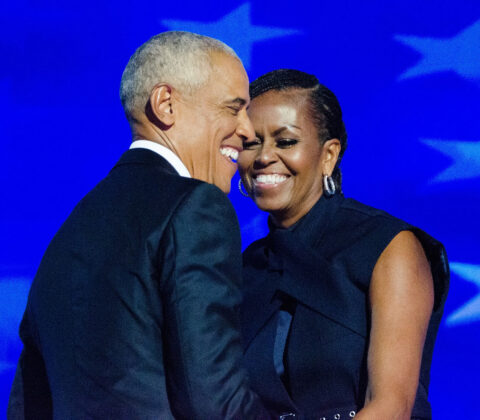







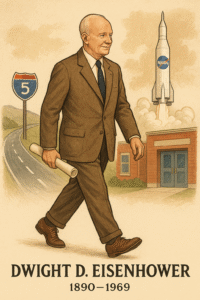
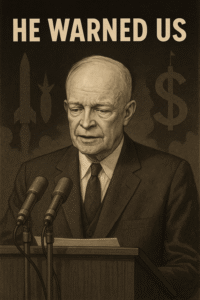

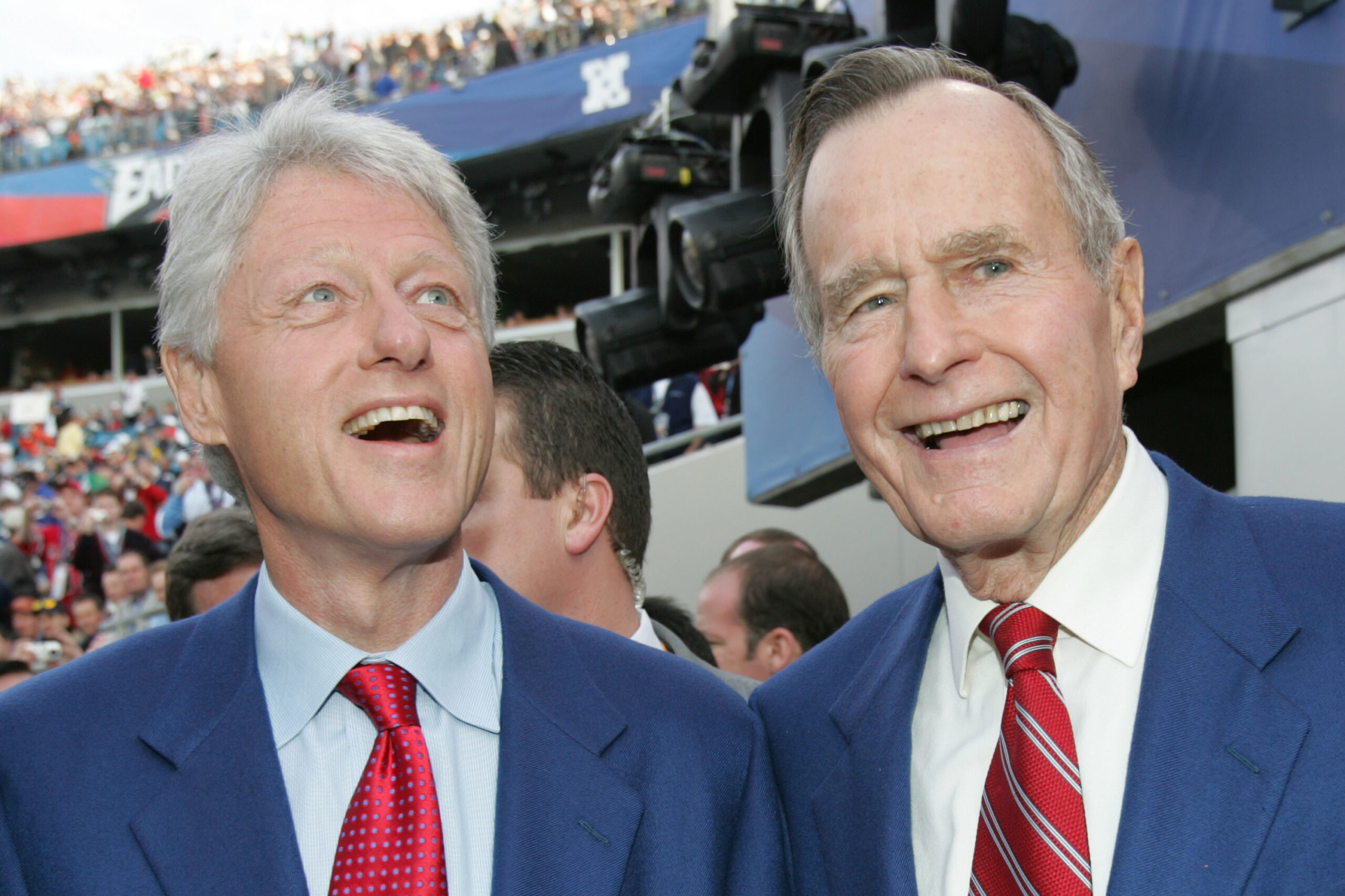
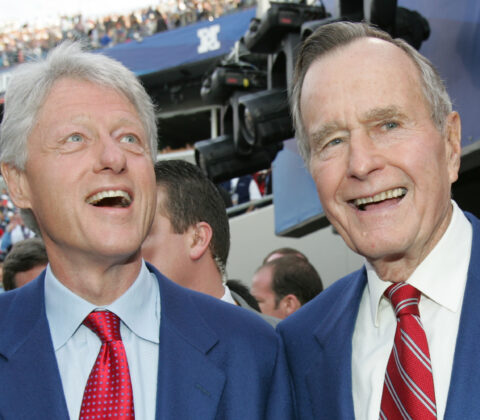

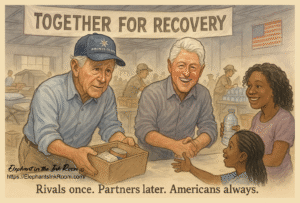




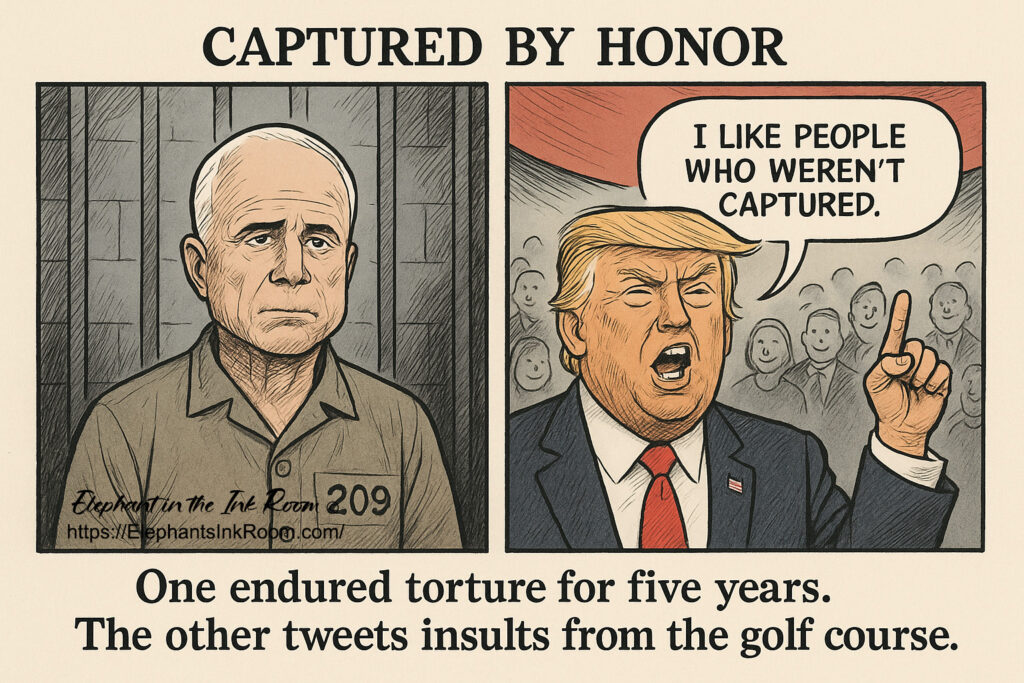

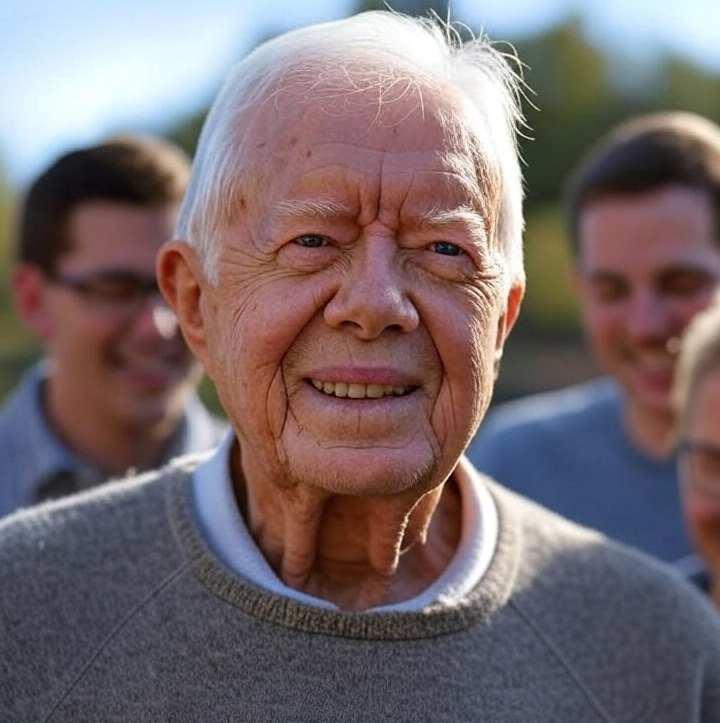


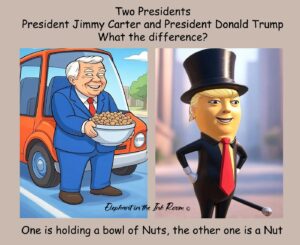

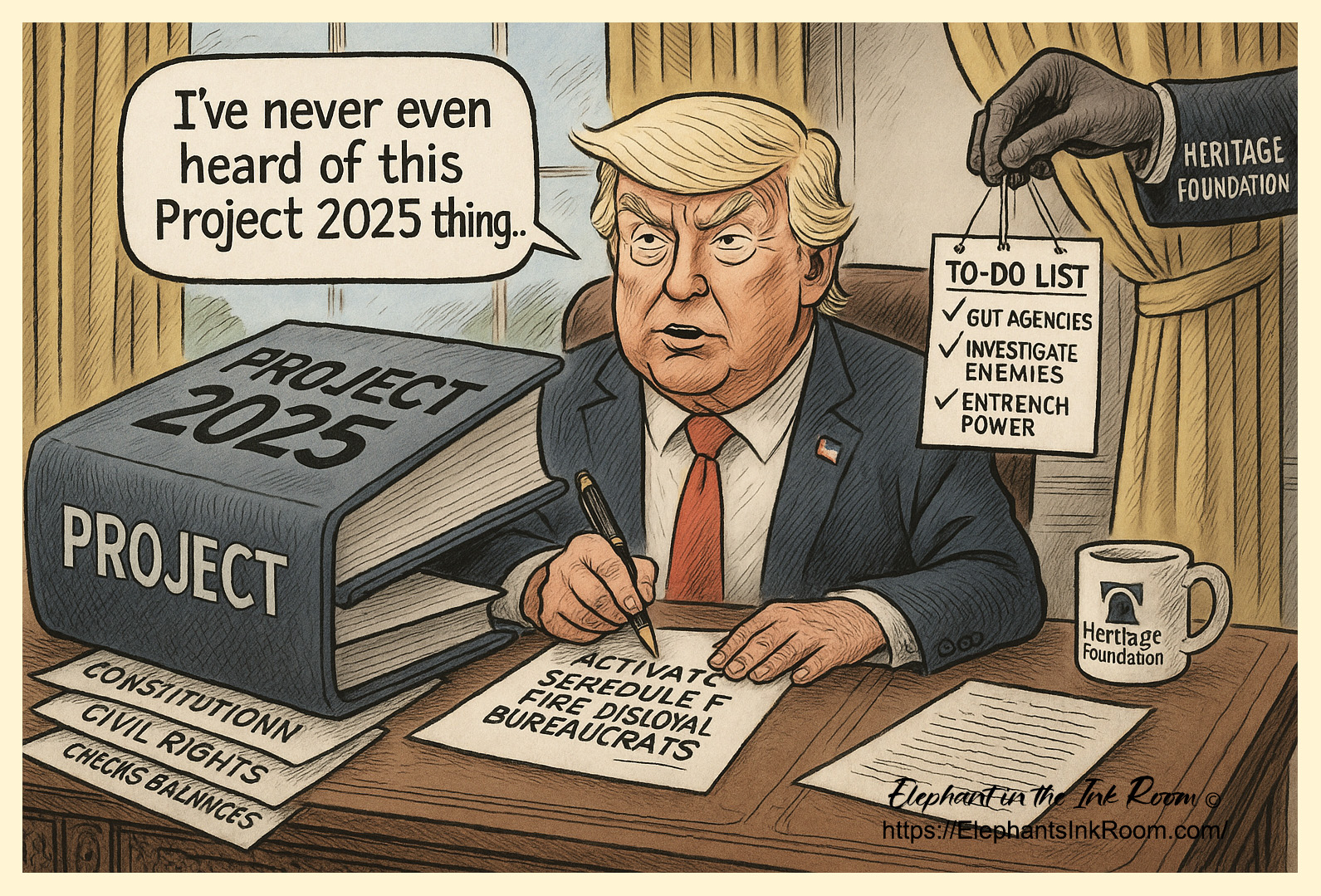

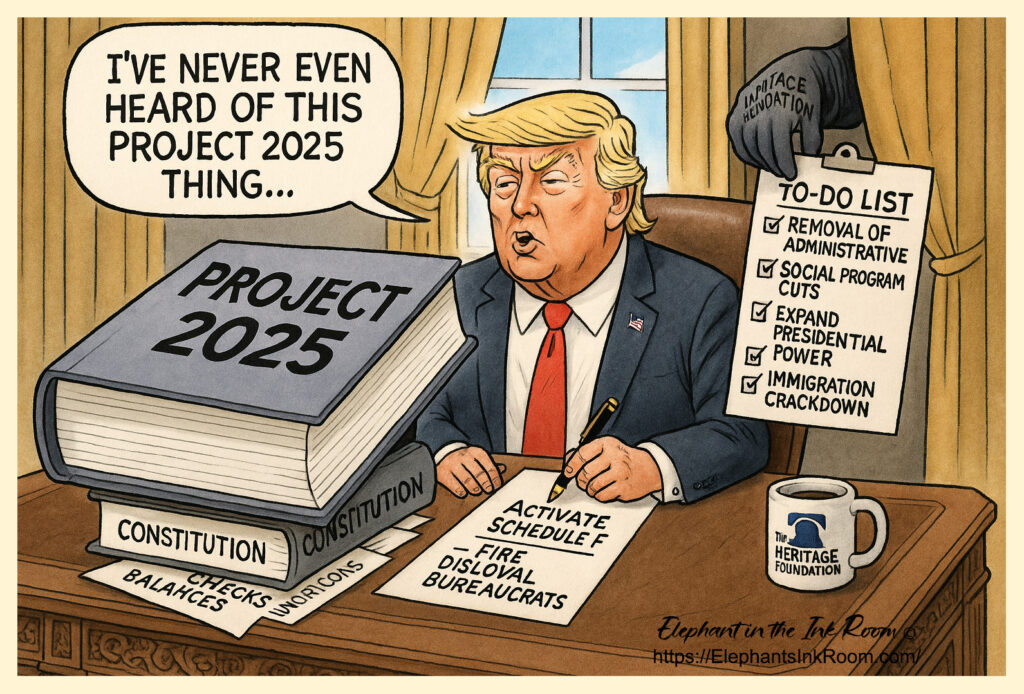
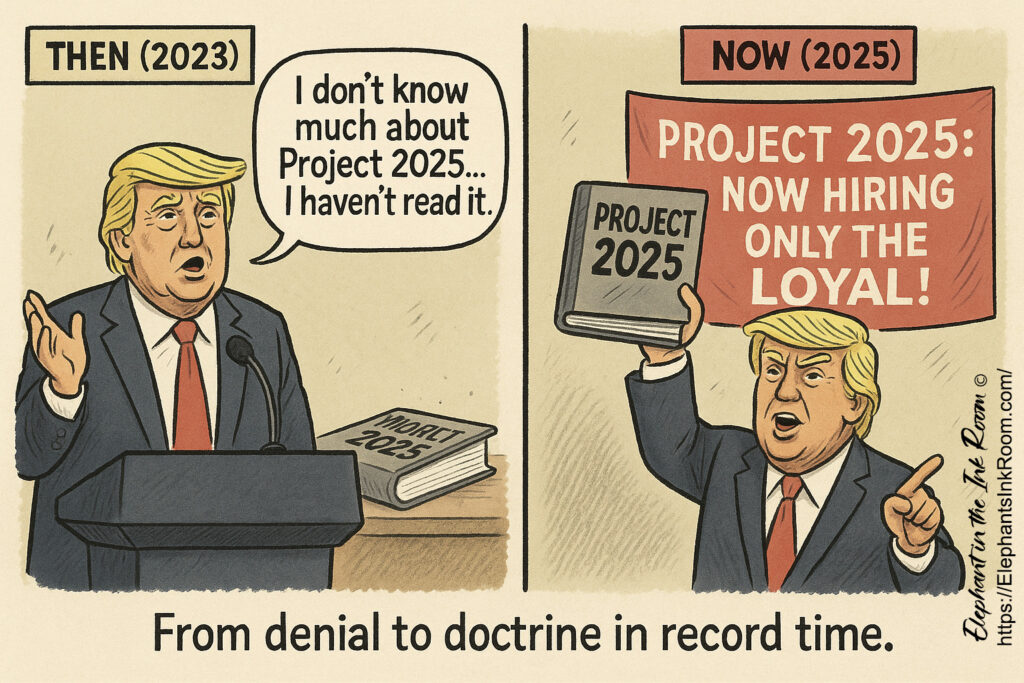


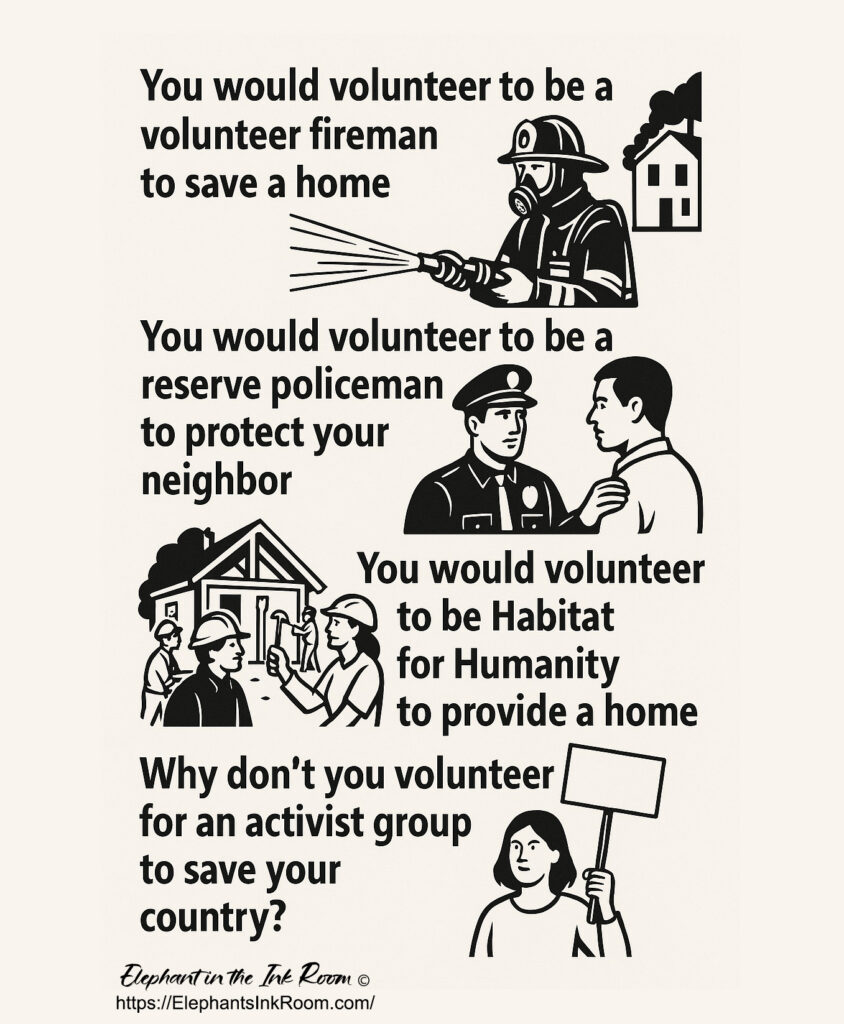




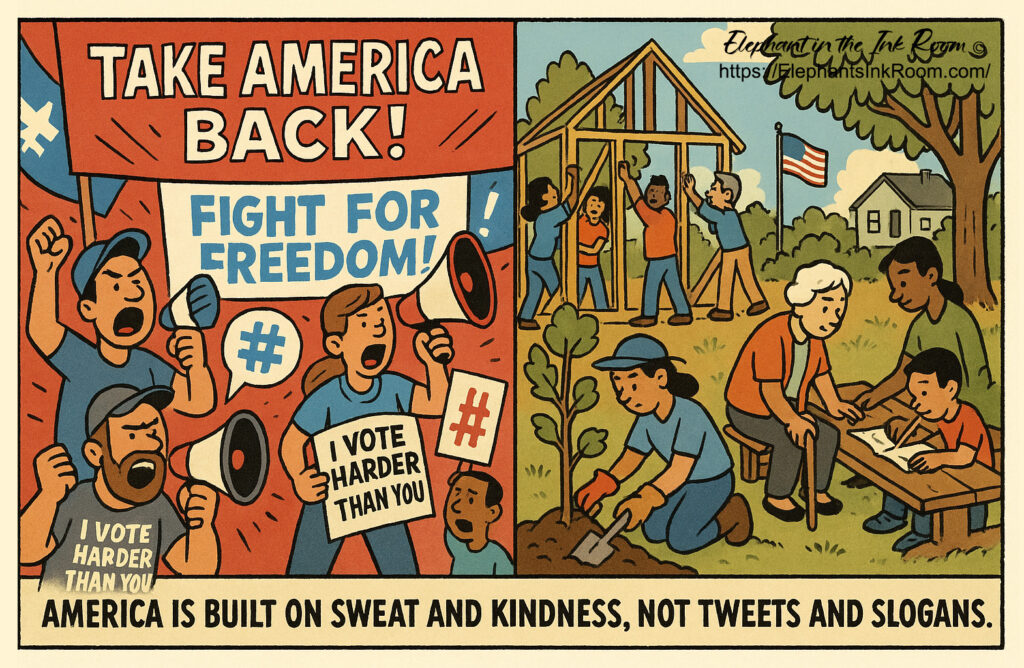


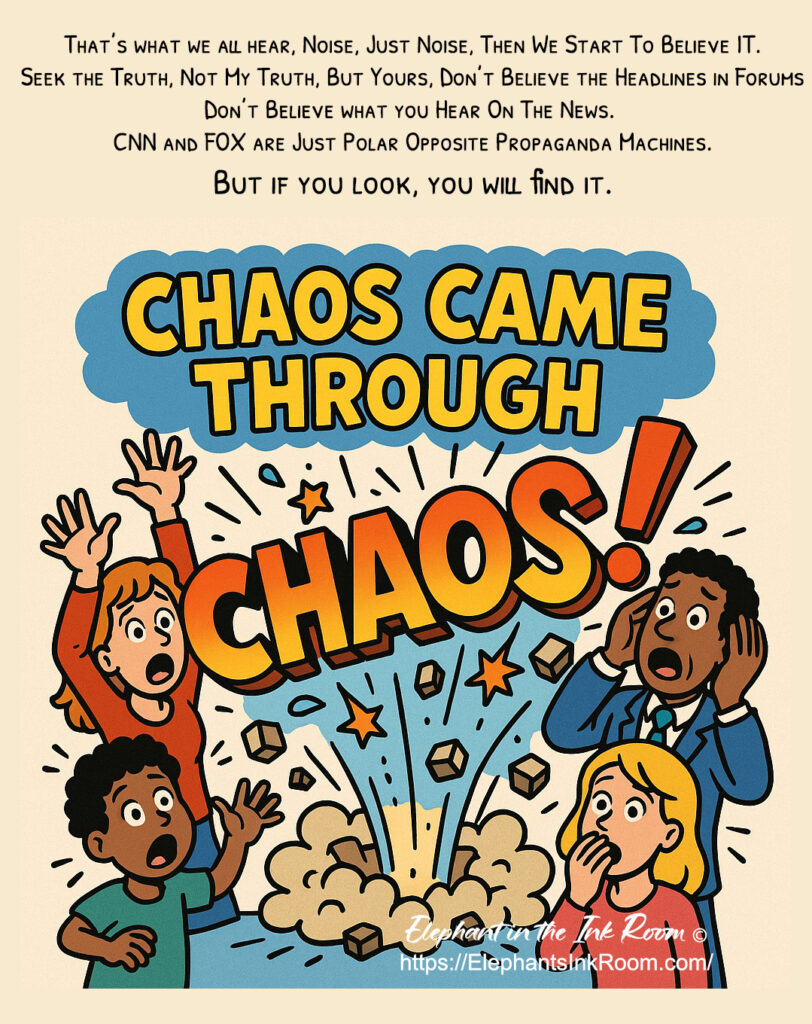

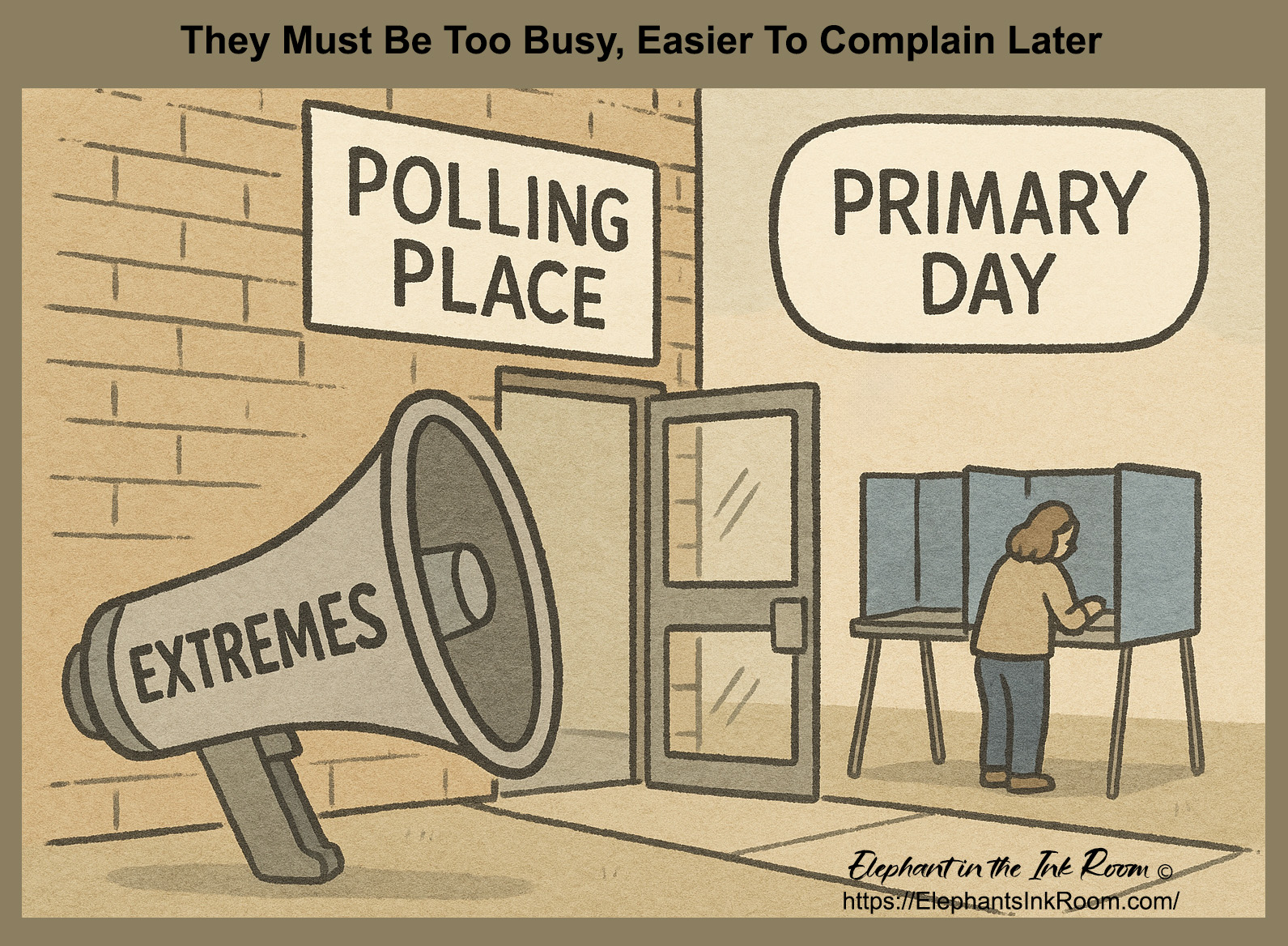
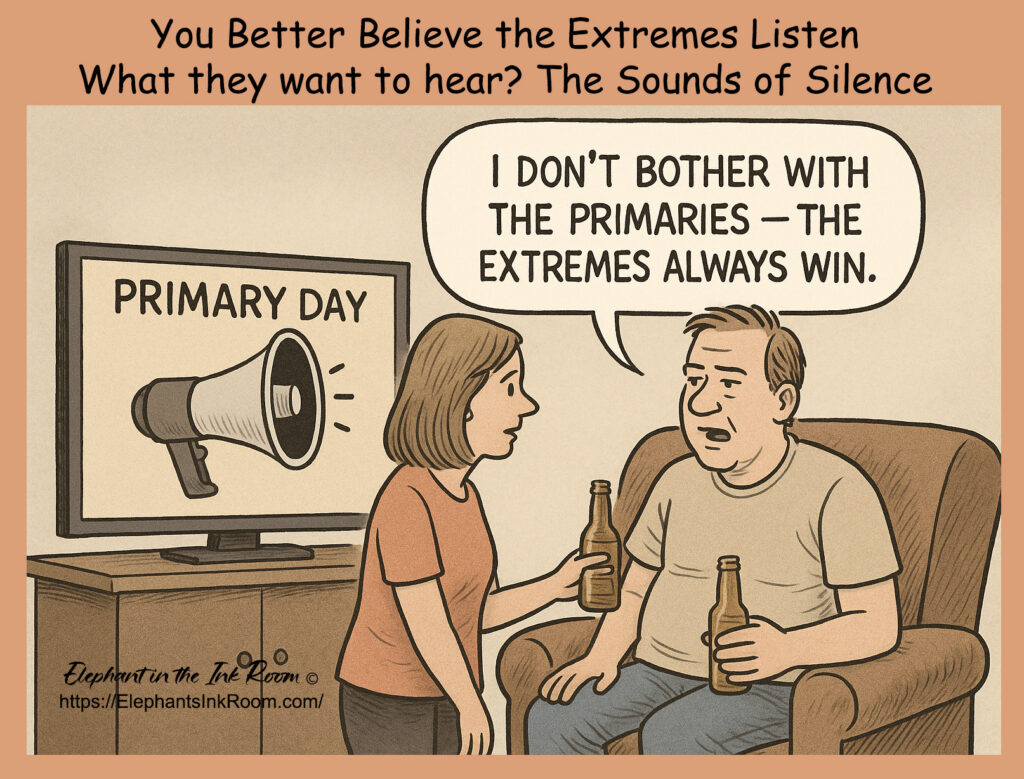
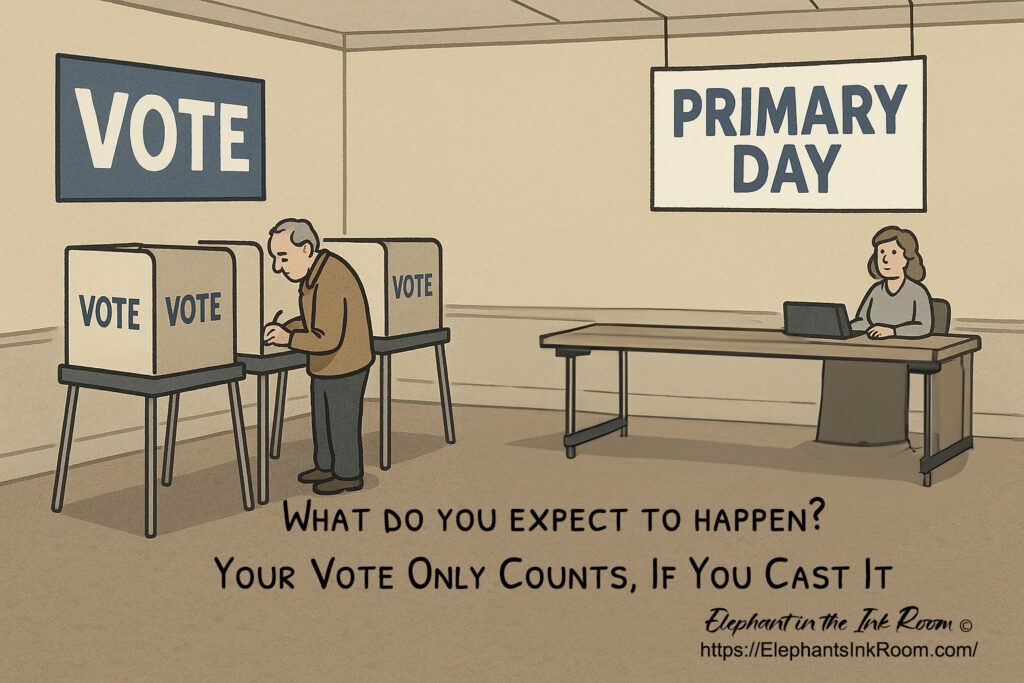

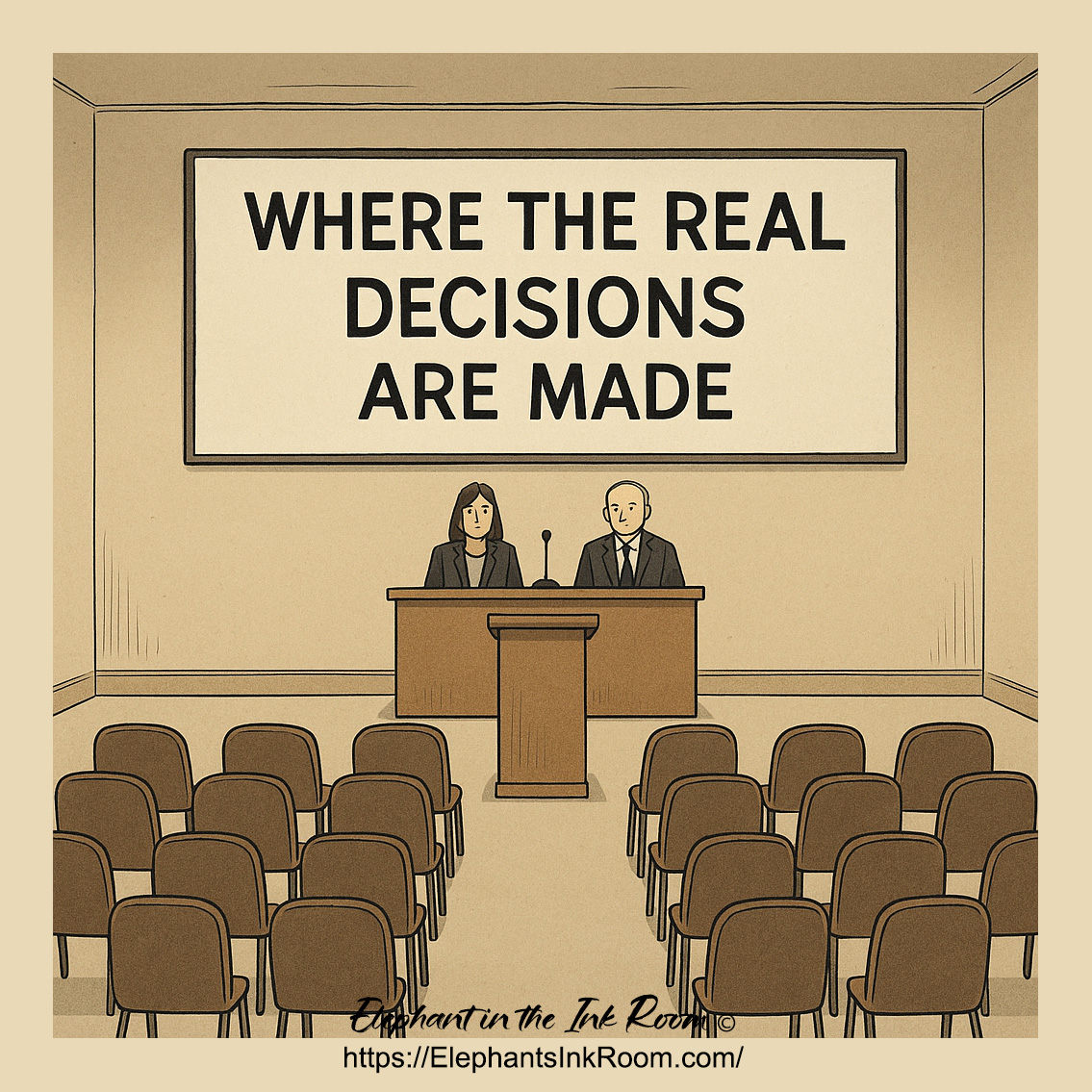




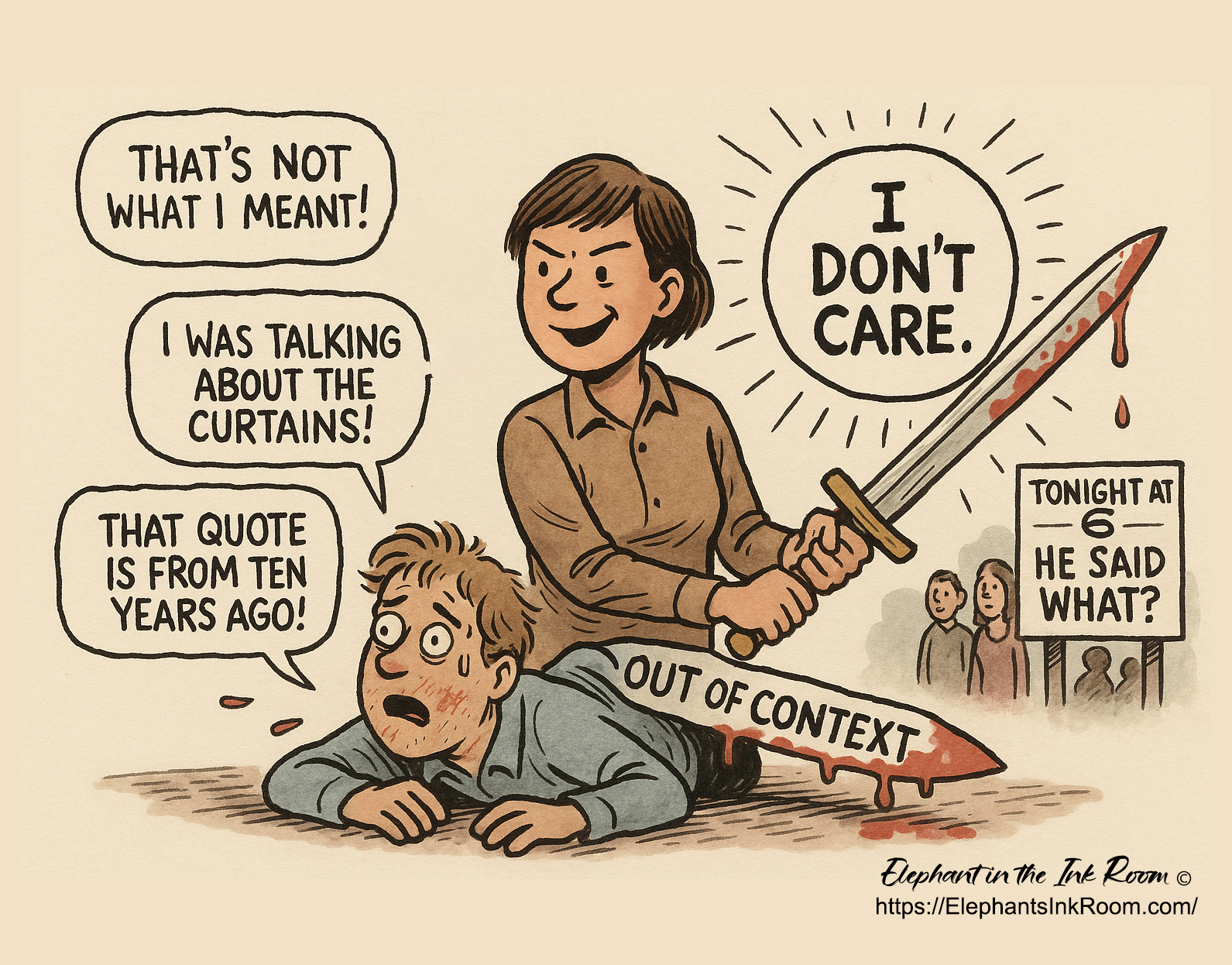


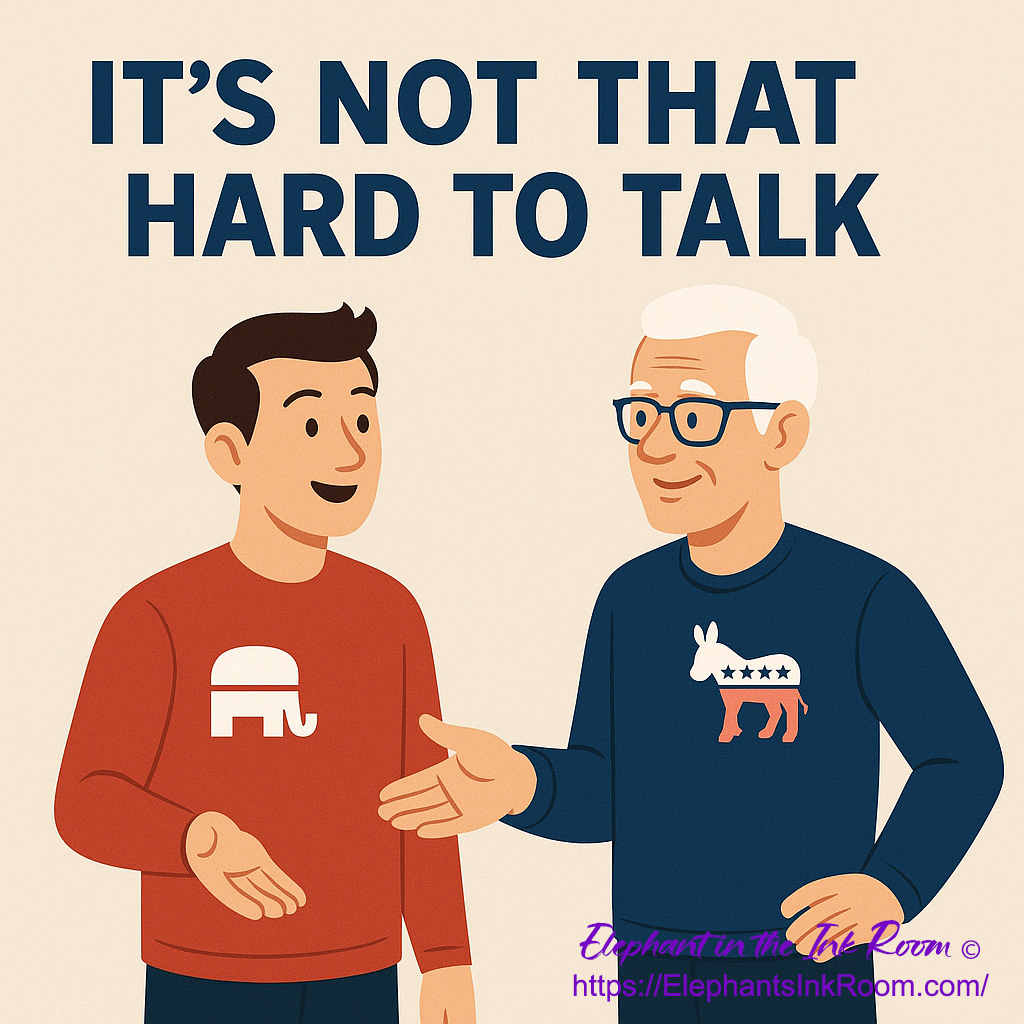





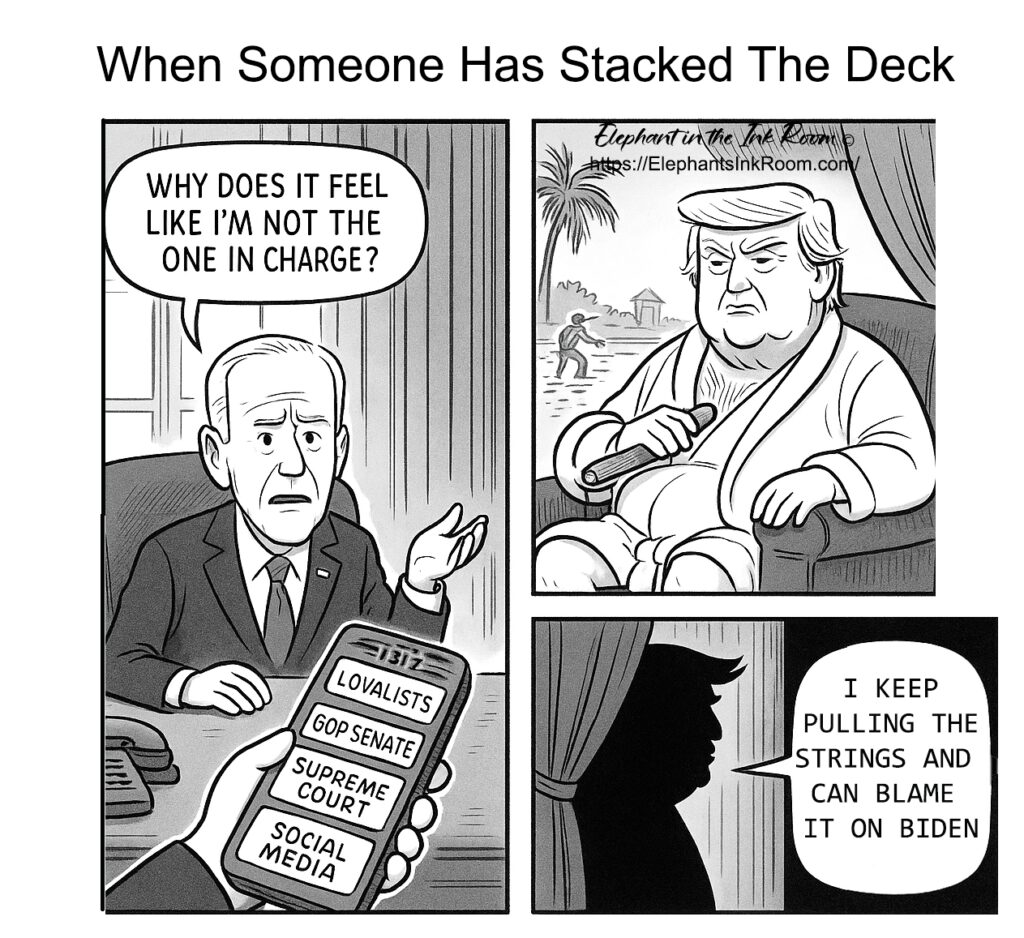


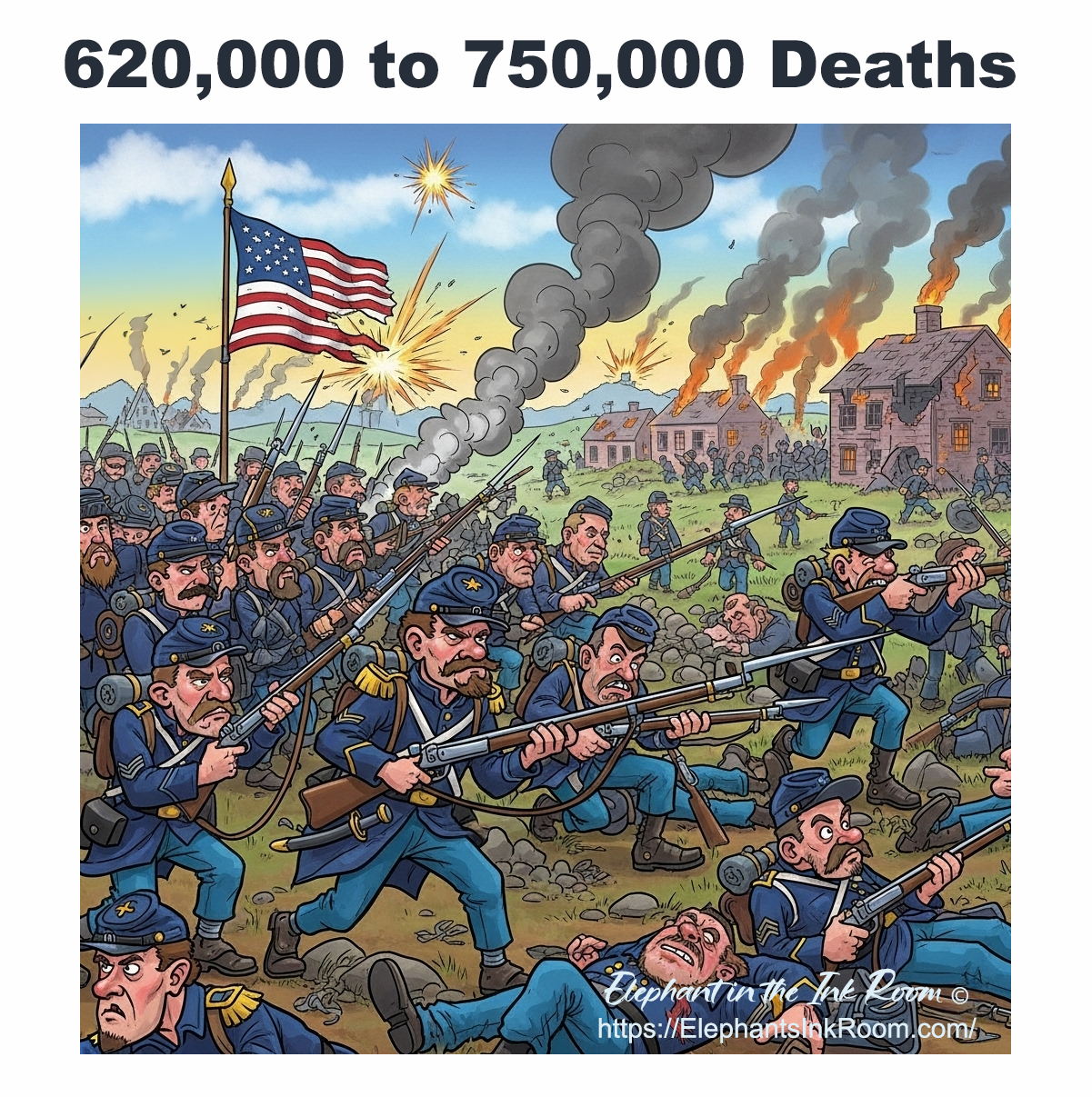


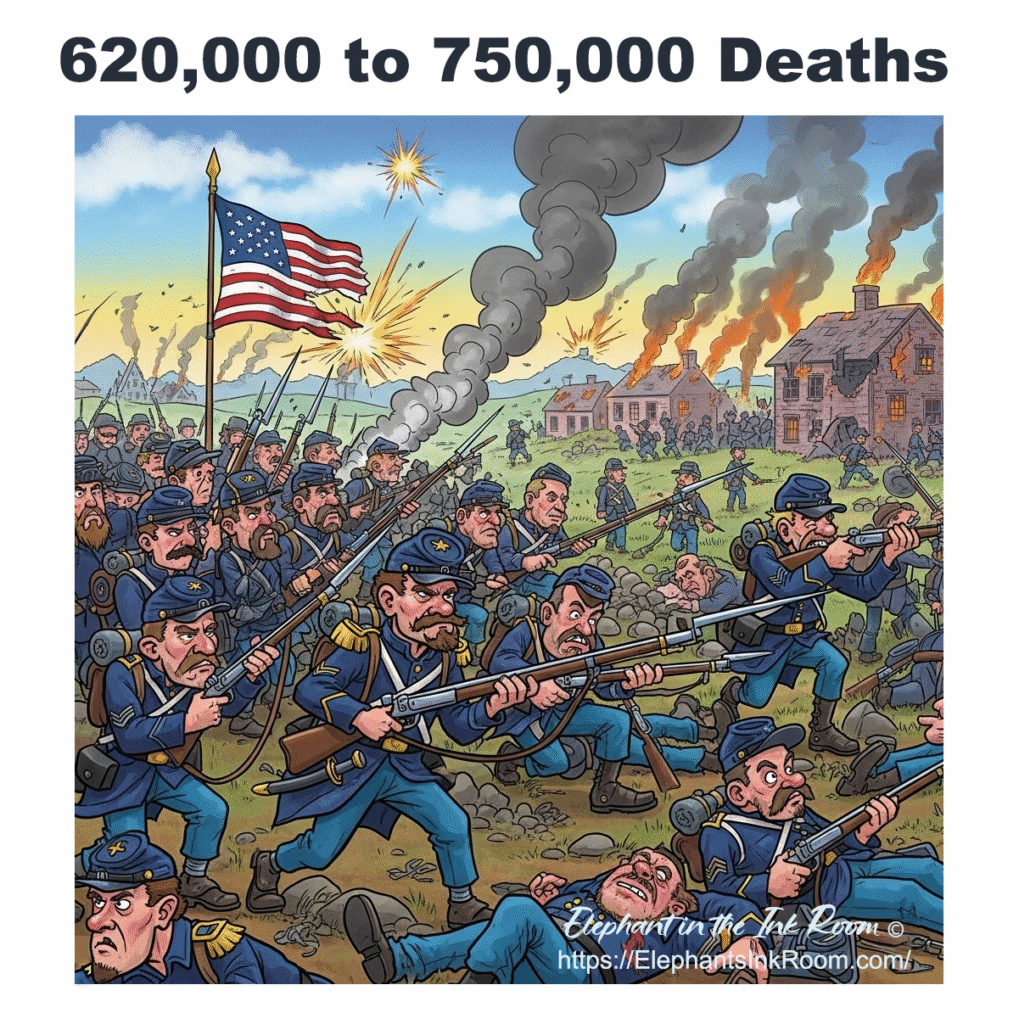

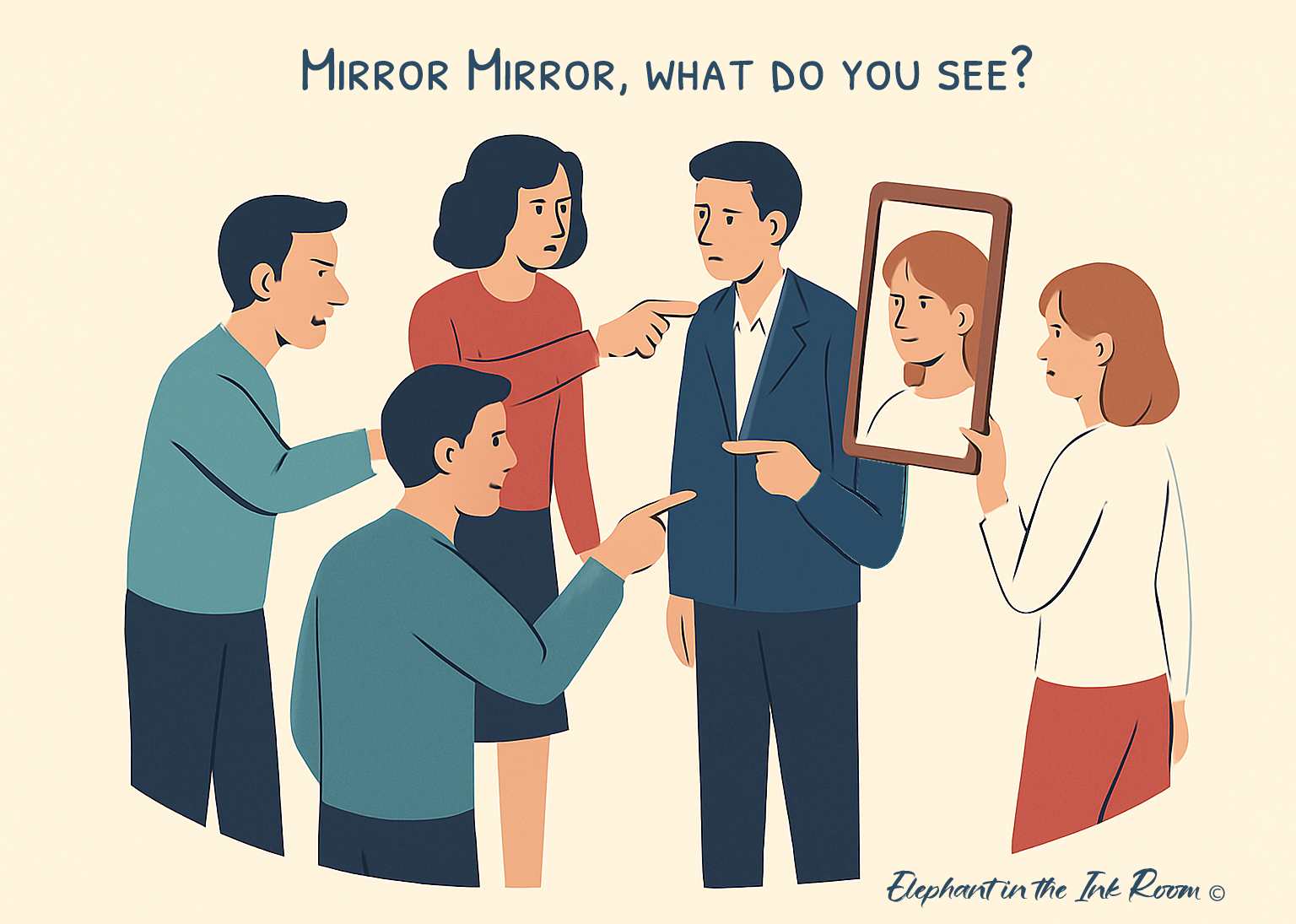

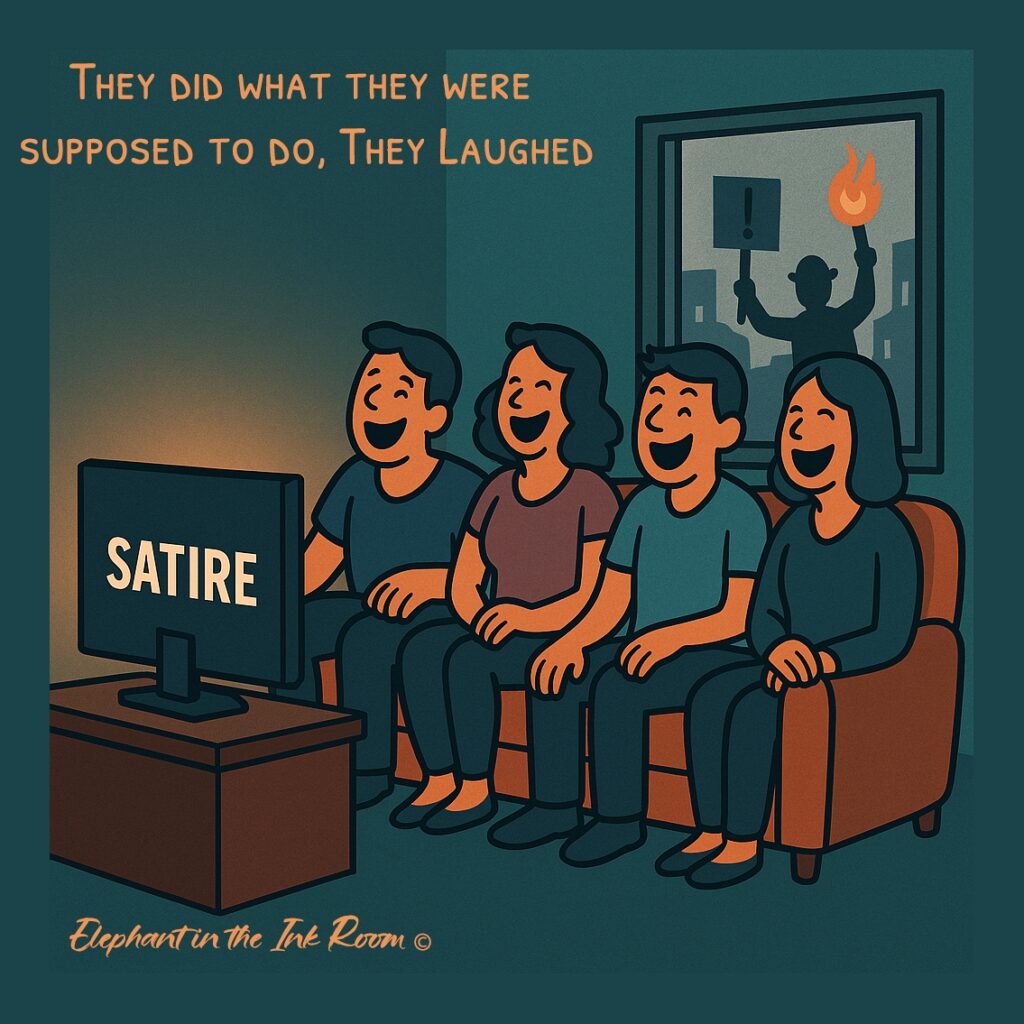

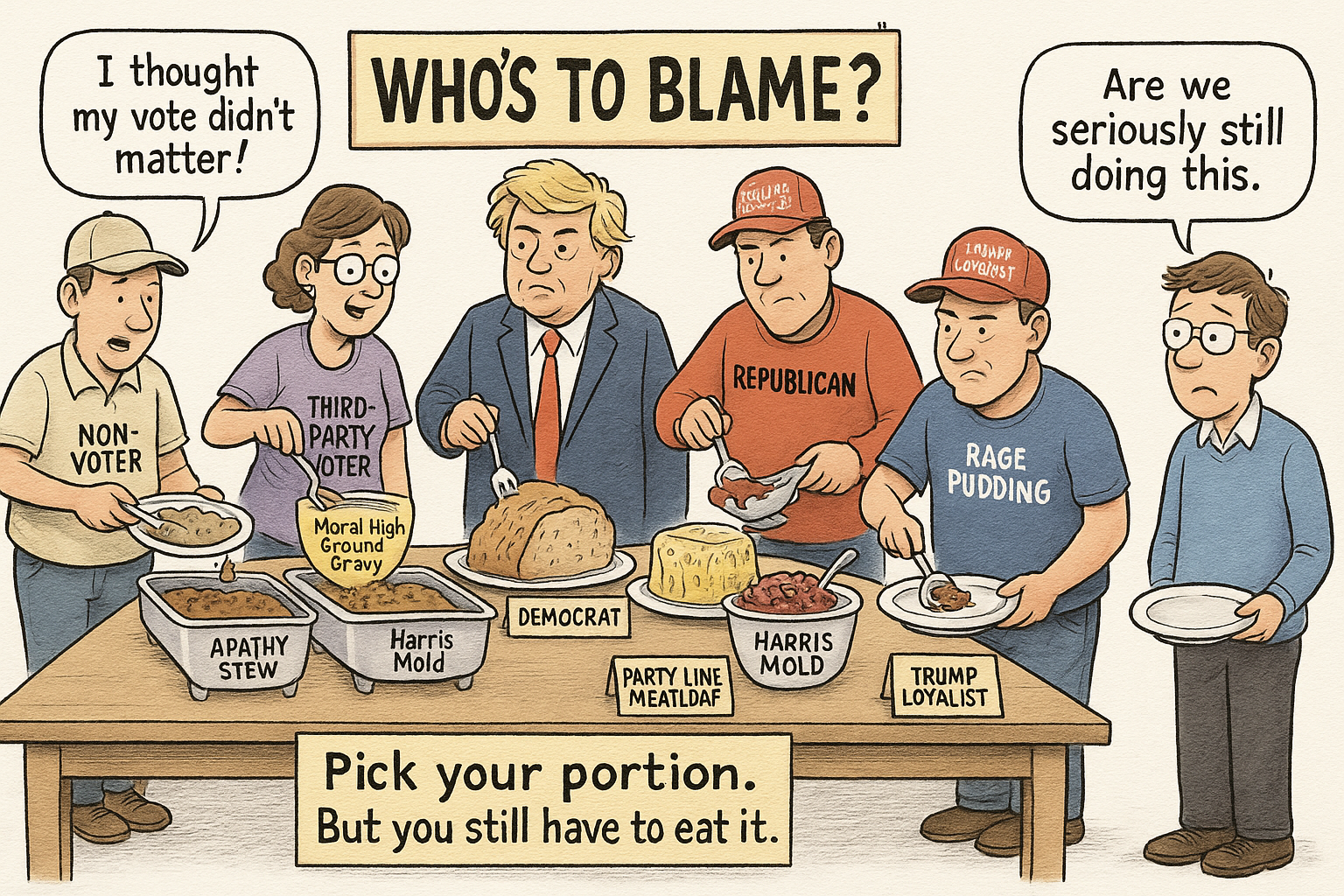
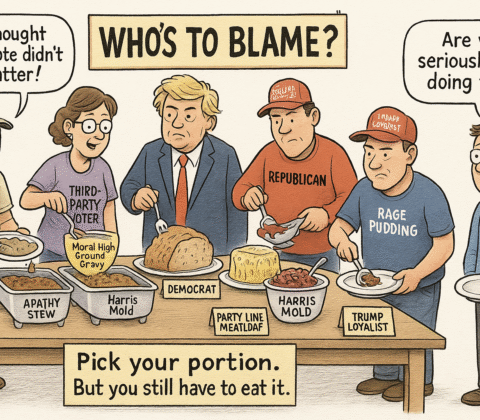



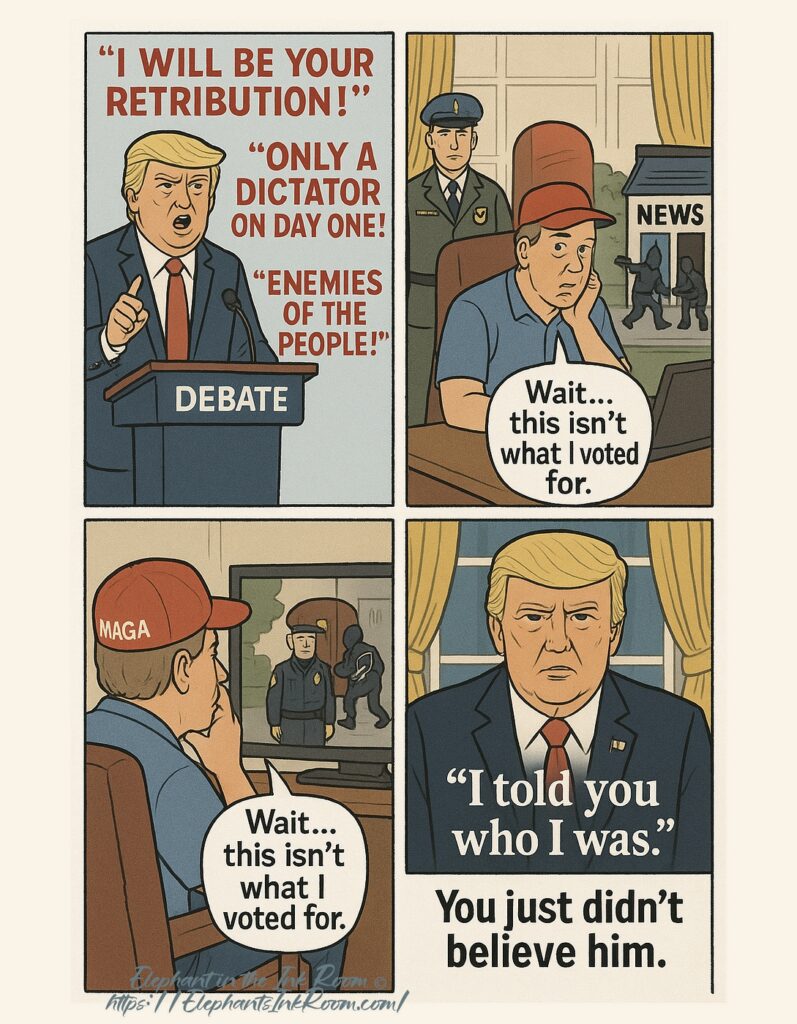
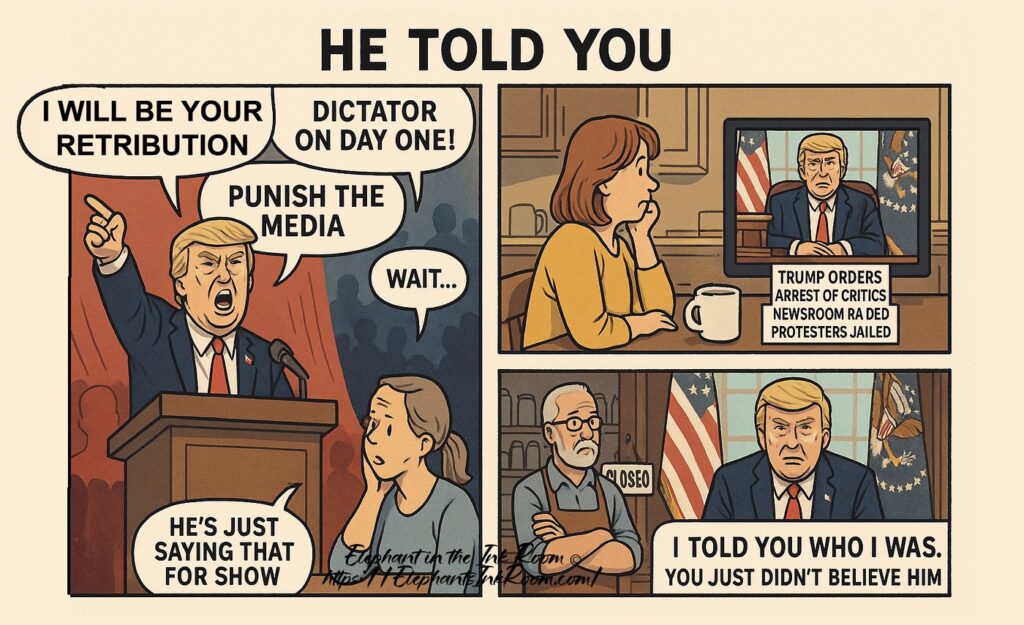









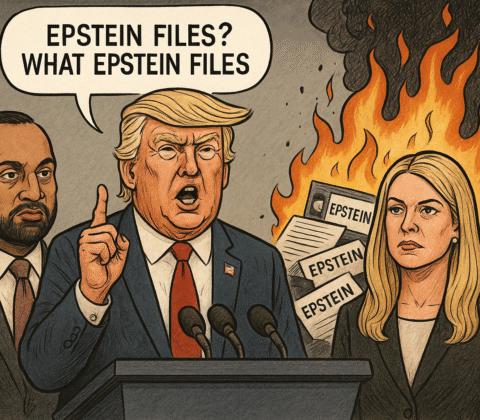



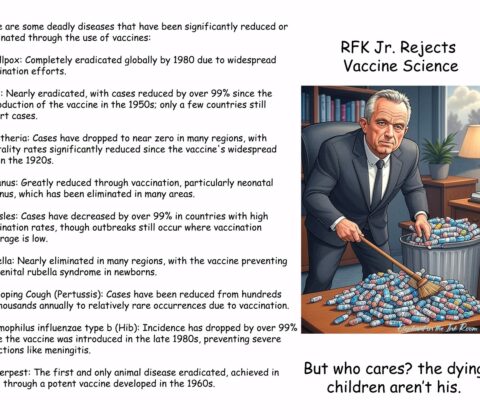


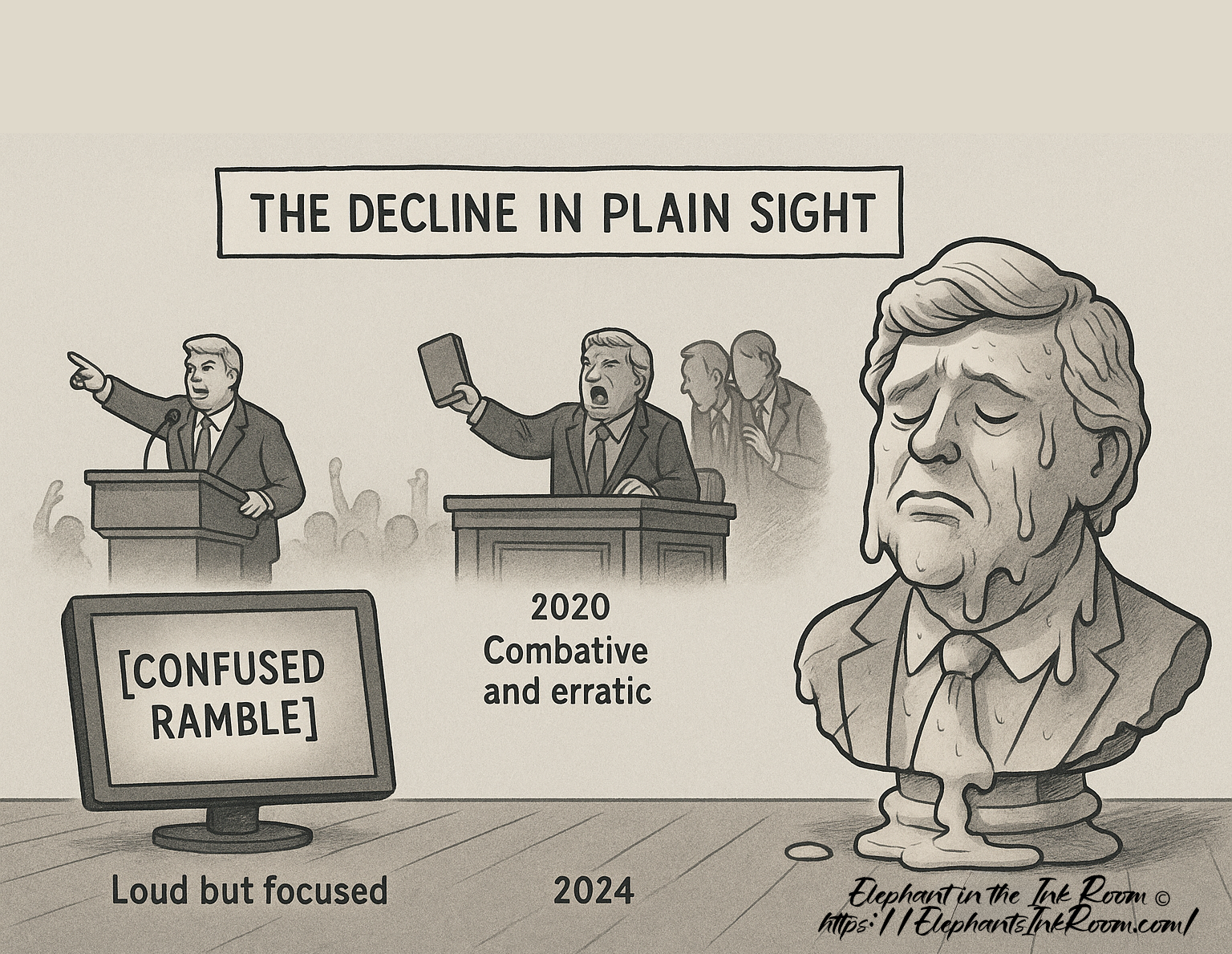

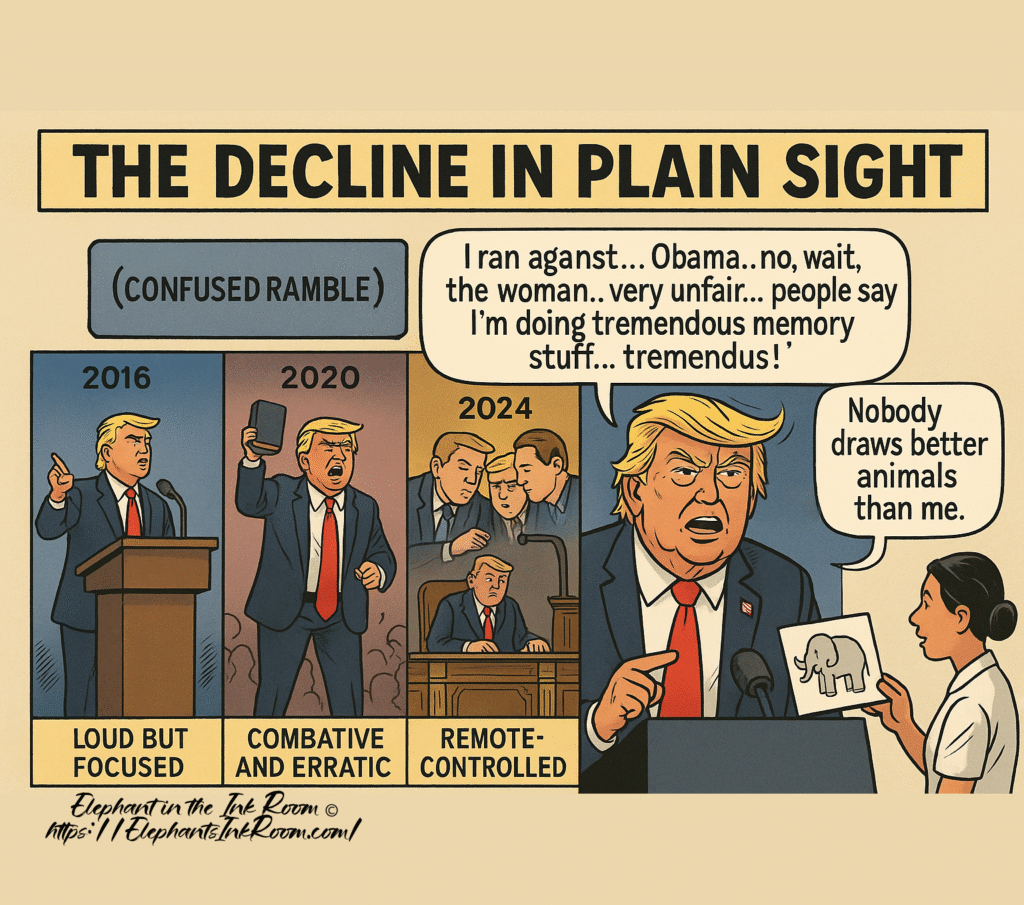


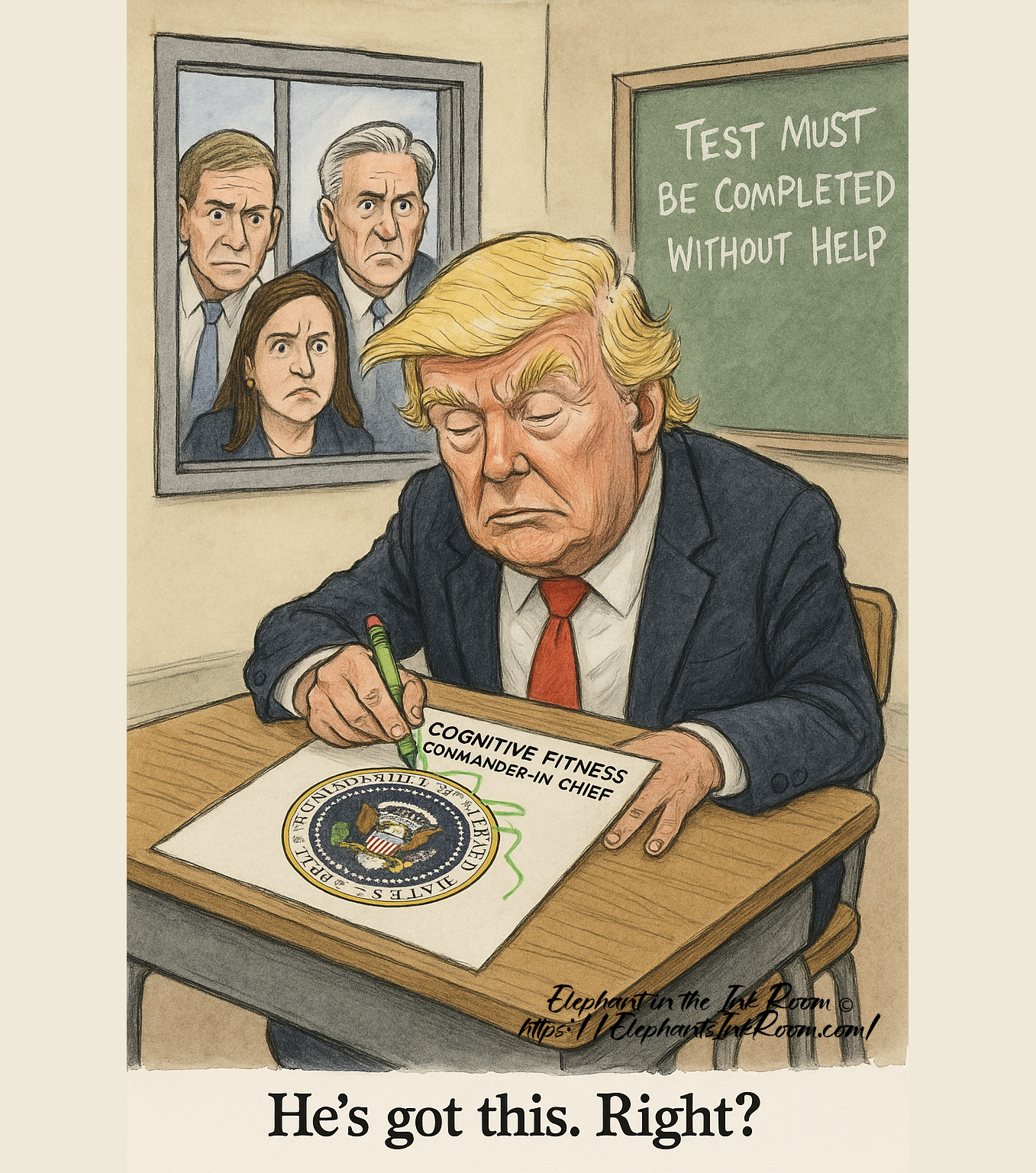




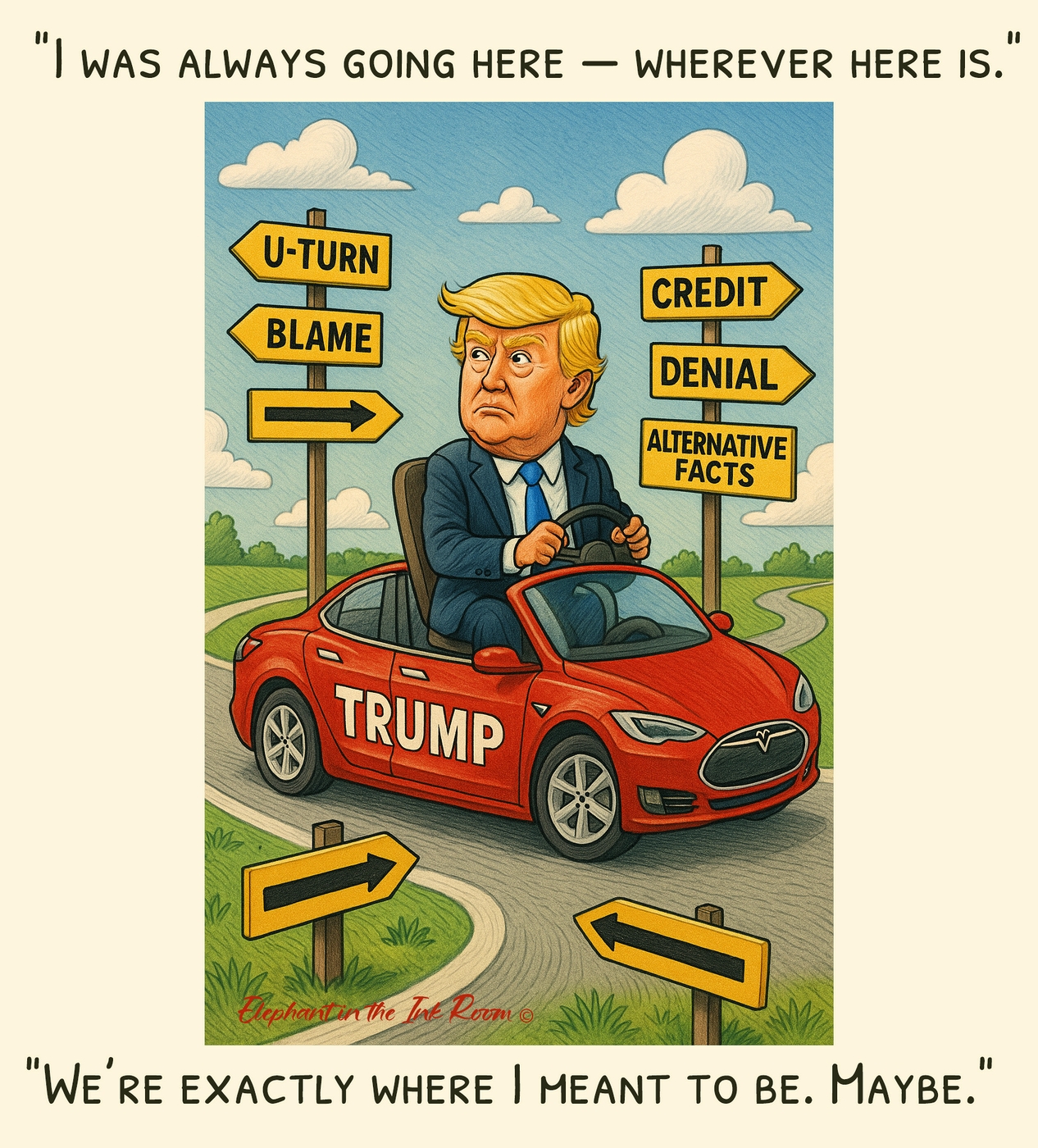


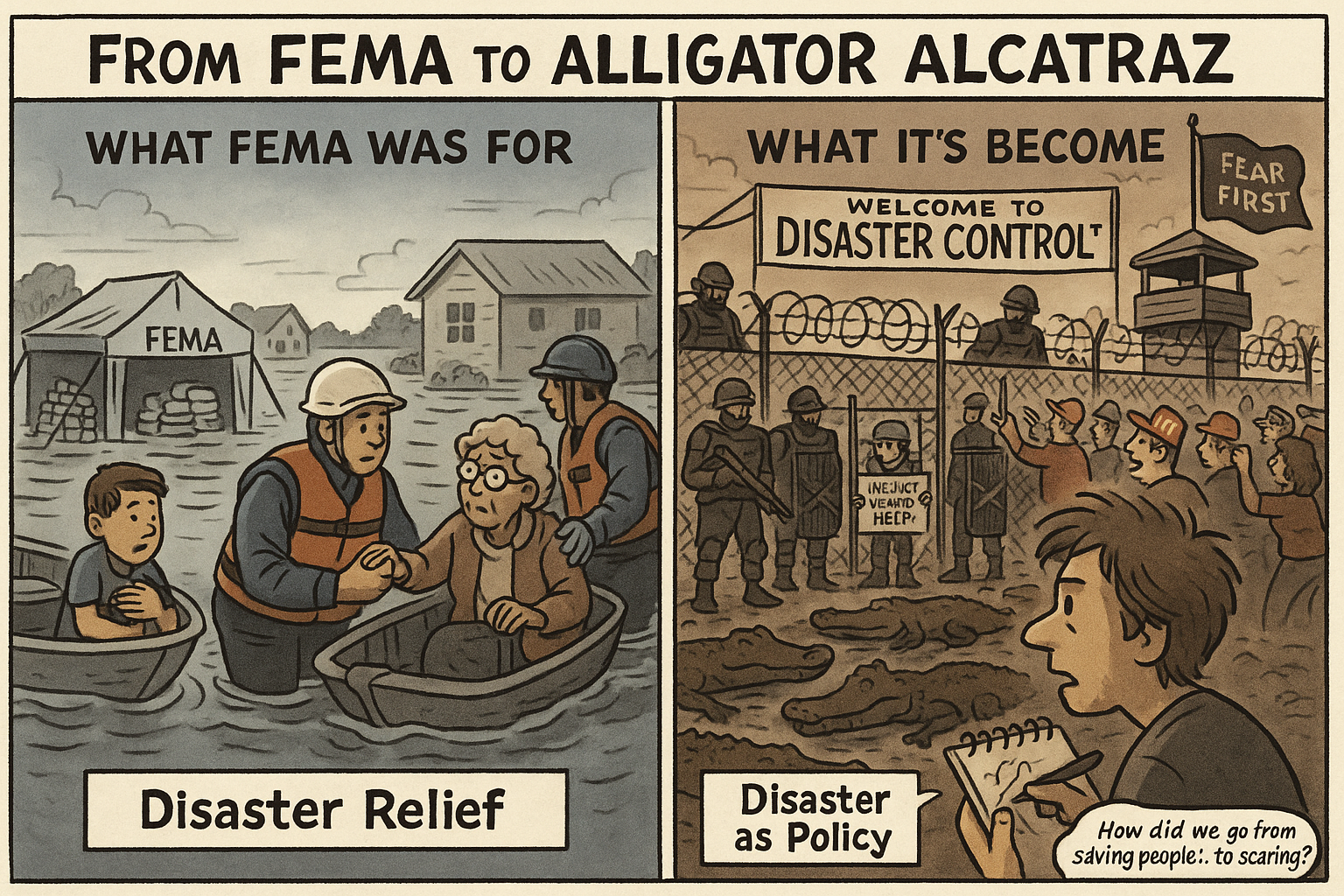


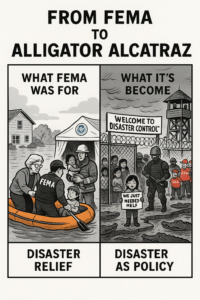


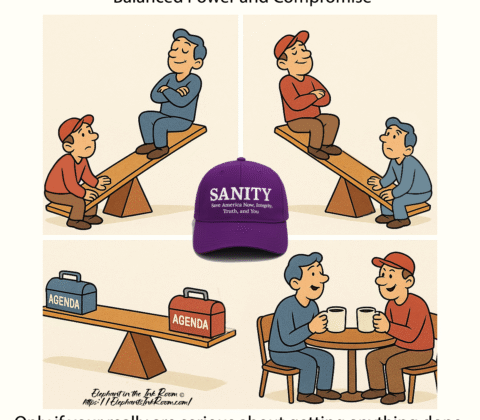


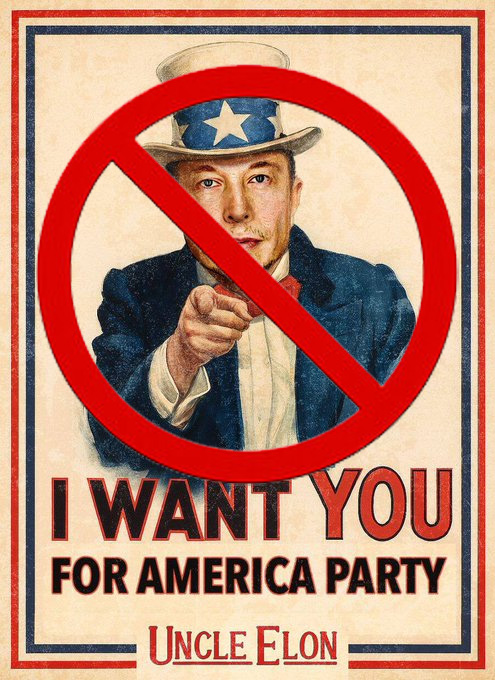

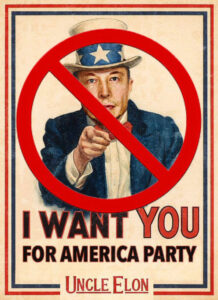







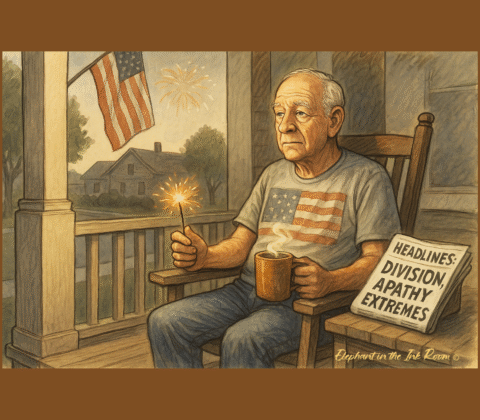



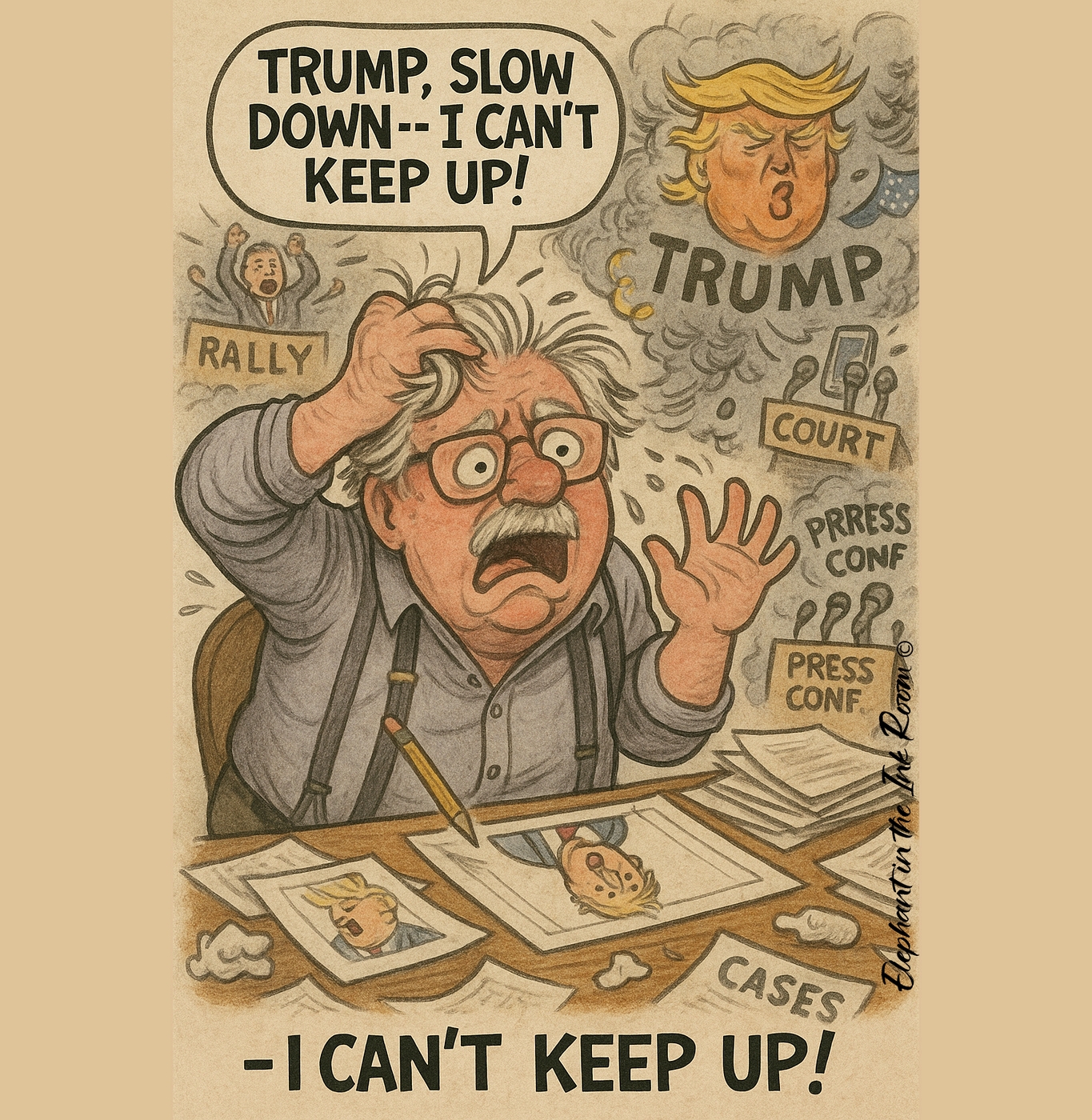

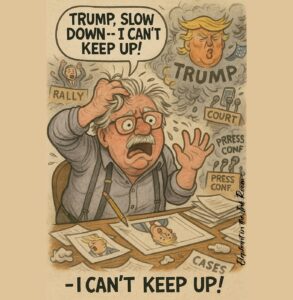
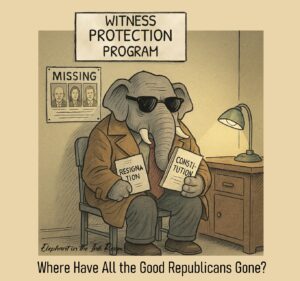









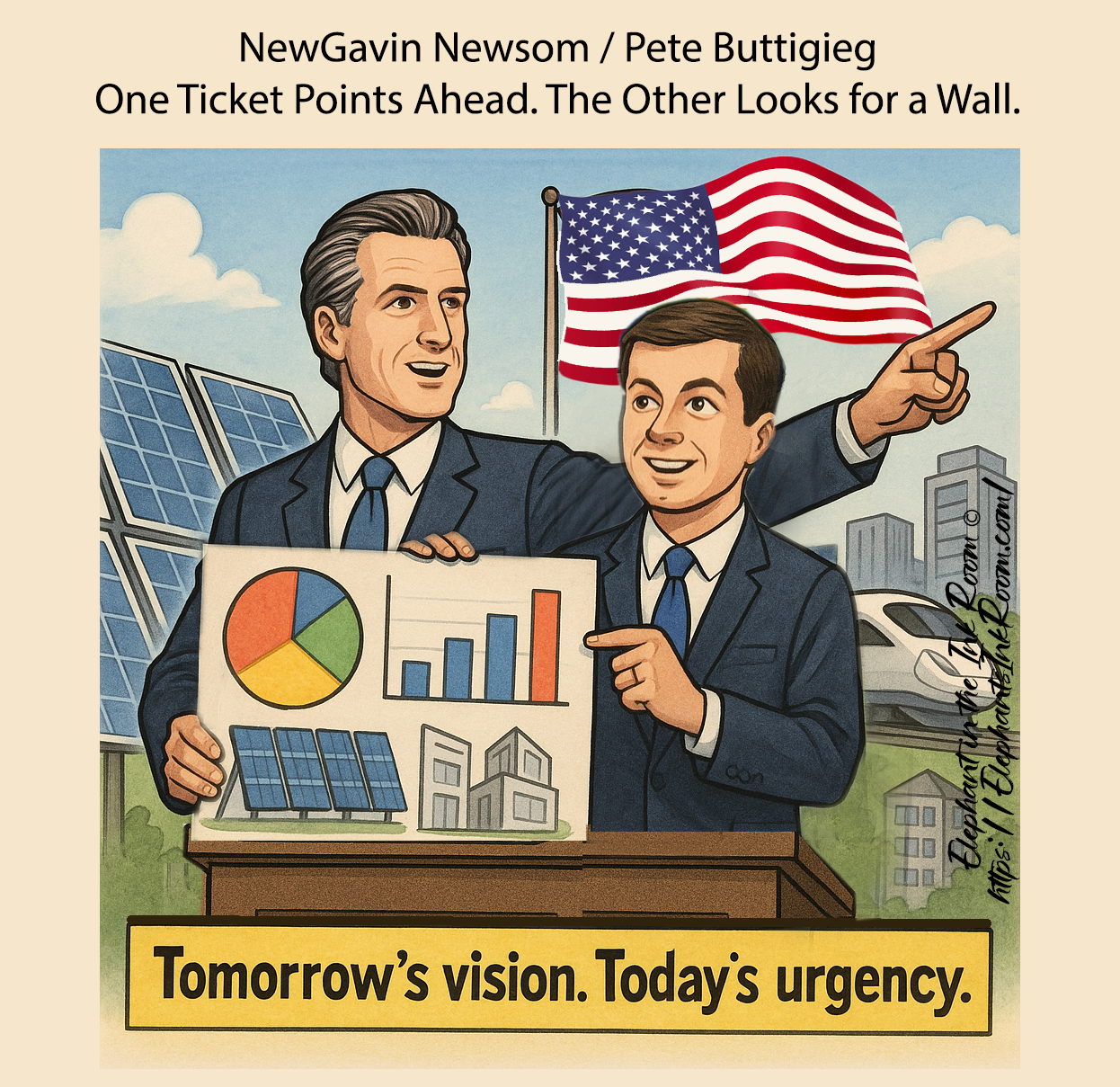




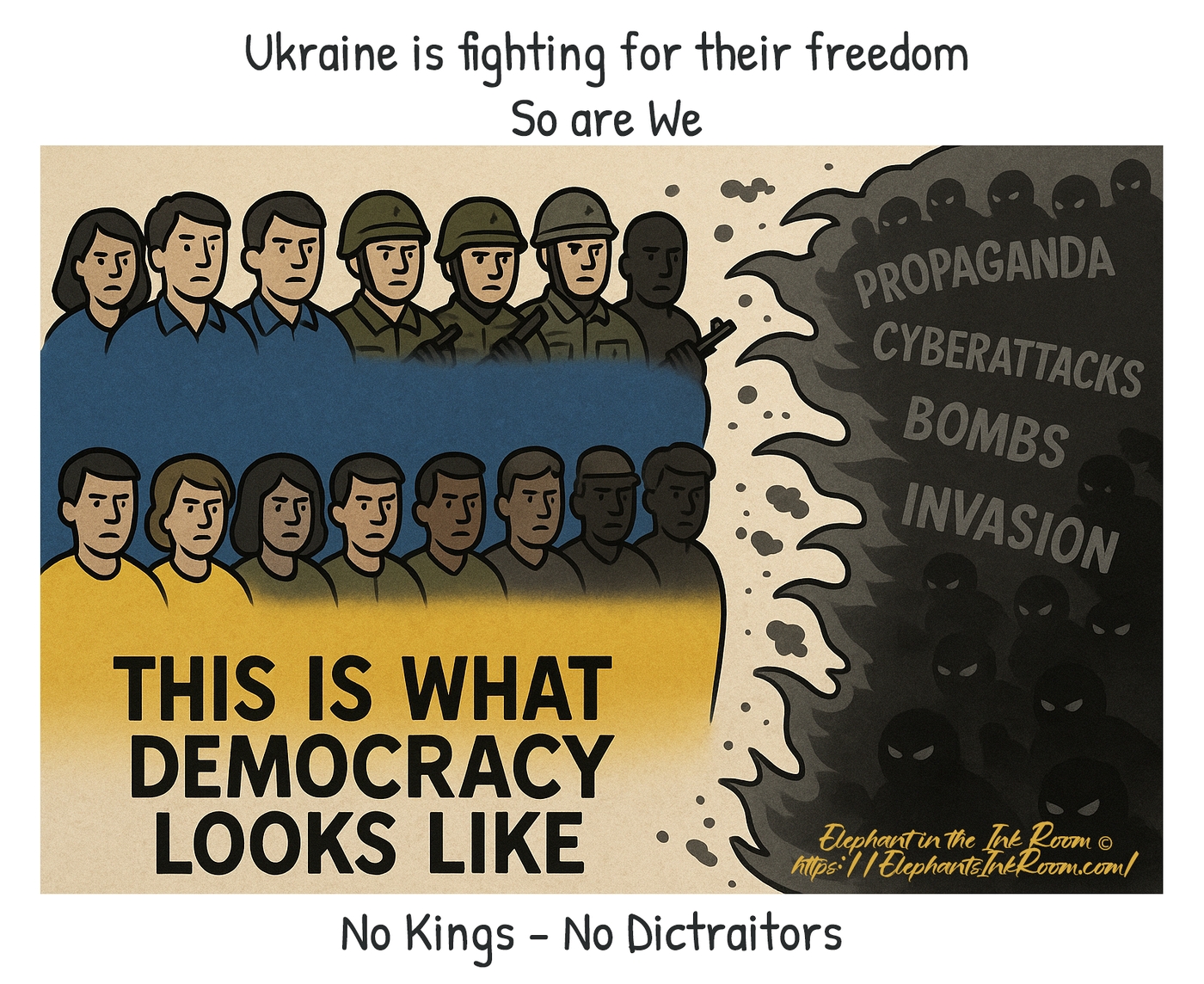


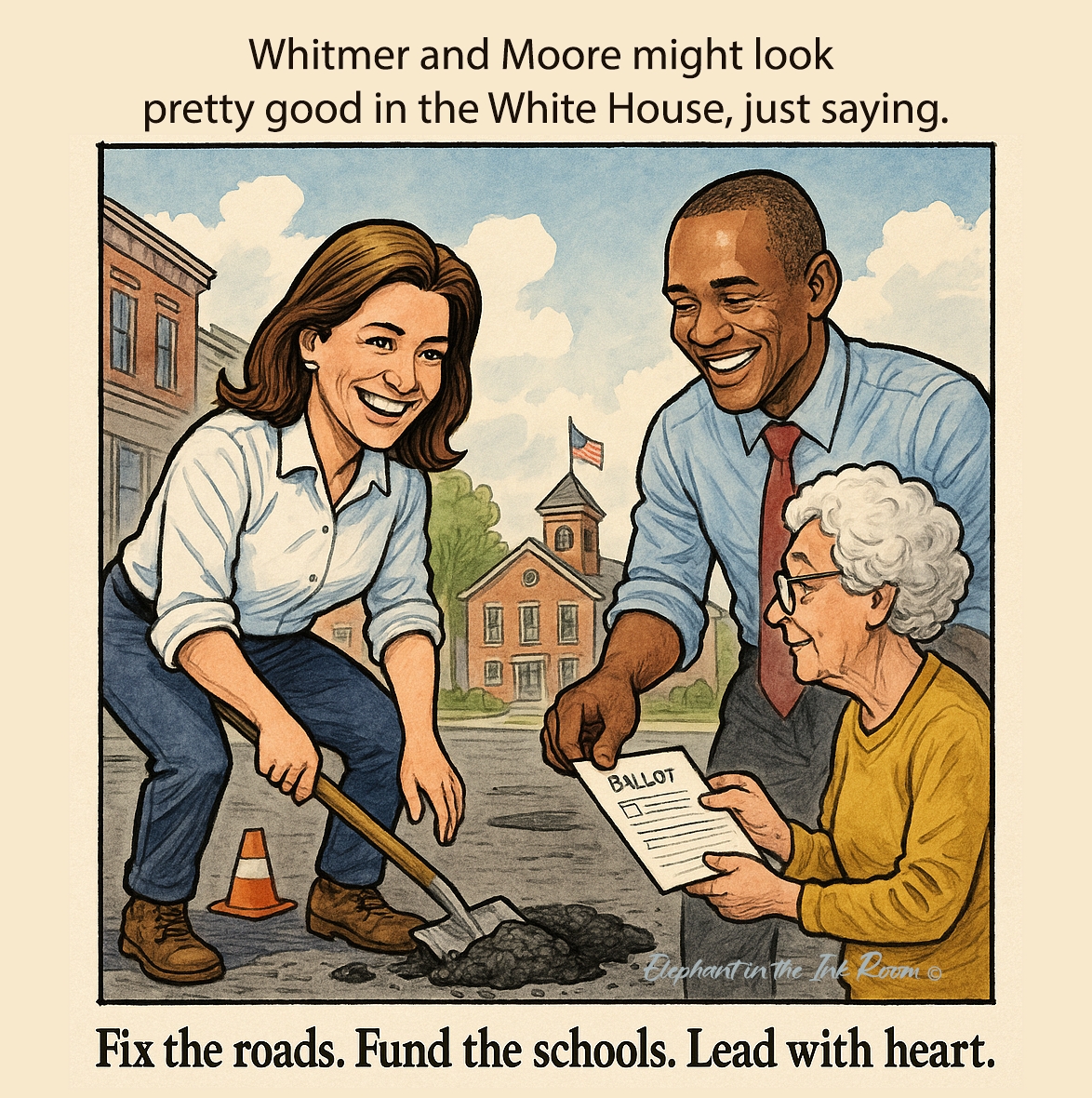
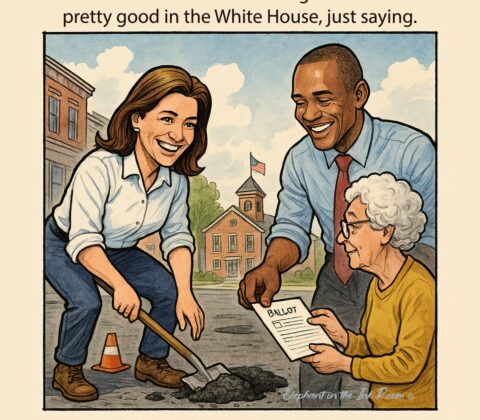

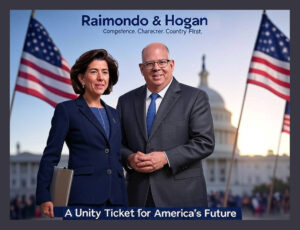
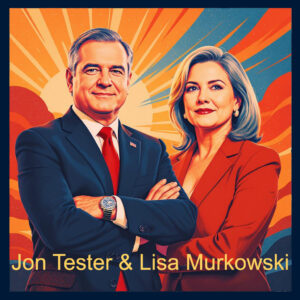
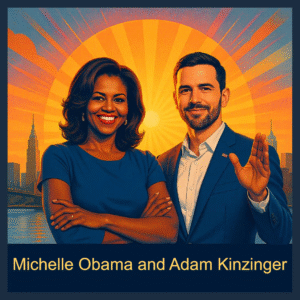
















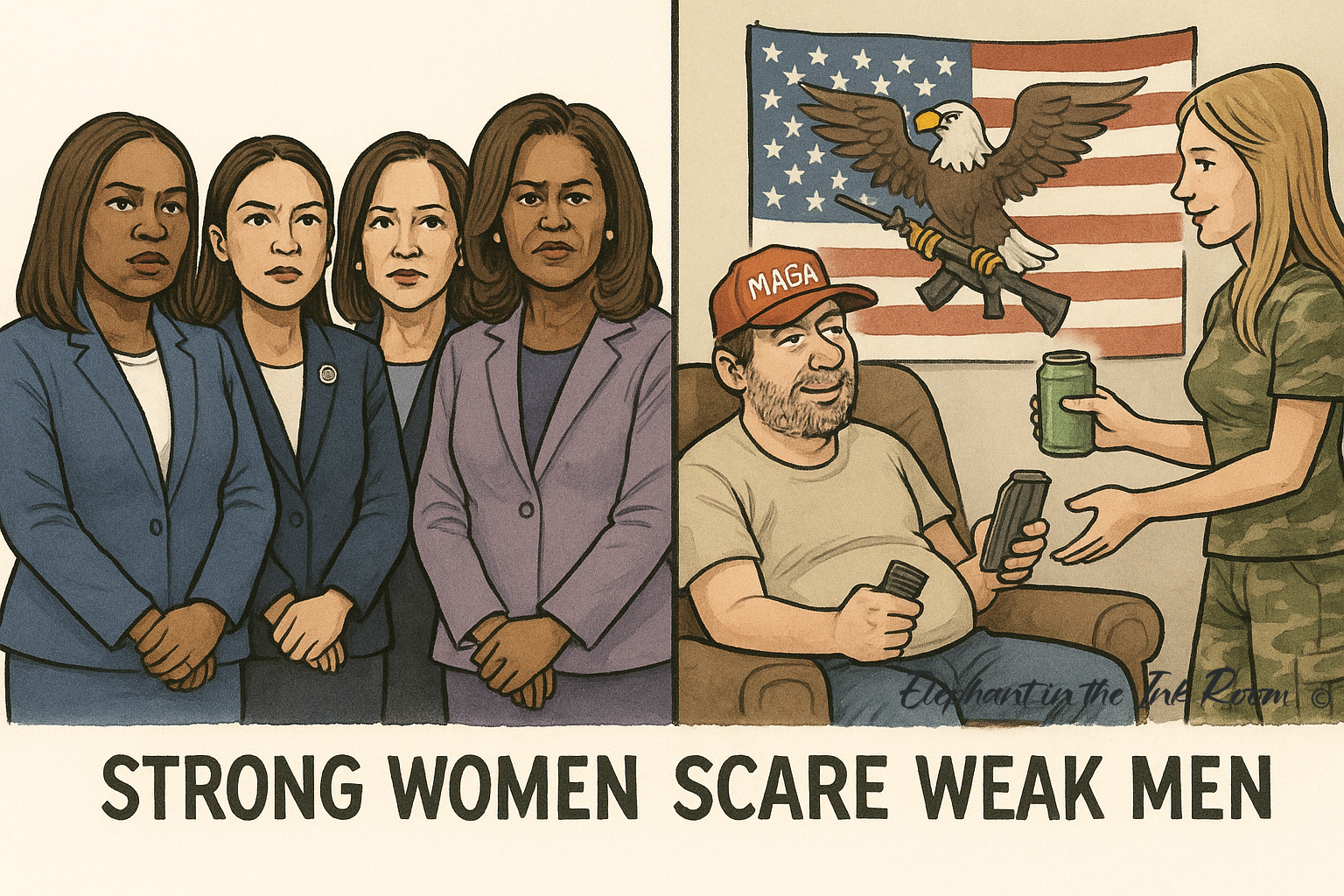


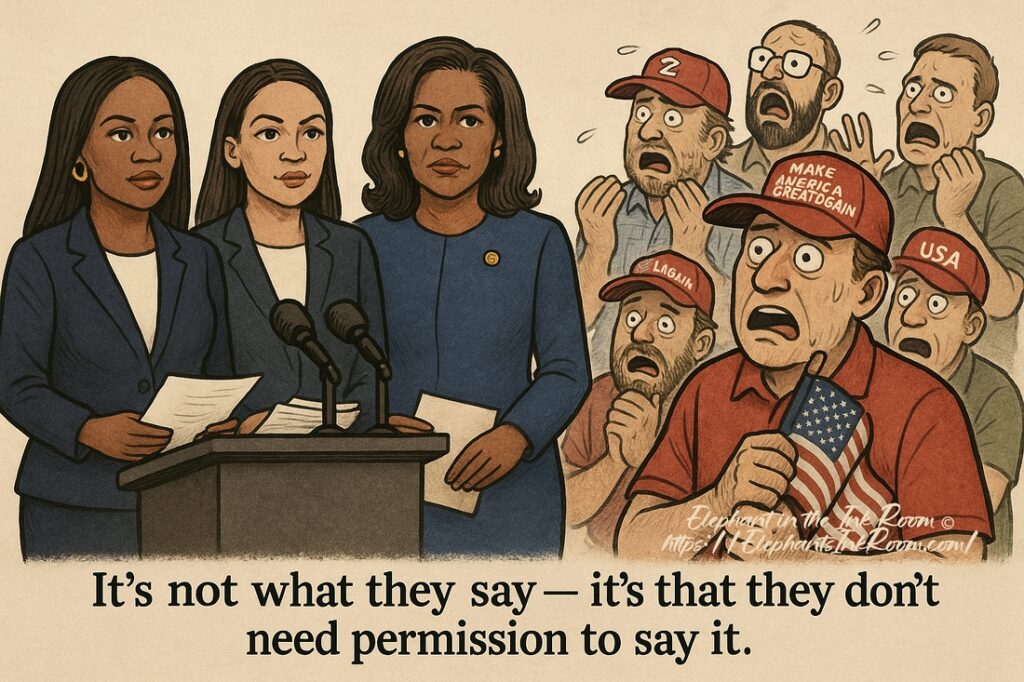

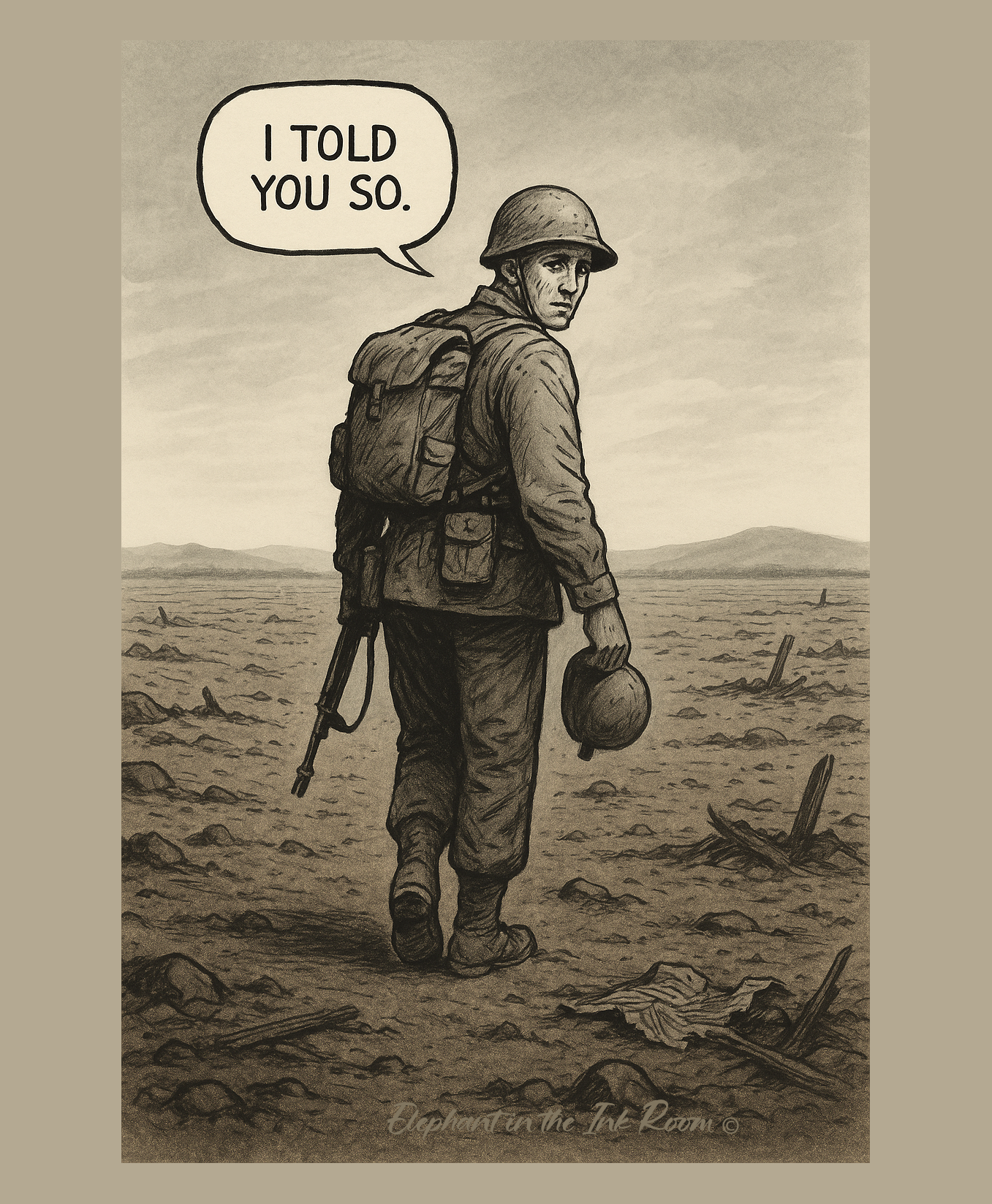




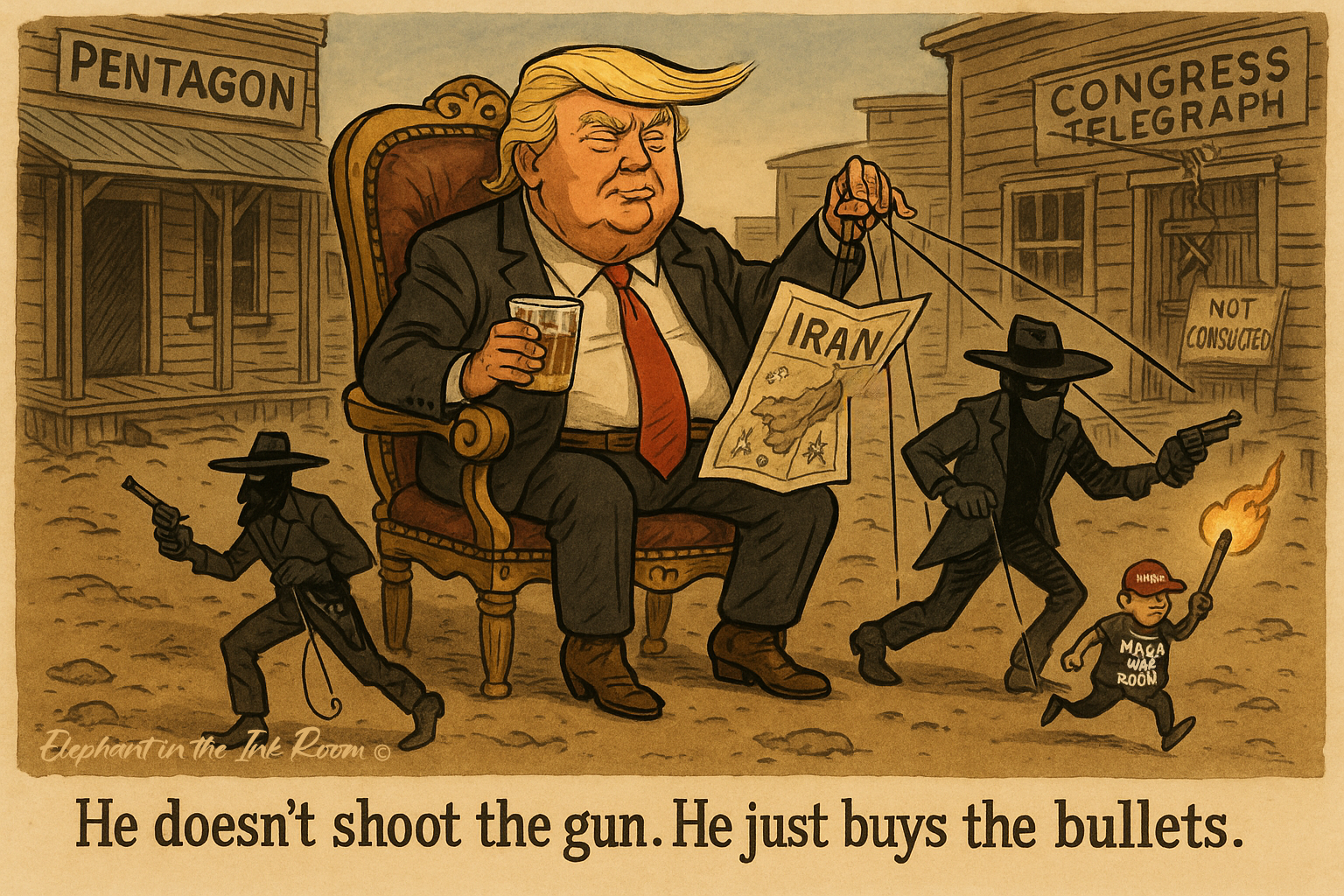




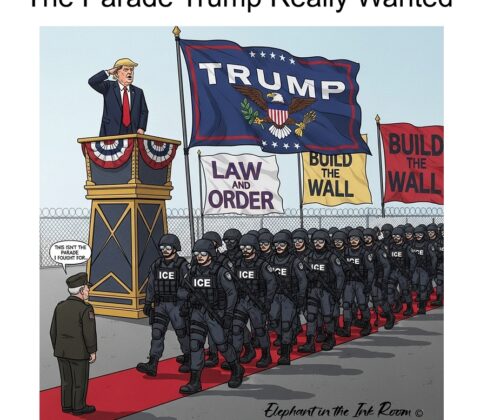






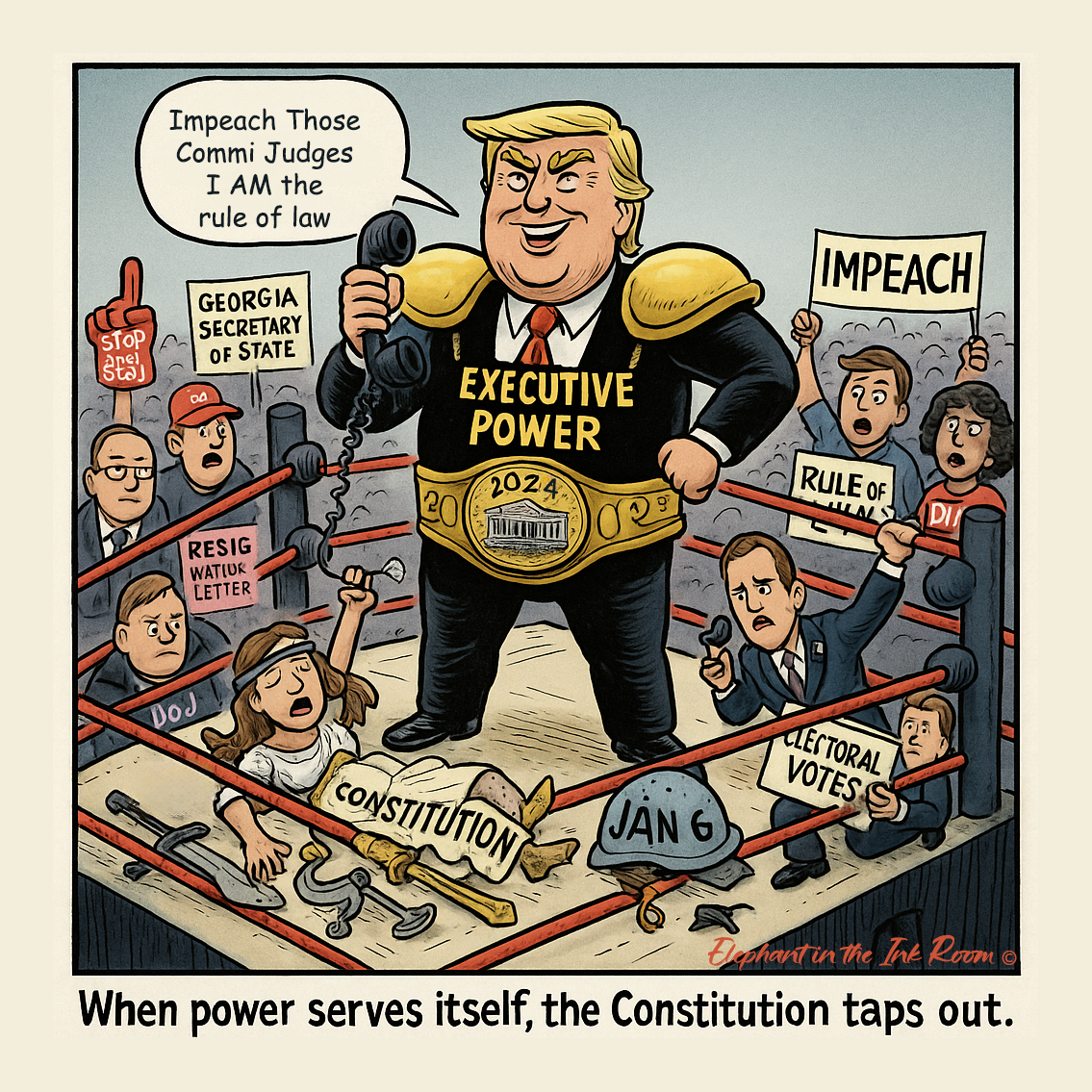
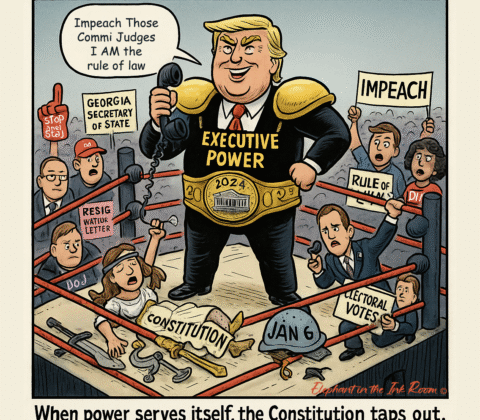


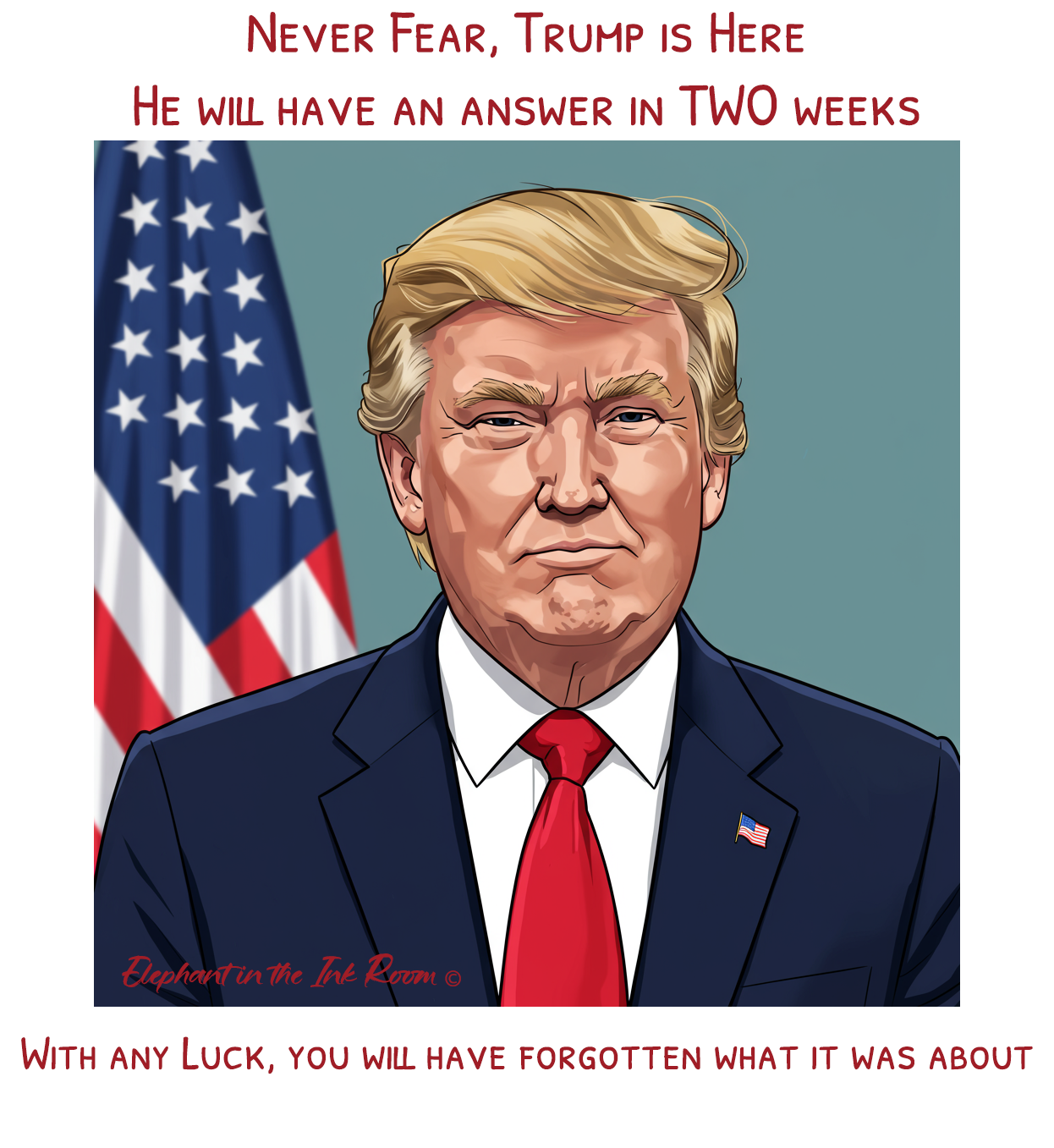

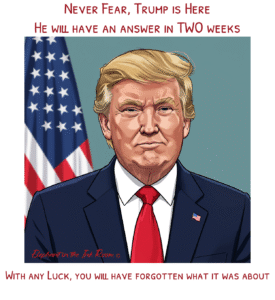

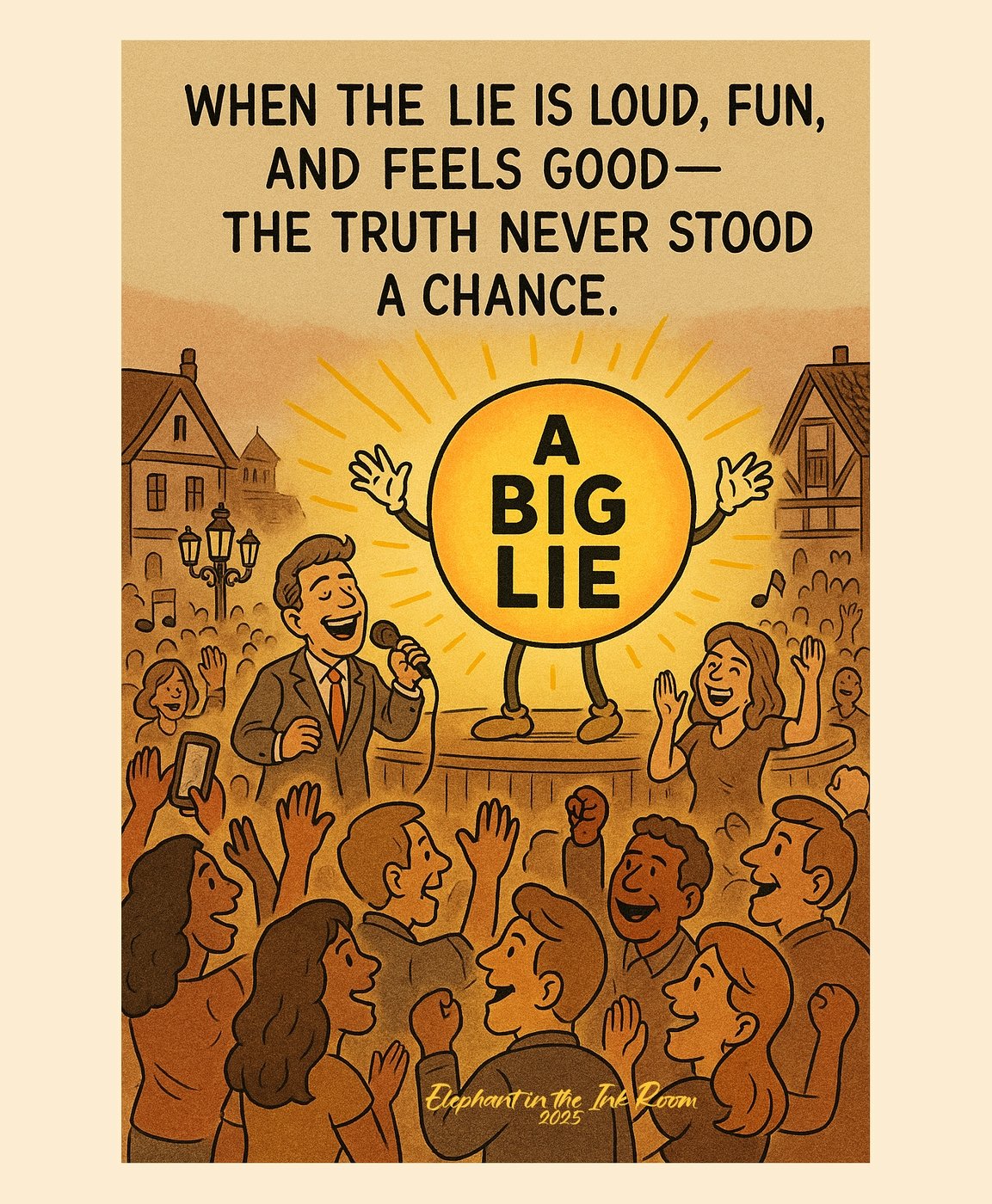


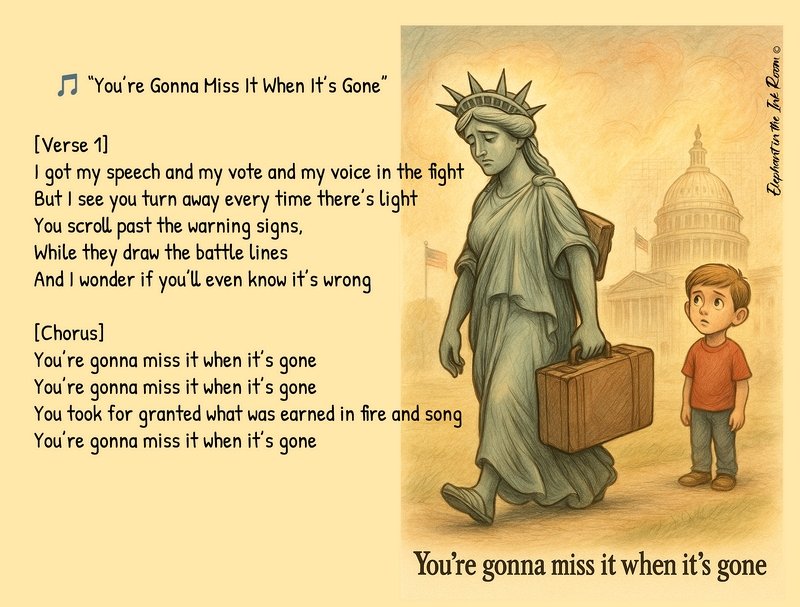



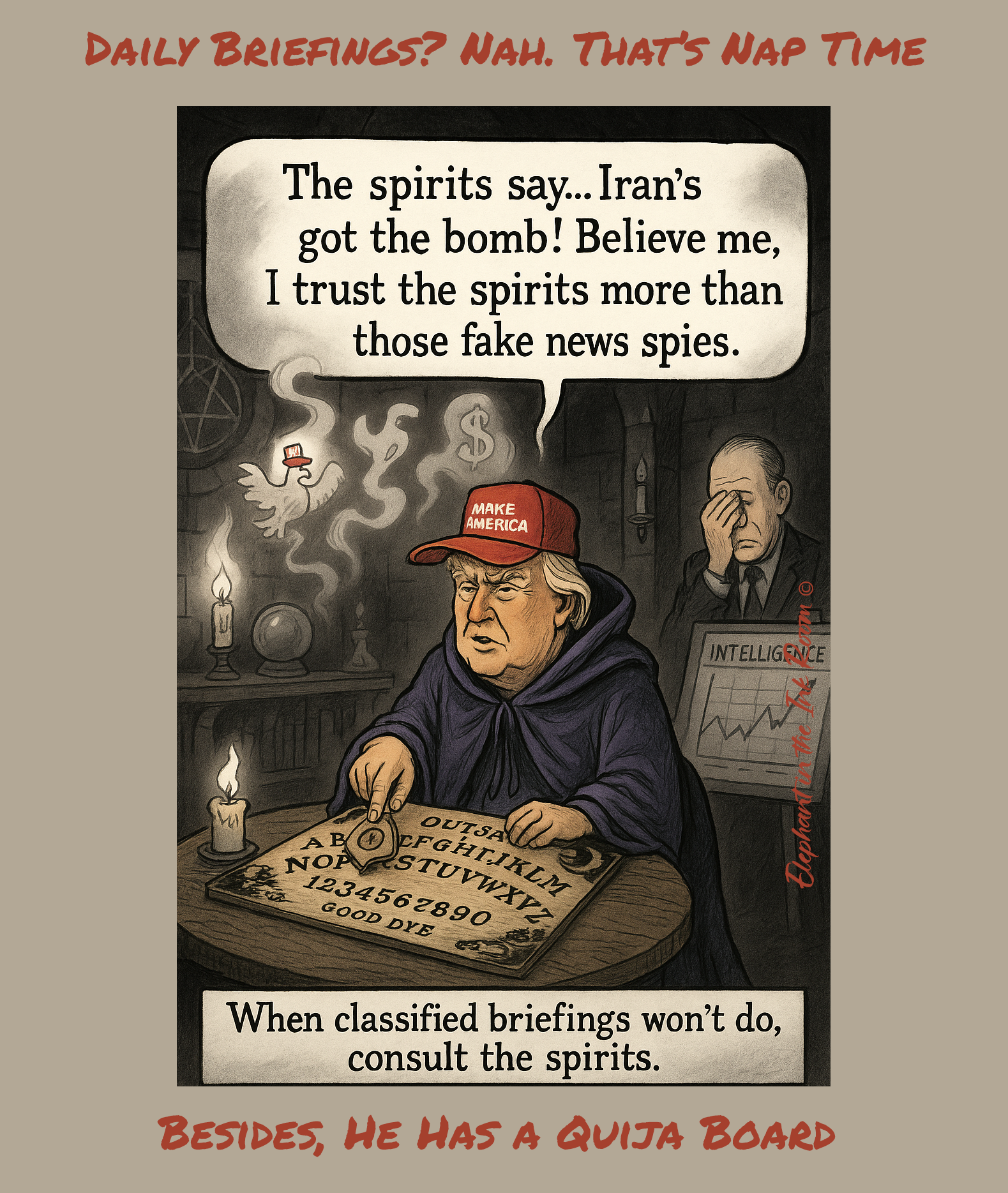

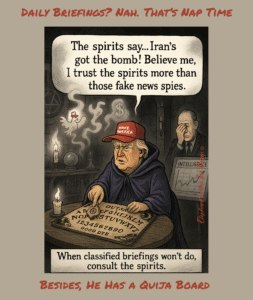

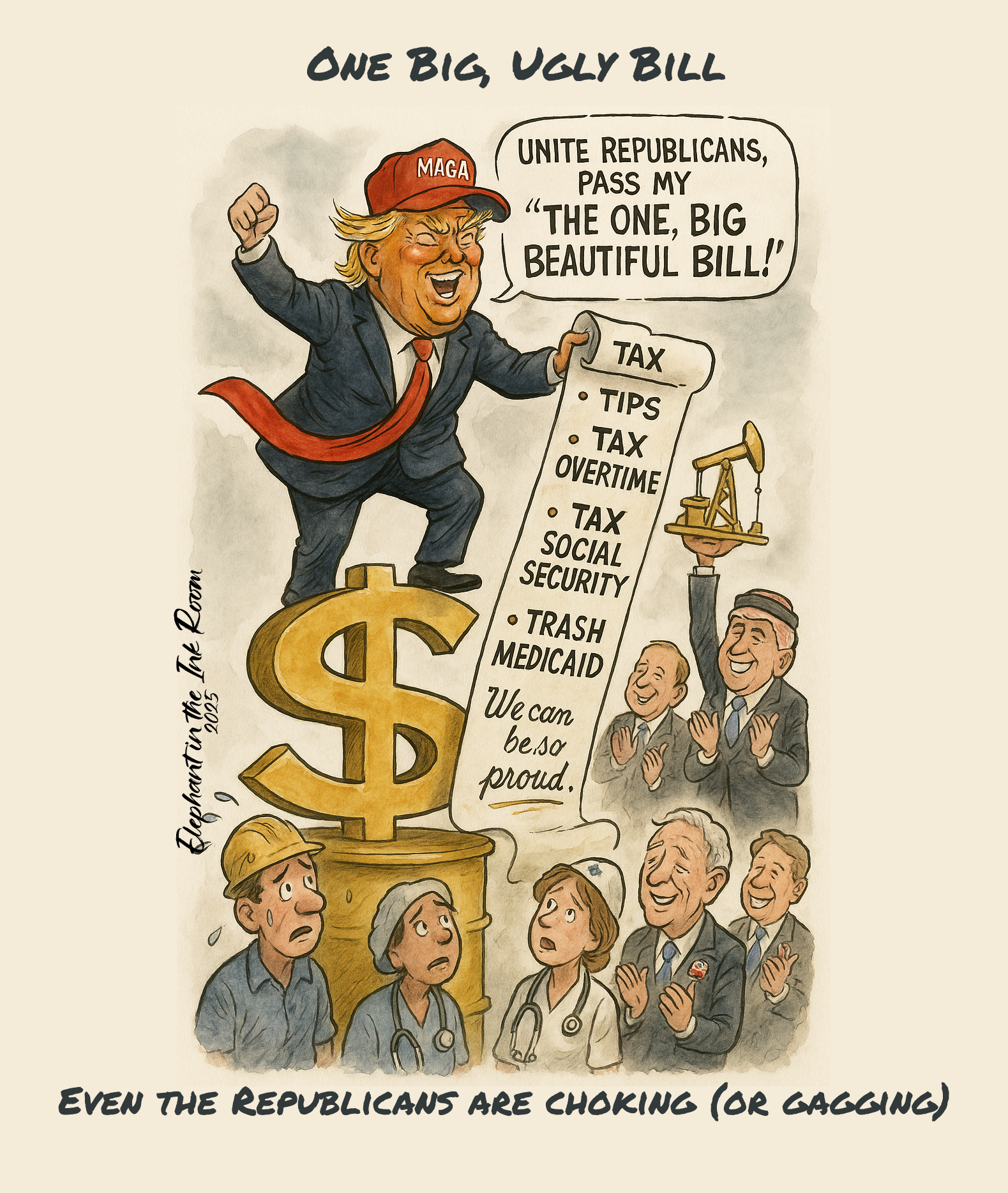


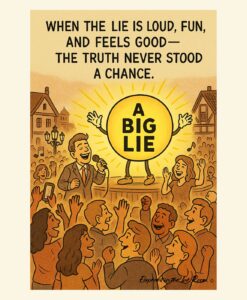
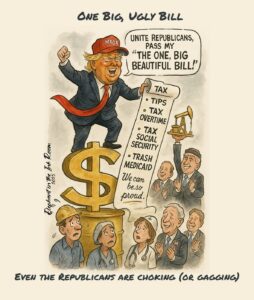

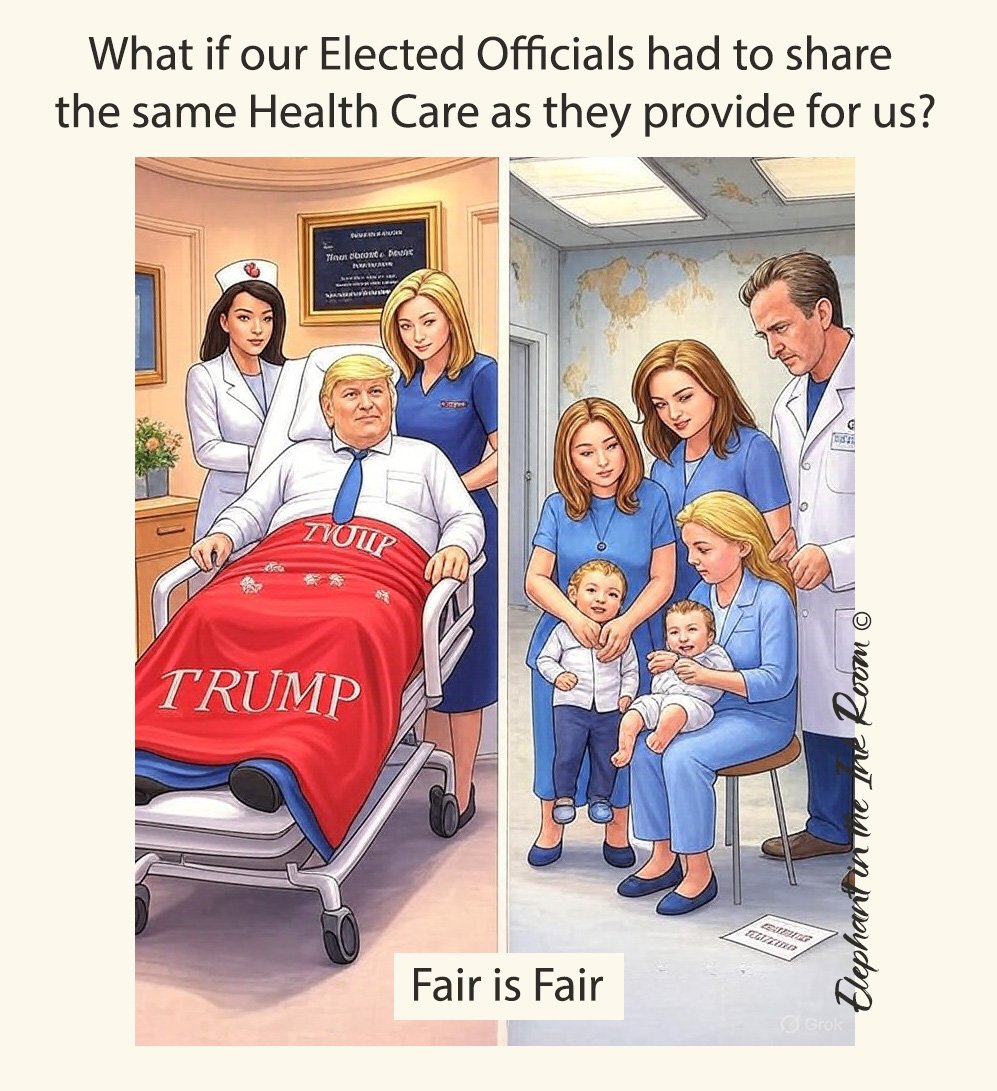




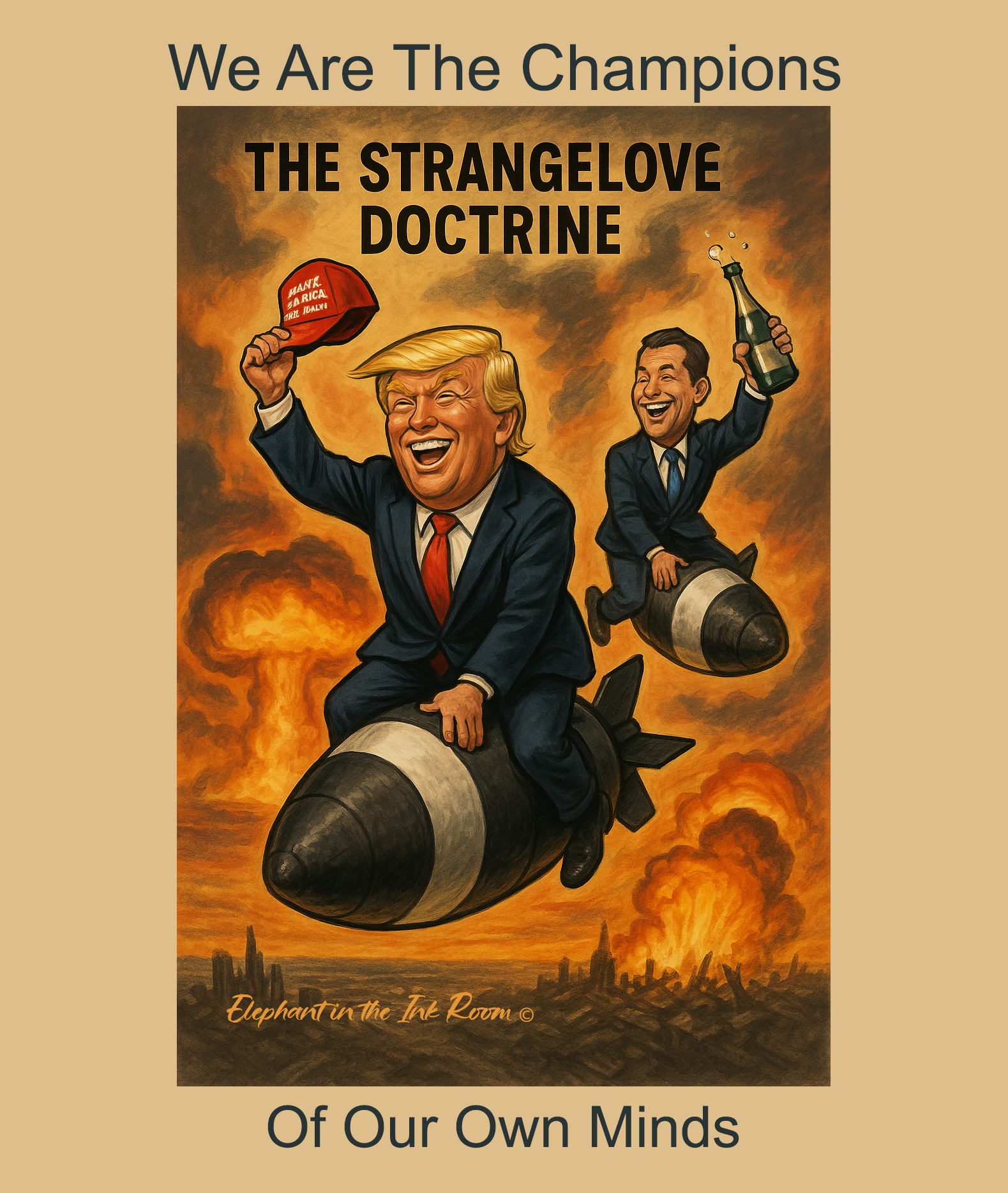

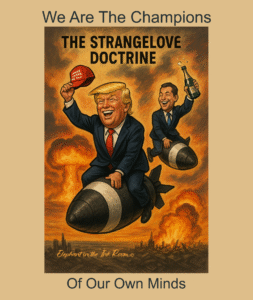




Promises and Prescriptions: The Reality of Veterans’ Healthcare in Trump’s Second Term
Veterans’ healthcare has always been a sacred pledge — a promise exchanged for sacrifice. But in Donald Trump’s second term, that promise is being reshaped, repackaged, and, in some cases, quietly outsourced.
Trump’s rhetoric remains bold: “No one has done more for veterans than me.” But behind the slogans, a different reality unfolds — particularly for those living in rural America, where access to quality care is already a logistical challenge. Under the guise of “freedom of choice,” the Trump administration has accelerated a shift toward privatization, outsourcing more care to the private sector. That sounds good — until you realize that for many veterans, especially in underserved regions, it means longer waits, fewer specialists, and an increased reliance on providers who don’t fully understand the VA system or military-related conditions.
The expanded use of private clinics through the VA Mission Act (initially passed in 2018 but dramatically expanded during Trump’s second term) has created what critics call a “two-tiered system.” The best care remains in VA hospitals, but the funding and resources are quietly being drained away — diverted to private providers whose oversight is looser and whose outcomes vary.
Rural veterans — those who arguably need the most consistent and integrated care — now face a fractured healthcare network. Many have to drive hours, not to the nearest VA hospital, but to a private clinic that may or may not accept them. If they don’t like the care? Tough. The much-touted “choice” is often an illusion.
Meanwhile, Trump’s political allies paint the issue in black-and-white terms: government care bad, private market good. But this ignores a fundamental truth — the VA system, for all its flaws, was built to treat the unique health challenges of veterans: PTSD, burn pit exposure, prosthetics, military sexual trauma. These aren’t routine ailments, and generic civilian care doesn’t cut it.
To make matters worse, partisan messaging has drowned out nuance. Anyone who criticizes the shift is branded as “anti-veteran.” But if honoring veterans means more than applause at rallies, we must ask: what kind of system are we building, and for whom?
Ironically, some of the loudest voices calling for the privatization of the VA have never served. And some of the most outspoken defenders of the VA — doctors, nurses, and veterans themselves — are struggling to be heard above the political noise.
In Trump’s second term, the battle for veterans’ healthcare isn’t just about clinics and co-pays. It’s about priorities. Do we value loyalty to slogans, or loyalty to those who served? Do we want a healthcare system that rewards political donors, or one that keeps its promise to the people who wore the uniform?
Veterans didn’t ask for this ideological experiment. They asked for care, dignity, and respect. It’s time we deliver.
Share this:
Like this: