Skip to content



It wouldn’t “die quickly”—more like a temporary federal retreat, with momentum shifting to states and courts. Post-2020, GOP election denialism rewarded incumbents (e.g., no electoral penalty for “stop the steal” supporters in 2022). But backlash (e.g., bipartisan criticism of Georgia raids) could erode support if overreach backfires.
Posts in Category: Voting Rights
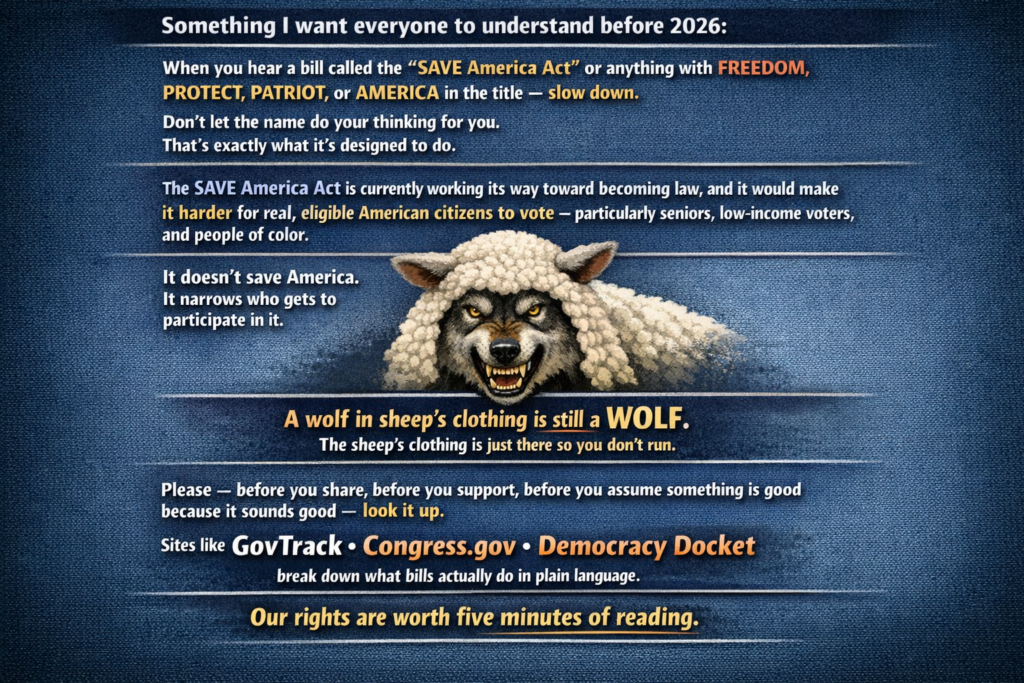
BEWARE THE NAME The more patriotic the name, the more suspicious you should be.
Something I want everyone to understand before 2026:
When you hear a bill called the “SAVE America Act” or anything with FREEDOM, PROTECT, PATRIOT, or AMERICA in the title — slow down. Don’t let the name do your thinking for you.
That’s exactly what it’s designed to do.
The SAVE America Act is currently working its way toward becoming law, and it would make it harder for real, eligible American citizens to vote — particularly seniors, low-income voters, and people of color who may not have easy access to the specific documents it requires.
It doesn’t save America. It narrows who gets to participate in it.
A wolf in sheep’s clothing is still a wolf. The sheep’s clothing is just there so you don’t run.
Please — before you share, before you support, before you assume something is good because it sounds good — look it up. Sites like GovTrack, Congress.gov, and Democracy Docket break down what bills actually do in plain language.
Our rights are worth five minutes of reading.
Share this:

How to Protect your Voting Rights
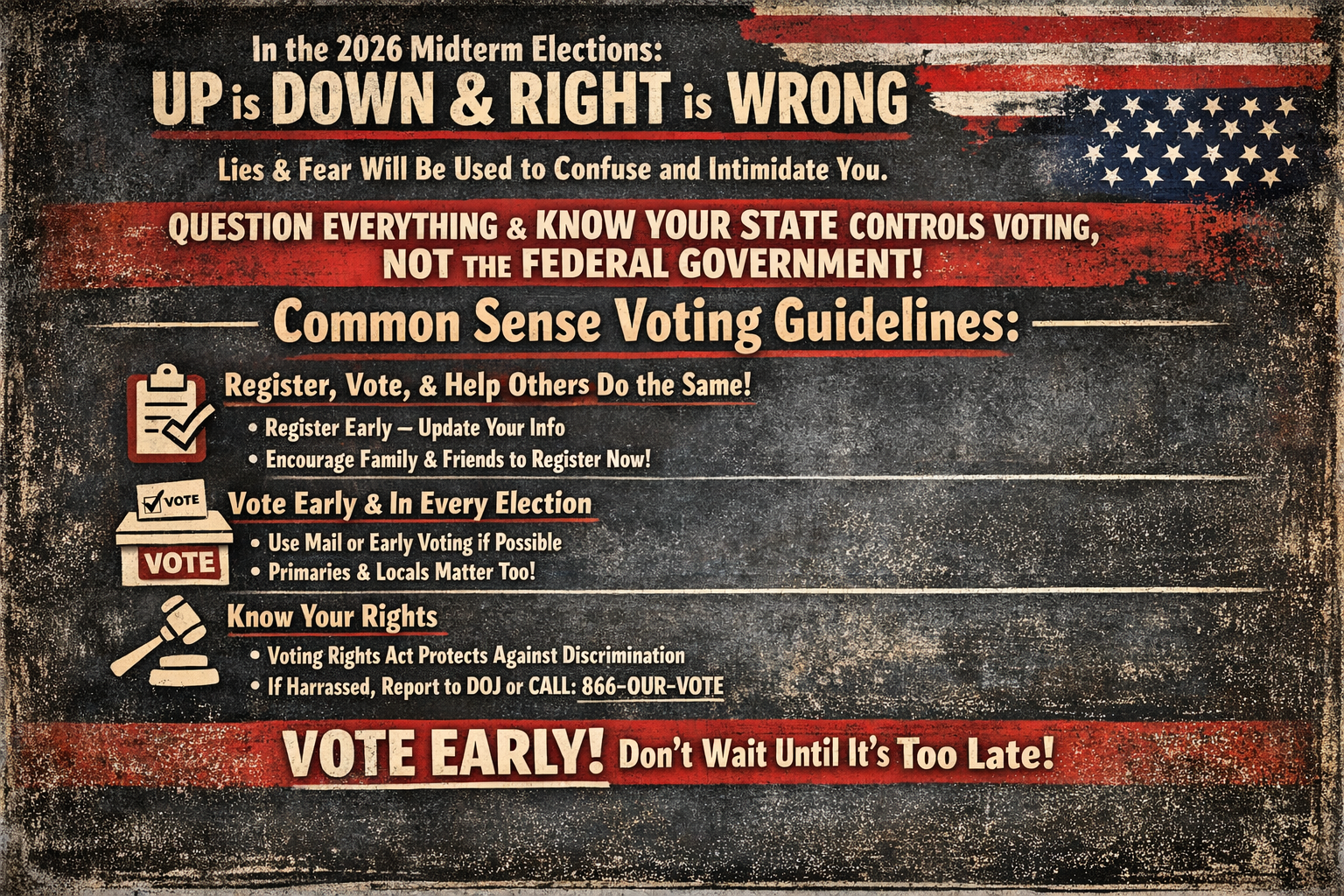
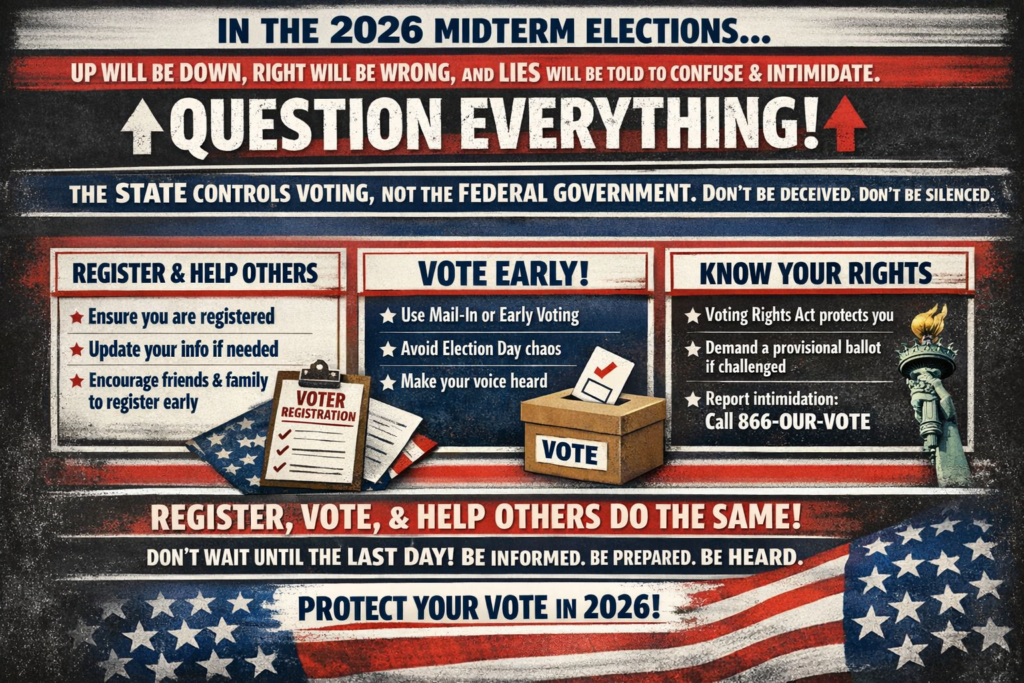
In the coming months we will told up is down, right is wrong and a myriad of lies designed to confuse and intimidate the way you vote in the 2026 Midterm Elections.
Question what you are being told, check with your State, The State controls voting, not the Federal Government and especially not the current administration. You will lied to and you will be threatened.
Follow these common sense guidelines to insure your vote will count and above ALL. vote early, do not wait until the last day to be heard as that will be when most efforts to disrupt the voting process will be.
Register, Vote, and Help Others Do the Same
-
Ensure you’re registered and update your information if needed—use the National Voter Registration Act (NVRA) provisions, which allow registration at DMVs or online in many states. Encourage friends, family, and neighbors to register early to avoid last-minute barriers.
-
Vote in every election, including primaries and locals, where turnout can influence who shapes voting rules. If mail voting or early voting is available in your state, use it to reduce reliance on Election Day logistics that could be disrupted.
-
Know your rights: Federal laws like the Voting Rights Act prohibit discrimination based on race, color, or language, and the Help America Vote Act (HAVA) ensures provisional ballots if your eligibility is questioned. If you face issues at the polls (e.g., intimidation or denial), report them immediately to the DOJ’s Voting Section or the Election Protection Hotline (866-OUR-VOTE).
Share this:

Is This You?
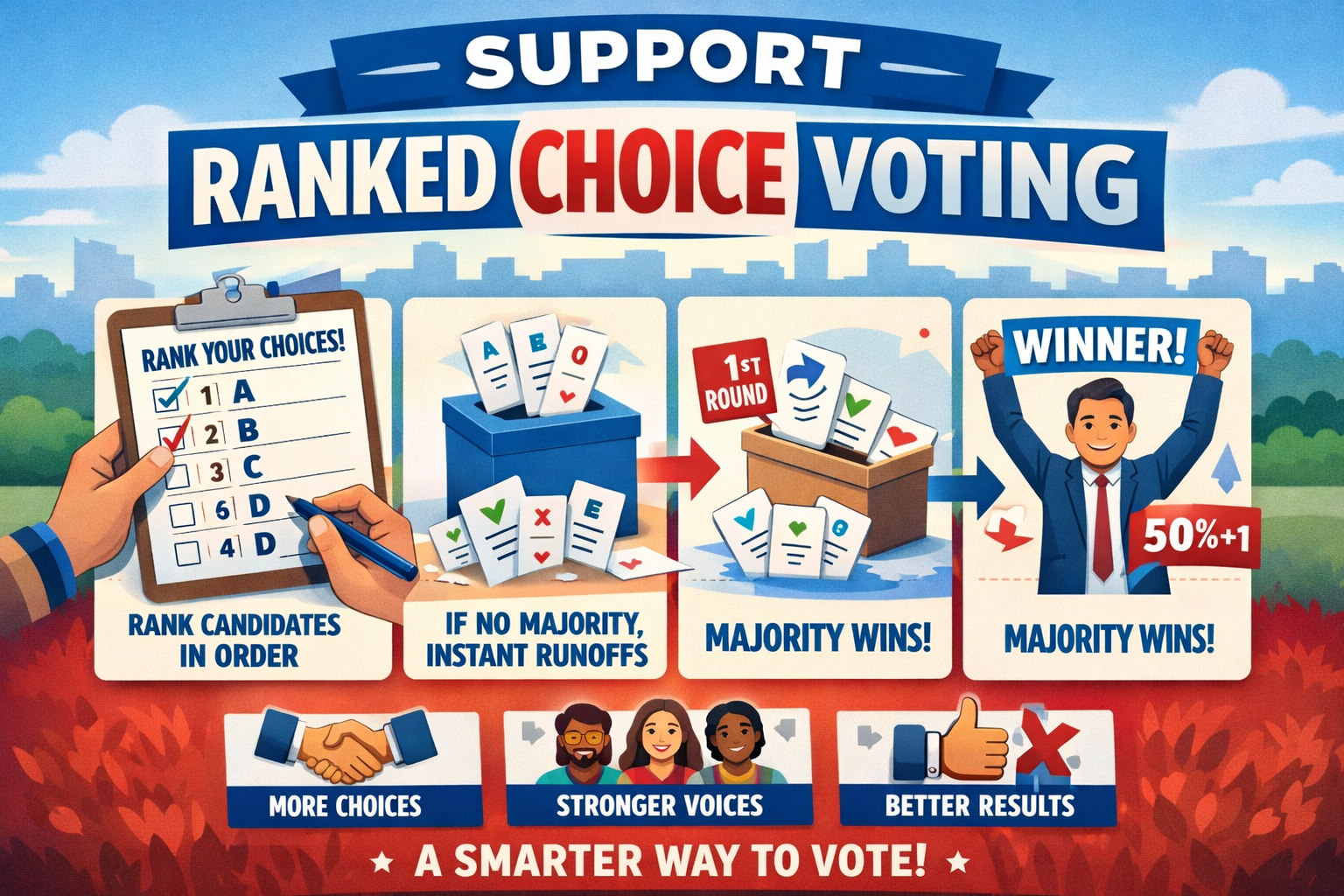
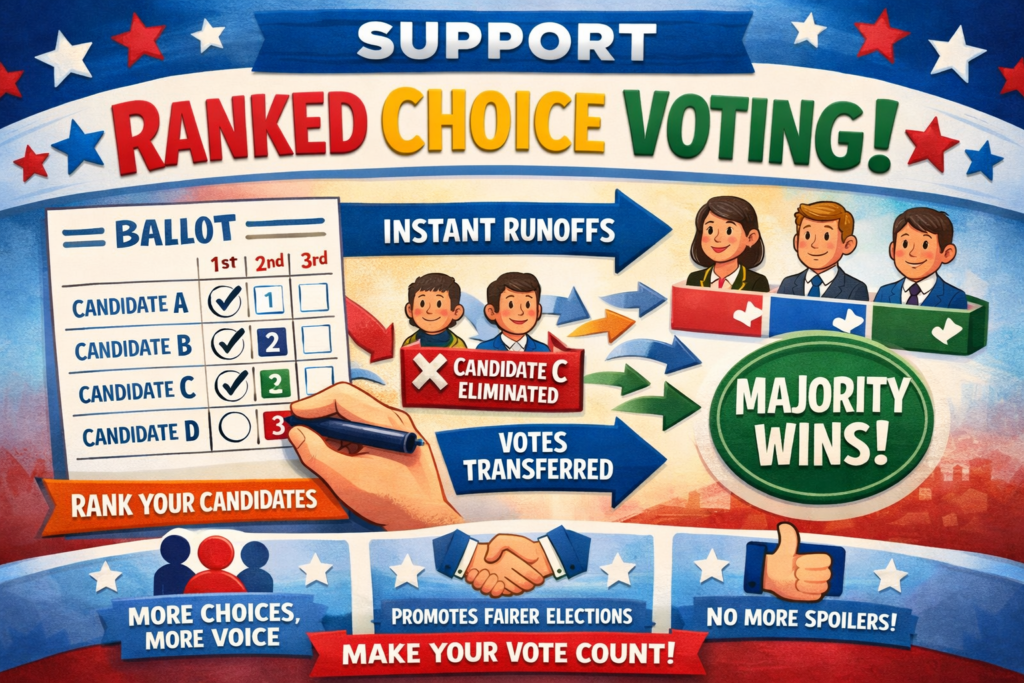
I must say terms like RINO are offensive and inaccurate. It should also be noted that the largest percentage of voters, over 45% align themselves as independents, maybe that’s why both parties fight so hard to keep this a two party system and are against ranked choice voting. If given the opportunity, both sides would lose.
Rank them in the order you prefer 🙂
-
“I’ve always thought of myself as a [Republican/Democrat], but it feels like the party has moved in a direction that doesn’t quite match where I’ve always stood. I haven’t really changed—it’s more that things have shifted around me.”
-
“I’m still the same [Republican/Democrat] I’ve always been, but lately the party seems to have gone in a different direction from the values I first signed up for.”
-
“I get why people might think I’ve switched sides, but honestly, I haven’t left the party—it just feels like the party’s priorities have drifted away from what drew me to it in the first place.”
-
“My views haven’t really changed over the years, but I do feel like the party as a whole has evolved in ways that don’t line up with mine anymore.”
Share this:

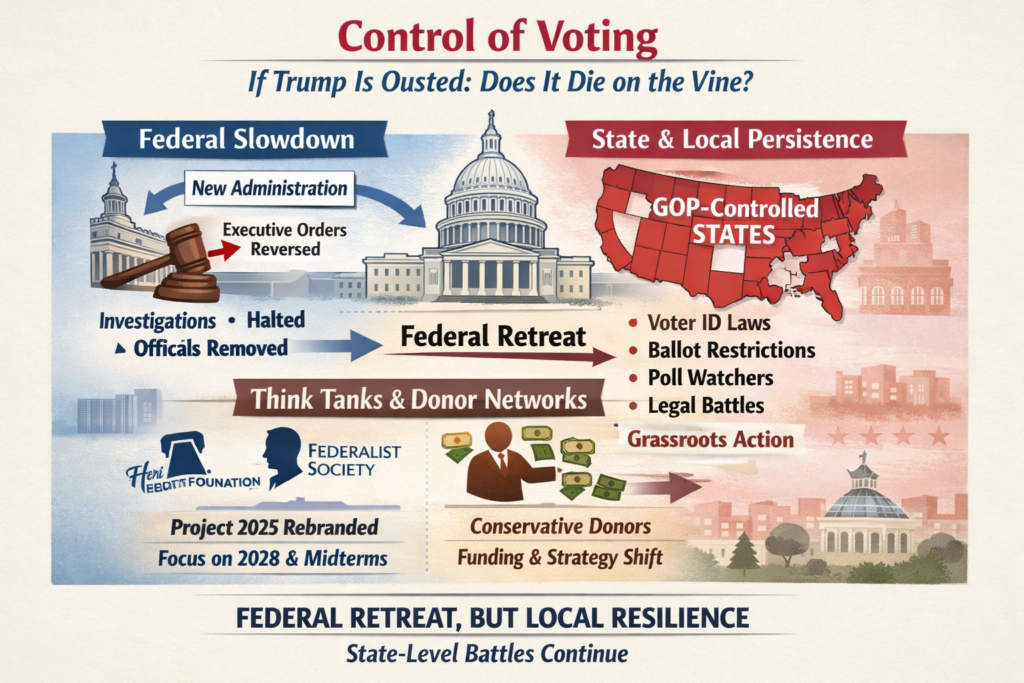
Control of Voting – If Trump Is Ousted: Does It Die on the Vine?
Control of Voting – If Trump Is Ousted: Does It Die on the Vine?
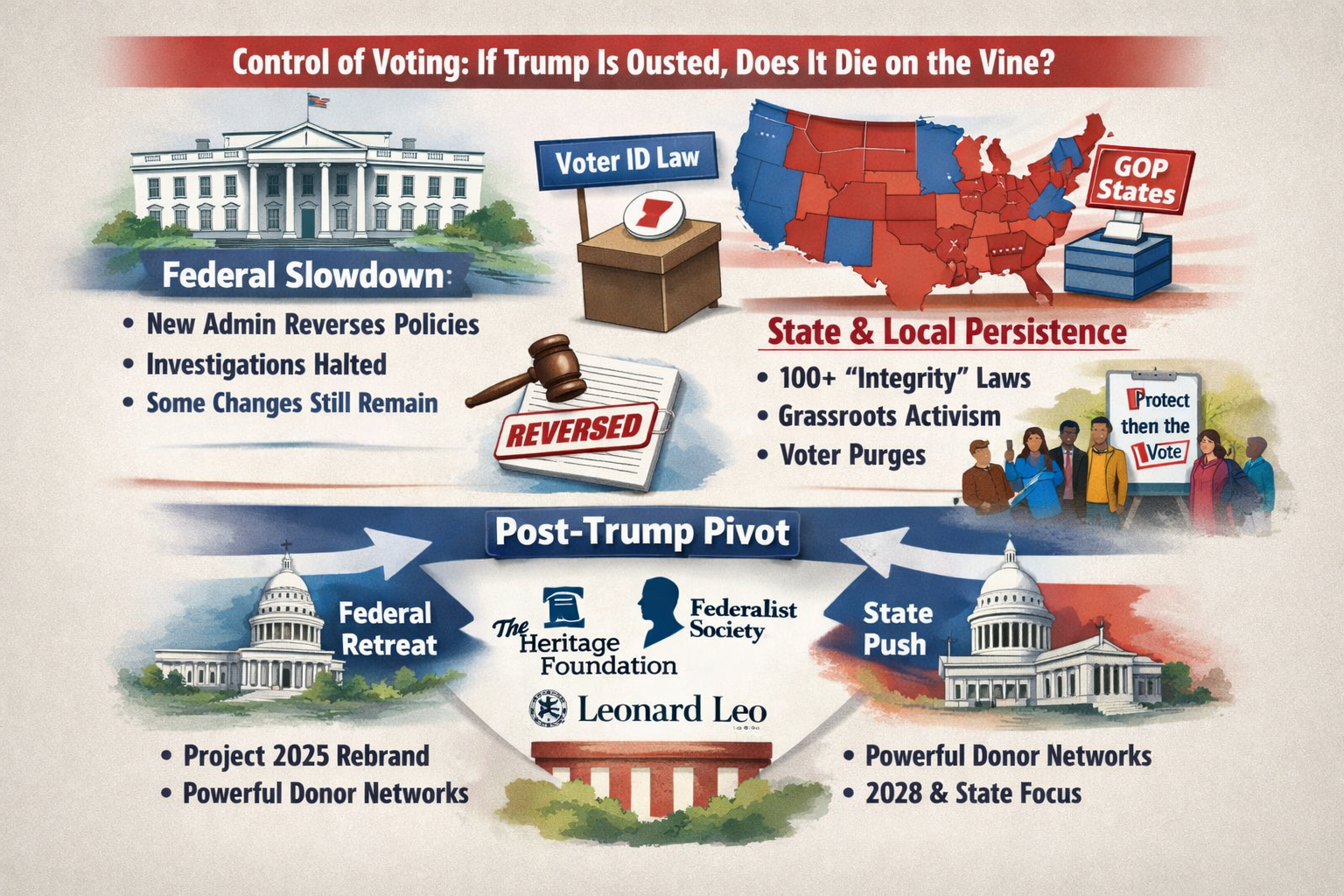
Not entirely, it would slow at the federal level, but these efforts are bigger than one person. Project 2025 isn’t just a Trump playbook; it’s a Heritage Foundation-led blueprint from over 100 conservative groups, predating his second term. By October 2025, Trump had implemented ~47% of its domestic agenda (e.g., workforce cuts via shutdown, executive orders on election “integrity”).
If impeached/removed:
Federal Slowdown: A new admin (e.g., under Vance or a Democrat post-midterms) could reverse executive orders, like Biden did with Trump’s first-term policies. DOJ probes into “fraud” might halt, and appointees like Cleta Mitchell’s network could be ousted. But some changes (e.g., embedded federal observers, voter roll purges) could linger if not actively undone, per experts at the Center for American Progress.
State and Local Persistence: Much of this is decentralized. GOP-led states have passed 100+ “integrity” laws since 2020 (e.g., voter ID, mail ballot restrictions), independent of Trump. Groups like the Election Integrity Network or RNC’s Protect the Vote operate at grassroots levels, training poll watchers and filing lawsuits, stuff that doesn’t vanish overnight. Even without Trump, red states resist federal overreach (e.g., some GOP secretaries of state withholding full voter data from DOJ).
Think Tank and Donor Networks: Heritage, Federalist Society, and funders like Leonard Leo would pivot. Project 2025 is framed as a “conservative promise” for any GOP admin, not Trump-specific. If Trump goes, they’d rebrand for 2028 (e.g., focusing on state ballot initiatives, litigation).
It wouldn’t “die quickly”—more like a temporary federal retreat, with momentum shifting to states and courts. Post-2020, GOP election denialism rewarded incumbents (e.g., no electoral penalty for “stop the steal” supporters in 2022). But backlash (e.g., bipartisan criticism of Georgia raids) could erode support if overreach backfires.
Will They Shift Gears?
Absolutely, conservative networks are adaptive. Without Trump, tactics might soften federally (e.g., less overt “nationalization” talk) but intensify locally: more state laws, voter challenges, or “audit” pushes. X chatter and op-eds suggest prepping for 2028 census fights or midterms as a “blue tsunami” opportunity for Dems. Critics (ACLU, Brennan) warn it could evolve into subtler subversion, like weakening DOJ voting rights enforcement.
In my view, this is a long-game ecosystem (think tanks, donors, state parties) that’s survived presidents before. Trump’s a catalyst, but removal would force a tactical reset—not abandonment. The midterms are the pivot point; if GOP holds, it accelerates. If not, it decentralizes.
Share this:

Seize Control of Voting, Who is Behind the Curtain
Feb 11, 2026, I read this informative article about the FBI seizing the voting records in Georgia.
“The Silent Coup Is Already Underway: How Trump is moving to seize control of voting — starting in Georgia” by Glenn Kessler (published on his Substack: glennkessler.substack.com).
It discusses concerns over Donald Trump’s statements and actions aimed at influencing or “nationalizing” election processes, with a focus on Georgia as an early example. The article opens with a quote from Trump in a February 2 interview with Dan Bongino: “The Republicans ought to nationalize the voting.” It revisits Trump’s past claims of election fraud and frames current moves (like potential federal involvement in state voting systems, ballot handling, or oversight) as steps toward greater control ahead of future elections, such as the 2026 midterms.
My question is who is actually the architect? I don’t believe Trump ever had the smarts to do this on his own and certainly not now. Someone or some organization is orchestrating everything behind the scenes
Key Players and Enablers from the Article and Related Context
The Kessler article doesn’t name an overarching “architect” but points to several individuals and groups actively involved in pushing this agenda, particularly in Georgia as a testing ground:
Cleta Mitchell: She’s a prominent conservative lawyer who was on the infamous 2021 call where Trump pressured Georgia’s Secretary of State Brad Raffensperger to “find” votes. Mitchell now leads the Election Integrity Network, a group focused on challenging election processes and training poll watchers. The article notes her influence through appointees like Heather Honey (Deputy Assistant Secretary for Election Integrity), who has ties to Mitchell’s network and has floated ideas like declaring a “national emergency” to override state voting rules.
Kurt Olsen: Appointed by Trump as Director of Election Security and Integrity, he’s been sanctioned in the past for baseless election fraud claims. He referred the warrant that led to the FBI seizing Fulton County ballots in January 2026, reviving old 2020 conspiracies.
Tulsi Gabbard: As Director of National Intelligence, she oversaw the FBI raid on Fulton County for a vague “national security issue,” which the article suggests is a pretext for federal overreach.
These folks aren’t new; they’ve been part of Trump’s orbit since his first term or the 2020 challenges. The Georgia focus—using a Trump-friendly state election board to potentially seize county boards—seems designed as a blueprint for scaling up nationally, per the article.
Broader Influences and Organizations
Looking beyond the piece, reporting ties this to a more structured conservative playbook that’s been in development since at least 2024-2025:
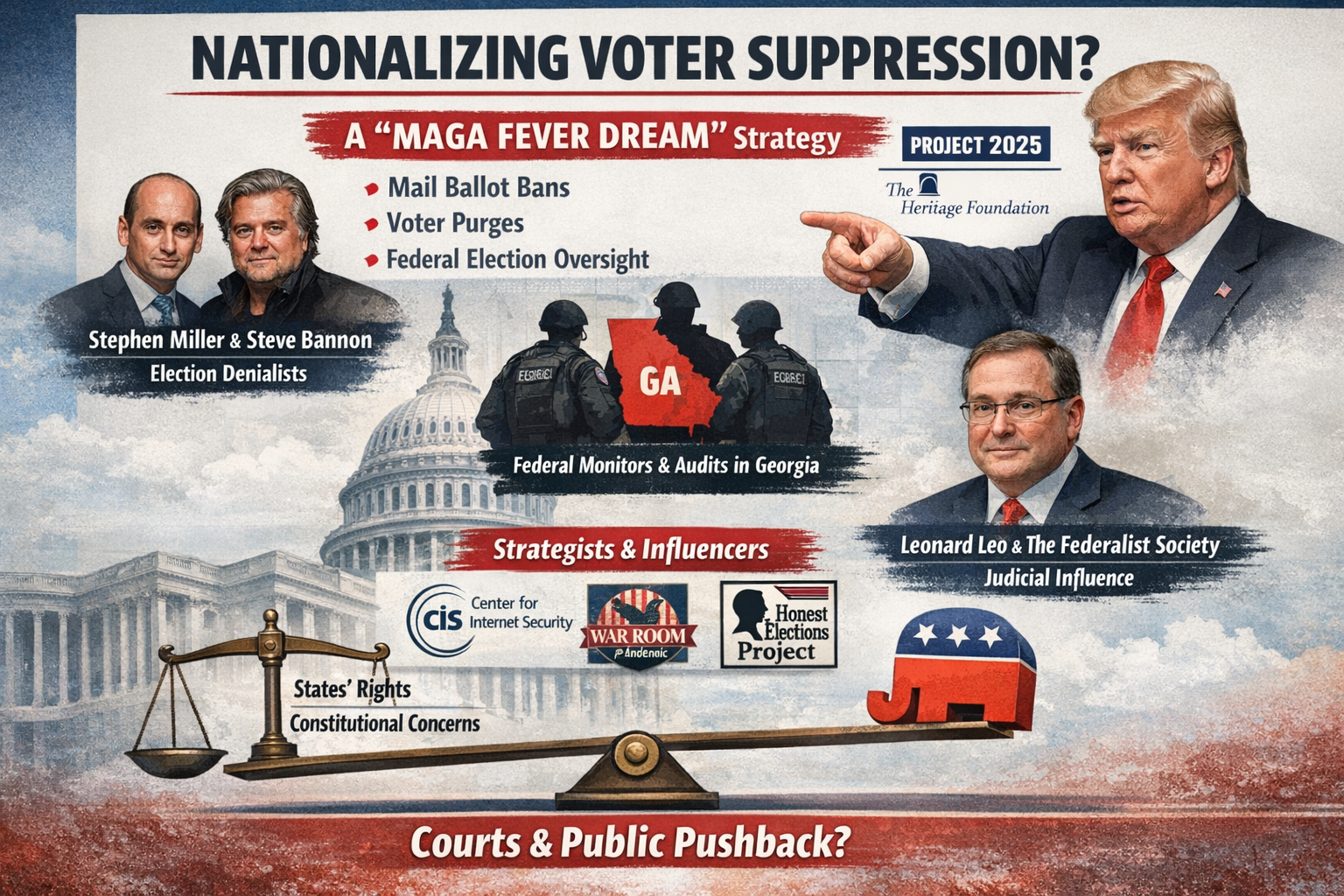
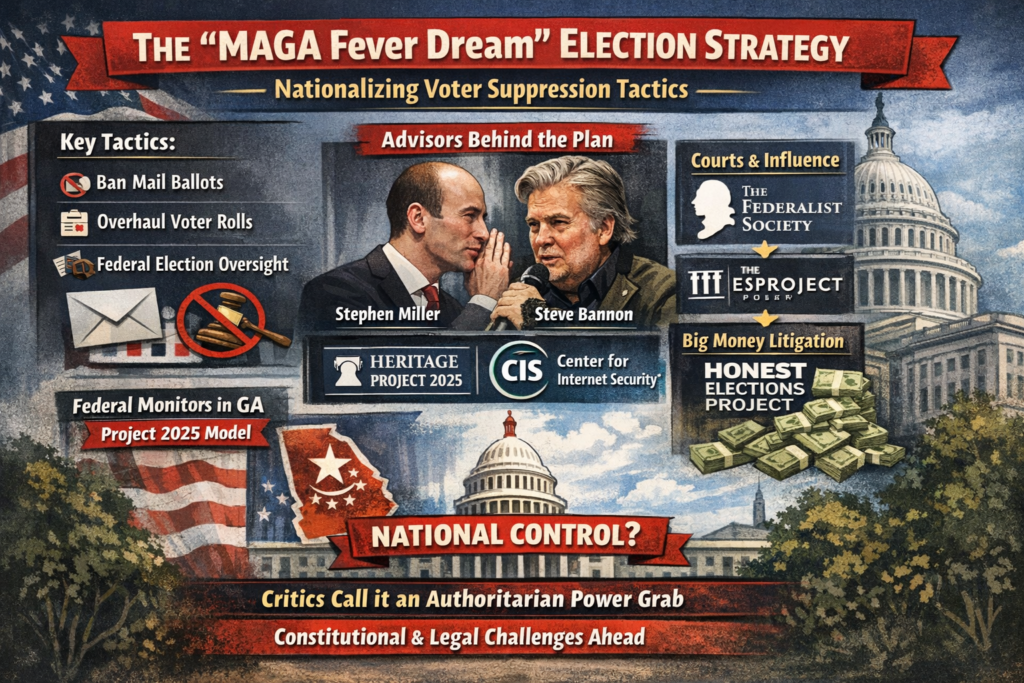
Heritage Foundation and Project 2025: This stands out as the most likely “organizational architect.” Project 2025, a detailed policy roadmap from the Heritage Foundation (a major conservative think tank), explicitly calls for using the Department of Justice (DOJ) to investigate and prosecute alleged voter fraud, even based on debunked claims. It proposes federal interventions like proof-of-citizenship requirements for voting and empowering agencies to audit state elections. Trump’s administration has implemented parts of this, such as shifting the DOJ’s Civil Rights Division toward “fraud” probes under appointees like Harmeet Dhillon (a 2020 election denier) and Kash Patel (FBI pick who’s vowed to go after perceived election riggers).
Critics from groups like the Brennan Center have called it a “MAGA fever dream” for nationalizing voter suppression tactics, like banning mail ballots or overhauling voter registration.
Other Advisors and Networks: Figures like Stephen Miller (Trump’s policy whisperer on immigration and now broader issues) or Steve Bannon (who’s pushed election denialism via his “War Room” podcast) often get credited in analyses for strategizing these moves. There’s also overlap with groups like the Center for Internet Security (CIS), which handles election cybersecurity and has DHS ties—some X discussions speculate it’s part of a deeper infrastructure for monitoring elections.
In Georgia specifically, the push involves embedding federal observers and audits, which echoes tactics from Project 2025.
As for the Federalist Society: They’re hugely influential in judicial appointments (shaping courts that could rule on election cases), and their co-founder Leonard Leo has funneled big money into conservative causes, including election-related litigation through networks like the Honest Elections Project. But they’re not the primary driver here—that seems more Heritage’s lane for policy blueprints. Federalist Society folks might advise on legal strategies to make this stick, though.
Trump isn’t devising this solo; his style is more improvisational and grievance-driven than master-planner. In my view, the real “architecture” is a decentralized but aligned network of conservative think tanks (led by Heritage via Project 2025) and loyalists like Mitchell, Olsen, and Patel, who’ve been gaming out ways to centralize election oversight under the guise of “integrity.” It’s not a conspiracy in the tin-foil sense—it’s out in the open, rooted in post-2020 frustrations and amplified by Trump’s platform.
The goal appears to be tilting the system toward Republicans by federalizing controls that states have historically managed, which raises constitutional red flags (elections are state-run per the Constitution, as even some GOP allies like Gov. Greg Abbott have pushed back on).
Whether this succeeds depends on courts, Congress, and public push back—it’s already facing bipartisan criticism and could backfire if it erodes trust further.

I Get It
Plato may be right. All democracies will fail. But I don’t think now’s the time.
When looked at from a distance, we can see the arc of almost anything. Civilizations, movements, ideas. The beginning and the end become visible, like a landscape from altitude. But the closer we get, the more the timeline shifts and blurs. The ending moves around. Why would that be? Maybe because philosophies and people don’t always work hand in hand.
Ideas are clean. People are not.
I have been around long enough to have stood in a few crowds, carried a few convictions, and watched more than one cause rise and fade. Through all of it, every march, every movement, every upheaval, there has always been a placard somewhere in the crowd that read some version of the same thing: Power to the people.
We both know that’s a catch phrase. It always has been. But here’s the thing about catch phrases. The good ones survive because they point at something real, even when nobody’s delivering it. The illusion has to be maintained because somewhere underneath it is a truth people can feel even when they can’t see it.
That truth is this. The closest thing to actual power most of us will ever hold is a vote and a voice. That’s it. That’s the whole arsenal. It isn’t much, until enough people pick it up at the same time.
But neither of those things work if we stop using them. And they stop working in a different way when we use them without thinking. When we vote the way we’re told to vote, believe what we’re told to believe, and accept what we’re told to accept.
Independent thought has always been the first casualty of concentrated power. Not because the people are stupid. They never are. But because every system, in every era, has had a quiet interest in discouraging it. It is easier to lead people who have already decided what they think. Easier still to lead people who believe that what they think, they arrived at on their own.
We live under a democracy, a republic if you want to be precise about it. Living under it comes with benefits most of us have stopped noticing, the way you stop noticing a foundation until it cracks. But those benefits have never been free. They have always cost something. The people who built this thing paid for it. The people who saved it, more than once, paid for it. And the people who will determine whether it survives this particular moment in its timeline will pay for it too.
The question isn’t whether you’re willing to believe in it.
The question is whether you’re willing to stop accepting the illusion in place of the real thing, and what you’re prepared to do about it.
That’s always been the question. It just hasn’t always been this urgent.
Share this:
Like this: