Posts in Category: Protest 2026
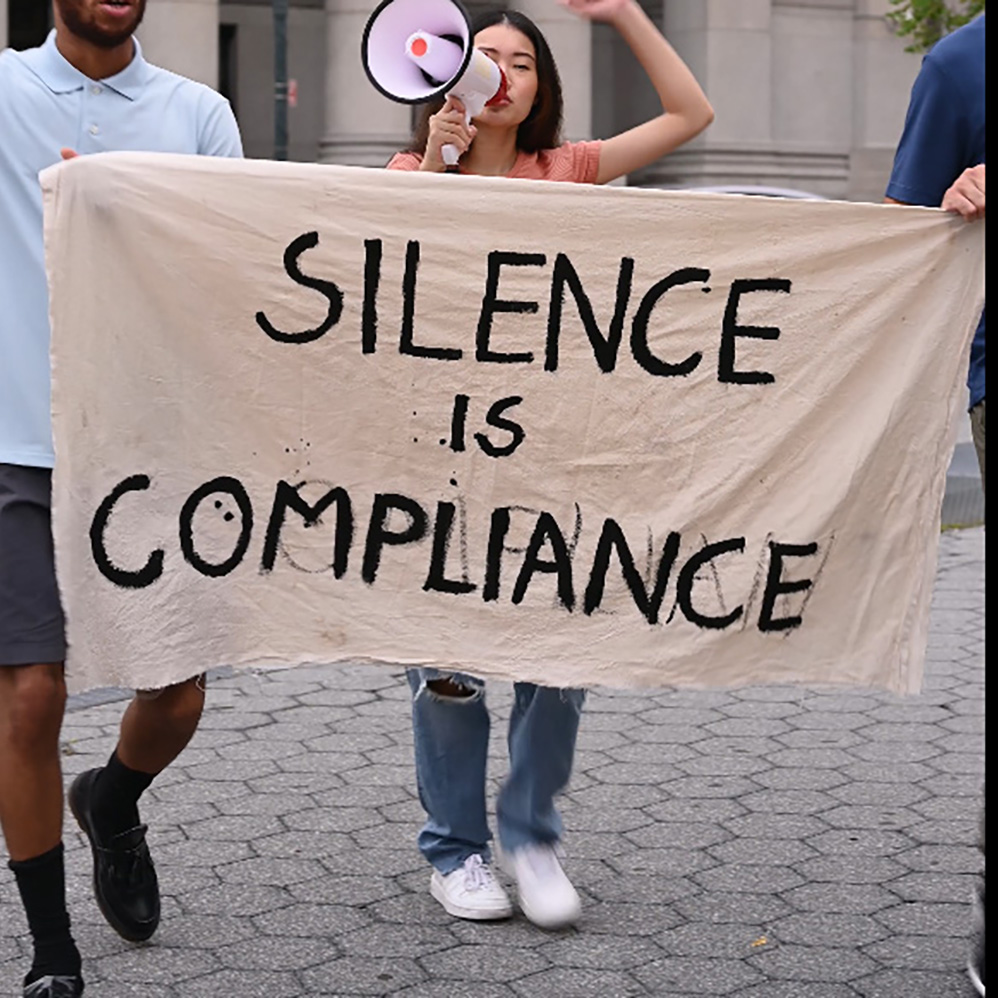
‘Over Here’ No Kings and No ICE
I grew up with big screen HEROS, John Wayne, Eddie Murphy, and way to many more saving America from the Evils of tyranny during WW II, and still enjoyed Gary Cooper as SGT York saving us during WW I, but none of that would have been possible if James Cagney hadn’t played George Cohan and given us music like OVER THERE.
Find it, listen to it, let the goose bumbs rise, remember what your grand fathers and your great gran fathers sacrificed so you could live in America.
This is MY version, sing it, use it, it’s ours, it’s mine and it’s yours.
“Over Here” – sing it to the same tune:
Verse 1
Folks, get your voice, get your voice, get your voice,
Raise it up high, up high, up high.
Hear them calling, you and me,
Every son and daughter free.
Hurry right away, no delay, stand today,
Make your fathers proud, to have raised such a crowd.
Tell your children not to fear,
Be proud we’re standing here.
Chorus
Over here, over here,
Send the word, send the word over here—
That the people are waking, the people are waking,
The truth is thundering everywhere.
So beware, say a prayer,
Send the word, send the word to beware—
We’re stronger than you, we’re coming through,
And we won’t back down till it’s over, over here!
Verse 2
Folks, see the game, see the game, see the game,
We see through the lies, the lies, the lies.
No more chains, no more chains, break away,
Liberty’s call won’t fade today.
From the farms to the streets we rise,
Grit in our hearts, fire in our eyes.
We’ve buried too many for this land,
Now we take back what’s in our hand.
Chorus repeat
Over here, over here,
Send the word, send the word over here—
That the resilient are rising, the resilient are rising,
The spirit is rumbling everywhere.
So prepare, have a care,
Send the word, send the word to beware—
We’re tougher than steel, we see what you conceal,
And we’re coming for freedom, over here!
Share this:

A Real-Time Example (Why Markets React Faster Than Voters) – Healthcare in America

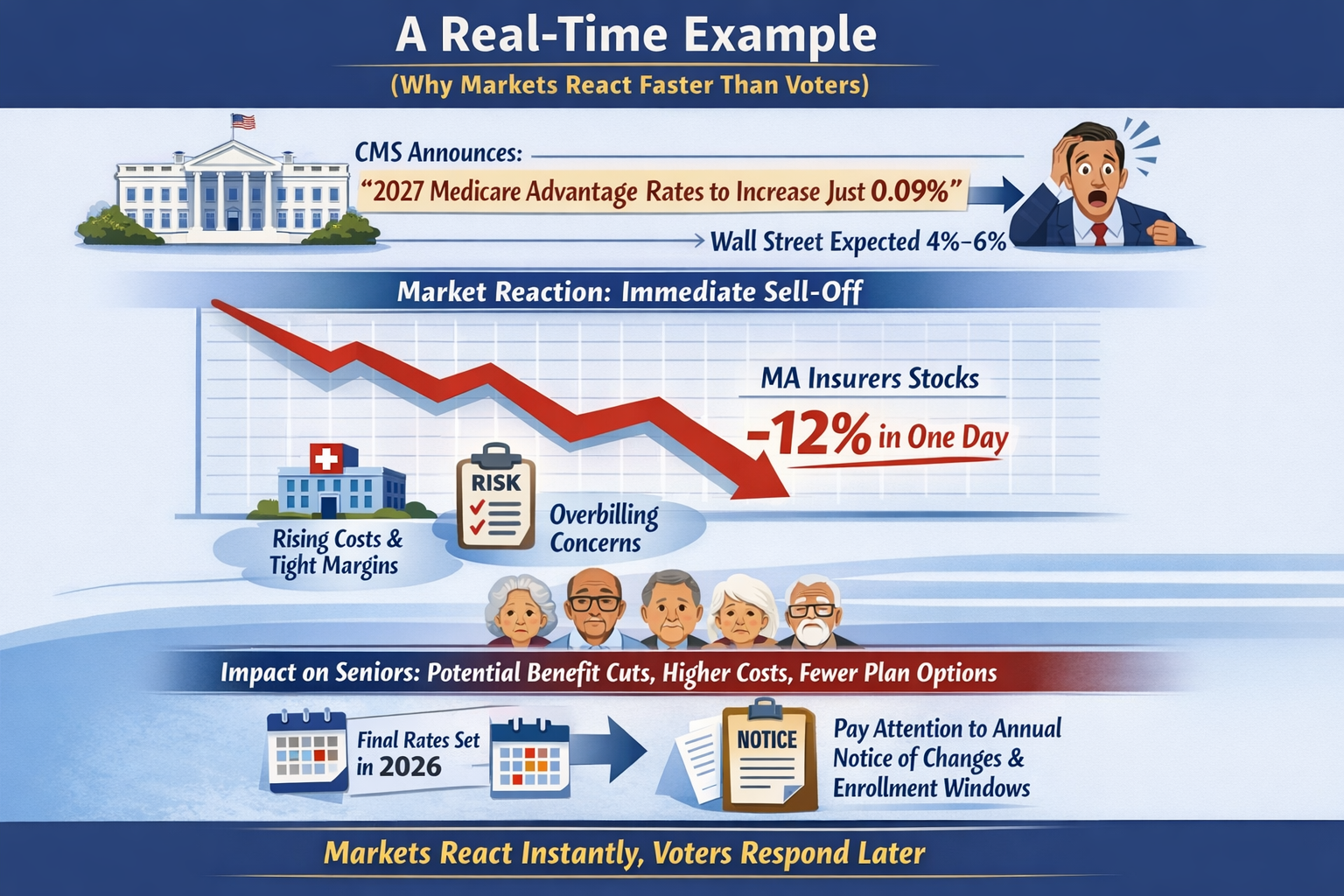
A Real-Time Example (Why Markets React Faster Than Voters)
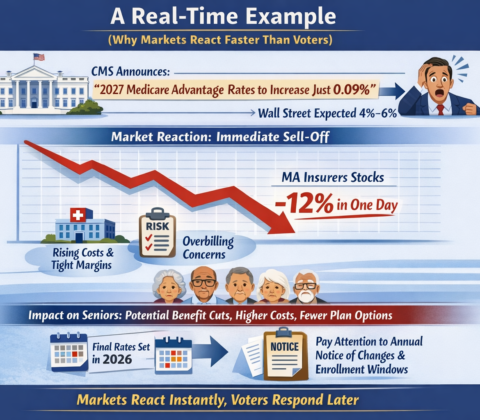
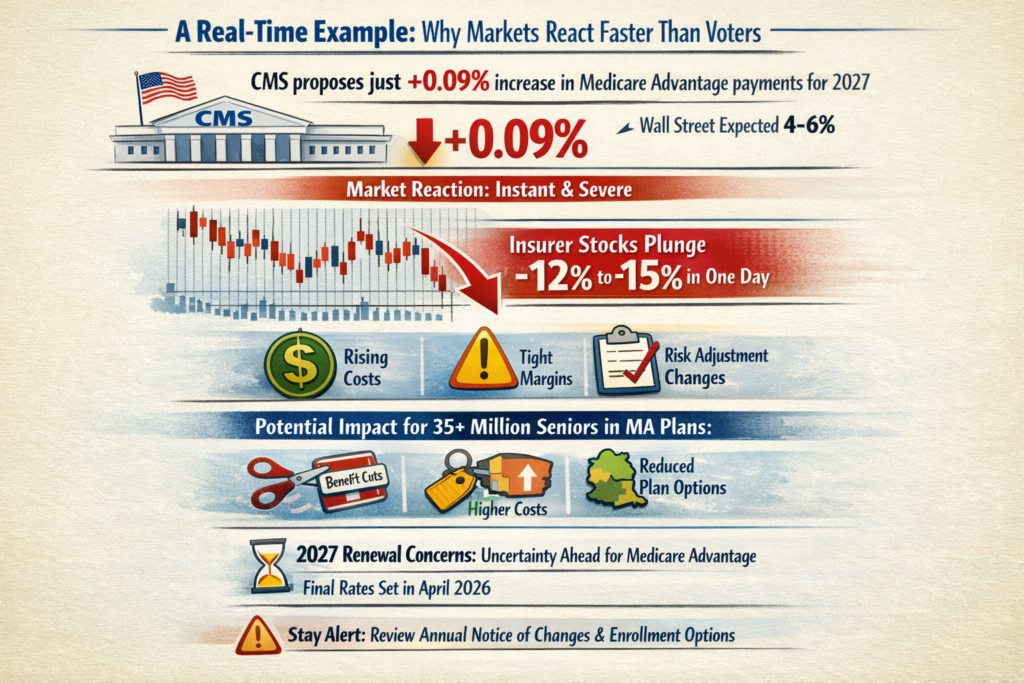
In a surprise move, the Trump administration’s Centers for Medicare & Medicaid Services (CMS) proposed a near-flat 0.09% increase in payment rates to private Medicare Advantage (MA) plans for 2027—far below Wall Street expectations of 4–6% and following a more generous 5.06% boost for 2026.
The announcement triggered an immediate sector sell-off the following day, with major insurers losing double-digit percentages in market value, led by sharp declines across the Medicare Advantage space.
Analysts cite tight insurer margins, rising medical costs, and efforts to curb overbilling (including changes to risk adjustment excluding certain chart reviews) as reasons the minimal increase could force benefit cuts, higher enrollee costs, or plan reductions for the more than 35 million seniors enrolled in MA plans.
Industry groups warn of potential disruptions when 2027 coverage renews in late 2026, though final rates will not be set until April. This adds pressure to an already challenging Medicare Advantage landscape, where many plans have recently faced premium increases, benefit adjustments, or network changes.
What matters here is not the stock reaction itself, but how quickly payment signals translate into market behavior — a dynamic we’ve been examining throughout this series.
For beneficiaries, this is a reminder to pay close attention to Annual Notice of Changes documents and enrollment windows, particularly if plan costs, benefits, or provider access begin to shift.
Healthcare In America – The Nuts and Bolts – The Series
Share this:

Part 3b – Repetition As Policy Signal – Healthcare in America

Part 3B: Repetition as Policy Signal
One of the easiest ways to miss what is happening in health policy is to listen only to what is being said, not how often it is being said.
Repetition is not accidental. In politics, it often functions as a substitute for action.
When leaders repeat the same reassurance, promise, or dismissal over and over—without new details, timelines, or mechanisms—it usually means one of three things:
-
The policy does not exist yet.
-
The policy exists only as a concept, not a plan.
-
The policy is unpopular or impractical, and repetition is being used to delay confrontation with that reality.
This is not unique to any party or moment. It is a structural behavior. Repetition fills the space where legislation, funding models, or regulatory language should be.
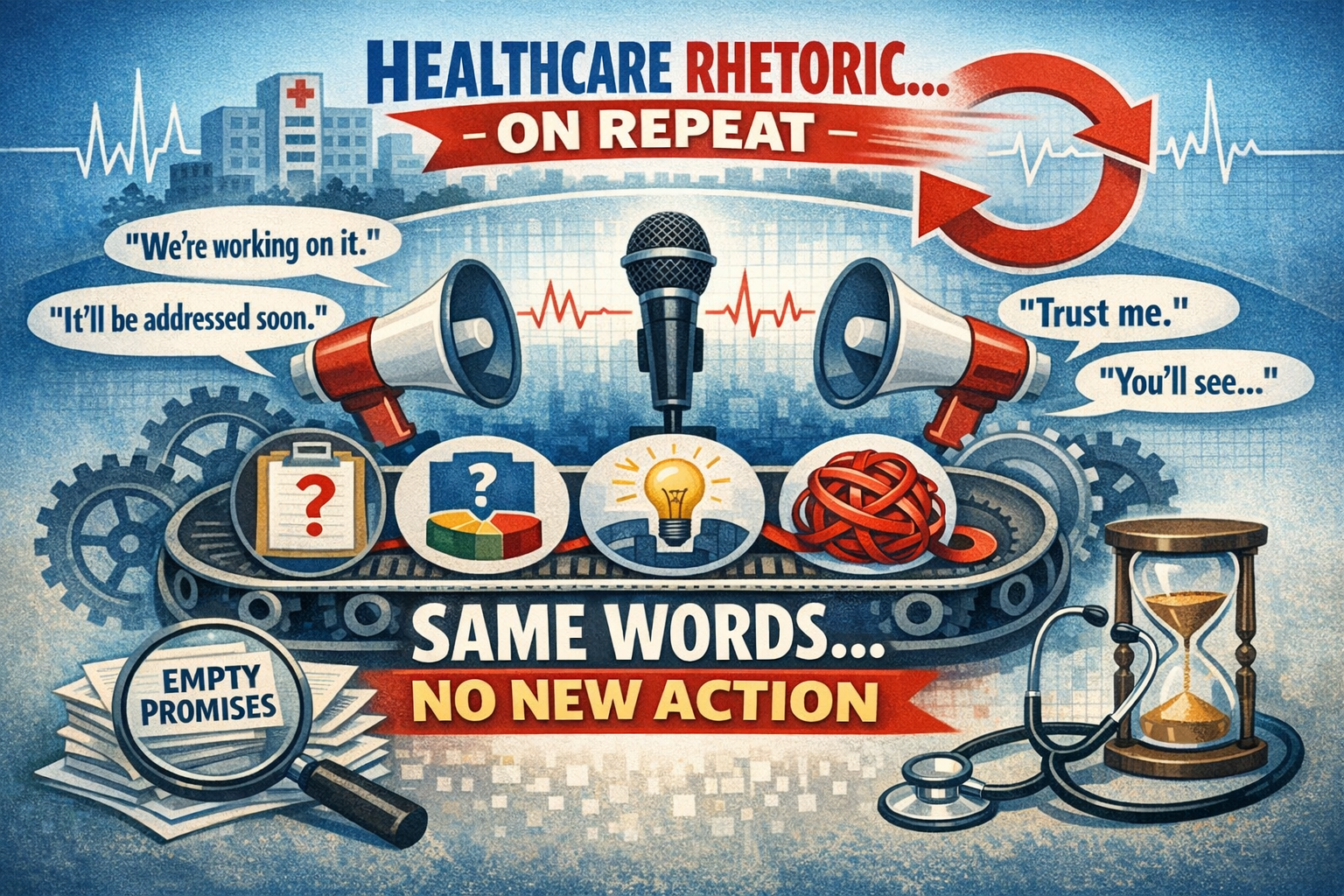
You can hear it in phrases like:
-
“We’re working on it.”
-
“It will be addressed very soon.”
-
“Trust me.”
-
“You’ll see.”
When these phrases appear once, they may reflect genuine uncertainty. When they appear repeatedly, over weeks or months, they become signals.
The tobacco era showed this clearly. For years, the same reassurances were offered while evidence mounted. No new information was added—only the same language, restated. The repetition was not meant to inform; it was meant to delay.
This is where readers can begin to exercise real agency.
Instead of asking, “Do I agree with this?” ask:
-
Has anything new been said since the last time this was promised?
-
Has the explanation become more detailed, or stayed vague?
-
Has responsibility shifted—from institutions to individuals?
-
Has repetition replaced accountability?
These questions require no ideology. They require only attention.
In health policy especially, repetition matters because delay has consequences. Costs rise. Coverage gaps widen. People make decisions based on what they believe is coming next.
Recognizing repetition as a signal—not reassurance—is one of the first practical tools citizens have to protect themselves in complex systems.
Tomorrow, we’ll look at how responsibility quietly moves from public systems to private individuals—and why that shift often goes unnoticed until it’s too late.
Healthcare In America – The Nuts and Bolts – The Series
Share this:

Part 3a – When This Happened Before – Healthcare in America
Part 3A: When This Happened Before
Before this series goes any further, it’s worth pausing to show that what we are describing is not new — and not partisan.
Long before COVID, long before Trump, and long before modern media ecosystems, the same policy pattern played out around tobacco.
This matters because it reveals how policy can be shaped without ever being formally decided.
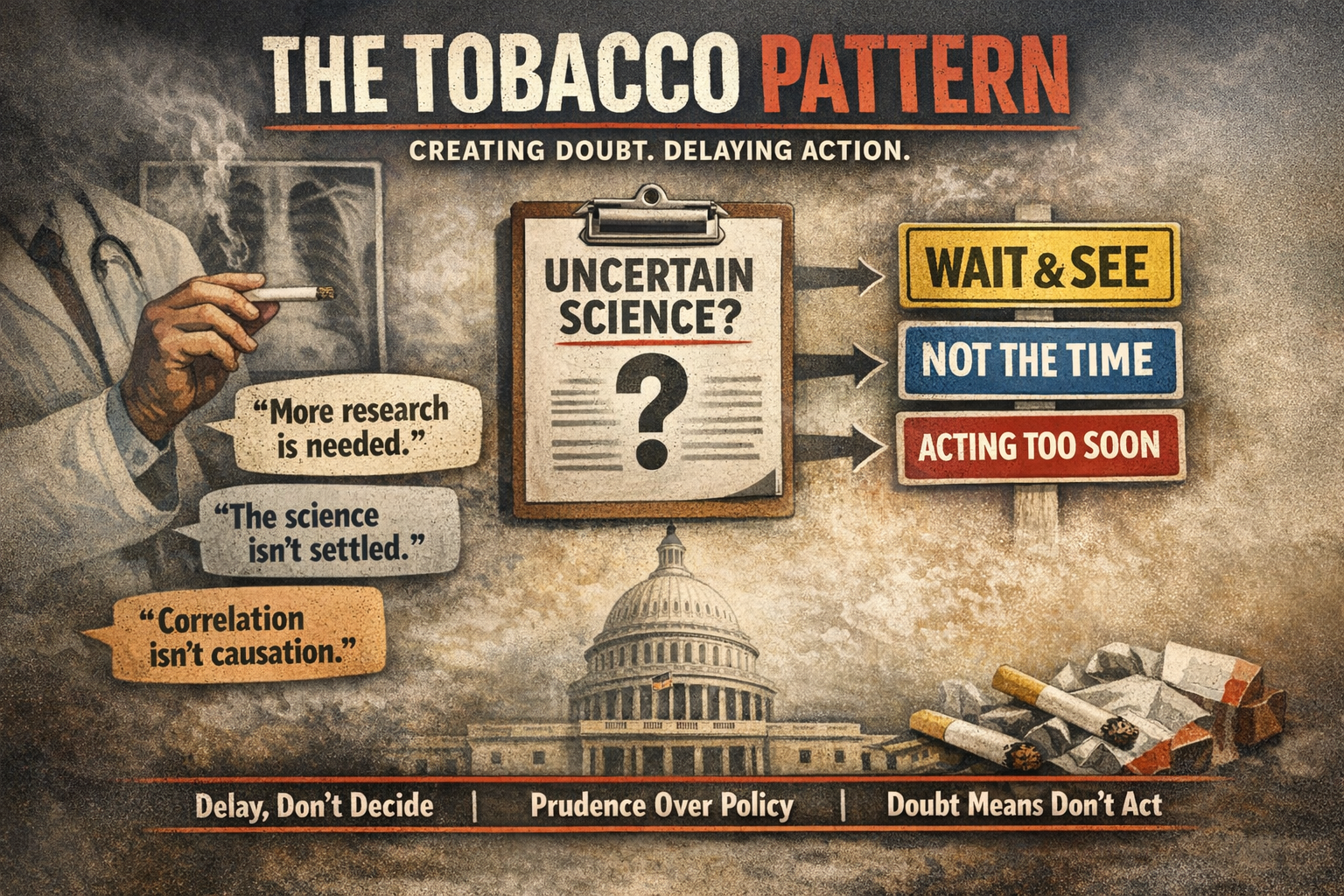
The Tobacco Pattern
For decades, the health risks of smoking were not unknown. Doctors observed higher rates of lung disease. Epidemiologists saw correlations strengthen year after year. Internal industry research — later revealed — often confirmed the danger.
Yet public policy stalled.
Why?
Because the dominant message repeated to the public was not that smoking was safe, but that it was uncertain.
“More research is needed.”
“The science isn’t settled.”
“Correlation isn’t causation.”
None of those statements were outright lies. That’s what made them effective.
They created just enough doubt to justify inaction.
Repetition as Delay
This is the critical mechanism.
The message didn’t need to persuade people that cigarettes were healthy. It only needed to persuade policymakers and the public that acting now would be premature.
Each repetition reinforced a sense of responsible restraint:
-
Waiting was framed as prudence
-
Delay was framed as neutrality
-
Action was framed as overreaction
Over time, delay itself became the policy.
No single announcement said, “We choose not to regulate.” But the repeated framing ensured regulation would always be postponed.
The Cost of Waiting
The human cost accumulated quietly.
Smoking-related illnesses rose predictably. Generations adopted a habit already known to be dangerous. The burden fell disproportionately on working-class families, veterans, and rural communities — long before those terms became political shorthand.
By the time policy finally caught up, millions of lives had already been affected.
No one could point to a single decision that caused the harm. That, too, was part of the design.
Why This Example Matters Now
Tobacco shows how repetition substitutes for policy.
When uncertainty is repeated often enough, it becomes permission. When delay is normalized, it feels responsible. When action is framed as reckless, inaction feels safe.
This is not about cigarettes.
It is about a pattern.
Setting Up the Next Step
Once you recognize this structure, you start to see it elsewhere — especially in health policy.
Not through detailed plans. Not through legislation. But through repeated language that signals what will not happen.
In the next section, we’ll examine how repetition itself functions as a policy signal — and why hearing the same claim again and again is rarely accidental.
Next: Part 3B — Repetition as Policy Signal
Healthcare In America – The Nuts and Bolts – The Series
Share this:



Be Prepared, Not off guard like the Berlin Wall
When the Berlin Wall fell, everyone was caught off guard, why people had to just grab what was handy to get the job done. Don’t be caught off guard, be ready. Get your Limited Edition Grand Ballroom Sledge Hammer now. Both His and hers editions, only $999.99 each, reserve yours now. Absolutely guaranteed to be available before the Trump Phone is available and decades before the Trump Health Plan leaves the concept stages.
Why for an additional fee, we will even have your name inscribed on the handle for you, spelling not guarenteeed. Priced does not include shipping or handling. Probably fullfilled from our trade partner in Canada. Tariffs additional.

Share this:

Part 2: When Expertise Became Personal – Healthcare in America

Part 2: When Expertise Became Personal
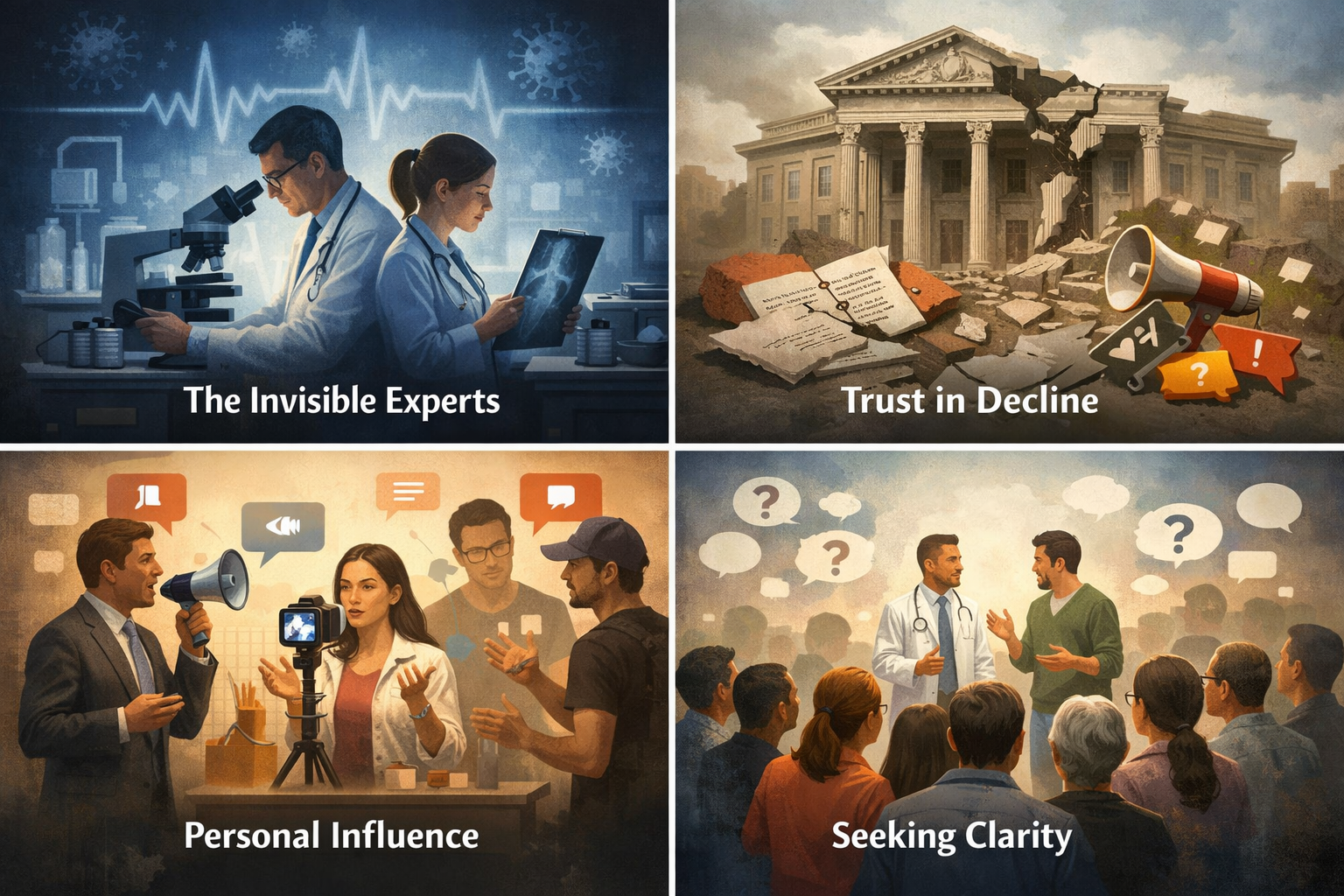
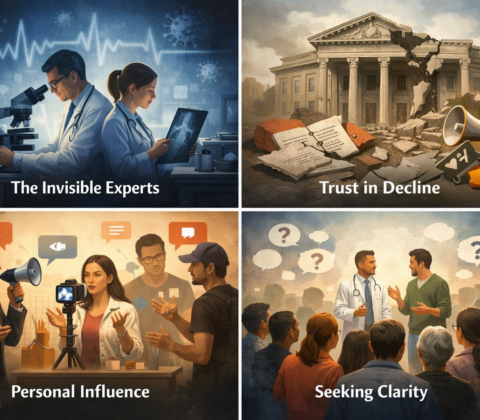
Public health expertise was not always controversial. For decades, it functioned largely in the background—technical, imperfect, and mostly invisible. When it worked, few noticed. When it failed, corrections were usually quiet and procedural.
That changed when expertise became personal.
As trust in institutions weakened, authority began to migrate away from systems and toward individuals. Complex guidance was no longer evaluated primarily on evidence or process, but on who was delivering it—and how consistently.
This shift did not require a coordinated effort. It was a natural response to confusion. When institutions struggle to communicate clearly, people look for human proxies they can assess intuitively.
From Institutions to Individuals
Institutions speak in committees, caveats, and revisions. Individuals speak in faces, voices, and confidence. In an environment already strained by complexity, the latter often feels more accessible—even when the underlying information is less complete.
As a result, public health authority increasingly became embodied in specific figures. Scientific disagreement, which is normal and necessary, was reframed as personal inconsistency. Updated guidance, which reflects learning, was recast as unreliability.
This personalization made expertise easier to attack, defend, or dismiss. A system can absorb critique; a person cannot without becoming the story.
Why Personalization Works
Personalization simplifies judgment. Instead of evaluating methods, data, and uncertainty, people are encouraged—often unintentionally—to evaluate tone, confidence, and perceived alignment.
Once expertise is tied to individuals:
-
Disagreement feels like betrayal
-
Revision feels like deception
-
Nuance feels like weakness
This dynamic is especially potent in public health, where uncertainty is unavoidable and recommendations evolve as evidence accumulates.
The Cost of Making Experts the Message
When individuals become symbols for entire systems, consequences follow.
Debate shifts away from institutional capacity, funding, and preparedness, and toward loyalty or opposition to particular figures. Questions about infrastructure and decision-making are replaced by arguments over credibility and character.
This does not improve understanding. It narrows it.
Over time, public health guidance becomes harder to evaluate on its merits because it is no longer received as guidance—it is received as advocacy.
What to Watch For
As this series continues, notice when:
-
Policy disagreements are framed around personalities rather than processes
-
Critiques focus on tone or consistency rather than outcomes
-
Individuals are treated as proxies for complex systems
-
Institutional failures are personalized instead of examined structurally
These are signs that expertise has been detached from the institutions that support—or undermine—it.
Why This Matters Going Forward
Once expertise becomes personal, it becomes fragile. Removing or discrediting an individual can feel like resolving a systemic problem, even when the underlying structures remain unchanged.
This creates an opening for rhetoric to replace capacity, and confidence to replace preparation.
Understanding this shift helps explain why later public health debates become less about evidence and more about allegiance—and why restoring trust is far more difficult than losing it.
That dynamic becomes clearer in the next phase of the series.
Next: Repetition as Policy Signal
Healthcare In America – The Nuts and Bolts – The Series
Share this:

Part 1: Trust Became the Weak Point – Healthcare in America

Part 1: Trust Became the Weak Point
Public health systems depend on trust in ways that are easy to underestimate. Not blind trust, and not perfect trust—but enough confidence that people believe guidance is given in good faith, decisions are explainable, and errors are acknowledged rather than obscured.
In the United States, that foundation weakened long before any recent crisis or political figure. It weakened quietly, through everyday interactions that felt small at the time but cumulative in effect.
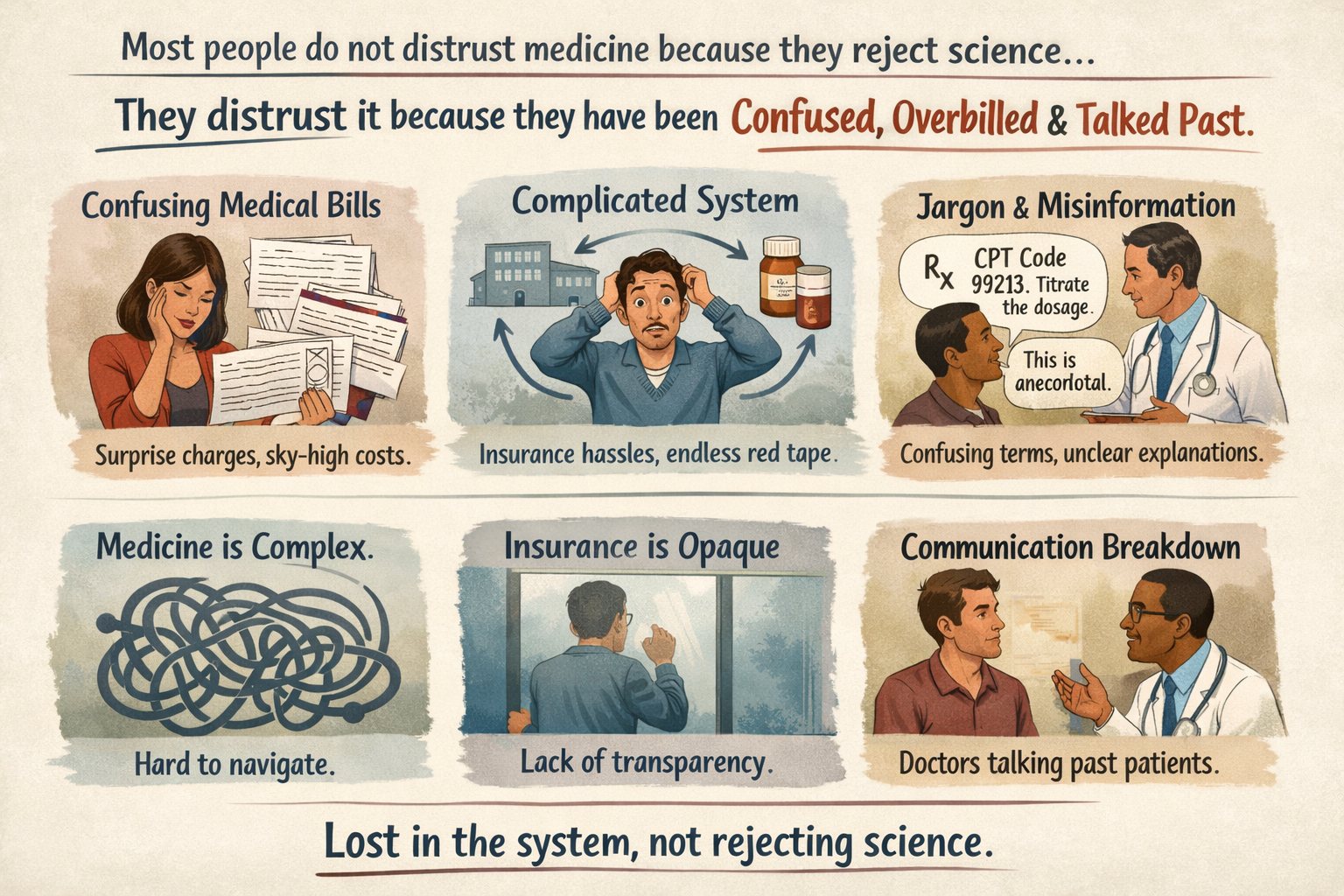
Most people did not stop trusting healthcare because they rejected science. They stopped trusting it because the system became harder to understand, harder to navigate, and harder to believe was working in their interest.
Complexity Without Clarity
Healthcare in the U.S. is genuinely complex. That complexity is not itself the problem. The problem is that complexity is often presented without translation.
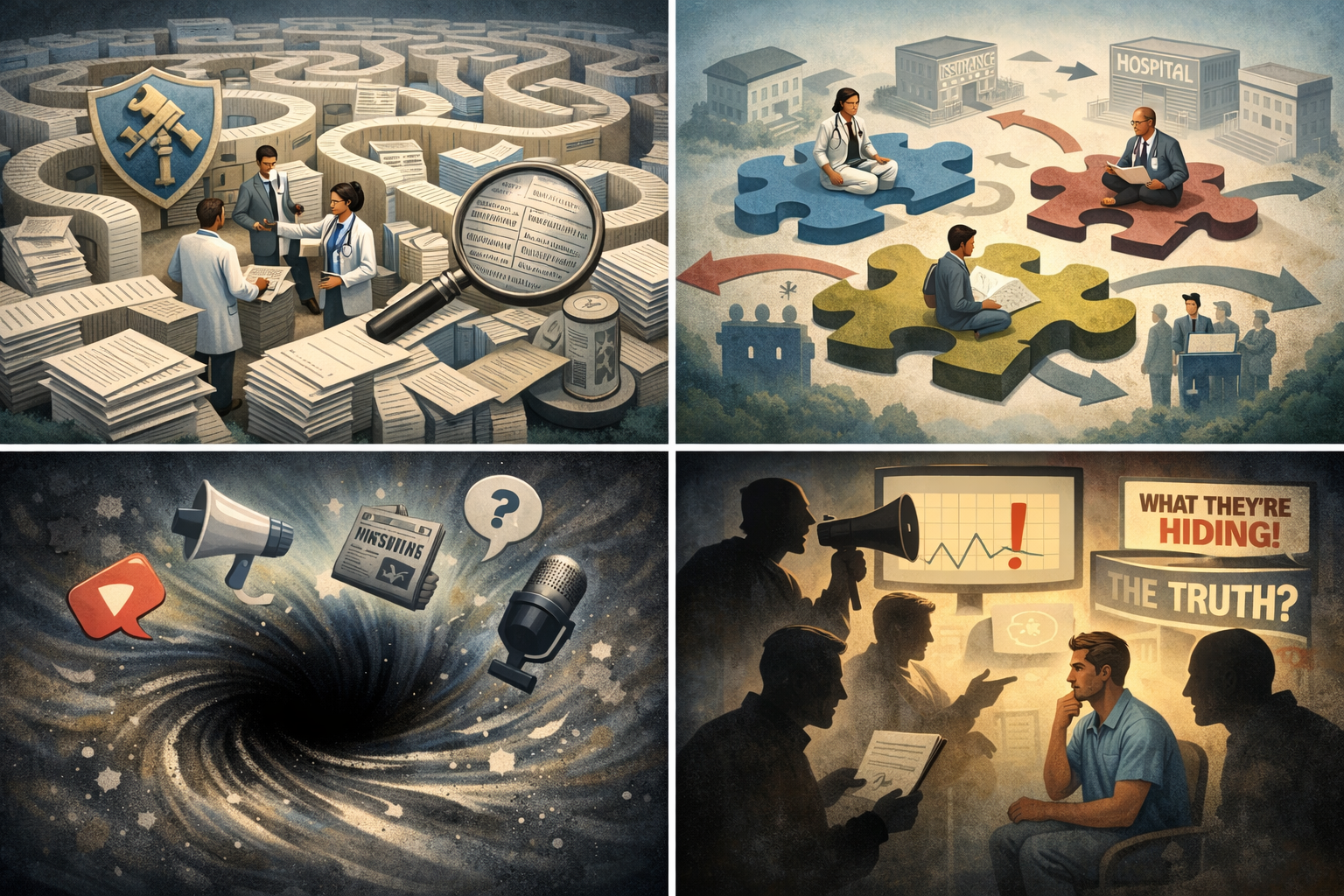
Insurance documents describe coverage in terms of tiers, codes, networks, and contingencies that are difficult for even attentive readers to interpret. Changes are communicated through dense notices that explain what is happening without clearly explaining why or what it means in practice.
When plans are canceled and replaced with alternatives that appear nearly identical—except for higher premiums or different cost-sharing—people are left with terminology rather than understanding. Over time, repeated experiences like this create a sense that explanations are designed to satisfy requirements, not to inform.
That gap matters.
Cost as a Trust Erosion Mechanism
Trust is also shaped by predictability. Few things undermine confidence faster than discovering the true cost of care only after it has been received.
Surprise billing, opaque pricing, and inconsistent coverage rules train people to expect uncertainty. Even when care is technically available, the fear of unknown cost changes behavior—delaying treatment, avoiding follow-ups, or disengaging entirely.
This is not an ideological response. It is a rational one.
When people cannot anticipate consequences, they stop believing assurances.
Institutions That Speak Poorly Under Pressure
As systems grew more complex, institutional communication often became more defensive. Language shifted toward legal precision and risk avoidance, rather than clarity.
Explanations became longer but less informative. Mistakes were corrected quietly, if at all. Accountability was diffused across agencies, insurers, providers, and administrators—each technically accurate, but collectively unhelpful.
Over time, this creates a vacuum.
When institutions struggle to explain themselves, others step in to explain for them.
What Happens When Trust Weakens
When trust erodes, several predictable shifts occur:
-
Expertise must compete with confidence
-
Repetition begins to substitute for evidence
-
Personal narratives feel more credible than institutional ones
-
Individuals become symbols for entire systems
None of this requires malice or conspiracy. It is how people adapt when clarity is missing and stakes are high.
By the time a crisis arrives, the groundwork has already been laid. The public is primed not to evaluate guidance on its merits, but on whether it feels consistent, confident, and aligned with prior experience.
Signals to Watch
As this series continues, it helps to notice a few early indicators of trust strain:
-
Explanations that grow longer but clearer on none of the practical details
-
Language that emphasizes compliance without understanding
-
Corrections that appear quietly, without acknowledgment
-
Complexity that increases without improving outcomes
These signals often appear well before policy consequences become visible.
Why This Matters Going Forward
Health policy does not fail all at once. It frays.
Trust is usually the first strand to weaken, not the last. Once it does, every subsequent decision—no matter how well-intentioned—faces skepticism, resistance, or distortion.
Understanding how that erosion occurs is essential, because it explains why later debates become less about evidence and more about narrative.
That is where the series goes next.
Next: When Expertise Became Personal
Healthcare In America – The Nuts and Bolts – The Series
Share this:

America’s Health Policy, Why This Series Exists – Healthcare in America

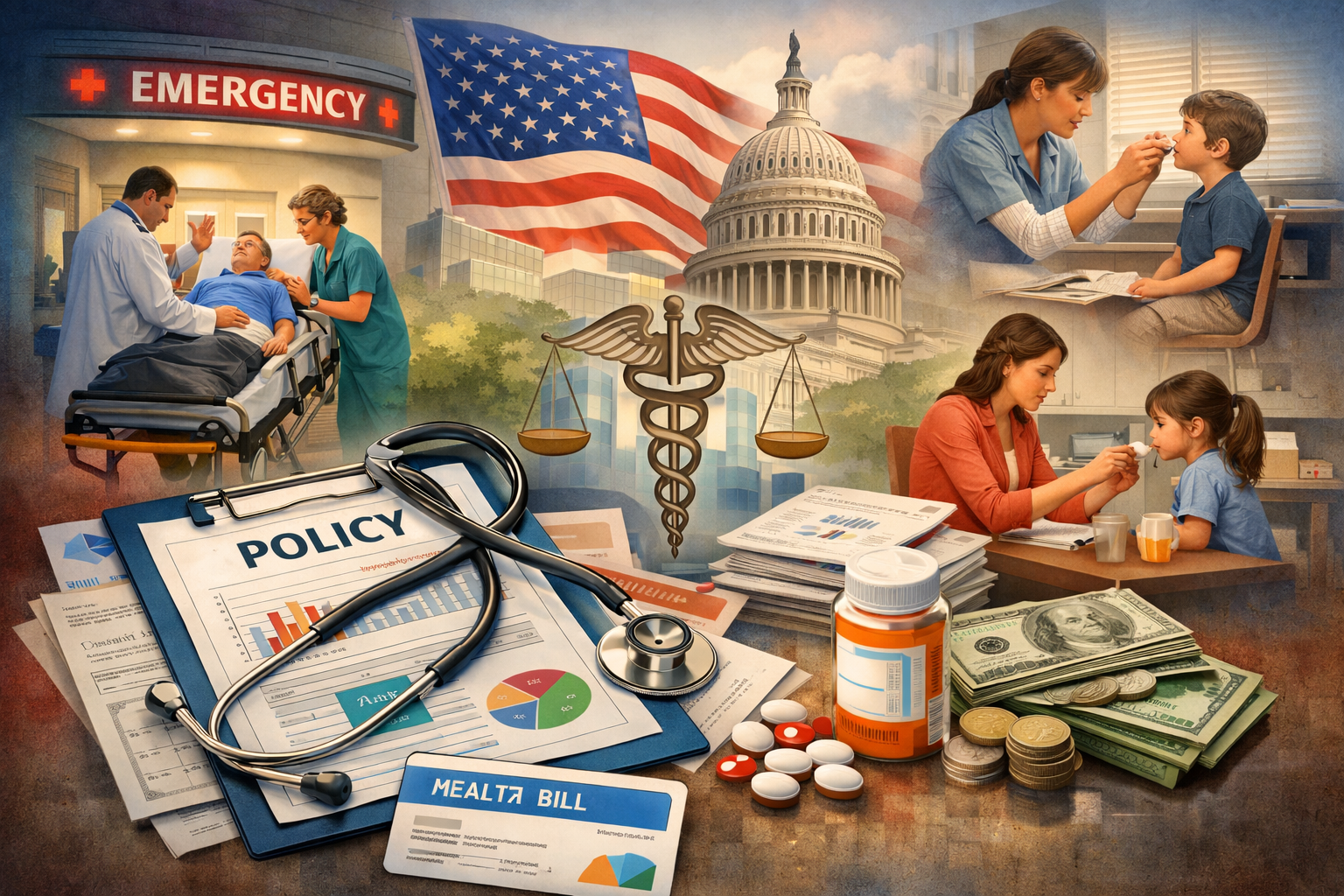
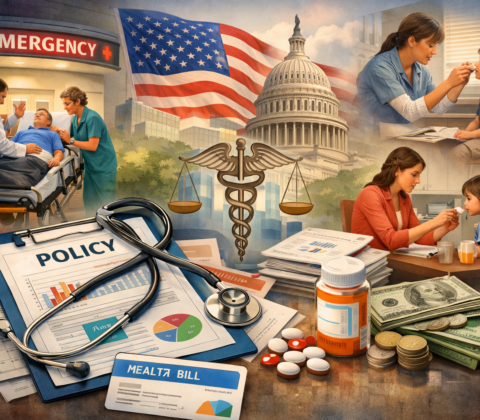
Health policy is often discussed either at a level so abstract that it feels irrelevant, or so emotional that it becomes exhausting. In both cases, people disengage—not because they don’t care, but because they can’t see where their understanding actually makes a difference.
The purpose of this series is to examine how health policy decisions in the United States are framed, funded, and communicated—and how those processes shape outcomes regardless of political intent.
Rather than advocating for specific programs, candidates, or ideologies, this series focuses on identifying patterns. How trust is built or lost. How complexity can clarify—or conceal. How rhetoric diverges from operational reality.
These patterns matter because health policy is not a single decision or law. It is an ecosystem of incentives, funding mechanisms, administrative choices, and public narratives. Once those systems are in motion, outcomes follow whether or not anyone agrees with them.
Why This Matters Now
Many people sense that something about healthcare feels increasingly unstable, but struggle to articulate why. Costs rise without explanation. Coverage changes without clarity. Experts speak, but confidence spreads faster than evidence.
This series does not assume bad faith. It assumes systems under strain.
Understanding how those systems work—and how they fail—is more useful than reacting to any single headline. It allows readers to recognize warning signs earlier and to distinguish noise from signal when stakes are high.
What This Series Will and Will Not Do
This series will:
-
Examine policy outcomes without assigning personal motive
-
Use real examples to illustrate structural dynamics
-
Move deliberately, one concept at a time
-
Include guidance on what signals matter and where influence exists
This series will not:
-
Offer voting advice or endorsements
-
React to breaking news
-
Reduce complex systems to villains or heroes
-
Use parody or satire to make its case
The goal is understanding, not alignment.
How This Will Unfold
Posts will be short enough to digest in one sitting and structured to build on one another. You do not need to read them all at once, and disagreement is expected.
The series begins with a simple question:
How did health policy become a trust problem?
Before examining any administration, crisis, or reform effort, it is important to understand why trust weakened in the first place—and what happens when it does.
That is where the series begins.
Next: Trust Became the Weak Point
Healthcare In America – The Nuts and Bolts – The Series
Share this:

This series is about health policy, not ideology – Healthcare in America
Opening Statement — What This Series Is About
This series is about health policy, not ideology.
Decisions about healthcare in the United States are often discussed as political abstractions—talking points, slogans, and personalities. But their consequences are not abstract. They show up in emergency rooms, schools, workplaces, and kitchens. They show up in who gets care, when they get it, and at what cost.

Most people do not distrust medicine because they reject science. They distrust it because they have been confused, overbilled, and talked past. Medicine is complicated, insurance is opaque, and explanations are often delivered in jargon that obscures rather than clarifies.
A simple example: when a Medicare plan is canceled and replaced with “alternative” options that appear nearly identical—except for a substantially higher premium—the consumer is left with paperwork, terminology, and reassurances, but little concrete understanding of what actually changed or why. Experiences like this are not rare, and they are not ideological. They are structural.
Over time, this kind of complexity erodes trust. That erosion did not begin with any single administration or crisis. It developed gradually, through cost opacity, administrative layers, and systems that demand compliance while struggling to communicate clearly.
When trust weakens, something predictable happens. Expertise begins to compete with confidence. Repetition replaces evidence. Policy debates shift away from institutions and toward individuals. In that environment, it becomes easier to confuse rhetoric with action—and harder for citizens to recognize when real decisions are being made.
This series is not an argument for or against any party, personality, or program. It is an examination of how health policy is framed, funded, and implemented—and how those choices shape outcomes regardless of intent.
Each piece will also include practical guidance on what signals matter, what patterns to watch for, and where individual citizens still have meaningful influence. Not as activism, and not as instruction—but as civic literacy.
Health policy is not theoretical. Understanding how it works, how it breaks, and how it is communicated is one of the few forms of leverage people still have when the stakes are this personal.
Healthcare In America – The Nuts and Bolts – The Series
Share this:

It isn’t funny anymore, so let’s get ready for tomorrow – Healthcare in America

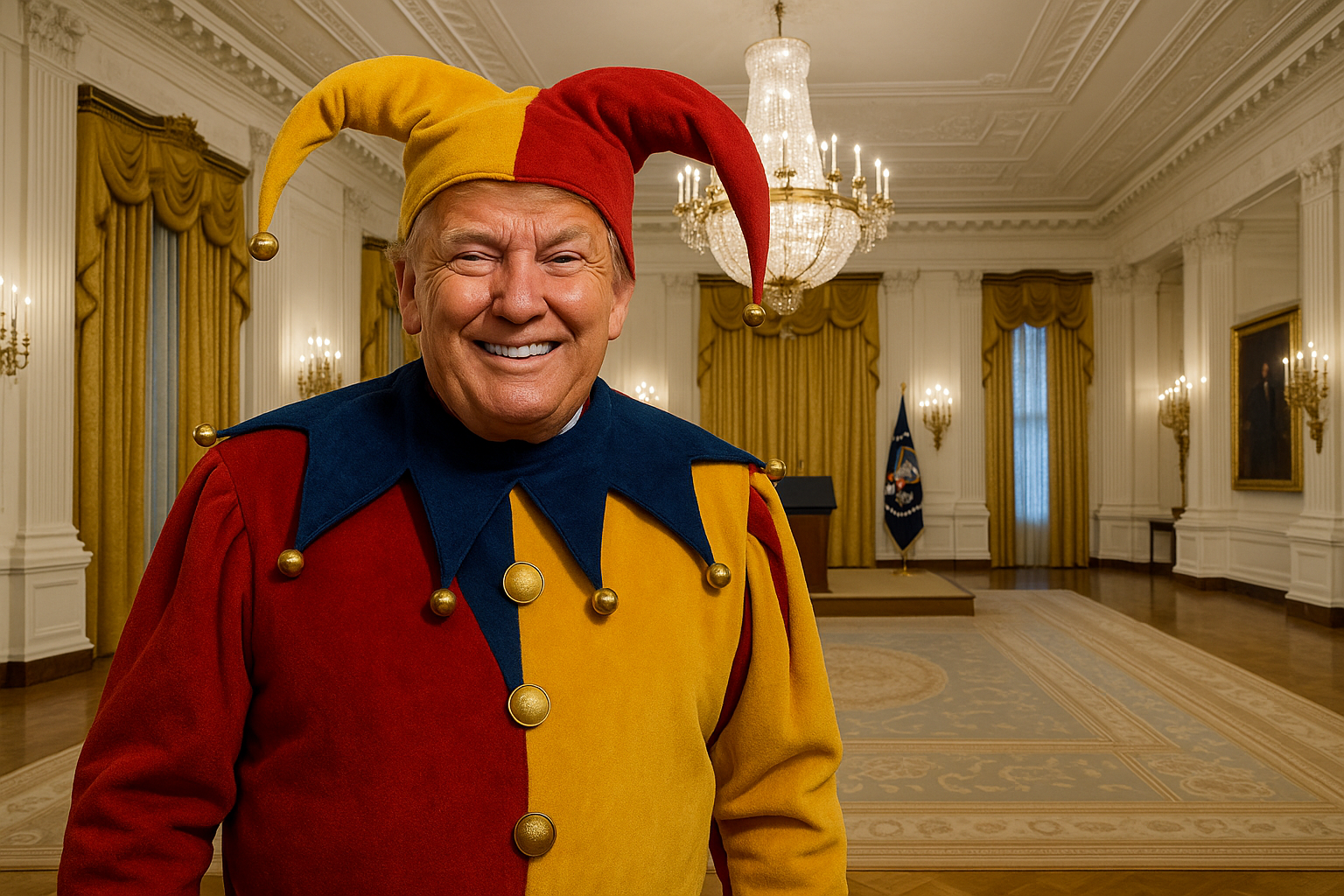
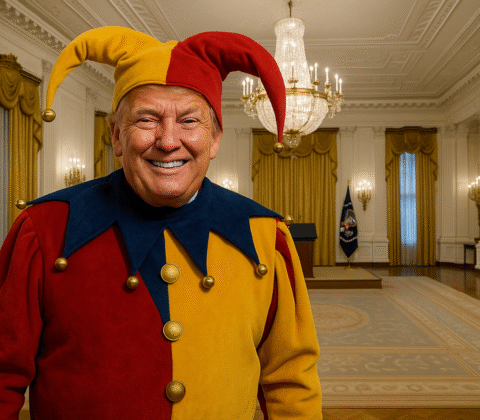
After a year of sharp satire aimed at one particularly loud clown who’s now less funny than frightening, I’ve shifted gears. For the past month, I’ve worked hard not to let the current atrocities wag me or incite me — because the chaos, as dangerous as it has become, is still a self-serving diversion.The parody landed its points. But I’ve shifted gears.
The noise is deafening — endless sky-is-falling takes, reaction bait, and soundbite wars. Parody can’t out-absurd reality forever, and outrage isn’t insight.So I’m moving on to something more useful: helping people understand the actual systems we live inside, not just the circus around them.
I’ve just wrapped up a month of breaking down dark money mechanics (how it flows, manipulates, and warps decisions on both sides). Not conspiracy theories, just a better understanding of the how and why. My goal wasn’t to be partisan — it was to help readers better grasp the mechanics behind the curtain and make better, self-informed decisions.
Next up: a 4 series, 43 chapter discussion on institutional healthcare. Not the latest premium hikes, Trump tweets, or partisan talking points. Instead:
-
How the U.S. healthcare machine evolved historically
-
Who really makes the decisions (incentives, gatekeepers, power structures)
-
What access actually looks like on the ground
-
A clear comparison of free-market vs. socialized models — trade-offs, not team cheers
The goal isn’t to push an agenda; it’s to equip you with context so you can think, decide, and act from knowledge instead of reflexes. For the majority of my life, my knowledge of healthcare was condensed into these three or four questions, asked under stress:
-
Am I insured?
-
Will my spouse’s job still cover us?
-
What happens if we get pregnant / sick / laid off?
-
Can we afford this surprise?
Knowing the answers to those 4 questions is not enough.Occasional memes will still sneak in (old habits die hard), but the main lane now is education over entertainment. Thanks for reading along so far. If this resonates, stick around.
Healthcare In America – The Nuts and Bolts – The Series
Share this:

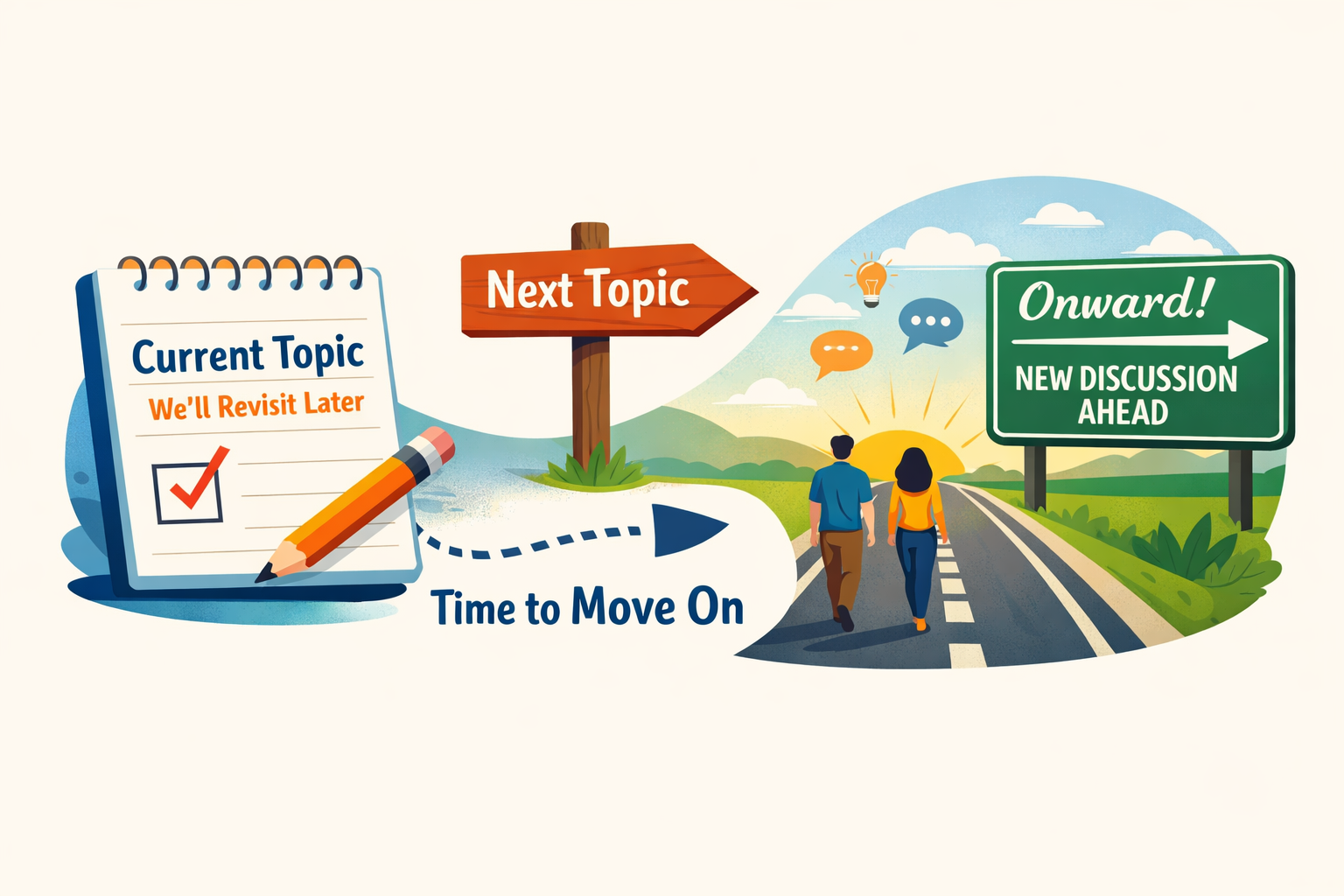

Dark Money and Influence, It’s time to move on.

At that point, the choice is yours.
You can go to the bar and complain.
You can leave angry comments online.
You can declare the right evil, the left evil, or both — and feel briefly satisfied.
Or you can do something about it.
To close out this section on dark money, We’ve pointed to the largest national players we know on each side of the ideological divide. On the right, the Federalist Society and Leonard Leo. On the left, the American Constitution Society and Arabella Advisors.
This wasn’t done to assign blame or score points.
It was done to show that influence networks exist on both sides, operate differently, and are rarely as simple as the slogans used to describe them. We’ve tried to approach this non-partisanly — not because “both sides are the same,” but because understanding requires honesty, not loyalty.
Our goal isn’t outrage.
It’s perspective.
If we want to slow the pendulum, regain some sanity in the process, and move forward in a way that doesn’t leave communities feeling manipulated or powerless, it starts here — with awareness, restraint, and local engagement.
What happens next is up to you.
Share this:

What we could expect with Major reform in campaign finance / donation transparency
What we could expect with Major reform in campaign finance / donation transparency
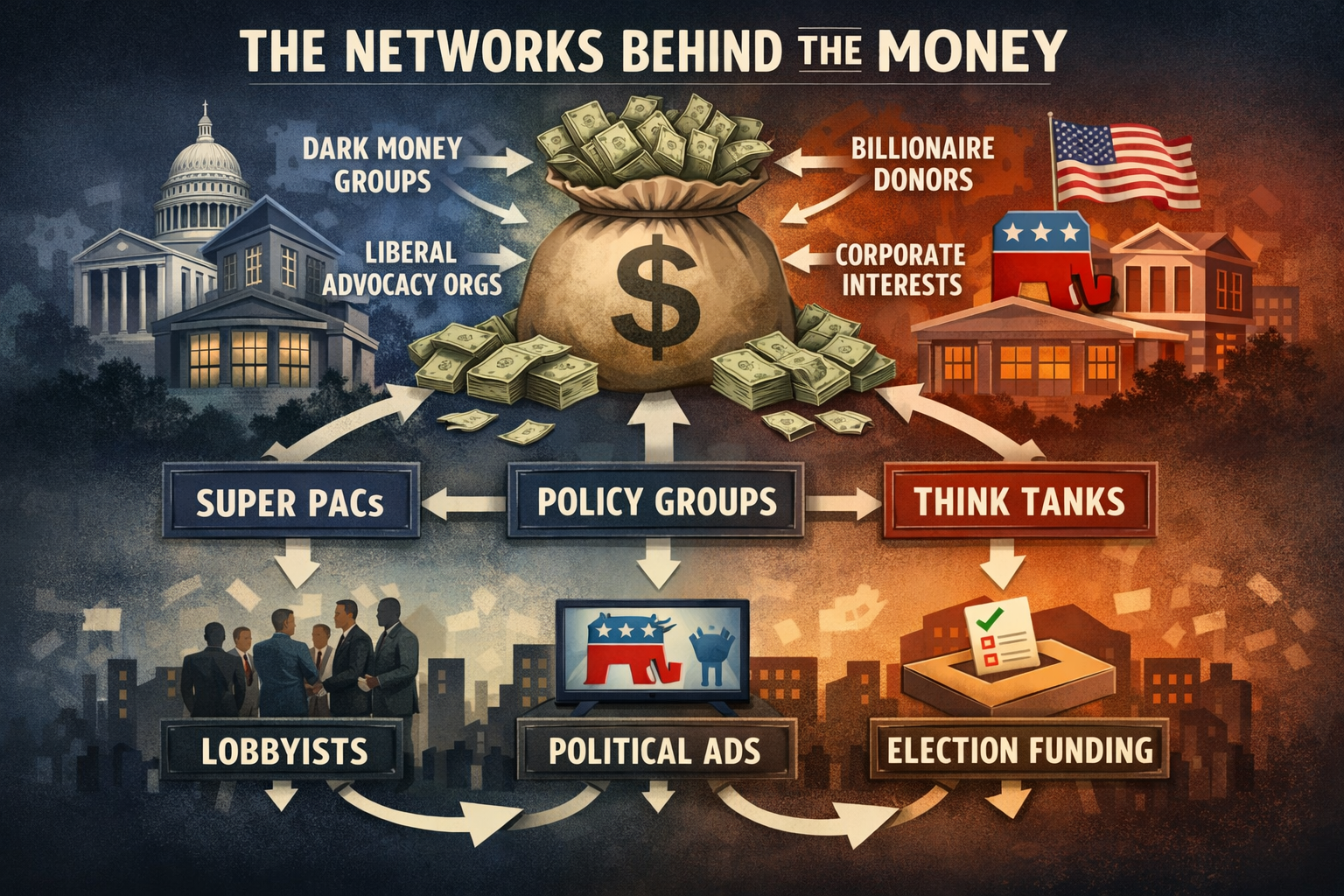
Most of this was included in the Pendulum Swing, assuming a right to left shift, but the organizations need to be brought to light and understood.
On the surface, what we might see would be more honest campaign promises as the backroom financing would become more transparent. This would be more obvious on the local level but would migrate up the National Ladder.
Major reform in campaign finance / donation transparency — if laws tighten, anonymity and dark-money flows shrink.
-
- Economic collapse or disruption to corporate profits — institutional money depends on capital; if the economy sours, so does financial influence.
- Mass public backlash / grassroots insurgency — if voters demand structural change, elite influence may become a liability rather than an asset.
- Global shifts (trade, climate, geopolitics) that outgrow traditional domestic lobbying and require new alignments — making old networks obsolete or forced to transform drastically.
Major Networks & Institutions Likely to Persist Through a Shift
|
Name / Network |
Why They Endure /What Makes Them Resilient |
|---|---|
|
Sixteen Thirty Fund (and affiliated Arabella Advisors funds) |
Long-standing “dark money” powerhouse for the left. Provides fiscal-sponsorship and funding to many progressive causes and campaigns. As a 501(c)(4) nonprofit, it can channel money — often anonymously — into activism, ballot initiatives, and elections. Wikipedia+1 |
|
Berger Action Fund (network tied to Swiss billionaire support of progressive causes) |
Serves as a major donor funnel for progressive policy agendas. Its role shows how international money and large-scale philanthropy can influence U.S. politics regardless of which party is in charge. Wikipedia+1 |
|
Priorities USA Action |
One of the largest Democratic-leaning super PACs. Has shown flexibility in shifting strategy (e.g. moving toward digital campaigning rather than just TV ads), which suggests institutional agility in changing political climates. Wikipedia |
|
American Bridge 21st Century |
A major liberal opposition-research and election campaign group—effective at media and messaging work. Such infrastructures are portable: no matter who’s in power, they can redirect resources toward oversight, opposition, or new causes. Wikipedia |
|
Tides Foundation / Tides Network |
A long-standing donor-advised fund and fiscal-sponsorship network. Its versatile structure lets wealthy donors fund causes under the radar — meaning it can remain influential regardless of which party holds power. Wikipedia+1 |
|
Major Conservative Mega-Donors (e.g. Richard Uihlein & family, Scaife-linked foundations, etc.) |
These “big-money backers” have deep pockets and substantial influence on think tanks, policy-planning networks, and regulatory lobbying. Their funds tend to follow structural interests (tax law, business regulation, corporate incentives) — which can often survive major party shifts. DeSmog+2The Good Men Project+2 |
|
Embedded Think Tanks and Policy Networks (e.g. Heritage Foundation, Intercollegiate Studies Institute (ISI), and other longtime policy infrastructure) |
These institutions provide long-term ideological frameworks, produce research, influence judiciary nominations, shape legislation drafts — and have memberships, staffs, and networks that outlast electoral cycles. DeSmog+1 |
|
Financial-industry donors and Super-PAC backers (e.g. Kenneth C. Griffin, other hedge-fund and Wall Street funders) |
Money from big finance often plays both ends: campaign donations, policy lobbying, influence over regulation. Because their interest is often stability, deregulation, and favorable economic policy — not always party ideology — they can pivot if a left administration offers similar benefits. Fiscal Report+1 |
Why These Actors Are So Durable
- Legal and structural opacity: Many are nonprofits or 501(c)(4) / donor-advised funds that are not required to publicly disclose all donors or spending. That secrecy makes them hard to trace — and easy to reorient quietly.
- Networks over individuals: Their power rests in institutions, infrastructure, think tanks, PACs, and donor webs — not individuals whose fortunes rise or fall with elections.
- Financial interests over pure ideology: Many of these players (especially donors, think-tanks, financial backers) prioritize economic, regulatory, and institutional stability — interests that survive either party being in power.
- Adaptability: Super-PACs and nonprofit umbrellas can shift focus quickly: from supporting one party to supporting causes, ballot initiatives, or policy campaigns under any administration.
- Trans-partisan appeal: Particularly for business interests and big donors — maintaining influence requires access from whichever side controls power. So pivoting becomes strategy, not betrayal.
Share this:



Arabella Advisors (via the Sixteen Thirty Fund)
| Leonard Leo | Arabella Advisors |
|---|---|
| Builds and steers a network | Builds and steers a network |
| Operates mostly out of public view | Operates mostly out of public view |
| Uses nonprofits and fiscal vehicles | Uses nonprofits and fiscal vehicles |
| Focuses on long-term institutional outcomes | Focuses on long-term institutional outcomes |
| Rarely the public face of campaigns | Rarely the public face of campaigns |
The Other Side of the Leonards Coin: Arabella Advisors and the Progressive Influence Network
Arabella Advisors dissolved in late 2025 and transferred its services to Sunflower Services. That organizational change does not alter the relevance of what follows. This discussion focuses on the methods, structures, and influence models that operated under Arabella’s umbrella—models that continue to exist across the political spectrum regardless of name or branding.
If you’ve read about Leonard Leo and wondered whether there’s an equivalent force operating on the other side of the political spectrum, the short answer is: yes — but it looks different.
If you are unfamiliar with Leonard Leo then I suggest you read our brief on him, it will make my cross references here clearer.
Rather than centering on one highly visible figure, progressive influence has tended to operate through organizational networks. One of the most significant of those is Arabella Advisors.
This is not a critique or an endorsement. It’s an attempt to understand how modern political influence actually works.
What Is Arabella Advisors?
Arabella Advisors is a for-profit consulting firm that specializes in managing and supporting nonprofit organizations and advocacy efforts. Its influence comes less from public messaging and more from infrastructure.
Arabella administers several large nonprofit funds, including:
-
The Sixteen Thirty Fund
-
The New Venture Fund
-
The Hopewell Fund
-
The Windward Fund
These funds act as fiscal sponsors, meaning they legally host and manage hundreds of projects that may not have their own independent nonprofit status.
In practical terms, this allows advocacy campaigns to:
-
Launch quickly
-
Share administrative resources
-
Receive funding efficiently
-
Operate under existing legal umbrellas
This structure is entirely legal and widely used across the nonprofit world.
How the Network Operates
Unlike traditional nonprofits with a single mission and brand, Arabella’s model supports many separate initiatives at once, often focused on:
-
Voting and election policy
-
Climate and environmental advocacy
-
Healthcare access
-
Judicial and legal reform
-
Democracy and governance issues
Most people encountering these efforts don’t see “Arabella” at all. They see:
-
A campaign name
-
A policy group
-
A ballot-issue committee
-
An issue-specific advocacy organization
That’s not secrecy — it’s organizational design.
Why Some Critics Raise Concerns
Criticism of Arabella’s network usually centers on three issues:
1. Donor opacity
Some of the funds administered through the network do not publicly disclose individual donors, which raises concerns similar to those voiced about conservative dark-money groups.
2. Scale and coordination
Because many projects are housed under a small number of fiscal sponsors, critics argue this can concentrate influence in ways that are hard for the public to track.
3. Distance from local impact
National funding routed through professionalized networks can shape outcomes in local or state-level debates without local communities fully understanding where the support originated.
These concerns mirror critiques made of conservative influence networks — which is precisely why Arabella is worth understanding.
Why Others Defend the Model
Supporters argue that Arabella’s structure:
-
Improves efficiency
-
Reduces administrative duplication
-
Allows rapid response to emerging issues
-
Helps smaller or newer causes compete in an expensive political environment
They also point out that conservative networks have used similar structures for decades — often more visibly and more successfully — and that progressive donors were slow to build comparable infrastructure.
Why This Matters
Arabella Advisors isn’t the progressive version of a political party, a campaign, or a single leader.
It’s something subtler:
An influence platform — not for persuasion, but for coordination.
That makes it powerful, and it also makes it easy to misunderstand.
Just as Leonard Leo represents how conservative legal influence became institutionalized, Arabella represents how progressive advocacy adapted to a landscape where money, law, and organization matter as much as ideas.
The Larger Point
Seeing Arabella Advisors clearly helps avoid two common mistakes:
-
Believing influence only flows from one side
-
Confusing infrastructure with ideology
Modern politics is less about speeches and more about systems — systems that decide which ideas get sustained, funded, and repeated over time.
Understanding those systems doesn’t require agreement.
It requires attention.
Share this:



Leonard Leo has done more to reshape the American legal landscape than many senators, presidents, or judges.
Most Americans can name Donald Trump. Many can name Joe Biden.
Fewer can name Brett Kavanaugh or Amy Coney Barrett.
But almost no one knows the name Leonard Leo, and that’s exactly how he prefers it. While the country fights over policies, Leo quietly builds the structures that decide them. He’s not an elected official. He doesn’t run for office. But over the past two decades, Leonard Leo has done more to reshape the American legal landscape than many senators, presidents, or judges. And he’s done it behind the curtain. As co-chairman and former executive vice president of the Federalist Society, Leo advised on the selection of Supreme Court justices who overturned Roe v. Wade, narrowed voting rights, and limited environmental protections.
But he didn’t stop at the high court, he built a pipeline. From district courts to appeals courts, Leo’s influence extends like a legal shadow network, placing originalist judges where precedent used to live.
And now he has the money to go even further. In 2021, Leo’s Marble Freedom Trust received a staggering $1.6 billion donation from Chicago businessman Barre Seid, the largest known political gift in American history.
Not to fund a campaign, but to advance conservative activism in his vision. That means supporting legal challenges against government regulation, climate policy, abortion access, and even election processes. The playbook? It aligns with efforts like Project 2025, a Heritage Foundation-led initiative to overhaul the federal government, and Leo’s networks have funded groups preparing for similar conservative policy shifts.
He’s also facilitated lavish, undisclosed trips for Supreme Court justices like Samuel Alito and Clarence Thomas, the kind of perks organized through his donor networks that would get a public servant fired, but which have evaded strict ethics enforcement in a judiciary with limited oversight.
And yet, the headlines rarely mention his name. That’s the danger. While we’re busy arguing on social media about candidates and slogans, Leonard Leo is writing the footnotes of history, in fine print most of us never see. This isn’t conspiracy. It’s coordination. And it’s working. So the next time you wonder how a fringe legal theory became binding law, or why public trust in the courts has cratered, remember this name. Not because he shouts it, but because he doesn’t have to. Leonard Leo. The most powerful unelected man in America. And we’re letting him do it in silence.
1.He’s almost completely invisible to the public
Most Americans couldn’t pick him out of a lineup, and yet he has arguably reshaped more of the American political landscape than any living figure, without ever running for office.
2.He operates through permanence, not popularity
While presidents come and go, Leo’s real power comes from engineering a judicial supermajority and embedding his ideology into the law for decades, particularly through lifetime federal judges.
3. He has billion-dollar influence with zero accountability
Through his networks (like the Marble Freedom Trust), he’s moved $1.6 billion from donors into judicial activism, legal campaigns, and media shaping, with almost no oversight or press scrutiny.
4. His agenda is deeply ideological, and strategic
This isn’t just about being “conservative.” It’s about remaking the constitutional framework:
-
Weakening federal oversight
-
Empowering state-level authority
-
Rolling back decades of precedent on voting rights, reproductive rights, regulatory power, and civil protections
He’s the force behind decisions like Dobbs, Shelby County, and the Chevron deference rollback, each systematically shifting power away from elected government and toward courts, corporations, and conservative legal theory.
So, a quick recap:
-
Co-chairman and former executive vice president of the Federalist Society
-
Longtime judicial kingmaker on the American right
-
Key advisor in the conservative legal revolution, including stacking the Supreme Court
-
Aligned with networks supporting Project 2025, the policy playbook for a conservative overhaul of government
Why He’s Dangerous
He doesn’t run for office. He runs people who do.
He’s behind the curtain shaping judicial, legal, and policy infrastructure that outlasts any election.
His fingerprints are on decisions gutting voting rights, abortion access, campaign finance law, and federal agency power.
He builds systems, not headlines.
While Trump tweets and shouts, Leo advises on the manual, places the judges, and engineers the undoing of the administrative state.
Bureaucratic reprogramming disguised as “liberty.”
He understands how to leverage chaos.
The louder the MAGA noise, the more quietly Leo’s network rewires the levers of power: Supreme Court, state AGs, education boards, religious coalitions, media outlets.
He has billions at his disposal now.
In 2021, he received $1.6 billion from Barre Seid, the largest known political donation in U.S. history, and he’s using it not to run ads, but to reshape the legal battlefield.
Why People Overlook Him
No bombastic rallies, no orange spray tan, no obvious cult of personality.
The media mostly sees him as “that judicial guy from the Federalist Society.”
But under the radar, he’s weaponizing legal legitimacy, which is far more enduring than any single politician’s charisma.
If Trump is the actor, Leonard Leo is the playwright, and the stage manager, and the guy who installed the trapdoor under the audience.
Share this:

A Beginner’s Guide to the Federalist Society
The Federalist Society for Law and Public Policy Studies (often called “FedSoc”) is a major American organization of conservative and libertarian lawyers, judges, law students, and scholars. Founded in 1982 by law students at Yale, Harvard, and the University of Chicago, it started as a way to challenge what its founders saw as dominant liberal ideas in law schools.Key Principles (straight from their mission):
- The government exists to preserve individual freedom.
- Separation of powers is central to the U.S. Constitution.
- Judges should interpret the law as written (textualism and originalism), not make new policy (“say what the law is, not what it should be”).
It’s not a lobbying group or political party — it claims to be non-partisan and focuses on open debate. They host events, panels, and speeches with speakers from all sides (though most align conservative/libertarian).Structure:
- Student chapters: Over 200 at law schools across the U.S.
- Lawyers chapters: In major cities.
- Faculty division and national events.
Influence:
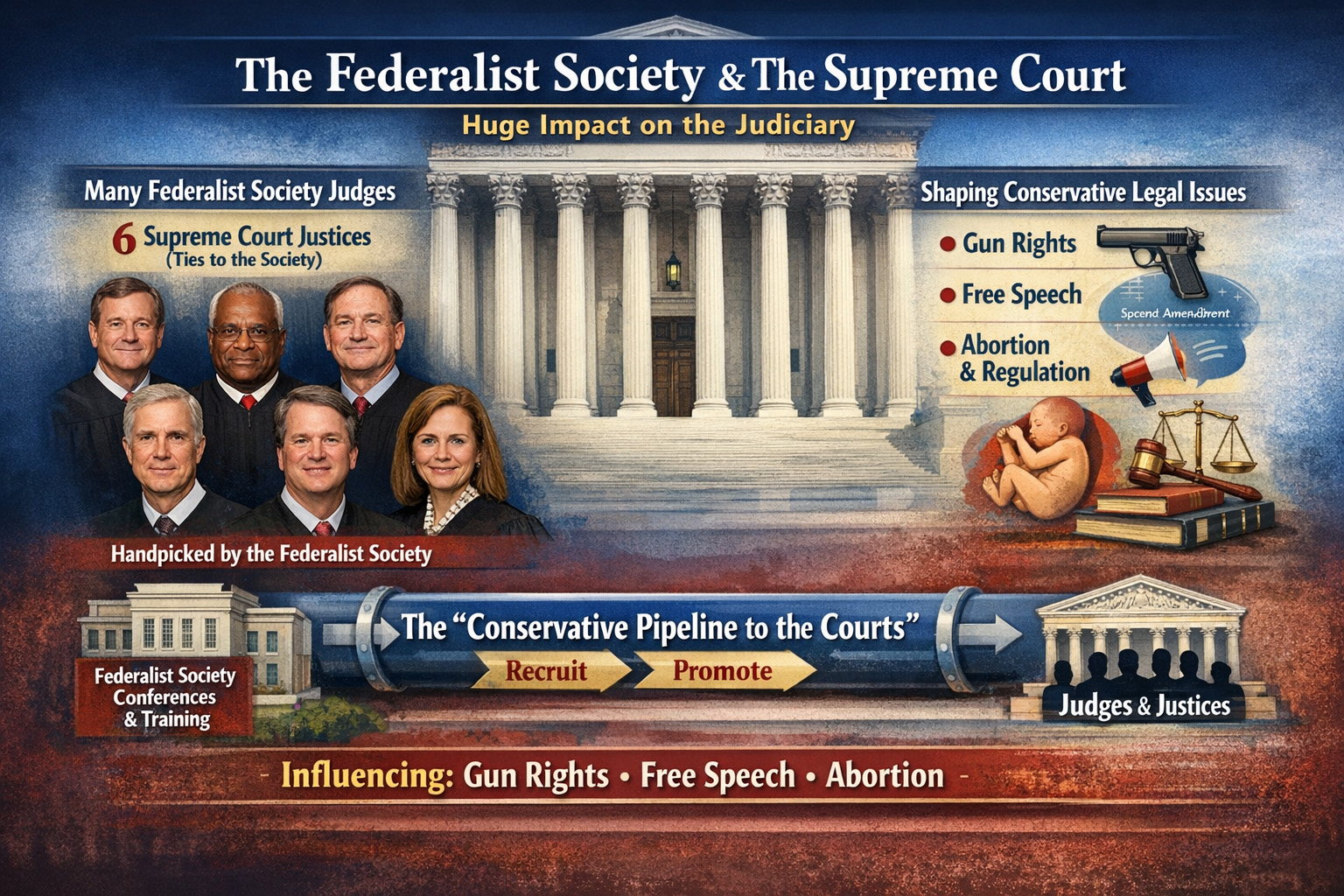
- Huge impact on the judiciary. Many federal judges (including 6 current Supreme Court Justices with ties) are members or recommended by the group.
- Helped shape conservative legal thinking on issues like gun rights, free speech, abortion, and regulation.
- Often called the “conservative pipeline” to the courts.
Critics say it’s too partisan and has shifted the courts rightward. Supporters say it promotes intellectual diversity and constitutional fidelity.The James Madison ConnectionThe society’s logo is a silhouette of James Madison (4th U.S. President, “Father of the Constitution,” co-author of The Federalist Papers). They see themselves as heirs to Madison’s ideas on limited government and checks and balances.
- They have a James Madison Club — a donor group for major supporters.
- Some student chapters win the “James Madison Chapter of the Year” award.
There is no separate major organization called the “Madison Society” directly paired with the Federalist Society. “Madison Society” refers to various unrelated groups (e.g., Second Amendment advocacy, university alumni clubs, or progressive counterparts like the American Constitution Society). The “Federalist and Madison Societies” likely refers to the Federalist Society’s strong ties to James Madison’s legacy.In short: The Federalist Society is the big player in conservative legal circles, proudly Madison-inspired. It’s all about debating ideas to keep government limited and judges neutral.For more: Visit fedsoc.org or read The Federalist Papers for the original inspiration!
Share this:

A few Dark Money Examples, Oh Yeah’s to sleep well with.
You don’t have to take my word for it. Most of us have already seen this — we just didn’t always know what we were looking at.
A Few “Oh Yeah” Examples of Dark Money at Work
You don’t need to follow these closely to get the point. Most of you already recognize the pattern.
1. Supreme Court Confirmation Campaigns
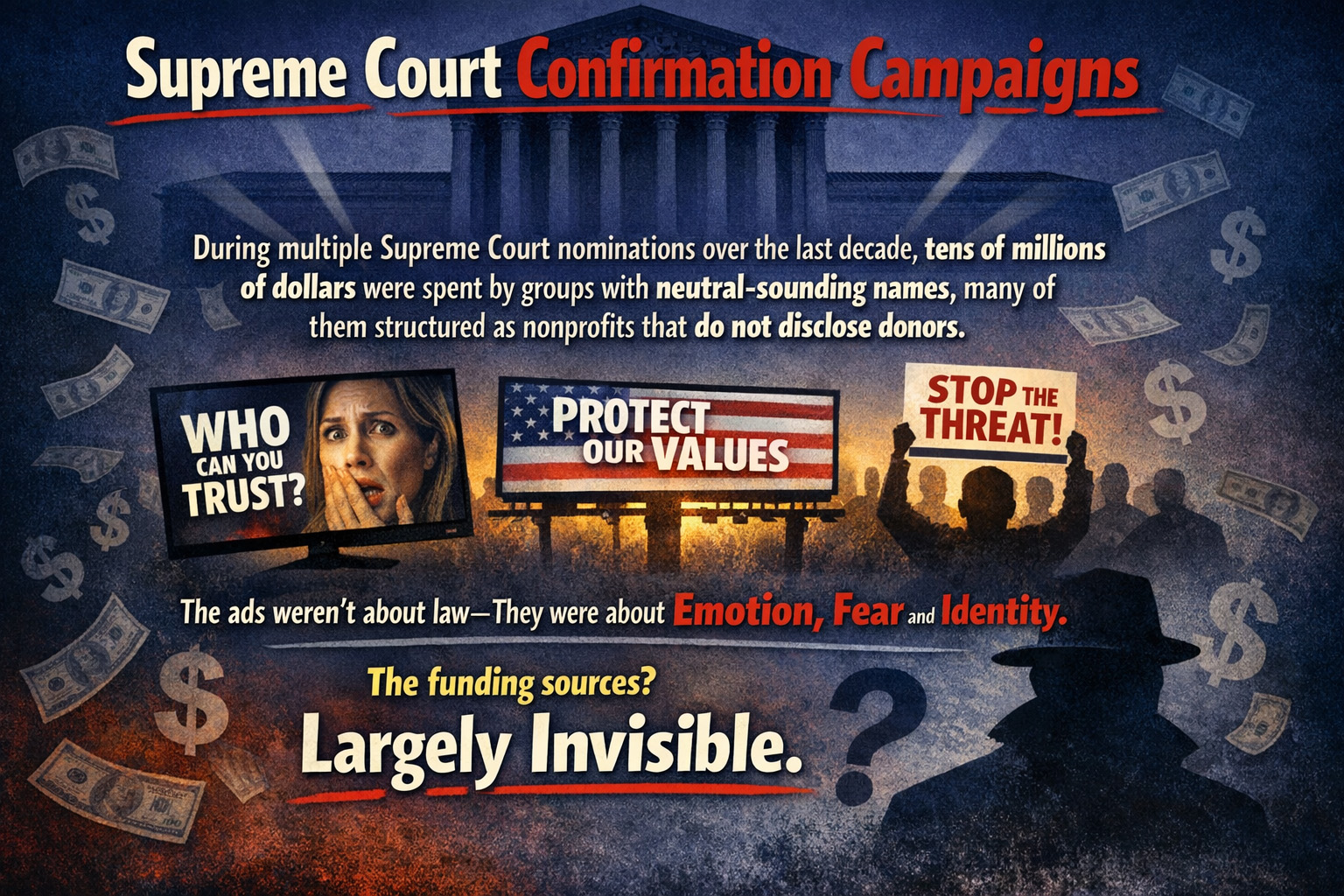
During multiple Supreme Court nominations over the last decade, tens of millions of dollars were spent by groups with neutral-sounding names, many of them structured as nonprofits that do not disclose donors.
The ads weren’t about law — they were about emotion, fear, and identity.
The funding sources? Largely invisible.
Oh yeah.
2. State Judicial Races
In several states, outside money has flooded judicial elections — races most voters barely notice — because judges decide issues like tort law, environmental regulation, and labor disputes.
Small states. Big money. Quiet races.
Oh yeah.
3. Local Ballot Initiatives with National Backers
Energy, mining, and real estate interests have repeatedly funded campaigns against local ballot initiatives — zoning rules, environmental protections, or tax measures — using PACs that make them look like grassroots efforts.
The campaign feels local.
The money often isn’t.
Oh yeah.
4. Education “Reform” Groups
School board races and education policy fights increasingly attract outside funding from ideological organizations on both the right and the left — often routed through nonprofits that don’t disclose donors.
Parents think it’s a local debate.
The funding strategy was written elsewhere.
Oh yeah.
5. Issue Ads That Aren’t Campaign Ads
Ever see ads that say things like:
-
“Tell Senator X to protect freedom”
-
“Call Representative Y and demand action”
These often come from groups legally classified as issue advocacy, not campaigns — which allows them to spend heavily without revealing who’s paying.
Same effect. Different label.
Oh yeah.
6. Small-State Disproportionate Spending
In lower-population states, a few million dollars can completely reshape a political conversation — making them attractive targets for national organizations seeking influence at a bargain price.
Montana, Wyoming, the Dakotas, West Virginia — none of them are accidental.
Oh yeah.
Share this:

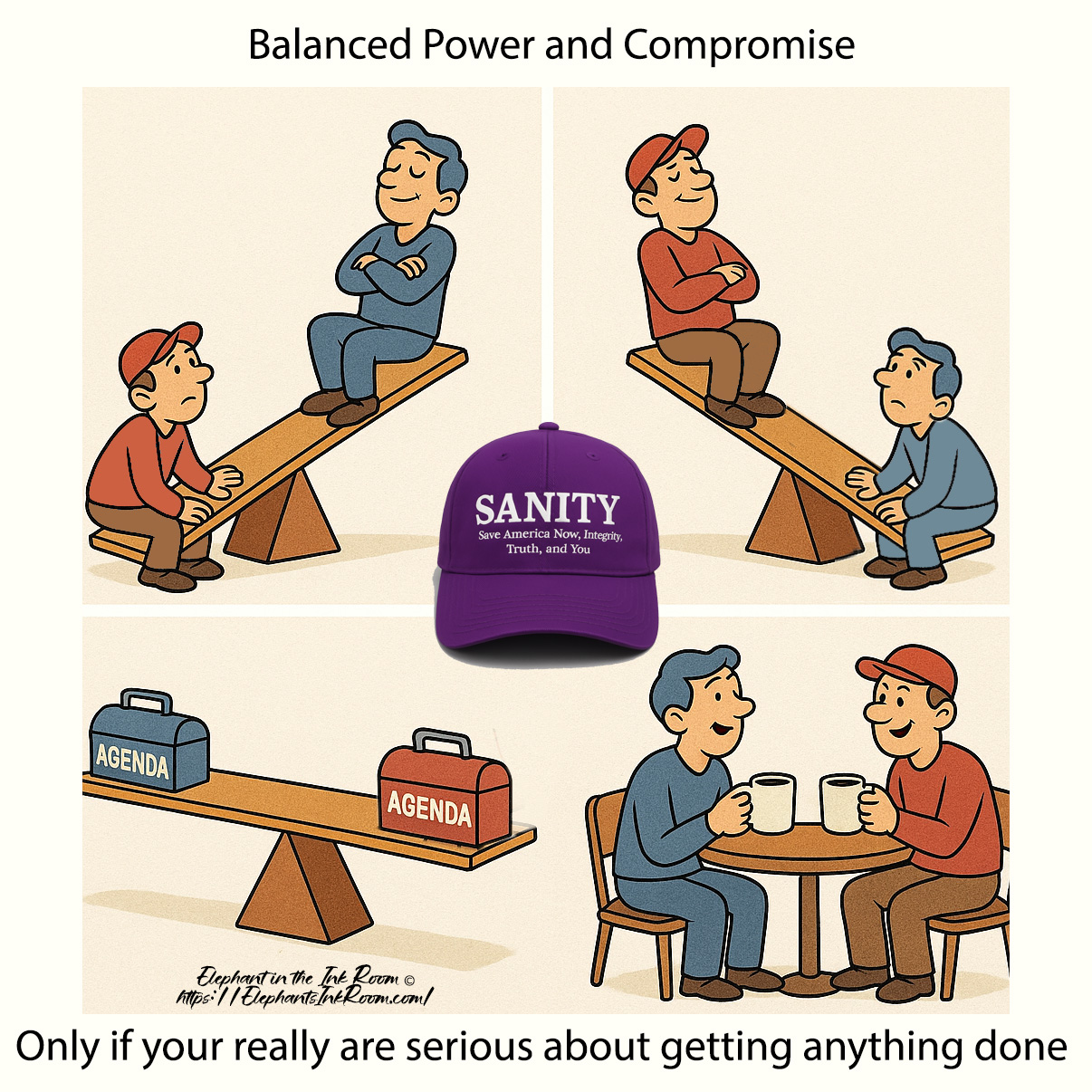
Stop Blaming the Republicans and Stop Blaming the Democrats
There are some really bad people ruining everything for everyone, from the President on down. I staunchly defend individuals that are honest, hard working and would risk everything including their lives for me and my family, I do not care if they call themselves a Republican or a Democrat.
Eisenhower was a Republican and John F. Kennedy was a Democrat, both great men that I would have been proud to have met and been able to call a friend.
Please, your neighbor that changed your daughters flat tire probably wore a different color cap than you. The family across the aisle in Church, the Clergyman, the list goes on. Stop the hate and work together. I am a Moderate Republican and I honestly believe that Donald ‘Appeals’ Trump is the worst thing that could and did happen to this country, and I have been working every single day get him out of office, and I feel that way about his entire administration.
So, once again, stop the blanket name calling, stop the generic hate, direct your energy towards those that deserve it and let us (those like me) work with you to get this country on the road to recovery.

Share this:

2026 – 2025 Fork
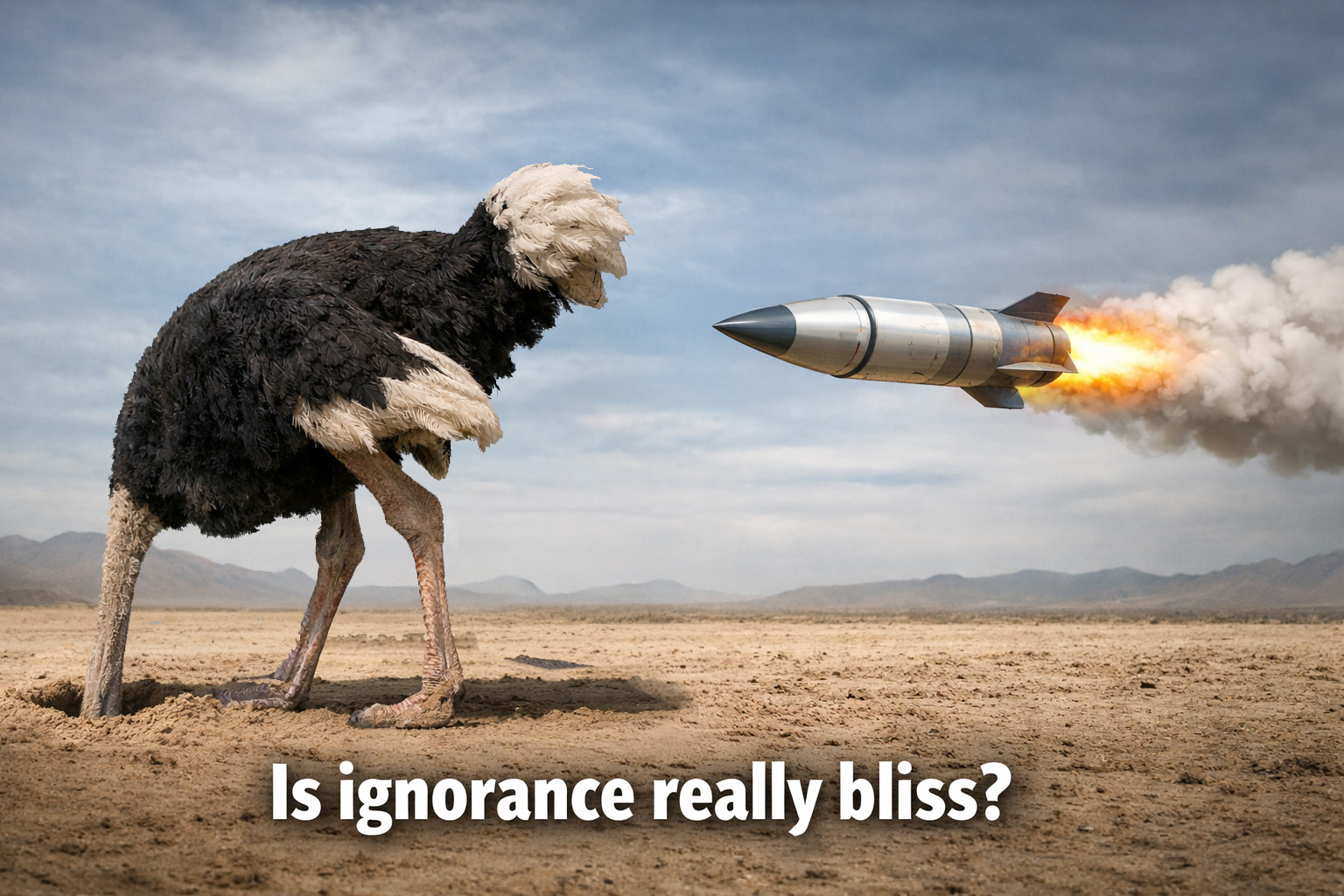
I used to think “conspiracy theories” were about secret plots and hidden agendas. Over time, I’ve come to believe something more troubling: the real danger isn’t what’s hidden, but what we’re distracted from. When attention is constantly pulled toward outrage, personalities, and cultural flashpoints, it becomes much easier for powerful interests to operate without scrutiny.
I’m not interested in relitigating Trump or competing in the coming flood of commentary and parody. That work will be done by others. What matters now are the deeper, quieter forces shaping our future — oligarch influence, the erosion of public education, the hollowing out of healthcare, and the propaganda strategies evolving to keep us unfocused. This space exists to slow that process down, to help us recognize patterns, and to remind ourselves that understanding is the first step toward regaining control.
2025. the joke was on us, they flew at us so fast we couldn’t keep up. The only way to respond was through satire and parody, but it may may be good or it may be bad, but I believe it’s time to start planning for what is to come. There is only one way to do that, and that is to understand what is behing all three curtains.
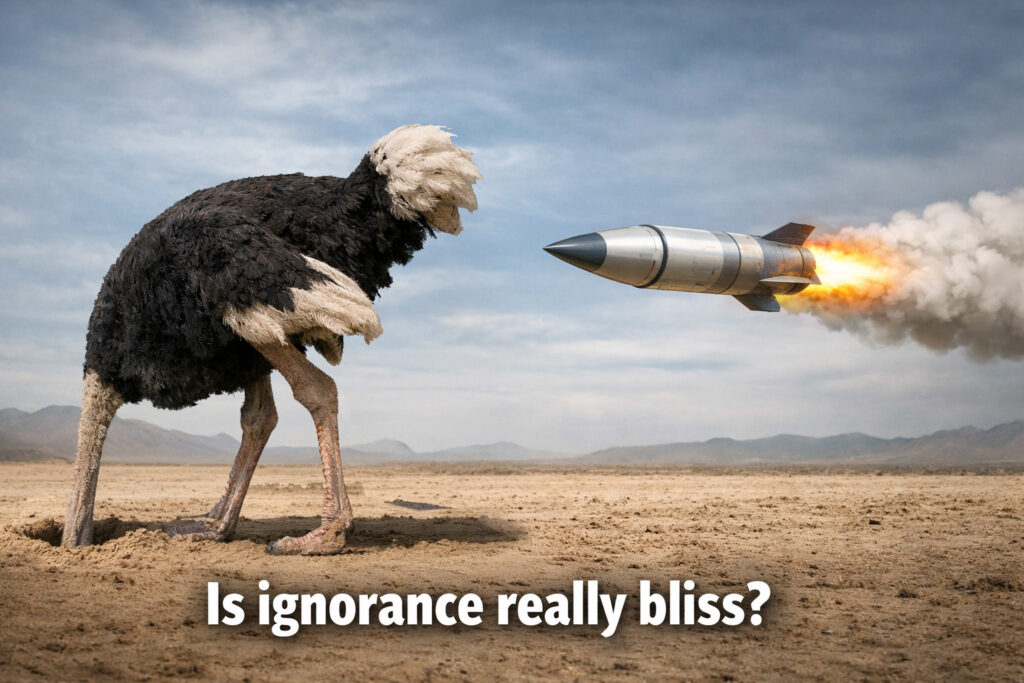
My first instinct was to paint MAGA on the war head, but upon a saner reflection I’m afraid MAGA is the target as well. Nobody is safe.
Share this:

No One Best Fix, Part 3 Dark Money Continued – Montana as a Test Case, Not a Template
No One Best Fix — 3
Montana as a Test Case, Not a Template
Most people outside of Montana don’t think about Montana much — and that’s exactly the point.
Montana matters here not because it has all the answers, but because it raises a question many places are quietly facing:
What happens when a community tries to limit outside influence structurally instead of just complaining about it?

To ground that question in reality, here are two useful references:
-
Official proposed ballot text and description (Montana Secretary of State) — this is the government’s own page listing what the initiative says it would do. Montana Proposed 2026 Ballot Issues Page (Official Text & Summary)
-
Plain-language summary of the initiative statement — a concise version of what the amendment would change. Group Releases Text of Proposed Montana Constitutional Amendment to Curb Dark Money (Summary)
With those in hand, you can always look at the source language while reading this section.
What the initiative would do
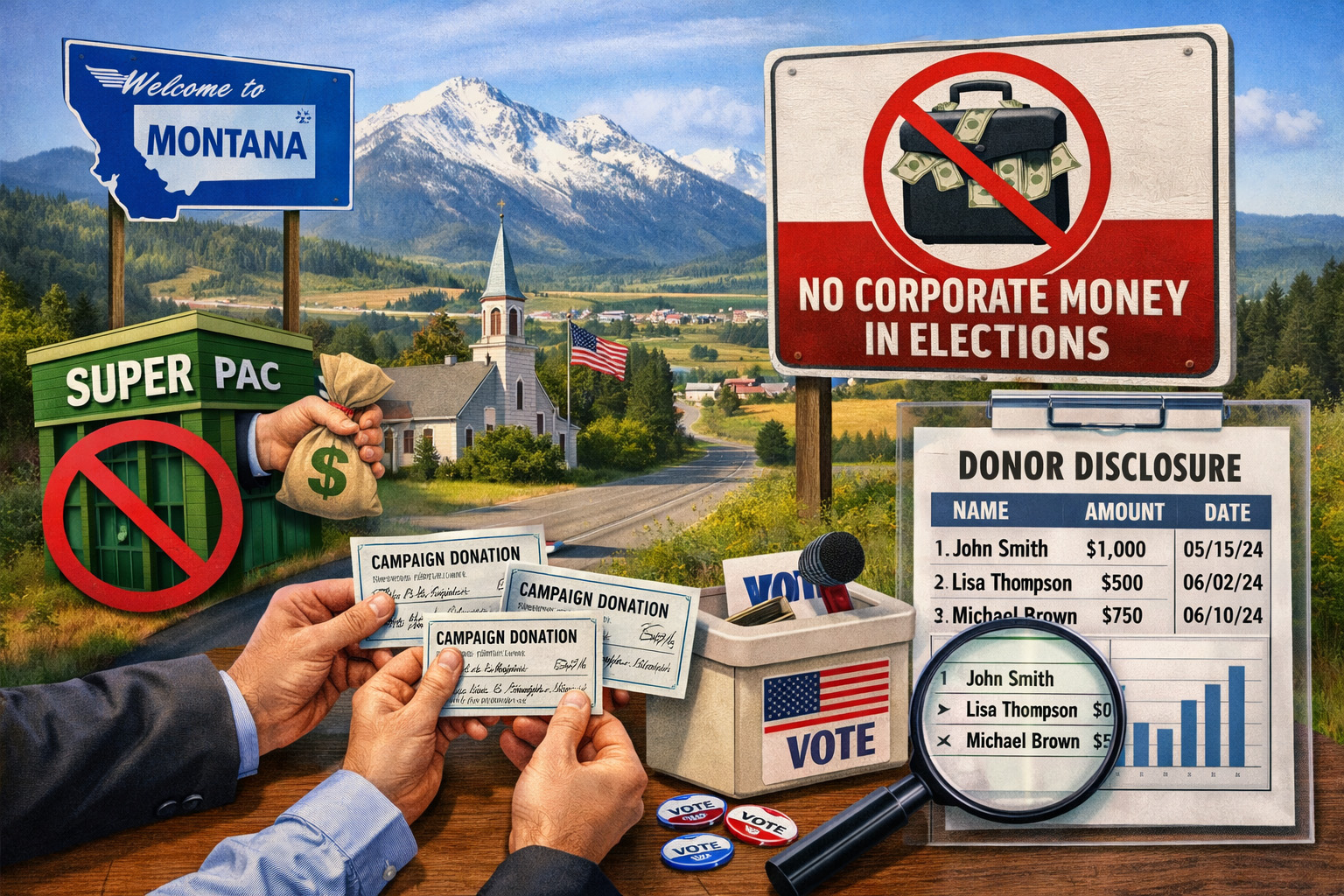
The change in Montana law would simply not grant the corporations the power to give to candidates or causes, but would allow individuals to give, but those donations would be tracked.
The proposed legislation is the first-of-its-kind and takes a different approach to the problem of campaign finance in spending. For example, last year’s U.S. Senate race in Montana, which saw Republican Tim Sheehy beat incumbent Democrat Jon Tester, had more than $275 million spent in a state of roughly 1.2 million people.
“Basically, the only difference is that corporations won’t be able to spend in our elections,” Mangan said.
The specifics of the proposed constitutional amendment would carve out exceptions for organizations like political parties and even media organizations whose coverage could possibly run afoul of the amendment’s language.
“If a person wants to spend money, then they have to put their name on it. It’s full disclosure. That’s what this is all about,” Mangan said.
The Montana proposal — often referred to as the Montana Plan or the Transparent Election Initiative — is fundamentally different from traditional campaign finance reforms.
Instead of regulating spending directly, it would change the basic definition of what corporations and similar entities (“artificial persons”) are allowed to do in elections. In effect, it would:
-
Amend the state constitution to say corporations and other artificial entities have only the powers the constitution explicitly grants them.
-
Specifically ensure that corporations have no authority to spend money or anything of value on elections or ballot issues.
-
Leave open the possibility for political committees (not corporations) to spend money on elections.
-
Include enforcement provisions and severability clauses to protect parts of the law if others are ruled invalid. Montana Secretary of State+1
This isn’t the typical approach of saying “limit X amount” or “disclose Y.” It says, in essence:
If the state never gave a corporate entity the power to spend in politics in the first place, then it can’t do so now. Harvard Law Corporate Governance Forum
That’s why proponents describe it as a doctrine-based challenge to the framework established by Citizens United — not a straightforward campaign finance rule. Harvard Law Corporate Governance Forum
Why this matters structurally
There are four big implications worth noting:
1. It reframes power, not just spending.
Instead of capping or reporting spending, it redefines who gets that power at all. That’s a deeper structural shift in how the political system treats corporations. Harvard Law Corporate Governance Forum
2. It acts at the level where consequences are visible.
When outside groups spend in small races or ballot campaigns, local voters often never see the circuit of influence. This initiative aims to shorten that circuit — even if imperfectly. Truthout
3. It shows how local contexts shape responses to national problems.
Dark money isn’t a national phenomenon only — it’s a distributed one, especially in low-attention environments like state and local elections. Montana’s approach reflects that reality. NonStop Local Montana
4. It illustrates why there’s “no one best fix.”
You’ll notice this proposal doesn’t:
-
Ban all political spending by wealthy individuals
-
Eliminate all influence from outside actors
-
End lobbying
-
And, according to some critics, may raise free speech or legal concerns if adopted wholesale Montana Free Press
What it does is test a structural lever that hasn’t been widely tried before: the state’s sovereign authority to grant or withhold corporate powers.
What’s happening with the initiative now
As of late 2025:
-
The Montana Attorney General has ruled the proposed initiative legally insufficient, arguing it combines multiple constitutional changes into one item and may affect more than a single subject. Montana Free Press
-
The organizers are planning to challenge that ruling and pursue placement on the 2026 ballot. Montana Free Press
This process — review, challenge, signature gathering — is itself part of what makes Montana a useful test case. It isn’t a finished story yet.
How to think about this
When you look at the initiative text and the summary together with your understanding of dark money and influence, here’s the clean takeaway:
-
Montana isn’t offering a pre-packaged solution.
-
It’s testing whether changing who can spend at all alters the dynamics of influence.
-
The state’s unique legal authority provides a laboratory for ideas that might be adapted elsewhere in different forms.
In other words:
Montana’s initiative isn’t the answer — it’s an experiment. Good data from experimentation — success or failure — gives other states something concrete to think with.
Share this:

No One Best Fix, Part 1 Dark Money Continued – Why Simple Solutions Fail
Parts One and Two are being kept deliberately short. Not because the issues are simple — but because my attention span is being throttled back.

I’ve found that even when something seems straightforward, actually understanding it requires letting it sit for a moment before moving on. Digest first. Then build.
By the time we reach Part Three, we’ll introduce an initiative from one state that attempts to address these issues as they affect them. The better we understand the basic principle, the better we’ll understand how — or whether — it could apply to our own states and circumstances.
And it’s worth repeating:
One size does not fit all.
No One Best Fix — 1
Why Simple Solutions Fail
Once people understand how dark money works, the next instinct is to ask:
“Why don’t we just ban it?”
That reaction is understandable — and it’s also where most discussions fall apart.
The free speech problem
Political speech is protected broadly in the United States, not because it’s always noble, but because limiting it is dangerous. Any rule strong enough to silence bad actors is also strong enough to silence legitimate dissent.
That creates a hard tradeoff:
-
Regulate too lightly, and influence hides
-
Regulate too aggressively, and speech is chilled
There is no clean line that separates “acceptable” influence from “unacceptable” influence without collateral damage.
The money problem
Money itself isn’t illegal. People are allowed to spend their own money advocating for causes they believe in.
The difficulty arises when:
-
Money becomes scalable
-
Influence becomes detached from consequences
-
The people paying don’t live with the outcomes
Banning money outright isn’t realistic. Limiting it too tightly just pushes it into new, often less visible channels.
The enforcement problem
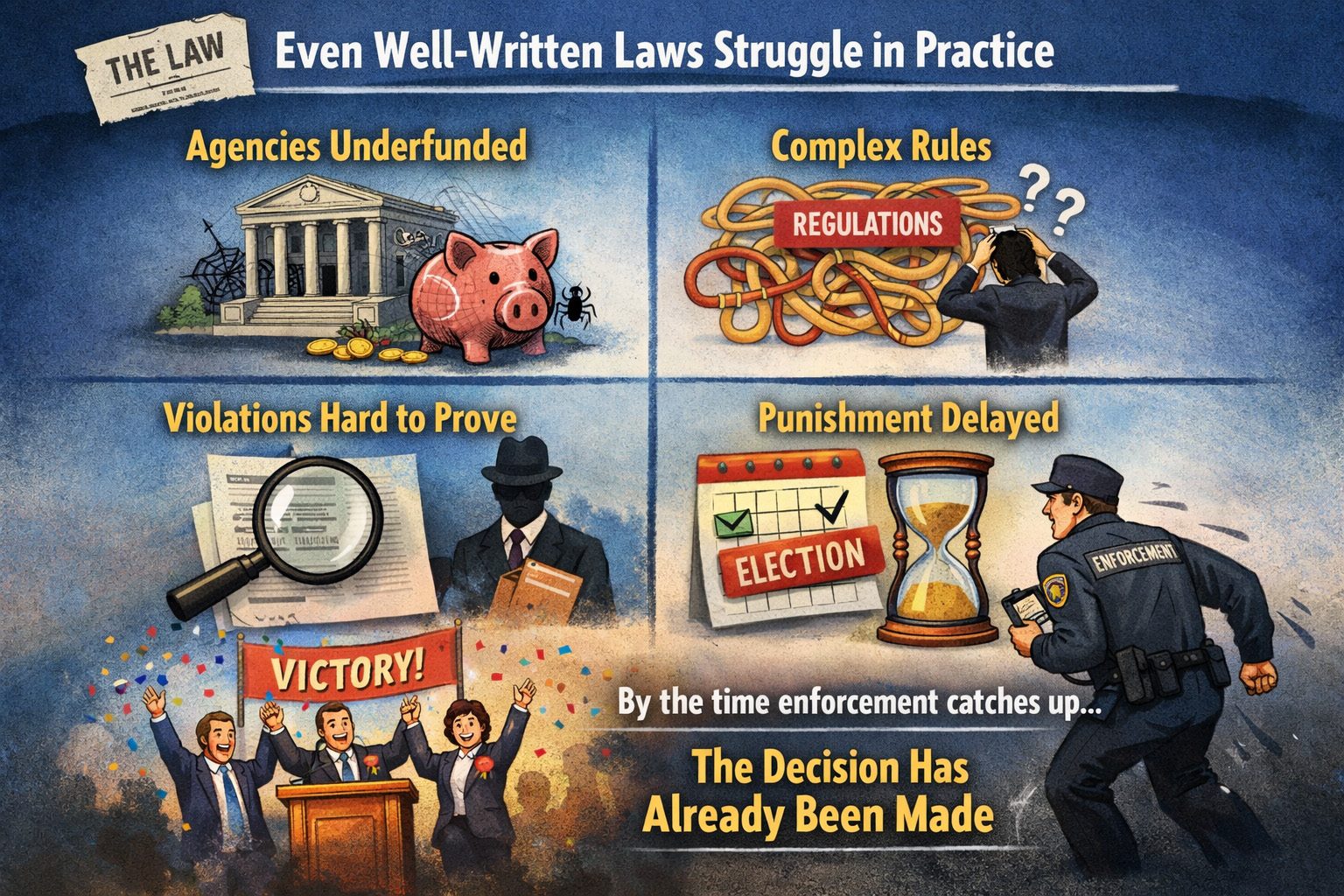
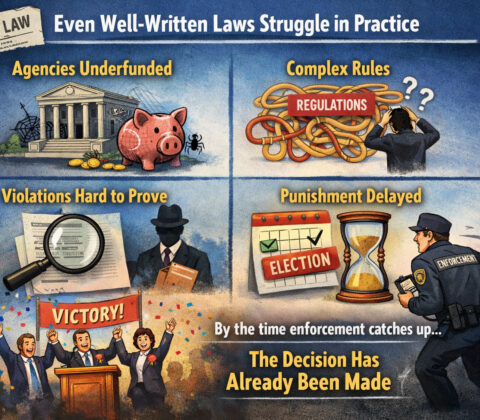
Even well-written laws struggle in practice:
-
Agencies are underfunded
-
Rules are complex
-
Violations are hard to prove
-
Punishments arrive long after elections are over
By the time enforcement catches up, the decision has already been made.
Why this matters
The reason dark money persists isn’t because no one has tried to fix it. It’s because every fix runs into real-world constraints.
Understanding those constraints doesn’t mean giving up.
It means being honest about what’s possible.
That honesty is the starting point for any solution that has a chance of lasting.

Share this:



Dark Money for Dummies — Part 3
Why It Shows Up in Small and Local Places
If you want to understand dark money’s real power, don’t look first at presidential elections. Look at small states, local races, and low-visibility decisions.

That’s where the leverage is highest.
Small places are efficient
Influencing a national election is expensive and unpredictable.
Influencing a state legislature, regulatory board, court election, or ballot initiative is often:
Far cheaper
Less crowded with competing messages
Less scrutinized by media
More consequential per dollar spent
In smaller political ecosystems, a relatively modest amount of money can:
Shape the debate
Deter opposition
Make outcomes feel pre-decided
This isn’t because voters are uninformed. It’s because the volume of influence overwhelms the scale of the system.
Local decisions can unlock national value
Many of the most important decisions affecting national industries are made locally:
Resource extraction permits
Environmental standards
Tax structures
Judicial interpretations
Regulatory enforcement
Winning a single state-level fight can:
Set precedent
Reduce compliance costs elsewhere
Protect billions in downstream revenue
From that perspective, local politics isn’t small at all. It’s strategic.
Why motives stay unadvertised
If an organization openly said:
“We’re here to protect a distant financial interest that won’t bear the local costs”
…it would fail immediately.
So messaging focuses on:
Jobs
Growth
Stability
Freedom
Tradition
Safety
These themes are not fake. They resonate because they matter to people’s lives. The issue isn’t that they’re false — it’s that they’re partial.
What’s usually missing is:
Who benefits most
Who absorbs long-term costs
Who leaves when the damage is done
That information gap isn’t accidental. It’s essential to the strategy.
The quiet effect on local communities
Over time, this kind of influence can:
Narrow the range of acceptable debate
Make opposition feel futile or extreme
Shift policy without visible public consent
The most important outcome often isn’t a single law or election result. It’s the normalization of decisions made with local consequences but remote beneficiaries.
That’s the point where influence becomes detached from accountability.
Where this leaves us
By now, three things should be clear:
Dark money is usually legal
It works best where attention is lowest
Its power comes from distance — not secrecy
The remaining question isn’t whether this system exists.
It’s whether communities should have the ability to limit how much invisible, outside influence their political systems can absorb.
That’s where ideas like the Montana initiative enter the picture — not as a cure-all, but as a structural experiment.
Share this:

No One Best Fix, Part 2 Dark Money Continued – Why Local Answers Matter More Than National Ones
No One Best Fix — 2
Why Local Answers Matter More Than National Ones

If there is no single best fix, the next question becomes:
“At what level should we even try?”
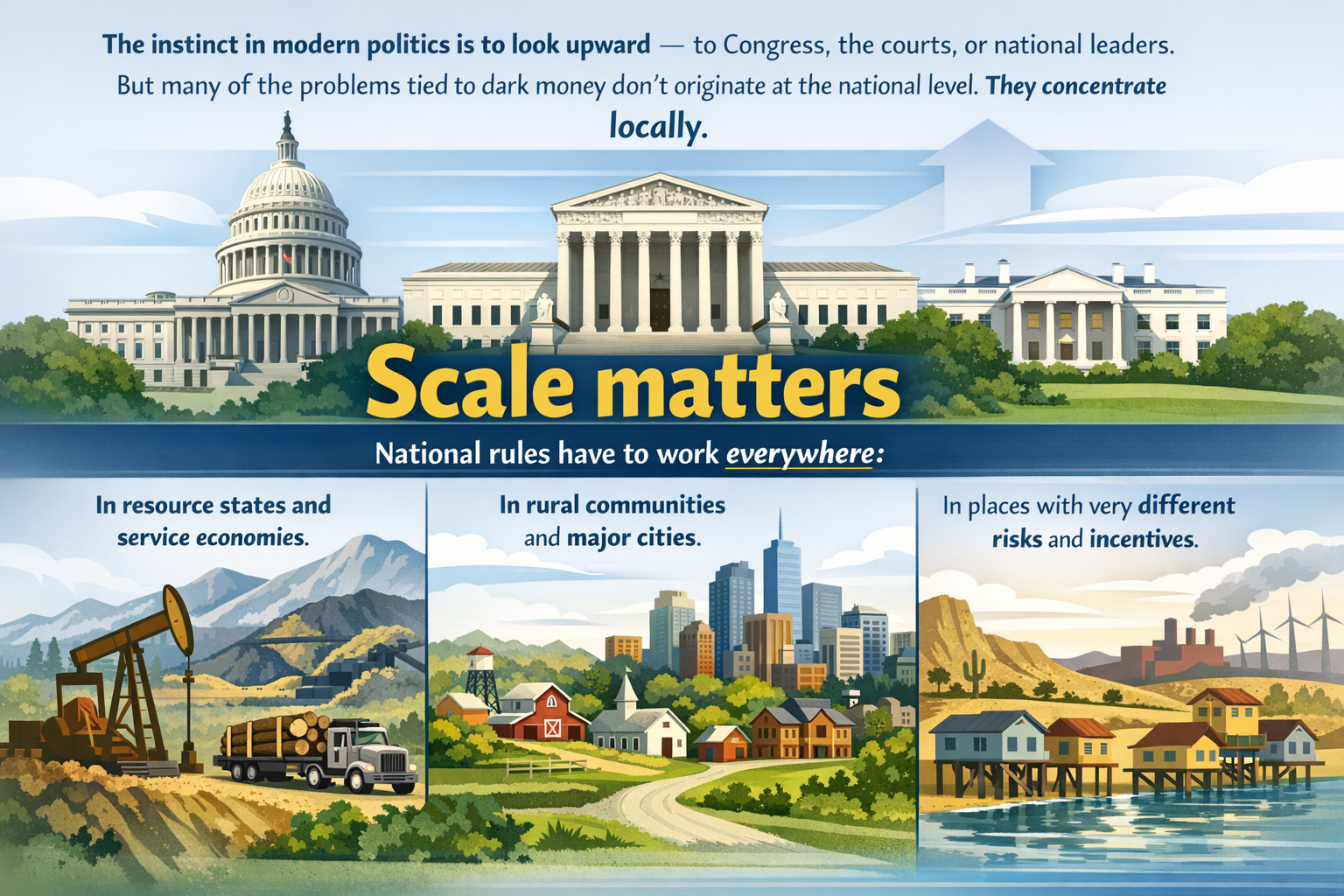
The instinct in modern politics is to look upward — to Congress, the courts, or national leaders. But many of the problems tied to dark money don’t originate at the national level. They concentrate locally.
In reality, many of the National Initiatives actually originated at the local level, they are designed, implemented and evaluated locally before they are introduced on a National Level. Although what works here doesn’t work there is true. Money is spent wisely and pilot plans or test runs are judged in different environments.
One of the most outwardly confusing observations is why actions or interference will be implemented in one locality or region and not another. When this happens you must step back and follow either the money or the vote. We may be led to believe the new infrastructure is for the communities health, but will it still be supported when the oil fracking or coal mining, or.. or.. is no longer profitable to the corporation located many states away without any other financial ties to the local population.
Scale matters
National rules have to work everywhere:
-
In resource states and service economies
-
In rural communities and major cities
-
In places with very different risks and incentives
That forces compromise — and compromise often produces rules that are too blunt to be effective and too rigid to adapt.
Local and state systems, by contrast:
-
Have clearer lines of cause and effect
-
Face specific pressures rather than abstract ones
-
Can tailor responses to their own vulnerabilities
What works in one state may fail in another — and that’s not a flaw. It’s reality.
Accountability is stronger closer to home
When decisions are made locally:
-
The people affected are easier to identify
-
The consequences are harder to ignore
-
The distance between influence and impact is shorter
That doesn’t eliminate outside pressure, but it makes it harder to hide.
This isn’t about isolation
Focusing on local solutions isn’t about shutting out the world or pretending states exist in a vacuum.
It’s about restoring balance:
-
National rules set guardrails
-
Local systems decide how much influence they can absorb
That balance is what federalism was designed to provide.
Share this:



Dark Money for Dummies — Part 2
Why It Exists (and Why It’s Legal)
Once people understand what dark money is, the next question is obvious:
If this creates so many problems, why does it exist at all?
The short answer is not corruption or conspiracy.
The longer answer is classification.
The difference between campaigns and “issues”
U.S. election law draws a sharp line between:
Campaign activity (which is regulated and disclosed)
Issue advocacy (which is far less regulated)
If an organization explicitly tells you to:
“Vote for” or “Vote against” a candidate
…it is treated as a campaign and must disclose donors.
If it instead says:
“Support energy independence”
“Protect public safety”
“Stand up for local jobs”
“Defend parental rights”
…it may be classified as issue advocacy, even if the timing, targeting, and messaging clearly benefit one candidate or policy outcome.
That distinction is the foundation dark money is built on.
Why nonprofits are central to this system
Many dark money organizations are nonprofits because nonprofits were never designed to function like political campaigns. They were meant to:
Promote causes
Educate the public
Advocate broadly for values
Over time, those purposes expanded — legally — to include political messaging that stops just short of explicit campaigning.
Once that door opened, the incentives became obvious:
Donors could influence politics without public scrutiny
Organizations could spend heavily without disclosure
Voters would see the message, but not the full context
Nothing about this requires bad actors. It works even when everyone is technically following the rules.
Why “just disclose it” hasn’t fixed the problem
It’s tempting to think the solution is simple: require more disclosure.
The problem is that disclosure alone often fails in practice because:
Information is scattered across filings few people read
Money moves through multiple layers of organizations
The source may be technically disclosed but practically untraceable
Voters encounter the message long before they encounter the data
By the time transparency arrives, the influence has already done its work.
Dark money doesn’t rely on secrecy so much as opacity through complexity.
Why the law tolerates this
Courts have consistently protected issue advocacy because:
Political speech is broadly protected
The line between ideas and elections is hard to police
Over-regulation risks suppressing legitimate civic activity
In other words, the system tolerates dark money not because it’s admired, but because the alternative risks collateral damage to free expression.
This creates a tradeoff:
Protect speech broadly
Accept influence that is difficult to see
That tradeoff becomes more consequential the smaller and quieter the political arena is.
Which brings us to the next question.
If dark money is everywhere, why does it seem to concentrate so heavily in state and local politics?
Share this:

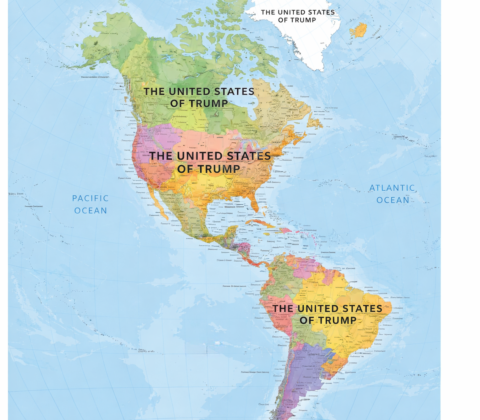
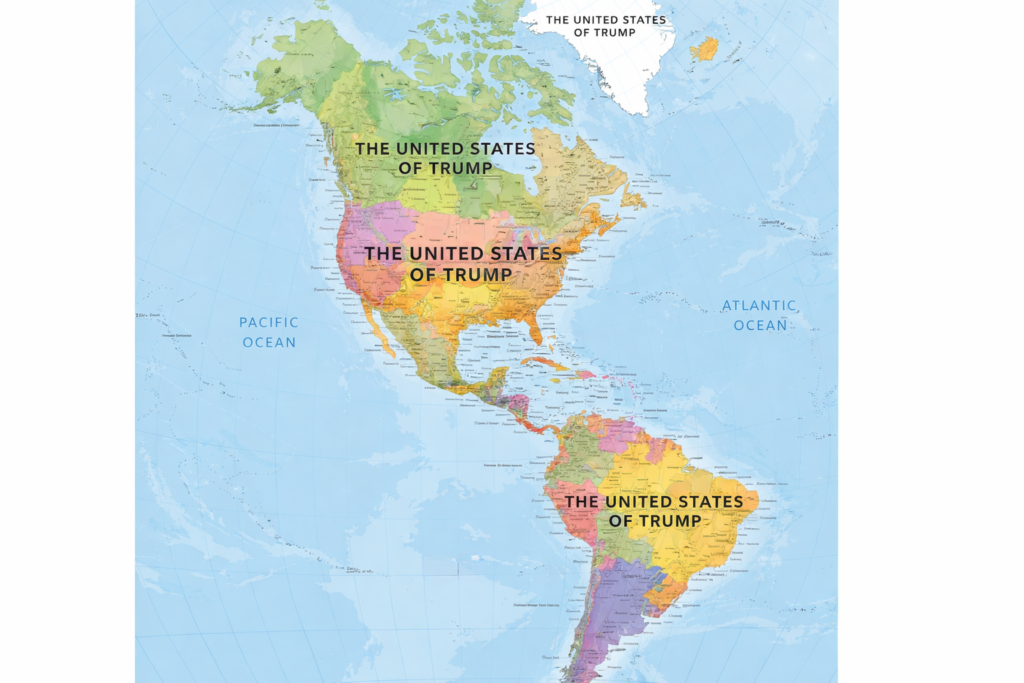
BREAKING NEWS: TOP SECRET MAP LEAKED FROM WHITE HOUSE PRINTING HOUSE!
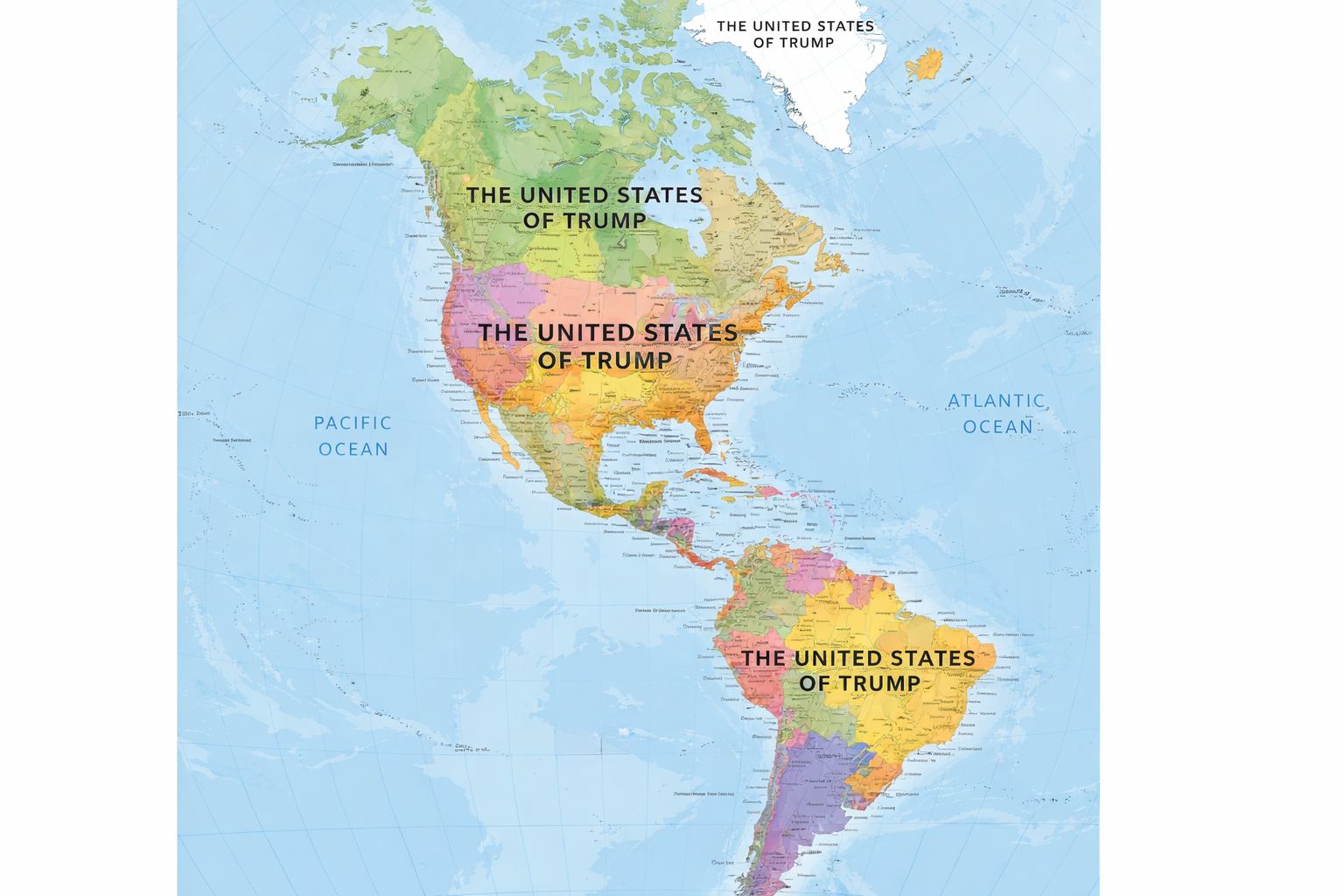
BREAKING NEWS: TOP SECRET MAP LEAKED FROM WHITE HOUSE PRINTING HOUSE!
Washington, D.C. – January 3, 2026 – In a stunning development that has sent shockwaves through the corridors of power (and probably a few golf carts), unnamed sources have secreted away a highly classified parody map from the White House Printing House. This explosive document, dubbed “The United States of Trump,” reveals what insiders are calling the President’s most ambitious secret plan yet: to incorporate ALL of the Americas – North, South, Central, and even those sneaky islands – plus Greenland into one glorious, untied mega-nation!According to the leaked map, which features bold red lines redrawn with what appears to be a Sharpie (classic Trump touch), the new “United States of Trump” would stretch from the icy tip of Greenland (because, why not? It’s got great real estate potential) all the way down to the southernmost penguin parties in Antarctica – wait, no, just the Americas, but let’s be honest, penguins might be next. Key highlights include:
-
Canada renamed “Trump North” – “Because it’s basically our hat anyway,” per anonymous whispers.
-
Mexico becomes “Trump Wall Wonderland” – Complete with luxury resorts on both sides of the… well, you know.
-
Brazil as “Trump Amazon Prime” – Free two-day shipping on rainforests!
-
Greenland dubbed “Trump’s Ice Palace” – Plans include melting it for premium bottled water branded “Trump Melt.”
-
The entire continent unified under one flag: Stars, stripes, and a giant golden T.
The map, allegedly printed on super-secret White House stationery (with watermarks of tiny MAGA hats), outlines Trump’s masterstroke to “Make America Yuge Again” by absorbing neighbors through “deals so good, they’ll beg to join.” Unnamed sources claim this was hatched during late-night tweet storms, with input from shadowy advisors like “that guy from the MyPillow ads.”White House officials have neither confirmed nor denied the leak, but a spokesperson muttered something about “fake news” while nervously shredding documents. Meanwhile, international leaders are reportedly in panic mode – Trudeau’s already packing his hockey sticks, and Denmark’s like, “Greenland? Again?!”
Share this:




Part 4: When Responsibility Moves Quietly – Healthcare in America
Part 4: When Responsibility Moves Quietly
When health policy stalls, something important happens that is easy to miss.
Responsibility doesn’t disappear.
It moves.
And almost always, it moves away from systems and toward individuals.
This shift rarely arrives with an announcement. There is no press conference declaring that people are now on their own. Instead, the change shows up gradually, wrapped in reasonable language.
Words like:
“Choice”
“Flexibility”
“Consumer-driven”
“Personal responsibility”
On their own, these words sound empowering. In practice, they often signal something else.
What Happens When Policy Pauses
When governments delay, defer, or avoid clear health policy decisions, the system still has to function.
Care still costs money. Providers still need to be paid. Insurers still need to price risk. Employers still need to decide what they will offer.
In the absence of coordinated policy, the burden of navigating those decisions shifts downward.
From institutions → to employers.
From employers → to families.
From families → to individuals.
No one votes on this transfer. It happens quietly, through defaults.
How “Choice” Becomes a Signal
Choice is not inherently bad.
But when choice expands while guidance, coverage, or protection does not, it becomes a signal that responsibility has shifted.
Instead of asking:
“Is this covered?”
People are asked to consider:
Which plan?
Which network?
Which deductible?
Which out-of-pocket maximum?
Which exclusions?
These are not choices most people can make with confidence, especially under time pressure or medical stress.
Yet the presence of choice creates the impression that outcomes are the result of personal decisions, not structural design.
The Human Experience of the Shift
Most people never engage with health policy directly.
They encounter it at moments of vulnerability:
A job change
A pregnancy
A diagnosis
A cancellation notice
A premium increase
At that point, the question isn’t ideological. It’s practical:
Am I covered?
Is my family covered?
What happens if something goes wrong?
When responsibility has already shifted, the answers are often unclear — not because people weren’t paying attention, but because the system expects them to manage complexity that used to be handled upstream.
Why This Shift Often Goes Unnoticed
The transfer of responsibility feels normal because it happens gradually.
Each step can be justified:
Employers reassess costs
Insurers adjust plans
Governments emphasize flexibility
No single change looks unreasonable.
But taken together, they redefine who bears the risk.
By the time people realize what has happened, the system presents the outcome as a matter of personal choice rather than public design.
Setting Up What Comes Next
Once responsibility moves to individuals, complexity becomes the gatekeeper.
Understanding plans, coverage limits, and tradeoffs becomes essential — and increasingly difficult.
In the next part, we’ll look at the difference between having choices and having meaningful coverage, and why those two things are often confused.
Next: Part 5 — Choice vs. Coverage
Healthcare In America – The Nuts and Bolts – The Series
Share this:
Like this: