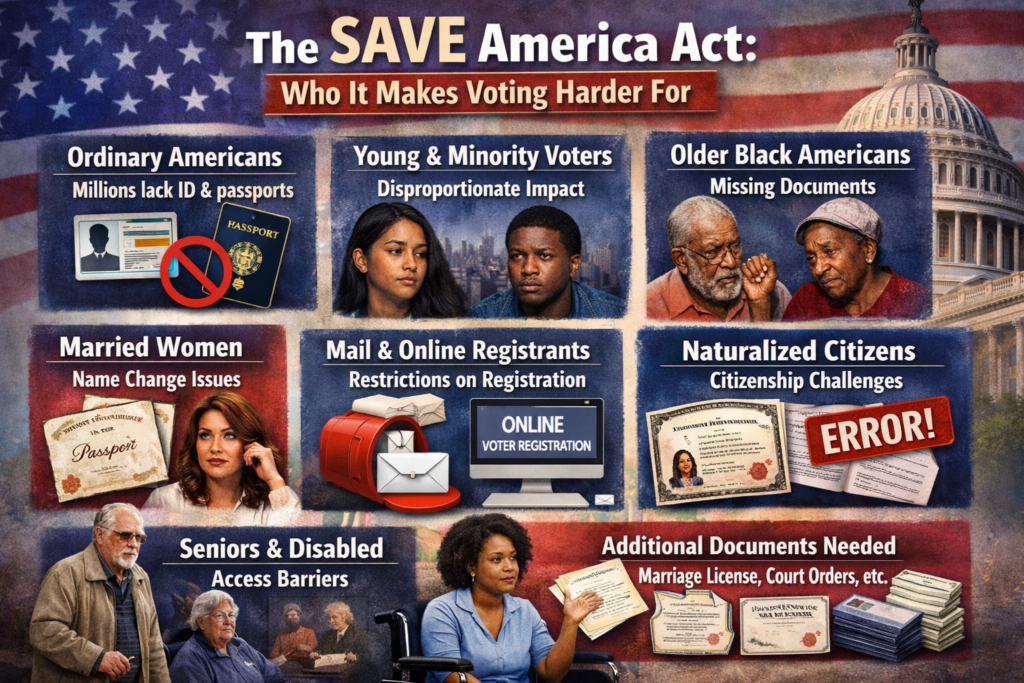
The SAVE America Act (the updated version of the earlier SAVE Act) passed the House in February 2026 and is currently being debated in the Senate.
Who it makes voting harder for:
Ordinary Americans broadly — More than 21 million Americans lack ready access to those documents. Roughly half of Americans don’t even have a passport.
Voters of color and younger voters — The SAVE Act would disenfranchise Americans of all ages and races, but younger voters and voters of color would suffer disproportionately.
Older Black Americans specifically — Decades after segregation left gaps in citizenship documents, the bill could create new barriers at the ballot box for people who were never properly documented during that era.
Married women (and anyone who changed their name) — The bill would disproportionately affect women whose current legal names differ from the names on their birth certificates or passports. It does not include exceptions for eligible voters whose names differ from those on their identification documents, and would force them to submit additional documents — such as marriage certificates, divorce decrees, or court orders to prove their identities.
People who register by mail or online — In 2022, more than seven million Americans registered to vote by mail, and almost 11 million registered online. The bill would severely threaten mail registration and require online registration systems to be overhauled.
Naturalized citizens — Naturalized citizens are particularly at risk for being inaccurately flagged for removal from voter rolls under the bill’s data-verification requirements.
People with disabilities and the elderly — People with disabilities and older voters who may not be able to register in person would also face new barriers.
Supporters’ argument
Proponents say the bill is necessary to ensure only citizens vote and that it simply enforces existing law. They argue an affidavit process exists for those without documents.
Critics’ counterargument
All available evidence, including from the Trump administration itself, indicates that only American citizens vote and the exceptions are vanishingly rare. Critics point to Kansas as a cautionary example when Kansas adopted a similar proof-of-citizenship law in 2011, it prevented over 31,000 eligible citizens from registering to vote before it was blocked by federal courts.