




















































Blog Archives

Health policy is often discussed either at a level so abstract that it feels irrelevant, or so emotional that it becomes exhausting. In both cases, people disengage—not because they don’t care, but because they can’t see where their understanding actually makes a difference.

Healthcare in America vs Socialized Medicine Today

Healthcare in America vs Socialized Medicine Today
Michael and Sarah Walker
Healthcare in America vs Socialized Medicine Today
Loading
/

Roughly half or more of U.S. healthcare spending already flows through government programs. We are not a pure market system. We are a complex blend.

Youtube Playlist for Our Healthcare Series

Healthcare in America Structural Reform Playbook Post 6 Technology & Telehealth Optimization

Healthcare in America Structural Reform Playbook Post 6 Technology & Telehealth Optimization
Michael and Sarah Walker
Healthcare in America Structural Reform Playbook Post 6 Technology & Telehealth Optimization
Loading
/

When combined with oversight, transparency, and coordinated care, technology turns abstract reforms into real-world improvements that patients can see and feel.
The series shows that practical, achievable reforms exist, even without overhauling the entire system. Small, structural changes — applied thoughtfully — can reduce friction, preserve access, and improve outcomes.

Youtube Playlist for Our Healthcare Series

Healthcare in America Structural Reform Playbook Post 5 Rural & Underserved Access

Healthcare in America Structural Reform Playbook Post 5 Rural & Underserved Access
Michael and Sarah Walker
Healthcare in America Structural Reform Playbook Post 5 Rural & Underserved Access
Loading
/

Rural and underserved populations are canaries in the coal mine for healthcare stress. Structural interventions — not political promises — determine whether access is preserved.

Youtube Playlist for Our Healthcare Series

Healthcare in America Structural Reform Playbook Post 4 Incentive Alignment for Prevention & Chronic Disease

Healthcare in America Structural Reform Playbook Post 4 Incentive Alignment for Prevention & Chronic Disease
Michael and Sarah Walker
Healthcare in America Structural Reform Playbook Post 4 Incentive Alignment for Prevention & Chronic Disease
Loading
/

Chronic disease drives the majority of U.S. healthcare costs. Managing it is not just a clinical challenge — it’s also a matter of incentives. Even small changes in how care is reimbursed or structured can produce better outcomes and lower costs.

Youtube Playlist for Our Healthcare Series

Healthcare in America Structural Reform Playbook Post 3 Integrated Care & Coordination

Healthcare in America Structural Reform Playbook Post 3 Integrated Care & Coordination
Michael and Sarah Walker
Healthcare in America Structural Reform Playbook Post 3 Integrated Care & Coordination
Loading
/

Integrated models — like Kaiser Permanente or other vertically coordinated systems — reduce these frictions by aligning care delivery, records, and financial flows.

Youtube Playlist for Our Healthcare Series

Healthcare in America Structural Reform Playbook Post 2 Price Transparency & Negotiation

Healthcare in America Structural Reform Playbook Post 2 Price Transparency & Negotiation
Michael and Sarah Walker
Healthcare in America Structural Reform Playbook Post 2 Price Transparency & Negotiation
Loading
/

Price transparency is not about “free market” ideology; it’s about clarity, fairness, and predictability. When patients see costs clearly, the system becomes easier to navigate — and wasteful practices are exposed.

Youtube Playlist for Our Healthcare Series

Healthcare in America Structural Reform Playbook Post 1 Administrative Oversight & Waste Reduction

Healthcare in America Structural Reform Playbook Post 1 Administrative Oversight & Waste Reduction
Michael and Sarah Walker
Healthcare in America Structural Reform Playbook Post 1 Administrative Oversight & Waste Reduction
Loading
/

Administrative tasks — billing, claims processing, coding, approvals — are necessary, but studies show U.S. administrative costs are roughly double those of comparable countries. That’s hundreds of billions of dollars each year that could be redirected toward actual care.

Youtube Playlist for Our Healthcare Series

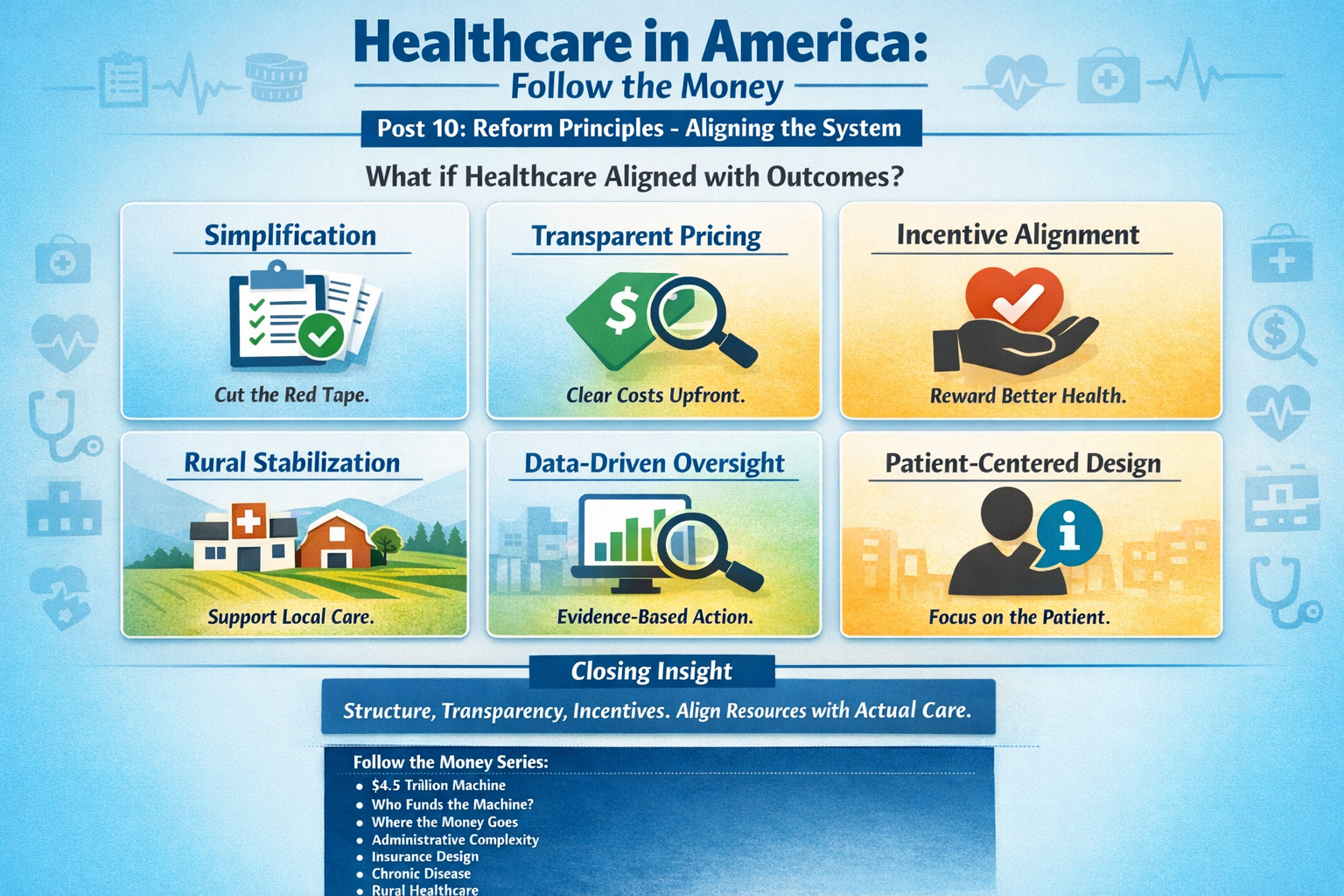
Healthcare in America, Follow the Money Post 10 Reform Principles: Aligning the System

Healthcare in America, Follow the Money Post 10 Reform Principles: Aligning the System

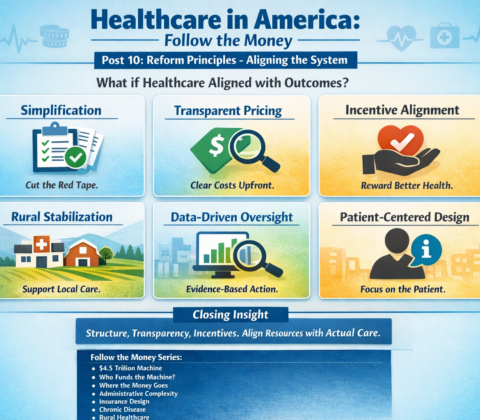
We’ve traced the U.S. healthcare system from dollars to delivery, explored administrative complexity, chronic disease, and rural pressures, and analyzed incentives. Now the question becomes: what would a system look like if it aligned with outcomes rather than complexity?

This is not about ideology or politics. It’s about structure and function.

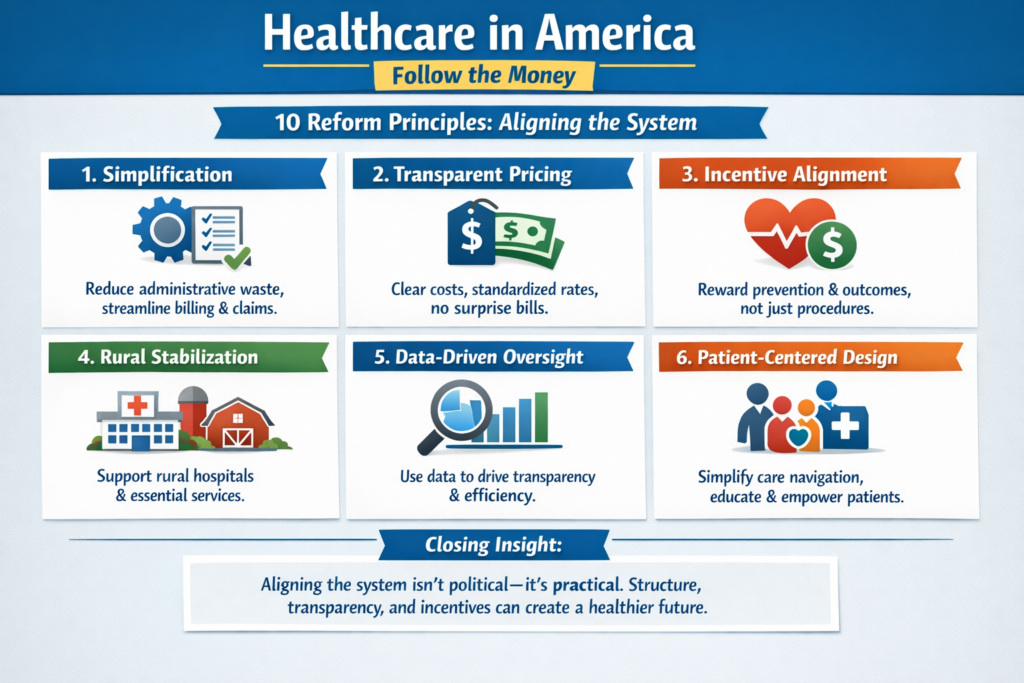
1. Simplification

  • Reduce unnecessary administrative layers.

  • Streamline claims, billing, and prior authorization processes.

  • Standardize coding and reporting where possible.

Goal: Money and effort should flow toward care, not paperwork.

2. Transparent Pricing

  • Make costs clear for patients, employers, and payers.

  • Standardize pricing across hospitals and providers where feasible.

  • Ensure out-of-network and surprise bills are minimized.

Goal: Reduce confusion, improve decision-making, and empower patients.

3. Incentive Alignment

  • Reward preventive care and long-term health outcomes rather than volume of procedures.

  • Align provider reimbursement with patient health metrics and chronic disease management.

  • Encourage insurers to focus on outcomes and accessibility rather than purely risk mitigation.

Goal: Make the system work for health, not just billing.

4. Rural Stabilization

  • Support small hospitals and critical access facilities with scalable administrative support.

  • Consider alternative models for staffing, telehealth, and regional collaboration.

  • Protect essential services even in low-volume communities.

Goal: Ensure equitable access regardless of geography.

5. Data-Driven Oversight

  • Use data to identify inefficiencies, high-cost drivers, and gaps in access.

  • Encourage transparency in spending and outcomes across all layers.

  • Support continuous improvement rather than static regulation.

Goal: Make evidence the foundation for policy and operational decisions.

6. Patient-Centered Design

  • Simplify insurance interactions.

  • Educate patients on coverage, preventive care, and cost implications.

  • Make navigation of care intuitive and friction-free.

Goal: Ensure patients experience the system as a service, not a puzzle.

Closing Insight

The U.S. healthcare system is enormous, expensive, and complex. But it is not irredeemable. By focusing on structure, transparency, and incentives, it is possible to reduce waste, improve access, and align resources with actual care.

The principles outlined here are nonpartisan and structural: they do not depend on ideology, politics, or personalities. They depend on understanding the machine and reshaping it to serve the people it was meant to help.

This completes the Follow the Money series:

  • Post 1: $4.5 Trillion Machine

  • Post 2: Who Actually Funds the Machine?

  • Post 3: Where the Money Goes

  • Post 4: Following the Dollar

  • Post 5: Administrative Complexity

  • Post 6: Insurance Design

  • Post 7: Chronic Disease

  • Post 8: Rural Healthcare & Consolidation

  • Post 9: Incentive Audit

  • Post 10: Reform Principles

20260227 0936 Image Generation simple compose 01kjg2pg1vf7hs80ej6yaxjkyd

Healthcare in America, Follow the Money Post 10 Reform Principles: Aligning the System

Healthcare in America, Follow the Money Post 10 Reform Principles Aligning the System
Michael and Sarah Walker
Healthcare in America, Follow the Money Post 10 Reform Principles: Aligning the System
Loading
/

The U.S. healthcare system is enormous, expensive, and complex. But it is not irredeemable. By focusing on structure, transparency, and incentives, it is possible to reduce waste, improve access, and align resources with actual care.
The principles outlined here are nonpartisan and structural: they do not depend on ideology, politics, or personalities. They depend on understanding the machine and reshaping it to serve the people it was meant to help.

Youtube Playlist for Our Healthcare Series

Healthcare in America, Follow the Money Post 9 Incentive Audit: Who Really Benefits?

Healthcare in America, Follow the Money Post 9 Incentive Audit Who Really Benefits
Michael and Sarah Walker
Healthcare in America, Follow the Money Post 9 Incentive Audit: Who Really Benefits?
Loading
/

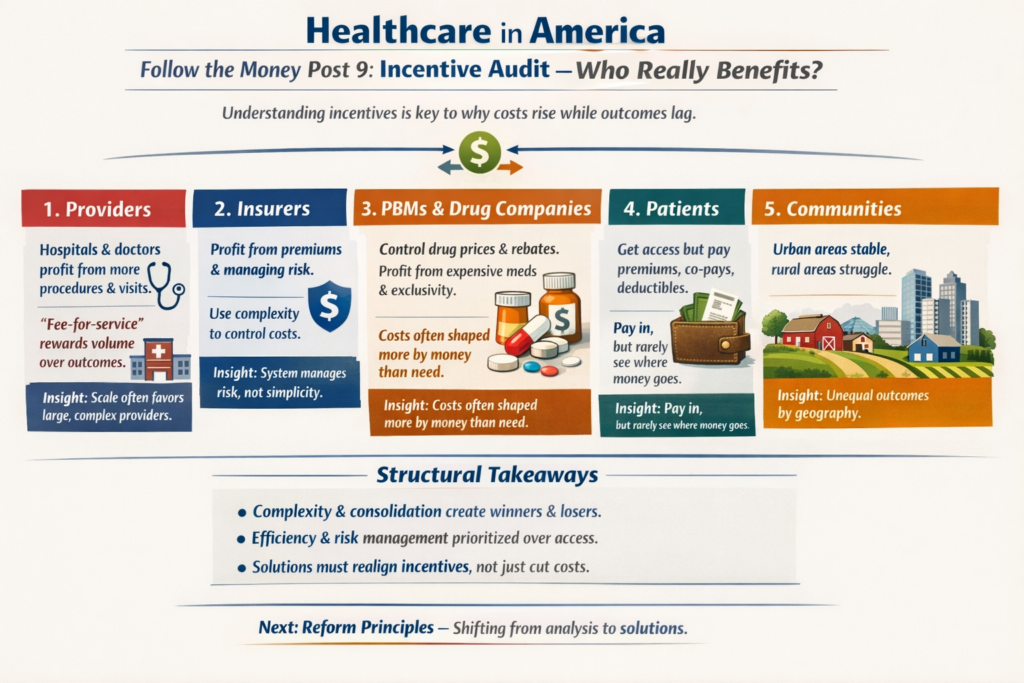
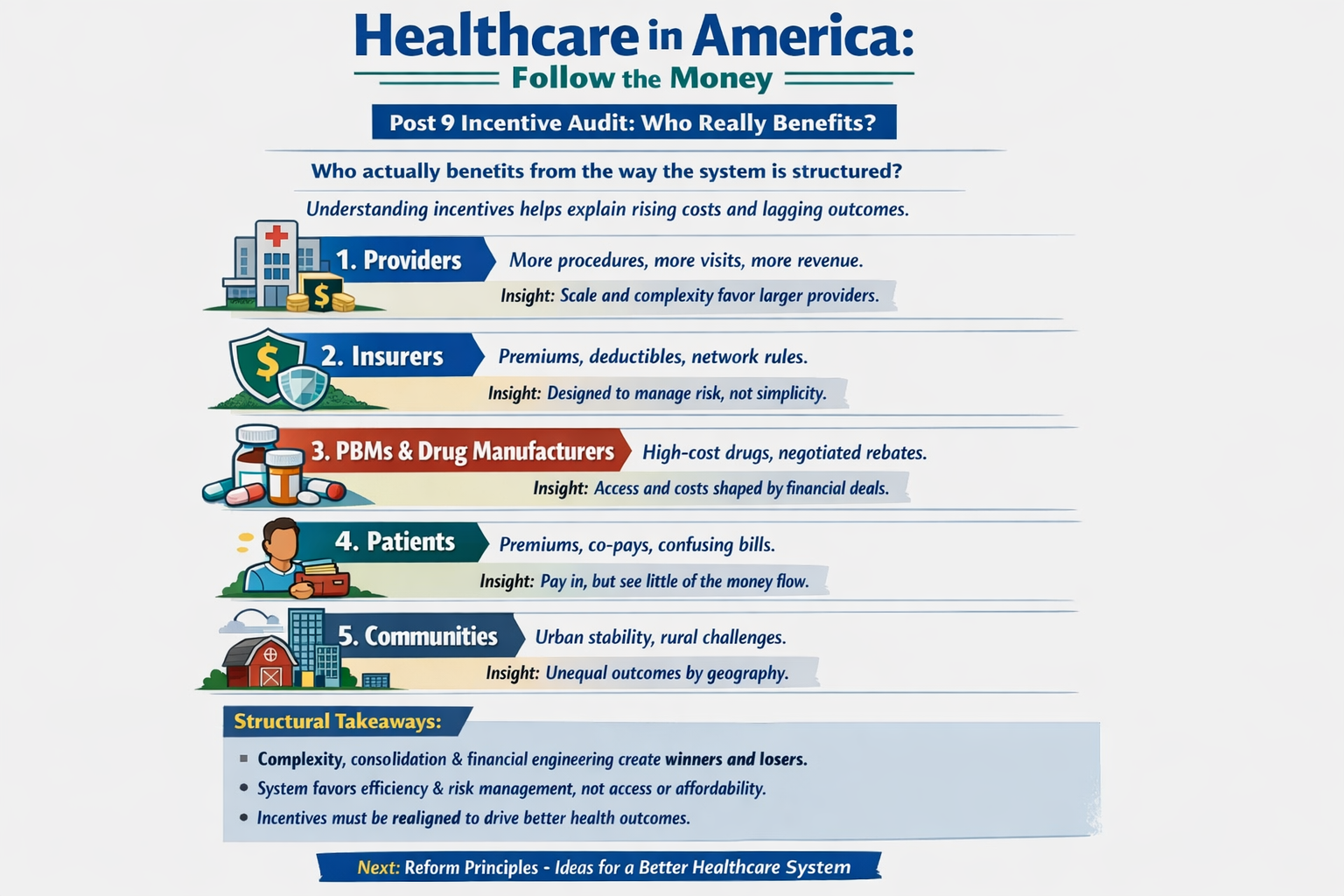
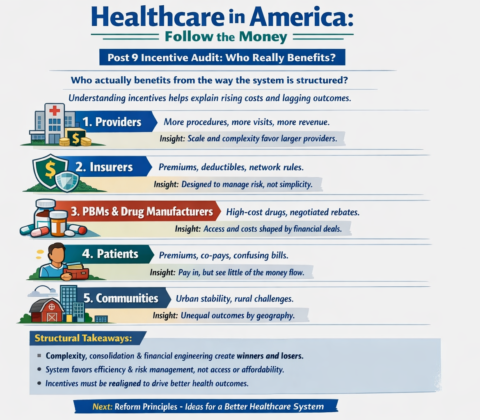
Structural Takeaways
Complexity, consolidation, and financial engineering create winners and losers.
The system works for efficiency and risk management, but not always for access, affordability, or simplicity.
Understanding incentives is essential before discussing reform: any solution must realign motivations, not just cut costs.

Youtube Playlist for Our Healthcare Series

Healthcare in America, Follow the Money Post 8 Rural Healthcare & Consolidation: When the Machine Strains

Healthcare in America, Follow the Money Post 8 Rural Healthcare & Consolidation When the Machine Strains
Michael and Sarah Walker
Healthcare in America, Follow the Money Post 8 Rural Healthcare & Consolidation: When the Machine Strains
Loading
/

Even when care is “available” virtually, the real-world friction remains: long travel times, delayed treatment, and fragmented services.

Youtube Playlist for Our Healthcare Series

Healthcare in America, Follow the Money Post 7 Chronic Disease: The Real Cost Driver

Healthcare in America, Follow the Money Post 7 Chronic Disease The Real Cost Driver
Michael and Sarah Walker
Healthcare in America, Follow the Money Post 7 Chronic Disease: The Real Cost Driver
Loading
/

“The machine isn’t broken because of greed. It’s stressed because of chronic demand and misaligned incentives.”

Youtube Playlist for Our Healthcare Series

Healthcare in America, Follow the Money Post 6 Insurance Design: Why It Feels Complicated

Healthcare in America, Follow the Money Post 6 Insurance Design Why It Feels Complicated
Michael and Sarah Walker
Healthcare in America, Follow the Money Post 6 Insurance Design: Why It Feels Complicated
Loading
/

Network design can be narrow, meaning that not every local provider is covered. This protects insurers from excessive risk but can frustrate patients who assume all doctors are treated equally under their plan.

Youtube Playlist for Our Healthcare Series

Healthcare in America, Follow the Money Post 5 Administrative Complexity: The Invisible Cost

Healthcare in America, Follow the Money Post 5 Administrative Complexity The Invisible Cost
Michael and Sarah Walker
Healthcare in America, Follow the Money Post 5 Administrative Complexity: The Invisible Cost
Loading
/

Administrative complexity is invisible to most patients. You see your bills, your deductible, your co-pay — but rarely the thousands of small interactions behind them.

Youtube Playlist for Our Healthcare Series

Healthcare in America, Follow the Money Post 4 Following the Dollar

Healthcare in America Structural Reform Playbook Post 4 Incentive Alignment for Prevention & Chronic Disease
Michael and Sarah Walker
Healthcare in America, Follow the Money Post 4 Following the Dollar
Loading
/

Even here, the dollar is split: part covers the premium contribution from the employee, part comes from the employer’s share. Often, employees never see this money — it’s folded into total compensation.
This means the same dollar has been contributed multiple times: first through the paycheck, then through taxes (if federal programs subsidize care), and again at the point of service.

Youtube Playlist for Our Healthcare Series

Healthcare in America, Follow the Money Post 3 Where the Money Goes

Healthcare in America, Follow the Money Post 3 Where the Money Goes
Michael and Sarah Walker
Healthcare in America, Follow the Money Post 3 Where the Money Goes
Loading
/

Price negotiation occurs through insurers and pharmacy benefit managers, but patients often experience unpredictability in costs, especially for high-cost or specialty medications.

Youtube Playlist for Our Healthcare Series

Healthcare in America, Follow the Money Post 2 Who Actually Funds the Machine?

Healthcare in America, Follow the Money Post 2 Who Actually Funds the Machine
Michael and Sarah Walker
Healthcare in America, Follow the Money Post 2 Who Actually Funds the Machine?
Loading
/

Employers contribute a significant portion of the premium, but economists generally agree those costs are built into total compensation. In practical terms, health insurance premiums come out of wages — whether workers see the deduction directly or not.
When premiums rise, wage growth slows.

Youtube Playlist for Our Healthcare Series

Healthcare in America, Follow the Money Post 1 The $4.5 Trillion Machine

Healthcare in America, Follow the Money Post 1 The $4.5 Trillion Machine
Michael and Sarah Walker
Healthcare in America, Follow the Money Post 1 The $4.5 Trillion Machine
Loading
/

American healthcare is not a single program. It is a layered payment network built over decades — employers, insurers, federal programs, state programs, hospital systems, physician groups, pharmacy benefit managers, pharmaceutical manufacturers, compliance divisions, coding departments, billing contractors, and regulators — all interacting at once.

Youtube Playlist for Our Healthcare Series

Healthcare in America Series III – Kicker: Security Is a Feeling. Risk Is a Structure

Healthcare in America Series III Part 3 When Risk Accumulates
Michael and Sarah Walker
Healthcare in America Series III - Kicker: Security Is a Feeling. Risk Is a Structure
Loading
/

Healthcare debates often center on security. People want to feel protected — protected from catastrophic illness, from unexpected bills, from system failure. That desire is reasonable. It is human.

Youtube Playlist for Our Healthcare Series

Healthcare in America Series III – Part 3 When Risk Accumulates

Healthcare in America Series III Part 3 When Risk Accumulates
Michael and Sarah Walker
Healthcare in America Series III - Part 3 When Risk Accumulates
Loading
/

At the community level, accumulation can reshape access entirely. When a hospital closes, travel times increase. Emergency response lengthens. Recruitment of clinicians becomes more difficult. Economic stability shifts. Healthcare infrastructure is not separate from community infrastructure — it is intertwined with it.

Youtube Playlist for Our Healthcare Series

Healthcare in America Series III – Part 2 Invisible Risk Carriers

Healthcare in America Series III Part 2 Invisible Risk Carriers
Michael and Sarah Walker
Healthcare in America Series III - Part 2 Invisible Risk Carriers
Loading
/

Clinical risk is inherent in medicine. But modern practice also carries moral and structural risk. Practicing under constraint — limited time, limited staffing, insurance limitations, documentation demands — forces tradeoffs. Liability exposure exists alongside ethical strain. Burnout, in this context, is not simply fatigue. It is accumulated tension between professional obligation and structural limitation.

Youtube Playlist for Our Healthcare Series

Healthcare in America Series III – Part 1 Risk Doesn’t Disappear. It Moves

Healthcare in America Series III Part 1 Risk Doesn’t Disappear. It Moves
Michael and Sarah Walker
Healthcare in America Series III - Part 1 Risk Doesn’t Disappear. It Moves
Loading
/

Which setting is appropriate?
How urgent is urgent?
Who coordinates what happens next?
These expectations exist — but the instruction rarely does.

Youtube Playlist for Our Healthcare Series

Healthcare in America, Follow the Money Post 9 Incentive Audit: Who Really Benefits?

Healthcare in America, Follow the Money Post 9 Incentive Audit: Who Really Benefits?

Healthcare in America, Follow the Money Post 5 Administrative Complexity: The Invisible Cost

Healthcare in America, Follow the Money Post 5 Administrative Complexity: The Invisible Cost

American healthcare is enormous. We’ve seen who pays and where the money goes, and even traced a single dollar through the system. Now let’s examine one of the largest, least visible drivers of cost: administration.

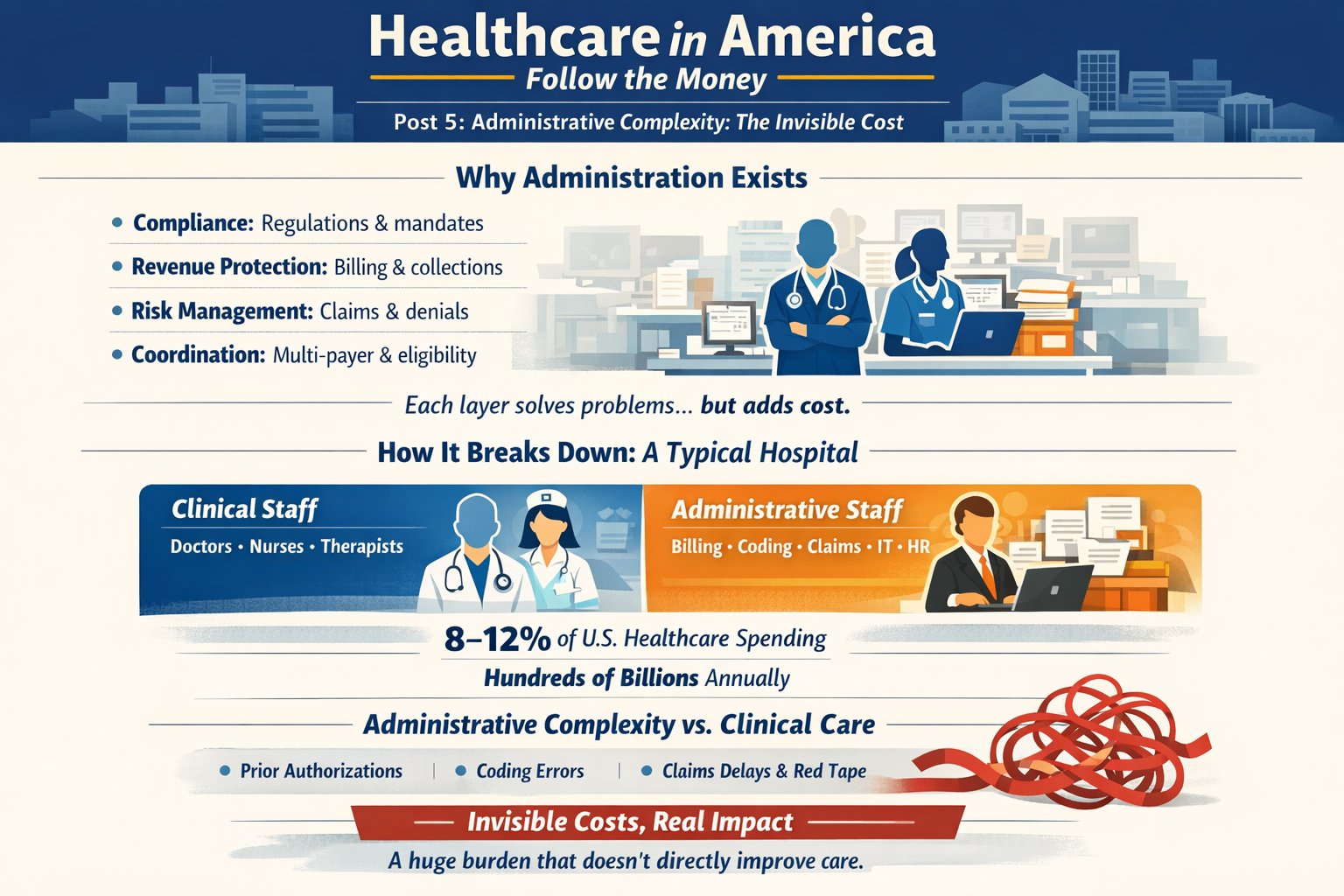
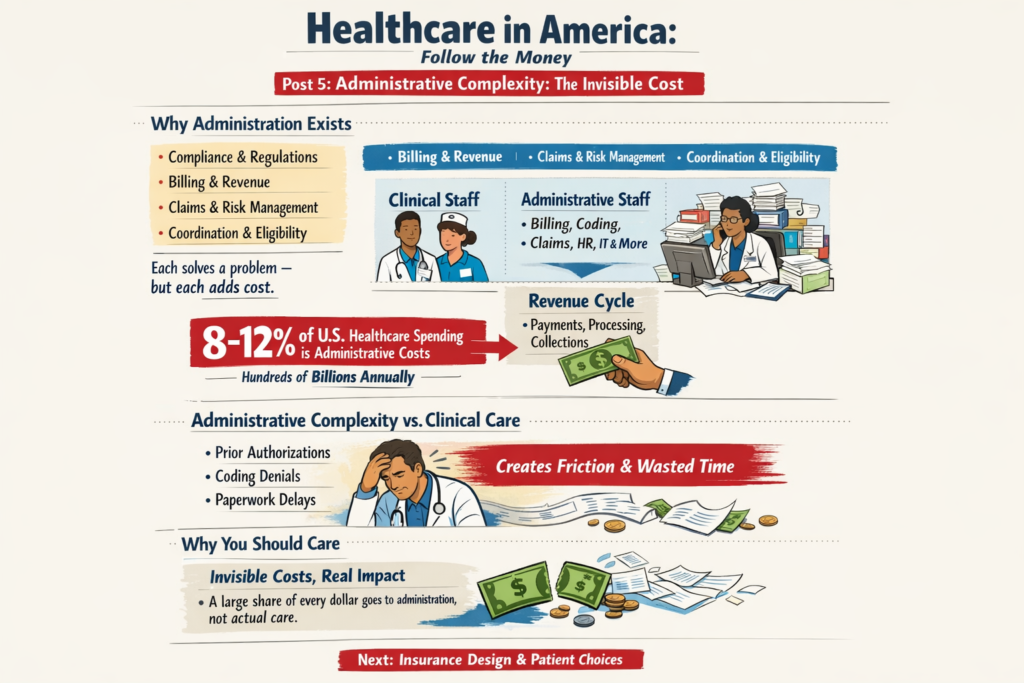
Why Administration Exists

No single entity is “to blame.” Administrative layers exist because:

  • Compliance requirements: Hospitals and insurers must follow federal, state, and local regulations.

  • Revenue protection: Providers need billing, coding, and collections departments.

  • Risk management: Insurers need claims review, denials, and appeals processing.

  • Coordination: Multiple payers, network contracts, and patient eligibility require staff to manage flow.

Each of these layers solves a problem — but each also adds cost.

How It Breaks Down

Consider a typical hospital:

  • Clinical staff: Doctors, nurses, therapists — directly delivering care

  • Administrative staff: Billing, coding, claims review, human resources, IT, compliance, legal

  • Revenue cycle management: Collecting, processing, and reconciling payments from insurers and patients

In the United States, administrative costs account for roughly 8–12% of total healthcare spending. That’s hundreds of billions of dollars annually — roughly double what similar countries spend.

Doctors spend more time on paperwork than in almost any other system. Nurses and support staff spend hours on documentation and prior authorizations.

This is why physicians burn out and hospitals struggle with margins, even when they are busy providing care.

Administrative Complexity vs. Clinical Care

The problem isn’t just cost. It’s friction.

  • Prior authorizations delay treatment.

  • Coding errors trigger denials.

  • Complex claims systems confuse patients.

Every layer of administration increases time, effort, and uncertainty for everyone: providers, payers, and patients.

In other words, money spent on administration doesn’t directly improve outcomes, yet it is essential to keep the machine functioning.

Why You Should Care

Administrative complexity is invisible to most patients. You see your bills, your deductible, your co-pay — but rarely the thousands of small interactions behind them.

Following the dollar in the previous post, you now understand: a significant portion of each premium and tax dollar never touches clinical care. It’s diverted to manage, track, and control the system.

This is the first clear point where incentives collide with outcomes: the machine works, but it also imposes invisible costs that no one directly sees.

Transition
Next, we’ll examine insurance design, where financial engineering meets patient experience. This is where the system’s complexity begins to influence behavior, choices, and ultimately, cost.

20260226 1110 Invisible Healthcare Costs simple compose 01kjdnpxmve0hv1j5e0xhaw2nq

Healthcare in America, Follow the Money Post 3 Where the Money Goes

Healthcare in America, Follow the Money, Post 3, Where the Money Goes

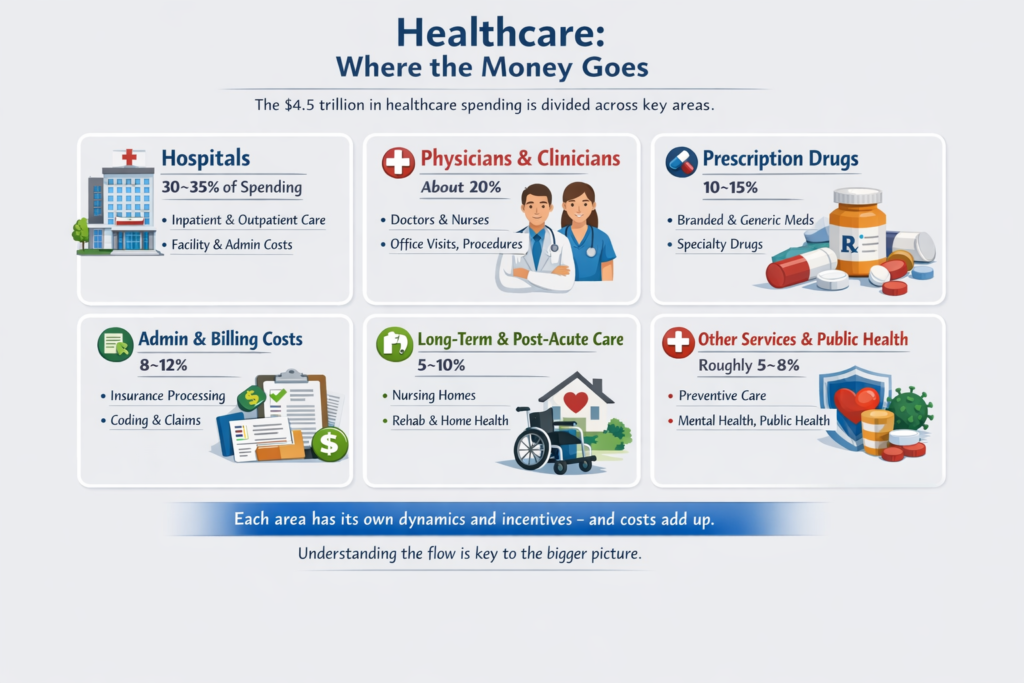
Knowing who pays is only the start. To understand the system, we need to see where those dollars actually land.

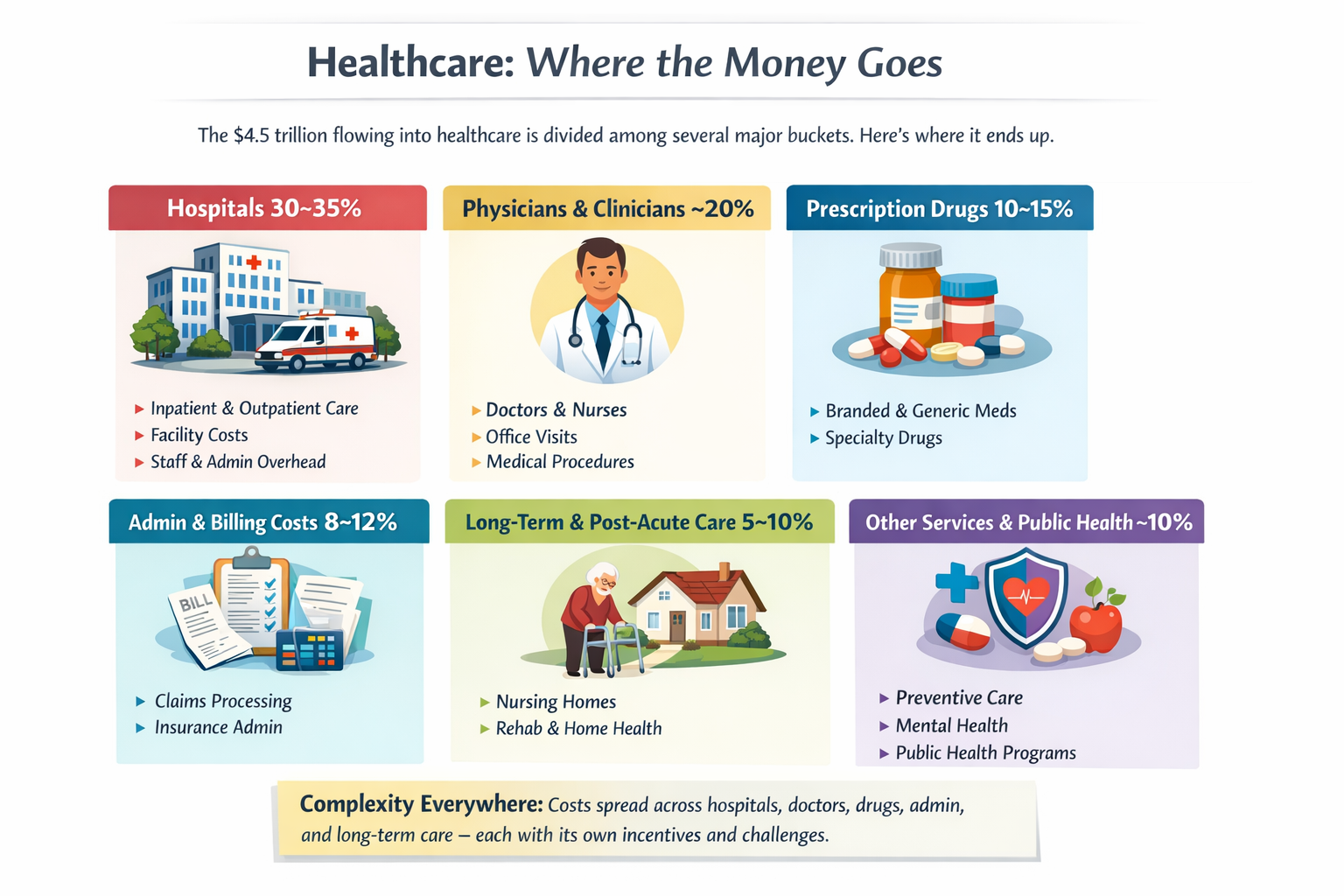
The $4.5 trillion flowing into healthcare doesn’t go to one place. It is split across several major buckets, each with its own dynamics and incentives.

1. Hospitals — Roughly 30–35% of Spending

Hospitals are the single largest cost center.

  • Inpatient care: surgeries, ICU, long stays

  • Outpatient care: ER visits, imaging, labs, procedures

  • Facility costs: building, equipment, administration

Hospitals are complex organizations:

  • Clinical staff

  • Administrative staff

  • Compliance, IT, revenue cycle management

Every additional layer adds cost, even if it doesn’t touch patient care directly.

2. Physicians & Clinicians — About 20%

Doctors, nurses, and other clinicians account for roughly one-fifth of total spending.

  • Compensation varies widely by specialty

  • Fee-for-service models often reward procedures over preventive care

Here, incentives shape behavior: more complex, billable procedures generate revenue, while counseling or preventive care may not.

3. Prescription Drugs — 10–15%

Prescription spending includes:

  • Branded drugs

  • Generics

  • Specialty medications

Price negotiation occurs through insurers and pharmacy benefit managers, but patients often experience unpredictability in costs, especially for high-cost or specialty medications.

4. Administrative & Billing Costs — 8–12%

One of the largest invisible drivers of cost:

  • Claims processing

  • Coding

  • Prior authorizations

  • Billing disputes

Studies show U.S. administrative costs are twice those of comparable countries, yet they do not directly improve patient care.

5. Long-Term & Post-Acute Care — 5–10%

Includes:

  • Nursing homes

  • Rehab facilities

  • Home health care

Population aging and chronic disease prevalence drive spending in this area.

6. Other Services & Public Health

The remainder covers:

  • Preventive care

  • Public health initiatives

  • Mental health services

  • Emergency preparedness

Small individually, but collectively essential.

Structural Insight

Looking at the buckets, one pattern emerges: complexity drives cost.

  • Hospitals and physician care dominate, but are themselves entangled with administrative and billing layers.

  • Drugs and specialized services add unpredictability.

  • Individuals and payers have little visibility into total flow.

The next step is tracing the flow of a single dollar — from paycheck to provider — to make the system tangible. That’s where things get almost counterintuitive, and where the first real tension appears between intention and outcome.

20260226 0959 Healthcare Spending Breakdown simple compose 01kjdhn1xdf4w9qcxt49df0x56

Healthcare in America Series III – Part 2 Invisible Risk Carriers

Healthcare in America Series III – Part 2 Invisible Risk Carriers

“Welcome back to Healthcare in America.

In the last episode, we said something simple but important: risk in healthcare does not disappear. It moves.

Today, we’re going to look at where it lands.

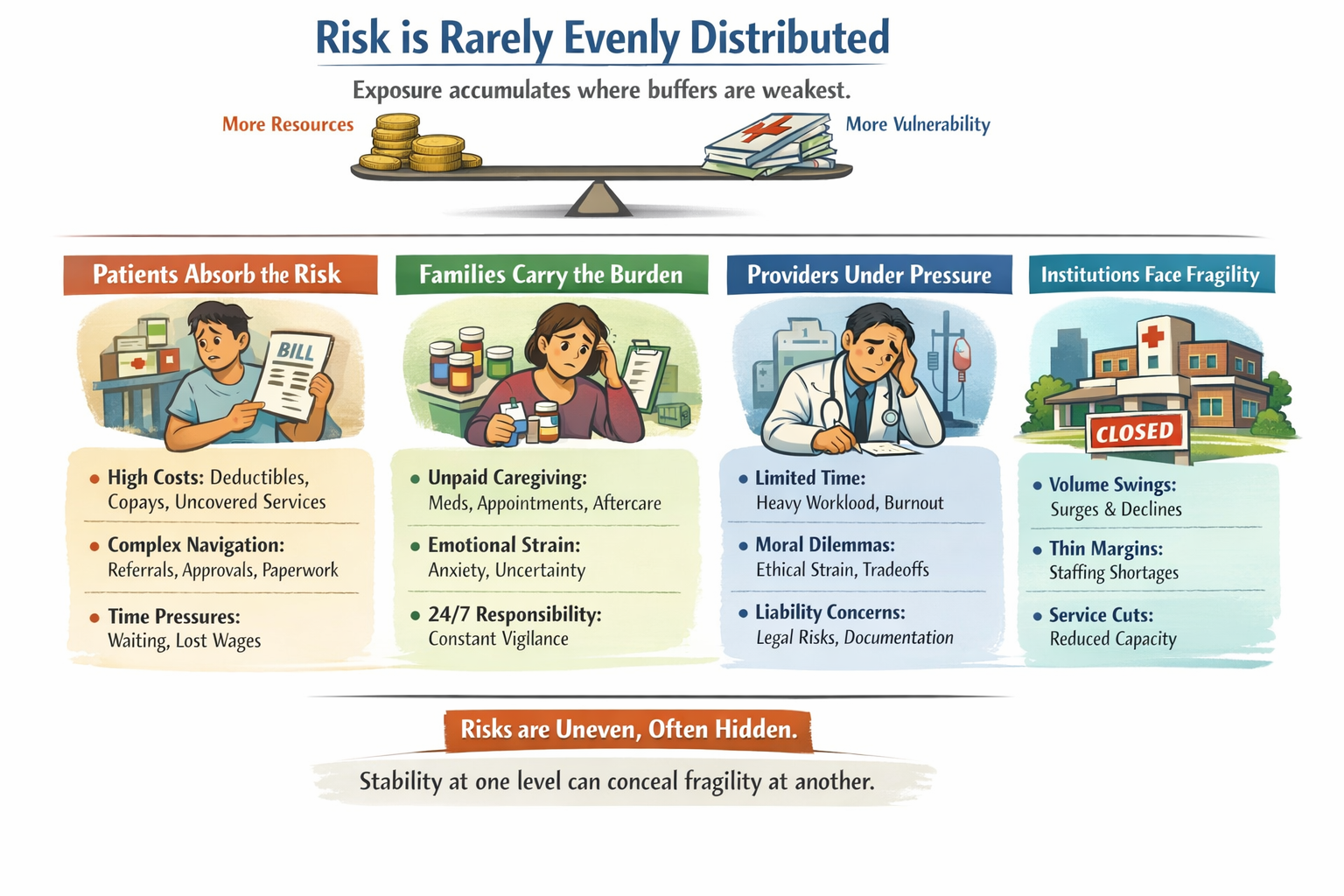
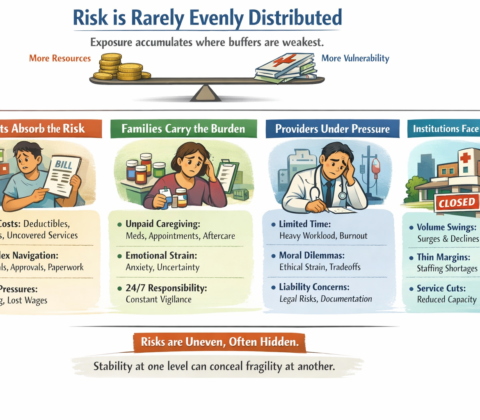
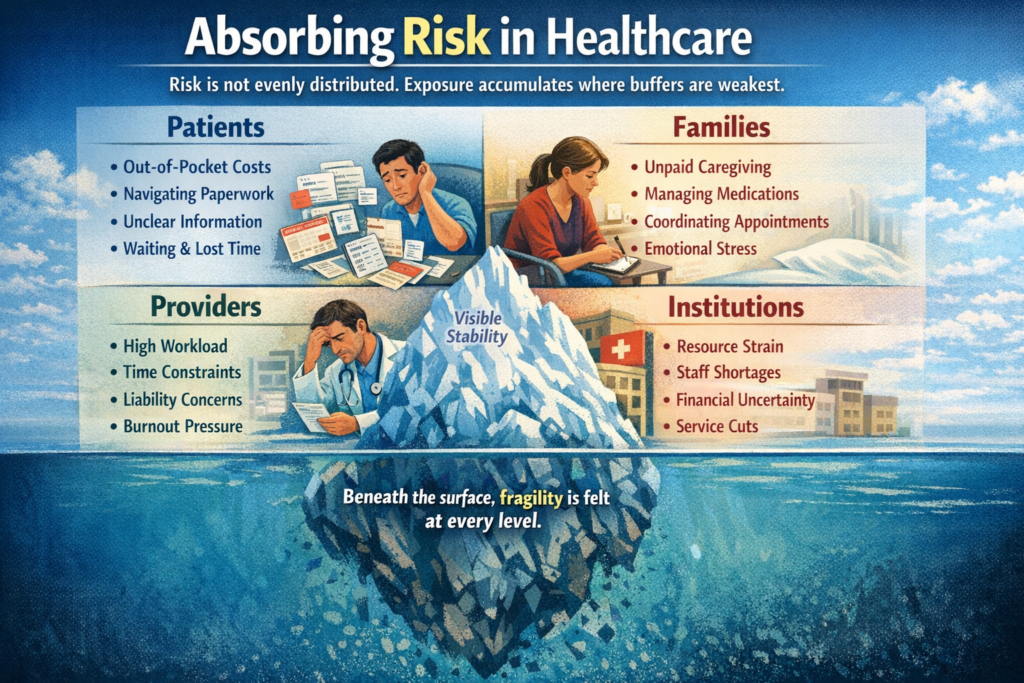
Risk is rarely distributed evenly. Exposure tends to accumulate where buffers are weakest. Some individuals and institutions are better positioned to absorb volatility. Others are not. And the distribution is often quiet — not announced, not debated — just experienced.

Patients are often the first visible absorbers of risk.

Financial exposure can begin long before insurance activates. Deductibles, copayments, and uncovered services create uncertainty before treatment even starts. But financial risk is only part of it.

There is navigational risk — referrals, approvals, coverage rules, and paperwork that must be managed correctly. A missed form or misunderstood instruction can delay care. Informational risk compounds this: patients frequently operate without full clarity about what is covered, what is authorized, or what will happen next.

There is also time risk. Waiting for appointments, coordinating schedules, losing wages during illness — these pressures rarely appear in formal accounting, but they are real exposures.

Families absorb risk as well.

When care transitions from hospital to home, coordination becomes informal. Someone manages medications. Someone schedules follow-ups. Someone interprets discharge instructions under stress. This labor is unpaid, often unrecognized, and structurally necessary. Without it, outcomes decline.

Families also absorb emotional uncertainty. They stabilize environments while waiting for results, while watching for symptoms, while navigating systems that were not designed for clarity.

Providers carry a different kind of exposure.

Clinical risk is inherent in medicine. But modern practice also carries moral and structural risk. Practicing under constraint — limited time, limited staffing, insurance limitations, documentation demands — forces tradeoffs. Liability exposure exists alongside ethical strain. Burnout, in this context, is not simply fatigue. It is accumulated tension between professional obligation and structural limitation.

Institutions absorb risk too.

Hospitals manage volume volatility — unpredictable surges and declines. Rural facilities operate with thin margins and limited redundancy. Workforce shortages increase fragility. Service lines close not necessarily because care is unneeded, but because stability requires contraction somewhere.

On paper, systems can appear stable. Metrics may show balance. But stability at one layer can conceal fragility at another.

This episode does not rank these exposures. It does not assign blame or prescribe reform. It simply observes distribution.

Risk pools where protection is thin.

In the next episode, we’ll look at what happens when that pooled exposure accumulates over time — and how quiet redistribution can eventually reshape entire communities.

For now, the important recognition is this:

When risk moves, it does not vanish.
It settles somewhere.
Often quietly.”

20260215 1553 Image Generation simple compose 01khhvgydbfrpr7ffr4c129f4v

Healthcare in America Series II, Part 8 – What Patients Are Expected to Know (But Don’t)

Healthcare in America — Series II, Part 8 — What Patients Are Expected to Know (But Don’t)
Michael and Sarah Walker
Healthcare in America Series II, Part 8 - What Patients Are Expected to Know (But Don’t)
Loading
/

Which setting is appropriate?
How urgent is urgent?
Who coordinates what happens next?
These expectations exist — but the instruction rarely does.

Youtube Playlist for Our Healthcare Series

Healthcare in America Series II, Part 7 – The Invisible Layer — Administration

Healthcare in America — Series II, Part 7 — The Invisible Layer — Administration
Michael and Sarah Walker
Healthcare in America Series II, Part 7 - The Invisible Layer — Administration
Loading
/

Healthcare administration isn’t a single office or department. It’s a web of functions required to make modern healthcare operable:

Youtube Playlist for Our Healthcare Series

Healthcare in America Series II, Part 6 – Insurance Is Not Healthcare

Healthcare in America — Series II, Part 6 — Insurance Is Not Healthcare
Michael and Sarah Walker
Healthcare in America Series II, Part 6 - Insurance Is Not Healthcare
Loading
/

One of the most persistent misunderstandings in healthcare is the idea that insurance and care are the same thing.
They’re related — but they are not interchangeable.
This confusion shapes expectations, frustration, and even how people judge their own experiences inside the system.

Youtube Playlist for Our Healthcare Series

Healthcare in America Series II, Part 7 – The Invisible Layer — Administration

Most people experience healthcare through exam rooms, waiting areas, and conversations with clinicians. What they don’t see is the layer that sits between care and payment — the administrative machinery that keeps the system running.

This layer is largely invisible to patients, but it shapes cost, access, and workload in ways that are hard to overstate.

What “Administration” Actually Means

Healthcare administration isn’t a single office or department. It’s a web of functions required to make modern healthcare operable:

  • Billing and coding

  • Insurance verification

  • Compliance with federal and state regulations

  • Documentation requirements

  • Quality reporting

  • Audit preparation

  • Contract management

None of these activities deliver care directly — but nearly all are mandatory.

Why So Much Paperwork Exists

Healthcare is one of the most regulated industries in the country, and for understandable reasons: safety, fraud prevention, privacy, and accountability all matter.

Over time, however, layers of rules, reporting requirements, and payer-specific processes have accumulated — often without coordination.

The result is a system where:

  • The same information is entered multiple times

  • Different insurers require different formats

  • Documentation is written for billing as much as for care

This complexity doesn’t disappear just because patients don’t see it.

The Staffing Reality Most People Don’t Know

It’s common for a single physician to require multiple non-clinical staff members to support their work.

These roles may include:

  • Billing specialists

  • Coding experts

  • Authorization coordinators

  • Compliance staff

  • Administrative support

This isn’t inefficiency in the casual sense. It’s the operational cost of navigating a fragmented system.

How This Affects the Exam Room

Administrative demands shape clinical care indirectly:

  • Less time per patient

  • More time spent on documentation

  • Delays caused by approvals and verifications

  • Burnout among clinicians who trained to practice medicine, not paperwork

Patients feel the effects even if they never see the cause.

A Quiet but Important Point

When healthcare costs rise, it’s tempting to assume the increase comes from tests, treatments, or clinician salaries.

Often, it doesn’t.

A significant share of growth occurs outside the exam room, in the systems required to document, justify, process, and pay for care.

That reality doesn’t assign blame — but it does challenge assumptions.

In the final post of this week, we’ll step back and look at the system from the patient’s perspective: what people are implicitly expected to know — but are almost never taught — when navigating healthcare.

20260209 1451 Image Generation simple compose 01kh29jg36e2ktzvhssw8j569r

Healthcare in America Series II, Part 5 – Why Emergency Rooms Are Overwhelmed (And It’s Not “Abuse”)

Emergency rooms are often described as being “overused” or “abused.”
It’s a familiar claim — and an easy one.

But it’s also an incomplete explanation that misses how people actually experience healthcare when something feels wrong.

To understand why emergency departments are overwhelmed, we need to look at how decisions are made in real time, not how they look in hindsight.

The Decision Most People Are Asked to Make

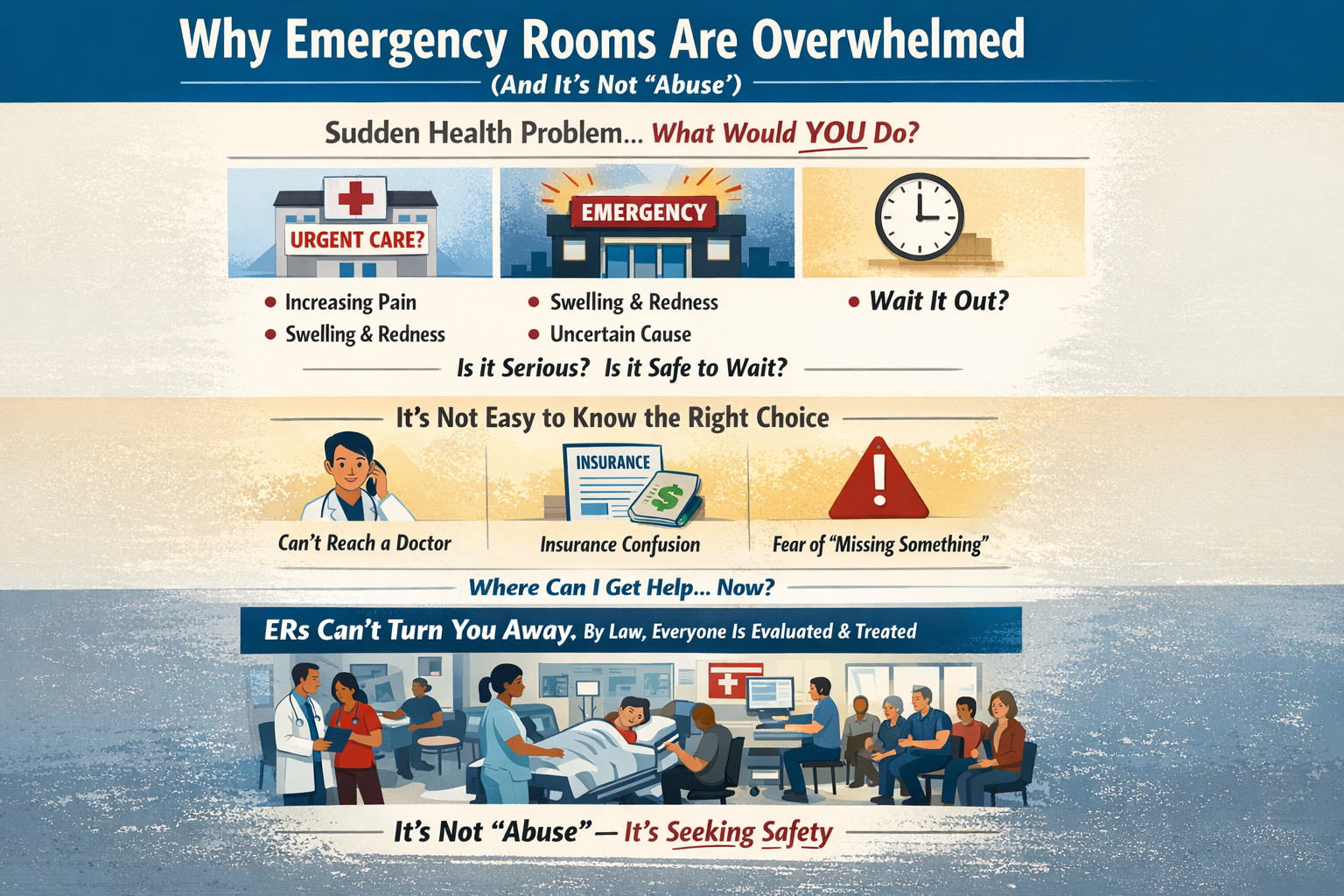
Imagine a sudden health issue:

  • Pain is increasingAll Episodes

  • Swelling is obvious

  • The cause isn’t clear

  • It’s happening now, not next week

Is this urgent care?
Is it the emergency room?
Is it safe to wait?

Most people were never taught how to answer those questions.

Take something as simple — and as ambiguous — as a spider bite. It’s swelling. It looks alarming. It hurts more than expected. Infection is a possibility, but not a certainty. Is that urgent care? Or the ER?

For most people, the safest choice feels obvious: go where help is guaranteed.

That instinct isn’t misuse. It’s risk avoidance.

What Emergency Rooms Are Required to Do

Under federal law (EMTALA), emergency departments cannot turn people away based on ability to pay or perceived severity. If someone shows up, they must be evaluated and stabilized if necessary.

That obligation is essential — but it also means ERs become the default safety net when other options are unclear, unavailable, or delayed.

Why the ER Becomes the Catch-All

Several structural factors push people toward emergency care:

  • Limited primary care access, especially after hours or in rural areas

  • Urgent care boundaries that aren’t well explained or intuitive

  • Insurance rules that complicate same-day care elsewhere

  • Fear of “missing something serious” when symptoms escalate quickly

In those moments, people aren’t choosing the ER because it’s convenient. They’re choosing it because it feels responsible.

The Mismatch No One Talks About

Emergency medicine is designed for stabilization, not continuity.

That means:

  • The problem is addressed, not managed long-term

  • Follow-up happens elsewhere — if it happens at all

  • The ER absorbs pressure created upstream in the system

When primary care access shrinks or urgent care becomes ambiguous, emergency departments feel the strain.

This isn’t random. It’s predictable.

Reframing the Conversation

Blaming patients for showing up doesn’t fix overcrowding.
It just ignores why they came in the first place.

Most ER visits that later get labeled “non-emergent” only look that way after a clinician has evaluated them. Before that evaluation, uncertainty is real — and fear is rational.

Understanding this doesn’t excuse system inefficiencies.
It explains them.

In the next post, we’ll untangle another common source of confusion: the assumption that insurance is the same thing as healthcare — and why that belief quietly shapes access, delays, and frustration throughout the system.

20260209 1451 Image Generation simple compose 01kh29jg37feytxzm554bgsaxz

Healthcare in America Series II, Part 5 – Why Emergency Rooms Are Overwhelmed (And It’s Not “Abuse”)

Healthcare in America — Series II, Part 5 — Why Emergency Rooms Are Overwhelmed (And It’s Not “Abuse”)
Michael and Sarah Walker
Healthcare in America Series II, Part 5 - Why Emergency Rooms Are Overwhelmed (And It’s Not “Abuse”)
Loading
/

Is this urgent care?
Is it the emergency room?
Is it safe to wait?

Youtube Playlist for Our Healthcare Series

Healthcare in America Series II – Kicker: Why We Struggle to Talk About the Unavoidable

Healthcare in America — Series II — Kicker Why We Struggle to Talk About the Unavoidable
Michael and Sarah Walker
Healthcare in America Series II - Kicker: Why We Struggle to Talk About the Unavoidable
Loading
/

Most conversations about healthcare skip this moment. We jump to policy, budgets, and blame. We treat crises as exceptions rather than as signals. But the truth is that someone always absorbs the weight when care can’t wait. Patients, families, frontline providers, and entire communities share the burden — quietly, unevenly, and often invisibly.

Youtube Playlist for Our Healthcare Series

Healthcare in America Series II, Part 4 – How the System Is Actually Structured

Before we talk about costs, delays, frustration, or reform, we need to pause and do something that rarely happens in public conversations about healthcare:

Define the system.

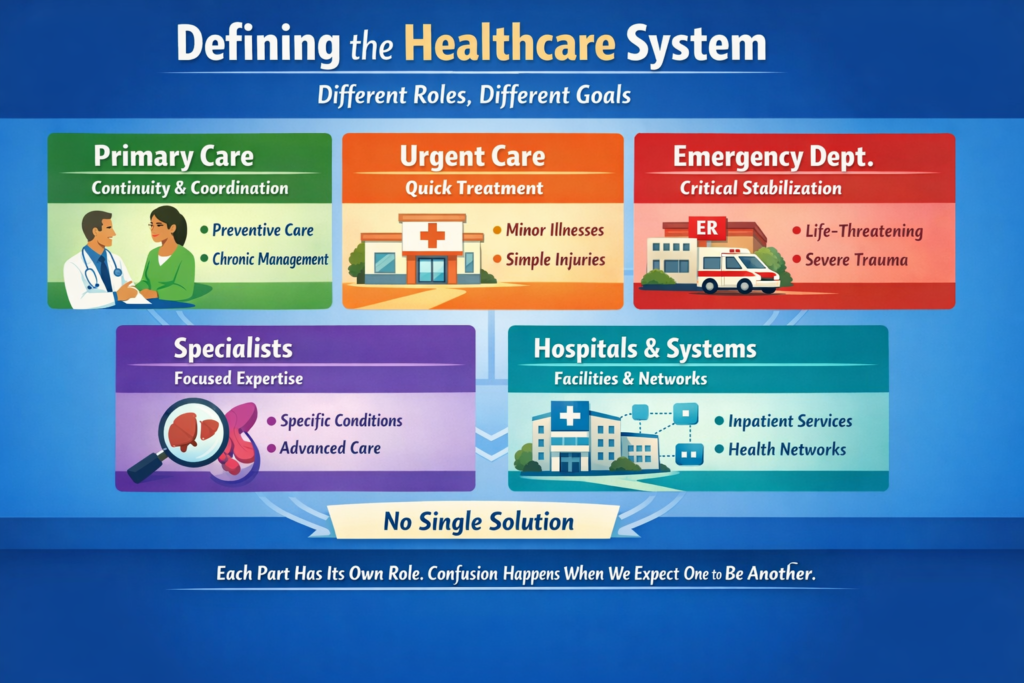
Most of the anger and confusion people feel about healthcare doesn’t come from bad intentions or unreasonable expectations. It comes from assuming that healthcare is a single thing — a place, a person, or a service — when in reality it’s a collection of distinct parts, each designed for a specific role.

When those roles blur, frustration follows.

This week is not about blame. It’s about understanding how the pieces fit together — and just as importantly, where they don’t.

Primary Care: Continuity and Coordination

Primary care is designed to be the foundation of the system.

Its role is not urgency. It is continuity:

        • Preventive care
        • Managing chronic conditions
        • Tracking changes over time
        • Coordinating referrals and follow-ups

Primary care works best when it knows you — your history, patterns, risks, and medications. It is the long view of healthcare.
When primary care access is limited or delayed, pressure builds elsewhere in the system.

Urgent Care: Episodic and Limited by Design

Urgent care exists to handle non-life-threatening issues that can’t wait, but don’t require hospital-level resources.

Examples include:

        • Minor fractures
        • Infections
        • Wounds requiring stitches
        • Sudden but stable symptoms

Urgent care is intentionally narrow. It is not meant to replace primary care, and it is not designed to manage complex or escalating conditions. Its value is speed and accessibility — not depth.

Because its boundaries aren’t intuitive, urgent care is often misunderstood.

Emergency Departments: Stabilization, Not Ongoing Care

Emergency departments are built for one purpose: stabilization.

They exist to address:

        • Life-threatening conditions
        • Severe trauma
        • Rapidly deteriorating symptoms
        • Situations where delay could cause permanent harm

Emergency medicine is about minutes and hours, not weeks or months. It is not designed for continuity, follow-up, or long-term management — even though it is often asked to fill those gaps.

This distinction matters more than most people realize.

Specialists: Depth Without Context

Specialists focus deeply on specific systems or conditions.

They provide expertise, not oversight.

        • Narrow scope
        • Referral-driven access
        • High value in defined situations

Specialists are essential — but they rely on other parts of the system to provide coordination and context.

Hospitals, Systems, and Networks (Not the Same Thing)

One final distinction that often gets overlooked:

        • Hospitals are places where care is delivered
        • Health systems manage multiple facilities and services
        • Networks manage contracts and access

These are operational and organizational layers — not clinical ones — but they shape how care is delivered and accessed.

We’ll come back to why that matters later.

Why This Structure Matters

When one part of the system is missing, overloaded, or inaccessible, pressure shifts to another part — often one that was never designed to handle it.

That’s not chaos.

That’s predictable behavior in a complex system.

In the next post, we’ll look at one of the most visible consequences of this mismatch: why emergency rooms are overwhelmed — and why it’s not as simple as blaming patients.

20260209 1450 Image Generation simple compose 01kh29fyr4emx9gyd9wnwt80y5

Healthcare in America Series II, Part 4 – How the System Is Actually Structured

Healthcare in America — Series II, Part 4 —How the System Is Actually Structured
Michael and Sarah Walker
Healthcare in America Series II, Part 4 - How the System Is Actually Structured
Loading
/

Most of the anger and confusion people feel about healthcare doesn’t come from bad intentions or unreasonable expectations. It comes from assuming that healthcare is a single thing — a place, a person, or a service — when in reality it’s a collection of distinct parts, each designed for a specific role.

Youtube Playlist for Our Healthcare Series

Healthcare in America Series II, Part 3 – Who Absorbs the Consequences When Waiting Isn’t an Option

Healthcare in America — Series II, Part 3 — Who Absorbs the Consequences When Waiting Isn’t an Option
Michael and Sarah Walker
Healthcare in America Series II, Part 3 - Who Absorbs the Consequences When Waiting Isn’t an Option
Loading
/

Urgency does not distribute impact evenly. Some patients are more vulnerable than others. Some families are better equipped to navigate complexity. And some communities have far fewer resources. The system doesn’t decide this intentionally. It just happens, quietly, invisibly, and sometimes tragically.

Youtube Playlist for Our Healthcare Series

Healthcare in America Series II, Part 2 – When Systems Built for Efficiency Meet Urgency

Healthcare in America — Series II, Part 2 — When Systems Built for Efficiency Meet Urgency
Michael and Sarah Walker
Healthcare in America Series II, Part 2 - When Systems Built for Efficiency Meet Urgency
Loading
/

Most healthcare systems are built around averages. Schedules, staffing, and workflow all assume a level of predictability. Efficiency depends on forecasting, and forecasting depends on stability. But urgent care doesn’t follow a curve or a plan. It arrives in spikes, in crises, in moments that no one could schedule. And when that happens, even the best-designed system starts to strain.

Youtube Playlist for Our Healthcare Series

Healthcare in America Series II, Part 1 – What Urgent Care Actually Is (and Is Not)

Healthcare in America — Series II, Part 1 — What Urgent Care Actually Is (and Is Not)
Michael and Sarah Walker
Healthcare in America Series II, Part 1 - What Urgent Care Actually Is (and Is Not)
Loading
/

Urgency collapses options. Decisions that would normally take days, weeks, or months are compressed into minutes or hours. There’s no time to compare prices, shop for the best facility, or negotiate who sees you first. Consent still exists, but it’s constrained. Choice becomes secondary to need.

Youtube Playlist for Our Healthcare Series

Healthcare in America — Series II: When Care Can’t Wait – Podcast Prelude

Healthcare in America — Series II When Care Can’t Wait Podcast Prelude
Michael and Sarah Walker
Healthcare in America — Series II: When Care Can’t Wait - Podcast Prelude
Loading
/

In the first episode, we’ll explore what urgent care actually is, and what it isn’t. We’ll see how immediacy changes the rules, compresses choices, and forces decisions that no one wants to make lightly.
In the second episode, we’ll look at what happens when systems designed for efficiency are suddenly forced into urgent, unpredictable situations. We’ll see where bottlenecks appear, where workarounds become routine, and how pressure spreads across the system in ways that aren’t always visible.
In the third episode, we’ll ask a simple but important question: Who carries the consequences when care can’t wait? Patients, families, frontline providers, and communities all bear the load — often quietly, without recognition.

Youtube Playlist for Our Healthcare Series

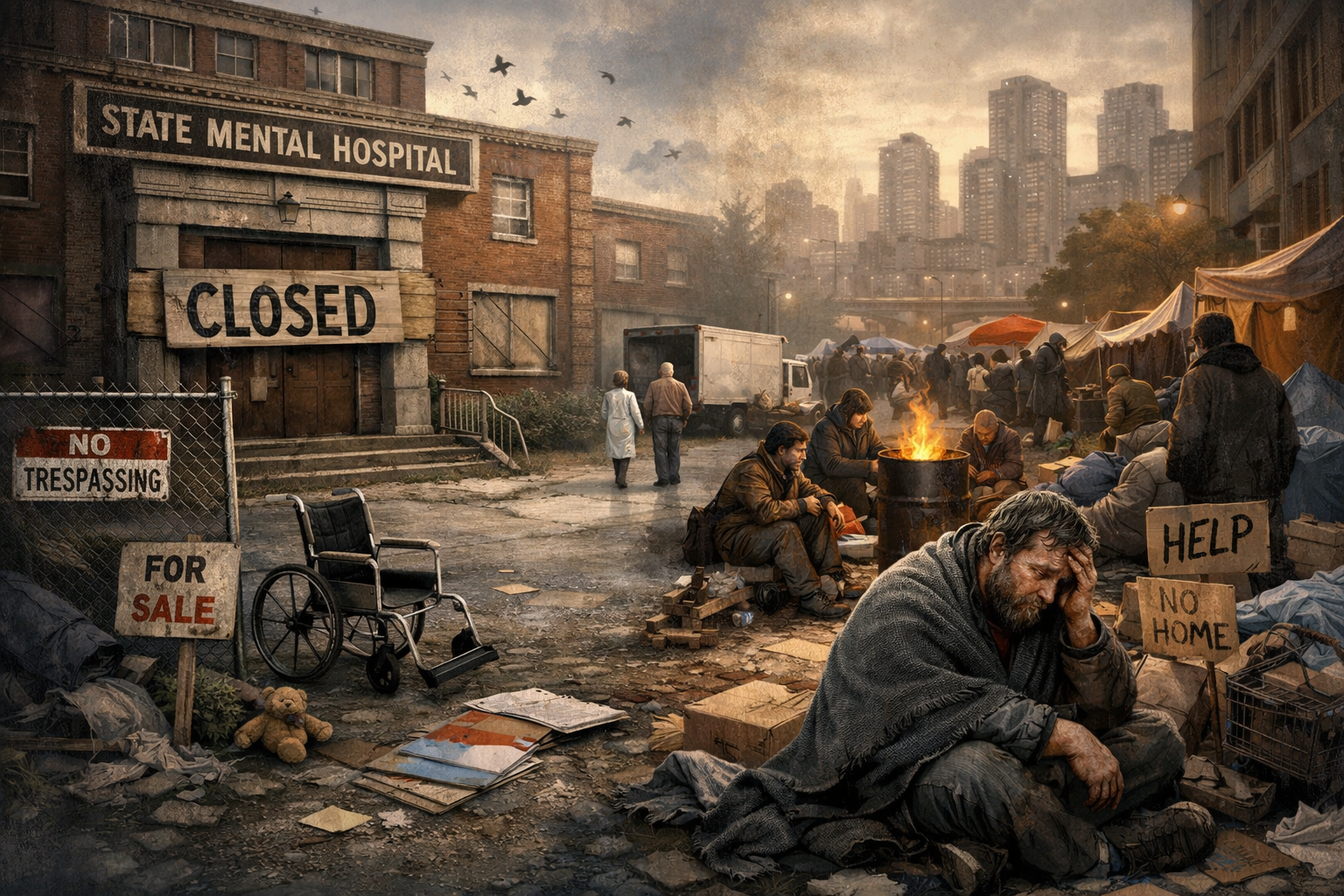
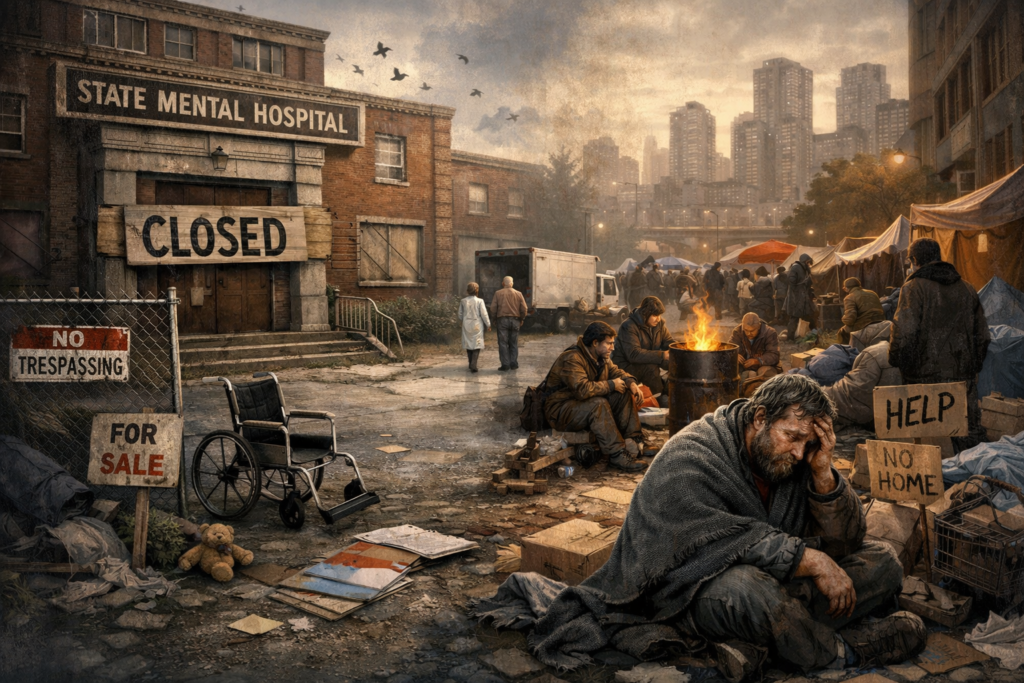
Heathcare – Closure of State Run Mental Facilities and Increase in Homeless Population

Heathcare Closure of State Run Mental Facilities and Increase in Homeless Population
Michael and Sarah Walker
Heathcare - Closure of State Run Mental Facilities and Increase in Homeless Population
Loading
/

Overall, Oregon’s closures are a microcosm of a national policy that prioritized deinstitutionalization without the necessary infrastructure, directly fueling homelessness by stranding vulnerable people. If you’re diving deeper for your healthcare series, sources like HUD’s Annual Homelessness Assessment Reports or AMA ethics journals provide robust data for further exploration.

Youtube Playlist for Our Healthcare Series

Heathcare – Closure of State Run Mental Facilities and Increase in Homeless Population

Historical Context: The National Deinstitutionalization Trend State-run psychiatric hospitals were once the primary providers of long-term mental health care in the U.S., peaking in the 1950s with around 559,000 inpatient beds nationwide.

By the 1990s, this number had plummeted to about 40,000, a roughly 92% reduction, as facilities closed or downsized dramatically.

This wasn’t isolated to Oregon; it happened across nearly every state, driven by a combination of factors: Policy Reforms and Federal Incentives: The Community Mental Health Act of 1963, signed by President Kennedy, aimed to shift care from large institutions to community-based centers, supported by new antipsychotic medications and civil rights advocacy against abusive asylum conditions.

Federal funding encouraged states to deinstitutionalize, but promised community resources were chronically underfunded — only about half of the planned 1,500 community mental health centers were ever built.

Budget Pressures and Cost-Shifting: States faced rising costs for institutional care amid economic shifts in the 1970s–1980s. Many closed facilities to cut expenses, relying on Medicaid and other federal programs to fund outpatient alternatives. However, this often meant discharging patients without sufficient follow-up, housing, or treatment options.

Examples Across States: Closures mirrored Oregon’s timeline (e.g., Dammasch in 1995). Nationally, facilities like Topeka State Hospital (Kansas, 1997), Metropolitan State Hospital (Massachusetts, 1992), and Allentown State Hospital (Pennsylvania, 2010) shut down in similar waves.

By 2023, many states had fewer than 10 state-operated psychiatric hospitals left, with total public beds dropping to historic lows.

In Oregon, the closure of Dammasch — opened in 1961 and shuttered amid reports of inhumane conditions — exemplified this, releasing patients into communities ill-equipped to support them.

The state’s Eastern Oregon Psychiatric Center in Pendleton closed in 2014, further reducing capacity.

Today, Oregon has only about 743 state hospital beds for adults, with even fewer staffed.

How This Contributed to the National Homeless Crisis While deinstitutionalization wasn’t the sole cause of homelessness — factors like affordable housing shortages, poverty, and substance use disorders play major roles — it undeniably exacerbated the issue by leaving many with severe mental illnesses without stable support. Here’s how the evidence connects the dots: Discharge Without Adequate Safety Nets: Many patients were released from institutions with minimal planning. Nationally, the lack of community mental health funding meant former inpatients often ended up cycling through emergency rooms, jails, or streets.

Studies show a direct correlation: as hospital beds vanished, homelessness among the mentally ill rose, with estimates that 25–30% of homeless individuals have severe mental illnesses like schizophrenia or bipolar disorder.

In Oregon, around 40% of the homeless population has a serious mental illness, higher than the national average, and closures like Dammasch directly led to increased street homelessness in Portland in the 1990s.

Rising Homelessness Statistics: U.S. homelessness hit a record 771,480 people on a single night in January 2024, up 18% from 2023 and 40% from 2018.

Chronic homelessness (long-term, often with disabilities including mental illness) surged 73% over the same period, from 97,000 to 168,000.

About 22% (140,000) of homeless adults in 2024 met criteria for serious mental illness.

Researchers attribute part of this to deinstitutionalization’s “trans institutionalization,” where people shifted from hospitals to prisons or homelessness.

Broader Systemic Failures: The affordable housing crisis amplified the impact — median rents outpaced wages, making stable housing unattainable for those with mental health challenges.

In states like California and Oregon, this led to visible increases in unsheltered homelessness (36% of the total in 2024).

Oregon’s experience echoes this: without enough community treatment or housing post-closures, many cycle between the Oregon State Hospital, jails, and streets.

Nationally, experts note that while deinstitutionalization aimed for better outcomes, underfunding turned it into a “system designed to fail.”

Key Nuances and Ongoing Implications Not every closure was detrimental — some states maintained or repurposed facilities, and advances in outpatient care have helped many. However, the national bed shortage (now about 50 per 100,000 people, far below the recommended 50–60) leaves gaps, especially for acute crises.

In Oregon, this manifests in long waits for care and over-reliance on emergency departments.

Recent federal efforts, like executive orders promoting institutionalization for homelessness reduction, highlight the debate: some advocate for more beds, others for better community funding to prevent crises.

Overall, Oregon’s closures are a microcosm of a national policy that prioritized deinstitutionalization without the necessary infrastructure, directly fueling homelessness by stranding vulnerable people. If you want to dive deeper into this topic, sources like HUD’s Annual Homelessness Assessment Reports or AMA ethics journals provide robust data for further exploration.

20260204 1044 Image Generation simple compose 01kgmzfkrefmjrd71fws9026z1

Coda: What We Know Now – Healthcare in America Series 1

What We Know Now
Michael and Sarah Walker
Coda: What We Know Now - Healthcare in America Series 1
Loading
/

The purpose here was not to provide answers, but to establish a starting point grounded in reality rather than ideology. Any serious conversation going forward has to begin with what healthcare actually is: partially market, partially public, and fundamentally human. It cannot be reduced to slogans without losing something essential.

Youtube Playlist for Our Healthcare Series

Part 6: When the System Stops Pretending – Healthcare in America

Part 6 When the System Stops Pretending
Michael and Sarah Walker
Part 6: When the System Stops Pretending - Healthcare in America
Loading
/

For years, America’s healthcare debates have circled the same familiar arguments: cost, access, innovation, choice. Each side insists the problem is just one adjustment away from being solved — a different payer mix, a different incentive, a different set of rules.

What rarely gets said out loud is simpler and more uncomfortable:

Youtube Playlist for Our Healthcare Series

Part 6: When the System Stops Pretending – Healthcare in America

Part 6: When the System Stops Pretending

For years, America’s healthcare debates have circled the same familiar arguments: cost, access, innovation, choice. Each side insists the problem is just one adjustment away from being solved — a different payer mix, a different incentive, a different set of rules.

What rarely gets said out loud is simpler and more uncomfortable:

The system no longer matches the reality it is supposed to serve.

This isn’t a failure of compassion, and it isn’t a failure of effort. It is a failure of structure — a system built on assumptions that no longer hold.

A system optimized for avoidance

Modern healthcare is not primarily organized around outcomes. It is organized around risk avoidance.
Risk is shifted:

  • From insurers to providers

  • From providers to patients

  • From institutions to families

  • From policy to paperwork

Each step is rational in isolation. Each makes sense on a spreadsheet. Together, they create a system where no one is fully responsible for the whole.

The result is not efficiency. It is fragmentation.

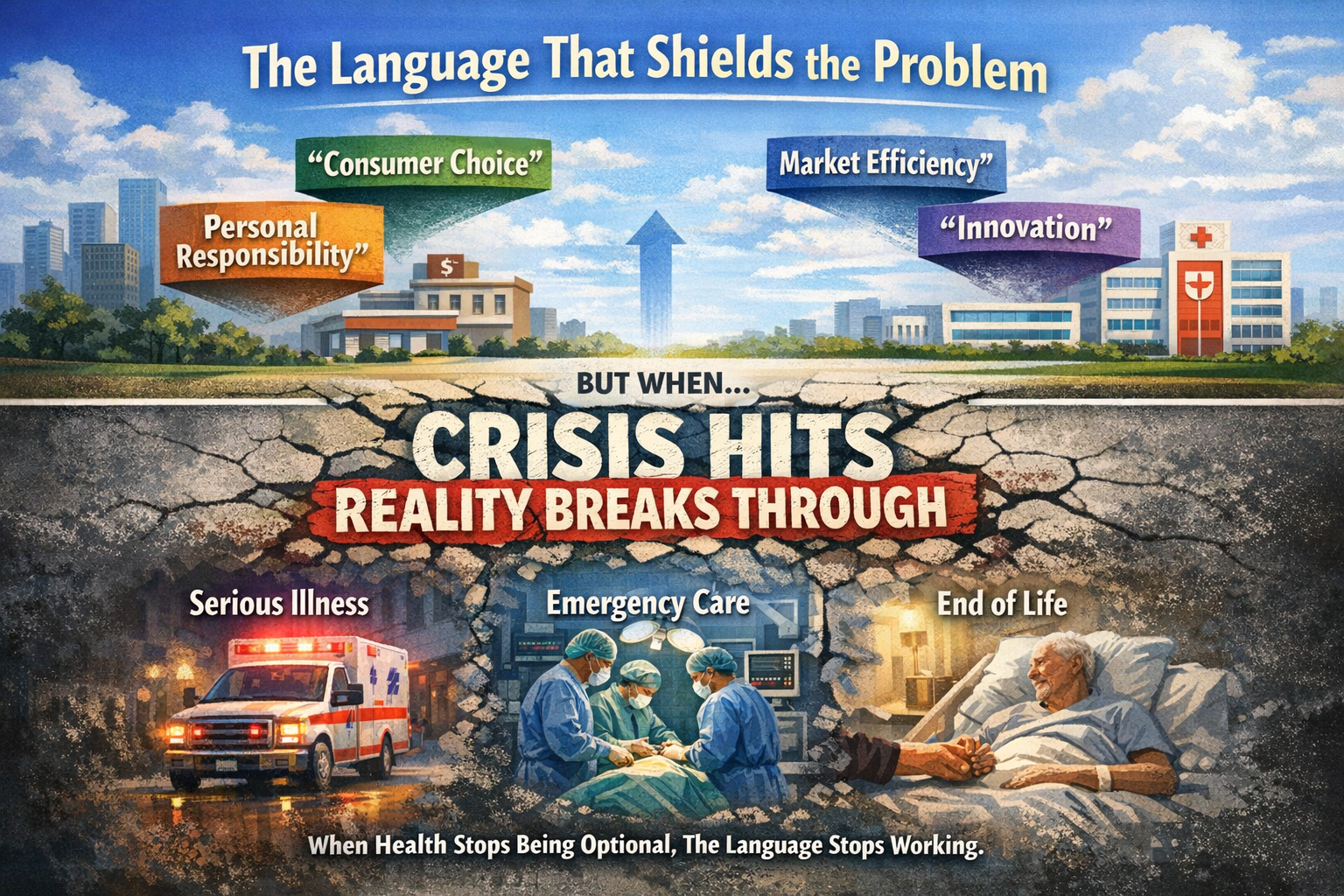
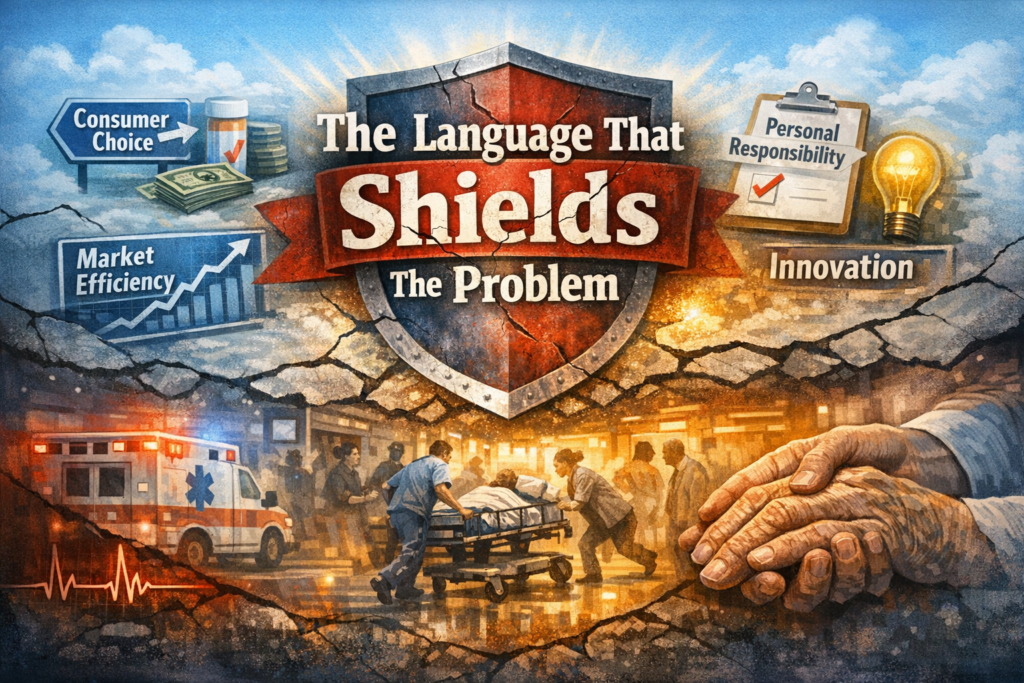
The language that shields the problem

We rely heavily on comforting language:

  • “Consumer choice”

  • “Market efficiency”

  • “Personal responsibility”

  • “Innovation”

These phrases are not lies, but they are incomplete. They work well for elective care, predictable conditions, and people with time, money, and literacy to navigate complexity.

They break down when care becomes urgent, unavoidable, or human.

When health stops being optional, the language stops working.

Who carries the weight now

As responsibility diffuses upward, the burden concentrates downward.

Patients manage billing disputes while recovering.
Families coordinate care without training.
Providers burn out navigating systems designed to protect revenue, not judgment.
Rural hospitals absorb losses with no margin for error.

None of this shows up cleanly in political talking points. It shows up in closures, staffing shortages, delayed care, and quiet financial collapse.

The place the system can’t avoid

There is one place where all of these distortions converge — where care cannot be deferred, denied, or negotiated in advance.

The system depends on it.
The system resents it.
And the system refuses to fully account for it.

This is not because it is inefficient, but because it is honest.

It is where every upstream decision eventually lands.

The political stalemate

Healthcare dysfunction has become politically useful.

One side uses it to fundraise.
The other uses it to posture.
Both promise fixes that stop short of structural change.

Real reform would force tradeoffs.
Tradeoffs create accountability.
Accountability threatens narratives.

So the system limps forward, managed rather than repaired.

The fork in the road

We are now past the point where incremental adjustments can hide the mismatch.

We can continue to:

  • Shift costs

  • Narrow networks

  • Add complexity

  • Manage decline

Or we can acknowledge the truth that has been visible for years:

A healthcare system that pretends everything is a market, everything is optional, and responsibility can always be deferred will eventually fail at the moments that matter most.

This series is not about choosing sides.
It is about deciding whether we are willing to stop pretending.

20260131 1305 Image Generation simple compose 01kgaxxq29evqbt5ttckk9s2zw

Part 5: Choice vs. Coverage – Healthcare in America

Part 5 Choice vs. Coverage
Michael and Sarah Walker
Part 5: Choice vs. Coverage - Healthcare in America
Loading
/

After responsibility shifts to individuals, the system offers something in return.
It offers choice.
At first glance, this feels like a fair trade. More options suggest more control. More plans suggest better fit. More flexibility suggests empowerment.
But choice and coverage are not the same thing.
Confusing the two is one of the most common — and costly — misunderstandings in modern healthcare.

Youtube Playlist for Our Healthcare Series

Part 4: When Responsibility Moves Quietly – Healthcare in America

Part 4 When Responsibility Moves Quietly
Michael and Sarah Walker
Part 4: When Responsibility Moves Quietly - Healthcare in America
Loading
/

When health policy stalls, something important happens that is easy to miss.
Responsibility doesn’t disappear.
It moves.

And almost always, it moves away from systems and toward individuals.
This shift rarely arrives with an announcement. There is no press conference declaring that people are now on their own. Instead, the change shows up gradually, wrapped in reasonable language.

Youtube Playlist for Our Healthcare Series

A Real-Time Example (Why Markets React Faster Than Voters) – Healthcare in America

A Real Time Example (Why Markets React Faster Than Voters)
Michael and Sarah Walker
A Real-Time Example (Why Markets React Faster Than Voters) - Healthcare in America
Loading
/

Industry groups warn of potential disruptions when 2027 coverage renews in late 2026, though final rates will not be set until April. This adds pressure to an already challenging Medicare Advantage landscape, where many plans have recently faced premium increases, benefit adjustments, or network changes.

Youtube Playlist for Our Healthcare Series

Part 3b – Repetition As Policy Signal – Healthcare in America

Part 3b – Repetition As Policy Signal
Dark Money in American Politics
Part 3b – Repetition As Policy Signal - Healthcare in America
Loading
/

When these phrases appear once, they may reflect genuine uncertainty. When they appear repeatedly, over weeks or months, they become signals.
The tobacco era showed this clearly. For years, the same reassurances were offered while evidence mounted. No new information was added—only the same language, restated. The repetition was not meant to inform; it was meant to delay.

Youtube Playlist for Our Healthcare Series

Part 3a – When This Happened Before – Healthcare in America

Part 3a – When This Happened Before
Dark Money in American Politics
Part 3a – When This Happened Before - Healthcare in America
Loading
/

Smoking-related illnesses rose predictably. Generations adopted a habit already known to be dangerous. The burden fell disproportionately on working-class families, veterans, and rural communities — long before those terms became political shorthand.
By the time policy finally caught up, millions of lives had already been affected.
No one could point to a single decision that caused the harm. That, too, was part of the design.

Youtube Playlist for Our Healthcare Series

Part 2: When Expertise Became Personal – HealthCare in America

Part 2 When Expertise Became Personal
Michael and Sarah Walker
Part 2: When Expertise Became Personal - HealthCare in America
Loading
/

Public health expertise was not always controversial. For decades, it functioned largely in the background—technical, imperfect, and mostly invisible. When it worked, few noticed. When it failed, corrections were usually quiet and procedural.
That changed when expertise became personal.
As trust in institutions weakened, authority began to migrate away from systems and toward individuals. Complex guidance was no longer evaluated primarily on evidence or process, but on who was delivering it—and how consistently.
This shift did not require a coordinated effort. It was a natural response to confusion. When institutions struggle to communicate clearly, people look for human proxies they can assess intuitively.

Youtube Playlist for Our Healthcare Series

Part 1: Trust Became the Weak Point – HealthCare in America

Part 1 Trust Became the Weak Point
Michael and Sarah Walker
Part 1: Trust Became the Weak Point - HealthCare in America
Loading
/

As systems grew more complex, institutional communication often became more defensive. Language shifted toward legal precision and risk avoidance, rather than clarity.
Explanations became longer but less informative. Mistakes were corrected quietly, if at all. Accountability was diffused across agencies, insurers, providers, and administrators—each technically accurate, but collectively unhelpful.
Over time, this creates a vacuum.
When institutions struggle to explain themselves, others step in to explain for them.

Youtube Playlist for Our Healthcare Series

It isn’t funny anymore, so let’s get ready for tomorrow – Healthcare in America

It isn't funny anymore, so let's get ready for tomorrow
Michael and Sarah Walker
It isn't funny anymore, so let's get ready for tomorrow - Healthcare in America
Loading
/

. Not conspiracy theories, just a better understanding of the how and why. My goal wasn’t to be partisan — it was to help readers better grasp the mechanics behind the curtain and make better, self-informed decisions.Next up: a ~15-part series on institutional healthcare. Not the latest premium hikes, Trump tweets, or partisan talking points. Instead:

Youtube Playlist for Our Healthcare Series

America’s Health Policy, Why This Series Exists – Healthcare in America

America's Health Policy, Why This Series Exists
Michael and Sarah Walker
America's Health Policy, Why This Series Exists - Healthcare in America
Loading
/

Examine policy outcomes without assigning personal motive
Use real examples to illustrate structural dynamics
Move deliberately, one concept at a time
Include guidance on what signals matter and where influence exists

Youtube Playlist for Our Healthcare Series

This series is about health policy, not ideology – Healthcare in America

This series is about health policy, not ideology
Michael and Sarah Walker
This series is about health policy, not ideology - Healthcare in America
Loading
/

Decisions about healthcare in the United States are often discussed as political abstractions—talking points, slogans, and personalities. But their consequences are not abstract. They show up in emergency rooms, schools, workplaces, and kitchens. They show up in who gets care, when they get it, and at what cost.

Youtube Playlist for Our Healthcare Series