Dark Money Today: From Montana to California and Beyond
Two months ago, we explored the Montana initiative as a test case for curbing dark money. The story didn’t end there. Today, states like California are building on that example, showing that structural solutions — not just outrage — can reshape the rules of political influence.
The Current Landscape
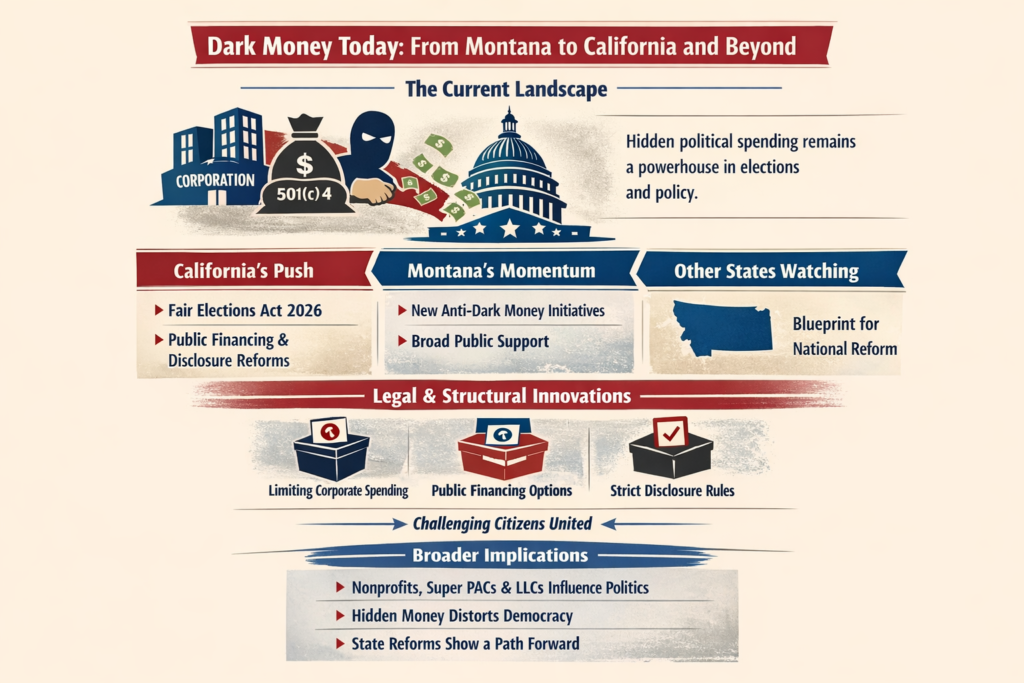
Hidden political spending remains a major driver of elections and policy. Corporations, nonprofits, and 501(c)(4)s continue to funnel large sums into campaigns with little transparency. But now, state-level reforms are gaining traction:
California is preparing ballot initiatives and legislation aimed at limiting corporate influence, expanding public financing, and enforcing stricter disclosure rules. Voters could see the California Fair Elections Act in November 2026, giving candidates alternatives to reliance on big donors.
Montana remains a test case. After a legal challenge stalled an earlier initiative, new filings are moving forward, backed by strong public support. These efforts focus on restricting corporate spending and making dark money sources visible.
Other states are watching. Models from Montana and California are providing a blueprint for structural reform nationwide.
Legal & Structural Innovations
States are exploring ways to sidestep Citizens United without waiting for a federal reversal:
Some leverage state corporate charters to limit corporations’ political spending at the source.
Public financing programs allow candidates to run competitive campaigns without large outside contributions.
Disclosure rules ensure voters see who is influencing elections, making money less “invisible.”
These approaches shift the focus from partisan debate to structural solutions, changing the incentives in the system itself.
Broader Implications
Dark money isn’t only about corporations. Nonprofit groups, super PACs, and LLCs contribute heavily to elections while keeping donors hidden. This creates outsized influence on local and national politics, often at odds with public interest.
Structural reforms like Montana’s and California’s tackle this from the ground up, offering practical paths forward rather than relying on idealistic federal solutions.
Connecting Back
As we discussed in the previous Montana series, states can push back against big money in meaningful ways. California’s emerging initiatives show that these strategies are not isolated — they’re part of a growing national movement. Readers following that series can now see how lessons learned in Montana are spreading and evolving.
Takeaways
Progress is possible through state-level reforms, disclosure requirements, and public financing.
Structural changes can reduce hidden influence and increase accountability.
Like in healthcare, small, practical reforms can create measurable improvements, even in complex systems.