Control of Voting – If Trump Is Ousted: Does It Die on the Vine?
Not entirely, it would slow at the federal level, but these efforts are bigger than one person. Project 2025 isn’t just a Trump playbook; it’s a Heritage Foundation-led blueprint from over 100 conservative groups, predating his second term. By October 2025, Trump had implemented ~47% of its domestic agenda (e.g., workforce cuts via shutdown, executive orders on election “integrity”).
If impeached/removed:
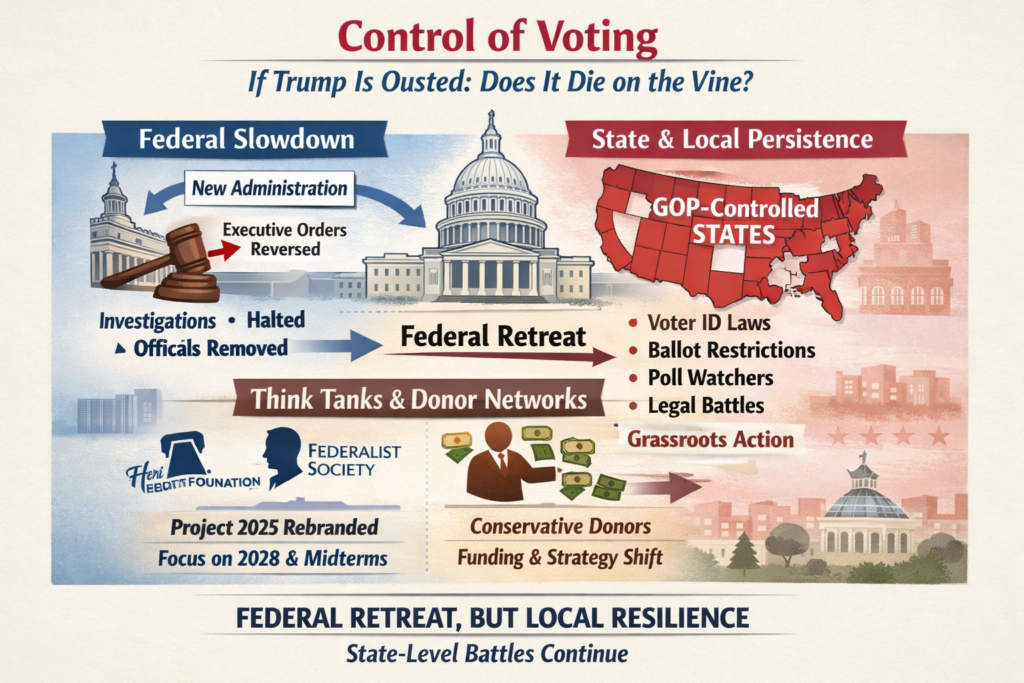
Federal Slowdown: A new admin (e.g., under Vance or a Democrat post-midterms) could reverse executive orders, like Biden did with Trump’s first-term policies. DOJ probes into “fraud” might halt, and appointees like Cleta Mitchell’s network could be ousted. But some changes (e.g., embedded federal observers, voter roll purges) could linger if not actively undone, per experts at the Center for American Progress.
State and Local Persistence: Much of this is decentralized. GOP-led states have passed 100+ “integrity” laws since 2020 (e.g., voter ID, mail ballot restrictions), independent of Trump. Groups like the Election Integrity Network or RNC’s Protect the Vote operate at grassroots levels, training poll watchers and filing lawsuits, stuff that doesn’t vanish overnight. Even without Trump, red states resist federal overreach (e.g., some GOP secretaries of state withholding full voter data from DOJ).
Think Tank and Donor Networks: Heritage, Federalist Society, and funders like Leonard Leo would pivot. Project 2025 is framed as a “conservative promise” for any GOP admin, not Trump-specific. If Trump goes, they’d rebrand for 2028 (e.g., focusing on state ballot initiatives, litigation).
It wouldn’t “die quickly”—more like a temporary federal retreat, with momentum shifting to states and courts. Post-2020, GOP election denialism rewarded incumbents (e.g., no electoral penalty for “stop the steal” supporters in 2022). But backlash (e.g., bipartisan criticism of Georgia raids) could erode support if overreach backfires.
Will They Shift Gears?
Absolutely, conservative networks are adaptive. Without Trump, tactics might soften federally (e.g., less overt “nationalization” talk) but intensify locally: more state laws, voter challenges, or “audit” pushes. X chatter and op-eds suggest prepping for 2028 census fights or midterms as a “blue tsunami” opportunity for Dems. Critics (ACLU, Brennan) warn it could evolve into subtler subversion, like weakening DOJ voting rights enforcement.
In my view, this is a long-game ecosystem (think tanks, donors, state parties) that’s survived presidents before. Trump’s a catalyst, but removal would force a tactical reset—not abandonment. The midterms are the pivot point; if GOP holds, it accelerates. If not, it decentralizes.


Comments are Disabled