Feb 11, 2026, I read this informative article about the FBI seizing the voting records in Georgia.
“The Silent Coup Is Already Underway: How Trump is moving to seize control of voting — starting in Georgia” by Glenn Kessler (published on his Substack: glennkessler.substack.com).
It discusses concerns over Donald Trump’s statements and actions aimed at influencing or “nationalizing” election processes, with a focus on Georgia as an early example. The article opens with a quote from Trump in a February 2 interview with Dan Bongino: “The Republicans ought to nationalize the voting.” It revisits Trump’s past claims of election fraud and frames current moves (like potential federal involvement in state voting systems, ballot handling, or oversight) as steps toward greater control ahead of future elections, such as the 2026 midterms.
My question is who is actually the architect? I don’t believe Trump ever had the smarts to do this on his own and certainly not now. Someone or some organization is orchestrating everything behind the scenes
Key Players and Enablers from the Article and Related Context
The Kessler article doesn’t name an overarching “architect” but points to several individuals and groups actively involved in pushing this agenda, particularly in Georgia as a testing ground:
Cleta Mitchell: She’s a prominent conservative lawyer who was on the infamous 2021 call where Trump pressured Georgia’s Secretary of State Brad Raffensperger to “find” votes. Mitchell now leads the Election Integrity Network, a group focused on challenging election processes and training poll watchers. The article notes her influence through appointees like Heather Honey (Deputy Assistant Secretary for Election Integrity), who has ties to Mitchell’s network and has floated ideas like declaring a “national emergency” to override state voting rules.
Kurt Olsen: Appointed by Trump as Director of Election Security and Integrity, he’s been sanctioned in the past for baseless election fraud claims. He referred the warrant that led to the FBI seizing Fulton County ballots in January 2026, reviving old 2020 conspiracies.
Tulsi Gabbard: As Director of National Intelligence, she oversaw the FBI raid on Fulton County for a vague “national security issue,” which the article suggests is a pretext for federal overreach.
These folks aren’t new; they’ve been part of Trump’s orbit since his first term or the 2020 challenges. The Georgia focus—using a Trump-friendly state election board to potentially seize county boards—seems designed as a blueprint for scaling up nationally, per the article.
Broader Influences and Organizations
Looking beyond the piece, reporting ties this to a more structured conservative playbook that’s been in development since at least 2024-2025:
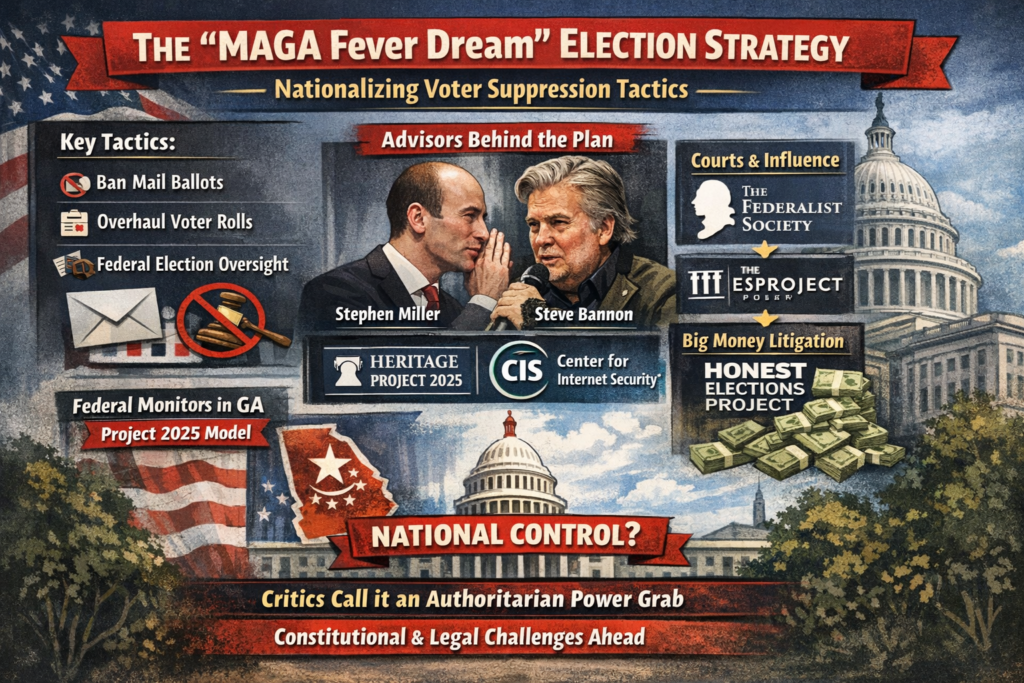
Heritage Foundation and Project 2025: This stands out as the most likely “organizational architect.” Project 2025, a detailed policy roadmap from the Heritage Foundation (a major conservative think tank), explicitly calls for using the Department of Justice (DOJ) to investigate and prosecute alleged voter fraud, even based on debunked claims. It proposes federal interventions like proof-of-citizenship requirements for voting and empowering agencies to audit state elections. Trump’s administration has implemented parts of this, such as shifting the DOJ’s Civil Rights Division toward “fraud” probes under appointees like Harmeet Dhillon (a 2020 election denier) and Kash Patel (FBI pick who’s vowed to go after perceived election riggers).
Critics from groups like the Brennan Center have called it a “MAGA fever dream” for nationalizing voter suppression tactics, like banning mail ballots or overhauling voter registration.
Other Advisors and Networks: Figures like Stephen Miller (Trump’s policy whisperer on immigration and now broader issues) or Steve Bannon (who’s pushed election denialism via his “War Room” podcast) often get credited in analyses for strategizing these moves. There’s also overlap with groups like the Center for Internet Security (CIS), which handles election cybersecurity and has DHS ties—some X discussions speculate it’s part of a deeper infrastructure for monitoring elections.
In Georgia specifically, the push involves embedding federal observers and audits, which echoes tactics from Project 2025.
As for the Federalist Society: They’re hugely influential in judicial appointments (shaping courts that could rule on election cases), and their co-founder Leonard Leo has funneled big money into conservative causes, including election-related litigation through networks like the Honest Elections Project. But they’re not the primary driver here—that seems more Heritage’s lane for policy blueprints. Federalist Society folks might advise on legal strategies to make this stick, though.
Trump isn’t devising this solo; his style is more improvisational and grievance-driven than master-planner. In my view, the real “architecture” is a decentralized but aligned network of conservative think tanks (led by Heritage via Project 2025) and loyalists like Mitchell, Olsen, and Patel, who’ve been gaming out ways to centralize election oversight under the guise of “integrity.” It’s not a conspiracy in the tin-foil sense—it’s out in the open, rooted in post-2020 frustrations and amplified by Trump’s platform.
The goal appears to be tilting the system toward Republicans by federalizing controls that states have historically managed, which raises constitutional red flags (elections are state-run per the Constitution, as even some GOP allies like Gov. Greg Abbott have pushed back on).
Whether this succeeds depends on courts, Congress, and public push back—it’s already facing bipartisan criticism and could backfire if it erodes trust further.
Seize Control of Voting, Who is Behind the Curtain
Feb 11, 2026, I read this informative article about the FBI seizing the voting records in Georgia.
“The Silent Coup Is Already Underway: How Trump is moving to seize control of voting — starting in Georgia” by Glenn Kessler (published on his Substack: glennkessler.substack.com).
It discusses concerns over Donald Trump’s statements and actions aimed at influencing or “nationalizing” election processes, with a focus on Georgia as an early example. The article opens with a quote from Trump in a February 2 interview with Dan Bongino: “The Republicans ought to nationalize the voting.” It revisits Trump’s past claims of election fraud and frames current moves (like potential federal involvement in state voting systems, ballot handling, or oversight) as steps toward greater control ahead of future elections, such as the 2026 midterms.
My question is who is actually the architect? I don’t believe Trump ever had the smarts to do this on his own and certainly not now. Someone or some organization is orchestrating everything behind the scenes
Key Players and Enablers from the Article and Related Context
The Kessler article doesn’t name an overarching “architect” but points to several individuals and groups actively involved in pushing this agenda, particularly in Georgia as a testing ground:
Cleta Mitchell: She’s a prominent conservative lawyer who was on the infamous 2021 call where Trump pressured Georgia’s Secretary of State Brad Raffensperger to “find” votes. Mitchell now leads the Election Integrity Network, a group focused on challenging election processes and training poll watchers. The article notes her influence through appointees like Heather Honey (Deputy Assistant Secretary for Election Integrity), who has ties to Mitchell’s network and has floated ideas like declaring a “national emergency” to override state voting rules.
Kurt Olsen: Appointed by Trump as Director of Election Security and Integrity, he’s been sanctioned in the past for baseless election fraud claims. He referred the warrant that led to the FBI seizing Fulton County ballots in January 2026, reviving old 2020 conspiracies.
Tulsi Gabbard: As Director of National Intelligence, she oversaw the FBI raid on Fulton County for a vague “national security issue,” which the article suggests is a pretext for federal overreach.
These folks aren’t new; they’ve been part of Trump’s orbit since his first term or the 2020 challenges. The Georgia focus—using a Trump-friendly state election board to potentially seize county boards—seems designed as a blueprint for scaling up nationally, per the article.
Broader Influences and Organizations
Looking beyond the piece, reporting ties this to a more structured conservative playbook that’s been in development since at least 2024-2025:
Heritage Foundation and Project 2025: This stands out as the most likely “organizational architect.” Project 2025, a detailed policy roadmap from the Heritage Foundation (a major conservative think tank), explicitly calls for using the Department of Justice (DOJ) to investigate and prosecute alleged voter fraud, even based on debunked claims. It proposes federal interventions like proof-of-citizenship requirements for voting and empowering agencies to audit state elections. Trump’s administration has implemented parts of this, such as shifting the DOJ’s Civil Rights Division toward “fraud” probes under appointees like Harmeet Dhillon (a 2020 election denier) and Kash Patel (FBI pick who’s vowed to go after perceived election riggers).
Critics from groups like the Brennan Center have called it a “MAGA fever dream” for nationalizing voter suppression tactics, like banning mail ballots or overhauling voter registration.
Other Advisors and Networks: Figures like Stephen Miller (Trump’s policy whisperer on immigration and now broader issues) or Steve Bannon (who’s pushed election denialism via his “War Room” podcast) often get credited in analyses for strategizing these moves. There’s also overlap with groups like the Center for Internet Security (CIS), which handles election cybersecurity and has DHS ties—some X discussions speculate it’s part of a deeper infrastructure for monitoring elections.
In Georgia specifically, the push involves embedding federal observers and audits, which echoes tactics from Project 2025.
As for the Federalist Society: They’re hugely influential in judicial appointments (shaping courts that could rule on election cases), and their co-founder Leonard Leo has funneled big money into conservative causes, including election-related litigation through networks like the Honest Elections Project. But they’re not the primary driver here—that seems more Heritage’s lane for policy blueprints. Federalist Society folks might advise on legal strategies to make this stick, though.
Trump isn’t devising this solo; his style is more improvisational and grievance-driven than master-planner. In my view, the real “architecture” is a decentralized but aligned network of conservative think tanks (led by Heritage via Project 2025) and loyalists like Mitchell, Olsen, and Patel, who’ve been gaming out ways to centralize election oversight under the guise of “integrity.” It’s not a conspiracy in the tin-foil sense—it’s out in the open, rooted in post-2020 frustrations and amplified by Trump’s platform.
The goal appears to be tilting the system toward Republicans by federalizing controls that states have historically managed, which raises constitutional red flags (elections are state-run per the Constitution, as even some GOP allies like Gov. Greg Abbott have pushed back on).
Whether this succeeds depends on courts, Congress, and public push back—it’s already facing bipartisan criticism and could backfire if it erodes trust further.
Share this:
Like this: