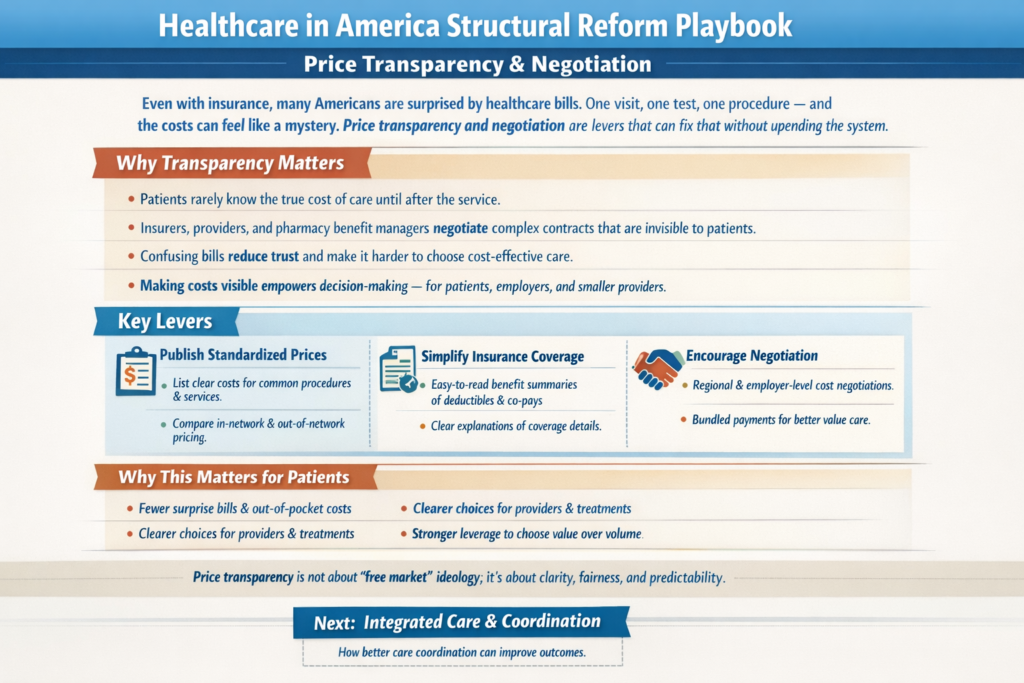
Healthcare in America Structural Reform Playbook Post 2 Price Transparency & Negotiation
Even with insurance, many Americans are surprised by healthcare bills. One visit, one test, one procedure — and the costs can feel like a mystery. Price transparency and negotiation are levers that can fix that without upending the system.
Why Transparency Matters
Patients rarely know the true cost of care until after the service.
Insurers, providers, and pharmacy benefit managers negotiate complex contracts that are invisible to patients.
Confusing bills reduce trust and make it harder to choose cost-effective care.
Making costs visible empowers decision-making — for patients, employers, and even smaller providers.
Key Levers
Publish Standardized Prices
Hospitals and providers should clearly list costs for common procedures and services.
Patients can compare in-network and out-of-network pricing before care.
Simplify Insurance Coverage Explanations
Standard summaries of deductibles, co-pays, coinsurance, and coverage rules.
Easy-to-read formats reduce mistakes and surprise bills.
Encourage Negotiation & Bundled Payments
Regional or employer-level negotiations can lower costs for common procedures.
Bundled payments align provider incentives with outcomes, not volume.
Why This Matters for Patients
Fewer surprise bills and unexpected out-of-pocket costs
Clearer choices when selecting providers or treatments
Stronger leverage to choose value over volume
Price transparency is not about “free market” ideology; it’s about clarity, fairness, and predictability. When patients see costs clearly, the system becomes easier to navigate — and wasteful practices are exposed.
Transition
Next in the playbook is Integrated Care & Coordination, a deep dive showing how putting services under one roof (or at least in a coordinated network) can improve outcomes and reduce duplication.