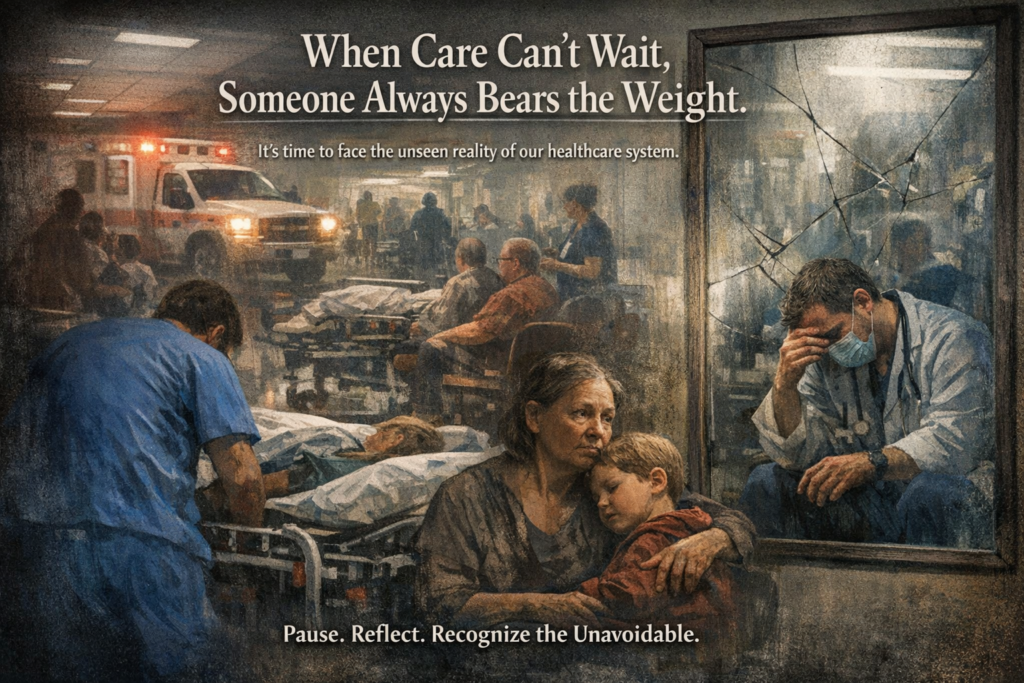
“Welcome to the final moment in this mini-series, Healthcare in America: When Care Can’t Wait. Parts 1, 2, 3, and 4.
What we’ve just seen — urgent care, strained systems, and the people who bear the consequences — is uncomfortable. It’s uncomfortable because it is real, unavoidable, and profoundly human.
Most conversations about healthcare skip this moment. We jump to policy, budgets, and blame. We treat crises as exceptions rather than as signals. But the truth is that someone always absorbs the weight when care can’t wait. Patients, families, frontline providers, and entire communities share the burden — quietly, unevenly, and often invisibly.
This series isn’t here to solve the system in three episodes. It’s here to notice it, to observe it, and to name what exists. By doing so, we give ourselves a chance to engage with it honestly — without illusions, without slogans, and without pretending the weight disappears.
Sometimes, the first step toward understanding is simply acknowledging reality. That is what this series hopes to do: hold a mirror, pause, and recognize the unavoidable.”
Kicker: Why We Struggle to Talk About the Unavoidable – outline
Healthcare is easiest to discuss when it’s optional, scheduled, or abstract.
But urgent care does not wait for comfort, familiarity, or convenience. It arrives whether systems are ready or not. It exposes where efficiency falters, where responsibility is invisible, and where human effort quietly fills the gaps.
This is why the subject is hard to discuss honestly. It carries no simple solution, no tidy numbers, no clear hero or villain. It’s uncomfortable because it is real, unavoidable, and profoundly human.
The point of this series is not to fix healthcare in three weeks or six episodes. It is to notice, to observe, and to respect what exists when care can’t wait.
By naming this reality clearly, we give ourselves the chance to approach the next questions with eyes open — not blindsided by ideology, not distracted by slogans, but aware of the pressures, the tradeoffs, and the human work the system requires.



Comments are Disabled