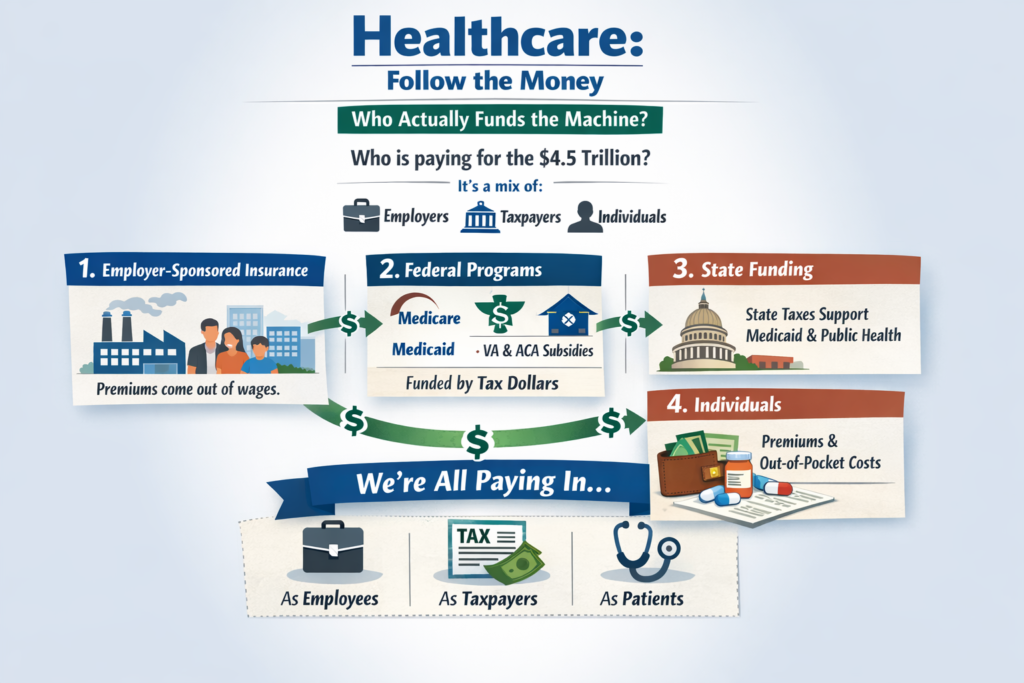
Healthcare in America, Follow the Money, Post 2, Who Actually Funds the Machine?
Before we trace how money moves, we need to answer a simpler question:
Who is paying for the $4.5 trillion?
The answer is not “the government.” It is not “insurance companies.” And it is not “other people.”
It is a layered mix of employers, taxpayers, and individuals — often the same people wearing different hats.
1. Employer-Sponsored Insurance
Roughly half of Americans receive health coverage through an employer.
That coverage is not free.
So when we talk about employer-based insurance, we’re really talking about compensation being routed through a benefits system instead of directly into paychecks.
2. Federal Government Programs
The federal government funds several major programs:
Medicare (primarily for seniors and certain disabled individuals)
Medicaid (jointly funded with states)
ACA exchange subsidies
Veterans’ health programs
Federal employee plans
These are financed through payroll taxes, general tax revenue, borrowing, and state contributions.
Again, the payer is not abstract. It is the tax base.
3. State Governments
States share Medicaid costs and fund public health systems, university hospitals, and safety-net services.
That money comes from state taxes — income, sales, property — depending on the state.
4. Individuals
Even with insurance, individuals pay:
Premium contributions
Deductibles
Co-pays
Coinsurance
Out-of-network charges
Out-of-pocket spending remains a substantial portion of total health expenditures.
The First Structural Insight
Almost every American is paying into the system in more than one way:
As an employee. As a taxpayer. As a patient.
The same dollar may leave your paycheck as a premium contribution, leave your income as a tax payment, and leave your wallet again at the pharmacy counter.
The system feels expensive because it is funded through overlapping streams.
And we haven’t even discussed where the money goes yet.