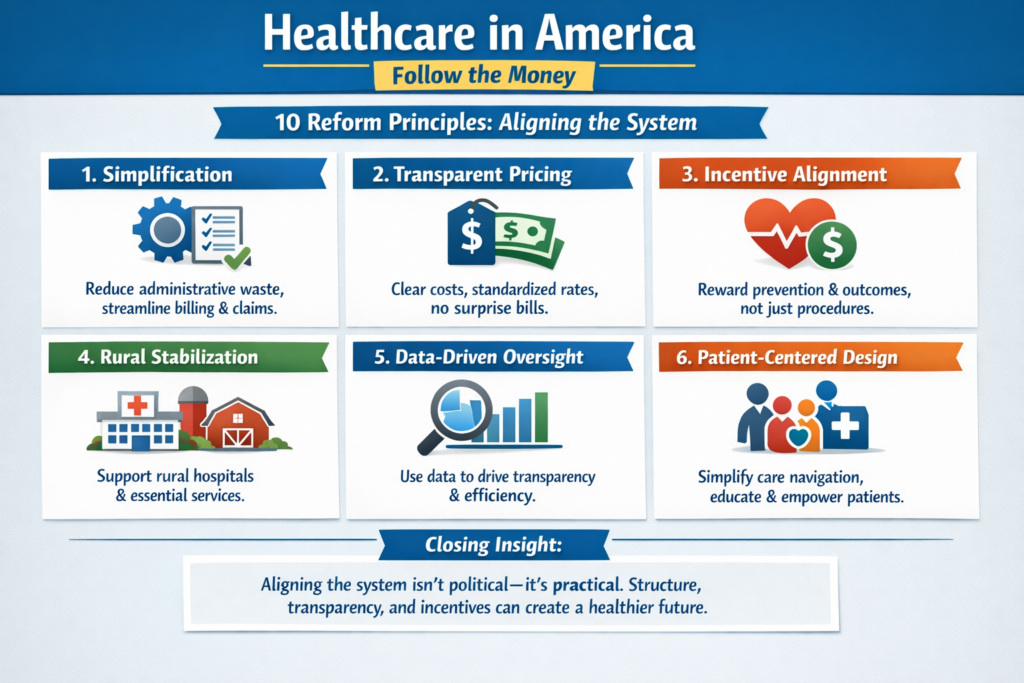
Healthcare in America, Follow the Money Post 10 Reform Principles: Aligning the System
We’ve traced the U.S. healthcare system from dollars to delivery, explored administrative complexity, chronic disease, and rural pressures, and analyzed incentives. Now the question becomes: what would a system look like if it aligned with outcomes rather than complexity?
This is not about ideology or politics. It’s about structure and function.
1. Simplification
Reduce unnecessary administrative layers.
Streamline claims, billing, and prior authorization processes.
Standardize coding and reporting where possible.
Goal: Money and effort should flow toward care, not paperwork.
2. Transparent Pricing
Make costs clear for patients, employers, and payers.
Standardize pricing across hospitals and providers where feasible.
Ensure out-of-network and surprise bills are minimized.
Goal: Reduce confusion, improve decision-making, and empower patients.
3. Incentive Alignment
Reward preventive care and long-term health outcomes rather than volume of procedures.
Align provider reimbursement with patient health metrics and chronic disease management.
Encourage insurers to focus on outcomes and accessibility rather than purely risk mitigation.
Goal: Make the system work for health, not just billing.
4. Rural Stabilization
Support small hospitals and critical access facilities with scalable administrative support.
Consider alternative models for staffing, telehealth, and regional collaboration.
Protect essential services even in low-volume communities.
Goal: Ensure equitable access regardless of geography.
5. Data-Driven Oversight
Use data to identify inefficiencies, high-cost drivers, and gaps in access.
Encourage transparency in spending and outcomes across all layers.
Support continuous improvement rather than static regulation.
Goal: Make evidence the foundation for policy and operational decisions.
6. Patient-Centered Design
Simplify insurance interactions.
Educate patients on coverage, preventive care, and cost implications.
Make navigation of care intuitive and friction-free.
Goal: Ensure patients experience the system as a service, not a puzzle.
Closing Insight
The U.S. healthcare system is enormous, expensive, and complex. But it is not irredeemable. By focusing on structure, transparency, and incentives, it is possible to reduce waste, improve access, and align resources with actual care.
The principles outlined here are nonpartisan and structural: they do not depend on ideology, politics, or personalities. They depend on understanding the machine and reshaping it to serve the people it was meant to help.