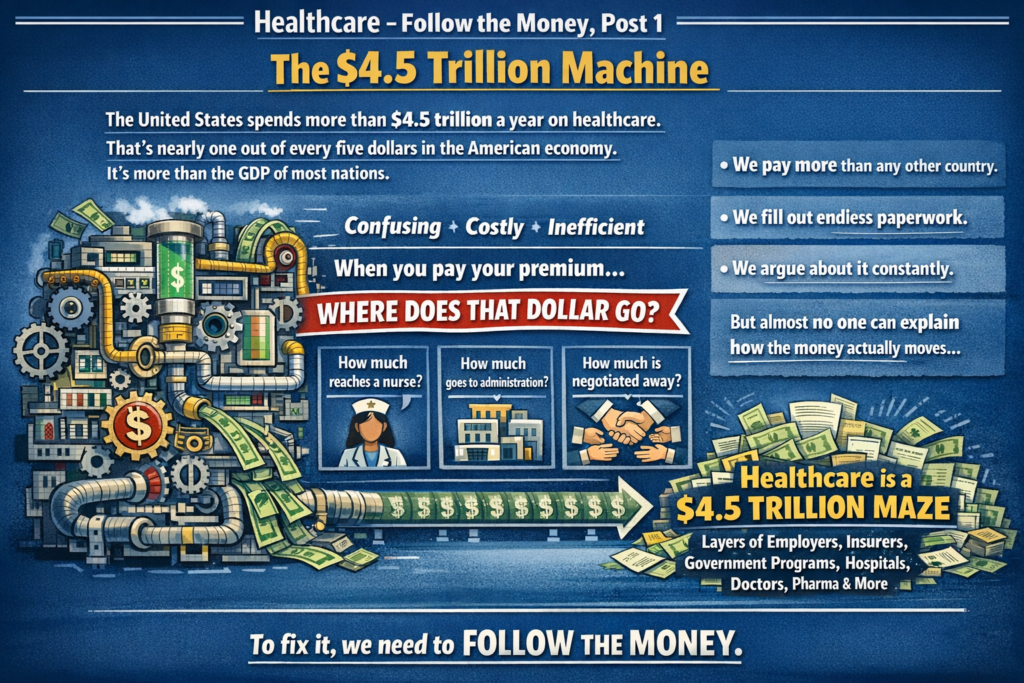
Healthcare in America, Follow the Money, Post 1, The $4.5 Trillion Machine
The United States spends more than $4.5 trillion a year on healthcare.
That’s nearly one out of every five dollars produced in the American economy. It’s more than the GDP of most nations. It is, by scale alone, one of the largest financial systems in the world.
And yet Americans routinely report confusion, frustration, and distrust when they try to use it.
We pay more than any developed country. We fill out more paperwork than anyone. We argue about it constantly. And still, almost no one can explain — in plain terms — how the money actually moves.
Ask a simple question:
When you pay your premium, where does that dollar go?
How much reaches a nurse? How much goes to administration? How much is negotiated away before a bill ever reaches you? How many entities touch a single claim before it’s paid?
The debate we usually hear is political. The structure underneath it is financial.
American healthcare is not a single program. It is a layered payment network built over decades — employers, insurers, federal programs, state programs, hospital systems, physician groups, pharmacy benefit managers, pharmaceutical manufacturers, compliance divisions, coding departments, billing contractors, and regulators — all interacting at once.
Each layer was added for a reason. Each layer solved a problem. Each layer also introduced cost.
Over time, the layers became the system.
If we are going to talk about reform — or even fairness — we need to start here. Not with ideology. Not with outrage. But with mechanics.
Because until we understand how the machine works, we will keep diagnosing the wrong disease.

 Healthcare in America, Follow the Money, Post 1, The $4.5 Trillion Machine