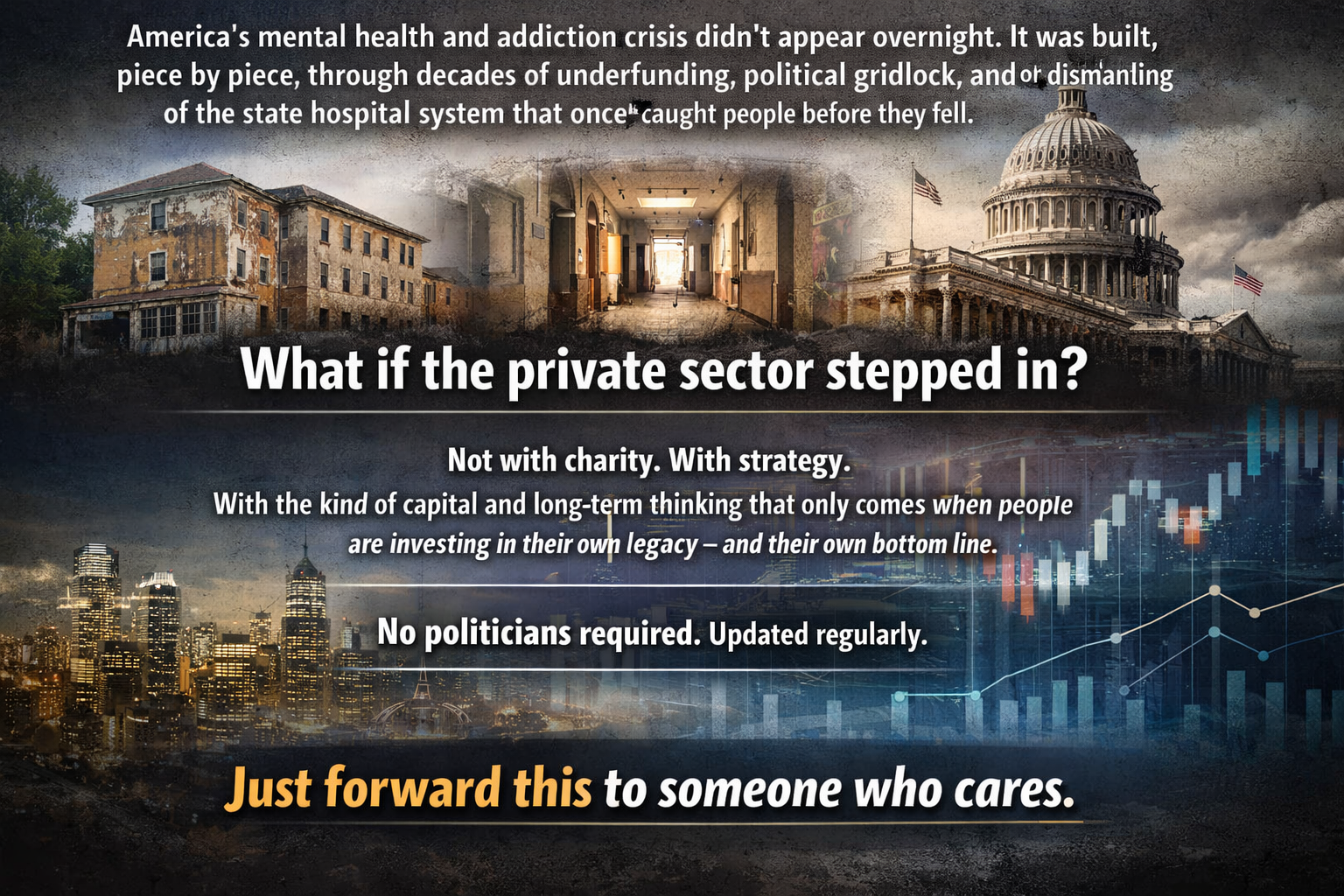
A Practical Approach: When Something Obvious Isn’t Being Done
There’s a lot of noise right now.
Wars. Elections. Markets. Politics layered on top of politics. Everyone talking, few people listening. Most of it feels unstable. Most of it feels out of reach.
And maybe that’s part of the problem.
Because while we’re all focused on the big, complicated, unsolvable things… there are problems sitting right in front of us that aren’t complicated at all.
They’re just not being picked up.
Addiction treatment is one of them.
Not addiction in isolation—because addiction is often the visible problem. The root often lies in untreated or poorly managed mental health challenges. But addiction is treatable. It’s measurable. Interventions can work. And it’s where we can actually make a difference.
We see it everywhere. In cities, small towns, emergency rooms, police calls, families trying to hold together. People falling through the cracks of systems that were supposed to catch them.
We’ve known this for years. Studied it. Funded it. Debated it. Reframed it. Turned it into policy arguments, budget fights, election talking points.
And still—it sits there.
Not solved. Not improving in any meaningful, consistent way.
Just… managed.
Part of the reason is that we’ve treated it like a political problem. Something to be argued over. Something funded or defunded depending on who’s in charge. Something that shifts direction every few years without building real continuity.
But addiction doesn’t wait for elections. It doesn’t follow politics. And this doesn’t feel like a political problem anymore.
It feels like a systems problem.
Systems problems—when they’re clear enough—can be built differently.
This isn’t about overhauling healthcare. It’s not about rewriting insurance laws or building another layer of bureaucracy.
It’s simpler than that.
It’s about creating places where people can go when they’re not okay—and actually get help for the things we can treat.
Places designed from the beginning to focus on outcomes, not billing cycles. Where addiction is addressed alongside the underlying mental health context. Where accountability is measured by whether people stabilize, recover, and return to life with some form of independence.
Right now, we spend an extraordinary amount of time and energy reacting to crises after they’ve already spilled out.
Emergency response. Law enforcement. Crisis management.
All necessary. None designed to fix the root.
The quieter question is whether we’re willing to build something that works before people reach that point.
This isn’t impossible.
It’s neglected.
And sometimes the difference between the two is simply whether someone decides to pick it up.