

Posts in Category: News

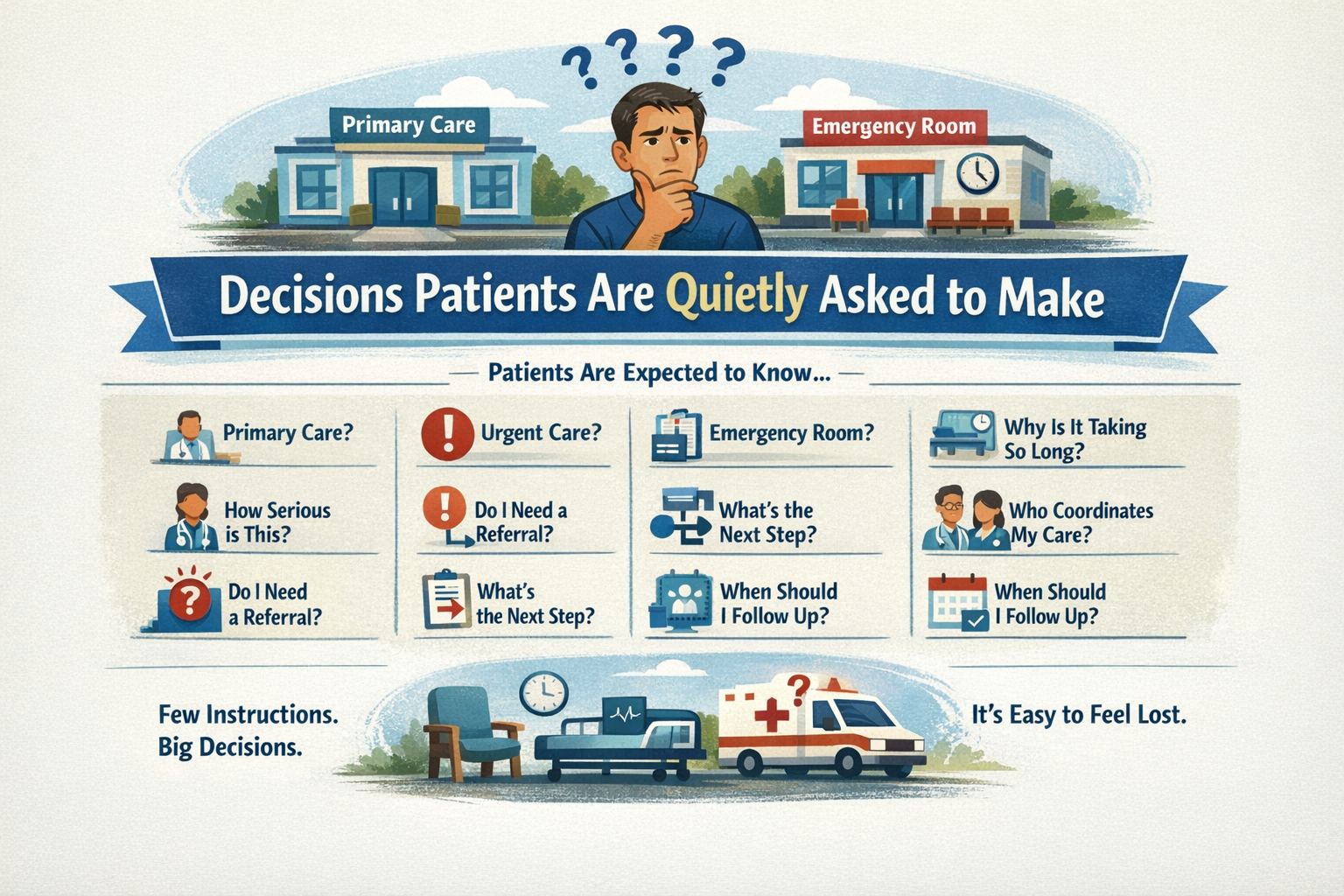
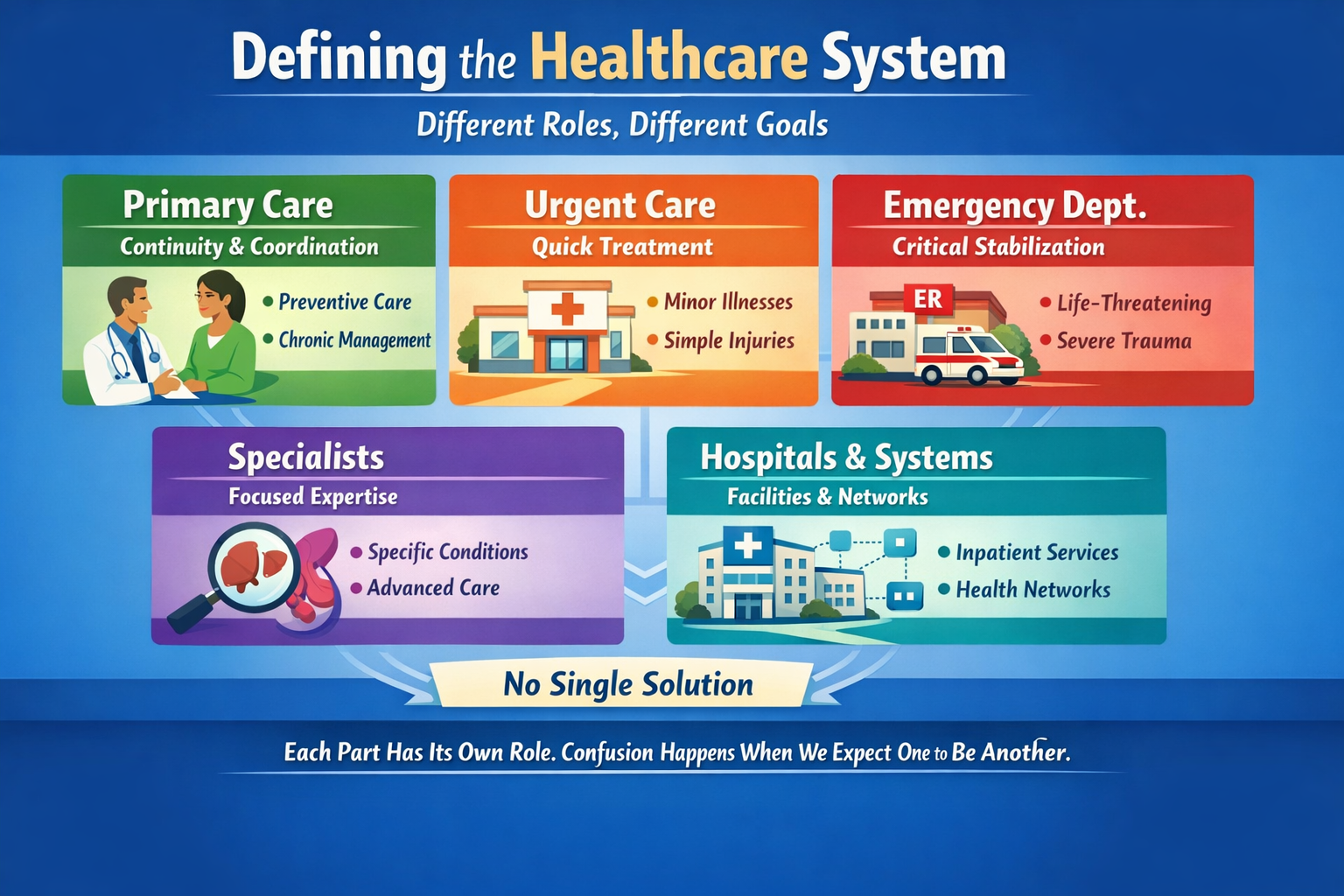
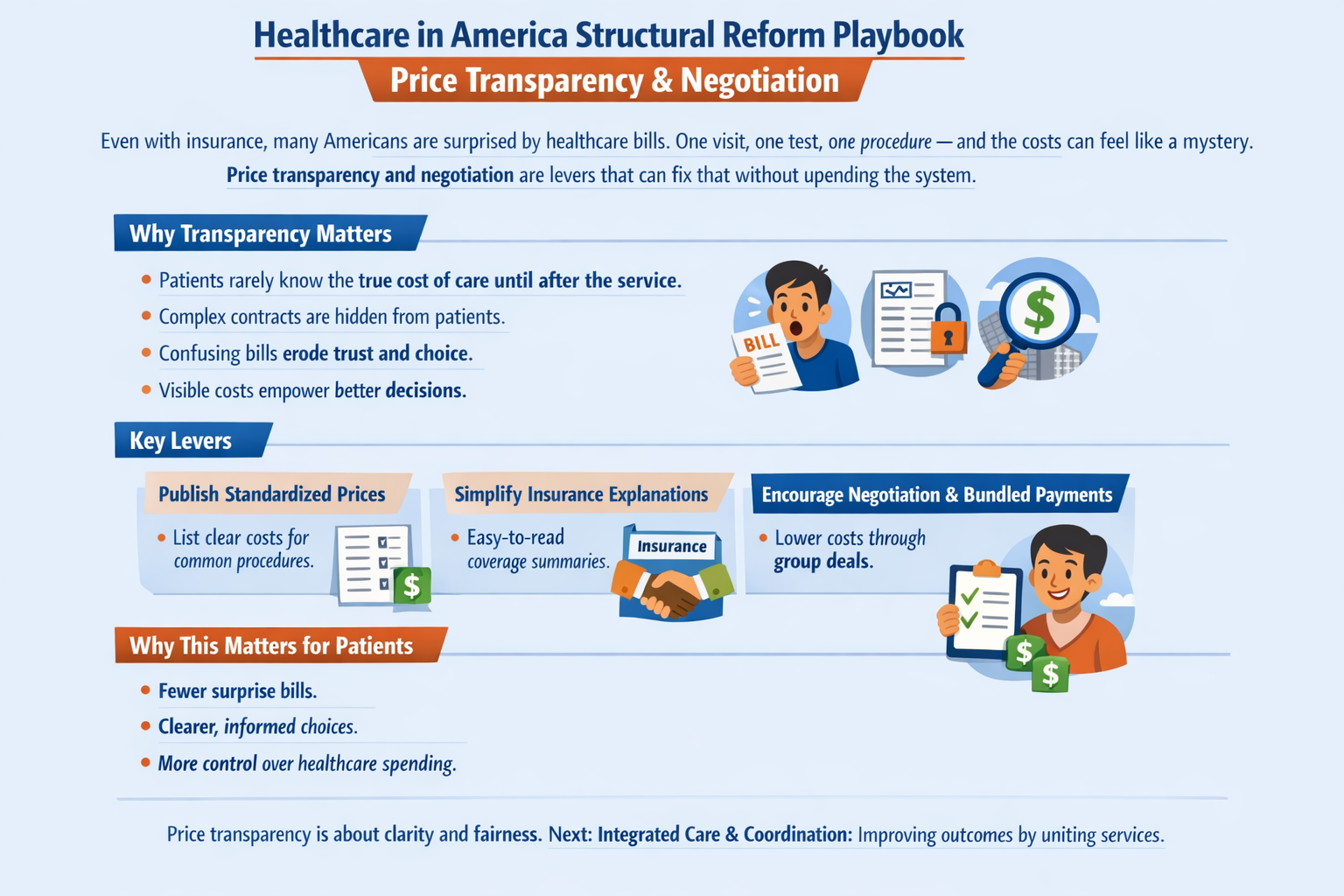
Healthcare in America Series II, Part 1 – What Urgent Care Actually Is (and Is Not)

YouTube player

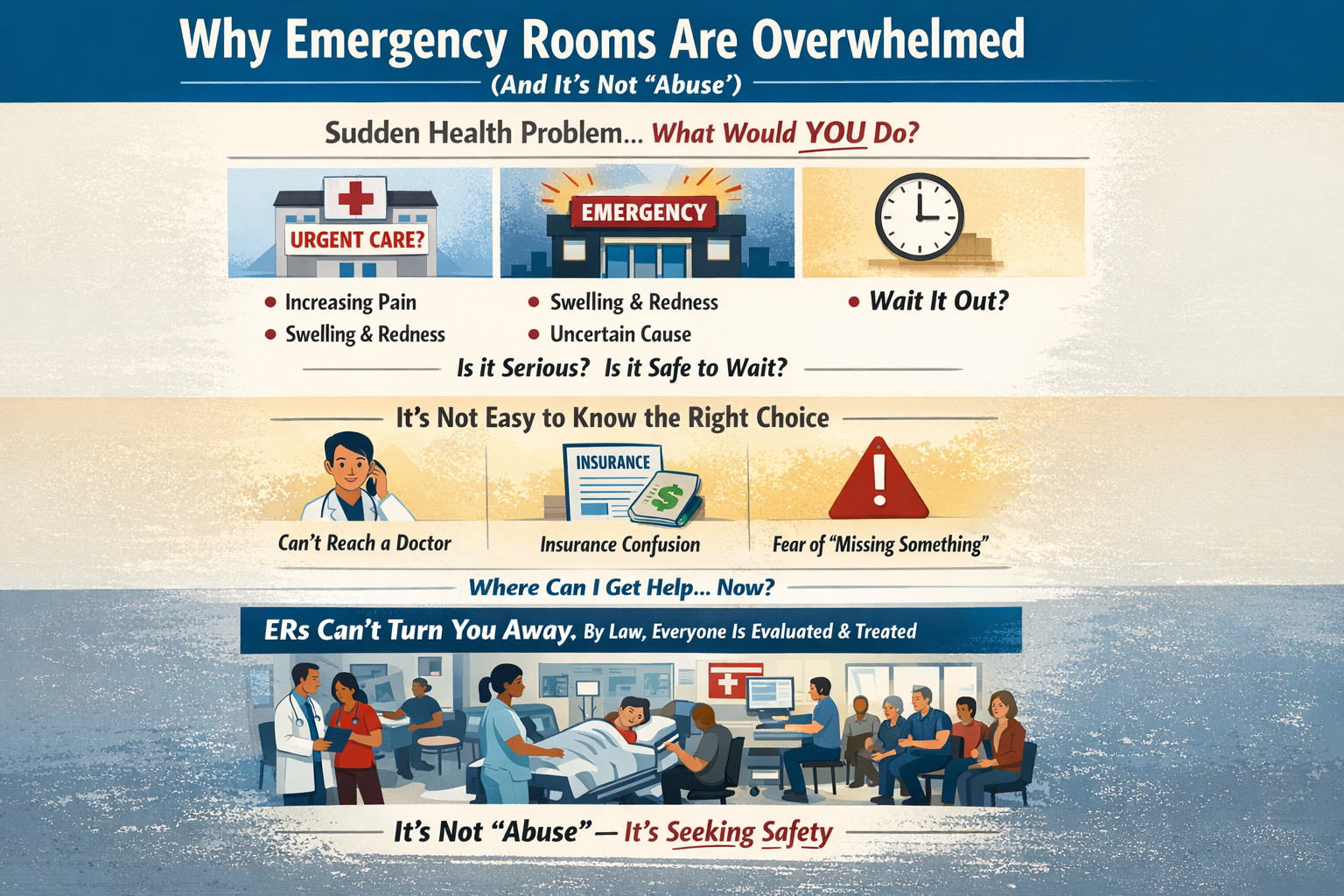
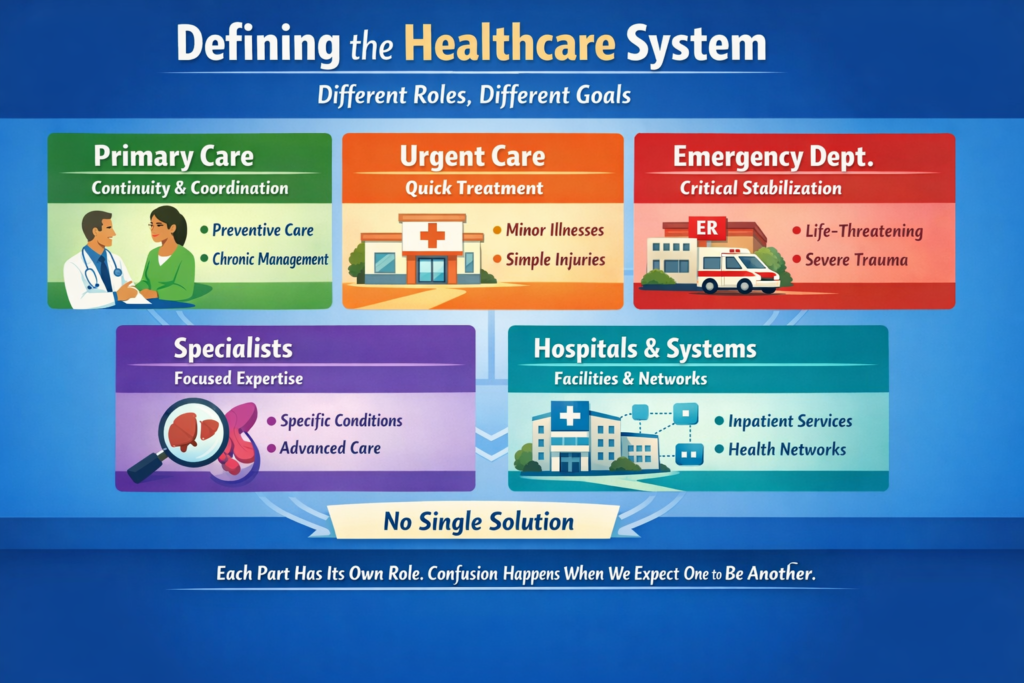
“Welcome to the first episode of Healthcare in America: When Care Can’t Wait. Today, we’re going to look at what urgent care really means — and what it doesn’t.

Most of the time, when we talk about healthcare, we think about appointments, schedules, and choices. But urgent care isn’t optional. It doesn’t wait for comfort or convenience. It arrives whether the system is ready or not, and it changes everything.

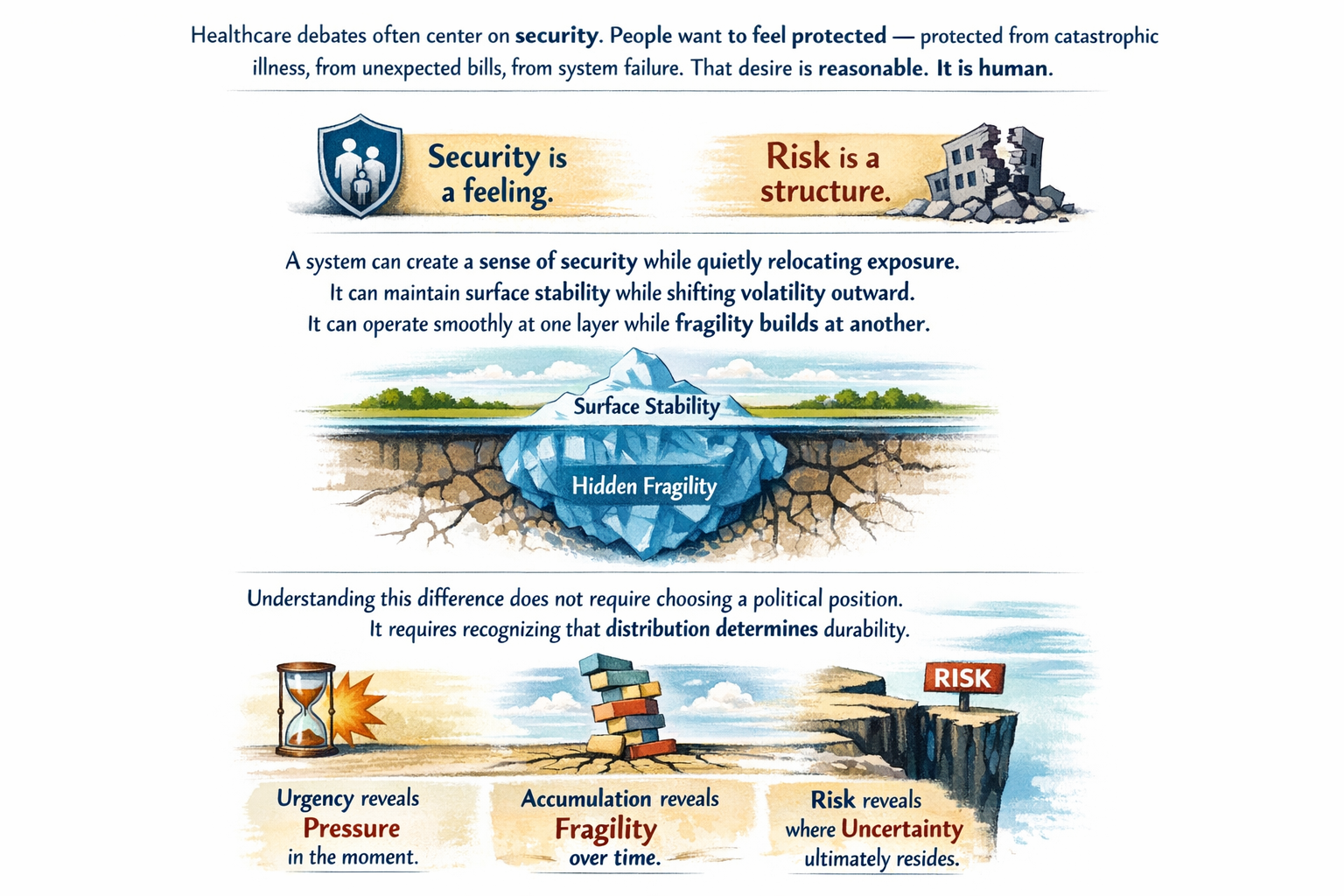
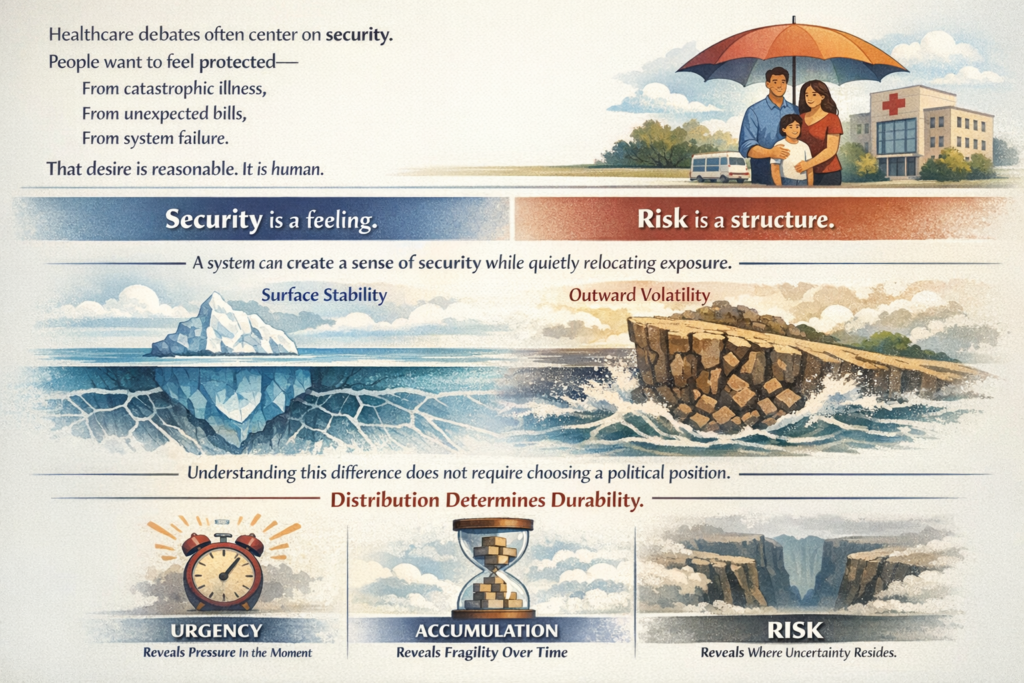
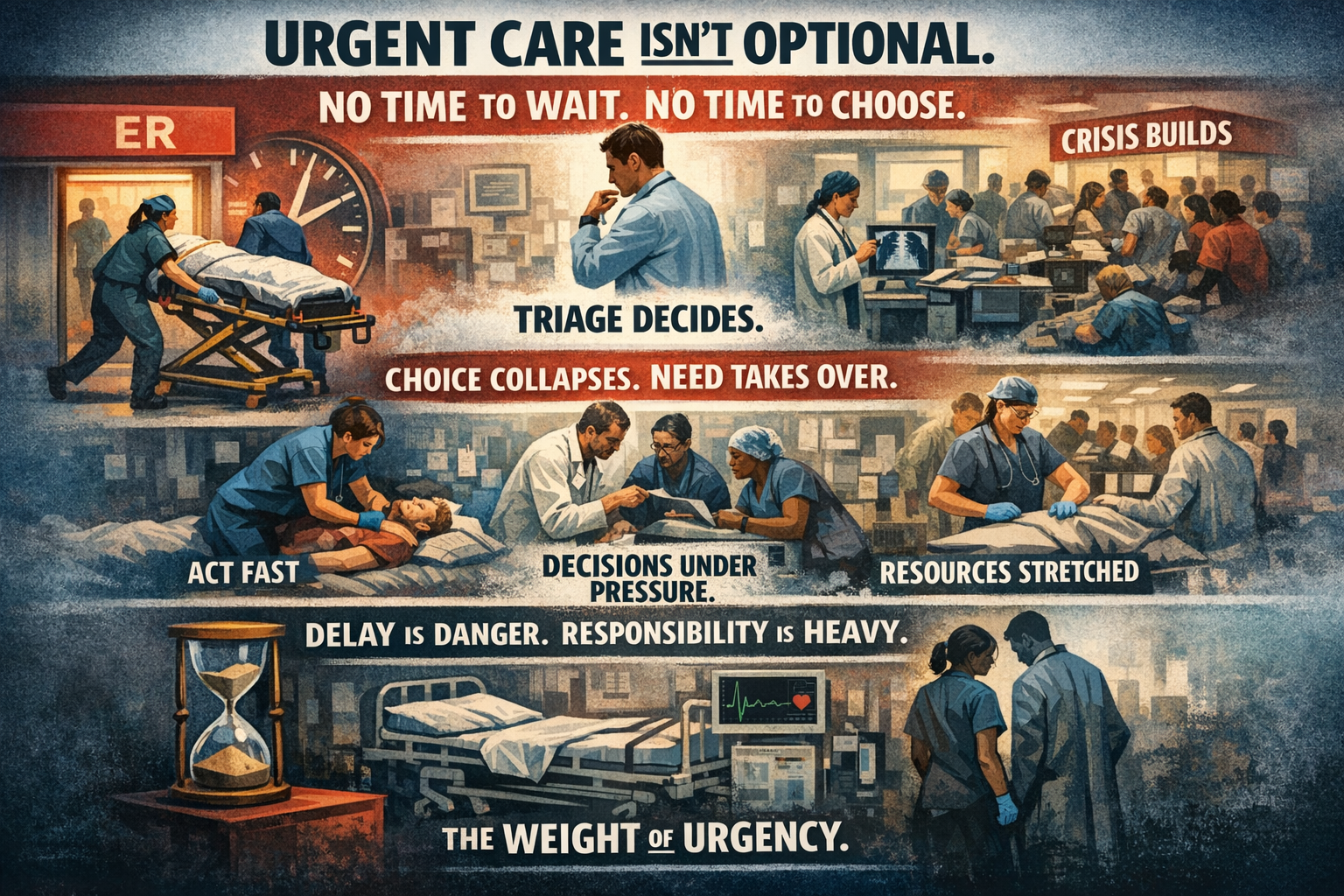
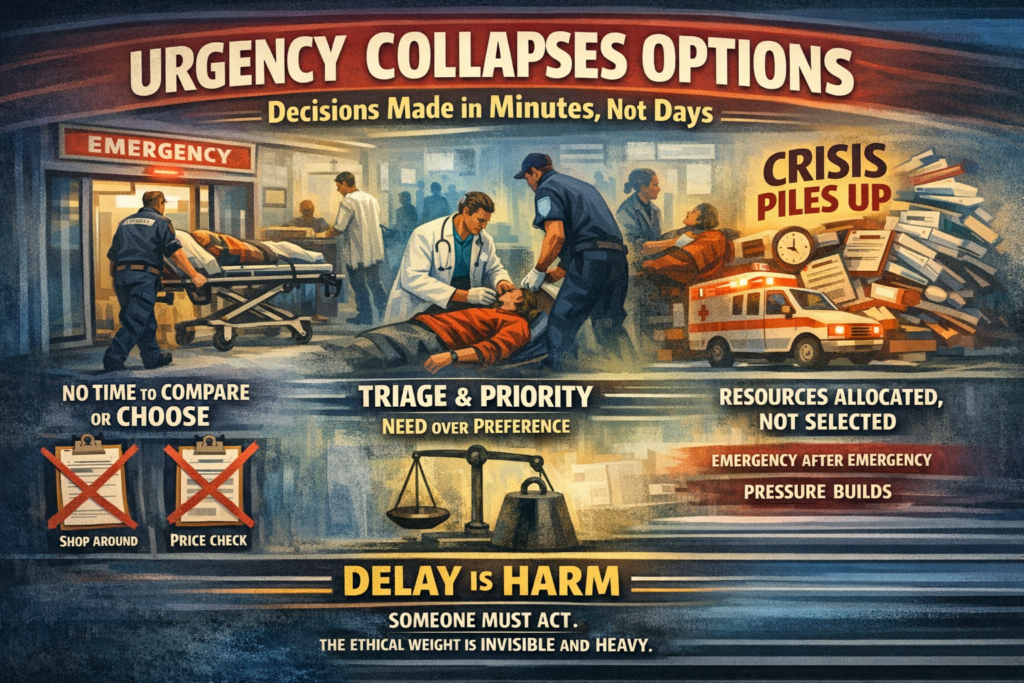
Urgency collapses options. Decisions that would normally take days, weeks, or months are compressed into minutes or hours. There’s no time to compare prices, shop for the best facility, or negotiate who sees you first. Consent still exists, but it’s constrained. Choice becomes secondary to need.

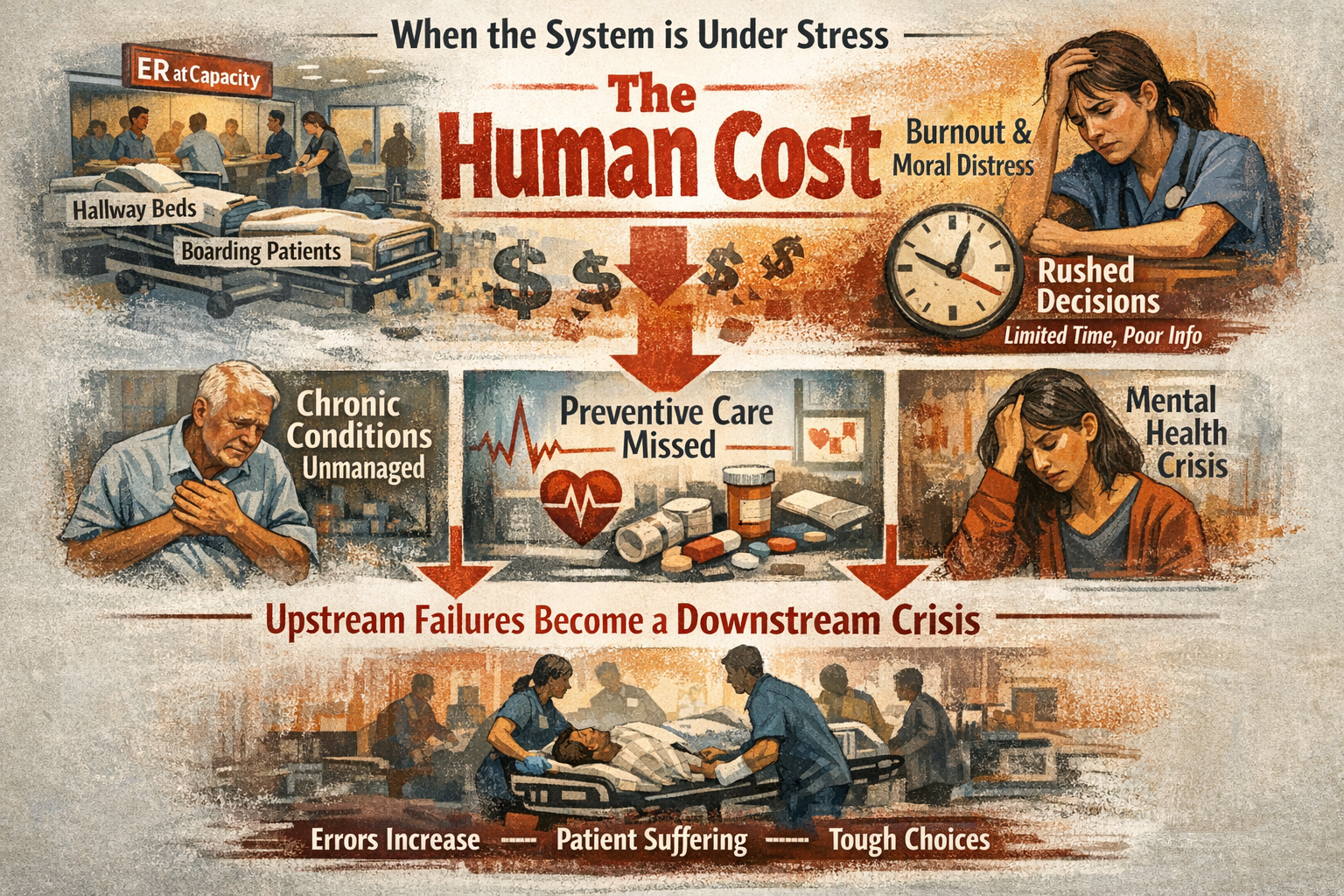
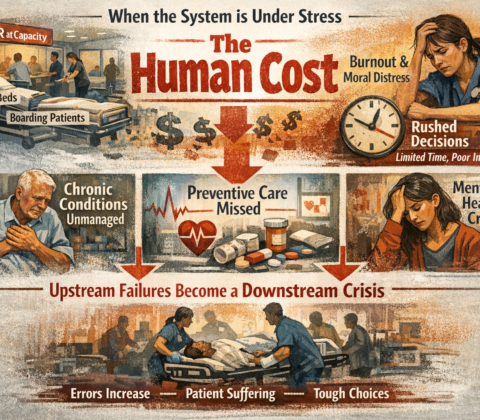
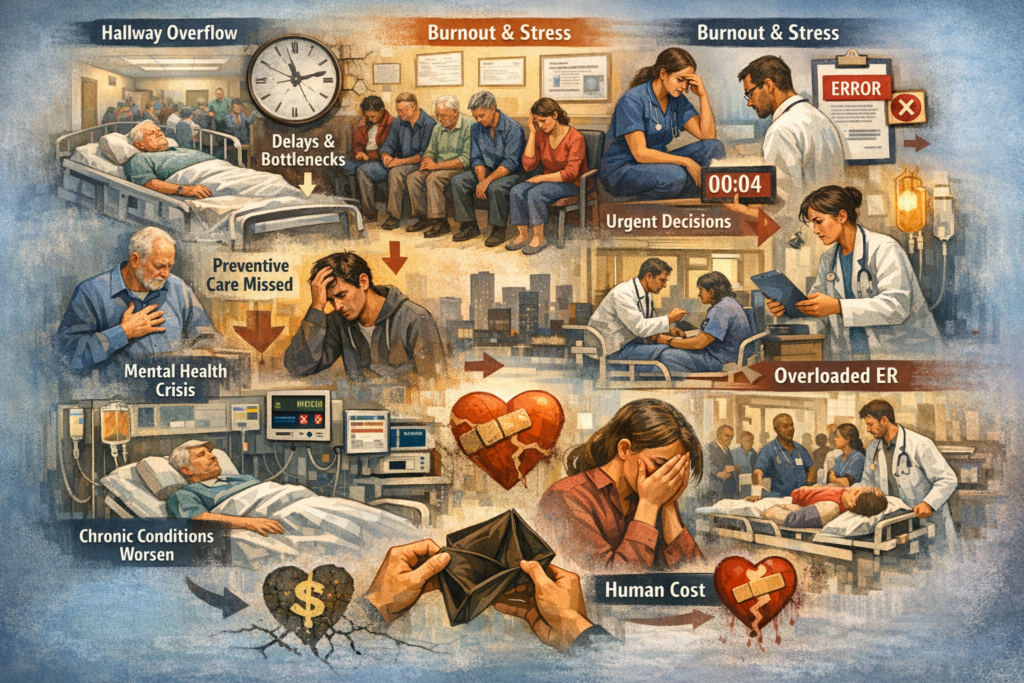
Triage replaces preference. Clinical judgment determines who gets attention first, and who waits. Resources are allocated, not selected. What begins as exception — a single patient needing immediate attention — can quickly become the new normal, because urgent care is cumulative. Emergencies don’t happen in isolation. Chronic neglect, unmanaged conditions, and mental health crises feed into the system until every gap becomes a pressure point.

At its core, urgent care is about responsibility. Someone must act. Delay itself is harm. And yet, the system doesn’t pause to announce this. The ethical load is quiet, invisible, and heavy.

In this episode, we’re not going to talk about costs, insurance, or policy solutions. That comes later. Today is about observation — about noticing how care behaves when it becomes unavoidable.

If this episode feels incomplete, that’s intentional — because urgent care itself is incomplete by nature. It demands action before understanding.

By the end, I hope you’ll see urgent care not as an anomaly, but as a lens: a way to understand the pressures, constraints, and human work that sustain healthcare when waiting isn’t an option.”

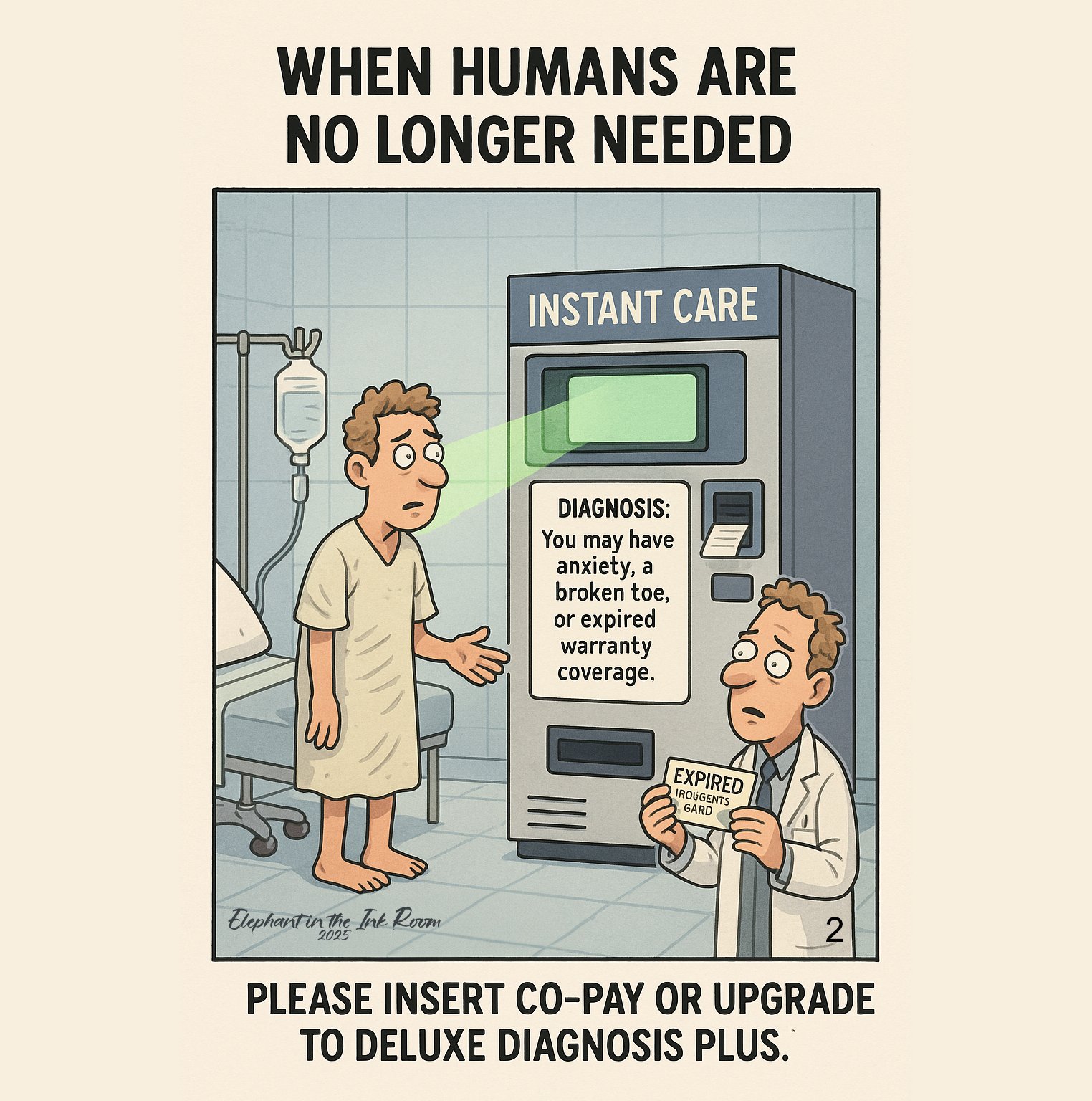
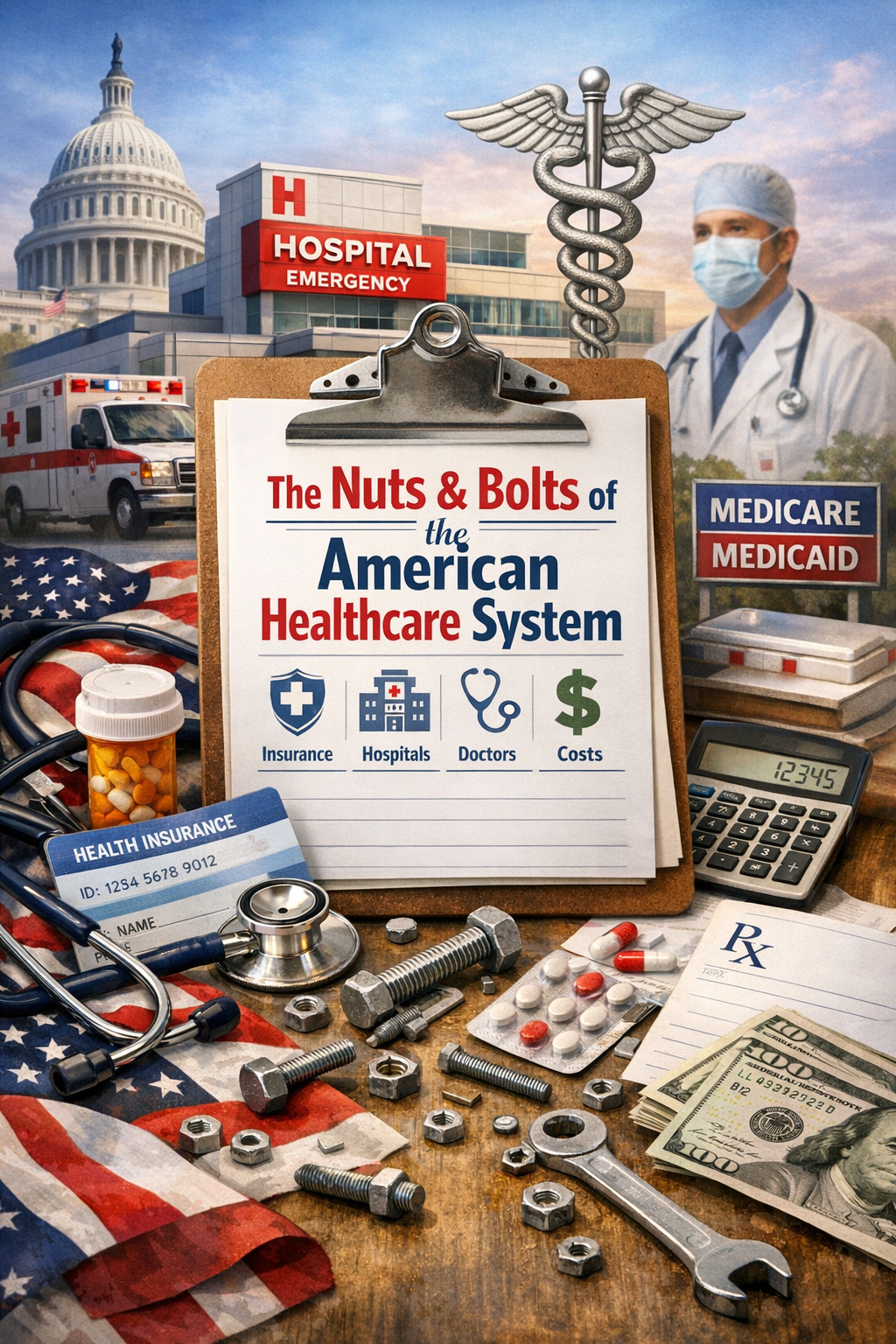
20260204 1712 Image Generation simple compose 01kgnnmmsve729wgddzdw0h39b

Part 1: What Urgent Care Actually Is (and Is Not) outline

Purpose of Part 1

To reset assumptions about urgency in healthcare — before ERs, costs, or policy enter the room.

This part answers:

What changes when care becomes immediate?


I. Urgency changes the rules

  • Urgent care is not just “faster care”

  • Time becomes the dominant variable

  • Delay itself becomes harm

  • Decision-making compresses

Key idea: Urgency collapses options.


II. Choice behaves differently under urgency

  • No shopping

  • No meaningful comparison

  • No negotiating scope or price

  • Consent exists, but it’s constrained

This is not a failure — it’s a condition.


III. Triage replaces preference

  • Clinical judgment overrides consumer preference

  • Severity determines sequence

  • Resources are allocated, not selected

This is where healthcare quietly stops behaving like a market.


IV. Urgent care is not rare — it’s cumulative

  • Emergencies aren’t anomalies; they accumulate

  • Chronic neglect turns into acute crisis

  • Mental health and physical health intersect here

Urgency is often the end point, not the beginning.


V. The moral baseline

    • Care cannot be deferred without consequence

    • Refusal is not always an option

    • Someone must act, even without clarity

This is where ethics quietly step in — without fanfare.


VI. What this part does not address (explicit restraint)

  • Costs and reimbursement

  • Insurance mechanics

  • Institutional blame

  • Policy fixes

We name these absences intentionally.

Healthcare in America — Series II: When Care Can’t Wait – Podcast Prelude

YouTube player

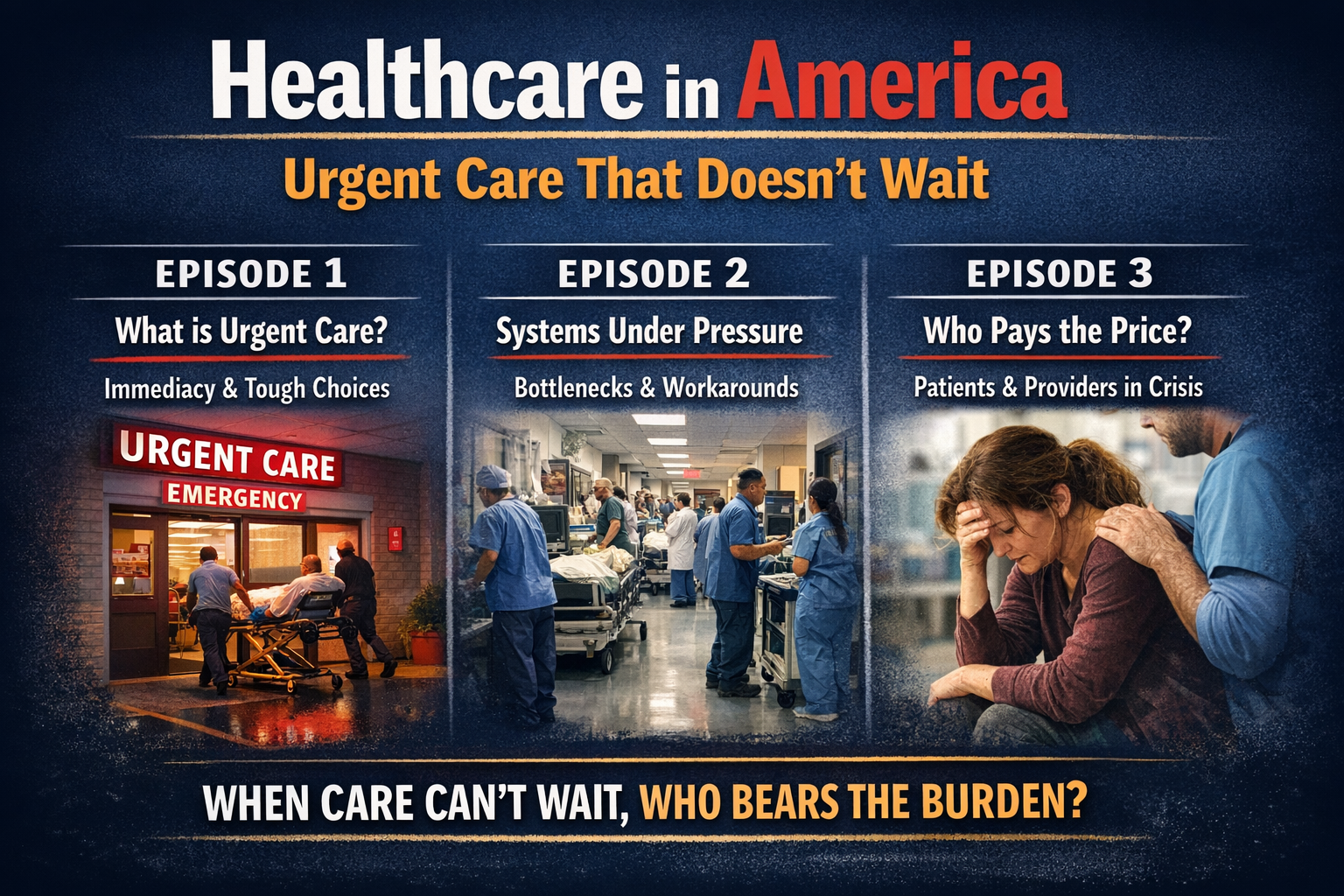
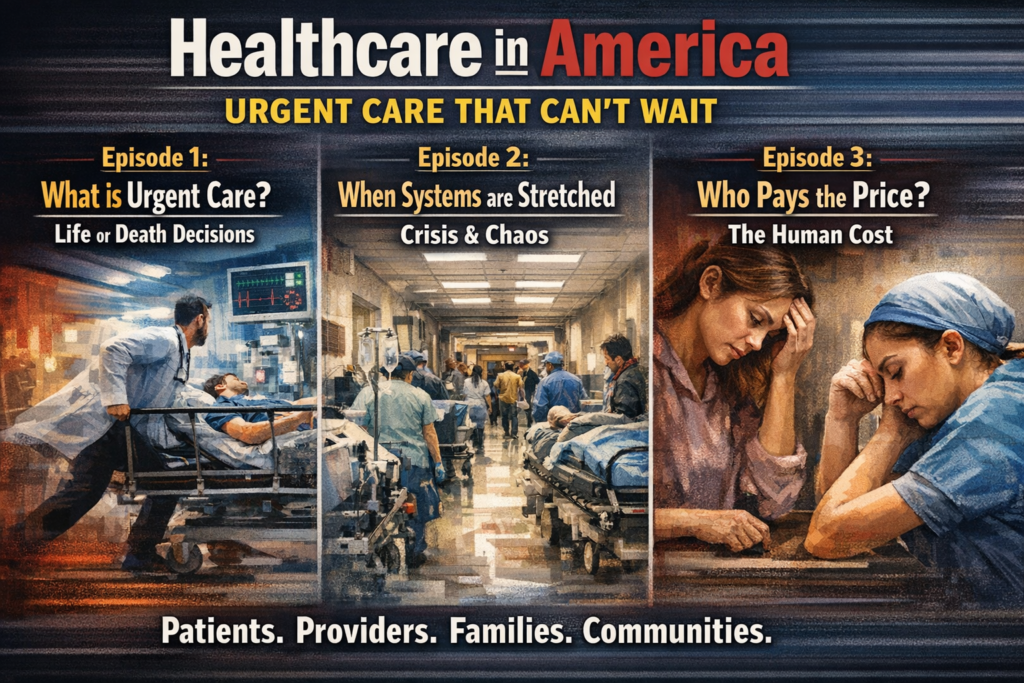
“Welcome back to Healthcare in America. Over the next three episodes, we’re going to look at urgent care — not the kind you schedule, not the kind you shop for — the kind that doesn’t wait.

In the first episode, we’ll explore what urgent care actually is, and what it isn’t. We’ll see how immediacy changes the rules, compresses choices, and forces decisions that no one wants to make lightly.

In the second episode, we’ll look at what happens when systems designed for efficiency are suddenly forced into urgent, unpredictable situations. We’ll see where bottlenecks appear, where workarounds become routine, and how pressure spreads across the system in ways that aren’t always visible.

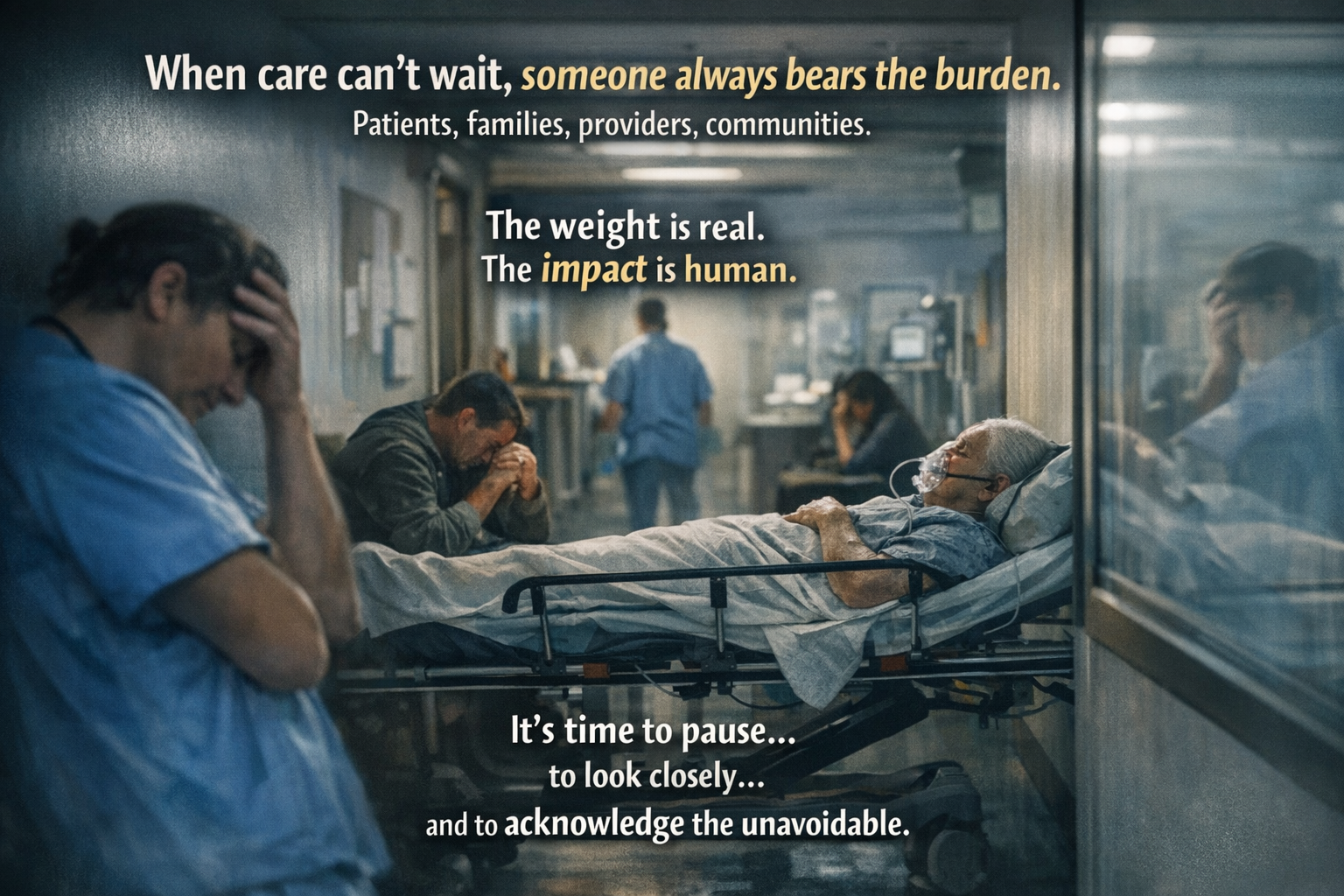
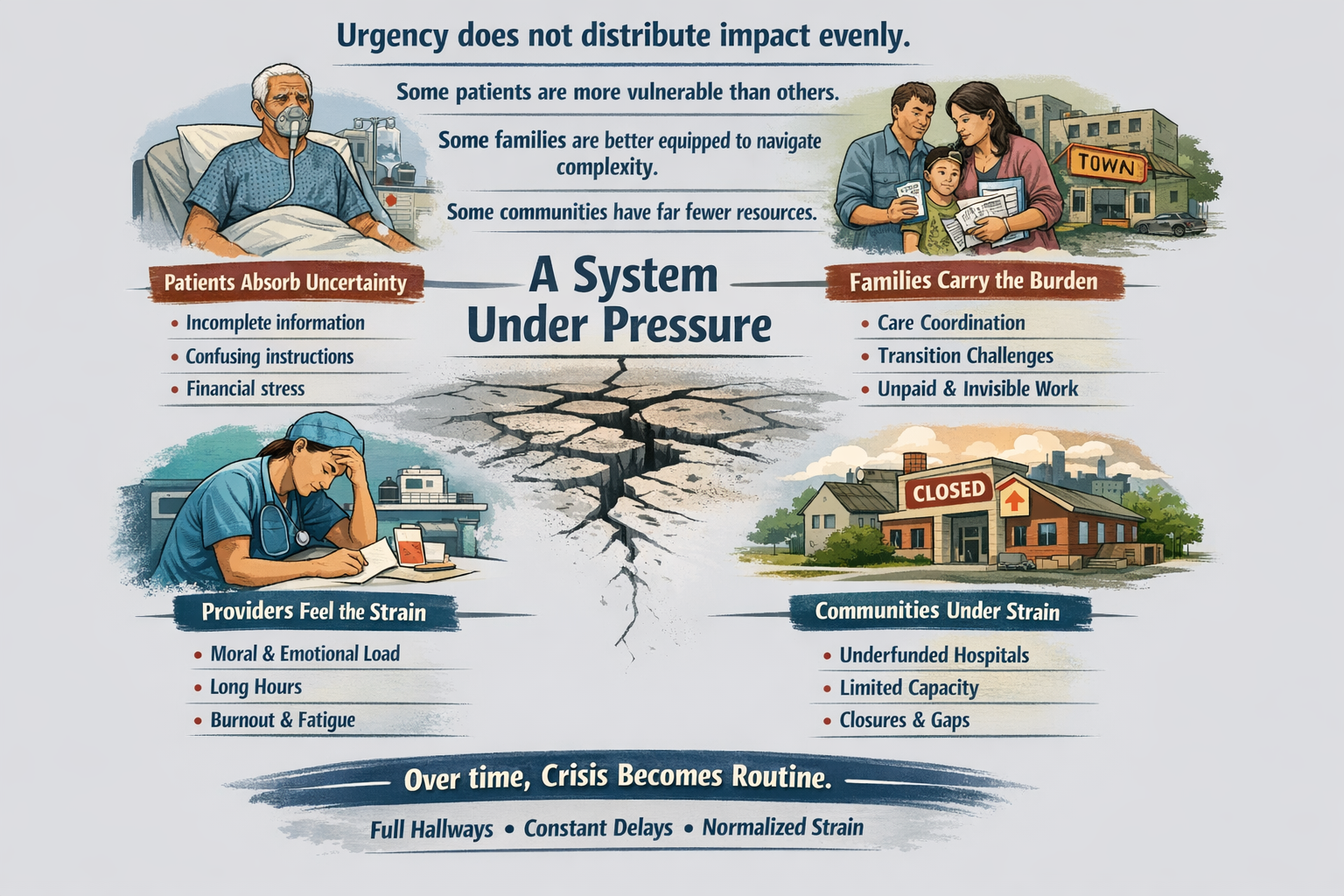
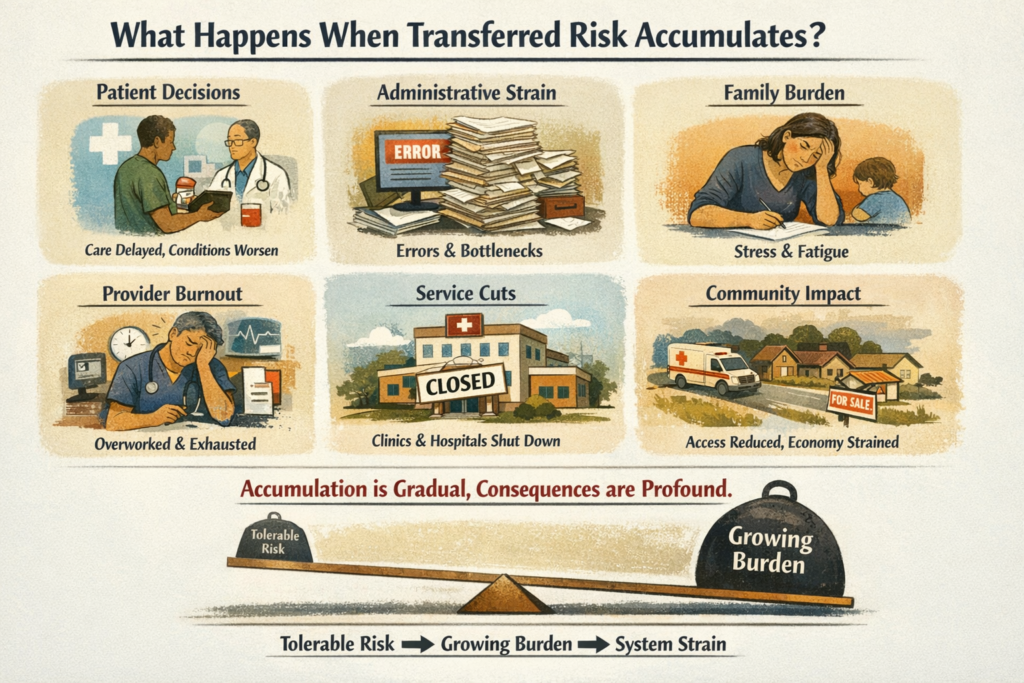
In the third episode, we’ll ask a simple but important question: Who carries the consequences when care can’t wait? Patients, families, frontline providers, and communities all bear the load — often quietly, without recognition.

At the end of the three episodes, we’ll pause to reflect on why this reality is so difficult to talk about honestly. No solutions, no slogans — just a clear look at what happens when care is unavoidable.

This series isn’t about pointing fingers or making policy. It’s about understanding what exists, so we can see the system clearly before we decide what to do next. Let’s begin.”

20260204 1722 Urgent Healthcare Challenges simple compose 01kgnp6mhjeg99krvmd5x3k6fx

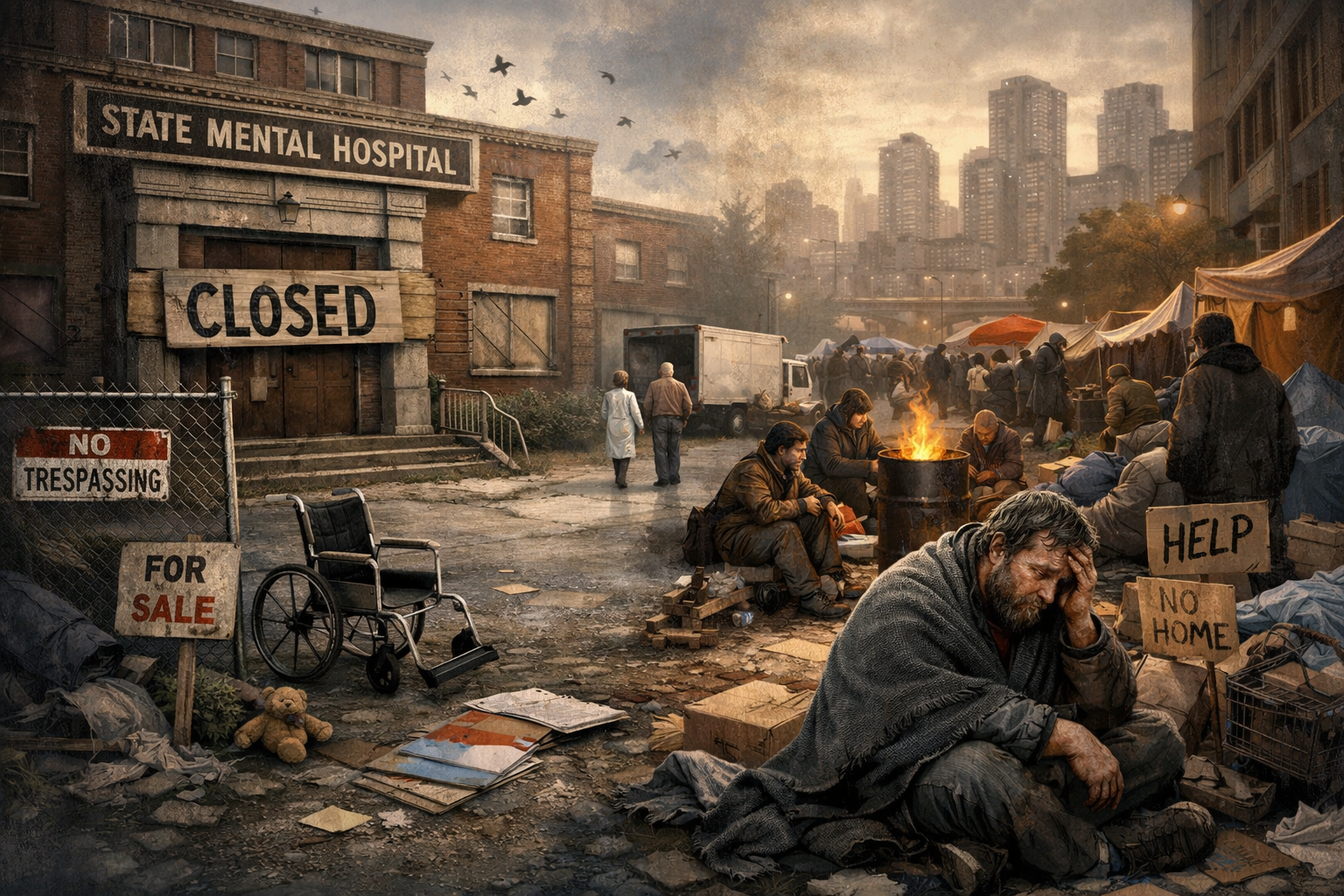
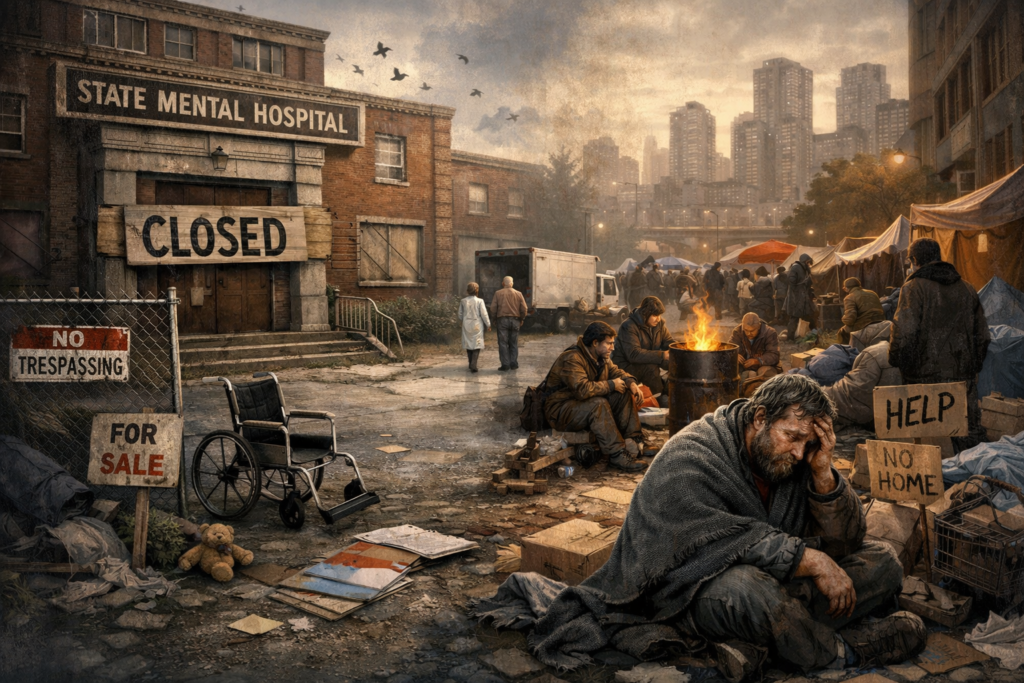
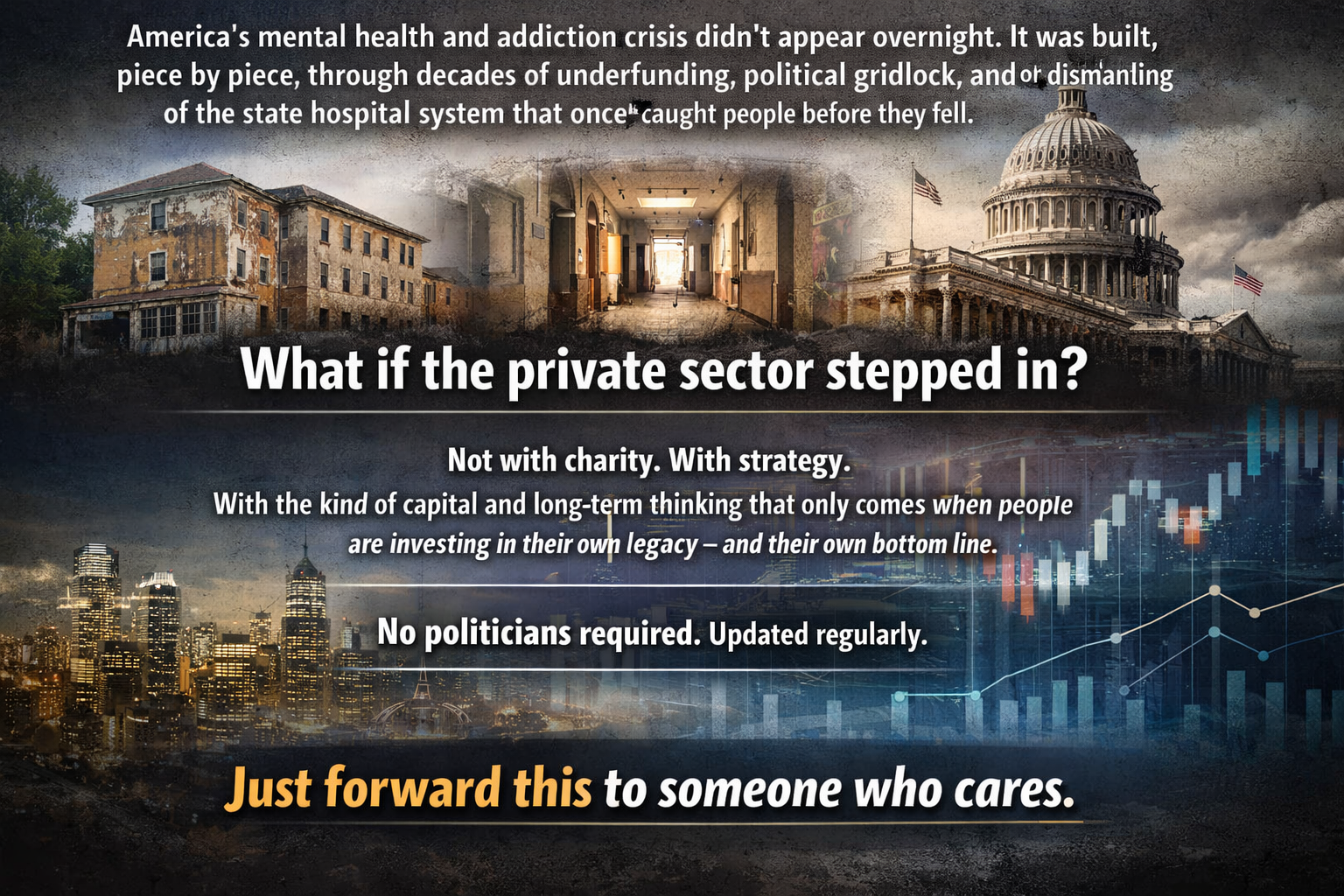
Heathcare – Closure of State Run Mental Facilities and Increase in Homeless Population

Historical Context: The National Deinstitutionalization Trend State-run psychiatric hospitals were once the primary providers of long-term mental health care in the U.S., peaking in the 1950s with around 559,000 inpatient beds nationwide.

By the 1990s, this number had plummeted to about 40,000, a roughly 92% reduction, as facilities closed or downsized dramatically.

This wasn’t isolated to Oregon; it happened across nearly every state, driven by a combination of factors: Policy Reforms and Federal Incentives: The Community Mental Health Act of 1963, signed by President Kennedy, aimed to shift care from large institutions to community-based centers, supported by new antipsychotic medications and civil rights advocacy against abusive asylum conditions.

Federal funding encouraged states to deinstitutionalize, but promised community resources were chronically underfunded — only about half of the planned 1,500 community mental health centers were ever built.

Budget Pressures and Cost-Shifting: States faced rising costs for institutional care amid economic shifts in the 1970s–1980s. Many closed facilities to cut expenses, relying on Medicaid and other federal programs to fund outpatient alternatives. However, this often meant discharging patients without sufficient follow-up, housing, or treatment options.

Examples Across States: Closures mirrored Oregon’s timeline (e.g., Dammasch in 1995). Nationally, facilities like Topeka State Hospital (Kansas, 1997), Metropolitan State Hospital (Massachusetts, 1992), and Allentown State Hospital (Pennsylvania, 2010) shut down in similar waves.

By 2023, many states had fewer than 10 state-operated psychiatric hospitals left, with total public beds dropping to historic lows.

In Oregon, the closure of Dammasch — opened in 1961 and shuttered amid reports of inhumane conditions — exemplified this, releasing patients into communities ill-equipped to support them.

The state’s Eastern Oregon Psychiatric Center in Pendleton closed in 2014, further reducing capacity.

Today, Oregon has only about 743 state hospital beds for adults, with even fewer staffed.

How This Contributed to the National Homeless Crisis While deinstitutionalization wasn’t the sole cause of homelessness — factors like affordable housing shortages, poverty, and substance use disorders play major roles — it undeniably exacerbated the issue by leaving many with severe mental illnesses without stable support. Here’s how the evidence connects the dots: Discharge Without Adequate Safety Nets: Many patients were released from institutions with minimal planning. Nationally, the lack of community mental health funding meant former inpatients often ended up cycling through emergency rooms, jails, or streets.

Studies show a direct correlation: as hospital beds vanished, homelessness among the mentally ill rose, with estimates that 25–30% of homeless individuals have severe mental illnesses like schizophrenia or bipolar disorder.

In Oregon, around 40% of the homeless population has a serious mental illness, higher than the national average, and closures like Dammasch directly led to increased street homelessness in Portland in the 1990s.

Rising Homelessness Statistics: U.S. homelessness hit a record 771,480 people on a single night in January 2024, up 18% from 2023 and 40% from 2018.

Chronic homelessness (long-term, often with disabilities including mental illness) surged 73% over the same period, from 97,000 to 168,000.

About 22% (140,000) of homeless adults in 2024 met criteria for serious mental illness.

Researchers attribute part of this to deinstitutionalization’s “trans institutionalization,” where people shifted from hospitals to prisons or homelessness.

Broader Systemic Failures: The affordable housing crisis amplified the impact — median rents outpaced wages, making stable housing unattainable for those with mental health challenges.

In states like California and Oregon, this led to visible increases in unsheltered homelessness (36% of the total in 2024).

Oregon’s experience echoes this: without enough community treatment or housing post-closures, many cycle between the Oregon State Hospital, jails, and streets.

Nationally, experts note that while deinstitutionalization aimed for better outcomes, underfunding turned it into a “system designed to fail.”

Key Nuances and Ongoing Implications Not every closure was detrimental — some states maintained or repurposed facilities, and advances in outpatient care have helped many. However, the national bed shortage (now about 50 per 100,000 people, far below the recommended 50–60) leaves gaps, especially for acute crises.

In Oregon, this manifests in long waits for care and over-reliance on emergency departments.

Recent federal efforts, like executive orders promoting institutionalization for homelessness reduction, highlight the debate: some advocate for more beds, others for better community funding to prevent crises.

Overall, Oregon’s closures are a microcosm of a national policy that prioritized deinstitutionalization without the necessary infrastructure, directly fueling homelessness by stranding vulnerable people. If you want to dive deeper into this topic, sources like HUD’s Annual Homelessness Assessment Reports or AMA ethics journals provide robust data for further exploration.

20260204 1044 Image Generation simple compose 01kgmzfkrefmjrd71fws9026z1

Coda: What We Know Now – Healthcare in America Series 1

CODA: What We Know Now

This series was not an argument for a particular healthcare system, nor an indictment of any single group. It was an attempt to slow the conversation down long enough to observe something that usually gets buried under urgency and outrage.

Healthcare in the United States does not fail because people don’t care.
It strains because the structure no longer matches the reality it serves.

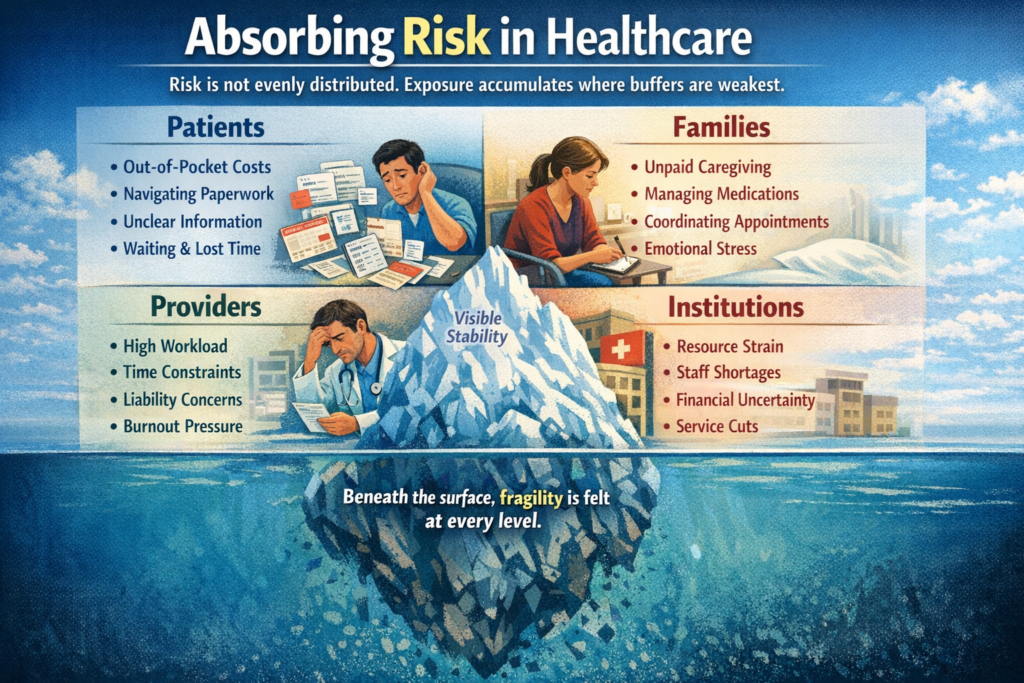
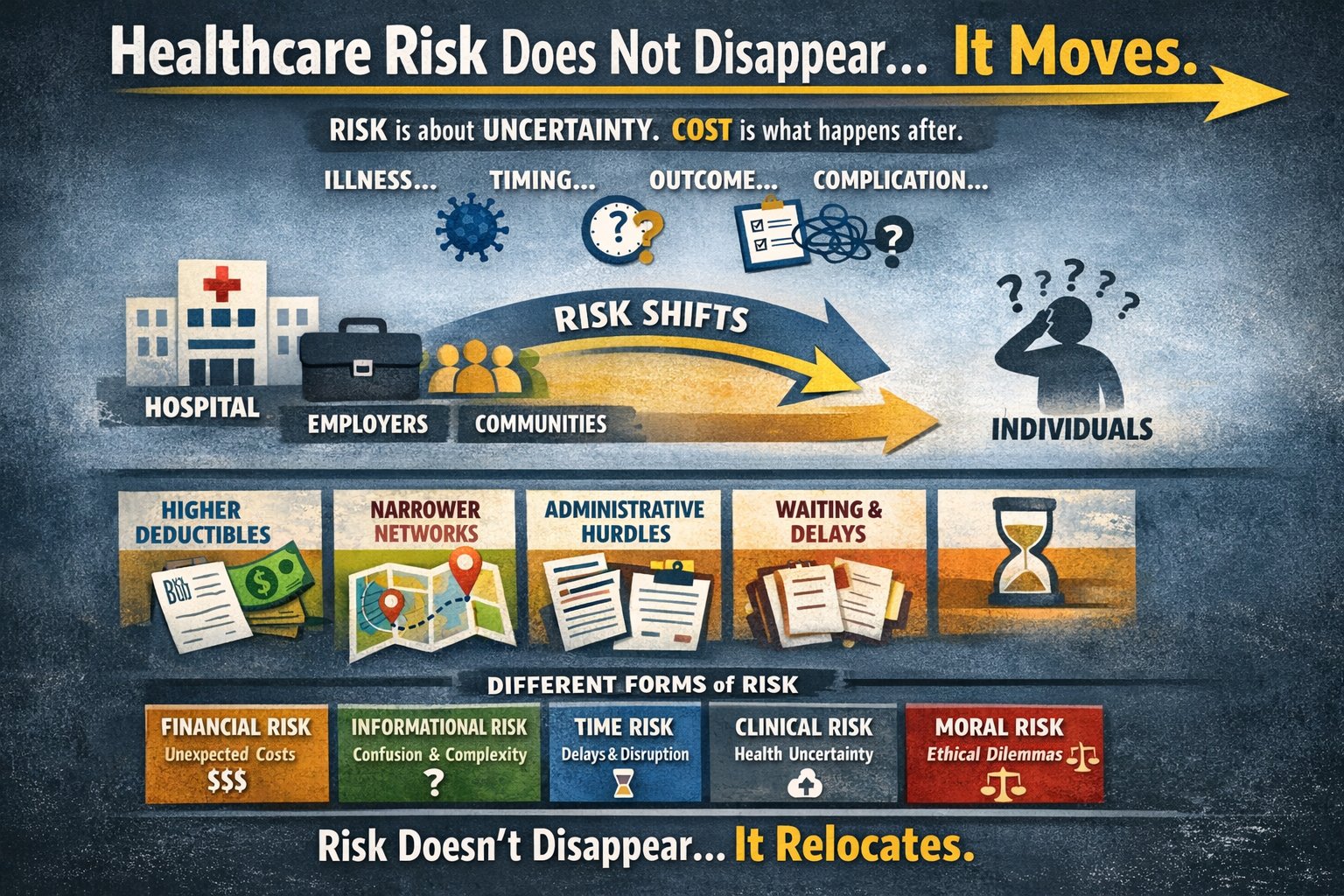
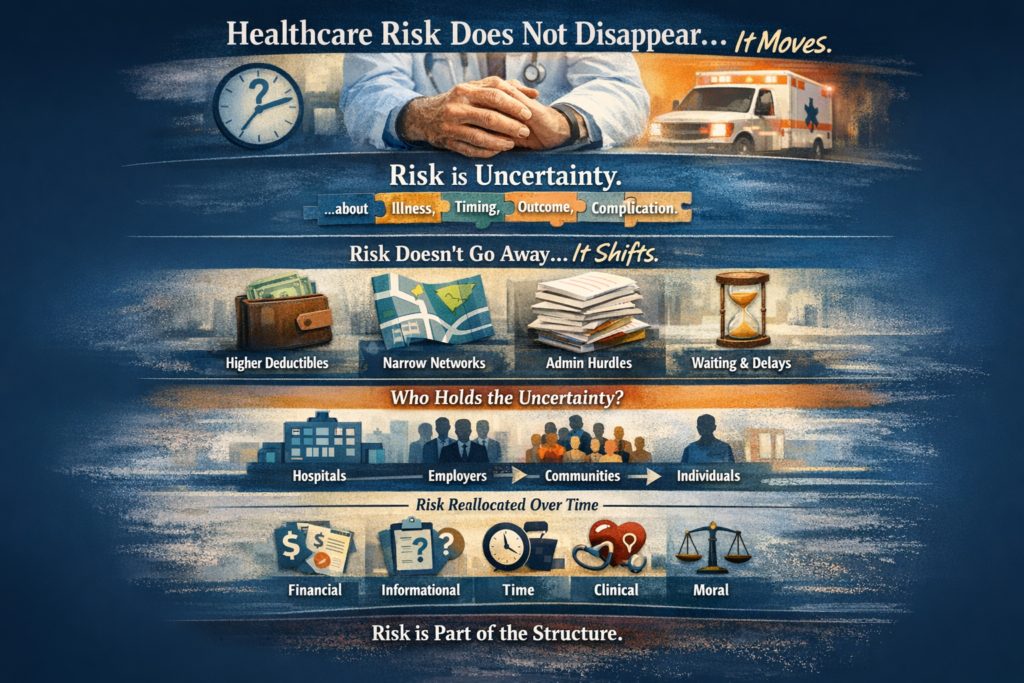
Across these six parts, a pattern emerged. Risk is endlessly redistributed, but rarely resolved. Responsibility is divided into pieces small enough that no one holds the whole. Language meant to clarify instead cushions the impact of hard truths.

Individually, each decision makes sense. Collectively, they produce a system that functions—until it doesn’t.

What this series set out to do was name the illusions that keep the system moving without being examined.

The first illusion is that healthcare behaves like a normal market. In many places, it doesn’t. Urgency removes choice. Complexity obscures price. Delay compounds harm. These are not moral failures; they are structural realities.

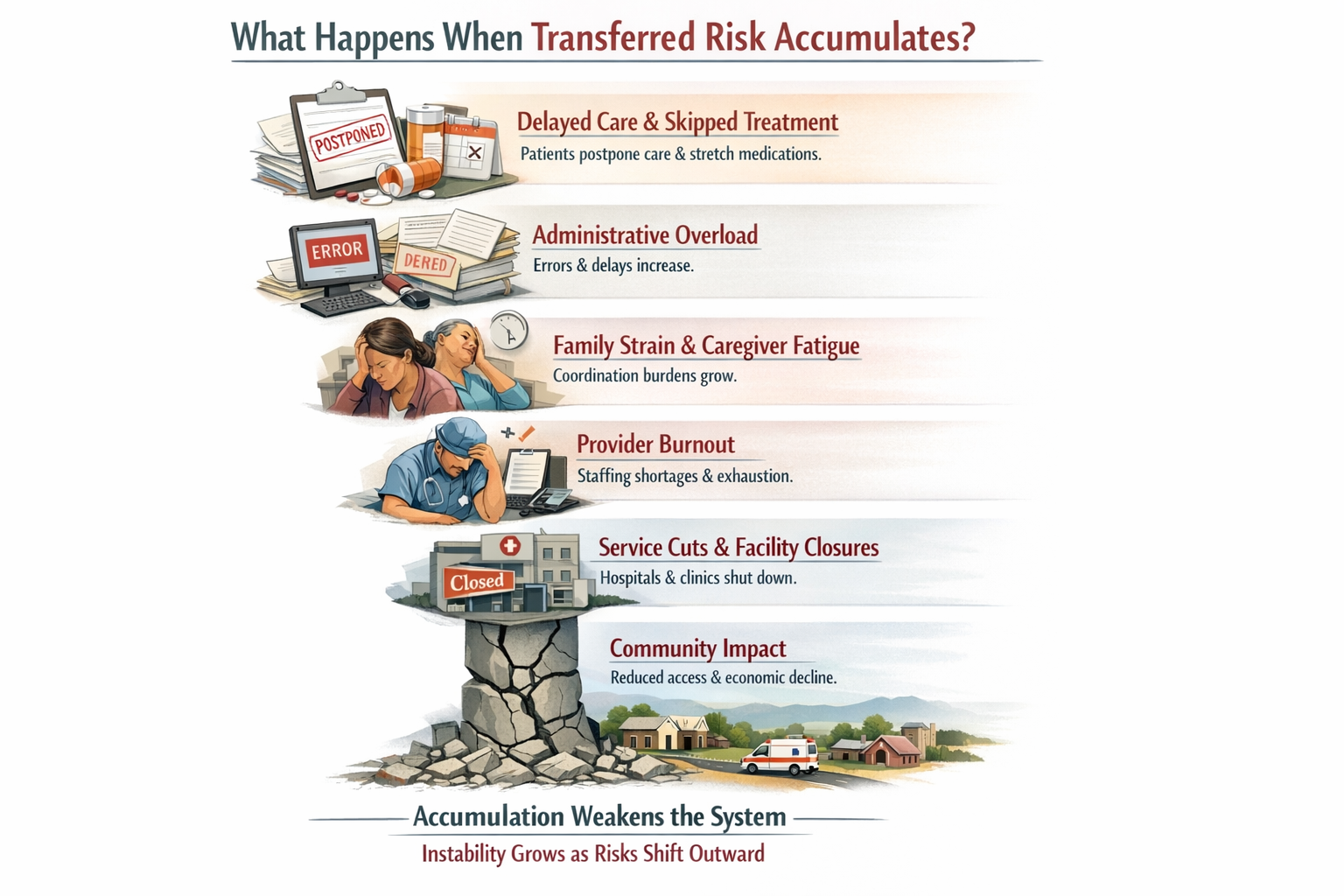
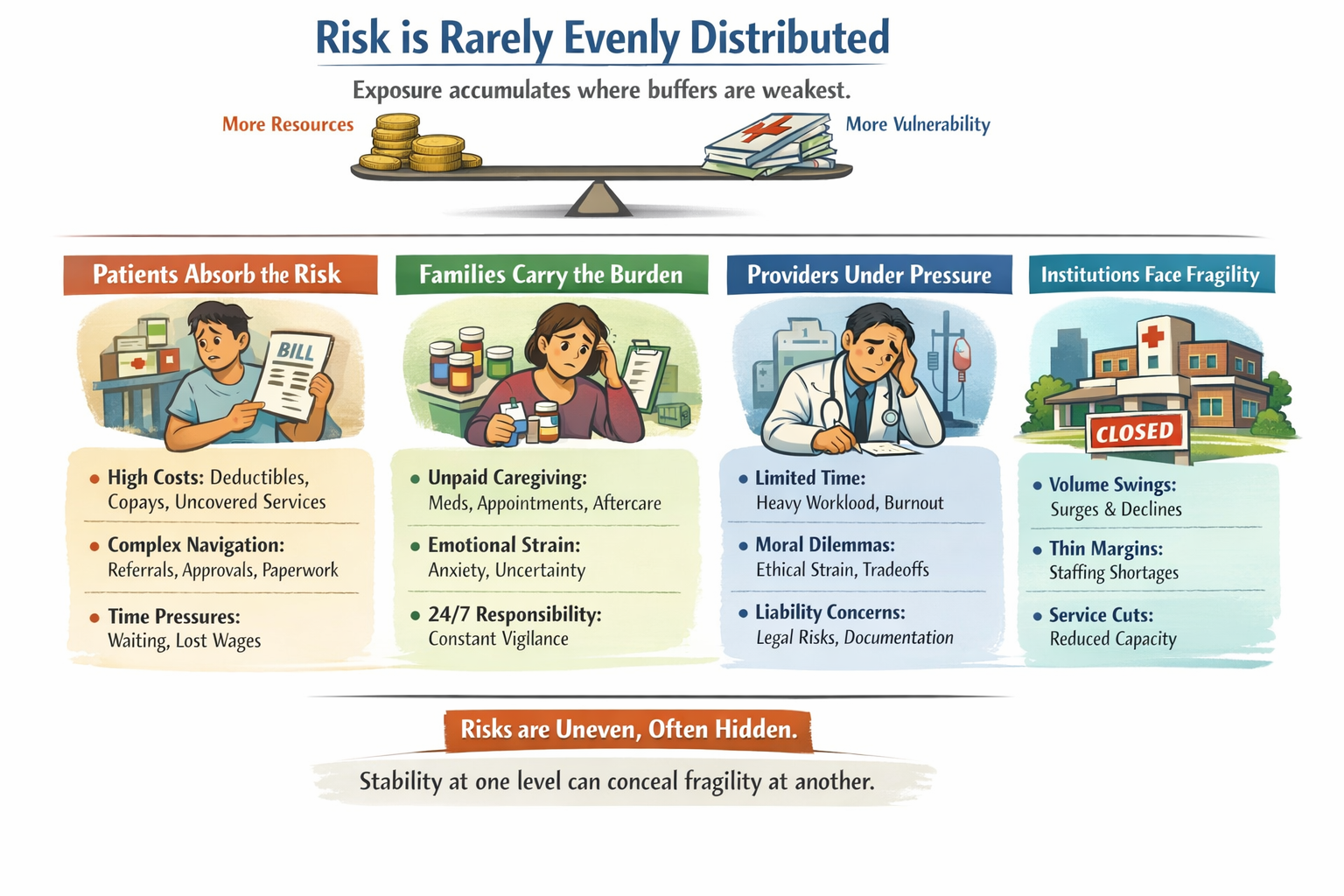
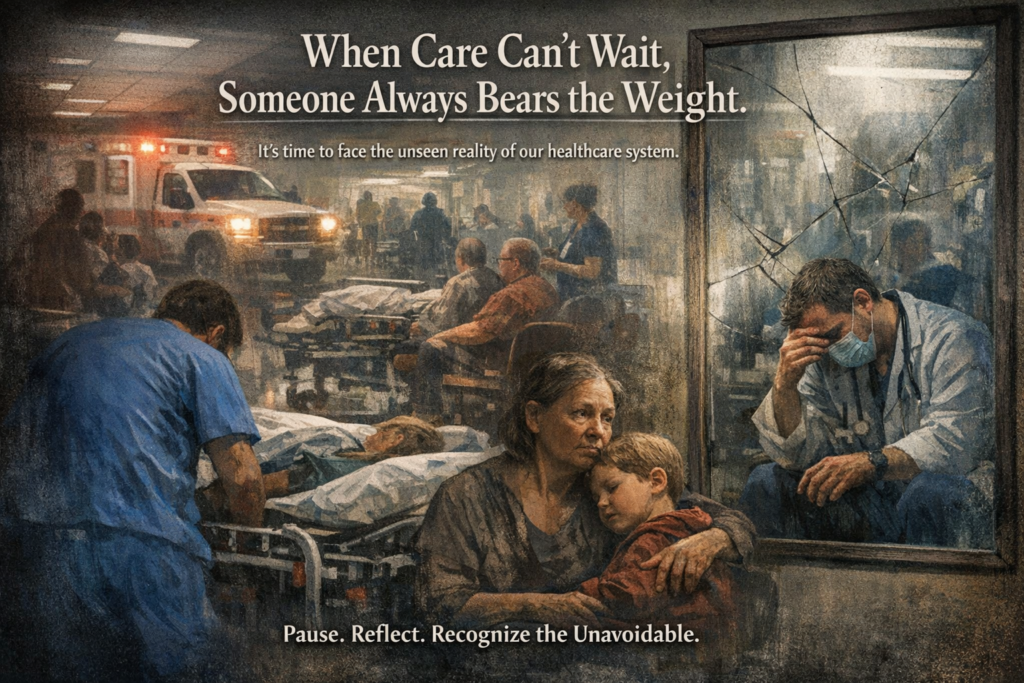
The second illusion is that responsibility can be shifted indefinitely. Costs move, risk moves, paperwork moves. Eventually, the weight settles somewhere. Increasingly, it settles on patients, families, frontline providers, and communities least able to absorb it.

The third illusion is that political disagreement is the primary obstacle to reform. In truth, dysfunction has become comfortable. It fuels narratives, fundraising, and positioning on all sides. Real reform would require tradeoffs, and tradeoffs require accountability. Accountability disrupts stories people rely on.

What holds all of this together—often invisibly—is effort. Care still happens. Professionals still show up. Systems still stretch to cover gaps they were never designed to hold. That endurance deserves respect, not exploitation.

Nothing in this series argues that healthcare must be simple. It argues that pretending it already is has consequences.

The purpose here was not to provide answers, but to establish a starting point grounded in reality rather than ideology. Any serious conversation going forward has to begin with what healthcare actually is: partially market, partially public, and fundamentally human. It cannot be reduced to slogans without losing something essential.

This is a pause, not a conclusion.

The questions raised here do not disappear because they are uncomfortable. They wait. They accumulate. And they resurface wherever care becomes unavoidable and responsibility can no longer be deferred.

Before solutions are proposed, before sides are taken, clarity matters. That clarity is the work of this series.

What comes next will deal with the parts we tend to avoid—not because they are controversial, but because they force choices. Those choices will deserve their own space, their own discipline, and their own honesty.

For now, this much is enough to know.

BUT, we are far from done. This was just series 1

20260131 1321 Image Generation simple compose 01kgayvss5fzn8gshahm4sz748

Part 6: When the System Stops Pretending – Healthcare in America

Part 6: When the System Stops Pretending

For years, America’s healthcare debates have circled the same familiar arguments: cost, access, innovation, choice. Each side insists the problem is just one adjustment away from being solved — a different payer mix, a different incentive, a different set of rules.

What rarely gets said out loud is simpler and more uncomfortable:

The system no longer matches the reality it is supposed to serve.

This isn’t a failure of compassion, and it isn’t a failure of effort. It is a failure of structure — a system built on assumptions that no longer hold.

A system optimized for avoidance

Modern healthcare is not primarily organized around outcomes. It is organized around risk avoidance.

Risk is shifted:

  • From insurers to providers

  • From providers to patients

  • From institutions to families

  • From policy to paperwork

Each step is rational in isolation. Each makes sense on a spreadsheet. Together, they create a system where no one is fully responsible for the whole.

The result is not efficiency. It is fragmentation.

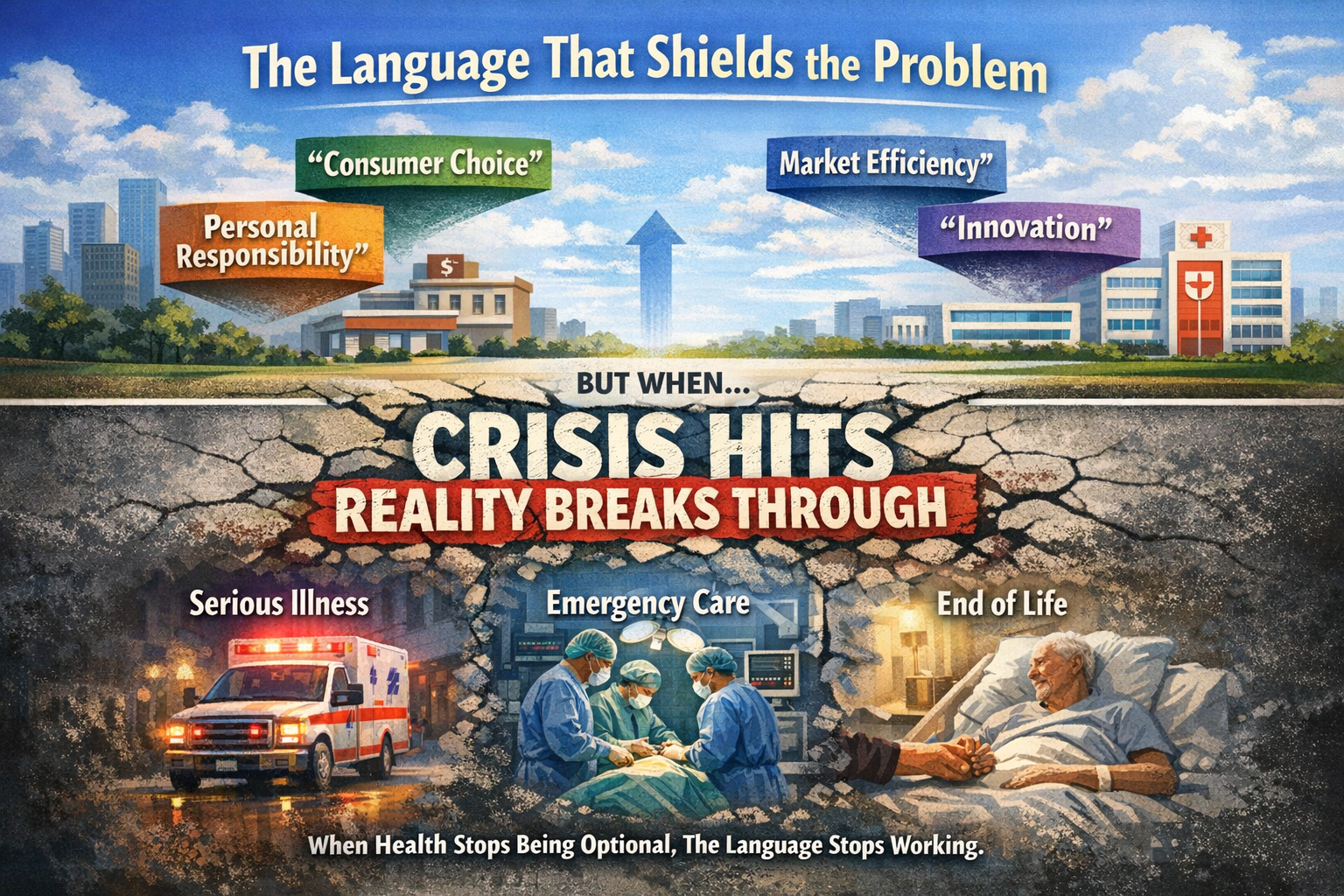
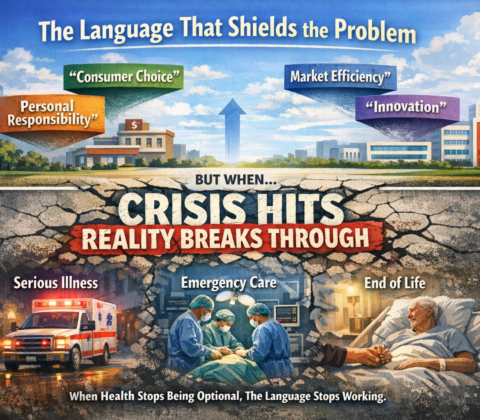
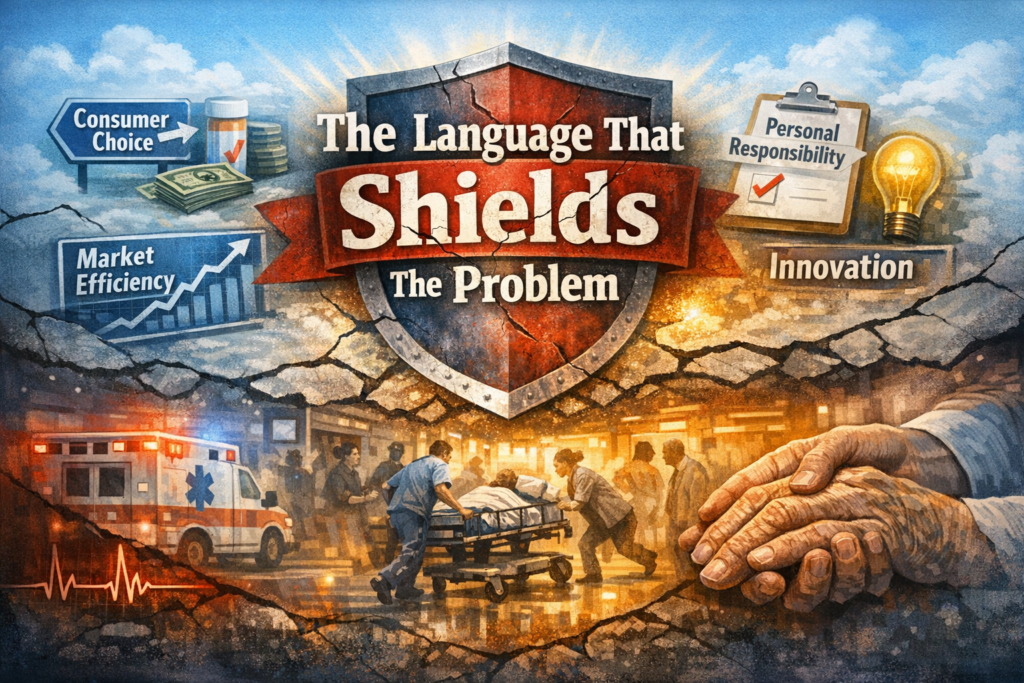
The language that shields the problem

We rely heavily on comforting language:

  • “Consumer choice”

  • “Market efficiency”

  • “Personal responsibility”

  • “Innovation”

These phrases are not lies, but they are incomplete. They work well for elective care, predictable conditions, and people with time, money, and literacy to navigate complexity.

They break down when care becomes urgent, unavoidable, or human.

When health stops being optional, the language stops working.

Who carries the weight now

As responsibility diffuses upward, the burden concentrates downward.

Patients manage billing disputes while recovering.
Families coordinate care without training.
Providers burn out navigating systems designed to protect revenue, not judgment.
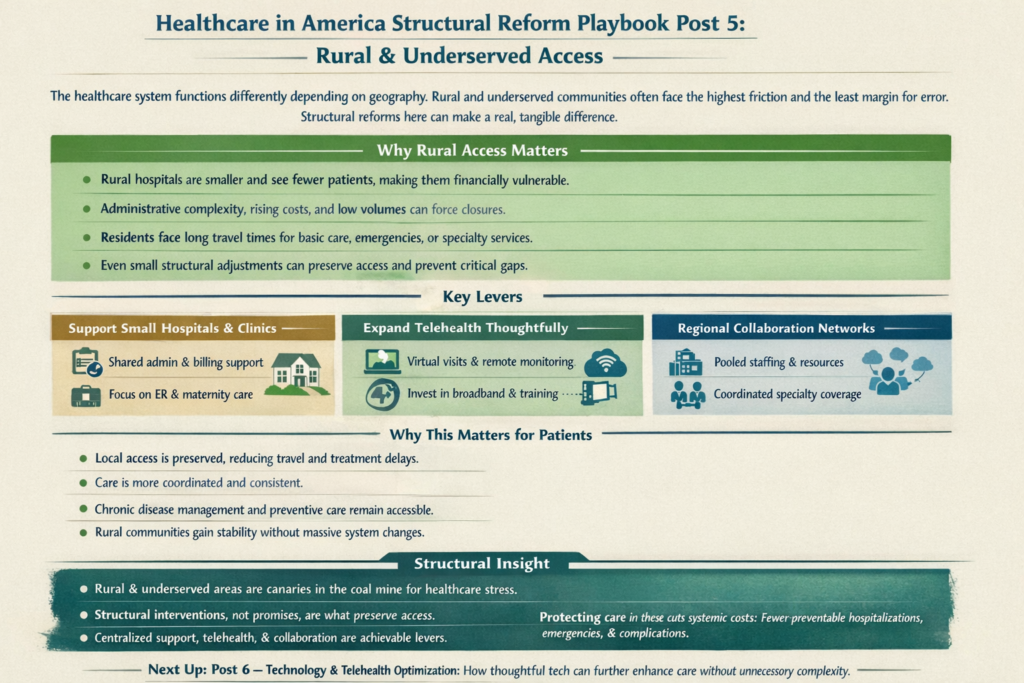
Rural hospitals absorb losses with no margin for error.

None of this shows up cleanly in political talking points. It shows up in closures, staffing shortages, delayed care, and quiet financial collapse.

The place the system can’t avoid

There is one place where all of these distortions converge — where care cannot be deferred, denied, or negotiated in advance.

The system depends on it.
The system resents it.
And the system refuses to fully account for it.

This is not because it is inefficient, but because it is honest.

It is where every upstream decision eventually lands.

The political stalemate

Healthcare dysfunction has become politically useful.

One side uses it to fundraise.
The other uses it to posture.
Both promise fixes that stop short of structural change.

Real reform would force tradeoffs.
Tradeoffs create accountability.
Accountability threatens narratives.

So the system limps forward, managed rather than repaired.

The fork in the road

We are now past the point where incremental adjustments can hide the mismatch.

We can continue to:

  • Shift costs

  • Narrow networks

  • Add complexity

  • Manage decline

Or we can acknowledge the truth that has been visible for years:

A healthcare system that pretends everything is a market, everything is optional, and responsibility can always be deferred will eventually fail at the moments that matter most.

This series is not about choosing sides.
It is about deciding whether we are willing to stop pretending.

20260131 1305 Image Generation simple compose 01kgaxxq29evqbt5ttckk9s2zw

Part 5: Choice vs. Coverage – Healthcare in America

Part 5: Choice vs. Coverage

After responsibility shifts to individuals, the system offers something in return.

It offers choice.

At first glance, this feels like a fair trade. More options suggest more control. More plans suggest better fit. More flexibility suggests empowerment.

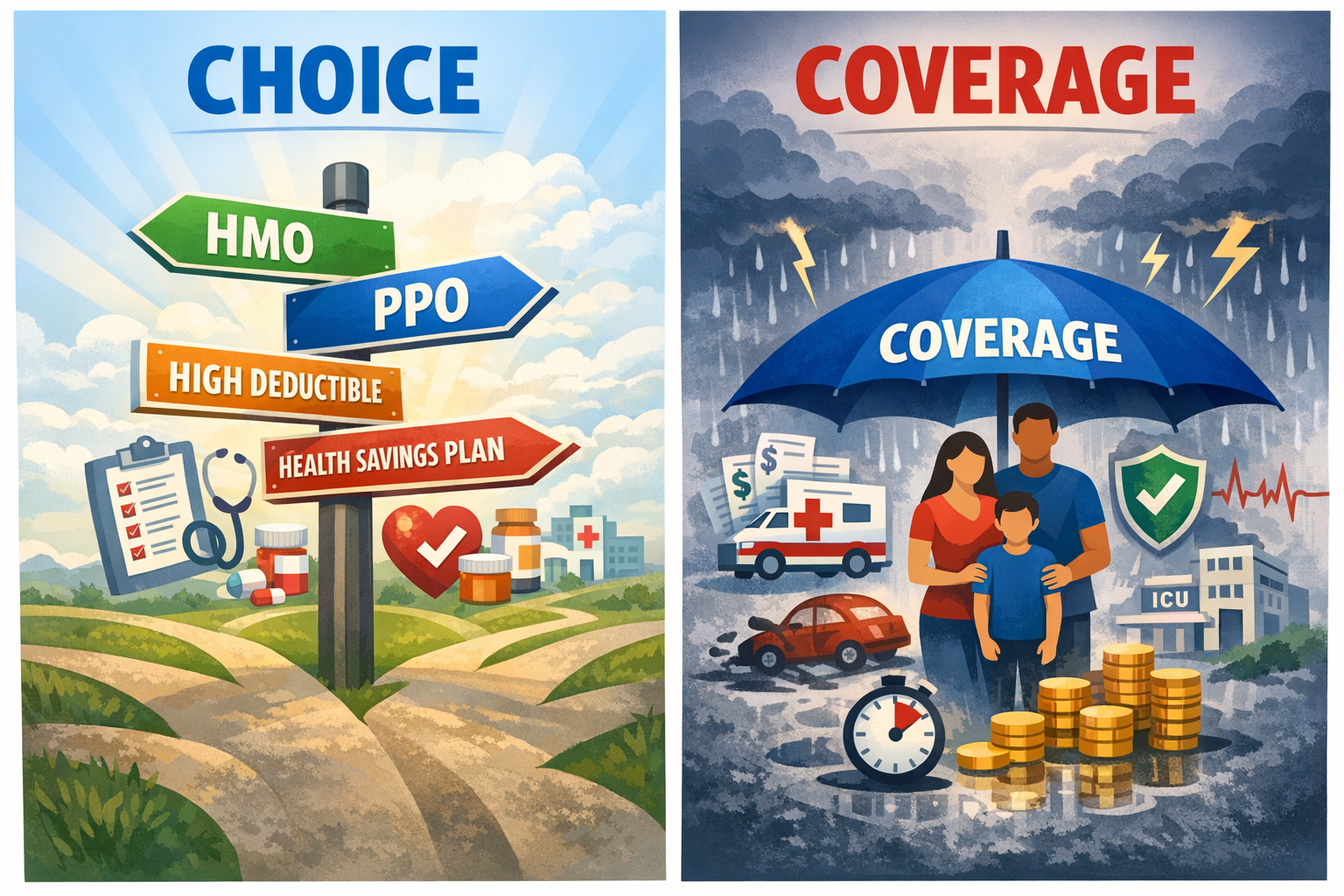
But choice and coverage are not the same thing.

Confusing the two is one of the most common — and costly — misunderstandings in modern healthcare.

What Coverage Actually Means

Coverage answers a simple question:

When something goes wrong, will care be there — and at what cost?

It is about:

  • Predictability

  • Risk pooling

  • Protection from catastrophic expense

Good coverage reduces uncertainty.

Choice, by contrast, often increases it.

How Choice Expands as Coverage Thins

As responsibility moves away from systems, people are asked to select from:

  • Multiple plans

  • Multiple networks

  • Multiple deductible levels

  • Multiple cost-sharing structures

Each option appears reasonable in isolation.

Taken together, they create a decision environment where:

  • Tradeoffs are hard to evaluate

  • Consequences are delayed

  • Mistakes are discovered only after care is needed

The presence of choice creates the impression that outcomes are the result of informed decisions, even when the information required to decide well is unavailable or unintelligible.

Why This Isn’t a Normal Market

In most consumer markets:

  • You can compare prices

  • You can test quality

  • You can change providers easily

  • Mistakes are reversible

Healthcare works differently.

Decisions are often made:

  • Under time pressure

  • Without full information

  • During stress or illness

  • With limited ability to switch later

Choice without usable information is not empowerment. It is exposure.

The Emotional Cost of Choice

When outcomes are framed as the result of personal choice, people internalize failure.

Confusion becomes guilt.
Unexpected bills become regret.
Coverage gaps feel like personal mistakes.

This emotional burden discourages people from seeking care, asking questions, or challenging outcomes — reinforcing the system that created the confusion in the first place.

What to Listen for Going Forward

When you hear health policy framed around expanding choice, it’s worth asking:

  • Is coverage actually improving?

  • Are risks being shared more broadly — or pushed downward?

  • Is guidance increasing along with options?

Choice can coexist with strong coverage.

But when choice replaces coverage, the difference matters.

Setting Up the Next Step

Once choice becomes the primary mechanism, the system begins to rely on an assumption that individuals can act as informed consumers.

In the next part, we’ll examine that assumption — and why the idea of the fully informed healthcare consumer breaks down in practice.

Next: Part 6 — The Myth of the Informed Consumer

Part 4: When Responsibility Moves Quietly – Healthcare in America

Part 4: When Responsibility Moves Quietly

When health policy stalls, something important happens that is easy to miss.

Responsibility doesn’t disappear.

It moves.

And almost always, it moves away from systems and toward individuals.

This shift rarely arrives with an announcement. There is no press conference declaring that people are now on their own. Instead, the change shows up gradually, wrapped in reasonable language.

Words like:

  • “Choice”

  • “Flexibility”

  • “Consumer-driven”

  • “Personal responsibility”

On their own, these words sound empowering. In practice, they often signal something else.

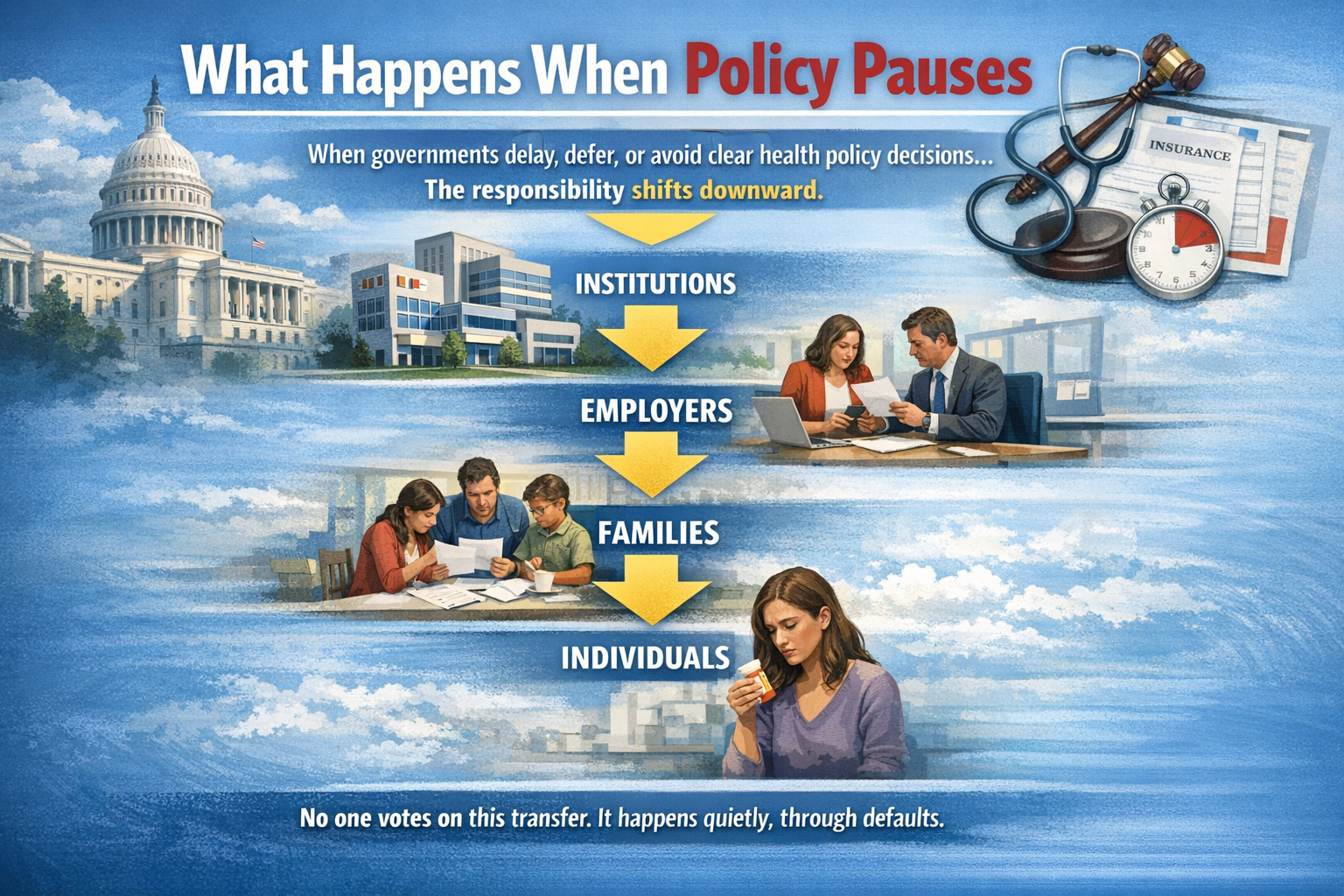
What Happens When Policy Pauses

When governments delay, defer, or avoid clear health policy decisions, the system still has to function.

Care still costs money. Providers still need to be paid. Insurers still need to price risk. Employers still need to decide what they will offer.

In the absence of coordinated policy, the burden of navigating those decisions shifts downward.

From institutions → to employers.
From employers → to families.
From families → to individuals.

No one votes on this transfer. It happens quietly, through defaults.

How “Choice” Becomes a Signal

Choice is not inherently bad.

But when choice expands while guidance, coverage, or protection does not, it becomes a signal that responsibility has shifted.

Instead of asking:

  • “Is this covered?”

People are asked to consider:

  • Which plan?

  • Which network?

  • Which deductible?

  • Which out-of-pocket maximum?

  • Which exclusions?

These are not choices most people can make with confidence, especially under time pressure or medical stress.

Yet the presence of choice creates the impression that outcomes are the result of personal decisions, not structural design.

The Human Experience of the Shift

Most people never engage with health policy directly.

They encounter it at moments of vulnerability:

  • A job change

  • A pregnancy

  • A diagnosis

  • A cancellation notice

  • A premium increase

At that point, the question isn’t ideological. It’s practical:
Am I covered?
Is my family covered?
What happens if something goes wrong?

When responsibility has already shifted, the answers are often unclear — not because people weren’t paying attention, but because the system expects them to manage complexity that used to be handled upstream.

Why This Shift Often Goes Unnoticed

The transfer of responsibility feels normal because it happens gradually.

Each step can be justified:

  • Employers reassess costs

  • Insurers adjust plans

  • Governments emphasize flexibility

No single change looks unreasonable.

But taken together, they redefine who bears the risk.

By the time people realize what has happened, the system presents the outcome as a matter of personal choice rather than public design.

Setting Up What Comes Next

Once responsibility moves to individuals, complexity becomes the gatekeeper.

Understanding plans, coverage limits, and tradeoffs becomes essential — and increasingly difficult.

In the next part, we’ll look at the difference between having choices and having meaningful coverage, and why those two things are often confused.

Next: Part 5 — Choice vs. Coverage

A Real-Time Example (Why Markets React Faster Than Voters) – Healthcare in America

YouTube player

A Real-Time Example (Why Markets React Faster Than Voters)

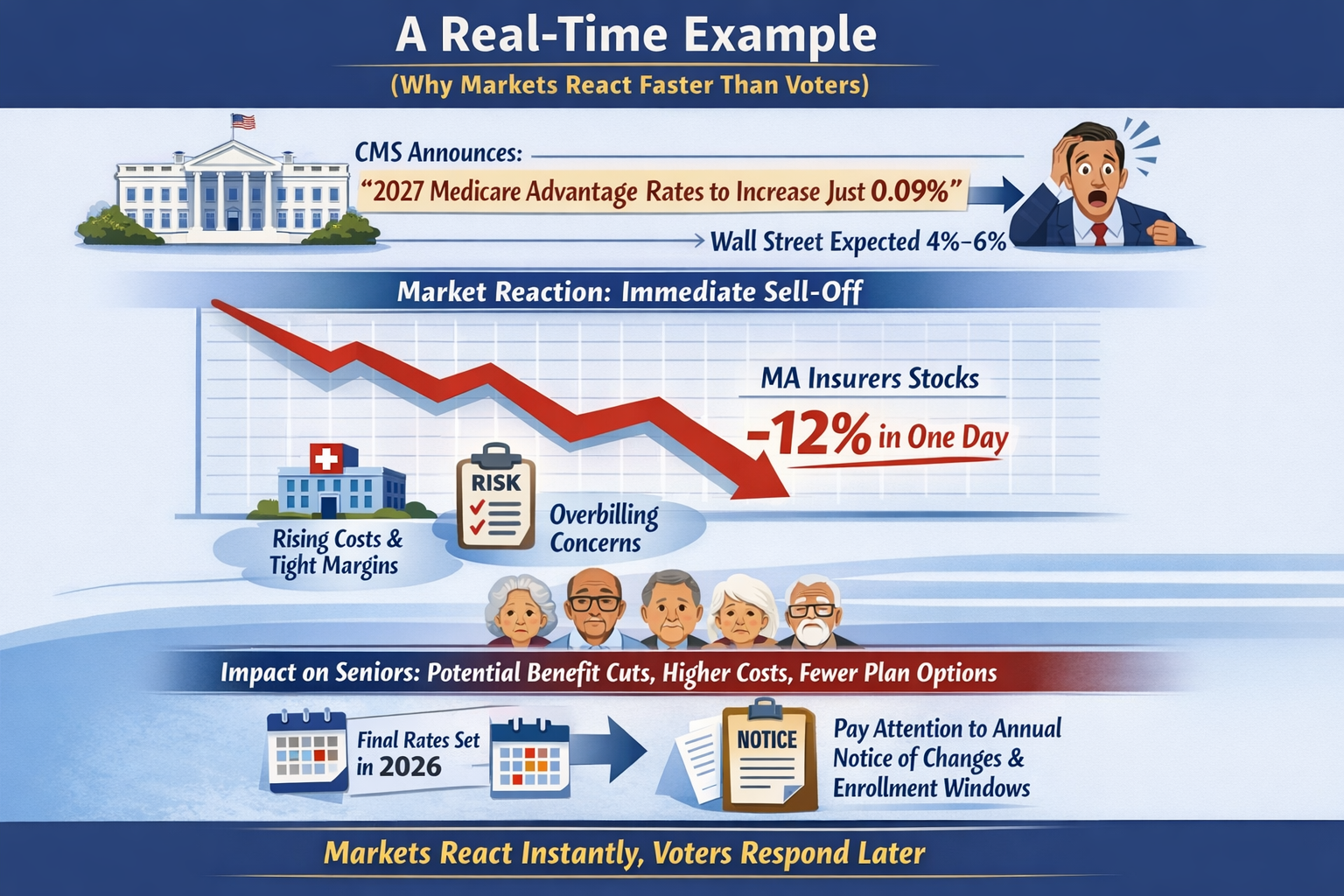
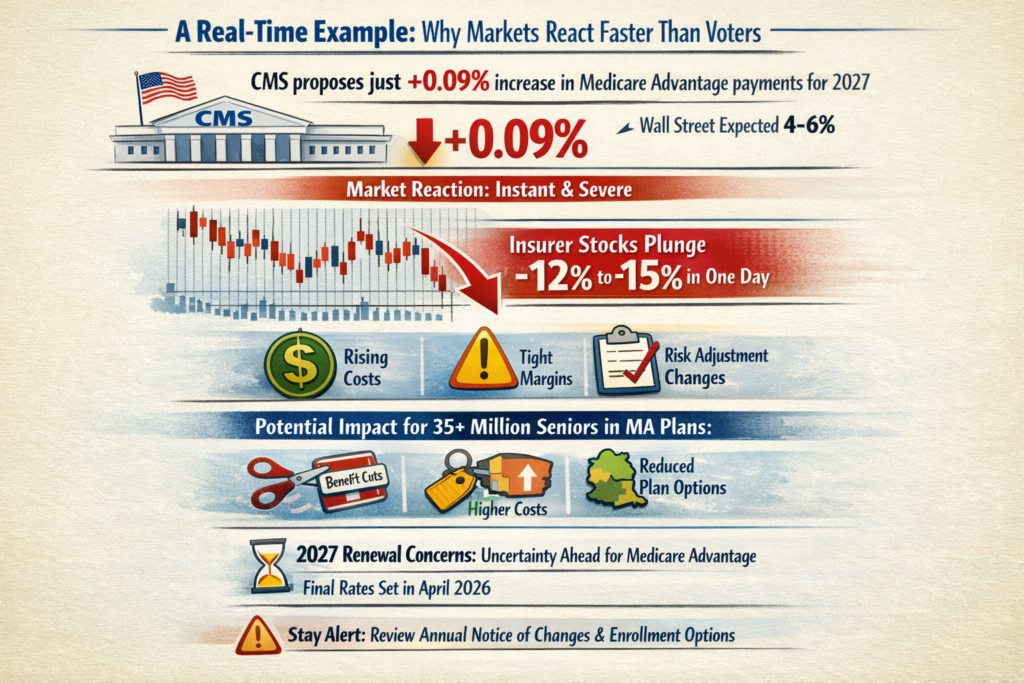
In a surprise move, the Trump administration’s Centers for Medicare & Medicaid Services (CMS) proposed a near-flat 0.09% increase in payment rates to private Medicare Advantage (MA) plans for 2027—far below Wall Street expectations of 4–6% and following a more generous 5.06% boost for 2026.

The announcement triggered an immediate sector sell-off the following day, with major insurers losing double-digit percentages in market value, led by sharp declines across the Medicare Advantage space.

Analysts cite tight insurer margins, rising medical costs, and efforts to curb overbilling (including changes to risk adjustment excluding certain chart reviews) as reasons the minimal increase could force benefit cuts, higher enrollee costs, or plan reductions for the more than 35 million seniors enrolled in MA plans.

Industry groups warn of potential disruptions when 2027 coverage renews in late 2026, though final rates will not be set until April. This adds pressure to an already challenging Medicare Advantage landscape, where many plans have recently faced premium increases, benefit adjustments, or network changes.

What matters here is not the stock reaction itself, but how quickly payment signals translate into market behavior — a dynamic we’ve been examining throughout this series.

For beneficiaries, this is a reminder to pay close attention to Annual Notice of Changes documents and enrollment windows, particularly if plan costs, benefits, or provider access begin to shift.

20260128 0912 Image Generation simple compose 01kg2scp5nexkbg21q7e94vdk5

Part 3b – Repetition As Policy Signal – Healthcare in America

Part 3B: Repetition as Policy Signal

YouTube player

One of the easiest ways to miss what is happening in health policy is to listen only to what is being said, not how often it is being said.

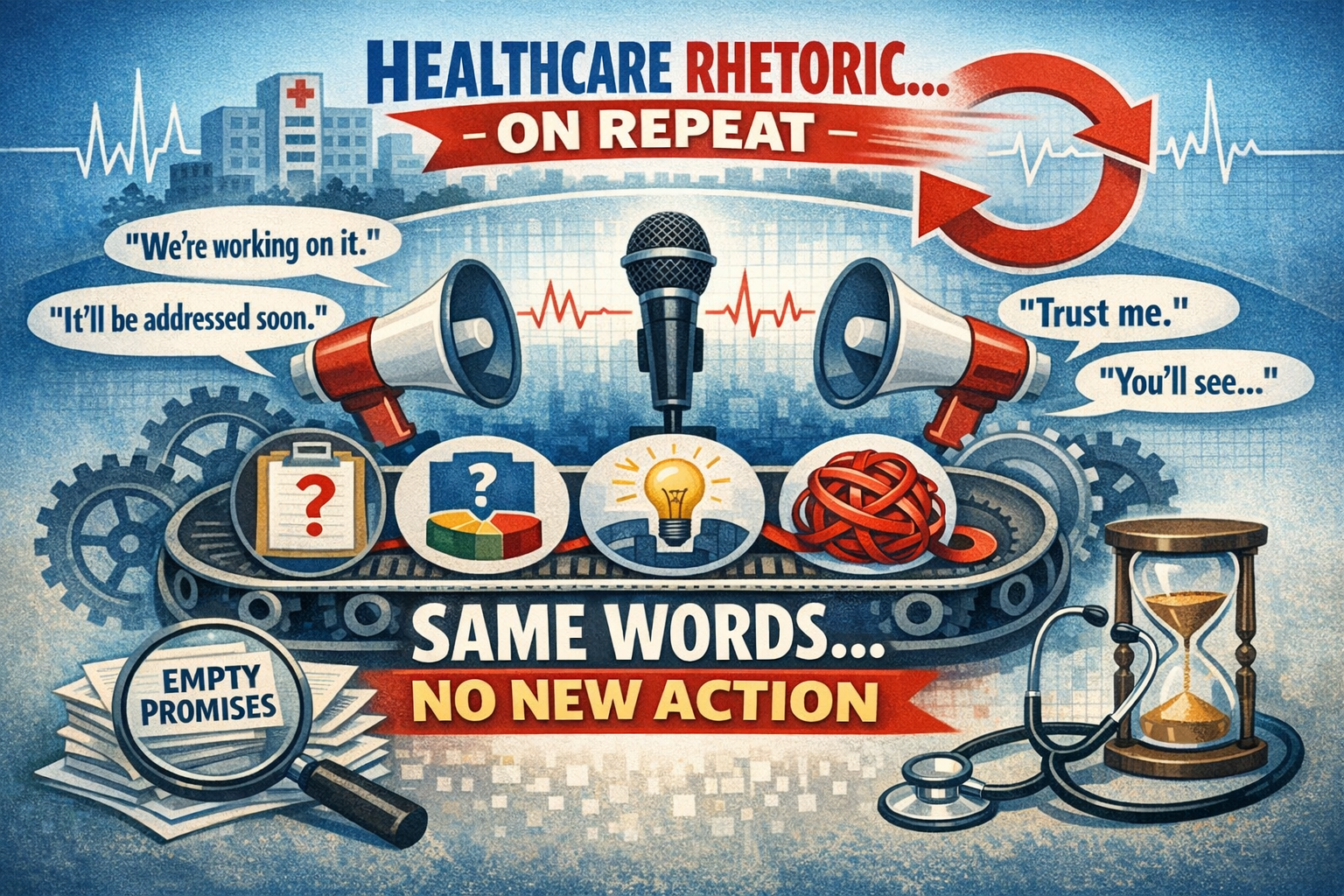
Repetition is not accidental. In politics, it often functions as a substitute for action.

When leaders repeat the same reassurance, promise, or dismissal over and over—without new details, timelines, or mechanisms—it usually means one of three things:

  1. The policy does not exist yet.

  2. The policy exists only as a concept, not a plan.

  3. The policy is unpopular or impractical, and repetition is being used to delay confrontation with that reality.

This is not unique to any party or moment. It is a structural behavior. Repetition fills the space where legislation, funding models, or regulatory language should be.

You can hear it in phrases like:

  • “We’re working on it.”

  • “It will be addressed very soon.”

  • “Trust me.”

  • “You’ll see.”

When these phrases appear once, they may reflect genuine uncertainty. When they appear repeatedly, over weeks or months, they become signals.

The tobacco era showed this clearly. For years, the same reassurances were offered while evidence mounted. No new information was added—only the same language, restated. The repetition was not meant to inform; it was meant to delay.

This is where readers can begin to exercise real agency.

Instead of asking, “Do I agree with this?” ask:

  • Has anything new been said since the last time this was promised?

  • Has the explanation become more detailed, or stayed vague?

  • Has responsibility shifted—from institutions to individuals?

  • Has repetition replaced accountability?

These questions require no ideology. They require only attention.

In health policy especially, repetition matters because delay has consequences. Costs rise. Coverage gaps widen. People make decisions based on what they believe is coming next.

Recognizing repetition as a signal—not reassurance—is one of the first practical tools citizens have to protect themselves in complex systems.

Tomorrow, we’ll look at how responsibility quietly moves from public systems to private individuals—and why that shift often goes unnoticed until it’s too late.

Part 3a – When This Happened Before – Healthcare in America

Part 3A: When This Happened Before

Before this series goes any further, it’s worth pausing to show that what we are describing is not new — and not partisan.

Long before COVID, long before Trump, and long before modern media ecosystems, the same policy pattern played out around tobacco.

This matters because it reveals how policy can be shaped without ever being formally decided.

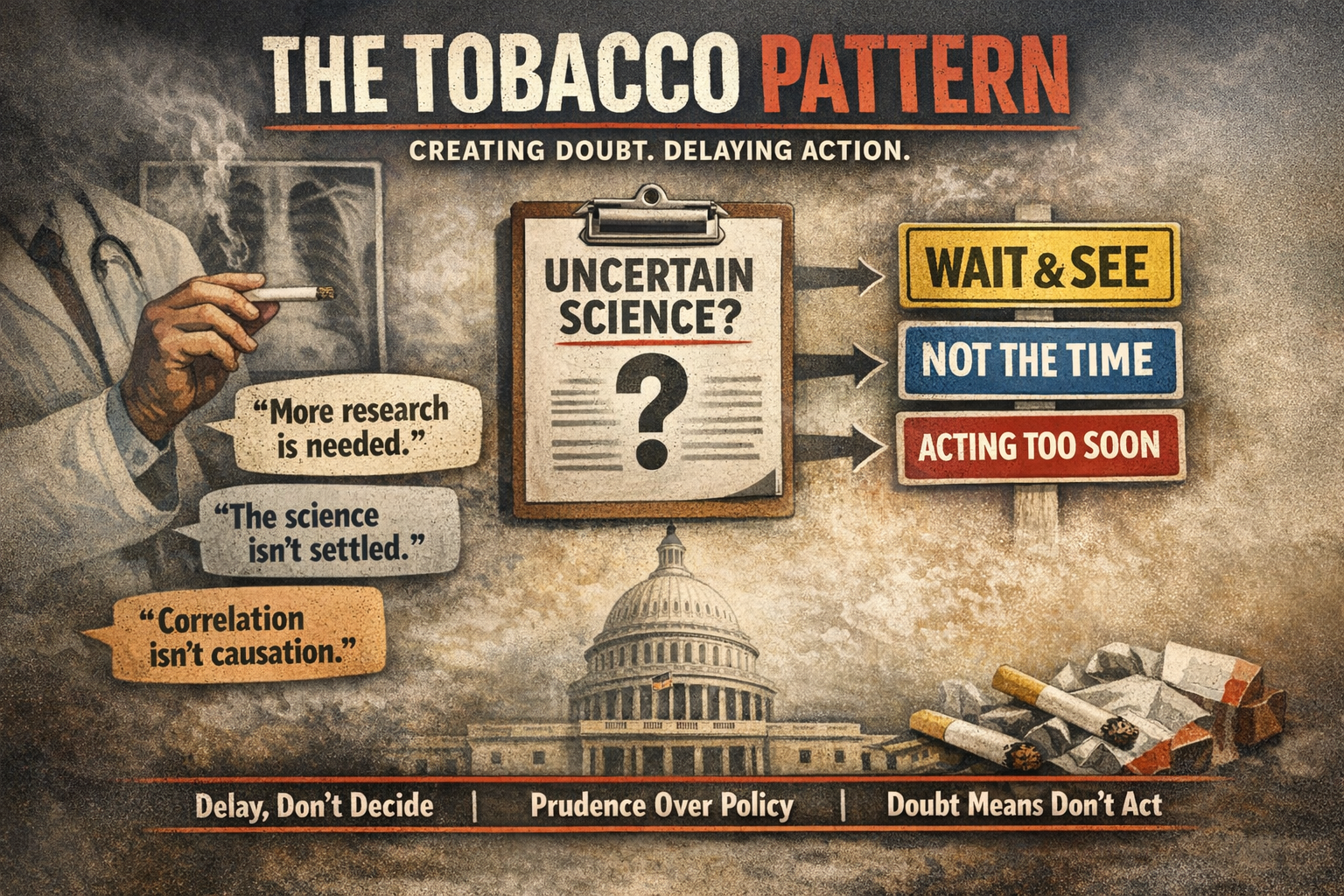
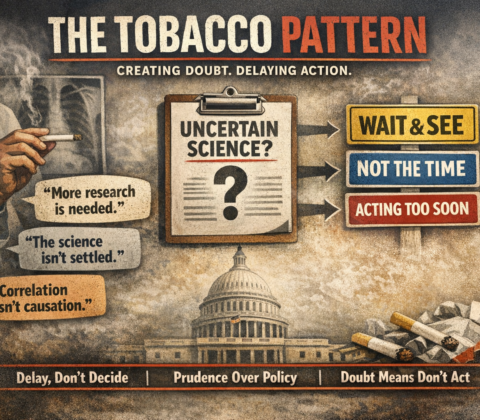
The Tobacco Pattern

For decades, the health risks of smoking were not unknown. Doctors observed higher rates of lung disease. Epidemiologists saw correlations strengthen year after year. Internal industry research — later revealed — often confirmed the danger.

Yet public policy stalled.

Why?

Because the dominant message repeated to the public was not that smoking was safe, but that it was uncertain.

“More research is needed.”
“The science isn’t settled.”
“Correlation isn’t causation.”

None of those statements were outright lies. That’s what made them effective.

They created just enough doubt to justify inaction.


Repetition as Delay

This is the critical mechanism.

The message didn’t need to persuade people that cigarettes were healthy. It only needed to persuade policymakers and the public that acting now would be premature.

Each repetition reinforced a sense of responsible restraint:

  • Waiting was framed as prudence

  • Delay was framed as neutrality

  • Action was framed as overreaction

Over time, delay itself became the policy.

No single announcement said, “We choose not to regulate.” But the repeated framing ensured regulation would always be postponed.


The Cost of Waiting

The human cost accumulated quietly.

Smoking-related illnesses rose predictably. Generations adopted a habit already known to be dangerous. The burden fell disproportionately on working-class families, veterans, and rural communities — long before those terms became political shorthand.

By the time policy finally caught up, millions of lives had already been affected.

No one could point to a single decision that caused the harm. That, too, was part of the design.


Why This Example Matters Now

Tobacco shows how repetition substitutes for policy.

When uncertainty is repeated often enough, it becomes permission. When delay is normalized, it feels responsible. When action is framed as reckless, inaction feels safe.

This is not about cigarettes.

It is about a pattern.


Setting Up the Next Step

Once you recognize this structure, you start to see it elsewhere — especially in health policy.

Not through detailed plans. Not through legislation. But through repeated language that signals what will not happen.

In the next section, we’ll examine how repetition itself functions as a policy signal — and why hearing the same claim again and again is rarely accidental.

Next: Part 3B — Repetition as Policy Signal


Part 2: When Expertise Became Personal – HealthCare in America

Part 2: When Expertise Became Personal

Public health expertise was not always controversial. For decades, it functioned largely in the background—technical, imperfect, and mostly invisible. When it worked, few noticed. When it failed, corrections were usually quiet and procedural.

That changed when expertise became personal.

As trust in institutions weakened, authority began to migrate away from systems and toward individuals. Complex guidance was no longer evaluated primarily on evidence or process, but on who was delivering it—and how consistently.

This shift did not require a coordinated effort. It was a natural response to confusion. When institutions struggle to communicate clearly, people look for human proxies they can assess intuitively.

From Institutions to Individuals

Institutions speak in committees, caveats, and revisions. Individuals speak in faces, voices, and confidence. In an environment already strained by complexity, the latter often feels more accessible—even when the underlying information is less complete.

As a result, public health authority increasingly became embodied in specific figures. Scientific disagreement, which is normal and necessary, was reframed as personal inconsistency. Updated guidance, which reflects learning, was recast as unreliability.

This personalization made expertise easier to attack, defend, or dismiss. A system can absorb critique; a person cannot without becoming the story.

Why Personalization Works

Personalization simplifies judgment. Instead of evaluating methods, data, and uncertainty, people are encouraged—often unintentionally—to evaluate tone, confidence, and perceived alignment.

Once expertise is tied to individuals:

  • Disagreement feels like betrayal

  • Revision feels like deception

  • Nuance feels like weakness

This dynamic is especially potent in public health, where uncertainty is unavoidable and recommendations evolve as evidence accumulates.

The Cost of Making Experts the Message

When individuals become symbols for entire systems, consequences follow.

Debate shifts away from institutional capacity, funding, and preparedness, and toward loyalty or opposition to particular figures. Questions about infrastructure and decision-making are replaced by arguments over credibility and character.

This does not improve understanding. It narrows it.

Over time, public health guidance becomes harder to evaluate on its merits because it is no longer received as guidance—it is received as advocacy.

What to Watch For

As this series continues, notice when:

  • Policy disagreements are framed around personalities rather than processes

  • Critiques focus on tone or consistency rather than outcomes

  • Individuals are treated as proxies for complex systems

  • Institutional failures are personalized instead of examined structurally

These are signs that expertise has been detached from the institutions that support—or undermine—it.

Why This Matters Going Forward

Once expertise becomes personal, it becomes fragile. Removing or discrediting an individual can feel like resolving a systemic problem, even when the underlying structures remain unchanged.

This creates an opening for rhetoric to replace capacity, and confidence to replace preparation.

Understanding this shift helps explain why later public health debates become less about evidence and more about allegiance—and why restoring trust is far more difficult than losing it.

That dynamic becomes clearer in the next phase of the series.

Next: Repetition as Policy Signal

Part 1: Trust Became the Weak Point – HealthCare in America

Part 1: Trust Became the Weak Point

Public health systems depend on trust in ways that are easy to underestimate. Not blind trust, and not perfect trust—but enough confidence that people believe guidance is given in good faith, decisions are explainable, and errors are acknowledged rather than obscured.

In the United States, that foundation weakened long before any recent crisis or political figure. It weakened quietly, through everyday interactions that felt small at the time but cumulative in effect.

Most people did not stop trusting healthcare because they rejected science. They stopped trusting it because the system became harder to understand, harder to navigate, and harder to believe was working in their interest.

Complexity Without Clarity

Healthcare in the U.S. is genuinely complex. That complexity is not itself the problem. The problem is that complexity is often presented without translation.

Insurance documents describe coverage in terms of tiers, codes, networks, and contingencies that are difficult for even attentive readers to interpret. Changes are communicated through dense notices that explain what is happening without clearly explaining why or what it means in practice.

When plans are canceled and replaced with alternatives that appear nearly identical—except for higher premiums or different cost-sharing—people are left with terminology rather than understanding. Over time, repeated experiences like this create a sense that explanations are designed to satisfy requirements, not to inform.

That gap matters.

Cost as a Trust Erosion Mechanism

Trust is also shaped by predictability. Few things undermine confidence faster than discovering the true cost of care only after it has been received.

Surprise billing, opaque pricing, and inconsistent coverage rules train people to expect uncertainty. Even when care is technically available, the fear of unknown cost changes behavior—delaying treatment, avoiding follow-ups, or disengaging entirely.

This is not an ideological response. It is a rational one.

When people cannot anticipate consequences, they stop believing assurances.

Institutions That Speak Poorly Under Pressure

As systems grew more complex, institutional communication often became more defensive. Language shifted toward legal precision and risk avoidance, rather than clarity.

Explanations became longer but less informative. Mistakes were corrected quietly, if at all. Accountability was diffused across agencies, insurers, providers, and administrators—each technically accurate, but collectively unhelpful.

Over time, this creates a vacuum.

When institutions struggle to explain themselves, others step in to explain for them.

What Happens When Trust Weakens

When trust erodes, several predictable shifts occur:

  • Expertise must compete with confidence

  • Repetition begins to substitute for evidence

  • Personal narratives feel more credible than institutional ones

  • Individuals become symbols for entire systems

None of this requires malice or conspiracy. It is how people adapt when clarity is missing and stakes are high.

By the time a crisis arrives, the groundwork has already been laid. The public is primed not to evaluate guidance on its merits, but on whether it feels consistent, confident, and aligned with prior experience.

Signals to Watch

As this series continues, it helps to notice a few early indicators of trust strain:

  • Explanations that grow longer but clearer on none of the practical details

  • Language that emphasizes compliance without understanding

  • Corrections that appear quietly, without acknowledgment

  • Complexity that increases without improving outcomes

These signals often appear well before policy consequences become visible.

Why This Matters Going Forward

Health policy does not fail all at once. It frays.

Trust is usually the first strand to weaken, not the last. Once it does, every subsequent decision—no matter how well-intentioned—faces skepticism, resistance, or distortion.

Understanding how that erosion occurs is essential, because it explains why later debates become less about evidence and more about narrative.

That is where the series goes next.

Next: When Expertise Became Personal

America’s Health Policy, Why This Series Exists – Healthcare in America

YouTube player

Health policy is often discussed either at a level so abstract that it feels irrelevant, or so emotional that it becomes exhausting. In both cases, people disengage—not because they don’t care, but because they can’t see where their understanding actually makes a difference.

The purpose of this series is to examine how health policy decisions in the United States are framed, funded, and communicated—and how those processes shape outcomes regardless of political intent.

Rather than advocating for specific programs, candidates, or ideologies, this series focuses on identifying patterns. How trust is built or lost. How complexity can clarify—or conceal. How rhetoric diverges from operational reality.

These patterns matter because health policy is not a single decision or law. It is an ecosystem of incentives, funding mechanisms, administrative choices, and public narratives. Once those systems are in motion, outcomes follow whether or not anyone agrees with them.

Why This Matters Now

Many people sense that something about healthcare feels increasingly unstable, but struggle to articulate why. Costs rise without explanation. Coverage changes without clarity. Experts speak, but confidence spreads faster than evidence.

This series does not assume bad faith. It assumes systems under strain.

Understanding how those systems work—and how they fail—is more useful than reacting to any single headline. It allows readers to recognize warning signs earlier and to distinguish noise from signal when stakes are high.

What This Series Will and Will Not Do

This series will:

  • Examine policy outcomes without assigning personal motive

  • Use real examples to illustrate structural dynamics

  • Move deliberately, one concept at a time

  • Include guidance on what signals matter and where influence exists

This series will not:

  • Offer voting advice or endorsements

  • React to breaking news

  • Reduce complex systems to villains or heroes

  • Use parody or satire to make its case

The goal is understanding, not alignment.

How This Will Unfold

Posts will be short enough to digest in one sitting and structured to build on one another. You do not need to read them all at once, and disagreement is expected.

The series begins with a simple question:

How did health policy become a trust problem?

Before examining any administration, crisis, or reform effort, it is important to understand why trust weakened in the first place—and what happens when it does.

That is where the series begins.

Next: Trust Became the Weak Point

America's Health Policy, Why This Series Exists

This series is about health policy, not ideology – Healthcare in America

Opening Statement — What This Series Is About

This series is about health policy, not ideology.

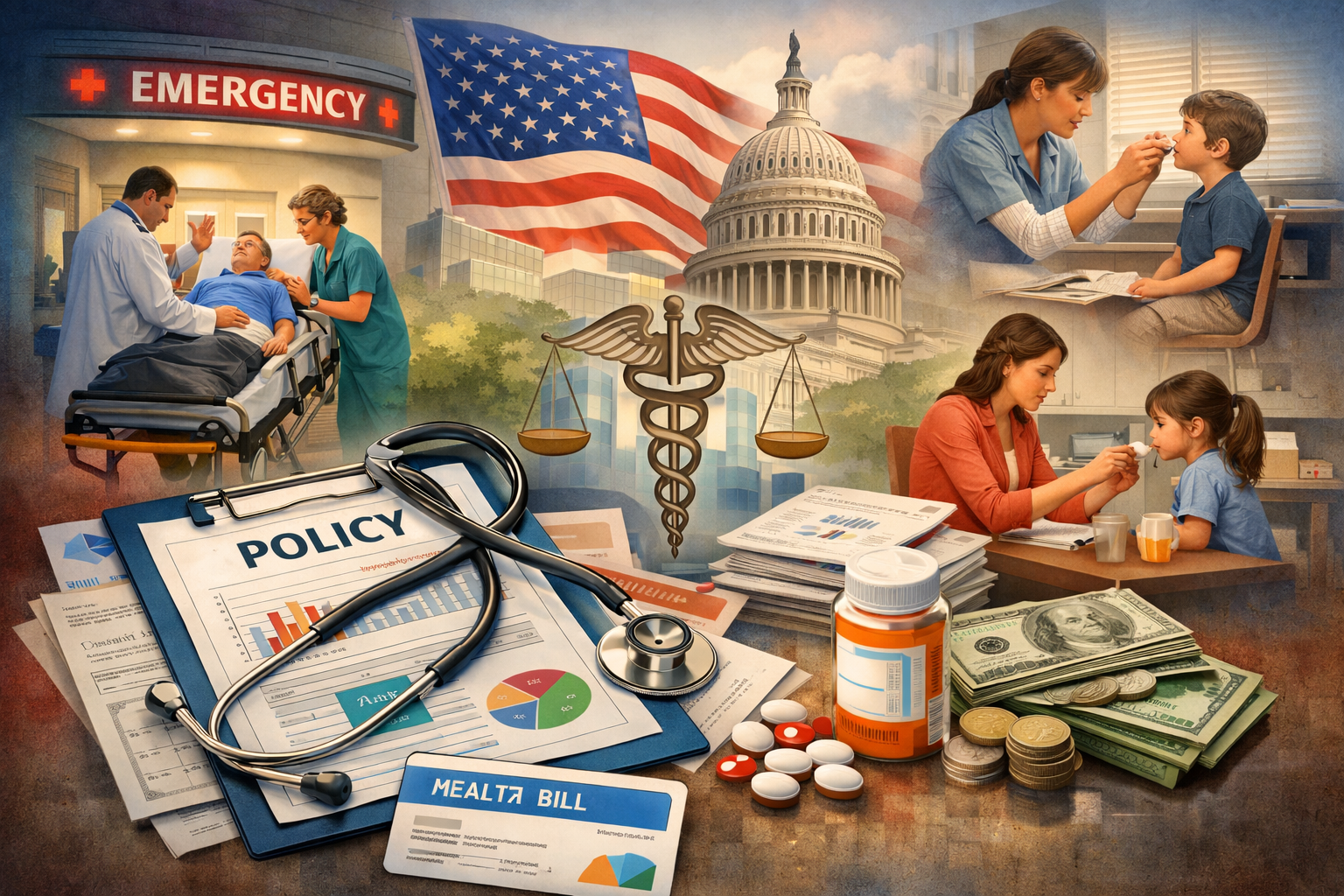
Decisions about healthcare in the United States are often discussed as political abstractions—talking points, slogans, and personalities. But their consequences are not abstract. They show up in emergency rooms, schools, workplaces, and kitchens. They show up in who gets care, when they get it, and at what cost.

YouTube player

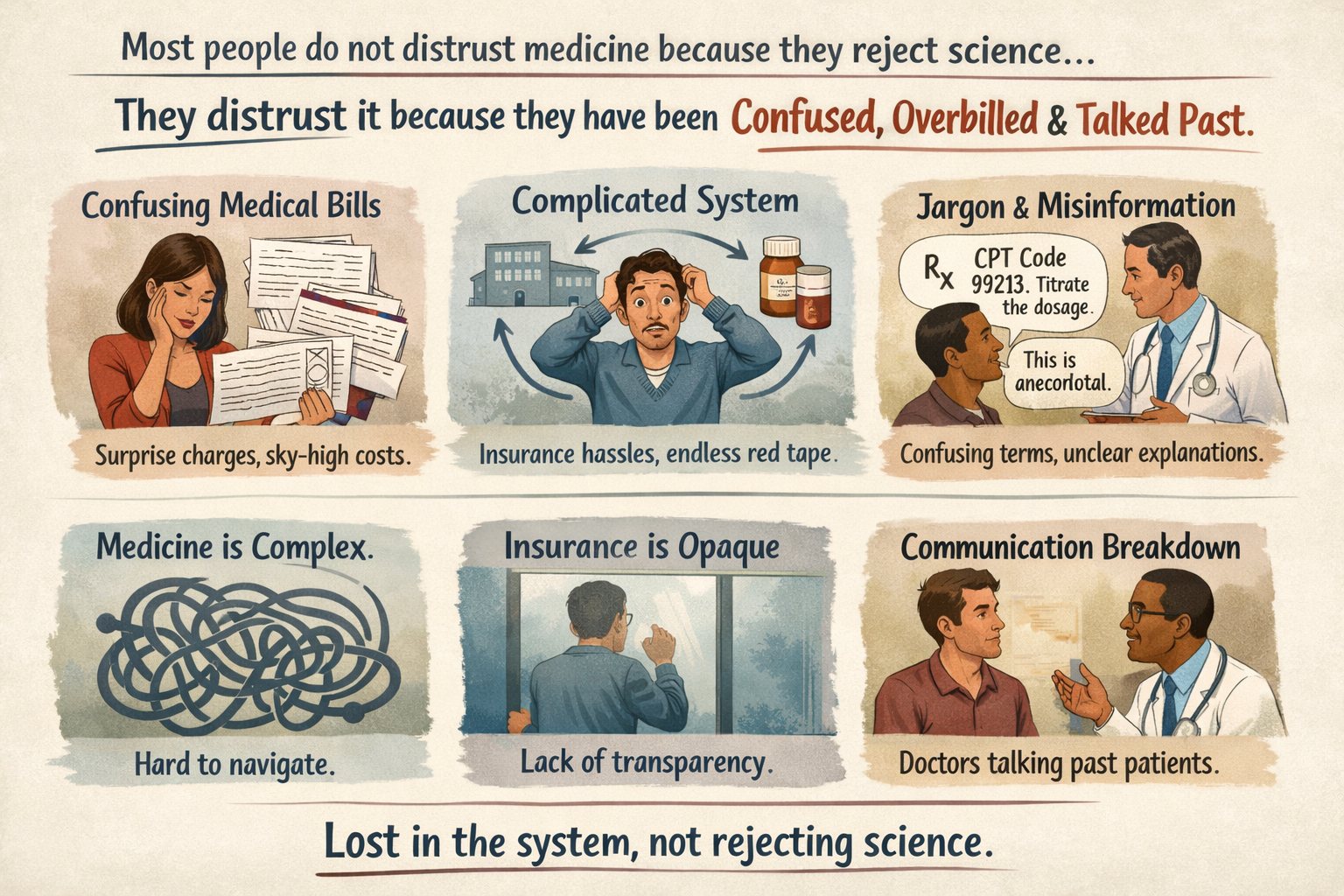
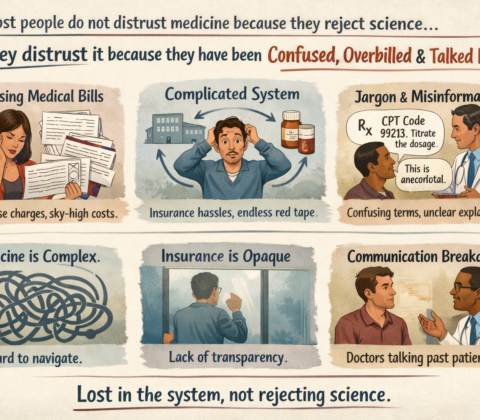
Most people do not distrust medicine because they reject science. They distrust it because they have been confused, overbilled, and talked past. Medicine is complicated, insurance is opaque, and explanations are often delivered in jargon that obscures rather than clarifies.

A simple example: when a Medicare plan is canceled and replaced with “alternative” options that appear nearly identical—except for a substantially higher premium—the consumer is left with paperwork, terminology, and reassurances, but little concrete understanding of what actually changed or why. Experiences like this are not rare, and they are not ideological. They are structural.

Over time, this kind of complexity erodes trust. That erosion did not begin with any single administration or crisis. It developed gradually, through cost opacity, administrative layers, and systems that demand compliance while struggling to communicate clearly.

When trust weakens, something predictable happens. Expertise begins to compete with confidence. Repetition replaces evidence. Policy debates shift away from institutions and toward individuals. In that environment, it becomes easier to confuse rhetoric with action—and harder for citizens to recognize when real decisions are being made.

This series is not an argument for or against any party, personality, or program. It is an examination of how health policy is framed, funded, and implemented—and how those choices shape outcomes regardless of intent.

Each piece will also include practical guidance on what signals matter, what patterns to watch for, and where individual citizens still have meaningful influence. Not as activism, and not as instruction—but as civic literacy.

Health policy is not theoretical. Understanding how it works, how it breaks, and how it is communicated is one of the few forms of leverage people still have when the stakes are this personal.

This series is about health policy, not ideology

It isn’t funny anymore, so let’s get ready for tomorrow – Healthcare in America

YouTube player

After a year of sharp satire aimed at one particularly loud clown who’s now less funny than frightening, I’ve shifted gears. For the past month, I’ve worked hard not to let the current atrocities wag me or incite mebecause the chaos, as dangerous as it has become, is still a self-serving diversion.The parody landed its points. But I’ve shifted gears.

The noise is deafening — endless sky-is-falling takes, reaction bait, and soundbite wars. Parody can’t out-absurd reality forever, and outrage isn’t insight.So I’m moving on to something more useful: helping people understand the actual systems we live inside, not just the circus around them.

I’ve just wrapped up a month of breaking down dark money mechanics (how it flows, manipulates, and warps decisions on both sides). Not conspiracy theories, just a better understanding of the how and why. My goal wasn’t to be partisan it was to help readers better grasp the mechanics behind the curtain and make better, self-informed decisions.

Next up: a ~15-part series on institutional healthcare. Not the latest premium hikes, Trump tweets, or partisan talking points. Instead:

  • How the U.S. healthcare machine evolved historically
  • Who really makes the decisions (incentives, gatekeepers, power structures)
  • What access actually looks like on the ground
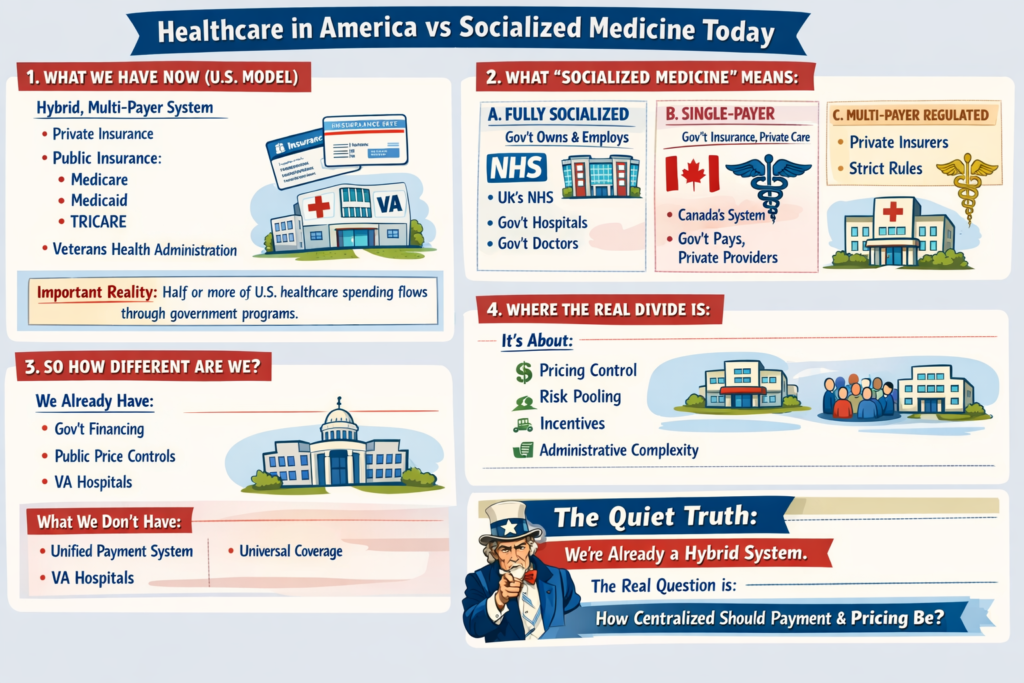
  • A clear comparison of free-market vs. socialized models — trade-offs, not team cheers

The goal isn’t to push an agenda; it’s to equip you with context so you can think, decide, and act from knowledge instead of reflexes. For the majority of my life, my knowledge of healthcare was condensed into these three or four questions, asked under stress:

  • Am I insured?
  • Will my spouse’s job still cover us?
  • What happens if we get pregnant / sick / laid off?
  • Can we afford this surprise?

Knowing the answers to those 4 questions is not enough.Occasional memes will still sneak in (old habits die hard), but the main lane now is education over entertainment. Thanks for reading along so far. If this resonates, stick around.

It isn't funny anymore, so let's get ready for tomorrow

The Greatest Econony Every, FOR TRUMP.

King Putz says Tiny Tim Cratchit can do with just 1 pencil for Christmas, the Trump economy is great, if your TRUMP.  Just How Stupid Are You?

Verifiable Estimates of Donald Trump’s Net Worth Increase Since Taking Office in 2025Yes, there are verifiable estimates from reputable sources like Forbes and Bloomberg tracking the change in Donald Trump’s net worth since he took office on January 20, 2025. These are based on public financial disclosures, stock valuations (e.g., Trump Media & Technology Group, or TMTG), real estate appraisals, and cryptocurrency holdings. However, exact figures are estimates due to the private nature of much of his wealth, market volatility (especially in crypto and TMTG shares), and varying methodologies between trackers. Trump’s net worth has reportedly surged, driven largely by cryptocurrency ventures (e.g., $TRUMP memecoin and World Liberty Financial), licensing deals, and TMTG stock performance.Key Estimates and TimelineHere’s a summary of the most cited figures from major sources, focusing on pre-inauguration (late 2024/early 2025) vs. current (as of late 2025). The increase is generally pegged at $2.5–3 billion year-to-date, with Forbes providing the most detailed breakdown.

Source
Net Worth (Jan 2025, at Inauguration)
Net Worth (Current, Dec 2025)
Estimated Increase
Primary Drivers of Growth
Date of Estimate
Forbes
$4.3–5.1 billion (end-2024 baseline, rising to ~$6.7B by Jan 21)
$7.3 billion
+$3 billion (from 2024 baseline); +$0.6–2.6 billion (from Jan)
Crypto ($1B+ from World Liberty tokens), licensing (+$400M), golf clubs (+$325M), TMTG shares

Sep 2025

Bloomberg Billionaires Index
~$7.16 billion (Jan 21)
$7.4–7.75 billion
+$0.24–0.59 billion (stable but with crypto gains)
TMTG stake, crypto exposure (~$620M in holdings), real estate licensing

Jul–Sep 2025

  • Forbes’ Detailed Breakdown: Their September 2025 report attributes the $3 billion year-over-year gain (from $4.3 billion in 2024) directly to his presidency, including a 580% jump in licensing revenue to $45 million (e.g., deals in Saudi Arabia, Vietnam, and Qatar) and crypto sales exceeding $1 billion via family-controlled entities.
    forbes.com

    Earlier in 2025 (March/April), Forbes valued him at $5.1 billion, showing intra-year growth of ~$2.2 billion by September.

    palmbeachpost.com
  • Bloomberg’s View: More conservative on volatility, they note his net worth held steady around $6.4–7.75 billion through mid-2025, with ~$620 million from crypto reshaping his portfolio but offset by TMTG fluctuations.
    bloomberg.com

    They highlight over $10 billion in Trump-branded real estate projects since early 2025 as a longer-term booster.

    bloomberg.com
  • Other Trackers: The New York Times (July 2025) estimated up to $10 billion including illiquid assets like crypto, while outlets like WION and Money Digest align with Forbes’ $3 billion gain narrative.

    Wikipedia’s aggregation (as of Dec 2025) cites a post-inauguration rise from ~$6 billion to $7+ billion, factoring in a June 2025 disclosure of $1.6 billion in assets and $600 million income.

    en.wikipedia.org

Key Factors Behind the Increase

  • Cryptocurrency Ventures: The biggest driver, adding $1–2 billion. The $TRUMP memecoin (launched Jan 2025) and World Liberty Financial (family-controlled, with 75% revenue share) generated over $1 billion in token sales, though values have since dipped.
  • TMTG/Truth Social: Stake valued at ~$2 billion (114 million shares), with spikes around inauguration (e.g., +20% pre-Jan 20).
  • Real Estate & Licensing: New deals (e.g., Vietnam resort, Gulf projects) added $400–500 million; golf clubs profited $66 million in 2024, up 30% into 2025.
  • Legal Wins: Overturned fraud penalties (~$500 million saved) and settlements (e.g., $15 million from Disney) reduced liabilities.
  • Presidential Perks: $400,000 salary plus gifts like a $400 million Qatari jet (for his library).

Caveats and Verifiability

  • Volatility: Crypto and TMTG can swing wildly (e.g., $TRUMP fell from $44 to $6 per token by Oct 2025), so daily tallies fluctuate.
    moneydigest.com
  • No Full Disclosure: Trump hasn’t released tax returns since 2016, relying on estimates from public filings (e.g., June 2025 disclosure).
  • Criticism: Watchdogs (e.g., House Democrats) claim up to $11.6 billion in unreported crypto, accusing conflicts of interest.

    Supporters view it as savvy branding.

  • Ongoing Tracking: Forbes and Bloomberg update regularly; check their sites for real-time figures.

In summary, the most substantiated tally is Forbes’ $3 billion increase from 2024 to mid-2025, with ~$1–2 billion post-inauguration—verifiable via their methodologies and public data. This makes his second term the most financially lucrative for any U.S. president on record.

Trumps Economy (1)

Breaking News – Commemorative Throne Opens to the Public

BREAKING NEWS:

The Donald “John” Trump Commemorative Throne opens to the public this week, inviting admirers to bask in marble and gold while paying tribute to the man who never met a surface too shiny to name after himself. Visitors are encouraged to reflect, recline, and perhaps flush away lingering doubts about the golden age of self-promotion.

Throne3

11/09/2025 Veterans’ benefits and healthcare from the past 21 days:

  • Here are several recent updates (past ~21 days) on benefits and healthcare for veterans.


    • Department of Veterans Affairs announced that it has processed more than 2 million disability claims in the current fiscal year, reaching the mark faster than ever before. The American Legion+1

    • The VA reported that the backlog of disability claims (claims pending more than the threshold) has dropped to under 200,000 for the first time since March 2023. VA News+1

    • A federal appeals court unanimously rejected a VA request to delay rulings on veterans’ benefits claims amid the government shutdown, signaling limits on the agency’s ability to pause adjudications. The Guardian

    • An investigative report criticized as misleading by veterans-groups suggested “rampant” fraud in the VA disability system, but advocates counter that the core issue remains bureaucratic delays rather than broad abuse. The Guardian+1

    • Due to the ongoing federal government shutdown, nearly 37,000 VA employees are either furloughed or working without pay, and several VA services (GI Bill hotline, certain benefits offices, transition briefings) are disrupted. nypost.com

10/16/2025 Changes or Headlines for National Healthcare in the past 30 days

General Healthcare – October 2025

🇺🇸 United States

  • Government Shutdown Impact on Healthcare: The ongoing federal government shutdown has led to the suspension of two Medicare remote care programs, including telehealth and hospital-at-home services, which expired on October 1. Health Policy Institute of Ohio

  • Medicare Advantage Oversight: Dr. Mehmet Oz, Administrator of the Centers for Medicare & Medicaid Services (CMS), addressed concerns over in-home health assessments and rising Medicare spending on skin substitutes. He emphasized the need for efficient prior authorization processes and warned of potential regulatory actions against misuse. The Washington Post

  • Public Trust in Healthcare Leadership: An Axios-Ipsos poll revealed that a majority of Americans believe the nation is less healthy under President Trump’s leadership, citing concerns over vaccine policies and the dissemination of unproven health claims. Axios

  • California Legislation on Pharmacy Benefit Managers: Governor Gavin Newsom signed Senate Bill 41 into law, regulating pharmacy benefit managers (PBMs) to lower prescription drug costs. This legislation prohibits certain practices like patient steering and mandates PBM licensure through the state government. Wikipedia

11/09/2025 What has Trump done in the past 21 days in a nutshell.

  • Here’s a 10-point factual summary of what Donald J. Trump has done in the past 21 days:

    1. The federal government shutdown became the longest in U.S. history, surpassing previous records, with significant disruption to services. The Washington Post+1

    2. The Supreme Court of the United States issued an emergency order temporarily blocking full funding of Supplemental Nutrition Assistance Program (SNAP) payments following an appeals-court ruling requiring full funding. The Guardian

    3. Trump publicly suggested redirecting federal money currently used to subsidize insurance under the Affordable Care Act (“Obamacare”) toward direct payments to individuals. The Guardian

    4. He pressed Republicans in the Senate to consider eliminating the filibuster to push through funding in the context of the shutdown. The Washington Post+1

    5. Executive orders were issued modifying U.S. tariff policies — including duties related to imports and trade arrangements — as part of his economic‐trade agenda. The White House+1

    6. The White House called on universities to align with the administration’s ideological priorities, and protests by students and faculty erupted on more than 100 campuses in response. The Guardian

    7. Trump faced increasing legal and institutional pushback: courts and other federal institutions signalled limits to his unilateral actions, especially concerning budget/aid decisions and emergency powers. The Guardian+1

    8. He made public statements emphasizing the importance of converting federal welfare funding into “self-reliance” mechanisms—though details and transition plans remain vague. (based on his remarks and policy direction)

    9. Funding reallocations and budget maneuvers under his administration triggered concern about executive overreach in spending decisions while Congress remains in deadlock. The Washington Post+1

    10. Trump’s messaging emphasized a return to manufacturing and domestic supply-chain priorities, positioning trade and tariff policy as central to his economic platform in this 21-day span. The White House+1

10/16/2025 What has Trump done in the past 30 days in a nutshell.

🕊️ Foreign Policy & Military Actions

  • Covert Operations in Venezuela
    President Trump confirmed the authorization of CIA operations in Venezuela, citing concerns over drug trafficking and the release of prisoners into the U.S. He also hinted at the possibility of U.S. land operations in the region. AP News+1

  • Naval Strikes in the Caribbean
    The U.S. Navy conducted strikes on alleged drug-smuggling vessels originating from Venezuela, resulting in multiple casualties. The administration labeled drug cartels as “unlawful combatants,” a move that has drawn bipartisan criticism in Congress. Wikipedia+1

  • India Ceases Russian Oil Imports
    President Trump announced that India will stop purchasing oil from Russia, marking a significant diplomatic shift and easing tensions between the U.S. and India. Politico


🏛️ Domestic Affairs

  • Wealthy Donor Dinner at the White House
    President Trump hosted a lavish dinner for approximately 130 top donors and political allies at the White House, celebrating the progress on a $250 million renovation project to build a new, bulletproof-glass-clad White House ballroom. AP News

  • Federal Judge Halts Mass Layoffs
    A federal judge temporarily blocked the Trump administration’s plan to lay off over 4,100 federal workers during the government shutdown, ruling in favor of unions that argued the layoffs were illegal. The Washington Post


🏗️ Infrastructure & Monuments

  • Plans for the ‘Arc de Trump’
    President Trump revealed plans for a monumental arch in Washington, D.C., dubbed the “Arc de Trump,” to commemorate the 250th anniversary of American independence in 2026. The proposed structure would be situated near the Lincoln Memorial. TIME+1

11/09/2025 Changes or Headlines for National Healthcare in the past 21 days

  1. Here are 10 recent national-healthcare headlines from the past ~21 days, focusing on U.S. policy, health care markets, and public health issues (no commentary, just the facts):

    1. Donald J. Trump announced a deal with Eli Lilly and Company and Novo Nordisk to lower the cost of popular GLP-1 weight-loss drugs in some cases to between approximately $149 and $350 per month. CBS News+1

    2. Millions of Americans beginning the 2026 open-enrollment period are bracing for higher health insurance premiums, with reports indicating significant premium increases and reduced subsidies under the Affordable Care Act marketplace. CBS News

    3. The administration’s shutdown of certain federal operations has created “sticker-shock” for many consumers as enrollment deadlines approach, and some essential health-care services face disruption. CBS News

    4. The Centers for Disease Control and Prevention (CDC) and other public-health agencies have reported staffing and operational challenges tied to funding freezes during the shutdown. ABC News+1

    5. States are competing for slices of a new $50 billion rural-health care fund to improve access in underserved areas, as public forums and health systems lobby for participation. CBS News

    6. Health-care providers and hospitals warned that changes in visa/immigration rules may worsen the nurse/medical-staff shortage, especially in rural and underserved markets. CBS News

    7. The American Hospital Association (AHA) expressed support for bipartisan legislation (H.R. 5142) that would pause planned Medicaid/home-health cuts for two years. American Hospital Association

    8. A federal court issued a stay on major 2026 marketplace rule changes under the ACA while the Centers for Medicare & Medicaid Services (CMS) appeals, conserving current benefit structures for the moment. Health Affairs

    9. Health-care oversight groups flagged that some Medicare/Medicaid plans operated by private insurers overstated mental-health-provider network sizes, raising concerns of access gaps. CBS News

    10. A surge in demand at food banks and pantries followed benefit disruptions for approximately 42 million Americans when SNAP aid was halted — underscoring the link between social services and health outcomes. ABC News

10/16/2025 Veterans’ benefits and healthcare from the past 30 days:

Major Policy / Legal / Insurance News

    1. Media scrutiny over VA disability claims / fraud claims

      • Washington Post published an investigation criticizing how some disability claims are handled — pointing out “minor health conditions” being approved, and alleging systemic incentives to maximize claims. The Washington Post

      • Veterans’ groups (American Legion, DAV, Paralyzed Veterans of America, etc.) pushed back hard, saying the reporting misrepresents the scale of abuse, overlooks the genuine struggles of many claimants, and ignores changes from things like the PACT Act. The Washington Post+1

    2. Government Shutdown Effects

      • With the U.S. federal government shutdown (which began Oct 1), many VA services remain active, and many veterans’ benefits continue to be delivered. The American Legion+2The White House+2

      • Some VA facilities/offices are closed to the public, especially regional benefit offices. Some transition programs, career counseling, and GI Bill-hotlines are impacted (closed or limited). Reddit+1

    3. Facility / Home for Veterans in Texas

      • In Bexar County, Texas, 27 acres donated for a state veterans home near San Antonio. It will include long-term care, memory care, therapy services, possibly dialysis, with capacity about 120 veterans. Most funding from VA + state agencies, no county taxes. San Antonio Express-News

    4. Veterans & Protests / Civil Rights Issues

      • A growing number of veterans are getting arrested during protests over ICE raids. Some are seeking damages, alleging aggressive tactics, harsh detention or treatment. The Guardian

    5. Artists / Mental Health / Advocacy

      • There’s the “Trail to Zero” horseback ride through NYC organized by BraveHearts to raise awareness of veteran suicide. New York Post

    6. What’s Not Changing or Being Cut

      • Despite the shutdown, veteran health care (VA medical centers, clinics, Vet Centers) are still open. Benefits like compensation, pension, education, housing continue. The American Legion+1

      • Hotlines for crisis / MyVA / core services remain active (Veterans Crisis Line, etc.). Reddit+1


    ⚠ What These Mean / Possible Impacts

    • Delays & closures of certain services: Even though most core VA functions are uninterrupted, things like regional office access, non-emergency counseling, career transition programs are getting disrupted. So vets might face delays in submitting or following up on claims, or in accessing non-urgent benefits.

    • Public perception & policy pressure: The reporting on disability claim abuse (real or overstated) could lead to increased political pressure for reforms, audits, stricter documentation requirements. That might make some cases harder to prove or slower to process.

    • Staffing / morale concerns: Some VA doctors and employees are speaking out about workforce cuts, potential privatization, or reduced support. That could affect quality or access in some areas, especially for specialty or remote VA services.

    • New facilities development: The Texas veterans home project is an example of expanding infrastructure for aged veterans, which is good, but likewise will take time to build and staff.

    • Legal / appeal standards: While not brand-new in the past 30 days, the Bufkin v. Collins Supreme Court decision (from earlier in 2025) continues to echo: it raised the standard for appellate review in “benefit-of-the-doubt” cases, meaning veterans appealing denials must overcome a stricter proof threshold. Justia Law+1

Oregon stopped Trump (for a while) why hasn’t Illinois stopped trump?

situation as best as can be pieced together from current reporting and legal context:


🟢 Oregon’s Case: “Stopped Trump (for a while)”

Oregon successfully pushed back because the deployment was federalized but without proper coordination or justification under the Insurrection Act.

  • The governor controls the state’s National Guard unless it’s formally federalized (under Title 10).

  • When Trump tried to use federal forces or redirect out-of-state Guardsmen into Oregon cities (like Portland), Governor Tina Kotek invoked state sovereignty and filed injunctions arguing there was no domestic “insurrection” or request for aid.

  • A federal judge temporarily blocked the deployment, citing both Posse Comitatus and 10 U.S.C. § 12304(b) violations (use of Guard forces without consent of the host state).

Essentially, Oregon had a legal foothold and a state leadership willing to go to court fast.


🔴 Illinois’s Case: “Why it hasn’t (yet) stopped Trump”

Illinois’ situation is trickier — and more recent.

  • The Texas National Guard troops arriving in Chicago are technically operating under Texas state orders, not federal activation (Title 32 status). That means they’re still under Governor Abbott’s command, not Trump’s.

  • Because of that distinction, Trump’s administration can claim it’s simply “supporting” Abbott’s anti-crime initiative, not directly deploying federal troops.

  • Governor J.B. Pritzker (Illinois) has condemned the action as unlawful and politically motivated, but the legal grounds are narrower. Illinois can’t directly order Texas troops out — it has to file in federal court, arguing that Abbott’s deployment violates the Constitution’s Compact Clause (Article I, § 10) by acting as a “foreign power” without congressional consent.

  • Pritzker’s legal team is reportedly preparing such a case, but until an injunction is granted, the troops can remain — though they have no policing authority.

In short:

  • Oregon fought a federal overreach.

  • Illinois is facing a state-to-state intrusion that hides behind the thin veneer of “cooperative security.”
    The courts have to sort that one out — and they move slower than governors can act.


⚖️ Broader Implication

What we’re seeing is Trump testing the boundaries of federal and state authority — especially around security, immigration, and public order — by using sympathetic governors (Abbott, DeSantis, etc.) as surrogates. It’s a coordinated experiment in soft federalization: testing what he can get away with without signing a single national order.

If it’s war he wants, he may very well get it. King Leprocy may be in over his head.

📰 What we know (so far)

  • California Governor Gavin Newsom says the Trump administration is dispatching 300 California National Guard members to Oregon. Politico+3AP News+3AP News+3

  • Oregon Governor Tina Kotek confirmed that 101 California Guard members had arrived overnight (Saturday to Sunday), though she said there was no formal communication from the federal government about the move. AP News+2Oregon Capital Chronicle+2

  • The timing is significant: this move comes right after a federal judge temporarily blocked Trump’s plan to deploy Oregon’s own National Guard to Portland. AP News+4Reuters+4The Washington Post+4

  • Newsom is vowing legal action, calling the deployment “a breathtaking abuse of the law and power.” AP News+3Politico+3AP News+3


⚠️ What’s unclear / what to watch

  • Whether the move is fully legal under federal / state law, or whether it’s being used to circumvent the judicial blocking of Oregon’s own Guard.

  • Exactly where those troops are being sent within Oregon (are they concentrated around Portland, ICE facilities, or other locations?).

  • What their rules of engagement / mission orders are (will they act in law enforcement roles, or purely to protect federal property/assets?).

  • Whether more California troops will continue to arrive—or even troops from other states.

  • The judicial response (will courts block this as well?)

Hey, all you good Christians, someone you should pay attention to has made his point.

Pope’s Rare Comments on U.S. Politics

Cq5dam.thumbnail.cropped.750.422

In a rare statement on U.S. politics, Pope Leo XIV expressed concerns over remarks made by President Donald Trump and Defense Secretary Pete Hegseth during a meeting with military commanders, criticizing their confrontational rhetoric as potentially escalating tensions. The pontiff, originally from Illinois, also commented on the moral tensions among American Catholics, highlighting the inconsistency of identifying as “pro-life” while supporting the death penalty or harsh treatment of migrants. Pope Leo urged a broader evaluation of a public servant’s record, underscoring the complexity of ethical issues.

9/14/2025 Veterans’ benefits and healthcare from the past two weeks:

Here are the key updates on veterans’ benefits and healthcare from the past two weeks:

Vetrans2

Here’s a roundup of key veterans-related news from the past 14 days:

Veterans News (Past 14 Days)

  • A federal indictment was unsealed in Georgia charging leaders of the House of Prayer Christian Churches of America for allegedly defrauding military members of $23.5 million in G.I. Bill education benefits. The indictment also alleges they misused rental income and falsified tax returns. AP News

  • The U.S. House passed its version of the National Defense Authorization Act (NDAA) with amendments affecting veteran- or military-linked policy. This includes a 3.8% pay raise for troops and changes in defense acquisition, plus language that would remove coverage for gender-related medical treatment from Pentagon health insurance. reuters.com

9/14/2025 What has Trump done in the past 14 days in a nutshell.

Here are the key actions taken by President Donald Trump in the past two weeks

Trump News (Last 14 Days)

  • Trump called for U.S. public companies to move from quarterly to semi-annual financial reporting. Financial Times

  • The administration is expected to again extend the September 17 deadline for ByteDance to divest TikTok’s U.S. assets or face a shutdown. Reuters

  • Trump and Treasury Secretary Bessent said the U.S. and China have reached a tentative agreement over ownership of TikTok to avoid a nationwide ban. The Washington Post

  • The White House has requested an additional $58 million from Congress for enhanced security for the executive and judicial branches following the killing of Charlie Kirk. The Guardian

  • Trump announced he will send the National Guard to Memphis, Tennessee, citing concerns about crime. AP News

  • During state visit negotiations with the UK, U.S. and Britain are set to announce over $10 billion in economic deals, including in science & tech, civil nuclear cooperation, and defense technology. Reuters

  • He called for the death penalty for the suspect in Charlie Kirk’s killing. The Guardian

  • Trump has threatened to retake control of Washington D.C. police over disagreements regarding ICE (Immigration and Customs Enforcement) enforcement. The Washington Post

  • Barron Trump transferred from NYU’s Manhattan campus to NYU’s Washington, D.C. campus.

9/14/2025 Changes or Headlines for National Healthcare in the past two weeks

Major Policy / Legal / Insurance News

  1. CDC losing key experts & cuts at the agency
    There’s concern among public health experts that the departure of senior CDC staff and program budget cuts will diminish the U.S.’s ability to respond to emergent health threats (measles, bird flu, Ebola). Critics say reforms under Health Secretary Kennedy have reduced CDC authority over vaccine policy, cut funding (e.g. for mRNA vaccine research), and weakened overall capability. The Guardian

  2. Family doctors urging broader COVID-19 vaccine recommendations
    The American Academy of Family Physicians (AAFP) has recommended that everyone over age 18—including children and pregnant women—receive COVID-19 vaccinations. This is broader than recent federal guidelines, which have narrowed recommendations to older adults and those with underlying conditions. Reuters

  3. Court ruling on Planned Parenthood and Medicaid funding
    A U.S. appeals court has ruled that the administration may go ahead with a plan to block Planned Parenthood from receiving Medicaid reimbursements. This could impact access for about 1.1 million Medicaid patients, many in rural or underserved areas. Planned Parenthood has warned of severe consequences for family planning, contraception, STI testing, cancer screening, etc. The Guardian

  4. Sharp premium increases expected unless ACA subsidies are extended
    The expanded health insurance subsidies under the Affordable Care Act (ACA), which helped many insured afford premiums (especially middle-income people), are set to expire end of 2025. If Congress does not act, premiums could spike—some estimates are as high as ~50% in certain places. AP News

  5. Connecticut insurance premium hikes
    In Connecticut, health insurance premiums for individual plans (on the Access Health CT exchange) are approved to increase ~16.8% on average for 2026; small group plan rates rising around 11%. These increases are tied to anticipated cuts in federal subsidies. CT Insider

  6. Medicare home healthcare rate cut delay pushed by bill
    A new bipartisan bill (Home Health Stabilization Act of 2025) has been introduced to stop a proposed ~6.4% cut (about $1.135 billion) to Medicare home health payments for 2026–2027. Proponents argue the cut could reduce access for seniors and disabled people requiring home care. MarketWatch


Medical / Tech / Innovation Updates

  1. WIRED Health Summit: Innovations & Biotech Highlights
    At the September 2025 WIRED Health summit, several developments were spotlighted:

    • Progress on CRISPR gene editing for diseases like sickle cell and beta thalassemia.

    • Advances in personalized mRNA cancer vaccines.

    • Use of liquid biopsies to catch cancers earlier.

    • Non-invasive therapy devices using ultrasound/holography for cancer & mental health. WIRED

  2. New allergen-blocker antibodies show promise
    Regeneron reported that its first-in-class antibodies blocking cat and birch allergens succeeded in phase 3 trials for adults with moderate-to-severe allergies. HCPLive

  3. Withdrawal of a drug for a liver disease
    Intercept Pharmaceuticals voluntarily withdrew obeticholic acid (marketed as Ocaliva) from the U.S. for treating primary biliary cholangitis (PBC). The FDA has also put a hold on related trials. HCPLive

  4. Potential first drug for focal segmental glomerulosclerosis (FSGS)
    Travere Therapeutics’ drug sparsentan (Filspari) is under review by the FDA (sNDA). An advisory committee meeting has been cancelled, but the drug still has a target PDUFA decision date in January 2026. If approved, it would be the first indicated drug for FSGS. HCPLive

8/30/2025 What has Trump done in the past 14 days in a nutshell.

Here are the key actions taken by President Donald Trump in the past two weeks (August 1–15, 2025)


Image (1)

Here’s what President Trump has been up to over the past two weeks:


Key Highlights: What Trump Has Done Recently

1. Tariffs Face Legal Blow

A federal appeals court ruled in a 7–4 decision that Trump’s use of emergency powers to impose broad “reciprocal” tariffs exceeded his authority—but, for now, the tariffs remain in effect as the administration appeals to the Supreme Court. Tariffs on steel, aluminum, and automobiles remain unaffected for the moment.

2. Crime Crackdown & Militarized Policing

Trump has authorized aggressive federal intervention in crime-fighting efforts, including deploying National Guard troops to Washington, D.C., and planning deployments to Chicago. He’s empowered them with strong authority, including using force as a last resort, drawing comparisons to authoritarian tactics.

3. Lisa Cook Fires Back

Fed Governor Lisa Cook has vowed to sue, arguing that Trump’s attempt to fire her on unfounded mortgage fraud allegations is illegal and undermines the Federal Reserve’s independence.

4. White House Contractor Banned Over Rose Garden Damage

After discovering a “deep and nasty” 25-yard crack in the newly renovated Rose Garden patio, Trump publicly named and banned the contractor responsible. He confirmed the damage occurred due to a steel cart scraping the limestone and vowed to replace the stone and charge the subcontractor.

5. Critics Decry Lack of Cabinet Diversity

The Guardian spotlighted mounting criticism of Trump’s cabinet composition—revealing that only one Black individual serves among 24 senior officials. The firing of Federal Reserve Governor Lisa Cook and others is being seen by critics as a deliberate rollback of racial representation and equity in government.

6. Diplomatic Snub from India’s PM

Reports reveal that Prime Minister Modi declined Trump’s recent invitations to travel to Washington, signaling a diplomatic distancing and frustration over Trump’s media-driven approach and “photo-op” focus.


At a Glance

Theme What’s Happening
Trade authority challenged Court rules Trump’s tariff imposition was unauthorized—appeal pending
Crime and law enforcement National Guard deployments and heightened federal policing raise civil liberties concerns
Federal Reserve conflict Fired Fed Governor is fighting back in court, citing improper presidential overreach
White House drama Trump publicly confronts contractor over Rose Garden damages—contract revoked
Diversity concerns Cabinet criticized as overwhelmingly white amid firings of prominent Black figures
Strained diplomacy India’s PM reportedly snubs Trump—diplomacy may be slipping into optics-driven tension

8/30/2025 Changes or Headlines for National Healthcare in the past two weeks

Here’s a comprehensive roundup of national healthcare news from the past two weeks:


Key Headlines & Policy Updates

1. States Move Toward Public Health Autonomy

Connecticut and several New England states are coordinating regional public health strategies in response to federal policy shifts—including proposed halts to COVID-19 vaccine distribution and removal of $500 million in mRNA vaccine funding. Governors and health officials want to maintain evidence-based vaccine guidance independently from federal changes.CT Insider

2. Leadership Turmoil at the CDC

President Trump fired CDC Director Susan Monarez, appointing Jim O’Neill as acting director—a decision supported by Health Secretary RFK Jr. This upheaval prompted the departure of several senior scientists and drew bipartisan concern about the politicization of the agency and potential threats to scientific integrity.AP NewsThe Guardian

3. Court Overturns CMS Broker Compensation Cap

A federal judge struck down a 2024 CMS rule that had limited Medicare Advantage brokers’ compensation to $100. Without the cap, brokers can now receive market-based commissions, raising concerns about increasing marketing-focused incentives over patient-centric care. CMS has until mid-October to appeal.MarketWatch


Broader Context & Legislative Movement

  • The “One Big Beautiful Bill Act”, passed earlier, continues to spark debates due to deep cuts in Medicaid and SNAP, as well as work requirements for Medicaid recipients. Critics warn of millions losing coverage.The Washington PostThe GuardianInvestopediaWikipedia

  • In Congress, bipartisan proposals such as the Protecting Healthcare and Lowering Costs Act aim to reverse these Medicaid and ACA subsidy cuts while extending premium tax credits permanently.Alston & BirdWorldatWork

  • Other legislative efforts include:

  • A surge in urban hospitals gaining rural Medicare designations raises concerns about eligibility for rural-focused funding under H.R. 1.Alston & BirdHealth Management Associates

  • HHS has launched MAHA in Action, an interactive platform highlighting implementation of its “Make America Healthy Again” agenda—covering reforms in food, health labeling, and vaccine advisory restructuring. It also includes real-time maps of ongoing initiatives.Alston & Bird

  • The HHS Office of Inspector General reports a notable rise in Medicare enrollees leaving hospitals against medical advice (AMA), especially correlated with lower-rated hospitals and vulnerable populations.Alston & Bird

  • A recent Supreme Court decision allows NIH to pause $783 million in grants tied to DEI and gender-related research, pending a jurisdictional review—highlighting a broader clash over funding criteria.Alston & Bird


Quick Summary Table

What’s Changing Key Highlights
CDC Leadership Crisis Firing of director, mass resignations, concern over political interference
State-led Public Health Push New England states coordinating independent vaccine and health response
Broker Pay in Medicare Advantage Court lifts broker pay cap; potential shift toward profit-driven marketing
Legislative Pushback Bipartisan bills aim to reverse Medicaid/ACA cuts from OBBBA
Home-Based Care Extensions “Hospital at Home” expansion bill under consideration
Medicaid Reforms at State Level Iowa work requirements; Louisiana doula coverage; NC financial delays
Rural Funding Eligibility Urban hospitals leveraging dual designation to tap rural support
MAHA & Oversight Tools Real-time tracker for HHS reforms; reports on AMA trends and Medicaid eligibility
NIH Grant Suspension Supreme Court allows temporary halt of DEI/gender research funding

8/30/2025 Veterans’ benefits and healthcare from the past two weeks:

Here are the key updates on veterans’ benefits and healthcare from the past two weeks:

Vetrans2

Here’s a roundup of key veterans-related news from the past 14 days:


Top Headlines

  • Proposed VA Abortion Ban Under Trump Administration
    The administration has proposed a new rule prohibiting abortions at VA facilities, even in cases of rape or incest. The only exception would be when a pregnancy is life-threatening. Critics argue the rule could endanger vulnerable veterans and restrict necessary care, reversing expansions made in 2022.

  • Military REBOOT Launching Women-Only Trauma Recovery Course
    Starting September 15 in Big Rapids, Michigan, a 12-week, faith-based trauma recovery course for women veterans, active-duty personnel, first responders, and their families will begin. It’s peer-led and has shown success in reducing issues like divorce, substance abuse, and suicide among military families.

  • Baldwin VFW Celebrates 50 Years of Service
    The Baldwin VFW Peacock Post 5315 marked its 50th year of supporting veterans and the local community. Established in 1975, it continues to serve veterans of various eras through services such as honor guards, educational initiatives, and outreach to nursing homes.

  • Critic: Veterans Prefer Benefits Over More Medals
    Veteran Matt Scherer criticized Rep. Tony Gonzales’ proposal for a new Iranian Campaign Medal, arguing veterans would rather see improvements in tangible benefits. He emphasized delays in receiving DD Form 214—a critical document for accessing benefits—pose significant obstacles for veterans.

8/15/2025 What has Trump done in the past 14 days in a nutshell.

Here are the key actions taken by President Donald Trump in the past two weeks (August 1–15, 2025)


Image (1)

🇺🇸 Domestic Policy

1. Federal Control of Washington, D.C. Police

On August 11, President Trump issued a presidential memorandum titled “Restoring Law and Order in the District of Columbia,” directing the mobilization of the District of Columbia National Guard to active service. This move was justified as a response to what the administration described as an “epidemic of crime” in the nation’s capital. The deployment includes 800 National Guard troops and represents a significant assertion of federal authority over local law enforcement. The White House+1Reuters+2The Times of India+2

2. Executive Orders on Competition and Trade

On August 13, President Trump signed several executive orders aimed at enhancing U.S. competitiveness and addressing trade relations:The White House

  • Enabling Competition in the Commercial Space Industry: This executive order seeks to foster competition and substantially increase commercial space launch activities by 2030 through streamlined licensing and permitting processes. New York Post+9Holland & Knight+9Office of Space Commerce+9

  • Ensuring American Pharmaceutical Supply Chain Resilience: This order directs federal agencies to fill the Strategic Active Pharmaceutical Ingredients Reserve, aiming to strengthen the nation’s pharmaceutical supply chain. The White House+2The White House+2

  • Modifying Reciprocal Tariff Rates with China: In response to ongoing trade discussions with China, this executive order adjusts tariff rates to reflect the current state of negotiations. The White House

3. Executive Order on Fair Banking

On August 7, President Trump signed the “Guaranteeing Fair Banking for All Americans” executive order. This directive mandates federal agencies to address the issue of “debanking,” which involves the denial or termination of financial services based on political views, religious beliefs, or industry affiliation. The order aims to ensure that all Americans have access to fair banking services. Sidley Austin+1


🌐 Foreign Policy

4. Summit with Russian President Vladimir Putin

On August 15, President Trump met with Russian President Vladimir Putin in Anchorage, Alaska, for a summit focused on negotiating an end to the ongoing war in Ukraine. President Trump expressed urgency for an immediate ceasefire and signaled severe economic sanctions if Russia fails to engage seriously. He also hinted at possible U.S. security guarantees to Ukraine in coordination with European allies, though not within the framework of NATO. The Guardian

8/15/2025 Changes or Headlines for National Healthcare in the past two weeks

Here are the key updates on healthcare from the past two weeks:

🏛️ Major Federal Healthcare Legislation

1. Medicaid and ACA Changes Under the “One Big Beautiful Bill Act”

Signed into law on July 4, 2025, this sweeping legislation introduces:Grantmakers In Health+3The Guardian+3JH Bloomberg School of Public Health+3

  • Medicaid Work Requirements: New eligibility criteria and work requirements for Medicaid recipients.JAMA Network+2The Guardian+2

  • Affordable Care Act (ACA) Premium Subsidy Reductions: Declines in ACA premium subsidies, potentially increasing out-of-pocket costs for many.The Guardian

  • Projected Coverage Losses: An estimated 11.8 million people could lose health insurance by 2034 due to these changes. Grantmakers In Health

Democrats have introduced the Protecting Healthcare and Lowering Costs Act, aiming to reverse these cuts and extend ACA premium tax credits. Senate Finance Committee


🏥 Medicare and Medicaid Updates

2. Medicare Payment Increases

The Centers for Medicare & Medicaid Services (CMS) announced:

  • 2.6% Increase: A net increase in Medicare inpatient payments, translating to approximately 1.9% after adjustments.DeBrunner & Associates

  • $2 Billion Boost: Additional funding for Medicare Disproportionate Share Hospital (DSH) uncompensated care payments. DeBrunner & Associates

3. Medicaid Managed Care Rate Guide

CMS released the “2025–2026 Medicaid Managed Care Rate Development Guide,” providing states with updated standards for setting capitation rates in managed care programs. Alliance of Safety-Net Hospitals+1


🩺 Telehealth Policy Extensions

4. Medicare Telehealth Services Extended

Medicare beneficiaries can continue accessing:

  • Non-Behavioral/Mental Telehealth: Services in the home through September 30, 2025, including audio-only options.telehealth.hhs.gov

  • Behavioral/Mental Health Telehealth: Permanent access to services in the home, with no geographic restrictions. telehealth.hhs.gov


💊 Pharmaceutical Industry Shifts

5. Direct-to-Consumer Drug Sales

Pharmaceutical companies like Eli Lilly and Novo Nordisk are exploring direct-to-consumer sales for medications such as Zepbound and Wegovy. This approach aims to reduce costs and bypass intermediaries, though it may primarily benefit wealthier patients. Barron’s


🧪 FDA Approvals

6. New Drug Approvals

  • Lung Cancer Treatment: The FDA approved a new antibody-drug conjugate (ADC) for treating lung cancer. Medscape+1

  • Chronic Lung Disease: Insmed’s drug became the first approved treatment for a specific chronic lung disease. Reuters+1


These updates reflect significant changes in healthcare policy and access. If you need assistance understanding how these developments affect you or your family, feel free to ask.

Recent Healthcare Developments
Big Pharma Has a New Vision for Selling Drugs. It's Going to the Mattresses.

Barron’s

Today
Trump's sweeping bill looms large over Democrats and Republicans as they head for recess

The Guardian

5 days ago
Trump health commission expected to miss its deadline, Bloomberg News reports

Reuters

6 days ago

8/15/2025 Veterans’ benefits and healthcare from the past two weeks:

Here are the key updates on veterans’ benefits and healthcare from the past two weeks:

Vetrans2


💰 VA Disability Compensation – August 2025

Veterans receiving VA disability compensation will see a 2.5% increase in their monthly payments, effective August 29, 2025. This adjustment aligns with the 2025 Cost-of-Living Adjustment (COLA). For example, a single veteran with a 100% disability rating and no dependents will receive approximately $3,357 per month, while those with dependents or Special Monthly Compensation (SMC) may receive up to $4,196 monthly .The Economic Times+1Sjnhmch.org


🏥 VA Healthcare – Staffing Challenges

A recent audit by the Department of Veterans Affairs (VA) Office of Inspector General revealed severe staffing shortages across all 139 VA medical centers in the U.S. 94% reported shortages in medical officer roles, and 79% in nursing roles. These shortages have worsened over the past year amid significant workforce reductions and fewer medical recruits .The Washington Post+2AP News+2AP News

Additionally, the VA has announced plans to reduce its total staff by nearly 30,000 employees by the end of fiscal year 2025, achieved through normal attrition, early retirements, and deferred resignations .AP News+3VA News+3The Washington Post+3


📚 Education Benefits – Fry Scholarship Expansion

The Marine Gunnery Sergeant John David Fry Scholarship, which provides education benefits to the children and spouses of service members who died in the line of duty, has temporarily expanded eligibility. This expansion applies to terms with a start date on or after August 1, 2025, and before October 1, 2027 .Benefits


🧾 VALife Insurance Program – Over $2 Billion in Coverage

The VALife program, which provides up to $40,000 of whole life insurance coverage to veterans with service-connected disabilities, has already provided over $2 billion in total coverage to more than 60,000 veterans since its launch in 2023 .GovDelivery


⚖️ Supreme Court Ruling – “Benefit-of-the-Doubt” Standard

In the Supreme Court case Bufkin v. Collins, the Court held that the Court of Appeals for Veterans Claims must apply clear error review when reviewing the VA’s application of the “benefit-of-the-doubt rule” regarding a veteran’s claim to a service-related disability .Wikipedia


🏥 VA Clinic Lease Renewal – Stamford, CT

The U.S. Department of Veterans Affairs (VA) has renewed its lease for the Stamford Community Based Outpatient Clinic at 1275 Summer Street for one year. Despite ongoing rumors of potential closure, the lease renewal marks the 12th extension since the VA established the clinic’s location in 2005 .Stamford Advocate