
Healthcare in America Series II, Part 2 – When Systems Built for Efficiency Meet Urgency

“Welcome back to Healthcare in America: When Care Can’t Wait. In the last episode, we explored what urgent care actually is — and what it isn’t. Today, we’re going to look at how systems, designed for efficiency and predictability, respond when urgency shows up uninvited.
Most healthcare systems are built around averages. Schedules, staffing, and workflow all assume a level of predictability. Efficiency depends on forecasting, and forecasting depends on stability. But urgent care doesn’t follow a curve or a plan. It arrives in spikes, in crises, in moments that no one could schedule. And when that happens, even the best-designed system starts to strain.
Bottlenecks appear immediately. Staff are limited, physical space is fixed, and specialized resources can’t be conjured out of thin air. What begins as a minor delay can cascade into something much bigger. Temporary workarounds — hallway beds, boarding patients, delayed transfers — start to look permanent. What was supposed to be exceptional quietly becomes routine.
The hidden costs of making the system work under stress are not just financial. They are human. Providers carry moral and emotional weight. Burnout rises. Errors increase. Decisions once carefully considered now have to be made in compressed time, with imperfect information.
Urgency also exposes upstream failures. Preventive care that didn’t happen shows up as crisis. Mental health needs that were deferred now land in emergency rooms. Chronic conditions unmanaged become acute. The system absorbs what the rest of the infrastructure failed to address — but it does so imperfectly, at a human cost.
And yet, on paper, it looks like control. Metrics suggest management. Dashboards track throughput. Administrators and observers can say the system is functioning. But what they are really seeing is workarounds, improvisation, and quiet suffering. Throughput becomes the proxy for success, and the deeper pressures remain invisible.
We’re not here to point fingers or propose solutions. Today is about noticing behavior under pressure — seeing where the system flexes, and where it strains. Because only by understanding this can we begin to grasp the consequences when care can’t wait.
In our next episode, we’ll explore exactly that: who absorbs the consequences when the system can’t flex enough, and what that looks like for patients, families, providers, and communities. Stay with us.”
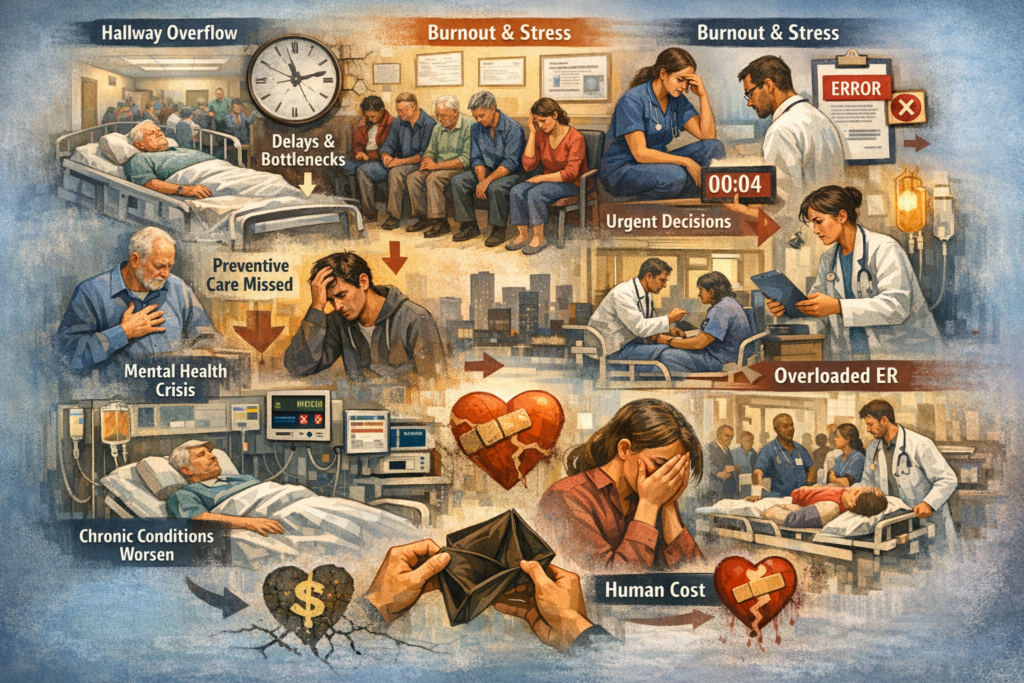
Part 2: When Systems Built for Efficiency Meet Urgency – outline
Purpose of Part 2
To show how systems optimized for efficiency, predictability, and throughput behave when forced into urgent, unpredictable conditions.
This part answers:
What breaks first when urgency enters a system not designed for it?
I. Efficiency assumes predictability
-
Scheduling, throughput, and optimization rely on forecasts
-
Most healthcare infrastructure is designed around averages
-
Urgency introduces spikes, not curves
Key idea: Efficient systems are brittle under stress.
II. Bottlenecks appear immediately
-
Staffing is fixed in the short term
-
Physical space cannot expand on demand
-
Specialized resources are finite
Under urgency, small constraints cascade.
III. Workarounds become the system
-
Hallway beds
-
Boarding patients
-
Delayed transfers
-
Informal prioritization
What starts as exception quietly becomes routine.
IV. The hidden costs of “making it work”
-
Burnout replaces sustainability
-
Errors rise under compression
-
Moral injury accumulates
The system functions — but at a human price.
V. Urgency exposes upstream failures
-
Preventive care that didn’t happen
-
Conditions unmanaged until crisis
-
Mental health needs with nowhere else to go
Urgent care absorbs what the rest of the system defers.
VI. The illusion of control
-
Metrics suggest management
-
Dashboards replace understanding
-
Throughput becomes the proxy for success
Urgency is managed, not resolved.
VII. What this part deliberately avoids
-
Funding formulas
-
Payment models
-
Assigning blame
-
Proposing fixes
The focus stays on behavior under pressure.

Comments are Disabled