For years, America’s healthcare debates have circled the same familiar arguments: cost, access, innovation, choice. Each side insists the problem is just one adjustment away from being solved — a different payer mix, a different incentive, a different set of rules.
What rarely gets said out loud is simpler and more uncomfortable:
The system no longer matches the reality it is supposed to serve.
This isn’t a failure of compassion, and it isn’t a failure of effort. It is a failure of structure — a system built on assumptions that no longer hold.
A system optimized for avoidance
Modern healthcare is not primarily organized around outcomes. It is organized around risk avoidance.
Risk is shifted:
From insurers to providers
From providers to patients
From institutions to families
From policy to paperwork
Each step is rational in isolation. Each makes sense on a spreadsheet. Together, they create a system where no one is fully responsible for the whole.
The result is not efficiency. It is fragmentation.
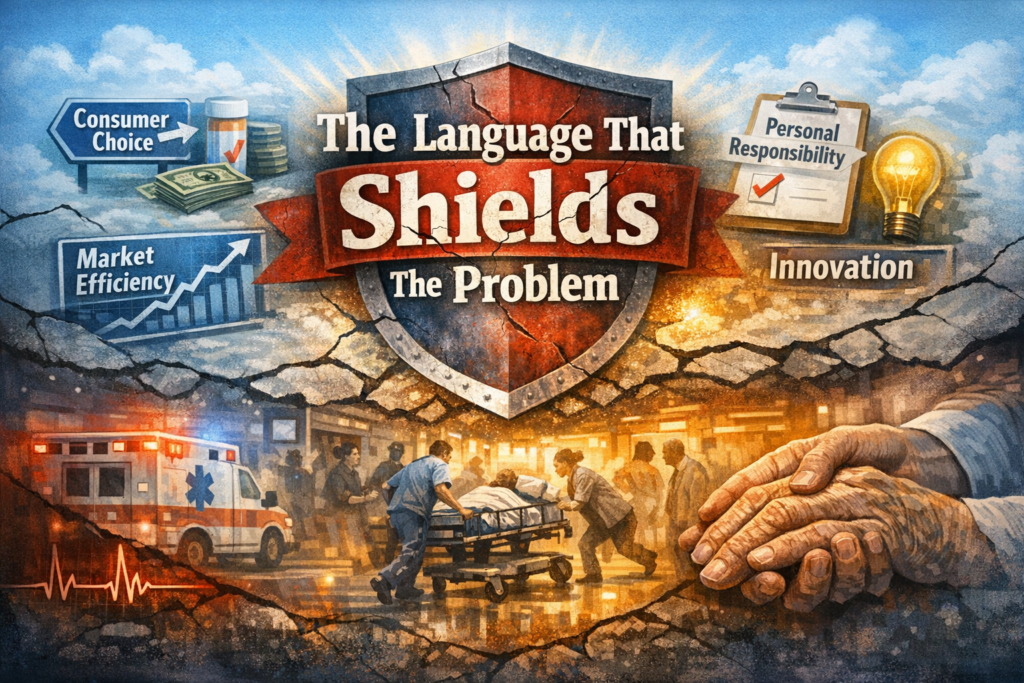
The language that shields the problem
We rely heavily on comforting language:
“Consumer choice”
“Market efficiency”
“Personal responsibility”
“Innovation”
These phrases are not lies, but they are incomplete. They work well for elective care, predictable conditions, and people with time, money, and literacy to navigate complexity.
They break down when care becomes urgent, unavoidable, or human.
When health stops being optional, the language stops working.
Who carries the weight now
As responsibility diffuses upward, the burden concentrates downward.
Patients manage billing disputes while recovering.
Families coordinate care without training.
Providers burn out navigating systems designed to protect revenue, not judgment.
Rural hospitals absorb losses with no margin for error.
None of this shows up cleanly in political talking points. It shows up in closures, staffing shortages, delayed care, and quiet financial collapse.
The place the system can’t avoid
There is one place where all of these distortions converge — where care cannot be deferred, denied, or negotiated in advance.
The system depends on it.
The system resents it.
And the system refuses to fully account for it.
This is not because it is inefficient, but because it is honest.
It is where every upstream decision eventually lands.
The political stalemate
Healthcare dysfunction has become politically useful.
One side uses it to fundraise.
The other uses it to posture.
Both promise fixes that stop short of structural change.
Real reform would force tradeoffs.
Tradeoffs create accountability.
Accountability threatens narratives.
So the system limps forward, managed rather than repaired.
The fork in the road
We are now past the point where incremental adjustments can hide the mismatch.
We can continue to:
Shift costs
Narrow networks
Add complexity
Manage decline
Or we can acknowledge the truth that has been visible for years:
A healthcare system that pretends everything is a market, everything is optional, and responsibility can always be deferred will eventually fail at the moments that matter most.
This series is not about choosing sides. It is about deciding whether we are willing to stop pretending.


Comments are Disabled