
Seeking the Truth as opposed to Affirmation
On
- Commentary, Politics


/
RSS Feed
In an age of rampant misinformation, understanding the distinction between genuine fact-checking and merely seeking evidence to support a preconceived notion is crucial. While both involve reviewing information, their fundamental goals and methodologies are worlds apart. Actual fact-checking is a process of impartial verification, while searching for supporting documentation is often an exercise in confirmation bias.
The Goal: Truth vs. Affirmation
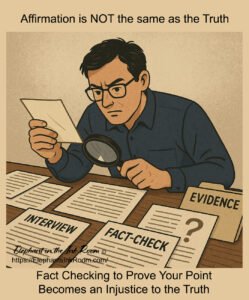
The primary objective of fact-checking is to determine the accuracy of a claim, regardless of the outcome. A fact-checker starts with a question: “Is this statement true?” They then embark on a comprehensive and unbiased investigation, gathering all relevant evidence, both for and against the claim. The ultimate goal is to present a verified and accurate picture to the public.
Conversely, the principal aim of searching for supporting documentation is to find evidence that validates a pre-existing belief or argument. The starting point is not a question, but an assertion. The individual is not seeking to test the validity of their claim, but rather to find proof that they are correct.
The Process: Investigation vs. Advocacy
The methodologies employed by fact-checkers and those simply seeking support differ significantly.
Fact-checking is a meticulous and often lengthy process that includes:
-
Identifying verifiable claims: Not all statements can be fact-checked. Opinions, for instance, are not subject to this process.
-
Gathering diverse evidence: Fact-checkers consult a wide array of sources, including primary documents, expert opinions, and data from reputable institutions. They actively look for conflicting information to ensure a well-rounded view.
-
Evaluating sources: A critical component of fact-checking is assessing the credibility and potential bias of each source of information.
-
Synthesizing and concluding: After weighing all the evidence, a conclusion is drawn about the veracity of the claim, often with a nuanced explanation of the findings.
Searching for supporting documentation, on the other hand, is often characterized by:
-
Cherry-picking data: Individuals may selectively choose evidence that aligns with their views while ignoring contradictory information.
-
Ignoring source credibility: The reliability of a source may be overlooked if the information it provides is favorable to the individual’s argument.
-
Avoiding contradictory evidence: There is no active effort to find information that might challenge the initial belief.

Comments are Disabled