There’s a feeling in the air right now—hard to pin down, but hard to ignore.
Something doesn’t sit right.
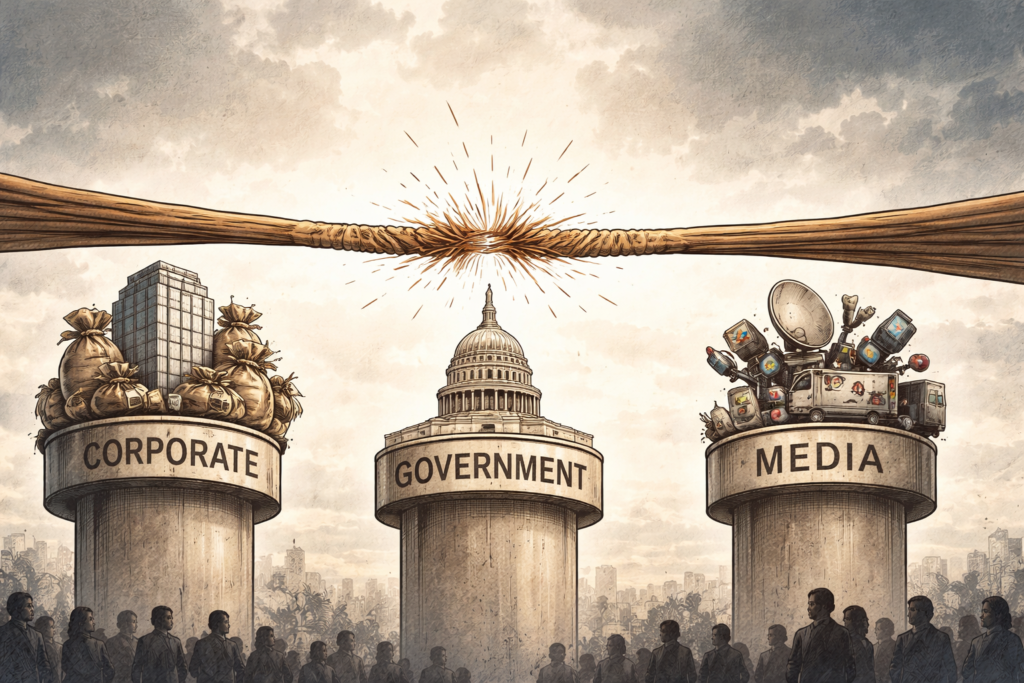
It shows up in different ways depending on who you talk to. Some point to politicians who seem more interested in staying in power than serving the public. Others see corporations with growing influence over policy. Many feel the media environment—on all sides—has become less about informing and more about shaping perception.
Individually, each of these concerns can be debated.
But taken together, they form a pattern.
Not a conspiracy. Not a master plan. A pattern.
And patterns matter.
Over time, power—whether political, financial, or cultural—has a tendency to concentrate. It’s not new. It’s not uniquely American. It’s human nature working through systems that reward influence, access, and control.
When those systems function well, they balance competing interests. When they don’t, the balance begins to tilt.
Rules get bent. Oversight weakens. Trust erodes.
Not overnight. Not with a dramatic moment everyone can point to. But slowly, incrementally—just enough that people begin to feel it before they can clearly explain it.
That’s where we are now.
And here’s the part that often gets lost in the noise: when power pushes too far, it rarely ends where it expects.
History is full of examples where those benefiting from a system assume it will continue indefinitely—until it doesn’t. Until the public adapts. Until people start asking harder questions. Until the same tools used to influence begin to be used to push back.
We’re starting to see signs of that pushback today.
Not as a unified movement. Not clean or organized. But as a growing awareness.
People are questioning narratives they once accepted. They’re comparing sources. They’re recognizing when emotion is being used as a lever. They’re less willing to stay neatly inside political lanes that no longer reflect their views.
In short, they’re learning.
That doesn’t make them wolves. It makes them participants again.
And that may be the most important shift of all.
Because the real safeguard in any system isn’t the absence of power—it’s the presence of an engaged public that understands how power works and where it can go wrong.
There will always be those who try to stretch the limits. That’s a constant.
What changes—what always changes—is how far they’re allowed to go.
If there’s a turning point ahead, it won’t come from a single figure or a single event. It will come from something quieter and more durable:
A public that sees a little more clearly than it did before.


Comments are Disabled